
Hedda
Re-lay Race
Hedda
by Tanika Gupta, inspired by Henrik Ibsen’s Hedda Gabler
Orange Tree Productions at the Orange Tree Theatre, Richmond until 22nd November
Review by Eleanor Lewis

Henrik Ibsen’s Hedda Gabler, written in 1891, seems to be having a bit of a moment at present. Earlier this year Matthew Dunster adapted it for modern times with Lilly Allen in the leading role and just last month a spectacularly reimagined film, Hedda, starring Tessa Thompson hit the cinemas.
Ibsen’s original Hedda Gabler, in which a strong, clever woman needs to live life on her own terms, but is trapped within the social constraints of the late nineteenth century does not easily translate into today’s world: unhappily married women these days have options. It does, however, adapt to different issues which writer Tanika Gupta has recognised. This latest Hedda is set in 1948, just after the Partition of India and, being inspired by the life of Merle Oberon, it reflects a different trap, that of having to conceal your racial identity when both your glittering career and your social status depend absolutely on passing for white in a racist world.

Merle Oberon, together with other leading stars of the Hollywood golden age – Vivien Leigh, Boris Karloff to name but two – who had partially Asian origins were obliged to conceal their roots to comply with the Hays Code, a form of rule book which stated what could and could not be shown on screen. Amongst many other requirements was one forbidding miscegenation i.e. relationships between the races.

So, in this latest adaptation, retired film star Hedda Gabler lives in Chelsea with her director husband George and her maid Shona. They are visited by producer John Brack; playwright Leonard who has been a flying ace in the recent war and who grew up with Hedda (and therefore knows her secret); Alice, a sweet, unhappily married young women longing to throw in her lot with Leonard; and George’s upright and reliable aunt Julia (Caroline Harker) whose appearances bookend the action, suggesting that things might change or things may very well remain the same. Hedda is beautiful and talented, her profession and everyone around her has assumed she is white, only Leonard and one other know she isn’t.
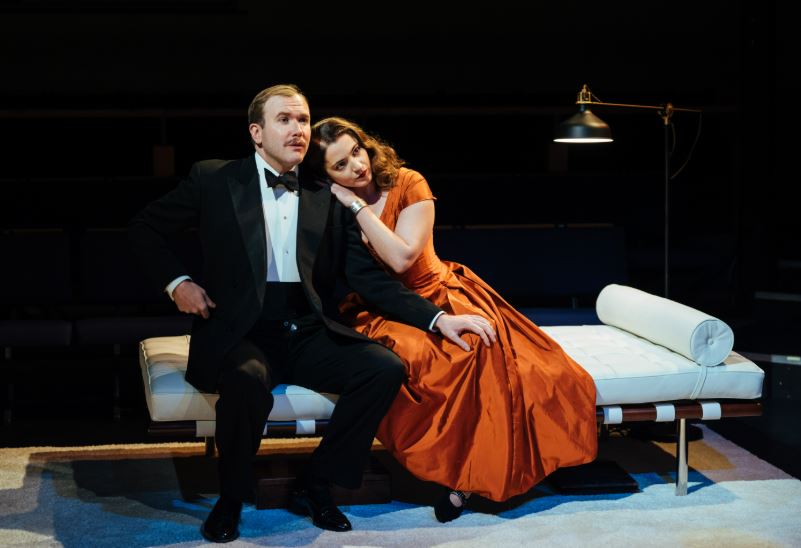
Leonard has written a play based on the struggles of a mixed race woman. George and John think it is exceptional and want to make it into a film. Leonard (played with calculated fragility by Jake Mann) is in thrall to alcohol though, and may easily reveal his inspiration for the work. Hedda must therefore remove this script as an option for anyone. Whilst this version of events takes a little while to fall into place, once there it works well and the ensuing plot fits quite neatly into Ibsen’s original structure. Where the original Hedda struggled with suffocating social misogyny, 1948 Hedda is overwhelmed by the embedded racism within British society (ignoring the thousands of black and brown soldiers who had fought alongside them so recently) which forces her to be what she is not.

Hedda’s maid Shona (a quiet, intimidating performance by Rina Fatania with a razor sharp flash of wit) is a particularly unnerving presence both actually and symbolically, and Pearl Chanda gives Hedda a brooding froideur, and unpredictability which is mesmerising but sufficiently controlled as to make her ultimate, ruthless cruelty still shocking. Hedda’s manipulative and entirely self-centred character remains the same as the original. The other characters provide a vignette of British postwar society: the desperate, well-meaning cheerfulness of Bebe Cave’s thoroughly nice Alice is mixed with the cynicism of Milo Twomey’s predatory producer John Brack, and the deluded but happy George (Joe Bannister). They will all muddle through and eventually progress but there will be casualties on the way. Hedda cannot avoid being one of them.
Simon Kenny’s design, a white carpeted, minimally furnished square is ideal (aside from the awkwardly placed anglepoise lamp). An elegant, three sided frame, gently lit, stands diagonally across the square almost a proscenium arch to emphasise that we are all, to some extent, on show and how difficult that is.
This is a fascinating production in itself but also for the skill with which it has been adapted, it’s an interesting and successful reinterpretation and it’s well worth seeing.
Eleanor Lewis, October 2025
Photography by Helen Murray


 Mark Aspen