
Home
Where the Art Is
Home
by David Storey
Rhinoceros Theatre Company at the Coward Studio, Hampton Hill Theatre until 8th November
Review by Steve Mackrell
Where are we? And what’s happening? That’s the confusing conundrum facing the audience at the start of David Storey’s absorbing 1970 play Home, presented by the adventurous Rhinoceros Theatre Company at the Hampton Hill Theatre.
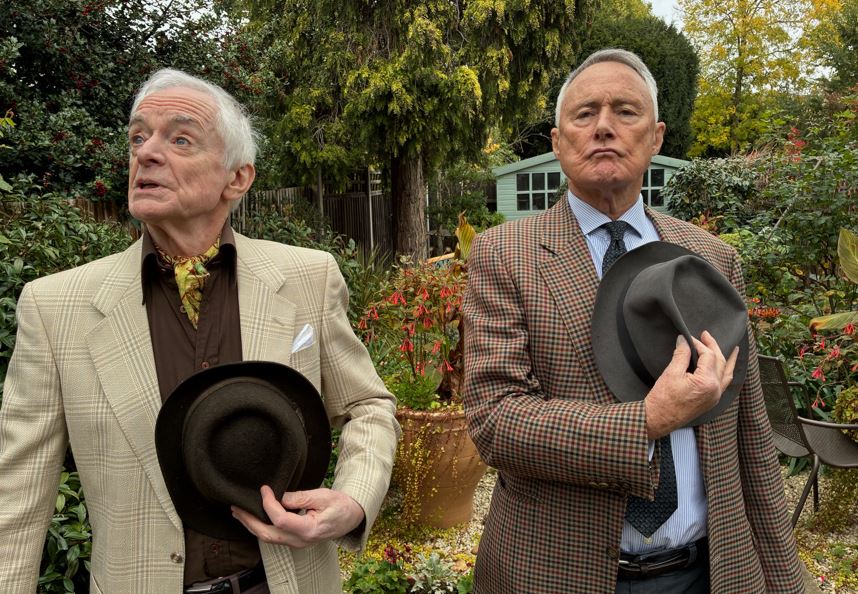
To begin with, a simple garden set with a white metal table and two matching chairs, aided by back projection of moving clouds. Enter two trilby-hatted gentlemen, elderly and elegant, who engage in casual conversation. Seemingly just a couple of old men with time on their hands, idly passing the time of day with small talk, of this and that, the weather, their work, their wives, their schooldays, their memories and dreams. Articulate and comfortable and yet, something is not quite right. Perhaps we’re in Samuel Beckett or Harold Pinter territory, complete with abstract musings, ambiguous narratives and obligatory long pauses.
Director Fiona Smith keeps us guessing as the play slowly begins to reveal its secrets. We start to understand the background of these two slightly eccentric men played, with captivating credibility by Robin Legard, as Harry, the fussy and fastidious Daily Mail reader, and Nigel Andrews, as the cravat wearing, cane carrying dapper Jack. The fun of watching their back-and-forth conversation is enhanced by the chemistry between the two actors, complementing each other like some theatrical double-act. Indeed, judging by Nigel Andrews’ lugubrious facial expressions, could their characters even be those of retired thespians? Alas no, as we learn that Harry had to swop a youthful dream of being a dancer to become a less-fanciful heating engineer, while Jack previously worked in food wholesale and now appears to recount an inexhaustible supply of stories about accident-prone friends.
There’s a lot of good humour, certainly at the beginning, and Fiona Smith’s direction ensures the dialogue can linger, giving it plenty of time to be digested. The diction of both Nigel Andrews and Robin Legard is crystal clear which adds to our enjoyment of their rambling chatter, as do their physical reactions and immaculate comic timing. But under the skin of this play there is a lot more going on than the simple exchange of anecdotes. Perhaps these are not two lifelong friends wallowing in their memories, which begs the question — what exactly is their relationship? And exactly what garden are they in? A public space or a normal domestic garden at home? Occasional clues are dropped as to their whereabouts, in what can only be called the art of the slow reveal. The answer eventually becomes clearer with the lively entrance of the two female characters, Kathleen and Marjorie, which heralds a significant change in pace and mood. Kathleen’s remark, that “they” took away her lace-up shoes in case she hanged herself, gives further confirmation to our suspicions. Yes, the setting for this home appears to be in the garden of a mental institution.
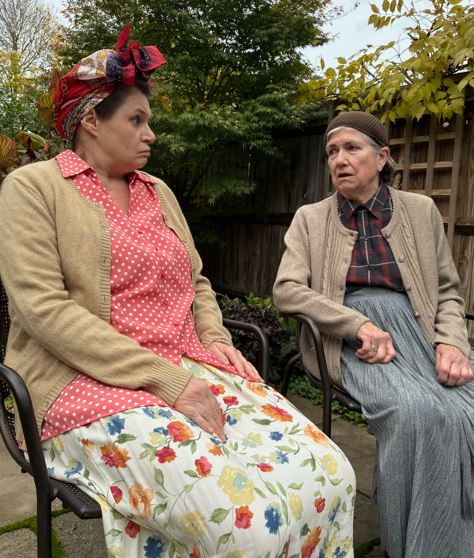
The introduction of two new contrasting patients provides an additional dimension to the play. Denise Rocard’s Kathleen is a sheer comic delight. Resplendent in a knotted head scarf and her frequently-flashed long white bloomers, she excels as a larger-than-life McGill seaside postcard caricature, excelling in her “Cor Blimey” mannerisms. In contrast, Fran Billington’s Marjorie is much more sedate and modest, with a clear no-nonsense approach, despite her tendency to open an umbrella while not raining. Two enjoyable performances providing much needed balance to the male characters.

The fifth member of the cast is Scott Tilley’s character Alfred who occasionally flits on and off the set. Dressed in an ill-fitting cardigan and khaki shorts, his main focus appears to be collecting garden furniture, then holding them aloft. An interesting and nicely observed cameo role and, with indications of having a lobotomy, perhaps a touching symbol of the perils of brain damage and institutionalisation.
As the play progresses the gentle humour starts to slowly spill over into contrasting sadness and despair. The definitive moment for this transition is probably the touching scene in the conversation between Jack and Kathleen, and their expression of the poignant hopelessness of the situation, “say what you like about this place, it’s not like home.” As an audience we have also witnessed the subtle development in character with, for example, Nigel Andrew’s Jack, played initially with a quiet and confident demeanour, morphing into a deeper sadness and a longing for the past. Or Robin Legard’s Harry, descending into inarticulate despair. Although we never discover the reasons for their arrival in this closed community, we can at least feel the anguish of their mental scars, and their pain of entering an institutional graveyard, discarded from a damaged society. Simply superb performances all around.
David Storey’s script, written some 55 years ago, retains its freshness apart from a short scene bemoaning the decline of the British Empire, a conversation more suited to the elderly of the 1970’s rather than today. However, this remains powerful theatre still asking many difficult and relevant questions. Can any institution, even as well-intentioned as many of our care homes or hospices, ever replace the security and familiarity of a safe domestic home? If you’re in need of cerebral stimulation, do catch this revival of David Storey’s classic play, if you possibly can.
Steve Mackrell, November 2025
Photography by Patrick Troughton


 Mark Aspen
What a lovely review, and so well deserved! I caught last night’s show and thoroughly enjoyed it.
I’m really glad to see Denise Rocard getting the spotlight here — she was fantastic as Kathleen. She had us laughing one minute and completely still the next, showing such a raw, vulnerable side. That switch from bright and bubbly to something much deeper was amazing to watch. A real standout in a brilliant show.
I also thought the staging was spot on. Inimate, simple and very believable, which drew us right into the world of the characters without any fuss.
I wasn’t expecting the play to hit home quite so much with today’s themes either. All those nods to the “good old days”, Rule Britannia, class divides, social mobility, families coming apart, and people struggling with identity, belonging and their own mental wellbeing… it all felt surprisingly relevant to the Britain we’re living in now.
It stayed with me long after I left the theatre. Which is quite normal for everything I am lucky to see at the Hampton Hill Theatre.