
Lightning Beneath the Waves
Cable Ties
Lightning Beneath the Waves
by David Hovatter and Company
Questors Theatre at the Questors Studio, Ealing, until 15th November
Review by Andrew Lawston
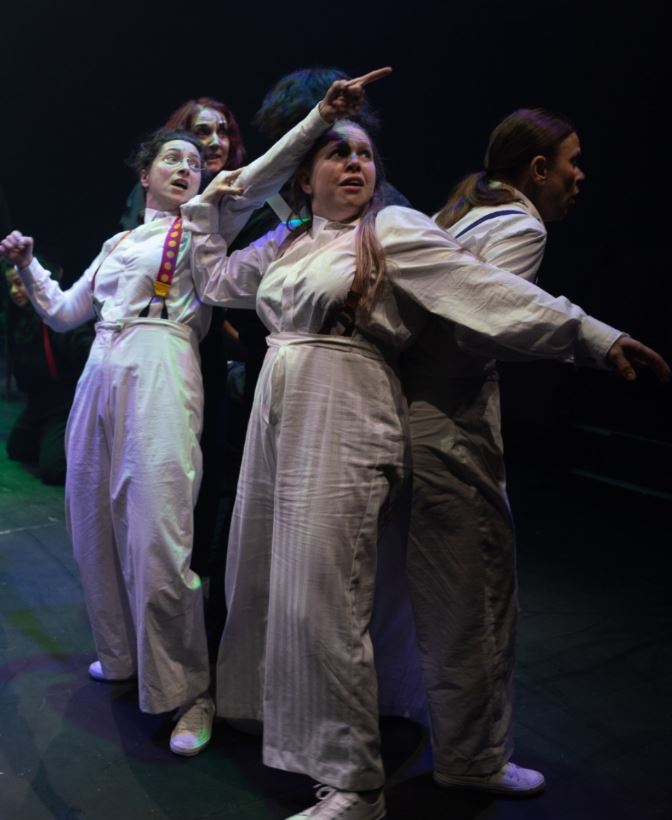
From transport to communications, advances in technology have made our world feel ever smaller, at the same time as highlighting the huge distances between us. In the middle of the 19th century, the telegraph enabled almost instantaneous communications between Europe and America – but only after a mammoth effort to lay tonnes of copper cable under several thousand miles of the Atlantic Ocean.
Following A Real Race Around the World, David Hovatter and Company return to the Studio at The Questor’s Theatre with another chronicle of 19th century achievement in Lightning Beneath the Waves, bringing out the human story behind a global undertaking.
This devised performance follows the initially doomed efforts of Frederick Gisbourne and Cyrus Field to lay the first Trans-Atlantic cable, before switching focus to Isambard Kingdom Brunel’s SS Great Eastern, the steamer that finally accomplished the task in 1867.
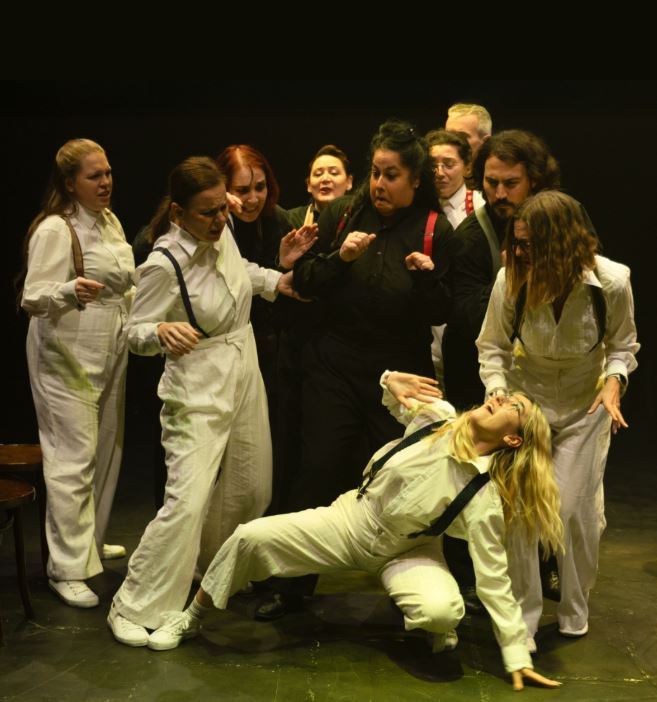
Hollywood would struggle to bring the tale of this global adventure to the screen even with a budget of millions. But against a bare black set and with just a few wooden chairs and Brunel’s magnificent stovepipe hat, the ensemble company tell the story through physical theatre, music and narration.
Falko’s choreographed movement is evocative throughout the performance, often depicting the back-breaking manual labour required for the feat of engineering that linked Europe and America forever. The first act opens with mimed pickaxes, breaking ground as American workers lay cable across Newfoundland, while the second act opens with mimed sledgehammers as British workers break up the SS Great Eastern on the banks of the Wirral. (“Why won’t you just break?” asks one of the workers in despair, completely charmingly).

Marcus Boel gives a committed performance as British inventor Frederick Gisbourne. Initially attempting to lay a cable between Newfoundland (as the closest point between America and Britain) and New York, to shorten communications between the continents by days, his efforts are thwarted by lack of funds. Pleading with his unpaid and disgruntled workers for a week’s grace, Gisbourne travels to New York, close to bankruptcy, to seek investment from Craig Nightingale’s imposing Cyrus Field. Field declares his ambition to reduce the lag in communication not by days, but by weeks, by laying an underwater cable across the Atlantic.
Investors are initially excited at the prospect, and work begins, only to face numerous setbacks. The first act builds to jubilation when the first cable is successfully completed in 1858. Bells ring out, parades march through city centres, and Tiffany even begins selling chunks of twisted copper cable as jewellery. All this detail is conveyed by the ensemble with huge enthusiasm. But there is a sting in the tail, and as a result, the second half shifts focus to the United Kingdom, and the shipyards.
Jerome Joseph Kennedy makes a dramatic entrance as Isambard Kingdom Brunel, and the SS Great Eastern, Brunel’s “Great Babe” and the world’s largest ship at that time, is refitted from passenger ship to carry the required tons of cable.

The ensemble convey the ship’s difficult launch into the Thames, with Ioana Feneru standing out for her committed “ship-pushing” performance, and they then perform the incident on her maiden voyage when a steam explosion destroyed one of the ship’s funnels and killed five crewmen. This section is particularly grisly and the cast pull no punches in their graphic description and performance of the injuries sustained and the passengers’ reactions to the catastrophe.
The ensemble of Mari Anton, Claire Campbell, Sunita Chana, Ania Choroszczynska, Ioana Feneru, Kate Kasampali, Falko, and Ellen Softley do great work throughout the show, whether narrating, singing, or through their movement.
The script is wordy, and often very poetic, and a few first night jitters occasionally get the better of the cast when relaying the more technical details of Trans-Atlantic cable-laying and the ships required to carry it out, but for the most part the performance is slick and tightly directed by Hovatter, segueing seamlessly between spoken sections, movement, and music.
The on-stage band comprises Robyn Backhouse, Margarida Bartilotti, Gareth Bevan, Niall Corbett and Chloe Park, and they deliver a huge sound that fills the studio and challenges the actors to match them for volume. The songs all have great energy and choreography, and further elevate this unlikely tale into an evening of great theatrical entertainment.
Andrew Lawston, November 2025
Photography by Robert Vass

 Mark Aspen
congratulations Claire and cast what a great achievement xxx