
Così Fan Tutte
All the Fun of the Fair
Così Fan Tutte
by Wolfgang Amadeus Mozart, libretto by Lorenzo da Ponte
English National Opera at the London Coliseum until 21st February
Review by Patrick Shorrock
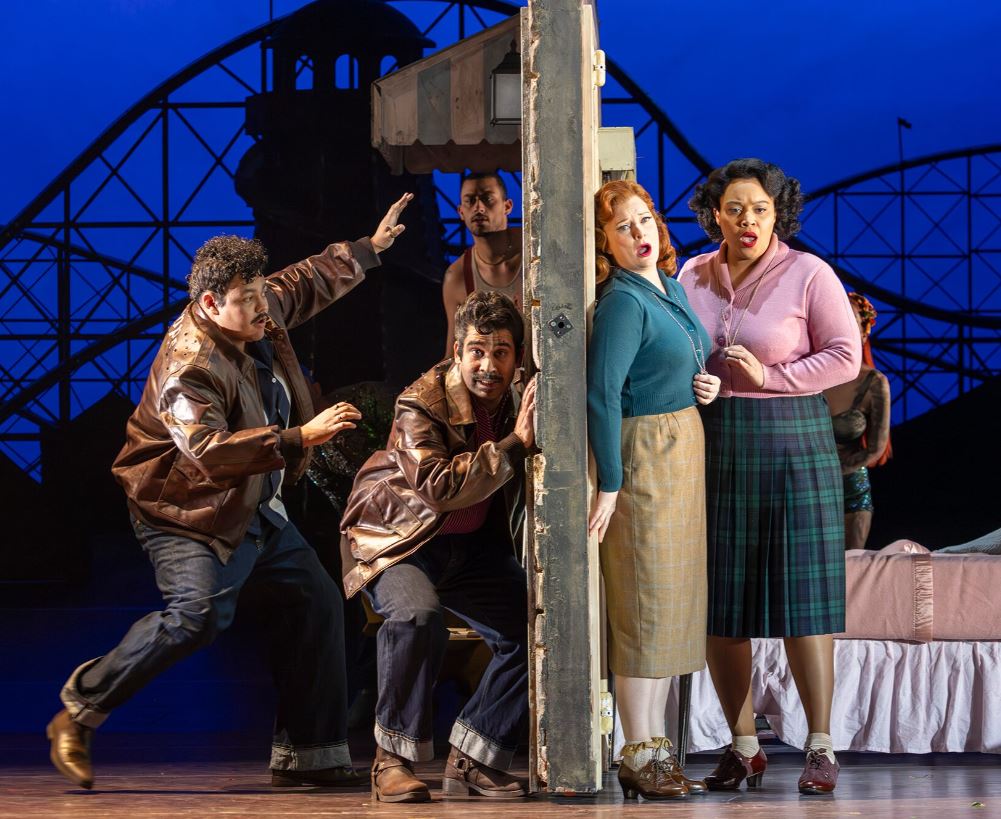
Just how hilarious an opera Così Fan Tutte is supposed to be remains an open question. Two men attempt to seduce one another’s lovers for a bet, because they are convinced of their faithfulness, and get a rude awakening from their romantic illusions – or perhaps, more accurately, a taste of their own medicine. This sounds like a recipe for something witty, ironic, and funny, but the music is so intense and so magnificent that it never quite feels like a joke, even in Act One when everyone is either pretending or bigging up their emotions for effect.
Previous generations rejected the piece as immoral because the lovers experiment with other people; or as an affront to the romantic spirit because everyone goes back to their original partners at the end. Nowadays, there are concerns about the extent to which it might be sexist: whilst the men in it certainly are, it remains much more ambiguous whether the opera itself is. The men are excessive in both their idealising and denigration of their women and have no self-awareness as they collude in the destruction of their own illusions, oblivious that they are applying a double standard and are just as unfaithful as the women whose loyalty they discover is not absolute. These days, there seems something quite healthy and sensible about the 18th Century view that you can’t completely trust anyone because everyone is fallible and needs a bit of forgiveness.
Phelim McDermott’ production and Tom Pye’s atmospheric designs set in a Coney Island fairground fluently address these ambiguities. A skills ensemble of circus performers – that includes fire-eating acrobats and sword swallowers from McDermott’s company Improbable, are overseen by Don Alfonso, the proposer of the bet, and provide plenty of stage business. There is something sinister as well as beautiful about this fairground location, a holiday pleasure garden that suggests that norms and inhibitions can be temporarily abandoned, as well as hints that there may be penalties for doing so.
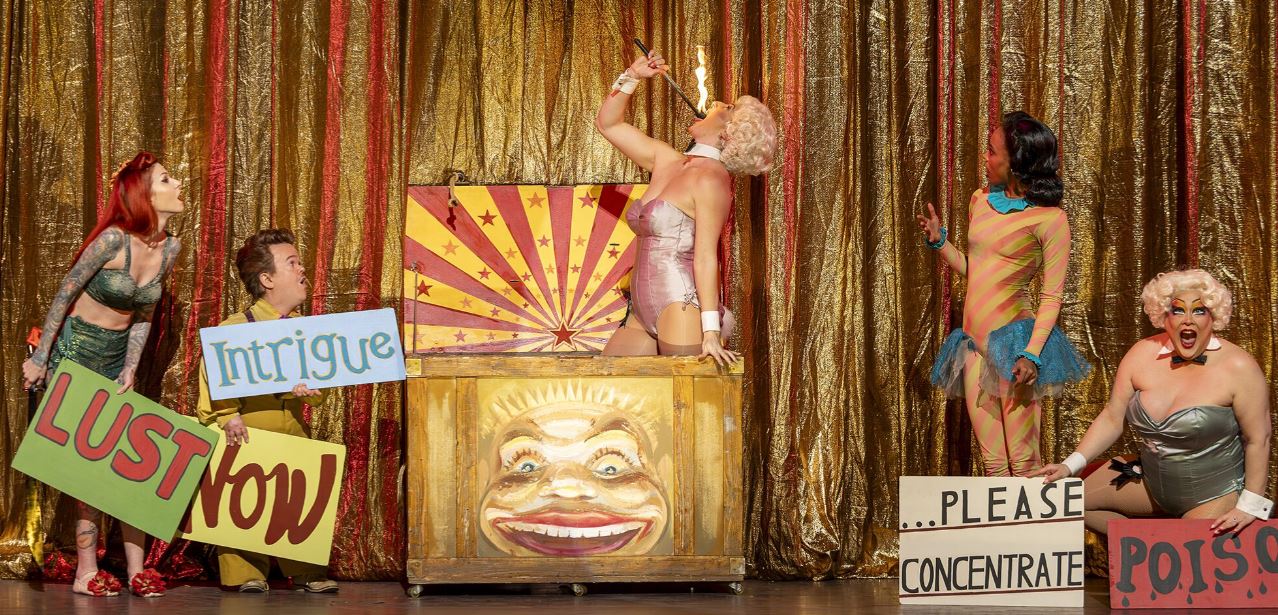
There are many brilliantly funny gags which I am not going to spoil by revealing here. But McDermott knows exactly when to stop and let the emotions and the music register. Jeremy Sams’s excellent translation elicits spontaneous guffaws for its wit – the joys of performing an opera in English! – although it carefully refers to human nature rather than women. The name of the opera, projected on the stage curtain, is amended in Act Two to tutti rather than tutte (all encompassing rather than just feminine) and Sams retains the opera’s title rather than attempting a translation from the Italian. (In this version the men adopt the names Guiseppe and Luigi and don leather jackets and moustaches as disguises.) Sams retains the references to Diana, even though these days it is more likely to suggest a former Princess of Wales rather than a Greek goddess. The only thing that doesn’t quite fit is the references to soldiers when the male characters are very much naval rather than military.
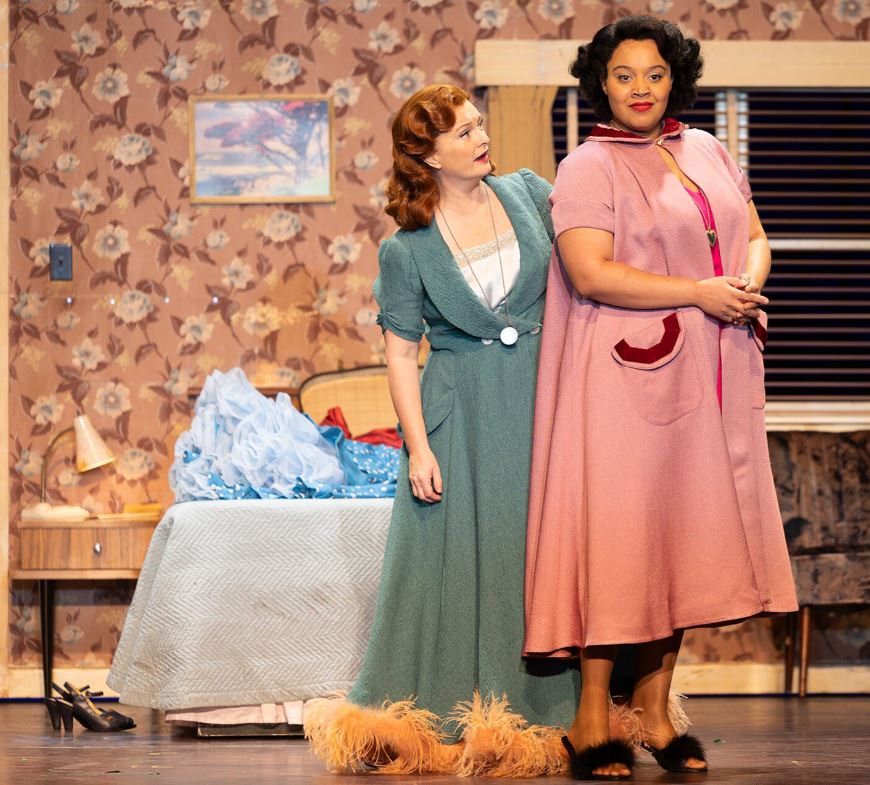
It was initially disappointing to hear that Lucy Crowe was not singing because of sickness, but this enabled the splendid Madeline Boreham to make a wonderfully confident debut as Fiordiligi. ENO still carries the ethos of an ensemble company in its DNA even if these days many of the singers seem to be imported. This shows the glories of their Harewood Artists— ENO founded in 1998 that enables ENO to provide proper cover.
Boreham has a splendid voice that effortlessly fills this huge house with gloriously even tone. Come Scoglio holds no terrors for her, and she visibly relishes that aria’s challenging intervals, even though most sopranos are inclined to approach them with understandable caution. She is a talented actor as well as a singer and fits into this cast like a glove. Anyone would think she had been performing with them for some time. I’m really keen to see her again. As the man who told us that Lucy Crowe would not be signing told us with visible pride, “Madeline is scheduled to sing Fiordiligi at Holland Park this summer, but you lucky folks get to hear her first.” He wasn’t exaggerating.
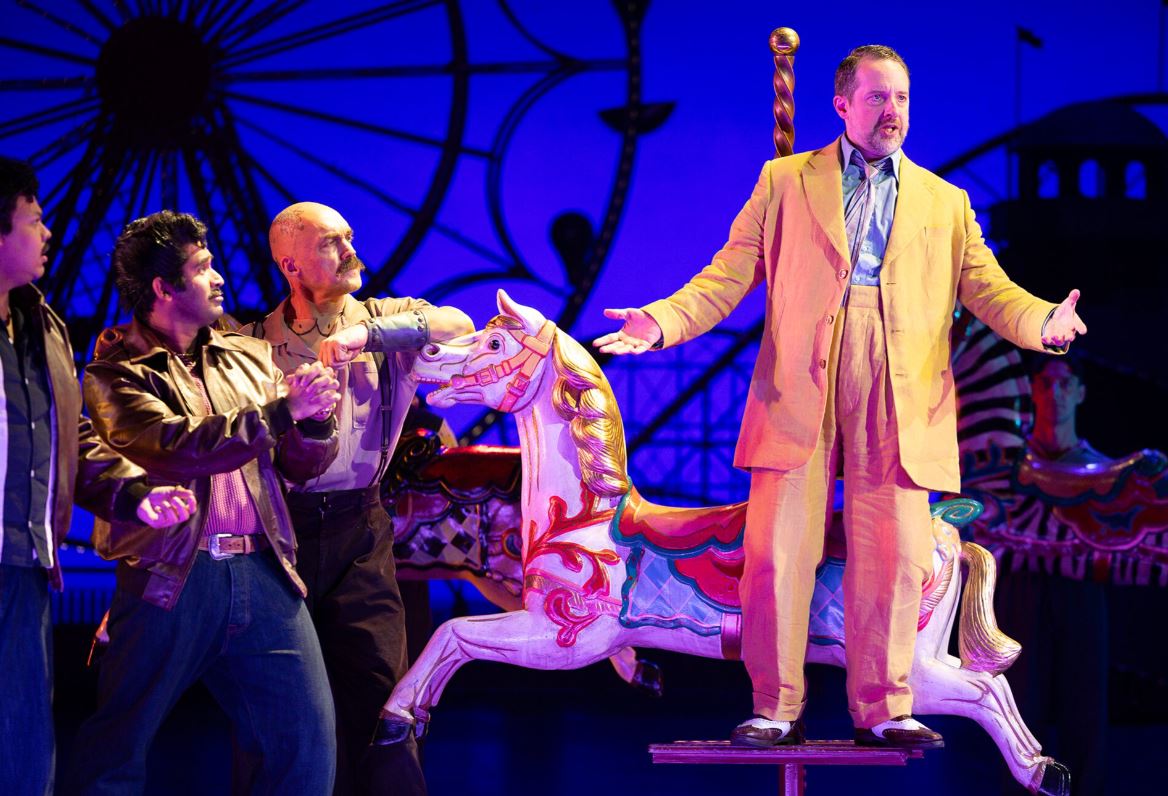
There is a fine cast all round. Darwin Prakash makes Guglielmo sound easy with a warm flexible baritone that never needed to force itself. Ailish Tynan is a winning, stylish Despina in a part that can be annoying if played in an exaggerated manner. Taylor Raven is a splendid Dorabella whose slightly darker tones added pleasing variety without spoiling the overall blend. Joshua Blue is not the most honeyed of Ferrandos in a part that unreasonably requires a uniformly beautiful voice that never tires or tightens, but is never less than serviceable and generally considerably more than that. Andrew Foster-Williams was a suitably sinister master of ceremonies as Don Alfonso, even if his voice is perhaps not quite big enough for this huge space.
Conductor Dinis Sousa had an unobtrusive grip on the score which allows Mozart’s music to dance, and generates a natural and exhilarating momentum for the finales. This is a brilliant show: funny, beautiful, inventive, heartbreaking, and very human, with some superb singing. What really distinguishes it is the superb playing and singing in the many ensembles: everyone very much their own personality and continuously inhabiting their roles whilst fitting together in a miraculous harmony.
Patrick Shorrock, February 2026
Photography by James Glossop

 Mark Aspen