
I’m Sorry, Prime Minister
Wit’s End
I’m Sorry, Prime Minister
by Jonathan Lynn
Barn Theatre Production at the Apollo Theatre, West End until 9th May, then on tour until 18th July
Review by Mark Aspen
Arriving rain-soaked, in tourist-trap seedy Shaftesbury Avenue, via disrupted rail and tube journeys, just in time for curtain-up, might seem not to create the right atmosphere to see a much-hyped comedy. Yet somehow, it is just right for I’m Sorry, Prime Minister, a pertinent caricature of what is outside the theatre, of all that is wrong with present day Britain. Laughter is the panacea. It’s the banana skin effect, guilty laughter gleaned from vicarious pain.
The much-loved Yes, Prime Minister TV series of the nineteen-eighties is given a new shot-in the-arm by its co-creator, Jonathan Lynn, now writing solo (the late Antony Jay died a decade ago), bringing its two priceless main protagonists back from retirement.
The two characters find themselves in a world far more treacherous than twentieth century political government, circumnavigating the not-so brave new world of culture wars and identity politics.
Ex-Prime Minister Jim Hacker, now ennobled as Lord Hacker, but in truth relegated to half-forgotten history, has bank-rolled his own Oxford foundation, Hacker College, of which he is Master. He still has his marbles, but some are slowly rolling away. In spite of his assertion, “I’m not dead, I’m in the house of Lords”, his senescence is asterisked by his dishevelled state, his reluctantly admitted micturition mishaps, and his malfunctioning flies.
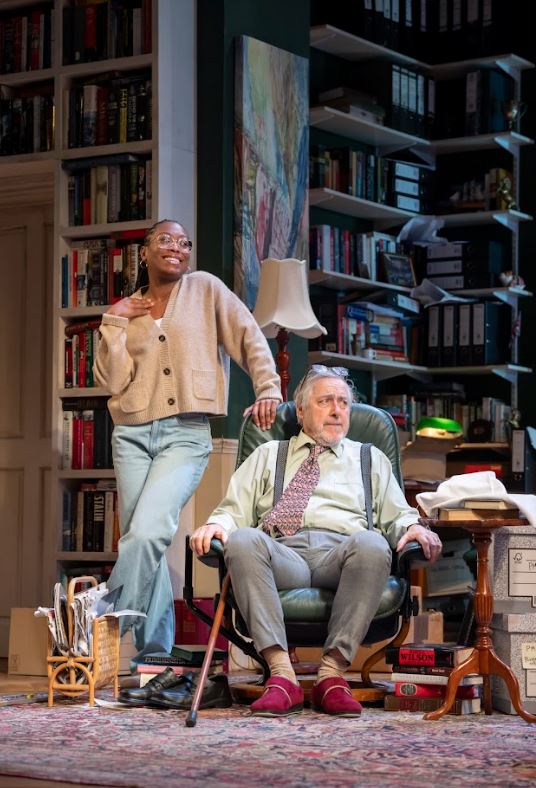
A panorama of his grandiose period Master’s lodgings, designer Lee Newby has made the set an allegory of Hacker’s present existence. He tells us, “organising stuff has never been my forté”, witness cluttered piles of past paraphernalia, busts, books and boxes. Hacker nurtures delusions of self-importance, yet is surrounded by archive files still in their packaging and, poignantly, piles of his unsold memoirs. Through the pair of large six-over-six sash windows, in the middle ground in front of views of Oxford, Mark Henderson’s lighting design not only animates the inclement weather outside, but cleverly uses it as a metaphor scene by scene of the unfolding situation, symbolised by the rain, sleet then snow.
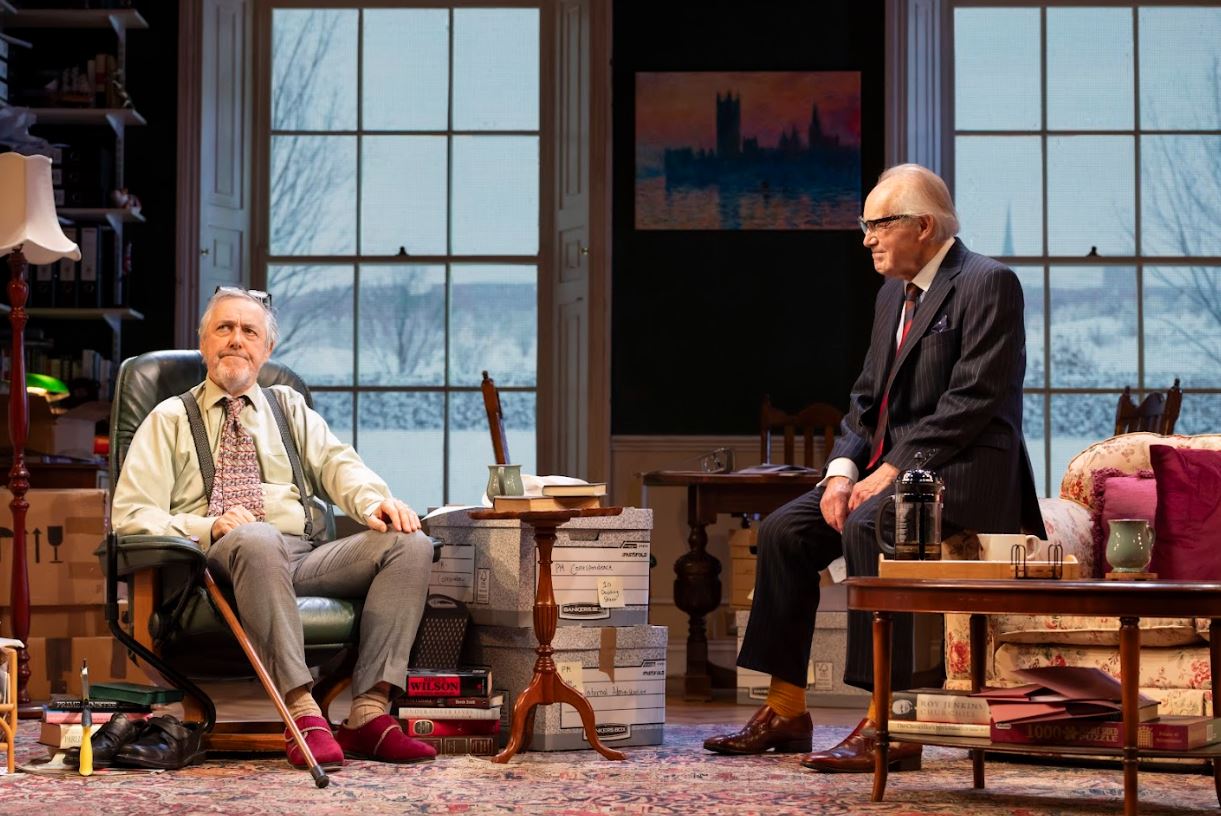
This back-story is revealed by the rather clunky device of his trying to employ a live-in carer, whoops, “care worker” (in the words of the laboured running gag), the irritatingly insubordinate Sophie. Against the foil of Hacker’s markedly non-PC customary life, she is the warning beacon of virtue signalling. However, as she soon elicits, he has already fallen foul of cancel culture, and he imminently faces ousting from his heretofore “lifetime” tenure as Master of the Oxford college he founded and endowed.
Whom can Hacker turn to as an advocate of his cause? After telephoning his first choice, and being reminded by the widow that he had attended the deceased colleague’s funeral, Hacker bites the bullet and phones his former cabinet secretary Sir Humphrey Appleby. He is doubtful about Humphrey, as he has heard that he is in a “home for the elderly deranged”.
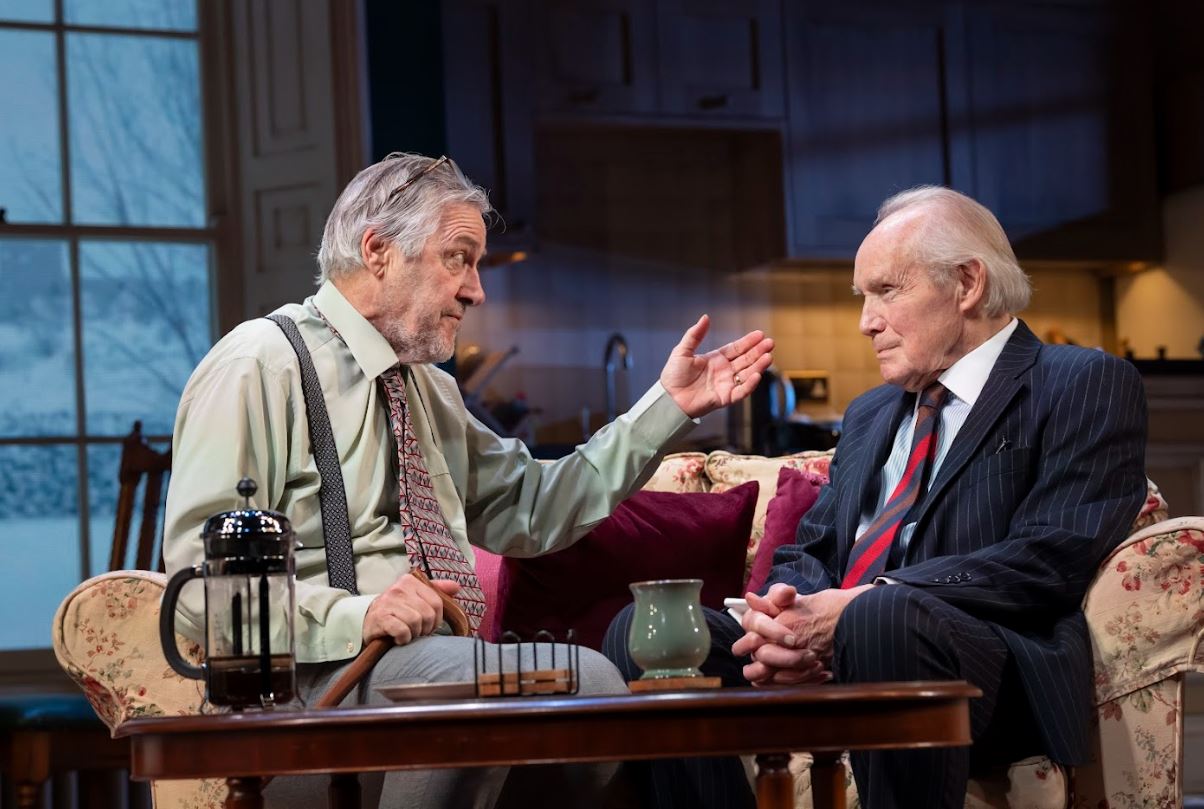
When, in due course, Sir Humphrey comes, he is clearly far from deranged. His rather improbable back-story is that, following concussion as a result of a self-inflicted car accident, he had been scammed into parting with his house and money (under the Inheritance Tax “seven-year rule”) to his scheming daughter-in-law. She had indeed incarcerated him in such a home during his concussed state, and now is obliged to stay there by his state of penury. Humphrey calls her his “evil queen”. In spite of his tribulations, Sir Humphrey is still the obfuscating sharp-witted master of floccinaucinihilipilification.
Hence, the two fallen mighty are catapulted into the alien and hostile world of the age of woke, with its minefields of “inappropriate” language, misgendering, safe spaces and trigger warnings, of de-colonisation and no-platforming. And the banana skin, awaiting them, comes in the form of the presumptuous Sophie. Any perceived slight releases an immediate rebuke, a landmine of current tropes detonated. And of course this pair of old codgers innocently step on every one.
Yet, it is a credit to Jonathan Lynn’s writing, and with Michael Gyngell their co-directing, that what develops is a sort of love-hate triangle, and then, in spite of the sniping, a reluctant common fondness.
Griff Rhys Jones’ Jim Hacker bumbles and blusters, chaffs and whines. Faltering charm occasional shines through, but disappointingly for this Name in comedy, the humour rambles rather than runs. That is not to say that it is absent, as the are flashes of wit, largely political aperçus. His character wavers between syrupy and splenetic, but perhaps this is a symptom of advancing age, a subject that is probably over-explored in the play. It is certainly the human condition that ageing trumps agency, and isolation trumps influence. But Rhys Jones comes across as two-dimensional; there is no emotional journey.
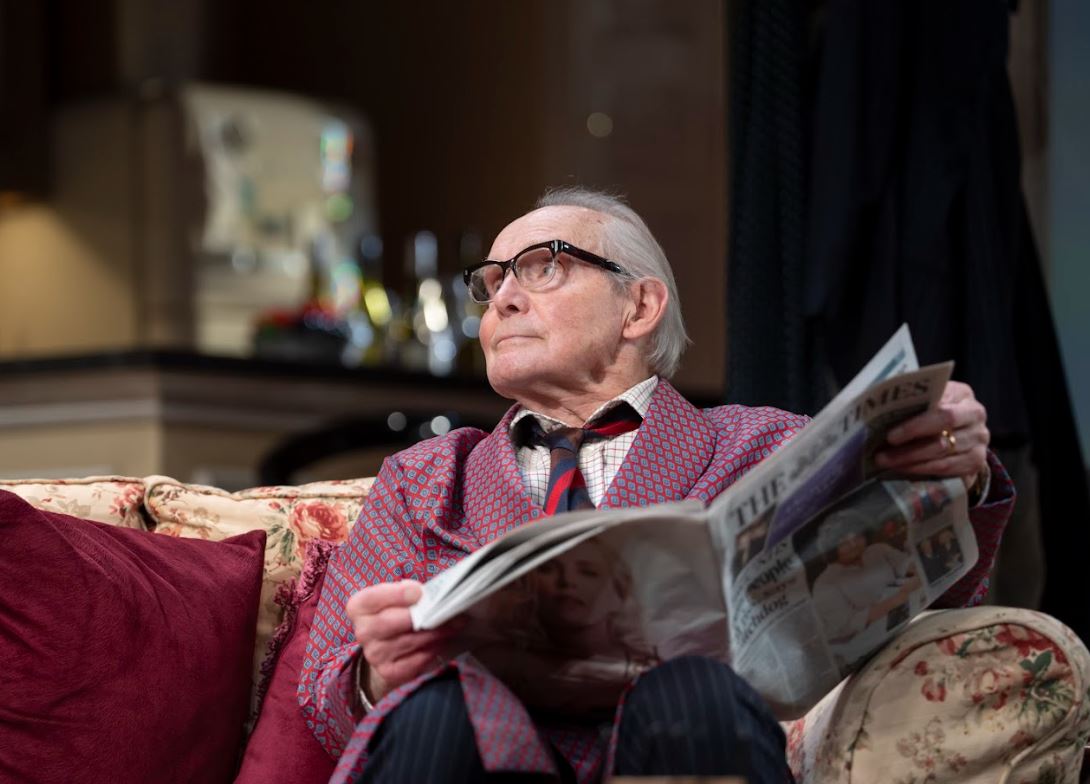
As Sir Humphrey, Clive Francis in contrast has razor sharp delivery and comic timing, pointing up the slippery sesquipedalian former civil-service grandee with the quick-fire repartee and vocal acrobatics in his chain-reaction pater of evasion that draws cheers and applause from the audience. He looks the part too, urbane if slightly faded at the edges, in his bespoke, albeit tired, pinstripes and Wykehamist old-school tie. And there those caustic cutting put-downs, slid under the radar amongst pithy political asides. “I’m glad you think so” is a reply imbued with a plethora of meanings, all laced with condescension.
Francis, now in his eightieth year, also excels in physical theatre with a comic exactitude that makes his visual gags very clever. A leg spasm turns out to be a call on the mobile phone in his trouser pocket, set on vibrate. And there is a consummate subtlety when, on the entrance of Sir David, the convenor of the college trustees, who comes to deliver Hacker’s pre-written resignation letter, Francis spreads his legs across the settee, forcing Sir David to squat ignominiously on the pouffe.
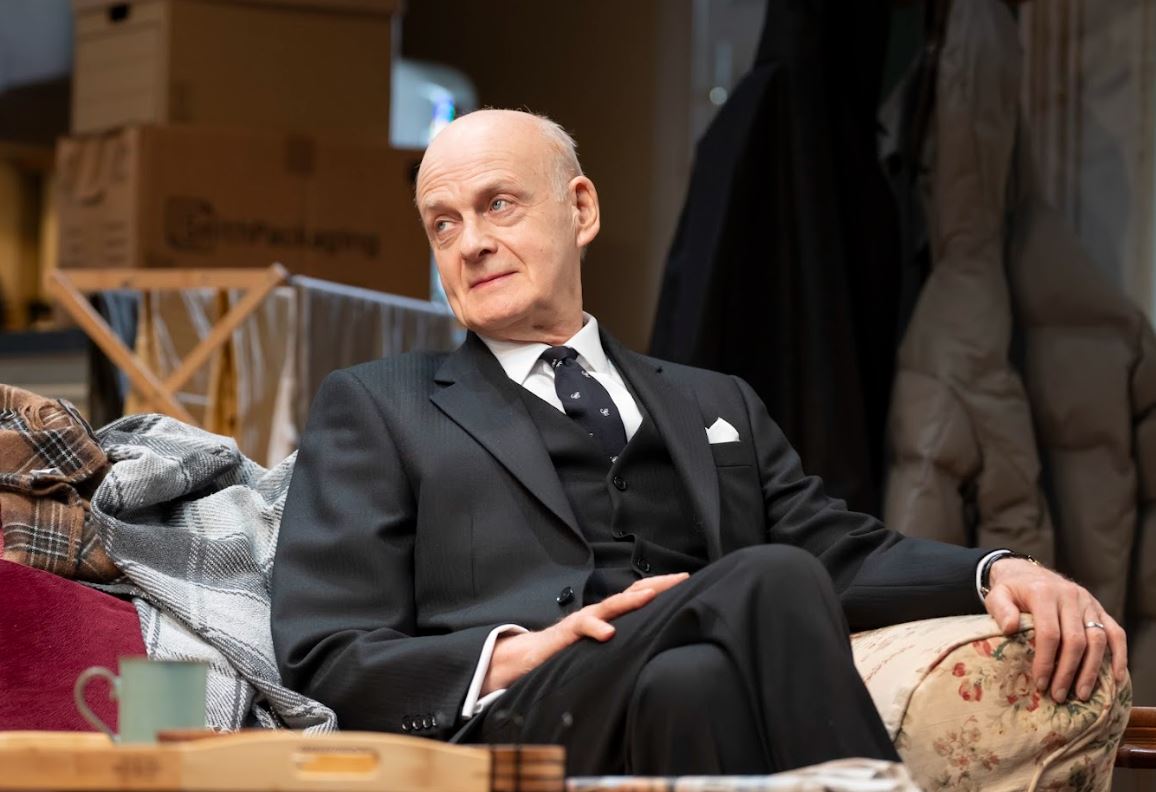
William Chubb is ideal in the part of Sir David, gaunt and cadaverous, yet refined and impeccably dressed. His first appearance is as his alter ego, the Grim Reaper, hooded from the pouring rain, to impart the news of the college authorities decision to appease the student demands that Hacker be removed for his inadvertent transgression. Sir David is the epitome of the modern university administrator, timorous, pliable and venal in the face of the shutting down of debate and open examination. Chubb’s depiction of bland civility and unflappable acceptance hits right to the point, as he vapidly acquiesces to the now order where tokenism triumphs over talent. It is a great pity that he has such an underwritten part.
Sophie “ticks all the boxes”, to use Hacker’s unfortunate choice of words, as she is black, lesbian, and impoverished. It emerges that she is an English literature graduate of Hacker College, which enables her to take some high ground. Moreover, she has some leverage to patronise both men, with the habit, which rankles them a little, of weaponising literary quotes. Hacker is mirrored in Shelley’s Ozymandias. However, her assertion that the Bible sanctions homosexuality (an often misinterpreted passage from the Second Book of Samuel), draws the bemused, or maybe amused, response from Sir Humphrey, “I never knew the Bible was queer literature”. Stephanie Levi-John plays Sophie with a gentle touch and a winning smile. Her Sophie seems more deluded rather than vindictive, although there is a nice touch when Sophie takes Hacker’s chair, a subtle symbol. She is feisty, but never puts the boot in. Her impertinence mellows as the play goes on into an almost maternal affection for both men.
The current mantra is “we mustn’t be judgmental” and, in accordance, I’m Sorry, Prime Minister throws its arguments into both pans of the scales, but on balance one feels that Lynn puts the balance towards the artificial sensitivities of the 21st Century. Without the broad, and wittily effective, comedy, the play would come across as a glib cross between Shakespeare’s King Lear and Neil Simon’s The Odd Couple. Plus, it would add ammunition to the present government’s war on the elderly.
But it doesn’t. I’m Sorry, Prime Minister is plotless, more of a mood piece than a drama. It doesn’t really have a resolution, except in that Sophie suggests that the two once procedural adversaries could move in together. (“Separate bedrooms”, Sir Humphrey hastily adds.) Instead, it is a funny and entertaining evening’s diversion, a bit of nostalgia for the original political comedy and for the simpler days it represented. If you didn’t laugh, you would cry.
Mark Aspen, February 2026
Photography by Johan Persson


 Mark Aspen