
Coitus Interruptus
Sex Cells
by Anna Longaretti
OHADS at The Coward Studio, Hampton Hill Playhouse until 9th November
Review by Eleanor Marsh
Anna Longaretti made her playwriting debut with Sex Cells in 2012. In a previous life Longaretti’s world was TV and the influence of that medium is prevalent throughout the play, which is a series of short vignettes delivered on a single set. The play could easily be an episode from a sitcom.
Set in the call centre of a sex aids business, (sex sells : a nice play on words for a play that speaks a lot about IVF – sex cells) the play is a gentle comedy with some real laugh out loud moments. It explores the hidden depths of emotion of its five characters; four women with very different issues and views and their hapless boss.
The performances are uniformly excellent. Sally Halsey’s matter of fact delivery and excellent comic timing belie the poignancy of her storyline. Her depiction of Lily, top sales person and star baker is pitch perfect. Darren McIlroy is superb as the sadly comedic Mr Causeway. It would be easy for this character to appear as a caricature, but McIlroy’s performance and debut director Joolz Connery’s sensitive direction give him real depth of character.


The remaining three characters are equally well-portrayed. And it is through these women that the complex relationships that women the world over have with sex, relationships and babies are channelled. Tiffany, played by Julie Davis is footloose and fancy free, enjoying her freedom and with no desire to “settle down”. Charlotte Pilbeam’s Sylvie is desperate to have a child, and Dionne King’s Janice is desperate to have some freedom from her large family of under 10’s. All perspectives are here in this one small office.


The play’s set is suitably minimal and functional. It could be any office anywhere, where the main subject of conversation in any given day is the quality of the office coffee. What makes the environment different is the merchandise that is dotted around the stage. The constant reminder of the fact that “sex” is linked to “fun” when juxtaposed with the definitely unfunny subjects of IVF, death and a complex mother-son relationship give the play a layer of depth that is surprising and effective.


But fun this play undoubtedly is. All the best tragedies have comedy running through them and we are treated here to some excellent one liners and visual gags with the props on loan from Ann Summers. It is a shame that it comes to a rather abrupt ending, but it is always a good thing to leave an audience wanting more. I’d urge anyone in need of a good laugh this week to go to Hampton Hill Theatre. You’ll not be disappointed.
Eleanor Marsh
November 2019
Photography by Jen Laney
Our friends in the Blitz
The Night Watch
adapted by Hattie Naylor from the book by Sarah Waters
The Original Theatre Company and York Theatre Royal, Richmond Theatre until 9 November
Review by Matthew Grierson
If we are to believe the wartime propaganda, carrots can help us see in the dark. Although there are no carrots in The Night Watch, darkness both literal and figurative sheds light on the small group of characters thrown together by love and other circumstances.
Alastair Whatley’s direction is an effective combination of atmosphere and detail. So well realised by designer Max Pappenheim is the terraced property that dominates the stage that it was not until the lighting changed that I realised it was transparent, serving first as its own interior and later as the bombed-out shell of itself. It is enough that we believe the house is there on the stage in front of us; or that the desk of the dating agency run by Viv and Helen becomes the roof of their building; or that a square of light is the cell in Wormwood Scrubs shared by Duncan and Robert.

Belief is not important only to us as the audience but is a central theme from the point Mr Mundy visits Christian Scientist Mrs Leonard for spiritual healing. Her insistence that the pain of his arthritis is imagined is well played by Izabella Urbanowicz, as is the willingness of the ironically named Mundy (Malcolm James) to believe in the otherwordly – and the clear distress of his companion Duncan (Lewis Mackinnon) to see him being exploited. But so much is sustained by belief in a time when one cannot depend on reality.
Even time is out of joint in The Night Watch: earlier I said ‘later’, but also meant ‘earlier’, for the conceit Hattie Naylor’s adaptation borrows from Sarah Waters’ wonderful novel is that its three acts progress backwards, from the London of 1947 to 1944 and then to 1941. This means we come weighted with the significance of details – the ring Kay gives to Viv, or the black market pink pyjamas she acquires for Helen – and only later become aware of how they have acquired that significance.
There is a deliberately, and effectively, mannered quality to the first act, portraying the way the characters are struggling to resume the straitened lives they imagine the war has merely interrupted. This is seen in the drawn fragility of Kay (Phoebe Pryce) as she sustains a haunted version of the masculine independence she enjoyed during the war. Similarly, when Robert (Sam Jenkins-Shaw) unexpectedly comes across Duncan working in a factory, their strained exchange speaks volumes about the awkward circumstances of their original encounter in prison earlier/later.

As the first act ends, it sets us up thematically if not causally for the second when it makes Viv (Louise Coulthard) the unexpected agent of happiness for both Robert and Kay, setting them on a hesitant but hopeful path into the future. With the beginning of the second, we are back in 1944 with feelings running stronger and clearer: Robert is fantasising about his perfect woman, and Kay is in love with hers but soon to suffer the double devastation of thinking Helen (Florence Roberts) dead in an air-raid before finding her safe in the arms of Julia (also Urbanowicz).
The further back we go into this war the more we realise the extent it has exploded supposed convention, like the piles of debris that frame the forestage. Helen and Julia relish the freedom they have to flirt in the dangerous streets of the Blitz, while Kay wins promotion for her diligence as an ambulance driver as Mr Cole (Jenkins-Shaw again) tells her she’s more of a man than many of her colleagues will ever be.
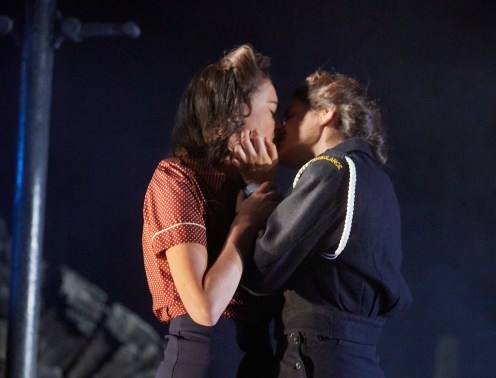
Ironically, the moment Cole realises that Kay is gay is also the moment that Kay and Julia’s own relationship starts to collapse. This means the three years in which The Night Watch’s bombshells land are the angles of the love triangle between Julia, Kay and Helen. Roberts’ performance as Helen is especially well nuanced, delighting in her chivalrous rescue by Kay from a bombed house in 1941, while in 1944 we have already seen her accusing her girlfriend of wanting to save everyone. This is again a different Helen to the woman who in 1947 shares a guarded chumminess with colleague Viv, or, anguished, suspects Julia of having an affair.
Similarly forceful to these lovers’ confrontations are the scenes in which Viv’s abortion and Duncan’s suicide attempt are discovered, with Coulthard and Mackinnon respectively evincing the distress into which their mistaken beliefs have carried them. Again, this intensity of emotion is all the more effective for being in tension with our experience of the characters so far.
The skilful depiction of the main characters’ facets is complemented by the play’s discreet use of doubling in the supporting actors, proving that this is a cast adept in versatility. As fussy, blustering dating agency client Mr Wilson Malcolm James is unrecognisably the peculiar prison warden Mr Mundy, and with his bluff, Welsh good humour, Jenkins-Shaw is believably a different man to conscientious objector Robert with his Oxbridge tones. Mara Allen is likewise excellent both as Kay’s foil, the mechanic and ambulancewoman Mickey, and she practically steals her only scene as factory manager Mrs Alexander.
In dark times it’s a dangerous proposition to take us back into the Blitz. But as the presiding spirit of Mrs Leonard tells the cinema-going Kay, we are enthralled by the lit-up fictions before us. So believe me when I write that The Night Watch is victorious.
Matthew Grierson
November 2019
Photos © Mark Douet
A Peek Behind the Cumulonimbus
Rewriting the Climate
by Matthew Griffiths
Arts Richmond, Richmond Literature Festival, Hampton Hill Theatre, until 2nd November
Review by Heather Moulson
A thoughtful and sedate event presented by Matthew Griffiths and Polly Atkin with guest readers, Malisa A Elliott, Stephen Leslie and Heather Montford, this thought-provoking evening was introduced gently by Matthew who explained his angle on one of the greatest issues of our time. Matthew explained how he was driven to produce his new collection, The New Poetics of Climate Change and elaborated on the innovative mix of modern poetry that is vital to comprehend such a complex subject.

In the first half, a scale of eclectic poems were read, with nicely paced explanations in between, and alternated by Matthew and Polly. The first being The Greenhouse Effect by Fleur Adcock, read by Malisa A Elliot. Malisa’s strong delivery drove home, and the lyrical works of Adcock’s poems focused on, simple things such as looking out to sea. Matthew talked about the very common term, The Greenhouse Effect and the many layers of its meaning. Stephen Leslie gave a strong reading of an excerpt from the immortal Wasteland by T S Eliot – The Burial of the Dead. Matthew chose this because of the clamouring of voices, and several landscapes, and felt it should be discussed about the way we see nature.
We welcomed back Malisa as she read My Heart Soars by Chief Dan George, from a collection of Canadian nature poems. Poetry Performance favourite, Heather Montford read The Poems of our Climate by Wallace Stevens. Heather’s gentleness and tone made these vital words from Stevens ring clear. The Leaves of a Dream and the Leaves of an Onion by Arthur Sze, an amazing Chinese American poet, was read by the talented Malisa. This was the most significant message, as Matthew elaborated how this poem provoked such multiple images, for instance the concept of separating things. Stephen breathed life into the words of Windscale by Norman Nicholson. Then the three effective poets were reunited to read the extraordinarily hard hitting The Imaginary Iceberg by Elizabeth Bishop. Heather then read Ordinary Details by Jane Cooper, which was anything but. The trio reformed for the final poem, Positive Feedback Loop by Jorie Graham.
Matthew’s summary of this array of poems was articulate and full of insight, genuinely making us re-think our concepts of Climate Change. Matthew’s choice became clear, full of illustration and strong images and provoking a response in all senses, and making us realise that these were carefully researched and well-chosen poems.
The second half brought a discussion between Polly and Matthew. They talked about motives for their work and theories, and the beginnings of their interests in Climate Change. This was followed by questions from the audience, for example – Who were the new eco-poets? Many names came up, including Frances Presley, an important and significant British poet, whose writing is very relevant to our issues. Another point came up about schools and young people, and Polly explained that she runs workshops with schools and community groups. Children are very concerned about climate change.
To conclude the evening, Polly read her own poems including the thought provoking, Bluebell Season and Hunting the Stag. The climax of the evening was Matthew reading his work consisting of the haunting Bearing Myself, Cod Philosophy and Metaphor, the latter from his pamphlet How to Be Late. I would sincerely recommend Matthew’s current collection about these issues and we thank him for such an insightful and innovative evening.
Heather Moulson
November 2019
Photography by BA Tipping
Fabulous Witty Art Deco Escapism
The Mikado
by W.S Gilbert and Sir Arthur Sullivan
English National Opera, London Coliseum until 30th November
Review by Eleanor Lewis
Any Gilbert and Sullivan fans sensitive to snobbery must have a tough time, as it’s fair to say that for some Gilbert and Sullivan falls into that small space between ‘too highbrow for musical theatre fans’ and ‘far too popular for opera fans’. Most G & S fans I’ve come across though don’t waste their time fretting about snobbery, preferring to spend it enjoying the fabulous, witty entertainment provided by this enduring canon of work.
There is an argument for updating the Savoy operas though. Another production of HMS Pinafore appropriately costumed and set is well and good but it will attract the “dated” label. On the other hand, directors such as Sasha Regan with her all male Pirates of Penzance, reinvigorate the work and give it a whole new lease of life, and a production of The Mikado created by Jonathan Miller in 1986 and revived by Elaine Tyler-Hall and team, with the ENO orchestra and chorus is really only going to work spectacularly.
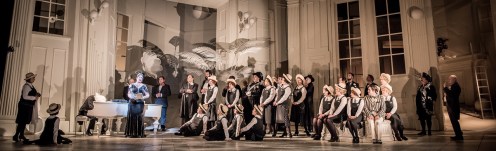
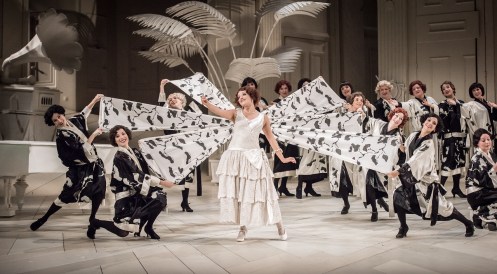
ENO’s Mikado is a beautiful production that provides two(ish) hours of total escapism to a lovely Art Deco land full of carefully crafted silliness. Stefanos Lazaridis’ cream and white grand hotel set, and Sue Blane’s monochrome costumes are visually stunning. Chris Hopkins’ conducting keeps the pace sufficiently brisk, doing full justice to Sir Arthur Sullivan’s music, but steady enough for all of W S Gilbert’s lyrics to be heard.

Characters in this happy land are carefree and eccentric. Richard Suart’s Ko-Ko minced about the stage happily living in the moment. Unsurprisingly our current Prime Minister (at time of writing) is on his Little List, as are the Sussexes, vegans, and the overly politically correct.
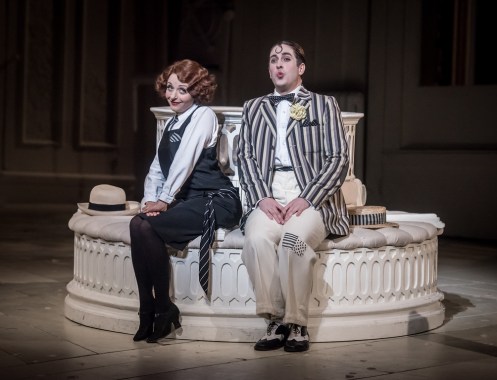
Elgan Llyr Thomas was a very sweet Nanki Poo paired perfectly with Soraya Mafi as Yum Yum. Soraya Mafi having achieved a perfect combination of teenage ego, an instinct for self-preservation and childlike insouciance in equal measure.
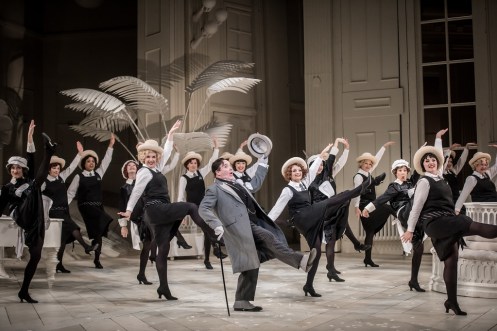
Andrew Shore’s Pooh-Bah was another comic creation, attempting to accommodate other characters whilst politely remonstrating with Chris Hopkins about the volume of the drums. Yvonne Howard’s Katisha was both intimidating and poignant with her gently drooping, single feather headdress and her crystal clear mezzo-soprano voice. John Tomlinson, navigating the stage in his huge costume like a small galleon on the seas, gave a rather arch element to the Mikado himself.
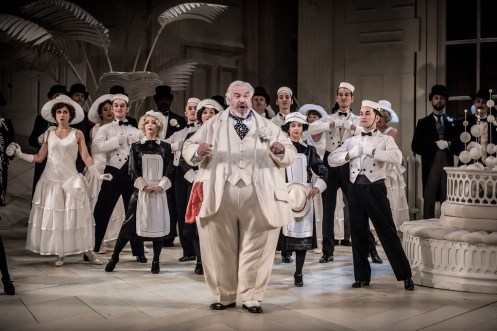
The details perfect the picture. Dancing maids and camp bellboys appear at appropriate moments, grinning winningly and dancing at a speed that brings to mind the first black and white films. When Yum Yum, Pitti-Sing and Peep-Bo sing together, but are static at one side of the stage, a maid struggles to carry laundry across the background and shortly afterwards another, drinking from a bottle staggers across too. In a random, (and possibly niche) way I was reminded of Bill Forsyth’s 1981 film Gregory’s Girl and the penguin in the background at various points in that film.
It’s probably stating the blindingly obvious to say that Jonathan Miller fully understands what Gilbert and Sullivan were about. They were indeed pointing out the flaws of The Victorian society in which they lived but doing it by creating a satire set in the faraway country of Japan where flirtation is punishable by death and a lot of very attractive characters can play out an entertaining storyline and everyone enjoys themselves. This, after all, is what theatre is about.
Eleanor Lewis
November 2019
Photography by Geneviève Girling
A Delight of Wit, Talent and Charm
The Pirates of Penzance
by W.S Gilbert and Sir Arthur Sullivan
HLO Musical Company, Hampton Hill Theatre until 2nd November
Review by Eliza Hall
This talented and popular company, until recently known as Hounslow Light Opera Company, has chosen to change its name to HLO Musical Company. The company says that the new name more readily matches themselves, their long history and more truly reflects what they perform. Indeed it does as we, the audience, were presented with a delightful night of song, dance and recitative of exceptional brilliance.

From the moment the overture began when Lee Dewsnap, musical director and one man orchestra, who had arranged the full score for the company and conductor Matthew Newton sounded out the first of the familiar songs from the show, feet were tapping and the audience were engaged but eagerly anticipating the moment the curtains were lifted.

No one could be disappointed by that first view of the set, the colours, costumes or with the singing of the opening number, set on a rocky cove on the coast of Cornwall. Strong mature voices were joined by the balcony choir and the pounding of the song celebrating the birthday of Frederic, a pirate, but not by choice, who having reached twenty-one years of age was able to end his ties with the pirates.
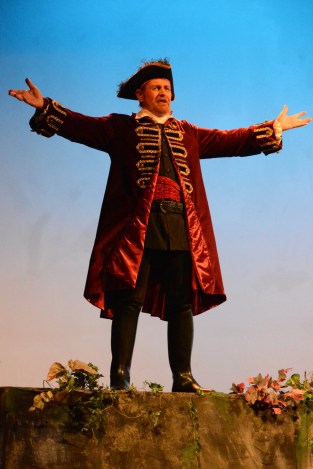 Kevin Chapman (Frederic), Felicity Morgan (Ruth) and Steve Taylor (Pirate King) set the scene and the story line, explaining the context to the ensuing tale with conviction, humour and strong voices. Delightfully successful harmonies with Felicity’s acting, her persuasive attentions were funny and sad and true to the G&S formula of pathos, the ridiculous and the cajoling of the audience into half believing the impossible. So the story enfolded, every scene a joy to behold. The choreography of the daughters of the Major General, chaperones and maids was clever and gentle. Singing supplemented by the balcony choir allowed for freer movement on stage for those acting, dancing and singing.
Mabel, played by Johanna Chambers, demurely glittered. Her astounding vocal range and strength of vocality along with clear diction, was a delight and she was so easily the seductress that Frederic was seeking. Her talent shone throughout the production and, like Felicity Morgan’s Ruth her voice was the perfect foil to Kevin Chapman’s Frederic.

Clever little choreographic details meant the audience was constantly watching for expressions and individual reactions whilst keeping the whole movement and position together as a chorus. As they pointed to the upstage left, awaiting the cue for the entrance of the very model of a modern major general he pussyfooted in, downstage right. Such little, clever devices kept the audience laughing, applauding and attentive as the familiar music and rhythms could so easily have lulled the audience into false securities.
 Tony Cotteril’s Major-General Stanley was what we all wanted to see – witty, weak, diminutive. Considering he is not small, he portrayed the figure convincingly and his many clever ad libs were such a valuable addition to the role, including his little reminder of HMS Pinafore. He ran the gauntlet with Steve Taylor’s Pirate King, the two making amazing music and repartee that kept the audience amused, quite amazed and full of admiration. Some excellent acting by both brought much well deserved applause.
The scene having been set and the dilemmas explained, we anticipated Act Two with delight. So, a word about the costumes and lighting before we return to the auditorium. The set (by Wesley Henderson Roe and team) and the lighting (Patrick Troughton) were of the usual high standard that audiences have come to expect from HLO Musical Company. Serviceable but appropriate as well as attractive, bearing in mind the large company and the growing number of people on stage – as we were to discover in Act Two. Lighting was used to change the mood, as well as depict the time of day or night, and was effective. Three lights at the very top of the backdrop were fine when they were sometimes blue, but from the back row downstairs were a little too hard on some of the older members of the audience whose eyesight becomes more sensitive with age. Just a thought when bearing in mind the needs of an audience. They may have been acceptable upstairs as I don’t think they would been seen. Comments from those sitting lower down in the stalls where the lights were more obvious seem favourable and not intrusive. Nevertheless, having made this little concern, the stage was very well lit and nothing could be missed – no one would want to miss any of the meaningful glances and expressions that worked their way through the storylines between characters. Some telling expressions added and supported the dialogue itself. Sound was good, well placed microphones were not intrusive and effective.
 Costumes were very convincing. A chorus line of Kate Greenaways at the beginning of the song Climbing Over Rocky Mountains and led by Edith (Andrea Wilkins ) with the other daughters, chaperones and maids in this and the following Stop Ladies Stop were all enchanting . Singing and dancing at the same time was well coordinated and supported well by the choir on the balcony. The colours of these ladies outfits were complementary and demure and added to their role rather than breaking the flow of action on stage. Even the outstanding Mabel was not dressed to impress, but matched the others’ attire, leaving the focus entirely on her singing and acting. How delightful to see the chaperones in dignified and elegant gowns and matching bonnets, that were also individual but did not overwhelm the audience’s attention from the chaperones’ part in the production.
 The outstanding costumes of the King of the Pirates and Major-General Stanley were flamboyant and commanding and fitting for their personalities- as well as actually fitting well. Velvets and silk dressing gowns, army style worsted and navy police uniforms; all good tailoring all round. Even Frederic scrubbed up impressively in Act Two. Fabrics were appropriate, even down to the stereotyping of Pirate’s socks and knickerbockers. Ill-fitting uniforms and helmets were just as delightful and equally appropriate on the Policemen, adding to the comedy and enjoyment.
Personally, I found Ruth’s pirate costume the best. A touch of the swashbuckling pantaloons combined with a picture book nursery rhyme dress. Felicity wore it as a female but pranced as a male and enabled her to look and play her part. Feminine enough and boyish enough to work for her character really well in her attempt to persuade Frederic that 47 was a good marrying age.
Choreography came into its own in the second act. A big applause of respect should be awarded to Karen Munday as well as her assistant, Faye Ellingham. We were in for several treats, the librettos and trios between Ruth, Frederic and Pirate King lightened up entirely by the entrance of the police corps and their wonderfully choreographed routine. Bellies to the fore and with perfect chorusing, enabled them to be united in their singing and disunited in sizes, shapes and their smaller actions. Very funny, they were the most comical part of the evening, they nearly stole the show but then the Sergeant of Police, who sang with force (excuse the pun)  and conviction, Paul Chambers, is (Mabel’s) Johanna Chamber’s real father and he surely would not want to steal (!) her glory, even though he made an engaging sergeant and used his voice well.
As more of the company filled the stage the tempo, the tension and the resolution were reached. Pathos and poignancy mingled as in so many of G&S’s operettas and this company managed to do just this. Whether it is experience and confidence or just excellent directing, it is difficult to pull the production apart to discover. There is no doubt that the director , Gareth Bevan, brings both excellent credentials in experience and success, understands singing, production and enjoys working with the accomplished team that constitutes the HLO as a whole. His enthusiasm for Gilbert and Sullivan, and in particular, Pirates of Penzance shines through. Here, he has worked with a team of experts in their own right, from a cast where some of the singers have small parts, Isabel (Harriet Muir), Kate (Anne Pringle) and the equally convincing Samuel, played by Paul Huggins, to the lead singers, all have lists of successful contributions to both HLO and elsewhere and come with a joy of Gilbert and Sullivan that is evident in their performances. No weak ones here. All contribute to making this a professionally acceptable and delightful production, the full chorus with no speaking parts have plenty to offer in their singing and acting, particularly the policemen – and the small one on the back row with an over large helmet just make this performance a delight and a refreshing evening of wit, talent and charm.
The Finale arrived too soon for us Gilbert and Sullivan fans. Richard Stockton explains in the programme that changes were made to include the original version of the Finale as performed in New York and London where some songs were reinstated. In this way, links to Act One are heard and tie in well, completing or resonating words are cleverly made. Sighing Softly by the River sung by the Major-General and the Pirates leads seamlessly into the Finale with a crowded stage and for the audience this is a satisfactory end to the production. A significant achievement by the director and musical director and the whole of the cast for the team work and the dedication to make the production a success was clear, the harmony was not just in the singing, dancing and acting – and there was plenty of that – but in the whole of the production and cast. Pirates of Penzance is one not to be missed.
Eliza Hall
October 2019
Photography by John Malone
‘Murder generally isn’t funny’
Agatha Crusty and the Village Hall Murders
by Derek Webb
Theatre West Four at the Questors Studio, Ealing, until 2 November
Review by Matthew Grierson
Why is Agatha Crusty so hung up about her surname? Expressing something not unlike Hyacinth Bucket’s disdain, she insists that it should instead be pronounced ‘Crewstay’. Surely she can’t share the opinion of the PM (at the time of writing) that ‘Crusty’ is an insult? In any case, Agatha Crusty and the Village Hall Murders is more hoary than crusty … but no less fun for all that.
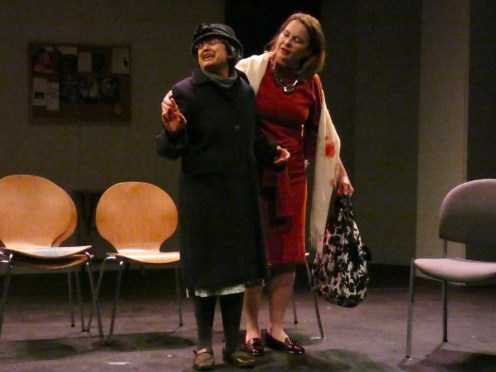
The premise of the plot – well, I say ‘plot’, it’s more of an excuse for a string of themed scenes – is that the titular crime writer (Judy Ramjeet), whoever she’s based on, happens to be spending a few days in the country when a string of themed murders takes place, and she is pitted against the dimwittedly literal DI Twigg (Alex Molloy as the plod who thinks ‘metaphorically speaking’ means talking about the weather) in trying to resolve them, with hilarious consequences.
If you thought that sentence meandered, then maybe this play isn’t for you. In keeping with the fictive rural setting of Chortleby, it takes a relaxed pace to life, and for that matter death – nothing will stave off the terror of multiple homicides like carrying on with knit club, or cookery club, or rehearsing the panto. For all of these serve as the basis of successive scenes in which the village hall committee attempts to keep calm and carry on, only to be capped with another grisly offstage death. Thank heavens there are so many Godots to bump off; in fact when we do see our first corpse of the evening (Julian Young), it takes a moment to register.
Were it not so far-fetched, I’d be tempted to say that play serves as a harrowing depiction of a community’s worsening trauma as it is compelled to repeat the same conventional inanities in the face of mass murder. Yvonne Austin, who gives a perfect performance as strait-laced committee chair Miss Wagstaff, could sum this up when DI Twigg asks whether a shotgun accident ended in death: ‘I should think so!’ she replies haughtily, as though it would have been poor form to remain alive in such circumstances.
Yet the fact that the murderer, once eventually revealed, is given such a convincing – and convincingly played – motivation gives it an unexpected grounding in the horrors of actual human experience rather than those of Christieland pastiche. The dénouement is thus the only moment in the play to follow the exhortation of caretaker Harry Nott (Jonathan Simmons) to Agatha to be more ‘realistic’ in her novels, when he mansplains the ground rules of crime writing to her in the opening scene.
The village’s relaxed attitude to murder extends beyond the fiction to some of the technical discipline of the production: a number of times actors stumble into or talk over their pick-ups, or step into view only to hurry back into the wings to await their cue. Similarly, the lighting can’t make its mind up whether it wants to be late or early, with the deliberately stilted scene-ends, à la Police Squad!, strung out longer than necessary to make the joke, or the house lights coming up before the cast has cleared the stage at the interval.
This all makes the script’s attempts at self-awareness – ‘I haven’t done any drama since school!’, ‘He’s murdered a few scripts in his time,’ etc. – a bit risky. But it would be unfair to put too much emphasis on this, because in truth I found myself as relaxed as the cast, and enjoying proceedings as much as they clearly were.
So what if Mick Cawson has failed to complete his switch from Oliver to Olivia between scenes and has to tie his headscarf over an obvious wig while upstaging the rest of the cast? His/her hair flicks just add to the general mirth. And Ashley Brown’s turn as the Rev. Bishop, a christening milked in his interview with the untwigging Twigg, is a particular hoot. Brown’s blend of commanding and camp in his performance, as is clear, respectively, in his confrontations with the dullard DI and flirtations with the ladies of the parish, always livens things up. To write in the spirit of the script, he makes for an arch Bishop.

Elsewhere, the cast are engaging and generally manage to strike the right comic note. As Agatha, Ramjeet is properly prim and preening about her reputation, but, never fazed by the absurdities of village life, sees her way through them to solve all the crimes in one fell swoop. In her practical approach, she is ably supported by her local contact Natalia Sirotkina as Alice Fogg, who keeps things grounded throughout. Meanwhile, Molloy’s leaden copper deadpans to excellent effect from the start; who would have thought a character so blunt would make such a good foil?
But props in particular to Veeda Ray as artist’s model Mandy, who makes a couple of scene-stealing cameos. She is subbed late into the village panto as Snow White (a strangely compelling scene already, with Austin giving free rein to her wicked stepmother) to demonstrate excellent comic timing in refusing a gift of fruit – ‘I don’t like apples’ – before hamming it up with the rest of them when she eventually succumbs to the poison.
And despite the hit-and-miss timing elsewhere, the jokes are not lacking in rhythm. They are strung through the script so liberally that there’s no chance you’re going to go a minute or two without chortling, or even guffawing, as we found ourselves doing. And yes, you may not like wordplay, and you’d be entitled to your opinion; but you’d be wrong.
For so cold-blooded a set-up, Agatha Crusty manages to be a warm-hearted production whose shortcomings are as nothing to the charm and enthusiasm that overcomes them.
Matthew Grierson
October 2019
Photography by Ellie Hopkins
What a Piece of Work Is Woman!
Hamlet
by William Shakespeare
Richmond Shakespeare Society at Mary Wallace Theatre, Twickenham, until 2nd November
Review by Louis Mazzini
Though it is billed as a “radical Scandi-noir production”, Richmond Shakespeare Society’s latest version of Shakespeare’s most famous play is on surprisingly traditional lines other than the gender reversal of several characters including the eponymous prince – there was a time when that might have been regarded as radical but it is not so unusual these days as explained in a fascinating programme note by Dr John Buckingham.

As the Princess Hamlet, Francesca Ellis brings to the role an edgy charisma and a near acrobatic athleticism while, in the opening scenes, her phobic reaction to Claudius, played with seedy power by Chris Mounsey, hints that something even darker than suspicions of murder might also lie behind Hamlet’s aversion to her uncle.

While Ellis is immediately credible in the most famous male role in theatre, some of the other switches are less effective, in particular the char acters of Hamlet’s friend Laertes and his doomed sister Ophelia. As Laerta, Nicola Doble is initially compelling but her performance becomes less plausible in the second half, while Hamlet’s feelings for Laerta’s brother simply do not ring true when so many of the lines – even subtly reworded – were plainly written with a sister in mind. For the same reason, Jamie Barker struggles to convince as Orpheus. On the other hand, Susan Reoch brings dignity and gravitas to Polonia, the siblings’ mother, without compromising the essence of Shakespeare’s Polonius and as Horatio, Rosencrantz and Guildernstern, Emily O’Mahony, Jessica Warrior and Pete Messum make more believable friends for Hamlet than is sometimes the case.
 Gertrude, Hamlet’s mother, is played by Jane Marcus who has little to do but does it very well, especially in the confrontation with Hamlet which is compelling and touching though robbed of the ambiguity that comes when Hamlet is male.
As for the others in the cast, a key element of Hamlet’s plot to avenge his father’s death concerns a travelling theatre company here led by Simon Bartlett, appropriately histrionic as The Player King. The two other members of the company are played by John Gilbert and Cath Messum – both of whom appear to good effect in other roles. And there is also Francis Abbott, as the ghost of Hamlet’s father, exciting and threatening despite a curious choice of costume.
Even with cuts, as have been sensitively made for this production, Hamlet is a long play and Susan Conte’s direction wisely keeps up the pace albeit sometimes at a cost to the characterisation as well as some of the comic elements. Marc Pearce’s lighting and sound design is excellent, and the special effects work well, while Joe Evans’ filmic music adds tension and atmosphere to the external scenes and bears comparison with the work of Ólafur Arnalds and other contemporary composers.
 The costumes, bar a jumpsuit or two, are well chosen and effective and by any standards, the set – painted by Francesca Stone and also designed by Marc Pearce – is spectacular, with a beautifully rendered multi-coloured marble floor and Carrara walls, broken up by arches and dominated by a red velvet arras between two superbly lit windows.
This is an effective retelling of Hamlet and Francesca Ellis’s performance should silence anyone who still believes that Shakespeare’s most compelling character cannot be portrayed by a woman.
Louis Mazzini
October 2019
Photography by Sally Tunbill
Precious Gentle Material
84 Charing Cross Road
adapted by James Roose-Evans from the book by Helene Hanff
SMDG, Hampton Hill Theatre, until 26th October
Review by Eleanor Lewis
84 Charing Cross Road is one of those mysterious dramas which is difficult to ‘sell’ to someone who knows nothing about it. What’s it about for example? Helene Hanff, a writer in New York, corresponds with Frank, the manager of a bookshop in Charing Cross Road from whom she is buying books, over a period of roughly 20 years. What happens? Through their letter writing Helene and Frank become friends. That’s it really, but to those familiar with it it’s so much more. This true story is loved by many people and has been successfully adapted for radio, television, the stage and in 1987 was made into a BAFTA-winning film starring Anne Bancroft and Anthony Hopkins.

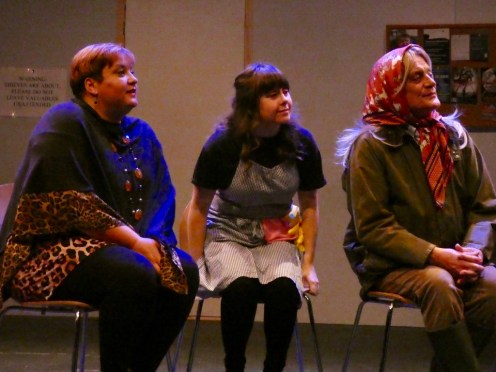
All of which is a tough act for St Mary’s Drama Group to follow, but they have risen to the challenge, and with some style. The stage at Hampton Hill Theatre is gently divided into two sections with the bookshop occupying the larger area. The shop, furnished with dark brown furniture including desks and well stocked bookshelves, is suitably atmospheric. Malcolm Maclenan’s soft lighting completes the look and even the vast, strangely coloured green doors don’t look out of place.
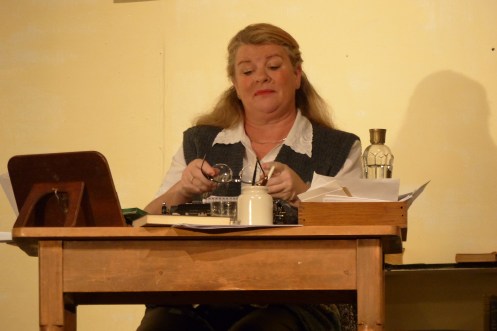
Miss Hanff (Jooz Connery) sits at her typewriter in her messy, New York apartment on a raised platform on the other side of the stage. She and Frank (Andy Smith) in turn read out the letters they send to and receive from each other, each interaction perfectly paced. Frank reacts to each letter either to himself or sometimes with the staff in the shop. Helene reacts to herself, engaging the audience but without breaking the fourth wall. They are in a kind of suspended conversation without directly, physically addressing each other.

The staff in the shop are an essential part of the stage adaptation and a considerable asset to this production. They have very few lines and are basically required to look as if they work in a bookshop, and this they succeed in doing to great effect, chatting quietly to each other, creating invoices and taking things to and from the stockroom. Hannah Few, Julie Davis, Rodney Osmond and Graham Beresford deserve credit for the natural, realistic background they have managed to create and which completes the period feel of a mid-twentieth century London bookshop.


Helene and Frank’s correspondence begins in 1949 and ends in 1968. Miss Hanff, as the London booksellers initially call her, loves English writers. She favours John Donne, Samuel Pepys and others but overall she has a love of books themselves, “such soft vellum and heavy cream coloured pages” as opposed to what she calls the “dead white paper” of American volumes, and Frank and the staff at Marks & Co understand this. As they all get to know each other Helene sends the bookshop staff food parcels while rationing continues in the UK after the war. Frank’s letters become less formal and other members of staff write to Helene.

Various major events are noted. A new Queen is crowned, the Beatles arrive with the sixties “We watch it all from a very safe distance” Frank remarks whilst looking out of the door at the pilgrimage to Carnaby Street. This all takes place via the mail though, before the days of email and the internet. None of these people meet. Helene tries to visit London but is thwarted once by a need for expensive dental treatment, later by the expense of moving to a new apartment. An actress friend (Gina Way) visits the shop and reports back to her but it is only after Frank’s death that Helene herself finally makes it to the shop in Charing Cross Road.
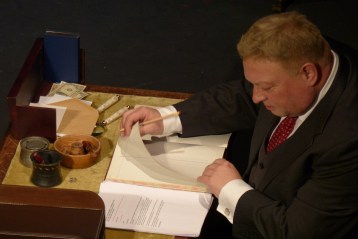 Andy Smith’s performance as Frank was understated and highly effective. To portray on stage a reserved, educated Englishman with a love of books cannot be simple but it’s certainly not beyond Mr Smith who also managed to grow gradually older over the course of the second act. (I would very much have liked Frank to have been equipped with an overcoat that fitted easily over his shoulders too but nothing is ever perfect!)
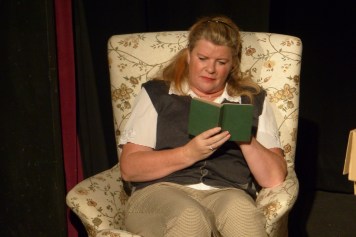 The outgoing, witty and warm-hearted New Yorker Helene Hanff was played intelligently by Joolz Connery without either sentiment or over-exuberance, and the developing friendship between Helene and Frank was believable. It is difficult to identify exactly what makes 84 Charing Cross Road so uniquely engaging to its readers but one element may be because it’s not a love story, it’s a friendship story and those don’t get told very often.
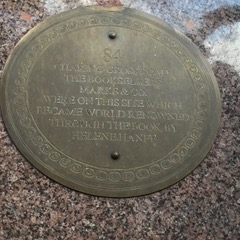 I wonder whether this work still communicates with anyone under the age of about 40 who probably has no idea of the joy of receiving a letter, particularly a letter from someone who’s good at writing them. Time will tell I suppose. There is a plaque in Charing Cross Road marking the place where the bookshop stood, it is now a McDonalds.
84 Charing Cross Road is precious material to those who know it and St Mary’s Drama Group has done justice to a small but greatly valued gem of 20th century writing. Highly recommended.
Eleanor Lewis
October 2019
Photography by Bill Bulford and Bookseller Archive
Parliamentary Backstop?
Integrity
by Vaughan Evans
Krimson Kestrel at OSO Arts Centre, Barnes until 25th October
Review by Wendy Summers
Integrity – “the quality of being honest and having strong moral principles that you refuse to change” (Cambridge English Dictionary).
The action of this play occurs in the murky world of Westminster politics, where it would appear, “integrity” is a dirty word. Ostensibly a play about the 2010 Coalition Government and the Liberal Democrat’s policy on tuition fees, the play also tries to tap into the #MeToo movement that arose at the same time following the Harvey Weinstein scandal. Somewhere along the line the tuition fee debate gets lost, forgotten or ignored in favour of playing up the “casting couch” and abuse of power themes.
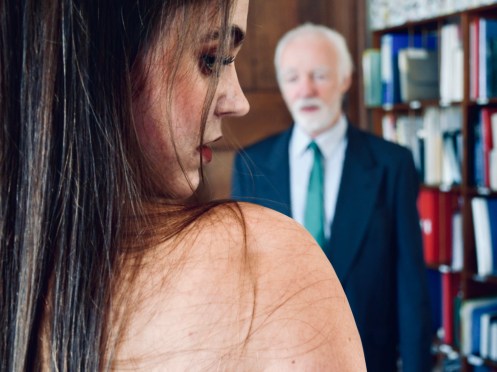
Integrity debuted at the Edinburgh Festival Fringe in 2018. It is perfect Fringe material; it deals with “issues”, has a fair amount of angst and lasted an hour. This new, full length version has, by the playwright’s own admission not been revised. Instead, a second act has been bolted onto the end to make room for an interval. And it doesn’t work. The first act is a complete play in itself and has a definite conclusion. Act Two meanders through “what has happened in the interim six years” without as much structure as the original piece and there is a lot of talk about characters and events unseen and previously unmentioned. In fact I completely missed that there was a further two year time lapse in Act Two until I re-read the programme.
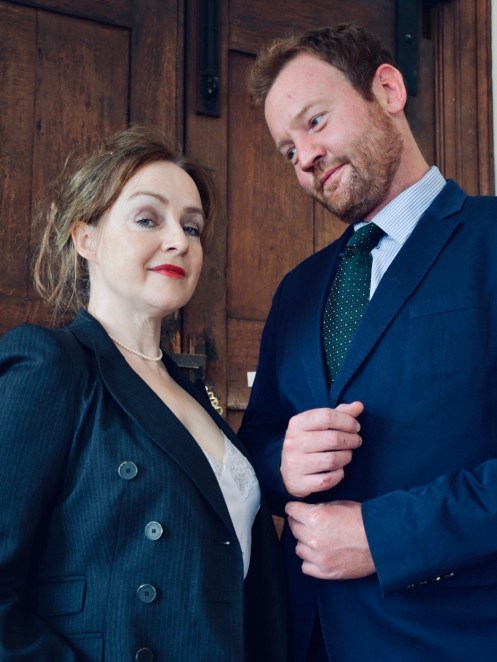
The play is directed by the author, who also appears on stage as one of the man protagonists. This multi-tasking, although admirable – and understandable – to entrust one’s “baby” to the care of another is difficult – is sadly to the play’s detriment. The cast are all capable actors and work very hard to breathe life into their characters but their performances suffer from direction by someone who is both too close to the piece and unable to give the cast his full attention as he is also performing and can never see the whole picture. Thus, Clare Farrow’s Vicky plays the entire piece as a femme fatale, which takes away any element of surprise when she is revealed as a sexual predator and Francesca Stone’s Tanya is glamorous, knowing and manipulative, but much of her dialogue is lost in the delivery, which could have been easily fixed by someone “out front” really listening to what she is saying. As Evan, Evans himself is sympathetic but could do with a little more “edge” as the play progresses and Richard Scott does a good job with George, the chauvinist who in the end shows himself to have the closest thing to integrity of anyone in the play. The fun second act cameos by Marie Bushell and Jenni Fownes brought some much-needed light relief.
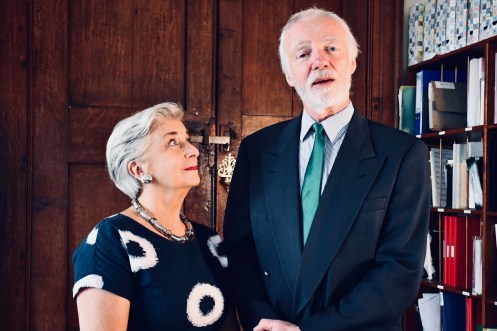
Krimson Kestrel’s production values are excellent. It is an uncommon pleasure to see a black box space used effectively with minimal furniture and the lighting and sound effects are effective and unobtrusive at the same time. Scene changes are slick and fast.
In summary, this is an interesting piece that tackles the issue of power and corruption well. Sometimes it is a little heavy handed, but the first half is thought provoking and well-constructed. A little more thought on how best to expand that initial hour would serve the piece well.
Wendy Summers
October 2019
Photography courtesy of Krimson Kestrel
The Food of Love
Toast
by Henry Filloux-Bennett, based on the book by Nigel Slater
PW Productions and Karl Sydow, Richmond Theatre, until 26 October
Review by Matthew Grierson
In the 1960s and 1970s, long before British people had iPhones and Instagram and emojis, the only way they could express their feelings was through food. Yet the humble national palate, all bread and baked goods and biscuits, proves highly articulate in this impressive, life-affirming adaptation of cook Nigel Slater’s hit memoir.
The relationship between young Nigel (Giles Cooper) – clad in sleeveless pullover and shorts à la Blue Remembered Hills to evoke the child the actor plays – and Mum (Katy Federmen) is one based on their shared experience at worktop and hob. The son’s enthusiasm makes up for the avowed shortcomings in his mother’s expertise, and the baking of jam tarts and mince pies binds them together. Dad (Blair Plant) meanwhile has fussy rules about what and how one should eat, memorably playing out as an episode of Top of the Form in which the contestants have to correctly gender confectionery as either ‘boy’ or ‘girl’ sweets.

The second-act appearance of Dad’s fancy woman Joan (Samantha Hopkins) on the scene then gives rise to a cookery conflict between son and stepmother, escalating from condiments to entire dessert trolleys. There’s even an excruciating but hilarious moment where Dad and Joan eat walnut whips in a manner bordering on the erotic, much to the embarrassment of Nigel. But we can tell how much he still cares for his Dad in the form of the impressive wedding cake he makes the couple, a gesture all the more poignant because he has used the Christmas cake recipe he and his mother once shared.
The Slaters’ feelings are also given physical form in the set, resembling a sparkling showroom kitchen – the kind in which the aspirational family long to feel at home. But the units are more than a workspace, more than status symbols, and are swung out into a range of charming dance routines, their wheels keeping pace with the cast’s effortless footwork.
For the food of love would be incomplete without its music, and the numbers that accompany the production evoke the period in which Nigel was growing up, and his own story in particular. The Crystals’ ‘Then He Kissed Me’ is an effective score for his first romantic encounter, and the anachronistic leap ahead to Talking Heads’ ‘Psycho Killer’, soundtracking his culinary arms race with Joan, can be forgiven because it is such fun.

This joyous and playful spirit is shared with the audience through a fourth wall that is not so much broken as entirely knocked through to make way for a kitchen extension. Nigel’s monologues are delivered so frequently to us that his exchanges with his parents are at risk of being asides themselves. There is also a danger that these speeches become the smug account of a middle-aged man nostalgically recalling his childhood. But the device is prevented from being wearing by having the other characters interrupt him or even remark wryly on Nigel’s habit of self-presentation (‘Who is he talking to?’ ‘He does this a lot.’)
It helps, too, that Cooper is never less than endearing as the infant and later teenage boy, and any self-satisfaction is always that of a child trying to take charge of his own story rather than a comfortable adult relating it as an after-dinner speech. As exuberant as his delivery is, Cooper is also a master of the telling look or expressive silence; similarly, a sudden frenzy of activity in making Christmas cake crumbles away in the desperation of wanting to hold on to the mother he is about to lose.
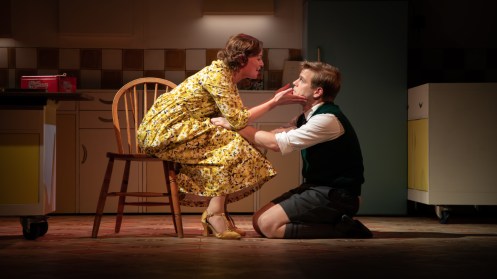
As Nigel’s Mum, Katy Federman is just as wonderful as her offspring, conveying a depth of character in declining health with a delicacy of touch throughout. Her comic timing is deft, and she is as capable as her son of making a glance speak volumes, whether in endurance of her husband’s idiosyncrasies or in flirty admiration of gardener Josh (Stefan Edwards). The high point is a worktop dance between mother and child, punningly enough to the strains of Charles Aznavour’s ‘La Mer’.
With the passing of Mrs Slater, Federman also proves admirably adaptable in the form of Nigel’s subsequent surrogate mothers, such as home economics teacher Miss Adams – an hilariously dipsomaniac turn in which she rails against tinned custard – or Doreen, the big-hearted cook at the local hotel where Nigel apprentices himself.
In a play where the cast is already given to distribute sweeties among the audience, Nigel’s Dad could so easily have been a pantomime villain, with his commanding presence and sudden anger. But Blair Plant’s sympathetic performance, and Henry Filloux-Bennett’s script, make him a much more nuanced character: the aspirational factory worker who joins the masons, makes a failed attempt to cook spaghetti Bolognese (the parmesan ruins it because ‘it smells like sick’), and is literally floored by his wife’s death.
Even though we see him capable of the worst – there’s a latent homophobia that surfaces whenever his son does anything remotely ‘girly’, and a sudden outburst that sees him repeatedly beat the poor boy – we understand these are the reactions of a man repressed, whose historical moment does not give him any other means of expression than a stiff upper lip and his fists. His temper is cut with a tenderness that complicates Nigel’s relationship with him, and ours. His unexpected death marks a believable climax to the emotional journey of the play: Nigel marks his sudden independence by devising a new dish on stage in front of us, the aroma of mushrooms, butter and toast drifting across the auditorium.

If Nigel and his parents are the chefs and maître d’ of Toast, the no-less-important serving staff are Samantha Hopkins and Stefan Edwards, who each take on a succession of swing parts (some of them actual waiters). As Joan, Hopkins affords the character enough particularity to be more than merely a wicked stepmother, as she successfully weaponises her homemaking to oust dust, and the ghost of Mum, from the Slater household, essaying some precision dancing into the bargain. As a Midlander myself, though, I think it’s a little unfair that she’s the only one charged with having to land the local accent (as though this were some signifier of her hated status for young Nigel).
Edwards in turn plays a roster of young men from handsome gardener Josh – sacked by a troubled Dad for having undressed in front of his son – to schoolmate Worrall and Doreen’s ballet-dancing son, with whom Nigel shares a first tentative kiss. It’s a versatile contribution, a magic ingredient that helps the show to rise.
So, think of it less as a cliché and more as a favourite dish when I say that Toast is a perfect recipe, its mixture of sweet and savoury flavours producing a satisfying and still surprising evening’s repast.
Matthew Grierson
October 2019
Photographs © Piers Foley

 Mark Aspen