
Circus Pentameters
Sky in the Pie
by The Feathers of Daedalus, based on poems by Roger McGough
The Feathers of Daedalus at OSO Arts Centre, Barnes until 22nd February
Review by Heather Moulson
Seated in an open set of sophisticated hangings of moons and stars, plus atmospheric lighting and a dry ice effect, this clever children’s production gets off to a promising start.
The Feathers of Daedalus is a flexible and skilled circus company consisting of young performers. Four men and two women interpret Roger McGough’s children’s collection, Pie in the Sky, plus later works, with elegance and insight, accompanied by keyboard and drums.
A fairly simple plot beginning with a young girl reluctant to get out of bed for the day ahead; then, amidst a backdrop of juggling stools, the company prepares for a typical school day.
What makes this production such a joy are the entertaining actions and witty poetic lines spoken by the pupils as they struggle with self-doubt.
The use of the props by performers is very slick, and we are treated to a headmaster with a cushion for a head, signifying an inability to observe what is going on in his school. On an autobiographical note, Roger was the ‘star’ pupil, entrusted to look after Raymond, a sickly new boy. However, Roger finds himself joining in the taunting of this troubled boy, who does not return to school.
The remorse Roger feels afterwards, perhaps strikes a chord of shame in all of us. Haven’t we as children all behaved in that brutal way?
Besides taking text from Sky in the Pie, there are also readings from Mr McGough’s other collection, Poetry Pie. In the improvised classroom, the question of should poetry rhyme stirred an interesting reaction from the young (and not so young) audience.
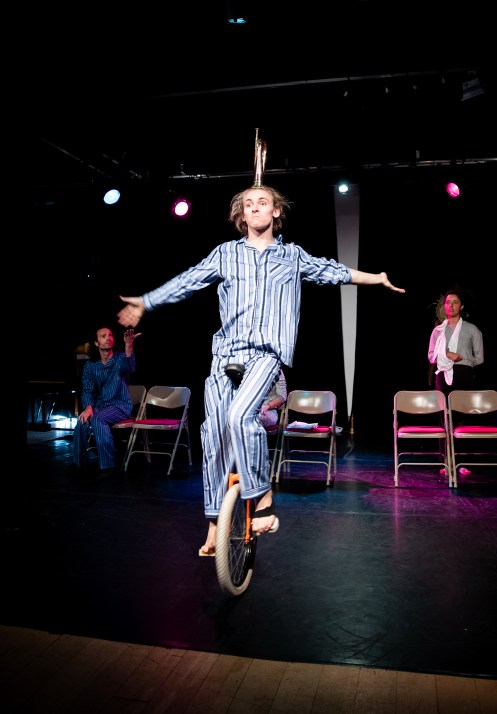
In this sequence we are treated to a unicycle performer with a bugle, while at the same time the subject of crotchets and keyboards is raised. Further skilful juggling follows during the reading of other poems, namely The Sound Collector, The Lollipop Man, and Tofu Eating Tiger, poems full of wit.
Then a succession of quick witted poems follows sung at a memorable pace, Does a Babysitter Really Sit on Little Tots, Wouldn’t It Be Funny If You Didn’t Have a Nose (put over in an hilarious sequence), Here Come The Dinner Ladies, and then lastly the title poem of this slick production, Sky in the Pie.
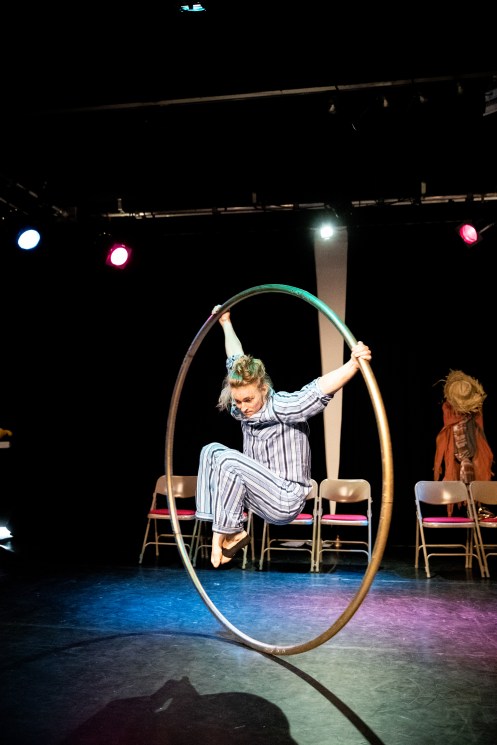
The climax of the show is The Midnight Skaters, which creates the impression of knives and forks coming alive. This involves a cast member practising an amazing balancing sequence on a golden circle, representing a beautiful plate.
The wonderful poem I Wanted a Puppy is followed by The Girl Who Became A Book, accompanied by a number of authentic props that adds to the magic of this company’s presentation.
The time sequence goes from morning to night. While we follow our heroine to bed, we have talking pillows accompanied by some edgy acrobatics, and a misunderstood scarecrow.
The poem, Tomorrow Has Your Name on It, received a great reception and ovation for the performers, with a nod to the sound and lighting operator. Then applause for the creative director sitting in the audience, who plans to tour this highly imaginative and carefully crafted show.
We were united in hoping it will be shared and loved by children nationwide.
Heather Moulson
February 2020
Photography courtesy of The Feathers of Daedalus Circus
A Shot of Spirits
Blithe Spirit
by Noël Coward
Theatre Royal Bath at Richmond Theatre until 22nd February, then on tour until 11th April
Review by Melissa Syversen
The first thing that strikes you as the curtain rises on Theatre Royal Bath’s production of Noël Cowards classic Blithe Spirit is the sumptuous set designed by Anthony Ward. It is clear that this is not your standard touring production, where allowances have been made for easy transport. A hat must be tipped to the stage crew who do the weekly get ins and get outs as the production moves around the country.

A favourite of the stage, Blithe Spirit has been produced multiple times in the West End and on Broadway since its premiere and attracts some of the best loved performers such as Margaret Rutherford, Angela Lansbury and Joanna Lumley. And though it is almost eighty years old, Cowards play remains a refreshingly flippant comedy about death, loss and the supernatural. Written at the height of the Second World War and The Blitz, you can appreciate how 1941 audiences must have relished in the dark humour and elements of the spiritualist movement still fresh in their minds during a time when death must have felt much more immediate.

The plot of the play is deceptively simple: Charles Condomine, wishing to gain some insight into the work of mediums for his new book, arrange a séance with the unconventional medium Madame Arcati. After a seemingly unsuccessful evening, Charles and his second wife Ruth discover that Madame Arcati have accidentally summoned and manifested Elvira, Charles deceased first wife. Thus, as with any classic Noël Coward comedy, chaos and wit ensues. Geoffrey Streatfield is satisfactory as Charles Condomine, but doesn’t quite manage the fine line delivery as he did with his turn in Congreve’s  The Way of the World at The Donmar Warehouse last year. Lisa Dillon, as Charles second wife Ruth, is much more successful finding the comic nuance within the given circumstances, jumping from vulnerability to perfectly executed domestic antagonism when faced with the glamorous ghost of her husband’s first wife.
Jennifer Saunders though, a certified living comedy legend in her own right, was made to pla y the psychic Madame Arcati. In Saunders’ capable hands, Madame Arcati is a surprisingly homely and earthy woman, played as well intentioned village eccentric, who is serious about carrying on the family business. That said, I think everyone in the audience at Richmond Theatre yesterday would agree that the show well and truly belonged to Rose Wardlaw as Edith, a twitchy parlour maid with unexpected gifts. Rare is the gift to make an audience laugh by just walking passed an open door, but Wardlaw has it in spades.
There is nothing especially wrong with director Richard Eyre’s take on Blithe Spirit , but it never quite reaches the comic heights and belly laughs of say, the Old Vic production of Present Laughter last year. That said, it is game and a sturdy take on a classic, made all the more enjoyable thanks to Saunders and Wardlaw’s excellent comic turns.
Melissa Syversen
February 2020
Photography by Nobby Clark
Provocative Physical Experience of Music
Luisa Miller
by Giuseppe Verdi, libretto by Salvadore Cammarano
English National Opera at the London Coliseum until 6th March
Review by Suzanne Frost
With the ambition of showing more new productions than ever before, ENO has invited Czech director Barbora Horáková, winner of the Newcomer Award at the International Opera Awards 2018, to interpret Luisa Miller, one of the lesser known of the twenty-six operatic work by Giuseppe Verdi, the “daddy of opera”, as he is introduced in the programme notes. A huge shout out to ENO’s editorial team for producing fantastic texts and truly delivering on the promise of making opera accessible to everyone. My ten minutes studying the programme were possibly my favourite bit all night.
Horáková’s Luisa is a highly sophisticated bit of Regietheater and went down a storm in Wuppertal last year – but in the UK, things are just not quite so, and audiences are often rather resistant to a directorial concept. Usually I am all up for productions that are more “out there” but in this case I tend to disagree. Horáková’s opera as psychological study is clinically precise, yet oddly lacking in drama. It looks slick and sophisticated in its white cube and neon lights aesthetic but leaves me feeling very little.

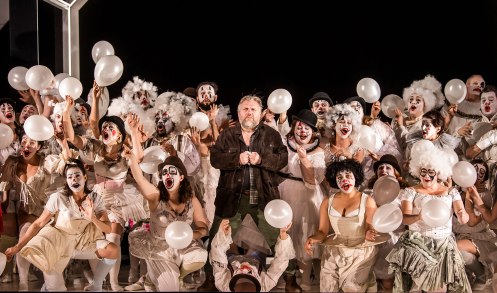
For Verdi, adapting Schiller’s drama Kabale und Liebe (Intrigue and Love) marked a change from epic stories towards the domestic, the power structures within the family. Horáková sharpens the focus even more and zooms in solely on fathers. Terrible fathers. Miller, a retired soldier loves his only child Luisa obsessively. Mostly though, he loves the idea of Luisa as a child. Constantly looking through a handful of Polaroids of his baby girl, the stage is swarmed by a bunch of creepy clowns and balloons as for a kid’s birthday party, while the grown-up Luisa (Elizabeth Llewellyn) is carried in like a corpse in a funeral procession – the fact she has become a woman is apparently already a loss to this father. The fact that she is in love with another man is unbearable to him and so he jumps at the chance to ruin her blossoming relationship with childhood sweetheart Rodolfo.
 Rodolfo’s own father Count Walter is a villain of an altogether different calibre. When we meet him, dressed like an oil tycoon, foot nonchalantly placed on a barrel, he seems to get a delivery of a twitching naked human being in a plastic bag. The abuse he then lays on this helpless boy is harrowing to watch, though it involves nothing more than black gloopy paint. And once that can of paint has been opened there is literally no stopping it! Absolutely everything and everyone gets smirched in the stuff. As symbolism goes it is fairly simplistic. The sweet and silly white clowns are being infiltrated by some bad clowns in black, a well-used group of dancers (choreography James Rosental) that have a mild S&M – naughty-sexual-awakening vibe about them. All the clowns are pretty creepy and maybe that’s the first thing we tend to always get wrong about children and childhood: it is not all sugar and spice and glorifying it and holding on to it past its sell by date is never healthy.
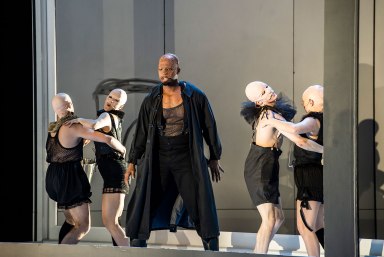 The aptly named Wurm, the plotting scheming super villain, is lurking in the corner like a black spider casually smoking Marlboros waiting for the perfect moment to strike. He is literally the personification of sin. He is also hot as hell, thanks to Salomon Howard’s six-foot something presence and sleazy raised eyebrows. An interesting twist to have the unpleasant Wurm look so fine in his shiny boots. What a horrible personality he must have that he has to resort to intrigue and blackmail to get the girl…
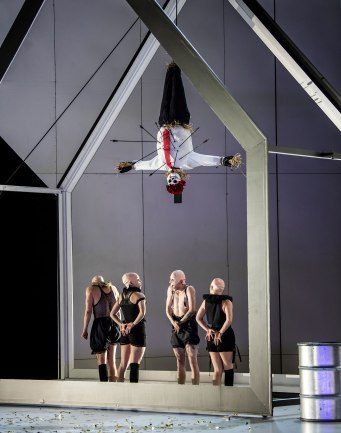 Rodolfo may be the one who made Luisa fall in love, but he is also far from the cute little kid we saw in the overture. His father is obviously a sadist who keeps little boys in plastic bags, enjoys slicing cuts into his prisoner Miller, encourages the fiancée of choice, the countess Federica, to shoot arrows into the heart of an upside-down crucified straw puppet and takes bets on his son proving his masculinity in the boxing ring. But Rodolfo has the capacity to be just as manipulative, dramatic, impulsive and cruel. Yes, he is damaged, but he is also damaging. Full of mistrust and self-pity, he immediately jumps to the conclusion that Luisa must be a “treacherous harlot” who deceived him. “You must show compassion” he demands of the woman he just wilfully poisoned, the very personification of the jealous stalker ex, and goes on to curse absolutely everyone but himself.

Luisa, literally driven mad by the demands of men, sings some fabulous coloratura with a blank face shocked by trauma in a nice Ophelia-like mad scene. Watching her die, her father bemoans “you were supposed to be my comfort as I grow old”. Wow. It is quite tricky to root for anyone in this production and very hard to care as well. Funny enough it is the silly old Miller who for all his flaws at least provokes some pity. Olafur Sigurdarson makes his character seems the most human, not just a vignette of good-bad or white-black. I found all the paint splotching a bit heavy on the symbolism. However, the bare staging and lack of colour allow for the music and the voices to take centre stage and the daddy of opera really knows how to let a choir have maximum impact. When they are allowed, the singers’ combined voices literally push like an invisible weight right against the chest and as we sit there in our little velvet chairs in the dark it’s a completely physical experience of music. And boy, does he know how to write a melody. My seat neighbour, a giant of a man, was swaying his head to the overture obviously knowing every single note. While obviously a fan of the music, he later nodded off – all the highly dramatic developments on stage somehow didn’t cross this time.
Suzanne Frost
February 2020
Photogrpahy by Tristram Kenton
Just a Sign of the Times
Blood Brothers
by Willy Russell
Bill Kenwright at Richmond Theatre until 15th February, then on tour until 31st October
Review by Andrew Lawston
Blood Brothers has been described by writer, lyricist, and composer Willy Russell himself as “the musical that’s loved by people who hate musicals”, and this would seem as good an explanation as any for the near-capacity audience at Richmond Theatre on a cold Tuesday night in February. It’s a show full of much-loved songs, but more than enough spoken drama that it feels like a play with music rather than a full-blown musical.
The story – a struggling working class mother can’t afford to raise the twin boys she’s expecting, so promises one to her affluent employer – is timeless in its simplicity, but is infused throughout with commentary on Britain’s class structure which is as relevant today, entering the third decade of the 21st Century, as it was back in the 1980s when the musical premiered.
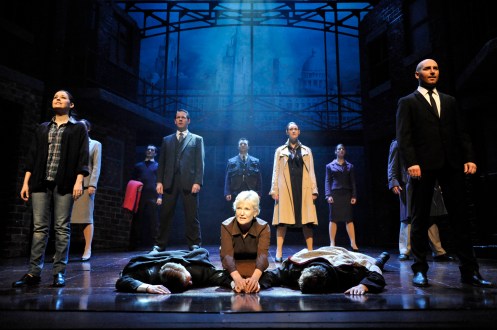
Andy Walmsley’s simple but effective set has stood the test of time: a run-down street with a backdrop that switches between the Royal Liver Building and a pastoral scene, with various other set items flown in as required. The gantry and the balconies provide an effective multi-level playing area for the cast, under the tight direction of Bob Tomson and Bill Kenwright.
The eponymous brothers may dominate most of the play’s action, but Mrs Johnstone is the character who carries her bat throughout this two and a half hour section, and she gets most of the best songs. As such she’s usually viewed as the lead character and this cast is no exception, with Lyn Paul showing a great range both in her acting performance and in songs that range from the haunting Easy Terms to the (initially) playful Marilyn Monroe.
Robbie Scotcher takes on the Shakespearean role of the Narrator, cutting an imposing and often intimidating figure on the stage. My wife named him “the bouncer of death” due to both his physical presence and his sober dark suit. He is an almost constant figure somewhere on stage, watching the action unfold, and only occasionally interacting. It’s something of a surprise to read the programme notes and realise that he only really has one song – although he gets to reprise it on several occasions, becoming ever more ominous as the story develops.
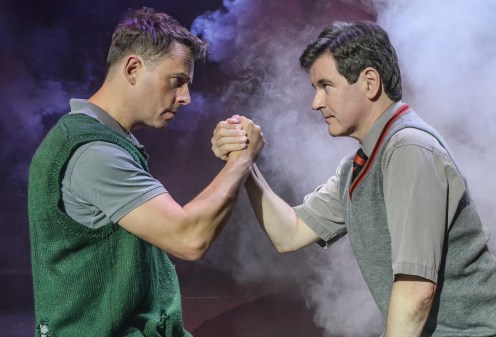
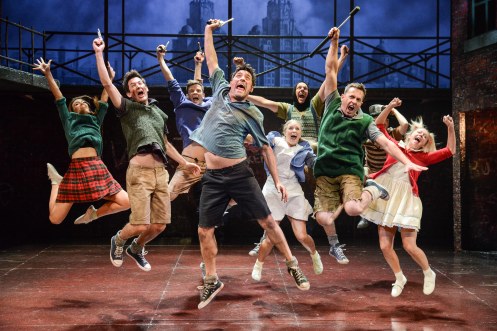
There’s a frantic pace to this production, and the audience only has to blink for the twins to be seven (but nearly eight) years old. Mickey (Alexander Patmore, the roguish beating heart of the play) and Eddie (Joel Benedict, playing the golden-haired Eddie with distinct cheeky relish) reunite, and spend the rest of the first half having carefree childish adventures. In an otherwise blistering chronology, this part of the story seems to have the most time to breathe, and rightly so. Quite apart from the comedy opportunities provided by adult actors depicting a gang of boisterous eight year olds, these scenes develop the audience’s sympathy for these characters, and throwaway elements become motifs throughout the rest of the show.
It may be opening night glitches on the mixing desk, or the actors straining the younger voices they’re using at this point, but these scenes do run into occasional problems distinguishing dialogue when all the “children” are on stage, and in parts of the lively number Kids Game the vocals become somewhat buried under Scott Alder’s small but impressively versatile band. Parts of Miss Jones suffer the same fate, as redundancy and economic uncertainty are intercut with and overshadow the celebration of Mickey and Linda’s wedding. However, the lyrics certainly shine through on the big ensemble numbers like Bright New Day and Tell Me It’s Not True.
In the second half, with the twins in their teenage years and beyond, the tone darkens quickly, and characters like Linda (Danielle Corlass in a wide-ranging performance) come into their own. Conversely, Mickey’s delinquent older brother Sammy becomes less interesting as he ages from the cocky leader of the childhood gang into a walking plot device to get the other characters in trouble. Paula Tappenden’s immaculate Mrs Lyons is credible as she deteriorates from friendly middle class housewife to a neurotic and vindictive mess. Her final act in the show defies logic, but Tappenden’s performance is strong enough to suggest that it’s motivated purely by spite.

The rest of the cast bring a brisk pace and bright energy to the whole show, but while this is very much the same production of Blood Brothers that I’ve seen on a couple of occasions over the years, I felt the overall tone was a bit darker. There’s underlying menace even to the carefree scenes from the characters’ childhood, and the Johnstone children’s legs are slathered with streaks of dark make-up to suggest a certain level of mud and squalor. Their childish jokes and insults seem pointed and hurtful, and even the delivery of Eddie’s first swear word to his mother seems to have a certain weight to it. Hints of the show’s tragic finale are never far away with this powerful current cast, even at the lightest moments.
But however the production has evolved over the years, it heads inexorably to the same conclusion, and if there is a dry eye in the house at the end of the soaring climactic rendition of Tell Me It’s Not True, it certainly doesn’t belong in our section of the audience, or indeed to any of the front of house staff that we pass on our way out of the building.
Andrew Lawston
February 2020
Photography courtesy of Bill Kenwright Productions
Image-conscious
The Duchess of Malfi
by John Webster
Putney Theatre Company at Putney Arts Theatre, until 15 February
A review by Matthew Grierson
Webster was, according to Eliot, much possessed by death, and this much is clear from the corpse-strewn tableau that concludes The Duchess of Malfi. But this intelligent, inventive production shows the tragedian was just as possessed by images – images that director Jaz Manville realises highly effectively in her pacey, dynamic staging. Attending closely to Webster’s verse, she draws out its images both visual and textual to intimate its contemporary resonances without ever imposing them on the play, or indeed on the audience.
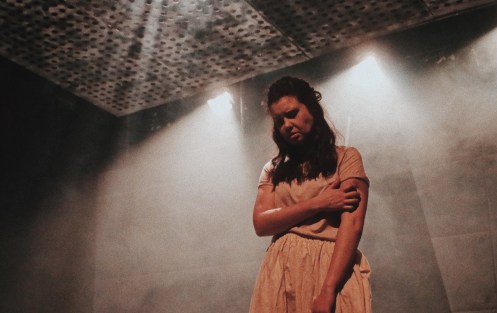
We are witness not only to the swift and often violent intrigues of the court, but to the way its protagonists manipulate these images: taking up a camera phone, they project close-ups of the action on to the wall behind, often contrasting with the full spectacle on stage. Live footage of the Duchess (Rachel Hewer) being primped at the opening of the play contrasts with the sotto voce exchange between her brothers below her, in which they express concern about preserving the popular image of her as a dutiful widow.
Although the Duchess is capable of using imagery to her own ends when she frames her clandestine husband, Antonio (Graham White), to enable his escape, she is just as susceptible to its power, and takes the jerky video of his supposed death – the ‘wax presentations’ of Webster’s dialogue – as reality. Even her brother Duke Ferdinand (Henry Peters), who masterminds her death because he thinks she has tarnished her own image, is vulnerable to the images he has helped to propagate: the motifs of wolves and of animal prodigies in men’s likenesses are consummated with his descent into madness, when he prowls the stage in lycanthropic form. Prophecies, like the horoscope cast for the Duchess’s eldest, become self-fulfilling.
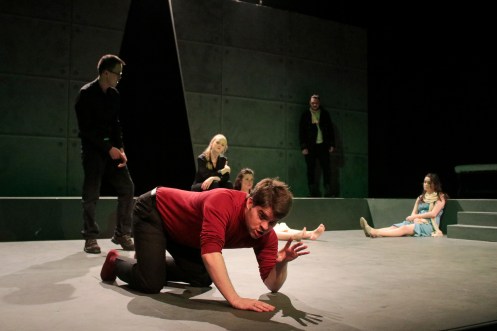
Though each character pays homage to image, the cynicism with which they do so means they are prone to betray themselves dramatically before the audience – the one set of eyes they cannot hide from. The director is sudden with us in orchestrating these displays of hypocrisy, from the moment the Duchess tries it on with Antonio barely a beat after she has promised her brothers she will never remarry.
This does make her flirtation seem more wilful than passionate, however, and the chemistry between the lovers at this early point has the air of nursery children playing at mummies & daddies. This impression is somewhat confirmed by White’s boyish manner as the steward; he has a tendency to rush his lines, and looks at times to be dwarfed like an infant in his father’s coat. The scene in which Bosola feeds the Duchess apricots also strikes an odd tone, being played by Hewer with a comedy as bluff and broad as her northern vowels.
Where it counts, though, the cast convinces: a three-way exchange between the Duchess, Antonio and maid Cariola (Becki Dack) is touchingly natural in its light humour and shows the genuine warmth of the household, before the scene turns on a proverbial ducat to become menacing as Ferdinand arrives onstage. Peters glowers and stomps his way through the villainous role, until the murder of the Duchess sees a one-eighty in his conscience. Then, his performance deepens in maturity, as though his hatred and disgust of his sister had itself been so much childishness, and we see the hypocritical pity that presages the Duke’s descent into lunacy. Hewer likewise energises the Duchess’s distress in the darker second act with a raw and immediate performance, before facing her murder with a quiet dignity; ahead of her strangulation, which is pretty throaty, she reclaims her own image by composing herself for the phone being held by Bosola.
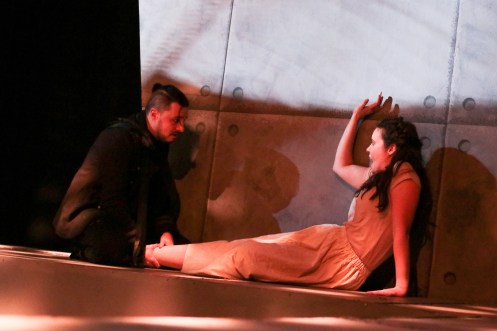
As the character whose arc we follow throughout the play, Bosola’s may be the real tragedy of The Duchess of Malfi. ‘[A]s we observe in tragedies/That a good actor many times is curs’d/For playing a villain’s part’, he becomes the antihero the brothers have cast him as. He is afflicted by a persistent melancholy on being demobbed at the beginning of the play, which we might read as PTSD, and he falls into the brothers’ bad company as their ‘intelligencer’, reporting the Duchess’ doings back to them. Jerome Joseph Kennedy turns in a sardonic, haunted portrayal that ties together the play’s humour and horror. Always ready to speak truth to power, the murders he is commanded to undertake take their toll, and he turns on his masters, leading to the bloody finale.
Strong support comes from Alice Hope Wilson as Antonio’s confidant Delio, one of the few characters honest enough to survive the slaughter, Lucas Omar as the scheming Cardinal, and Lucy McIlgorm as his mistress Julia, a wanton contrast to the noble Duchess. The professional feel of the piece is enhanced by Cat Fuller’s simple but highly effective design, with a black stage augmented by a raised surround and steps and a wall of rivetted metal panels behind. Although access is freely made through a triangular section of curtain between them, and at either side, the space is quickly and effectively transformed into the Duke’s dungeon with light thrown through the rings of the ceiling. Hannah Hayden’s music, with its rhythmically eerie electronic cues, underscores this menacing ambience. The definite look of the piece is completed by the wardrobe, giving it a simplified mid-century feel – with their long coats and suitcases, the fleeing Duchess and her eldest child (Clara Tubiermont) put me in mind of evacuees during the Blitz – and goth flourishes for Bosola and the Cardinal.
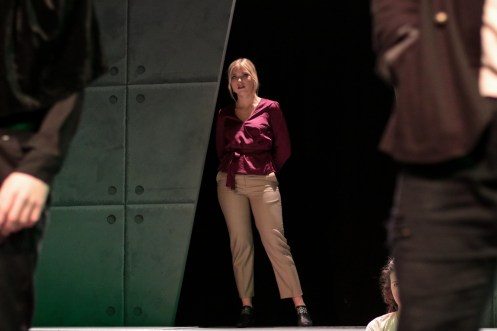
The production’s ability to make memorable images means that, long after the deaths of the Duchess, Cariola and Antonio, their bodies remain on the stage, propped up ragdoll-like as the remaining action takes place between them. It’s a fitting way to dramatise the title character’s declaration that ‘I am Duchess of Malfi still’, and show how the moral consequences of the Duke and the Cardinal’s concern with image are closing in on them, restricting the scope of their power. Death-driven it may be, this is an energetic and engaging production that commands the audience’s attention, lingering in the mind’s eye like an after-image.
Matthew Grierson
February 2020
Photography by Ben Copping @benpretends
Three’s Not a Crowd
Darling It’s Not About You
by Julia Thurston and Sof Puchley
Threedumb Theatre at The Tristan Bates Theatre, 8th February
Review by Denis Valentine
At a time where shows like Sex Education 2 are being heavily watched on Netflix, Darling It’s Not About You is cut from very much the same cloth (imagine if Sex Education was about the love trials and tribulations of those in their early twenties rather than teenagers).
The style of the play changes throughout, addressing the main theme of love in three classic forms: it is a poem, a song and a story all intertwined together. Each of the three actors on stage break off at times to show their dramatic and straight acting skills before coming back together into the ensemble to tell the overall story as one.
In what would typically be a love triangle that forces the audience to take sides, it is testimony to the writing and strong character work that there is no clear hero or villain to the piece, and that sympathy and understanding are invoked by each of the three players.
Actress and co-writer Julia Thurston anchors the play with a great first opening monologue that does well to establish the mood and themes of the story that is about to unfold.

Amy Leeson has wonderful comic timing and elicits many genuine laughs from the audience with an almost throw-away style of interjection. Her character work is strong, and the audience never sees her as the cuckold but as someone genuinely trying to understand their own feelings.
As Joel it is a tribute to Chris Mohan’s natural charisma and presence that he brings humour and empathy to a character that could so easily have been more of the classic villain of the piece in his struggle to choose between two people to love.
The way the play is written, by Thurston and Sof Puchley, is clever in the sense that at times rhyme and poetry are suddenly woven in for brief interludes before the writing suddenly returns to a more straight prose style, which really brings to life the relatable thoughts and emotions one might feel or struggle with or relish in such relationships.
It may be due to the time constraints and what is possible in this type of production, but the only slight disappointment is that the ending creeps in rather than landing with a final dramatic punch.
Director Bethany Fox’s staging is excellent and makes the most of a stripped back set and minimal props. The stage always feels full and the way the play is crafted means there is never a clear hero or someone to root for but rather three people to try to understand.
Denis Valentine
February 2020
Photography courtesy of Threedumb Theatre
Razor-Edged Exhilarating Bleakness
Rough for Theatre II and Endgame
by Samuel Beckett
Old Vic Baylis Company at the Old Vic Theatre, Waterloo until 8th March
Review by Heather Moulson
I was so glad to get to the Old Vic to see a revival of these two Beckett productions of Rough for Theatre II and Endgame, the former being rarely seen.
W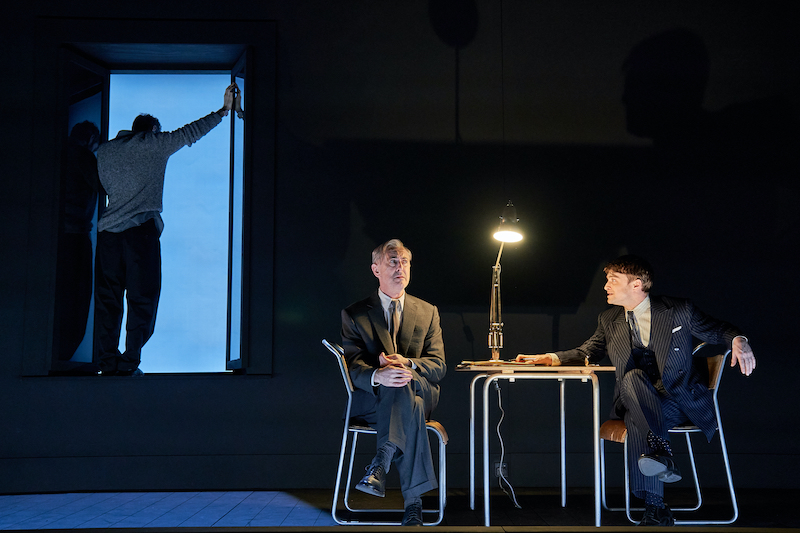 e open up to a very stark, albeit short, first play with Daniel Radcliffe, as “A”, and Alan Cumming, as “B”, sitting desk to desk in semi-darkness; a simple and strikingly clever set, but not unassuming. A large window frame is a focal point, where there is a silhouette of a man about to jump from a great height. A and B relish the painful aftermath of this suicide … but perhaps he had already fallen to his death. Or was he hung in suspension and the duo had to assess the situation?
A disturbing tableau, with mean and grudging lamplight, the two bureaucrats look over the potential suicide’s files, with detachment and bleak black humour. Plus A goes over to the victim twice, (wiping a tear?) dangerously hanging outside the window himself. There are some genuinely funny and profound lines about the human condition.
At the interval, you realised how tense you had actually been.
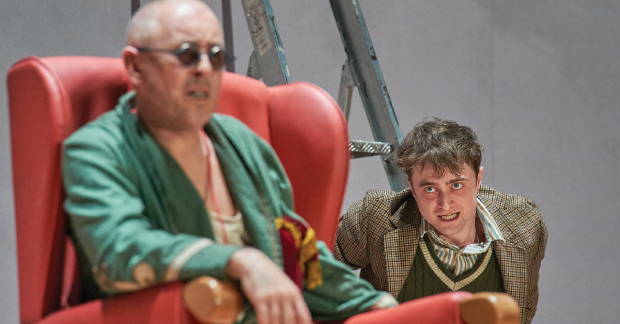 Daniel Radcliffe excelled himself as the bleak administrator, however I felt he was miscast in the second play, Endgame. Playing Clov, the lame and twisted valet to Alun Cummings’ Hamm, an invalid blind man, did not seem a comfortable role. However, that did not mean Clove didn’t produce some genuinely comical and unique moments.
The second set was subtle and innocent enough. This, however, was deceptive and not entirely straight forward. Menacing actor’s shadows appeared on the light wall, uncovering the true malevolence underneath.
Beckett’s macabre style shone through this hopelessness, making us work to unravel the situation. Richard Jones’ razor sharp and detailed direction peaks at this point.
The immobile Hamm sits in a chair centre stage, whose whims Clove grudgingly attends to. They share a grim rapport, and tangible pessimism. At will, the two wheelie-bins situated at the foot of the stage are opened. The excellent Karl Johnson is revealed as Hamm’s father, Nagg, followed by the vibrant Jane Horrocks as the mother, Nell.
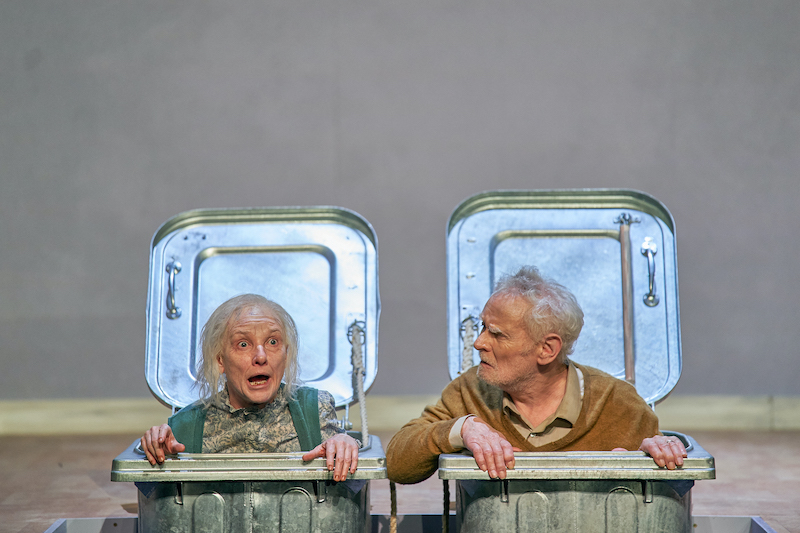 Symbolic of an old people’s home? Where they can be visited at will? Or killed off? Overtones of old people treated like rubbish? Judging by Hamm’s neglect and disregard, this could well be the case.
From then on, the point, if one ever exists in Theatre of the Absurd, started to feel laboured.
However, the play’s title, Endgame, solves some clues for us, its very meaning being a particular outcome in a game of chess. At the least, it highlights the play’s pessimism and our general doom. We are already aware of the outcome.
Or does Endgame symbolise the end of the world as we know it? Are these characters survivors of a nuclear disaster? You can’t say they’re not grim!
One left the theatre, after just over two hours and fifteen minutes, in a trance of exhilarating bleakness.
Don’t let this one get away.
Heather Moulson
February 2020
Photography by Manuel Harlan
Passion on the Rocks
My Cousin Rachel
by Daphne Du Maurier, adapted by Joseph O’Connor.
Theatre Royal Bath at Richmond Theatre until 8th February
Review by Mark Aspen
Kernow. Now there’s a name of mystery: it’s different and almost exotic. Cornwall has a certain differentness about it, the only English county with its own language, its sea pounded rocky peninsulas, beasts wandering its moors, and of course all those differently named Cornish saints, names that don’t exist elsewhere. There’s a preponderance of the surname English in Devon, an historical relic of times when the Tamar was a big boundary and the them-and-us-ness was more marked, times like the mid-nineteenth century when Daphne Du Maurier’s novel, My Cousin Rachel is set.
Add in a mysterious stranger who comes from a different, almost exotic country, and you have a potential powder-keg of tension. And of course, we are all suspicious of strangers (think the high-vis man who knocks unannounced at your front door and offers to “repair” your roof). Moreover though, if the mysterious stranger is also beautiful then it ups the potential for passion, and you have all the ingredients for the gothic romantic thriller, one of the hallmarks of Du Maurier.
Barton House is a fine country mansion on the Cornish coast, the home for many generations of the landed and wealthy Ashley family. Twenty-four years old Phillip is the current incumbent of Barton and, following the death in Italy of Ambrose Ashley, Phillip is due to inherit the estate on his twenty-fifth birthday. He had been orphaned as a young child and for most of his life Ambrose, an older cousin, had been his attentive and loving guardian. Now, in these months before Phillip is to become master of Barton, the estate is held under the trusteeship of the family solicitor, Nicholas Kendall, also a close family friend, affectionately known as Nick. Indeed, his daughter, Louise has been always Phillip’s childhood companion.
Notwithstanding the frequent visits of Louise, Barton House has been an exclusively masculine domain. Even the household servants are all men, the old retainer John Seecombe and the young Thomas Conners, given employment after losing a leg in an industrial accident. Masters and servants have a mutual loyalty and respect which binds them in this austere environment. Into this milieu, unexpectedly, arrives an Italian countess, Contessa Sangalletti, who is Ambrose’s widow and another cousin in the tangled branches of the Ashley family tree. She is Rachel Coryn Ashley.
The presence of Rachel has an unnerving effect on the settled household. Rachel is a stranger, an exotic foreigner, and most difficult of all, a woman. On all three counts, she is a cause for deep suspicion. Why is she here: is she merely nostalgically visiting her late husband’s home, or is she after something for herself? Did Ambrose die, deranged, from a brain tumour, or did she have some hand in his death? Has she come to give or to take, to build or to destroy? The feelings of Phillip and Nick, and even of Louise, see-saw between attraction and repulsion. Only the servants are delighted in what seems like a breath of fresh air from the self-assured Rachel, but the other men feel threatened. Moreover, she is very beautiful and her attractions, of which she is all-too aware, gradually outweigh the balance of the see-saw. Clues push feeling one way or another and the plot develops more twists and turns than a Cornish cliff path.
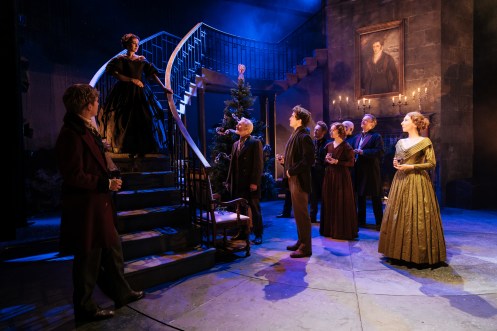
The atmosphere of this volatile situation is beautifully evoked in designer Richard Kent’s clever set, mounted on a revolve and symbolically symmetrical. Its overarching feature is an elegant sweeping spiral staircase, its helix embracing the gothic Barton house, black and purple with soot-blackened baronial fireplace on the inside and opening to the Atlantic seascape at Guinevere’s Point on its outside. David Platter’s mood-enhancing lighting and Max Pappenheim’s tingling soundscape complete the charged ambience.
The metastable balance is carefully handled by director Anthony Banks and his skilled cast. Banks is not afraid to use silence, not in the sense of an awkward hiatus but of a suspended moment, characters weighing each other’s motives, a look that betrays the words, or that eyes-meeting moment. There is “the awful daring of a moment’s surrender” as T.S.Eliot would have put it. Banks is a prolific director, and a past-master in the thriller, many of which have been seen at Richmond Theatre (most recently Dial M for Murder) and hits a zenith with My Cousin Rachel.
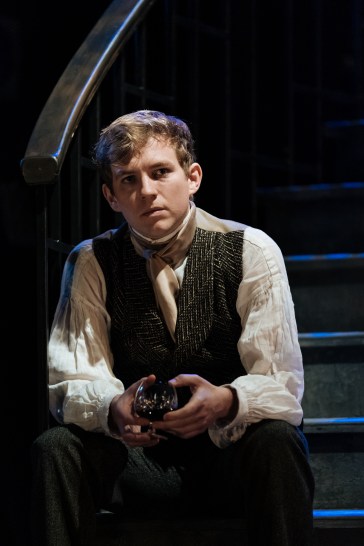 The Phillip Ashley we first see is grieving and not able to come to terms with Ambrose’s death. He is at the anger stage of grief and looking for something to blame. After the arrival of Rachel, his petulance becomes impetuosity as the charms of the older woman win over his suspicions. Jack Holden as Phillip depicts an immature young man, who would be a lairy “youf” if it were not for his sense of duty, but one who is genuinely troubled. He is a complex character, full of deep affection for his home and his household, including his loyal servants. Holden’s Phillip is buttoned-up with values instilled in him as a member of the landed gentry, but with another Phillip, impulsive and expressive, bursting to get out. Here is a young man with a long emotional journey from a misogynist, who equates marriage with murder, to a bowled-over lover who would give everything he has for the cousin with whom he has become infatuated.
 The impetus of that emotional journey of Phillip’s is the eponymous Cousin Rachel, an enigmatic figure of aristocratic bearing, fearless and self-confident. Helen George, currently best known for her role in the television series, Call the Midwife, here delivers an outstanding portrayal of Rachel as imperious and proud, her clipped tones adding to her authority. The multifaceted mystery of this winning widow only serves to add to her allure, and she is certainly not a lady to be crossed. She is intelligent and her multiple talents range from creating exotic tisanni, her herbal teas that raise further suspicions amongst her paranoid hosts, to landscape gardening. Helen George’s attractive portrait of Rachel is boldly painted, with strong characterisation, a particular example being her powerful speech when Rachel rejects a monetary allowance as unwanted charity, accusing Phillip of “ignorance and arrogance”.
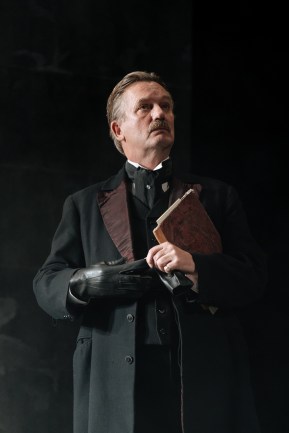 Kendall regards himself as guardian of not only the estate of his friend Ambrose, but also of the good name of the Ashley family and, by extension, that of local society. He constantly admonishes Phillip for any perceived in impropriety or weakness, urging him not show his emotions in front of the servants, whilst himself at first falling for Rachel’s charms. His mantra, “Things are done a certain way” is taken up by Phillip, sometimes mainly to extract himself from embarrassment. An assured and insightful actor, Simon Shepherd cuts a sharp figure as Kendall, astute and protective, yet not impervious to distractions.
Phillip fails to see that Louise is in love with him, although Rachel understands this straight away. The light-hearted and patient Louise is played with fetching charm by the sparkling Aruhan Galieva, as a constant factor in Phillip’s life. Louise, like her father, is both alarmed by, and jealous of, Rachel’s hold over Phillip.
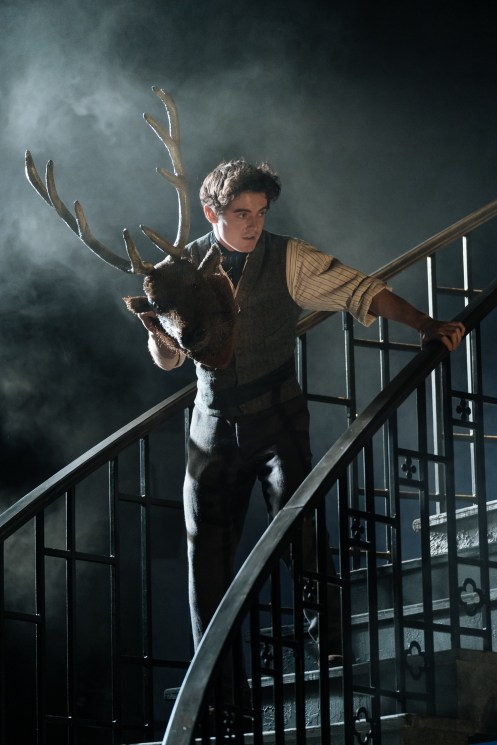
 The only characters acceptant of Rachel are the servants, Seecombe and Thomas. Long serving and much trusted Seecombe is the epitome of the “true and faithful servant”. He is comfortable with the family and they with him, but Seecombe immediately warms to Rachel, delighted to have a lady about the house once more. He can replace stuffed stag’s heads with flower arrangements, and is happy to assist Rachel in re-planning the garden. Sean Murray plays Seecombe as an amiable, kind and down-to-earth countryman. Seecombe’s loyalty is unimpeachable, think Adam in As You Like It. He also has some great Cornish turns of phrase. The manservant Thomas Conners is equally loyal, and is grateful that the Ashley family has rescued him from penury after his life-changing accident. Thomas has a hobby making string marionettes; perhaps so that he can still vicariously control a limb that he has lost. John Lumsden plays Thomas as a likeable, but sometimes cheeky young man, reliable and steadfast.
As they are beginning to be reconciled to Rachel, perhaps too much so, and Kendall warns that “the word mistress has many meanings”, so in Act Two a new side to Rachel is revealed with the unannounced arrival of Guido Rainaldi, an old friend of Rachel’s in Italy and ostensibly her lawyer. Rainaldi makes a stark contrast to Phillip and Kendall, snappily dressed and suave, he is ideologically the antithesis of them. He expresses his laid-back approach, “While you Englishmen conquer the world, we drink wine and make love in the sun”. His recollection of “nights of folly” with Rachel draws barbed insults from Phillip, who is riposted with seeming good-humoured but equally slighting replies. Christopher Hollis clearly enjoys playing Rainaldi but wisely steers way from a too-easy caricature towards a relaxed urbanity.
Banks has an eye for composition. Rainaldi’s presence in the room could have been etched by Hogarth, the Rachel-Phillip altercation in the garden painted by Millet (indeed with the two manservants in the background it smacks of The Angelus), or the Christmas scene illustrated by John Leech, it so resemble a Dickensian Christmas. This particular tableaux, with family, visitors and servants singing carols to the accompaniment of Louise on the piano, gave a quiet moment of beauty, and greatly enhanced by Christina Rossetti’s In the Bleak Midwinter, touchingly sung by the cast. A bit of an anachronism (there are a few) but who cares when the best Christmas carol in the canon is sung so well, especially by the lady members of the cast.
Harmony is however, not maintained in the running passions at Barton. Pride and jealousy surge in turn and the gradual dismantling of propriety fires up the emotional stew-pot. The plot moves on with a palpable inevitability along a path strewn with red herrings. If the path were straight the dramatic ending would be one of overblown melodrama, but this is Du Maurier who has ensured that it is not. There are the checks of the unexpected turns, of the balance of emotions, and there’s the mystery, the exoticism, there’s Cornwall.
Mark Aspen
February 2020
Photography by Manuel Harlan
No Score
The Maestro’s Last Words
by Barry Langley
A Trevor Hartnup production at the OSO Arts Centre, Barnes, until 8 February
A review by Matthew Grierson
An old white man from a privileged background with an international reputation finds out he has lymphoma, but the lump is swiftly and successfully removed in a private hospital: it would be difficult to spoil the surprise of The Maestro’s Last Words as, sad to say, there isn’t any.

The play attempts to overcome its dramatic deficit by being fortissimo from the outset, but, with so little at stake much of the incident feels contrived, bearing little sense of a reality with which we can engage. I appreciate we’re in an operatic milieu here, but there’s no modulation of the self-involved tone orchestrated by Sir Charles Ackroyd (Edmund Dehn). When, for instance, the conductor’s entourage visit him in hospital as he convalesces, they waste no time in running around screaming the place down with the threat of a lawsuit. There is no sense of crescendo, it’s a forced farce.
Yet the play doesn’t seem to be pitched as a comedy either. What jokes there are have little weight or build-up, as exemplified by the ill-judged interjections made by Sir Charles’s hapless secretary Hickton (Alexander Jonas) when his employer is entertaining morbid visions. The one joke that evidences some sense of structure is when soprano Madame Fontana (Violetta Gapardi) is invited to sing: assuming an operatic posture she then simply offers an anticlimactic: ‘No.’ I had thought this was to avoid the need to cast a trained singer, but Gapardi acquits herself admirably in this regard when she does get to sing.

Intimations of mortality ought to give an author something worthwhile to work with, whether they were going for introspection or dark comedy, but Barry Langley’s script is a series of rococo flourishes off the idea without taking it anywhere. This is typified by dumping information into the dialogue so we know exactly how he has conceived the characters, rather than taking us on a journey with them. Exhibit A: ‘You know I always conduct without looking at the score,’ says Sir Charles, telling Fontana something that she is explicitly already aware of. ‘Yes,’ she replies, ‘you’re world-famous for it.’ So now we know.
For a play so ostensibly concerned with music it’s surprising that all the characterisation is one note: Hickton is a toady, producer Herr Kleist (Stephen Riddle) is hysterical, Fontana is a diva, the Sister (Robin Miller) is firm but fair. If the story doesn’t develop, then the characters seemingly can’t. That’s not to say that Dehn isn’t watchable as Sir Charles, and present onstage for much of the play he sustains what momentum it has. He manages to convey something of the man’s ego and the physicality of his illness, but he is never allowed the opportunity to show the distress or vulnerability that would make us sympathise with, if not warm to, him. Is his doctor trying to kill him? Will Fontana leave him for a rival? Or has he really thrown her over for a nurse? It’s not so much that I wasn’t clear, it was that I didn’t care.
Surgeon Professor Galt (Martin Wimbush) fares a little better. Former schoolmate to Sir Charles – and long-time rival in a tiresome ‘two cultures’ debate that rears its head every now and again – he has a tongue-in-cheek sense of humour that the twinkly Wimbush brings to life, as when he joshes with his patient by sharpening a carving knife before an operation. But then I suppose am inclined to sympathise with a man who only goes to a show because he was given a complimentary ticket.

Nurse Hodges could be a breath of fresh air, too. Certainly in Mimi Tizzano’s unaffected performance she’s the most relatable of the characters, with a lighter touch when it comes to humour – I did actually chuckle when she told the recumbent conductor: ‘Your famous last words might be “Nurse! Get your pen out!”’ But the script largely lumbers her with being a dim-witted caricature of a working-class professional.
The show ends with Fontana’s rendition of ‘Song to the Moon’, a resurrected Sir Charles clad in his dressing gown conducting her, but the significance of her doing so is, like much of what happens in the play, unclear. It’s not funny enough to be a comedy and not plausible enough to be drama, so I still can’t see what The Maestro’s Last Words is trying to be.
Matthew Grierson
February 2020
The Mother of All Rom-Coms
Pride and Prejudice
by Jane Austen, adapted by Simon Reade
The Questors at the Judi Dench Playhouse, Ealing until the 8th February
Review by Emma Byrne
It is a truth universally acknowledged that Jane Austen is once again à la mode, with the film adaptation of Emma landing for Valentine’s Day, all decked in tulle and ringlets.
On the tulle and ringlets front, the Questors production of Pride and Prejudice refuses to be outdone. It has a wardrobe department of twenty under the direction of designer Carla Evans. That’s one more costumier than the nineteen-strong wardrobe department for the upcoming film. With gowns and petticoats aplenty, Pride and Prejudice doesn’t shy away from the ‘costume’ challenge of costume drama.
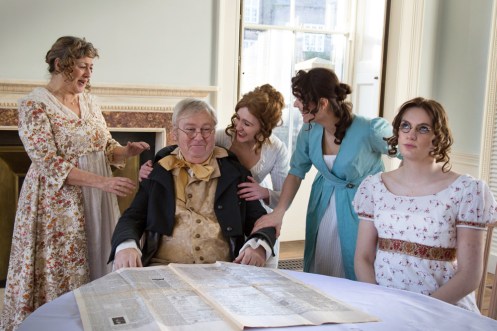
In some places, the costumes themselves deserve supporting actor billing: the gown and chapeau of Lady Catherine de Bourgh deserves a spotlight of its own. Wisely, director Sukhi Kainth allows us to revel in the visual feast of the gowns and breeches, as well as the effective and impressionistic set by Bron Blake, by opening with a dance number before hitting us with Mrs Bennet’s opening line: one of the most recognised lines in the canon of English novels.

And here is the challenge; Pride and Prejudice is such well-worn stuff that there is a danger that it can become threadbare with use. Cutting and stitching to display the material at its best is the job of the playwright and the director, and here they have done a deft job. Some things are necessarily compressed. Reade’s adaptation focuses on the will-they-won’t they pairings of the two elder sisters and gives only brief asides to the darker core of Austen’s work: the unenviable lot of women whose role was to remain in a marriageable state until a suitable match could be made.
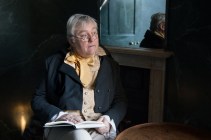 But what Reade’s adaptation does, it does well, and the cast carry the pace beautifully. Anthony Curran plays Mr Collins with an oleaginous self-satisfaction that is both great fun to watch and utterly horrifying to imagine in one’s partner for life. Sarah Morrison’s Mrs
 Bennet and Robert Gordon Clark’s Mr Bennet play beautifully together. Alexandra Rose Wilson’s Jane is so sincerely lovely, and James Burgess’ Mr Bingley so sweetly affable that it is impossible not to wish to see them reconciled. This is a beautiful change of pace from some adaptations that make the two of them such simpering simpletons that the cynic in me fears for the intellect of their offspring.
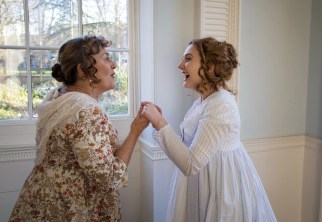 And while it is unfair to pick out favourites among such a strong ensemble, Kitty Cockram’s Lizzy and Madeleine Tavare’s Mary both won my heart in different ways. Cockram’s performance is rangy, bringing a truly rounded presence to a character that could so easily become a wafer thin portrait that is simply entitled ‘Feisty!’ Meanwhile Tavare takes what really is a wafer thin portrait (here entitled ‘Nerd!’) and imbues Mary with sweetness and a crippling lack of social poise. Tavare’s comic timing and consistent character deservedly got some of the biggest laughs of the night whilst also making me ardently hope that Mary gets her happy ever after, not through matrimony but by living out her days in a library. It is a truth universally acknowledged that we all need to get lost in a good story from time to time.
Emma Byrne
January 2020


