
Oceans Apart
Madama Butterfly
by Giacomo Puccini, libretto by Luigi Illica and Giuseppe Giacosa
Ellen Kent at Richmond Theatre until 8th March then on tour until 22nd April
Review by Vince Francis
The drive to Richmond was enriched by an intense rainbow straddling the A316. Was this a portent of some kind? We were on our way to see Ellen Kent’s production of Madama Butterfly at Richmond Theatre and I was a little apprehensive at the prospect of this assignment, not being an opera buff’ ’n all that. My initial thought was that it would boil down to my responses to three questions; firstly, given that my Italian is rudimentary at best, would the cast be able to convey the story? Secondly, would I be able to say that I was entertained by it? Thirdly would it engage me sufficiently to cause me to explore opera further?

Madama Butterfly is a tragedy – aren’t they all? – set in Nagasaki, itself to become the scene of the ultimate tragedy later in the century. Based on a one act play by David Belasco which, in turn was based on a short “pot boiler” story by John Luther Long, At its most basic, it is a case of girl meets boy, girl loses boy, the end. However, this is an oversimplification of a plot that explores some interesting and uncomfortable themes, such as the marriage of our heroine at the age of fifteen to an American naval officer. Also, we (I) learn that Butterfly, or Cio-Cio San, as the character is named, was a geisha prior to this marriage, hinting at exploitation of children. The cavalier attitude of the naval officer to this, and to his marriage vows perhaps suggests a view of American imperial ambitions of the time.
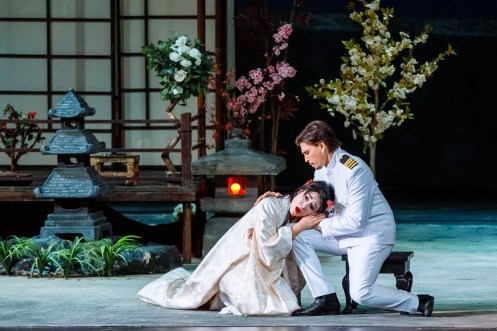
The principals all present us with well-drawn characters and real character development. Giorgio Meladze’s Pinkerton establishes himself as a swaggering cad in Dovunque al Mondo (Throughout the world), but shows real remorse when he realises the extent of his shallowness and duplicity at the end in Addio, fiorito asil (Farewell, flowery refuge).
I also enjoyed Miroslava Shvakh-Pekar’s portrayal of Suzuki, Cio-Cio San’s maid. The duet with Cio-Cio San in the second act, Tutti i fior? (All the flowers?) is particularly appealing. Iurie Gisca as Sharpless, the U.S. Consul brings a natural presence and authority to the role. Both have the talent of being able to react authentically and naturally in exchanges and when they are not in the focus of the action.
However, it is Elena Dee, as Cio-Cio San, who carries the main load of the show and gives us the complete emotional palate of the character. In this tyro’s humble opinion, Ms Dee is to be congratulated for maintaining a consistency throughout, having a delightful soprano voice, which can vary from delicacy to full force strength with apparent effortlessness.
It goes without saying that the singing is of premier quality. It may sound strange to say, but it is good to hear it sung in the original language, even if that presents a challenge to the less linguistically adroit among us (me). It appeals to my reasoning to suggest that the original language and the development of the music are inter-related.
However, if you are seated with a full orchestra between you and the performers, who I don’t think are mic’d, it is inevitable that there will be the odd moment when the vocals aren’t quite the match of the twenty-two musicians supporting, but such instances are rare.
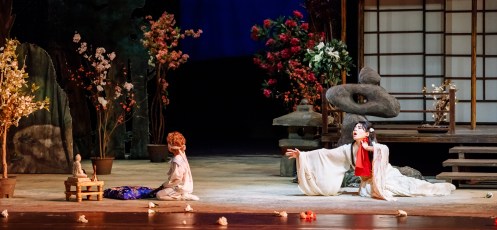
I did wonder whether Zac O’Toole, as Cio-Cio San’s child, Sorrow, was entirely comfortable on stage and there was a minor moment of unscripted comedy when Cio-Cio San accidentally covered him entirely with the sleeve of her robe.
There are a couple of things which I was curious about, but which any regular opera goer might be able to enlighten me on; firstly, if the night is indeed so quiet and peaceful and serene, why exactly are we singing at full volume about it? Secondly, there is an intermezzo in the second act which, presumably was written to cover a scene change between act II and act III. However, since the scenery is not changed throughout, it would seem to be a candidate for a little judicious pruning – or is that a heresy?
Having said all that I felt more engaged in the second act, which seemed to have more emotional content.
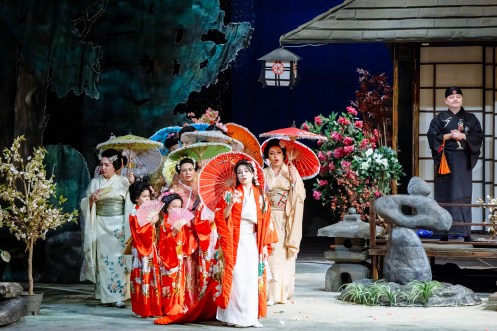
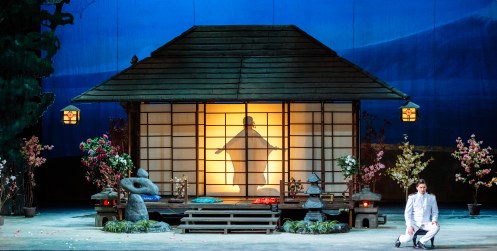
This is a touring production, so the set is kept simple in principle, with the focus being the house truck set centre stage. This uses translucent panelling, which is effective in providing silhouetted action at various points in the show. There are two other flats set stage right and left to depict garden walls, but which also serve to mask entrances and exits. The real artistry here is in the set dressing, though. Clever and interesting use of floral arrangements, together with a working water feature provide enough to describe the setting without being overly fussy. Lighting is subtle and efficient.
The orchestra, under the brisk and expressive direction of Vasyl Vasylenko, supported well and delivered Puccini’s trademark flowing and sweeping lines with aplomb.
Looking at the souvenir brochure, there appear to be two orchestras involved, each with its own conductor. The cast list provided for Sunday evening’s performance indicated that the conductor was Nocolae Dohotaru, which would imply the production was supported by Orchestra of the National Opera and Ballet Theatre of Moldova. However, the conductor in front of us looked an awful lot like the photograph of Vasyl Vasylenko, which, according to the brochure, would imply that the orchestra was that of the Ukrainian National Opera. They were superb, in any event and received a well- deserved cheer at the end. Incidentally, I did spot a little motif which I would be prepared to have a small side bet on that Schönberg “lifted” and used in the song Bring Him Home in Les Miserables.
So, how did it do on my initial questions? Well, linguistically, the sur-titling helps considerably, although it can be distracting. Did the cast portray the story well anyway? Yes, they did. Was I entertained? Yes, very much so. Do I want to see more? Maybe. It’s good to get outside your comfort zone. So they tell me.
Vince Francis
March 2020
Photography by Mark Douet
Passions Reflected
Cause Célèbre
by Terence Rattigan
Teddington Theatre Club at Hampton Hill Theatre until 13th March
Review by Eleanor Lewis
Set in the 1930s, Cause Célèbre was based on the true case of Alma Rattenbury and George Wood. When Alma Rattenbury’s marriage to the elderly Francis reaches the sleeping on separate floors of the house stage, she hires 17 year old George as chauffeur and general help. He becomes her lover. However, on realising that Alma and Francis’ marriage is not in fact entirely dead, George finds himself unable to cope and takes extreme action. Horrified, Alma rises to the occasion, assumes personal responsibility and is tried alongside George for her husband’s murder.
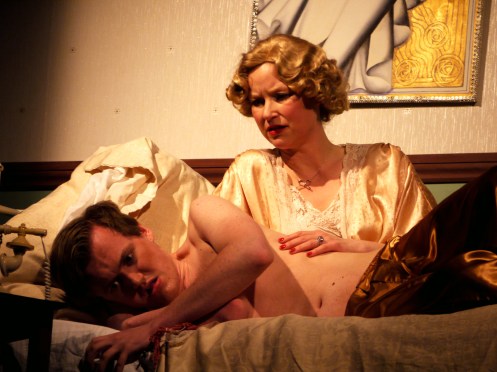
Rattigan, however, has more to bring to his audience’s attention than a shocking trial. He is fabulously good at women, specifically women of a certain age about whom he writes with great sensitivity. Hester Collyer in The Deep Blue Sea (1944) and Olivia Brown in Love in Idleness (1952) are witty, intelligent and firing on all cylinders, their lives restricted only by the social mores of the time, and their men – both lovers and sons. Alma Rattenbury is another of these women, far more than the wicked corruptor of boys the tabloids would have her be. Rattigan’s master stroke in Cause Célèbre, though, was to include the character of Edith Davenport and TTC’s master stroke (presumably in the person of director Fiona Smith) was to cast Jane Marcus as Mrs Davenport.
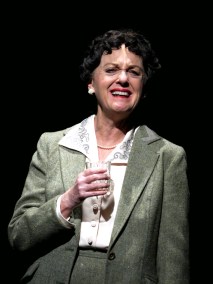 Superficially Edith Davenport is the antithesis of Alma Rattenbury. Alma takes sexual freedom for granted. Edith is someone for whom ‘that side of things’ has never given her any pleasure, but the two women are in fact close in character and in their sense of what is right. Both are also doomed to misery, one for following her passionate soul, the other for not knowing hers existed. Jane Marcus’ performance as Edith Davenport was both skilful and endearing. This potentially wounded and embittered woman was seen as a sympathetic, dignified character whose emotional life had been cruelly unfulfilled. When the judge refuses her pleas to be excused jury service as she knows she is prejudiced against Mrs Rattenbury, Edith grits her teeth and goes on to do her duty with great integrity.
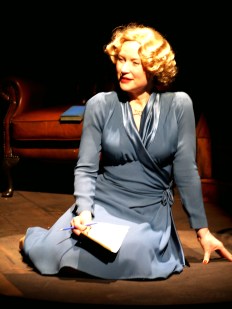
Similarly Alma Rattenbury as played by Mia Skytte-Jensen, loving and seeking male attention of any sort, was an honourable woman, a victim of the times rather than any one individual.
The level of performance in this production was consistently high. Jake O’Hare as George Wood had little to work with but nonetheless produced a convincingly confused and unpredictable teenage boy far out of his depth. Jacob Taylor managed to convey the exact boy-to-man point at which Edith’s son Tony found himself with the mix of excitement and panic that entailed.
Particularly enjoyable were the exchanges between Edith and her sister Stella (Dionne King) which were both brisk and authentic. Everyone in fact shone in this production. Daniel Wain clearly enjoyed himself playing the eccentric, slipper-wearing KC, O’Connor acting for Mrs Rattenbury and if Sue Reoch as Montagu isn’t already in the legal profession, she probably should be. Additionally, the gentle ‘thawing’ of Heather Mathew as warden Joan Webster was endearing and Genevieve Trickett as the put-upon companion Irene was played as a character with more to her than was on display. Jack Dwyer produced a particularly mature performance as Alma’s young son Christopher.
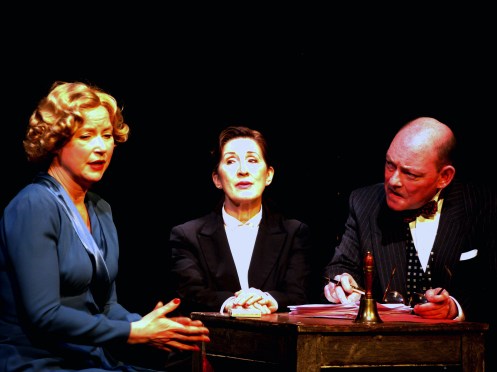
Patrick Troughton’s wood-panelled set brought a ‘closed in’ atmosphere to the proceedings (beautiful staircase), though any action taking place stage left seemed a little cramped. Mike Elgy’s lighting was perfectly judged, the darkening and spotlighting at certain points added a sense of things shutting down. There seemed to be some small issues with sound on opening night, Chris Morris as the floundering policeman was not always audible when he was positioned at the top of the set but these, I imagine were first night issues.

Zoe Harvey-Lee’s costumes were exemplary, including hats, all hats male and female were worn at the correct angle for the period. (We do love a detail!)
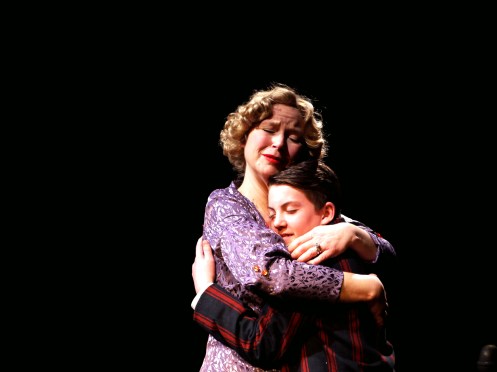
In 1968, 33 years after the trial of Alma Rattenbury, Paul Simon wrote a song about a certain Mrs Robinson. Fifty years on and despite huge social progress, it is probably still the case that a middle aged woman with a younger man will attract more general opprobrium than the other way around.
“Laugh about it, shout about it,
When you’ve got to choose
Every way you look at this you lose.”
This is a very good production, TTC and Terence Rattigan are a very good mix. Highly recommended.
Eleanor Lewis
March 2020
Photography by Cath Messum
Raw Bonds
First Love is the Revolution
by Rita Kalnejais
The Questors at the Questors Studio, Ealing until 14th March
Review by Nick Swyft
Basil Brush meets Shakespeare, in this imaginative retelling of the Romeo and Juliet story like no other.
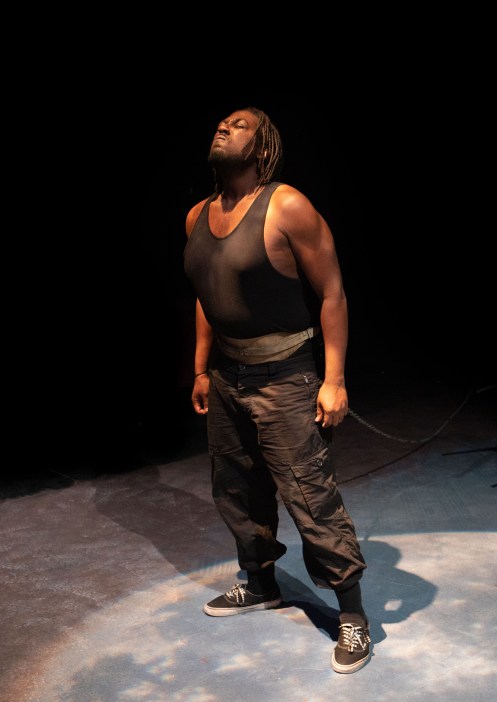
The play opens with a brother and sister holding up a leaf covered window and looking through it. The girl shrieks randomly, and at first the audience might be forgiven for thinking that the play is about mental health. It is not, although the synopsis suggests that this could be a fantasy that the main character, Basti (Zac Karaman) uses to shield himself from the trauma of his mother’s absence. Like The Life of Pi, you can choose which story to believe.
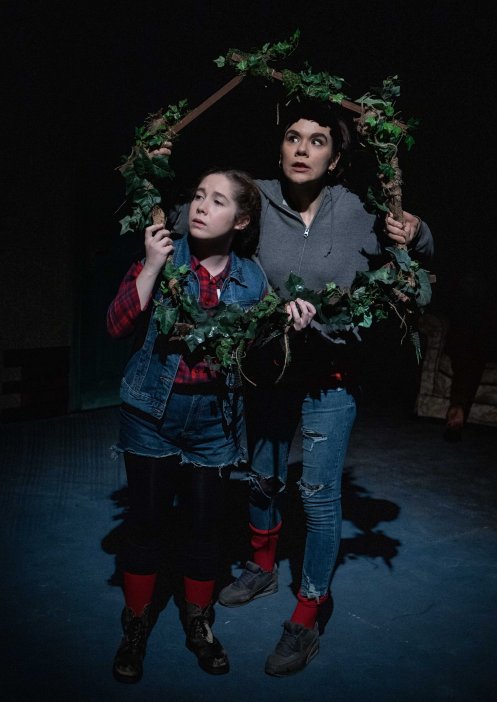
It turns out that the brother Thoreau, played by Jason Welch, and sister Gustina (Gusti), played by Lucy Palfreeman, are foxes, and the window is the entrance to their den.
The play portrays the discomfort and violence of life in the wild very effectively, starting with the mother Cochineal, played by Maya Markelle capturing a mole, Gregor, played by Iain Reid. The youngest daughter Rdeca, played by Fionna Gough, is introduced to Gregor. He is to be her first kill. She must, after all, learn to hunt like the rest of her family. Gusti shows her what to do, and Rdeca attacks him, but doesn’t kill him outright. She is ordered to bury his corpse and there is a lovely piece of comedy in which Gregor ends up digging his own grave. Being a mole he just wants to do a proper job.
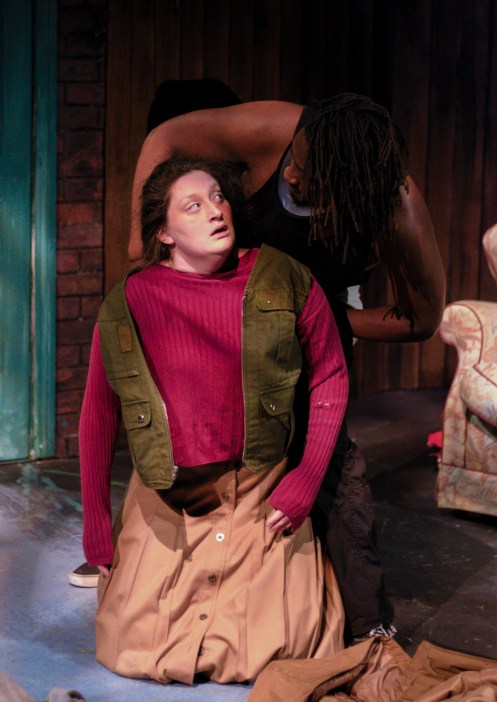
The scene then switches to show us another family, this time human. Basti played by Zac Karaman lives with his dad Simon played by Mike Hdjipateras. He is being bullied at school, because of his state of mind. Basti is focussing his mind on building traps for foxes.

He meets Rdeca when she is caught in one of his traps. We are not told how, but the two of them can talk to each other, and an unlikely relationship develops. Rdeca teaches Basti how she lives, and Basti treats her fleas.
Like all good plays, the comedy is counterpointed by moments of high drama and emotional tension. There is, for example, something uniquely distressing about the inhuman way the foxes cry when tragedy strikes.
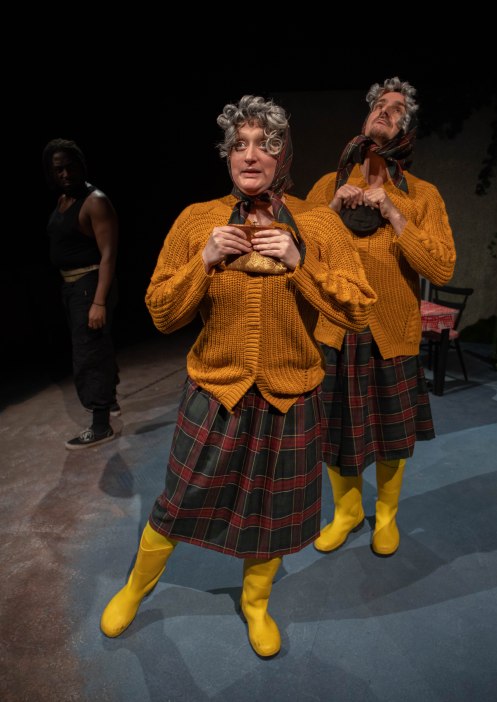
The production is refreshingly sparse, although having the actors eating cereal saying ‘crunch crunch crunch’, seems unnecessary; we know what they’re doing. Many of the actors play multiple parts. Lucy Palfreeman, who plays Gusti, also plays Basti’s upstairs neighbour Gemma whom dad, Simon, is hitting on. She is also delightfully sensual as the farm cat Smulan, who teases the farm dog Rovis, also played by her ‘fox brother’ Jason Welch. The farm chickens may be recognised as Cochineal the fox mother (Maya Markelle) and Simon, Basti’s dad (Mike Hadjipateras). One might read something into this, perhaps?
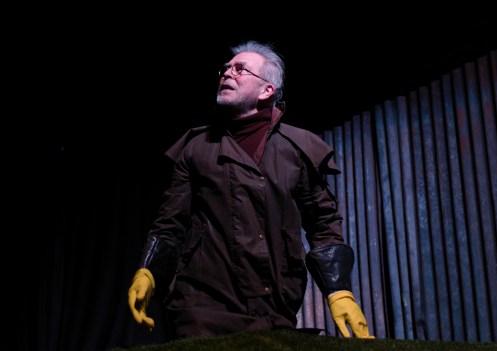
Actually one could read a lot into this play. Shakespeare’s Romeo and Juliet highlighted the tragedy of star-crossed lovers in inter-family strife, and there have been many productions that have applied this to race and sexuality. To apply it to species might seem a step too far. Society is maybe not ready to accept bestiality, but it’s not likely that many audience members will go away disgusted. That is the genius of the playwright Rita Kalnejais, the actors and the production team.
Nick Swyft
March 2020
Photography by Robert Vass and Evelina Plonyte
All in Place
Hairspray JR
by Marc O’Donnell and Thomas Meehan
Questors Youth Theatre at Judi Dench Playhouse, Questors Theatre, Ealing until 7th March
Review by Vince Francis
Hairspray JR is a cut-down version of the full musical, Hairspray, edited to be family friendly and thus a candidate for schools or youth theatre productions.
For those who may not be familiar, the original Hairspray is an American musical with music by Marc Shaiman, lyrics by Scott Wittman and Shaiman and a book by Mark O’Donnell and Thomas Meehan, based on John Waters’s 1988 film of the same name. The action is set in Baltimore, Maryland in 1962 and the songs include 1960s-style dance music and downtown rhythm and blues. The plot revolves around the heroine, teenager Tracy Turnblad, whose dream is to dance on The Corny Collins Show, a local TV dance programme based on the real-life Buddy Deane Show. When Tracy wins a role on the show, she becomes a celebrity overnight, leading to numerous consequences. One consequence is stealing the boyfriend of the incumbent Miss Teenage Hairspray; an altogether bigger consequence is the beginning of social change as she campaigns for racial integration on the show.
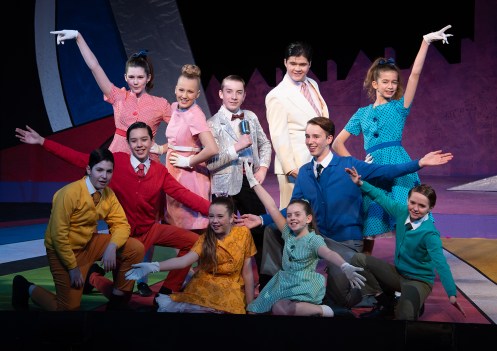
So, where to start? Well, the show is a one-act version, running for approximately 75 mins and, with a curtain up time of 7:15pm, it is both appealing to and practical for parents and the children involved. It is playing in the main auditorium, where the stage thrust has been removed to provide space for extra seating facing the proscenium and a walkway created in the space surrounding this seating.
The production itself is a delight. I did wonder whether abridging the book to this extent might mean that some significant elements may be lost. Some are, of course, for example the relationship between Tracy’s parents, Edna and Wilbur, isn’t explored to the same extent as the full production, which means their comedy duet (You’re) Timeless to Me is dropped. However, Alice Barker and Joshua Carr in the respective roles capture the deep connection between the two. There are a couple of other numbers omitted, but actually – dare I say it – they aren’t missed as much as I thought they might be. So, the lesson for me is that this is a production in its own right and should be treated as such.
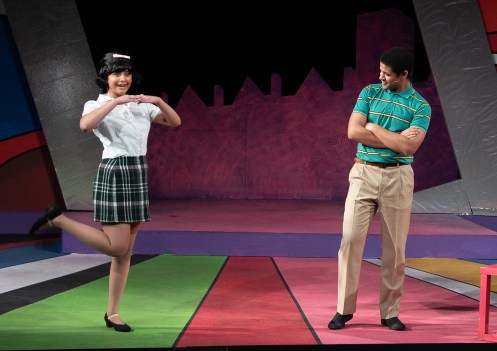
Emily Turner gives a beguiling performance as Tracy Turnblad, having an excellent singing voice and a sense of innocence and wholesomeness that is key to the character.
Isaac Beck has captured the spirit of the 1960’s television presenter; slick, slightly sickly, but always seemingly in control. Similarly, Sam Thompson Roche’s Link Larkin provides the veneer of Elvis-like louche cool that cracks with the warmth of true affection. The Temptations-style number It Takes Two is one to savour.
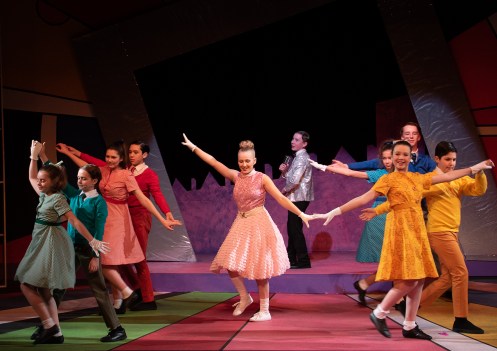
I’ve often heard actors say that playing baddies is more fun that playing goodies and Blonda Bolganschi, who I’m sure is delightful in real life, is clearly having fun here providing us with the deliciously spiteful over-indulged princess that is Amber Von Tussle in the process. A nod here, too, to Stella Robinson’s interpretation of Amber’s ambitious mother, Velma, which was equally forcefully played.
William Connor gives an admirably assured and mature portrayal of Seaweed J. Stubbs, complimented by some of the slickest dance moves in the show.
I like Motormouth Maybelle ‘s rendition of the iconic I Know Where I’ve Been very much. Motormouth is played by Destiny West, whose voice is well suited to this number, but I felt she was a little nervous, which is perfectly understandable for opening night in the main house. She needn’t be, in my view, and once she relaxes a little, I’m confident that will soar.

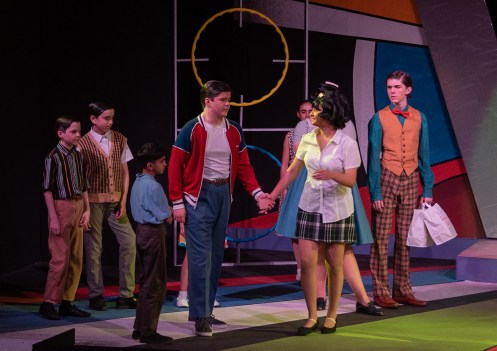
The direction of the piece was overall pleasingly pacy and made good use of the space, with cast and chorus using the auditorium stairways and the passerelle to great effect – particularly in minimising the crowding that can take place exiting the stage after a big chorus number. Also, the use of suggested scenery, such as the hand-held jail bars, helps to keep things rolling.
Sarah Page’s choreography hits the mark with period appropriate moves and a well-disciplined chorus. Everyone looks confident and happy in what they’re doing – well, nearly everyone, but, hey. The three girls as backing singer-dancers work particularly well.

Musical Director Dave Roberts is well established in youth theatre, his experience stretching back beyond 1996, when he formed Starlight Theatre Company. This experience shines through the performances both of principals and the chorus – and, indeed, the band. I liked Chris Edwards drum percussion lines a lot and had a sneaking suspicion he may be adding to the score. If that’s true, then credit to him, but also to Dave Roberts for being confident enough in his team to give that space.
Great use is made of colour in the design. The set consists of a decorated cyclorama with a large angled square frame set slightly downstage, which represents the television screens of the time and provides a focal point for parts of the action. Other pieces, such as jail bars, are set and struck by the cast as required. The use of bright colours is effective in suggesting the décor of the period and supporting the generally upbeat spirit of the show. Costumes reflect this approach too. Everyone on stage looks authentic and comfortable in their rig. The ‘glam’ costumes sparkle and the day-to-day costumes fit nicely with each other. Good straightforward lighting brings out the best in both and the use of strobe in one of the later scenes is very effective.
Sound-wise, Danny Tigg’s design was exactly what was required. The score for this show is energetic and soulful and there is a risk that the band could run away with it and overpower the cast. To Dan’s credit, that isn’t the case here. There is a bit of ‘techie-ness’ used that gets the musicians wired directly into the sound desk, thus removing the need for any local amplification. I think – I may be wrong – that even the drummer was playing an electronic kit, which was ideal for this production, as the output levels are wholly under the control of the desk. The sound desk in Questors is in the auditorium, so the sound operator can monitor and adjust according to what’s going on. The benefit is twofold, in my opinion: firstly, the musicians can still play with all the energy that is required and secondly, that energy can be managed to a level that is pleasing to the audience and supportive to the cast.
From the optimistic opening number Good Morning, Baltimore, to the celebratory closer, You Can’t Stop the Beat, this is a joyous production and a great night out. See it if you can.
Vince Francis
February 2020
Photography by Jane Arnold-Forster
‘As if a magic lantern threw the nerves in patterns on a screen’
Madam Butterfly
by Giacomo Puccini, libretto by Giuseppe Giacosa and Luigi Illica, after Bellasca
English National Opera, Metropolitan Opera and Lithuanian National Opera, the Coliseum, until 17th April
A review by Matthew Grierson
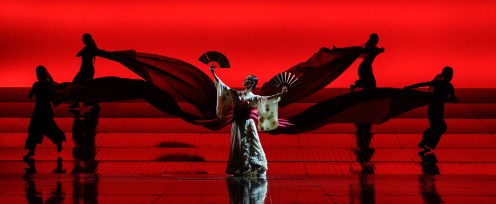
Madam Butterfly opens in silence: from the cinematic space at the rear of the stage, the silhouette of Cio-Cio San appears and moves down the ramp towards the audience, fluttering fans and trailing cloths in a way that suggests the insect from which she takes her name. It’s a striking image, presumably conceived by the original director Anthony Minghella, and prepares one for a production in which visual spectacle will predominate.
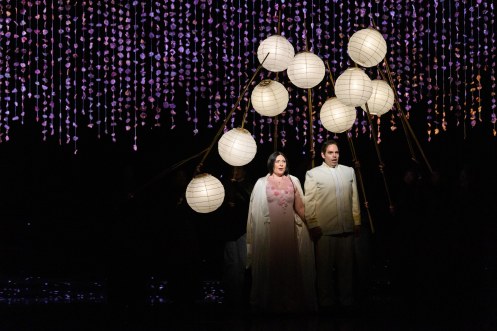
At its best, this emphasis is a perfect complement to mood and action. Near the end of Act I, Pinkerton and Butterfly are alone together and the lights pick them out, both in their white outfits against the dark, with moon-shaped paper lanterns gradually closing in on them. It’s a tender moment that concentrates our attention on the lead and her lover, and one can almost believe, as she does, that he will love her forever. But the image also speaks to their isolation, given her ostracism from family and society in Nagasaki, and his distance from home – and the life he will live without her.
There is an echo of this scene after the second interval: whether it is Butterfly’s dream or that of her maid, Suzuki, a marionette of Cio-Cio San is married to an Asian dancer in the guise of Pinkerton, and they perform a ballet that parodies the relationship between the two lovers to that point. The motif of puppetry is an important one to this production, what with its mini mannequin son, origami birds and even servants playing puppets, and suggests we need to be conscious of who’s pulling the strings even as the stagecraft contrives to hide them.
The production treads lightly at first, conscious it is walking on thin ice with a tragic depth beneath. The marriage scene is rueful, almost playful, although with Sharpless’ enquiry about whether the 15-year-old Butterfly has a sister we are never far from the sordid realities of the trans-Pacific relationship. The mannered quality is clear in the contrast between Butterfly’s white bridal gown – matching her husband’s uniform – and the vibrant colour blocks of her entourage, there first to witness the nuptials with a jaunty good humour, and subsequently drawn into denouncing it by her uncle, the Bonze.

As the tragic Butterfly, Natalya Romaniw is remarkable, her performance tender and mischievous in her flirtatious early encounters with Pinkerton, deepening as they become closer throughout the first act. In each of her arias, Romaniw sings affectingly, raising the hairs on one’s neck. Through the middle of Act II she awaits the return of her husband with a fragile faithfulness, ultimately broken when he arrives with his American wife in tow. Romaniw completely sells these transitions, with the precision of her singing giving way to the rawness of her screams, and this allows her sudden suicide the weight it might otherwise lack.
Support comes from Stephanie Windsor-Lewis as Cio-Cio San’s reliable maid, Suzuki, a wry presence who is later realistic enough to see that her mistress has been betrayed. Butterfly also gets a good hearing from US consul Sharpless, who in Roderick Williams’ performance is endearingly awkward, and one still senses that, some diplomatic faux pas aside, he wants to do right by her.

The difficult task of making one sympathise with Pinkerton – a failed Romeo who does not match his lover’s suicide – falls to Dimitri Pittas. Despite whipping up some good-natured booing from the audience at his curtain call, Pittas is successfully engaging over the preceding three hours, his Lieutenant blithe and careless, at least at first. Indeed, his intimidation by Cio-Cio San’s assembled family, and the way his libido bursts into expression through song, make him almost as adolescent as his bride. So absorbed he has been in his own desire that he doesn’t seem to realise that his wife, young as she is, is a person in her own right, and not his puppet.
There is, then, a gentle, surprised humour in the way he responds to the dolls that she produces of her ancestors, and this has two ramifications in the production. First of all, within moments we learn that his full name is Benjamin Franklin Pinkerton and that he is a lieutenant about the USS Abraham Lincoln, both of which are celebrations of his own ancestors through American cultural swagger. Yet, second, their son, is a descendant brought to life as a puppet himself, manipulated by black-clad, ninja-like stagehands. The craft they use is simple and manages to be very touching, each turn of the head or gesture of the hand speaking of the child’s awestruck attention to the world.
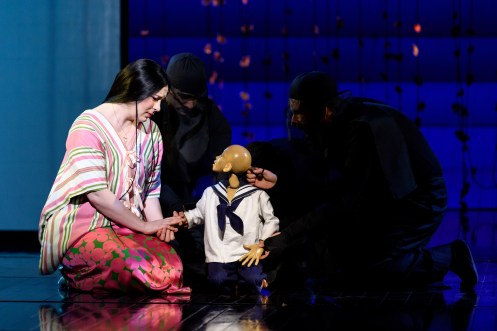
None of the production’s design is anything less than accomplished – it looks fabulous, in fact – but given so many outlets it is difficult at times to know where to look. The sliding paper screens making up Pinkerton’s love nest are slid in and out by the stagehands, sometimes disguising an entrance or exit by one of the principals, sometimes serving as a blank on to which the shadow of another can be projected; behind them is the ramp down which the cast can enter in silhouette, backed by widescreen light that varies from clear day to romantic sunset; and in front the puppets that may represent children, dreams, or just puppets. So giddy with possibility, it’s as though no one has decided what the visual focus of the staging will be.
With this reliance on spectacle, there is also a lack of dynamism in the blocking. Although entrances are strikingly visual as characters come in great waves over the back, once they are downstage most of the action takes place in one plane, and tends to be fairly static, though this may be a function of the most dynamic performers – the puppeteers and scenery hands – being specifically invisible in black.
It is a more fitting spectacle with which this rousing production ends, however: where the trains of cloth that accompanied Butterfly on her arrival signified the freedom of her flight, they are at the close the blood she sheds as she renounces this world forever.
Matthew Grierson
February 2020
Photographs © Jane Hobson
One Step, Two Steps, Tickly Under There
Round and Round the Garden
by Alan Ayckbourn
Rare Fortune Productions at OSO Arts Centre, Barnes until 6th March
Review by Eleanor Marsh
Part of Ayckbourn’s The Norman Conquests trilogy, Round and Round the Garden is based on the premise that Annie, who is the main carer of her demanding mother, has decided she needs a weekend off. She has been beguiled by her sister Ruth’s husband Norman and is planning on a “dirty weekend”; something she has never before contemplated. Things inevitably go wrong when Norman arrives early to collect her rather than meet as planned and they are joined by brother Reg and his wife Sarah and – for added farcical comedy value – sister Ruth. The family are also visited by local vet, Tom, who has ostensibly called in to check on the cat but really has his eye on Annie. Drunken escapades, temper tantrums and inappropriate liaisons ensue.
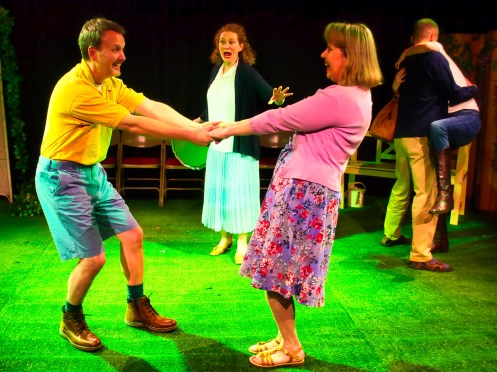
The play is presented “in the round”, which is an interesting pun on the title and could work in another venue, but at the OSO the term is somewhat misleading as the vast majority of the audience were situated “end on” as normal, with twelve lucky punters literally on the stage and this felt a little uncomfortable and very unbalanced. The play itself is of its time and the design and direction paid suitable homage to the classic TV sitcoms of that era. It would have been very easy to fall into the trap of trying to update the setting and thereby making the play appear dated. As a period piece it works well. Congratulations, therefore, to director Maurice Thorogood for having the courage of his convictions and a true belief in the writing. Congratulations to him, also for taking on the formidable task of covering for an indisposed actor and playing the part of Reg himself, book in hand. And playing it very well, too. The energy levels of the entire cast seemed to increase every time Reg made an appearance.
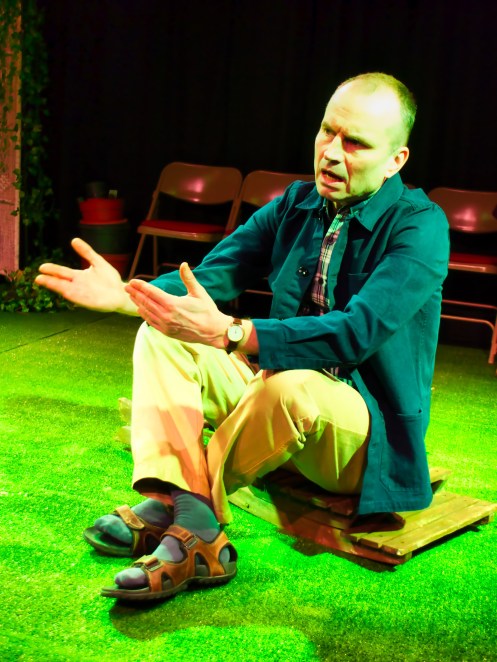
The characters in this, and every Ayckbourn play, are far more complex than they first appear, and they require actors to be thoughtful in producing a multi-layered performance. Despite holding that script Maurice Thorogood gave us the impression that beneath the blustering “hail fellow well met” lurked a much darker character and it came as no surprise that wife Sarah (Fiona Evans) was just a little tempted to stray. Jeremy Drakes as Tom was the quintessential sitcom underdog and played the role straight without trying too hard for laughs. The laughs came, as they always do when the writing is of this standard. A totally different approach was taken by Mike Duran as Norman, who played up the comedy so much that there were times it was quite irritating and, more importantly, made us question why any of the intelligent women he managed to seduce would have been interested. Why did the fragrant Ruth (nicely portrayed by Julia Haythorn) marry him in the first place, let alone stick with him when he was not only a cad and a bit of an idiot but also left her to pay the mortgage! As for poor Annie, she is the most difficult character of all to play; downtrodden carer with no self-confidence one minute and glamorous femme fatale taking no prisoners the next. Robin Miller was most effective in her scenes with Tom, where she appeared to have the upper hand; it would have been good to have seen some of that steel of character in the scenes with Norman, too.
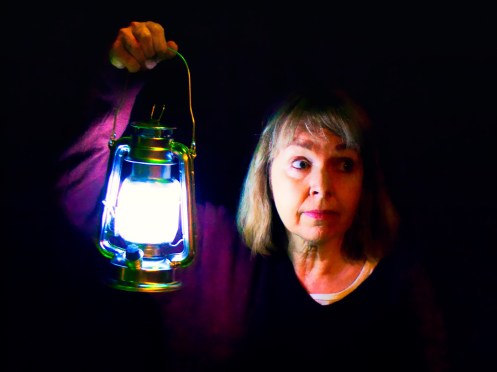
Rare Fortunes provided a very enthusiastic audience with an entertaining evening and fought valiantly against the handicap of losing a leading actor at short notice. And for two short hours they transported me back to the orange wallpaper and brown carpets of my 1970’s youth.
Eleanor Marsh
February 2020
Photography courtesy of Rare Fortune Productions
Bonded in Grief
The Revlon Girl
by Neil Anthony Docking
Teddington Theatre Club at Hampton Hill Theatre, until 29th February
Review by Melissa Syversen
On 21st October 1966, at 9.15 in the morning, 150 000 tonnes of mining slurry came down from the mountain and crashed into Pantglas Junior School and the surrounding buildings. 144 people lost their lives. The Aberfan disaster is still well known in Britain. Recently the incident was depicted on an episode of the Netflix series The Crown renewing awareness of the tragedy amongst a younger and larger international audience. The disaster remains a stark reminder of the importance of health and safety regulations and the dangers of putting profit above human beings. Aberfan wasn’t the first tragedy caused by corporate ineptitude, greed and systemic negligence and unfortunately has not been the last. It is important to continue to tell these stories through media such as The Crown and The Revlon Girl, and to hold those responsible to account so that we can minimize the chance of future disasters.
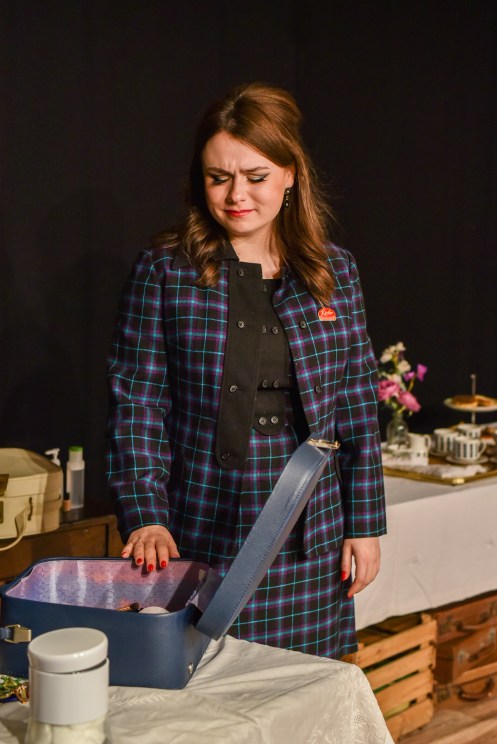
The effects that that terrible day had in the Aberfan and the surrounding areas cannot be understated. It effectively robbed a close-knitted community of an entire generation. Of the 144 killed that day, 116 were children aged three to fourteen years. How does anyone manage to go on after trauma of that magnitude? In the months following the tragedy, a group of bereaved mothers organised to meet once a week, to talk, grieve and support each other in a private environment, away from prying eyes, the media and dare I say it, tourists. The Revlon Girl imagines one of these meetings eight months after the event. Inspired by a true story, the title refers to a Revlon representative whom the women secretly invite to one of their meetings to give them some beauty tips. Through this narrative lens, Welsh playwright Neil Anthony Docking has found a beautiful opportunity to not only tell the story of the Aberfan disaster, and the immediate aftermath but also the long term effects of trauma and grief.


In a room above a pub, with a leaking skylight, we meet four of the mothers who have lost one or several of their children. There is the good-natured Sian (Lara Parker), the brash Rona (Hannah Lobley), the vicar’s wife Jean (Jenna Powell) and the quiet Marilyn (Julie Thomas). They have all suffered great losses, and each carries their pain in a different way, be it through faith, mediums or indignant rage. Though they are still struggling to cope, that doesn’t mean that there aren’t moments of normality, of laughter and even of cruelty between the women. Having grown up together, they know exactly what buttons to push when they want to hurt, they bicker and fight viciously. But within that, there is also aching vulnerability and affection towards another that only comes from lifelong friendships. And most importantly, they are there for each other, week after week. Having volunteered for the assignment, Charlotte, the titular Revlon Girl (Rachel Burnham) does her best to navigate in this dynamic. Akin to a deer trapped in headlights, she is acutely aware of what these women have been through, and genuinely wants to help in whatever way she can.


It is clear that the cast and crew of The Revlon Girl care deeply about the material at hand and they treat it with great respect and sensitivity. Rising to the challenge of the Welsh accent, the performers are all on pointe and portray these women with empathy and heart, but also do justice to the humour and anger present in the text. What the writing, the cast and director Kelly Wood are so successful at capturing in The Revlon Girl is the everyday, almost humdrum quality of grief. Yes, there is pain and anger, but there is also laughter and comfort. These women have lost, and yet they carry on as best they can. The Revlon Girl is a moving, heartfelt piece of theatre and I’ll admit I shed a tear more than once.
Melissa Syversen
February 2020
Photography by Jojo Leppink, Handwritten Photography
A Message from Midsummer
Dream
by Katie Abbott, based on William Shakespeare
RSS Young Actors’ Company at the Mary Wallace Theatre, Twickenham until 23rd February
Review by Milly Stephens, one of our younger reviewers (aged 14)
Dream is performed by an outstanding cast of twenty-three talented young actors from Richmond Shakespeare Society’s (RSS) Young Actors Company. Dream is an adapted version of A Midsummer Night’s Dream, directed and reworked with an environmental message by Katie Abbott.

The set design by Jo Moles was very innovative with four green hammocks, giving lots of levels to the stage, where the on-looking fairies could perch. This made the audience feel more included in the play as you almost felt like you were one of the fairies watching over the world. I also thought that the costumes and makeup by Miriam King and Izzy Timpson were very creative and made the show feel even more magical and mysterious. I also was impressed by the lighting and sound designed by Paul Nicholson and John Pyle as it gave the effect of a mystical forest and was used to reflect the intention of the script very efficiently.


The young actors all had very strong performances and engaged the audience very well. I would like to give a special mention to Jake Neill-Knight, who played Oberon, as he could always capture the audiences’ attention with his presence, and was very engaging to watch as he was a very convincing Oberon. I also  thought that Krishnan Miller-Pullen did an outstanding performance as Theseus, and even though he had a minor speaking role, he sung five beautiful and angelic solos with his guitar and he was always invested in his role, which is what I think makes a great actor. Nicole Kasumu and Charlie Lacey-Harrison added loads of emotion i
 nto the play. Nicole, as First Fairy managed to leave the audience feeling moved and motivated to change the way we live, after everything she said. Also, on the other hand Charlie, as Quince, added humour into the scenes, especially when Bottom, Kieran Judd, annoyed him. I think that they both added a good balance to the show as it had a moral message, but wasn’t too down hearted.
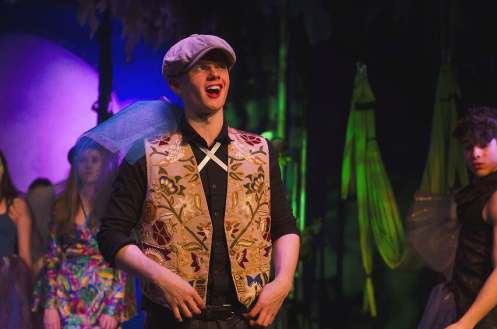
Overall, it was an excellent show and I would highly recommend it to anyone who would like to have a light-hearted evening with an environment slant.
Milly Stephens
February 2020
Photography by Tom Shore
Other-Worldly Visual Delight
Dream
by Katie Abbott, based on William Shakespeare
RSS Young Actors’ Company at the Mary Wallace Theatre, Twickenham until 23rd February
Review by Eleanor Marsh
There have been many adaptations and interpretations of most of Shakespeare’s plays. I have seen A Midsummer Night’s Dream set in World War II, in a travelling fairground (think My Big Fat Gypsy Dream) and more times than I can count in a more traditional setting. The BBC’s Shakespeare Retold series took us to a holiday resort where Lennie James and Sharon Small battled it out as Oberon and Titania – fairies living in the surrounding woods – and Johnny Vegas played Bottom the security guard hoping to make it onto the entertainments staff. I remember watching the entire Shakespeare Retold series and finding this particular episode the least convincing. Despite the all-star cast and the fact that it is possibly Shakespeare’s most accessible play, trying to update the plot itself, rather than playing with settings of time and place, just did not work. The crossover of “real” and “fairy” worlds in the 21st century was taking suspension of disbelief a little too far. I felt a similar problem at the Mary Wallace Theatre this week.

Dream is a mix of Shakespearean dialogue, modern dialogue (including some expletives that did not sit quite right in context, but must have been a treat for the performers to play with!) and music that attempts to weave the plotline into a climate change themed morality tale. It is an ambitious, big ask that on paper works beautifully. It is also evident that the entire cast are passionate about what they are doing and the message they are conveying. However, a mix of poor diction and voice projection, and a lot of the dialogue being directed upstage made it very difficult to follow the storyline. This audibility problem was compounded by an extremely loud musical underscore to much of the dialogue, which totally drowned out the young voices. Only the mechanicals managed to avoid this fate as they were fortunate to be performing their “play” downstage, facing the audience and with no musical accompaniment. They were very funny.


The design element of this production was excellent – it is a visual delight of both wardrobe and set design that immediately gives the impression that the audience are going to experience something other-worldly. Video projections are used throughout the piece and are very clever but a little distracting at times, although effective at others. My preference would have been for more burning planet and less Greta Thunberg, although in the context of switching a lot of the focus of the play to Shakespeare’s Changeling Child it did make sense to feature her. Despite the soundtrack being overly loud the use of music is excellent and it was particularly good to see under twenty year olds giving their all to songs by David Bowie and Elvis Presley, which were well chosen and quite poignant.
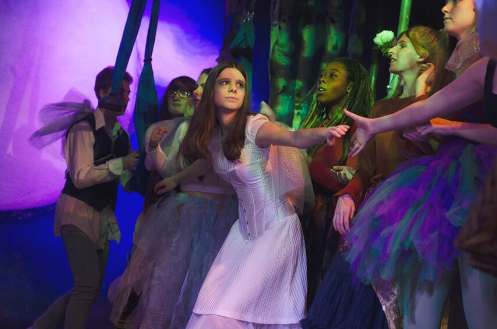
As well as directing the play, Katie Abbott is also responsible for choreography, which includes working on aerial silks. This is such a difficult thing to do that it deserves special mention; several of the cast spent time in and on the “hammocks” and made it look so easy –impressive indeed!

Dream is a nicely constructed ensemble piece with each person on stage being given a moment in the spotlight and every one of them giving their all. And it was good to see that RSS have given so much practical support to the youth group, which is their future. The performances were uniformly of good quality visually. Congratulations to all concerned on such a stunning looking production. I just wish I could have heard more of it!
Eleanor Marsh
February 2020


