
The Paparazzi of the Mind
March
by Lilla Radeck
Critique by Quentin Weiver
Life sometimes breaks in on us, kicks the door down and, like inquisitive paparazzi, threatens to reveal something of us, of our intimate self, to … to whom? … those who affect our lives, to the world… to ourselves?
Lilla Radeck’s March is a prose poem that packs some punch. It is a remarkable piece of work. It is remarkable for its style, its author, and its prescience.
It is prescient in that, although it was written on a dull November’s day last year, it relates to the events, or rather non-events, of 3rd and 4th March. Written in the first person, but clearly referring to the first person narrator, it tells of a girl confined to one room. These were the days when the coronavirus pandemic was concentrated in China, over 80,000 confirmed cases there, whereas the 750 case on the Diamond Princess cruise ship was more that the totals in France, Germany and Spain combined. But two weeks later in the UK, schools were forced to shut and the current “lockdown” measures began.
The protagonist in March is confined, not by the advent of a deadly virus, but by the presence of an equally deadly affliction, depression, but one that, although usually catalysed by events, is self-inflicted. The girl in March is struggling to find the motivation to get out of bed.
Stop! Before you switch off, thinking all I need in these troubled times is a polemic about depression, let me reassure you that here is a piece that ends with burgeoning hope. Therefore I would count this as a piece for our time, when we need to see the light at the end of … whatever the coming months might bring.
March is remarkable in that its author, Lilla Radeck, is a young lady in her mid-teens from Richmond. Her piece is one of two dozen shortlisted for the Arts Richmond’s Young Writers’ Festival 2020, which in mid-March showcased some of the best pieces of literary work by authors of school age in a professional presentation at the Exchange Theatre in Twickenham that proved to be the last theatre event locally before the lockdown.
Radeck’s remarkable style in writing this piece is in its oneiric approach, the realities of waking life intruding into the shelter of sleep, the articulated buzz of the alarm clock, or the inspired intrusion of the “click, zoom” of surreal cameras. The acting company at the Exchange chose to dramatise this as a sinister pair of paparazzi, who manifest themselves in the bedroom of the girl (played by Lauren Anthony) or rather in her mind. This inspired model of directing by Keith Wait gave the whole presentation a film noir feel. The paparazzi lunge and stab with their cameras, as the girl tries to retreat from the harassments of real life into the comfort of her dishevelled bed.

Of course, this presentation picks up Radeck’s portrayal of the scene in her prose poem, where the description of neglected hygiene and hopelessness is, in all its brutal directness, Tracey Emin meets Otto Dix. However, the use of sibilant syllables and fleeting alterations contrast the sense of the girl’s withdrawal from the realities of life.
There is the packaging of the piece in diary-like sections which are hinted at in the two halves entitled March 3rd and March 4th. The second day however brings a nadir in the girl’s self-regard as she imagines “why someone would bother to inconvenience themselves for … garbage”. Moreover, when we later find out that she had been contemplating “the iron-clad comfort of eternal rest”, it brings the reader up with at start.
The suddenly, light breaks through the gloom. “You can’t sit here all day”, a voice tells her. “You need to go out and live your life”. Reading this piece, with its beautifully bared insight, one almost jumps with joy as “the leaden covers are thrown back…”.
What wonderful optimism pierces the darkness! A great parable for these troubled times.
Quentin Weiver
April 2020
Photography by Terry Richardson and Tamara Sellman
March
by Lilla Radeck
March 3rd
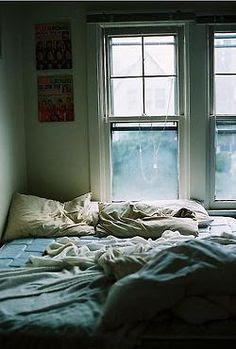
Pallid sunlight reaches through a half-open window; it freezes, grasping coldly, then falls behind thick curtains.
Click, zoom.
A dreary, viscous pair of camera lens focus and un-focus, fluttering, mechanical.
Click, zoom.
A girl breathes.
Click, zoom.
And then – awakening.
Patterned sheets fly across the breadth of an aging bed, caught in a frantic flurry of effort powered by frustration; a mess of limbs jumps forward, extends-
and falls back down again.
It’s cold, the girl murmurs, a sudden breeze passing by in lieu of any confirmation and she shivers, pulling the comfortingly twisted duvet closer around paper skin.
Her auburn hair snakes along the linen, touching the skewed pillow, the stained cotton, the overhanging layers – it doesn’t leave a single trace.
It’s cold, she repeats.
She sits up – not so much a graceful, swan-like gesture but a dull, automatic jump-start – and falls back down again.
I’m okay, she whispers to no one.
I’m just…tired.
She clumsily reaches for glasses, glasses that haven’t have been cleaned in days, glasses that are scarred with stains of tears and food and the occasional fleck of blood and equips them, a shield against the coming day.
It’s hard to move, she notes and, like every day, the comforting sheets melt into lead.
It’s cold.
I want to sleep forever…
March 4th
BZZZ!
BZZZ!
Camera lenses flicker to life again and focus on that stain on the ceiling the girl said she’d clean.
She moves the overgrown hair she said she’d cut to the side and half-heartedly grasps the dying alarm clock she said she’d replace.
It’s cold, she notes, and though the window is closed this morning, it doesn’t feel that way.
I won’t be missed, she tells herself, ignoring the soft buzz of her phone in the corner of the room.
It’s fine.
They’ll understand – sooner or later.
She knows that eventually someone will come to check on her and pull her out of bed because that someone came yesterday and tomorrow, and all she can do is shrug and say, What’s the point? because she can’t imagine why someone would bother to inconvenience themselves for garbage.
And yet at the same time, through all the what’s the points and why go through the same motions every days, the girl can’t help but feel guilty about lying there, doing nothing and being nothing.
She thinks of what that person would say to her, sighing.
You have things to do.
You can’t sit here all day.
The girl recalls plans she has made for the day, plans that would remind her of something that wasn’t the iron-clad comfort of eternal rest and decides on something.
“Let’s begin our daily routine.” she tells someone, herself, and it feels real because it is and for once she feels real because she is.
You need to go out and live your life.
In one final, desperate attempt, the leaden covers are thrown back…
and she gets out of bed.
Lilla Radeck
November 2019
No Squeak in the Nub
Waiting for Godot, the Silence
Nocturnal Productions at the Passin Theatre until 1st April
Review by Avril Sunisa
How could one have imagined, when reviewing Nocturnal Productions’ annual outing this time last year, the extent that the whole world would have changed in a few brief weeks leading up to the company’s unveiling of its Waiting for Godot, the Musical.
Last year’s premiere of Waiting for Dawn, Nocturnal Productions inaugural masterpiece of hypo-minimalistic theatre, left the audience gasping with vacancy. On that memorable occasion, finding myself part of this specially invited audience at the ephemeral non-venue specific nocturnal production, I was utterly transfixed. The forgone feeling at the end of a night filled with anticipation left me hungry to see what Nocturnal Productions’ 2020 offering would lack.
Alas; the social distancing rules, which have brought down an early curtain on the theatre season everywhere, have meant that Waiting for Godot, the Musical has not been able to be created in its all its intended postposterogenus glory.
 However, fortunately for the aficionado, the theatrical conceit on which Nocturnal Productions whole philosophy is built, lends itself, in all its scarcity, to social distancing. The tenet behind the company’s genius is that the performance should not take place in a fixed acting space, be uncluttered by the physical encumbrances of traditional theatre, and that it should take place before sunrise, as its magic evaporates at noon.
Since so much rehearsal for the musical had taken place, it had been decided that a cut-down version would be presented, Waiting for Godot, the Silence.
It would be an act of lese-majesty to reveal the exact location of the Passin Theatre, which was only posted to me during the late evening of March’s closing day, hours before the production went up. In fact, it would not be possible, for the set, such as it wasn’t, was not static, moving like a land yacht in the night’s gentle breeze. This is of course entirely in line with Beckett’s description of the setting as “the idea of the lieu vague, a location which should not be particularised”.
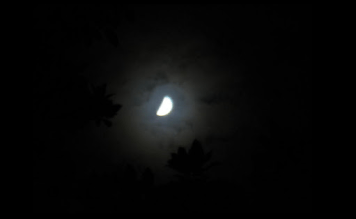
 Just after midnight, the clouds parted just slightly enough for the crescent moon, waxing towards its first quarter, to almost light the inspired set of designer Boreas Pagoma. One of the new wave of eco-designers who aim to lower the carbon footprint of their creations, Pagoma’s particular skills were obvious in this respect, as he took the ethos of hypo-minimalism to its ultimate conclusion. Returning again this year was Scandinavian lighting designer, Elifrop Pots, whose paraperceptible lighting plots are reputedly inspired by the winter skies of his North Cape home. Another designer celebrated for his energy-saving approach, Pots made full use of his favourite colour, ultra-ultraviolet in his deconstructive lighting design.
Nocturnal Productions, a company renowned for its green credentials, would of course be expected to have a heightened sense of social responsibility in these testing times. To enable social distancing, the audience was kept to a minimum and, in line with government advice, to less than two. From a theatre critic’s point of view, not having the distracting barometer of audience reaction was, I found, refreshingly liberating.
In those moments before the performance opened, I was able to appreciate the skyscape on this just below freezing spring night. I was grateful for the advice of the local council to those currently self-isolating … to count clouds. (I quote, “Clouds can be seen from the garden or through a window. Look for different shapes and patterns and notice how they change over time.”)
Such is the anticipatory frisson just before curtain up on such a landmark piece, the epitome of the mould-breaking perception of hypo-minimalistic theatre. I almost underdosed on adrenaline.
Beckett’s play, voted the “most significant English language play of the 20th century”, was called En attendant Godot at its premiere early in 1953 … in French …. in Paris. Such is the sine qua non enigma of this work, which Nocturnal Productions exploited in burrowing detail.
Director Nemo Knightman has distilled the very quintessence of Beckett’s work in reducing the number of characters. Stripping out the irrelevancies of Estragon, Lucky, Pozzo and The Boy concentrates the dearth of action into one character, Vladimir, Beckett’s “an ineffective man of the world”. This is of course a brilliant condensation of plot and plot-makers, getting to the nub, nay the squeak in the nub, of the play’s transparent message, and thinning its transparency.
Moreover, director and producers have had proper perception of the propriety of social distancing, by this astute presentation of the work. Audience and cast were never closer than two metres, or six foot six in human terms, both of us maintaining ten times that distance for good measure (not the poor measure of those, deprived of a tape-measure, who have erroneously been putting around that 2m = 6 feet). This aurally extending approach, or rather absence of approach, is truly homeopathic.
Enter past master of the thespian art, Cyrus Bender as the hapless Vladimir. Speechless with admiration of his art, we await, our breath held in anticipation, and Bender, true to form responds likewise. What can we say? Or he? This was minimalism taken to new heights, stratospherically depleted.
Bearing in mind that Waiting for Godot, the Silence was originally intended as Waiting for Godot, the Musical , how much true to intent is it to dispense with extraneous music and all that goes with it (musicians for instance, huffing in the woodwind, slobbering in the brass, and scratching at the catgut). Besides, Bender has long since been capable of dance, having suffered a strangulated splitch some years ago. And the singing, initially intended as Sprechgesang, has been relieved of both Sprache and Gesang, much to the enhancement of the purity of the work and the post-penultimate expression in its title.
In the production’s tenebrous setting, the body language of this consummated actor underlined the sheer microscopy of the character’s impetus: Bender more than inhabits the vitiated psyche of Vladimir, a man of magnanimous immobility, while the scale of Bender’s stage presence remains staggering in its imperceptibility. Priceless is a word that percolates up into this reviewer’s mind. There is no vocabulary sufficient to express such a performance.
Right from the very beginning of this portrayal of impotent paucity, the pregnant pause that heralded more, one was wishing it would go on. And indeed it certainly did. We waited hungry for those immortal words that open Act Two, “well, that passed an hour or two … … well, they would have passed anyway”.
Here is an incomparable piece of theatre that will lodge its microtudinous moments in my memory. The phrase, “I have never seen anything like it”, seems overworked. For this reviewer, Waiting for Godot, the Silence is incomparable. The words “like it” are superfluous.
For a production that does what it says on the tin, this musicale manqué delivers. Silence says it all … loudly.
Naturally, one of the advantages of hypo-minimalistic theatre is that it weighs lightly on the soul. Making my way back from this fugitive theatre in the dawning rays, as April came creeping in on the lassitude of this pestilent world, I returned to self-isolation, knowing that from Waiting for Godot, the Silence I took nothing away … but one thing … if only I could remember what it was.
Avril Sunisa
April 2020
Photography by Lisa Erin Brown
What Happened to Poor Mum?
(Spoiler: She went to the theatre.)
A cogitation by Mark Aspen
Mothering Sunday has been a day of celebration ever since the Middle Ages. Here’s the tradition: the fourth Sunday in Lent is the day to go “a-mothering”, which originally meant going back to the church where you were baptised. Since you might well find your own mother there, the idea of Mothering Sunday soon transferred to dear ol’ mum herself. Mothering Sunday is also exactly half-way through Lent, so you can have a break from what you gave up, time for celebration indeed!
Although nowadays usually confused with the American Mothers’ Day (which is mid-May in the United States) and ruthlessly commercialised, we still love this happy day when mothers and motherhood spring to the fore, as Spring itself comes in.
Alas, in 2020 the pestilence of COVID-19 has cast its ominous shadow over poor mum, and many mums, particular the septuagenarian ones have not been celebrated in person.
This led us in Mark Aspen Reviews to cogitate that we have seen so many plays (and operas) over the past twelve months, in which mothers have featured strongly.
So here is a thespian celebration for Mothering Sunday 2020
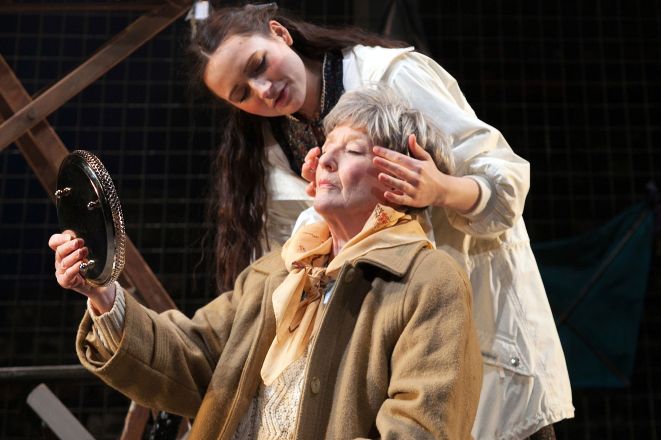
We start a year ago with My Mother Said I Never Should, which toured throughout March and April last Spring. Grandmother, mother and daughter relationship, so two mothers for the price of one.
 In
In
June, Paula Young played Mrs Beech, a “damaged and dangerous” mother in Edmundians’ Goodnight Mr Tom, a real tear-jerker.
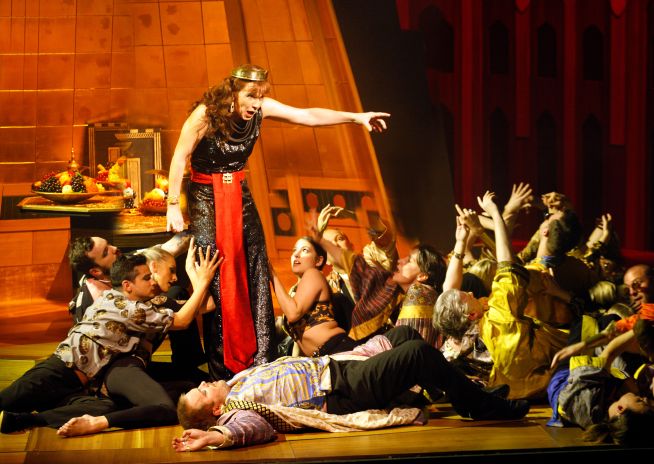
Out into the countryside in June for the Grange Festival’s remarkable production of Handel’s opera Belshazzar. The feisty Nitocris, Belshazzar’s mother, is savagely protective of her son, but what a son!

Opening the autumn season, the Best family have a very busy 115 years of troubles, tribulations and titillations in Questors’ Table. Who come out the strongest? The mums of course.
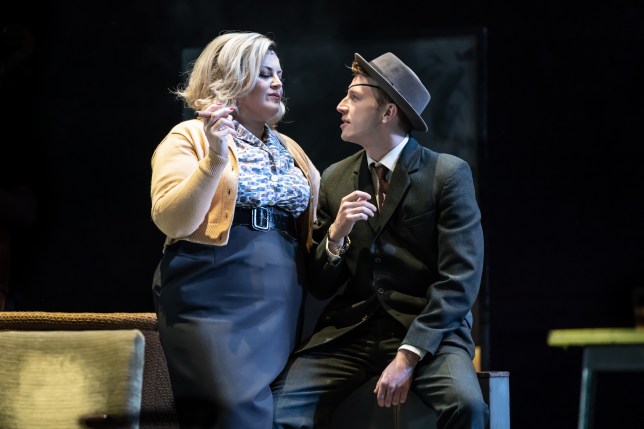
In A Taste of Honey the mother, Helen, is no sweetie. Even her daughter, Jo thinks of her as a “semi-whore”. “Brash, bold and brassy”, Helen is alas not an ideal role model.

RSS confused traditionalists with its gender-bending Scandi –Noir production of Hamlet. Gertrude, Hamlet’s mother may have been robbed of the role’s ambiguity, but Jane Marcus played it to the hilt.
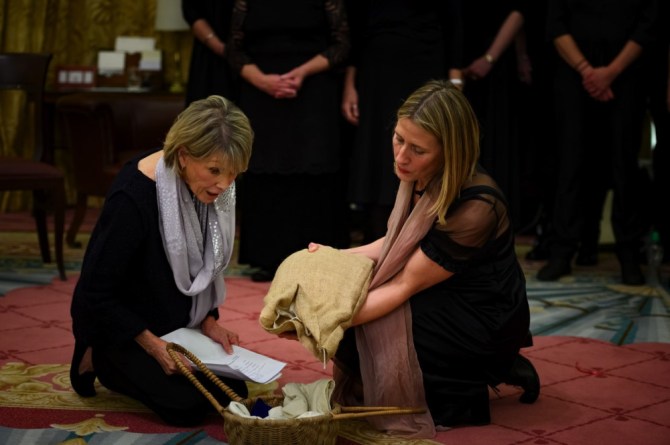
If you want tragedy laid on with a trowel, Euripides is your playwright. And Women of Troy is as tragic as you can get. In the plush surrounds of the Athenæum Club, the Actors of Dionysus presented some hard-rending depictions of tragic motherhood. Grandmother Queen Hekabe and mother Andromache must part with the baby Prince Astyanax to be killed by the Greeks.

At the end of November Sarah Crowe gave us the “frazzled and hollowed-out” Phoebe, the ultimate put-upon mother, trying to keep a crumbling family together in The Entertainer .

In the New Year, Blood Brothers, has another stretched mother Mrs Johnstone, played by Lynn Paul, in Bill Kenwright’s “somewhat darker” take on the musical.

Another set of heroically tragic mothers were found in The Revlon Girl, a moving account of the 1966 Aberfan disaster.

ENO’s revival of Puccini’s Madam Butterfly, one of opera’s many tragic mothers, “threw the nerves in patterns”, until it was tragically cut short by the shadow of coronavirus and the London Coliseum, as all London theatres closed its doors for the foreseeable future.
Our dramatic mothers this past year are all pretty strong characters, but not one of has had a happy story to tell. In retrospect, for our real mothers, isolated by the novel coronavirus, Mothering Sunday 2020 doesn’t seem so bad.
So, let’s give thanks for mothers. Happy Mothering Sunday!
Mark Aspen
March 2020
Photography by Sheila Burnett, Simon Annand, Robert Vass, Rishi Rai, Marc Brenner, Sally Tunbill, Katerina Kalogeraki, Helen Murray, Jojo Leppink and Jane Hobson
The Familiar from Unfamiliar Angles
In Praise of Aposiopesis
By Keith Wait
Critique by Thomas Forsythe
Suddenly, over the past few days, we have found all our normal life that we have taken for granted turned upside down. What we thought was going to happen, now and abruptly, isn’t. While tasks started wait on desks, on workbenches, on building sites, real or virtual, our aspirations wither.
KW’s In Praise of Aposiopesis accurate captures the mood of the moment, in a witty re-visiting to things familiar now unfamiliar.
Like Wordsworth, we still can walk in the Lake District … or Richmond Park (if we leave our cars and bikes outside the gate), but we can see it in a different way.
Thomas Forsythe
March 2020

In Praise of Aposiopesis
(With apologies to William Wordsworth)
I wandered lonely as a …
That floats on high o’er …
When all at once …
A host of gold … …
Beside the lake, beneath … beneath …
Fluttering …
Continuous as …
And twinkle on the Milk…
They stretched in never-ending … never-ending …never-ending
Along the marg …
Ten thousand saw …
Tossing …
The waves beside …
Out-did the spark …
A poet could …
In such a jock …
I gazed … and gazed… and gazed… and gazed …
What wealth …
For oft, when …
In vacant oar …
They flash …
Which is … … … … bliss …
And then my heart with pleasure …
And dances …
Keith Wait
March 2020
In Times of Pestilence
Just about this time of the year, 417 years before COVID-19, in what playwright Thomas Dekker ironically called this “wonderfull yeare”, all the theatres were shut.
One of the “wonders” was the death of Queen Elizabeth I at Richmond Palace on 24th March 1603. The plague once more revisited London in late February, and the exponential growth in the numbers of its victims triggered the provision under the law that all meeting places for more than fifty people were to be shut.
1603 was to become the most devastating year for plague deaths until the Great Plague of 1666. Over one quarter of London’s population was wiped out.
So the new sovereign, King James I, started his reign having to try to get control of a disease that seemed incurable. Laws were swiftly enacted to try and control the plague in London its environs. Houses were “to be closed up” for six weeks if one of the inhabitants fell ill. The law on shutting public meeting places was tightened to those of more than thirty people, effectively all pubs, eating places and places of entertainment. Those showing symptoms were encouraged to be “restrained from resorting into company of others”. Moreover, money was set aside to support those who were confined in their homes. Doesn’t this all seem familiar more than four centuries later?
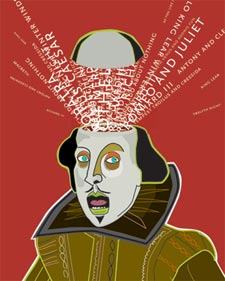
The best known Elizabethan playwright is undoubtedly William Shakespeare, who was incredibly busy during the years around the turn of the century, writing many of his best plays and performing them in Queen Elizabeth’s court as well as in the public theatres.
So what did Shakespeare do when the theatres had to shut? Well he had had a “dry run” ten years earlier when the theatres were also shut for almost a year, again due to the plague, that one not proving as fatal to the populace; 1593 saw about a fifth as many fatalities as in 1603. In this enforcedly freed-up time had made a small living by writing sonnets (possibly on commission). In 1603-4, he again turned his skill to poetry and again to sonnets, refining and adding to the earlier ones, along with long poetic pieces such as Venus and Adonis and The Rape of Lucrece.
This seems to us to set a good example and, following the 2020 closure of all the theatres, Mark Aspen Reviews is now concentrating more on non-performance arts. Shakespeare has set the pattern, so watch this space for more poetry and poetry critiques.
We hope to add in book reviews and more very soon.
Four centuries behind, Mark Aspen Reviews is swimming behind The Swan of Avon !!
The Younger Generation, Bold, Touching, Hilarious
Young Writers’ Festival 2020
Arts Richmond at The Exchange, Twickenham, until 15th March
Review by Heather Moulson
Looking forward to a celebration of Richmond’s young writers’ showcase of poetry and prose, we had an effective introduction of bold and creative lighting, before being privileged to witness all this young talent at the Young Writers’ Festival 2020.
The Festival is the culmination of Arts Richmond’s annual Young Writers Competition in which school-age authors enter short pieces of literary work, prose or poetry, which are judged by a panel of experts, drawn from literary backgrounds. From over 650 entries, pieces of high quality of the writing, Young Writers’ Festival 2020 presented the six best pieces in each of four age-groups. From these nominations the finalists and winners in each age category were announced.
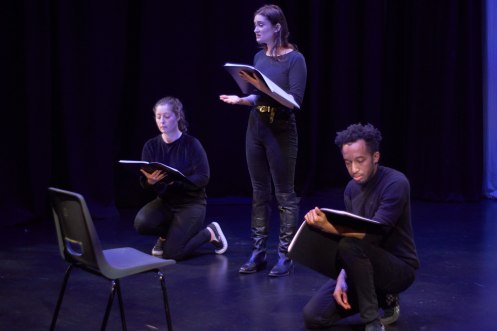
Read strongly by actors, Lauren Anthony, Victoria Morrison and AJ MacGillivray, this unique production, co-ordinated by The Stage Company, opened up with very vibrant work. An array of intriguing poems and prose pieces were read, starting with The Decider, a stunning account of fate hinging on five cards.
During readings, two of the actors became three, then two again. Then solo, then together, forming a dramatic and interesting tableau. Their rapport came over successfully, and they were clearly comfortable with each other.


The Curse of the Headteacher had us on the edge of our seats, likewise with the eerie Chapter 1: The Girl. Not only were these works striking prose, they were thrillers too! This standard of absorption was consistent with the poems Somewhere!, I Want to Sing!, The First Drop and The Sea. Keith Wait’s clever directing gave the actors elegant alternatives in reading.
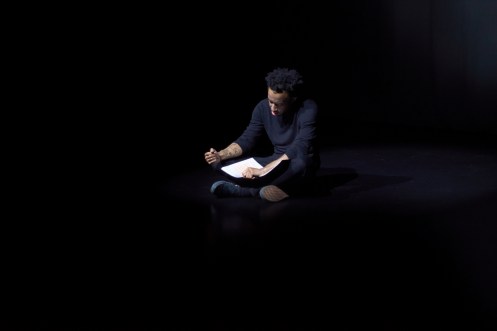
The very poignant See Me As I Am, on receiving a diagnoses of Asperger’s Syndrome, was moving, and struck a chord in all of us. This touching piece counteracted with the hilarious There’s Something At The Bottom Of My Lunch Box. Both of these pieces were solo, and very appropriately done.


The beautiful Sad, When The Sun Didn’t Shine, and Viking Girl, concluded the first set of younger writers (Year 3 to Year 6).
After a warm reception from the Mayor, Cllr. Nancy Baldwin, Hilary Dodman, the Arts Richmond Chairman, supplied us with positive and encouraging feedback. Then the Mayor duly presented the awards and certificates to this exciting, young talent. These were: Seb Jones, Poppy Tawil Mukhida, Elliot Steven Indio Watts, Cassia Mavra, Georgia Rose Mackew, Mia Pomford, Megan Smith, Anna Wilkinson, Lola Grace Alge, Amelie Grandjean, Emily Hayman and Scarlett Monahan.
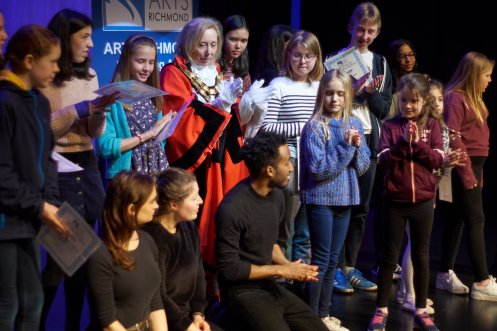
A second half of strong writing from the older section followed (Year 7 to Year 11), and we were not disappointed. Inside a Depressed Mind, Car Crash and For My Grandparents particularly left a strong impression; not to mention the very contemporary A Poem of Climate Disaster. However, these did not overshadow Requiem, Down Down Down nor The Fallen Ones. All accompanied by the strong direction, skilled projection and bold, detailed lighting. I Am Positivity, Something’s Fishy, Silence and March completed these amazing works. This rewarding production told us a lot about the younger generation. This section of deserving writers came to greet the Mayor and Hilary Dodman. These were: Anabelle Spasova, Simone de Almeida, Morag McCabe, Max Norman, Sophie Payton Conway, Celine Shekarsarai, Alice Lambert, Anna Magee, Lilla Radek, Aisha-Jane Harris, Eden Hartley and James Joseph Hunter.
Young Writers’ Festival was a fulfilling and inspiring experience, and I would urge everyone to go to next year’s presentation.
Heather Moulson
March 2020
Photography by Joe Stockwell
Ding dong!
The Marriage of Figaro
by Wolfgang Amadeus Mozart, libretto by Lorenzo Da Ponte, after Beaumarchais
ENO and Oper Wuppertal at the London Coliseum until 18 April
A review by Matthew Grierson
Through the four doors of Johannes Schütz’s set – a white Ikea bookcase denuded of its shelves – tonight’s cast appear and disappear like the little figures in an antique weather house as the overture to Mozart’s comic opera is played. Their to-ings and fro-ings and occasionally frozen poses, photos from the weddings that are yet to take place, also forecast the romantic runaround gleefully staged in this uplifting production.
This Marriage plays with the idea of the secrets the characters are keeping from one another and plots they are hatching: the doors sometimes keep the rest of the world at bay while they have their confidential conferences, while at other times the action taking place in front of them is for real and the doors open on to the imagination or unconscious, like eerily lit erotic tableaux from a Soho of yesteryear.
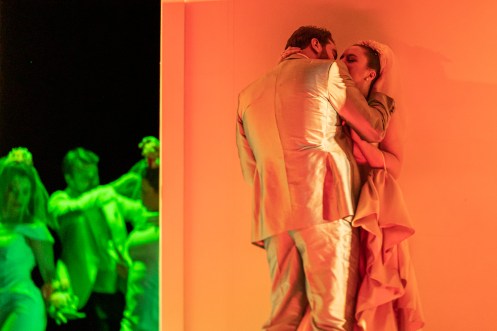
The farce is well choreographed in these two dimensions, but director Joe Hill-Gibbins is keen to add a third: hoisted into the gods, the bookcase is socially as well as physically elevated to become the apartments of the Count and Countess, allowing some nicely coordinated interplay between the nobles above and servants below, who are often oblivious to one another. This increases the tension when the approach of someone below is visible to the audience but not those having a liaison above, enhanced by some beautiful comic business when horny adolescent Cherubino has to throw himself onto a crashmat hastily positioned under him by the servants.
If one were somehow to see only the first half of the performance, it would in fact be quite easy to imagine the young page to be the main character, such is his part in the action and Hanna Hipp’s charisma in the part, her look putting me in mind of Tilda Swinton’s more androgynous performances. Whether strutting in full R ’n’ B style to the lovesong the boy has written or being dressed and redressed by the maids like a doll, Hipp manages to be both impish and ingenuous at the same time.
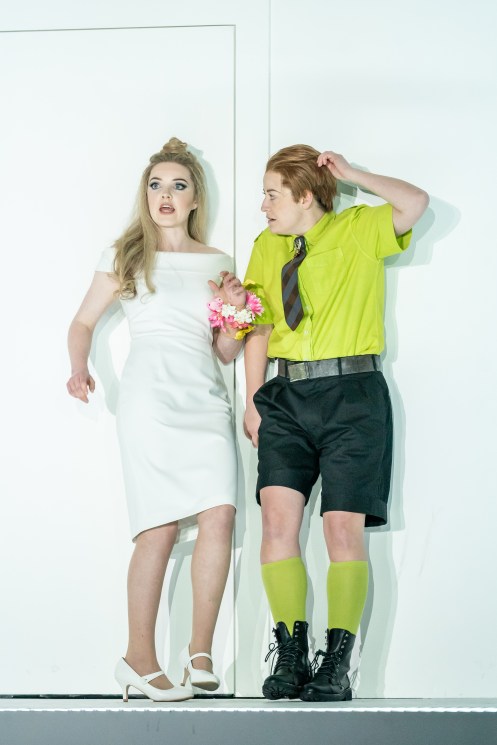
Come the interval at the end of Act II, the raising and lowering of the set is starting to feel unnecessary – but by the time of the wedding night as Act IV begins it is quite literally backgrounded. It’s hardly a safe space, but its distant whiteness – lit up throughout in moods variously lively and sordid by Matthew Richardson – means there is a downstage darkness where all the cons and confusions can play themselves out.
In these bed tricks and badinage, Mozart & co. are clearly having a lot of fun with the conventions of comic drama. ‘A play should end in jollity in theatrical tradition’ is one refrain, for instance, while the sudden disclosure of Figaro’s origins – gamely played by Božidar Smiljanić – is a self-aware strategy to pluck the plot from a pickle, akin to the wild revelations and reversals of Henry Fielding a generation before the composer.
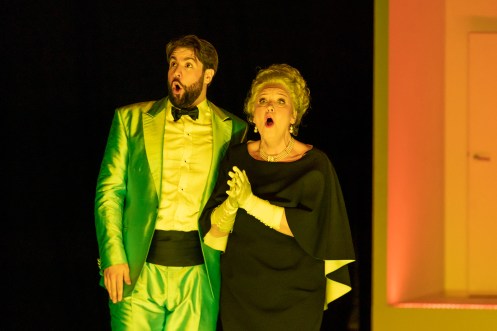
That knowingness is embraced, but never overdone, in this production. Susanna and Figaro respectively invoke the faults of men and women in direct addresses to the audience, as if to say ‘Am I right?’, while Jeremy Sams’ English version of the libretto has the quality of some of W. S. Gilbert’s finest, as well as a nice nod to Monty Python (no-one expected that).
Figaro also sings that his master may be dancing but that he will call the tune, and Hill-Gibbins picks up this cue very obviously by having the manservant mimic maestro Kevin John Edusei to conduct a chorus of fellow below-stairs staff in singing mock praises of the Count. The way the ne’er-do-well nob is manoeuvred into affirming his own decency and disclaiming his droit de seigneur seems especially timely, and plays against the protestations Susanna is forced to make of renouncing her own rights when under pressure from the Count and music instructor Basilio (played with an incongruous estuary accent by Colin Judson).
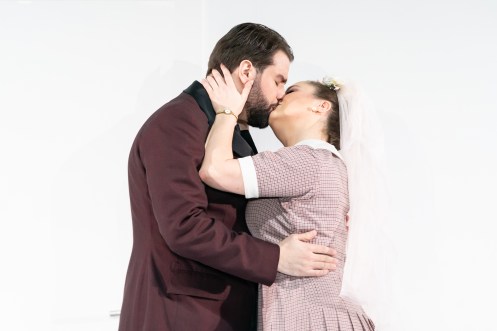
But if Figaro believes he is conducting matters and Basilio is looking to steer his pupil Susanna into a duet with her master, they only think they are in charge of proceedings: for it is the sanguine bride-to-be who remains the most clear-sighted protagonist, even when she cannot always exercise direct control. Louise Alder’s portrayal mingles wit and weariness, as is evident when she ends an occasional line with a word almost spat in indignation rather than sung. And she is a joy to watch, whether she’s slipping from the Count’s grasp or delivering a beautiful aria to Figaro when he suspects her fidelity. She proves the critical role of female agency in ‘rounding the play off nicely’.
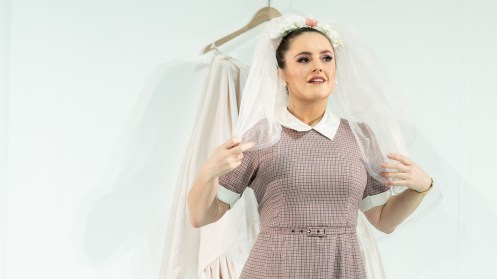
She is complemented in this by Elizabeth Watts as the Countess, whose heartfelt singing expresses her continued love for her unfaithful spouse. Hanging in the set above him, she is literally floored to hear him conduct one of his assignations below and, even when she is silent in the closing scene, she conveys dignity and distress in equal measure in her realisation of how irredeemable is his behaviour.
Wily though he is, Figaro always remains a beat or two behind the two women when it comes to subterfuge, instead breezing his way through his deceptions of the Count on an ad hoc basis. In Smiljanić’s characterisation, he’s an ebullient comic presence, and his wedding attire, which wouldn’t be out of place in Vegas, matches his showy good humour. In his final reconciliation with Susanna – his surrender to her, in fact – it is this charm that ensures her understanding of him is moderated by forgiveness.
It’s not only Figaro and Susanna among the servants who claim their share of the action: Clive Bayley’s interruption as gardener Antonio forces both Count and Figaro to improvise him into their plans, while pity his daughter Barbarina (Rowan Pierce), who not only has to cope with her father’s drunkeness but also endeavours to make an honest man of Cherubino. Good luck to her. And of course there are the opportunist Marcellina and Dr Bartolo (Susan Bickley and Andrew Shore), at first dead set on prosecuting Figaro, but then suddenly on his side when they discover their … true relationship to him.
As Count Almaviva, meanwhile, Johnathan McCullough has to tread a careful path, not a villain so much as an exponent of unenlightened self-interest. While it’s uncomfortable to watch his hands roving over Susanna or see him standing above Barbarina, trying to indulge the power he might once have exercised, there’s equally a sense in which he is a man out of time, isolated as he is in our final image of him: shut out of proceedings as the happy couples race back to the house and slam the doors behind them. It’s a fitting moment, albeit one that is at risk of being lost in the speed with which the curtain falls.

In a world where old orders are crumbling and new certainties are hard to lay hands on, those who succeed – as this production does – seize their moment joyfully.
Matthew Grierson
March 2020
Photos © Marc Brenner
An Intriguing Point of No Return
The Night Titanic Sank
by Jonathan Goodwin
Don’t Go Into the Cellar Theatre Company at OSO Arts Centre, Barnes until 12th March then on tour until 4th June
Review by Heather Moulson
As the theatre fell into darkness, as well as attending an account of the ultimate maritime disaster, we were also drawn into our own personal séance!
Focusing on personal testimonies by survivors was, changed forever by this public tragedy. The Night Titanic Sank brought the loss, in April 1912, of the RMS Titanic into vivid reality.
We unwittingly entered into a medium’s aura by Peter Llewellyn, who gave us an eerie and effective introduction. Written and starring Johnathan Goodwin, from the Victorian theatre company, Don’t Go Into The Cellar, the atmosphere was thick and intense, an intriguing point of no return.
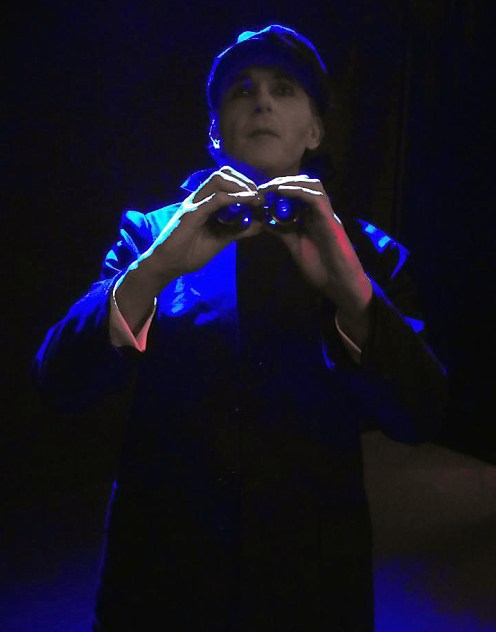
The first spirit, and eyewitness, Laurence Beesley, an English teacher and journalist, recalled sadly how the Irish cliffs were the last sight of land that many would see. He emphasised how huge the Titanic actually was, with its eleven levels. Beesley also recalled the irony of how Third Class seemed to have the most fun, dancing and singing and genuinely enjoying, the experience of the voyage. Like others, he felt the judder of the iceberg, and his guilt was palpable as he was instructed to jump into Lifeboat 13.
Charles Joughin, the ship’s head baker, a dipsomaniac, was then called up. He shared his insight of throwing deckchairs out to sea for people to cling onto. Through his drunken haze, the cries of help rang in his ears. His account of swimming round the bitterly cold sea until a lifeboat came, has become a thing of legend. Defying the odds of hypothermia, we got the impression that being drunk saved his life.
Military man, Archibald Gracie followed, blustery, gruff, angry, he elaborated bitterly how his friend, Clinch Smith, didn’t survive the brutal wave that carried them. Sadly, his remains were never found. Exhausted, Archibald was pulled onto Lifeboat 12.
After a very long first half of one hour and ten minutes, which I’m not sure worked, as the audience were flagging, the shorter second half transformed the theatre as we met another survivor tortured by accusations of cowardice and corruption.
Sir Cosmo Duff Gordon, an eminent Scot, bore these scars and bitterly denied the allegations. Accused of getting into Lifeboat number 1, along with his wife and secretary, (Lady Gordon refused to go without him), and bribing the crew with cheques of five pounds not to return and rescue others, he became emotional in his denial, and the impact on the rest of their lives. He presented a valid and real case, and came over as a sympathetic character. Urging us not to believe the slander written about him, and the stigma of men getting into the lifeboats.
 Llewellyn cast up the final and most haunted, the Captain who had steered that “Ship of Death”. With the grim task of retrieving the bodies, he reached the depths of his sadness when many had to be recommitted back to the sea, as they were so damaged. A very moving account.
Llewellyn presented a touching epilogue that there was no single fault, nor blame. What mattered most was that we heard from those who shared the horror. A mature and thoughtful production by a gifted and passionate actor.
This is a theatre company well worth watching.
Heather Moulson
March 2020
Photography courtesy of Don’t Go Into the Cellar
Frequent Flyers
The Kite Runner
by Khaled Hosseini, adapted by Matthew Spangler
UK Productions and Flying Entertainment. at Richmond Theatre until 14th March, then on tour until 4th July
Review by Andrew Lawston
In 1970s Kabul, kite-fighting is all the rage. Amir, the creative son of a prominent businessman, flies kites and plays cowboys with his servant and close companion, Hassan, until a terrible incident separates the pair forever. Years later, as a writer living in California, Amir still struggles to deal with his guilt from the childhood tragedy. He is finally offered a chance to atone for his past cowardice, but will he seize the opportunity?
The Kite Runner, adapted by Matthew Spangler from Khaled Hosseini’s best-selling 2003 novel, offers the audience at Richmond Theatre a fascinating if frequently harrowing look at Afghanistan’s turbulent history in the late 20th Century.

The first act focuses on Amir and Hassan’s childhood, up until their separation in the late 1970s. David Ahmad alternates between an adult American accent as the grown-up Amir and the play’s narrator, and a childlike Afghan accent as the younger Amir. He switches between the two effortlessly, and with exuberant body language to match Amir’s younger self. Andrei Costin gives the stand-out performance as Hassan, the eponymous kite runner whose meekly subservient dialogue is undercut by his fierce devotion to Amir, and his immense dignity in the face of his cruel treatment.
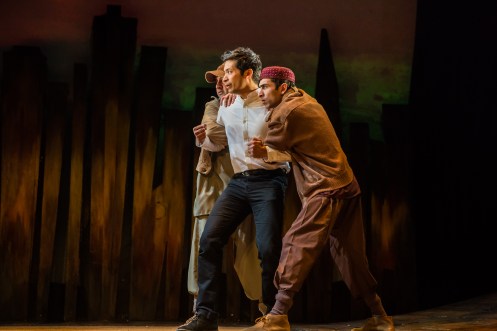
Amir’s father, Baba, is played by Dean Rehman in a strong performance that develops throughout from authoritative scotch-sipping Kabul businessman to principled but humble flea market vendor. His friend Rahim Khan (Christopher Glover) manages to convey the heart of the play, full of wise words and advice for Amir throughout his life. Hassan’s father Ali doesn’t get a huge amount to do within the play, but conveys a humble but dignified man, and his low-key confrontation with Baba when he resigns is powerful.
Against all these dignified performances that shelter deep passions and dark secrets, The Kite Runner also provides a solidly unpleasant villain in the form of Bhavin Bhatt’s Assef. From his first appearance, it’s clear that this menacing youth is far more dangerous than the average bully figure that pops up in coming-of-age narratives.
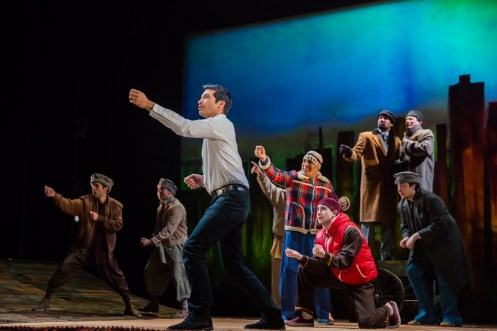
The second act covers a period of over twenty years, jumping between California, Pakistan, Kabul, and back again. As such it sometimes feels a bit choppy, in spite, or perhaps because of, director Giles Croft’s smooth and pacy direction. Given the span of time covered by the play, the tone also begins to feel uneven. The play’s next confrontation between Amir and an older Assef sees the bully transformed almost into a caricature figure, and his final pratfall, complete with windmilling arms, struck a bit of a discord considering the context.
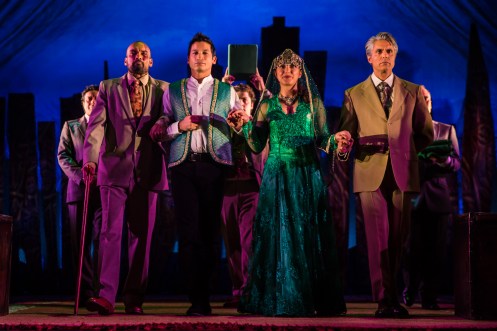
It’s in the second half that Lisa Zahra steps forward from the ensemble to play Soraya, the only significant female role in the production, and she gives a spirited performance, particularly when telling Amir about a teenage adventure that provoked the wrath and shame of her staunchly conservative father General Taheri (Ian Abeysekera, playing with just enough of a twinkle in his eye to stop the patrician character sliding into stereotype territory). It would have been great to see more of Soraya, as her main function is to illustrate his ongoing spinelessness in conversations with General Taheri.
When a play is adapted from such a widely-read and comparatively recent book (and film adaptation), there is a whole conversation to be had about to what extent audiences will be aware of the story’s twists and turns, and thus how much care should be taken when foreshadowing them. I’m faintly embarrassed to say that I came to Richmond completely ignorant of the story, but within ten minutes I was extremely confident as to certain revelations that inevitably popped up in the second act.
Throughout, however, Barney George’s design is wonderfully evocative of the play’s Afghan setting, while opening out the full width of Richmond Theatre’s stage. The swooping kites become an effective motif, with two huge kites forming a backcloth for projected backgrounds during many of the Kabul scenes.

Jonathan Girling’s musical direction is similarly evocative, using instruments including tabla, Tibetan Singing Bowls, and Schwirrbogen. During set-piece scenes such as the kite-fighting tournament, the instruments, played live on stage, come together to produce a fantastic soundscape that conjures up the roar of the wind and the excitement of the spectators.
The Kite Runner is strongest in those scenes set in 1970s Kabul, and during some of the meatier dialogues in the second half: Soraya’s speech to Amir during their courtship, for example, and Amir’s final meeting with Rahim Khan. At other times it feels like a dizzying scattergun of a production: plenty to enjoy, but rarely enough time to truly savour it.
Andrew Lawston
March 2020


