
Absurdist Farce of Time Again
My Name Is Cathy
by Andrew Sharpe
KatAlyst Productions at Chapel Playhouse, Kings Cross until 18th August, then on tour until 11th October
Review by Quentin Weiver
“If I had my time all over again …” is an utterance frequently breaks forth from the exasperated lips of those of us of a certain age. The pen of emerging writer Andrew Sharpe has reshaped the sentiment of these words into the thesis for his new play, My Name is Cathy, which he has presented in this year’s Camden Fringe.
The writer is aptly named as there is a keen edge to the word-craft and structure of the play. Sharpe describes it as “an absurdist farce for our time” and with nicely crafted black humour, Sharpe just steers it away from political polemic. His inspiration come from his background as a lawyer in the family and criminal courts.

It the evening of the eponymous Cathy’s fiftieth birthday and she sits with her only friend, a rapidly emptying bottle. Her opening monologue starts with the, sadly much parodied, introduction at a meeting of Alcoholics Anonymous, “My name is Cathy, and I am an alcoholic.” But somebody is there to hear her confession, her own self of a decade and a half earlier, the happy, successful and socially well-adjusted 35 year old Cathy, a clever and successful schoolteacher. The didactic that follows is a riches-to-rags story painful to hear, an aleatoric decline, almost Fassbinder-like in its inevitability, attributable to nobody, or everybody, a series of wrong-turns, bad choices, and farcical mistakes.
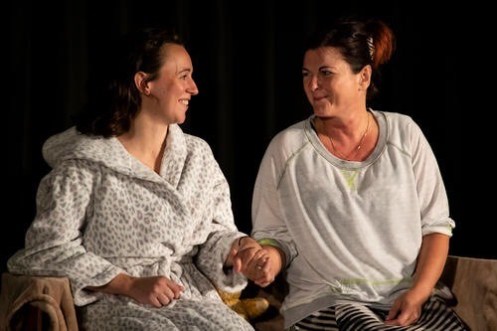
In the hands of director, Velenzia Spearpoint, the dispiriting theme is lightened by pulling out the moments of, albeit fairly dark, humour and of farce. She keeps the chronology focussed by the use of titbits of contemporary newscasts and of the songs then in vogue. Designer Adam Bottomley’s simple set transforms effortlessly from the chaotic orderliness of a classroom to the ordered chaos of a court of law.


In the courtroom scene, zealous young QC, Joanne Young argues her case unsuccessfully in a largely unsympathetic hearing before Judge James Goode. Playing both Young and the younger Cathy, Sally Paffett differentiates the roles well, showing an up-and-coming QC anxious to succeed, seen against the younger Cathy resting on the laurels of success as clever and popular teacher. But when, for Cathy, did confidence merge into arrogance?


Also doubling roles, Edwin Flay portrays a self-opinioned Judge Goode, very much of the old-school, and an entirely different character Dorian Craig, known to all as Dee, a self-absorbed man, seemingly unconcerned about that effect his has on the morale and self-esteem of the declining Cathy.
As the older Cathy, Kat-Anne Rogers’s portrait is as absorbing and as it is realistic, making for griping theatre. One could often almost feel the audience willing a different decision from her as her life gradually disintegrates.
Ambitions thwarted, spirit decimated, relationships dissolved. Would thing have been different if she could have had had time all over again? The question remains rhetorical.
Quentin Weiver
August 2019
Photography by Origin8 Photography
Sharp and Edgy Theatre
The Long Road
by Shelagh Stephenson
St Michael’s Players at St Michael’s Centre, Chiswick until 16th August, then at the Edinburgh Fringe until 24th August
Review by Eleanor Lewis
Dan, a teenage boy, goes out in the evening with his older brother Joe. There is a small altercation with a young woman outside a shop, she stabs Dan and he dies quickly on the pavement, his brother Joe leaning over him. The Long Road opens with Joe’s dazed but graphic description of those events, and calls the audience to attention with a ferocity that continues throughout Shelagh Stephenson’s sharply written play.

Over the course of the next eighty minutes, on a small set, efficiently lit and furnished with minimum scenery and props, five characters deal with the effects of this event. Dan’s grieving family veer off in different directions: his mother Mary struggles to understand; his father John wrestles with rage and distracts himself with running and then with alcohol. Dan’s brother Joe wonders whether he alone can be enough for his parents since Dan, he believes, was their favourite. Eventually Mary decides she wants to meet her son’s murderer and with the help of a counsellor she begins that process despite John’s objections.
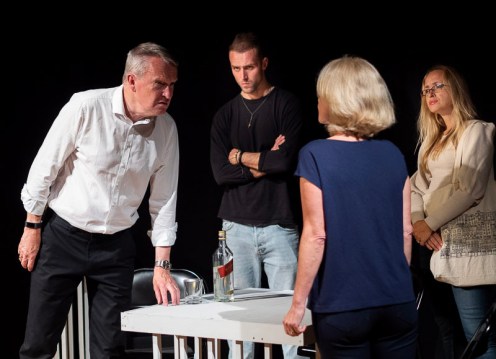
Shelagh Stephenson’s writing is pared down to the essential, it’s highly focussed with small details used to great effect. Elizabeth Ollier’s Mary describes the indentations of her late son’s feet in his shoes and says that she has told a university that he’ll be taking up the offer they made him. She’s not deluded, she’s pragmatic while lost in grief and all the more affecting because of it. 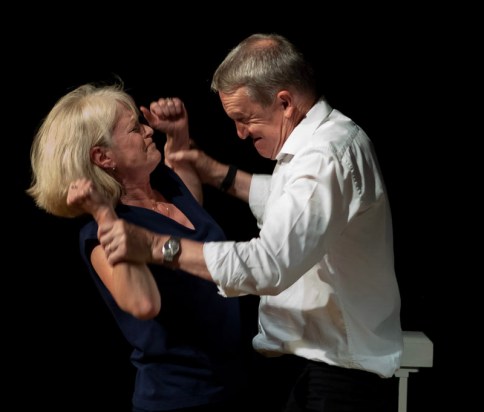
Alistair Dewar’s John is a man well on the road to self-destruction until brought up sharply by his own actions. Dewar plays him as a human being, not always sympathetic in his rage, but still recognisable as ‘one of us’.
Louis Bricusse as the older son and now the only child, skilfully portrays the confusion of a young man burdened with guilt and grief and without the life experience to bolster him.


Fleur de Henrie Pearce is striking as the badly damaged Emma, Dan’s murderer, with a beautifully observed and crafted performance. This character’s constantly hyped, constantly moving, defensive-aggressive demeanour is a human powder keg, a woman to whom nothing has been given and from whom an awful lot has been taken. She’s the woman you walk through the train carriage to avoid.
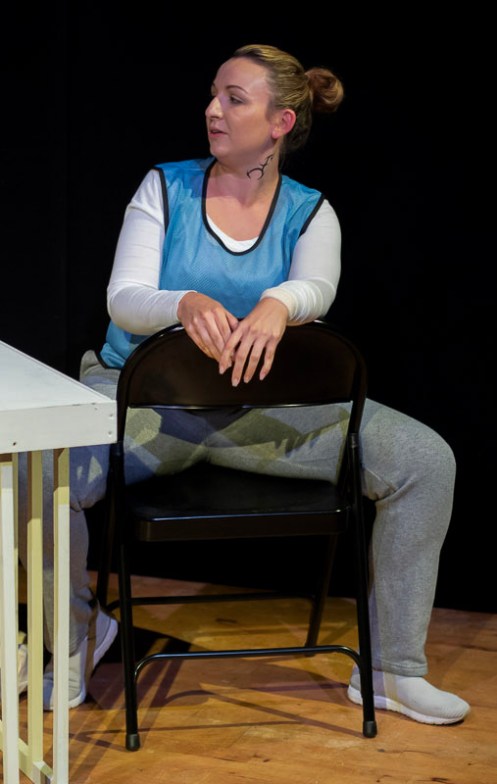
Into this festering mix, Elizabeth the psychologist arrives to take Mary and Emma possibly towards some sort of restorative justice. Leonia Chesterfield gives a suitably restrained performance as Elizabeth, again with attention to the small details, her momentary loss of control during her challenging interactions with Emma being highly effective because of its brevity.
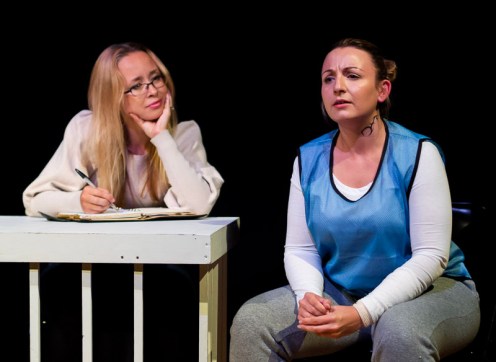
Though Emma’s dramatic trajectory is perhaps ultimately predictable and the play’s resolution a little too neat, this is not real life; it’s drama, and an exploration of the possible, so all bets are off and we are allowed to appreciate a little light at the end of a dark tunnel.
St Michael’s is high definition drama which ticks every box. Director and actors are completely in tune with their material and the material they have is high quality. My only disappointment was olive-related. The ‘olives exchange’ between various characters was a moment of gentle relief. I suspect there were others or rather I’m dimly aware that there were others but they weren’t as apparent as they could be. Humour is always present around death, however awful, and a peppering of it through the drama breaks the relentlessness and rounds the characters. That aside, this is an excellent piece of theatre very well presented. Highly recommended.
Eleanor Lewis
August 2019
Photography by Ian Trowbridge
Georgians on My Mind
Sense and Sensibility
by Jane Austen, adapted by Fiona Hatcher
Youth Action Theatre, Hampton Hill Theatre, until 15 August; 19–24 August, theSpace @ Niddry St – Lower Theatre, Edinburgh
A review by Celia Bard
The Dashwood sisters, Elinor and Marianne, must find their way through the delicate rules and salacious gossip of Regency society in this lively adaptation of the Jane Austen classic by Fiona Hatcher. Lasting no more than an hour, the show treats the audience to a series of highlights in a flurry of well-paced and well-structured scenes. The imaginative use of two narrators help the audience navigate the trials and tribulations of the Dashwood sisters and their associates.

The action opens with the funeral of John Dashwood senior, father of the three sisters. The security of the sisters and their mother is threatened when their half-brother John, heir to the Norland Park estate, and Fanny, his voracious wife, take over the family home and put pressure on them to leave, completely ignoring the wishes of Dashwood senior that their interests should be looked after. Fortunately for mother and sisters, a distant relative comes to their rescue and offers them a comfortable cottage in Devonshire.
The opening funeral tableau of members of the Dashwood clan is very atmospheric. The characters, dressed in funeral attire, hold static, photographic positions, while in the background is heard the singing of the Benedictus. The scene ends sharply, and within seconds the main characters have cast aside their mourning garb and we are in the feminine, pink drawing room of the family home, enjoying the witty but calculating manipulation of John Dashwood junior by his wife Fanny as she plots to remove mother and sisters from the estate.
John, played by Timothy King, is suitably pliant, putting up little resistance to his wife’s callous demands. Zofia Komorowska as Fanny gives an interesting performance: her characterisation reflects Fanny’s striking appearance and her manipulative, snobbish, self-centred qualities, but the actor tends to react to what is being said by other characters at the expense of interacting with them. She does, however, have considerable stage presence, and can certainly hold the audience’s attention. In her case it is perhaps worth remembering the old adage that ‘less is more’.
The three sisters Elinor, Marianne and Margaret, played respectively by Jennie Hilliard, Emmy Coates and Meaghan Baxter, give strong and compelling performances. The two older sisters Elinor and Marianne are complete contrasts. Elinor is ruled by her head and shows very little emotion and Jennie gives a very controlled performance, right up until near the end of the play when she breaks down, giving full vent to her emotions after learning that the man she loves, Edward Ferrars, has been secretly betrothed to another. In contrast, Marianne is played by Emmy as spontaneous and romantic. She attacks her performance full-on, displays a whole range of emotions, gripping the audience with her volatile personality. Meaghan Baxter as the youngest of this trio is just charming as Margaret Dashwood. She weaves in and out of the action, is delightfully childlike, and provides a running commentary on the comings and goings, and helps move the action along at a bouncy pace as she innocently drops snippets of adult conversation she has overheard into other conversations, much to the consternation of others.
The second of the narrators is Mrs Jennings, acted by Mary Rycroft. Through her eyes the audience are drawn into the misbehaviour of the gentlemen folk. She revels in their misfortune, keen to provide an upbeat, gossipy account of all that she witnesses. Mary positively embodies this role, and her attempts to act as matchmaker are especially humorous. Working well as a foil to Mrs Jennings is Lucy Steele, a giddy, simpering young woman amusingly played by Inara Stamp.

The male actors in this production are outwardly correct in manners and deportment, as would have been expected of them in Regency society, but their inner sensibilities tell a different story. John Dashwood, for example, inherits wealth, and although initially keen to carry out his father’s last wishes is shown to be weak and without morals, allowing himself to be totally dominated by his wife. Timothy underplays this character, and this contrasts well with his overbearing spouse.
Jake O’Hare’s portrayal of John Willoughby is carefully sketched. On the surface he is attractive and charming, but he is exposed as a cad by his easy abandonment of Marianne and seduction of Colonel Brandon’s 15-year-old ward. Edward Ferrars, at first seemingly dominated by Fanny as well, manages to extricate himself from his long-standing secret engagement to Lucy Steele, marrying Elinor Dashwood instead – much to the ire of Fanny, who was determined that he should marry someone of wealth. Cameron Christie is entirely convincing as Edward and plays him with great charm. Colonel Brandon, acted by Josh Clarke, is the most rounded of all the male characters. Throughout he acts kindly, honourably and graciously. Josh does justice to this role; he has charismatic stage presence and interacts intelligently and sensitively with other characters.
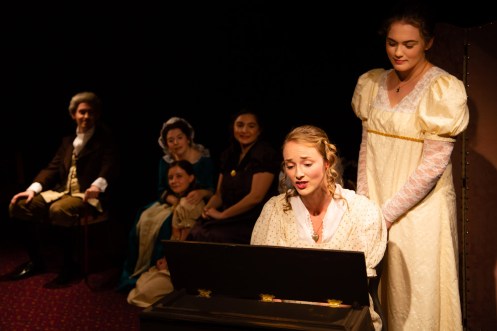
The play is in the capable hands of two strong directors, Sarah Down and Elizabeth Lattimore. The social fabric of the times is well researched, and this shows in the authentic costumes worn by the actors, the choice of music, which is very much of the period, and the deportment and manners of all the characters. Marianne’s piano playing and singing looked and felt very natural. The stage is well used, and the blocking is sound. The scenes move along seamlessly and are pleasing to look at. Only a slight readjustment of props was needed to indicate different locations, a great feat.
The whole of the YAT cast and crew should be complimented on successfully staging a fresh take on an old classic, it felt new. The cast came over as relaxed, enthusiastic, vigorous, and totally absorbed in their characters. A thoroughly enjoyable evening that deserves to be a great success in Edinburgh.
Celia Bard
August 2019
Photography by Jonathan Constant
Masterful
Die Meistersinger von Nürnberg
by Richard Wagner
Fulham Opera, Greenwood Theatre, Southwark, until 17 August
A review by Andrew Lawston
I must preface this review with a confession: I know rather less about opera than Walther von Stolzing knows about the process of becoming a meistersinger. So Paul Higgins’s new production of Wagner’s comic opera Die Meistersinger von Nürnberg came as something of a revelation.
The full four and a half hours of Wagner’s work is presented here, but the 16th-century setting has been updated to the grass, trestle tables and indeed wellies of a 21st-century music festival. This plain set is embellished by back-projected images for occasional comic effect (act II’s raucous climax being a particular highlight in this regard). Jessica Staton’s simple and economical design allows for rapid scene changes, and draws the audience’s eye to the performers.

From the opening, where Walther von Stolzing (Florian Thomas, giving an impassioned performance throughout) tries to attract the attention of Eva Pogner (Philippa Boyle, a hugely powerful voice from whom we definitely wanted to hear more) during a church service, the orchestra, conducted by artistic director Ben Woodward, gamely filled the venue with a broad sound that constantly suggested a far larger ensemble.
There are two casts for this production, with Eva and Walther being portrayed by different performers on alternate performances. After one of the Hans Sachses was forced to withdraw from the production during rehearsal, however, Keel Watson is playing the role for all performances, and singing from the score in places as a result. Watson’s performance as shoemaker–poet Hans was a highlight of the production, his rich voice and controlled gestures bringing this rather sad and philosophical man to life wonderfully.

The plot of Die Meistersinger is light – essentially a knight must be accepted as a master singer in order to win the hand of the girl he loves – but even the lightest plot needs a villain, and this role is pulled off with gusto and relish by Jonathan Finney as ageing hipster Sixtus Beckmesser, Walther’s unlikely love rival and marker for the master singer trials. It’s hard to completely dislike Sixtus in this production, as his attempts to serenade Eva in act II are consistently frustrated by Hans, mischievously hammering at his shoes. Finney deserves triple plaudits for not only embodying such a wonderfully charismatic antagonist, but also training the chorus, and arranging the score for the 18-piece orchestra!
Mirroring the burgeoning relationship between Walther and Eva, Sarah Denbee’s spirited Magdalene is also courting Edward Mout’s put-upon but energetic David. Their sub-plot, which could easily have faded into the background, provides consistently entertaining light relief thanks to the charismatic performances. Veit Pogner, the town’s goldsmith and Eva’s father, is portrayed with great dignity by Gerard Delrez. His wonderful voice even manages to smooth over the eyebrow-raising crack in the plot that Pogner intends to marry off his daughter to the winner of a song contest.
In fact, there is much in the libretto for Die Meistersinger that is problematic by today’s standards. Above and beyond the problem of Wagner’s lingering association with anti-semitism, Hitler and Nazi rallies (the programme notes don’t attempt to excuse the composer’s own views, but do point out sensibly that Richard Wagner died before Hitler was even born), act II briefly veers down a very troubling path as Eva and Hans discuss their love, with Hans commenting that she can be both a wife and a child to him at once. Boyle and Watson tackle the material with a playful edge, suggesting the two are teasing each other jovially rather than … well, rather than whatever else was supposed to be going on there. Throughout, the production treads an assured line that keeps the audience on side.

The rest of the meisters provide gravitas for the show’s big scenes: Andrew Mayor as Frith Kothner has a great time questioning Walther as he prepares for his trial in act I. Then in act III, the meisters have their time to shine at the singing contest: Robert Barbaro as Kunz Vogelgesang, Tom Asher as Konrad Nachtigall, Philip Clieve as Balthasar Zorn, John Rodger as Ulrich Eisslinger, Holden Madagame as Augustin Moser, Ian Wilson-Pope as Hermann Ortel, Simon Grange as Hans Schwarz, and Henry Grant Kerswell as Hans Foltz. It’s a fantastic ensemble, and even Robert Byford’s nightwatchman (or festival security guard, in this update) entertains.
Given its sheer length and the size of its cast, Woodward is probably right to describe this production as ‘surely the maddest thing ever attempted by a fringe opera company’. But dedication, skill, and passion have combined to produce a truly remarkable production.
Andrew Lawston
August 2019
Photography by Matthew Coughlan
Celebrating a Towering Figure
Clara: Sex, Love and Classical Music
by Elena Mazzon
Ram Jam Records, Kingston, 1–3 August 2019
A review by Helen Astrid
Nancy Reich’s book Clara Schumann: The Artist and the Woman was the basis for Elena Mazzon’s portrayal of the composer and wife of Robert Schumann, Clara Wieck, in her 60-minute show.

A towering figure in the German Romantic movement, Clara’s gifts as a pianist, composer, teacher, wife and mother were multifaceted. In her bicentenary year, we are gently reminded of her significance in the musical oeuvre of the early 19th century. Born in Leipzig in 1819, she was by the age of thirteen already undertaking concert tours to Paris, Weimar and Vienna, celebrated as a phenomenon wherever she went. And at just 18, she was engaged to Robert, much to the annoyance of her fiendish father Friedrich.
It was a tall order to master the stage both dramatically and musically in this one-woman show. Mazzon’s ambitious performance was dissipated and erratic, meandering through various characters, settings and languages. The ambience of the Ram Jam Records cabaret room, however, was superbly intimate, transporting us to another era. At times audience participation was also – surprisingly – called for.

The concept is smart and sensitively executed, and credit must be given for the creative endeavour, not least the way it exemplifies Clara’s own detailed and exemplary piano compositions. But it was perhaps unnecessary for the music to be adulterated, as it was for instance at the end of Robert Schumann’s lied ‘Widmung’ (‘Devotion’).
Not only did Clara juggle an international solo career with being a mother of eight and a teacher, she also inspired a huge amount of music-making among her contemporaries. Such an icon was Clara that she even featured on the 100-deutschemark banknote from 1989 until the adoption of the euro in 2002. The back of the note shows a grand piano she played, and the exterior of the Hoch Conservatory in Frankfurt where she taught.
It has indeed taken too long for Clara Schumann’s full significance as a prodigious, all-round musician to be recognised. Events such as Clara: Sex, Love and Classical Music rightly bring her to the forefront of our culture in 21st century.
Further performances are scheduled for later this year.
Helen Astrid
August 2019
Photography by Elena Mazzon
Kräftig mit Humor
Clara
by Robert and Clara Schumann
All Saints Church, Isleworth, 20th July
A review by Helen Astrid
Mezzo-soprano Sandra Porter and pianist Graeme McNaught’s recital of music by Robert and Clara Schumann was a captivating performance.
Sandra’s opening ‘Frauenliebe und Leben’, Op. 42, relates the tale of a woman’s marriage, motherhood and widowhood. This romantic song cycle of eight lieder was written in 1840, and it is interesting to note that prior to this, Schumann wrote almost exclusively for the piano.

It was an accomplished, striking and sensitively executed performance. Heart-stopping moments in ‘Süsser Freund’ and the poignant final lied, ‘Nun haßt du mir den ersten Schmerz getan’ left us wanting to hear it all again.
Joined by celebrated musicians Robert Gibbs (violin) and John Rogers (viola), the performers gave a cheekily playful rendition of Schumann’s Trio in G Minor, Op. 110. Kräftig mit Humor it certainly had!
The highlight, though, was Sally Beamish’s soliloquy ‘Clara’, written for Sandra in 1995; a clever commentary on the Schumann song cycle we had heard earlier, with playful melodic and rhythmic references. Its Bergian-like proportions took us somewhere else entirely.
In the words of the composer, ‘the vocal line moves from a childlike simplicity for Clara’s early years to a more complex, passionate expression’. Sandra’s performance was indeed that. Masterful.
Helen Astrid
July 2019
Photography by Lucia Calcini
Lives that were larger than life
Marie Lloyd Stole My Life
by J. J. Leppink
Kemp’s Jig
by Chris Harris
Blue Fire Theatre Company, Mary Wallace Theatre, Twickenham, 27 July 2019
A review by Celia Bard
Two historical plays about two well-known theatrical performers who lived three centuries apart: Nelly Power, a popular entertainer of the music hall in the 19th century, and Will Kemp, who worked alongside William Shakespeare in the 16th century. What, you may ask, do these two performers have in common, apart from their respective reputations as artistes?
Both were figures larger than life on and off the stage. They were innovative, fearless of authority, hugely talented, but suffered the humiliation of being eclipsed by contemporaries – in Nelly’s case by her young admirer, Marie Lloyd, who would bring flower posies to her dressing room, and in Will Kemp’s case by William Shakespeare, a writer and small-part actor for the Lord Chamberlain’s Men, a company in which they both held shares. In contrast, the final years of their lives ended very differently: Nelly died penniless in wretched conditions at the young age of 32, whereas Will Kemp died in relative wealth, having received an annuity of 40 shillings a year after his famous jig from London to Norwich, his ‘Nine Daies Wonder’.
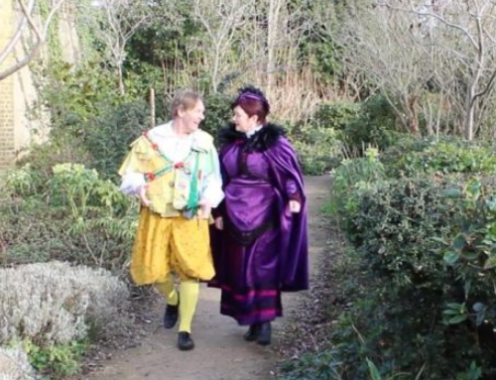
Born in 1854, Ellen Maria Langham started her theatrical career in pantomime at the age of eight. Three years later, she had become one of the top music hall performers in the country. Now she is best remembered for being usurped by the more famous Marie Lloyd, who took over both her acts and songs, and one song in particular: ‘The Boy I Love is Up in the Gallery’.
Charlotte Walker takes on the role of Nelly in Marie Lloyd Stole My Life. Charlotte gives an interesting interpretation of this character, not going for the full-throttle burlesque characterisation, but a much more reflective performance. The audience are shown Nelly’s vulnerability through Charlotte’s facial expression, especially her eyes, and tone of voice. Some of her most moving lines are those recounting a conversation she’d had with her agent, who asserts that Marie Lloyd, her protégé, was younger, prettier and did everything better than she did. This, Nelly flatly states, was true.
Contrasting her reflective monologue is when Charlotte as Nelly sings. Then the audience are transported into the music hall and witness the powerful presence of a star performer, an artiste who connects strongly with that audience, encourages them to sing along with her, which they do during this performance. Here, this reviewer felt that the spotlight could have been used to highlight all her songs, not just ‘The Boy I Love is Up in the Gallery’. This would have more sharply focused the difference between the starkness of her dressing room and her colourful, vibrant presence on the stage.
The stage is barren apart from a bottle of wine and a large costume trunk that Charlotte uses as a seat. This could be interpreted as a metaphor for aspects of Nelly’s life, but perhaps a little more to convey a dressing room, such as a screen over which are draped items of theatrical costume? Mention here should be made of the piano accompanist who displays an easy rapport with Charlotte. Just a pity (but quite understandable) that it was an electronic piano and not something more in keeping with the period.
Will Kemp is remembered as an English comedian and dancer, and an important member of the Lord Chamberlain’s Men, acting in many of Shakespeare’s plays, including Dogberry in Much Ado About Nothing, possibly Launcelot Gobbo in The Merchant of Venice, Bottom in A Midsummer Night’s Dream and perhaps Falstaff. Apart from the latter, these are of course clown or fool figures, and as such an audience might expect either the depiction of a rustic character whose purpose is to evoke laughter through his ignorance, or that of the courtly fool or jester in whom low comedy is accompanied by wit.
In his time, Kemp was as famous for his often bawdy stage jigs as for his acting. According to accounts, Kemp infuriated Shakespeare by his love of improvisation, more often than not ruining the whole mood of the play. This leads to strong disagreement between actor and writer, and around 1599 Kempe sells his shares in the company and leaves. As a way of raising money he undertakes the remarkable feat of performing a Morris dance from London to Norwich over the course of nine days. He writes about this experience in Kemp’s nine daies wonder published in 1600, a pamphlet that underpins this monologue, Kemp being performed by the hugely talented actor Steve Taylor.

The staging of this part of the production is imaginative and well considered. The 16th-century music, a map showing the places that Kemp passed through on his nine days’ jig and a chest containing a whole manner of props, including puppets, successfully sets the scene for Steve’s ‘jigging’ first appearance. His interpretation of Kemp’s boisterous character seems close to most accounts written during the time. Throughout his performance of some 45 minutes, Steve successfully entertains the audience with his jokes, mimicry – especially of Will Shakespeare and the stroking of his chin – dancing, puppetry, general tomfoolery and a constant reminder that Kemp is ‘spelt with a “p” at the end of his name and not an “e”,’ an aside denoting the author’s irritation with the confusion over the correct spelling.
This well-crafted monologue, depicting the different episodes of life on the road during Kemp’s nine days’ endurance test, provides a suitable vehicle to showcase the comedic skills of a talented performer such as Steve. The joyous expression on this actor’s face is a sight to behold on achieving his character’s ultimate goal and arriving in Norwich, transporting the audience back to his wonderful moment in time.
Both monologues give us a thoughtful insight into the lives of two hitherto lesser-known theatrical performers, as well as the social history of their times. The plays are now going to the Edinburgh Fringe Festival. This reviewer wishes these two talented actors and their crews well, and hopes they enjoy good audiences.
Celia Bard
July 2019
Photography by Blue Fire
Love rarely tells its truths directly
Much Ado About Nothing
by William Shakespeare
Shakespeare’s Wanderers, St George’s Gardens, Bloomsbury, 22–26 July
A review by Matthew Grierson
There’s a moment in Shakespeare’s Wanderers’ Much Ado when you can see how effortless the six-strong cast have made it. Having caught our attention from the first with a natural but audible manner that successfully competes with passing pedestrians and planes, Claudio, Don Pedro and Leonata deliver their dialogue with just that bit extra, convincing us that they’re playing not only to an audience of summer-evening picnickers but the supposedly hidden Benedick as well, secreted cartoonlike against a tentpole a tenth of his diameter.
Their connivance is no more contrived than Benedick subsequently binding himself in bunting as he tries to avoid their gaze, an episode that, along with the parallel scene in which Beatrice is likewise gulled into love, show the light-hearted liveliness that the Wanderers bring to the Bard’s timeless comedy. They give clear expression to its perfect pattern, in particular the way it demonstrates that love can rarely tell its truths directly and that anything presented straight is probably a lie. When Benedick says ‘there’s a double meaning in that’, it’s one of few lines that does not itself have a double meaning.

As our leads, Mark Rush and Tara Dowd are a fine pair – an airy B&B, you might say. Rush’s long, expressive face projects his reaction as capably in silence as in speaking, and he makes the masterful switch from screwball comedy to solemnity when drawn into conflict with Claudio. Dowd meanwhile is a sparky Beatrice, and the couple sustain a convincing chemistry throughout. Their relationship, which describes an arc from pretended hate into true affection, is counterpointed by that of Julia Parlato and Philip Honeywell as Hero and Claudio, who instead move from love to hate and then to marriage. Both the latter come across as more mature than other versions I’ve seen: although Hero definitely benefits from this, it does mean Claudio can seem more dogmatic than ingenuous when suspicious of his fiancée.
The mood of the play is largely that of a balmy, nay, blazing summer evening in the urban heat island, even though the production has transposed the scene from Messina to Dover, with the consequent loss of a syllable from the verse. In fact, recurrent imagery of the seasons – Beatrice’s protests that she will not love until a ‘hot January’, or Benedick’s that her fury exceeds her beauty as much as May does December – warrant an ironic nod of recognition in our rapidly changing climate.
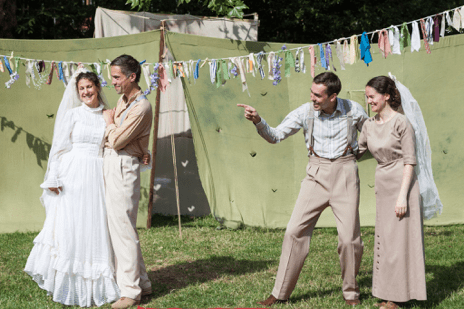
Whether intentionally or not, the play often acquires more resonance this way than it does from being set after the Great War. Songs of the period add a jolly touch to the dance scenes but there’s little hint of late autumnal gloom about the piece, and its relocation would feel curious were it not so buoyantly directed and ebulliently performed.
Against a khaki canvas that suggests a village summer fete as much as a military camp, the cast move with rhythmic, seamless ease between one scene and the next, and often between one part and the next along with the necessary costume change. Ben Higgins retains a sense of benign authority as Don Pedro, Sexton and the Watch despite his changes of hat, but pity Rebecca Peyton in a succession of Georgian blouses and crinolines: in the regendered roles of Leonata and Donna Julia, she has to switch frocks with unenviable speed, and if she’s suffering in the heat she doesn’t show it.

In keeping with the dualities of plot and dialogue, the production makes wry use of doubling among the cast, so ne’er-do-wells Donna Julia, Borachio and Conrad are no sooner done plotting than the actors reappear in the subsequent scene as Leonata, Hero and Beatrice, denouncing their wicked counterparts. Special mention, too, to Parlato, who as Borachio and Hero manages to be both villain and victim in the same scheme.
In other respects that scheme is not so cleverly executed; the point where Claudio is tricked into thinking his beloved is being seduced should pivot the play into tragedy, but unfortunately the moment is dispatched so quickly that it is lost, the comedy of Dogberry and Verges following hot on its heels. Similarly, Beatrice’s command that Benedick kill Claudio should merit at most a nervous titter, not the big laugh it gets tonight.
As the play moves into its tricky second half, though, these more serious undertones come to the surface, and in a world where as much authority is vested in ladies as in lords – with a syllable thereby restored to the verse – gender politics can’t help but be more apparent either.
For instance, Claudio seems more remorseful when he learns he has been tricked than he does when, taunting Benedick, he hears of Hero’s death, as though his code of honour is more important than the life of his fiancée. After this, Leonata’s insistence that he marries Hero in the guise of her cousin looks more like a punishment for bride than for groom. Indeed, the way patriarchy pervades the minds of men and women alike is strikingly evident when Hero is denounced by a Leonata rather than Leonato.
So perhaps here the postwar setting does resonate in the trauma of those who have lived through it, and want to assert an old order to prevent further conflict. To be fair, though, there is always the promise of sunnier days to come – a promise that the Wanderers keep alive even as the sky darkens over St George’s Gardens.
Matthew Grierson
July 2019
Photography by Chris Marchant
Deadpan Bedpan
Bed 13
by Marcia Kelson
Putney Arts Company, Old Sorting Office, Barnes, until 19th July
Review by Vince Francis
My mother was a nurse. She arrived from Ireland during the last war to train and dealt mainly with airmen and some mariners. After we had all grown up a bit (there are six of us), she returned to nursing as a dental nurse in the outpatients department of the local teaching hospital. This wasn’t as mundane as it might sound as she was occasionally involved in supporting the A&E teams’ work with survivors of road traffic accidents, fights and other traumatic events. It wasn’t unusual for her to come home having assisted in stabilising the facial injuries of some poor sot who had come off his motorcycle (and yes, it was usually a he and yes, it was usually a motorcycle) so that the trauma team could focus on other priorities. Also I think it’s fair to say that most of the issues explored in this piece are familiar to me as a result. I offer this information as I think it’s relevant to declare I have a particular interest in Putney Theatre Club’s production of Bed 13.
This is a new piece, written by Marcia Kelson, who also directs. The play has been entered for the Papatango New Writing Prize and has been long-listed as a result. For those who may be unfamiliar with this prize, it was established in 2009. It was the first and remains one of the few annual playwriting award in the UK to guarantee an emerging playwright a full production on the professional stage. It provides a royalty of 10% of the gross box office and publication by Nick Hern Books, as well as a full commission to support a follow-up play.
Putney Theatre Company (PTC) is normally associated with the Putney Arts Centre, so they are playing away here, and making a pretty good fist of it.
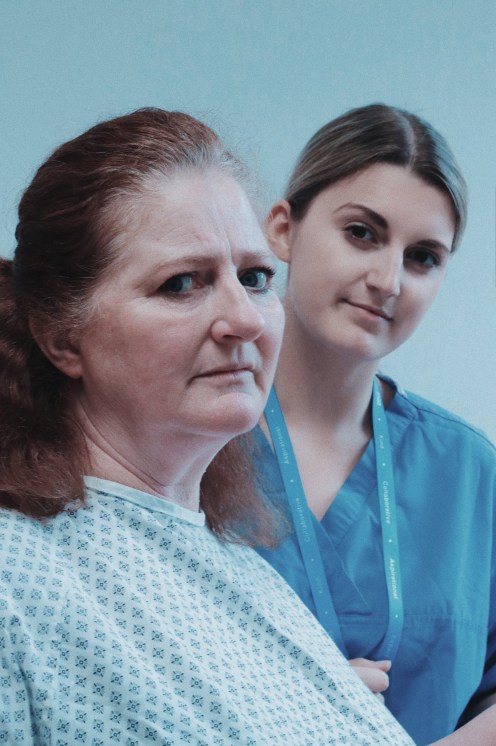
I’m sure that many of us are familiar with the problems and issues facing the NHS and offer opinions and solutions in the abstract. The advantage of a play, or film, or television programme is that it can set those discussions in the context of real people and the effects on them. This script has great strength in this respect. Marcia Kelson draws on her experience as an NHS researcher to provide characters that are well drawn, believable and developed throughout the play, as are the situations they face.
As we enter the auditorium, we are soothed into our seats by the playing of Samuel Woolf, offering such arch references as The First Cut Is The Deepest and I’m No Superman, which was the theme from the American hospital based comedy drama TV series Scrubs. But it is the theme from our own Casualty that acts as the figurative curtain-raiser and introduces us to Angela, an NHS manager who implores us to make proper use of A&E and not take up time with cuts and bruises or sniffles and coughs. The opening number, The 999 Song, serves to underline this plea and introduce us to a well-drilled ensemble.
Angela, ably presented by Caroline Salter, comes across well as someone who is trying to access and present that breezy efficiency that we all love to hate, but who is actually hanging on to any positivity by her fingernails in the face of conflicting demands that threaten to overwhelm. These demands are, of course the huge call on services by the public, diminishing resource levels and increasing management demands. As a result, Angela becomes an altogether more sympathetic character. Angela also addresses us directly on occasion to provide relevant information.

We are then introduced in short order to nurses Stacey (Emma Bugg) and Carol (Tamsin Gatewood), together with patients Mr Jackson (David Jones) and Graham (Tim Iredale). Mr Jackson is in the middle stages of dementia and is looking for his wife, who in reality has died some time previously, whilst Graham takes on the role of the ward jester. Both are familiar characters and in the case of Mr Jackson, sadly so. I wondered briefly whether this device of looking for his deceased wife was going to slip into a form of Carry-On standing gag, but it didn’t. It rightly emphasized the pathos of the situation. The character of Graham is interesting in that his storyline points towards a resolution that doesn’t occur. As such, it is more reflective of the random elements of diagnosis and treatment.
Stacey and Carol are a great pairing. The conversations between colleagues provide the opportunity to point up the front-line issues facing nurses and their overriding vocational dedication. The one element that is not referenced, I think, is that of violence towards A&E staff. That aside, the dialogue and interactions and emotional responses all felt natural and realistic. Both sing well, too. Their duet, Nurse Patient Note Song delivers a witty and insightful observation and demonstrates a well-balanced musicality.
Other notable performances include the aforementioned David Jones in a second role as Doctor. Rachelle Grubb as variously Susie, Alison, Sophie or Janice, where each character was distinct and defined and even her appearance and physicality changed to suit. The costume changes must be a nightmare. Also, Craig McAulay playing Clive, the sort of manager one would never get tired of slapping.
The scope of the piece is fairly wide ranging, including the effect of chronic illness on relationships, particularly family relationships. There are two key instances of this; one with Mr Jackson’s daughter, who is rather self-obsessed and materialistic and the other with a mother and her adult daughter, who has a recurrence of a cancer. This last, although it was well acted by Lesly-Ann Jones and Rachelle Grubb, felt a bit laboured in contrast to the pacy coverage shown up to that point. It may possibly benefit from a bit of tightening up in the writing, or the inclusion of a song, such as Alison and Mr Jackson’s duet, Alison’s Song, which occurs later in the piece.

Overall, I found this to be an engaging, entertaining and interesting exploration of the current state of the NHS. The action moves through comedy, sometimes the black comedy that is the means by which front-line staff deal with these situations, to pathos, to tragedy, in the death of a patient and the reaction of staff to it. The woman directly behind my partner was living through it and, rightly so. I would openly admit to welling up at the death of one of the patients. There is also a treatment of the growing corporate nature of the NHS and the politics within it.
Musically, the numbers felt appropriately crafted into the action and dialogue. The chorus numbers work well and there are some lovely duets, Carol and Stacey as already noted, but also Graham and Doctor in a glorious soft-shoe routine, Doctor-Patient Song, using crutches as walking canes – well, you would, wouldn’t you? I didn’t come out humming anything from the show, but that could be said of many a show I have enjoyed. Sometimes, the music works intrinsically for the piece. Geoffrey Hewitt’s score fulfils that requirement and that’s perfectly OK.
The choreography suited the space and the cast and that is the sign of a mature and considered approach in my humble opinion. If people look comfortable with what they are doing they come across so much better than if you can see the panic in their eyes. My current exemplar of this approach is Come From Away.
Other stand out points for me were:
The programme. Succinct, informative and comprehensive. Take a house point. But please, please, please include a list of the songs and characters singing them.
The baritone voice of David Jones and the lovely Mezzo/Alto voice of Tamsin Gatewood are both worth a hearing in their own right.
The use of set and lighting. In a small space like the OSO Arts, any crew intervention is noticeable and this production avoided that by blacking out areas not in use and using bed screens to mask upstage changes made by the cast. This keeps the action moving.
If I were able to offer a couple of touches at the elbow, they would be:
To the cast; relax and let the script and characters take you on the journey. The audience will come with you. Having said that, I appreciate this was an opening night and I’m confident that this cast will settle and shine.
To both the cast and tech crew be prepared for the bounce at the bows. This is good and it deserves one.
A minor irritant was that the electric piano had too much bass in it. This may be due to a heavy left hand, or it may perhaps be an EQ issue, but solo and duet voices were sometimes lost, particularly when temporarily facing upstage. It may be that this was not apparent to Samuel Woolf, who is an excellent player, as the amplifier was angled – rightly so – on stage. It just needs someone to listen from the auditorium to check.
Bed 13 refers to the practice of not having a bed number 13 in an A&E department, as it might be considered unlucky. With this crew, I’d risk it. I think I’d be in safe hands.
Niggles aside, I’d thoroughly recommend this production. At eighty minutes, there’s ample time to meet and greet after and that is an added bonus.
Vince Francis
July 2019
Photography by Benjamin Copping
Much ado about seeing this play!
Much Ado About Nothing
by William Shakespeare
Richmond Shakespeare Society, The Fountain Gardens, Twickenham until 20th July
A review by Viola Selby
2019; the 100th anniversary of the first female MP in the House of Commons and so far a year with a lovely sunny summer! What better way to spend it then with a picnic watching Fiona Poole’s exceptional and female focused rendition of Shakespeare’s Much Ado About Nothing. But how, you may ask, can one celebrate such a political anniversary through such a light-hearted comedy, written in a time where women had little if any political power? Well, Poole has managed to cleverly set her play a century ago, during the suffrage movement, with characters dressed in period-perfect attire, creatively crafted by Junis Olmscheid, Miriam King and John Gilbert. Along with the stunning, yet minimalistic set design, realised by Junis Olmscheid, Ron Hudson, Peter Messum and Fiona Poole, this play is both a feast for the eyes as well as the ears! There are also some toe-tapping musical numbers that bring the period even more to life, thanks to the maestra in charge of sound design and composition, Sarah Hill!
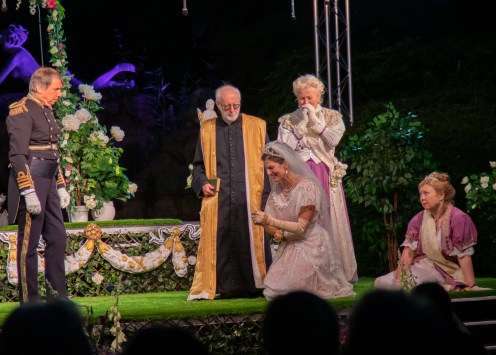
In addition to this, Poole has also chosen a powerful cast, each of whom shows an extraordinary level of performing expertise through their clear understanding of their character. For example, when Leonato’s daughter is shamed in front of everyone at her wedding, having been accused of sleeping around with another man who is not her betrothed, Vaughan Pierce, as Leonato, does not just fly off the handle at his daughter, but instead portrays a man who is a mixture of emotion. He is both shocked at this claim, furious by the shame it has brought his family and also upset due to the effect it has had on the daughter he loves so dearly.  As well as this, each thespian delivers the lines with such passion that they will have you sitting on the edge of your seat (or rolling on the grass) with laughter. This comedic element is especially true when Benedick and Beatrice are on stage. Francis Abbott (Benedick) and Dorothy Duffy (Beatrice) make a sublime double act, whom one may think are an old bickering married couple, when in fact the pair cannot stand one another yet later end up marrying one another! Whilst Ben Collingwood Best and
  Deborah Tinsdale will have you in stitches as they create an almost Laurel and Hardy – esque portrayal of an officer and his second who manage to catch Conrad and Borachio, played by the craftily cunning Francesca Ellis and Dominic Upton, in their plan to ruin the forthcoming wedding. It is a plan devised by the evil Princess, yes you read that right – a brilliant change made by Poole to focus the play on the power of the females, Donna Julia. Nicola Doble’s portrayal of Donna Julia is villainously victorious, as she uses both tone and body language to create a socially cunning classist whom no one would expect. Finally, this play would not be the same without Claudio and Hero, one of our main couples involved in both the weddings and “funeral”. Matthew Tyrrell is regal and upstanding in his depiction of the Prince’s favourite, and his chemistry with Héloïse Plumley as Hero passionately breathtaking, even though Plumley manages to create a character that is demure and gentle.

Altogether the cast and crew have given new life to this play and have made it their own. If you are a Shakespearean fan or completely new to the bard, there is much ado about seeing this play! A magnificent way that celebrates the skill of Shakespeare whilst also paying homage to the wonderful wit of women!
Viola Selby
July 2019

 Mark Aspen