
Buzzy Itchy Reality?
New Writing from Twickenham
Richmond Literary Festival at The Conservatory at The Exchange, Twickenham until 13th November.
Review by Eliza Hall
On a wet, cold evening over fifty young people, mostly undergraduates from the Creative Writing programme at St Mary’s University, along with an assortment of others, ranging from two graduates about to be published in 2020, to short course attendees and members of the public, gathered to listen and read.
It was noisy, buzzy, itchy. Some nervous about standing in public to read their private thoughts, others ready and keen to get started. It was an evening of prose, poetry and flash fiction. The lights in the Conservatory were perpetually altering in colour throughout the readings, just as the continuum of human emotions and experiences were constantly changing.

It seemed that everyone had something to say. Some writers expressed the real and the mundane whilst others conjured with the listeners’ sympathies and appreciation as they were plunged into the obscure, the magical, the humorous, the surreal. A myriad of meanings set in words, with cutting statements, some nightmarish moments, some crude and explicit, others read more delicately woven pictures of events and feelings.


Sometimes one could almost catch a glimpse of Proust through the kaleidoscope, or was it ‘Fleabag’? As the lights continued to change their colour, so there were expressions of loss, of love, reminiscences, of searching and of freedom. Cruel reality was mixed with pathos, charm and romanticism and reminiscences. The evening was a challenging mix of created images, imagined pictures, accepting loneliness, pain and life’s realities.
The evening drew to a close with two readings by two graduates whose books will be published in 2020. These were Molly Gartland’s The Girl from the Hermitage and Louise Fein’s People Like Us.
Such is the human condition and such is the power of the word. It was an evening of vibrant ideas being expressed by those who certainly had something to tell. It offered a secure platform on which to say in public what was important to the individual, as well as to showcase their course work and developing writing skills. There are promises of more evenings like this, if you want to sample, wonder or contribute!
Eliza Hall
November 2019
Photography by Agnieszka Studzinska
By Any Other
What’s in a Name
by Matthew Delaporte and Alexandre de La Patellière, translated by Jeremy Sams
Adam Blanshay at Richmond Theatre until 16th November, then on tour until 18th April
Review by Eleanor Lewis
If Mike Hitler had invaded Poland and then led the charge of fascism throughout Europe, it’s likely no child would‘ve been named Michael after 1945. The naming of children, specifically the appropriate naming of children, is just the starting point for the family gathering in this very funny play by Matthieu Delaporte and Alexandre de la Patelliere, translated from the French and adapted by Jeremy Sams.

Events begin with a character called Vincent strolling into Francis O’Connor’s set, a large, book-walled living room in a soon to be gentrified area of London. Vincent looks like every overconfident, can’t-be-more-than-fifteen, estate agent you’ve ever met: his hair slicked back and his demeanour one of someone who realises it’s part of his job to speak to you but actually he’d really rather not. As well as taking part in this story, Vincent is its occasional narrator, introducing characters, desperately announcing the interval and eventually drawing things to a conclusion.

Elizabeth and Peter are giving a dinner party for Vincent (Elizabeth’s brother), their friend Carl, and Vincent’s pregnant girlfriend, Anna. It is the potential name of this unborn child and the outrage it provokes which kicks off proceedings and appears to settle the play into something that is almost a cross between Yasmina Reza’s excruciatingly well-observed God of Carnage, and a decent 1970s farce without the slamming doors or falling trousers. This would be entertaining enough in itself, if a bit predictable but Act Two races off at breakneck speed and with great hilarity through every type of the most cringingly awful family and political rows you could possibly have, including the ones likely to cause twenty-year rifts, and leaves the issue of children’s names far behind. The press night audience on Tuesday lived through every hairpin plot bend squealing with delight at some. Eventually the action comes to what I am struggling not to describe as a rather sweet end. ‘Sweet’ being a fairly devalued word these days but in its purest sense, the conclusion of this work as it is related to the exhausted audience by a mellowed Vincent, it must be said, is sweet.

A highly skilled cast under expert direction (Jeremy Sams and Sadie Spencer) squeezed every drop of comedy out of this cleverly constructed script. Laura Patch as the patient Elizabeth gave full vent to her spectacular ‘enough already!’ exit scene, accompanied by a well-deserved round of applause. Bo Poraj’s Peter was suitably oblivious to his many shortcomings to great comic effect, and there was sterling eyebrow work from Summer Strallen, cleverly not overdoing the glam girlfriend and therefore giving her lots of credibility. Alex Gaumond as Carl provided a soothing and bonding presence between the other four until his own particular plot strand began to unravel, at which point chaos ramped up a gear and all bets were effectively off.


What’s In a Name contains distinct elements of Alan Ayckbourn, and Yasmina Reza. It targets everyone and everything including the woke generation, the rich seam of middle class pretentions, and the often bizarre complexity of personal relationships but I’m not convinced it’s intended to be more substantial than it seems. That said, making people laugh still makes points, it just makes them easier to absorb. What’s In a Name is very entertaining. Highly recommended.
Eleanor Lewis
November 2019
Photography by Piers Foley
Evergreen Holly
Buddy, the Buddy Holly Story
by Allan Janes
Buddy Worldwide at the Ashcroft Theatre, Fairfield Halls, Croydon until 16th November then on tour until 19th July
Review by Vince Francis
This show has become something of a phenomenon over the past thirty – count ‘em – thirty years. I last saw it about twenty years ago in the West End and was swept along by the sheer energy of the piece. It is a tribute to the writing, production, direction and performance that this still remains the case.
The show tells the story of Buddy Holly’s rise to fame and his untimely death in 1959, along with The Big Bopper and Ritchie Valens. I was born in 1956, so this was slightly before my time, but it is a tribute to Holly that his music continued to be played through the sixties, when I first became aware of such things, and into the present day, where he is rightfully revered as one of the founders of rock music as we know it.

The first act takes us from early beginnings in the local radio station through to the gig at the Apollo, New York, where Buddy and the band gain acceptance from the initially intimidating Harlem audience. The Apollo gig scene brings us a fine pastiche of Jackie Wilson, as played by Miguel Angel, and some particularly delicious vocals on the part of Sasha Latoyah and Cartier Fraser.

The second act opens with some audience “warm up” leading to a portrayal of the final gig that Buddy Holly played, along with Ritchie Valens and the Big Bopper. It was given to Harry Boyd to play the M.C. of the venue in question (Clear Lake, Iowa) and it has to be said, that on a cold Monday evening in Croydon, in a theatre where audience numbers could have been better, he was having to earn his keep up there, but he did it and with great aplomb. The remainder of the cast join as band members and backing singers for this section, which beefs up the numbers wonderfully.

The risk with a show like this is maintaining the balance between telling the story and being a tribute act. This production achieves that well, through strong characterization, supplemented by the use of a narrator, who steps out of the action to communicate directly with us when it helps to move the story along. Harry Boyd takes on this challenge, portraying various characters, including DJ Dave Stone and producers ‘Hipockets’ Duncan and Norman Petty with huge energy.
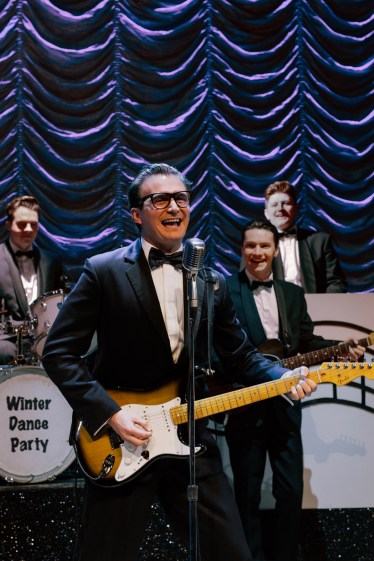 A J Jenks gives an impressively rounded portrayal of Buddy. Sometimes showing that young man’s awkwardness and sometimes the brashness, but always the growing confidence. He plays pretty well, too. The band around him were supportive, wholly credible, energetic characters, particularly, I thought, Josh Harberfield as Jerry Allison. Maintaining that drum pattern in Peggy Sue is no mean feat and the precision and attention to detail in Not Fade Away was excellent.
In the humble opinion of this hack, this genre of music is the most accessible and inclusive of any available in the western world. As a jobbing band musician, I know that you only have to include a ten-minute spin through the rock’n’roll hits of the late 50s and early 60s to fill the dance-floor with people of all ages. More than that, I’m sure I’m not alone in being able to remember all of the lyrics and flourishes of songs such as Johnny B. Goode, Peggy Sue and suchlike, whereas I struggle to get beyond the first four lines of I Wandered Lonely As A Cloud.
As a lover of Fender guitars and amplifiers, I’m always happy to hear the crystalline tones of a cranked Stratocaster or the nasal snap of a hard-strummed Telecaster (my instrument of choice, incidentally) and those joyous sounds are in abundance here. Having said that, I know that the two Fender amps on stage were set-dressing, but I had a sneaking suspicion that those models may be a little anachronistic. Still, it would have been nice, if at all practical, to hear them spreading the word. Also, the programme tells us that Buddy applied the tooled leather wrap to his Gibson acoustic, yet the guitar on stage is a Takamine, which, if nothing else, is also a little anachronistic.


This is a touring production and, as such, set and furniture is kept to the minimum required to suggest an environment, be that an office, a studio or a venue. For the most part, this works very well, but there were a couple of clunky changes, which may well have been first-night issues that will be corrected for the rest of the week.
Overall, this is a wonderful, feel-good evening out, which will have you up in the aisles singing out the lyrics, clapping your hands (on two and four, please … this is rock’n’roll dontcherknow) and bopping your hearts out. That is in some ways ironic given that the story itself is so tragic, but a tribute to the man and his legacy. Go see.
Vince Francis
November 2019
Photography by Rebecca Need-Menear
Watching You
George Orwell’s 1984
by George Orwell, adapted for the stage by Matthew Dunster
The Questors at the Judi Dench Playhouse, Ealing until 16th November
Review by Nick Swyft
“War is Peace”, “Freedom is Slavery”, “Ignorance is Power”. These are all seemingly nonsensical statements displayed on video screens around the theatre as the play begins. The set is austere, as befits the subject, with a room above the stage for later scenes. We then see Winston Smith (Julian Smith) doing his job of presenting ‘alternative facts’ according to the requirements of IngSoc, the shadowy regime under which everyone lives, embodied by the immortal figure of ‘Big Brother’.
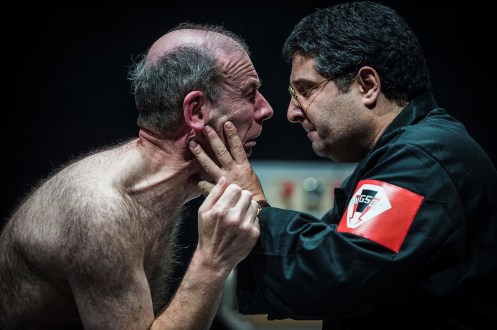
Winston Smith is a subversive from the start, and Julian Smith gives us a subtle portrayal of someone who is a little separate from the herd. When Goldstein (Simon Taylor), the resistance leader is pilloried on screen, his co-workers join the jeering enthusiastically in true Jeremy Kyle style, but Winston is seen as apart from the others.
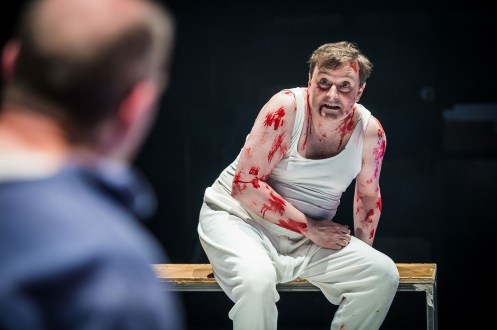
He writes his secret memoir in the ‘privacy’ of his apartment, although everywhere there are the ever-present telescreens. These present constant propaganda while at the same time watching the viewer (not unlike Alexa perhaps). Unfortunately throughout the performance these were inactive, which took away from their pervasive impact. Thus, when the old antique dealer Charrington (John Davey) shows him his upstairs bedroom, the fact that there is no telescreen there doesn’t have quite the impact it should.
The first part of the play is about world building – the constant war between Oceania and Eurasia, the relentlessly positive propaganda and the contrasting general misery of the populace. During this section, we learn of Winston’s relationship with his mother and also his sterile relationship with his wife. It is against party policy to derive any pleasure from sex, and as she lies flat on the marital bed it was easy to wonder how the population could possibly survive.
We are also introduced to Mrs Parsons (Lisa Day) and the Parson’s children. These are delightful brats who are disappointed at having had to miss the hanging of Eurasian prisoners – not too dissimilar to a lot of children today.
In the work canteen Smith meets Mr Parsons (Robert Gordon Clark), who portrays the proud father well, telling us how well his children support the Party. Smith also talks to Syme (Wesley Lloyd) who is working on reducing the number of words in the dictionary to make the fine art of ‘double think’ easier for the general population to grasp. Lloyd is very believable as the enthusiastic young lexicographer.
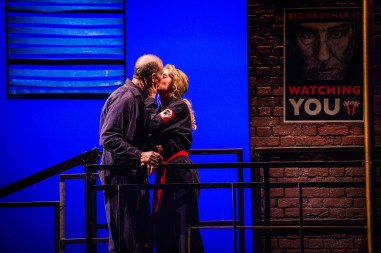 His first encounter with Julia (Clare Purdy) is puzzling to begin with. It is a fantasy scene in which he is seen attacking her. Later, it turns out that she is a member of the hated thought police and when he tells her that he used to think about raping and murdering her, one wonders whether this would ever work as a chat-up line.
When he gets the famous note in which she says “I love you” the words are repeated over and over on the speakers – the mechanism for voicing everything that is read. This should have had more impact than it did, since it wasn’t even clear that Winston had actually received the note.
 Clare’s performance brings a breath of fresh air both to the world in which they live and to the production itself, which is necessarily dour. She is a vivacious free spirit, who works in the porn department providing material to keep the proles in their bedrooms rather than on the streets causing trouble. What’s not to like?
As their relationship develops it is clear from the performances how different Winston and Julia are. He is an intellectual subversive, while his view of her is that her subversion begins below the waist.
At the start of Act Two, Winston reads Goldstein’s book to Julia in bed, and Goldstein (Simon Taylor) himself reads it to the audience. This is quite a long scene that adds little to the production, which is two and a half hours as it is, except perhaps for the die-hard intellectuals. For them the advice would be to actually read Orwell’s book.
Then follows the arrest and subsequent breaking down of Winston.
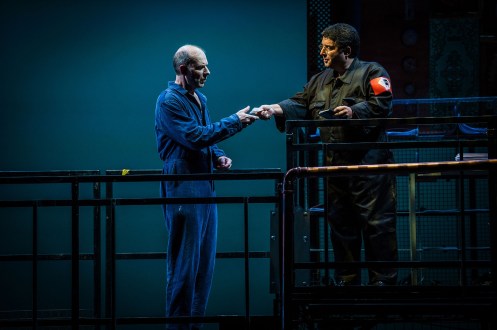
His nemesis O’Brien (David Erdos) does not come across as overtly sinister. Rather he portrays the cuddly, if somewhat sadistic, voice of reason, which is far more effective. He is almost able to persuade the audience that maybe Winston Smith is the bad guy after all. After all a man who has openly admitted to be willing to betray his country, spy for the enemy and more damningly, throw acid into the face of a child, may not be a paragon of virtue.
Smith is an outsider, and there are questions here regarding how such outsiders should be treated by society, but they are not the ones that we generally believe 1984 to ask.
A succession of other prisoners come and go, and the scene in which Bumstead (John Dobson) is constantly taunted for being unable to stop his shaking, was well done. A classic example of the kind bullying we’ve all seen, where the torturer is clearly enjoying his cruel fun. Parsons, the proud father, is even glad that it was his daughter who shopped him for talking in his sleep. Syme also appears, needing to be cleansed of the idea that he is actually destroying the language in his work.
 It is hard to portray torture scenes on stage, not least because it’s illegal to actually hurt the actor, but also because today’s audiences are too squeamish for that kind of thing. Unfortunately this means that we are not as engaged with this as we might be, although Julian Smith does much to recover this shortcoming.
 At the end, Smith is stripped and humiliated. More than the torture, this an extremely powerful scene. Julian Smith’s performance during this harrowing scene was outstanding. Winston Smith’s identity, which has been scurrying around his brain like the rats he is so frightened of, is finally cornered. When O’Brien holds up four fingers and tells him that the Party says that it is five, we can believe that he actually does see five fingers.
There is only one thing left. Julia. He insists that he will never betray her, even though she betrayed him at the first opportunity. O’Brien attaches a mask to his face, which is attached to a long tube at the end of which there is a box of hungry rats. O’Brien lifts the first door to the box which allows the rats to see him and him to see the rats. Smith’s morbid fear of rats prompts the response ‘do it to Julia, not me’. (Unfortunately the tube is so long that there is no way he could see the rats. A note perhaps to the props department?)
And so his ‘rehabilitation’ is complete. Free, he meets Julia again. They confess to having betrayed each other – although maybe betrayal is the wrong word in context – and they part with a kind of ‘see you around’; they don’t hate each other, but they no longer love each other either.
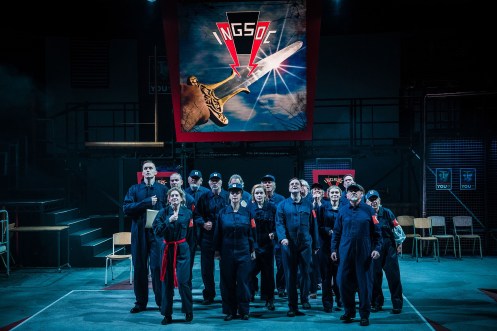
Finally, Winston is seen with a crowd enthusiastically confessing his love for ‘Big Brother’. What sets this production apart from other dystopian visions, aside from the glitches, is that we can believe that he means it.
Nick Swyft
November 2019
Photography by Rishi Rai
Editor’s Note:
This production of George Orwell’s 1984 is The Questors Theatre’s Ninetieth Anniversary Celebratory Production.
Memento Non Mori
Dead Women’s Poetry Society
by Helen Bowell
National Poetry Library at the Southbank Centre until 6th November
Review by Heather Moulson
It is with some trepidation than one approaches a promised resurrection, albeit literary rather than literally. Therefore this looked like an exciting prospect, that of literary séances with forgotten deceased female poets.
Our host, Helen Bowell, an Education Co-ordinator at the Poetry Society, gave a very lively introduction to the event, and conveyed that its aim was to raise women poets from the dead, and keep their legacies alive. This project, the Dead Women’s Poetry Society, was founded in 2015 with this very aim.
Helen then read We Shall Not Escape Hell by Marina Tsvetaeva, a Russian poet who passed away in 1941. And so our frame of mind was set.
 Séance number one was hosted by Ruth Sutoye, a creative producer whose work spanned across photography, poetry and film. She resurrected June Jordan (1936 – 2002), a Jamaican-American bisexual poet, essayist, teacher and activist, whose poetry was of a biographical nature, and who invited other voices. This collection included: Apologies To the Dead of People of Lebanon; then Poem About My Rights (confronting issues of patriarchy and of supremacy); and It’s Hard To Keep A Clean Shirt Clean. Ruth played us recordings of June herself reading these works, which really breathed life into the words. We caught her passion and meanings, for June’s poems were flawless. To conclude this talk, Ruth read her own work, Blood Sings, a very strong presentation, and a new respect gained for this previously forgotten writer.
 The next speaker, Zahrah Sheikh, a British Pakistani poet from Ilford, resurrected and introduced us to Fahmida Riaz (1946 –2018), an Urdu writer, poet, human-rights activist and feminist. After a vibrant first resurrection, this section sadly dimmed. What could have been an exciting journey into Fahamida’s life, became badly read and ill-rehearsed. A pity, because this poet broke barriers and taboos, and was a formidable figure. Even when exiled to India, Fahmida was tireless and wrote very strong work, which continued to challenge convention. Poems read were: The Language of Stones, The Body Exposed , The Body Abject, Four Walls and a Black Veil , and concluded with Condolence Resolution. I came to my own conclusions that sometimes information is not enough, and justice wasn’t really done to this very brave poet.
Helen, in a closing speech, imparted the exciting information that Dead Women’s Poetry Society planned to tour England. This is very good news indeed for such an exciting project.
Do give the National Poetry Library a try at the Southbank Centre. Its catalogue of poetry is inexhaustible and it occupies a wonderful and accessible space. I certainly look forward to returning.
But now I was departing. Leaving a séance, even a literary one, is an odd sensation, and as I passed the looming edifice of the Royal Festival Hall I felt the spirit of Jordan and Riaz … were they forgotten?
Heather Moulson
November 2019
Photography by Madani Younis
Erudite Master Storytelling
The King and the Catholics
by Lady Antonia Fraser, in conversation with Anna Sebba
Duke Street Church, Richmond Literature Festival, Duke Street, Richmond until 6th November.
Review by Eliza Hall
An evening of gentle discussion which hinged on the book The King and the Catholics was led by Anna Sebba. Lady Antonia was introduced to the 300 strong audience, via her books and the amazing reviews they have all received.
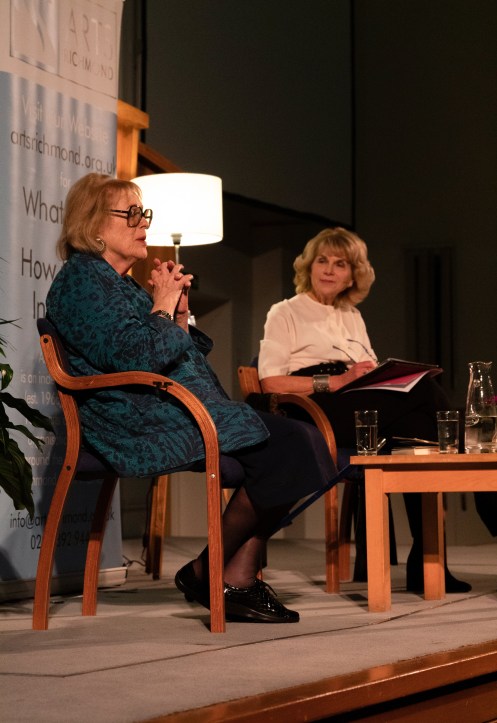
Turning to the book to be discussed, we were given a glimpse of the opening scene of violence and bloodshed and the reason Lady Antonia wrote this as she explained that that it was in fact a bloodless time of emancipation during the reign of George III. Anna had asked Lady Antonia how she started the book, was it a scene that that she imagined or a real moment in history? This led to some interesting answers about how the author gains a feeling about the time and in particular the characters involved with the Gordon riots against Catholic Relief in 1780.
When Lady Antonia was asked to explain why there was such a depth of feeling against the Catholics she took us back in history to look at the background of fear of Catholic Europe and our wars against the Spanish and French, of Guido Fawkes’ attempt to blow up parliament – with a wry interjection from Anna about our present parliamentary situation. Lady Antonia was not drawn on this, but reminded us of the plaque placed on the Monument after the great fire of London which blamed the destruction on the Catholics. Taken down by James III it is now housed in the Museum of London. An historical event, she made very clear, should not be erased from history. It is fact and stands for a particular time in our history. She went on to explain that the Pope was seen as a ‘bogey man’ as he appointed the Catholic priests who were still present in England. Catholics were still not allowed to vote, hold commissions in the armed forces, or attend university. Catholic peers were not allowed in the House of Lords even though some peers were prepared to change their religion to Protestantism in order to take their seats.
Lady Antonia explained that she grew up a Catholic, having experienced her parents’ conversion. She was eight years old when her mother converted and when she was fourteen years of age Antonia did the same, attracted to the ‘choreography’ of the services or she described it, as ‘the smells and bells’, the music and the mystery of the religion, including the mystery surrounding the nuns at her school.
After this little reminiscence, which helped explain the context of her interest in Catholicism, she was asked what was her narrative drive in her books or how does she attempt to make history accessible to the reader. Again she brought us back to the characters and how in this particular book two heroes emerge, the Duke of Wellington and Daniel O’ Connell. Digging deeper into this, Anna asked about narrative history and Lady Antonia reminded us that her characters did not see what we see in retrospect and how one cannot tell a story if you review it from the present. It is the present of the historical situation and the characters, how they behave, that make the history.
This became more evident when she made a clear distinction between writing historical fact and historical fiction, which Lady Antonia said she did not read, but acknowledged that Hilary Mantel has probably brought more history than anyone and rekindled those who might have lost their taste for the past. When questioned about the film adaptation of Marie Antoinette by Sophia Coppola, she was complementary and enjoyed the interpretation.
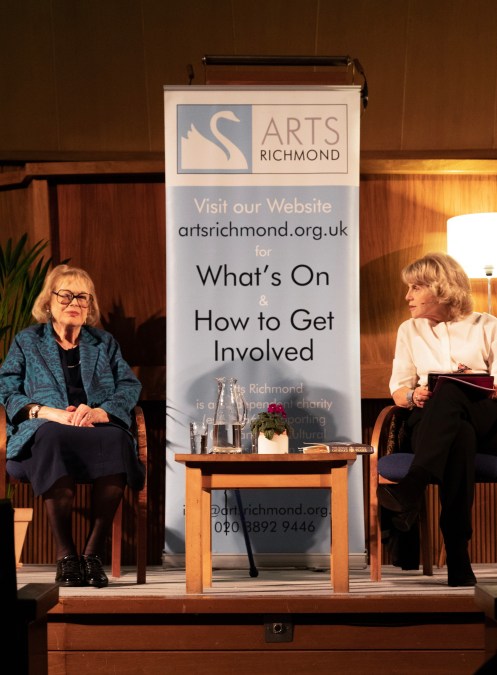
She touched later on some specific incidences where she was challenged by history’s outcome, wrestling with the activities and decisions that people in power make, citing George III and the Act of Union with Ireland which he refused to sign, just as George IV had the same trouble in deciding if he should swear an oath to uphold the Protestant Church, where his life style did not help his decision making.
Antonia is very aware of the present political situation with Ireland and Brexit and could see certain resonances in today’s lack of tolerance , acknowledging that Jewish emancipation came much later, we still live in an intolerant society and exclaimed that to pass judgement on another’s religious habits, rituals, life style, she said ‘is none of my business’.
Two amusing little anecdotes were prompted by questions about her liking the characters she wrote about. She still dearly likes Mary Queen of Scots, and recalled the time when her mother, also an historian, said she would be writing about her, at which Antonia exclaimed to her mother, ‘No, she’s mine !’ On a much later occasion she started a book on the battle of the Boyne but realised she disliked Edward III and had to stop, saying to her husband ‘Harold, bin the Boyne’.
What fires her to write? She loves what she does and is able to be the captain of her own destiny: ‘I never became a writer, I was born a writer’. She recalled receiving an e-mail from Elton John who told her that she was his favourite historical writer. When he asked how long would she continue writing she replied to him ‘As long as I receive praise like yours, I’ll write’.
Spending an evening with Lady Antonina was fascinating. We all learned what we already knew of her – an erudite, objective, thoroughly-researched, master storyteller of our past.
Eliza Hall
November 2019
Photography by Holly Ibbs
Secrets and Lies in SW15
Things I Know To Be True
by Andrew Bovell
Putney Theatre Company, at Putney Arts Theatre until 9th November
A Review by Andrew Lawston
There can be no more foreboding sight to greet a theatre audience than a set depicting a well-kept family garden. You know that you’re in for two hours of intense drama and revelations. The better-kept the garden, the more intense your evening is likely to be.
And so it is with Andrew Bovell’s Things I Know to Be True, a relatively new play (2016) which has swiftly captured the imagination of UK theatre companies, and has now been taken on by Putney Arts Theatre in their spacious auditorium. Young Rosie Price has her heart broken on her gap year, and returns to the family home for solace, only to find a family on the verge of tearing themselves apart.
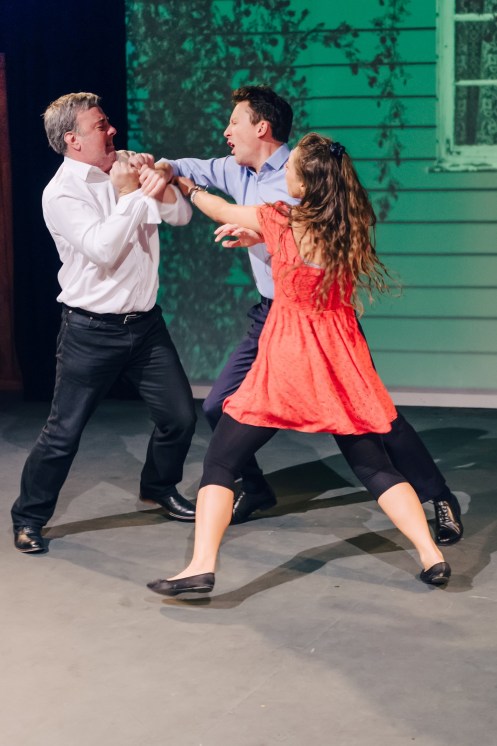
“This garden was the world” as various characters tell us throughout the play, and appropriately we never really leave it. Tom Sainsbury’s simple set comprises a single flowerbed filled with roses that bloom and wilt throughout the play according to the changing seasons, with a garden shed off to one side, and projected photos and video clips on the backcloth. Seating lines both sides of the stage, and the cast gamely make sure they play to all sides of the auditorium throughout the evening.
 Director Frances Bodiam ensures that the cast make maximum use of the spacious playing area, and more. Characters frequently enter through the aisles, and from the back of the theatre, so the audience is never quite sure where the next revelation will come from. Frances also made the very sensible choice of asking her cast to perform in their own voices, rather than attempting Australian accents. As the programme notes, Hallett Cove is broadly similar to any suburb throughout the Western world. So while the setting remains Australian, with references to dollars, Sydney and Brisbane, the play’s themes are revealed to be truly universal.
 After a tableau of a phone ringing at 3am, the phone call every parent dreads, Rosie opens the show with an upbeat performance by Natasha Henson, who talks about her gap year, and Berlin, in lively conversation with the audience as she roams the aisles and the full space of the stage. It’s a shame that, as her extended monologue draws to a close and she makes her way back to Hallett Cove in Adelaide, we never really get to see much of Rosie again as a character; she becomes the figure in front of whom much of the rest of the play unfolds.
As Rosie arrives back home, the family cluster around and there is a joyful reunion, though already tinged with ill-tempered sniping. Penny Weatherall’s powerful and dominant performance as Fran quickly establishes that the family is something of a matriarchy, while Aidan Kershaw gives a performance that is often wonderfully understated as Bob, the quietly proud retired working man who has long tired of his gardening.
As the other siblings come and go, we see the play’s funniest moments, well-observed exchanges about traffic, laundry, and the father being unable to operate the coffee machine, that will be familiar to many families. There’s an enjoyable pace, and the cast are in complete control of the material, as lines are swapped with huge energy, but crisply and with confidence. But there’s an edge to many of these interactions, when eldest daughter Pip (Emily Prince, in a tight and controlled performance that always seems to be on the point of cracking to reveal her character’s deep inner pain) becomes strangely upset at the discovery that brother Ben (Theo Leonard in a brilliantly manic turn, bounding around the stage with barely repressed nervous energy) still brings his washing home. And when Bradley White’s enigmatic Mark refuses to answer questions about his recent relationship break-up.
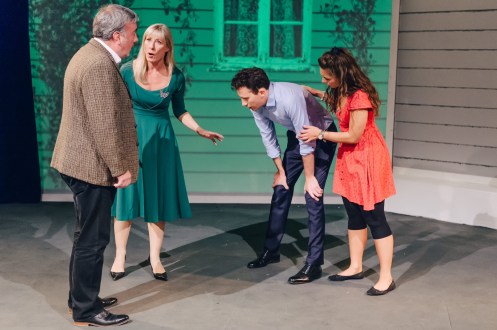
With his untucked shirt and slightly aloof attitude, Mark seems distinct from the rest of the family, even as the rest of its members begin to fragment and grow further apart as the play progresses. When the reasons for this detachment become clear later, he and his two parents enjoy a powerful scene filled with resentment, love, and quiet desperation. “Stop swearing!” bawls Bob at one point, unable to articulate his actual feelings, and resorting to his parental role to try and regain his footing in the conversation.
With a play that is so new, and so popular, it doesn’t feel appropriate to talk in detail about the plot, beyond mentioning that although there are frequent clues towards the problems and preoccupations of most of the characters, this is no soap opera, and their true secrets generally surprised the audience by being just out of kilter with our expectations.
The play is also a visual delight, both with the inventive images and clips projected by Tom Sainsbury, and with Carrie Cable’s costumes, which seem perfect for each character, from the manic Tom’s slim-fitting suit, to Bob’s dishevelled gardening clothes, Rosie’s floaty outfits, and Fran’s simple but elegant green dress, which somehow manages to perfectly mirror her nurse’s uniform with a brooch pinned in the place of her watch.
The masterstroke of Things I Know to Be True is that despite the many revelations and divisions between family members, the audience are never in any doubt that the characters all love each other deeply. This is a bold and assured new production of a play whose popularity is growing at an impressive rate.
Andrew Lawston
November 2019
Photography by Steve Lippitt.
Coitus Interruptus
Sex Cells
by Anna Longaretti
OHADS at The Coward Studio, Hampton Hill Playhouse until 9th November
Review by Eleanor Marsh
Anna Longaretti made her playwriting debut with Sex Cells in 2012. In a previous life Longaretti’s world was TV and the influence of that medium is prevalent throughout the play, which is a series of short vignettes delivered on a single set. The play could easily be an episode from a sitcom.
Set in the call centre of a sex aids business, (sex sells : a nice play on words for a play that speaks a lot about IVF – sex cells) the play is a gentle comedy with some real laugh out loud moments. It explores the hidden depths of emotion of its five characters; four women with very different issues and views and their hapless boss.
The performances are uniformly excellent. Sally Halsey’s matter of fact delivery and excellent comic timing belie the poignancy of her storyline. Her depiction of Lily, top sales person and star baker is pitch perfect. Darren McIlroy is superb as the sadly comedic Mr Causeway. It would be easy for this character to appear as a caricature, but McIlroy’s performance and debut director Joolz Connery’s sensitive direction give him real depth of character.


The remaining three characters are equally well-portrayed. And it is through these women that the complex relationships that women the world over have with sex, relationships and babies are channelled. Tiffany, played by Julie Davis is footloose and fancy free, enjoying her freedom and with no desire to “settle down”. Charlotte Pilbeam’s Sylvie is desperate to have a child, and Dionne King’s Janice is desperate to have some freedom from her large family of under 10’s. All perspectives are here in this one small office.


The play’s set is suitably minimal and functional. It could be any office anywhere, where the main subject of conversation in any given day is the quality of the office coffee. What makes the environment different is the merchandise that is dotted around the stage. The constant reminder of the fact that “sex” is linked to “fun” when juxtaposed with the definitely unfunny subjects of IVF, death and a complex mother-son relationship give the play a layer of depth that is surprising and effective.


But fun this play undoubtedly is. All the best tragedies have comedy running through them and we are treated here to some excellent one liners and visual gags with the props on loan from Ann Summers. It is a shame that it comes to a rather abrupt ending, but it is always a good thing to leave an audience wanting more. I’d urge anyone in need of a good laugh this week to go to Hampton Hill Theatre. You’ll not be disappointed.
Eleanor Marsh
November 2019
Photography by Jen Laney
Our friends in the Blitz
The Night Watch
adapted by Hattie Naylor from the book by Sarah Waters
The Original Theatre Company and York Theatre Royal, Richmond Theatre until 9 November
Review by Matthew Grierson
If we are to believe the wartime propaganda, carrots can help us see in the dark. Although there are no carrots in The Night Watch, darkness both literal and figurative sheds light on the small group of characters thrown together by love and other circumstances.
Alastair Whatley’s direction is an effective combination of atmosphere and detail. So well realised by designer Max Pappenheim is the terraced property that dominates the stage that it was not until the lighting changed that I realised it was transparent, serving first as its own interior and later as the bombed-out shell of itself. It is enough that we believe the house is there on the stage in front of us; or that the desk of the dating agency run by Viv and Helen becomes the roof of their building; or that a square of light is the cell in Wormwood Scrubs shared by Duncan and Robert.

Belief is not important only to us as the audience but is a central theme from the point Mr Mundy visits Christian Scientist Mrs Leonard for spiritual healing. Her insistence that the pain of his arthritis is imagined is well played by Izabella Urbanowicz, as is the willingness of the ironically named Mundy (Malcolm James) to believe in the otherwordly – and the clear distress of his companion Duncan (Lewis Mackinnon) to see him being exploited. But so much is sustained by belief in a time when one cannot depend on reality.
Even time is out of joint in The Night Watch: earlier I said ‘later’, but also meant ‘earlier’, for the conceit Hattie Naylor’s adaptation borrows from Sarah Waters’ wonderful novel is that its three acts progress backwards, from the London of 1947 to 1944 and then to 1941. This means we come weighted with the significance of details – the ring Kay gives to Viv, or the black market pink pyjamas she acquires for Helen – and only later become aware of how they have acquired that significance.
There is a deliberately, and effectively, mannered quality to the first act, portraying the way the characters are struggling to resume the straitened lives they imagine the war has merely interrupted. This is seen in the drawn fragility of Kay (Phoebe Pryce) as she sustains a haunted version of the masculine independence she enjoyed during the war. Similarly, when Robert (Sam Jenkins-Shaw) unexpectedly comes across Duncan working in a factory, their strained exchange speaks volumes about the awkward circumstances of their original encounter in prison earlier/later.

As the first act ends, it sets us up thematically if not causally for the second when it makes Viv (Louise Coulthard) the unexpected agent of happiness for both Robert and Kay, setting them on a hesitant but hopeful path into the future. With the beginning of the second, we are back in 1944 with feelings running stronger and clearer: Robert is fantasising about his perfect woman, and Kay is in love with hers but soon to suffer the double devastation of thinking Helen (Florence Roberts) dead in an air-raid before finding her safe in the arms of Julia (also Urbanowicz).
The further back we go into this war the more we realise the extent it has exploded supposed convention, like the piles of debris that frame the forestage. Helen and Julia relish the freedom they have to flirt in the dangerous streets of the Blitz, while Kay wins promotion for her diligence as an ambulance driver as Mr Cole (Jenkins-Shaw again) tells her she’s more of a man than many of her colleagues will ever be.
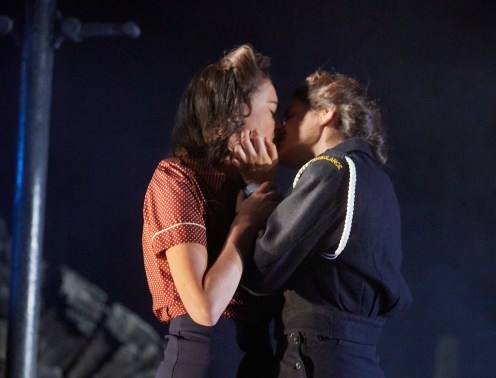
Ironically, the moment Cole realises that Kay is gay is also the moment that Kay and Julia’s own relationship starts to collapse. This means the three years in which The Night Watch’s bombshells land are the angles of the love triangle between Julia, Kay and Helen. Roberts’ performance as Helen is especially well nuanced, delighting in her chivalrous rescue by Kay from a bombed house in 1941, while in 1944 we have already seen her accusing her girlfriend of wanting to save everyone. This is again a different Helen to the woman who in 1947 shares a guarded chumminess with colleague Viv, or, anguished, suspects Julia of having an affair.
Similarly forceful to these lovers’ confrontations are the scenes in which Viv’s abortion and Duncan’s suicide attempt are discovered, with Coulthard and Mackinnon respectively evincing the distress into which their mistaken beliefs have carried them. Again, this intensity of emotion is all the more effective for being in tension with our experience of the characters so far.
The skilful depiction of the main characters’ facets is complemented by the play’s discreet use of doubling in the supporting actors, proving that this is a cast adept in versatility. As fussy, blustering dating agency client Mr Wilson Malcolm James is unrecognisably the peculiar prison warden Mr Mundy, and with his bluff, Welsh good humour, Jenkins-Shaw is believably a different man to conscientious objector Robert with his Oxbridge tones. Mara Allen is likewise excellent both as Kay’s foil, the mechanic and ambulancewoman Mickey, and she practically steals her only scene as factory manager Mrs Alexander.
In dark times it’s a dangerous proposition to take us back into the Blitz. But as the presiding spirit of Mrs Leonard tells the cinema-going Kay, we are enthralled by the lit-up fictions before us. So believe me when I write that The Night Watch is victorious.
Matthew Grierson
November 2019
Photos © Mark Douet
A Peek Behind the Cumulonimbus
Rewriting the Climate
by Matthew Griffiths
Arts Richmond, Richmond Literature Festival, Hampton Hill Theatre, until 2nd November
Review by Heather Moulson
A thoughtful and sedate event presented by Matthew Griffiths and Polly Atkin with guest readers, Malisa A Elliott, Stephen Leslie and Heather Montford, this thought-provoking evening was introduced gently by Matthew who explained his angle on one of the greatest issues of our time. Matthew explained how he was driven to produce his new collection, The New Poetics of Climate Change and elaborated on the innovative mix of modern poetry that is vital to comprehend such a complex subject.

In the first half, a scale of eclectic poems were read, with nicely paced explanations in between, and alternated by Matthew and Polly. The first being The Greenhouse Effect by Fleur Adcock, read by Malisa A Elliot. Malisa’s strong delivery drove home, and the lyrical works of Adcock’s poems focused on, simple things such as looking out to sea. Matthew talked about the very common term, The Greenhouse Effect and the many layers of its meaning. Stephen Leslie gave a strong reading of an excerpt from the immortal Wasteland by T S Eliot – The Burial of the Dead. Matthew chose this because of the clamouring of voices, and several landscapes, and felt it should be discussed about the way we see nature.
We welcomed back Malisa as she read My Heart Soars by Chief Dan George, from a collection of Canadian nature poems. Poetry Performance favourite, Heather Montford read The Poems of our Climate by Wallace Stevens. Heather’s gentleness and tone made these vital words from Stevens ring clear. The Leaves of a Dream and the Leaves of an Onion by Arthur Sze, an amazing Chinese American poet, was read by the talented Malisa. This was the most significant message, as Matthew elaborated how this poem provoked such multiple images, for instance the concept of separating things. Stephen breathed life into the words of Windscale by Norman Nicholson. Then the three effective poets were reunited to read the extraordinarily hard hitting The Imaginary Iceberg by Elizabeth Bishop. Heather then read Ordinary Details by Jane Cooper, which was anything but. The trio reformed for the final poem, Positive Feedback Loop by Jorie Graham.
Matthew’s summary of this array of poems was articulate and full of insight, genuinely making us re-think our concepts of Climate Change. Matthew’s choice became clear, full of illustration and strong images and provoking a response in all senses, and making us realise that these were carefully researched and well-chosen poems.
The second half brought a discussion between Polly and Matthew. They talked about motives for their work and theories, and the beginnings of their interests in Climate Change. This was followed by questions from the audience, for example – Who were the new eco-poets? Many names came up, including Frances Presley, an important and significant British poet, whose writing is very relevant to our issues. Another point came up about schools and young people, and Polly explained that she runs workshops with schools and community groups. Children are very concerned about climate change.
To conclude the evening, Polly read her own poems including the thought provoking, Bluebell Season and Hunting the Stag. The climax of the evening was Matthew reading his work consisting of the haunting Bearing Myself, Cod Philosophy and Metaphor, the latter from his pamphlet How to Be Late. I would sincerely recommend Matthew’s current collection about these issues and we thank him for such an insightful and innovative evening.
Heather Moulson
November 2019


