
Animalism Unleashed
Baal
based on a play by Bertolt Brecht
Impermanence at Bristol Old Vic until 25th April
Review by Sophie Catherine Chinner
From the company that produced SEXBOX, Da-Da-Darling and the fifty-minute arthouse film The Ballet of the Nations, Bristol based dance company – Impermanence, tackles an innovative, new adaptation of the Bertolt Brecht play BAAL. The play, written in 1918, was the first full length work by the German Modernist playwright and now, proudly makes its UK dance première on the main stage of the Bristol Old Vic.
Fundamentally, the abstract work monitors the notoriously flawed central protagonist – Baal. Despite an indistinct storyline, Impermanence flourished in its thematic focus, which tracks Baal’s ill-fated journey through solipsism, violence and manipulation to his pre-destined destruction. The performers unleash themselves in bestial forms. In one scene, the women role play matadors as the men act out a bull fighting duet, challenging the stereotypical expectation of sexes in the dominant and submissive roles. The same red scarves used to provoke the animalistic performers here are later used to symbolise the blood and subsequent death of Ekart, a friend murdered by Baal. In a grotesque display, the company embody a kind of over-the-top Japanese Theatre technique, by revealing the silk material from the victim’s own costume and smothering it around his face and skull. The characters also womanise and create discomforting images across the stage suggestive of rape and lascivious seduction. Collectively, these recurring tropes infer greedy consumerism, lust, betrayal and committing hostile aggression is the hamartia, the downfall, by which modern society as well as the fictional world of Baal suffers from.

BAAL was driven by an original score, composed by Robert Bentall, which was featured forefront of the action. Bentall’s live and pre-recorded performance on the peculiar, ancient nyckelharpa instrument, was a refreshing musical accompaniment that had a curiously awe inspiring effect. Its wholesome notes reverberated through the auditorium in unusual waves of sound which mimicked the provocative behaviour of the dancers on stage. This unexpectedly led to an uncanny fusion with David Bowie’s Ashes to Ashes and The Drowned Girl (perhaps intentionally from an EP entitled In Bertolt Brecht’s Baal ). The performance grew even more unrestrained and wild with the performers also engaging in spoken word and song. They vocalised the eponymous figure – Baal, as well as some of the other 31 characters that are originally written into the play. Multi-rolling these parts, indicated in the constant costume changes, was an intelligent solution when creating a work with a cast of only four.
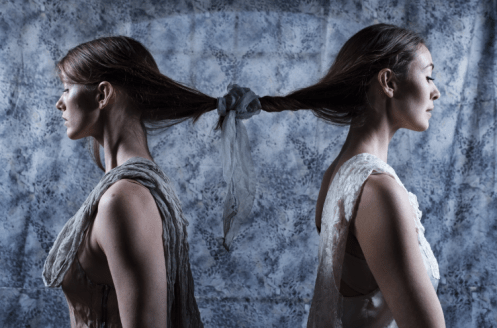
There is formality in the performer’s poetic dialect which seems to mock the heightened verse of Shakespearean language. The speech, perhaps excerpts from the original script, is often threatening and chilling. The dancer’s voices, though sometimes inaudible due to an excess of surrounding sounds, boomed through a microphone prop on stage and also electronically erupted as part of the musical backing track. Merged with dialogue from an omnipotent narrator, who attempts to guide us through the indistinct plot, in reality, obscures our perspective further. Dancing out some of this narration, the dual-channel films projected directly onto white screens, designed by Duncan Wood, also attempts to explain the events on stage. The multi-media clips including: circus elephants being forced into obedience, chorus line dancers and trippy, stuttering videos filmed within a forest, reiterates the excessive nature of an ego-driven world. This eccentric mix of sound and film, although somewhat overwhelming in dynamics, succeeds in representing the chaotic life of Baal.

After three years of crafting and creating, the company, comprised of the skilful quartet; Roseanna Anderson, Josh Ben-Tovim, Alessandro Marzotto Levy and Sonya Cullingford, combine their performance and choreographic talents to re-invent the messy, misogynistic world of the twentieth century anti-hero. A challenging choice of play with a complex narrative, the début of Impermanence’s BAAL, will not be its last. The company will continue the tour to small and mid-scale scale venues across the UK as well as taking the production to Indonesia. Beautifully danced, immensely physical and thought-provoking, BAAL is a riveting, emotive piece of contemporary dance theatre
Sophie Catherine Chinner
April 2019
Photography by Maurizio Martorana
Songs of Innocence?
English Song
by Roger Martin and Martin Pagnamenta
Good Seeds at St Mary’s Church, Hampton, 27th April
Review by Thomas Forsythe
In the dim and far distant past, I recall standing in the school hall with other short-trousered boys and singing Linden Lea or other such pieces of beautifully bucolic whimsy. For many of the audience at the Good Seeds recital this was a similar plucking of the strings of innocence from decades ago. Or was it? Listening carefully to this nostalgia-fest, did we not detect that the English countryside of yore was far from innocent?
Shakespeare is always good for a robust look at life and most of the first half of this delightful concert was taken up with songs from Shakespeare’s plays, set to music by Gerald Finzi or Roger Quilter. In fact, we had a version from each composer for two songs, both from Twelfth Night: O Mistress Mine with the carpe diem line, “Then come kiss me, Sweet and twenty, Youth’s a stuff will not endure”; and Come Away Death, although I think Quilter has better understood than Finzi that Feste is mocking Orsino’s melancholy. Quilter also hits the mark dipping into As You like It with Blow, Blow, Thou Winter Wind.
Finzi’s triumphant feel in his Fear No More the Heat of the Sun in the duet of Guiderius and Arviragus from Cymbeline misses the air of pathos with which Shakespeare imbues this richly metonymic but gently punning elegy. As such he does not serves our singer, Roger Martin well. Martin’s finely determined accurate baritone is very much a chamber voice and it felt that he needed to overstretch his delivery in that he would need to in the role of a sacred choral singer in the large physical space of the nave of St Mary’s church. The drama of Shakespeare and the demands of space point towards a more operatic approach. Nevertheless the reflective themes of the words, the atmosphere of an historical parish church, and the folksy nature of the music throughout the recital spoke loud of the permeated Englishness of this concert.
Indeed, the core of the evening was a tour of the English counties. For most of the first half, Shakespeare had delightfully detained us in Warwickshire, but now we were to move on to Shropshire and Suffolk, although not before a pleasantly oenological interval.
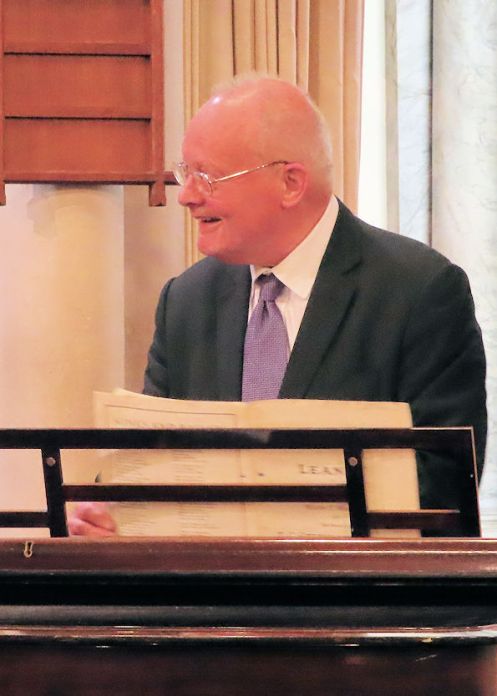
Martin Pagnamenta provided precise and purposeful piano accompaniment with seemingly effortless skill; and, during the break, we learnt a little of the strong mark that Martin and Pagnamenta have made to the musical landscape of in and around Chepstow (alas just outside of Merry England).
Most importantly however, Fiona Rowett (herself a very accomplished soprano) told of the work of Good Seeds, the charity that was the raison d’être of the evening’s concert. The Good Seeds programme supports a hundred pupils, helping them to be able to attend school in their village of Mandimba in Mozambique, together with student nurses and midwives. Mandimba, near the border with Malawi, has a sister church to St Mary’s Hampton. The concept of the support is good seeds in fertile ground, an apposite metaphor in the poorest part of one of the world’s poorest countries, now made poorer still by the floods that have followed Cyclone Idai.

Back in spirit and song in England, we moved on to that lovely but off-the-beaten-track county of Shropshire, immortally described in the poems of A.E.Houseman. In a well interpreted musical setting by George Butterworth these moved from the sweetly sentimental to the potently moving. Loveliest of Trees describes spring blossom and I thought of my own garden where I could in this very moment “go, to see the cherry hung with snow”. Going via the tripping notes of Think No More Lad, the poem Is My Team Ploughing?, the dead man’s question to his still living friend, packs a really poignant punch
We have to cross to the other side of England to Benjamin Britten’s beloved Suffolk, although Britten sourced his Folksong Arrangements from all over the country. The touching O Waly Waly is perhaps even further north, but Martin first gets well into his stride with There’s None to Soothe. However, it is Britten who makes the running with the most earthly songs: his arrangement of the old folksong The Foggy, Foggy Dew beats “come up and see my etchings”. The singer remembers “a fair young maid” who “knelt down by my side, when I was fast asleep” … “So all night long I held her in my arms, to keep her from the foggy, foggy dew”. Well I never … he now looks at his son and apprentice (he is still a bachelor) and can’t quite remember why the boy looks so much like the fair maid.
Martin and Pagnamenta’s charmingly cheerful and cheeky nostalgic trip around the counties was neatly parenthesised by a package of top-and-tail trios. It opened with that archetypal English composer Henry Purcell and concluded a few centuries later with John Ireland’s setting to John Masefield’s Sea Fever. As Martin put it, “A baritone must always sing a sea-shanty”. Nevertheless, the countryman’s diversion still seem to be mainly the country-lass. This it seems is far from a new phenomenon; Tudor twinkles in the eye include John Dowland’s What If I Never Speede, “Either I will love or admire thee”; and John Bartlet’s When from My Love, “She did agree to love, but jestingly”.
Hugh Wright breaks this mould in Martin’s encore piece, Leanin’ on the Gate, where the country lad “Had a lurcher once; better than a gal. Poacher? Well … a bit”. It seems that there is no end to the variety of out-of-town amusements.
Maybe those schoolboys of that dim and far distant past, where I once stood, missed something in wondering what the distractions might have been hiding “down by The Ash Grove”.
Thomas Forsythe
April 2019
Photography by Maurizio Martorana and Lewis Lloyd
The Thespian Frame of Mind
Kindly Leave the Stage
by John Chapman
Richmond Shakespeare Society at the Mary Wallace Theatre, Twickenham until 4th May
A Review by Celia Bard
A cleverly crafted and light-hearted satirical mise en abyme, John Chapman’s Kindly Leave the Stage is amusingly brought to life by members of the Richmond Shakespeare Society in their friendly, intimate theatre, The Mary Wallace, situated on the banks of the River Thames in Twickenham. The outer story, the framing device, tells the story of Rupert and Sarah whose marriage has broken down. Their friends, Charles, and Madge, both loosely connected with the law, agree to handle the threatened divorce.

The opening scene of the play, set in the well-furnished, living and dining room of a well-appointed garden flat, lulls the audience into a false sense of security albeit a lively one with Charles and Madge sitting uneasily at the dining table listening to sounds from the kitchen of crockery being smashed. Any comfortable illusion the audience may have about the development of the plot soon vanishes when Rupert suddenly stutters and repeats his words. This is followed by an awkward silence until the prompt feeds him a line. Here, the audience may be forgiven if they inwardly groan thinking the actor is not secure in his lines. Rupert’s forgetfulness, however, is the beginning of the play’s inner story in which our leading man is having to act with the full knowledge that Madge, his real wife, is having an affair with Charles. Rupert’s anger, jealousy, and rage spill over into the framing story, confusing the audience who watch bemused as Rupert picks up a knife and threatens to kill Charles who takes refuge in a trunk whilst the rest of the cast try to continue with the play. Confusion further mounts when a nurse suddenly appears from the back of the theatre, breaking the fourth wall, exclaiming that she is responding to an appeal for a doctor in the house to treat somebody who is injured on stage. Again, the audience must be forgiven if they begin to think that like King Lear, they have entered the realm of madness when the character Edward, playing the muddled, elderly father of Madge, enters and confused by events on stage, lapses into Shakespearean verse whenever the opportunity arises: dans une confusion totale.
The overall play within a play structure used by the playwright provides him with an opportunity to explore a double plot, one in which he is able to highlight the egotism, jealousy and vanity of the acting profession as well as being able to exploit his knowledge of different acting, genre and theatrical styles. The framing narrative of Kindly Leave the Stage is modern. Lines though witty are naturalistic as seen in the dialogue between the two couples and Mrs Cullen, Madge’s mother. In contrast the inners story lapses into pure farce, characters chasing each other across the stage, in and out of doors and although there isn’t a cupboard for a character to hide in, there is a large wooden trunk. Opportunities abound in this play for actors to exploit their knowledge and acting skills within the different genres provided by the playwright.

At times performances lose just a little of the meticulous discipline required of stage farce. Although the situation characters find themselves in are often ludicrous, nevertheless the characters must be recognisable. Cast in the role of Rupert is David Kay, totally believable as the cuckolded husband, but would have liked to have seen him act a little more menacing while wielding the knife and threating Charles. Kay has to carry much of the physical and emotional burden of the plot and his strong stage presence and vocal skills help him exploit this character. Particularly effective is the interchange between him and Edward (Michael Andrew) when discussing the merits of naturalistic dialogue, using as an example the line referring to Rupert’s and Charles’ long friendship starting in Oxford. Kay has to deliver this line in such a way that encourages Edward to demonstrate how it should be delivered: here pace and timing is excellent.
Kay is joined by actors Kate Wilcox (Sarah), Cath Messum (Madge), Matt Dennis (Charles), Maxina Cornwell (Mrs Cullen), Michael Andrew (Edward), Denise Tomlinson (Nurse) and Lynda-Louise Tomlinson (Angela). In some instances, there could have been a clearer contrast between the characters in the framing narrative and their other inner stories. Tomlinson is appropriately sympathetic as the nurse and makes a good entrance through the audience. Lynda-Louise Tomlinson is an effective stage prompt, keen to learn how to project her voice. Would like to have seen more of a grande dame performance from Cornwall, particularly in her opening scene. Dennis’s Charles is a little restrained as is his liaison with Sarah, here the relationship seemed rather forced.

Messum’s Madge is delightfully sexy, and she does succeed in differentiating between her two characters – would be wise to heed intelligibility when using a higher vocal pitch. Wilcox is convincing in the framing narrative as the angry wife, but less so in her alternative role when she is required to act the cheating wife and display a besotted love for Charles.
Michael Andrew’s Edward is just superb as the ageing Shakespearean actor, now an alcoholic and bemoaning his lack of chance which would have placed him among the giants of Shakespearean actors. He is totally unaware that the play has switched from art to life and has invited his new agent to this performance. This actor has an incredibly strong stage presence, dominates the stage (at times deliberately) and is versatile in all acting genres. Whether playing the drunken fool, the confused actor, or portraying the madness of Lear, Andrew is magnificent. I would go and see his Lear anytime.
The RSS succeed in portraying an enjoyable evening of entertainment. Actors took their final bow remaining resolutely in character, and manfully allow Andrew to dominate the line-up. Kindly Leave the Stage is a light-hearted and highly entertaining play, well worth seeing.
Celia Bard
April 2019
Photography by Pete Messum
First as tragedy, then as farce
King Charles III
by Mike Bartlett
The Questors at Judi Dench Theatre, Ealing until 4th May
A review by Matthew Grierson
Neither tragedy nor comedy, Mike Bartlett’s King Charles III blends both genres to offer us a history – or rather, an ahistory, given that it depicts a possible future spun from the state of the nation some five years ago. While the exact details do not thus correspond with ‘true events’, as they say, it’s remarkable that Bartlett is as successful at hitting its beats – a female PM, Harry consorting with a commoner and, most notably, a constitutional crisis – as he is in matching Shakespeare’s.
Questors’ eminently watchable, pacey production honours these intentions in the observance rather than the breach. It plays out dynamically on a plain thrust stage, in front of Victoria Smith’s minimalist set: one door to No. 10 and another to various rooms of Buckingham Palace, flanked by two blank portals. Above these is the screen on to which a suggestion of scene can be projected, whether the funeral with which the show opens, the House of Commons, or the interior of the palace itself. The latter is lit effectively to suggest the window through which Charles looks out on the kingdom he inherits – and divides.

By fitting its matter to the form of a Shakespearean history, the show makes its fake news more legible. Although the story is pulled by the twin poles of comedy and tragedy, it would stretch one’s suspension of disbelief to attach itself to either, for instance by remounting Agincourt or Dunsinane, even offstage, and even in the current political climate. So even while King Charles III is dramatic it never loses its grounding in reality. Similarly, the dialogue treads a careful path between Jacobethan drama and modern vernacular, in places achieving the resonance and lyricism of the Bard’s verse.
The playing of the public figures, too, conveys this sense of reality at one remove. Rather than opt for impersonations, director George Savona wisely draws out performances of character rather than caricature, meaning that laughs are earned legitimately rather than being bantamweight satire. Mind you, it would not be unfair to say that the play is well cast in terms of likeness. Ian Recordon as the titular, divisive monarch resembles the real-life HRH sufficiently that he could have gone for out-and-out mimicry, the Spitting Image version the new king recalls in a reflective moment. Instead, he gives an anchoring performance as a man beset by concern when he takes on the long-coveted crown, all the while keeping the real royal in view with discreet, unobtrusive expressions and hand gestures.

Responsibility and regalia make for a heavy burden; by my reckoning, even Recordon’s longest break from the stage must be spent getting togged up for the end of Act III ahead of the interval (well done costume designer Sarah Andrews). It’s thus to be expected that the actor might be a little shaky on some of his innumerable lines, but if anything this endears his portrayal of Charles to us all the more. By the time of his showdown with his sons in the palace in Act V, yours truly felt truly affected, and that’s coming from someone far from being a staunch royalist.
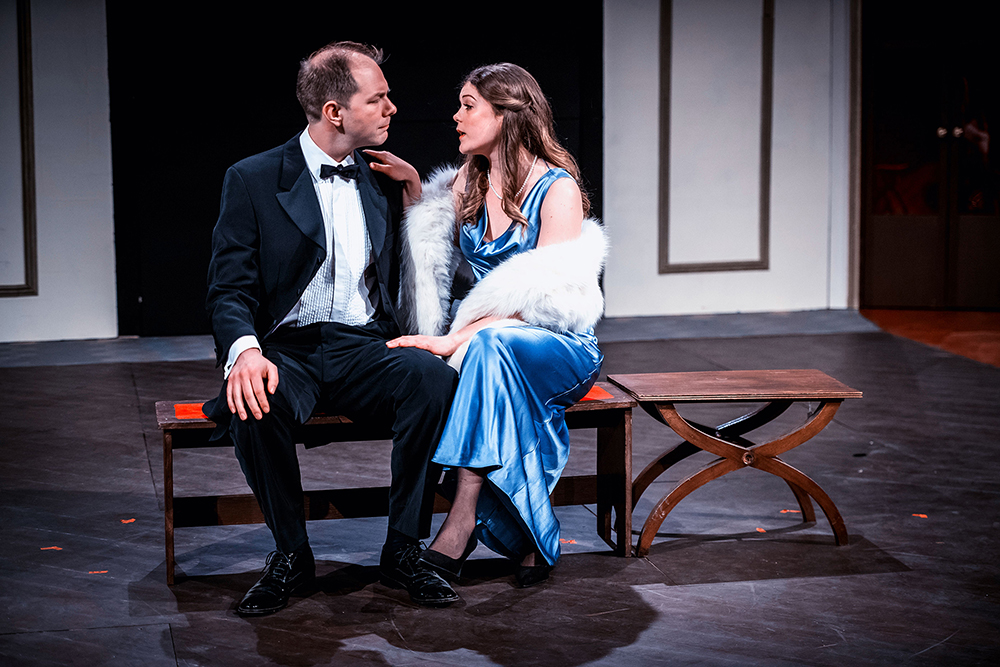 In contrast to his father, James Burgess as the balding William – a hairless heir? No, all right – is bold and resolute, but still fleet of foot enough at one point that he presumes to take the mic in place of his perplexed pater, something Savona’s direction accomplishes so perfectly you barely notice. Behind, or rather beside, this manoeuvre is Claudia Carroll as a friendly but firm, and firmly feminist, Kate.
Rather than leaving the role of Lady Macbeth solely in her hands, though, Bartlett Lear-like splits that legacy three ways, and also getting a look-in as ambitious women are Lisa Day as Charles’ helpmeet Camilla and Samantha Moran as the ghost of … Well, that would be telling. Perhaps more pertinently, an audience acquainted with current affairs over the past three or four decades will see each of these women have more justification for seeking power than some have allowed the Scottish play’s fiend-like queen.

If Bartlett eschews absolute villainy for nuance here, there are more Machiavellian possibilities with politicking opposition leader Mr Stevens. As the top Tory Simon Taylor cuts an odd figure, considerably less Latinate and more avuncular than any parallel you may care (or not care) to identify. There’s certainly enough latitude in Bartlett’s script to make him into a neo-Iago, and as a result I can’t decide whether Taylor’s portrayal is a missed opportunity or a conscious decision to avoid extremes.

We’re on firmer ground with the PM, Mrs Evans. Portrayed by the aptly named Pamela Major, she may be as put-upon as the current incumbent of No. 10 but is in contrast a model of leadership. She’s just as determined to defend democracy – in this case, against the king’s idiosyncratic vision of the popular will – but she still manages to do so maintaining a humanity and good humour all but missing from Mrs May. And OMG you should see her face when she realises the king has invited Stevens to the weekly meeting: it’s a picture.
Mediating between politicos and princes is press advisor James Reiss, who is of all characters the most conscious of the public picture the palace residents paint. Francis Lloyd is thus pitch-perfect in his mediated performance, winningly cool and cruel when he feels the need but also able to express his care for his charges and concern for the continuity of the monarchy.
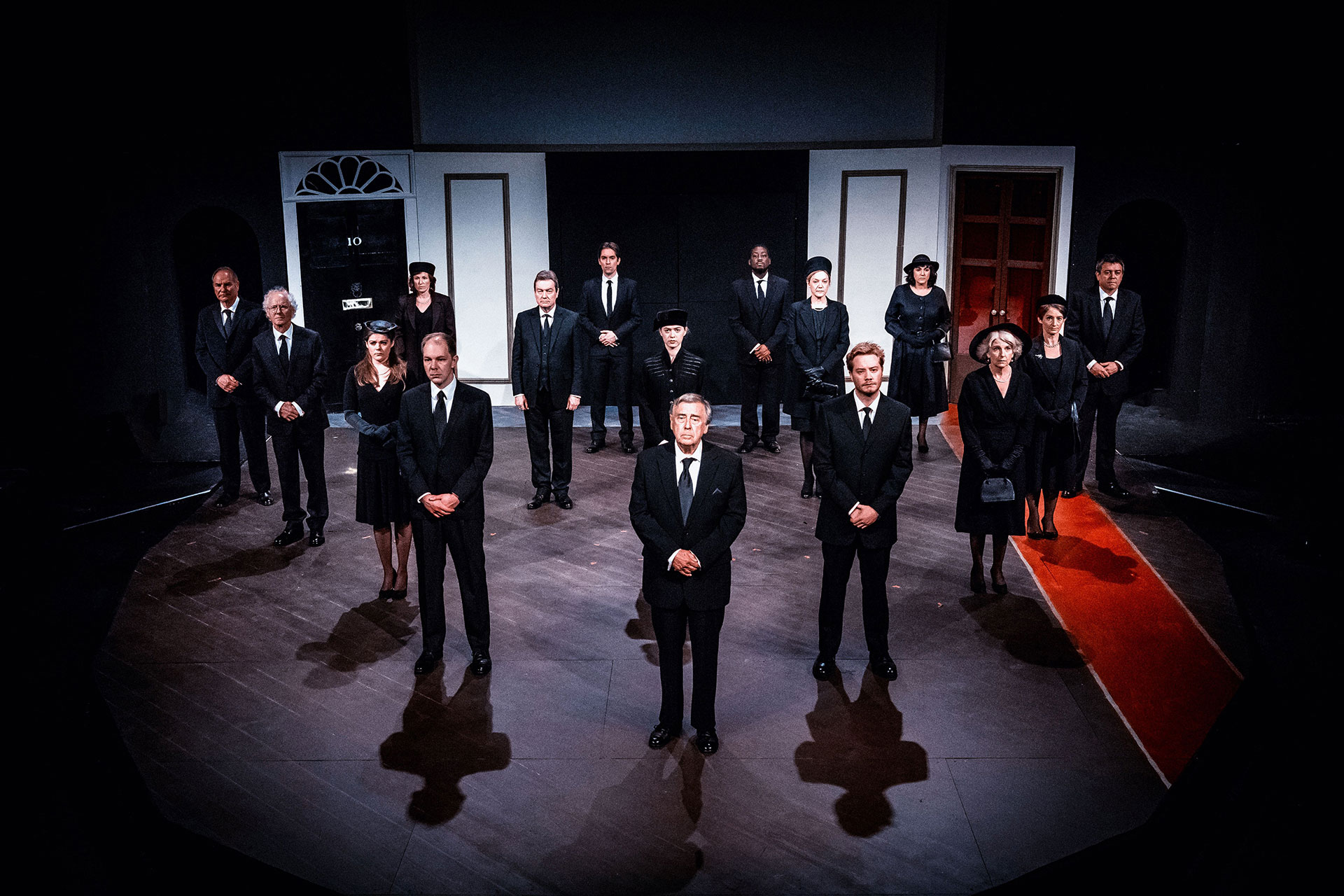
Indeed, the play shares with Shakespeare a preoccupation with people consciously performing roles, particularly in the exercise of authority. There’s thus a tender irony in the fact that this, unMarkled Prince Harry has the persona of Hal thrust upon him by his aide, Spencer (Jason Welch, giving it the full ‘Yah, bro’), when, back from military service he proves a reluctant rake. Oscar Gill’s charming version of the ginger joker supports a touching romantic subplot with an art student he meets in a nightclub, but drama and duty mean that this relationship must eventually echo Hal’s with Falstaff. Unlike Sir John, thankfully, the only respect in which Roselle Hirst’s Jessica is rounded is her characterisation, a winningly republican comment both within and without the Windsor camp.
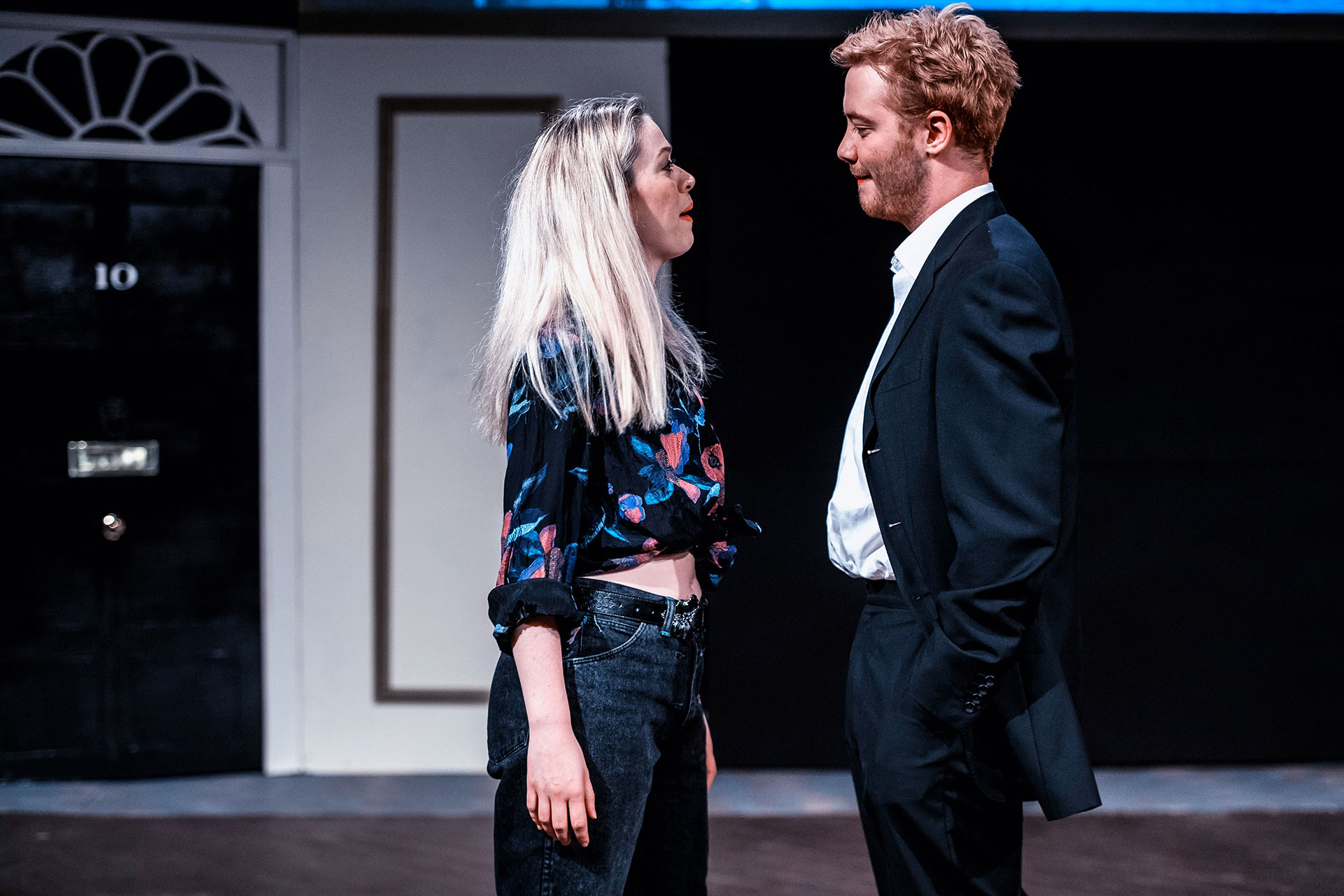
On the face of it, the political arguments that play out over the show’s two-and-a-half hours are precipitated by a storm in a teacup: of all things, Charles is exercised by the need to maintain press freedom, when as both he and the PM point out the media has never been a friend to him. The bait of legislation restricting runways is also dangled before the new king, and with later mention of his visit to the flooded Somerset Levels, plus Charles’ known environmental concerns, I did see the ghost of another play haunt this one, preoccupied not with the state of the nation but the state of the world. When the Met Commissioner (Deborah Flatley) remarks that ‘reserves are cut, no more to come’, I couldn’t help but think of the policing of this month’s Extinction Rebellion protests, and the environmental issue the play avoids is only going to get more pressing in reality.
Nonetheless, it is the press that is Bartlett’s theme, and however contrived the conceit, public image is explored intelligently through the play. But let’s not forget that our impression of who the royal family are is heavily coloured already by the Fourth Estate, especially since the days of Diana. In which case, it’s not so much the freedom of the press that is at issue, rather its decision to continue reinforcing the narrative it has itself established: of Charles as a proto-Hamlet, the earnestness of his eldest, and his younger son as a playboy with a conscience.
Telling its story in the overlap on the Venn diagram between the red tops and the Complete Works, King Charles III may signify that Britain is ‘a weakling shadow’ of its Golden Age, as Charles fears he will be as monarch. Or, it may show us that we can survive a new constitutional crisis without resort to civil war. Who knows, it may even turn out to be truer to history than Shakespeare’s versions of the past.
Matthew Grierson
April 2019
Photography by Rishi Rai
Δύναμη από Σύγχυση
Captain Corelli’s Mandolin
adapted by Rona Munro from the novel by Louis de Bernieres,
Neil Laidlaw, RTK Productions, Church & State Productions and Birmingham Repertory Theatre at The Rose Theatre, Kingston until 12th May, then on tour until 29th June.
A review by Mark Aspen
War is a confusing thing, a messy thing. Many things happen, and for many motives and conflicts may not be confined to the battlefield.
Confusion and a mess of action open the Rose’s enthralling adaptation of de Bernieres’ Captain Corelli’s Mandolin. There is a contemplative flash-forward between two soldiers and then a whirlwind of movement, a confusion of characters, some who seem nether to look nor sound like the inhabitants of Cephalonia, where the play is set. The strong accents are those more from around the various parts of British Isles than those from the islands of the Ionian Sea. Actors double and treble, some play animals, while settings change across each other. There is the hustle and bustle of rural and maritime life, thrown into confusion during the attack by Mussolini’s forces in 1940, following Gen Metaxas’ declaration of no surrender on 28th October, Επέτειος του Όχι (the Day of “No”). All this commotion, however, sits within the seasonal enfolding of Cephalonian life and the ordinary complexities of its human relationship. Hence, director Melly Still creates a mood piece, which lasts most of the first half of the play, to set the scene.
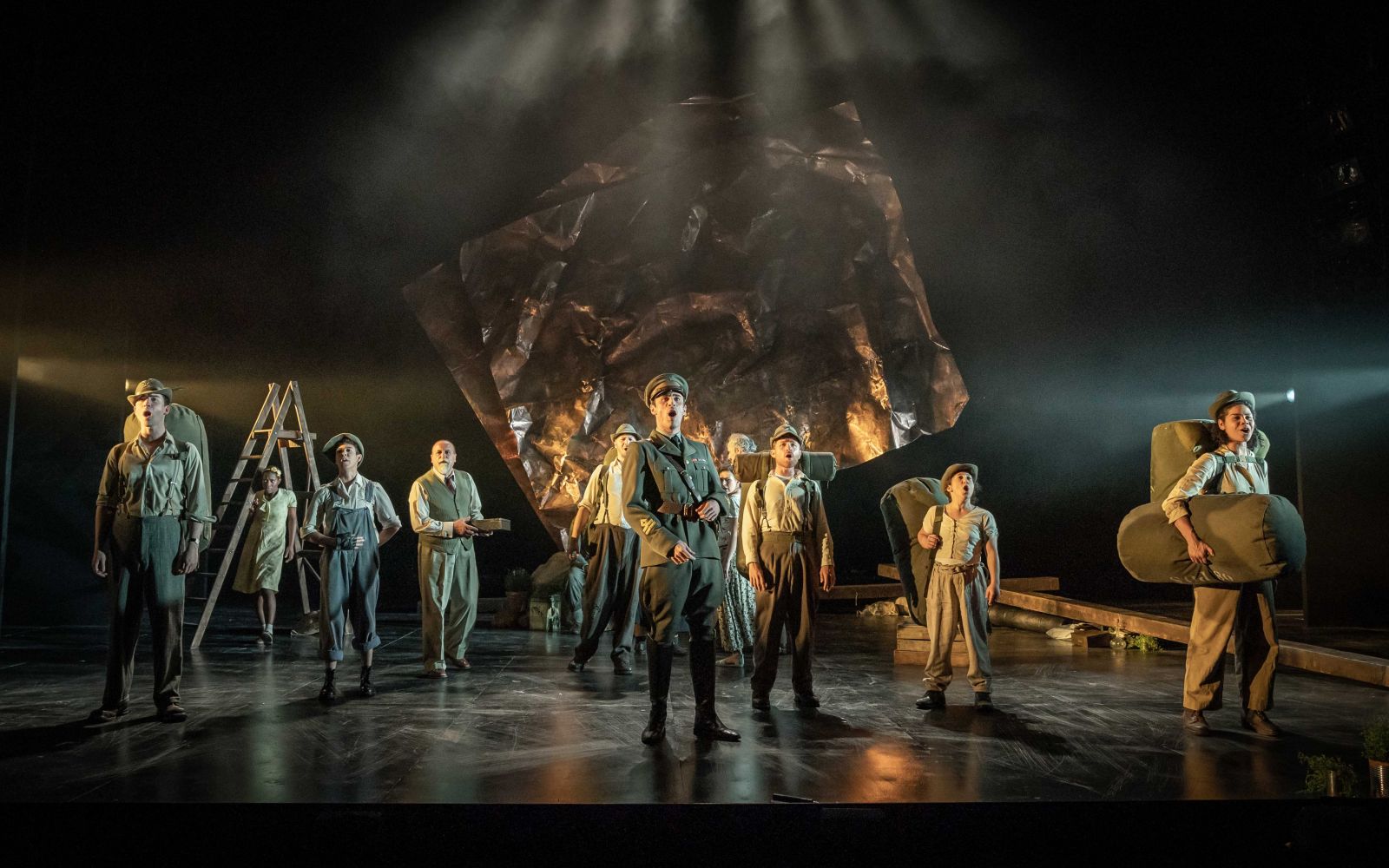
This mood is nevertheless set within the permanence of the island itself and the long continuing history of its peoples. That permanence is embodied in the two oldest characters, Dr Iannis, the local physician and herbalist, and Drosoula, an elderly widow. Iannis’ view of their world is rooted in history, in the Greek journey “from the mundane to the eternal”. After all, sitting in Homer’s wine-dark seas, between Cephalonia and the mainland is Ithica, the goal of Odysseus in his wanderings. So here is a place to be patient. Drosoula is the island’s matriarchal symbol and a staunch nationalist and acts as a foil to the communist sentiments expressed by others, as presage of the civil war yet to be endured.
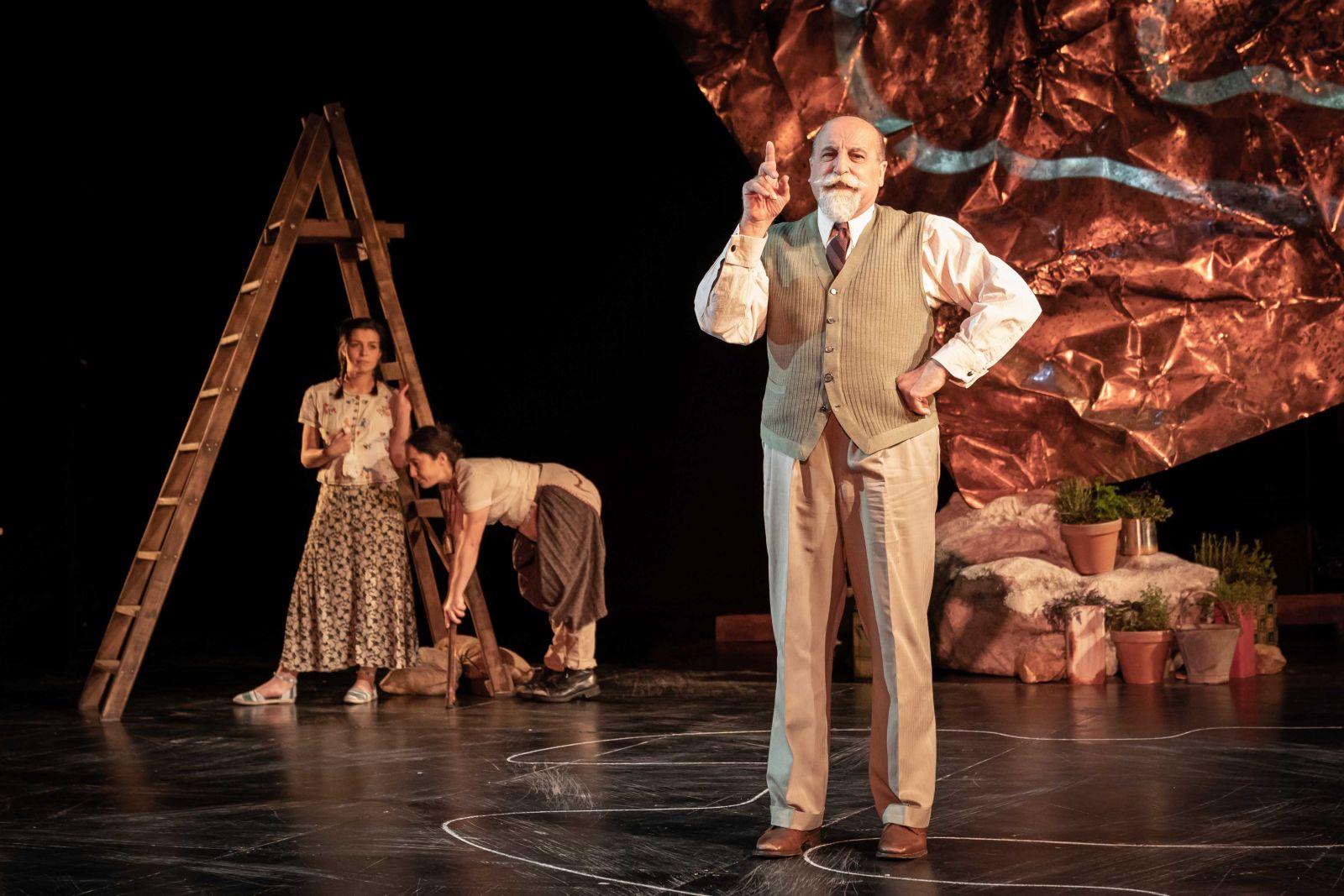
Joseph Long totally lives the part of the proud, erudite Dr Yannis, so full of wisdom and of love for his daughter Pelagia. His avuncular authority bristles like his splendid moustache. The poetry and the insight of this character are so accurately expressed by Long, that one can almost read his thoughts. Eve Polycarpou is the epitome of the Greek widow of yore, and as the only mother-tongue Greek speaker in the cast, she is steeped in the character of Drosoula. Moreover, Polycarpou has a beautifully resonant voice, a strong mezzo sung with her whole body: θαυμάσια !
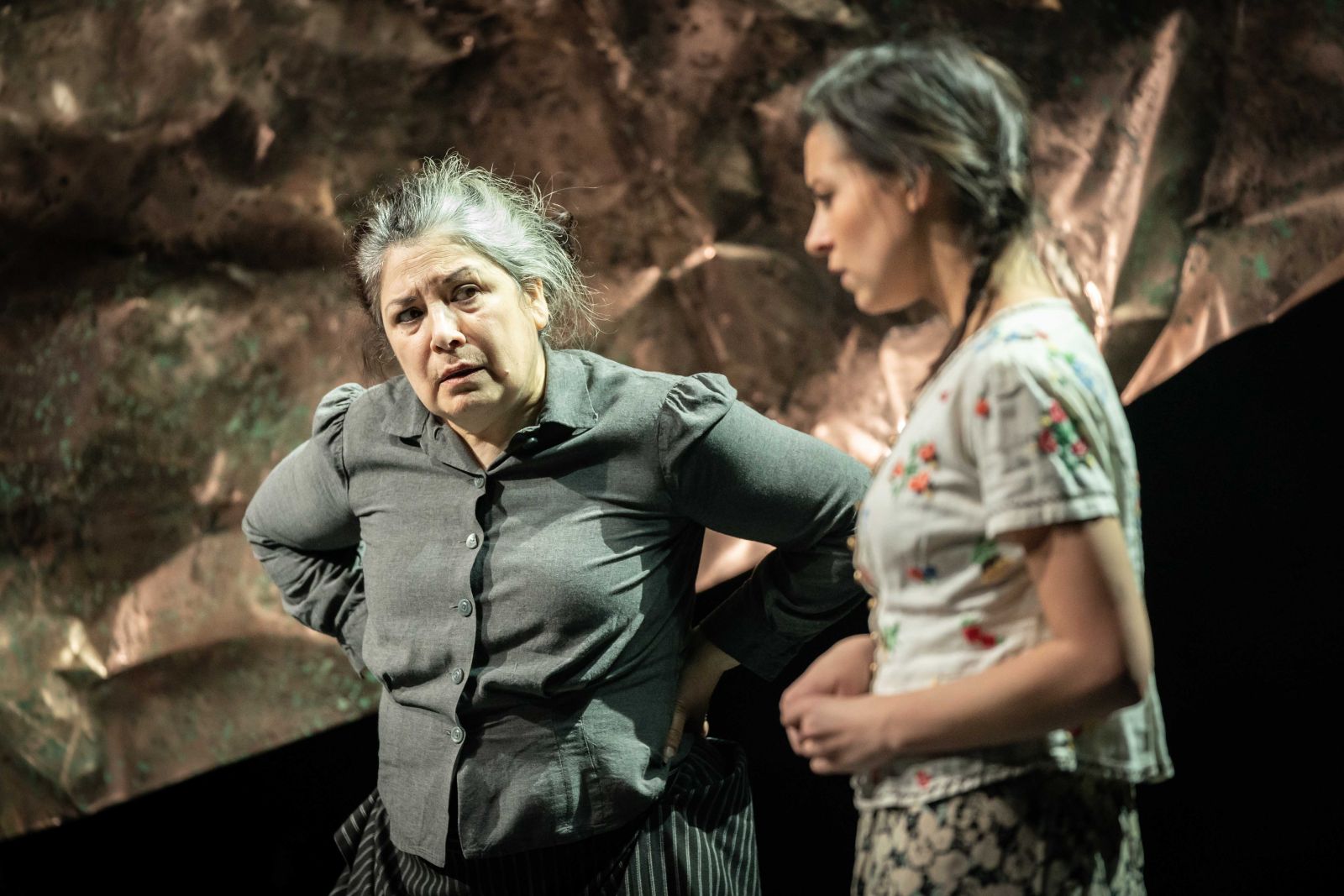
The mood and the permanence is powerfully and imaginatively captured by renowned Greek designer Mayou Trikerioti. The overarching element is a massive pellucid foil rhombus the full height of the acting space, the island’s rockface, which forms the background for mesmerising light and video effects, by Malcolm Rippeth and Dom Baker. The predations of nature: sea, sun, earthquake; and of military: barbed wire, bullets, tanks, are here all writ symbolically in light.
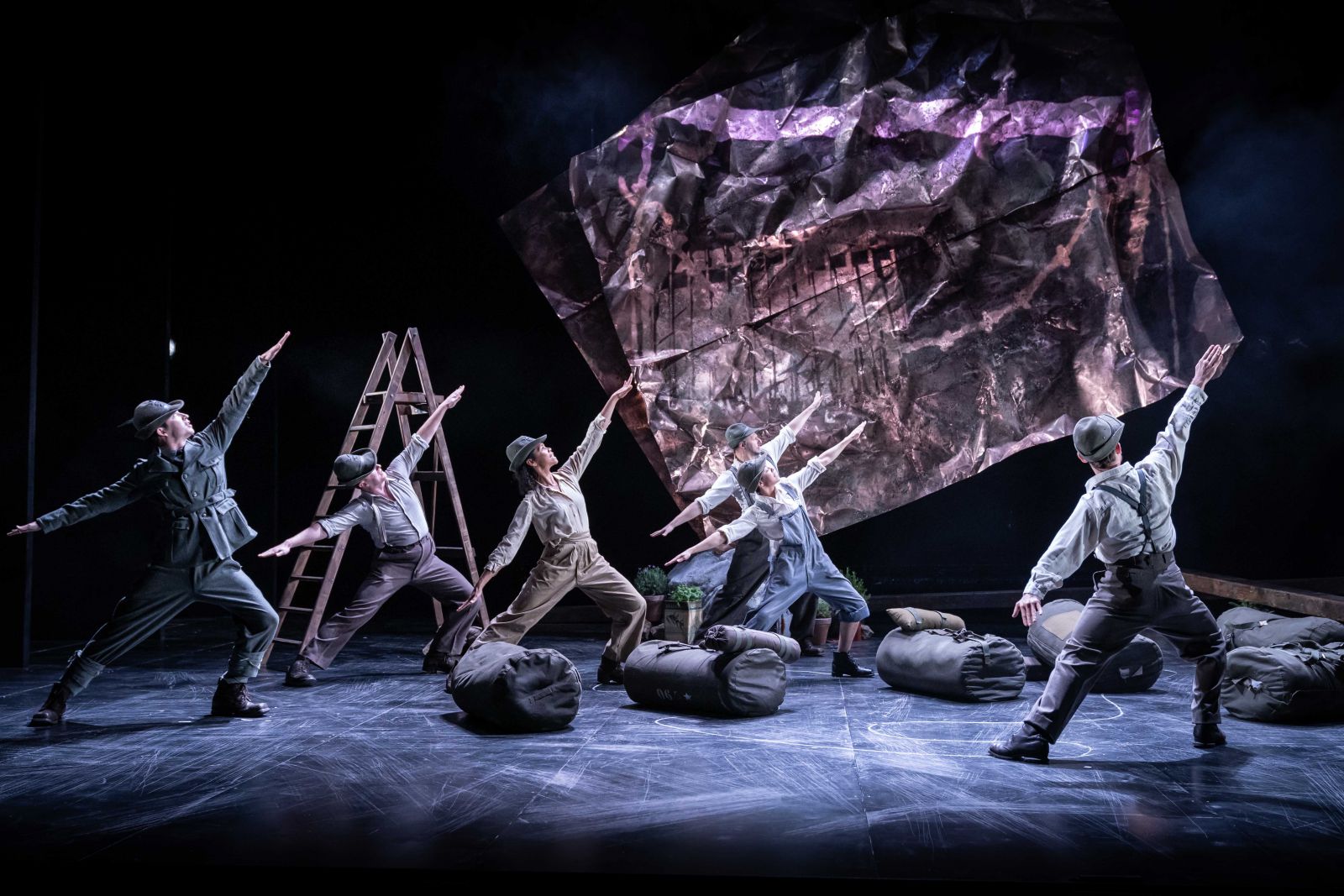
Another element that makes Captain Corelli’s Mandolin so watchable is the use of special effects, for example a shoal of silvery fish that quiver through the air, and yet another is the physical theatre that makes the piece so alive. An athletic chorus moves with balletic grace, or creates an idea or an artefact from their bodies. Soldiers’ backpacks become springboards to the next action.
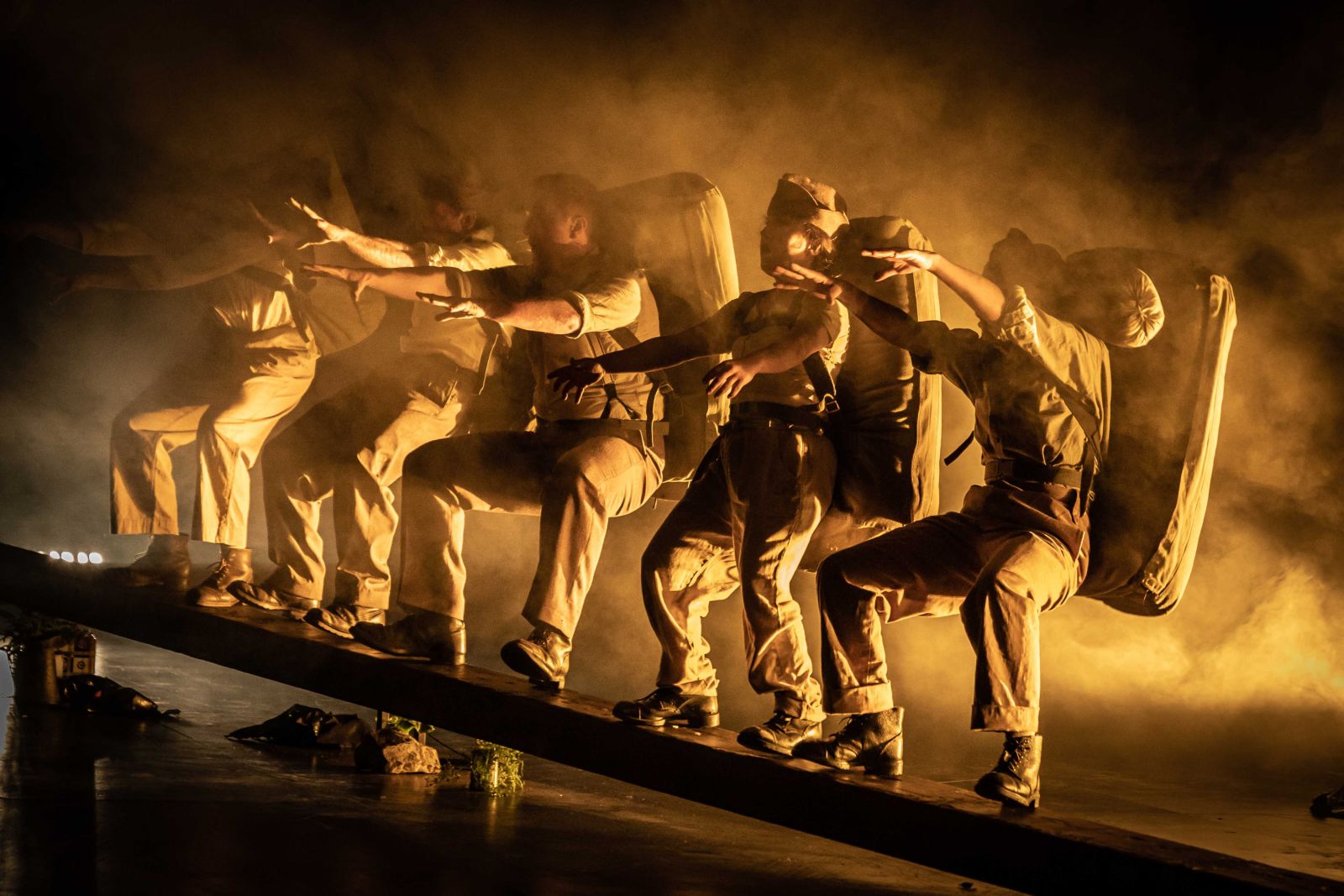
Also part of the action is Jon Nicholls’ sound design, but as the very title suggests, this is a play about music. Harry Blake has composed a number of pieces for this production, some folksy, some powerful, some haunting, but Verdi and Puccini are very much in evidence. The Italian army seems to march not so much on its stomach as on its music. The operatic capabilities of our chorus are quite impressive too. In play full of ironies, the Italian squad even use operatic ironies. They march in with The Prince’s famous aria from Turandot and make much of the final sustained, “… vincerò! vincerò!”, but is it love that conquers or war?
But when Dr Iannis spiritedly stands up to the next wave of conquerors, the German invaders, the defectors sing Lauretta’s “O mio babbino caro”, for Iannis is now the “dear father”.
This is all clever stuff, but what of the plot? Well, there are plenty of sub-plots, but it is getting on for the interval before the main plot begins to develop and a narrative untangles itself from the business of life and war. This revolves around the ill-fated loves of Pelargia.
In the tight-knit community Pelargia’s first sweetheart is a local boy, the illiterate fisherman Mandras, Drosoula’s son. Pelargia does not requite the earnestness of his falling in love, so he goes to war, much to his mother’s dismay, to prove himself. However, war brutalises him, and eventually wrecks him physically. When he returns, ridden with every parasite known to entomology, her affections have completely cooled, “hollowed out … now love has dried up”. The chilliness is compounded by his not having answered any of her myriad letters (he cannot write!). The emotional journey of Mandras is a long one, but Ashley Gayle, in this role, does not deliver this length, nor the depth of the character.
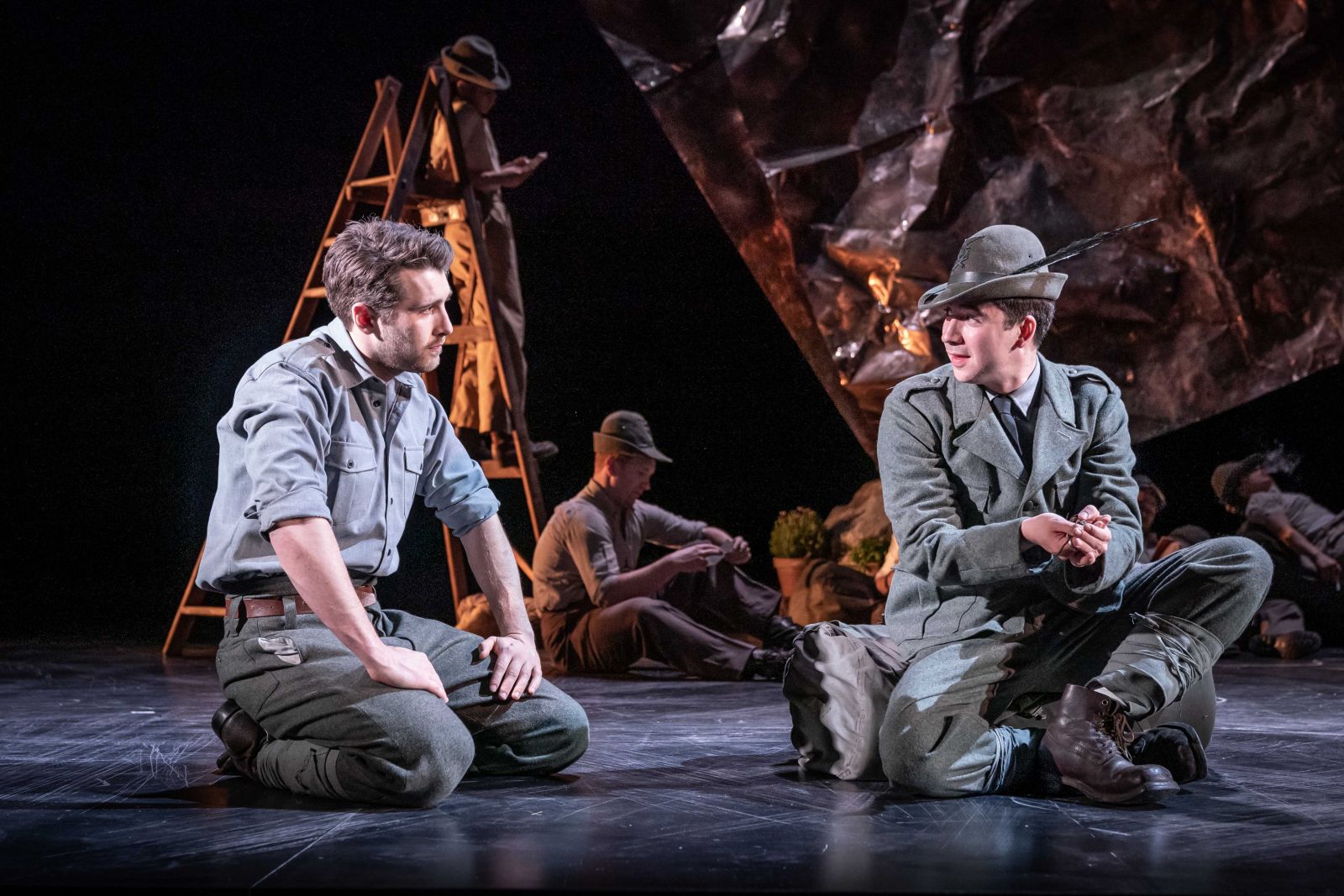 Within the entwined confusions of the tousled first half, another sub-plot emerges, the friendship of two Italian soldiers, Carlo, increasingly disaffected with war, and his comrade Francesco, engaging played by Fred Fergus, a gentle easy-going man, who even befriends a mouse. They are sent, unknowingly to them as agents provocateurs, disguised as Greek soldiers (unconvincingly pantomimic in their ceremonial Evzone uniforms completed with pom-pom clogs!) and Francesco is killed. As Carlo cradles him in his arms, he realises that they were more than just brothers in arms. Carlo is thus set up to be the ardent symbol of the futility of war in the second half.
Then the second half comes and the main narrative emerges, when the eponymous Captain Corelli comes into Pelagia’s life. It is the Romeo and Juliet plot, as hearts reach to each other across the warring divide. Greek and Italy in the Second World War, though, far supersede any complexity of the Montagues and Capulets, and ramp up the complexities of falling in love for the hapless Pelagia.
Captain Corelli is a reluctant soldier, and would rather be playing his mandolin, making music not war. His billet is the requisitioned house of Dr Iannis where he at first treated with indifference by all. But he has winning ways, helped by his devotion to his music, manifest even in his men who keep fit by singing. Alex Mugnaioni is a twinkling eyed energetic Corelli, albeit with a more than a hint of an English officer and gentleman about him. Mugnaioni has learnt to play the mandolin by Sergi Vacca, and his wistful Vivaldi-esque pieces demonstrate a remarkable capability for the instrument. (Mugnaioni did however blot his copybook when, four weeks before opening night, he left the original highly valuable 1890 mandolin on Sidcup train, a Wildean mishap that proved to be quite a publicity boost.)
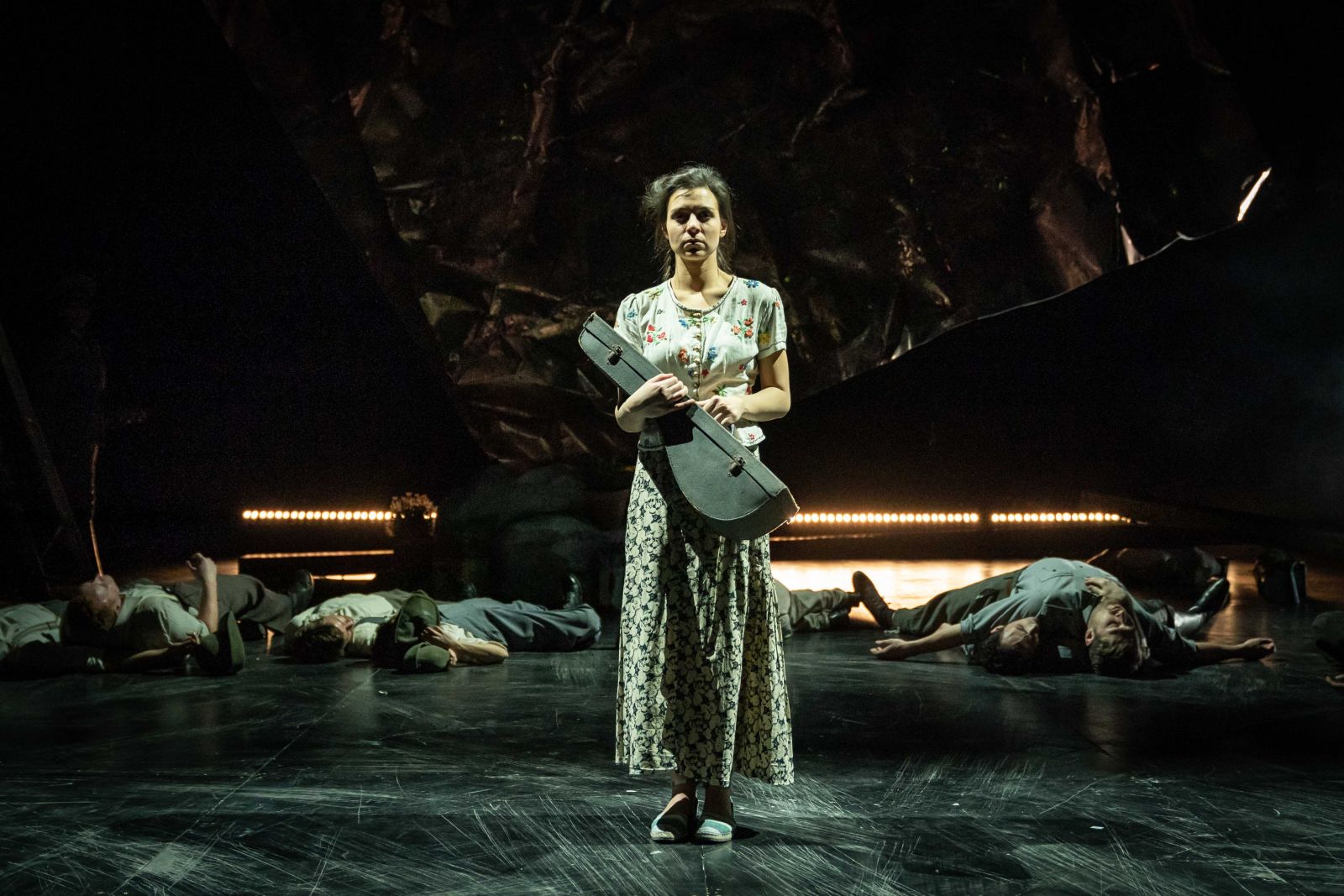
Pelagia is a highly intelligent and knowledgably young lady, who has learnt the physician’s art, not only from her father, but also by using an inquiring mind, to gather knowledge of local herbs and of animals, even, when food is scarce, dissecting a chicken before it goes in the cooking pot. She is no only beautiful, but has the added bonus for Corelli of speaking Italian, which she does very forthrightly. Making a fresh debut in a major role, Madison Clare is captivating as Pelagia, absorbing her feisty character and travelling with all the triumphs and tribulations which fate has paved her road to love.
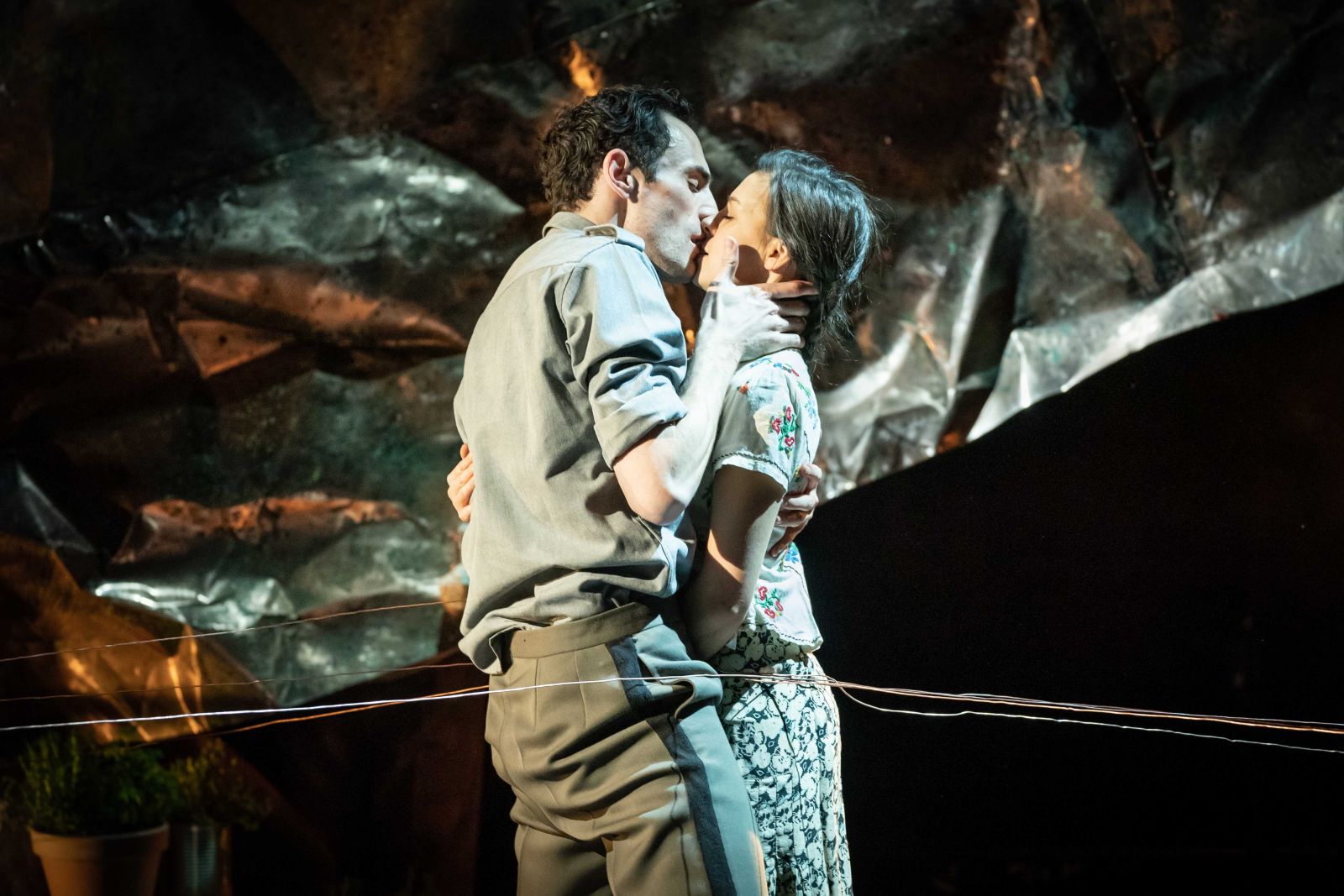
Indeed true Capuletarian contrariness leads her to fall in love with Corelli, not that one could not see that coming an Adriatic’s width away. Dr Iannis at the end of an eloquent soliloquy on love sums it up, “love is a madness; that is its nature”.
In all its ironies, there is much to jerk the tears and lump the throat in this remarkably poetic piece of theatre. Perhaps the epitome of this is the episode that references the massacre of Acqui Division (on 26th September 1940, when 5,200 Italian soldiers who had refused to surrender to the German forces were put to death). Corelli and his platoon are lined up to be executed as renegades. They bravely face the firing squad, singing the humming chorus from Madama Butterfly as they are all shot.
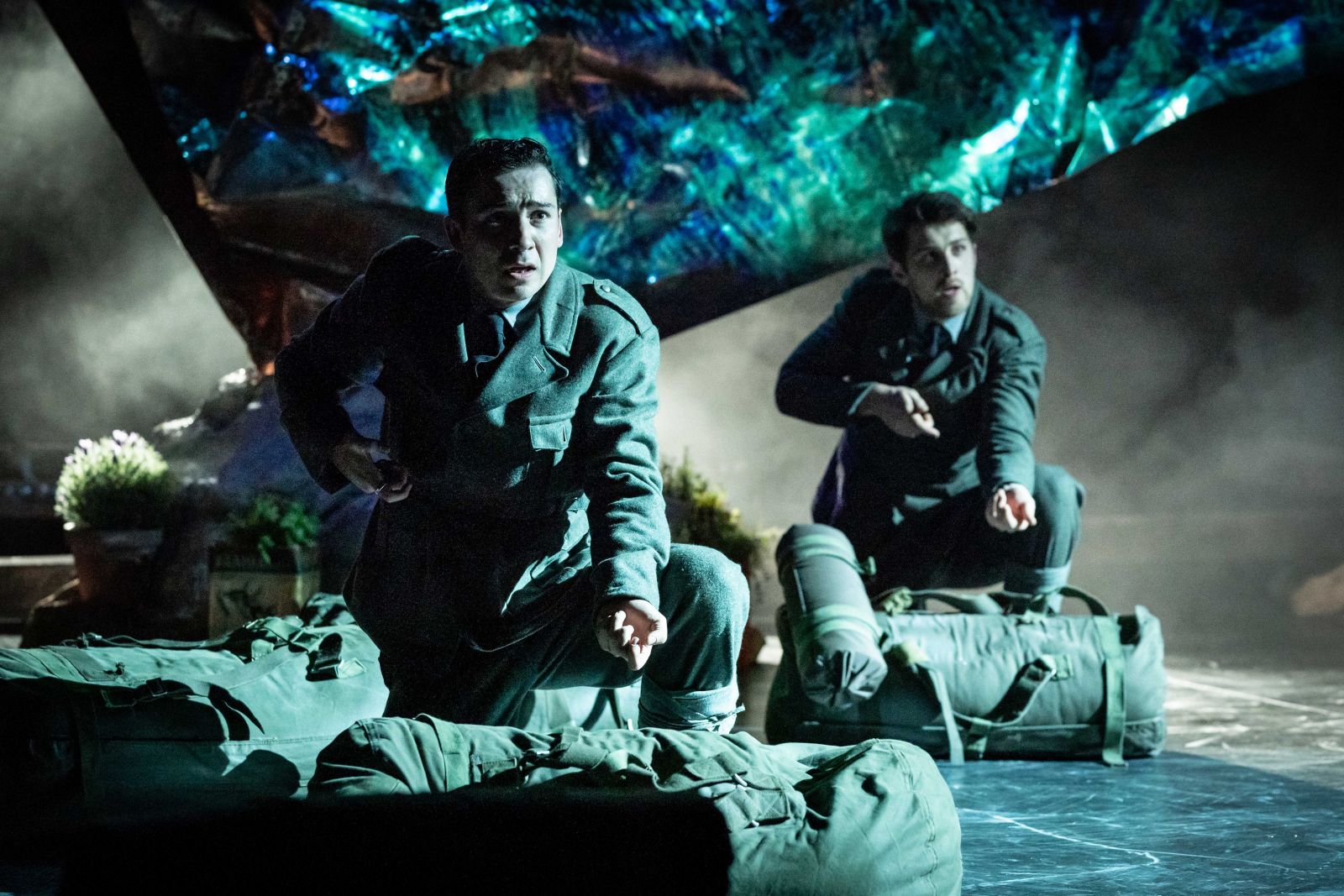
When Corelli is brought to Dr Ianiss’s surgery, he is discovered to have survived badly wounded. The strings of his mandolin are used to suture his wounds. He owes his life to Carlo, the same agonised spirit whom we saw as the symbol of war’s futility in the first half. Carlo had shielded Corelli with his own body in an act of sacrifice. His penultimate words are “keep the love alive … in perpetuity”. Ryan Donaldson’s depiction of the romantically redemptive and independently willed Carlo is powerfully inspired. However, why, amongst Still’s mishmash of accents does Donaldson keep his rich Ulster accent in this role? (Equally baffling is the casting of Kate Spencer as Günter, the Nazi officer at the massacre. A fine actress, she is acting her socks (jackboots?) off, a svelte and statuesque young lady, to portray a character based on General Lanz, a balding middle-aged Wehrmacht war-criminal.)
Many of the minor roles in this production really shine, Kerenza James as the sparky mischievous child, Lemoni, for example. But really outstanding are two actors who play the animals which form part of the Cephalonian household. In the hands (hooves?) of physical comedy actress, Luisa Guerreiro, the Goat really lives a one woman caprine Greek chorus, constantly silently commenting on the action and injecting much needed humorous relief. Here is a goat with a catholically omnivorous appetite. I was quite disappointed when a hungry Italian soldier carried her off, “bella capra”, to eat! Equally fascinating is Elizabeth Mary Williams as Psipsina, a pine marten that is rescued from the barbed wire to become a family pet. Williams is lithe, vivacious and athletic as the inquisitive tiny rodent. Both Guerreiro and Williams must have spent hours studying these animals to get the nature of their movement and temperament to a tee.


A flashback between Carlo and Corelli parenthesises the flash-forward at the beginning, but the epic scale of this production does not allow an end. It moves on from WWII, to the Greek Civil War, to the Ionian earthquake of the 1950’s, to the later tourist invasion. This adaptation cannot release itself from the ambitious intricacies of the novel and, instead of extracting the quintessence of the story, continues, like a major symphony, to a number of grand finales. But, in the end, how many endings do we need?
Enfin, a baby found in the rubble of the earthquake becomes a symbol of hope, but in a play of multiple ironies this symbol dashes the hopes of the lovers. The infant, informally adopted by Perlagia, is seen as her own daughter by the returning Corelli, and what could have been is not.
Captain Corelli’s Mandolin inverts the old adage: now, all’s unfair in love and war.
Mark Aspen
April 2019
Photography by Marc Brenner
In the Midst of Life
BU21
by Stuart Slade
OHADS at Hampton Hill Theatre until 27th April
Review by Eleanor Lewis
Terrorism-related drama is all over the place. A couple of years ago Hampton Hill Theatre staged a production of The Mercy Seat, Neil LaBute’s tale of opportunism in the midst of 9/11. On television The Looming Tower dealing with the run up to the same 9/11, is about to hit BBC 2, and even Radio 4’s daily fifteen-minute drama on Woman’s Hour is currently a story of terrorism. It would be dismissive though to describe BU21 as simply timely, it is an extraordinary piece of writing, adroitly performed by OHADS at Hampton Hill Theatre this week.
BU21 is the flight number of a plane which, at some point in a present day summer, crashes onto London having been hit by a surface to air missile, fired by a terrorist. Unsurprisingly it causes carnage and worryingly carnage is something we in 2019 have begun to get used to. This play however, covers the seismic effect the carnage has on those who live on after it. Writer Stuart Slade assembles six characters in a survivors’ group who meet regularly to try and come to terms with what has happened to them.
“In the midst of life we are in death, from whom can we seek help?” is a quote familiar to many of us but for the three male and three female characters at the survivors’ meeting it’s their reason for being there. Six characters speak occasionally to each other but mostly in monologue whilst at the edge of what any human being can be expected to process. Each individual story is both unpredictable and totally plausible.
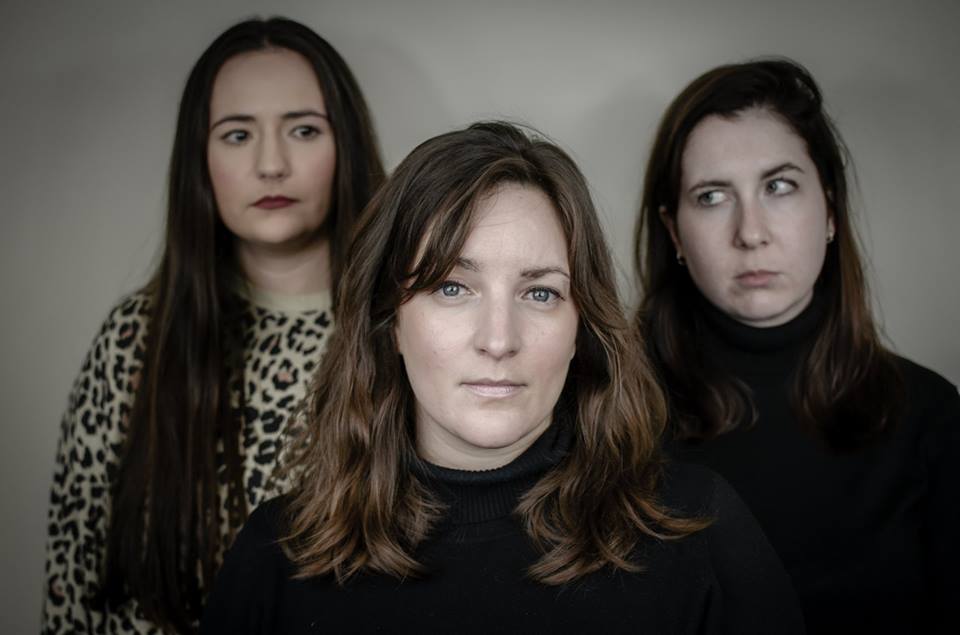
It’s a credit to this production that no acting performance was stronger than any other, all six actors inhabited their characters with clarity, integrity and considerable skill. Amy Hope and Stephanie Von Weira as two young women forced to react to equally shocking events, moved on from them in different directions but took their audience with them all the way in what passed for decision-making when so much of their essence as human beings was compromised. Emily Moss as the terribly burnt crash victim was brave and tragic in equal measure and provided pause for thought on the idea of ‘not letting them beat you’. How much of a sacrifice does that actually involve, and is it worth it?
Charlie Golding as the chirpy London builder caught by the media while rushing to help and thereby launched into his fifteen minutes of fame, was a character with a story which initially sparked a judgemental view and then snatched that away. Hadrian Howard played the one darker-skinned character in the group, this single feature bringing him yet more issues than usual including the simple task of travelling on the tube with a rucksack in the wake of a terrorist attack. His character’s storyline seemed contrived at first but was actually no less believable than the fact of a plane falling suddenly from the sky onto the people below, and the level of his performance left little room for any scepticism.

Gwithian Evans, was recognisably insufferable and very clever as banker Greg, shouting through the fourth wall to challenge the audience as to why they had come to gawp at these people. Greg took what he could from the attack and ultimately developed his own detached mantra for surviving anything (and feeling nothing). He retained a surprising amount of heavily disguised humanity nonetheless, his being another story that could not be predicted. In other hands this character might have been allowed to dominate at the expense of the others but the restraint applied by both director and actor to this role was completely appropriate.
OHADS have excelled themselves in this production, director Dane Hardie has produced a haunting, powerful piece of theatre which strikes precisely the right tone. There was no sentimentality, no smoothing over or avoiding the unpalatable, there were no pauses for effect because none was needed. Michael Bishop’s gentle lighting and Fintan Davies’ unobtrusive but complimentary sound were absolutely right. Similarly the set by Jenna Powell and Lizzie Lattimore, a black stage with the half-tidied debris of a major catastrophe swept into corners, was a visual image of the detritus of our lives and a poignant reminder of all it will amount to in the end.
Despite the dark subject matter this isn’t a piece without humour, because generally human beings aren’t without humour, particularly in adversity and there are several laugh out loud moments (I particularly liked the Stephen Hawking moments). An impressive amount of thought, care and sensitivity went into this production. And whilst it’s probably necessary to say that this won’t suit those who have issues with language (there is a great deal of swearing), and the subject matter is graphic, this is a very well-produced, well-acted, engaging and intelligent piece of drama and this reviewer can only highly recommend it, and OHADS.
Eleanor Lewis
April 2019
Photography courtesy of OHADS
Into a Glass Darkly
The Picture of Dorian Gray
by Oscar Wilde, adapted by Séan Aydon
Tilted Wig Productions at Richmond Theatre until 27th April, then on tour until 18th May
Review by Mark Aspen
If conscience could be put into abeyance, where would that leave morality? Tilted Wig’s stylish and innovative production firmly tilts Wilde’s Faustian parable of the nature of morality towards us all, in a setting that hints constantly at reflections.
Director Séan Aydon’s bold adaptation condenses Oscar Wilde’s only novel down to a two hour melodrama that overplays and underplays the story’s themes in equal measure. As a piece of theatre, it is a triumph, but it is a triumph with “buts” …
The eponymous Dorian Gray’s soul-selling licenses him to exploit his youthful good looks and vigour in pursuit of a life of pure hedonism, whist its consequences are transferred onto a painted portrait which bears the disfigurement of his decline into dissolution. So Gray gives the excitement of evil full throttle and the picture takes the kickback.

A clear triumph is Sarah Beaton’s design. The set is a mansion of not so much faded grandeur as dank dilapidation, decay instead of decoration: Gray’s world is grey. The effect is old-master symbolism; think Jan Gossaert. The period of the costumes is fugitive, not 1890 Wilde, not 2019 London, but disconcertingly in-between. Jon McLeod’s music and soundscape is eerie, startling, yet ephemeral. Matt Haskins lighting is atmospheric chiaroscuro. The whole design induces uneasiness, although pointing to perennial themes in the plot. “But” a purist might feel short-changed of a period piece, and subtlety is sometimes lost with sudden music punctuations or lighting pointing out weapons ahead of the plot. Audience mumblings suggested that playing nineteen scenes in multiple locations on a single set baffled some.
The plot revolves around the three principal men, Dorian Gray, Basil Hallward an established society portrait artist, and the Mephistophelean Lord Henry Wotton. It is implied that all three are bisexual, although the homoerotic undertones in Wilde’s original are downplayed; and to advantage, as the 1890 legal and social constraints lack relevance in the indeterminate setting. Nevertheless, there is an emotional power-play between the three, who all take wide emotional journeys as the plot relentlessly enfolds.
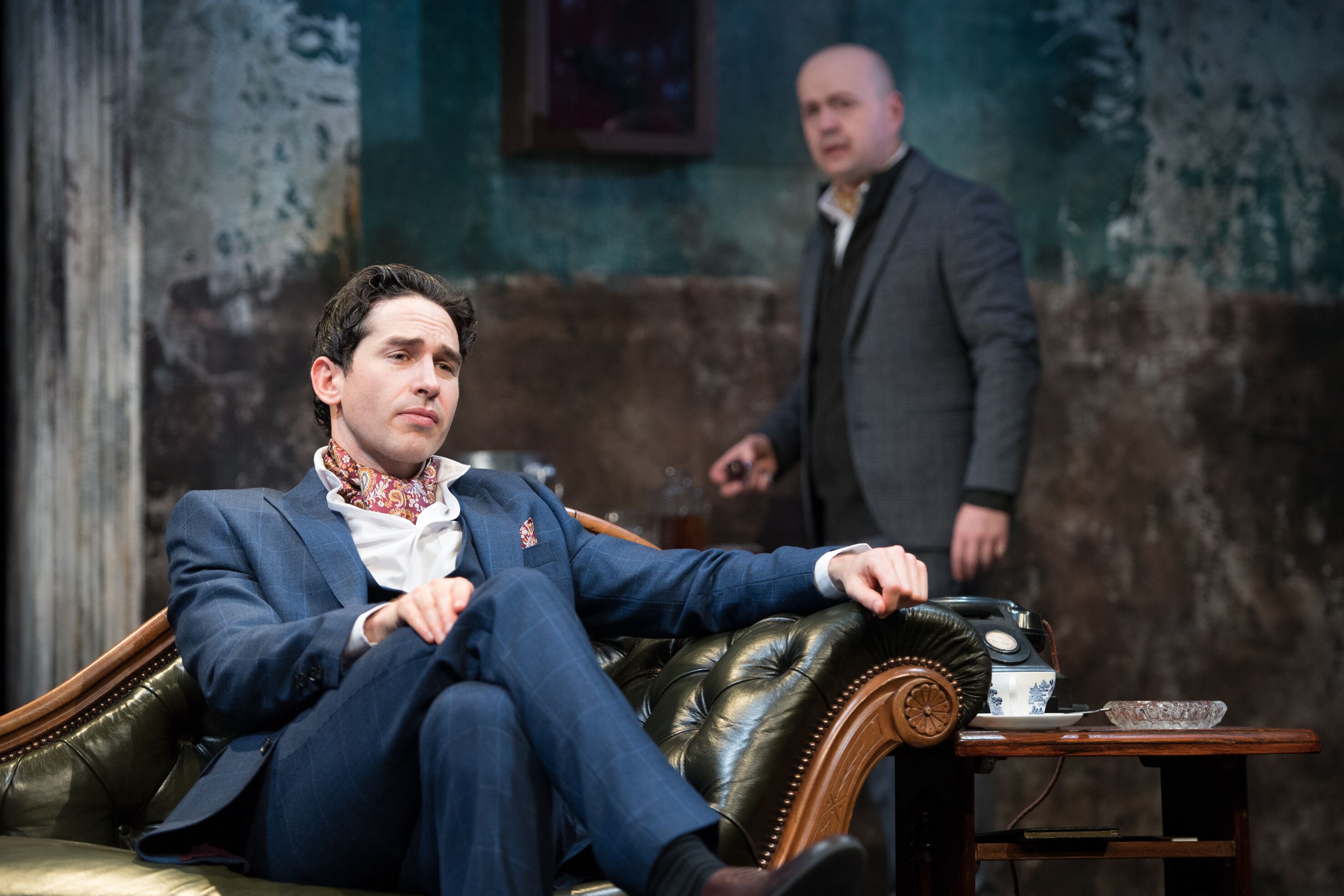
When we first meet Dorian Gray, he is self-effacing, diffident, personable. He can hardly believe that an eminent artist admires his beauty and has captured it on canvas, to the delight of both of them. Gavin Fowler plays Dorian as an easy-moving innocent abroad, apparently oblivious to the attentions of two older men. He is to take the longest emotional journey, as he is seduced into abandoning concepts of morality as artificial, and taking an accelerating downward path to depravity. Fowler’s depiction of Dorian’s decline to indifferent coldness, then to arrogant heartlessness, and on to a cruel callousness that borders on psychopathy is chillingly believable.
Dorian has become a muse to the artistic temperament of Basil who now cannot bear to part with his Mona Lisa creation. Basil’s attraction to Dorian is quite clear but his relationship is platonic and becomes increasingly protective. Basil’s is the voice of conscience for Dorian, but one of rapidly waning effect.
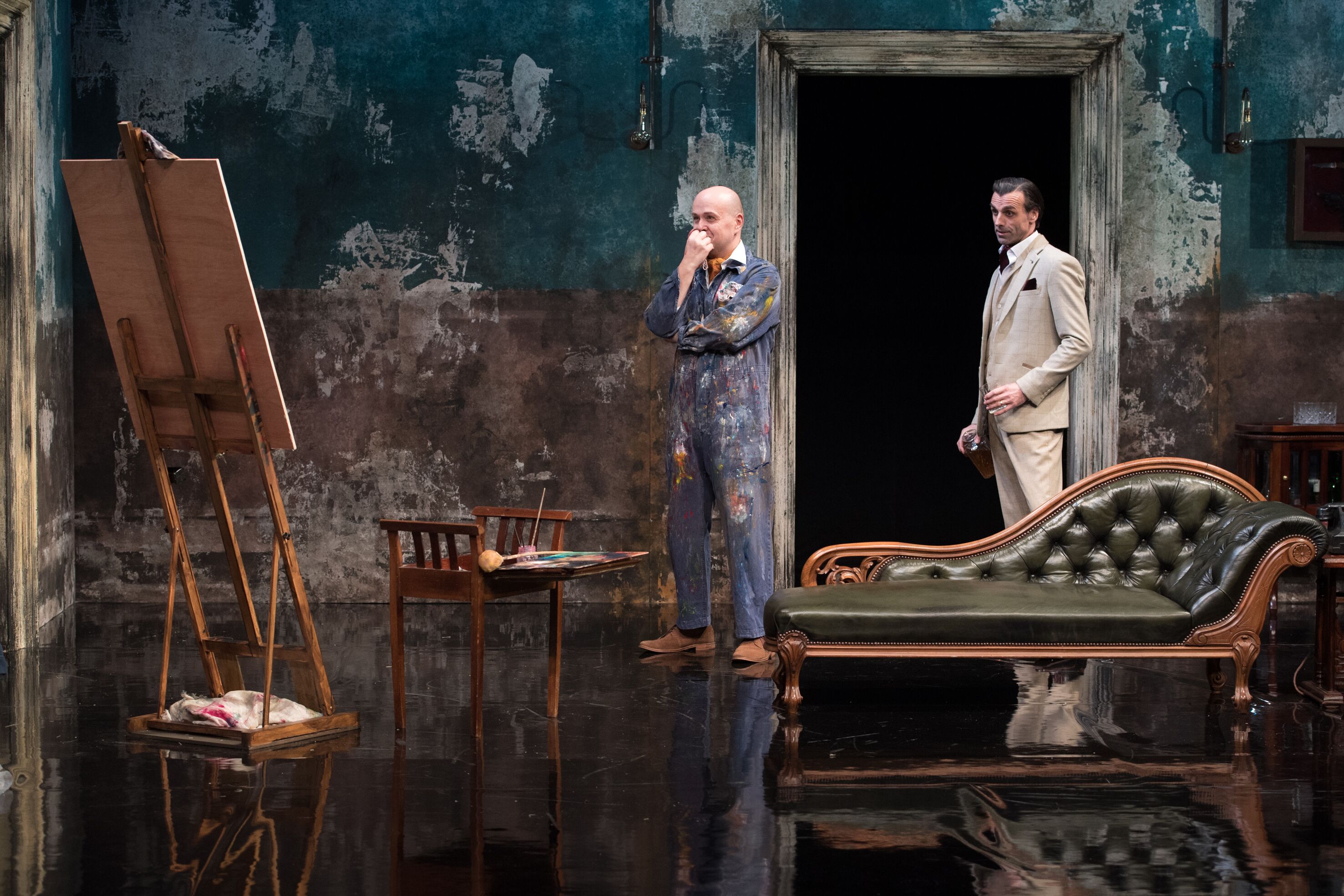
The catalyst for Dorian’s decline is Lord Henry Wotton, a hedonistic arch-cynic. He is intrigued when he sees the sublime portrait created by his former Oxford chum, Basil, and insists on meeting Dorian, whom he then proceeds to indoctrinate with his personal philosophy. Morally is an illusion, self-pleasure is paramount and all that matters is youth and its beauty. Henry’s seductive sardonic style captivates Dorian. Henry gets all the best Wildean aphorisms; oh yes, including the cynic being one “who knows the price of everything, but the value of nothing”, rather contrarily from Henry’s mouth.
Jonathan Wrather certainly looks the part of the louche Henry, oiled-back hair, complete with devilish widow’s peak as slick as his silver tongue. He plays Henry as a suave Lothario, totally self-centred. There is a sense of untamed menace showing beneath the urbane veneer. The body-space intrusions and sweeping gait speak it all. Henry’s subjugation of Dorian’s morality is almost engineered. He is the Screwtape who feeds the rope for Dorian’s ethical gallows.
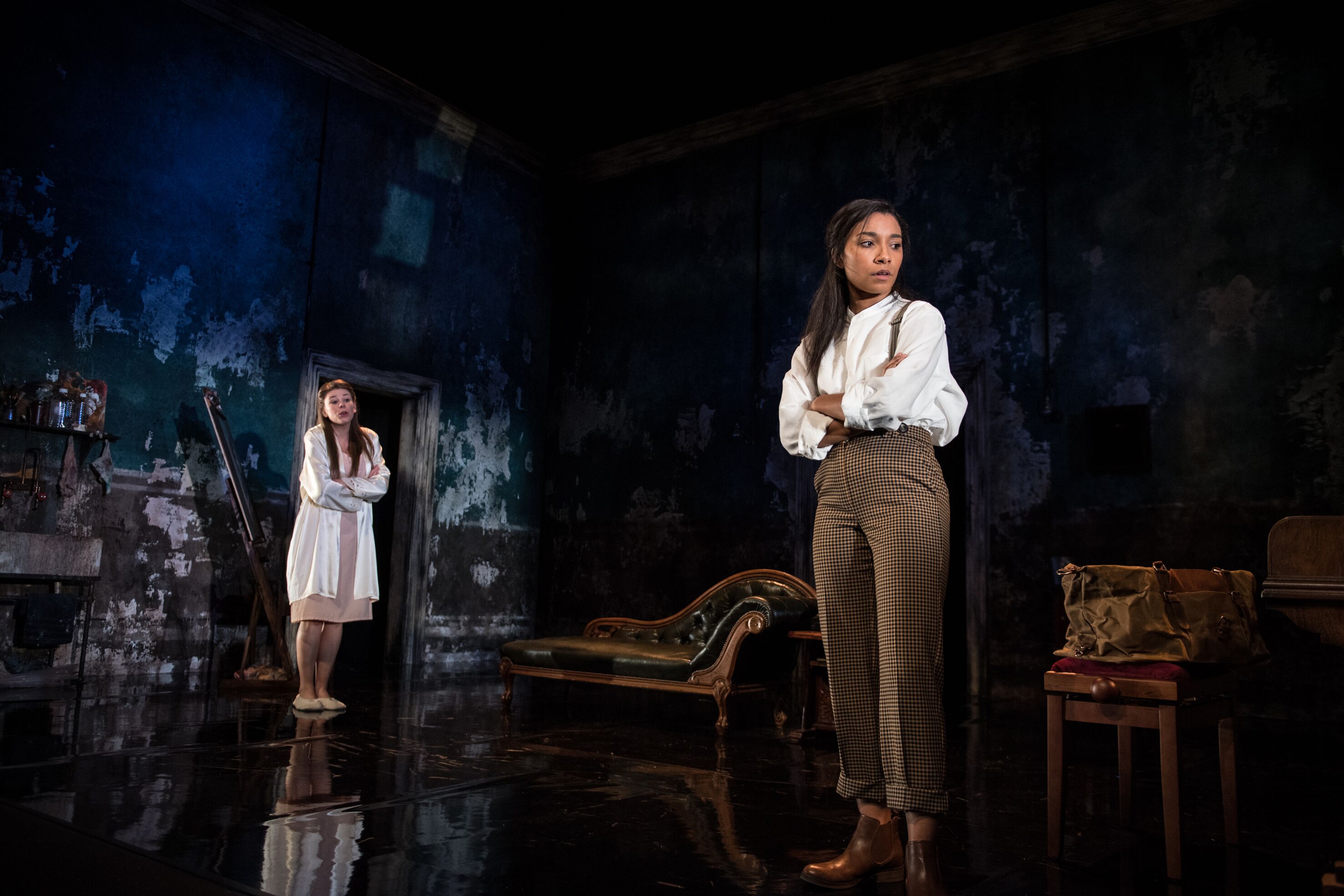 Dorian squirms a bit on this ethical rope, and we long for redemption when early on he seems to fall in love with Sybil Vane, a rising young actress of some clear talent. Henry does not approve of Sybil, or of her socially inferior status, whereas Sybil’s sister Catherine does not approve of Dorian, and makes her views strongly felt. “If he harms her I will hunt him down like a dog”, she spits. Nevertheless, Dorian and Sybil become engaged to be married. However, on the day that Henry and Basil come to the theatre to see her perform Shakespeare, she fluffs her part as Juliet, for acting no longer matters now she is in love for real. Her change of image for Dorian knocks her off of the pedestal he had made in his mind for her, and he cruelly jilts her. “Now, you don’t even stir my curiosity”. Sybil is so distraught that she commits suicide. (The character’s name is thought to be an amalgam of characters from romantic-tragic novels by Disraeli, but note the classical allusion to the prophetess who stood at the gates of Hades.) Kate Robinson’s bubbly innocent Sybil is spot on and her rendering of the dejected and rejected fiancée is heart breaking.
The philosophy of Henry admits no such mishaps, and he convinces Dorian that the suicide was no more difficult for her than acting Ophelia or Desdemona, her “greatest romantic tragedy”. They go off together to the opera, followed by a night on the tiles with another woman.
There is an exquisite tiny cameo by Samuel Townsend as Dorian’s manservant, trying to wake him from his hangover the next day; just in the actor’s body language and look of pure disdain. Townsend also gave us a great piece of comic relief in his Romeo, a textbook exemplar of Victorian declamatory acting.
Dorian, horrified to see a twisted look of cruelty on the hitherto pristine portrait of himself, which is now in his possession, hides it beneath a sheet (of anachronistic bubble-wrap). But now we can only recoil at his state of mind, as he visits the mortuary where Sybil’s body lies, not to see her, but to ask “What does it feel like to cut up a dead body?” of a pathology student he meets. This is Ellen Campbell, a lovely young woman, who he then seduces. Adele James (doubling also as a feisty Catherine Vane) depicts Ellen’s conflicted emotions with pinpoint accuracy.
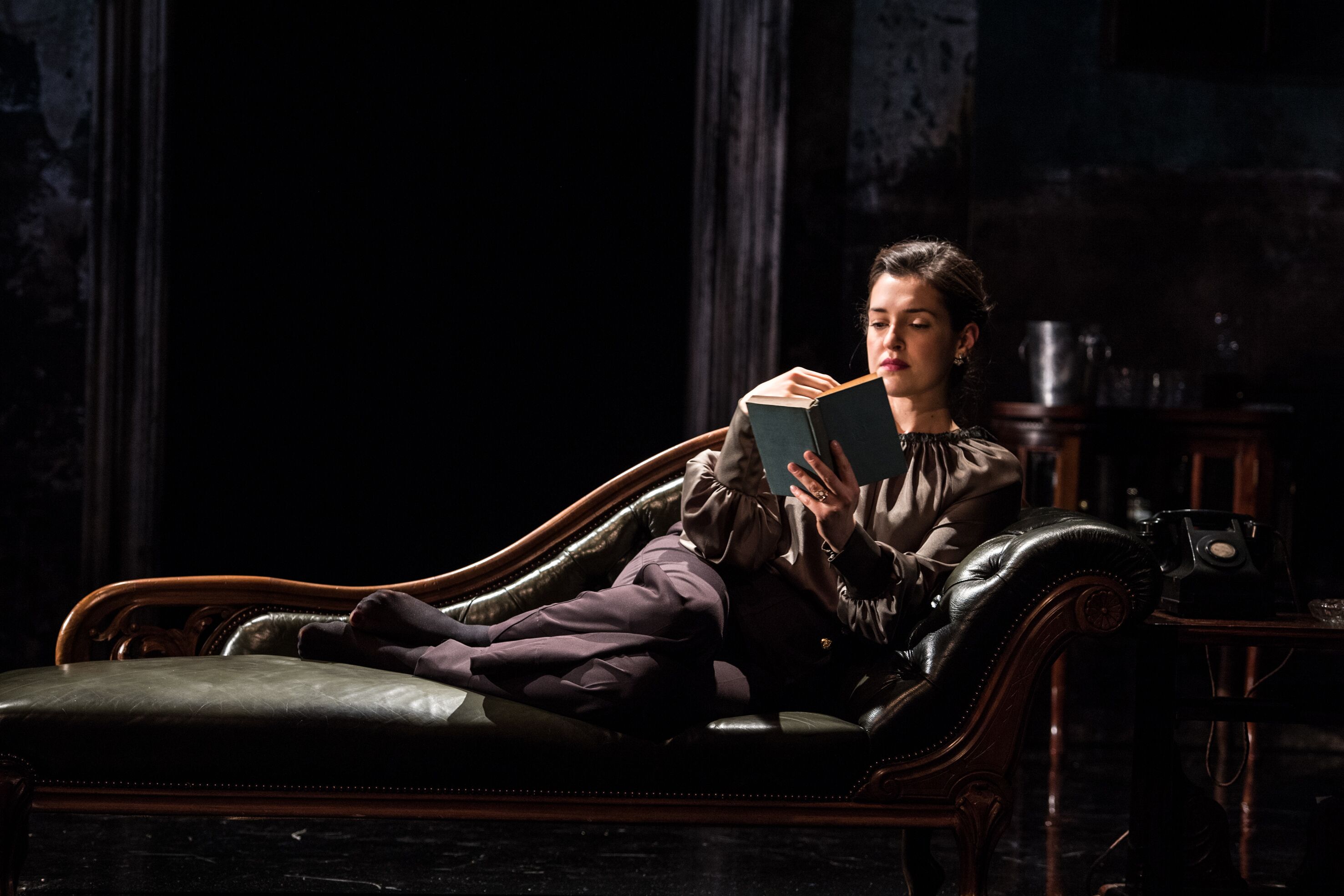 Henry has a dismissive attitude to his own brittle marriage, one largely of convenience, to Victoria. Such now is Dorian’s depravity that he seeks out his mentor’s wife. However, does he seduce her, or does she seduce him? He meets his match, for Lady Wotton is a lady to be reckoned with. Not only is this goose for Henry’s gander, but Lady W obviously relishes the frisson of danger in flirting with a now near-psychopath. Phoebe Pryce is peerless as the elegant, statuesque Lady Victoria Wotton, cool and deliciously in control.
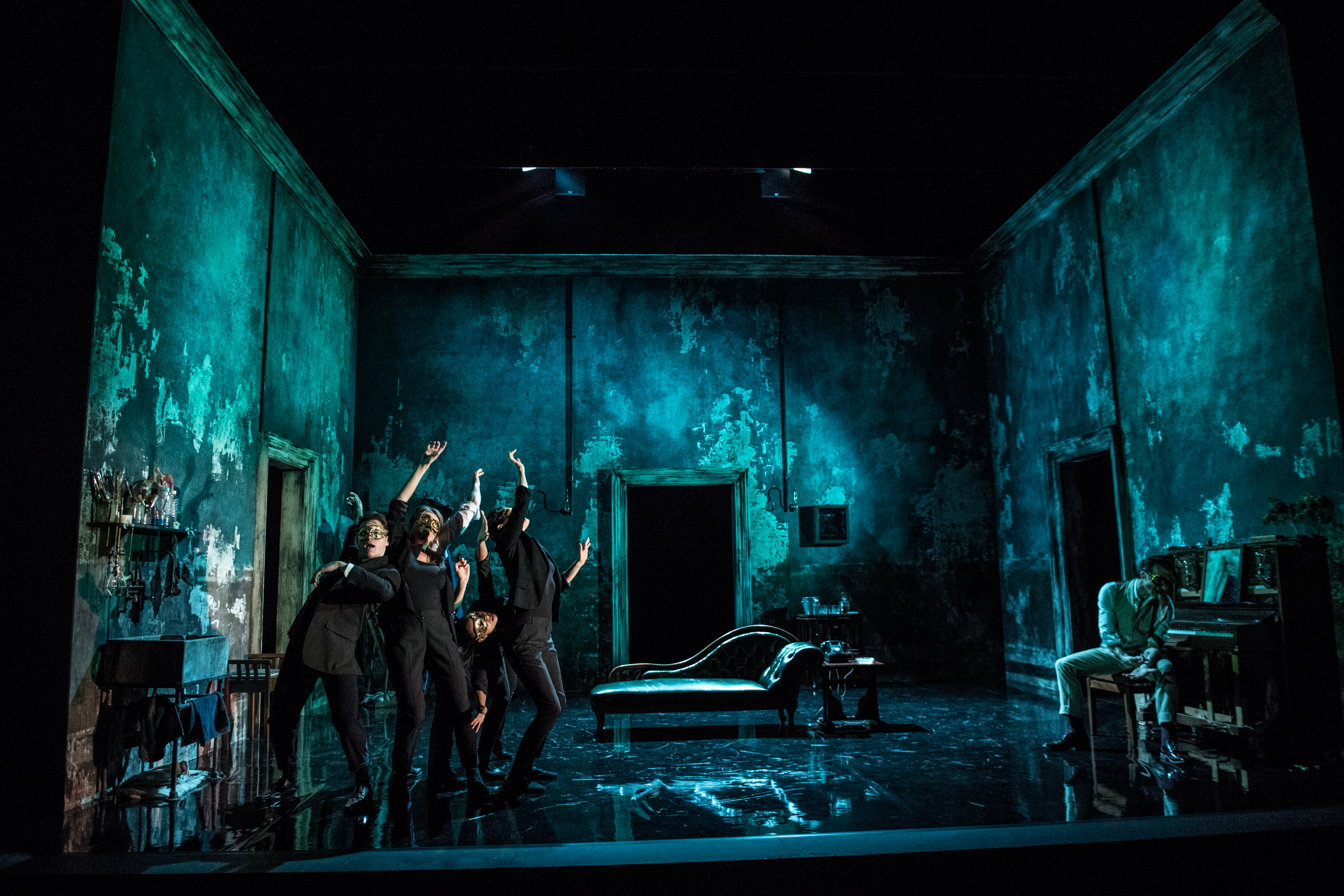
The depths are plumbed when Henry organises a drug-fuelled sex orgy to fire Dorian’s perversions further. The staging is stylised as a dance to heavy-metal music and bathed in red light. Under Jo Meredith’s choreography the effect is mesmerising, as the convulsive dance of depravity explodes into exhaustion. The morning after the night before, Dorian’s rules are dehumanising; all should leave without knowing even each other’s names.
Eighteen years of Dorian’s excess take their toll on Henry’s now jaded appetite for sensual pleasure. Meanwhile Basil has observed the vileness of the situation he has created in encapsulating the consequences of Dorian’s amoral life into the once beautiful picture. It is with barely disguised disgust, deep regret at his actions, and mounting fear at the outcome that Basil visits Dorian to ask for the portrait back. He wishes to exhibit it in Paris and there stay for many months to work on a redemptive piece of art. But when he sees the horror of Dorian’s life that has been subsumed into the portrait, now an image of a hideous monster, he is overcome with fear and can only plead for divine intervention through his prayers. Basil’s voice of conscience now speaks loudly to Dorian, but he only wants it silenced. So he kills the voice of conscience. Dorian’s stabbing of Basil to death is vicious in its mechanical brutality (another all-too realistic creation of acclaimed fight director Bethan Clark). “But” pity about the over-manged neatness of the enactment on a precisely placed piece of bubble wrap. (Doesn’t Kensington gore clean off as easily as it used to?)
Daniel Goode gives a superbly nuanced performance as Basil Hallward. The slight campness in the open scenes is replaced by a true representation of the character’s sense of responsibility as he becomes more grounded in the realisation of the uncontrolled wantonness he has released. The awkwardness of trying to say the right thing is gradually replaced by guilt at the unbridled atrocities his once greatest masterpiece has uncaged. Goode subtly portrays all these registers of mood.
The big “but” comes towards the end of the play when the adaptation seems to have said all it needs to, and yet still goes on, perhaps intending to get in all of the details of Wilde’s novel into the closing scenes, rather than accepting the essence of the tale. It then begins to feel too long. It is a pity. A small “but” is a problem that is becoming perennial, that is the way television acting seemingly spoils an actor’s need to keep the delivery big enough to actually be heard at the back of the stalls. When so much of the joy of Wilde’s writing is the cleverness of the wit, it is a huge shame not to hear it.
Nevertheless, this is a piece of theatre that is a sophisticated statement of complex psychological, philosophical and spiritual question of the nature of morality. Why and how do we have a conscience? This play never shows us the final picture of Dorian Gray, but we see the transparent canvas as he lifts it to look at himself. And then we see ourselves reflected. The floor of the stage, the base parts, are also reflective. Maybe without constraints, any of us could be a Dorian Gray. Moreover, it is not bound by spatial or temporal anchors. So the where and when are irrelevant too.
How would we behave if we could put our conscience into abeyance, park it on a portrait, later to pick up our unsullied selves? No, no, The Picture of Dorian Gray tells us, our conscience is what we are, and when our conscience dies, so do we.
Mark Aspen
April 2019
Photography by Craig Sugden
The Jig’s Up
Kemp’s Jig
by Chris Harris
Blue Fire Theatre Company at Tara Arts Theatre, Earlsfield until 23rd April, then on tour until 17th August
Review by Andrew Lawston
In 1599, Elizabethan comic actor and clown Will Kemp danced from London to Norwich, following his departure from the Lord Chamberlain’s Men, William Shakespeare’s company. When I’d first read about this epic jig, it was in a context where it appeared as little more than an eccentric footnote, and it struck me as more of a quixotic mission than a show business masterstroke. Now, Steve Taylor’s revived performance of Chris Harris’s one-man show Kemp’s Jig for Blue Fire Theatre Company and producer Lottie Walker, expands on the 125 mile Morris Dancing adventure. The perfect show to mark both St. George’s Day, and the anniversary of William Shakespeare’s death; and of course birth. (Kemp’s Jig is part of the Tara Theatre Celebrates Shakespeare week, which includes The Dramatic Exploits of Edmund Kean.)
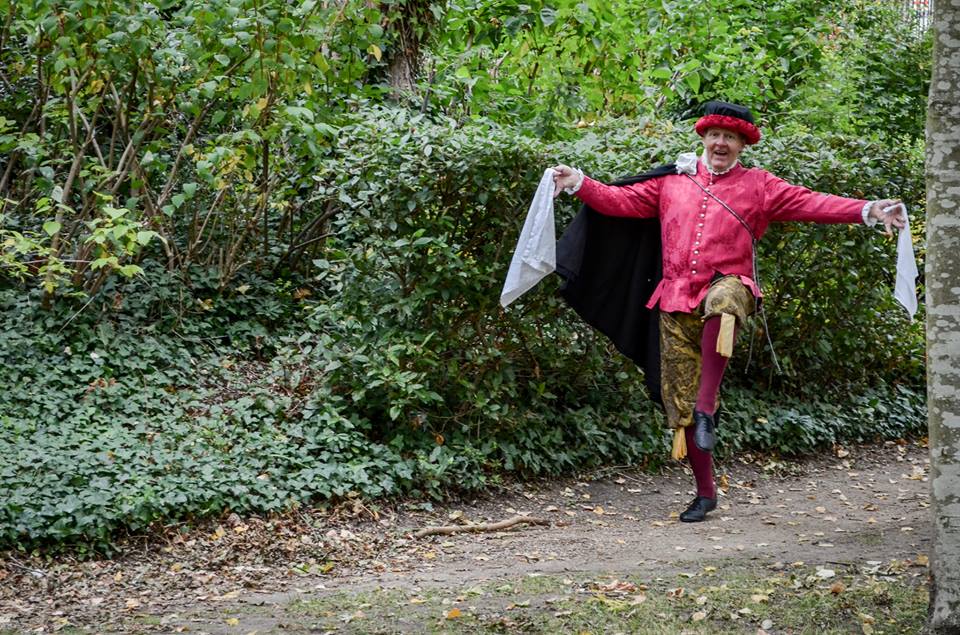
On a plain set that consists almost entirely of a map of Kemp’s route, a screen, and a trunk emblazoned with its owner’s name (“Kemp with a ‘p’, not Kemp with an ‘e’,” as Kemp keeps reminding the audience), Kemp relates the tale of his feat, with frequent digressions into his theatrical career, and grumbling about his former colleague “Shakesrags”.
 On several occasions, wonderful puppets and other props are brought out of the trunk to help him perform scenes from The Two Gentlemen of Verona, Merchant of Venice and, finally, after a full show of Kemp shouting, “I should have played the Nurse!” from Romeo and Juliet. Sometimes Kemp even showcases the dancing which made his feat so extraordinary, but these sections are few, and generally brief.
Taylor maintains character as Kemp at all times, even when interacting with the audience at Tara Arts Theatre by handing them his props for safekeeping. A one-man show of ninety minutes (not including an interval) is a huge undertaking, and the script is clearly divided into sections to help the performer, with, I suspect, at least a couple of aides memoires in Kemp’s trunk. Even when Taylor’s focus is occasionally visibly shaken, however, he remains in total command of the material.
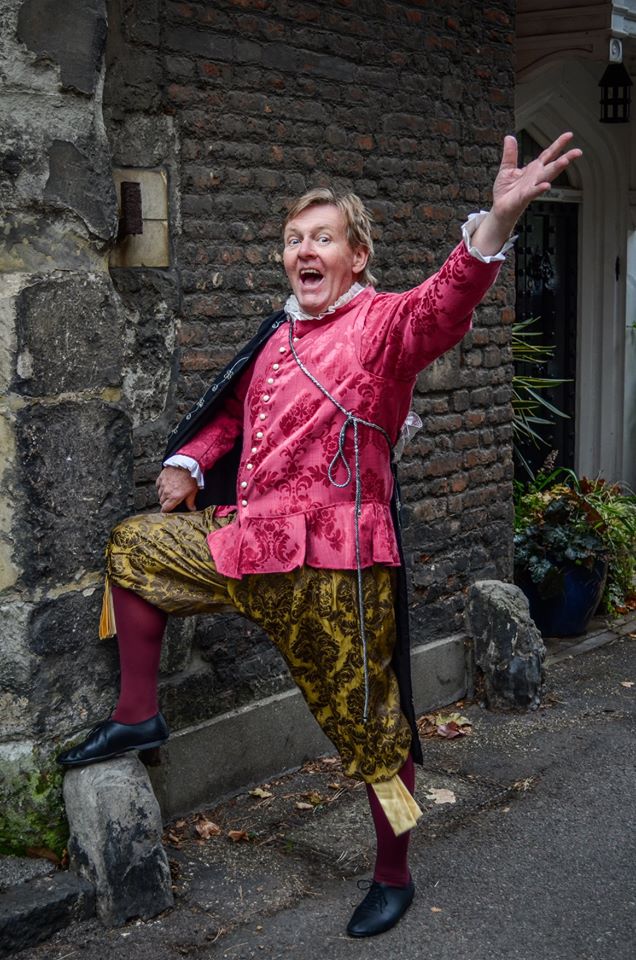 As the tale of a comic actor, Kemp’s Jig is inevitably very funny. But it’s not all laughs, as Kemp talks frankly about being glad to be out of plague-ridden, filthy London, and gives a stomach-turning description of dragging Shakespeare to a public execution. He claims Shakespeare couldn’t eat for a week after witnessing the gruesome spectacle, and then begins a flashback of an extended argument with the Bard which comes as welcome comic relief. These interludes (between Taylor as Kemp and Taylor as Kemp as compulsively beard-stroking “Shakesrags”) are consistently entertaining, though as the show goes on it becomes very difficult to think of William Shakespeare as anyone other than whining old Albert Steptoe. Which is almost certainly deliberate.
“Let those that play your clowns say no more than is set down for them,” is Hamlet’s famous line that many scholars have believed to be a dig from Shakespeare aimed directly at Kemp’s ad-libbing and embellishments, and Kemp repeats it often, alternating between gleeful pride and professional disdain. Kemp has a great deal to say, and its delivery is unfailingly entertaining. The show sets up an intriguing conflict between character comedy and more performative slapstick, audience interaction, and visual comedy material. While it’s clear which side of the argument Kemp favours, it’s hard to dismiss Shakespeare’s more thoughtful approach.
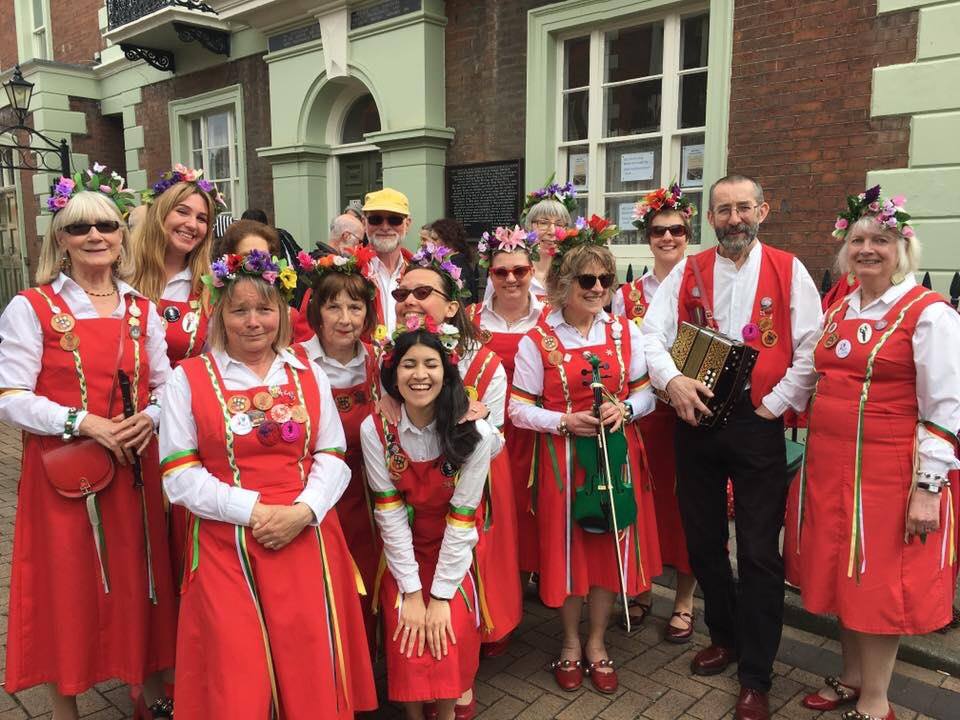
Featuring a wonderful performance of Morris Dance from Dacre Morris, the members of whom sit patiently at the side of the stage throughout, Kemp’s Jig is a thoroughly irreverent and entertaining look at England’s theatrical and social history.
Andrew Lawston
April 2019
Photography by JoJo at Handwritten Photography and Timeline
Caveat Emptor
Glengarry Glen Ross
by David Mamet
ATG, Act Productions, Glass Half Full Productions and Rupert Gavin, Richmond Theatre, until 20th April, then on tour until 4th May
A review by Matthew Grierson
The secret of a successful magic trick, I understand, is distracting the audience from the sleight of hand involved. But if sales is a kind of magic, then the customer can just as easily be distracted by being told the mechanism by which the deal itself is made. After all, if the salesman is telling you how he is doing it, he can’t be untrustworthy – can he?
The deals to which we are party in Sam Yates’s slick revival of Glengarry Glen Ross have exactly this quality about them. When we first encounter Nigel Harman’s mesmeric Ricky Roma, he is deconstructing the art of the sale over a drink in a Chinese restaurant, telling us how it depends on living in the here and now – as his own performance demands it does – and that one needn’t nurse remorse about what one wants or how one gets it. It doesn’t matter that what he’s talking may be BS: he absolutely sells it.
More to the point, he absolutely sells us the idea of Ricky as a seller. James Staddon as the hapless James Lingk hangs on his words as much as we do, and it gradually becomes clear Ricky is talking his fellow diner into a deal. As we’re reminded, ‘Always be closing.’ And as the first act closes, the lights dim and Harman seems positively Mephistophelean.
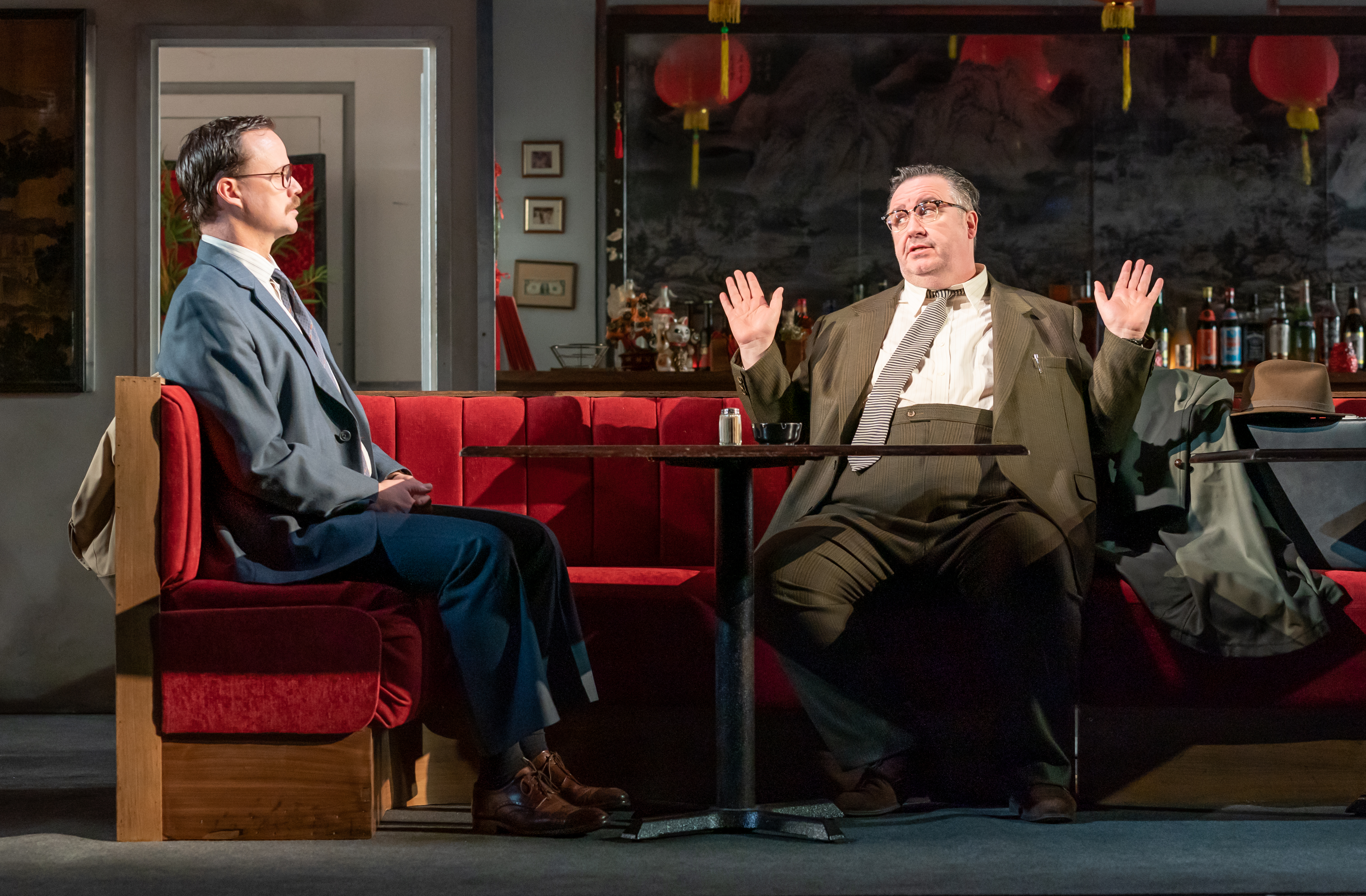
Each of the scenes in the first half has something of this dynamic. The preceding exchange, between sales colleagues Dave (Denis Conway) and George (Wil Johnson) in the same restaurant, seems likewise to be a discussion of the way their workplace works, but the former is becoming increasingly apoplectic and taking the latter into incredulity along with him … Only it turns out that Dave is inveigling George into being a stooge in more than just comic terms. Again, Conway and Johnson sell this relationship beautifully, Dave’s diatribe, replete with throwaway bigotry, conjuring nervous laughter from the Richmond audience.
But the sell to which we are first exposed is the hardest of all: Mark Benton’s Shelly is trying to convince office manager John Williamson – Scott Sparrow, maintaining an icy and functional calm – that he is worthy of the premium leads that will restore his place on the chalkboard league table. Shelly’s struggle to negotiate his way back to success works in inverse correlation with Benton’s capacity to affect us; to put it another way, the actor’s stock is as high as his character’s is low.
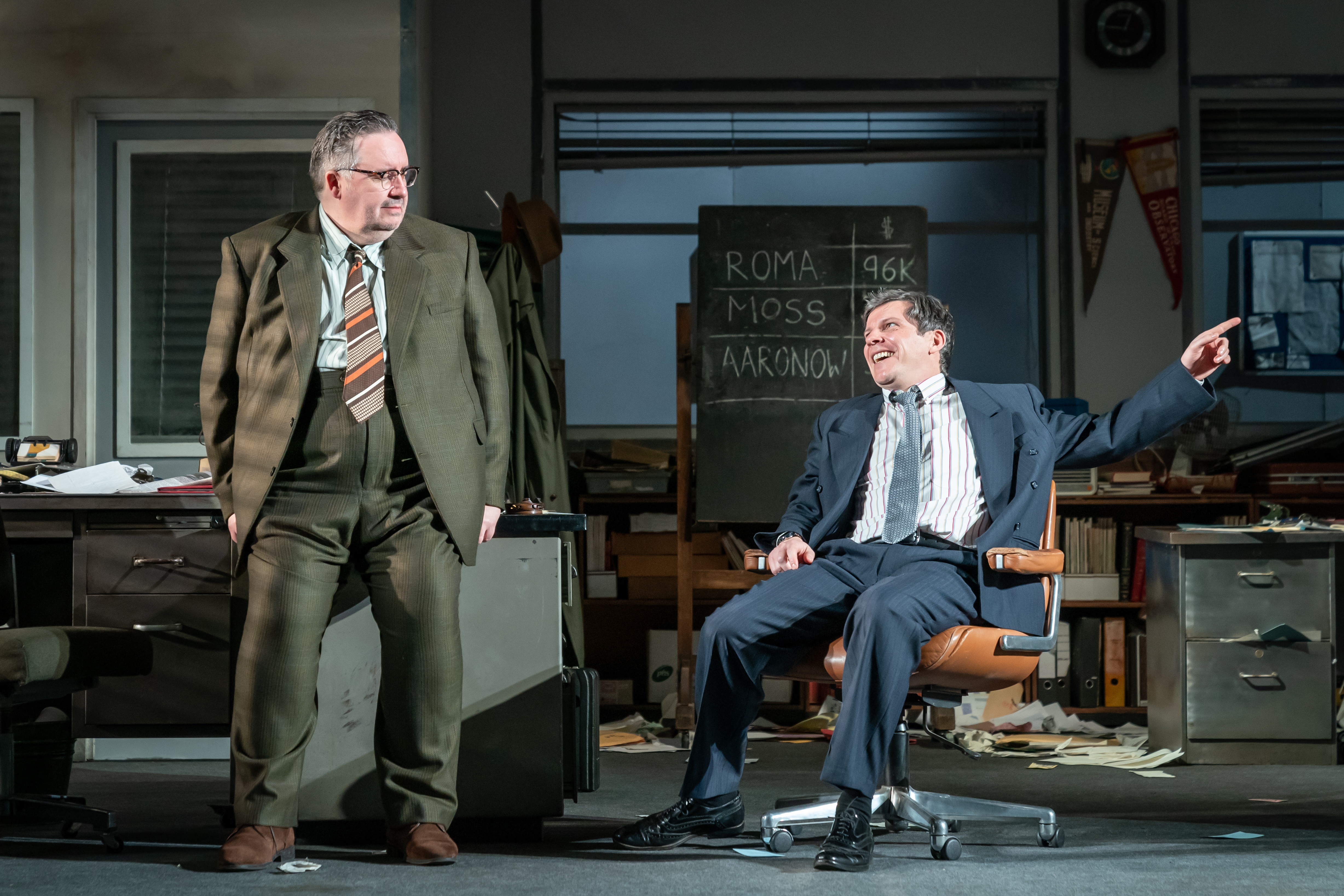
Chiara Stephenson’s impressive but otherwise empty restaurant set, in which all these scenes take place, concentrates the essential loneliness of the salesman’s art, the valiant or vain struggle of the patter against consumer resistance in the era of Reaganomics. It also allows the characters to sharpen themselves against one another for the second act, which returns us to their real-estate office the next morning, after it has been broken in to. It’s an impressive change of set for the interval, although given that it’s no more messy than a number of offices I’ve worked in, I wondered whether the stagehands would do better to take less rather than more care about how they put it together.
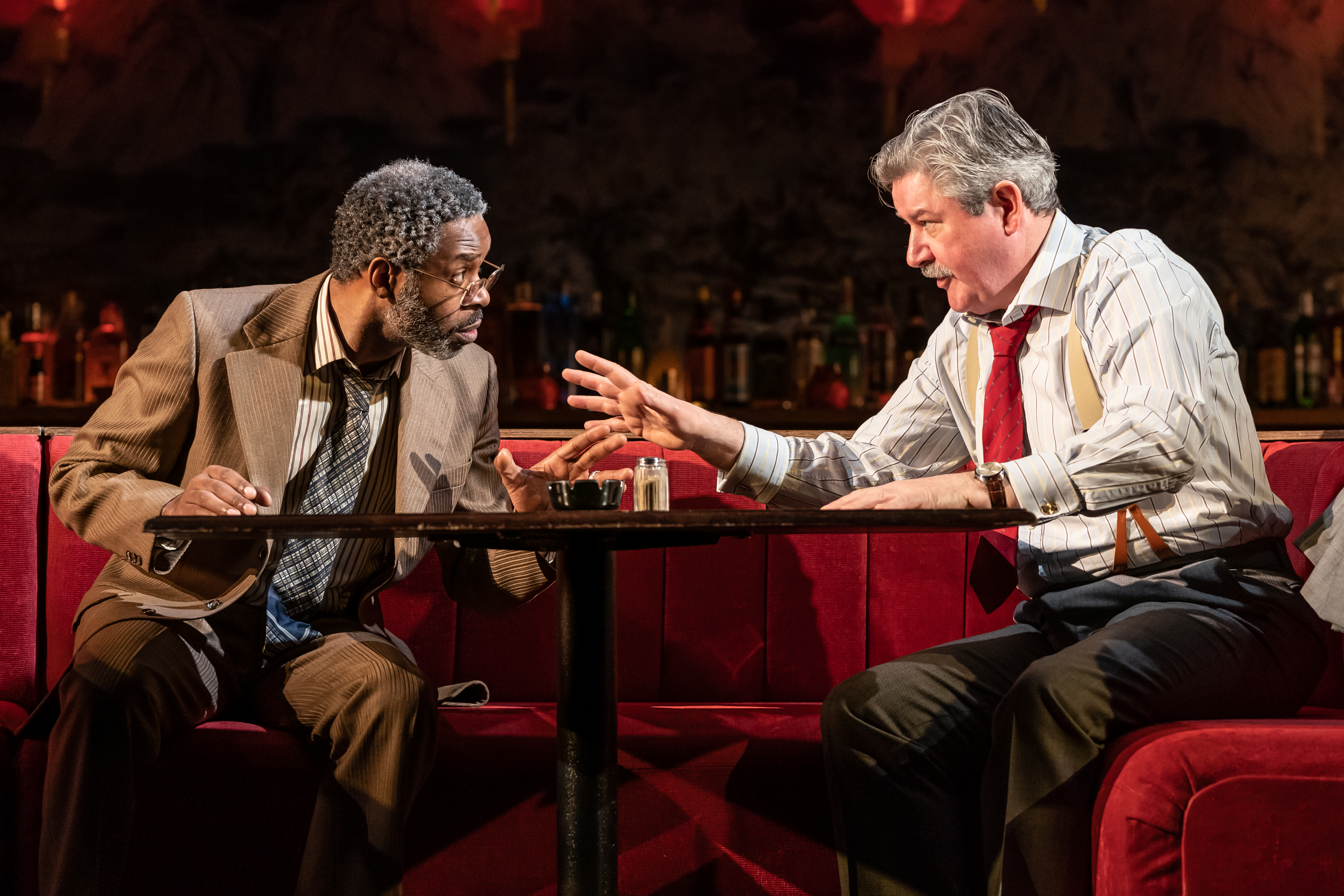
As the pairs of the first half come into play against one another, we witness new aspects to each of them. Buoyed up by a successful morning’s sales, Shelly is now confident enough to tear Dave and John to pieces. His re-enactment of the deal he has closed again makes play of the fact that he has let the customers in on the secret of the sales. Why, even Benton’s glasses twinkle in the lights with the recollection of it. Such is his conviction that even Ricky marvels at it, believing he still has tricks to learn from the older man. But when Dave returns, Harman and Conway are circling each other like wild animals to give their machismo room to preen.
The salesmen are now competing not only with one another but with the law, though, in the form of Officer Baylen (Zephryn Taitte), whose height allows him to exert a presence beyond his limited dialogue. That presence is in turn used to emphasise the power of both Harman’s performance, when Ricky squares up to the cop, and the brilliant diffidence of Benton’s, when he equivocates between submitting to interview and maintaining a ruse set-up with his colleague.
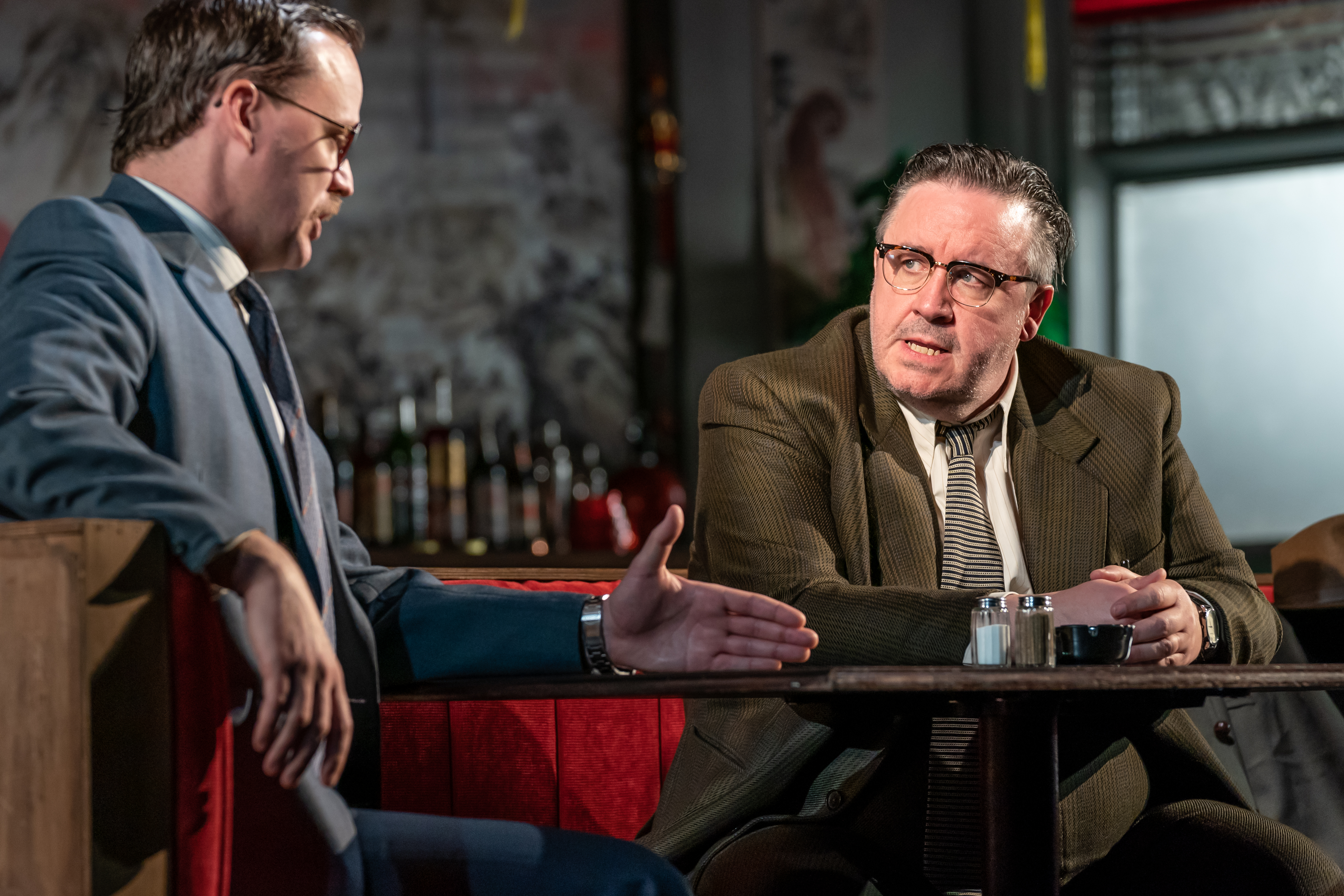
The play’s careful balance of tragedy and comedy is apparent here. Mistimed interventions from John and Baylen move the plot along, forcing Ricky to try to keep the reluctant Lingk on the chain – Harman is never more sincere than when he is selling – while Shelly edges round the room as though in a farce. Careful stagecraft does not labour the conflict Mamet has cleverly dramatised between the ruthless free market and the rule of law.
If the blocking can attain the balletic, the delivery of dialogue can at times be machinic; but the full emotive force of it is paid out by the unfortunate customer as Lingk departs, distraught not by the fact that he has betrayed his wife but that he has let down Ricky himself, whose full skill and power are again thrown into relief.
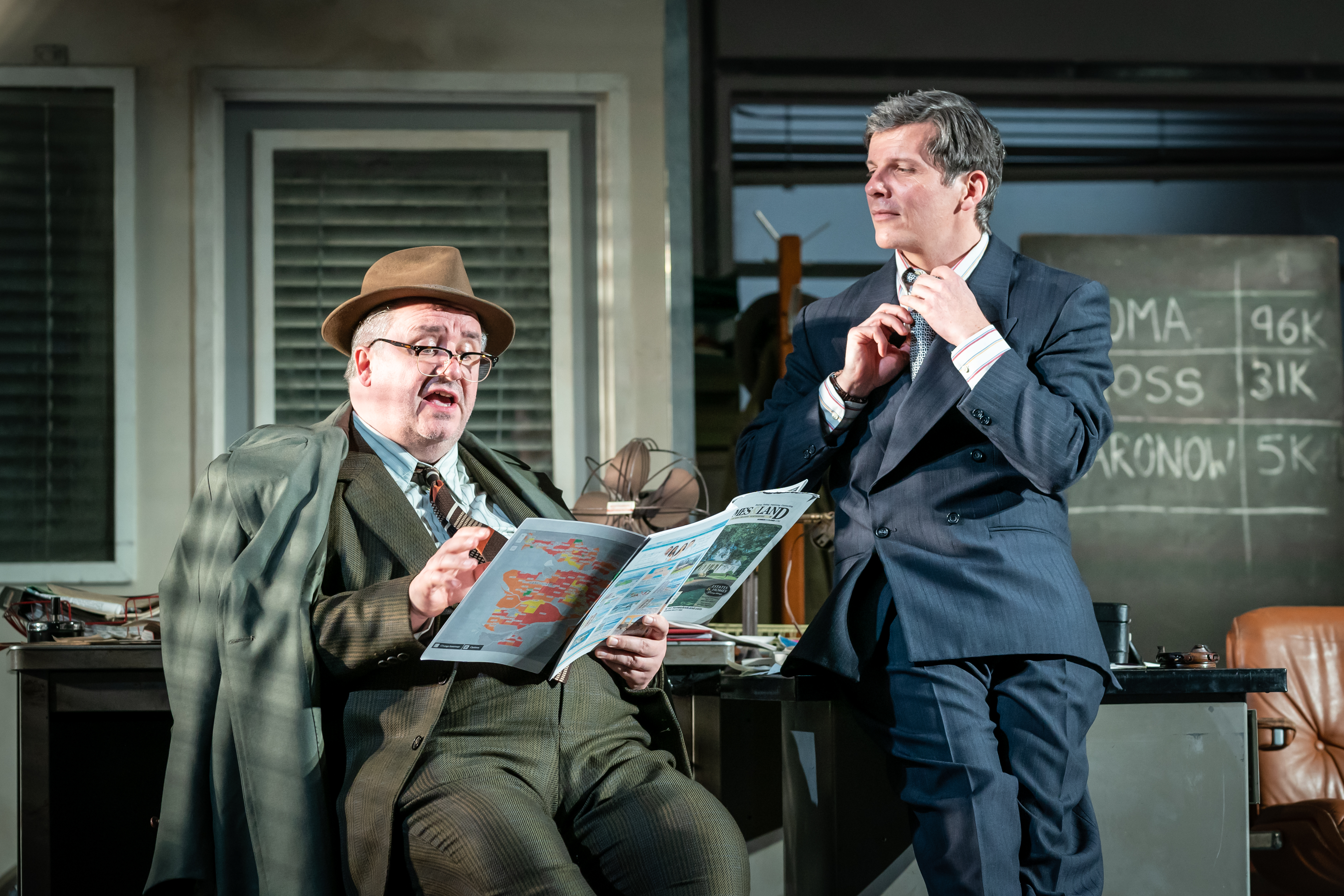
As the drama draws to its own closure, Ricky laments that the profession is a dying breed. Sadly, rumours of the death of the salesman are greatly exaggerated: 35 years after the play was originally put on we have a mountebank in the White House and daily talk on this side of the Pond about the need to get a deal done. Mamet’s script acquires particular new resonance in that it turns on the theft of customers’ personal details, a concern only more pertinent in the age of GDPR. Once more, the production is effective on this point for having not overemphasised it.
Of course, Glengarry Glen Ross’s true sleight of hand is that it sets up a plot that plays out, but not as we expect it to – let’s just say that a poor salesman makes for a poor thief. Mamet may have sold us a dummy, but on the strength of this evening I’m not cooling off any time soon.
Matthew Grierson
April 2019
Photography by Marc Brenner
Keeping Up Appearances
The Importance of Being Earnest
by Oscar Wilde
Q2 Players, The National Archives Theatre until 13th April
a review by Matthew Grierson
The Importance of Being Earnest is, at face value, a play about appearances. It relishes them and the fictions woven around them – the Bunburyism that is Algie’s creed – rather than the realities they conceal. To paraphrase another wit: sincerity is all that matters, and once you can fake that you’ve got it made.
In this respect, Q2’s production of Wilde’s classic comedy works when it keeps up appearances, and suffers when it fails to maintain them. The confected lives of Jack and Algernon convince as long as one doesn’t linger too long over their absurdities; but this staging has a stop–start rhythm that in places fails to maintain its facades. In Jack’s interview with Lady Bracknell, for instance, Tim Williams makes for a game dame, but his responses to his prospective son-in-law sound like punchlines to jokes that haven’t properly been set up, as David Tedora struggles to convey the essential nervous garrulity that the scene demands.
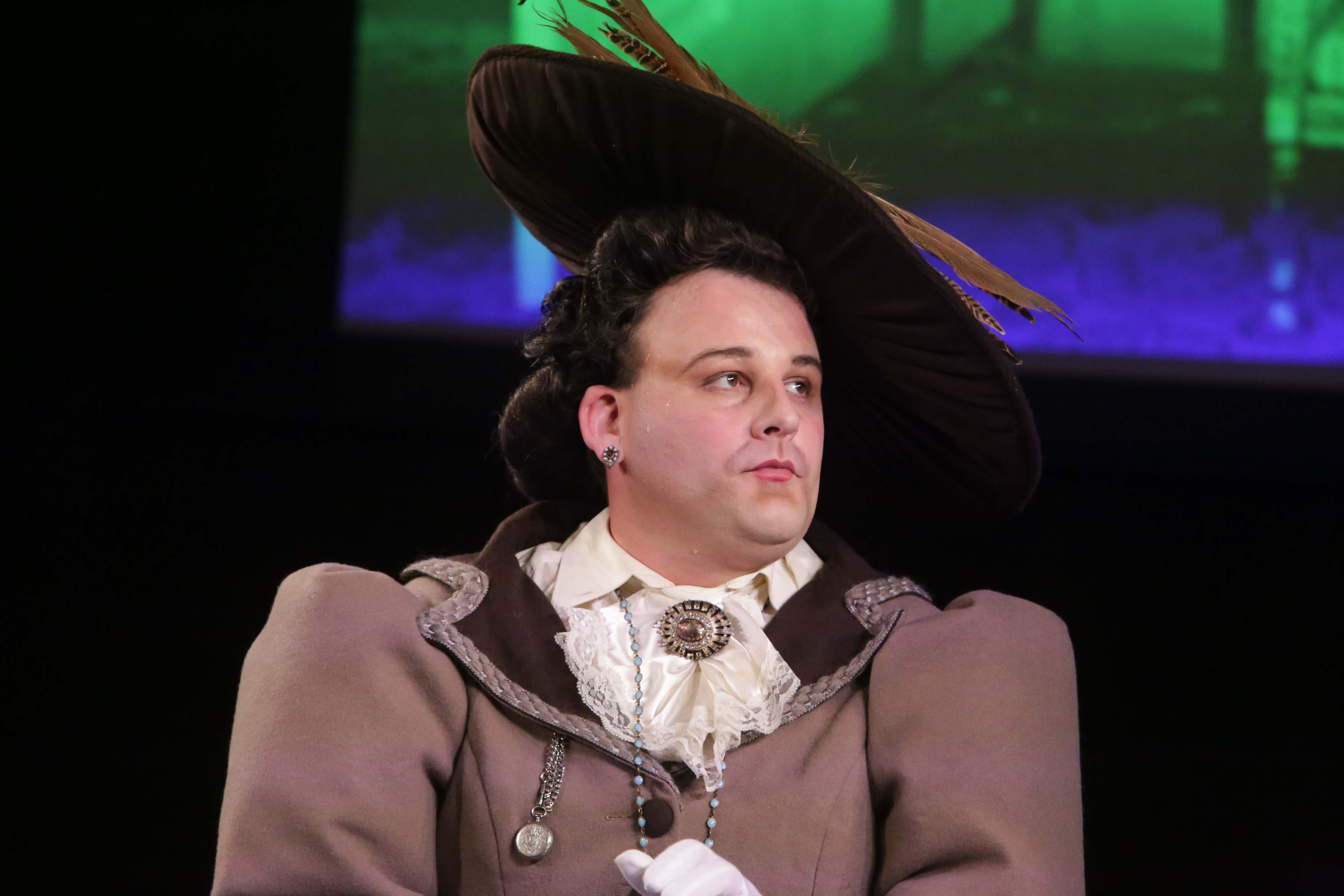
While her ladyship insists on Victorian formality, the set conveys the milieu in an unusually minimal way, making effective use of projections on a screen behind to offer some depth. But then instead of exploiting the space this lightly furnished setting affords, the action largely takes place in one plane, as though projected on a screen itself. It is only as the play moves towards its end and the couplings of Jack with Gwendolen and Algernon with Cecily are confirmed that we get some sense of a third dimension, with one beau pulling his respective belle towards him and the other repeating the action in front.


With so few moveables, the scene changes ought to be a piece of proverbial cake (plenty of which is served up in the action), but they are long, fussy bits of business; at the same time, they allow the awkwardly affectionate affair between Miss Prism and Rev. Chasuble to play out delightfully on the screen. Are the stagehands extemporising to afford us this entertainment, in much the same way as the characters do? If so, fair play to stage manager Charlotte Priestly and the two butlers who help her out.
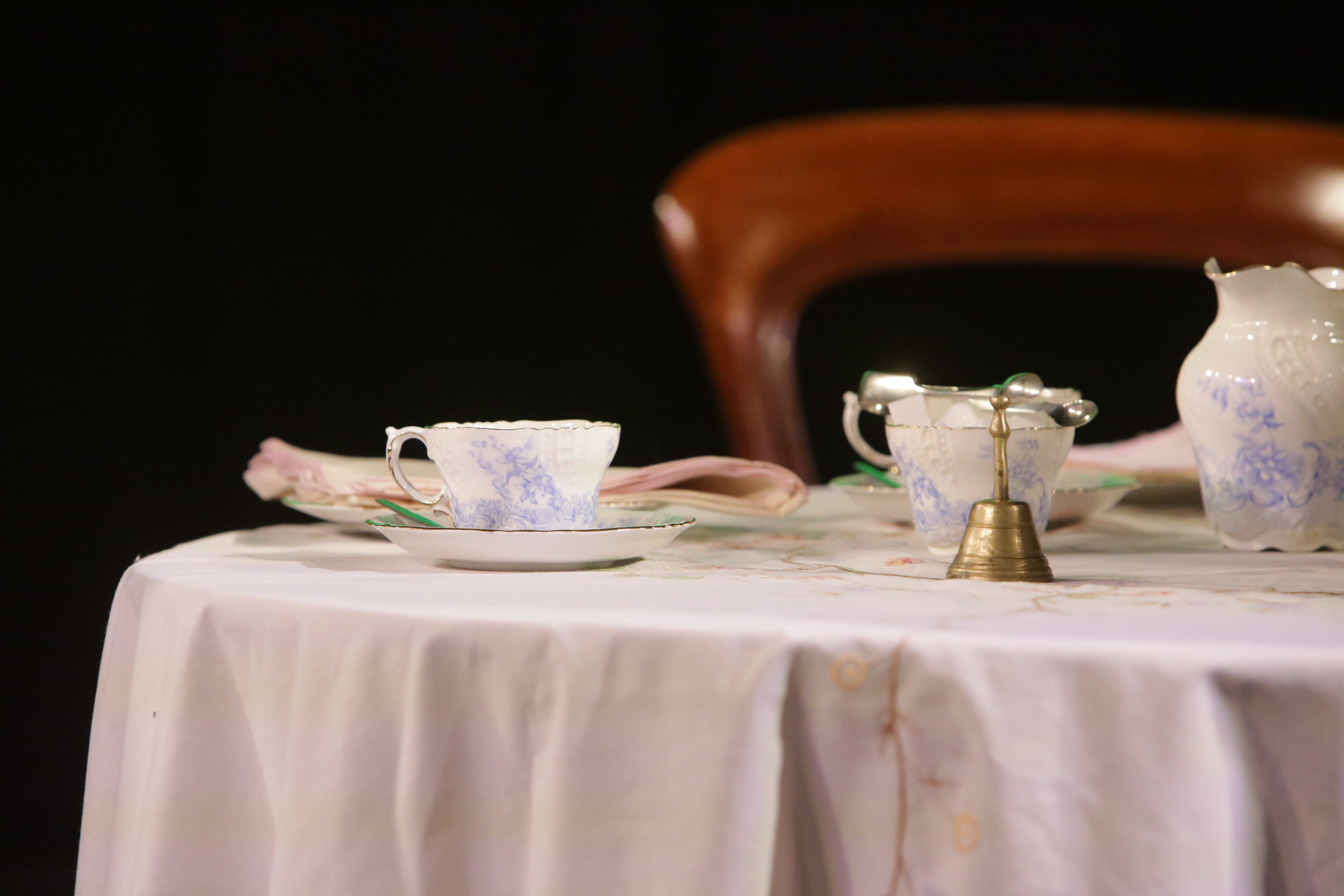
I’m making this sound like a curate’s egg, though, and I don’t think that does the show justice (Chasuble is a canon after all) because there is an eagerness to please that evidences the earnestness of the cast. To coin a Wildean apothegm, to play The Importance as a string of funny lines may be a misfortune, but not to play it as a string of funny lines would be careless. And one could hardly in this instance say the lines were immaterial, as they conjured the requisite laughter throughout Thursday’s audience.
Hugh Cox lights things up from the start, with his perky and expressive Algernon. I’d say he owes something of a debt to Bertie Wooster, only that would be a little anachronistic, and Algie is also quicker on the uptake than Wodehouse’s hero. Slightly less quick on the uptake is Tedora’s Jack, who hasn’t yet mastered the comic timing that should make the piece sing; never mind pulling one over on Gwendolen and her mother, he needs a more commanding presence if he’s to convince us that he’s as earnest as he makes out.
As Algie’s Aunt Augusta, Tim Williams takes this production down the line of the pantomimic; it’s a brave move, especially in the shadow – or the light of – the acclaim won recently by the much more diminutive David Suchet as her ladyship in the West End, but Williams gives a solid performance, in several senses, anchoring the particular tone of this staging, and he neither milks nor underplays the handbag.
In the role of his/her daughter Gwendolen, Rachel Burnham offers a full, and fully crafty, portrayal, from which it is hard to take one’s eyes. Even in a small gesture such as pretending to follow her mother offstage, when she has been forbidden to converse with Jack, the single step Burnham takes before remaining precisely where she stands is a model of playful poise.
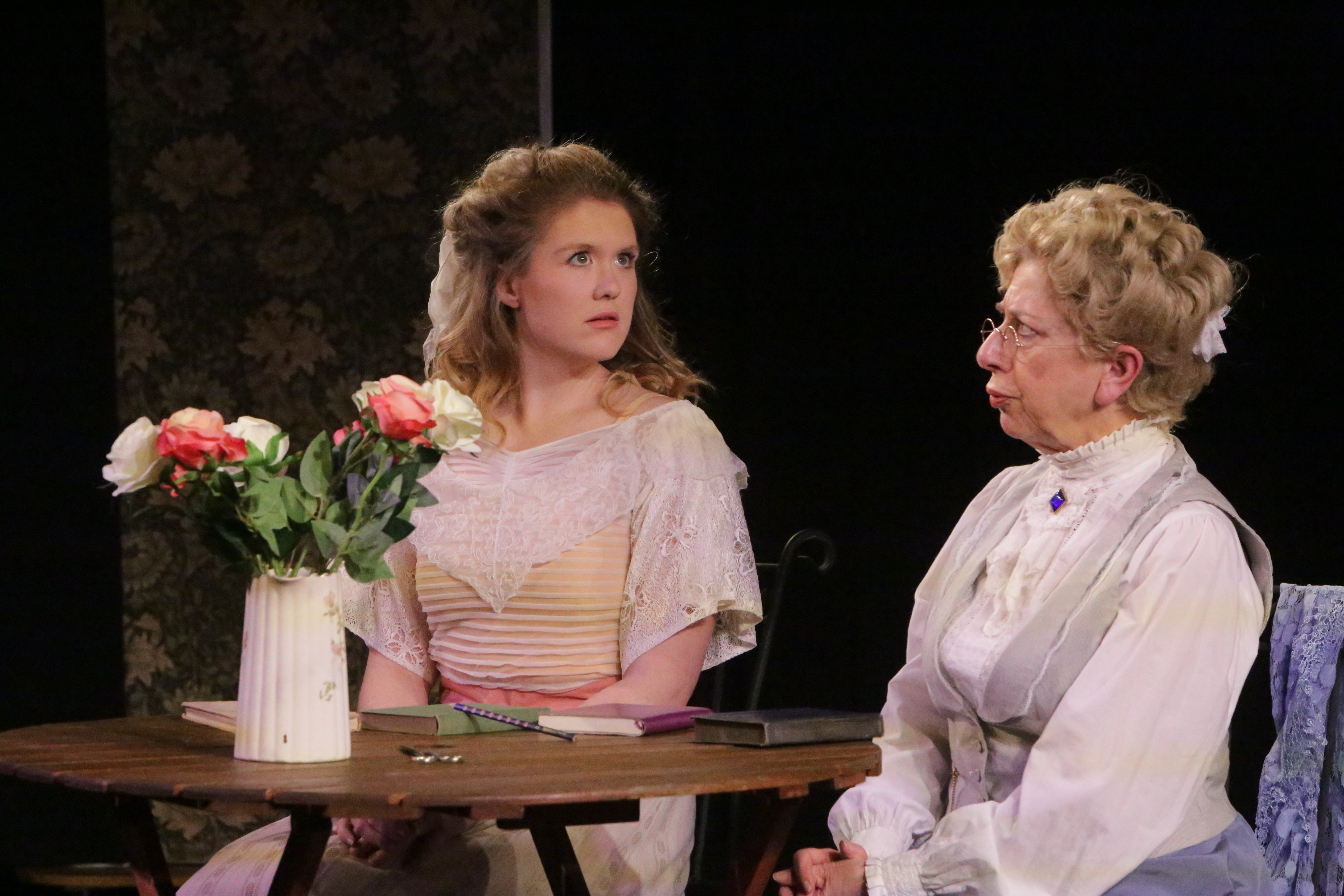
Equally watchable is Ellie Greenwood as Cecily, confined to the countryside by her guardian but living an imaginary life through her diary. Once she has ensnared Algie, who is posing as Ernest, there is an endearing twinkle to the way she reads this diary back to him, to reveal that – in her version of events at least – they have already been engaged for months.
With the characters of both fiancées nicely established, the stage is set for their meeting and misunderstanding. Their first encounter, which starts the second half, does not disappoint: the manners of the maidens run the gamut of faux-friendliness, passive aggression and finally fellow feeling – I punched the air when they pronounced themselves sisters as the boys had predicted – the scene perfectly played, paced and blocked.

There is a likewise enjoyable dynamic between Laurie Coombs as Miss Prism and Craig Cameron-Fisher as Chasuble, whose romance plays out in the background – I derive the metaphor from the literal here – of the two young (well, youngish) couples. Chasuble could merely have been a stooge for Jack and Algie’s impromptu demands, but Cameron-Fisher has him perk up with pecuniary interest when a funeral or christening is in the offing; and he is nicely balanced by Coombs, who allows Prism as much girlish fantasy as her charge, in remembering the sentimental three-volume novel she composed as a younger woman. We all place our faith in such fictions.
If these pairings work, the denouement is nevertheless a bit of a strain. While individual lines get their laughs, Sarah Hill’s direction at this crucial juncture lacks sufficient zip or zing to suspend our disbelief. Lady B’s ad lib about looking up the name of Moncrieff Sr in the National Archive is on its own terms fine, but it throws Jack off and gives us all pause to ponder the unlikelinesses that have stacked up to get us into this situation. While it may be difficult for Jack and Algie to maintain their earnest fictions for the women in their lives, Earnest needs at least to sustain that story for the audience.
Matthew Grierson
April 2019

 Mark Aspen