
Projections
Solaris
by David Greig, based on the novel by Stanisław Lem
Lyric Hammersmith Theatre, Malthouse Theatre Melbourne and the Royal Lyceum Theatre, Edinburgh, Lyric Hammersmith Theatre, until 2 November
Review by Matthew Grierson
Psychologist Kris Kelvin (Polly Frame) arrives on stage like the breath of reason in a madhouse. Boarding the space station in her pressure suit, she seems as alien as the planet Solaris below: Dr Snow (Fode Simbo) treats her like one of the apparitions that have been plaguing the crew. Sure enough, Kelvin has soon thrown reason out of the window, or rather the airlock, and taken up with the spectre of her dead lover, Ray (Keegan Joyce).
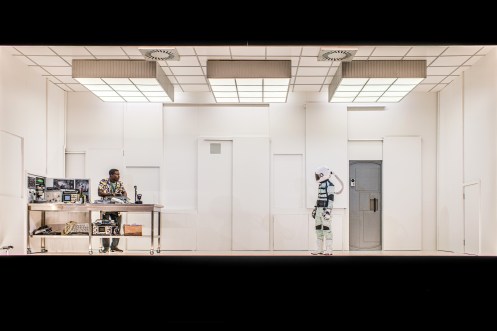
Solaris succeeds on stage because it is a ghost story, a tragic romance, a thriller, a chamber piece and even at times a comedy of manners. It doesn’t try to blind us with science fiction, and indeed takes a simple delight in such retro-futuristic flourishes as the VHS tapes used by the scientists to log their observations.
Even the impressive set, which smoothly transforms from cabin into lab, lounge and concourse, is satisfying low-tech. At rest it resembles nothing so much as the painting at contention in Art, all discreetly uneven white surfaces from which beds, benches and lockers are revealed. The curtain lowers frequently to enable these changes, and though intrusive at first this motion soon contributes to the nervous tempo of the piece, and gives the planet itself stage presence as its oceanic surface is projected on to the screen this offers. With the scenery transitions and a lighting palette ranging from clinical to 1970s movies, the characters’ moods play out on a cinematic canvas.
This makes, at times, for quite a raw experience. The oceanic planet, so far as the crew understand it, is trying to communicate with them through the medium of the ‘visitors’, manifestations of lost loved ones from their own subconscious. We only twig properly that this is going on with the sudden appearance of Ray in Kris’s bed, and her panic on waking to discover him there can be felt quite keenly. It becomes still more harrowing when she coaxes him out of the airlock to his death.
As a ghost, though, Ray continues to haunt Kris, and her attempt to hang on to her sense of scientific reason is in tension with his distress at being apart from her. The sight of his blood on the pristine white wall where he has been banging his head is a particularly shocking reminder of his physicality and agency.
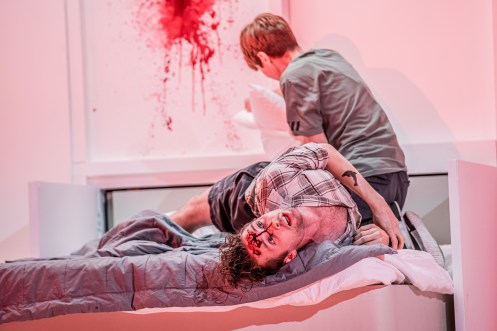
Joyce’s portrayal of the visitor is affectingly primal and childlike, and he draws increasing enthusiasm and engagement from Frame’s Kris. Between them they can often turn a moment of terror into one of humour, modulating the tension with comic relief. This is seen most effectively in the lounge where the scientists attempt a formally informal soirée to get to know Ray, which plays out like an awkward dinner party (and boasts an impressive if implausible amount of wine for a space mission).
But existential dread is never far away on Solaris, and as Kris laughingly conducts a personality test on Ray he turns the tables on her sharply and tellingly. This means that the moment she leaves him alone in her cabin, and he looks falteringly around him, it is as though we the audience are now sharing and sustaining her delusion.
The contrast between the young, remembered lover and the maturer, more lonely scientist means their relationship does not always feel like a credible one. But then, as biologist Dr Sartorius (Jade Ogugua) reminds Kris, the young man is effectively her id, her unguarded sense of who she was, given physical form. There may be more the play could have done with this device dramatically, but as it is his presence provides at least some irrational rationale for Kelvin’s increasingly erratic behaviour.
It would be misleading to talk of character development as such in Solaris, because emotions happen to the two leads tidally, as the ocean outside on Solaris broils and churns. While this ups the pace of the more meditative novel on which the production is based, it also shows how thoroughly and effectively the story has been dramatised.
Against this dynamic, however, it is not so easy to gauge the characters of Snow and Sartorius, who (as Donna Grierson observed, with her own scientific eye) seem to exhibit tendencies as much as personalities. Snow is nervy, jokey and forever trying to record evidence of the visitors’ presence; Sartorious is more sceptical and dispassionate, only hinting at what she has had to endure in her two years on station. Neither Simbo nor Ogugua can be faulted on their performances, but had they had more to go on it would have enabled us more clearly to plot the fluctuations of Kris’s character.
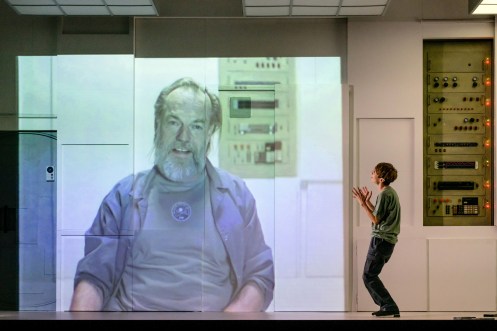
For all their hard work, the cast cannot help but be upstaged by another absent presence. The sage countenance of Kris’s dead mentor Prof. Gibarian dominates the white wall of the set when she plays back the video diary he has kept. Ghosts take many different forms, and Gibarian’s is none other than screen legend Hugo Weaving. Afforded so much expressive space, he can be far more dialled down and nuanced than the rest of the cast and he turns in a compelling performance, though director Matthew Lutton works some nice interplay between projection and live actors.
In these interactions between the living and the dead lies the dramatic potential that this production successfully exploits. Despite its shortcomings Solaris, taken as a whole, is a bold theatrical experiment that proves just how disorienting an encounter with a truly alien consciousness would be.
Matthew Grierson
October 2019
Photography by Mihaela Bodlovic
A Pure Joy to Hear
Elemental
music and lyrics by Elaine Samuels
Kindred Spirit, recording to be released on 2nd November
Review by Larry Richmond
Well, hello readers. I’d best put my glass of champagne down to tell you about a most interesting new record album that I have just heard.
The album, to be released on compact disc (CD) at a special launch gig at All Hallows, Twickenham, on Saturday 2nd November, is called Elemental and is from the Kindred Spirit Band. It has various musical elements to it. A combination of folk, with touches of Irish folk, jigs, reels and a touch of sea shanty, plus blues and light rock.

The musicians are excellent. The lead vocalist has a very pleasant voice. Overall I found it a most enjoyable listen. The album is well produced, with the front cover and all the album art designed and produced by the versatile Elaine Samuels, who writes both music and lyrics and is the leading light of this group.
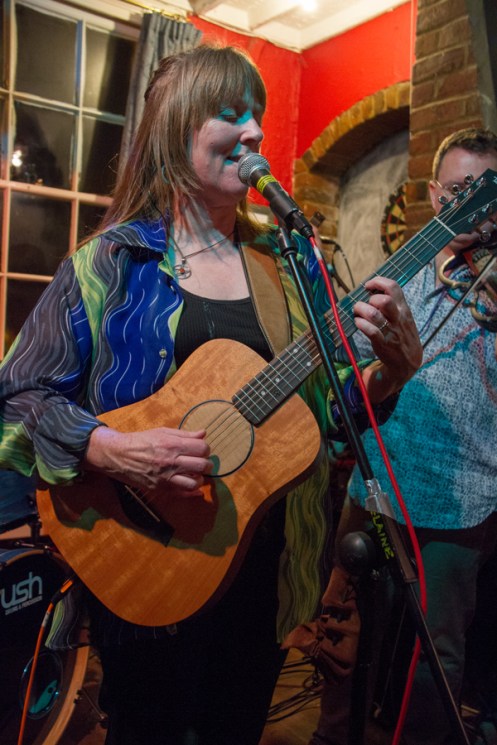
Mention must be made of the individual performers, starting of course with the vocalist and guitarist Elaine Samuels, whom I believe wrote all the original new songs, has a most charming voice, hauntingly relaxing in her delivery. She has an immense talent and a pure joy to hear.
Martin Ash on violin and viola, plus Catherine Cooper on flute and saxophone both have a classical feel that is delightful. Les Binks on drums and percussion is equally perfect.
Mike Hislop and Aleem Saleh share the bass guitar credits and provide good bass support throughout, while Steve Hutchinson provides backing vocals.
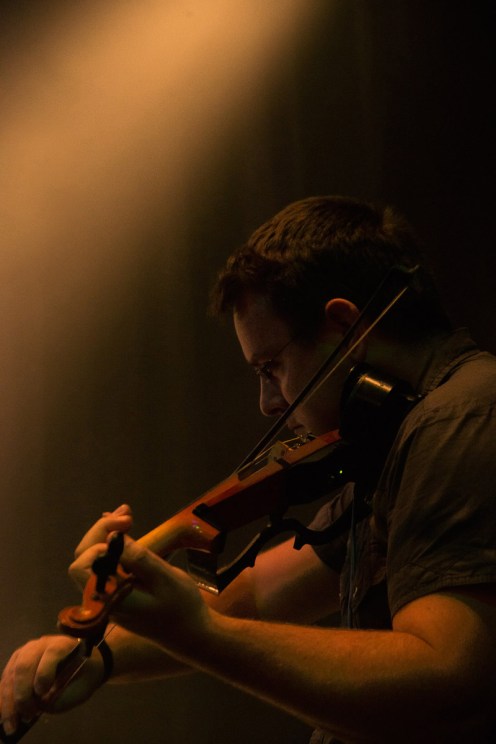
There are twelve tracks on the album, Elaine Samuels’ eleven original tracks and a bonus cover number, Feelin’ Good made famous by Nina Simone and Muse. Each track conveys an inner kindred feeling of life, and which are mesmerizing in their lyrical content and musical arrangements.
The title track, The Alchemyst, featured on the cover mount CD of the September issue of Prog Magazine, is inspired by the life of Dr John Dee, Queen Elizabeth I’s court advisor, alchemist and astrologer and hints at the heroic historical nature of his intriguing inquisitive mind.
A similar placing of the band’s previous album, Phoenix Rising as a Prog Magazine cover mount propelled them to international recognition.
Another historically based track, Vikings features no less than a Viking invasion and battle. With some stimulating time signature changes, it is suffused with the ambience of legend.
Perhaps this feeling leads on to the almost celestial atmosphere of Need Your Love, which Samuels revels as being inspired by the Philip Pullman, Northern Lights trilogy.
Progressive rock, or art rock, which is defined as “the expansive nature of lyrical themes and more unusual melodic and rhythmic structures” is well illustrated in Elemental in the versatility and virtuosity of the artists. The variety is evident in the tracks, Make a Change, with its world music flute-led sound and No Smoke Without Fire, skilfully steering its way between rock and the hard place of pure blues.
Now let me pour another glass of champagne … no, vintage champagne … and play again this excellent album, Elemental.
Life can be wonderful. Get the album and enjoy.
Larry Richmond
Oct 2019
Photography by Clive Turner and RP Photography
Dream the Impossible
The Sound of Music
by Richard Rodgers, lyrics by Oscar Hammerstein II
Hinchley Manor Operatic Society at Epsom Playhouse until 12th October
Review by Mark Aspen
Love or money, freedom or fame, pragmatism or honour: these are the dilemmas facing Georg von Trapp, an aristocratic Austrian, and his family during the Anschluß, the annexation of Austria to the Germany of the Third Reich in 1938. Heavy considerations for heavy times, but Rodgers and Hammerstein’s much-loved musical, The Sound of Music treats these subjects with a simplicity that has delicacy and charm. HMOS’s engaging production picks up the light approach and runs with it.
The Sound of Music is based very loosely on the real von Trapp family whose adventures were recorded by the wife Maria in her memoires. Several books were written based on her published memoires, which in 1958 were made into a German film, Die Trapp-Familie. This was Rodgers and Hammerstein’s source material, the basis of which had gone through a string of Chinese whispers. Personally having driven on mountain roads between Salzburg and Switzerland, on both the north and south sides of the Germany-Austria border, I know that it is over 250 miles of very demanding driving. I would not want to walk it over the Alps, even in peacetime let alone to escape the Nazis, and with seven young children in tow. (The real von Trapp took ten children on a train to Italy.) Oh, and the direct route goes straight through Hitler’s “Eagle’s Nest”. But let us not let facts get in the way of a good story.
HMOS certainly tells a good story well. Director, John Harris-Rees heads a co-ordinated company who clearly enjoy working together with a large crew and a cast that includes two teams of young actors playing the von Trapp children. On the press night this was Team Whiskers, but I have no doubt that Team Raindrops are equally well drilled.

Can the have been a musical with so many of its songs becoming standards as The Sound of Music ? … and all very memorable and very sing-able. HMOS’s band of three string players and three woodwind, plus keyboard played by its musical director Brian D Steel, created the lively, adept and nimble sound that propelled the action on stage. Occasionally however, the band’s enthusiasm did tend to overwhelm the children’s voices.

The nuns of Salzburg’s Nonnberg Abbey form the stable foundation on which the plot is built and act as a chorus throughout the musical. Sixteen in number, they make a very impressive opening to the show, and a parenthesising finale. The gravitas of their choral singing, mostly in Latin, makes a very nice foil to the lightness of the well-known songs of the lay characters. In particular, the rich mezzo of Yvonne Bracken-Kemish, a soft and subtly coloured voice as Mother Abbess, is a case in point. Equally pleasing, the clear simple soprano of Ruth Fogg, as Maria the principal character, has a bright alpine ring that sets a narrative contrast. We first see Maria as a postulant, a candidate hoping to gain admission into the nunnery as a novice. Sister Berthe, the Mis tress of Novices (Shannon Hearn) and Sister Margaretta, the Mistress of Postulants (Caroline Green) debate the suitability of Maria to join their ranks. The third named nun, Sister Sophia, (Catherine Quinn) joins them to ask How Do You Solve a Problem like Maria? They with Mother Abbess are unsettled by Maria, wondering if she is too frisky and frivolous when she should be demure and decorous as a would-be nun.
You see, Maria’s “problem” is a penchant for singing, which is infectious. Soon she even has the sombre Mother Abbess singing along with My Favourite Things. Ruth Fogg’s Maria is spirited, irrepressible and utterly charming. When Maria is seconded from the Abbey as temporary governess to the child ren of Captain von Trapp, she quickly charms then into finding their natural love of singing too. The von Trapp children’s natural liveliness has been repressed by their stern father, whose idea of exercise is marching drill. A now redundant naval officer, von Trapp instils discipline by means of the signals of a boatswain’s whistle. This control extends equally to his servants, the stoically pragmatic butler Franz, played with phlegmatic hauteur by Peter O’Donovan and the slightly more questioning housekeeper Frau Schmidt, a bustling anxious portrayal by Kay Coulson.
The younger children, Friedrich (Sol French), Louisa (Charlotte Harris), Brigitta (Milla Hawkins), Kurt (Daniel Lumley), Marta (Annastasiya Lysyshyn) and Gretl (Megan Hill) are a superb ensemble with great confidence. (Of course as always it is the youngest, seven-year old Megan Hill, who steals the heart of the audience.) They are kept in order by big sister Liesl, played by Maia Phillips. With Maria, they form a prefect octave. Doh-Re-Mi fairly bounces along.

Liesl is a teenager who is about to discover love … and be disillusioned by it. The local post-boy, Rolf has fallen for her. He finds every opportunity to deliver letters and telegrams to the house in person. Young love blooms, but later Rolf espouses the Nazi cause, which becomes of greater importance to him. Maia Phillips makes an enchanting Liesl von Trapp, with a lovely bright singing voice. Samuel Quick convincingly depicts Rolf’s journey from awkward but genuine boy-next-door to a strutting embryonic Nazi. Their duet, Sixteen, Going on Seventeen is a sweet picture of burgeoning love and trust (misplaced as it turns out).
The Liesl-Rolf sub-plot echoes the love story of Maria and Captain von Trapp, but whereas the young couple’s budding love blows before it fully blossoms, the older couple’s swelling love ripens and matures. Maria is by nature a loving but lonely person, and widower von Trapp has locked his feelings up in his heart. Their feelings for each other unfold when they allow themselves to open up. Chris Gibbs accurately portrays the steely buttoned-up von Trapp with a suave elegance, underlined by a singing voice with a hint of huskiness. The first clear indication of their growing mutual affection is when they dance together, ostensibly to teach Kurt the society adaptation of the Ländler folk dance. Kelly Neilson choreographs a very well-executed version for the pair, acting in this light-bulb moment.
 Maria is almost pipped at the post to be Frau von Trapp by Baroness Elsa Schräder, a wealthy socialite and long-standing friend of van Trapp, but who wants more to consolidate their estates than their hearts. Kay Rose plays the part of Elsa as a suitably condescending and conceited man-eater. Elsa believes that “only poor people have the time for great romances” and wonders what is holding von Trapp back. How Can Love Survive, she sings with von Trapp and Max Detweiler, a mutual friend who is a music impresario. Then they move on to talking politics. Elsa is enthusiastic about prosperity under the Third Reich, Max is ambivalent, von Trapp is vehemently against, as a nationalist who values freedom. (It is interesting how in eighty years the “A” word in Austria has become the “B” word in Britain!) They sing a trio, No Way to Stop It. However, the schism is too great and Eliza and von Trapp’s relationship and engagement come to an abrupt end. Zak Negri plays the conflicted Max as a man ill-at-ease with himself, one moment fondly singing The Lonely Goatherd with the children, the next taking furtive phone calls from Berlin to arrange high profile concerts.
The von Trapp estate that Elsa was hoping to get her hands on is cleverly reproduced in HMOS’s set, designed by Scenic Projects and enhanced by Richard Pike’s lighting and Stuart Vaughan’s sound. By means of changes to various flats, the mansion’s interior becomes its exterior or grounds, trees drop in from the fly floor, or the Abbey interior puts in a swift appearance. First night anxiety meant that some of the changes were not as slick as they might be later in the run, and this reflected a somewhat reduced pacing from the cast, which nevertheless picked up as confidence grew.
Indeed, the plot becomes increasing urgent as its denouement approaches, with the wedding in the Abbey (presided over by the bishop no less), the coercive arrival of the Nazi officials and the concert from which the whole von Trapp family escapes. Some minor characters only put in an appearance right at the end. The German Admiral von Schreiber (neatly underplayed by Sid Dolbear) arrives in person to enlist the well-regarded Captain von Trapp with a commission in his navy, while the Herr Zeller, a close neighbour now turned zealous Gauleiter, is affronted by the Admiral’s pliant nature in allowing a stay while the concert takes place. Joe Martin plays a suitably slimy Zeller with gusto.

At the concert we see the line of the von Trapp family singers, hands cupped across each other in a stiff recital style whilst they sing the ironic line from Doh-Re-Mi, “far, a long, long way to run”, before doing just that. Then von Trapp defiantly sings of the Austrian alpine flower Edelweiß. While Max stalls at the prize-giving, in the distance, across the backdrop, we see the family making their way through a narrow alpine pass.
The audience can now cheer and make its way home trying not to hum those eminently memorable songs. We feel a warm glow, as love, freedom and honour have won through.
Mark Aspen
October 2019
Photography by Shannon Hearn.
Warm, Absorbing and Uplifting
These Shining Lives
by Melanie Marnich
Park Players, Hampton Hill Theatre until 12th October
Review by Eleanor Lewis
Melanie Marnich’s play These Shining Lives tells the true story of a group of women working for the Radium Dial Company in Ottawa, Illinois in the 1920s. The women painted the digits onto watch faces with radium that made the numbers glow in the dark. The jobs were popular as they paid well but the women neither knew, nor were they told, that the radium was a poison which would ultimately kill them. When they found out, eventually one of them took the company to court.
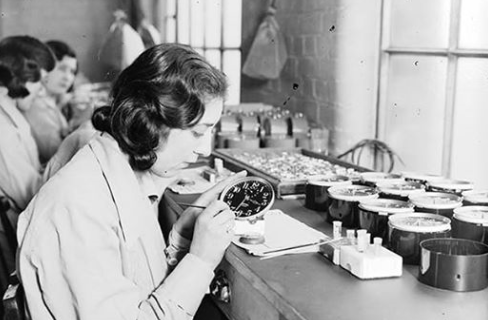
The subject of women coming together and taking action to improve the conditions in which they work has produced at least two other popular dramas that spring quickly to mind from the last 50 years or so – Bill Owen and Tony Russell’s The Matchgirls, and Richard Bean and David Arnold’s Made in Dagenham – but of the three These Shining Lives might be best described as the most straightforward. It simply tells a story effectively.


In keeping with the clarity of the piece, Park Players have staged an efficient production of These Shining Lives. In the main auditorium at Hampton Hill, the stage is gently divided into sections: the factory benches at which the women work, the central character’s home, and various offices for managers, doctors and solicitors as required. Details are changed during the interval but there is little fuss and this works well. (The lighting shifts accompanying the changes of focus on stage were a little ‘clunky’ on Wednesday night but this was almost certainly a case of first night issues).

There are many strengths to this production, casting being just one. The central character, Catherine, narrates the story as well as taking part in it. As played by Jo Viney, Catherine was an engagingly sweet-but-not-saintly woman. Her three co-workers Charlotte, Pearl and Frances (respectively Sarah Jane Brindley, Anneke Sando and Rebecca Tarry) formed an intelligently played and directed trio of colleagues whose relationships developed convincingly into friendships. Catherine’s husband Tom (Daniel Gask) also came across as a rounded character and the strong relationship between the two was convincing, (I once saw a professional production of Calendar Girls where two actors playing husband and wife, despite their best efforts, clearly did not like each other!)
Other smaller roles served largely to move the action on or provide a voice when required but nonetheless these were played with integrity by Sue Viney, Ian Ramage (doing a good job as a man struggling to live with himself) and Nigel Roberts. Direction was smart, the action moved along at a brisk pace.


Being a straightforward tale, the story is unsurprising and follows the expected arc. This is possibly where the play itself loses momentum. As written, the second half of the drama would benefit from turning the focus on to the court proceedings and the company’s position rather than dwelling further on the tragic impact on already established family and friend relationships. This though is a writing issue and Park Players can deal only with what they’re given.
The choice of sepia colours for costumes (by Kit Greenleaves and Vanda Gask), during the first act may or may not have been deliberate but either way worked perfectly and added to the atmosphere as did the women’s hair and make-up. I wondered at the reason for leaving Catherine in the same costume all the way through when others changed, as it might have enhanced the idea of time passing but this is no great issue. There was strong evidence of team work in this production as props too had been carefully chosen to complete the period look, the huge wireless radio in the factory was beautifully appropriate, and the special effects used at the end of Act I were striking without being melodramatic.
There was a tiny but bizarre scene between Catherine and her children which I wish had been done almost any other way possible, but that aside, this is a warm, absorbing and uplifting story, well told by Park Players and I can only recommend it.
Eleanor Lewis
October 2019
Photography by Philip Hollis
Bitter Irony
A Taste of Honey
by Shelagh Delaney
The National Theatre at Richmond Theatre until 12th October, then on tour until 29th February
Review by Mark Aspen
The taste of honey can be a bitter taste, an ironic thought when reflecting on all of the ironies that stream through this classical kitchen sink drama. Ironic too that we, the audience, are dimly reflected in a disintegrating mirror that stands at the back of the set.
From the viewpoint of 21st Century we can reflect on what we would find taboo and what would we tolerate as an audience in 1958; how we might have felt about premarital sex, miscegenation, homosexuality or abortion. Today, most people would not bat an eyelid, but in those days toes would curl to breaking point.
How remarkable then that an unexperienced teenager, Shelagh Delaney not only penned a play that touched on all these taboos, but boldly presented it to a leading theatre producer. And how bold it was that that producer, Joan Littlewood put that play, A Taste of Honey straight onto a major London stage.
The National Theatre’s version of A Taste of Honey gives more than a nod to the original production but has a more contemporary approach to the staging. Hildegard Bechtler’s design creates an atmosphere that is scruffy, smoky, seedy and subterranean. It is an empty warehouse; and it needs to be, for the wares are empty lives. It is open; and it needs to be as busy running changes are part of the action as each scene unfolds. What it is not, is claustrophobic; and it needs to be, as each of the lodging rooms that form most scenes are tightly closed spaces, each confining, pressuring and constraining taut human emotions. However, claustrophobia comes from Paul Anderson’s moody lighting, delineating closed spaces with angular vaporous beams in an expressionist sepia style.
The opening of the play eases into a scene in a rundown dive in Salford where a band plays lazy jazz. In a homage to the first 1958 Stratford East production, a jazz trio remains on stage throughout like a Greek chorus, musically commenting on the action. Music director, David O’Brien leads on keyboard with Alex Davis on double bass and George Bird on drums. Moreover, all the actors are called upon to sing and they make a fine job of it. In clever arrangements by Benjamin Kwasi Burrell, we only hear snatches of songs, for there never is any resolution or completion for what each is reaching out for. Hope is always frustrated. The truncated numbers interpose themselves in scene changes to summarise the coming plot element.
It is the mid-1950’ and in the first lodgings Helen, a forty-something alcoholic and single mother, has just moved in with her daughter Jo, seventeen, who has never had a continuous school education. There is no love lost between them, as their caustic conversation testifies. Their relationship is as dilapidated as the rooms they now occupy. Sandwiched between the gasworks and the slaughter house, it lacks heating, functioning fittings and wallpaper.
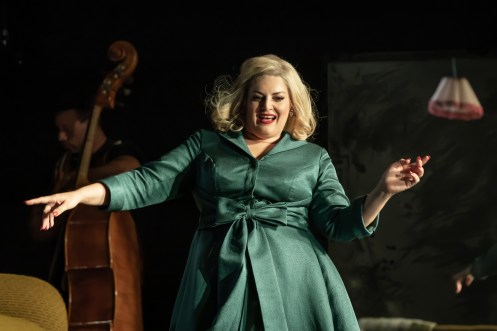
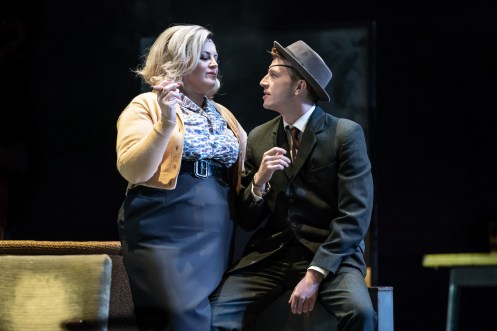
Hellen is a promiscuous good-time gal (Delaney described her as “a semi-whore”), living off of her latest lover, and whose only sustenance seems to come in a bottle. Jodie Prenger, as Helen, pulls out all the stops, brash, bold and brassy, she commands the part. She gives no quarter, for Helen doesn’t do subtle. Prenger does however, and once or twice we almost see a chink in the brass, but the soft side never quite makes it through.
A Taste of Honey is largely Jo’s story. Jo is pert, precocious and pushy, but it is her protection against a harsh world without a father, without an education, without any hope. Gemma Dobson plays the sullen but sassy teenager to a tee. One can almost feel the frustration as she longs to escape her lifestyle, but knows she cannot.
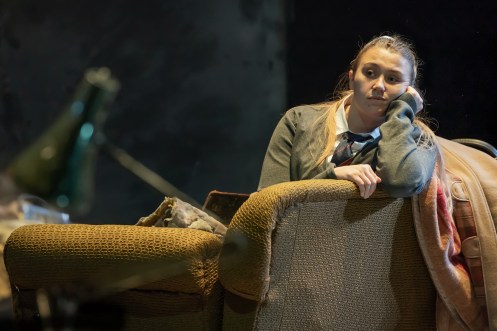
It is worth noting that Delaney was Jo’s age when she wrote the play, and she lived in Salford. The opening dialogue between Helen and Jo is delivered ultra-fast and in a heavy Lancastrian accent, which takes a little while for the southern ear to tune into (although I have worked in Salford). However, the stinging whiplash of their interchange is only too clear. One hopes Delaney’s own adolescence was not this bleak. Nevertheless, her description in the programme for the first production in 1958 was as “the antithesis of London’s ‘angry young men’. She knows what she is angry about.”
Helen is already starting an affair with her latest “fancy man”, Peter, a wide-boy some fifteen years younger than Helen, who has made a tidy sum in shady deals. A snappy dresser, he sports a black patch across one eye, which he says he lost during the war. But we feel that it was not lost in military action, and we never find out how. Tom Varey imbues Peter with an air of cocky menace, giving him an uncomfortable aura of barely contained violence. Helen finds it exciting.
In a heated conversation between Jo and Helen (Jo never calls her mother) about one of Helen’s former lovers, Jo says he had an ugly the nose, only to get the flat repost, “It wasn’t his nose I was interested in.” In contrast Jo is really only looking for affection.
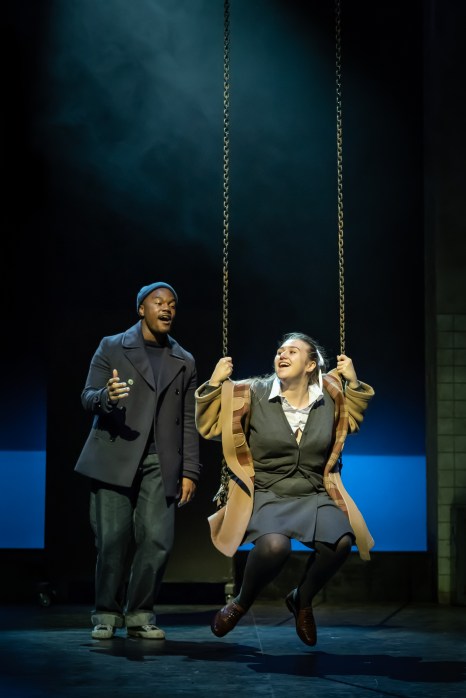
Along comes a West Indian sailor Jimmie, who woos Jo with apparent tenderness. Indeed, the scene with Jo on a playground swing and Jimmie singing My Love Is like a Red, Red Rose is genuinely affecting. He even proposes marriage and give her a ring, which she wears on a string, out of sight of Helen, who herself is now engaged to Peter. Durone Stokes makes a very personable Jimmie. With a disarming smile, he portrays the gentle nature of Jimmie that Jo falls for. Yet, Jimmie’s honeyed words count for nothing when Jo becomes pregnant. He disappears to sea, and we only see him again in Jo’s dreams.
Jo, abandon by Jimmie and left to fend for herself when Helen goes off to her wedding, lives a lonely life, pregnant and living on dog biscuits.
The second half opens with Geoff, an art student, supplementing his grant by singing in the jazz club. His song, Mad About the Boy, beautifully sung by Stuart Thompson, tells us right from the start where his proclivities lie. Even Jo understands this when she meets Geoff in a fairground, but she shrugs it off and they strike up a friendship. When she finds out that Jo is homeless, having been kicked out by his landlady (by implication because of his, then illegal, homosexuality) she offers him her couch for the night.
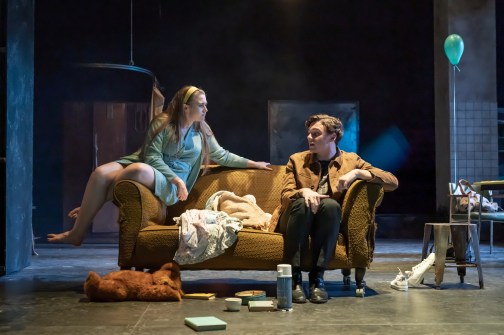 Needless to say, they need each other, and a warm and close platonic relationship develops, reinforced by their mutual love of art in which they are both skilled. She quickly becomes reliant on him, and Geoff enjoys “mothering” Jo, as her nurse and housekeeper. He is a far better mother to her than Helen ever was. Stuart Thompson is outstanding as Geoff, fully immersing himself in the affectionate and forgiving nature of the character, all the mannerisms and voice infections being spot on. The bond between Jo and Geoff is the only truly loving relationship in the play, uncomplicated by sex, although Geoff does offer to marry her. We can even believe that we are heading for happy-ever-after. We know though that a big “but” is coming, for this is the realism of the kitchen sink drama.
Director Bijan Sheibani has understood that, although giving his A Taste of Honey a modern presentation, it must be seen within the customs and moral codes of sixty years ago. It strongly underlines how much our outlook has changed in those few decades. The characters are very real and their predicaments have evolved from the exigencies that the deprivations of the then quite recent War had put upon them.
Sheibani has not lost the grit of the original. There is that “but” and for Jo, when the taste of honey dissolves, only bitterness remains.
Mark Aspen
October 2019
Photography by Marc Brenner
A Hell of a Time
Orpheus in the Underworld
by Jacques Offenbach, libretto by Hector Crémieux and Ludovic Halévy
English National Opera at the London Coliseum until 19th November
Review by Mark Aspen
Balloons, fluff, pastel, these Emma Rice trademarks are not what might spring to mind as immediate images of hell, but it is her ability to counterpoise picture-book imagery against disturbing undercurrents that makes her contribution to ENO’s Orpheus Series memorably different.

The Series takes four different approaches to the classical myth of Orpheus descending into hell to try to bring back his dead wife Eurydice, with four very different composers and with four very different directors, each with backgrounds of different genres. Rice brings the innovative drama style of her Wise Children company into this her debut as an opera director.
So what does Rice do with Offenbach’s spoof piece? We have balloon sheep, balloon bees, balloon tutus and a London taxi flying on a bunch of balloons. There are little wow moments and big wow moments. Fluorescent paint and phosphorescent light, within Malcolm Rippeth’s colour-bursting lighting design, Lez Brotherston’s zany costumes and an erotic fly puppet all add to the sense of a rumbustious romp.
… Yet there is an edge to this production that makes it feel very uncomfortable. The sheer nastiness and sleaze of some of the plot doesn’t sit easily in a knock-about comedy. Offenbach and his librettists took Virgil’s version of the Orpheus story, complete with abduction, murder, rape and incarceration and made it bearable by over-the-top lampooning, mocking the heaviness of the original. They we also taking a side-swipe at convention by inverting Gluck’s established Orpheus and Eurydice and covertly satirising Napoleon III, then established as Emperor of the French, and his court. Offenbach’s operetta leans towards a cruel Carry-On approach, but with its hint of misogyny, it clashes with the radical 21st Century zeitgeist that Emma Rice would subscribe to. In trying to rein it back, she has missed the point. Her Orpheus in the Underworld has something of the gorgonzola about it: creamily enjoyable but veined with bitter threads.
That all said, Rice’s Orpheus in the Underworld is entertaining, in spite of itself, a frothy spectacle, with lots of fun and much clever wit. Nevertheless, the Offenbach black comedy is wrong-footed from the start, with a dumbshow during the overture. This creates a back-story to account for the friction between Eurydice and Orpheus before her death, which culminates in their baby’s stillbirth. The jokey introduction of a wreath with the words Baby is miscalculated: not a good start for a comedy, even a black-comedy, and it takes a while for the show to get back into gear.
 But once the operetta is on the road, it motors along a fair old rate. Indeed our narrator, who can’t help interfering in the plot, is a London cabby called Public Opinion. You see, he has The Knowledge. Lucia Lucas makes a very genial Public Opinion and, although not a 1950’s London cabby’s speaking voice, Lucas’ firm warm baritone is convincing. Public Opinion soon convinces Orpheus to win back Eurydice from her dalliance with Aristaeus, the shepherd, a man full of conceit at his own handsomeness.
 Aristaeus is the alter ego of the demi-god of beekeeping and here he is “covered with bees from nape to knees”. The bees are one of the incarnations of the ever versatile ENO Chorus. All though is not as it seems, Aristaeus is one of the disguises from the box of disguises of Pluto, the god of the Underworld. ENO Harewood Artist, Alex Otterburn plays Pluto with mischievous gusto, bringing an athletic baritone voice to an athletic role.
Pluto also has a box of snakes, which lead to the demise of Eurydice in a cornfield. She believes she is going there to flatten the corn with Aristaeus and sings “I have dreamt of love again”. Mary Bevan shines as the hapless but defiant Eurydice, her elfin charm carrying a very difficult role. Bevan’s lovely clear soprano is heartrending, for we know her hopeful opening aria will ironically presage terrible things as Eurydice becomes used and abused.
Olympus, the home of the gods, is an Art Deco ocean yacht, the core feature of set designer Lizzie Clachan’s inspired concept which sits within a structure common to all four of the productions. The balloon-tutu clad chorus provides the heavenly clouds. Here the gods introduced themselves, each of in turn, Venus (Judith Howarth), the Kalashnikov-wielding Mars (Keel Watson), Diana (Idunnu Münch), Juno (Anne-Marie Owens) and Cupid (Ellie Laugharne) with all their various foibles.
 Then Jupiter, father of the gods, puts in an appearance. His foibles are more than petty peccadilloes, as his wife Juno forcefully reminds him, backed up by the other gods. Sir Willard White adds an air of authority with his rich stentorian voice, in spite of his laid-back garb of multi-patterned Bermuda shorts. Puffing on his vape, he looks a little ill-at-ease.
Jupiter knows of the post-mortal abduction of Eurydice and sends Cupid down to the Underworld to fetch Pluto. She is appropriately clad for hell in hot-pants (gold!) and goes off hot-foot.
Orpheus’ bold arrival in Olympus is by Public Opinion’s balloon-borne FX4 taxicab, but he is in earnest to “go down to hell to rescue love from death”. When Orpheus plays his enhanced violin, the gods are moved. And so they should be, for Ed Lyon is a personable Orpheus, and his heart-felt singing of “Who am I without Eurydice?” is genuinely touching. The gods all en-bloc go to hell.

Here is where the mood changes. The Underworld is 1950’s Soho. The gods have come to party in what could have been the Raymond Revuebar, but for Eurydice it is different. She is imprisoned in a sleazy Peep Show, a filthy plain bedroom, where she is leered at by D.O.Ms in archetypical dirty raincoats. Hell indeed, and made worse by the omnipresence of her gaoler, the drunken John Styx. As Styx, an Olympian medallist in creepiness, Alan Ope is brilliantly nasty, and manages to pull of the feat of acting the drunkenness whilst stinging with strong tenor punch a biographical song, Styx’s sob story about how he was once the King of Poland.


Shudder-inducing stuff, but Eurydice’s exploitation doesn’t end there, for Jupiter has designs on her. He disguises himself as a fly (previously he had specialised in bulls and swans) and comes to her room. Now, Rice does return to the Offenbach sense of ridicule. The lustful Jupiter has suitably erectile wings, while his entomological alter ego, a tickling stick skilfully sported by puppeteer Chloe Christian, sends her orgasmic: a sort of insect-ual intercourse, one supposes.
Meanwhile Pluto’s party continues and Eurydice is tricked in joining in, only to be abused by all in a burgeoning gang-bang. Her latest “admirer” is Bacchus, as drunk and revolting as Styx. ENO Chorus member, Peter Wilcock certainly savours the sliminess of this role, and manages to dance with enormous vigour, even with an enormous prosthetic beer-gut! The dancing is of course leading up to the famous (notorious?) galop infernal, now known to all as the Can-Can.
However, Public Opinion’s FX4 has made it to hell with Orpheus, whose violin charms the gods and convinces them that Eurydice should return … but for the ultimate irony that condemns her to stay forever as the consort of Bacchus.

And when the Bacchanal resumes, le galop infernal returns in a frenzy. Choreographer Etta Murfitt elicits a storm of energy from everyone on stage as the music’s tempo continually increases. In this version however, we realise that it is a dance to oblivion, to “embrace the frenzy and the pain”. Eurydice is in an abyss of despair, but she must dance with the others until “you feel your soul goes”. This puts an edge on what sets out to be a lampoon.
Emma Rice said of Orpheus in the Underworld in a recent interview that she doesn’t find much of it funny: rather awkward for a comedy. But then again, in an interview in May 2012, she was asked, “Is there an art form you don’t relate to?” …”Opera. It’s a dreadful sound; it just doesn’t sound like the human voice”. Maybe it is these contradictions in a director of a comic operetta that make this Orpheus in the Underworld jar in its ambiguity.
Nevertheless, this is a piece that is visually impressive, witty and bold, and is executed with consummate skill by its artistes and propelled by the baton of conductor Sian Edwards (formerly ENO’s Director of Music) and the ENO Orchestra. Maybe it is those contradictions, that very ambiguity, that lifts this Orpheus in the Underworld from Offenbach’s anarchistic frolic to give it a sharp bite.
Mark Aspen
October 2019
Photography by Clive Barda
Super Human
Orpheus and Eurydice
by Christoph Willibald Gluck, libretto by Ranieri de’ Calzabigi
English National Opera, in collaboration with Studio Wayne McGregor, at the London Coliseum until 19th November
Review by Suzanne Frost
I once read a very funny article that said: “God listened to all my hopes and dreams and then made them come true for Keira Knightley.” Poor Keira and her success famously annoy a lot of people. In the world of dance, the unstoppable rise and rise of choreographer extraordinaire Wayne McGregor could trigger an equal level of annoyance – if he wasn’t just so damn amazing. By now dripping in awards and with his fingers in pies as varied as the Royal Ballet, fashion week or the Harry Potter franchise, I still get a little kick out of brand McGregor reaching a new level of world domination.
So hurrah for his ENO debut as an opera director, opening this autumn season no less, and hurrah for his company of extraordinary super humans filling the stage of the Coliseum. In another themed season, this autumn ENO is looking at the Orpheus myth in a variety of forms: four different operas – from minimalist Philip Glass to wacky Offenbach – and four directors from a variety of disciplines, from dance to film to theatre. Plus, if I understand correctly, they will all be performed within the same set by Lizzie Clachan.
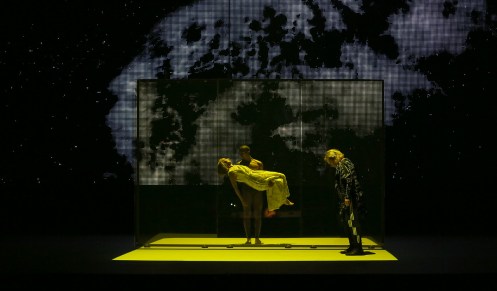
This set is more or less a barren stage with a screen backdrop, bathed in gloomy grey light. The choir is tucked away in the orchestra pit and only features as ghostly bodiless voices. For the prologue, we meet Orpheus (a very ill Alice Coote) and his wife Eurydice (the warm and wonderful Sarah Tynan) on the day of their wedding, but almost 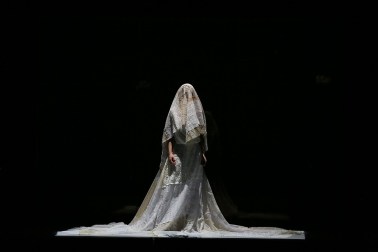 immediately, the happy bride is relieved of her bouquet, put into a hospital gown and given a deathly injection, whereupon she dies and is laid out on a futuristic suspension behind a yellowish acrylic glass, where she floats eerily like the shark in Damien Hirst’s fish tank. The backdrop turns into a black and white super slow-motion film of the ocean, the wave movement so sparse it is hardly noticeable – an immensely effective device but, to the superfan, actually familiar from McGregor’s stunning Virginia Woolf ballet Woolf Works at ROH (whose star, the prima ballerina Alessandra Ferri is in the audience tonight!). Nevertheless, there is very little that could transmit the idea of all consuming, time stopping grief better than an ocean zapped of its colour and movement.

For someone who is currently going through grief, there is a lot to recognise in Gluck’s Orpheus and Eurydice: denial, anger, pleading with the gods, bargaining, the complete incomprehension of the finality of death. The backdrop screen just showing flickering static, the nothingness of it all.  As Orpheus, Alice Coote practically has to carry the entire opera alone, visibly struggling with a nasty virus infection but her sniffles, whether real or performed, integrate into the story. Orpheus never reaches the last level of grief, acceptance, and is instead spurned on by Love (a chirpy Soraya Marfi) to rescue his wife from the underworld. Down to Hades we go, with a black light, strobe lit dance break to show off Company McGregor’s ridiculously skilled super-dancers. They are without a doubt among the best in the world. I wish they weren’t dressed in stripey deconstructed clown athleisure – but I suppose the blacklight does bring out the neon. It’s a version of hell I have never encountered in any of my fever dreams, but it looks fascinating.

Act Two opens on the peaceful dwellings of the shadows in their “calm and pleasing haven” – Company McGregor now dressed in more colourful sportswear and inexplicably all featuring a heart shaped patch on their bums… Their dancing is sublime, full of kindness and with the tenderest of male duets between the expressive Jordan James Bridge and the fantastically tall Izaac Carroll. I have so much respect for these dancers, which is why I would have really wished for something a little nicer than patched up Sweaty Betty sports bras. I know McGregor likes a deconstructed costume, but I’ve seen them look a lot more stylish before. His trademark zero-facial-all-bodily expression brings a serene calming quality to the movement. When Orpheus bursts into this kingdom of shades he is literally disrupting a meditation session. Again, it is a version of heaven I have never encountered in my dreams, but it does make you wonder if Eurydice isn’t actually perfectly fine surrounded by those calm, kind and colourful spirits. Sarah Tynan is a beautiful warm presence on stage and the final duet where the lovers almost reach the light at the end of the tunnel but of course cannot escape their terribly human instinct to look at each other – the one thing the gods forbade them to do – is moving. Eurydice dies for a second time and Orpheus begins the whole grieving process again, harder, angrier, bargaining with bigger stakes, threatening to kill himself. Love decides that this is proof enough for the gods and in a dreamy sequence, the lovers are reunited, not with each other but with a dancer version of themselves, a curious choice, possibly suggesting the dancer as a sort of animus of the singer? A beautiful thought that isn’t quite coherent but makes for a pretty final image under a twinkling night sky. As the very last notes sound though the auditorium, Eurydice is once again laid behind the sickly yellow glass. Maybe there is no bargaining with death. No gods to decide when your suffering is enough. Maybe Orpheus has reached acceptance finally. It’s oddly comforting in its terrible bleakness.

Nevertheless, I’m left wondering if I liked it. What was meant to be an interdisciplinary hybrid of dance and opera never really reaches amalgamation. The dancers are so highly trained they do look like a whole different species next to the trio of singers. The thing is, I do like McGregor tromping around the foyer in his vinyl platform boots with his entourage of neon clad designers, fashionistas and eccentrics. I like the audience he brings in. I think it’s healthy for opera, healthy for art and healthy for ENO. I’m just not quite sure this Eurydice felt very memorable to me …
Suzanne Frost
October 2019
Photography by Donald Cooper
Pints and Prejudice
Ghost Bell
by Steve Webb
This Is Us Productions at OSO Arts Centre, Barnes until 5th October
Review by Andrew Lawston
There’s an undercurrent of mild embarrassment at the OSO tonight. Due to circumstances beyond anyone’s control, there has been no technical or dress rehearsal, so this evening’s production of Ghost Bell, by Steve Webb, has been declared a preview. We’re told this on the door, and again by a member of the production team before the play – which gets underway perhaps a little later than advertised. Thankfully, the cast gamely rise to the occasion, apparently word-perfect and with Cornish accents in place as required. While they will no doubt pick up the pace a little as Ghost Bell’s run continues, the only visible mishap is a projected backdrop being reset while the cast carry on regardless.
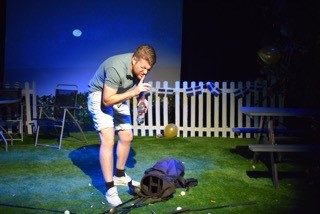
Set in a pub garden over a bank holiday weekend, Ghost Bell tells the story of a collection of regular drinkers in The Griffin. Joey, a troubled 40-something who “was going to go to drama school”, drives much of the play’s action through his drunken and drug-fuelled antics, and David Shortland pulls off a subtle performance that captures the inherent sadness in this grown man who knows he’s still acting like a teenager but can’t quite work out how to do anything else.
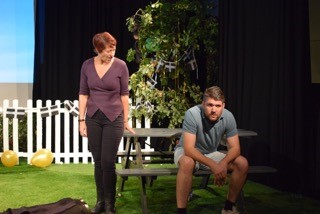 Joey’s antics drive his childhood best friend Debbie to distraction. A teetotaller who still always seems to be in the pub, Zoë Arden is powerful in perhaps the most emotionally demanding role in the play, and is ably supported by Danielle Thompson as her younger more carefree sister Hally. Meanwhile, Debbie’s boyfriend Matt (Scott Tilley, left out of the programme, but an imposing presence on the whole production) encourages and even funds Joey’s lifestyle.
 Debbie, Matt and Joey are surrounded by the rest of the Griffin’s regulars, and owners. Andy Hewitt’s Brendan remains rooted in the corner playing chess against himself, sipping pint after pint, and occasionally chipping in with a classic film quote with exquisite timing. Harry Medawar’s Burling also provides frequently welcome comic relief, as he wanders through the action with quaint tales of murdering the local wildlife, looking faintly bemused when anyone tries to involve him in the play’s plot.
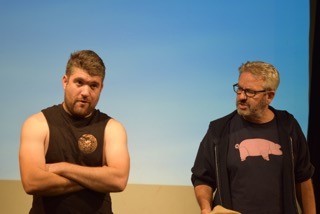 Publican Alan is played with a twinkle in his eye by Nigel Cole, handing out sage wisdom to his regular customers, and enjoying a tempestuous relationship with his wife Pauline. Pauline is literally a character of two halves, she opens the play snapping at all and sundry, before Alan shouts at her halfway through and she, literally, lets her hair down and becomes sweetness and light for most of the rest of the play. Liz Williams (also the play’s producer) plays both versions of the character well, but the contrast between them is… striking, and I’m not sure the message that shouting at your wife will turn her into a nicer person is one that makes for a comfortable evening’s theatre.
Finally Roberta Cole gives great gusto to a brief appearance as Barbara, just before the interval, and her breezy no-nonsense attitude provided a great contrast with the slightly drunk or stoned demeanour of much of the rest of the cast; it would have been great to see her again at the conclusion.
The set is an ambitious recreation of a pub garden in the OSO space, and Malcolm MacLenan’s lighting design captures the various times of day perfectly, from the midday sun to the mellow evenings and bright moonlight. Wearing two hats, Designer and Director John Buckingham makes sure his cast move with ease and pace through the artificial turf of his set. John Pyle’s sound conjures up wind, waves, and occasional bursts of music from inside the pub.
In short, Ghost Bell is a well-acted and sumptuously designed production which more than overcame its lack of final rehearsals. Unfortunately, it can’t always plaster over problems with the script. A lengthy foreword from playwright Steve Webb in the programme makes it clear that large amounts of the play are grounded in autobiography, which is always a tricky proposition. Truth is indeed often stranger than fiction, but reality has a shaky grasp of dramatic structure.
The play wants us to root for Joey, but he opens it by killing a cat with a golf club. It’s hard to come back from something like that, and the audience is given precious little reason to try, beyond Debbie’s clear concern for her old friend. Later we learn that he’s been caught trying to steal a penguin, and that’s the sort of quirky drunken crime that an audience can get behind. But we already know that a brutal cat clubber lurks behind the cheerful penguin pilferer.
Matt gradually emerges as a villain of sorts, keeping Joey trapped in his addictive spiral by supplying him with money and drugs, apparently so that he’ll always have someone to go to the pub with. When he takes a more active role in sabotaging his friend’s happiness by literally burning a lifeline, it’s all a bit melodramatic. “You’re not going anywhere, Joey. Not yet,” he purrs, and in an otherwise naturalistic play, this streak of soap opera intrigue that sets up the plot for the second half just doesn’t ring true.
Being set in a pub garden, the play’s dialogue is naturalistic in that it features a huge amount of swearing, and everyone drinks, smokes, and tokes their way through the play. Which (smoking ban notwithstanding) isn’t necessarily a problem, but it does mean that the play’s climax, in which revelations come thick and fast and loose ends are resolved, essentially descends into people screaming at each other to “eff off”, without resolving a great many of the loose ends.
The performance I attended also highlighted the big problem with filling your play with quotes of other people’s best material: you’re relying on people having seen that material. While the audience tittered dutifully when Brendan chipped in with familiar James Bond lines, they were a little more hesitant about The Usual Suspects. Finally it became very obvious that I was the only person in the audience who’d ever seen Withnail And I – which was a shame as it was quoted often, extensively, and in plummy-voiced character, to the audible confusion of much of the audience.
A strong cast, on top of the material and well-directed, have breathed life into this stunningly-designed production, but their best efforts can’t disguise a play in need of a bit more polish, and a little judicious pruning.
Andrew Lawston
October 2019
Photography courtesy of This Is Us Productions
Honesta Quam Magna
Daisy Pulls It Off
by Denise Deegan
Teddington Theatre Club, Hampton Hill Theatre until 4th October
A Review by Celia Bard
Daisy Pulls It Off is a play that treats it audience to a feast of ‘Jolly Japes’ and ‘spiffing fun’. There are ‘hi-jinks galore’ at the Grangewood School as girls indulge in midnight feasts, hot water bottle fights, overcome cliff edge dangers, search out lost treasure – all against a backcloth of bullying and cheating, mystery and intrigue. It all falls on Daisy Meredith to save the school and save the day. The play is inspired by the adventure stories about life in boarding schools written in the early 20th century by authors such as Angela Brazil. The play’s depiction of upper class language, social and moral attitudes and norms might provide a temptation for actors to caricature the characters. These two directors and cast members do not fall into this trap, the actors totally immerse themselves in their characters and succeed in drawing the audience into the ‘ups and downs’ of this group of schoolgirls, particularly those which befall Daisy Meredith. Although we laugh at many of characters’ utterances, we were not laughing at them. The quality of the acting is as such that we do not applaud when the bully and snob, Sybil Alexandra Burlington is expelled from the school but feel a sense of relief when the expulsion is lifted after Sybil’s moment of honesty, and pleas for clemency from Daisy. The play is more a pastiche of this genre of writing, not a parody. Although the time period is 1927 some of the themes the play touches upon are still with us: class discrimination; Public versus State Education; foreign enemies of the State.
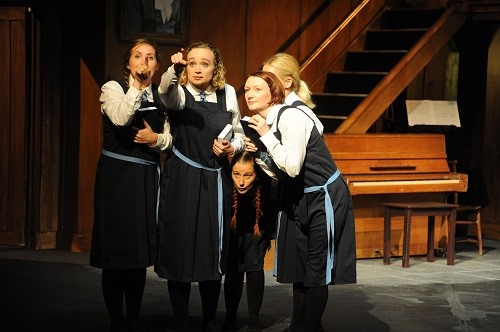
The main setting of the play is the Grangewood Boarding School for Girls. Our heroine is Daisy Meredith, daughter of an opera singer who has fallen on hard times. The fate of Daisy’s father is unknown, presumably killed during the First World War whilst at sea. Meredith is the first pupil from an elementary school to win a scholarship to Grangewood. Many of the girls are appalled by this event, while in return Daisy, a girl with a strong moral compass, is shocked by the snobbery and venom displayed by some of the girls. She does, however, bond very quickly with poetry lover, Trixie. Together they decide to set up a secret society with the purpose of finding some hidden treasure in order to save the school and the family that own it. Alas the two girls share the dormitory with a couple of rich girls who plan to get Daisy expelled and succeed in making her life as difficult as possible. The story unfolds in an establishment in which the game of hockey plays a significant role.
The dialogue of the majority of characters is interesting. Speech is directed to the audience when that character is introducing him/herself, an extremely helpful device with such a large cast, or continuing the narrative of the story to move the action on. It is also, of course directed to the other characters in the play.
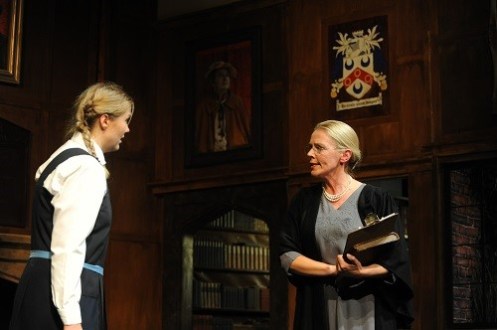
Daisy Meredith describes herself as a “daredevil, tomboy, possessed of a brilliant mind, exuberant, quick-witted, fond of practical jokes, honourable, honest, courageous, straight.” Ellie Greenwood, who plays Daisy, shows all these attributes in her characterisation and in her interaction with other characters, she lives the role. Just occasionally her enthusiasm got the better of her at the expense of intelligibility. Her loyal chum, Trixie Martin played by Lara Parker, is as much the ‘madcap’ as Daisy. She gives a fine performance and is just delightful to watch. Daisy’s nemesis, Sybil Burlington played by Lily Tomlinson, has the most wonderful facial expressions that aptly reflect her character which she herself describes as “conceited, beautiful, only daughter of very wealthy parents.” Sybil’s ‘chief crony and school toady’, Monica Smithers acted by Juliette Sexton, gives a great comic touch to the role without going over the top. The two of them together are mesmerising. Another significant character is Clare Beaumont, head girl and Games Captain, acted by Jenna Powell. Her telling of the tale about lost treasure to Daisy and Trixie is spell binding. Annabel Miller is a suitably stern Headmistress, comfortable with her school audience of parents, brothers and sisters and grandparents, slightly less so when dealing with the misdemeanours of her pupils, at times lacking projection. Jeremy Gill as Mr Schblowski provides a well-considered and sinister interpretation of the Geography teacher and Choir Master, succeeding in disguising his true character and motives. All actors in this production must be commended for their commitment and level of characterisation they bring to their roles, whether large or small. The History and Music teacher, Sue Bell, is a case in point. This actor does not have a word, a line to speak but throughout all of her scenes she is totally engaged in the action.
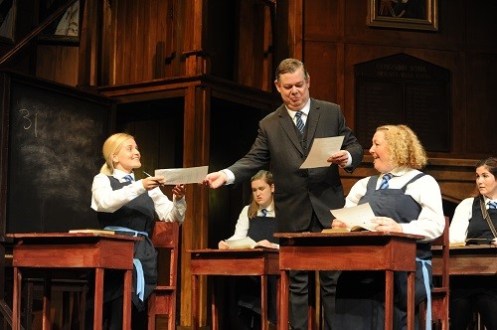
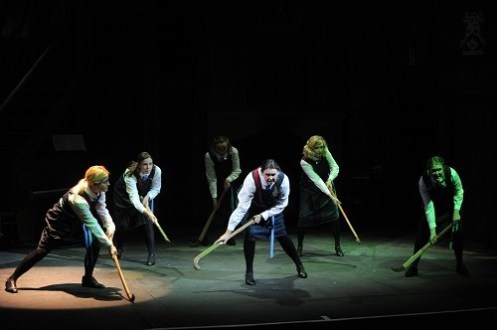
As well as a wonderful, talented cast of actors whose overarching strength is the quality of their vocal interaction mention must be made their physicality. There are a number of incidents when the human body is at the centre of the storytelling process including the spectacular hockey match sequence and the rescue from the cliff top. The choreography of the hockey match triggered an appreciative round of spontaneous applause from the audience and the ingenuity that went into the rescue of Sybil and Monica results in real drama.
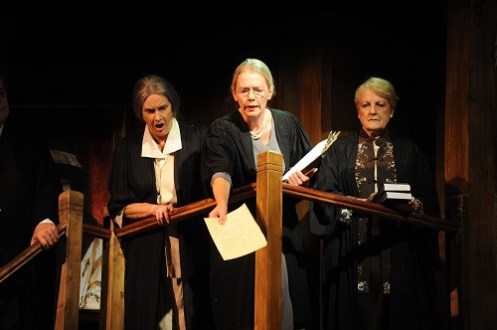
The play’s settings move speedily from a train to the school, from the library to the dormitory, to the sports grounds, to the cliff top. These speedy scene changes are imaginatively achieved by the use of smoke, which serve to disguise the main set, a wonderfully designed interior representation by Wesley Henderson Roe of a rambling red-brick Elizabethan Mansion consisting of a wooden staircase and panelling, an upper landing, and lower Manor Hall, now the school hall, still with portraits of former members of the family hanging on walls. The smoke acts as a mist during the playing of the hockey match. Contrasting this carefully crafted choreographed movement is Trixie sitting on the window ledge, looking out on the match, and acting as commentator. The same technical device is used for the cliff top scene: a puff of smoke, a clap of thunder and ‘hey presto’ the scene has shifted from inside to an outside scene of a cliff top shrouded in mist. Wonderful!
Well devised and effective Lighting design by Patrick Troughton and Sound including some special effects by Charles Halford was equalled in standard by realistic and well fitted costumes under the meticulous eye of wardrobe mistress Mags Wrightson, all components adding to the creditability of the piece. Overall this was a highly enjoyable play provided by a fine cast, organised by two creative, talented and visionary directors, Clare Henderson Roe and Wesley Henderson Roe, and enjoyed by a lucky audience. This is a production not to be missed.
Celia Bard
September 2019
Photography by Sarah Carter
Honeymoon Engagements
Private Lives
by Noel Coward
The Questors at The Judi Dench Playhouse, Ealing until 5th October
Review by Viola Selby
Private Lives is undoubtedly one of Noel Coward’s greatest successes, with its timeless humour it has entertained audiences since 1930, and Francesca McInally’s adaptation truly gives homage to this, as the audience are given a glimpse into the private lives of a divorced couple who run into each other whilst on their respective honeymoons. This meeting appears to relight an old flame and the couple decide to run away together to Paris. What follows is staged in such an intimate and awkward way that it makes anyone watching not only deeply invested but also able to engage with how the characters must be feeling at the time. Such engagement is also greatly helped by the stunning set designs, by Jake Smart, and period perfect costume design, by Carla Evans, which truly bring the 30s alive in Ealing!

The play’s success relies heavily upon the quality of its cast, ensuring that Coward’s repartee is done in a perfectly timed manner and that a simple story is turned into a night of high class hilarity. This need is strongly met by the tremendous talent of the caddish Robert Seatter as Elyot Chase, whose dance moves in silk pyjamas would rival those of Fred Astaire. Seatter manages to convey a wide range of ever changing emotions, from veracious fury when dealing with his ex-wife Amanda Prynne to relaxed indifference with his new wife, Sybil. He does this all whilst delivering most of the best yet completely misogynistic lines, like when he informs Amanda that it does not suit women to be promiscuous, which evoked a collective sharp intake of breath from the audience. Amanda, passionately portrayed by Kate Langston, then retorts this by stating “It doesn’t suit men for women to be promiscuous”, encouraging a huge applause. As Amanda, Langston completely becomes the passionate and often selfish character, always ensuring that every jibe and sarcastic comment is captured in the cold-hearted and brutal nature it was intended to be delivered.


Together, Seatter and Langston have a fantastic chemistry together that truly helps to create their characters’ overbearingly lustful and self-absorbed relationship. However, this relationship would be nothing without the added support and confusion that is brought along by the new yet estranged spouses, Sybil Chase and Victor Prynne. These characters, both polar opposites of each other, highlight how Amanda and Elyot have consciously chosen to marry individuals very different from their exes. Sybil for one, is very young and naively only ever wants the constant approval of her new hubby. Her ear splittingly shrill voice is cleverly kept constant throughout her performance by the comedic Nell Rose who gets the audience to feel both sympathy for the poor Sybil and annoyance at her incessant wailing, which would put any toddler to shame. Whilst Victor is the very definition of a British ‘stiff upper lip’, well to do gentleman, played perfectly pompously by Francis Lloyd whose ability to portray such a stiff man so naturally, especially in such emotional moments, added to the play’s overall humour.

Finally the most intimate and oh so awkward moments were made even more awkward and strangely intimate by the addition of the French maid Louise, whose accent and annoyance was made extremely realistic by Yvonne Monyer. For example, making everyone sit on the small sofa and drink the coffee she had been asked to make led to one of the most awkward scenes one could imagine having with their new partner, their ex-partner who they had just run off with and their ex partner’s new partner. Altogether, a thoroughly good night to be had and one not to let get away.
Viola Selby
September 2019


