
Show me the figures
Enron
by Lucy Prebble
Putney Theatre Company, Putney Arts Theatre, until 28 September
Review by Matthew Grierson
‘There’s a dignity in giving people things they can’t touch,’ is one of the observations that sustained Enron, and which sustains Enron in that so much of the play and the corporate scandal on which it is based is about selling us what is immaterial. As these things include both the energy being sold by the firm and the energy on which this play sells itself, it wouldn’t be unfair to say that both have their outages, with a subsequent effect on their respective reputations – perception being another of those qualities on which the business model is said to rely.
To redeem the promise of making something as abstract as the operation of markets visible before our eyes, the show therefore depends on its episodes of financial theatre. A large ensemble takes on the roles of employees, investors and public, and from their number will step an occasional individual to serve as newsreader and fill us in on key developments. Although some of these are entertainingly snappy, the diction is not always as clear as it really ought to be, with the American accents of varying quality, while the shift between chorus and speaker is often too pacey to help us pick up what is going on.
Most successful of these episodes is the metamorphosis of three of the swings into velociraptors at the end of the first act, with the simple addition of some effective cardboard masks and appropriate movement. The dinosaurs make material a metaphor openly embezzled by CFO Andy Fastow (Michael Maitland-Jones) from Jurassic Park and give stage presence to the shadow company he’s established to eat up the corporation’s losses, an objective correlative for his reptilian behaviour.
Maitland-Jones handles each aspect of Fastow’s personality well, from aspirant accountant to book-cooker to carnivore-keeper, especially as I understand he was drafted into the role at short notice. But, again, the transition between each could do with more work. I can buy him wanting to get on to the boss’s good side, but when it comes to the crucial shift from eager employee to criminal accomplice, well, I’m out.

Fastow’s character arc is less Faustian than Mephistophelean, for it is Enron chief Jeff Skilling who is effectively the tragic figure tempted from being your regular ruthless businessman into actual suspect practice. It’s hard to see why Lucas Pozzey’s Skilling should stand out at first: although he is built up in the dialogue before he gives his opening speech, this is delivered hesitantly from a set of steps stage left, and not all that well lit. Neither is it clear why the mark-to-market model that Skilling espouses distinguishes Enron, because if it’s as obvious as he makes it out to be won’t other companies be practising it as well?
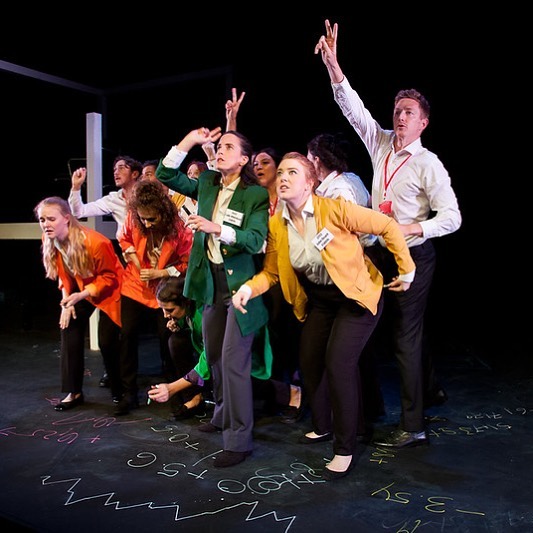
The company’s USP continues to remain unclear for much of the rest of the first act, despite entertaining sequences along the way. A troupe of traders in bright, baggy jackets exchange braggadocio accounts of their activity amid a string of ‘buys’, ‘sells’, and ‘f***s’ as they hot-shoe shuffle around the stage and chalk prices on the floor. If you can overcome the cognitive dissonance of watching a largely female ensemble spout this testosterone-fuelled banter, it’s quite a spectacle – but given the traders are behaving just as we would expect them to behave, the scene obfuscates the mechanics of the market as much as it tells their story. While Enron was certainly in the business of pulling the wool over our eyes, dancing around the numbers here does nothing to illuminate this.
I found it worrisome, then, that the play began to sell itself to me at the precise point that Fastow is shilling his scheme to Skilling, miming the boxes within boxes on which the raptor-riddled shadow company depends. At this point, engagement with the narrative noticeably picks up, and we can see the tragic trajectory on which Skilling’s willingness to buy in to Fastow’s innovation sets them.
Pozzey’s performance, which has been gaining strength as the firm does, comes into its own here, adding light and dark to his characterisation of the self-styled captain of industry. A pair of contrasting scenes with his daughter capture his downfall perfectly. In the first, he helps her with her arithmetic by counting out actual dollars, but in the second he is left staring into the middle distance as though looking for the missing money, unable to answer her repeated question of ‘Why?’
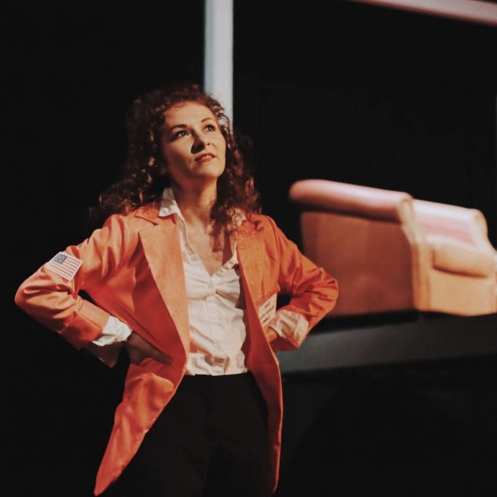
His fortunes are mirrored by those of Claudia Roe, who starts out awaiting her anointment as Enron’s boss from money man Ken Lay before Skilling talks himself into the job instead. Kendal Barrett gives a sympathetic portrayal of Roe, a woman as skilled as Skilling against whom we can measure his rise and fall, and her parting words to him show how much better her business nous is than his. Michael Rossi’s Lay, meanwhile, is as ethereal as Enron’s money: offstage, he is heard only in phone calls that echo around the auditorium, God with a Texan drawl.
As Enron overreaches itself, we see its effects on both Fastow and Skilling, the former haggardly trying to keep his raptors in check and the latter nervily having his office swept for bugs. It is not only the law closing in, however, but reality. We’ve already had nods to the Lehman Brothers, given amusing form as a kind of Tweedle Dum and Tweedle Dee, and there’s a surprisingly affecting rendering of 9/11 that ties together a metaphor about investment and flying. But it’s the jokey references to W that ask us to pay attention, as they gradually build into a critical moment for the plot.
Speaking of plot, throughout Enron a graphline is gradually being chalked downstage by the cast to chart the company’s fortunes, but it’s not clear how this should be understood. From the audience’s point of view, this would have to be read left to right to make sense of the stock price, while from the stage it would look to close on the up rather than the fall. With its highs and lows and a lack of certainty about where things are going, this might be the best metaphor of all for PTC’s production.
Matthew Grierson
September 2019
Photography courtesy of Putney Theatre Company
Transcending Tchaikovsky
Bright Stars Shone for Us
by Tama Matheson
Word & Music and the London Mozart Players, Wimbledon International Music Festival, Kings College School Concert Hall, Wimbledon until 21st September
Review by Helen Astrid
Russian poet Alexander Plescheyev supplied many poems for composer Peter Ilyich Tchaikovsky to create a series of Russian songs. The poet’s collection entitled Words and Music includes Нам звёзды кроткие сияли , Bright Stars Shone for Us, the title of this performance. In this unique production which launched the Wimbledon Music Festival, the stars were evidently on stage.
This was a unique and smart concept called Lyric Drama, devised by the multi-talented Tama Matheson alongside Davina Clarke and Dr Kirsten Fehring. It combines the spoken word with live music. The result? A powerful performance transcending all other art forms. It was captivating from start to finish and the trio of performers Tama Matheson, Eleanor McLoughlin and dancer Alexander Nuttall, were accompanied by the outstanding London Mozart Players.
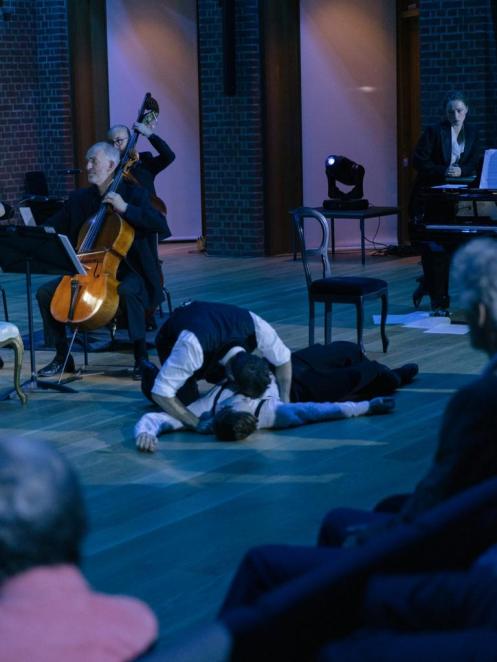
Bright Stars Shone for Us is based on the tumultuous personal and professional struggles of Tchaikovsky. The unadulterated and shocking truth about his life was revealed to us with such sensitivity and compassion, that the generous-sized Kings College School Concert Hall in Wimbledon did not deter from the intimacy which engulfed us.
Interspersed with the music of Tchaikovsky and a few bars from the overture of Mozart’s Don Giovanni, references to Eugene Onegin permeated throughout.
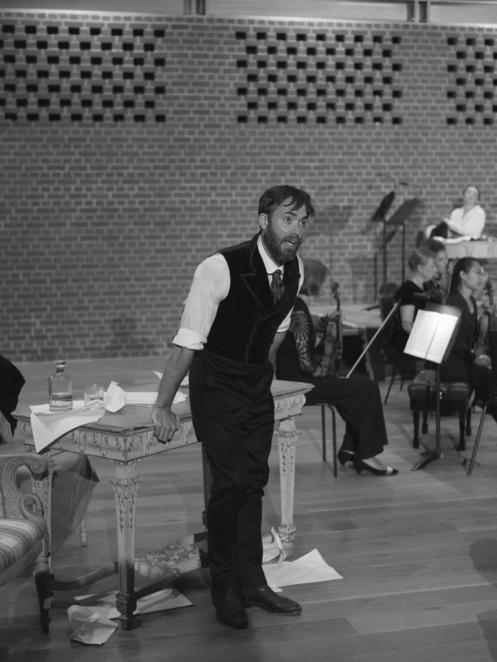
We are drawn to Tchaikovsky’s constant struggle with his sexuality causing him anguish and a yearning for salvation. Even God ignored his prayers. A string of eligible society ladies threw themselves in Tchaikovsky’s direction, but nothing matched the craving and passion he had for his many male lovers. These moments were breathtakingly choreographed and acted by Matheson and Nuttall. It was impossible not to be moved.
The London Mozart Players, founded in 1949 by Harry Blech, demonstrated some fine playing as well as acting, being an integral part of the action on stage. Clever.
Founded in 2018, Word & Music Production Company is one to watch out for. A genuine and heartfelt performance left us eager for more from this fresh and innovative young company.
Helen Astrid
September 2019
Photography by Oskar Chu
Thoughtful and Gripping
Table
by Tanya Ronder
Questors at The Studio, Ealing, until 28th September
Review by Mark Aspen
“If walls had ears” … they say … but what if a table had eyes, and ears and all the senses, for a table interacts much more with people than a wall. This is the thesis of Tanya Ronder’s ambitious intimate epic of a play, Table, in which the eponymous piece of furniture is as much a character as the human actors.
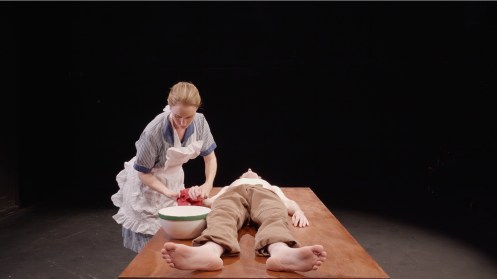
The play follows the family fortunes, or rather misfortunes, over a period of 115 years from the end of the nineteenth century up until 2013. All are united, or divided, by their commonalities. All seek happiness, and all (or maybe almost all) fail. Table potently illustrates the disintegration of family structures and values that have occurred over the last twelve decades or so, caused by huge upheavals such as war, but more so by changing social values. We all long for the continuity of the family, but is it still there? This is what makes Table such a thoughtful and gripping play.
There are no less than twenty-two characters in Table, members of the (ironically named) Best family. Over the decades, the biological family may spill into other “families”, maybe convents or communes, but these do not have the permanence of the blood line. The story, and its intercalated sub-stories, is revealed through a series of snapshots, but unlike a family photo-album we do not see only the happy and posed moments. The chronology is non-linear, so we are able to note recurring themes. If all this seems tough on the audience, it is. (The programme, though, helpfully contains a family tree). However, such is the skill of the Questors’ company that, although we look at the family metaphorically through the gaps in a picket fence, we really care for them. The first-night audience was totally engaged.
The play is equally tough on the cast of eight, who are not only called upon to play up to four characters each but also to portray their characters at myriad points in their lives, from cradle to grave, even as a new-born baby or as a corpse. Moreover, several characters speak in Cantonese or Swahili, and, oh, they must all sing well. And they do, for crucially the scenes are linked with snatches from the hymnal. These, although well-known hymns, make you think, for they comment pithily on the action. Inevitably, and pertinently, the most used is the reflective, “Dear Lord and Father of mankind, forgive our foolish ways …”
These foolish ways are seen, heard and felt by the ever-present table and indeed it is personified by one of the actors, who plays the character Gideon, the member of the family who is perceptive of the heritage of the table and its tangible link between the generations that mean so much to him. Effectively, Gideon is the table.
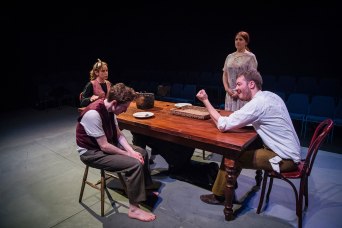 A good point to talk about the set: well, the set is the table. Normally tables are a director’s and designer’s nightmare: they get in the way. But here, congratulations, to the comprehensively consummate director Steve Fitzpatrick and to his inventive designers, especially the table constructor, Stephen Souchon, whose ingenuity allows the table to be moved, flown from the fly frame, and most remarkably cut up with axe and saws, and then later reconstituted. (Although there were some heart-stopping moments when the set did seem to be a test-bed!). The action takes place on a thrust stage, which helps the stage proxemics. Costumes and props are struck and set on the go, and Terry Mummery’s subtle lighting and Paul Wilson’s sound design appropriately enhanced the mood.
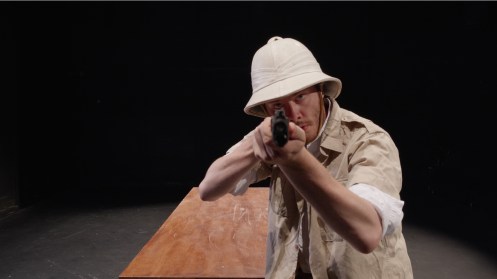
So, what happens? Well, lots and lots. And all of it on or around the table. There are health warnings on the box: violence, nudity, sex (lots), gunshots, prostitution, homosexuality, paedophilia, incest … but thankfully no smoking! The Best family have a very busy 115 years! No animals are harmed … except a leopard shot by a big-game hunter, but we only see blood splashed on the cyc. However none of this trivialises what is an in-depth study of human relationships, carefully and sensitively examined.
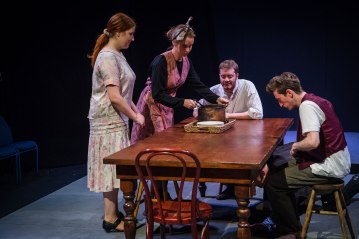 Amongst the relationships, fatherhood and motherhood feature strongly. The play is parenthesised by a prologue and an epilogue, repeating the cause of the marks on the table. Significantly this is recited by Gideon. It is Gideon, brought up as an only child, who most seeks a father. The only link he ever has with his father, Jack Holman, is the phrase pater familis carved on the table edge. Gideon’s emotional journey is as convoluted as his physical globe-trotting from his birthplace in post-colonial Tanganyika. Neil Dickens plays this role with intensity and physicality (he spends much of his under the table). In his attempt to reconcile with his wife and son, whom he abandoned three decades earlier, he is revealed as being as vulnerable as everyone else.
 Sarah, Gideon’s mother, also spends her life seeking. She is seeking something to believe in and it always just eludes her. Jordan Fowler (who also plays Elizabeth, the wife of the joiner who originally makes the table) is outstanding in this difficult role, portraying the hard knocks of Sarah’s life. Her twin brother, Albert and disabled father, Finley gradually become a burden as they cannot accept her Catholic faith. She becomes a missionary nun and has the table shipped out to the convent in Tanganyika. It is here she has her fateful meeting with Jack Holman, a big-game hunter who saves her from a marauding leopard. Sarah’s impulsive emotional response is to strip naked and offer herself to him.
Now here is a small difficulty with this play. After a notional nine-month long interval (yes, the bar and loo one), we return to witness the birth of Gideon, propelled into the world with a somersault from under the table. Is this a light-hearted attempt to leaven a heavy play, or is it just making fun of itself? This self-deprecation is, nevertheless, obvious in the scenes in which Sarah, the teenage Gideon and the table join a 1960’s hippie commune. This, presented as a caricature of the flower-power era, admittedly a sitting target for a bit of mickey-taking, rather trips up the passage of the plot. The second half of Table is perhaps not as well written as the first, and the scenes of Gideon’s belated family reconciliation seem somewhat overworked.
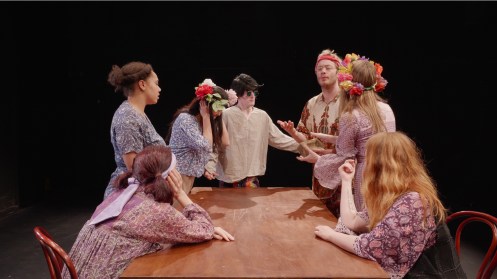
However the hippie episode does underline the message of the danger of messing with social and family structures, for their advocacy of free love does not turn out well, as their commune breaks up in rancour and jealousies. Sex is not a game, and fidelity is important to emotional security.
The density of the plot and its episodic nature does not lead to full analysis here, and the ensemble working of the cast is exemplary. Most actors play multiple roles and all differentiate them superbly. Special mention must be made of Lucy Aley-Parker, who stepped into her roles in the last minute. These include the hidebound Mother Superior and Michelle, Gideon’s hard-bitten wife. From her sharp acting book-in-hand on press night, one felt she would be seamless before the end of the run.
Oscar Gill’s Finley, coarsened and wounded mentally by the First World War, is a text-book example of hitting a difficult role at the right level, as it could easily be overplayed. His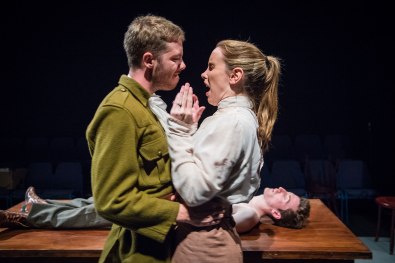 depiction of Finley’s final months, incapacitated by a stroke and dependent of his resentful son, Albert, is superlative.
Nia Acquaye’s transformation from brassy prostitute to demure nun is striking. As Sister Hope, strong in her faith, her interpretation of the scene in which she parts with Sarah and her young son when they are expelled from the convent is so moving, “I’ve never felt so miserable”.
Emma Kennedy’s contrasting roles of Margaret, Finley’s brittle-edged wife, and the feisty Sister Babette; and Tony Sears embittered Albert against the well-grounded David Best, the joiner, are further examples of top-notch acting.
As the youngest member of the hierarchy, Su-Lin, the ebullient actress Ting Ting Cul exactly captures the innocent charm and breathless naivety of the juvenile adoptee. Su-Lin has three carers, the gay couple Anthony and the unseen Ben, and Anthony’s mother, Michelle. One wonders in projected extension to the chronology, what would happen on the demise of Michelle. Would she be another lost soul searching for a mother-figure and for a father? Would she look for carvings on the ubiquitous table, or would she be adding to its scars? What if a table had eyes, and ears and … a sixth sense.
Mark Aspen
September 2019
Photography by Robert Vass and Rishi Rai
Powerful, Radical, Memorable
Giselle
by Akram Khan, music by Vincenzo Lamagna, after Adolphe Adam
English National Ballet at Sadler’s Wells until 28th September, then on European tour until 18th July
Review by Mark Aspen
Walls, walls that contain, walls that exclude have made potent socio-political statements throughout history from Hadrian’s Wall or the Berlin Wall to modern divides such as those in Israel or along the Mexican-USA border. Such a wall is the overarching presence in Akram Khan’s Giselle, first produced three years ago by the English National Ballet, and now vigorously revived for a ten-month tour of Europe, opening at Sadler’s Wells.
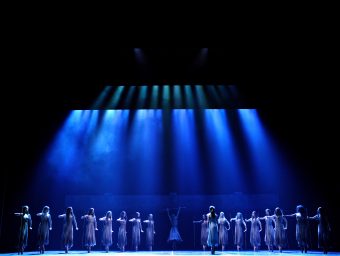 Khan has reworked the 1841 romantic ballet with dramaturg Ruth Little into a topical parable of today’s displaced peoples. It is set outside of an abandoned clothing factory, from which its former workers (the Outcasts) are excluded, shut off from employment or return to their own dispersed communities. Beyond the wall, which divides society, wealth from poverty, the Landlords live in luxury.
From its thunderously dramatic opening with its overwhelming heartbeat music, this is a piece that packs some punch. Full of energy and dark excitement, the tension and threatening nature of the story is retold in a way that takes it far away from the 1841 chocolate box ballet to something much deeper and intense. The imaginative imagery embraces the setting, the music and of course the dance.
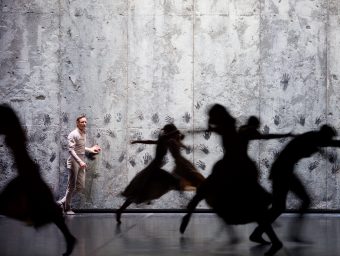 The setting, by designer Tim Yip, whose concept for the Beijing handover ceremony at the close of the Athens Olympics brought international recognition, has a clear feel for the monumental, and his Giselle design paradoxically combines large scale with a feeling of claustrophobia. Mark Henderson’s moody lighting underlines this dichotomy. Yip’s costume design starkly contrasts the Outcasts and the Landlords, plain shifts of the woman workers with the exotic dresses of their wealthy counterparts. The latter lifts the period from the topically of the present into an indeterminate unworldliness of all-time (witness the phantasmagoric pannier dress of one of the ladies).
The music is just as innovative in its synthesis of sources and styles. Composer Vincenzo Lamagna’s score is sit-up-in-your-seat powerful. Its opening impact is almost overpowering, fully illustrative of the power of the Landlords over the Outcasts, metaphorical chains and whips. However, Lamagna uses silence to equally impressive potency. Between, the motifs of Adolphe Adam’s original score percolate like primeval reminiscences. Adams contemplative lyricism mainly accompanies the pas de deux of Giselle and Albrecht, a solo cello when they meet in the underworld and a plaintive oboe when Giselle’s spirt is given up for ever. All this makes for a busy time in the orchestra pit, and the English National Ballet Philharmonic under conductor Orlando Jopling deliver an impassioned and energetic rendering of Gavin Sutherland’s orchestration.
Then there is the imagination in the dance. Akram Khan’s trademark fusion of contemporary dance with both classical ballet and the Kathak patterns of his Bengali heritage leads to a remarkably enthralling experience.
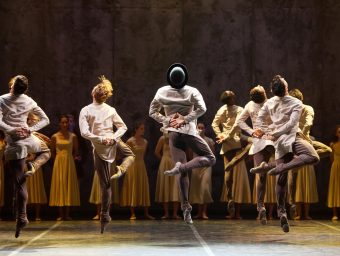
Khan’s concept takes the romantic ballet of 1841, peasants and aristocrats in a mediaeval Rhineland, into a much more totalitarian world. In Act I, the class divide becomes the physical barrier of the wall; the vicissitudes of the harvest becomes the factory closure; the gamekeeper, Hilarion becomes a predatory overseer; and the disguised grandee Albrecht becomes a 21st Century HRH mingling with the masses. Act II remains ethereal, but the forest glade haunted by Wilis, the spirits of jilted brides, becomes a ghost factory populated by the malign spectres of women workers killed in industrial accidents; while Myrtha, the Queen of the Wilis, becomes even more merciless and vindictive.
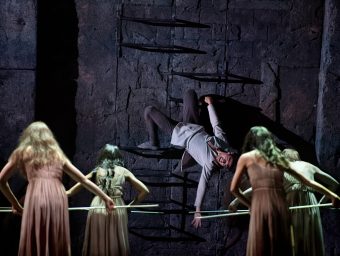 The hard-edged approach to the concept allows for an expansive mixed palette of choreography. It is percussive at its opening, then broadens to show the migrants’ plight through the metaphor of the movement of fleeing animal herds. The palette ranges from hints at the popping and locking of hip-hop to the more fluent forms of folk-dance. The lyrical pas de deux are pure classical ballet, and in Act II Khan, very atypically, uses extensive pointe work. In fact, the corps de ballet spend most of Act II en pointe, increasing the demands on them in an already difficult ballet. But the effect is mesmerising, as they move in numerous pas de bourrée, fluttering across the stage with a fragile lightness. However, Khan’s Wilis are far from fragile, they are terrifying! They goad Hilarion viciously to death, are unremitting with the pleading Giselle, and abandon a broken Albrecht with a chilling heartlessness. Moreover the Wilis come armed, literally to the teeth, with slender rods, symbolic of punishment and of authority, but these have been the battens of the dilapidated power looms. Their ensemble entrance, with its accompanying music, is a recreation of the working factory loom: a brilliant double edged metaphor.
Lead Principal Fernanda Oliveira as Giselle dances with a light and delicate liquidity, the character’s naivety overshadowed by her hopeful and loving nature: a joy to watch. Giselle has fallen in love with the noble-born Albrecht, who has infiltrated the Outcasts in disguise. Aitor Arrieta makes an imposing Albrecht, bringing something of his native Basque country’s fire and determination to his unflaggingly energetic dancing. Their wooing scenes are full of tenderness.
The lovers are however thwarted by the cunning Hilarion, who also has designs on Giselle, which go unrequited. Hilarion, as the de facto go-between for the Outcasts and Landlords, is an ambiguous presence, hunting with the hounds and running with the hare. Khan describes him as “a shape-changing fixer”, lining his own pockets. In the role of Hilarion, Erik Woolhouse fills the part with a muscular athleticism, aerial yet grounded at the same time. Woolhouse is a remarkable dancer with enormous potential. (He was awarded Young British Dancer of the Year when still student.)
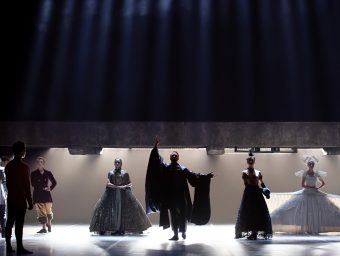
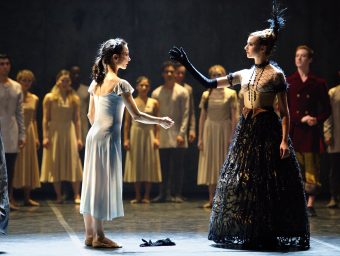 The sudden arrival of the Landlords, announced by a broken factory hooter, is a moment of remarkable theatre as the massive wall pivots and we see its gold-plated far side. Their entrance is stately, glamourous yet unnervingly bizarre. Amongst them is Bathilde, the heiress daughter of a duke, to whom Albrecht is betrothed, and Albrecht is exposed as a duplicitous two-timer. Giselle recognises Bathilde’s evening dress, a (not-so)-little black number, as her own handiwork. Bathilde’s reaction to the hurt Giselle feels is one of pure distain. Stina Quagebeur as the aloof Bathilde certainly knows how to put across an emotion by pure body image. She peels off a long formal glove and, before Giselle’s eyes let it drop on the floor. When coerced to choose, Albrecht takes money and status, rather than love and fidelity.
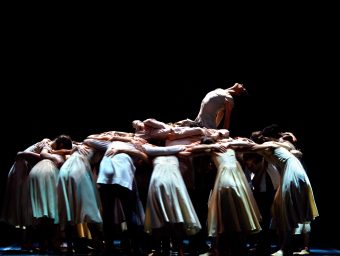 Khan’s Kathak style elements come into their own in the inactions of empathy of the Outcasts to Giselle, at first in the vibrant dance patterns as they rejoice with her in her finding love with Albrecht and now in a swooping whirl of sympathy with the distraught Giselle. As an ensemble, the Outcasts spiral around as one protective organism as she succumbs to death, traditionally of a broken heart, but here aided by a mimed overdose. The undulating whorl is a visually powerful image of the embrace of love in death.
The different feel of Act II is powerfully enhanced in this Giselle, as the corps de ballet transmogrify from the supportive but downtrodden Outcasts into the vengeful and implacable Wilis. Isabelle Brouwers’ Myrtha, the Wilis Queen, fairly drips with malice and callousness, exerting her unbending control on Giselle, truly the psychopath to make you shiver.
Giselle may be pliant to the whims of successive choreographers, but Khan’s radical retelling has already set itself as a definitive modern version, as powerful as it is memorable.
Nevertheless, one need not take a mere critic’s view. At the Saturday matinee, which this critic attended, a couple leaving after the final curtain were overheard: “I’d like to see that again”. “So would I: let’s go to the box-office to see if they have any tickets for tonight”. I was tempted to join them.
Mark Aspen
September 2019
Photography by Laurent Liotardo
More haste, less speed
A Woman of No Importance
by Oscar Wilde
Classic Spring Theatre Company, Richmond Theatre, until 21st September
Review by Matthew Grierson
What is important in A Woman of No Importance – apart, of course, from the eponymous Mrs Arbuthnot? If we are to believe Dominic Dromgoole’s production, it is cementing Wilde’s reputation as a wit of the first order. Most of the opening two acts play as though excerpted from a dictionary of quotations, with characters speaking apercus in the rhythm of the machinegun: each of the miscellaneous aristos seems to be seeking to outdo another by trumping a preceding bon mot.
You sense that Wilde has set it up so that we are at once bamboozled by the whirligig of lords and ladies to which we are introduced while being dazzled at their brilliance. But if ‘the clever people never listen, and the stupid people never talk’, as Mrs Allonby smartly observes, where does this leaves a speechless audience? Well, at least we’re laughing.
 The pacey delivery and light tone allow the stars – of which we are reminded that there are ‘a great many’ – to shine. Isla Blair is a naturally dry and authoritative Lady Caroline, and holds court for much of the first half of the play by looking up from her embroidery to issue pronouncements or reproach her husband (John Bett on amusing form as the doddery Sir John). Liza Goddard is meanwhile effortlessly genial as hostess Lady Hunstanton, a character unflappable other than when failed by her own memory. The most impish and impressive of these important women is Mrs Allonby, in a charismatic performance by Emma Amos, swishing among the seated matriarchs and gainsaying anything that can be gainsaid – and, with the appearance of Lord Illingworth (Mark Meadows), sparking an illicit chemistry.

In these scenes, Wilde is setting out the way women can exert the seemingly limited power society affords them. In a world sprung from words, they can exercise considerable authority to create and contest their place, and act II serves in effect as their parliament, putting the world wittily to rights in the men’s absence. Indeed, the scene would ace the Bechdel Test were it not for the fact that they are continually talking about the gents on the terrace.
 With wit and wisdom to the fore, the performances of the younger women Lady Stutfield (Meg Coombs) and Hester Worsley (Georgia Landers) are somewhat overshadowed. Keyed up to appreciate the bristling dialogue, we are invited with Lady H. to patronise Hester’s earnest denunciation of English society. But as a character whose name has resonances of the Old Testament, Hester’s speech on the unequal justice meted out to sinning men and women serves as an appropriate prophecy for the subsequent arrival of Mrs Arbuthnot, the woman of no importance who is all-important to the action of the play.
Maintaining the pace of the comedy on into this drama is perhaps this production’s failing. The snappy capping of line with line is perfect for the earlier exchanges, which contain some of Wilde’s most memorable dialogue outside Earnest, but sustaining this through the confrontation between Lord Illingworth and Mrs Arbuthnot (Katy Stephens) does not give us the breathing room to appreciate the human feeling of the scene, and takes it as read that we will already have divined the nature of their relationship.
As Illingworth, Mark Meadows makes a sinuous transition from charming rake to a cold manipulator, but the rhythm of the dialogue is as though they are still trading badinage.
The juxtaposition of amusement and brutality at the end of act III risks leaving a particularly sour taste. One of the young women is sexually assaulted before the curtain suddenly falls and we are then treated to an entr’acte music hall song. I can see that what Dromgoole might intend with this interpolation – one of the ‘cheap entertainments’ Lady Hunstanton would afford the poor to divert from the very inequities to which Hester wants us to attend. As a comment on society it’s as troublingly relevant now as it was when Wilde wrote, but at the same time the play needs to do more to distinguish these issues from the pacey handling of the more comic scenes.
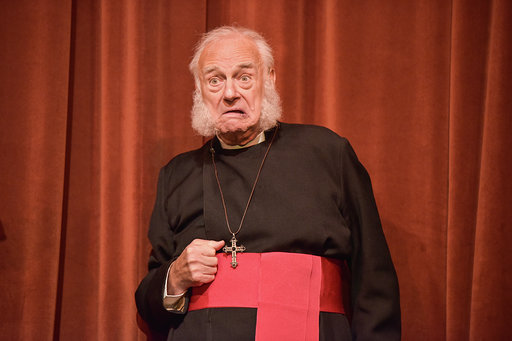
A note of praise at this point all the same for the marvellous Roy Hudd. He’s a fine comic turn in the play proper as Reverend Daubney, forever reciting a litany of his wife’s maladies, but he also breaks the fourth wall between acts to sing the jaunty numbers of the below-stairs ensemble, drawing on his venerable variety experience to bring these to life.
As we move into the final act there is no let-up in the relentless pace of the drama, though. Katy Stephens not only gives a bravura speech about bearing and bringing up Gerald – something that belongs alongside any words of Wilde’s we’ve committed to memory – but sees off the no-good father of her child before throwing herself onto the couch as though ready to weep. Nary a beat later, however, she is revived by the return of her son and his new fiancée. Give her a break, Dom.
It’s a happy ending, certainly, but it short-circuits any relief we might feel at Mrs Arbuthnot’s redemption, and likewise Hester’s sudden conversion from Biblical morality to a more compassionate worldview. The play has much to say that remains urgent, but needn’t be so urgent in doing so.
Matthew Grierson
September 2019
Photography by Robert Day
Sombre, Wry, Clever
Marvin’s Room
by Scott McPherson
Teddington Theatre Club, Coward Room Studio, Hampton until 21st September
Review by Helen Astrid
In this dark comedy in two acts by Scott McPherson, you would be forgiven if you thought Marvin’s Room a hybrid of Samuel Beckett and Tennessee Williams. Without the pregnant, awkward pauses à la Beckett, the American accents were not quite as far South as a Williams play.

Playwright and author McPherson is also an actor who shares his own personal experience of being HIV positive and of the various family breakdowns and dynamics as a consequence of his illness. Brought up a devout Roman Catholic, religion permeates Marvin’s Room, given by Teddington Theatre Club at the Coward Room, Hampton Playhouse.
 Based on a major film with Meryl Streep and Leonardo DiCaprio, the play focuses on the reunion of two estranged sisters. We never see Marvin, Bessie’s father; we only hear his painful groans offstage, leaving our imagination to determine his aged physical appearance. He has been dying for the past two decades and Bessie, played by Linda Hansell, is his full-time carer. As is often the case in such situations, the carer needs caring for! She herself becomes ill and requires a bone marrow transplant, but is unable to find a suitable donor.
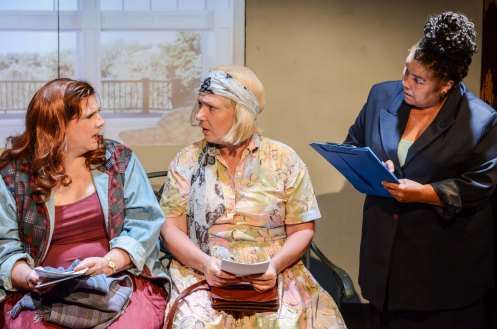
There is much family (and familiar) tension throughout. Each has their own issues and unresolved resentments. McPherson draws on his wit and snappy dialogue to delight and surprise.
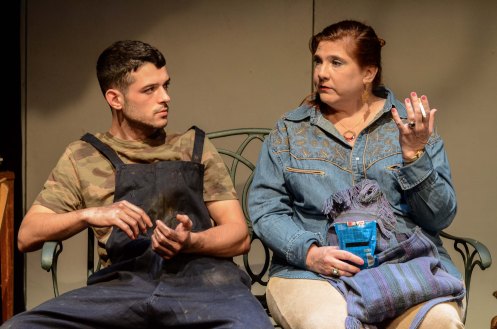
The intimate setting of the Coward Room was perfect for this kitchen-sink drama directed by Eirin Compton. Susan Gerlach as Lee, Daniel Baldock as Dr Wally were excellent; the two sons, Alex Rand as Hank and Ben Jeffrey as Charlie gave fine performances. The latter bears an uncanny parallel to Christopher in Mark Haddon’s The Curious Incident of the Dog in the Night-time.
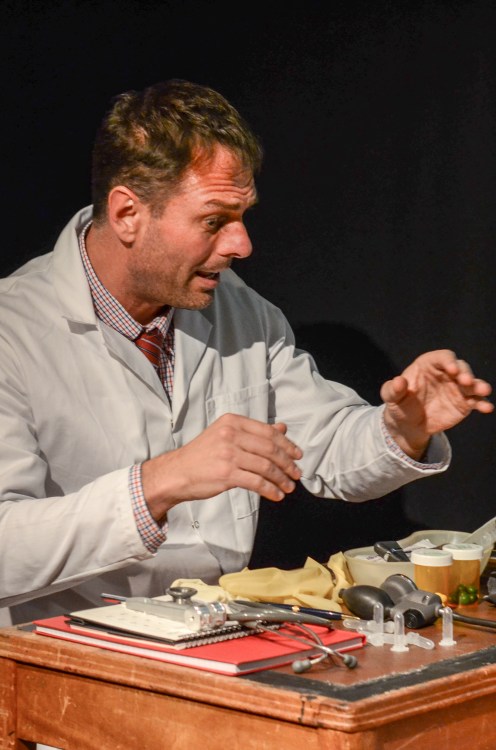
Atmospheric lighting and smart screen projections set the many different scene changes with precision; these were swiftly executed by nurses in uniform accompanied by well-known song clips ranging from Simon and Garfunkel to George Michael.
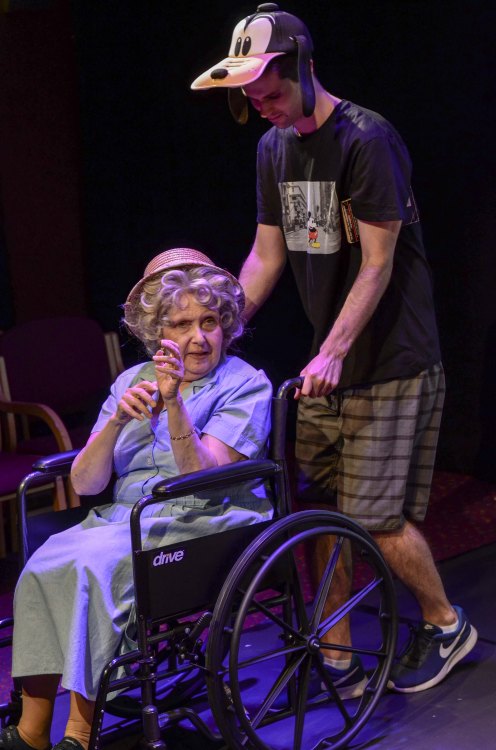
For an in-depth peek into family issues, Marvin’s Room is wry, sombre yet clever. It’s worth seeing not least to address one’s own family mechanics.
Helen Astrid
September 2019
Photography by Jojo Leppink (Handwritten Photography)
Through a Glass Darkly
The Father
by Florian Zeller
Richmond Shakespeare Society, Mary Wallace Theatre until 21st September
Florian Zeller’s The Father is about an elderly man descending into dementia. Understandably this is not the most attractive of opening lines, nor is dementia as subject matter likely to have audiences rushing for tickets, which is a shame as RSS’s current production of this clever play is well worth a look.

To begin with, the staging is highly effective. Portraying dementia on a stage relies upon a skilled set designer and an efficient crew. Set Designer Mike Read and the RSS crew fulfilled this brief to a high standard. The set, a white-ish room with basic furniture, the walls delineated by wispy strips of cloth was managed and changed efficiently, many times by a brisk, silent crew (not named in the programme other than under the headings of ASMs and set constructors). This set, together with Paul Nicholson’s lighting and Wayland Booth’s sound, echoed the mind of an elderly man losing chunks of his life on a daily basis. Visually the production was striking, the bright light of the scenes in which people talk, contrasted with the softer, total black indicating a scene’s end, and then the dim, flickering while changes took place sometimes looked like an old film. Crucially though, it made you think of confusion without actually confusing you – clever.
 The short description of what actually goes on over the next ninety minutes, usual in most reviews, would perhaps spoil the piece for a new audience. Suffice to say, events are viewed solely from Andre, the father’s, point of view. Andre is cared for by his daughter Anne, apparently in his flat in Paris. However, nothing is straightforward. Andre is not necessarily where he thinks he is. Or is he? Anne may not be Anne. She may or may not be married and Andre is unclear as to which man might be her husband. Zeller shows us the disintegration of the father but also the strain on the people who love him, but who must carry on their lives while trying to care for him. There is humour here too, gentle and sometimes poignant but present. As Andre flirts with his new carer, we have glimpses of the man he was.
Chris Haddock’s performance as Andre must have connected with anyone who has had dealings with dementia. Characters like Andre, who are not so much individuals as representatives of something, could be oversimplified or bland. Chris Haddock however, played an endearing, flirtatious and witty version of Andre, which made his personal losses so much more affecting.
Also connecting with the audience was Lynne Harrison as Andre’s daughter Anne. Her personal life, stuck semi-permanently between a rock and a hard place while she tried to do the right thing for the father she loved, struck chords you could almost hear. Anne was any one of us, not perfectly patient but doing her best. She drew a natural sympathy as her father began to lose his automatic self-control about which of his daughters he preferred.


The supporting cast provided strong back up. Laura-May Hassan was the type of carer we have all met and the apparently amiable Peter Easterbrook was quite frightening in a suitably unexpected way.
There were a couple of slightly odd elements to the acting, possibly because of direction. It is challenging to play characters who are not necessarily what they appear to be, in a play that is about confusion. That said, it was unclear whether Lizzie Williams as the nurse, towards the end, was directed to deliver certain lines as she did or whether that was her chosen approach to the moment. Perhaps it was an intended nuance I missed but it seemed slightly out of step. Similarly Luciano Dodero, as Pierre, did not seem at ease with the character-type he was playing. These are small distractions though and they did not detract from the piece as a whole.


Since being lucky enough to see Still Alice last year at Richmond, I have found drama about dementia to be surprisingly absorbing, and often comforting. I couldn’t honestly describe The Father as comforting but I would definitely recommend it and RSS should be proud of the job they have done with this production.
Eleanor Lewis
September 2019
Photography by Timeline Photos
Absurdist Farce of Time Again
My Name Is Cathy
by Andrew Sharpe
KatAlyst Productions at Chapel Playhouse, Kings Cross until 18th August, then on tour until 11th October
Review by Quentin Weiver
“If I had my time all over again …” is an utterance frequently breaks forth from the exasperated lips of those of us of a certain age. The pen of emerging writer Andrew Sharpe has reshaped the sentiment of these words into the thesis for his new play, My Name is Cathy, which he has presented in this year’s Camden Fringe.
The writer is aptly named as there is a keen edge to the word-craft and structure of the play. Sharpe describes it as “an absurdist farce for our time” and with nicely crafted black humour, Sharpe just steers it away from political polemic. His inspiration come from his background as a lawyer in the family and criminal courts.

It the evening of the eponymous Cathy’s fiftieth birthday and she sits with her only friend, a rapidly emptying bottle. Her opening monologue starts with the, sadly much parodied, introduction at a meeting of Alcoholics Anonymous, “My name is Cathy, and I am an alcoholic.” But somebody is there to hear her confession, her own self of a decade and a half earlier, the happy, successful and socially well-adjusted 35 year old Cathy, a clever and successful schoolteacher. The didactic that follows is a riches-to-rags story painful to hear, an aleatoric decline, almost Fassbinder-like in its inevitability, attributable to nobody, or everybody, a series of wrong-turns, bad choices, and farcical mistakes.
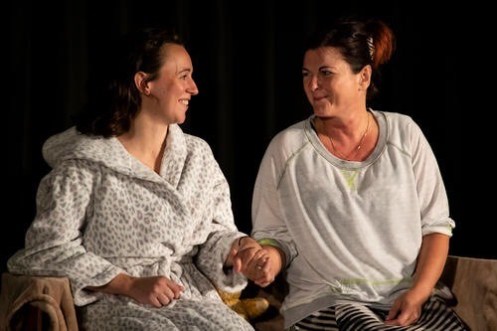
In the hands of director, Velenzia Spearpoint, the dispiriting theme is lightened by pulling out the moments of, albeit fairly dark, humour and of farce. She keeps the chronology focussed by the use of titbits of contemporary newscasts and of the songs then in vogue. Designer Adam Bottomley’s simple set transforms effortlessly from the chaotic orderliness of a classroom to the ordered chaos of a court of law.


In the courtroom scene, zealous young QC, Joanne Young argues her case unsuccessfully in a largely unsympathetic hearing before Judge James Goode. Playing both Young and the younger Cathy, Sally Paffett differentiates the roles well, showing an up-and-coming QC anxious to succeed, seen against the younger Cathy resting on the laurels of success as clever and popular teacher. But when, for Cathy, did confidence merge into arrogance?


Also doubling roles, Edwin Flay portrays a self-opinioned Judge Goode, very much of the old-school, and an entirely different character Dorian Craig, known to all as Dee, a self-absorbed man, seemingly unconcerned about that effect his has on the morale and self-esteem of the declining Cathy.
As the older Cathy, Kat-Anne Rogers’s portrait is as absorbing and as it is realistic, making for griping theatre. One could often almost feel the audience willing a different decision from her as her life gradually disintegrates.
Ambitions thwarted, spirit decimated, relationships dissolved. Would thing have been different if she could have had had time all over again? The question remains rhetorical.
Quentin Weiver
August 2019
Photography by Origin8 Photography
Sharp and Edgy Theatre
The Long Road
by Shelagh Stephenson
St Michael’s Players at St Michael’s Centre, Chiswick until 16th August, then at the Edinburgh Fringe until 24th August
Review by Eleanor Lewis
Dan, a teenage boy, goes out in the evening with his older brother Joe. There is a small altercation with a young woman outside a shop, she stabs Dan and he dies quickly on the pavement, his brother Joe leaning over him. The Long Road opens with Joe’s dazed but graphic description of those events, and calls the audience to attention with a ferocity that continues throughout Shelagh Stephenson’s sharply written play.

Over the course of the next eighty minutes, on a small set, efficiently lit and furnished with minimum scenery and props, five characters deal with the effects of this event. Dan’s grieving family veer off in different directions: his mother Mary struggles to understand; his father John wrestles with rage and distracts himself with running and then with alcohol. Dan’s brother Joe wonders whether he alone can be enough for his parents since Dan, he believes, was their favourite. Eventually Mary decides she wants to meet her son’s murderer and with the help of a counsellor she begins that process despite John’s objections.
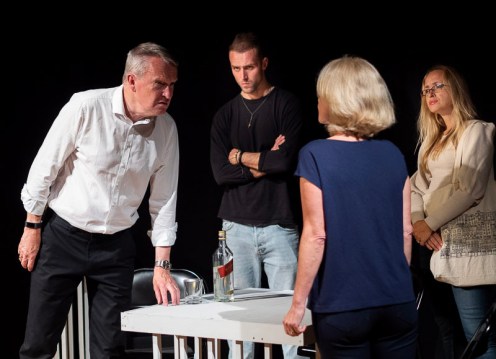
Shelagh Stephenson’s writing is pared down to the essential, it’s highly focussed with small details used to great effect. Elizabeth Ollier’s Mary describes the indentations of her late son’s feet in his shoes and says that she has told a university that he’ll be taking up the offer they made him. She’s not deluded, she’s pragmatic while lost in grief and all the more affecting because of it. 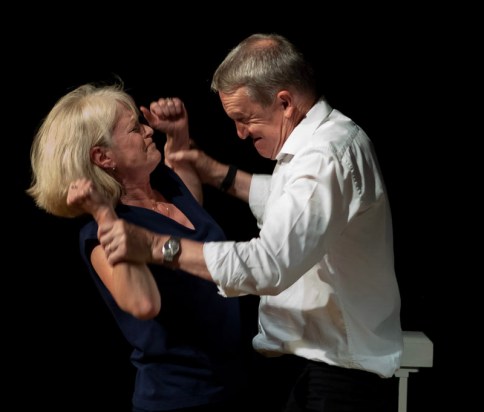
Alistair Dewar’s John is a man well on the road to self-destruction until brought up sharply by his own actions. Dewar plays him as a human being, not always sympathetic in his rage, but still recognisable as ‘one of us’.
Louis Bricusse as the older son and now the only child, skilfully portrays the confusion of a young man burdened with guilt and grief and without the life experience to bolster him.


Fleur de Henrie Pearce is striking as the badly damaged Emma, Dan’s murderer, with a beautifully observed and crafted performance. This character’s constantly hyped, constantly moving, defensive-aggressive demeanour is a human powder keg, a woman to whom nothing has been given and from whom an awful lot has been taken. She’s the woman you walk through the train carriage to avoid.
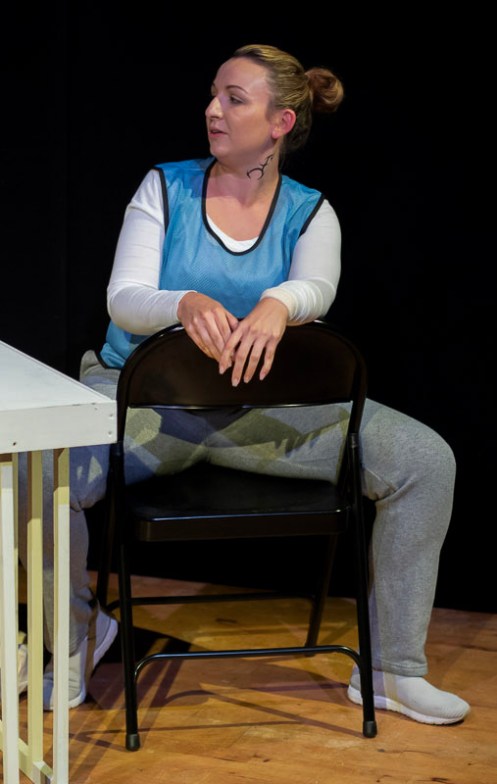
Into this festering mix, Elizabeth the psychologist arrives to take Mary and Emma possibly towards some sort of restorative justice. Leonia Chesterfield gives a suitably restrained performance as Elizabeth, again with attention to the small details, her momentary loss of control during her challenging interactions with Emma being highly effective because of its brevity.
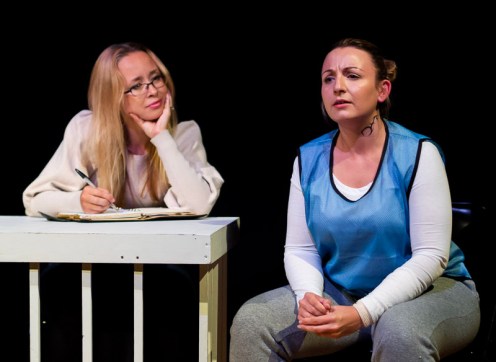
Though Emma’s dramatic trajectory is perhaps ultimately predictable and the play’s resolution a little too neat, this is not real life; it’s drama, and an exploration of the possible, so all bets are off and we are allowed to appreciate a little light at the end of a dark tunnel.
St Michael’s is high definition drama which ticks every box. Director and actors are completely in tune with their material and the material they have is high quality. My only disappointment was olive-related. The ‘olives exchange’ between various characters was a moment of gentle relief. I suspect there were others or rather I’m dimly aware that there were others but they weren’t as apparent as they could be. Humour is always present around death, however awful, and a peppering of it through the drama breaks the relentlessness and rounds the characters. That aside, this is an excellent piece of theatre very well presented. Highly recommended.
Eleanor Lewis
August 2019
Photography by Ian Trowbridge
Georgians on My Mind
Sense and Sensibility
by Jane Austen, adapted by Fiona Hatcher
Youth Action Theatre, Hampton Hill Theatre, until 15 August; 19–24 August, theSpace @ Niddry St – Lower Theatre, Edinburgh
A review by Celia Bard
The Dashwood sisters, Elinor and Marianne, must find their way through the delicate rules and salacious gossip of Regency society in this lively adaptation of the Jane Austen classic by Fiona Hatcher. Lasting no more than an hour, the show treats the audience to a series of highlights in a flurry of well-paced and well-structured scenes. The imaginative use of two narrators help the audience navigate the trials and tribulations of the Dashwood sisters and their associates.

The action opens with the funeral of John Dashwood senior, father of the three sisters. The security of the sisters and their mother is threatened when their half-brother John, heir to the Norland Park estate, and Fanny, his voracious wife, take over the family home and put pressure on them to leave, completely ignoring the wishes of Dashwood senior that their interests should be looked after. Fortunately for mother and sisters, a distant relative comes to their rescue and offers them a comfortable cottage in Devonshire.
The opening funeral tableau of members of the Dashwood clan is very atmospheric. The characters, dressed in funeral attire, hold static, photographic positions, while in the background is heard the singing of the Benedictus. The scene ends sharply, and within seconds the main characters have cast aside their mourning garb and we are in the feminine, pink drawing room of the family home, enjoying the witty but calculating manipulation of John Dashwood junior by his wife Fanny as she plots to remove mother and sisters from the estate.
John, played by Timothy King, is suitably pliant, putting up little resistance to his wife’s callous demands. Zofia Komorowska as Fanny gives an interesting performance: her characterisation reflects Fanny’s striking appearance and her manipulative, snobbish, self-centred qualities, but the actor tends to react to what is being said by other characters at the expense of interacting with them. She does, however, have considerable stage presence, and can certainly hold the audience’s attention. In her case it is perhaps worth remembering the old adage that ‘less is more’.
The three sisters Elinor, Marianne and Margaret, played respectively by Jennie Hilliard, Emmy Coates and Meaghan Baxter, give strong and compelling performances. The two older sisters Elinor and Marianne are complete contrasts. Elinor is ruled by her head and shows very little emotion and Jennie gives a very controlled performance, right up until near the end of the play when she breaks down, giving full vent to her emotions after learning that the man she loves, Edward Ferrars, has been secretly betrothed to another. In contrast, Marianne is played by Emmy as spontaneous and romantic. She attacks her performance full-on, displays a whole range of emotions, gripping the audience with her volatile personality. Meaghan Baxter as the youngest of this trio is just charming as Margaret Dashwood. She weaves in and out of the action, is delightfully childlike, and provides a running commentary on the comings and goings, and helps move the action along at a bouncy pace as she innocently drops snippets of adult conversation she has overheard into other conversations, much to the consternation of others.
The second of the narrators is Mrs Jennings, acted by Mary Rycroft. Through her eyes the audience are drawn into the misbehaviour of the gentlemen folk. She revels in their misfortune, keen to provide an upbeat, gossipy account of all that she witnesses. Mary positively embodies this role, and her attempts to act as matchmaker are especially humorous. Working well as a foil to Mrs Jennings is Lucy Steele, a giddy, simpering young woman amusingly played by Inara Stamp.

The male actors in this production are outwardly correct in manners and deportment, as would have been expected of them in Regency society, but their inner sensibilities tell a different story. John Dashwood, for example, inherits wealth, and although initially keen to carry out his father’s last wishes is shown to be weak and without morals, allowing himself to be totally dominated by his wife. Timothy underplays this character, and this contrasts well with his overbearing spouse.
Jake O’Hare’s portrayal of John Willoughby is carefully sketched. On the surface he is attractive and charming, but he is exposed as a cad by his easy abandonment of Marianne and seduction of Colonel Brandon’s 15-year-old ward. Edward Ferrars, at first seemingly dominated by Fanny as well, manages to extricate himself from his long-standing secret engagement to Lucy Steele, marrying Elinor Dashwood instead – much to the ire of Fanny, who was determined that he should marry someone of wealth. Cameron Christie is entirely convincing as Edward and plays him with great charm. Colonel Brandon, acted by Josh Clarke, is the most rounded of all the male characters. Throughout he acts kindly, honourably and graciously. Josh does justice to this role; he has charismatic stage presence and interacts intelligently and sensitively with other characters.
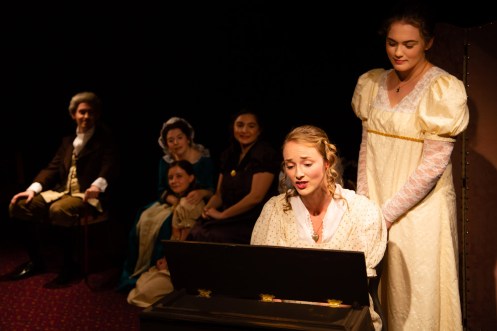
The play is in the capable hands of two strong directors, Sarah Down and Elizabeth Lattimore. The social fabric of the times is well researched, and this shows in the authentic costumes worn by the actors, the choice of music, which is very much of the period, and the deportment and manners of all the characters. Marianne’s piano playing and singing looked and felt very natural. The stage is well used, and the blocking is sound. The scenes move along seamlessly and are pleasing to look at. Only a slight readjustment of props was needed to indicate different locations, a great feat.
The whole of the YAT cast and crew should be complimented on successfully staging a fresh take on an old classic, it felt new. The cast came over as relaxed, enthusiastic, vigorous, and totally absorbed in their characters. A thoroughly enjoyable evening that deserves to be a great success in Edinburgh.
Celia Bard
August 2019
Photography by Jonathan Constant


