
Corpsing on Stage
Murder on Cue
by Robin Jennifer Miller
Rare Fortune Productions at the OSO Arts Centre, Barnes until 6th April
Review by Andrew Lawston
As if there weren’t enough actors living in Barnes already, the OSO has been transformed into Maple Lodge: a small but comfortable retirement home where a select group of thespians spend their autumn years sipping glasses of dry sherry, reliving past glories, and indulging old grudges. And possibly committing murders?
Robin Jennifer Miller brings her second play, Murder on Cue, to the OSO with Rare Fortune Productions, following last year’s enjoyable farce Liberty Hall. This time she has turned her sights on that other mainstay of British theatre, the murder mystery.
Maple Lodge’s relentlessly chipper manager Sue (Julie Haythorn) is not having a good day. The home has been cut off from the outside world by a blizzard, someone is sending poison pen letters to her residents, and the council are threatening to close her down. The one bright spot is that she has been named as a beneficiary in the will of one of the residents.

As the residents gather in the home’s lounge for drinks, along with the wonderfully obnoxious Gareth (James Price) nephew to the pugnacious resident Sybil (Sylvia Carson), many of their past misdeeds are revealed. The emotional stakes are raised and everyone takes a turn to look suitably suspicious until, inevitably, a dead body turns up just in time for the interval. Murder on cue, indeed!

In addition to writing Murder on Cue, Robin Miller appears as one of the actors, the apparently timid and fragile Desiree, and I’ve often observed that you can usually tell that a play has been written by an actor from the fact that everyone in the cast gets a decent joke. Here, there is a real ensemble feeling to the cast. Leonora Fyfe’s spirited Judy gets a lot more to do than your average cleaner in a murder mystery, and the murder victim spends most of the first half being so wonderfully unpleasant as to give the entire cast a motive! Martin Wimbush gives a poignant performance as Charles, an apparently restrained man, spending a lifetime regretting youthful mistakes, while Gregory Cox often dominates the room as Larry – positively relishing his own colourful past. Hilary Derrett’s Olivia clashes with him frequently, as the other larger than life character among the actors. Carolyn Pertwee’s character Molly remains an enigma throughout much of the play, always observing but speaking comparatively rarely.
It’s amusing that in a play full of characters complaining about being upstaged, however, director Maurice Thorogood gives each character time to shine and the cast is extremely well-balanced.

Miller’s new play embraces the genre’s tropes full-bloodedly, and often with its tongue firmly in its cheek. The cast are playing it straight, but most of them are also playing wonderfully camp old actors who are visibly glorying in the chaos and mystery that surrounds them.
The set, full of comfortable chairs and drinks cabinets, surrounded by drapes and faded black and white photos of the characters in their heyday, conveys the setting from the outset. The cheeky renditions of the Casualty and Midsomer Murders theme tunes prior to the show set the tone perfectly. The gentle and slightly knowing comedy is never allowed to dominate the production, but it’s also never far away.
The mystery at the heart of Murder on Cue’s second act is well-constructed, but the murderer is ultimately relatively guessable – although hopefully not from this review, which is spotlessly spoiler free. It’s around this point, however, that it becomes clear that the play is more about spending a wonderful evening with these delightful characters than it is about constructing a fiendishly ingenious mystery.
Murder on Cue is an enormously fun play, well aware of its roots, and not afraid to acknowledge them.
Andrew Lawston
April 2019
Photography by Paddy Gormley
Much Ado About Nothing
Waiting for Dawn
Nocturnal Productions at the Pop-Up Theatre until 1st April
Review by Avril Sunisa
“Unbeliveable” tended to be the reaction of the audience at last night’s premiere of Waiting for Dawn, at the inaugural outing of the ephemeral Nocturnal Productions company.
The concept of the non-venue specific production seems to be à la mode. For the weary theatre critic an invitation to review another such dramatic experience seems almost quotidian, but this performance emphatically shattered the mould. The theatrical conceit was that it should not be performed on a fixed acting space. Moreover the ethos of Nocturnal Productions is that the performance should be before sunrise, for its magic would be broken at noon.
Hence, the surprise venue for the specially invited audience was inspirational. When we arrived at Pop-Up Theatre, it was what might more accurately be described as a plop-up theatre, for it took place on an acting space that was certainly not fixed, on the River Thames itself. “Sweet Thames flow softly ‘til I end my song”, wrote Edmund Spencer in his Prothalamium, a phrase usurped by the dreary copier, T.S.Eliot. There was no such usurpation at last night’s premiere, which began shortly after midnight, and certainly no Waste Land. In fact, there was no land at all, as the performance took place solely on the quietly moving water. The moon, now in its third quarter, had not risen, and a superinundation of cumulus ensured there was not a glint to distract from the restful effect, so suited was it to this post-modern masterpiece.
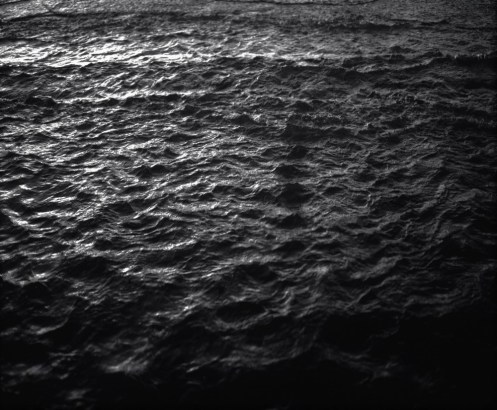
Designer Hydra Cherwell is at the forefront of her profession in minimalist design and her work for Waiting for Dawn seemed totally effortless. Of course a remarkable designer needs a remarkable team, and what can one say about Lighting Designer, Elifrop Tops, fresh from his home town near North Cape, where he habitually spends each winter. His lighting design is unique in never using, to quote his own words, “wavelengths in the range 380 to 740 nanometres”. I have never seen anything like it, and it is only his own much vaunted modesty that prevents me from calling his work brilliant. Equally remarkable is the Sound Designer, “Buz” Rowfoe’s nihilistic soundtrack, which cleverly enhances Cherwell’s concept of silently moving water. It left me speechless. You could have heard a pin drop.
It is difficult to summarise the plot in less than a few words. Preposterogenious does not do it justice. It honours the classical unities of time, space and action, indeed bringing them to their ultimate. The plot centres around the inaction of Otto Nix, scion of a wealthy family of stopwatch makers. His parents, Bob and Anna, named him Otto as they liked the nature of a palindrome, in that it makes no difference if it goes forward or backwards, and it is this equilibrium that has informed Otto Nix’s life. The role of Nix was played with great indifference by Hamm Stil, who neatly underplayed the somnambulant hero to great effect. Then into Nix’s life strolls Fanny Grey, who has an imperturbable influence on him. She plays hard to get by totally ignoring him and eventually succeeds in losing his understated affections. The excellent ennui of Ida San Souci, who played the part of Fanny, gave an air of unconcern which provided the dramatic statement needed for this circumventive femme flatale.
However, Nix has an erstwhile rival Hugo Slack, a cataleptic villain whose inability to do no evil knows no bounds. It would be a spoiler to reveal the extent of the dramatic tension that leads to the play’s inevitable conclusion, but suffice it to say the incredible portrayal of Slack by veteran actor Cyrus Bender leaves one breathless with anticipation.
A cameo role by much loved household name Penelope Prolapse as Mrs Toxwell, the unnoticed chatelaine of Nix’s country mansion, brought a definitive punctuation mark to the skilfully measured denouement of the plot. However it was largely the unnamed minor characters that stood out as the deep bedrock of this phenomenal production and gave it the nuanced hint at a love story that is not be.

The audience received this minimalistic mood-piece as mind boggling. One felt them willing it to go on. Riveting.
Director Nemo Knightman is to be congratulated for an unforgettable spectre of theatre, which barely ruffled the waters of his fugitive stage, a low-energy footprint piece that is worth watching out for, in case it makes a revival.
The last Tuesday in March 2020 marks Nocturnal Productions’ next post-midnight premiere. It is firmly in my last diary. It is already in rehearsals, Waiting for Godot, the Musical. It is also mooted that the company is acquiring the rights to Waiting for Brexit, which is under discussion for Nocturnal Productions’ 2029 season. For the aficionado of the hypo-minimalistic theatre these productions will be a must!
Watch and watch this space.
Avril Sunisa
April 2019
Photography courtesy of Nocturnal Productions
Caprine Caprice
The Goat
or Who Is Sylvia?
by Edward Albee
Arena Theatre at the OSO Arts Centre, Barnes until 30th March, then on tour until 29th May
Review by Celia Bard
I first became aware of this question ‘Who is Silvia? What is She’ in the play Two Gentlemen of Verona, written by William Shakespeare. Edward Albee provides us with his own 21st century account of the same question.
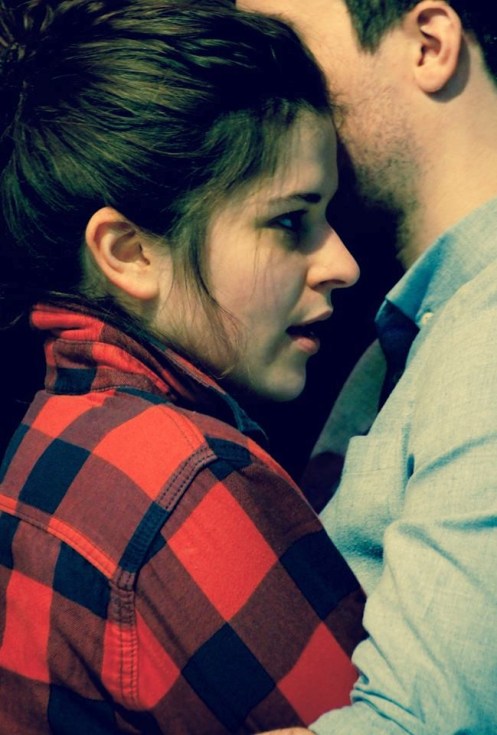
Arguably Albee has something else in common with Shakespeare other than his use of the same question and that is his interest in bestiality, but with a difference. For example in the play A Midsummer Night’s Dream, Titania falls in love with Bottom after his head metamorphoses into that of a donkey’s. In the play The Goat, our protagonist, falls in love with a goat, but that is where the similarity ends. Shakespeare’s play is a comedy, and it is fanciful. There is no question that you are in the world of make believe, a world controlled by fairies. Shakespeare tells the story of young Athenian lovers, a group of mechanicals and fairies. Any thoughts of sexual deviancy as seen between Titania and Bottom is viewed as comedic, light-hearted, and mischievous. Although there is a great deal of comedy in The Goat, the same cannot be said of Martin and Sylvia where the relationship falls into the arena of sexual deviance, though the audience is spared the actual physical sordid details of intercourse. The play tears apart any semblance of social norms relating to an extra marital affair. What occurs between Martin Grey and Sylvia goes well beyond what is considered acceptable by society, the audience is asked to consider the sexual relationship between a man and a goat, and this is a hard task for any audience.
The setting of the play lulls the audience into a false sense of security. The trendy black chairs suggest that we are in the living room of an educated, comfortable, middle-class, trendy family. The cast consists of four characters: Martin Grey, a successful architect; his wife, Stevie; their 17 year old gay son who is at College; and Ross Tuttle, a close family friend and host of a television programme. To all intents and purposes Martin, played by Matthew Ellison, and Stevie, played by Lotte Fletcher-Jonk, are a happily married couple of some 23 years. They are casual in conversation, joke a lot and their sex life is good, judged by their conversation, Stevie’s flirtatious behaviour and sexual innuendos in the opening scene. There are however signs of strain in Martin. Despite the jesting, he appears ill at ease and forgetful. In casual conversation he comments that he is having an affair with a goat. The audience, like Stevie, can be forgiven for thinking that this is light-hearted banter. She laughs aloud and jokingly responds that she off to the pet shop to buy some food.
Just before Stevie leaves, Ross arrives at the Grey’s house ready to tape an at-home interview with Martin. During a lull in the taping, tells Ross of his transgression. This secret once fully comprehended by Ross and then Stevie, after Ross informs her in a letter, turns this comfortable, middleclass home into a combat zone. Any illusion of normality dissolves. Martin’s secret is dramatic and is threatening to both his family and career, and he has a lot to lose, having just won the prestigious Prizker price and the contract to design a very large city community complex.
All three adult actors give excellent performances. The dialogue is fast moving, they are quick to pick up on each other’s cues and are superb at building up dramatic tension, holding the audience in suspense. This play demands strong physical action and movement, and the actors don’t disappoint. Direction is sound, good use is made of the stage and the director unquestionably has a good grip of play content, and stage and acting strategy.
Lotte Fletch-Jonk is outstanding as Stevie. Her performance is spell-binding, able to convey intense emotion whether it is anger, horror, disbelief, realisation and then eventually revenge. Her vocal range is impressive, as is the way she is able to shape her speeches, the highs, and the lows. She is totally immersed in this character, so it is quite a shock when she comes to take her bow at the end of the performance and smiles disarmingly at the audience.
Mathew Ellison as Martin provides a perfect behavioural contrast. On the whole an understated performance, given to occasional bouts of anger. He succeeds in depicting a character totally detached from his own feelings, that is until he experiences an epiphany with Sylvia. He knows that he is behaving in an amoral way, is ashamed of the act, but doesn’t feel guilty. He is surprised when he attends a therapy group with people who share his same peculiarity that he feels different to them. Whereas they feel guilty, he doesn’t: they are going there to be cured. He rejoices in his new-found relationship and doesn’t want it to stop. In the opening scenes he displays a preoccupation, and forgetfulness, which may be explained away by the secret he has to keep for fear of retribution. The other explanation is that suffers from the beginnings of dementia and this is having an effect on his sexual urges. Martin is a complex character and Matthew captures the disturbed and tormented dimensions of him well.
Ross is played by Ancor Figueras Ramos who gives a strong performance. The friendship between him and Martin is long standing, some forty years, starting when they were both ten. One aspect of his performance that slightly jars is Ancor’s European accent, which felt that he hadn’t been in England for long. He is, however, extremely convincing, at first wanting to help Martin by finding out what is troubling him, but then totally disgusted, horrified, and shocked when he finally realises that Martin is ‘having it off’ with a goat, i.e. Sylvia.
The gay teenage character Billy, played by Stephanie Brewer adds another dimension to the play. It is perhaps no coincidence that the couple’s off-spring is called ‘Billy’, a name often word associated with a male goat. The kiss between father and son plus Martin’s dialogue about holding a baby and feeling a sexual urge arouse uncomfortable thoughts in minds of audience. Stephanie acted this part with intelligence and sincerity, but for me this role does need to be played by young male and Stephanie undoubtedly is female. This broke the suspension of belief that is needed for the drama.
The Goat is a difficult play to watch, often stomach churning, no taboos, nothing is off limit, but it does succeed in raising questions about the nature of human beings and the relationship between the intellect, sexual desire, and uncontrollable sexual urges. To complicate things Martin make it quite clear that his feelings for Sylvia are more than just a sexual urge. He talks about having an epiphany on first seeing Sylvia on the farm in the countryside and gazing into her eyes. Shakespeare touches on this theme in The Tempest and in the character of Caliban, who has some of the beautiful, poetical lines in the play, but is depicted as bestial by Prospero and imprisoned, because of his urge to sexually assault Miranda. The audience left with the question: not who is Sylvia, but who is Martin and how could this educated, creative, happily married, sordid, tragic man behave in such a bestial manner? If Martin represents human kind, a greater question is an old age one “What piece of work is Man!” [Hamlet (2.2.295-302), Hamlet to Rosencrantz and Guildenstern.]
Celia Bard
March 2019
Photography courtesy of Arena Theatre, Constellations, 2017
Claws Analysis
Future Conditional
By Tamsin Oglesby
Questors Academy at The Studio, Ealing until 6th April
Review by Eleanor Lewis
“Adults are only children grown up”, was a saying my mother, a primary school teacher, occasionally came out with. On the face of it a statement of the blindingly obvious, but what she meant was that if you look hard enough at the adult, you can often see the child they were. She had another one: “Everyone goes to school”, by which she meant that if you’re in the state system you don’t get to pick who your child makes friends with. The second is, I think, in the minds of more parents than care to admit it but both these observations came back to me whilst watching Questors’ highly entertaining production of Tamsin Oglesby’s play Future Conditional.
There are child characters in this work but only one, Alia a refugee from Pakistan, is present on stage. Resilient and highly intelligent, Alia lives with a foster family and arrives at a British school where she meets Mr Crane, an overworked, overstressed but still committed English teacher. Throughout the play, action shifts to and fro from classroom to playground, a government think tank, a café and an Oxford college, each location suggested by childlike, crayon sketches projected on a screen. Alia, played by Sunaina McCarthy with exactly the right mix of naïveté and sizzling intellect, appears from time to time, pulling the narrative along.

In the playground, mothers from different backgrounds extract information from each other as to whose child has a tutor or is taking up an obscure musical instrument to make him more attractive to the private school. There are two fathers, one pretends to be constantly on the phone, the other has little input but all the parents are deeply neurotic about which school their children will go to, with the possible exception of Kaye who is more devoted to her dog than her child. Friends on the surface, they are ruthless competitors on behalf of their children until they are thrown into solidarity by a combination of guilt and desperation. One then tells another about the website which will fake council tax bills so you can prove an address; another, no longer able to afford school fees, engineers her child’s now empty place for her friend’s daughter who doesn’t approve of private education, but can’t face the choice of state school she’s been offered.
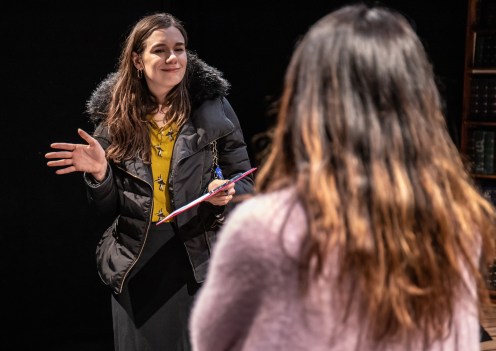
Several actors were playing two characters. Matthew Saldanha, Ruth Comerford and Nicola Amory, all with two roles made each of them particularly distinct, but every actor on stage produced a strong, well-observed performance. The mothers, each with a basic identity – hippy, yummy mummy, dog-obsessed, etc – did not perform as caricatures. Lucy Palfreyman, as Suzy, did a sterling job of representing the parent who’s trying to do the honourable thing and use the system as it’s supposed to be used. She also delivered the line that sums up the whole sorry scenario: “You expect the system to work don’t you, but it doesn’t, you have to work the system.”

The Education and Equalities Commission, whilst searching for ways to improve the way the British do education, neatly provided us with an image of how we as adults have to account for our education: the Eton old boy is generally despised and the grammar school girl is apologetic (what’s that myth about it not being your fault where you went to school?). In an attempt to make progress, the Commission invites a child who’s actually in school to its meetings. Alia is, of course, the child. She is oblivious to festering British class issues (when she discovers the Eton-educated policy advisor is not the only public schoolboy in the room, she joyfully announces “Ah, you’re from the same tribe!”) and her logical approach actually provides them with a solution (no spoilers) which they cannot handle and which ultimately results in a full-on flapjack fight (front row audience, take cover), adults being, as we know, only children grown up. Bradley Peake and Joshua Perry were totally convincing and very entertaining as two sides of the educational divide, their contempt for each other barely contained, but not quite as simple as either of them thought. Credit must also go to Tony Sears who will be on sugar-overload by the end of the run.

There was an equality to this cast and their level of performance which makes focussing on individuals unfair. That said, William Busby’s Crane was an endearing, accurate and completely unsentimental portrayal of an exhausted teacher, still on the side of his students even as he reached peak frustration resisting a senior manager’s insistence that he apologise to a parent whose child has abused him. Crane was often on stage on his own, talking to an invisible class. It was some distance from Joyce Grenfell’s George, Don’t Do That but still laugh-out-loud funny. Richard Gallagher’s perfectly paced direction was seamless and made the whole thing work beautifully.
Doing the best for your child in an education system that is complex and quite mysterious in many ways is a challenge no parent looks forward to. Education at its core though – children forced into an environment they don’t want to be in whilst adults try desperately to equip them for a world that will cut them no slack once they arrive in it – has always been a comedy gold mine, from Willy Russell’s Our Day Out, to today’s Derry Girls. Writing about the British system is perhaps only slightly easier than trying to write about Brexit, but Future Conditional is both hugely funny and as informative as it is possible to be about how our system works, or is worked. This is Team Questors at peak fitness, and this production is splendid. Highly recommended.
Eleanor Lewis
March 2019
Photography by Robert Vass
Fairly Fizzling Fantasy
Aladdin Jr
Dramacube Productions at Hampton Hill Theatre until 1st April
Review by Didie Bucknall
It is good to see that the performing arts are thriving in the Richmond area with so many young people being involved in singing acting and dancing. Dramacube Productions provides students aged 7-16 years with an opportunity to perform in full scale musical theatre shows around the borough.

Eight performances of Aladdin Jr were given over three days involving five teams, two from Hampton Hill and three from Twickenham. Each team comprising 18 to 24 young people. The amount of organisation and rehearsal involved to achieve this is mind boggling.

It would be invidious to single out any individual performers because the reviewer was not present for seven of the performances, but on Saturday night the stage fairly fizzled with energy, cheered on by an appreciative audience comprising chiefly of friends and families. There were plenty of laughs, some intentional and some unintentional.
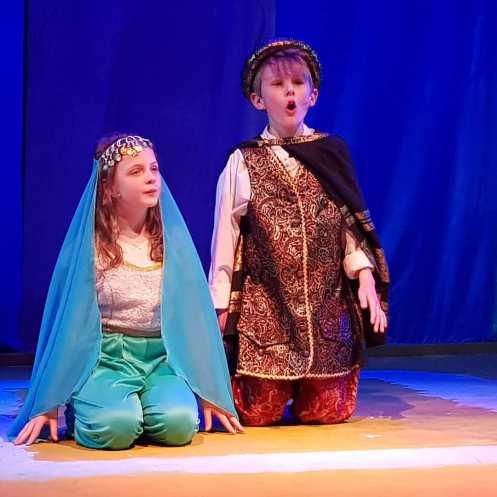
Sometimes lines were delivered a bit fast to be heard in the auditorium and sometimes the recorded music drowned out the singing, but the pace was good and characterisation largely well sustained. The principal actors were good and sang and danced with great stage presence.


The cast enjoyed themselves and this enjoyment reached out to the audience. Obviously some shone more than others but taking part in productions helps young people to develop social skills and grow in confidence which will be of use to them in their adult lives.
We wish them well in their future productions.
Didie Bucknall
March 2019
Photography courtesy of Dramacube Productions
Chance Relations
Wise Children
Adapted by Emma Rice, from the novel by Angela Carter
Old Vic and Wise Children, Richmond Theatre, until 30th March, then on tour until 6th April
a review by Matthew Grierson
There are at least three sets of twins in Wise Children – it’s hard to count, given they’re each portrayed by several different pairs of actors – and in their youth one brace of brothers, Melchior and Peregrine Hazard, are distinguished by their respective interests in art and fun. Happily the play itself makes no such distinction: as far as Angela Carter and Emma Rice are concerned, art and fun are identical.
In fact this play has little truck with binaries of any kind, and makes a virtue of the cast’s capacity to double, as well as their universal excellence in dance, song, gymnastics and lightning-quick costume changes. Gender is equally fluid, with twins Nora and Dora Chance portrayed by men for at least some of their lives, flaunting the show’s debt to panto and music hall.

Coupled with the longish timespan of 75 years, the cross-dressing also put me in mind of Virginia Woolf’s Orlando – an impression only reinforced by the fact that the passage of time from the First World War to the dying days of Thatcherism barely registers outside the ageing of the characters, and this is a London as much mythic as historical. In short, time passes, and the Chance-Hazard family’s antics remain centre stage.
The show’s conceit is that, on their 75th birthday, Dora and Nora (Gareth Snook and Rice herself) are looking back on their lives “sarf” of the river, and forward to a party on the opposite bank that evening. These Chelsea festivities are not being held in their honour, however, but celebrate the 100th birthday of famous thesp and infamous philanderer Melchior Hazard (by this stage, Paul Hunter), also the Chances’ biological father.

This prompts the re-enactment of the family story, a digression that is actually the story itself. Nora and Dora narrate, and the lives of their parents and grandparents are recreated by a troupe of performers who weave effortlessly in and out of character around them. The family’s theatrical lineage means we are often watching plays within plays within plays, in a space that is part dressing room, part stage and entirely magical.
Central to the set is a caravan representing the Chances’ Brixton home, the gaudy décor of which, perhaps resembling the cover of one of Carter’s novels, is revealed as it is spun out centre stage. Its presence cannot help but recall Jerusalem, and like Jez Butterworth’s play this one is interested in the idea of Englishness, and more so in reworking Shakespeare. (Did I mention that Dora, Nora, Melchior and Peregrine were all born on 23rd April?)
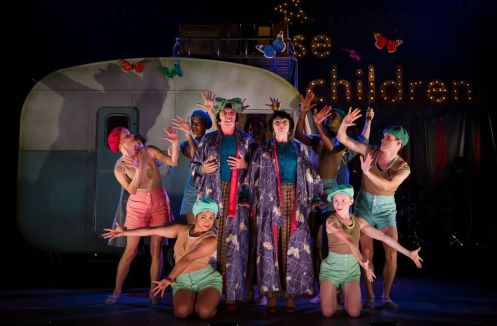
Even the title twists the older proverb that Launcelot Gobbo riffs on in The Merchant of Venice, ‘it is a wise father that knows its own child’. From hereonin, Wise Children never stops taking and tweaking, as is cheekily emblematised in the show by the Melchior-managed revue that shoots to the Chance sisters to stardom, What You Will.
The family’s or families’ story plays out like the Folio’s greatest hits, what with murdered parents, transvestite twins, embedded plays, bed tricks and spurned spouses, at the same time mixing it with the finest music hall tradition, a mash-up neatly encapsulated in the Chance sisters’ address at 49 Bard Lane, Brixton.
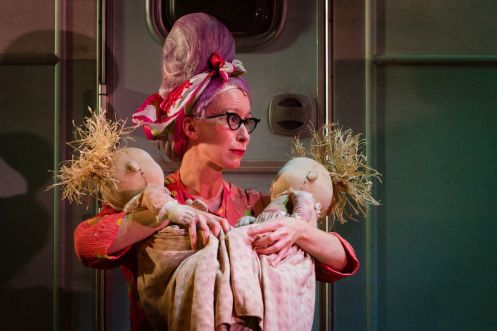
The doubling and trebling of cast members works cleverly to unite high culture and low, too: Hunter, for instance, is equally but distinctly charismatic as end-of-the-pier entertainer Gorgeous George and aged ham Melchior. He even ends up marrying himself, sort of, when he elopes with his earlier incarnation (Ankur Bahl) once the latter reappears, dizzyingly and delightfully, as a young American hoofer.
Speaking of footwork, Omari Douglas has already stolen several scenes as a dancer-cum-mime before he drags up as Showgirl Nora to brilliant effect, and he’s ably matched by Melissa James’s Showgirl Dora. As the teenage twins emerge as individual characters, though, neither can help falling for Patrycja Kujawska’s taciturn Blue-Eyed Boy … Cue a series of acrobatic simulations of sex.
Without a word of salaciousness, the numerous couplings between various combinations of characters are one of the play’s many highlights, each act done with a playful articulation and sense of fun. These coital encounters are not without their shadows all the same. Melchior and Peregrine’s mother is killed by jealous husband Ranulph, while Nora has a miscarriage, which conveyed respectively through a mime to music and the deft deployment of a groundsheet and red paint, are testament to the production’s faultless stagecraft.
The one exception to the spectacular lovemaking is also the one unsuccessful element of the play. The first act hints at Nora’s abuse by Uncle Peregrine, and the closing scene confirms this, striking at first a joyous and then a recriminatory note. While the theme of incest is toyed with elsewhere in the show, notably in two Lears’ marriages to their Cordelias and George’s pier-end patter, it’s difficult to get this particular worm back in the can after it’s been opened. Perhaps the relationship is part of the novel that Rice, as adaptor, was neither able to excise nor resolve?

Elsewhere, Mike Shepherd as old Peregrine takes his nieces for a ride in an altogether more wholesome fashion, though at the wheel he suggests he’s had driving lessons from Mr Toad. Such choreographed chaos corresponds with well-drilled song-and-dance numbers throughout, whether the tunes are pastiches from the jazz age or pop hits of the 80s (there’s a rousing routine to Eddy Grant’s Electric Avenue in homage to the Brixton setting).
Without exception the cast are exceptional, and a reviewer less pressed for time and space than yours truly could afford to effuse over them all. Still, the scary, brattish junior Hazards must merit a mention, as does Katy Owen as Grandma Chance, shimmying about the place in a nude suit and vowing that not even Hitler will stand between her and another milk stout. Bless her. And as if you don’t think the cast are talented enough already, they all prove very handy with the puppets that pepper proceedings, too – flames, butterflies and babes in arms are all marionetted to enrich the Chances’ relations.

I could pseud and enthuse all night about this theatrical triumph, but that might prevent you catching Wise Children at Richmond before it closes. At bottom, and indeed other orifices you may care to name, the play is a delight, never losing sight of the darkness but always filling it with greasepaint and sawdust, glitter and neon.
Matthew Grierson
March 2019
Photography courtesy of Target Live
A New Look
Iolanta
by Pytor Tchaikovsky
Rose Opera at the Normansfield Theatre, Teddington until 24th March
Review by Didie Bucknall
The scene is set in the paradise garden of an overprotective king who is desperately trying to shield his daughter from discovering that she is blind. She is cosseted by many maidens who tend to her everyday needs. She is oblivious to the fact that she cannot see and is content with much; the sound of the wind in the trees, the smell of flowers, the warming of the sun, but feels a certain melancholy as though something is missing from her life.
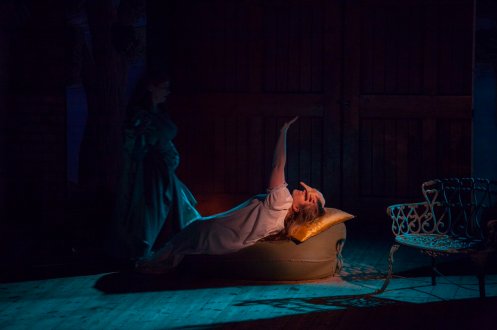
Iolanta, Tchaikovsky’s short lyric opera in one act was performed in the original Russian by the fledgling Rose Opera in the stunning Normansfield theatre, still unspoilt with its beautiful arts and crafts decoration and stage settings. Surtitles were provided on a screen adjacent to the stage.
Ukrainian born Tamara Ravenhill took the lead part of Iolanta is a beautiful lirico spinto soprano and we look forward to hearing her in future Rose Opera productions. She held the audience as she felt her way around the garden, her character being blind from birth. It may have been a small stage to manoeuvre a big cast of her supporting maidens, however in contrast we might have hoped for a bit more movement from the principal singers as the production was occasionally somewhat static.

Intruders arrive at the garden; Ian Helm as Iolanta’s intended suitor Robert, in fine voice, bewails the fact that though he had been betrothed to Iolanta from childhood. He dreads the thought of marrying her as he had been smitten by love elsewhere. Luckily for him it was love at first sight for his friend Vaudémort, played by Andy Evans, and it was he who revealed to Iolanta the fact that she was blind, thereby incurring the king’s wrath.
Crispin Lewis as King René took a little time to get into his stride but his rich bass baritone voice gave gravitas to the part. He brings with him a mysterious oriental healer, Aleksi Koponen, another fine baritone, who can only heal Iolanta if she really wishes to be healed and for that she has to be made aware of the fact that she is blind. It is a hard choice for her to make as hitherto her world has been one of sounds and smell and touch and she cannot comprehend what it is to be able to see, but she makes her decision and, as she gains her sight, we the audience like Iolanta are almost blinded by the suddenness of the colourful set and the bright light. She shields her eyes and we feel her shock as the stage appears to erupt in a blaze of colour, the ladies of the court now appearing in glowing blue robes instead of the previous drab.
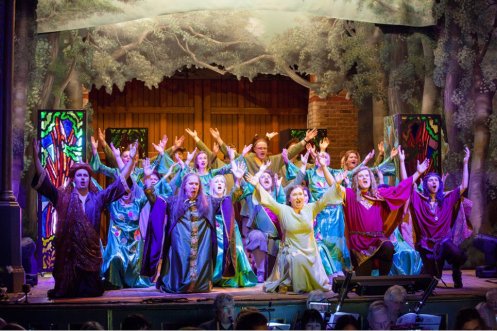
The twenty nine strong orchestra conducted by Peter Ford did not overpower the singers as is so often the case. The music was beautiful and descriptive of mood.
It was an ambitious opening presentation by this new opera company and they must be congratulated on their fine achievement. We wish them every success in the future.
Didie Bucknall
March 2019
Photography by Tom Medwell
Just Your Cup of Tea?
A Nice Dilemma
Hounslow Light Opera Company, short tour until 23rd March
Review by Eleanor Lewis
Hounslow Light Opera’s spring musical revue took the form of a selection of show songs and medleys loosely brought together by a script in which an amateur operatic society tries to decide on which show to do next. A small group of actors played the part of the society’s committee members discussing past shows, possible shows and favourite shows. The rest of the company, on cue from these sections of conversation, performed a selection of songs from each show.

HLOC adopted a similar approach with their 2017 show, Spring Song Singers, that revue being based on the idea of a choir that had to be coaxed into focus in order to rehearse their upcoming concert. This is a useful format for performing songs with a quirky bit of humour to stitch it all together, and it’s an alternative to just standing in lines with the music in front of you and a narrator providing background to the songs. The spring show is also an opportunity to bring to the front performers who do not necessarily get to perform leading, or more substantial, roles in the bigger autumn shows.
Saturday night therefore saw the company dressed in black and performing a range of show favourites including work by Stephen Sondheim, Rodgers & Hammerstein, Gilbert & Sullivan and others. HLOC are at their strongest in their choral work and this was clear from their rendition of both Marc Shalman and Scott Wittman’s You Can’t Stop the Beat and a Rodgers & Hammerstein medley in the second act – they were evidently both comfortable and confident with the music and it made a significant difference to the level of performance. Pushing the company to the dizzy heights of a Stephen Sondheim Into the Woods medley might have been a push too far, but the assembled singers made a reasonable job of it though the nerves did produce a little hesitation; and hesitating with Sondheim’s music is unwise.
The musical accompaniment of Lee Dewsnap, HLOC’s Musical Director, who played keyboard with a genuine passion also raised the level and buoyed the company along. When amateur singers are comfortable the possibilities are probably not endless, but definitely greater than when they’re nervous. Credit must therefore be given to Chris Blackmore who maybe does not always perform solo but gave a very decent rendition of West Side Story’s Somewhere, again, despite nerves. There were other brave soloists not specifically named in the programme, a sweet (uncredited) voice sang the opening of The Sound of Music. It must be said, however, that it’s always good to err on the side of caution if singers are not yet musically ready for a lone performance. You’ll Never Walk Alone is no easy feat for a professional, never mind an amateur singer and Andrea Wilkins’ brave attempt at this musical icon was, if truth be told, not ready for a paying audience.
While singing, the company moved to choreography by Fay Ellingham which occasionally looked a little like a gentle aerobics class but suited the level of the performers, complemented the singing and allowed for singing without breathlessness.
The device of using an operatic society’s committee wondering which show to do next was what brought to mind HLOC’s 2017 show. Johanna Chambers’ direction of this part of the 2019 concert, however, was a little odd. Lucy Sim seemed to be delivering lines to an audience that was hard of hearing (in the cosy surroundings of St Mary’s Church Hall), and the other committee members were enunciating their lines in the rather extreme way in which children might after a teacher had tried to get them to vary their tone of voice for performance at assembly. Whilst there is little scope for characterisation beyond caricature in the tiny little scenes they performed in between the music, their interactions as characters seemed rather forced. The attention to small detail in the 2017 show’s characters on the other hand, had made a tiny but critical difference which produced more natural acting performances.
It’s always difficult for a society performing on a limited budget to cover all the bases, but the strip lighting in the church hall is no great creator of mood and perhaps paying a little attention to this – use floor lamps or standard lamps or similar – with a view to being able to turn off most of the strip lights would help to summon up a little atmosphere.
Recent Hounslow Light Opera shows have been strong, their autumn Ruddigore, a tribute to the late Peter King, was an entertaining and uplifting event. They are a society that works with the talent they have, and that in itself is to be admired. A Nice Dilemma, whilst not their most outstanding work, was still a pleasant evening’s choral entertainment and I look forward to their autumn show.
Eleanor Lewis
March 2019
Photography by St Erudite
Perfect Tension
All My Sons
by Arthur Miller
Richmond Shakespeare Society, Marry Wallace Theatre, Twickenham, until 30th March
a review by Matthew Grierson
The Keller family may not be perfect, but the three performers who bring them to life in RSS’s All My Sons are.
Miller’s domestic drama is set in suburban Ohio in the aftermath of the Second World War, and pays close attention to its everyday detail and vernacular before plunging into lake-like depths. Yet never do these transitions from banality to intensity feel unnatural, such is the carefully modulated direction and the lightness of touch with which the cast handles the heavyweight material.

As he is introduced to us, Joe Keller seems the godparent of the neighbourhood, play-acting police chief for local kids such as Wilhelmina Stringer’s charming ‘Bert’. However, through Simon Bickerstaffe’s steady, nuanced performance, we gradually understand the troubles that beset Joe, and even as he squanders the sympathy of his family he retains ours, making for compulsive viewing. In particular, we see why he feels so paternal to children not his own, and why they in turn have come to associate him with the law: the jail that ‘Bert’ imagines him in charge of becomes the prison in which his previous decisions have trapped him, and the over the course of the play we learn how confined he actually is.
Miller’s deft deployment of the classical unities helps effect this confinement. The action is limited to one time and space, 24 hours in the Kellers’ yard, structuring the piece as a series of disclosures that gradually but inexorably move the narrative towards its sad conclusion. There is also unity of subject, in that although the play seems at first concerned with missing son Larry, who never returned from the hostilities, it then opens up the possibility that Joe is implicated in an industrial scandal for which business partner Steve Deever ended up in jail, before finally revealing the two events to be intimately connected.

This tragic movement is reinforced by the way the play entertains a Sophoclean view of fate without ever labouring it. Faith in superstition is playfully ascribed to chirpy, guileless neighbour Frank Lubey (Emilio Cavaciuti), who draws up a horoscope proclaiming that Larry is still alive, keeping the concept of fate in view while ironically misreading it as postwar optimism. Kate – Larry’s mother, Joe’s wife –insists on believing such astrology, her need to imagine her son’s return being shown in the veiled desperation of Dorothy Duffy’s faultless characterisation. While she and Frank are ultimately proved wrong, fate is nonetheless closing in on the family as a grim consequence of Joe’s past actions.

That all this drama unfolds over the course of a day might require that we not simply suspend our disbelief, rather abandon it entirely. But the conviction of Mair Graham’s tight direction honours the script’s fine balance between realism and the tragic tradition. The action moves freely and easily as it needs to, but can turn on a dime to become tense and confrontational. We see this, for instance, in an exchange between Sue Bayliss (Claire Driver), the doctor’s wife, and Ann Deever (Sarah Imran), former sweetheart of Larry who is now engaged to younger Keller brother Chris: what begins as pleasant small talk between the two women quickly but imperceptibly shifts into an awkward stand-off, with each positioning themselves at either downstage corner. Similarly well handled is the reappearance of Ann’s brother, George (Ben Willows), who swiftly escalates an argument with Chris before being mollified by the appearance of Kate, who treats him as though he were her own missing son, returned at last. When Joe emerges onto the porch once more, though, the temperature on stage noticeably drops.
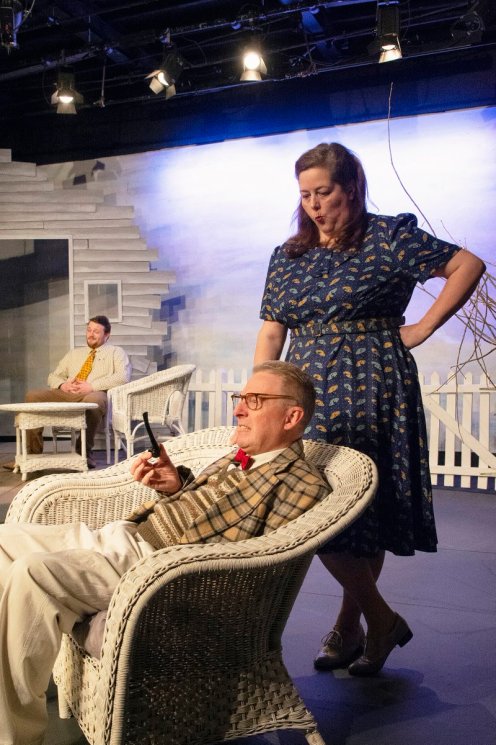
Though the weight of the play does not fall on them as it does on the Kellers, Imran and Willows give able support as the Deevers. Under the shadow of his father’s imprisonment, George is an embittered contrast to Chris, but being a newly qualified lawyer is able to tell the Kellers some difficult truths, which Willows plays with convincingly awkward authority. As Ann, Imran portrays a character resolute to move on from Larry while maintaining good relations with her own family and her fiancé’s. It would have helped if she could have conveyed more of the burden she carries throughout the play in the shape of Larry’s last letter – deploying this like an oracle towards the end of the play, she has given little indication over the previous two or so hours of having to nurse the terrible secret it contains. There is no doubt, though, that the love she expresses for Chris is genuine, and one of the most tender moments of the play is the kisses they steal when alone together.


But the breakout star of the production is surely Jack Lumb as the affable, easygoing Chris Keller. Unlike the rest of the characters, Chris is upfront about his failings – having lost most of the unit he led in Europe – and so as the others’ secrets emerge we experience them through his reactions. Indeed, his is the character that undergoes the greatest transformation in the course of the play, and Lumb completely sells it. From boy next door to heartbroken son, no line reading or gesture is misjudged, and in technique and affect alike he proves himself equal to the impressive Bickerstaffe and Duffy as his parents.

With such a strong trio at the heart of the play, it’s not easy for the smaller parts to shine, although as Sue Bayliss, Driver definitely holds her own. Dr Bayliss (John Mortley) and Lydia Lubey (Heloise Plumley) meanwhile are essentially comic sketches, there to supply the lighter beats, so have less room for manoeuvre. The former in particular is not helped by his struggles with the American accent, something sadly emphasised by the otherwise uniform quality of the cast in this regard. At least he gets some good lines.
What remains perfect, though, is the way that Miller writes human imperfections¬ and Graham orchestrates them. The space of Hazel Ashworth’s simple, angled set – sky, house, yard and trees – together with period music and projections, form a fine package in which this excellent production is presented.
Matthew Grierson
March 2019
Photography by Rachael Burnham
100+4+300=39
The 39 Steps
By Patrick Barlow from the novel by John Buchan
The Questors at The Judi Dench Playhouse, Ealing until 30th March
Review by Viola Selby
Right at the beginning our protagonist, Richard Hannay, states that he is bored with life and needs a bit of excitement – and this is exactly what he and the audience get throughout Simon Rudkin’s adaptation of this novel, film and west end play! For a story that has been told many times in many ways for many years, Rudkin manages to keep this adaptation fresh and the audience on the edge of their seats whilst wiping away tears of laughter. One reason for such comedy must come from the creatively clever set design by Peter Collins whose minimalistic approach allows for the audience to use their imagination and the four actors to use the props to create some superbly choreographed slapstick silliness. It is clear to see how all the cast and crew have made this performance appear to be one of effortless excellence, when actually it is anything but, with over 300 sound and lighting cues carefully designed by Tim Hayward and Christopher Smith. It is clear to see how both the cast and crew work wonders to make this play one not to be missed!


Richard Graylin as Richard Hannay makes for a superlative lead and the only actor in the entire play to play just one role. Graylin’s captivating performance as the rather handsome gentleman with the even more handsome pencil line moustache ensures audience members are constantly rooting for him, even during his many setbacks and consistent flirting with any pretty young lass he meets. Whilst Claire Durrant manages perfectly to portray not just one female role, but three, all with such different personas and with accents ranging from German to Scottish! No matter which role she plays, Durrant’s chemistry with Graylin is powerful and a great source for many of their most hilarious moments together, especially one involving handcuffs and a pair of stockings.


However, The 39 Steps would be nothing without its two clowns, brilliantly acted by Freddy Sledge and Nicholas Thomas who effortlessly slip into a multitude of different characters of either gender, many of which happen in the same scene. To do this, Sledge and Thomas master a variety of accents, fast movements and timings that keep the audience in stitches. A scene that really shows of their talents is the one that takes place in the lobby of a Scottish hotel where they simultaneously take on a couple of English crooks and the excessively Scottish husband and wife who own the hotel and who end up kicking the crooks out of their hotel. This scene also shows the creative mastery of Shaan Latif- Shaikh and Jenny Richardson who designed the outfits that allow the actors to be able to create such scenes whilst highlighting each character’s persona. For example, the vampish dress of the seductive secret agent Annabelle to the simple yet pretty smock of the oppressed farmer’s wife Margaret.


So no matter if you are a 39 Steps anorak or completely new to the tale, this adaptation is a thrilling, laugh-a-second comedy that takes you on a misadventure of a lifetime! From a murder in a boring London flat, through a number of showdowns and jumping through windows in the highlands of Scotland and back down to the London Palladium, all in just 100 minutes and with only four actors! Absolutely brilliant!
Viola Selby
March 2019
Photography by Robert Vass

 Mark Aspen