
Mixed Doubles
A Visit from Miss Prothero and
An Englishman Abroad
by Alan Bennett
Teddington Theatre Club at the Coward Studio, Hampton Hill Theatre, until 15th June
Review by Melissa Syversen
This is my second time seeing Teddington Theatre Club dig into Alan Bennett’s vast body of work. It’s easy to understand the appeal. Alan Bennett has an incredible catalogue rich with pathos, humanity and humour. Bennett’s gift of writing “ordinary people” and his ability to find beauty in the seemingly mundane and everyday is nothing short of extraordinary. Last time, I saw a charming double bill of Talking Heads, this time around TTC has brought us two others Alan Bennett shorts, A Visit from Miss Prothero (1978) and An Englishman Abroad (1983).


Of the two pieces, A Visit from Miss Prothero is, for me, the stronger of the two. We meet Arthur Dodsworth (a wonderfully understated Jeremy Gill), a recently retired widower whose newfound peace is disrupted by an unexpected visit from his former secretary, the titular Miss Prothero (played pitch perfectly by Liz Williams). What follows is what seems like polite enough visit between to old colleagues, discussing their co-workers and the new boss etc. Miss Prothero’s reason for visiting is seemingly innocent enough at first, though there is not much warmth between them to speak of. But throughout their conversations, it is clear that her visit is not one with pleasant intentions, her insistence on discussing the changes made since Mr Dodsworth left appearing almost cruel. Once she leaves, the damage done by her visit becomes quietly and heartbreakingly clear. Heavens help us, we all know a Miss Prothero.
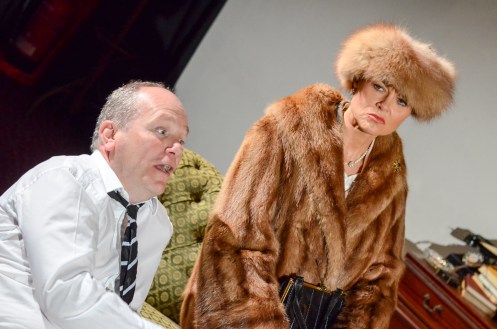
An Englishman Abroad is perhaps one of Bennett’s most famous pieces. It is the true story of the meeting and subsequent visit paid by actress Coral Browne to infamous Cambridge Five spy Guy Burgess (played serviceably enough by Roberta Cole and Patrick Harrison respectively) whilst on tour in Moscow. Despite alterations by Bennett from the story originally told to him by Browne herself, it remains an interesting window into a piece of recent history. However, this production does not quite live up to the remarkable nature of the story. Lush costumes (fine work by Maggie Revis) and crisp received pronunciation aside, Bennett’s words never quite connect. Moments that should have some weight or sharp wit all fall a bit flat. The result is a unfortunate feeling of “put on-ness” the piece never seems quite able to shake. There is a lot of unnecessary chuckling, sighing and pausing that hampers the flow of the text. Combine this with a habit of looking down and spotlights leaving half of the performer’s faces in shadows, it makes for a mildly frustrating hour. Overall the lighting by Patrick Throughton is spot-on, but during the characters addresses to the audience, it might be worth considering adding some light from stage right.


The Noel Coward studio at the Hampton Hill Theatre remains a flexible space as always and director Jenny Hobson, together with set and props constructors Vicky Horder, Alan Corbett and Mart Stonelake make good use of it. Both pieces are set in the 1950s sitting rooms but each piece has a very clear feeling of time and space. A Visit from Miss Prothero and An Englishman Abroad is not an obvious pairing at first. But both though different in tone and subject matter, shed light on themes such as isolation, loneliness and sacrifice for some form of “greater good”, be it honest work or misplaced political ideology. Despite my nit-picking I did, as I always do, enjoy my evening spent at The Hampton Hill Theatre together with the TTC and I look forward to seeing what they do next.
P.S. A special mention to Florrie in her role as Millie the Budgie, quite charming.
Melissa Syversen
June 2019
Photography by JoJo Leppink of Handwrittenphotography
Big, Boisterous, Brilliant !
Falstaff
by Giuseppe Verdi, libretto by Arrigo Boito
The Grange Festival, The Grange, Northington until 29th June
A review by Mark Aspen
Cheers! Falstaff would approve: we start in the pub for The Grange Festival’s priceless production of Verdi’s Falstaff. Blustering, big, boisterous and brilliant, it is Falstaffian to a tee.
The pub is one of those country town inns now spruced up as part of a hotel chain. Simon Higlett’s finely observed set is varnished wood, regency stripes, Amtico floors and modern brass, with newly installed lifts and uniformed staff not quite yet up to speed; the sort of place where middling companies hold corporate events. This is The Garter at Windsor, where the erstwhile peripatetic Falstaff is now ensconced, and where he has become one of the famous sights of the town for excited tourists staying in the hotel to grab a sneaky selfie on their mobiles.
And we are straight into the action with a noisy altercation between Falstaff and his cronies, and Dr Caius, a well-heeled semi-retired GP, who has been robbed, and he knows by whom!
They never quite get to blows, but the hapless Caius is ejected. All this causes riveting entertainment for the hotel guests and bar staff. Falstaff has a scheme to bolster his evaporating finances: to seduce two wealthy (and married) Windsor ladies, and has identical love letters prepared. His accomplices, the hitherto disreputable Bardolfo and Pistola refuse, on their honour, to be involve. Falstaff is outraged and kicks them out in a thunderous tirade, “L’onore! Ladri … !” (Honour! You thieves … !).

Thus we are introduced to Falstaff, larger than larger-than-life. As Falstaff, Robert Hayward is outstanding in all senses, including the big-belly that is a source of pride for Falstaff who, for all his egotism, has no self-awareness. A hairy, bearded and bare-footed bohemian, clad in loudly mismatched free-flowing patchwork, Falstaff may call himself vecchio John, but he has certainly not any intention of growing old gracefully. There is no false modesty in Falstaff; when he tells us he is immenso, enorme, he is referring as much to his ego as his bulk. Haywood’s ruby-rich clear bass-baritone floods the opera-house with easeful energy and power as he makes Falstaff the epitome of the loveable rogue. Yes, he is an old roué, but a big-hearted one taking a punt; if he is lecher, he is a likeable one.
Verdi was almost eighty years old when he wrote Falstaff. It had started out as a little exercise “to pass the time”, since in in all his decades of composing, he had never tackled a full-length comic opera. Although he didn’t speak English, he loved Shakespeare and is said to have always kept Italian translations by his bedside. When Verdi happened to mention his ambition to Arrigo Boito, the librettist of his Otello, Boito said nothing, but he secretively started writing a libretto, abridging The Merry Wives of Windsor, and using some material from Henry IV. When Bolto casually dropped a copy of his libretto in on him, “Verdi could not hide his delight”.
The Grange Festival’s bang-up-to-date version would most certainly have delighted Giuseppe Verdi (and William Shakespeare too would have a good belly-laugh at how far his The Merry Wives of Windsor had come). This is a production that every member of the company has had huge fun creating, and everyone has put their all into the show.
Simon Higlett’s pub set is trucked and slides aside to reveal the Ford villa, a high spec new-build des-res right on the Thames with its own private mooring, complete with a rather swish mahogany steam-launch, fully working! The villa is on a revolve and turns to reveal the interior of the villa, with its all mod cons kitchen-breakfast room, an Ideal Home Exhibition star exhibit. There are visual gags galore. Is that a portrait of The Grange Festival Chairman hanging in the Garter pub? For the final scene we are at Herne’s Oak in the moonlight, a totally magical creation. Then, a propos of nothing, a little hunched-up lady walks past, wearing green welly-boots, a Barbour coat and patterned headscarf: on her dog lead, she has her corgi. We know we are definably in the Royal Windsor Park. The audience loved it. If the design is a tour de force, which it undoubtedly is, then Karen Large’s costumes are a further witty element, each one commenting on each character’s idiosyncrasies and foibles.
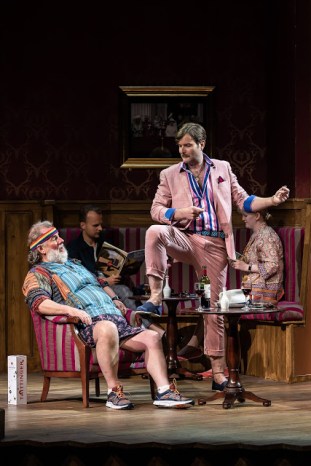
Master Ford, the husband of Alice, one of Falstaff’s would-be paramours, swaps his everyday middle-class dowdiness to disguise himself as his alter-ego Fontana, pink-suited and sockless, straight from the Milan catwalk. Nicholas Lester, in this role, equally takes his character from studious propriety to supressed jealousy as his tries to thwart Falstaff’s designs on his wife. Lester’s great comic timing as an actor complements his fine baritone singing.
The mistress of the house, Alice Ford is more than a match for Falstaff’s lechery. Elin Pritchard portrays her as vivacious, intelligent and cunning, plus Pritchard’s singing is superb, a bright mellifluous soprano. Meg Page, Falstaff’s other yummy mummy target is in the hands of Angela Simkin attractively energetic and personable, her fine mezzo pairing nicely to make the “Merry Wives”. This conspiratorial band of ladies is completed by Susan Bickley as Mistress Quickly, the Ford’s housekeeper, and Rhian Lois as Nanetta their youthful daughter, together making an integrated intimate quartet working seamlessly in ensemble. They form a figurative chastity belt to protect the virtue of these very 21st Century merry wives.
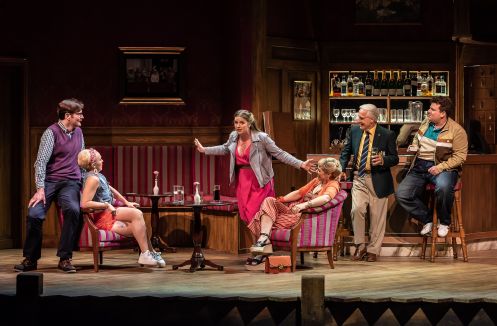
Susan Bickley’s contralto emphases those falling notes, the ribbing nature of Mistress Quickly that make Falstaff so gullible to her bait. We know that, when she describes Alice as povera donna, she is taking the mickey, but Falstaff falls for it a second time round.
An effervescent soprano, Rhian Lois plays Nanetta as an attractive, slightly coquettish and rather savvy teenager. Her beau, the love-stricken Fenton, takes plenty of opportunities to pootle along in the steam launch to woo Nanetta. Alessandro Fisher’s Fenton makes a gentle and charming suitor. Just as Fenton has captured Nanetta’s heart, so Fisher captivates the audience with his beautiful tenor rendering of Fenton’s love song, dal labbro il canto estasiato vola (from my lips, a song of ecstasy flies), then as he is melodically reassuring her, bocca baciata non perde ventura (lips that are kissed do not lose their fascination), his song is interrupted. Alas!
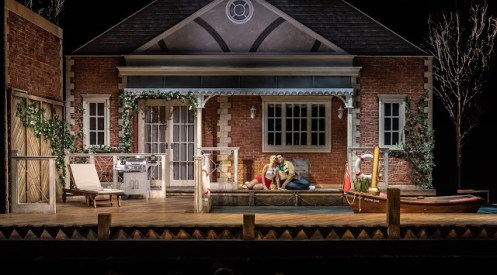
Together they make an engaging couple, and indeed would be engaged were it not that her father has promised her to the aging Dr Caius. Dapper in his boating blazer, Graham Clark cuts a purposeful figure. The international acclaimed tenor is in fine voice, putting a playful punch into this role. But of course the hapless Caius is also to be thwarted in his intentions, as he is sucked into the wake of Falstaff’s come-uppance.
Poor old Falstaff allows himself to be gulled, not once but twice. The first is at the hands of the women, a perfumed ambush into which he walks, well spruced-up in a smart red and white Henley regatta jacket and shiny co-respondent shoes, with a dozen red roses to present to Alice Ford. His awaited dalliance is rudely interrupted by the entrance of Master Ford and he is bundled into a laundry basket, prepared by the washing-machine repair men (dungaree clad members of The Grange Festival Chorus). They merely shrug as they carry out the lady of the house’s instructions to dump the contents in the Thames.

The Grange Festival’s Falstaff is the first operatic undertaking for Christopher Luscombe, the eminent Shakespearean director, and it is a mark of his skill that this wonderful rollicking production does not get stuck on one level. There are moments of lyricism and also moments of sheer pathos. One such is when a dank and depressed Falstaff emerges from his dunking in the river. Hayward’s brilliance is seen once again in his expression of misery and the real anguish he feels, which is also expressed in Verdi score. However, Falstaff is irrepressible and, after a quick mulled wine at The Garter, that pathos quickly switches to bathos as Mistress Quickly appears, assuring his reverenza that her povera donna awaits him still.
The second ambush Falstaff willing walks into is to a midnight assignation in Windsor Great Park. He is expecting a mystical sexual fantasy, a ménage à trois with both Alice Ford and Meg Page as he goes with priapic expectation towards Herne’s Oak. But this time almost everyone has ganged up in the trickery, including his own henchmen, Bardolfo and Pistola. Tenor, Christopher Gillett’s Bardolfo, a scruffy and sozzled soak, his bulbous purple trademark nose much in evidence, is contrasted nicely with bass Pietro di Bianco’s slick and scathing Pistola, like a blinged-up black-suited bookie’s runner.
The ethereal clearing at Herne’s Oak is a beautifully created space, with Peter Mumford’s lighting design leaving the canopies of the trees almost floating on mystical under-lighting. Equally atmospheric is interpretation of Verdi’s score by Francesco Cilluffo, conducting The Bournemouth Symphony Orchestra. As we approach the forest, a plaintiff horn sets the scene. Horns of the deer? Horns of the cuckold? A neat musical pun either way. But the BSO plays exemplarily throughout.
In the forest, Falstaff (and Caius) have their shaming, then all is resolved, lovers united, marriages conducted and finally the fugue tutto nel mondo è burla reminds us that all the world’s a …not a stage, but a jape!
With its feel-good factor, world class singing, and fantastic music, brilliantly acted on an ingenious set, The Grange Festival’s Falstaff is a winner. If you only go to one country-house opera this summer, this must be it!
Mark Aspen
June 2019
Photography by Clive Barda
A Magnetic Mine
Springing the Mine
celebrating 250 years since Garrick’s Shakespeare Jubilee of 1769
by Keith Wait
SMDG at Garrick’s Temple to Shakespeare, until 8th June
Review by Eliza Hall
“It was a sunny and blustery afternoon in early summer”, so the Narrator, played by director, Helen Smith, introduced the audience to hear and watch Keith Wait’s latest piece of writing come magically alive.
Springing the Mine was presented by the multi-talented and amazingly versatile SMDG (St Mary’s Drama Group). Each member of the group of twelve actor-readers held the audience spellbound and amused throughout the performance. In anticipation of a good afternoon’s entertainment, enlightenment and ‘Fun’ – the final word chorused by the entire company of actors – the small audience filled the Garrick’s Temple situated in the lawns leading down to the River Thames in Hampton.

Indeed, the director had appropriated the opening script to fit the moment of the imagined scene in June 1769, for it was indeed the sunny afternoon in early summer. It was here that the audience as invited to imagine two figures on the lawns outside, deep in conversation. One, the wife of David Garrick, La Violette, a ballerina of some distinction, played by Norma Beresford, and her companion, a friend, diplomat and successful dramatist, Richard Cumberland played by William Ormerod. The two are discussing both the successes and disappointments of both his and her husband’s writing. Almost immediately we are led to believe that Garrick’s writing, though influenced by his acting, may not have been as successful as his acting.
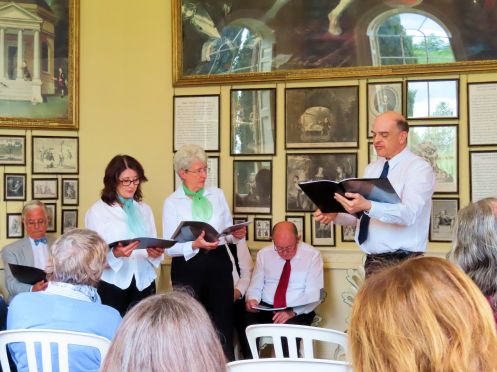
Whilst the characters discuss the wit of Mr Garrick, it is the writer of our play, Mr Wait who mocks jocundly the work of the famous actor and the ambiguity of the rivalry between business propositions in London’s theatre world, as well as a hint at plagiarism – or was it merely successful collaboration? By cleverly narrating the placement of character roles the players lead us into a taste of several Garrick plays. This is a clever and seamless manoeuvring by writer and actors both. The lively cameos woven into the narration illustrate to the audience both the style and humour of our Mr Garrick as well as the skill of both the playwrights, not to mention the actors.


The bawdiness and, more than a touch of, the restoration phase of English theatre are not lost, indeed they are played out in front of us, as the wit of the 18th century playwright mingles with the present narration and commentary on Garrick’s writing and his entrepreneurship rather than directly on his acting – this has been left to the talent of the present company to show us.
We, the audience are taught about the context and the complexities of writing in the 1760s, how Sheridan was influenced by Garrick’s writing of Mrs Heidelberg, played by Sue Birks, for his later creation of Mrs Malaprop, whose wit shines through, “I purtest there is a candle coming … and a man, too” as mor e comic characters are introduced. The romp and bawdiness follows, where people are in the wrong place with apparently the wrong persons, one loves another who cannot reciprocate. It all foretells not only the work of Feydeau a hundred years later, but, as the narrator Graham Beresford reminds us, of the Whitehall farces of Brian Rix that were to become so popular two centuries years later. So through these vignettes we are informed of the collaborative elements of Garrick’s work, his creative developments, interests and motivations to write as well as act. “This is Georgian Romance at its most charming, over half a century before Jane Austen began to epitomise the style” the narrator tells us.
Another explains that his solo writing forays are not as successful as his collaborative endeavours. It is through his own merits and skill as an actor that he made Shakespeare’s characters known and loved. Through these performances he had become famous by bringing to public notice the exemplary and valued work of Shakespeare, but it also publicised his own creativity. His theatre in Drury Lane had been the venue for audiences to learn to love the bard. A shrewd businessman, indeed, to have won the public’s acclaim, as well as its money. It is later when we learn of the washout of the Jubilee Festival that we are told how Garrick is able to recoup his loss of money and to turn his fortunes around.
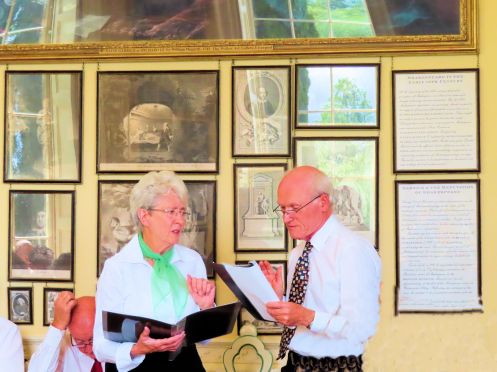
Keith Wait’s ability, beautifully brought alive by the actor-readers, weaves us through several more examples of David Garrick’s plays, whilst guiding us on a journey to Garrick’s Jubilee Celebration of Shakespeare in the market town of Stratford upon Avon, as somewhere almost unknown by London folk according to Richard Cumberland, in his conversation with La Violette.
So, having met other characters, including Mr Fribble – so foppishly portrayed by Graham Beresford – yet another excerpt of a play is introduced, so if the audience is lagging behind and has paused to contemplate, then onto the ‘stage’ bounces yet another loud and enthusiastic person played by this time as Captain Flash, played by Ron Hudson, with his several military metaphors and at last we are enlightened as to the title of this piece.

William Ormerod, who moves from being Cumberland and Garrick with such ease,
then explains that the term “springing the mine” was used by Garrick used to describe his acting method. “He himself is surprised by an upsurge of emotion in performance” , Garrick continues, “until circumstances and warmth of the scene has sprung the mine, as it were, as much to his own surprise as that of his audience”.
A narrator, Diana Bucknall, takes up the main question of the performance when she asks whether Garrick did succeed in “springing the mine” of his writing genius. We are informed that Garrick wrote some two dozen or so plays, and very few were performed. We are given several, but tiny, glimpses and certainly not enough for us in the audience and those attempting to critique this performance, based on some of his writing would dare to judge.
Once again we are directed back by the narrators, not to a discussion of his success as a writer, nor his undisputed skill as an actor, but to his entrepreneurial adventure that was the Shakespeare Jubilee, to be held in Stratford upon Avon. We are given another glimpse of another setting as description of the magnificence, pomp and the disastrous circumstances that befall those who travelled to this three day Shakespeare Festival. It is hard to separate the man from his creation, as we are informed of the 170 Shakespearean costumes – and characters, the prominence of David Garrick, the portrait painting of him in roles, transparencies painted on glass, the specially commissioned music and, of course, his recitation written for the occasion An Ode in Honour of Shakespeare, or “The Bard of Avon” as we are told by Mrs Garrick is the name he gives to The Playwright.
So, the audience is left with the question, whilst there is no doubt David Garrick’s acting filled with emotion, sprung the mine for both him and his 18th century audiences and gave them a love for the Bard of Stratford, his plays have their place in the history of the theatre and the development of English drama, but did we see that “springing of the mine” in his writing? Certainly we did in the SMDG performance.
We were enthralled by the presentation, and if some of us were sometimes lost in the weaving of the words, the multiplicity of characters, intricacies of plot and its focus, the production was a delight and a perfect way to spend a sunny June day by the river, away from the wind and the noises and bustle of 21st century England, to learn, be amused and be delighted by the local talent of acting and writing seen today, as well as 18th century Hampton.
Eliza Hall
June 2019
Photography by Lewis Lloyd
Multi-Layered Mille-Feuille
Le Nozze di Figaro
by Wolfgang Amadeus Mozart, libretto by Lorenzo da Ponte
The Grange Festival, The Grange, Northington until 30th June
A review by Mark Aspen
Multi-layered Mozart, majestic, mellow, musically exquisite, Le Nozze di Figaro opens The Grange Festival season in a stylish production that complements the Beaumarchais story told last year in Rossini’s Il Barbiere di Siviglia. It continues the adventures of Figaro a year of so on when the erstwhile barber now is in the service of Count Almaviva as his valet.
However, Mozart moves the mood on in Le Nozze di Figaro, from Rossini’s romp to something with much darker undertones. Both are opera buffa, but the comedy is now much blacker. Almaviva is no longer a romantic youth, but a despotic misuser of his household. Figaro and Susanna are about to get married, but Almaviva is planning to exercise droit de seigneur and claim her maidenhead. Rossini’s plot is quite simple, but Mozart’s librettist, da Ponte takes the plot along more twists and turns than the Stelvio Pass, and Mozart points up every hairpin turn in a gorgeous and witty interplay of unforgettable music.

The Grange production pulls out the complexity and the darkness from the story, without in any way undermining the thrills, the farce or the comedy in the story.
The Academy of Ancient Music, playing with period precision (barring a couple of wobbles) under the baton of the versatile musician Richard Egarr, is alive to all the nuances of Mozart’s score from the well-known breakneck presto of the overture to the intricacies of the wedding feast finale.
Designer Tim Reed creates a set that hints at the duplicity in the darker motives of the protagonists, heavily-rich colours, swags of foliage in the muted mellowness of an Old Master, something a bit sinister that smacks of Caravaggio. The sense of faded grandeur somewhat echoes the preserved distressed décor of The Grange itself. In its shadowing of the misuse of power unfolding on stage, it seemed to reference the closing days of the ancien régime that Napoleon himself noted about Beaumarchais’ play on which Le Nozze di Figaro is based.
Beaumarchais’ Figaro was seen to be so political subversive that it was banned in a number of European countries. Joseph II though was fairly relaxed about da Ponte’s libretto for Mozart’s opera buffa, as only the gentry went to the opera. Le Nozze di Figaro may be an Italian opera written for the Austro-Hungarian court, but its sentiment is still thoroughly French, a farce based on a mille-feuille of thwarted amorous desires. Its spectrum ranges from unbridled sex, to amorous love, to decorous marriage, but my goodness, everybody’s at it!

At the nasty end of this spectrum is Count Almaviva re-establishing his feudal rights of droit de seigneur which he had vowed to abolish. The wily Figaro, and his ever-resourceful bride Susanna, are however more than a match for their lecherous master.
Toby Gerling’s powerful baritone voice and forceful strutting body-language paint a picture not so much of an arrogant aristocrat but of a bull-necked pugilist, who will have his own way, and with Gerling’s strong stage presence the picture is of one not to be messed with. Figaro’s approach is ma, piano, piano (but softly, softly) as he determines to frustrate Almaviva’s intentions towards his bride. Se vuol ballare … sì, le suonerò (If you want to dance … I’ll play the tune) is Figaro’s short cavatina that sums up how he will “catchee monkee”. Bass-baritone Roberto Lorenzi, as an energetic Figaro, delivers the cavatina with a sense of tethered aggression. There is a barely disguised alpha-male squaring-up between the two men that is only restrained, resentfully, by valet Figaro’s deference to his master.
Here we have a version of Le Nozze di Figaro, which, in spite of its true to period setting and Kate Lyons’ authentic costumes, is certainly no chocolate-box whimsy.
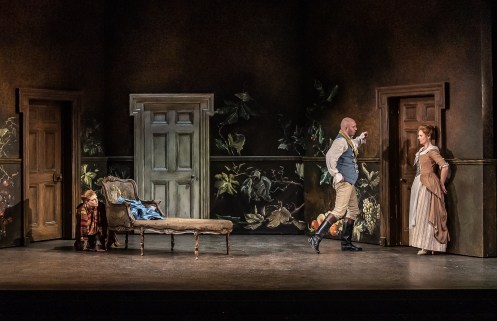
On the sexual harassment front, we have another prospective predator, the pubescent pageboy, Cherubino, fired up with the rising sap of teenage testosterone. Wallis Giunta clearly relishes the breeches role, flitting around, goosing the gals below stairs, and mooning after the ladies above stairs. While the ladies are cross-dressing him, one of Figaro’s ruses, Cherubino explains his hormone affliction, “Voi che sapete che cosa e amor, Donne …” (You ladies know what love is …). Mezzo Giunta’s meticulous delivery of the aria has a plaintive appeal that is hauntingly captivating.
Ellie Laugharne’s Susanna is a woman who knows her own destiny. Despite her precarious position, she can balance guarded necessity against a slight amusement at the manly mayhem around her. As a smile flickers across her lips, you know that she is the brains behind the Figaro-Susanna conspiracies. Laugharne (whom we saw last season as Phyllis in ENO’s tongue-in-cheek Iolanthe ) has a clear soprano with a pleasing legato which softens even Susanna’s harsher pronouncements.
That director, Martin Lloyd-Evans has made this production of Le Nozze di Figaro a realistic and emotionally observed version, is very evident in the rounding of the character of Countess Almaviva. Ross ini’s erstwhile chased (and chaste) Rosina, has in Mozart’s Figaro now become the Count’s neglected wife. Romanian soprano Simona Mihai picks up this approach, giving a tragic Countess who is really experiencing the pain of being passed over by her husband for other women. When we discover her, distraught, “Porgi, amor, qualche ristoro al mio duolo, a’ miei sospir …” (Grant, love, some relief from my sorrow, from my sighing … ), Mihai’s rendering is truly moving.
Almost as a visual metaphor Lloyd-Evans has a motif of flowers being offered, rejected and then accepted, echoing the continuing theme of sexual ambitions frustrated, reignited and then stymied (or redirected) that is the fate of so many if the protagonists. This continues through in the sub-plot of Dr Bartolo, the guardian of the Countess when she was in her minority, and his housekeeper Marcellina, who appear on the scene to redeem her contract with Figaro for a monetary loan, the default to which is the he must marry Marcellina. We are in very safe hands with the highly experienced pairing of Jonathan Best as a sullen Dr Bartolo and Louise Winter as Marcellina, who transmogrifies from acerbic harridan to maternal matron following the (pre DNA-testing era) discovery of their true relationship with Figaro. This, at first antagonistic, sub-plot is completed by tenor Ben Johnson (also seen in Iolanthe) as a preening Don Basilio, the Count’s musician.
The entrance of this trio forms the basis of the ensemble sequence in Act Two, as the plot takes one of its many turns. Also bursting in on the scene, via a ladder and open window, is the elderly gardener, Susanna’s uncle Antonio, complaining about the man (Cherubino!) who fell into his carnations. This part is a gift for the consummate character acting skills and rich bass voice of Richard Suart. The ensemble builds from trio to quartet, to quintet, to septet, in a technically demanding and musically intricate tour de force, in which each character expresses differing emotions, be it anger, sadness, hope or open glee: musically and dramatically impressive.
The role of Barbarina is usually a background one, but for me Rowan Pierce stands out clearly from that background in this role of Antonio’s daughter and one of the girls of the household who has to run the gauntlet of the Count, and of Cherubino. Pierce is an up-and-coming soprano who has commanded a plethora of awards, including the inaugural the Grange’s International Sin ging Competition. She is a captivating and effective actress, bringing a gamine charm to the role of Barbarina. The sweet bell-like innocence of her singing was beautifully illustrated in the Act Four aria L’ho perdita, (I have lost it). She emerges from under the wedding banquet table, ostensibly referring to the pin that Susanna has used to seal her honey-trap note to the Count, but we know that she has also lost something definitely more irreplaceable under that table.
Of course the Count gets his come-uppance and Figaro gets Susanna as his unmolested wife, and we head towards the happy ever after ending. However, in spite of its traditional period presentation, our Nozze di Figaro has a twenty-first century fizzle of scepticism.
The Count may be ashamed and full of remorse as he pleads on his knees “Contessa perdono!”, but in Gerling’s delivery of these words there is a hint of … until the next time. The Countess may forgive her errant husband and her “Più docile io sono” (I will be more kind) may have been heart-rending, but Mihai’s slant loaded it with ambiguity.
Lloyd-Evans’ Le Nozze di Figaro may have the period chocolate-box wrapping, and indeed its contents are rich, smooth and fulfilling, but they are those fashionable contemporary ones, with the piquant flavours of chillies or crushed peppercorn … sweetness with a bite.
Mark Aspen
June 2019
Photography by Clive Barda
Gasp Inducing Dream World
Cinderella In-the-Round
by Christopher Wheeldon, music by Sergei Prokofiev
English National Ballet at the Royal Albert Hall until 16th June, then on tour until 26th October
Review by Suzanne Frost
Christopher Wheeldon has won his reputation as a master storyteller with Alice in Wonderland and his Shakespeare adaptation A Winter’s Tale for the Royal Ballet, but proved himself equally at home in the world of commercial entertainment, winning a Tony Award for An American in Paris on Broadway. His Cinderella, originally a standard proscenium arch production created for San Francisco Ballet, has now been transformed and upscaled for the vast Royal Albert Hall, to be played in the round, marrying classical ballet and large-scale entertainment. Entering the spectacular auditorium, the excitement is palpable and, unlike at the Coliseum, there are a good few evening gowns to be spotted. Looking around I felt that my ticket in hand was much like my very own invitation to the ball of the year and everyone from London’s dance scene showed up.
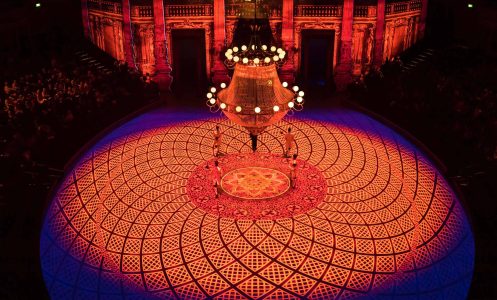
Wheeldon uses the prologue to show us a young Cinderella with her happy family before her mother succumbs fast to an incurable illness and so, within minutes, we are emotionally involved. Unlike ever in fairy tale history, we also get to see the young prince growing up, dashing around the palace with his friend Benjamin, two very unprincely balls of little-boy energy, clowning around and breaking a priceless Royal Wedgwood vase. I always love how Wheeldon uses children not as cutesy gimmicks for grandma but as proper characters within the story.

The recent Disney live-action adaptation by Kenneth Branagh made a huge point of Cinderella being kind rather than pretty, emphasizing that true beauty comes from within. Wheeldon has embraced this celebration of kindness and this suits perfectly for Alina Cojocaru, tiny and unassuming, there is a warmth and humility in her every gesture. Consistently, the two “ugly” stepsisters are actually far from ugly, Edwina (Emma Hawes) statuesque and coquettish, the bespectacled Clementine (Katja Khaniukova) more goofy. Tamara Rojo as Cinderella’s stepmother is glamorous and saccharine sweet – as long as you don’t push her. For Cinderella’s father to fall so severely under the spell of his new family, it makes sense that the ladies all seem rather charming, their uglier side, their vanity and cruelty only revealed when it is too late.


As the prince’s best friend Benjamin, Jeffrey Cirio is a joy to watch, executing breakneck choreography with flawless precision and a real sense of fun. Helping his buddy out, who has been pushed by the king to hand-deliver all the ball invites, the two friends swap roles, Benjamin introducing himself as the prince (immediately to be fawned over by the stepsisters), and the prince himself disguised as a poor beggar. This little trick allows us not only to witness Cinderella’s innate kindness in action, as she alone welcomes the urchin into the house, but also gives our two heroes time to actually get to know each other. Rather than trying to convince us it’s love at first sight at the ball, these two make a much more believable couple, as we see them having fun together and a very obvious, real connection.


Just like in An American in Paris, Wheeldon uses projection instead of scenery to transport us, at times to spectacular effect, when the young prince gets a history lesson from his father the king, walking all over a large-scale map of the world or studying a gallery of grim-looking ancestors’ portraits. Rather than a “Bibbidi-bobbidi-boo” fairy godmother, Wheeldon goes with the original much more gothic Brothers Grimm version, where Cinderella’s dead mother watches over her, growing a huge magical tree on her grave from her tears.
The four spirits who accompany Cinderella’s every step I found less successful and occasionally distracting, but they have the benefit of, whenever fate calls, making Cinderella literally fly. There is a Cirque du Soleil aesthetic to the dance of the seasons, partly due to the arena feel of the Albert Hall, and partly from the saturated colours of the spectacular costumes, elaborate headdresses and outlandish makeup. While for Summer, Wheeldon doesn’t quite capture the lazy heat of Prokofiev’s music, he creates a real whirlwind of canon choreography for Autumn. His shtick with canon can occasionally look messy in group scenes, but for in-the-round ballet it is clearly the way to go, giving every seat in the house something to look at. There is so much space here, and so many soloists relishing the leeway with travelling jumps and joy of movement. There are magical creatures galore, dancing chestnuts and a corps de ballet of feathered herons (costume and set design by Julian Crouch) that are beyond fantastic and barely on stage for five minutes. Cinderella’s dress is so beautiful it gave me tingles all over and that carriage… I wouldn’t want to spoil it but a child behind me audibly gasped and you lean back with that satisfaction of knowing a new recruit has been converted to the magic of theatre.
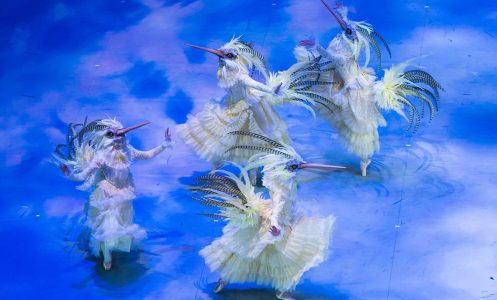
The ball then ups the scale to complete phantasmagoria and left me feeling like I landed headfirst in a Disney technicolour masterpiece. Prokofiev’s sumptuous dark-velvety grande valse was literally made to be danced by 24 lavishly dressed couples. It is the sign of a fantastic supporting cast that I was touched by goofy Clementine timidly introducing her crush Benjamin to her dad and Tamara Rojo relished her comedic role getting royally drunk and giggly.
Cinderella’s entrance has to be some of the most magical music ever written and it feels like the whole world stands still. Her variation is one of my favourite solos and Alina Cojocaru acts it beautifully, starting so modest and plain and culminating in sheer abandonment as she succumbs to the joy of falling in love. The dashing Isaac Hernandez shows us a prince visibly growing up and becoming a man in front of our eyes. Although Wheeldon hardly invents a step that isn’t classical ballet, his use of dancers’ bodies is always surprising, with transitions and lift never seen before or deemed possible. While fireworks go off in the background, our heroes are oblivious to all the pomp, absorbed in each other, looking like the kind of couple who will likely never run out of things to talk about or steps to dance.
For the next morning, Prokofiev gives us that glorious drunk music that sounds like the coarse voice and achy feet you only get after a really good party. And his happy end is underscored with music so melancholic, it just knows that great happiness can only exist in the world because of great pain and heartache, as we see our young couple dance under the shadow of the tree growing on her mother’s grave. My heart is full with fairy-tale fuzzy feelings.

I recently happened to see Baz Luhrman’s Moulin Rouge! again and was reminded of the song Spectacular Spectacular: “So exciting, the audience will stomp and cheer! So delighting, it will run for 50 years!” – Thinking of what this lavish extravaganza production must have cost ENB, I certainly hope so. And may generations of kids get the chance to gasp and dance all the way home to the tube station because that’s what Cinderella is all about: believing your dreams can come true. What ENB has here is the ultimate fairy tale ballet.
Suzanne Frost
June 2019
Photography by Ian Garvin
Poignant, Gentle, Moving
Goodnight Mr Tom
by David Wood, adapted from the story by Michelle Magorian
Edmundians at the Cheray Hall, Whitton until 8th June
Review by Eleanor Lewis
Goodnight Mr Tom, written in 1981 by Michelle Magorian and adapted for the stage by David Wood is destined to become a children’s classic. 100 years from now when WW2 is pure history and no longer an actual memory for anyone, there will still be children reading it, fascinated by what passed for normal with 1940s children.

Edmundian Players’ performances of Goodnight Mr Tom took place in the Cheray Hall behind St Edmund’s Church in Whitton. This hall, the programme tells me, is the same hall used as a temporary place of worship after a German bomb hit the original church in October 1941. You couldn’t get much more of an appropriate setting than that.
In this small village hall, a large cast backed up by a similarly large team of props and scenery designers and builders, managed to create and populate both Central London in the midst of the Blitz, and the relative peace and quiet of the West Country. Amateur productions always involve people who are doing ‘real’ jobs the rest of the time. Clearly a lot of work had gone into this production and credit must be given to everyone involved in it
 Goodnight Mr Tom is not the easiest of stories, despite being aimed at children, as the childhood experiences of William Beech, until he meets Tom Oakley, are far from ordinary and definitely not pleasant. Accordingly, playing the two central characters is a challenge: the general ‘thawing’ of both the older man and the terrified child must be handled slowly and with care. Matt Power as Tom Oakley was perfectly cast. His performance was poignant, gentle and witty without ever slipping into sentimentality. Oakley is also on stage most of the time, with the most to do. Matt Power was line perfect and never out of character.
Tom Melia as William Beech gave a suitably hesitant and guarded performance, moving gradually into a more relaxed, happy boy, as he began to trust the man who had taken him in. His critical moment (actually one of his critical moments) when he accepts the baby Mrs Hartridge hands him to hold, after his appalling experiences with his mother, was suitably moving.
Aside from the two central characters the ensemble cast worked well together and were perfectly costumed in 1940s outfits. Directors Jackie Howting and Terry Bedell had made good use of the space, allowing entrances to be made from either side of the stage and from the back of the hall which produced an inclusive atmosphere. The scene in which a meeting took place and several characters sat at the front of the audience was particularly effective.
There were several particularly well-judged, smaller character roles: Theresa McCulloch as the Billeting Officer and Mrs Fletcher managed to be both brisk and endearing; Terry Bedell as the Doctor was a suitably reassuring presence, and Paula Young by contrast, as the damaged and dangerous Mrs Beech was an appropriately unnerving presence on stage.
Ellen Smith, playing the exuberant Zach was a treat and quite an achievement as Ms Smith was convincing as a boy despite occasional hair issues, and the sudden, terrible loss of the character was as shocking as it was intended to be because Smith had created such an appealing and eccentric child. The other children: Kathryn Bedell, Mary McGrath and Charlie McMaster were equally strong, delivering their lines naturally and unselfconsciously.
Special mention must, of course go to Becky Halden for handling the puppet dog, Sammy. The objective with a puppet on stage is always to focus audience attention on the puppet and not the handler and Ms Halden achieved this to great effect.
The action as a whole would have benefited from quicker scene changes, some were quite lengthy and this interrupted the pace of the whole piece which was in fact moving quite well. I wondered too at the treatment of the death of Zach which would arguably have been better handled indirectly i.e. if his death had simply been reported to other characters who were then required to react to the information, but I suspect this is an adaptation issue rather than anything to do with the performance.
Edmundian Players should be pleased with their treatment of this marvellous story, the audience on Friday night was totally engaged with what they saw and rightly so as the commitment of everyone on stage produced a great evening’s entertainment.
Eleanor Lewis
June 2019
Photography by Devizine and Jessica Young
Uneasy Lies the Head That Wears a Crown
King Charles III
by Mike Bartlett
Wild Duck and Barnes Community Players Co-Production at Kitson Hall, Barnes until 8th June
Review by David Marks
When Mike Bartlett’s Modern Shakespearean history opened in 2014 is was nominated for every award going on both sides of the Atlantic and won the Critic’s Circle and South Bank Sky Arts Best New Play Awards. It was subsequently presented as a radio play on BBC Radio 3 in 2015 and the ninety-minute TV version was screened by BBC2 in 2017. These dates are important. The play has only relatively recently been released for general performance and I fear it is past its sell by date already. It was written pre-Brexit, pre-Trump and, probably most importantly pre-Meaghan Markle as a response to the News International phone hacking scandal.
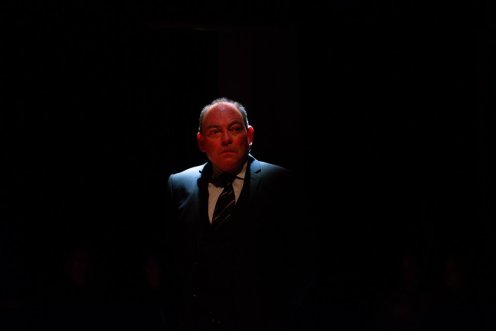
The play is set in the near-future and imagines the political fallout and social unrest likely after the death of HM the Queen when the new King Charles refuses to play the Government’s political game. Needless to say the wider issues that the play tackles are mirrored in the family scenario of the royal household. As well as echoes of several Shakespearean devices to complement the blank verse, King Charles III has a very impressive moment as King Charles II. The play is clever and very ambitious. It is also very long and was made longer by the addition of a guest appearance by a local choir at the beginning of the piece and the many, lengthy scene changes throughout the play.


The production at Kitson Hall is a joint venture between Wild Duck and Barnes Community Players. Like the Curates egg it is “good in parts”. Daniel Wain is a totally believable King Charles, giving us a realistic portrayal of the real man without falling into caricature. Likewise, Richard Scott’s Harry is a delight. The stage came alive every time either of these actors inhabited it. Director Susan Conte has done a fine job in finding a “royal family” with more than a passing resemblance to their real counterparts who can also deliver blank verse and have decent comic timing. The supporting artistes of various politicians, bishops and commoners battle with varying degrees of success with the verse and their characters. Emily O’Mahony’s Prime Minister and Chris Mounsey’s Leader of the Opposition have a particularly difficult time here as they are portraying fictional characters in a world inhabited by household names and faces. They both manage admirably and their individual scenes with King Charles are some of the best in the play.


As to the actual production – much more attention could have been paid to details that are easy to overlook but make such a difference to the verisimilitude and integrity of such a piece. For example – the Prime Minister and Princess Diana would never be seen out without wearing tights or stockings, Catherine, Duchess of Cambridge would never have a hemline four inches or so above the knee, and everyone in a ceremonial role in a cathedral would polish their shoes. These are tiny things but they make a real difference when the audience is virtually part of the action. Equally, one more technical rehearsal might have negated the immersive nightclub experience of not being able to hear a word and an errant spotlight that could not make its mind up whether it was on or off.
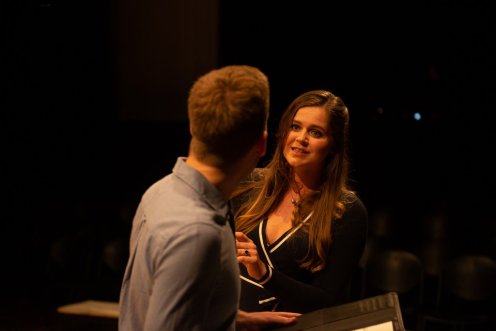
The director has chosen to present the play in the round and this works well. The cast use all the space and the audience never feel excluded. However, this format works best with little or no set changes and the action, which moved along at a nice pace in individual scenes, was slowed down considerably by the scene changes that added considerably to the running time.
In summary, this production has a lot going for it. A collaboration between companies is always a positive thing and to be brave enough to take on a piece of this magnitude is worthy of praise indeed. A brave choice but I am not sure the right one. In these uncertain times there is something at this that seems a little unsavoury about imagining life after HM Queen.
David Marks
June 2019
Photography by Marc Pearce
A Steamy Toe Tapping Affair!
Nell Gwynn
by Jessica Swale
The Questors at The Judi Dench Playhouse, Ealing until 8th June
Review by Viola Selby
‘Let not poor Nelly starve’, those were Charles II’s famous last words and Jessica Swale has certainly not let her do so by creating this raunchy, regal feast of comedy and talent. Nell Gwynn, through its cast and crew, manages to transport its audiences back in time and tell a tale based mainly on historical fact about a ‘Protestant Whore’ who stole the heart of the king.
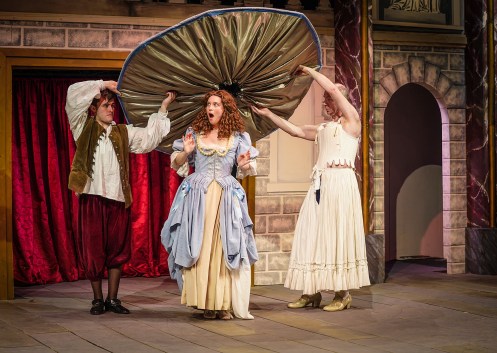
From the very start, the audience are greeted with a sense of regal pomposity, similar to that of a West End theatre. This is all thanks to the creative genii of Set Design Advisor Alex Marker and his team of scenic painters and prop makers. Although the centre of the stage has been kept bare, not only emphasising the role of the stage in Nell’s life but also allowing the audience to use their imagination, the backdrop is stunning with painted statues, marbelsque columns and red velvet curtains. This same high level of artistry is maintained throughout the play by Carla Evans’s fantastic use of shape, material and colour in her period costume designs. Each piece perfectly matches its character and helps to bring this period to life. From the rainbow of colours worn by Charles and Nell to the sinisterly black outfit of Lord Arlington, a sneaky game-playing foreign minister and chief adviser to the king – played so realistically by Philip Sheahan you would have thought he was one of our current MPs!


Although this play is set hundreds of years ago, the cast effortlessly manage to make it a story just as entertaining and relevant for today’s audience as it could ever be. From phones being thrown in buckets of water, tit jokes and naughty ditties to perfectly planted puns and the very honest responses from Nancy, performed by the wonderfully witty Wendy Megeney, the audience are kept laughing throughout. If you are a fan of the Carry On series or Black Adder, then this would definitely be up your alley! However, this is not a pantomime with unrealistic characters. Even the bitchy egocentric Edward Kynaston, an actor who plays female roles, is not performed as a two dimensional dame. Instead Julian Smith is captivating, both in his dresses and as an actor whose very purpose on stage is now being taken over by a woman and he just cannot accept giving up the limelight. But what a woman to give up the limelight to! Nell Rose gives both a sensual and feminist edge to the title character, proving she is not just a woman out to grab herself a title by ‘lying back and thinking of England’, like Lady Barbara, or Louise de Kerouaille, both brought to life by the brilliance of Maya Markelle. No, Rose’s Nell is a woman achieving her career goals and an advocate and role model for female advancement, telling Dryden, an anxiety-prone playwright, tremendously played by Tim Pemberton, to stop writing such flimsy pathetic female characters as ‘we’re as knotty and tangled as you’. Whilst it is through Rose’s chemistry with both David Hovatter, a heartthrob of an actor who plays leading actor Charles Hart, and Mike Hadjipateras, regally sublime as Charles II, that truly makes this play one steamy toe tapping affair!
Viola Selby
May 2019
Photography by Carla Evans and Marissa Hahn
Ready Player Juan
Don Giovanni
by Wolfgang Amadeus Mozart, libretto Lorenzo da Ponte
Rogue Opera at Hampton Hill Theatre, until 1 June, then on tour until 9th June
Review by Matthew Grierson
Setting itself in the Milanese fashion scene, and a post-#MeToo world in particular, this production of Mozart’s tragicomic opera exhibits a sharp dress sense and sharper satire.

When we arrive, the Hampton Hill stage is furnished with clothes rails, a trolley of champagne and design sketches, as well as a selection of mannequin torsos and legs that signify the objectification of women we are to witness from the saturnine young antihero (Theo Perry). For a moment, all is bathed in the violent violet light of a nightclub toilet, ready to disclose his crimes clinically and coldly.
The show opens as Don Giovanni anoints himself with fragrance while preparing a parade of models for the catwalk, to the accompaniment of MD Guy Murgatroyd’s piano overture. But it’s clear that the Don has his mind less on the women’s clothes than their bodies, and before long he is menacing Donna Anna (Alexandra Cowell) in her dressing room in a manner that leaves no doubt about her lack of consent.
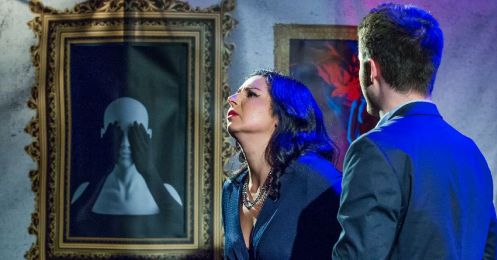
As he leers over her prone form, his assault is interrupted by her father the Commendatore (Ian Shenstone), and after what is an oddly underpowered fight Giovanni is mirroring his earlier pose, this time leaning over the dead body of his victim. Once he has fled and the crime is discovered, the corpse is wittily hidden by the other cast members using a clothes rail – as with the title character, horror is clothed in well-cut jackets and trousers, and I felt the show might have made, and indeed wanted to make, more of this conceit in its staging.

Certainly the production makes adept use of two wheel-mounted screens that the cast seamlessly turn to change scenes from a swanky bar to Giovanni’s penthouse, complete with art gallery. Stage right, one screen also becomes the studio for Giovanni’s valet-cum-tailor Leporello, its corner lined with blown-up measuring tape. Leporello also carries such a tape around his neck showing that, even when he connives to with his master to ensnare women, he has his measure. As the manservant, André Andrade’s performance is a highlight among a strong cast, treading with careful footsteps between comedy, collusion and caution.
In this respect, he is as equivocal about his boss’s behaviour as the unfortunate Donna Elvira (Anna Sideris) is about her quondam paramour. As we are introduced to her, she is ripping pages from a fashion magazine and swearing to do the same with Giovanni’s heart, but cannot be rid of her attraction to him all the same. The parallel between the spurned lover and reluctant retainer is established in the first act as he recounts the list of his master’s conquests to the unfortunate woman, all the time counting off their numbers on the measuring tape he holds against her; I was reminded not so much of a dressmaker as an undertaker, preparing to bury her romance. But by act two, both Elvira and Leporello are back under the Don’s sway, as he invites his manservant to take advantage of the blindfolded woman in his stead.

There’s always a hint of a smile before Sideris sings, giving the unpleasant suggestion Elvira finds the relationship as much of a game as Giovanni does; and yet we know from her arias that this is not the case, with the added detail in this production that she is carrying both his child and an ultrasound image of the foetus. But if this production wants to highlight the agency of women then seeking to marry Giovanni, despite his evident errancy, for the benefit of their baby doesn’t speak to Elvira’s good judgement.
Greater independence is demonstrated by the model Zerlina: though not a player in Giovanni’s league, she is no sooner betrothed to photographer Masetto than she is flirting with the Don himself, and in Maya Colwell’s playful performance she dances and sings in convincing chemistry with both men. Plaudits are also due to Edwin Dizer as her hapless fiancé: the sweet dance that signifies their engagement is soon after recapitulated with steps that I can only describe as sarcastic, thanks to Michelle Buckley’s capable choreography. Just to confirm Dizer’s physical comedy credentials, he is also given the opportunity for some fine drunk acting – and singing – opposite the Don in the second act.
As the titular character, meanwhile, Perry cuts a dark, lithe young figure. Although perhaps lacking the rakish gravitas and presence an older actor would bring to the role, he describes the inevitable arc of Giovanni’s dissolution and descent into hell with a gradually ratcheted mania, and there is scope in his aria early in act two to see him pathologising himself as a sex addict. He also has a believable appeal as a brooding hipster that convinces us he has bedded as many women as Leporello claims – and this bearing in mind that the only two instances of ‘seduction’ to which we are witness can only euphemistically be called such, especially given that the first is the attempted rape of Donna Anna.
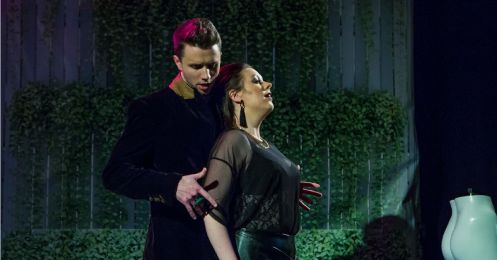
Occurring so near the start, this episode serves as the thematic overture to this production, and resonates strongly with our contemporary consciousness. As Donna Grierson pointed out to me, the surtitled translations do not deal with an antiquated concept of honour but rather talk in terms of crimes against women themselves. With such an emphasis, the death of the Commendatore is merely confirmation of Giovanni’s criminality rather than representing his tragic overstepping of the mark.
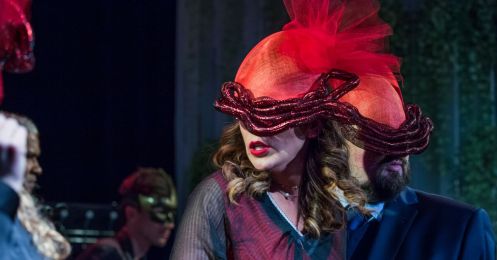
All the same, it’s around this one man’s death rather than subjugation of women that the campaign to bring Giovanni to justice is organised by Ottavio. As Anna’s fiancé, Hugh Benson makes for a sympathetic ally – even though Ottavio makes some poor choices about the timing of his proposals – and by the end of act one, he has put word out on social media of Giovanni’s crimes, and the culprit ends up surrounded by the accusing light of an array of smartphones.
While the surtitles have been used sneakily to flash up Giovanni’s hook-ups on dating app ‘Findr’, this clever device is not used sufficiently to establish it in the audience’s imagination, so when Anna and Ottavio first spread word of the crimes it’s the reaction among Milan’s fashionistas that tells us rather than any projection across the top. Similarly, although Giovanni’s art collection is stripped away at the end to reveal a string of damning hashtags, it’s not clear why these too aren’t conveyed by the more contemporary digital medium.
For a production supposedly set in the world of haute couture, it’s an odd decision too to make the cast sport an improbably unfashionable get-up combining wedding hats and graduation gowns when they assume the role of chorus. The staging also seems to miss a trick in that the mannequins, so long a place where Giovanni and Leporello can project their fantasies and desires, become in turn a locus for their frightened subconscious when the ghost of the Commendatore raises the arm of one into an accusatory gesture. With the opera’s famously figural ending in mind might more have been made of this, or would it have been too technically difficult to achieve?
As it is, it is Shenstone as the statuesque spectre of the Commendatore that drags Giovanni off to hell. Does the ending, abrupt when it does come, deny human justice or embody it? Honour seems to be finally at stake when it hasn’t been before, although there is a sense that Giovanni has, in taking up the ghost’s invitation, having to consent to his own doom, when he hasn’t been seen to seek the consent of the women he pursued.
There’s no doubt that, for all its small scale, Don Giovanni is thinking big. While it doesn’t always have the impact it might, director Bronwen Stephens-Harding and the Rogue team are to be commended for their ambition.
Matthew Grierson
May 2019
Photography by Cristina Schek
The Music of Time
joinedupwriting
by Roger McGough
Arts Richmond Book Picnic at May Fair Marquee, Richmond, 12th May
Review by Greg Freeman
Time was when Roger McGough was regarded as one of the voices of a new poetry generation. As one of the Liverpool Poets, with Brian Patten and Adrian Henri, he encouraged thousands to have the confidence to believe that they could write poetry, too.

These days the calm, soothing voice of the presenter of BBC Radio’s Poetry Please has something of the bedside manner of a trusted, if somewhat older, family doctor. But although McGough may have just eased into his 80s, he certainly doesn’t look it. Dressed in a bright blue boilersuit, he delivered an entertaining set based around his latest collection, joinedupwriting, at an Arts Richmond event to celebrate a poetry competition that he had judged – on the theme of Time.
A poem called The Cure for Ageing begins: “There is no cure for ageing.” Commissioned by Age UK, it had its generally mature audience roaring with laughter. It is, in fact, a fabulously upbeat poem, containing spry advice such as: “Think yourself younger than you really are: / On a crowded bus or tube, offer your seat to a young man / Help a traffic warden across a busy road / Grow cannabis in the commode”.

Another, The Living Proof, offered more wise words: “The earth need not move, no call for / fanfares and fireworks. The perfect day / can be as ordinary as a stroll by the river, / as simple as the absence of bad news.”
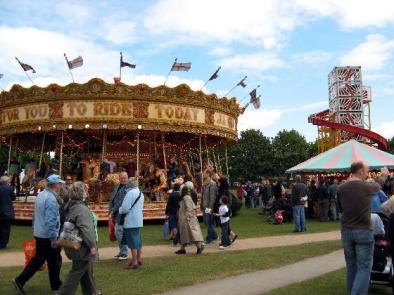
The lunchtime marquee event, part of the bustling May Fair on Richmond Green, had a carnival air at times, with the strains of a carousel hurdy-gurdy almost drowning out the more regular overhead refrain of Heathrow jets coming in to land. All this going on as we listened to a poem called The Full English, a pointed comment on immigration and heritage, even if it didn’t mention Brexit by name.
There was a lament, I Hear America Sighing, after Walt Whitman, for what America has become: “Flags furled, insults hurled, banners waved in anger. / In Times Square the wind moans, and all around the sound / of groaning, the earth trembling as the screen fades to black. / Stop sighing, American, start singing. Time to come back.”
The last poem in the latest collection, which Roger McGough also read on Richmond Green, has the air of a belated confession. So Many Poems, an Apology looks back on “being twenty, runningallthewordstogether / and thinking, There must be more to it than this.” Another ‘apology’ is for “trying to prove that, if not for everyone, / it is for anyone.” No need for apologise for that, Roger. It’s why you are still loved by so many.
The competition that he judged was won by Jenny Martin. Her poem, Disaster in Silence, oddly enough talks about a carousel’s horses after some nameless catastrophe “petrified mid-gallop … open-mouth shock on their faces, such that it seems they were once alive”. Jenny was unable to make the occasion and it fell to me to read the poem – twice – as the carousel played outside on the green. You can find the competition winners and the commended poets on the Arts Richmond website. An anthology of forty competition poems will be launched on 29th June.
 One other thing. Is there a statute of limitations on poetry plagiarism? If so, what is the time period? At the risk of being ungallant, I should say that we are talking more than forty years ago. During a Q&A session after Roger McGough’s reading, my wife finally unburdened herself of a sense of guilt that she had first mentioned to me two years ago, when we had seen him perform with Little Machine – that at the age of seventeen she had largely plagiarised a McGough poem that was published to great acclaim in her school magazine. She chose to make this confession in public, in a tent full of people. Mr McGough absolved her, of course. What a gent!
Greg Freeman
May 2019
Photography by Arts Richmond, Calvery Parkside and Totally Richmond
This article was first published on the poetry website Write Out Loud www.writeoutloud.net/public/blogentry.php?blogentryid=90647


