
Laugh Your Head Off !
Wolf Hall and Bring up the Bodies
by Mike Poulton, adapted from the novels of Hilary Mantel
Teddington Theatre Club at the Hampton Hill Theatre until 28th June
A review by Viola Selby
Who fancies a good gossip about so called friends, adultery, incest, divorce and beheading? Well then Sally Halsey’s production of Mike Poulton’s adaptation of Hilary Mantel’s Wolf Hall and Bring up the Bodies is just up your alley! This six-hour long production, including intervals, but not dinner breaks, is a royally rumbustious affair that will have you both laughing your head off (pun intended) whilst sitting on the edge of your seat. Taken along by Sally Halsey’s great direction, the audience is transported back to various famous locations of Tudor England by Junis Olmscheid’s exquisite and highly detailed set designs, including hidden gems like the Tudor Rose on one of the corridor walls, clever lighting and sound by Gary Stevenson and Harry Jacobs and costumes that would make a queen green with envy, creatively crafted by the wardrobe team.
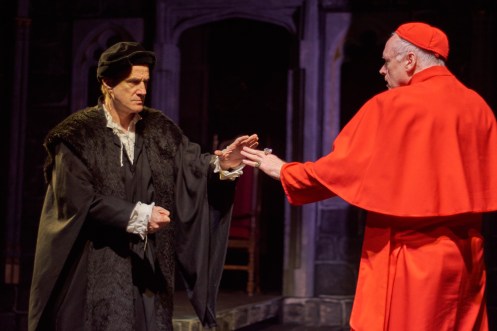
Each performance is strong and carefully planned out, with all actors having a clear understanding of their character and motives. For example, Dave O’Roarty plays Cardinal Wolsey, not just as a greedy right hand of the king, but as a man whose beliefs and desires are often in conflict with his need to survive and to serve his king. Whilst Tom Wright’s Thomas More is not some gentle religious man as often More is made out to be, but an annoying pious creep.
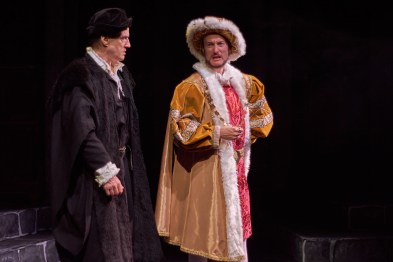 But it is Dave Brickwood, who is the star of the show as Thomas Cromwell, managing to portray a man with many layers, in an intense yet seemingly effortless performance. Instead of portraying him as a man completely devoted to Wolsey, as Mantel would have us believe, or the Tudor Alistair Campbell with an axe, as David Starkey argues, Brickwood has the audience’s mind in a real muddle as they try to work out Cromwell’s true intention. As Cromwell says, “I have never known what is in your heart. Do not presume to know what is in mine.” And this is something that in this play we can never do!
Unlike many other plays adapted from books, this is not a play about which the audience needs to have read and remembered Mantel’s books word for word, nor do you feel the need to remember everything from your GCSE History lessons. It holds well on its own. However a light understanding of the characters and places would help, as there are so many plot twists and place names it is almost like watching a Game of Thrones episode! It would also help in understanding the comedy behind lines such as when Jane Seymour, brilliantly played by Hannah Lobley, introduces herself as, “Oh, I’m nobody. I’m only Jane Seymour.”
A gripping and hilarious royal romp filled with backstabbing, plotting and intrigue, Wolf Hall and Bring up the Bodies is a six-hour production that will have you both sitting on the edge of your thrones and laughing your breeches off!
Viola Selby
June 2019
Photography by Joe Stockwell
Riotous Spectacle, Gloriously Sung
The Magic Flute
by Wolfgang Amadeus Mozart, libretto by Emanuel Schikaneder
Scottish Opera at the Hackney Empire until 22nd June
A review by Genni Trickett
As a steampunk enthusiast, I have learned to be wary of mainstream events and productions that claim to be steampunk. Often, it signals a half-hearted attempt to leap on the popular bandwagon by bunging a few cogs into the design and making the ladies wear their corsets over their dresses.
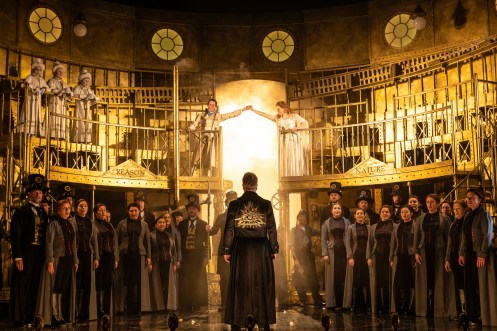
Not so in this production of The Magic Flute, however; Scottish Opera have really gone for it. Simon Higlett’s lavish set gleams with brass, there are top hats and goggles everywhere, a delightful mechanical automaton almost steals the show, and a gloriously voluptuous, rather kinky chaise makes an appearance – maybe a sly nod to the rumour that Victorians considered furniture legs obscene. Oh, and there is also a rather fabulous monster, all gleaming metal and glowing eyes.

Papageno first appears as a flamboyant Victorian showman, drawing Tamino into the house of wonders, where a sparkly Queen of the Night and a sinister, black-clad Sarastro await him. The Masonic symbols are all present and correct, of course, but they fit rather well into the lavish spectacle. Mark Jonathan’s lighting is marvellously atmospheric, giving us gloomy shadows, bright sunshine and sinister flashes of lightning as required.
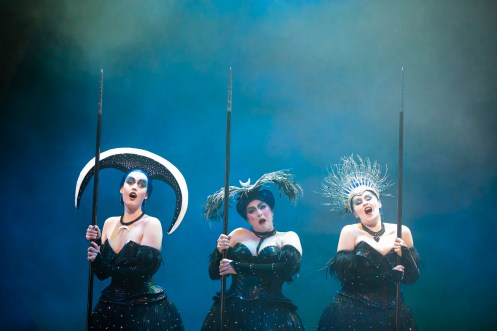
All in all, a visual feast. And thankfully, the production itself lived up to the aesthetic. Movement is kept largely minimal, especially during the singing, but what little there is works well. Sarastro’s henchmen lurk unsettlingly in the shadows on scaffolding, the Queen’s naughty handmaidens glide about, full of devilment, and three small boys dangle bravely from the rafters.
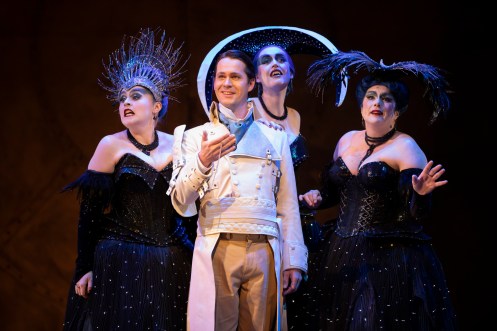
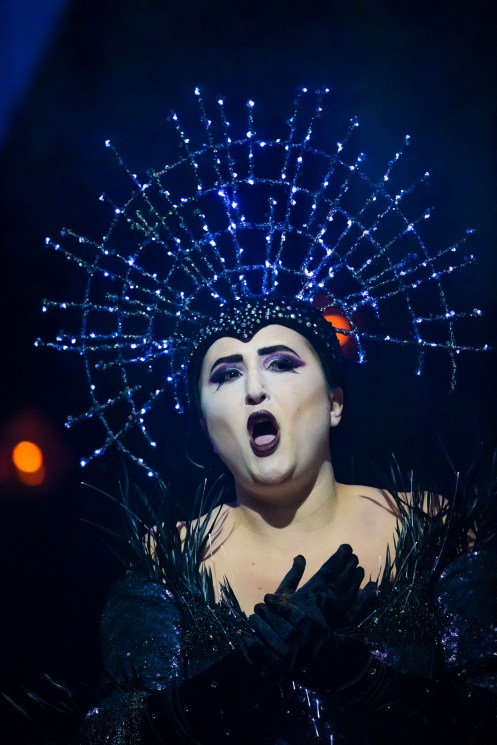
Peter Gijsbertsen is a noble, bewildered Tamino, and Gemma Summerfield brings some welcome melodrama to his long-suffering love, Pamina. Adrian Thompson is perfectly revolting as the cartoon villain, Monostatos, and Dingle Yandell gives an unnerving stillness to the ineffable Sarastro. Julia Sitkovetsky, as the Queen of the Night, gave a bravura performance while singing, perfectly nailing the legendarily difficult Der Hölle Rache. However, her character lacked power, particularly when compared to her handmaidens, played by Jeni Bern, Bethan Langford and Sioned Gwen Davies.
Full marks for James Cleverton, standing in for Richard Burkhard as Papegeno; his is surely the most difficult and complicated role, but he really pulls it off. His clowning and theatrics give a much-needed lift to the meandering story line, and in this he was greatly aided by Sofia Troncoso’s ridiculously entertaining Papagena.

The orchestra, doubtless sweating away in their pit on such a hot night, were simply wonderful, and the sound levels were spot on.
It is impossible to review The Magic Flute without touching on the thorny issue of its innate sexism and misogyny. In this production its troublesome presence was greatly alleviated by Kit Hesketh-Harvey’s witty, slightly modernised English libretto and Sir Thomas Allen’s light, comic direction. Together they emphasised the fact that almost everything and everyone in this opera is ridiculous, and should not be taken seriously. It is a sumptuous, riotous spectacle, gloriously sung and marvellous fun. That is all.
Genni Trickett
June 2019
Photography by James Glossop
Power, Piety and Pity Flow from Sybaritic Sensuality
Belshazzar
by Georg Frideric Handel, libretto by Charles Jennens
The Grange Festival, at The Grange, Northington until 6th July
A review by Mark Aspen
If you want a good rip-roaring story, there is probably no better place to go than the Old Testament. There are tales on an epic scale, as armies besiege cities, Jericho … or Babylon. There are cities of debauchery, Sodom and Gomorrah, … or Babylon. Or Babylon … here you have the best of the worst worlds, an army besieges while the city debauches. Hence, the fall of Babylon at the end of the reign of Belshazzar is a gift for an opera, and particularly if large scale choral singing is your forte (in both senses of the word).
Large scale choral works, oratorios and opera, were unquestionably a forte of Georg Frideric Handel, but to the devout Handel and his pious and staid librettist Charles Jennens, Belshazzar had a strong moral and religious message (and possibly hints of a political one).
The excesses of the eponymous Belshazzar, King (or strictly speaking co-regent) of Babylon, as the conquering Persians attack his city, are certainly strong meat; and Daniel Slater, the director of The Grange Festival’s powerful production of Belshazzar, takes every opportunity to squeeze out every delicious drop of juice from that meat.

Handel conceived Belshazzar as an oratorio and it is indeed rare for it to be presented as a fully staged opera. Michael Chance, The Grange Festival’s ebullient Artistic Director, tells us that this is the first UK production* of Belshazzar as an opera in “living memory”. The dedicated and knowledgeable Chance knows how to pick his season, and this opera is more than a dramatised oratorio, it is a triumph!

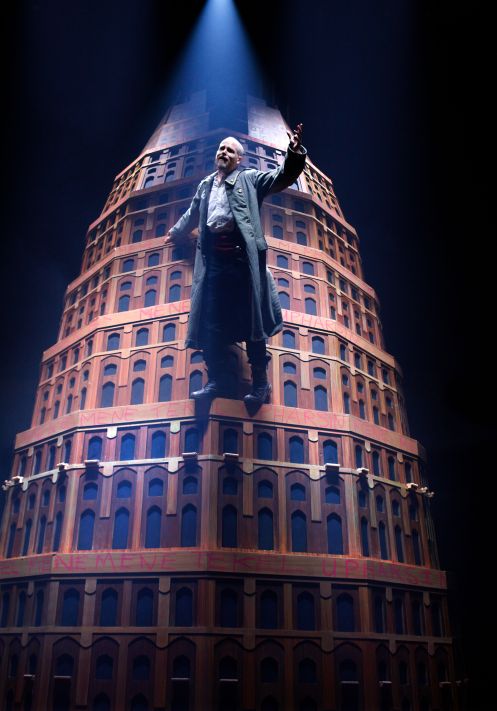
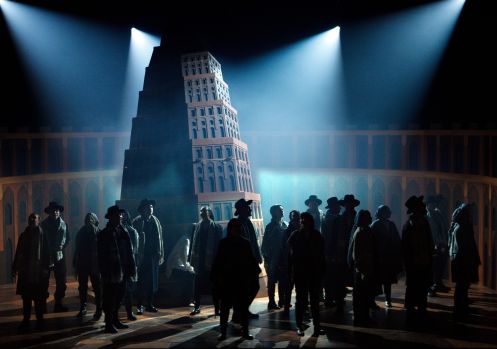
Slatter’s setting reeks of voluptuousness, think Peter Greenaway meets Sir Lawrence Alma-Tadema. The setting has a tripartite artistic concept, design, lighting and movement. Robert Innes Hopkins set design is an inspired by the iconic image of Breughel’s Tower of Babel. We feel we have to let pass the anachronism of a couple of millennia between Genesis and Daniel, but then again this tower is truncated and no longer has the conceit to reach heaven. It is still a structure of some substance set with precarious footholds for the cast to clamber on. The tower is mounted on a revolve and turns to reveal the sumptuous golden walled palace of Belshazzar. Then Peter Mumford’s lighting design follows the various moods of the plot, colour-coding emotions and emphasizing place. We can be with the licentious Babylonians inside the massive city walls, or outside with the haughty Persians. The third impressive element is the movement, individuals become masses: crowds whose every move underlines the action, sometime disciplined armies, sometime mobs, sometime orgiastic writhing heaps of sensuality. Movement director Tim Claydon’s choreography is a well-studied and accurately observed replication of the collective instincts of the crowd. It delivers just as much impact as the large scale operatic or dramatic blockbusters mounted on the London stages by directors such as Deborah Warner.

Claydon’s palette is the augmented festival chorus comprising The Sixteen Choir and The Grange Festival Chorus. It is unusual in a review to mention the chorus before the principals, but in this production the chorus makes such a magnificent visual and vocal foil to set off the talents of the individual performers. Handel gives the chorus much to do, and they are certainly kept busy repeatedly changing costumes to become Babylonians, Jews, Medes or Persians. But Handel gives them music of grandeur and magnificence, and the augmented chorus of some 27 singers bring this out with musical vibrancy and unimpeachable coordination. Each of the peoples has its own character. The Babylonians, gaudy and brash, mock the besiegers from atop the walls, “Hark, Cyrus! A tedious time! To make it short, thy wise attempt will find us sport”. The Jews, dressed in black are pious and are submissive, until Belshazzar profanes their sacred chalice, “Recall, O king, thy rash command”. The Persians, determined and confident, hold the moral high ground, “Of things on earth, proud man must own, falsehood is found in man alone.” The chorus differentiate between each with well-polished skill.
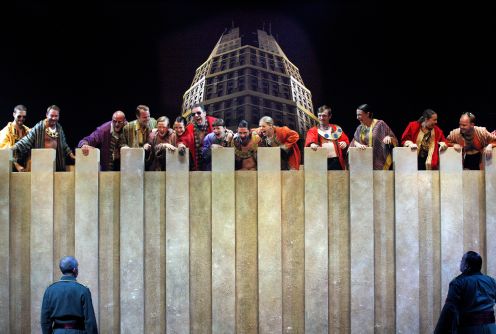
The visual impact of the chorus, increased to thirty by the presence of three skilled acrobats (Haylee Ann, Craig Dagostio and Felipe Reyes), comes from the fluent and expressive choreographed movement that almost articulates the collective consciousness of the group, as cowed prisoners, marching disciplined armies, or decadent courtiers. The depraved licentiousness of the Babylonian court reaches its depths in the Feast of Sesach, an unbridled drunken orgy of sex in all its versions and perversions, which continues even as the Persians besiege the city.
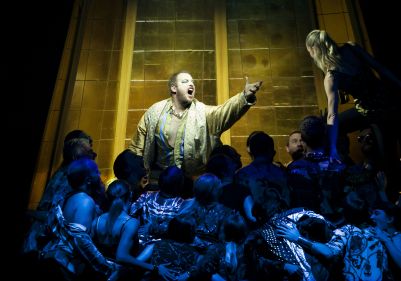 And from the innermost core of the depravity there bursts like an erupting volcano the lip-smacking figure of the bisexual tyrant, Belshazzar. Robert Murray makes a remarkable Belshazzar, his muscular tenor negotiating the intricacies of the score with aplomb, and obviously relishing acting the reckless despot. The sybaritic sensuality of his court is played out in Haylee Ann’s aerial ballet, on a stream of golden silk, dangled before Belshazzar’s popping eyes. She climbs the silk to retrieve the Jewish chalice … Belshazzar drinks from it! Then a sudden staccato violin chord as he faints in fear! At first it is only he who sees the Writing on the Wall.
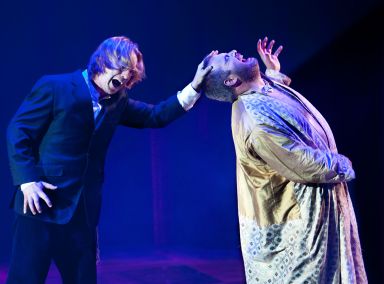 Daniel, the charismatic prophet of royal Jewish descent, is brought forth, as only he can decipher The Writing. James Laing, as a long haired, bespectacled and somewhat studious Daniel, conveys calm and dignified piety. Laing (soon to revive his “sleazy” Terry in Nico Muhly’s Marnie at ENO) has a finely pointed countertenor voice, which emanates authority “Thou hast not glorified, but hast blasphem’d.” As he interprets the portentous message, he places a healing and exorcising hand on Belshazzar, who is spiritually slain.
The countertenor is a stock in modern interpretations of Baroque opera, and The Grange Festival has built a strong reputation in the Baroque with its yearly production of early opera. (Michael Chance himself is of course a renowned countertenor.) It is interesting to hear the subtleties of timbre and approach that exist within the countertenor range. Christopher Ainslie, who played Ottone in The Grange Festival’s Agrippina last year (and Oberon in A Midsummers’ Night’s Dream at ENO) is now Cyrus in this production, Cyrus the Great, the Persian Emperor. He portrays the patient confident Cyrus with an assertive countertenor, slightly more coloured than Laing’s defined approach, imbuing the character with considered audacity.

Cyrus’s audacity is at its most evident in his bold tactic of diverting the Euphrates river which encircles the city, an historic detail that Jennens gleaned from Herodotus rather than the Old Testament, but which embodies the out-of-the-box daring-do of the character. This trait is highlighted by the juxtaposition of Cyrus’s more conventional military man, his general Gobrias, scored as a bass. The men are depicted as mutually supportive. Gobrias is “oppress’d with never-ceasing grief” over the murder of his son by Belshazzar, but Cyrus urges him to revenge. Henry Waddington portrays Gobrias as a tragic figure for whom “no hope, but in revenge, is left”. He relishes in his delivery of his observation of Belshazzar, “Behold the monstrous human beast, wallowing in excessive feast” and the drama of the descending scales paints a vivid picture. It is Gobrias who kills Belshazzar with his own hand, and in a dramatic coda we feel his revulsion as he hands over the bloodied sword to Cyrus.
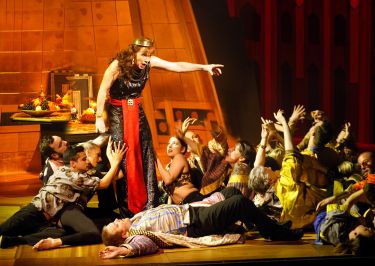 In spite of all the swashbuckling, there are profound depths to Belshazzar. It is a three-way struggle between reason, immorality and spirituality, embodied in each of the three peoples, the good, the bad and the pious. Nitocris, Belshazzar’s mother, is a well-developed character who is torn by the heart-rending dilemma between condemning Belshazzar’s sins and protecting him as the son she loves, whilst filled with foreboding about his fate. Slater places Nitocris as the parentheses around the opera. During the overture we see the veiled Nitocris mourning alongside the coffin of her late husband, one of the four Babylonian kings assassinated during the bloody six years following the death of Nebuchadnezzar. Finally, as a visual epilogue to the opera, we see the veiled Nitocris mourning alongside the coffin of her late son. Claire Booth’s Nitocris sincere characterisation and expressive soprano vocal colour exudes the emotional language at the heart of the opera’s message.
Slater’s Belshazzar drips with symbolism. Some is obvious, witness the lascivious things the Babylonians do with luscious bowls of fruit, some less so. Why does Daniel end up locked in erotic embraces with Nitocris after Belshazzar’s death? There is nothing in the libretto or score to suggest this. Maybe it contrasts with Cyrus, for whom the libretto has him declaring to Nitocris, “Be still a queen, a mother still, a son in Cyrus you shall find”. A bit Freudian-Oedipal it seems, so perhaps the implication is that Daniel will become a spiritual step-father to Cyrus. Are we meant to read that much in?
The Orchestra of The Sixteen, under the baton of its director Harry Christophers, is at one with the piece. Christophers moves the opera along at just the right pace, and the orchestra and the augmented Sixteen Choir are in perfect balance. Indeed, they have had a long time working together as this year marks the fortieth anniversary of The Sixteen, which Christophers founded in the summer of 1979.
With all the flair that The Grange Festival has for the baroque, its Belshazzar is a tour de force, a parable of power, piety and pity told with epic spectacle and artistic finesse. Yet another must see for The Grange.
Mark Aspen
June 2019
Photography by Simon Annand
* Rene Jacobs rather lacklustre production featured at the Aix en Provence Festival in 2008.
If You Go Down in the Woods
Hansel and Gretel
by Engelbert Humperdinck, libretto by Adelheid Wette, based on the Grimm brothers’ story
Regent’s Park Theatre and English National Opera, Regent’s Park Open Air Theatre until 22nd June
Review by Suzanne Frost
I have never been to the amphitheatre in Regent’s Park before, because the reality of a Great British Summer always means that, in choosing a date and buying a ticket, you also acquire the risk of having a right miserable wet time. For ENO’s opening night of Hansel and Gretel the weather gods were on our side (the only dry day all week!) and how lovely the grounds look, with fairy lights in the trees and the lawn dotted with picnic baskets and happy people carrying wine coolers. My continental bones still need a fleece jacket and a blanket to wrap up in but there’s no denying that when it goes right, a Great British picnic really is charming.
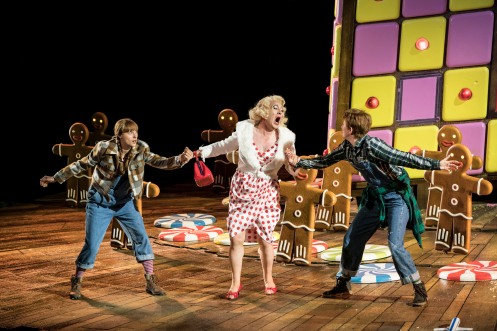
With the trees whispering and birdsong mingling with the human voices, those pastoral brass notes of the overture develop a very special magic. Engelbert Humperdinck’s children’s opera is sweet in its simplicity yet rich in melodies and orchestration; very reminiscent of his mentor and teacher Richard Wagner, but much more optimistic and in this case, deliberately more modest with a close vicinity to German folk music. Indeed, so many of the songs are nursery rhymes any German kid knows to sing in kindergarten and so the opera taps right into memory, transporting you back to simpler times. Usually Hansel and Gretel is a Christmas favourite, its rich brass and wind section giving it a festive splendour. But in Derek J Clark’s stripped down re-orchestration for a scaled down ensemble, conducted by Ben Glassberg, it has a pastoral charm that works just as well when your stage is in the forest and the surrounding bushes act as wings and the odd pigeon comes flying through the scenery.
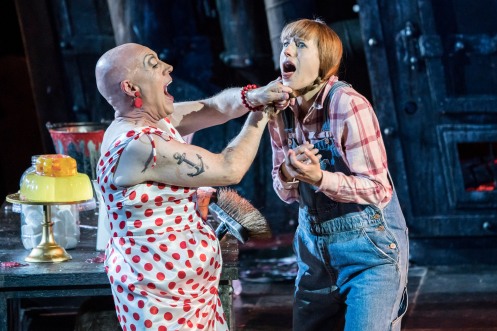
To the sounds of the overture, director Timothy Sheader populates the stage with a chorus of sinister looking witches in dirty rags carrying broomsticks and sulkily sucking on lollipops. With their empty stare and exaggerated rings under their eyes they resemble a zombie army straight out of The Walking Dead and give a nice chilly creepiness to the fairy tale without ever doing anything truly unsettling.
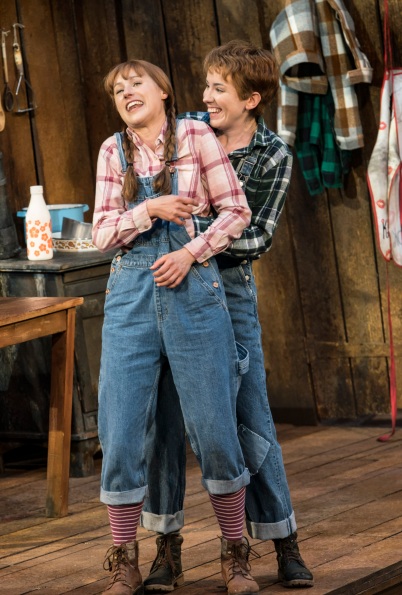 We meet Hansel and Gretel in their squalid little house, short on food but rich in cheer and energy, playing games using their imagination. Grown-ups playing child characters often ends up icky but I found Rachel Kelly and Susanna Hurrell convincing enough without piling on the sugar. While not confined to any distinctive time period, there are fun contemporary touches such as Rosie Aldridge’s robust mother calling on God to help with a lottery scratch-ticket or getting positively turned on by the can of Heinz beans her brush maker husband brings home to feast on, while swigging from a can of beer (and relieving himself in the bushes of Regent’s Park!) A special mention to Duncan Rock’s beautifully clear articulation and I am so pleased that while in the past I have often struggled with ENO’s insistence on English libretti, the translation for Hansel and Gretel by David Pountey is perfect, with natural, easy rhythm that retains the simplistic charm and dreamy poetry of the original.


There are beautiful directorial ideas, from the forest built out of upside-down broomsticks, lit up with twinkly fairy lights, to the dream pantomime that concludes Act II and sees a crew of fourteen angel airline hosts descending in a wonderfully imaginative scene with a distinct Matthew Bourne aesthetic to it.
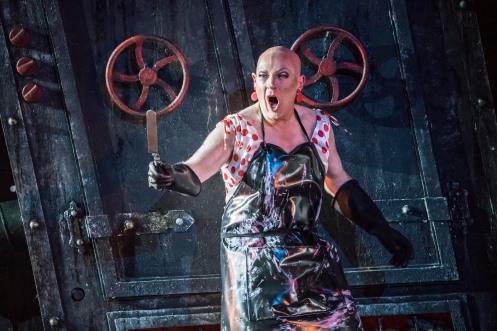
The gingerbread house that greets us on return from the interval is a colourful construction of blinking flickering lights with the irresistible appeal of an amusement arcade to a gambling addict. Only Alasdair Elliott’s witch is a bit of a let-down, his panto dame attire just isn’t as menacing compared to the truly spooky chorus of zombie witches – but then he does shave his legs using whipped cream and reveals a bald head under his wig, in a nice nod to Roald Dahl’s The Witches.

The spirited kids from Pimlico Children’s Choir get to finish the show with a Mathilda-like power to the little people number, but overall this production feels more for grownups than children – it’s got humour and heart and a few knowing winks and pop culture references that make it quite sophisticated in its sweetness.
Suzanne Frost
September 2018
Photography by Johan Persson
Anywhere, Anywhen, Together
Di and Viv and Rose
by Amelia Bulmore
The Questors at the Studio, Ealing until 22nd June
A Review by Genni Trickett
Di and Viv and Rose is, as you would expect, a play about three women. Three women at university in the 1980s. Three women with very strong, disparate personalities. Three women who, throughout their lives, will share and support each other through experiences both good and bad. Three women called…err, Di and Viv and Rose.
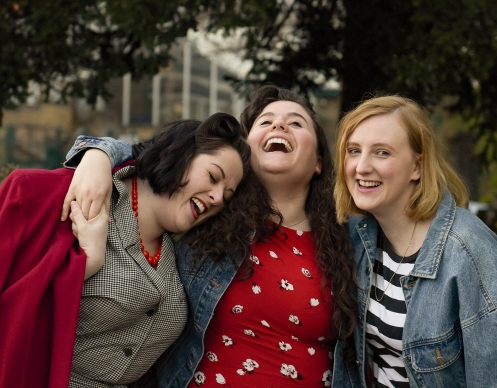
Despite the strong whiff of nostalgia running through the play, emphasised in this production through the use of political activism posters and a catchy 80s soundtrack, the play itself seems strangely timeless. For the most part it’s set in the north of England, but that also is irrelevant. These three women could be anywhere, anywhen. All over the world, this kind of deep, complex, very female relationship has been played out, over and over again, since the beginning of time. Writer Amelia Bulmore focuses intently on the intertwined personalities of the three as the basis for the story, their shared house serving almost as a protective bubble for much of the first act, but the intense social and political upheaval of the era outside is reflected in the personalities of the girls.
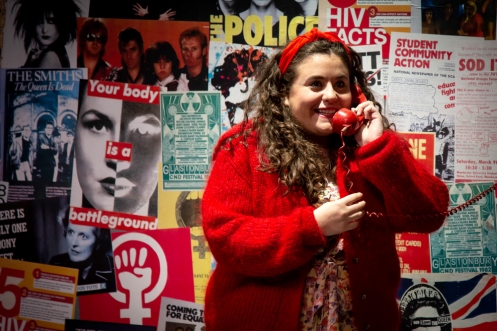
Rose is a well-to-do, bubbly arts student, with a penchant for sleeping with anyone who takes her fancy. Di is a strapping, sporty, proud lesbian, who nevertheless daren’t come out to her family. And Viv is a no-nonsense intellectual feminist, obsessed by the social history of the corset.
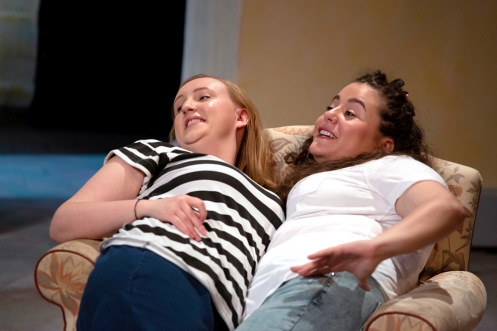
All three actresses inhabit their roles with verve and gusto, making their characters sympathetic and believable. Lauren Grant, as Rose, is perhaps the most comfortable in her character’s skin, playing her with a wide-eyed childishness that seems very genuine. Their interactions are, for the most part, lovely to watch – although a joint dance sequence to Prince was overlong and very awkward.
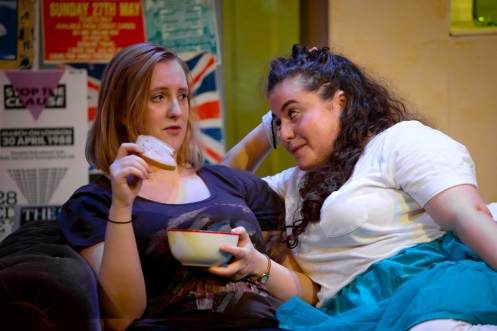
Despite the strong characters and acting, the play is patchy; whether this is due to the writing or to Sukhi Kainth’s direction it is hard to tell. It begins with a series of jerky vignettes – maybe a legacy of Bullmore’s screen writing past – which then stretch gradually, like bubblegum, to form whole scenes. At times it feels dragged out, and at times rushed; possibly the whole script could have done with some judicious pruning. Bron Blake’s set was also often more hindrance then help; people tripped over trailing phone wires, bumped into chairs and, at a point where we really should have been focussing on tragic Viv, we were all distracted watching the other two running around with mattresses.
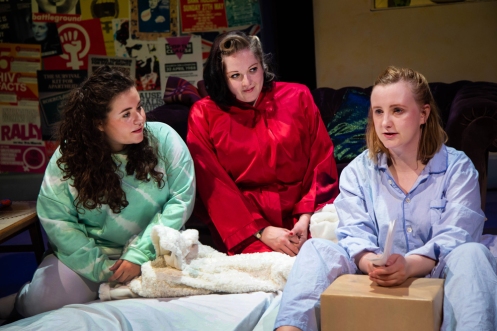
Despite its flaws, there is enjoyment to be derived from Di and Viv and Rose. Merely watching and listening to the girls is a delight, and, thanks to our emotional investment, the occasional moments of darkness pack a heavy emotional punch. With some trimming and tightening, it could be a great success.
Genni Trickett
June 2019
Photography by Carla Evans
Firing On All Cylinders … And In All Directions
The Lonesome West
by Martin McDonagh
Richmond Shakespeare Society, Mary Wallace Theatre, Twickenham until 15th June
A Review by Raymond West
Every so often you have an evening at the theatre that is hard to describe. Was it terrific? Was it terrible? Richmond Shakespeare Society’s revival of The Lonesome West provides just one of those evenings. This hilariously funny production is a non-stop carnival of lunacy, set in the west of Ireland and centred on two brothers who seem to have been hell-bent on destroying each other since birth and are now set to bring their home – if not the neighbourhood and everyone in it -crashing down around them.
Fiona Smith directs Martin McDonagh’s play with verve, allowing the quiet moments of reflection – there are some – the time and space they need, while keeping the brothers’ never-ending struggle centre stage even when they are in the wings. The production is well cast with good performances from the quartet of actors, especially Tom Shore’s quietly desperate priest who has failed in every aspect of his life and Elle Greenwood as a schoolgirl poteen dealer (only in Ireland!) who might have more balls than any of the men – all failures in their way – yet has a softer centre that comes to the surface only when events take a turn for the worst.
As the Connor brothers, living a Punch-and-Judy life in a sparsely furnished cottage, Steve Webb and Martin Halvey are very entertaining. Halvey’s is a more subtle portrait of insanity – just – while Webb’s herky-jerky twitches owe much to Father Ted, too much so when he first appears. Against the odds, the two actors, well paired, succeed in making some sense of the Connors’ insanely destructive rivalry.
The pace of the production is furious throughout which means that the over-lengthy set changes and blackouts provide a little respite and are less distracting than they would otherwise be. The technical effects are generally good, especially the sound, though the opening scene of the second act was too expansively and brightly lit, leading to audible confusion for some members of the audience.
All in all, a flawed but thoroughly enjoyable whirlwind of an evening that will stay in the memory for some time to come. Was it terrific? Was it terrible? It was both.
Raymond West
June 2019
Photography by Simone Germaine Best
Mixed Doubles
A Visit from Miss Prothero and
An Englishman Abroad
by Alan Bennett
Teddington Theatre Club at the Coward Studio, Hampton Hill Theatre, until 15th June
Review by Melissa Syversen
This is my second time seeing Teddington Theatre Club dig into Alan Bennett’s vast body of work. It’s easy to understand the appeal. Alan Bennett has an incredible catalogue rich with pathos, humanity and humour. Bennett’s gift of writing “ordinary people” and his ability to find beauty in the seemingly mundane and everyday is nothing short of extraordinary. Last time, I saw a charming double bill of Talking Heads, this time around TTC has brought us two others Alan Bennett shorts, A Visit from Miss Prothero (1978) and An Englishman Abroad (1983).


Of the two pieces, A Visit from Miss Prothero is, for me, the stronger of the two. We meet Arthur Dodsworth (a wonderfully understated Jeremy Gill), a recently retired widower whose newfound peace is disrupted by an unexpected visit from his former secretary, the titular Miss Prothero (played pitch perfectly by Liz Williams). What follows is what seems like polite enough visit between to old colleagues, discussing their co-workers and the new boss etc. Miss Prothero’s reason for visiting is seemingly innocent enough at first, though there is not much warmth between them to speak of. But throughout their conversations, it is clear that her visit is not one with pleasant intentions, her insistence on discussing the changes made since Mr Dodsworth left appearing almost cruel. Once she leaves, the damage done by her visit becomes quietly and heartbreakingly clear. Heavens help us, we all know a Miss Prothero.
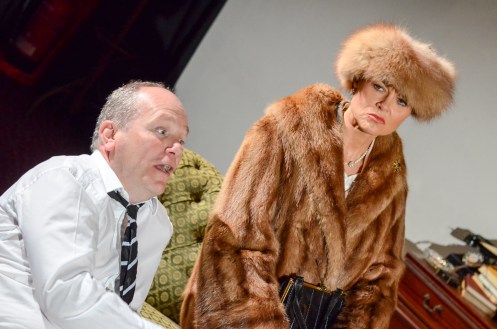
An Englishman Abroad is perhaps one of Bennett’s most famous pieces. It is the true story of the meeting and subsequent visit paid by actress Coral Browne to infamous Cambridge Five spy Guy Burgess (played serviceably enough by Roberta Cole and Patrick Harrison respectively) whilst on tour in Moscow. Despite alterations by Bennett from the story originally told to him by Browne herself, it remains an interesting window into a piece of recent history. However, this production does not quite live up to the remarkable nature of the story. Lush costumes (fine work by Maggie Revis) and crisp received pronunciation aside, Bennett’s words never quite connect. Moments that should have some weight or sharp wit all fall a bit flat. The result is a unfortunate feeling of “put on-ness” the piece never seems quite able to shake. There is a lot of unnecessary chuckling, sighing and pausing that hampers the flow of the text. Combine this with a habit of looking down and spotlights leaving half of the performer’s faces in shadows, it makes for a mildly frustrating hour. Overall the lighting by Patrick Throughton is spot-on, but during the characters addresses to the audience, it might be worth considering adding some light from stage right.


The Noel Coward studio at the Hampton Hill Theatre remains a flexible space as always and director Jenny Hobson, together with set and props constructors Vicky Horder, Alan Corbett and Mart Stonelake make good use of it. Both pieces are set in the 1950s sitting rooms but each piece has a very clear feeling of time and space. A Visit from Miss Prothero and An Englishman Abroad is not an obvious pairing at first. But both though different in tone and subject matter, shed light on themes such as isolation, loneliness and sacrifice for some form of “greater good”, be it honest work or misplaced political ideology. Despite my nit-picking I did, as I always do, enjoy my evening spent at The Hampton Hill Theatre together with the TTC and I look forward to seeing what they do next.
P.S. A special mention to Florrie in her role as Millie the Budgie, quite charming.
Melissa Syversen
June 2019
Photography by JoJo Leppink of Handwrittenphotography
Big, Boisterous, Brilliant !
Falstaff
by Giuseppe Verdi, libretto by Arrigo Boito
The Grange Festival, The Grange, Northington until 29th June
A review by Mark Aspen
Cheers! Falstaff would approve: we start in the pub for The Grange Festival’s priceless production of Verdi’s Falstaff. Blustering, big, boisterous and brilliant, it is Falstaffian to a tee.
The pub is one of those country town inns now spruced up as part of a hotel chain. Simon Higlett’s finely observed set is varnished wood, regency stripes, Amtico floors and modern brass, with newly installed lifts and uniformed staff not quite yet up to speed; the sort of place where middling companies hold corporate events. This is The Garter at Windsor, where the erstwhile peripatetic Falstaff is now ensconced, and where he has become one of the famous sights of the town for excited tourists staying in the hotel to grab a sneaky selfie on their mobiles.
And we are straight into the action with a noisy altercation between Falstaff and his cronies, and Dr Caius, a well-heeled semi-retired GP, who has been robbed, and he knows by whom!
They never quite get to blows, but the hapless Caius is ejected. All this causes riveting entertainment for the hotel guests and bar staff. Falstaff has a scheme to bolster his evaporating finances: to seduce two wealthy (and married) Windsor ladies, and has identical love letters prepared. His accomplices, the hitherto disreputable Bardolfo and Pistola refuse, on their honour, to be involve. Falstaff is outraged and kicks them out in a thunderous tirade, “L’onore! Ladri … !” (Honour! You thieves … !).

Thus we are introduced to Falstaff, larger than larger-than-life. As Falstaff, Robert Hayward is outstanding in all senses, including the big-belly that is a source of pride for Falstaff who, for all his egotism, has no self-awareness. A hairy, bearded and bare-footed bohemian, clad in loudly mismatched free-flowing patchwork, Falstaff may call himself vecchio John, but he has certainly not any intention of growing old gracefully. There is no false modesty in Falstaff; when he tells us he is immenso, enorme, he is referring as much to his ego as his bulk. Haywood’s ruby-rich clear bass-baritone floods the opera-house with easeful energy and power as he makes Falstaff the epitome of the loveable rogue. Yes, he is an old roué, but a big-hearted one taking a punt; if he is lecher, he is a likeable one.
Verdi was almost eighty years old when he wrote Falstaff. It had started out as a little exercise “to pass the time”, since in in all his decades of composing, he had never tackled a full-length comic opera. Although he didn’t speak English, he loved Shakespeare and is said to have always kept Italian translations by his bedside. When Verdi happened to mention his ambition to Arrigo Boito, the librettist of his Otello, Boito said nothing, but he secretively started writing a libretto, abridging The Merry Wives of Windsor, and using some material from Henry IV. When Bolto casually dropped a copy of his libretto in on him, “Verdi could not hide his delight”.
The Grange Festival’s bang-up-to-date version would most certainly have delighted Giuseppe Verdi (and William Shakespeare too would have a good belly-laugh at how far his The Merry Wives of Windsor had come). This is a production that every member of the company has had huge fun creating, and everyone has put their all into the show.
Simon Higlett’s pub set is trucked and slides aside to reveal the Ford villa, a high spec new-build des-res right on the Thames with its own private mooring, complete with a rather swish mahogany steam-launch, fully working! The villa is on a revolve and turns to reveal the interior of the villa, with its all mod cons kitchen-breakfast room, an Ideal Home Exhibition star exhibit. There are visual gags galore. Is that a portrait of The Grange Festival Chairman hanging in the Garter pub? For the final scene we are at Herne’s Oak in the moonlight, a totally magical creation. Then, a propos of nothing, a little hunched-up lady walks past, wearing green welly-boots, a Barbour coat and patterned headscarf: on her dog lead, she has her corgi. We know we are definably in the Royal Windsor Park. The audience loved it. If the design is a tour de force, which it undoubtedly is, then Karen Large’s costumes are a further witty element, each one commenting on each character’s idiosyncrasies and foibles.
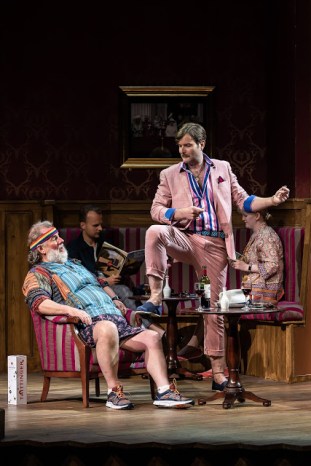
Master Ford, the husband of Alice, one of Falstaff’s would-be paramours, swaps his everyday middle-class dowdiness to disguise himself as his alter-ego Fontana, pink-suited and sockless, straight from the Milan catwalk. Nicholas Lester, in this role, equally takes his character from studious propriety to supressed jealousy as his tries to thwart Falstaff’s designs on his wife. Lester’s great comic timing as an actor complements his fine baritone singing.
The mistress of the house, Alice Ford is more than a match for Falstaff’s lechery. Elin Pritchard portrays her as vivacious, intelligent and cunning, plus Pritchard’s singing is superb, a bright mellifluous soprano. Meg Page, Falstaff’s other yummy mummy target is in the hands of Angela Simkin attractively energetic and personable, her fine mezzo pairing nicely to make the “Merry Wives”. This conspiratorial band of ladies is completed by Susan Bickley as Mistress Quickly, the Ford’s housekeeper, and Rhian Lois as Nanetta their youthful daughter, together making an integrated intimate quartet working seamlessly in ensemble. They form a figurative chastity belt to protect the virtue of these very 21st Century merry wives.
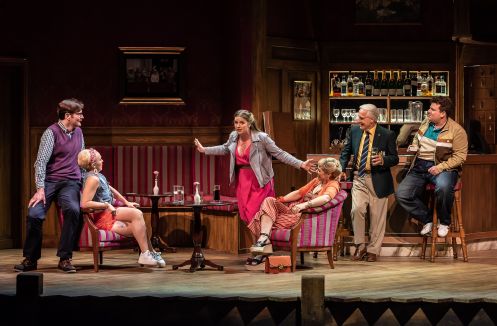
Susan Bickley’s contralto emphases those falling notes, the ribbing nature of Mistress Quickly that make Falstaff so gullible to her bait. We know that, when she describes Alice as povera donna, she is taking the mickey, but Falstaff falls for it a second time round.
An effervescent soprano, Rhian Lois plays Nanetta as an attractive, slightly coquettish and rather savvy teenager. Her beau, the love-stricken Fenton, takes plenty of opportunities to pootle along in the steam launch to woo Nanetta. Alessandro Fisher’s Fenton makes a gentle and charming suitor. Just as Fenton has captured Nanetta’s heart, so Fisher captivates the audience with his beautiful tenor rendering of Fenton’s love song, dal labbro il canto estasiato vola (from my lips, a song of ecstasy flies), then as he is melodically reassuring her, bocca baciata non perde ventura (lips that are kissed do not lose their fascination), his song is interrupted. Alas!
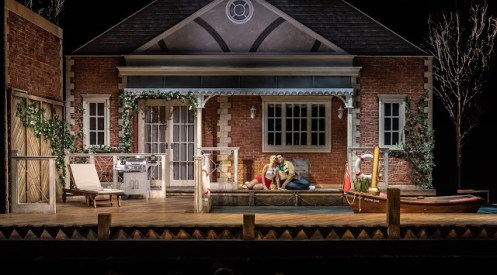
Together they make an engaging couple, and indeed would be engaged were it not that her father has promised her to the aging Dr Caius. Dapper in his boating blazer, Graham Clark cuts a purposeful figure. The international acclaimed tenor is in fine voice, putting a playful punch into this role. But of course the hapless Caius is also to be thwarted in his intentions, as he is sucked into the wake of Falstaff’s come-uppance.
Poor old Falstaff allows himself to be gulled, not once but twice. The first is at the hands of the women, a perfumed ambush into which he walks, well spruced-up in a smart red and white Henley regatta jacket and shiny co-respondent shoes, with a dozen red roses to present to Alice Ford. His awaited dalliance is rudely interrupted by the entrance of Master Ford and he is bundled into a laundry basket, prepared by the washing-machine repair men (dungaree clad members of The Grange Festival Chorus). They merely shrug as they carry out the lady of the house’s instructions to dump the contents in the Thames.

The Grange Festival’s Falstaff is the first operatic undertaking for Christopher Luscombe, the eminent Shakespearean director, and it is a mark of his skill that this wonderful rollicking production does not get stuck on one level. There are moments of lyricism and also moments of sheer pathos. One such is when a dank and depressed Falstaff emerges from his dunking in the river. Hayward’s brilliance is seen once again in his expression of misery and the real anguish he feels, which is also expressed in Verdi score. However, Falstaff is irrepressible and, after a quick mulled wine at The Garter, that pathos quickly switches to bathos as Mistress Quickly appears, assuring his reverenza that her povera donna awaits him still.
The second ambush Falstaff willing walks into is to a midnight assignation in Windsor Great Park. He is expecting a mystical sexual fantasy, a ménage à trois with both Alice Ford and Meg Page as he goes with priapic expectation towards Herne’s Oak. But this time almost everyone has ganged up in the trickery, including his own henchmen, Bardolfo and Pistola. Tenor, Christopher Gillett’s Bardolfo, a scruffy and sozzled soak, his bulbous purple trademark nose much in evidence, is contrasted nicely with bass Pietro di Bianco’s slick and scathing Pistola, like a blinged-up black-suited bookie’s runner.
The ethereal clearing at Herne’s Oak is a beautifully created space, with Peter Mumford’s lighting design leaving the canopies of the trees almost floating on mystical under-lighting. Equally atmospheric is interpretation of Verdi’s score by Francesco Cilluffo, conducting The Bournemouth Symphony Orchestra. As we approach the forest, a plaintiff horn sets the scene. Horns of the deer? Horns of the cuckold? A neat musical pun either way. But the BSO plays exemplarily throughout.
In the forest, Falstaff (and Caius) have their shaming, then all is resolved, lovers united, marriages conducted and finally the fugue tutto nel mondo è burla reminds us that all the world’s a …not a stage, but a jape!
With its feel-good factor, world class singing, and fantastic music, brilliantly acted on an ingenious set, The Grange Festival’s Falstaff is a winner. If you only go to one country-house opera this summer, this must be it!
Mark Aspen
June 2019
Photography by Clive Barda
A Magnetic Mine
Springing the Mine
celebrating 250 years since Garrick’s Shakespeare Jubilee of 1769
by Keith Wait
SMDG at Garrick’s Temple to Shakespeare, until 8th June
Review by Eliza Hall
“It was a sunny and blustery afternoon in early summer”, so the Narrator, played by director, Helen Smith, introduced the audience to hear and watch Keith Wait’s latest piece of writing come magically alive.
Springing the Mine was presented by the multi-talented and amazingly versatile SMDG (St Mary’s Drama Group). Each member of the group of twelve actor-readers held the audience spellbound and amused throughout the performance. In anticipation of a good afternoon’s entertainment, enlightenment and ‘Fun’ – the final word chorused by the entire company of actors – the small audience filled the Garrick’s Temple situated in the lawns leading down to the River Thames in Hampton.

Indeed, the director had appropriated the opening script to fit the moment of the imagined scene in June 1769, for it was indeed the sunny afternoon in early summer. It was here that the audience as invited to imagine two figures on the lawns outside, deep in conversation. One, the wife of David Garrick, La Violette, a ballerina of some distinction, played by Norma Beresford, and her companion, a friend, diplomat and successful dramatist, Richard Cumberland played by William Ormerod. The two are discussing both the successes and disappointments of both his and her husband’s writing. Almost immediately we are led to believe that Garrick’s writing, though influenced by his acting, may not have been as successful as his acting.
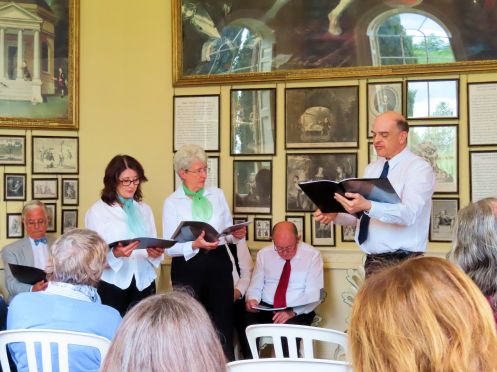
Whilst the characters discuss the wit of Mr Garrick, it is the writer of our play, Mr Wait who mocks jocundly the work of the famous actor and the ambiguity of the rivalry between business propositions in London’s theatre world, as well as a hint at plagiarism – or was it merely successful collaboration? By cleverly narrating the placement of character roles the players lead us into a taste of several Garrick plays. This is a clever and seamless manoeuvring by writer and actors both. The lively cameos woven into the narration illustrate to the audience both the style and humour of our Mr Garrick as well as the skill of both the playwrights, not to mention the actors.


The bawdiness and, more than a touch of, the restoration phase of English theatre are not lost, indeed they are played out in front of us, as the wit of the 18th century playwright mingles with the present narration and commentary on Garrick’s writing and his entrepreneurship rather than directly on his acting – this has been left to the talent of the present company to show us.
We, the audience are taught about the context and the complexities of writing in the 1760s, how Sheridan was influenced by Garrick’s writing of Mrs Heidelberg, played by Sue Birks, for his later creation of Mrs Malaprop, whose wit shines through, “I purtest there is a candle coming … and a man, too” as mor e comic characters are introduced. The romp and bawdiness follows, where people are in the wrong place with apparently the wrong persons, one loves another who cannot reciprocate. It all foretells not only the work of Feydeau a hundred years later, but, as the narrator Graham Beresford reminds us, of the Whitehall farces of Brian Rix that were to become so popular two centuries years later. So through these vignettes we are informed of the collaborative elements of Garrick’s work, his creative developments, interests and motivations to write as well as act. “This is Georgian Romance at its most charming, over half a century before Jane Austen began to epitomise the style” the narrator tells us.
Another explains that his solo writing forays are not as successful as his collaborative endeavours. It is through his own merits and skill as an actor that he made Shakespeare’s characters known and loved. Through these performances he had become famous by bringing to public notice the exemplary and valued work of Shakespeare, but it also publicised his own creativity. His theatre in Drury Lane had been the venue for audiences to learn to love the bard. A shrewd businessman, indeed, to have won the public’s acclaim, as well as its money. It is later when we learn of the washout of the Jubilee Festival that we are told how Garrick is able to recoup his loss of money and to turn his fortunes around.
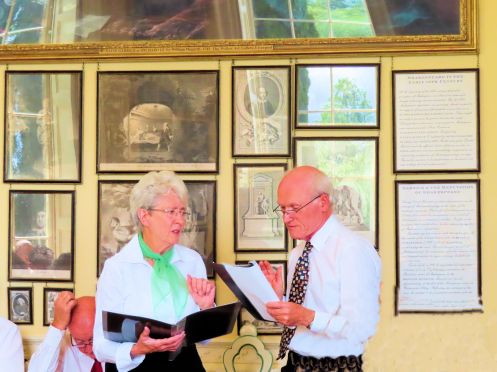
Keith Wait’s ability, beautifully brought alive by the actor-readers, weaves us through several more examples of David Garrick’s plays, whilst guiding us on a journey to Garrick’s Jubilee Celebration of Shakespeare in the market town of Stratford upon Avon, as somewhere almost unknown by London folk according to Richard Cumberland, in his conversation with La Violette.
So, having met other characters, including Mr Fribble – so foppishly portrayed by Graham Beresford – yet another excerpt of a play is introduced, so if the audience is lagging behind and has paused to contemplate, then onto the ‘stage’ bounces yet another loud and enthusiastic person played by this time as Captain Flash, played by Ron Hudson, with his several military metaphors and at last we are enlightened as to the title of this piece.

William Ormerod, who moves from being Cumberland and Garrick with such ease,
then explains that the term “springing the mine” was used by Garrick used to describe his acting method. “He himself is surprised by an upsurge of emotion in performance” , Garrick continues, “until circumstances and warmth of the scene has sprung the mine, as it were, as much to his own surprise as that of his audience”.
A narrator, Diana Bucknall, takes up the main question of the performance when she asks whether Garrick did succeed in “springing the mine” of his writing genius. We are informed that Garrick wrote some two dozen or so plays, and very few were performed. We are given several, but tiny, glimpses and certainly not enough for us in the audience and those attempting to critique this performance, based on some of his writing would dare to judge.
Once again we are directed back by the narrators, not to a discussion of his success as a writer, nor his undisputed skill as an actor, but to his entrepreneurial adventure that was the Shakespeare Jubilee, to be held in Stratford upon Avon. We are given another glimpse of another setting as description of the magnificence, pomp and the disastrous circumstances that befall those who travelled to this three day Shakespeare Festival. It is hard to separate the man from his creation, as we are informed of the 170 Shakespearean costumes – and characters, the prominence of David Garrick, the portrait painting of him in roles, transparencies painted on glass, the specially commissioned music and, of course, his recitation written for the occasion An Ode in Honour of Shakespeare, or “The Bard of Avon” as we are told by Mrs Garrick is the name he gives to The Playwright.
So, the audience is left with the question, whilst there is no doubt David Garrick’s acting filled with emotion, sprung the mine for both him and his 18th century audiences and gave them a love for the Bard of Stratford, his plays have their place in the history of the theatre and the development of English drama, but did we see that “springing of the mine” in his writing? Certainly we did in the SMDG performance.
We were enthralled by the presentation, and if some of us were sometimes lost in the weaving of the words, the multiplicity of characters, intricacies of plot and its focus, the production was a delight and a perfect way to spend a sunny June day by the river, away from the wind and the noises and bustle of 21st century England, to learn, be amused and be delighted by the local talent of acting and writing seen today, as well as 18th century Hampton.
Eliza Hall
June 2019
Photography by Lewis Lloyd
Multi-Layered Mille-Feuille
Le Nozze di Figaro
by Wolfgang Amadeus Mozart, libretto by Lorenzo da Ponte
The Grange Festival, The Grange, Northington until 30th June
A review by Mark Aspen
Multi-layered Mozart, majestic, mellow, musically exquisite, Le Nozze di Figaro opens The Grange Festival season in a stylish production that complements the Beaumarchais story told last year in Rossini’s Il Barbiere di Siviglia. It continues the adventures of Figaro a year of so on when the erstwhile barber now is in the service of Count Almaviva as his valet.
However, Mozart moves the mood on in Le Nozze di Figaro, from Rossini’s romp to something with much darker undertones. Both are opera buffa, but the comedy is now much blacker. Almaviva is no longer a romantic youth, but a despotic misuser of his household. Figaro and Susanna are about to get married, but Almaviva is planning to exercise droit de seigneur and claim her maidenhead. Rossini’s plot is quite simple, but Mozart’s librettist, da Ponte takes the plot along more twists and turns than the Stelvio Pass, and Mozart points up every hairpin turn in a gorgeous and witty interplay of unforgettable music.

The Grange production pulls out the complexity and the darkness from the story, without in any way undermining the thrills, the farce or the comedy in the story.
The Academy of Ancient Music, playing with period precision (barring a couple of wobbles) under the baton of the versatile musician Richard Egarr, is alive to all the nuances of Mozart’s score from the well-known breakneck presto of the overture to the intricacies of the wedding feast finale.
Designer Tim Reed creates a set that hints at the duplicity in the darker motives of the protagonists, heavily-rich colours, swags of foliage in the muted mellowness of an Old Master, something a bit sinister that smacks of Caravaggio. The sense of faded grandeur somewhat echoes the preserved distressed décor of The Grange itself. In its shadowing of the misuse of power unfolding on stage, it seemed to reference the closing days of the ancien régime that Napoleon himself noted about Beaumarchais’ play on which Le Nozze di Figaro is based.
Beaumarchais’ Figaro was seen to be so political subversive that it was banned in a number of European countries. Joseph II though was fairly relaxed about da Ponte’s libretto for Mozart’s opera buffa, as only the gentry went to the opera. Le Nozze di Figaro may be an Italian opera written for the Austro-Hungarian court, but its sentiment is still thoroughly French, a farce based on a mille-feuille of thwarted amorous desires. Its spectrum ranges from unbridled sex, to amorous love, to decorous marriage, but my goodness, everybody’s at it!

At the nasty end of this spectrum is Count Almaviva re-establishing his feudal rights of droit de seigneur which he had vowed to abolish. The wily Figaro, and his ever-resourceful bride Susanna, are however more than a match for their lecherous master.
Toby Gerling’s powerful baritone voice and forceful strutting body-language paint a picture not so much of an arrogant aristocrat but of a bull-necked pugilist, who will have his own way, and with Gerling’s strong stage presence the picture is of one not to be messed with. Figaro’s approach is ma, piano, piano (but softly, softly) as he determines to frustrate Almaviva’s intentions towards his bride. Se vuol ballare … sì, le suonerò (If you want to dance … I’ll play the tune) is Figaro’s short cavatina that sums up how he will “catchee monkee”. Bass-baritone Roberto Lorenzi, as an energetic Figaro, delivers the cavatina with a sense of tethered aggression. There is a barely disguised alpha-male squaring-up between the two men that is only restrained, resentfully, by valet Figaro’s deference to his master.
Here we have a version of Le Nozze di Figaro, which, in spite of its true to period setting and Kate Lyons’ authentic costumes, is certainly no chocolate-box whimsy.
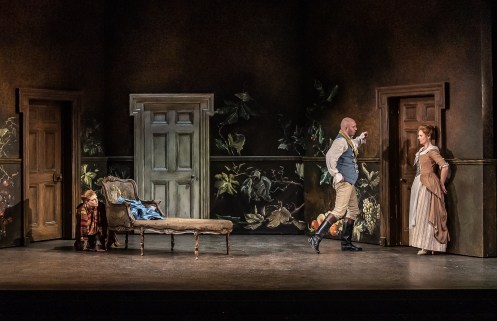
On the sexual harassment front, we have another prospective predator, the pubescent pageboy, Cherubino, fired up with the rising sap of teenage testosterone. Wallis Giunta clearly relishes the breeches role, flitting around, goosing the gals below stairs, and mooning after the ladies above stairs. While the ladies are cross-dressing him, one of Figaro’s ruses, Cherubino explains his hormone affliction, “Voi che sapete che cosa e amor, Donne …” (You ladies know what love is …). Mezzo Giunta’s meticulous delivery of the aria has a plaintive appeal that is hauntingly captivating.
Ellie Laugharne’s Susanna is a woman who knows her own destiny. Despite her precarious position, she can balance guarded necessity against a slight amusement at the manly mayhem around her. As a smile flickers across her lips, you know that she is the brains behind the Figaro-Susanna conspiracies. Laugharne (whom we saw last season as Phyllis in ENO’s tongue-in-cheek Iolanthe ) has a clear soprano with a pleasing legato which softens even Susanna’s harsher pronouncements.
That director, Martin Lloyd-Evans has made this production of Le Nozze di Figaro a realistic and emotionally observed version, is very evident in the rounding of the character of Countess Almaviva. Ross ini’s erstwhile chased (and chaste) Rosina, has in Mozart’s Figaro now become the Count’s neglected wife. Romanian soprano Simona Mihai picks up this approach, giving a tragic Countess who is really experiencing the pain of being passed over by her husband for other women. When we discover her, distraught, “Porgi, amor, qualche ristoro al mio duolo, a’ miei sospir …” (Grant, love, some relief from my sorrow, from my sighing … ), Mihai’s rendering is truly moving.
Almost as a visual metaphor Lloyd-Evans has a motif of flowers being offered, rejected and then accepted, echoing the continuing theme of sexual ambitions frustrated, reignited and then stymied (or redirected) that is the fate of so many if the protagonists. This continues through in the sub-plot of Dr Bartolo, the guardian of the Countess when she was in her minority, and his housekeeper Marcellina, who appear on the scene to redeem her contract with Figaro for a monetary loan, the default to which is the he must marry Marcellina. We are in very safe hands with the highly experienced pairing of Jonathan Best as a sullen Dr Bartolo and Louise Winter as Marcellina, who transmogrifies from acerbic harridan to maternal matron following the (pre DNA-testing era) discovery of their true relationship with Figaro. This, at first antagonistic, sub-plot is completed by tenor Ben Johnson (also seen in Iolanthe) as a preening Don Basilio, the Count’s musician.
The entrance of this trio forms the basis of the ensemble sequence in Act Two, as the plot takes one of its many turns. Also bursting in on the scene, via a ladder and open window, is the elderly gardener, Susanna’s uncle Antonio, complaining about the man (Cherubino!) who fell into his carnations. This part is a gift for the consummate character acting skills and rich bass voice of Richard Suart. The ensemble builds from trio to quartet, to quintet, to septet, in a technically demanding and musically intricate tour de force, in which each character expresses differing emotions, be it anger, sadness, hope or open glee: musically and dramatically impressive.
The role of Barbarina is usually a background one, but for me Rowan Pierce stands out clearly from that background in this role of Antonio’s daughter and one of the girls of the household who has to run the gauntlet of the Count, and of Cherubino. Pierce is an up-and-coming soprano who has commanded a plethora of awards, including the inaugural the Grange’s International Sin ging Competition. She is a captivating and effective actress, bringing a gamine charm to the role of Barbarina. The sweet bell-like innocence of her singing was beautifully illustrated in the Act Four aria L’ho perdita, (I have lost it). She emerges from under the wedding banquet table, ostensibly referring to the pin that Susanna has used to seal her honey-trap note to the Count, but we know that she has also lost something definitely more irreplaceable under that table.
Of course the Count gets his come-uppance and Figaro gets Susanna as his unmolested wife, and we head towards the happy ever after ending. However, in spite of its traditional period presentation, our Nozze di Figaro has a twenty-first century fizzle of scepticism.
The Count may be ashamed and full of remorse as he pleads on his knees “Contessa perdono!”, but in Gerling’s delivery of these words there is a hint of … until the next time. The Countess may forgive her errant husband and her “Più docile io sono” (I will be more kind) may have been heart-rending, but Mihai’s slant loaded it with ambiguity.
Lloyd-Evans’ Le Nozze di Figaro may have the period chocolate-box wrapping, and indeed its contents are rich, smooth and fulfilling, but they are those fashionable contemporary ones, with the piquant flavours of chillies or crushed peppercorn … sweetness with a bite.
Mark Aspen
June 2019


 Mark Aspen