
The Royal We
Handbagged
by Moira Buffini
Teddington Theatre Club, Hampton Hill Theatre until 24th May
Review by Andrew Lawston
The 1980s are back. Hampton Hill Theatre’s stage is littered with portable televisions and VCRs, while a single giant screen hangs above a faded Union Jack backdrop and plays Cyndi Lauper videos. Meanwhile a corner set with wonderful cut-down walls features a suitably regal tea set. The stage is set for the figure who, for good or ill, embodies the 1980s for many in Britain.
When Margaret Thatcher strides on stage with a triumphant wave, in trademark blue suit, the audience isn’t quite sure how to react. There are a few boos, and a few nervous laughs at the booing. It’s telling that almost two decades after her resignation as Prime Minister, and six years after her death at the age of 87, people are still unsure whether it’s safe yet to boo Margaret Thatcher.

Teddington Theatre Club’s ambitious new production of Moira Buffini’s play Handbagged is well aware of the iconic status of its two central characters. The play imagines the weekly meetings between the Queen and Thatcher more or less chronologically throughout the course of the Iron Lady’s premiership, with their younger and older selves standing side by side, commentating on and often contradicting their counterparts’ attitudes. It is speculative, educational, and very funny indeed.

The lead characters here are striking evocations of the real people depicted, without ever descending into caricature. Tracy Frankson and Heather Stockwell portray the older and younger Queen Elizabeth II as a concerned and compassionate monarch, who seems constantly to be repressing a wicked sense of humour, expressed in part through Heather Stockwell’s frequent literal winks to the audience. The continuity between the two performances strikes a chord with Frankson’s repeated observation as the older Queen that she has seen so many Prime Ministers come and go, over the long years of her reign.

There is more of a contrast between the younger “Mags” in a playful performance from Helen Geldert and the more controlled “T” played by Jane Marcus. While both make use of the same vocal mannerisms and gestures, the older Thatcher is more rigid, calcified, hard-baked into our collective image of the Iron Lady. Her character’s development is referred to frequently by the text, and is also signalled by the evolution of her wardrobe, courtesy of Zoe Harvey-Lee. Helen Geldert’s sleeveless blue jacket and colourful blouse as Mags is almost casual next to the buttoned up iconic blue suit of Jane Marcus’s T. In general, the older characters seem to depict our public perceptions of these two powerful women, while their younger counterparts are an attempt to convey their personal characters.

The two Thatchers and two Elizabeths are supported by Actor 1 (Lizzie Lattimore) and Actor 2 (Jim Trimmer), who take on an impressive repertoire of parts ranging from Dennis Thatcher through to Kenneth Clarke, but they squabble over who gets to play Neil Kinnock. When the full cast is on stage, arguments break out over which events deserve to be narrated, highlighting what a divisive time the period was for British society. Actor 1 tends to cast a historian’s eye over proceedings, for the benefit of members of the audience who didn’t live through the events depicted, while Actor 2 is a world-weary figure who presents his own perspective on the period.

It should also be noted that Lizzie Lattimore is additionally credited as the voice coach, and this must have been something of an undertaking in itself for a play which requires not just the two Queens and Thatchers, but also creditable Scottish, Irish, Welsh, American and Australian accents (and more than a couple of regional English accents) for Actor 1 and Actor 2.
Between scenes the central screen lights up with clips from the evening news and contemporary music videos, grounding the discussions in their era even more firmly than the performances of these well-known figures. One small technical glitch aside, the production is slick and runs at a blistering pace, with Harri Osborne’s stage management team keeping things moving around the small cast. This is no mean feat given the impressively ambitious set designed by Patrick Troughton, which offers many surprises throughout the show.
Ben Clare’s direction ensures the cast make full use of the set’s potential, and the show’s pace is relentless with all six performers on top of their cues throughout.
As this is a comedy dealing with such a divisive figure, Handbagged strikes a difficult balance in order to avoid sliding into either Spitting Image mockery or mawkish hagiography (there is no danger at all of this latter). Undeniable achievements such as the end of the Cold War are alluded to, and tragedies such as the 1984 Brighton hotel bombing offer a glimpse of humanity in Thatcher, but there is no shying away from the times when the Iron Lady was on the wrong side of history, most clearly with the poll tax riots and the reluctance to take a tougher line on Apartheid in South Africa. By the end of the performance I’m still not sure whether it’s safe yet to boo Margaret Thatcher, but finally we are able to laugh at her.
This opening night coincided with this year’s Eurovision Song Contest, and as such it certainly deserves to be awarded douze points.
Andrew Lawston
May 2019
Photography by Cath Messum
Cornucopia of Joy
Easter Anthems
music by G.F. Handel, J. Rutter, C.V. Stanford and S.S. Wesley
St Mary’s Extended Parish Choir, St Mary’s Church, Hampton, 12th May
Review by Mark Aspen
In a secular world, it is easy to forget that Easter is not a single weekend’s binging blast of fluffy bunnies and chocolate eggs, but is a celebration that lasts the whole of Eastertide, right up to Whitsunday, nine days into June in 2019. How appropriate then, half way through Eastertide on the Fourth Sunday of Easter, to be celebrating the Resurrection with another blast, a joyous musical binge, from a cornucopia of outstanding voices, and majestic organ music.
First out of this cornucopia sprang Johann Sebastian Bach’s Little Organ Book, which was opened for us by guest organist Nat Keiller at BWV 630, Heut’ triumphieret Gottes Sohn (Today, God’s Son triumphs). Bach’s Orgelbüchlein is an anthology of short chorale preludes for organ, composed in Weimar while Bach was Capellmeister to his Serene Highness the Prince of Anhalt-Cöthen in the early 1700’s. Albert Schweitzer described the Orgelbüchlein preludes as, “ … the most simple imaginable and at the same time the most perfect”. Keiller, an accomplished Royal College of Organists graduate, fulfils this description, and fulfils it … well, simply and perfectly. As an aside, Schweitzer also enigmatically describes Bach’s style in composing these preludes as “Dürer-like”. Perhaps he was likening them to the precise execution of an engraver’s artwork.
Then the extended St Mary’s Choir launched into the gist of the evening with This Joyful Eastertide, George Ratcliffe Woodward’s translation of an old Dutch carol, Vrüchten (Fruits) in an 1894 musical setting by Charles Wood. Joy is perhaps the overarching adjective for this service, and followed through the whole choice of the hymns and anthems assembled by Choir Director, David Pimm, who is building a reputation amongst music lovers and worshippers alike for his occasional series of choral music, requiems and oratorios. Another theme evident in Woodward’s carol that recurred throughout the service is the musical interaction of male and female voices, a natural complementation that enhances both the music and the concept of words.


This interdependency was clearly evident in Blessed Be the God and Father by Samuel Sebastian Wesley, where after muted opening phrasing, the second verse introduces men’s voices only. These are then displaced in the central section of the work, which is effectively a dialogue between the soprano chorus and a soprano solo. As the solo voice, Lucy Fernando was outstanding, her accurate bell-like soubrette soprano floating charmingly across the accompanying organ. The soprano dialogue is then underlined by the returning male voices culminating in ‘But the word of the Lord endureth forever’, before the drama of a fanfare on full organ announces the final fughetta for full choir. All this is impressively powerful stuff!
Samuel Sebastian Wesley wrote Blessed be the God and Father for the Easter Day service in 1832 at Hereford Cathedral, where he had just been appointed Organist at only 21 years of age. Only the boy choir was available and the Dean’s fishmonger was drafted in as the sole bass voice. The St Mary’s arrangement substitutes sopranos for the boy trebles.
(As an aside, there are a number of connections between Samuel Sebastian Wesley and St Mary’s church. The organ, built by J.C.Bishop in 1831, was a gift from King William IV, who as Duke of Clarence attended the church. The present church building was consecrated on 1st September that year, exactly one week before William’s coronation. The King was keen that the inauguration of the organ should be by some eminent organists and these included the composer Thomas Attwood, a pupil of Mozart, then the King’s organist; and 21 year old Samuel Sebastian Wesley, who had been regarded as a child musical prodigy while a chorister in the Chapel Royal. A few months later Samuel Sebastian was appointed the youngest ever Organist to Hereford Cathedral. There he later married the sister of the Dean, John Merewether. Merewether had been the effective priest in charge at St Mary’s during the twenty year incumbency of Dr Samuel Goodenough, who spend most of his time in Carlisle, where he was a canon and his father was bishop. Merewether was a polymath, had much practical involvement with the church rebuilding, and would have had close-hand experience of the musical skills of his brother-in-law to be.)
Apart from the musical interaction of male and female voices, Easter Anthems as a whole had another linking theme; that of reaching across time. The choice of Christ the Lord Is Risen Again is a case in point. Moravian pastor, Michael Weiße, a contemporary and supporter of Martin Luther, wrote Christus ist erstanden in 1532, based on an earlier Bohemian hymn. Catherine Winkworth translated it from the German in 1878, and in 1971 John Rutter composed the version sung by St Mary’s choir. It opens with a lively bouncy passage and then that discourse of men and women’s voice breaks in, rising to the crux line of the anthem, “Christ has broken every chain”. It is quite a whirlwind of a piece with a crisp finale.
In contrast Reginald Sparshatt Thatcher’s Come, Ye Faithful, Raise the Strain is stately and measured in its opening, before it too uses the technique of contrasting the voices of the men and lady singers. This reaches even further across time as it uses the words (as translated by JM Neale) of St John Damascene, an eighth century Syrian monk, in a setting written during the Second World War: and is there a hint at conflict in the music?


The choral conclusion of our cornucopia was an excerpt from George Frederic Handel’s majestic masterpiece Messiah, appropriately that sublime climax of the central section of that work that takes the theme of Passion right into Eastertide, the Hallelujah Chorus. What an opportunity to fill the church with voice and organ music! From the back of the nave, one could see the congregation taking the musical grandeur into their very bodies. One was moved physically as well as emotionally by the sheer grandeur of the piece.
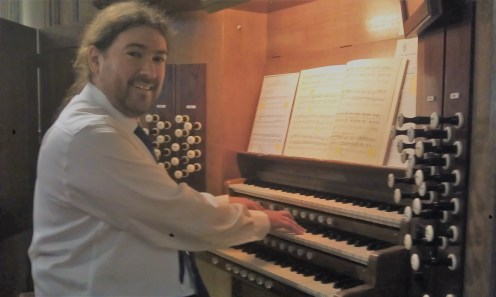
But the organ had more to give. David Pimm had regaled us last year with the music of Sir Charles Villiers Stanford and for Nat Keiller Stanford’s Postlude No.6, Op 105, gave an opportunity to show the capabilities of the Bishop Organ, and us an opportunity to admire Keiller’s skill. The opening is gloriously expansive, but about a third of the way it becomes very soft and gentle, opening into a lyrical almost bucolic theme. It appears to take an easy journey, light and joyous and its destination is triumphant, open and opulent. Its finale is a sustained and confident crescendo. It’s stirring and inspiring music.
Eastertide continues, but thankfully, by definition, a cornucopia can never be emptied. A full choral evensong is promised for mid-July and you can be sure that the music, the inspiration and the joy will continue to flow.
Mark Aspen
May 2019
Photography by Thomas Forsythe and Wiki Commons
Inside Track
Admissions
by Joshua Harmon
Simon Friend Productions at the Trafalgar Studios until 25th May, then at Richmond Theatre until 1st June and on tour until 22nd June
Review by Eleanor Lewis
Scrolling through the BBC News website this week, you find coverage of the US college admissions scandal, in which wealthy parents and a sprinkling of celebrities have been discovered using a scam to get their children into America’s elite universities. Joshua Harmon’s play Admissions, currently at Trafalgar Studios, couldn’t be more timely, even though over here the issues tend to collect around secondary education rather than university admissions.
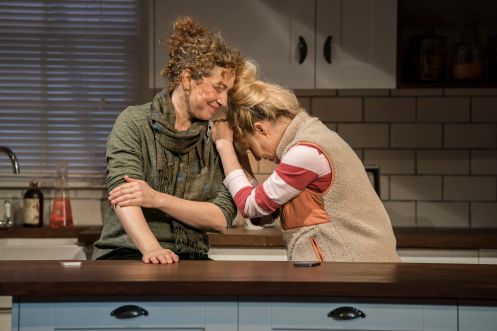
Moving seamlessly to and from the office of Sherri Rosen-Mason who controls admissions at the elite Hillcrest School, and her creamy, spacious kitchen at home, Admissions takes place over about just one academic year. Sherri is trying to increase the diversity at Hillcrest and must struggle with Roberta (an endearing performance from Margot Leicester) who has not included enough pictures of ethnically diverse faces in the school brochure. From a different generation, Roberta does not understand, she “just does not see race”.
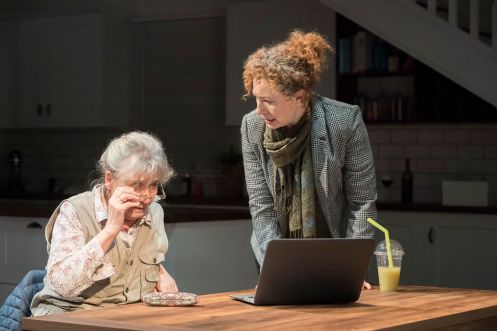
Sherri is good friends with Ginnie. Both women have sons the same age and academic ability at Hillcrest, but Ginnie’s son has a black father. When both boys apply to Yale and Ginnie’s son Perry is accepted while Sherri’s son Charlie is deferred, a very uncomfortable kind of hell breaks loose and the women drift from each other. It’s worth noting that Ginnie could be seen as a purely symbolic character, there to illustrate that any breakthrough must involve loss, but Sarah Hadland is too skilled a performer to make her anything other than dignified, sympathetic and real. The structure of the play tends to focus on Sherri and Charlie but there are sterling performances from all on stage including Andrew Woodall as Sherri’s stay-with-the-status-quo husband.
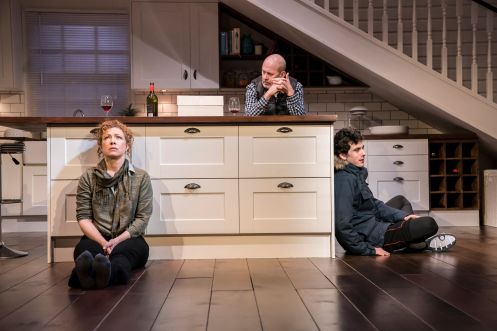
The Yale deferment provides the final straw for Charlie. He is white, male and privileged and this status, he believes, is almost counterproductive in the diversity-led world he inhabits. Added to this, Charlie is no lazy, rich boy: he has worked for his grades. Joshua Harmon’s characters are full blooded Americans, they do not purse their lips, fold their arms and seethe in silence as we angry British do. They vent at full volume and rage with every sinew when required. True to form, in response to rejection, Charlie embarks on an extended rant at full volume for some time and then a little more time, slightly too much time really. It’s an understandable, and definitely adolescent reaction, but the length of it rather than leaving you focussed on the issue in question, makes you wonder what the daily repetition does to an actor’s voice, even a professionally trained voice. It’s a harsh bit of direction and a change in tone after the initial fury would be more effective.

Later in the year, a calmer Charlie has arrived at an objective view of the situation and wants to make the type of personal sacrifice most parents wouldn’t entertain for a nanosecond (though if there is a way to solve the education-privilege conundrum this is probably it). His mother on hearing his decision reacts with the brand of horror usually reserved for the discovery of an unexpected corpse on the living room carpet – the reaction of any parent on hearing this news. This makes for a fabulous scene, highly entertaining, deeply cringe-worthy, and perfectly rendered by Alex Kingston as Sherri and Ben Edelman as Charlie. I will go no further into the resolution of this family’s difficulties, though I suspect it will not surprise an audience familiar with how The System works, because The System has really always worked this way. Admissions is not only about the admissions system, it’s also about the admissions we avoid making to ourselves: “You want things to look different but I don’t really think you want them to be different” is Ginnie’s response to her ex-friend when she asks for help, and it probably sums up the whole hill of beans.
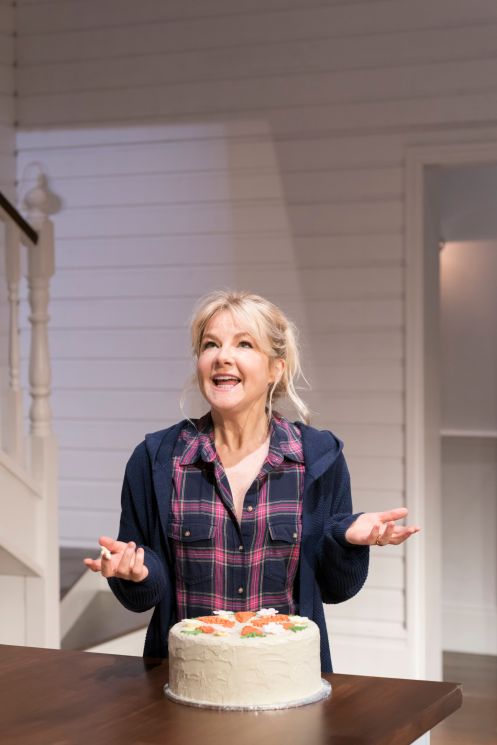
Prior to Admissions, in 2013 Joshua Harmon brought Bad Jews to the stage. In Bad Jews the children of holocaust survivors deal, or not, with their history. Harmon doesn’t beat about the bush: he confronts the sensitive and the hypocritical loudly, with no cushioning ambiguity and a great deal of humour. Admissions doesn’t disappoint, it sizzles with cleverness and wit but it will scorch the nerves of any liberal parent striving to do the educational best for their child whilst clinging on to any kind of credibility. It should probably be required viewing for parents everywhere, not that it provides any answers other than the one they could not bring themselves to effect. Enjoyable, funny and challenging drama. Highly recommended.
Eleanor Lewis
May 2019
Photography courtesy of Simon Friend
Peeling Back the Big Apple
Frankie and Johnny at the Clair de Lune
by Terrence McNally
Teddington Theatre Club at the Noel Coward Studio, Hampton Hill Theatre until 11th May
Review by Eugene Broad
The idea behind Frankie and Johnny in the Clair de Lune is, as veteran director Harry Medawar says in his introductory note, how tragic it would be for two star-crossed lovers to never give each other a chance, and thereby never become star-crossed lovers in the first place. A brief outline of the plot is that two unsatisfied and troubled co-workers go out on a date, and end up passionately making love in Frankie’s Manhattan apartment before discussing their various troubled pasts and future hopes. Frankie, however, is unwilling for various reasons to allow Johnny into her life, whereas Johnny is convinced they have the potential to make their relationship more than a simple one off liaison.
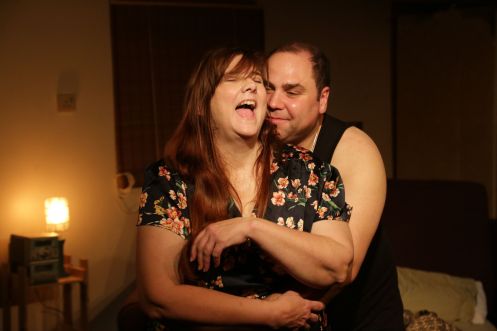
Johnny, played by Peter Easterbrook, flits between casual light-hearted banter with Frankie, and jarring forceful passion that she is truly his soulmate. Frankie, played by Susan Gerlach, initially rejects his advances, torn between her physical insecurities and her past. But Johnny is persistent, won’t take no for an answer, and spends most of the first act working out how to stay in her apartment longer despite her protestations for him to leave. At times I wasn’t sure whether the play wanted to simply be a light-hearted exploration of middle-aged love – once the rose-tinted glasses are trampled underfoot by the ravages of crushed dreams – or whether there was a deeper psychological aspect of Johnny emotionally manipulating Frankie for his own enjoyment and emotional security. The crude objectification Johnny revels in (asking to see her “pussy”, a word Frankie finds abhorrent; to generally bask in her nudity, making her uncomfortable; and the love-bombing he engages in with her shortly before asking for a blowjob), points towards someone whose words ultimately seem to be, as Johnny himself says “just words” and “empty” when compared to his actions. I couldn’t help but feel, that given Frankie’s past, she feels trapped in her apartment and chooses to go along with Johnny’s suggestions, viewing it as the path of least resistance.
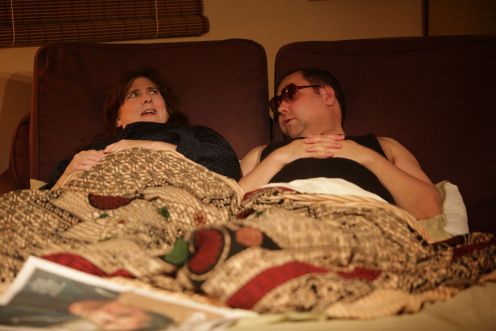
Partly because of this dissonance between playful banter, sudden intensity, and the vulgar and objectifying nature of Johnny’s actions, the play occasionally seems loose and disjointed, as if a number of different visions and interpretations were vying for consideration, but at times it feels like it lacks a rudder without having any kind of unifying theme. This isn’t any disservice to Gerlach and Easterbrook, both of whom are entirely convincing in their respective roles – Easterbrook impressively keeping up an American accent throughout the entire show (Gerlach originally being American, has the advantage here). Rather, the constraints of the script and play-writing in general could very well have contributed to this issue, as well as the lack of movement implied by only having one set, and could all have ultimately constrained the concepts Medawar had in mind.
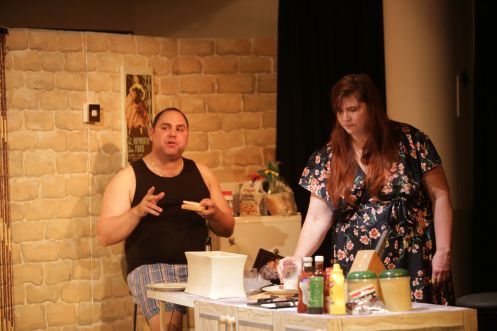
That being said, the set and general ambience are excellently conceived by designer Francesca Stone. As the play is performed in Hampton Hill Theatre’s Noel Coward Room, the more intimate atmosphere make one feel as if you are actually sitting in the living-room with the cast. Wall decorations, and small flourishes make the apartment feel more authentically American – such as Johnny drinking a Coors light lager, and Frankie providing cold meatloaf. This is boosted by the ambient sound effects. John Pyle’s sound design includes the sorts of sounds one could expect from night-time New York in a high rise apartment – the muffled and muted sounds of late night traffic. The Noel Coward room is undoubtedly challenging from a lighting design perspective. Nevertheless, Emma Burton creates a lighting design that cleverly weaves in table and floor lamps to provide the realistic and soft lighting that you would expect from a late-night tête-à-tête (and corps-à-corps, judging from the sounds at the start of the play…).

Consequently, whereas the play could occasionally feel disruptive and pull you out from the narrative being woven, the set and soundscape was entirely immersive, and our actors took us right into the intimate spaces that can exist even in the a crowded metropolis like New York.
Eugene Broad
May 2019
Photography by Simone Sutton
Colour Blind
Blue/Orange
by Joe Penhall
Questors at The Studio, Ealing until 11th May
Review by Eleanor Lewis
The desperate state of NHS funding doesn’t automatically create a draw to a play about it. You could say the same about the difficult process of getting your child into a particular school. So deeply, however, are we all engaged with these two huge concerns, and so many and varied are the issues they throw up that more than a couple of successful plays on these two subjects have entertained appreciative audiences over the last few years. Indeed Questors itself recently produced a highly successful version of Future Conditional, Tamsin Oglesby’s play on the subject of school admissions.

So the prospect of Blue/Orange, Joe Penhall’s play in which the treatment of an NHS patient with mental health issues is explored, is these days attractive in itself and even more so when based on the experience of the high standard of Questors’ recent productions.

The three characters in Blue/Orange have almost equal stage time. Junior doctor Emily, consultant Robert, and patient Christopher interact in an office with soft seats of muted colours, a water cooler and a small table on which is a bowl of oranges. The lighting is clear and slightly harsh, suggesting the strip lights of a public building where the design aimed for comfort but was shot down by the budget.
 Emily is struggling to keep Christopher in hospital; he wants to go home; she thinks he isn’t ready. Robert, the senior medic needs the bed and the cash currently taken up dealing with Christopher. Robert also, it transpires, views Christopher as prime research guinea pig for his pet theory that mental illness within ‘the black community’ is caused largely by white clinicians simply failing to understand ‘them’. As events progress, Robert reveals himself often willingly, as both the epitome of arrogance and a supreme manipulator. Adam Kimmel in this role (and in two beautifully tailored suits) moves seamlessly from avuncular mentor to power-crazed despot, leaving the audience almost gasping at the audacity of it all.
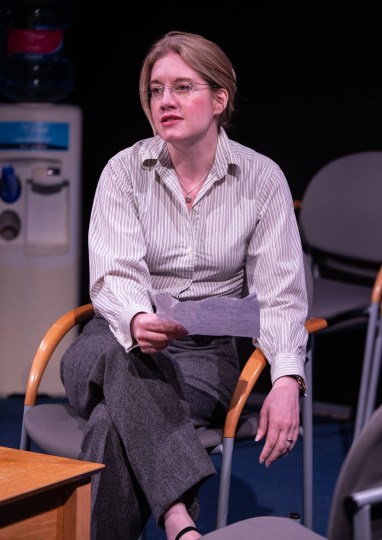 Clare Purdy is highly appealing as Emily, the junior doctor. Already an intense character, she moves through confusion, frustration, indignation and back again as she struggles to fight Christopher’s corner, whilst trying to keep her career afloat in the face of Robert’s unbending obstruction. Christopher believes oranges are blue and Idi Amin is his father. Chukwudi Onwere as Christopher, the patient with borderline personality disorder, has created a small time bomb of a man, his constant physical movement and rapid mood swings give rise to nervous tension in everyone around him, at his every appearance the audience sits up to give their full attention, ready for whatever might happen.
There are no scene changes in Blue/Orange and though much happens it is all spoken. There are spiels of weaponised political correctness: Christopher is black, both clinicians are white, but the one with more power is free to exploit all the elements of that particular situation. The struggle for career development and a position within the hierarchy descends into brutal survival of the fittest. But this is also a funny play – not often laugh out loud funny, but funny nonetheless. Perhaps the main strength of this work is that it isn’t possible to predict how it will play out, what will happen next, who if anyone will ‘win’. The emphasis shifts constantly and sympathy moves between all three beleaguered protagonists in this impossible arena, however badly they behave.

For this work Questors Studio was set up so that the audience was either side of a central playing space. This might have been intended to suggest opposing sides watching some sort of combat. Verbal combat there certainly was but the arrangement rather limited the audience experience at either extreme of the seating, the middle sections being closer to the intensity of what took place. This is also quite a long work, at 2 hours 40 minutes and whilst overall it didn’t feel like almost three hours, it must be said that Act One took a little time to build the pace it needed. That aside, Questors’ production of Blue/Orange is very engaging, hugely enjoyable and certainly recommendable.
Eleanor Lewis
May 2019
Photography by Robert Vass
Split Level Accommodation
Our House
By Tim Firth, music by Madness
YAT at Hampton Hill Theatre until 4th May 2019
Review by Wendy Summers
As possibly the only person in the audience not overly familiar with the work of the band Madness, I was pleasantly surprised to recognise most of the songs in this not-quite juke box musical.
The show is an interesting piece with a complex plot involving the same characters in two parallel and very different plotlines; it’s a sort of Sliding Doors meets Top of the Pops. Overall it works but it is difficult to follow and in this particular production it is Marc Batten’s characterisation of Dad we have to thank for keeping the audience up to date with the goings on. Amidst energetic dance routines, some scarily fast quick changes and frenetic projection-based scene changes it is Batten’s commentary on the action that provides a constant calm and reassuring presence amongst the organised chaos that Madness brought to the popular culture of the 1970’s and ‘80’s and YAT gloriously bring to Hampton Hill Theatre.

The cast are uniformly enthusiastic and obviously having great fun. Unusually the YAT membership has been augmented by more mature actors in the roles of Dad and Mum (the latter a warm portrayal by Danielle Thompson) but the key thing being celebrated on stage is the exuberance of youth. Each and every one of the seventeen strong cast is lively, engaged and engaging. They all work extremely hard and there are some really good performances amongst both main characters and ensemble. No individual plays less than two characters; some considerably more. It is exhausting to watch them.
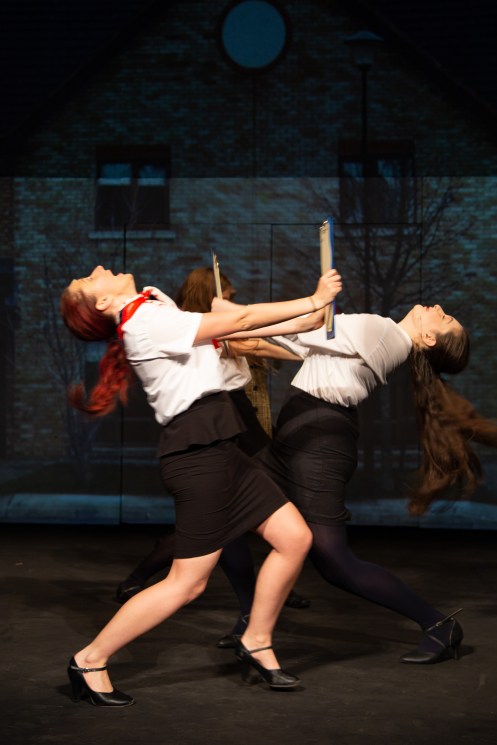
Singling out individuals is not something that YAT encourages. However, it would be mean spirited not to give due credit to the central couple, Joe and Sarah, played by George Barnden and Jojo Leppink. Barnden is a versatile actor with a good singing voice who gave the two sides of Joe equal depth and Leppink’s Sarah is admirably feisty. The surprisingly folky tone to her singing voice, reminiscent of a young Joni Mitchell, added extra poignancy to the song Admirable support was provided by Nate Higgins, Bradley Gray, Leona Ademi and Naomi Pink as the faithful sidekicks of Joe and Sarah and Jerome Ifill and Anton Agejev made chillingly appropriate north London villains.

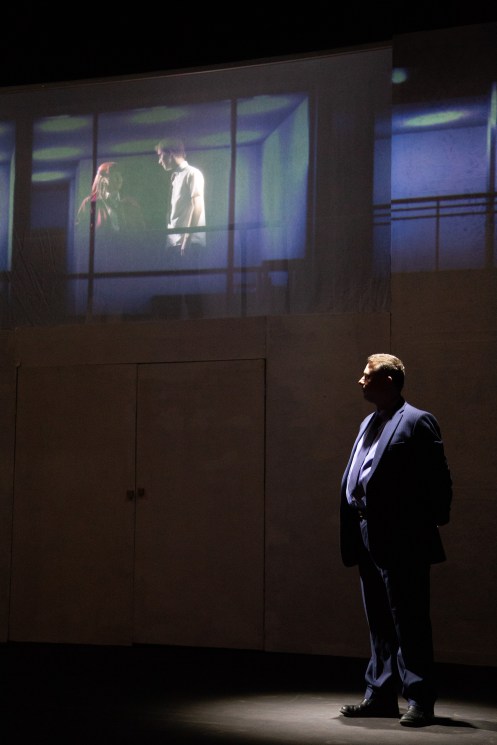
At first look Our House appears to be a light-hearted, simple and straightforward piece. It is far from it. It deals with very real social issues (the rehabilitation of offenders, gentrification of working-class areas, etc.) and is surprisingly thought-provoking. No “built” set means very complicated projection is required and all credit to director Bill Compton who was personally responsible for this aspect of the show. It must have taken days to design, programme and, most importantly with a musical, to time all the projection cues.
Like the music of ABBA, Madness’ songs are underrated in terms of their complexity. They are difficult to sing and there were many times during the course of the opening night that the cast struggled. Harmonies were very often “off” and in the humble opinion of this reviewer could have been dispensed with – less is always more and a strong unison or two-part harmony line is much more effective than a hesitant, weak or inaccurate multiple part arrangement. So congratulations to the cast who gamely battled through regardless. Musical Director James Hall has put together an excellent band. If only he’d paid a little more attention to detail in terms of the on-stage music.
It is always such a pleasure to see a new generation of performers come through and in this YAT always deliver. Their repertoire is broad, and they are not afraid to take on challenging pieces. They have again succeeded in rising to a rather large challenge and deserve all the applause and cheers the first night audience gave them.
Wendy Summers
May 2019
Photography by Jonathan Constant
Rumbustious Romance or Frenetic Farce? Who Nose ?
Edmond de Bergerac
by Alexis Michalik, translated by Jeremy Sams
Adam Blanshay Productions at Richmond Theatre until 4th May
Review by Mark Aspen
Panache! Now this play about a play about a playwright certainly has panache, and tons more beside.
Panache as a word jumped into the English language following the popularity of Edmond Rostand’s fin de siècle verse tragi-comedy Cyrano de Bergerac, about the eponymous French playwright Cyrano de Bergerac, who died 245 years before. Alexis Michalik’s super-successful Edmond de Bergerac, about the bumpy gestation of Rostand’s play, has won five Molière Awards and been adapted for French television. Jeremy Sams’ translation keeps all the feel, the verse patterns and the hilarity of Michalik’s tour de force.
Hope you are keeping up: Edmond de Bergerac is a 2019 translation of the 2016 French play Edmond, about the writing of the 1897 play Cyrano de Bergerac, about the 1619-1655 playwright Cyrano de Bergerac. Whew! Breathless? Keep up the breathlessness, for this production dissipates more energy than an explosion in a caffeine factory and it fairly buzzes with joie de vivre.
We are in the Naughty Nineties. Ooo, la, la! Robert Innes Hopkins’ design captures the Parisian life in an inspired design of mahogany arcades, trucked to swivel and swirl like a showgirl’s skirts to form theatres, cafés, nightclubs, restaurants, hotels and trains, even the proto-cinema where Lumière’s demonstration of moving pictures fails to convince the thespians of theatre’s demise.

And how right they are. Actor-manager Constant Coquelin “the greatest theatrical figure of the age” has had a spat with the Comédie-Française around acting styles, declamation versus realism, prose versus verse, verse versus verse etc. He needs a successful show not only to feed his unquenchable appetite to perform but also to get the theatre proprietors, the rent-hungry Floury brothers, off his back. Edmond Rostand is a hitherto successful playwright, but not only looking for a new style, a style with verisimilitude, but also to feed his wife and two children. It seems to be a “marriage made in heaven”, except for one thing: Edmond has that curse of all authors (and indeed occasionally critics), writer’s block.
Nevertheless, Coquelin believes implicitly in Edmond’s ability to come up with the goods, and gets rehearsals (prematurely) underway. The problem is that the capriciousness of the actresses, the nagging doubts of the actors, the vested interests of the producers and the vanity of Coquelin all pull in different directions. Then comes along a muse, the beautiful Jeanne. The problem is that she is the love interest of his best friend, one of the actors; and, oh, his wife suspects (mistakenly) that he is having an affair.
Dear reader, you may have gathered that the plot of Edmond de Bergerac is not simple. Indeed, that is one of its joys, for it is comedy, it is tragedy, it is romance, it is satire, it is farce, it is (to use the term of one of my recent reviewing colleagues) mise en abyme.
Everything is played big in this production, and it has to be for everything is larger than life. Everybody is part of a well-oiled ensemble, apart from the titular character (for Edmond is TT), and they have to be for everything moves very quickly.

The biggest thing of all is, of course, the historical character on which all of this is based, Cyrano de Bergerac, playwright, poet, romantic, duellist, and irrepressible optimist … and bearer of the famously impressive nose. Constant Coquelin as Cyrano in Rostand’s play built on all these traits of his personality. In turn, in today’s production, Henry Goodman takes the character of Coquelin and builds on it. With great stage presence, well-placed comic timing and accurate body language Goodman’s Coquelin is a force to be reckoned with. The Nose does not make an appearance until the moment of triumph, when it is a triumph in itself.

Freddie Fox depicts Edmond as bemused and battered by the whirlwind of action that his creativity has unleased, who rides the whirlwind in spite of himself, trying to keep up with events. Here is a man who ends up in a brothel … to drink camomile tea! Fox pitches the impression of both perpetrator and victim of events with just the right balance, giving an empathetic character for whom we want it all to work out right.
Gina Bramhill paints a charming picture of the demure but highly capable Jeanne, as easy to feign offence at the men’s forwardness, whilst falling in love with the beautifully crafted letters ghost-written by Edmond for her beau, Léo; or with Léo’s sub-rosa declarations of love in impromptu verse, speech-shadowed from the hidden Edmond. Raised in Edmond’s imagination she subsumes the madonna persona of Cyrano’s Roxanne (and finally saves the day in this guise).
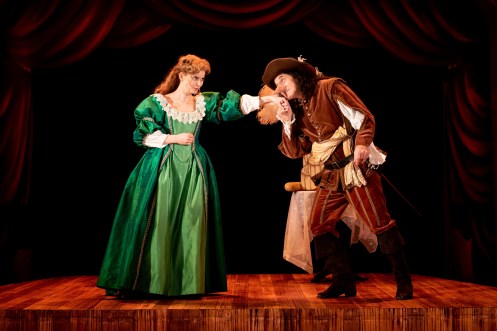
Léo, who is played with stylish athleticism by Robin Morrissey, almost comes to grief in the R&J-lookalike balcony scene, when he falls backwards off of a very tall ladder, just one of many cleverly crafted visual gags that run randomly through this hectic show. Gags of all sorts are dropped in with impeccable timing. Many are powered by the versatile Simon Gregor who pops up as a camp wardrobe master and a nonchalant Maçonais hotel receptionist to name a few. But with the equally versatile Nick Cavaliere, Gregor makes a priceless pair, the Floury brothers, Ange and Marcel respectively, pimping proprietors of places of entertainment turned devilish theatrical angels. With their gibus opera hats, satin overcoats and spats; and their angular pose, they are directly out of a Toulouse-Lautrec lithograph. Add in harsh voices and strutting gait and Cavaliere and Gregor raise caricature to a fine art.
Deft miming also moves the plot on, Edmonds long-suffering wife Rosemonde’s housekeeping money diminishes as the months wear on, from folding notes, to coins, to a watch to pawn, as her sits at a desk waiting for inspiration. Sarah Ridgeway plays Rosemonde with great determination as her wifely attentions and attractions are ignored in favour of fugitive inspiration, although green-eyes flare when his muse is revealed.
In the incubation of the grand theatrical project which is to become Cyrano de Bergerac, one of its champions is Monsieur Honoré, notre patron of the bar that bears his name, whose heritage is from francophone Africa. His silver tongued oratory and poetic prowess give concrete support to Edmond and company, as does his constant supply of absinthe, or camomile tea as the case may be. M. Honoré feels camaraderie with Edmond both as a victim of rapacious landlords and as an outsider. The mellifluous Delroy Atkinson wears this character with an easeful lightness of touch.
 On the antagonistic side are Maria, cast against type as Roxanne, as the insistence of the forceful Floury brothers, both of whom believe they are the father of Maria’s son, and rival playwright Georges Feydeau, famed then, as now, as France’s greatest writers of farce. Chizzi Adukolu has enormous fun with the role of the self-centred diva Maria, who carries her own fan club with her. Meanwhile David Langham makes a suitably oily Feydeau and reappears as a plethora of other cultural icons, including Maurice Ravel and Anton Tchekov.
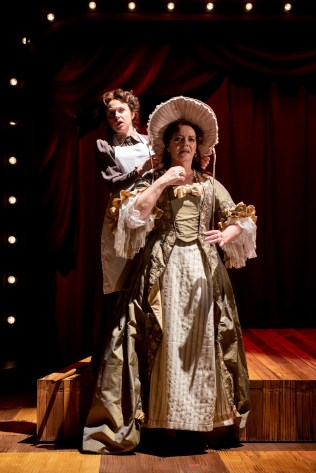 Parenthesising the progress of Edmond’s work, strides the actress superstar of the era, Sarah Bernhardt, whom the historical Rostand described as “the queen of the pose”. Slightly less generous is our Edmond, who calls her “a monument no one wants to visit any more”. Josie Lawrence does however take monumental aplomb to the role of Sarah Bernhardt, and contrasts Bernhardt with a character with a different type of stage presence, Suzon. Suzon is the madame at the Floury’s brothel, who takes in hand (so to speak) Jean, the son of Coquelin, a reluctant actor who would rather be a pastry chef. Harry Kershaw as Jean has the difficult role of playing a poor actor, and as a good actor takes it on with élan, going on to play Jean as a good actor once Suzon has stiffened up (so to speak) Jean’s acting confidence.
All the excesses of La Belle Époque are deliciously stereotyped by the creative virtuosity of director Roxana Silbert and her technical designers. As a for instance, amongst many little design nuances, we have the brass scallop-shell footlights that might have been in place in a theatre of the 1890’s. Lighting designer Rick Fisher seems to have an eye for topical detail. This autumn Richmond Theatre celebrates 120 years since its first performance on 18th September 1899, and every time Sarah Bernhardt comes on stage the inscription above Frank Matcham’s proscenium arch is lit, “To Wake the Soul with Tender Strokes of Art”. (A quote from Alexander Pope who lived just across the river.) Most of the protagonists in Edmond de Bergerac would have appreciated the reference.

If Cyrano de Bergerac’s last words were “Draw in the ash … my panache”, Silbert’s frenetic Edmond de Bergerac draws a generous kaleidoscopic cornucopia of sheer panache.
Mark Aspen
May 2019
Photography by Graeme Braidwood
Animalism Unleashed
Baal
based on a play by Bertolt Brecht
Impermanence at Bristol Old Vic until 25th April
Review by Sophie Catherine Chinner
From the company that produced SEXBOX, Da-Da-Darling and the fifty-minute arthouse film The Ballet of the Nations, Bristol based dance company – Impermanence, tackles an innovative, new adaptation of the Bertolt Brecht play BAAL. The play, written in 1918, was the first full length work by the German Modernist playwright and now, proudly makes its UK dance première on the main stage of the Bristol Old Vic.
Fundamentally, the abstract work monitors the notoriously flawed central protagonist – Baal. Despite an indistinct storyline, Impermanence flourished in its thematic focus, which tracks Baal’s ill-fated journey through solipsism, violence and manipulation to his pre-destined destruction. The performers unleash themselves in bestial forms. In one scene, the women role play matadors as the men act out a bull fighting duet, challenging the stereotypical expectation of sexes in the dominant and submissive roles. The same red scarves used to provoke the animalistic performers here are later used to symbolise the blood and subsequent death of Ekart, a friend murdered by Baal. In a grotesque display, the company embody a kind of over-the-top Japanese Theatre technique, by revealing the silk material from the victim’s own costume and smothering it around his face and skull. The characters also womanise and create discomforting images across the stage suggestive of rape and lascivious seduction. Collectively, these recurring tropes infer greedy consumerism, lust, betrayal and committing hostile aggression is the hamartia, the downfall, by which modern society as well as the fictional world of Baal suffers from.

BAAL was driven by an original score, composed by Robert Bentall, which was featured forefront of the action. Bentall’s live and pre-recorded performance on the peculiar, ancient nyckelharpa instrument, was a refreshing musical accompaniment that had a curiously awe inspiring effect. Its wholesome notes reverberated through the auditorium in unusual waves of sound which mimicked the provocative behaviour of the dancers on stage. This unexpectedly led to an uncanny fusion with David Bowie’s Ashes to Ashes and The Drowned Girl (perhaps intentionally from an EP entitled In Bertolt Brecht’s Baal ). The performance grew even more unrestrained and wild with the performers also engaging in spoken word and song. They vocalised the eponymous figure – Baal, as well as some of the other 31 characters that are originally written into the play. Multi-rolling these parts, indicated in the constant costume changes, was an intelligent solution when creating a work with a cast of only four.

There is formality in the performer’s poetic dialect which seems to mock the heightened verse of Shakespearean language. The speech, perhaps excerpts from the original script, is often threatening and chilling. The dancer’s voices, though sometimes inaudible due to an excess of surrounding sounds, boomed through a microphone prop on stage and also electronically erupted as part of the musical backing track. Merged with dialogue from an omnipotent narrator, who attempts to guide us through the indistinct plot, in reality, obscures our perspective further. Dancing out some of this narration, the dual-channel films projected directly onto white screens, designed by Duncan Wood, also attempts to explain the events on stage. The multi-media clips including: circus elephants being forced into obedience, chorus line dancers and trippy, stuttering videos filmed within a forest, reiterates the excessive nature of an ego-driven world. This eccentric mix of sound and film, although somewhat overwhelming in dynamics, succeeds in representing the chaotic life of Baal.

After three years of crafting and creating, the company, comprised of the skilful quartet; Roseanna Anderson, Josh Ben-Tovim, Alessandro Marzotto Levy and Sonya Cullingford, combine their performance and choreographic talents to re-invent the messy, misogynistic world of the twentieth century anti-hero. A challenging choice of play with a complex narrative, the début of Impermanence’s BAAL, will not be its last. The company will continue the tour to small and mid-scale scale venues across the UK as well as taking the production to Indonesia. Beautifully danced, immensely physical and thought-provoking, BAAL is a riveting, emotive piece of contemporary dance theatre
Sophie Catherine Chinner
April 2019
Photography by Maurizio Martorana
Songs of Innocence?
English Song
by Roger Martin and Martin Pagnamenta
Good Seeds at St Mary’s Church, Hampton, 27th April
Review by Thomas Forsythe
In the dim and far distant past, I recall standing in the school hall with other short-trousered boys and singing Linden Lea or other such pieces of beautifully bucolic whimsy. For many of the audience at the Good Seeds recital this was a similar plucking of the strings of innocence from decades ago. Or was it? Listening carefully to this nostalgia-fest, did we not detect that the English countryside of yore was far from innocent?
Shakespeare is always good for a robust look at life and most of the first half of this delightful concert was taken up with songs from Shakespeare’s plays, set to music by Gerald Finzi or Roger Quilter. In fact, we had a version from each composer for two songs, both from Twelfth Night: O Mistress Mine with the carpe diem line, “Then come kiss me, Sweet and twenty, Youth’s a stuff will not endure”; and Come Away Death, although I think Quilter has better understood than Finzi that Feste is mocking Orsino’s melancholy. Quilter also hits the mark dipping into As You like It with Blow, Blow, Thou Winter Wind.
Finzi’s triumphant feel in his Fear No More the Heat of the Sun in the duet of Guiderius and Arviragus from Cymbeline misses the air of pathos with which Shakespeare imbues this richly metonymic but gently punning elegy. As such he does not serves our singer, Roger Martin well. Martin’s finely determined accurate baritone is very much a chamber voice and it felt that he needed to overstretch his delivery in that he would need to in the role of a sacred choral singer in the large physical space of the nave of St Mary’s church. The drama of Shakespeare and the demands of space point towards a more operatic approach. Nevertheless the reflective themes of the words, the atmosphere of an historical parish church, and the folksy nature of the music throughout the recital spoke loud of the permeated Englishness of this concert.
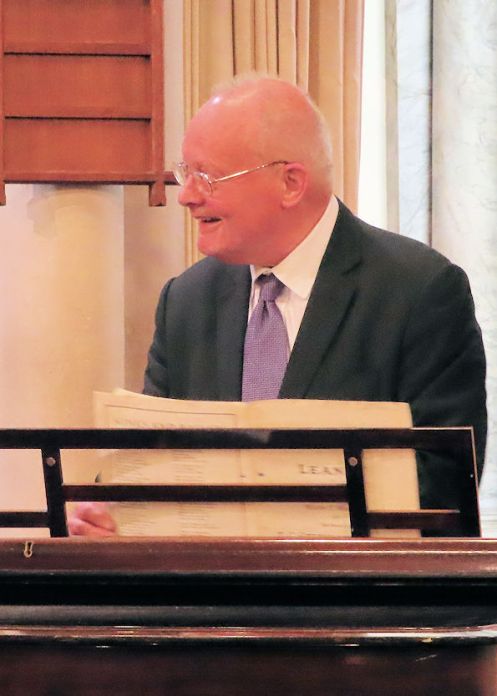
Indeed, the core of the evening was a tour of the English counties. For most of the first half, Shakespeare had delightfully detained us in Warwickshire, but now we were to move on to Shropshire and Suffolk, although not before a pleasantly oenological interval.
Martin Pagnamenta provided precise and purposeful piano accompaniment with seemingly effortless skill; and, during the break, we learnt a little of the strong mark that Martin and Pagnamenta have made to the musical landscape of in and around Chepstow (alas just outside of Merry England).
Most importantly however, Fiona Rowett (herself a very accomplished soprano) told of the work of Good Seeds, the charity that was the raison d’être of the evening’s concert. The Good Seeds programme supports a hundred pupils, helping them to be able to attend school in their village of Mandimba in Mozambique, together with student nurses and midwives. Mandimba, near the border with Malawi, has a sister church to St Mary’s Hampton. The concept of the support is good seeds in fertile ground, an apposite metaphor in the poorest part of one of the world’s poorest countries, now made poorer still by the floods that have followed Cyclone Idai.

Back in spirit and song in England, we moved on to that lovely but off-the-beaten-track county of Shropshire, immortally described in the poems of A.E.Houseman. In a well interpreted musical setting by George Butterworth these moved from the sweetly sentimental to the potently moving. Loveliest of Trees describes spring blossom and I thought of my own garden where I could in this very moment “go, to see the cherry hung with snow”. Going via the tripping notes of Think No More Lad, the poem Is My Team Ploughing?, the dead man’s question to his still living friend, packs a really poignant punch
We have to cross to the other side of England to Benjamin Britten’s beloved Suffolk, although Britten sourced his Folksong Arrangements from all over the country. The touching O Waly Waly is perhaps even further north, but Martin first gets well into his stride with There’s None to Soothe. However, it is Britten who makes the running with the most earthly songs: his arrangement of the old folksong The Foggy, Foggy Dew beats “come up and see my etchings”. The singer remembers “a fair young maid” who “knelt down by my side, when I was fast asleep” … “So all night long I held her in my arms, to keep her from the foggy, foggy dew”. Well I never … he now looks at his son and apprentice (he is still a bachelor) and can’t quite remember why the boy looks so much like the fair maid.
Martin and Pagnamenta’s charmingly cheerful and cheeky nostalgic trip around the counties was neatly parenthesised by a package of top-and-tail trios. It opened with that archetypal English composer Henry Purcell and concluded a few centuries later with John Ireland’s setting to John Masefield’s Sea Fever. As Martin put it, “A baritone must always sing a sea-shanty”. Nevertheless, the countryman’s diversion still seem to be mainly the country-lass. This it seems is far from a new phenomenon; Tudor twinkles in the eye include John Dowland’s What If I Never Speede, “Either I will love or admire thee”; and John Bartlet’s When from My Love, “She did agree to love, but jestingly”.
Hugh Wright breaks this mould in Martin’s encore piece, Leanin’ on the Gate, where the country lad “Had a lurcher once; better than a gal. Poacher? Well … a bit”. It seems that there is no end to the variety of out-of-town amusements.
Maybe those schoolboys of that dim and far distant past, where I once stood, missed something in wondering what the distractions might have been hiding “down by The Ash Grove”.
Thomas Forsythe
April 2019
Photography by Maurizio Martorana and Lewis Lloyd
The Thespian Frame of Mind
Kindly Leave the Stage
by John Chapman
Richmond Shakespeare Society at the Mary Wallace Theatre, Twickenham until 4th May
A Review by Celia Bard
A cleverly crafted and light-hearted satirical mise en abyme, John Chapman’s Kindly Leave the Stage is amusingly brought to life by members of the Richmond Shakespeare Society in their friendly, intimate theatre, The Mary Wallace, situated on the banks of the River Thames in Twickenham. The outer story, the framing device, tells the story of Rupert and Sarah whose marriage has broken down. Their friends, Charles, and Madge, both loosely connected with the law, agree to handle the threatened divorce.

The opening scene of the play, set in the well-furnished, living and dining room of a well-appointed garden flat, lulls the audience into a false sense of security albeit a lively one with Charles and Madge sitting uneasily at the dining table listening to sounds from the kitchen of crockery being smashed. Any comfortable illusion the audience may have about the development of the plot soon vanishes when Rupert suddenly stutters and repeats his words. This is followed by an awkward silence until the prompt feeds him a line. Here, the audience may be forgiven if they inwardly groan thinking the actor is not secure in his lines. Rupert’s forgetfulness, however, is the beginning of the play’s inner story in which our leading man is having to act with the full knowledge that Madge, his real wife, is having an affair with Charles. Rupert’s anger, jealousy, and rage spill over into the framing story, confusing the audience who watch bemused as Rupert picks up a knife and threatens to kill Charles who takes refuge in a trunk whilst the rest of the cast try to continue with the play. Confusion further mounts when a nurse suddenly appears from the back of the theatre, breaking the fourth wall, exclaiming that she is responding to an appeal for a doctor in the house to treat somebody who is injured on stage. Again, the audience must be forgiven if they begin to think that like King Lear, they have entered the realm of madness when the character Edward, playing the muddled, elderly father of Madge, enters and confused by events on stage, lapses into Shakespearean verse whenever the opportunity arises: dans une confusion totale.
The overall play within a play structure used by the playwright provides him with an opportunity to explore a double plot, one in which he is able to highlight the egotism, jealousy and vanity of the acting profession as well as being able to exploit his knowledge of different acting, genre and theatrical styles. The framing narrative of Kindly Leave the Stage is modern. Lines though witty are naturalistic as seen in the dialogue between the two couples and Mrs Cullen, Madge’s mother. In contrast the inners story lapses into pure farce, characters chasing each other across the stage, in and out of doors and although there isn’t a cupboard for a character to hide in, there is a large wooden trunk. Opportunities abound in this play for actors to exploit their knowledge and acting skills within the different genres provided by the playwright.

At times performances lose just a little of the meticulous discipline required of stage farce. Although the situation characters find themselves in are often ludicrous, nevertheless the characters must be recognisable. Cast in the role of Rupert is David Kay, totally believable as the cuckolded husband, but would have liked to have seen him act a little more menacing while wielding the knife and threating Charles. Kay has to carry much of the physical and emotional burden of the plot and his strong stage presence and vocal skills help him exploit this character. Particularly effective is the interchange between him and Edward (Michael Andrew) when discussing the merits of naturalistic dialogue, using as an example the line referring to Rupert’s and Charles’ long friendship starting in Oxford. Kay has to deliver this line in such a way that encourages Edward to demonstrate how it should be delivered: here pace and timing is excellent.
Kay is joined by actors Kate Wilcox (Sarah), Cath Messum (Madge), Matt Dennis (Charles), Maxina Cornwell (Mrs Cullen), Michael Andrew (Edward), Denise Tomlinson (Nurse) and Lynda-Louise Tomlinson (Angela). In some instances, there could have been a clearer contrast between the characters in the framing narrative and their other inner stories. Tomlinson is appropriately sympathetic as the nurse and makes a good entrance through the audience. Lynda-Louise Tomlinson is an effective stage prompt, keen to learn how to project her voice. Would like to have seen more of a grande dame performance from Cornwall, particularly in her opening scene. Dennis’s Charles is a little restrained as is his liaison with Sarah, here the relationship seemed rather forced.

Messum’s Madge is delightfully sexy, and she does succeed in differentiating between her two characters – would be wise to heed intelligibility when using a higher vocal pitch. Wilcox is convincing in the framing narrative as the angry wife, but less so in her alternative role when she is required to act the cheating wife and display a besotted love for Charles.
Michael Andrew’s Edward is just superb as the ageing Shakespearean actor, now an alcoholic and bemoaning his lack of chance which would have placed him among the giants of Shakespearean actors. He is totally unaware that the play has switched from art to life and has invited his new agent to this performance. This actor has an incredibly strong stage presence, dominates the stage (at times deliberately) and is versatile in all acting genres. Whether playing the drunken fool, the confused actor, or portraying the madness of Lear, Andrew is magnificent. I would go and see his Lear anytime.
The RSS succeed in portraying an enjoyable evening of entertainment. Actors took their final bow remaining resolutely in character, and manfully allow Andrew to dominate the line-up. Kindly Leave the Stage is a light-hearted and highly entertaining play, well worth seeing.
Celia Bard
April 2019


