
Milk, Muck and Memories
Lilies on the Land
by the Lions part
Teddington Theatre Club at Coward Studio, Hampton Hill Theatre until 9th March
Review by Didie Bucknall
The sun shines on a cornfield, a slim girl holding a pitchfork, dressed in spotless dungarees and a green jumper, sleeves rolled up showing her bronzed arms, her neatly curled hair loosely tied back, surveys the land – one of the enticing posters encouraging girls to join the Women’s Land Army. As an alternative to working on ‘munitions, who could resist the lure of the open countryside. Thousands joined and thousands were quickly disabused – up to the armpits in slurry, back aching from digging spuds, impossibly long hours, awful toilet arrangements and precious little food were the reality. Some girls had no idea where milk came from let alone how to milk a cow and the revelations and rude comments when putting the bull to the cow were all a shock. Some girls were well treated, others not.

A group calling themselves the Lions part were searching for a play that gave a voice to the wartime efforts of these women and hit on the idea of placing an advertisement to gather some first-hand accounts of their experiences. They were amazed at the volume of the response. The subsequent play Lilies on the Land, these were brought together in a collection of some of these memories.
The play is a collection of snippets culled from this correspondence and is performed by four women each taking multiple parts in quick fire succession as the action follows the progress of the war, helped by a few news announcements and Churchill’s “we shall never surrender” speech.

The four strong parts were taken by four strong actors, Juliette Sexton, Lily Tomlinson, Victoria Hinds and Héloïse Plumley, who seamlessly took on 28 different roles including farmer, farmer’s wife and American airman but mostly as their original characters – innocent northerner, happy go lucky, posh southerner, clear eyed and focussed girls.


In spite of the hardship there were moments of glad relief for the girls; exchanges with the Italian and German POW’s, sharing Silent Night at Christmas each in their own language, but especially when the Americans arrived and the lavish amount of food, not to mention nylons and chewing gum available was such a treat.
It was evident that everyone had developed a good rapport one with another during the production and the programme shows Jojo Leppink’s lovely photographs of the cast enjoying themselves sitting on bales in a hay barn and propping up a fence in a field at Hardwick Park Farm
It was not an easy play to stage in the restricted space of the Coward Room but director Linda Sirker and Mandy Stenhouse co-director and choreographer, moved the cast about easily and Fiona Auty’s straw-strewn staging of bales and tool shed set the scene well.

As a theatrical piece, it was obviously a bit disjointed, though held together by the underlying narrative, but the homesickness, hardship and deprivation were there. In the end however, in spite of the very hard work and harsh conditions, the thought of returning to their ordinary lives was a rather sad prospect for the girls as things could never be the same again.
Didie Bucknall
March 2019
Photography by Jojo Leppink, Handwritten Photography
The Art of Friendship
Art
by Yasmina Reza, translated by Christopher Hampton
David Pugh and Dafydd Rogers’ Old Vic Production at Richmond Theatre until 9th March, then on tour until 30th March
A review by Matthew Grierson
For a script conceived of and set in Paris it’s interesting, and especially interesting now, to see how very British Art plays. First, there are the characters’ anxieties about art, and being seen to like or have an opinion about it. Next, there is its use of characters who are not so much physically trapped as stuck by their situations and backgrounds, as in the classic British sitcom. Which of course then means there’s class … and it should go without saying this is not in short supply given Nigel Havers’ presence in the cast.
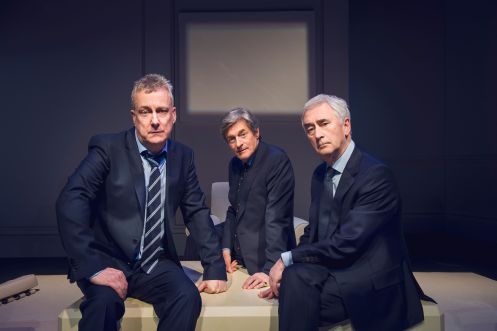
He and friends Marc (Denis Lawson) and Yvan (Stephen Tompkinson) may be constantly circling one another, but one still gets a glimpse of the classic Frost Report sketch configuration in their sharp exchanges of glance and ability to strike a characteristic pose, even though on the occasions that they are actually shoulder to shoulder – few and far between given the increasing volubility of their arguments – the hapless and, one infers, lower-middle class Yvan actually towers above his wealthier pals.
Broadly speaking, he is the common man for whose allegiances Serge and Marc contest in their views about a painting, white lines on a white canvas, for which Serge has just paid 200 grand. To say that Serge is the radical and Marc the conservative, or Serge the modernist and Marc the classicist, makes too glib a scheme of so humane a piece as Yasmina Reza’s play – it’s more three men went into a bar than a Platonic dialogue – but it’s difficult to watch the way their increasing polarisation drags Yvan after them and not to be reminded of similar conversations on social media today. In one of his last monologues, Yvan avers ‘nothing beautiful ever came from rational argument’, and a quick glance at the news will confirm the timelessness of Art in this regard.


One needn’t reach too far to describe the escalating antagonism between Serge and Marc through the analogy of an old married couple, which is clear long before they decide on having a ‘trial period’ for their friendship near the end of the play. In this set-up Yvan becomes the child in a custody battle, and Tompkinson’s performance can consequently veer one way and t’other thanks to the irresistible force of Havers and the immovable object of Lawson. So for all that the script emphasises Yvan’s passivity and neutrality we do see him become pretty exercised, whether by his friends or his impending wedding, though this anger seems spontaneous rather than dramatically earned or natural to his character.
The gear change would be less forgivable were Tompkinson not so endearing in both modes. At his most put-upon, he is the surrogate for the audience on the stage, unable to see why a painting has stirred the latent animosity of his two friends. At his angriest, though, Tompkinson turns up on Serge’s doorstep and has a meltdown about how he and his fiancée can manage to invite their respective stepmothers to their imminent nuptials. It’s a tour de force that certainly does earn the applause it receives.

While the production stages friendship as a pastiche of familial relationships, there’s no getting away from the fact that Art is a play as much about middle-aged men as it is about a painting. Yes, all the characters have, or have had, women in their lives, but these women appear solely in the men’s dialogue, more often the proxy for the men’s feelings towards one another: Serge’s takedown of Marc’s partner Paula is really an expression of his antipathy to his friend’s taste in women, much as Marc’s fury has been spiked by Serge’s taste in art, while Marc in turn predicts a horrible future for Yvan after marriage.
After this it would be quite understandable for the characters to end up going their separate ways, but it’s a joy of this performance to sense that, beneath it all, they cannot help but remain friends. How else would they have been able to say the awful things they have to one another? In the earlier scenes they’ve been unable to articulate their true feelings openly, and dialogue is shot through with asides from each of them much as the white canvas is hatched with white diagonals. But like Chekhov’s felt-tip pen, which is dropped into proceedings early on, these soliloquies prepare us for the expression of grievances in the denouement.
The movement between monologue and duologue may also be a dramatic expression of observations made about whether we come to be ourselves as a result of ourselves alone or as a function of our relationships with others. These observations have been made by Dr Finkelzohn, Yvan’s therapist, and carried around on a slip of paper by the latter, offering a gnomic comment on the action that counterpoints that of the equally inscrutable white painting.
Or perhaps the play is already commenting on itself? Each of its opening also scenes works as a dissection of the preceding one, switching characters so that two can share their concerns about a third who isn’t present. These onstage reviews could have saved me a job except that they’re done a scene at a time, and are actively shifting the comic dynamic as they take place. This keeps the piece moving at a fair old lick, but then so too does the tendency barely to pause for breath during the dialogue. This is effective when the characters are accelerating into a rant, less so in the establishing monologues when they can leave one struggling to take everything in (I’m looking at you, Lawson).

The pace is kept just this side of runaway by director Ellie Jones, and together with Mark Thompson’s effectively minimal design, in which the three men’s apartments are identical save for a revolving wall displaying their distinctive choices of conversation-piece art, gives the show an impression of classic Hollywood comedy. There’s another nice touch in that Hugh Vanstone’s lighting casts diagonals across the wall, as though through a Venetian blind, to signify Serge’s home and the painting he will eventually hang there. In the end the lighting also affirms the direction’s suggestion that we need to synthesise all three characters’ viewpoints to appreciate art – or Art – with the actors picked out respectively in the red, yellow and blue that must be blended to become white.
If art/Art is ultimately the occasion for some good-natured pontificating, then you’ll forgive me the previous thousand-odd words. But what this show does with a lick of paint remains remarkable.
Matthew Grierson
March 2019
Photography by Matt Crockett
Un Beau Soir
Jazz, Dances and Classics
by Amy Gould and David Harrod
SOS!SEN Charity Concert at United Reformed Church, Twickenham, until 2nd March
Review by Rebecca Vorley,
in association with Pearl Chang and William Ormerod
Shipwrecks and sunsets, exorcisms and mediations: this was the broad compass of Jazz, Dances and Classics, an enthralling concert by ’cellist Amy Gould and pianist David Harrod. The audience was captivated throughout the concert by the skilful performances of both musicians. The fascinating variety of pieces – from the lilting, playful La Cinquantaine by Jean Gabriel-Marie the elder and romantic jazz standard Harlem Nocturne, to the elegant Romance from The Gadfly by Shostakovich and the uplifting, carefree African Song by Abdullah Ibrahim – demonstrated the artistry of Amy and David, who complemented each other beautifully.
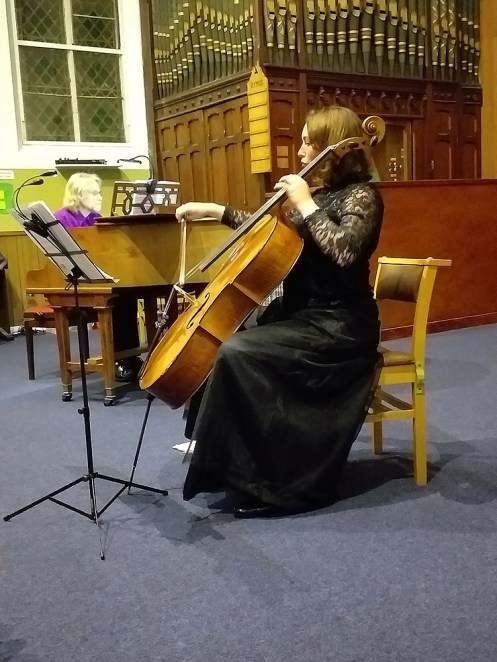
The programme was a harmonious mixture of the familiar and the unusual, and included several pieces of ‘programme music’ – that told a story: La Cinquantaine, literally ‘the fiftyfold’, describes the celebration of a golden wedding anniversary, with revels, dances and merry banter; the informative programme notes told how the Méditation from Massenet’s opera Thaïs represented a religious conversion from a life of depravity, and that this piece inspired Shostakovich’s Romance which followed it; The Song of the Black Swan (originally from Villa-Lobos’s 1916 tone poem Naufrágio de Kleônicos) laments the last moments of a shipwreck; Beau Soir by the teenaged Debussy describes an autumnal sunset – literal and metaphorical; the Ritual Fire Dance from Falla’s 1915 ballet El Amor Brujo at the end of the evening depicted the ever faster-whirling ritual which summons up the ghost of the dancing widow’s husband, luring it into the fire to finally exorcise it.
David displayed remarkable technical skill during the performance of Elegy op.96 by Nikolai Kapustin – a real modern discovery – and Amy showed great dexterity and skill in the excellently executed pizzicato section. The warm, melodic start to the Méditation was played with feeling, and conveyed a sense of harmony and anticipation. A listener commented that the piece was “beautiful – I was transported.”

The largely reflective and romantic first half of the concert concluded with the vibrant jazzy harmonies and dance rhythms of Ibrahim’s African Song, a soaring ’cello melody (with pizzicato interludes) over punctuated piano interjections of fascinating (dis)chords, followed by David Popper’s Tarantella, a virtuoso showstopper for both performers.
During the interval the audience was given a short introduction by Elizabeth Wright, the charity’s co-ordinator, to the work of SOS!SEN, the locally-based national charity supported by this concert – helping children with special educational needs and disabilities, and more particularly their parents and carers, to access the help available.[Note: Support for this charity seems all the more topical following the death on 20th March 2019 of a great champion of special educational provision, Baroness Mary Warnock, CH.]
The beautiful variety of pieces continued after the interval with Villa-Lobos’s The Song of the Black Swan – O canto do cysne negro (possibly a response to Saint-Saëns’s Le Cygne, published thirty years earlier) which had a lovely rippling, soft quality: a melodious legato ’cello tune floating on an ethereal piano tone – and right at the end, was that the ship’s bell tolling distantly in the piano, as Captain Kleônicos and his crew sank beneath the waves? The double-stopped section of Étude op.8 no.11 by Scriabin was most expressive. Alexandr Scriabin seems to have been endowed with the sense of synaesthesia – the association of musical sounds with optical colour, and like a few other composers (Grétry, MacDowell, Rimsky-Korsakov) he identified particular harmonic keys with different colours. On closing the eyes, this piece in B-flat minor seemed to be redolent of deep blues and browns, flecked with gold…. or was it just the influence of the interior décor of the church and its painted organ pipes?

Perhaps the most intriguing piece was the aptly named Romance Lyrique by Kodàly: key changes conveyed an underlying sense of sadness; it was delicately played with tremendous feeling. With its graceful tune over the piano’s traditional Alberti bass (in a treble register!) it was reminiscent of Gounod’s Ave Maria after Bach. Beau Soir by Debussy (another musically colour-sensitive composer) is a transcribed setting of an early poem by his older contemporary, the writer Paul Bourget, who later visited the U.S.A. and the British Isles, and was admired by Gladstone. Similarly to The Song of the Black Swan, the ’cello provided the rose-pink sunset over rippling rivulets in the piano. At the end Amy produced a deceptively easy-sounding (but fiendishly difficult) perfectly tuned coda in thumb-position as the sun set. Outside the weather in the streets was dark, cool and wet, but in here the atmosphere was of a beautiful, warm evening in the countryside. Debussy once wrote: “There is nothing more musical than a sunset.” (He also described Wagner’s music as “a beautiful sunset that was mistaken for a dawn”).
Burlesque, op. 97 and Nearly Waltz, op. 98, two more Kapustin pieces, improvisational in style, with rhythmic challenges, were played with lively energy, and wonderful embellishments added great character: a brilliant, accomplished performance, which (yes !) nearly had us dancing in the aisles. This was followed by the virtuosic Ritual Fire Dance in which dynamic contrast provided a sense of urgency and drama. The evening concluded with an encore: Tarantella by W.H. Squire – another tuneful showpiece.
In all, today’s was an outstanding performance, received warmly by the audience, particularly following the two Tarantella pieces, which received rapturous applause. A beau soir indeed!
Rebecca Vorley
March 2019
Photography by Pat Stancliffe
Love, Jealousy, and the Price of Freedom
My Mother Said I Never Should
by Charlotte Keatley
London Classic Theatre at Richmond Theatre until 2nd March, then tour continues until 20th April
A Review by Andrew Lawston
A rubble-strewn wasteland litters Richmond Theatre’s stage. Part bombsite, part derelict factory, part suburban living room. There’s even a bare tree with a laced pair of trainers dangling from the upper branches as though JD Sports were sponsoring Waiting For Godot.
But instead of two tramps adrift in time and space, four young girls come poking through the rubble to play, in wildly disparate costumes. Charlotte Keatley’s My Mother Said I Never Should starts with intensity and never lets up in Michael Cabot’s new touring production.

The quartet of characters span several generations and most of the Twentieth Century: Doris, Margaret, Jackie, and Rosie live their lives as society’s opportunities and expectations for women evolve dramatically, while quietly demonstrating that women have always wanted more than just to get married young and have children quietly.
Judith Paris’s Doris initially seems to be a fearsome and detached matriarch when raising her reluctant pianist daughter Margaret. She seems much more comfortable twenty years or so later when looking after her granddaughter Jackie, and later she is positively complicit in great-granddaughter Rosie’s games and nascent activism, revealing an inherent non-conformist streak that had been suppressed all along. As the oldest character, Doris is arguably called upon to go on the longest journey throughout the play.

Lisa Burrows is captivating as the stoic and proud Margaret, the woman who conversely does everything society expects of her throughout her life (marriage, a daughter, later a job), and ends up worn out, mentally and, ultimately, physically.

Kathryn Ritchie reinvents the mercurial Jackie several times throughout the play. She grows from rebellious teenage hippie to desperate single mother to respected artist, and her scenes with Rebecca Birch’s Rosie are hugely poignant. Two women who are so similar in so many ways, divided by a terrible secret.
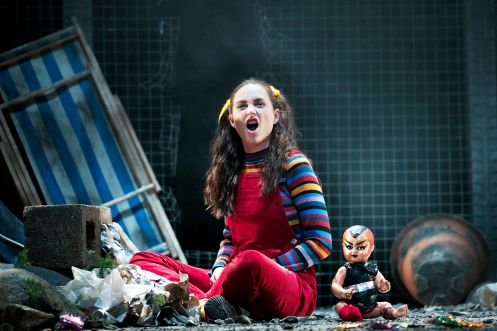
The play contains several scenes full of raw and painful emotion, but it is also often very funny. The dialogue is often reminiscent of Alan Bennett’s juxtaposition of the dramatic and the banal. Characters swap painful and shocking revelations, while sorting through curtains for an auction. Much is left unsaid between the four women, and this gives extra weight to the climactic scene between Jackie and Rosie, when the truth of their relationship is finally revealed and Jackie bares her soul in a heart-breaking desperate speech.
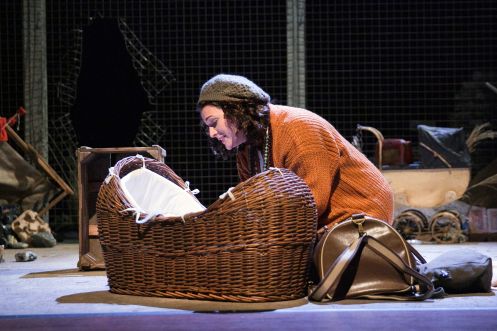
Occasional brief snatches of pop music evoke a given era, and quite possibly cover some of the huge number of costume changes for each of the characters, but they feel oddly out of place in a production whose bleak wasteland set, designed by Bek Palmer and lit to great effect by Andy Grange, emphasises the timeless quality of the women’s experiences. The play is nominally set in Greater Manchester and in London, and there are several local references to Hammersmith and Twickenham, as well as to Moss Side, but really the themes and situations are universal.

The production is particularly impressive in that the set, costumes, props and equipment all needed to be assembled in a matter of weeks, after a devastating fire at the production’s storage facility destroyed the originals. The furious energy that must have been deployed in order to get this touring production back on schedule seems to have infused the performances as well, resulting in a moving and powerful production that had large sections of the audience in tears on more than one occasion.
Andrew Lawston
February 2019
Photography by Sheila Burnett
Young Peeking into Old Peking
Aladdin
The Star Pantomime Group at Hampton Hill Theatre until 23rd February
A Review by Eleanor Marsh
Pantomime on a sunny spring evening (albeit in February – who says there’s no such thing as climate change?) seems a little incongruous, but the young audience waiting to see The Star Pantomime Group’s Aladdin were as full of beans and excitement as a Christmas cracker. And thus the mood was set for a traditional evening of cross-dressing, audience participation and traditional silliness.
Before I go any further – the Star Pantomime Group is run by its producer and director, Kate Turner who every year assembles a group of people together to put on a show to raise funds for a chosen charity. This year the charity is SSAFA and all credit to the actors who apparently came from as far afield as Birmingham for this week’s show that was in such a good cause.

The show opened on the streets of old Peking, with an excellent performance by the young dance troupe. Sadly there was no mention in the programme of a particular dance school, so it’s not possible to credit them, but these children were really good. In particular, their acrobatic dances were very impressive. In fact the entire show lifted whenever the chorus were on.
The principal actors were not as consistent as the chorus, however and although first night nerves may have been blamed for dropped lines there were an awful lot of them. There were also several missed technical cues, which may have gone unnoticed had the cast not drawn attention to them. The audience were slow to get going with their participation and this was not helped by Aladdin (Lewis Powysocki) saying “some more interaction would help” rather than “shall I get in the basket – shall I?”. First rule of pantomime – the audience are an additional member of the cast. Get them to work with you and you’ll have a success on your hands. Alienate them and you might as well go home in the interval. And sadly there were several moments like this, with cast members reminding others that they were in the wrong place, had forgotten lines and shouldn’t be on the stage. There was even a one to one conversation with an audience member that was nothing to do with the show and was met by deadly silence. In jokes just don’t work unless everyone is “in”.
And so the show progressed with all the traditional elements : Aladdin and Princess Jasmin looking every inch the Disney hero and heroine and singing beautifully, Evil Uncle Abanazar (Daniel Bosculescu) encouraging boos and hisses and Genies of Ring and Lamp (Chloe Besant and Rylee Hicks respectively) raising a cheer when they ran off to get married themselves. And the story of Aladdin and the Princess Jasmin (Hayley Wheeler) of course ended happily ever after.
The young audience who had been so excited at the beginning of the evening were no less upbeat at the end and they were particularly thrilled to be able to meet the stars of the show afterwards. And this evening was all about the children. From a performance perspective this was a great showcase for the stars of tomorrow – those wonderful dancers. As for the grown-ups, they are to be admired for doing what they do for charity. The stand out performance of the evening was definitely Gemma Bennett’s Widow Twankey; she was way too glamorous but saved the day on more than one occasion; we felt safe when she was on stage and in control of proceedings.
There was a certain charm to the “amateur” nature of this performance and the goodwill with which it was received, but I couldn’t help but think it would have been even more charming in a village hall rather than the polished and professional surrounds of the Hampton Hill Theatre.
Eleanor Marsh
February 2019
Photography by Dick Burton
Exit, Norwegian Style
Rosmersholm
by Henrik Ibsen, in a version by Paul Collins
The Questors at Questors Studio, Ealing until 2nd March
A review by Matthew Grierson
It’s easy to see what makes Rosmersholm a tempting proposition for a contemporary production: mental health, sexual politics, the influence of the press and, most significantly, a sudden polarisation of conservatives and liberals; all make for topical concerns. But the play maps modernity onto the late 19th century as awkwardly as the portraits of ‘the clan of Rosmer’ across the back of the set are Photoshopped to show the face of Paul James as Johannes, the last of the line.

Elsewhere, design and lighting manage not to draw so much attention to themselves, placing us in the present day without going for the obvious Ikea and low-angled sunshine one might expect. However, the version of Ibsen’s text by Paul Collins, who directs, seems not to have been translated into English so much as cliché, such is the abundance of hackneyed phrases. If he’d wanted to be as daring as the political context allows, the dialogue could have been livelier than this; as it is, the cast are lumbered with such clunkers as ‘That fact is inescapable and I can never escape it.’
Indeed, it’s with such killer lines as ‘Ours is a friendship without passion’ and ‘I won’t go through life with a corpse on my back’ that Rosmer attempts to woo cohabitee Rebecca West (Veronika Smit), although it’s not clear whether these are expressions of the former pastor’s emotional tone-deafness or simply ham-fisted transpositions into English. One wouldn’t blame a woman for turning him down on the strength of this. But when Rosmer does propose, Rebecca’s glee is immediately evident – and then abruptly rescinded, in a technically accomplished expression of some questionable direction. The plot both helps and hinders in navigating the sexual dynamics of the pair. Whatever shame would have attached to their domestic arrangements 130 years ago is entirely lost in the production’s modernised setting. However, the relationship is – fortuitously – recontextualised with the revelation that Rebecca is haunted by the suicide of Beata, Rosmer’s previous wife, and this restores some comprehensibility to their anguish.

Exchanges between the pair feel among the truest of the evening, with James and especially Smit conveying strength and depth of feeling, and the concluding scene has a crackle that the rest of the play largely lacks. Sadly these heartfelt moments are fleeting, lightning out of a clear sky that is just as suddenly gone and, having hit emotional paydirt, Rosmer and Rebecca leave the stage to their own deaths as stiffly as robots. The peculiar decision to introduce a voiceover of maid Therese (Catherine Day)’s thoughts at this point – characters have spoken their brains directly throughout the preceding two long hours – makes the climax still more muted.

Turns on an emotional sixpence (that’s about 0.3 krone) are so typical of the performance that it’s difficult to tell whether this is a function of the unmodulated dialogue or whether, as one suspects in a few cases, the acting is just stilted. So often are characters stood facing off against each other with their arms clamped to their sides that one expects them – longs for them – to break into Riverdance. Instead, each sustains one note until such time as they are called on to do otherwise, the resultant effect not unlike a wrenching, Eurovision-style key change. When someone opines ‘Now I’ve lost the power to act’, one is inclined to agree.

What contributes to the production’s absence of affect is that nothing is as telling about the characters than what we are told. Then told once more. Then told again. Act 1 scene 1 in fact is so lumbered with exposition – signalled by that cringeworthy tag ‘as you know’ – one wonders whether a more daring director might not resorted to a ‘Previously, on Rosmersholm …’ to make the piece a truly present-day Scandi-noir. Occasionally, the mannered quality can be exploited to effect, as when glances between Rosmer and Rebecca counterpoint their polite dialogue to show what they really feel about the presence of Ulric Brendel (Iain Reid). But the play can still largely be described as people standing awkwardly, trolling each other’s politics and throwing shade – like Twitter, only more protracted.

To be fair, the modern parallels are entirely without merit. Derek Stoddart as prudish principal Magnus Kroll and Martin Halvey as hack Peter Mortensgaard are never more believable than when they’re conniving to spin Rosmer’s private life or radical inclinations for their own gain. But in order to accept this messaging, we have to live both in the present of social media – at the start of act 2 Rosmer is on his laptop as if to say ‘Look! It’s 2019!’ – and in the glory days of the press, with so much hinging on which of two local papers finds the former pastor in favour.
The physical appearance of one of these rags as a prop prompts similar cognitive dissonance, as, like the portraits, it represents painstaking design work on computer. Likewise, a jarring reference to ‘DNA’ is thrown in at one point, but is simply used as a 21st century shorthand for the play’s preoccupation with inheritance – all those meaningful looks at the ancestral wall – when it could have been an opportunity to interrogate the significance of both concepts.
The problem is that the production keeps insisting on its significance while rarely making one feel it. The only thing one can be thankful for is that the political allegory is not as laboured as the rest of the production. Goodness knows, it would have had plenty to go on right now.
Matthew Grierson
February 2019
Photography by Jane Arnold-Forster
Complex Comment, Powerful Impact
Punk Rock and Bassett
by Simon Stephens and James Graham
Richmond Shakespeare Society Young Actors Company at The Mary Wallace Theatre, Twickenham until 24th February 2019, then on tour to Malta in July.
Review by Ian Nethersell
Adolescence is a difficult time. We struggle to know who we are and to find our place in the world. There are so many things to understand and think about whilst being influenced by peer groups, looking up to those we idolise, wanting to fit in and being constrained and controlled by the state. Indoctrination and manipulation can be a subtle and passive process as well as ‘in your face’.
James Graham explores this in his play, Bassett, set in the classroom of a modern comprehensive in the town of Wootton Bassett, through the eyes of a Year 11 class who have been locked in during lunch break for ridiculing and teasing the teacher. Needless to say, this theatrical device is a strong metaphor and allows a microcosm of society to be explored in its contrivance.
The themes of this play, which although billed second in the programme’s title was actually performed first for reasons which became apparent later on, are as relevant today as in 2011 when it was first performed as part of The National Theatre’s Connections Festival. It also explores more universal themes of love, hate, ‘who am I?’ and ‘what do I believe?’

We meet the young characters as very developed and believable individuals, a real credit to the skills of the director and the work put in by the cast. The plot is driven by the character of Leo, whose anguish at not being able to attend the repatriation of a young soldier who went to the school a few years before, comes out through anger and conflict with the other teenagers. Adam Green was able to maintain the level of emotion and kept a good pace throughout. We also meet Kelly who claims that she had a relationship with the soldier, and we are never sure if this is real or a phantasy; Honor Paul managed to project both a girl wearing the façade of a precocious and sexually confident teenager and youthful vulnerability at the same time.
The ensemble gave us characterisations from a wide range of characters and backgrounds, including Amid, sensitively played by Aaron Thakar, whose Muslim faith is ridiculed by Leo; Lucy (Maria Melanaphy) who says nothing until we realise that she is on a sponsored silence and who is driven to break it by her need to show her anger at the situations happening around her; and Graeme, played by Luigi Jones, whose technical expertise leads him to try and help the situation by getting the televised repatriation up on the teacher’s computer.
It was also refreshing to see that many of the girls played strong characters, especially Daisy Haslam as Rachel, who takes the lead when she is asked to demonstrate a military march and Ella Jarvis as Spencer a girl who at first seems to be extremely passive and only able to do as she is told by the teacher, but who we then realise later is actually a very intelligent and self-minded person, destined to achieve. As the lunch bell tolls, we hear the key in the lock which brings to mind the sound of a jail being opened, in yet another layer coming through to the audience.
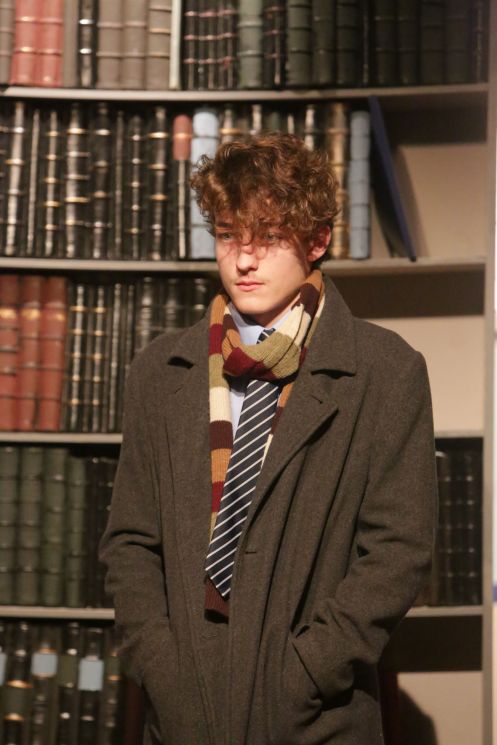
Punk Rock by Simon Stephens was first performed at the Lyric, Hammersmith, in early 2009. In this (almost) continuation of Bassett we now see A-level students in a fee-paying grammar school, and whilst coming from different backgrounds, there are similarities with the previous school. This play explores relationships, individualism and uniqueness. Opening with Another Brick in the Wall by Pink Floyd, we were again presented with fully-developed characterisations, wholly believable in their delivery. William, dancing with his headphones on, is engrossed in his own world. The extent to which he lives in his own world whilst interacting with everyone else is developed through to stark conclusion with a superb performance by Johnnie Clark of a young man suffering borderline personality disorder and psychosis. This could have so easily been caricatured but through strong direction and character research it remained believable rather than stereotypical. New girl Lilly, was strongly played by Edie Moles as a confident young woman who attracts the attentions of William. The pressures to achieve still remain and are seen clearly through the character of Cissy, played by Anna Watson, a straight-A student completely able, yet racked with insecurity, whose relationship with the bullying and domineering Bennett, portrayed by Dominic Upton, demonstrates the human desire and need for acceptance. When Bennett orders her to kiss Chadwick, she complies and as Bennett tries to make Chadwick his plaything, he breaks loose. Again the parts of Cissy and Bennett were believable and very well acted, as was Chadwick (Kieran Judd) whose characterisation came across as someone who was truly confident in himself and unlike the others, was not projecting a façade.
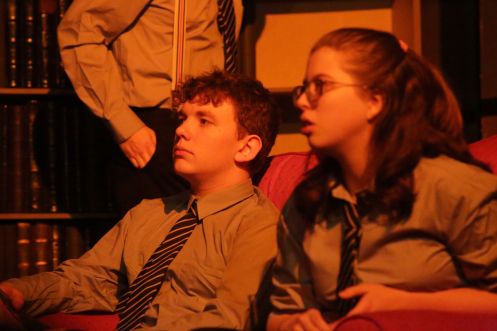
Things start to unravel in individual worlds when Cissy gets a B and therefore has not lived up to everyone’s expectations. As the lights dim and I Don’t Like Mondays by the Boomtown Rats begins to play, William enters, carrying an automatic machine gun, and the situation begins to escalate. Cassie Woodhouse played the supporting role of Tanya particularly well here.
The final scene of this uncompromising play finds the now adult Spencer as seen in Bassett, as a qualified doctor interviewing William. Therefore these two plays, individually written, became inextricably linked through the vision of the director, Katie Abbott and her assistant director Laura-May Hassan.
The sets were designed and built to give the audience all they need without cluttering the space for the performers – special credits to Jo Moles as designer for achieving a great deal within a small space and Geoff Warren for realising the vision. In the first play we are in a Year 11 classroom and in the second, the set is a library of a fee-paying grammar school, portrayed by bookshelves and sofas. I particularly liked that the classroom was still visible though not lit behind the library scene, in what is now a portrayal of youth moving forward into another stage of their lives, representing that the past is always present, wherever the future is.
With sound designed by Martin Pope and sensitively operated by Jake Neill-Knight, there was good use of music at the start of the show which was interspersed throughout both plays and was very well chosen, as was the incidental sound which all added to the furthering of the piece both in character development and emotional content for the audience. The lighting design by Simon Bickerstaffe again added to the intensity and the emotion of the characters and allowed the audience a chance to enter their inner worlds.
Ultimately this was a complex and powerful political comment and its impact on the lives of young people today.
There is another chance to see these talented young performers as they take this bill to The Blue Box Theatre in Malta in July.
Ian Nethersell
February 2019
Photography courtesy of the RSS Young Actors Company
Newton’s Cradle and Interconnecting Relationships
Closer
by Patrick Marber
Putney Theatre Company, at Putney Arts Theatre until 23rd February
A Review by Celia Bard
First successfully performed at the Royal National Theatre in May 1997 the play Closer continues to play to receptive audiences, bearing out the idiom by Woody Allen that “Sex without love is an empty experience, but as empty experiences go it’s one of the best!” The four characters in this play, Alice and Anna and Dan and Larry, in their pursuit of love lead each other a merry dance of sex and infidelity, but their quest is founded on deception and lies which ultimately leads to pain and disillusionment. The theme is as old as the hills but in the hands of Patrick Marber it remains as fresh and pertinent as ever.

The play consists of twelve scenes where events play out over hours, days, months, years. Innovative use of video images, including shots of The London Aquarium, an Art Gallery, Postman’s Park, and some carefully selected pieces of furniture provide easily recognisable settings. The audience is never left in doubt as to where the action is taking place, leaving audience members free to focus on the cleverly constructed dialogue, which is both witty and poignant, and on the characters’ brutal and tense relationships. An ingenuous prop is the use of a Newton’s Cradle. The continuous backwards and forwards force of the swinging spheres symbolise the dramatic tension between the characters, wonderfully realised by both director and actors.
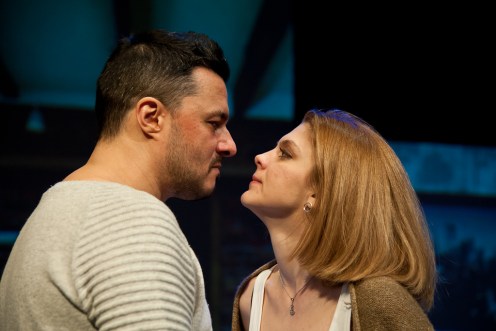
The first scene opens in a hospital waiting room. Alice, a club stripper, nursing a minor injury meets Dan, a newspaper obituarist and would be novelist, whom he helps and quite soon afterwards goes to bed with. The other two characters in the play are Larry, a dermatologist, who meets Anna, a photographer, in The London Aquarium. They too go to bed. Dan then meets Anna when he is having his portrait taking for his new book. Sexually drawn to her, he eventually succeeds in persuading her too to go to bed with him. Larry finds out about the affair and goes to bed with Alice whom he meets in a strip cub. This merry go round of sexual encounters and splitting up exacerbate emotional wounds. The title of the play, Closer, becomes irony as the scenes we see and don’t see make it clear that the couples do not become closer, even at their most intimate moments. Although each of them embarks on a quest for true love, their search is fruitless. The men cannot commit, and the women want something that their partners as lovers cannot provide.
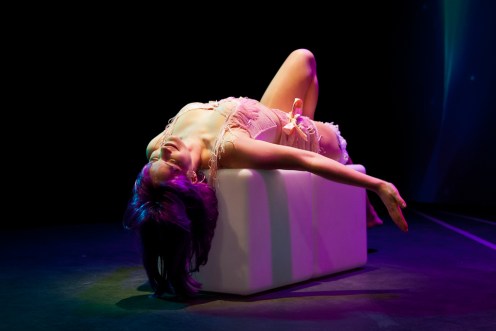
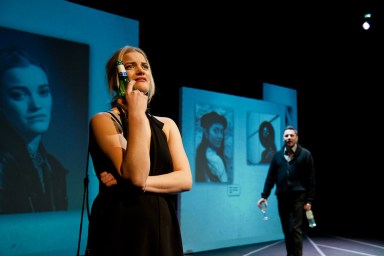 Grace Cullen brilliantly portrays the character of Alice, needy, vulnerable, sexually alluring, and feisty. Her vulnerability shows through in her facial expression during a photographic session with Anna when she instinctively realises that Dan is going to stray. This actor is able to exactly replicate her character’s wistful facial expression in the photograph later on display at Anna’s photographic exhibition. The scene with Larry in the striptease club is wonderfully played out. Grace’s physicality is impressive. Her movement is sexy, but not seedy nor offensive: throughout she manages to convey an innocence and vulnerability, which maintains audience sympathy. Her character’s façade disappears in the final scene when Dan who, on having learned the truth about the question mark etched on her leg, questions her about it. Rather than face up to the brutal truth of her insecurity and destroying the fiction of the persona she so carefully maintains, she sharply ends her relationship with Dan. Alice is a complex character and Grace Cullen exploits this to the full.
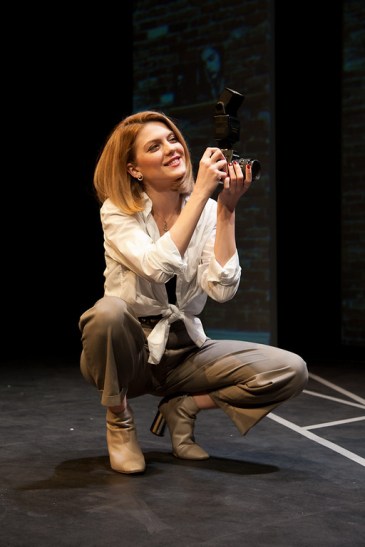 In contrast Anna, skilfully played by Olivia Nita is a very different character. Sexually attractive, older, sophisticated, a talented photographer, appears not to be needy, but she has an Achilles’ heel. She practises deception, which she cannot maintain when challenged, she cannot lie. In many ways Anna is a victim of her own sexuality and she is easily manipulated. She feels guilt about betraying the three other characters, but her feelings of guilt do not override any moral consideration. The beautifully directed scene in the restaurant when the audience sees her in different time zones with both Dan and Larry highlights the extraordinary and painful situation in which she frequently finds herself. This scene requires careful timing which this actor handles expertly.
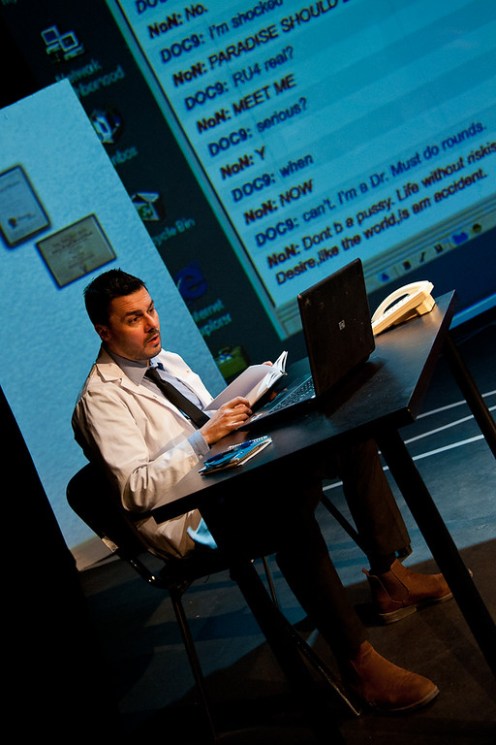
 The two men, Dan and Larry, superbly acted by Tim Duthrane and Jerome Joseph Kennedy do not display the same sensibilities. They appear to be driven by certain Alpha Male negative characteristics, displaying confidence and dominance in pursuit of women and being possessive and jealous. Dan, as realised by Tim Duthrane, is manipulative and mischievous as revealed in the computer chat room. He of all the characters swings the most, backwards and forwards, in his quest for sexual desire. In Larry’s office, Dan appears wearing glasses. Although this indicates failing eyesight the spectacles also symbolise his lack of insight regarding women: his relationships with women are only skin deep. Larry on the other hand is driven by feelings of revenge. This same encounter with Dan in his office, earlier in the strip club scene with Alice, and then in the restaurant, acutely reveals this trait of personality. He is not going to forgive Dan for robbing him and sleeping with Anna, he sleeps with Alice as revenge and he forces Anna to have sex with him again before signing the divorce certificate. The male characters in Closer are not depicted sympathetically by the writer. Both actors, however, play their parts with such a lightness of touch, incredible believability, and an ability to hold and engage the audience by varying the way they portray their characters on stage that you never become bored or irritated by them.
For all four characters love, friendship and genitals are explosive ingredients of items that go to make up affairs of the heart, which as Larry puts it is “wrapped in a bloody fist.” This brutal, hard-hitting, interesting, and thought-provoking play, cleverly directed by Jeff Graves, superbly acted by the four actors, and supported by an imaginative and skilful technical design team make this a memorable production, one that is not easily forgotten.
Celia Bard
February 2019
Photography by Rich Evans
Laughter or Treason?
Trial by Laughter
by Ian Hislop and Nick Newman
Trademark Touring and Watermill Theatre at Richmond Theatre until 23rd February, then on tour until 9th March
Review by Mark Aspen
Huzzah, huzzah! Hislop and Newman’s latest historical docu-drama,Trial by Laughter has all the robust rumbustiousness that we have come to accept as the quintessence of the Regency period. Indeed, it is a fitting caricature of a highly caricaturible period and centres around the famous caricaturist George Cruikshank, or more specifically his promoter and collaborator William Hone. Who? I hear you say. Hone, a writer, satirist and Fleet Street bookseller, is undeservedly much less well known than Cruikshank. Hone is often described as “the greatest champion of press freedom”, for his court battles against censorship, where he was victorious in defending freedom of speech against the powerful interests of the day.
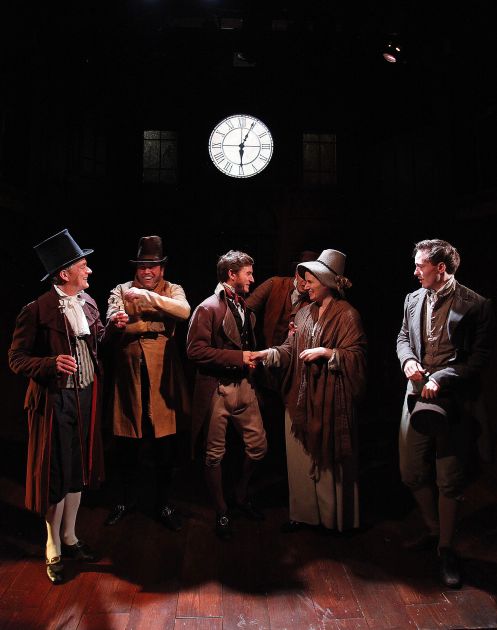
In fact there were three court cases on three consecutive days just before Christmas 1817, three separate trials, which took place in The Guildhall before special juries, and in all of which he was found not guilty and acquitted. Unfortunately, in Trial by Laughter, we are put on trial by having the same play three times over. The writing of the play does not stir the same empathy for the protagonists, nor have the gentle humour, of Hislop and Newman’s earlier historical piece, Wipers’ Times.
Notwithstanding a somewhat weaker script, the cast of Trial by Laughter attack the drama with huge dynamism and such palpable glee that it sweeps these misgivings aside. It is carried vigorously away by a score by Nick Green whose Baroque style draws on Thomas Attwood, who was a chamber composer for the Prince Regent. Indeed, Trial by Laughter is leavened by musical interludes sung by the cast, in the style of Regency “glees and catches”, ribald rounds loaded with double entendres (not that the text is in any way short of double entendres). For instance, the catch The Tree of Life straddles biblical allusion and suggestive satire: your imagination can unravel the entendre.
Herein lies the basis for Hone’s prosecution. He had published political parodies in the Reformists’ Register, which were illustrated by Cruikshank. These squibs not only exposed the corruption in the establishment of the day, but also ridiculed their scandalous “private” lives, including the sexual incontinence of the Prince Regent. Hone’s biggest mistake was to use the then familiar patterns the Bible, the Prayer Book and the liturgy of the church as the template for his satires. This gave a very sharp hook on which the prosecution could hang its case, and he was charged both with seditious libel and with blasphemy.

Designer Dora Schweitzer’s set has the calculated proportions and precision of Regency cabinetwork, in a sedate “solid mahogany” street façade, complete with a practical town clock, which adds to the state of urgency. It is a metaphor for the society. Behind those doors all is far from sedate, including in the royal court. Jeremy Lloyd portrays the Prince Regent as a shallow indecorous fop. The part is played big in many senses, for Prinny is surrounded by his mistresses, in a pneumatic ménage à trois with Lady Hertford and Lady Conyngham, played by Helena Antoniou and Eva Scott respectively. This is caricature writ big and all three have great fun in a continued scatological and sexual romp. Even children’s games are voluptuously hijacked into use as sexual horseplay by this plush trio.
Through the long-suffering courtiers and palace staff stride Baron Ellenborough, the Lord Chief Justice, and Viscount Sidmouth, the Home Secretary. They are intent on using the Prince Regent’s vanity to lever up the charges against Hone and use the courts to silence his criticisms. Sidmouth had already suspended the right of Habeas Corpus, hence securing a trail and two retrials of Hone on three successive days was a straightforward matter. Dan Mersh’s Ellenborough is a bluff character, a hard man, ruthless in getting his way, whereas Phillip Edwards plays Sidmouth as a manipulator, insinuating his own way, but equally effective.
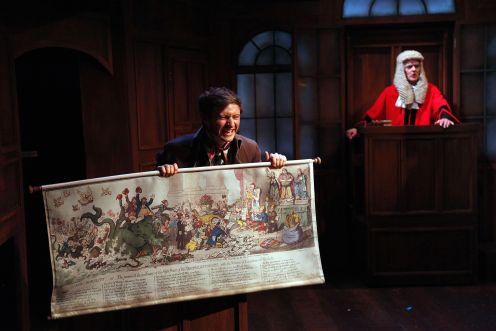
The court of law is convened in The Guildhall, where we, the audience, in a nod to the metatheatrical, are included in the noisy crowds inside the court (if not in the mob of thousands outside), enhanced by some clever stereophonic effects by sound designer, Steve Mayo, which plant virtual hecklers in our midst. The court is depicted as, to say the least, biased. Most bigoted is the judge himself, Mr Justice Abbott, a wickedly gimlet-browed Nicholas Murchie. Dirty tricks even extend into the gaol, where a lithe seductress, Mary Oliver, is sent to compromise Hone, in a delicious cameo for newcomer Rosa Hesmondhalgh.

The open matter-of-factness of William Hone, which borders on the naïve, is energetically depicted by Joseph Prowen, as a passionate and earnest young man, a David bold (and foolish) enough to take on the Goliath of the state machine. Hone has the self-belief, and lack of cash, to mount his own defence. He is spurred on by the devil-may-care Cruickshank, played with verve by Peter Losasso, who embodies the relentless energy of the caricaturist who incites Hone to keep going, despite his exhaustion to give six or eight hour long defence speeches. The increasingly ill Hone uses a good natured humour to win over the jury on each occasion, in spite of being counselled by the much more grounded William Hazlitt to be wary of using jokes in a court of law, “Wit is the salt of conversation, not the meat”.
Jeremy Lloyd doubles as Hazlitt, well differentiating the urbane literary critic with Ellenborough, the head-on Cumbrian. Other effective doubling comes from Nicholas Murchie, who returns as an exasperated Frederick, Duke of York, and Eva Scott who plays the pivotal role of Sarah, Hone’s loyal and very resourceful wife. Sarah is very much the rock-solid foundation of the ever increasing Hone household. Initially with little sympathy for his, as she sees it, self-imposed incarceration, it is she who eventually gathers the evidence that leads to his third acquittal.
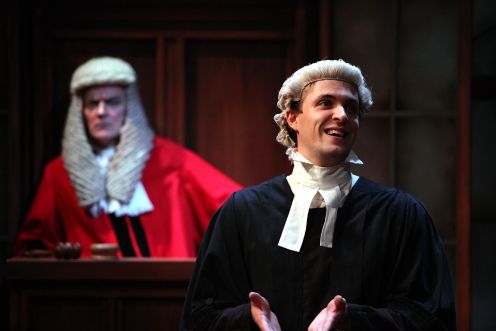
Prosecuting council, Weatherill, played with tenacity by Lewis Bruniges, plugs away at the blasphemy angle. Hone argues that he is using the sacred texts as models in style because they are familiar, and that he is parodying that style in his satires, without any intention of being disrespectful to the name of God. It cuts little ice with the lawyers. However, in the third trial Lord Ellenborough himself takes the judge’s bench, and Hone is able to bring out evidence, uncovered by Sarah, that Ellenborough’s own father, Edmund Law, had used a similar literary device … when he was Bishop of Carlisle.
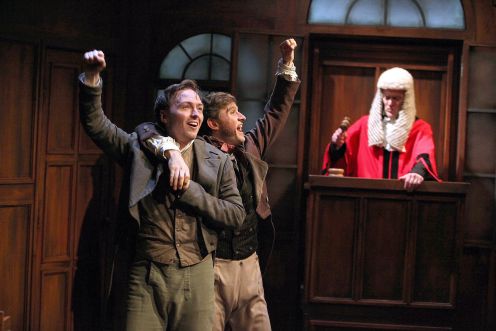
There is a nice comment, pointed at our modern world, from Hazlitt when a youth gets Cruickshank to sketch him with Hone, as a sort-of early nineteenth century selfie, “ah, well there is unlooked-for fame”. Director Caroline Leslie’s boisterous high-octane knock-about makes for entertaining fun in twenty-first century Britain, but one should feel some sympathy for the “villains” of the piece when one reflects that in 1817 that the bloody aftermath of a bloody revolution across the Channel continued, that a revolution had lost us a valuable colony in America and that a British Prime Minister had been assassinated five years before. Revolution was in the air. There was an edginess with the instability of politics that perhaps chimes two centuries later. In an age of belief, blasphemy was an unspeakable offence against the Almighty, whereas it is actively encouraged in politics today. It is ironic that Richmond Council has just voted to prevent people peacefully praying in silence outside of an abortion clinic within half a mile of Richmond Theatre. Freedom of speech and freedom of religion are just as under threat as they were 202 years ago.
Blasphemy may be old-hat here and now … but try that out in Raqqa! A sobering thought even for the less than temperate protagonists in Trial by Laughter. Hislop and Newman’s new play makes an entertaining and fun evening, but gives much food for thought, a Prince Regent’s banquet load of food for thought. Huzzah, huzzah!
Mark Aspen
February 2019
Photography by Philip Tull
Infinite and Expansive
Ondule
by Rouet and Martinez
Resolution at The Place, Euston, 12th February,
The Festival of New Choreography continues until 23rd February
A reflection by Abigail Joanne
Ondule by Laura Rouzet and Alejandro Martinez is a performance showcased as part of Resolution 2019 at The Place. Part of a Resolution triple bill in-between Hazel Lam’s Lighthouse and Mara Viva’s time/less, Ondule entices the audience into its mysterious dimension. Informed by contemporary, popping, voguing, and dancehall, Ondule is a ‘point of intersection where otherness emerges’.
 Ondule, from the French, means ‘undulate, swirl, swing, sway’: the dancers have captured this beautifully and invite the audience to relax into their organic display.
Choreographed and performed by Rouzet and Martinez, with music produced by Monica Mia in collaboration with Rouzet, Ondule is a duet which explores genderless movement.
In the beginning we see two figures joined in motion, foreheads touching to create a loving and intimate composition. Sparkles dance from nude tones and masks with edgings, twinkling to the curling movements, the figures are like cells under a microscope, merging, then moving away. I am reminded of the power of ten; the miniscule and the massive are as one, infinite and expansive.
 We see each dancer become more independent while the other gently continues undulating in the background, behind a shimmer of silver curtain strips. The physical expressions become stronger and wider. The music picks up and an irresistible beat takes you into the night where the covert becomes liberated.
I wonder what ‘otherness’ they describe in their bio is? Is it something different, separate, and unknown? Or is it, in fact the very core essence of us all? The inevitable evolution of nature?
It is possible to expand beyond our preconceptions of gender, and to challenge our own identifications within ourselves and towards others. We can connect and move into this space to find celebration in our sovereignty and togetherness in our independence.
I really hope Rouzet and Martinez continue to collaborate; I would be interested to see their ideas develop further.
Abigail Joanne
February 2019
Read more at The Place’s Resolution Review
Photography by Laura Rouet

 Mark Aspen