
Flights of Fancy: Real and Imagined
Festival of One Act Plays
Step on Stage at The Exchange, Twickenham until 9th December
A Review by Celia Bard
The Exchange in Twickenham gives home to The Festival of One Act Plays by Step on Stage, as three new plays for youth theatre, written and directed by Emma Tinniswood, founder of Step on Stage, are performed. Two of the plays, Hope and Millie’s Dream contain strong psychological undertones whilst the third, Sing Little Cuckoo explores the mental states of women locked away in a mental institution. All three plays reflect the playwright’s passion for historical events and shifting time periods.
Sing Little Cuckoo is the first of the plays and is based on the life of Nelly Bly, the pen name for the American journalist Elizabeth Cochrane Seaman, who was famously known for her exposé of the conditions of asylum patients at Blackwell’s Island in New York City in 1887. This play makes use of pre-existing documentary material in the form of photographic images, letters and interviews and fits in with the concept of documentary drama. The use of choral speaking moves the drama and the horrific experiences of the women locked away in the asylum into the sphere of Greek tragedy.
The setting for the play Hope is World War Two. Caught up a bomb blast, Poppy escapes to the country where she meets a group of children. This is an unsettling play and works on suggestion. The character, Hope, is enigmatic. The audience is never entirely sure who she is and what she represents. She is always present, in the barn with Poppy and with Charlotte in flashback when the latter is hugging her dead baby brother. The implication is that Charlotte has accidentally smothered the baby through love, a recurrent theme in the play in which Charlotte is described by one of the characters as somebody who grows more dominant by the acts of kindness that she bestows on others.
Millie’s Dream tells the story of an eight-year-old girl whose life is changed for ever, the result of a car accident involving her parents and younger brother. Her mother is killed, and Millie is so badly injured in the crash that for a while she loses the use of her legs. The action takes place in the hospital ward and it is Millie’s love of writing and storytelling that help her cope with the sadness and awfulness of her situation. The times period switches between the eight-year-old girl and a grown-up Millie. Her journey involves coming to terms with the guilt she feels resulting from the unintentional part she played in causing the death of her mother.
 The director has given a great deal of thought about the many scene changes involved in the overall production, one which works both for the individual plays, and for the ensemble casts where there is lot of physical movement. Space for the chorus who comment with a collective voice on the dramatic action must also be considered. The use of a minimalistic stage, simple and plain with just a few items of furniture proves to be the solution. Photographic images projected onto a large screen provide information about settings, people, dreams. These include photographs of Nellie Bly, a workhouse, the Blackwell Island Lunatic Asylum, inmates, and quotations in Sing Little Cuckoo.
Images of a bombed town juxtaposed with that of green fields, followed by those of the inside and outside of a barn provide information about causation and settings in Hope; whilst the beautiful and imaginative image of a ladder reaching into the sky provide a vivid metaphoric insight into the journey that Millie yearns to climb.
The different casts are well costumed and tell the audience something about place and time period. The uniformity of costumes in Sing Little Cuckoo reflects the inhumanity of the people running the institute where the inmates count for nothing. Costumes in Hope are typical of those worn by children in WW2 whilst the nightdress worn by Hope and the attire of doctors, nurses and Hope’s father and brother reflect her hospital setting and a more modern time period.
Recurring motifs are dramatic devices used by the director to symbolise significant moods in the play. Sing Little Cuckoo starts with the sound of a trumpet playing O Shenandoah. This tune echoes throughout the play and is beautifully sung by Hope Groizard and Millie Bleazley in the penultimate scene. O, Shenandoah is a sad and wistful tune and well reflects the hopeless yearnings of the women locked away in the asylum. The nursery rhyme, Ring a Ring o’ Roses is repeated ominously throughout the play, Hope. Its association with plague and death strengthens the suggestion of a sickness of mind as evidenced in the character Agatha. At the end of the play the nursery rhyme is repeated again and again by the cast building up to a dramatic climax. Repeated spoken references by Millie to dreams and nightmares in Millie’s Dream tell the audience something about the guilt she feels, as do her stories.
The cast list is long and so your reviewer must be forgiven for not naming all the performers taking part in this Festival of One Act Plays. Suffice to say that the characterisation, interaction between actors, movement and confidence is strong throughout. Some of the cast, particularly those in Hope, with the exception of Agatha and Poppy, are not able to cope with the vastness of The Exchange theatre. Voice projection is soft, and voices do not carry into the auditorium thus audibility and meaning suffered.
In Sing Little Cuckoo, Hope Groizard is very convincing as Nelly Bly, both as the journalist in the outside world and as the undercover journalist within the asylum. Millie Beazley is notable for her strong, pleasing resonance of voice and an ability to stay in character throughout. Andrew Rhodes succeeds in portraying a frightening image of the bullying and insensitive Doctor whilst Matthew Greenway is thoughtful and believable in his portrayal of Mr Pulizter and Doctor. The young actress speaking in French stunned the audience into silence as she heartbreakingly railed against her situation, having ‘lost her state of mind’.
The cast of Hope are all aged between 9 and 13 and must be commended for their movement and commitment to the characters they portray. Charlotte Williams as Agatha gives a true to life performance, sometimes kind but at other times bossy and domineering. She is a young actress who is developing good vocal skills, able to project well, and endows her lines with meaning. Jessica Jenner too provides a realistic portrayal of the confused Poppy, unable to make sense of the situation in which she finds herself. Darcey Boyle as Hope is almost translucent thus adding to the mysterious quality of her character.
Maddie Everard provides an angry portrayal of the Young Millie. This is in keeping with her determined nature and strong sense of guilt she feels. At the same time the anger fuels her resolve to walk again and to write. Samia Islam is supportive and reassuring as Millie’s case worker; whilst Abbie Craddock plays Millie’s father realistically, at first resentful, withdrawn, and then supportive. Eve Gregson provides a mature image of the Old Millie, happy, confident and at ease with the people around her.
The production team did well to end the programme with Millie’s Dream, as this play ends on a note of hope, contrasting sharply with the other two plays in the festival. The themes in all the plays are hard hitting and starkly reflect some of life’s cruelties. Some might question the appropriateness of content for young people, some as young as nine, and their suitability for this festive time of year. Other will put forward the point of view that it does no harm in bringing home to children and young people the awful experiences that many people endure and that the Christmas season is not all about pantomimes, Christmas trees, presents and jollity. Judging from the involvement, and truthful performances displayed by all three casts, there was no question about their commitment to the roles they were playing nor to the nature of the themes being explored. Overall, I thought this festival of short plays was a brave production in terms of its mature and thought-provoking content. Emma Tinniswood must be congratulated for writing scripts that provide wonderful dramatic opportunities for her talented young casts.
Celia Bard
December 2018
Photography by Louise Hill
Paved with Gold
Dick Whittington
by Daniel Wain, directed by Bill Compton
Teddington Theatre Club at Hampton Hill Theatre until 15th December 2018
A review by Matthew Grierson
It is a truth universally acknowledged that a panto in possession of a fortune must be in want of a decent audience.
I say this because TTC’s production of Dick Whittington is in many respects as golden as Dick hopes London to be, but that, until the interval, we the audience are a lukewarm bunch, despite the cast’s best efforts. Poor old Idle Jack (an endearing performance by Lara Parker), for instance, can’t get any response from audience member Darren and has to pick on birthday boy Nick instead. And for heaven’s sake, we miss a sitter when the cast patiently cue up a gag about where their careers are and leave us a beat to call out ‘They’re behind you!’ No dice.

All the same, the show delivers everything you’d expect with aplomb – fun performances, big musical numbers, a clever, versatile set and excellent costumes. The jokes come hot on the heels of one another, so that if one is not to your taste – there is plenty of single entendre – then there will be a dumb pun, a sight gag or something political along shortly after. What more could we ask for?


Another truth universally acknowledged is that an audience in possession of children must be in want of a drink sooner or later, and it is certainly the case that after the interval there seems to be more engagement, and the cast can reap the reward for the work they have put in during the first half. Who knows, maybe they’ve been having a tipple as well: the normally urbane Alderman Fitzwarren (Jim Trimmer) certainly seems to drop an otherwise inexplicable follicle not long after he’s back onstage. Well, I strained to make out any pun at least.
To their credit, the performers remain straight-faced through plenty of such ribaldry, enabling them to tell some downright filthy gags in a room half-full of pre-teens as though butter wouldn’t melt. The moment Rebecca Dowbiggin, who is brilliantly disingenuous throughout as the titular Dick, delivers the punchline to meeting Tommy the Cat, sets the tone for the rest of the show (I’ll leave you to work it out, it’s not hard … so to speak). The master of these innuendos, in the person of Marc Batten, is Sarah the Cook. So I suppose that should that be the mistress of innuendo? A mistress is, as she tells us, what comes between a mister and a mattress … Perhaps all this barefaced smut explains the initially nervy reaction from the stalls.

In a more family-friendly vein, there is a string of intertextual – panpantomimical? – jokes that find characters forgetting which show they’re in. When we join Fairy BowBells (a chirpy Danielle Thompson) at the top of the show, she thinks she has a season off panto duty, only to get a call on her mobile to come to Dick’s assistance. As if our hero doesn’t have enough on his plate with making his fortune, wooing Alice and defeating King Rat, he’s also worried about the reviewers being in tonight. And the script doesn’t miss an opportunity to have a dig at rival groups and productions, or even the local rail franchise: Dave Dadswell, who makes great sport out of his multiple parts, has a lovely turn as Dandini looking for Cinders, having been delayed by South West Trains.
The topicality of poor transport is a motif at its most blatant in the naming of Alderman Fitzwarren’s ship the Brexitannia, which is boarded by way of an appropriately wobbly entrance and then not much later holed below the waterline. Far be it from me to spoil a delightful surprise, but our heroes are saved from a watery grave by an apposite, and appositely named, local celebrity appearing by video. I won’t say who this might be, but if you want a hint check your programme.
The whole sequence makes good use of the curtain as a semi-transparent screen for projection, bubbles playing up its surface with the cast stranded behind it doing the ‘Baby Shark’ challenge (yes, I had to look it up too). It’s been used similarly effectively to separate Dick from his true love Alice (steadfast Kelly-Marie Toothily) earlier in the show as they sing a tender ballad on either side. Nice work Patrick Troughton, who I daresay is fed up of being in the shadows of his Time Lord namesake, and Gary Stevenson on lights.

The shipwreck throws the crew – that is to say, the cast – ashore in Morocco, where they encounter the Sultana of Morocco. Mia Skytte Jensen makes the most of her long-delayed entrance to sing ‘Whatever Happened to my Part?’ in mock-diva mode. In a show packed with accomplished musical numbers it’s a particular highlight, and gives the hard-working chorus the opportunity to show their acting chops in an amusingly choreographed sulk. Fair play to them, they’ve already executed a number of fine routines – shout-out to choreographer Emma Knight – including a hornpipe, served to swell the rodent population and endured the jibes of the main characters.
Arriving in North Africa, the production avoids some awkward Orientalism by having the Sultana speak in the Queen’s English and her father – the redoubtable Mr Dadswell again – affect a Geordie accent. But seriously, guys, I’d have thought twice about the Native American headdress in the first act; just because the Village People used it in the 70s doesn’t make it all right. More perplexing, though for different reasons, is the decision for Sarah to get double drag on by dressing as Freddie Mercury for this number. Sure they’re all supposed to be in disguise, but I couldn’t work out was going on there – especially in a medley of ‘In the Navy’, ‘YMCA’ and ‘Go West’ – unless it’s an attempt to cash in on the recent Queen movie.
But back to the plot: it is also on their Mediterranean jaunt that our heroes find their fortune and finally trounce King Rat, who has troubled them throughout with his boo-hiss hair and Shakespearean pretensions … signalling the further truth that a writer in possession of a deadline will be in want of a handy quotation now and again (don’t worry, Daniel Wain, we all do it). As the recurrent rodent, Edz Barrett gnaws as much of the scenery as he does Fitzwarren’s stores and manages to send the kids scurrying as a result. The younger audience can take heart, however, from Asha Gill’s cutely wordless turn as Tommy the Cat, who is repeatedly on hand – or rather, on paw – to see off the villain and his entourage.
By now it’s time for the traditional singalong, and as Dadswell and Parker lead us through a rousing rendition of ‘Flash, Bang, Wallop!’, it’s clear just how much the audience has warmed up, given that some of us start singing ahead of the lyrics. Then it’s back to London, which as the opening number has told us is England, is home – a sentiment perhaps designed to ensure a bit of political balance to the piece. Here we are treated to the curtain call-cum-triple wedding of Jack and the Sultana, the Alderman and Sarah, and Dick and Alice. Three cheers indeed.
Was Dick worried that the reviewers were in tonight? I don’t think he needed to be.
Matthew Grierson
December 2018
Photography by Jojo Leppink, Handwritten Photography
Woolly Winter Warmer
Sleeping Beauty
by Ben Crocker
Barnes Community Players, Kitson Hall, Barnes until 1st December
Review by Ian Nethersell
Once upon a time, in the mystical land of ‘Woollybarnes’, we were warmly welcomed to a panto production by the community theatre group Barnes Community Players, Sleeping Beauty.
We knew we had arrived at the venue on this cold damp evening when we spied festoons of bunting and a show banner, the design of which was the winning entry from a competition offered out to local schools. The winner was 9-year-old Maggie Conway-Hughes, whose colourful design featured all the components that make up the tale of Sleeping Beauty.

On entering the hall we were greeted with the chance to partake in warming mulled wine and various other festive offerings, most appreciated on this dank night. The seasonal cheer continued as we were greeted and seated by our Front-of-House Mrs Santa, wearing a duly appropriate festive fascinator! The overall effect was very jolly and Christmassy, although it would have been nice to enjoy a little more pre-show music – on this particular evening it did not start until ten minutes before curtain up.
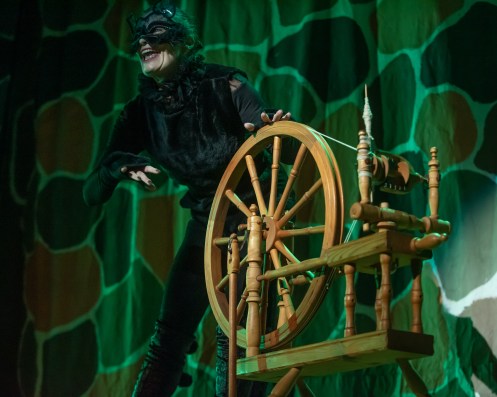
At the back of the hall sat the Lighting and Sound technicians. Quite a bit of installation work had been carried out to transform the tricky and sparse multi-purpose hall into a nicely atmospheric space. The pre-show lighting was at a gentle level with the basic rig being supplemented by a couple of movers which threw wonderful branch-like images on to the thicket gauze; later on in Act II this created a fantastic effect when the Prince was battling through the forest. The walk-down thrust resembled a catwalk runway dressed with hanging snow which brought the action out in the audience space: after all, panto has no fourth wall and at every possible opportunity should invite the audience to engage and take part, which in most parts this production attempted to do.
The colourful set was designed and constructed by the multi-talented Francesca Stone, who, as well as taking on the role of Princess Aurora, also directed the whole show together with Symeon Wade.

Francesca was an energetic and likeable Princess who displayed a pleasant singing voice and good rapport with the audience. Her parents were played by Terry Oakes and Rodger Hayward Smith as King Norbert and Queen Dottie respectively; both entered into their parts with gusto and were obviously favourites with the local crowd as they ventured ‘off book’.
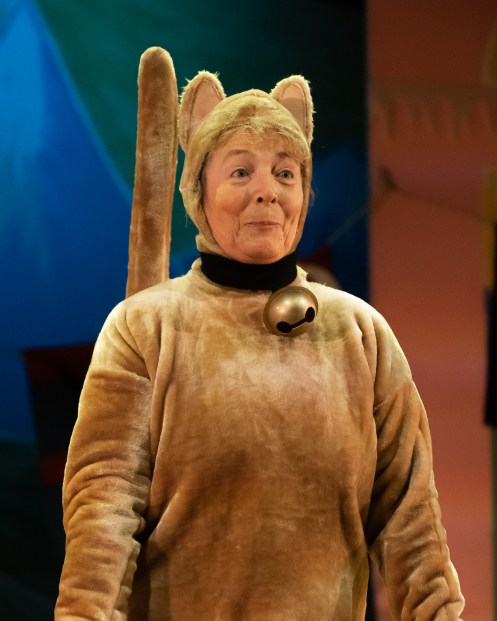
Annie Collenette as Kitty the cat was a loveable character, showcasing well-observed cat mannerisms, while Alexa Bushell as Billy, the court’s chief washer-upper, clerk and every other role under the sun, shone with a strong stage presence and a well-projected voice.

The traditional Fairy Godmother role was played by Marie Bushell, who led a highly entertaining troupe of fey fairies, Andrew Rapley and Symeon Wade – however for me her standout moment was the transformation into a Cockney serving wench in the second half. Songs were sparse in this production, but Roll Out the Barrel showcasing Marie and the enthusiastic chorus as said serving wenches was the most memorable of all. The small role of Prince Orlando, and later on his great, great grandson who was “in no way the same person” was nicely played by Steve Bannell.
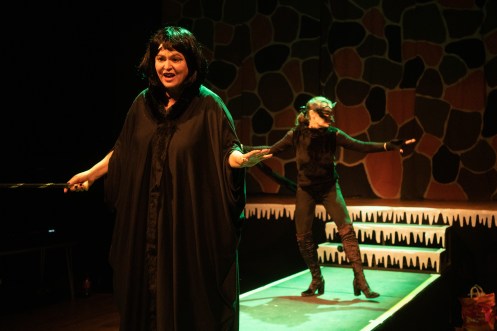
Special mention must go to Jill Turetzsky and Julie Smith as the evil fairy Carabosse and her cat Spindleshanks. This pair really embraced their remit of nastiness and gave a spirited rendition of One Way or Another, hugely appreciated by the audience.
Profits over and above the group’s working capital are donated to local causes, this year the 1st Barnes Rangers Guides and the Castelnau Community Centre, so this production offered a fitting start to this festive and giving season in more ways than one.
Ian Nethersell
November 2018
Photography by Lewis McCarthy
Image by Maggie Conway-Hughes (Aged 9)
Doomed Romance Dusted with Snow
La Bohème
by Giacomo Puccini, libretto by Luigi Illica and Giuseppe Giacosa, based on a novel by Henri Murger
English National Opera, London Coliseum until 22nd February
Review by Georgia Renwick
It’s that time of year again … The fires are lit (well, the heating is on at least!), the heavy coats are out of hibernation and we all dream of (or dread) a fresh coating of snow. It is important I stress that I welcome snow, before likening its return to that of La Bohème at The Colosseum; you half expect it, but are still delighted by that first flurry. As the first notes of Puccini’s quintessential winter opera quiver into the cavernous opera house, you can virtually hear the audience in their plush velvet seats sigh in blissful anticipation.
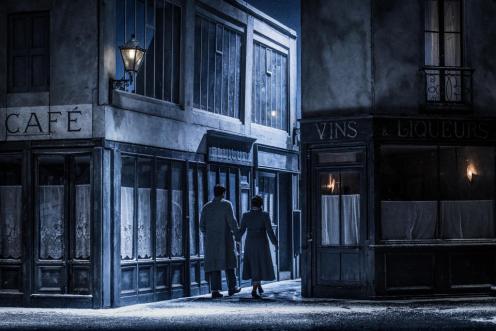
This production marks English National Opera’s fourth revival of director Jonathan Miller’s 2009 La Bohème, set charmingly in 1930s Paris. It also coincides with the forty-year anniversary of Miller’s ENO directional debut. It is by no means unusual for favourite versions of this opera to be revived time and time again, the Royal Opera House called “final curtain” on their 41-year-old John Copley production only a couple of years ago, and there are many qualities not only in the classic story but in this Miller production that I can anticipate enduring for years to come.
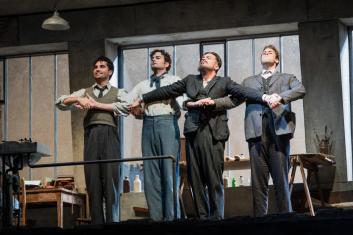 The modern English language translation by Amanda Holden is sparky and genuinely funny, the young bohemian artists under Miller’s direction cavorting and playful. They play-fight physically, which balances beautifully with their heavy romanticism. They are believable as young men trying to make a go of their craft, pitted against the poverty and despondency of inter-war Paris and the threat of dreaded tuberculosis.
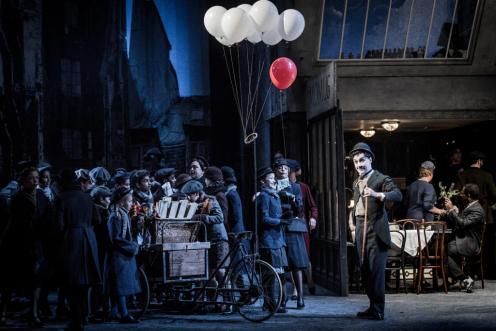
The set is a living, breathing dolls’ house: full-scale rooms, easily possible at The Coliseum, with intricate details that draw you in. An eager eye (and a good seat) and you can spy drying paintbrushes and soiled linens. In Act Two the artists’ studio opens out, pushed by costumed stagehands, into Cafe Momus, where dozens of singers flood the stage to bring to life Christmas Eve in Paris. It is a spectacle the principal characters, quite literally, get lost in. You would be foolish in fact, to let them distract you from the dozens of stories taking place all around them. Pickpockets skulk, lovers disappear into the night or behind closed doors, parents chase their over-excited children, delirious at the sight of toy drums and sugar canes. The attention to detail in Miller’s Bohème is true nostalgic bliss, made to get lost in.
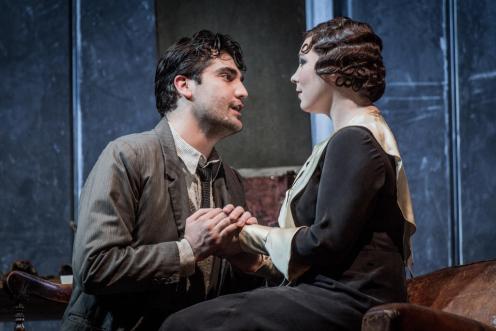
Of course, La Bohème endures but it has long had the popular vote. Indeed, it’s opening in 1896 saw such popularity it went against Puccini’s reputation in critical circles. A quote from Roger Parker’s insightful programme notes from critic Eduard Hanslick reads “This is new, a sensational break with the last romantic and artistic traditions in opera”. It is clear in the context of his full review, he did not intend this as a compliment. Brought forward a few decades it may be, Miller’s production still relies aesthetically on sentimentality and nostalgia, which does belie its original impact. For a simple seamstress, Mimi’s neat pin-curls are perhaps a little too perfect for her to be believably impoverished, in fact, they look enviably glossy.
There have been versions of La Bohème which have radically changed the aesthetic to fit the times, and offer the story to a new, and non-opera-going audiences. Robin Norton-Hale’s 2009 version at the 35-seater Cockpit Tavern pub theatre, went on to win an Olivier in 2011 with its stripped back modern day production set in a messy student flat in Kilburn. 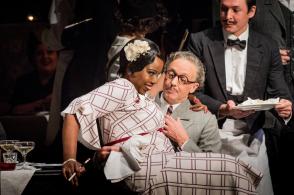 Appearing in another guise, the late Jonathan Larson’s 1990s cult rock-opera RENT, is in fact based very closely on La Bohème with Tuberculosis transposed for AIDS, and poets and painters for aspiring musicians and film makers. These productions serve to prove that the story, in its many versions, endures and will doubtless continue to do so in more yet-to-be-realised stagings and in other formats.
Naturally, ENO has evolved and modernised in many ways outside of the staging of this production (you may have seen the bright pink My Little Pony poster promoting their latest production of Salome) and is of course not only concerned with bringing back, but with pushing forward. On opening night, two young, rising-star performers make their ENO debut here in the primary roles of the two lovers, Rudolfo and Mimi: Chilean born, American trained and devilishly handsome tenor Jonathan Tetelam and mesmerising Welsh talent Natalya Romaniw, respectively. It’s a winning combination of traditional material, nostalgic staging and fresh blood.
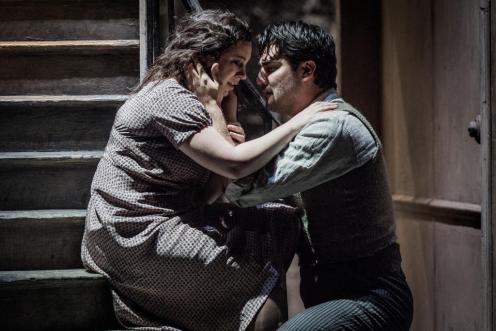
As one of the longest continually played operas of all time, La Bohème isn’t going anywhere, but it’s a wonderful time of the year to be whirled by this doomed romance, dusted with snow.
Georgia Renwick
November 2018
Photography by Robert Workman
Hallelujah !
The Messiah
by Patrick Barlow
Simon Friend and Birmingham Repertory Theatre at Richmond Theatre until 1st December, then on tour until 5th January
Review by Mark Aspen
Tea-towel headdresses, toy sheep, false beards. Doesn’t all this seem familiar from school nativity plays, memories that induce smiles or cringes, but so far away from the commercial onslaught that is twenty-first century’s pillage of Christmas. Between “Black Friday” (how did such a sinister-sounding name become associated with the season of goodwill?) and Advent, starting this Sunday, Richmond Theatre has launched our theatre Christmas season with The Messiah, which is a most unlikely candidate to bring out a true Christmas spirit … but it does!
Maurice Rose is suffering a mid-life crisis. Tired of the direction of his life, he has chucked in his job as a Hoover salesman in Debenhams, and the vacuum in his life is filled by his passion for the theatre. He had dabbled in am-dram, but has now decided to set up a theatre company. He is also fired up with another passion, a feeling that the world should be a better place. Filled with evangelical fervour, he has written a play with a message that he wants everyone to know. It is the story of Christmas, lifting the school nativity, he hopes, to an uplifting experience for adults too.

Maurice has also sunk at lot of money in the project it seems, judging by the lavish set, a grand revolve with a dozen Doric columns. Lots of gold and royal blues, a drape backdrop of the hills around Bethlehem and a ground-row cut-out of the town itself complete the scenery, which unfortunately as yet has no stage hands to manipulate the winch handle (prepare for pun on a well-known oratorio). Oh, and there are not enough channels on Maurice’s lighting rig, so things have to be plugged and unplugged to get the spectacular lighting effects that he is aiming for. Designer Francis O’Connor and lighting designer Howard Hudson skilfully achieve not-quite-there-yet feel of the set within the set.
Fortunately for Maurice, he has recruited a loyal chum, Ronald Bream, to support his project. Ronald is the general factotum but also his fellow actor, Maurice having cast him in, er well, all the other parts not played by the writer-producer-director … and some of those where Maurice cannot be in two places at once. All this doubling and splitting of roles adds to the confusion of the simple and kind-hearted Ronald, who is neither quite up to the complexities of the stagecraft nor to the pretentiousness of Maurice’s script.
Hugh Dennis is very much at ease with the role of Maurice Rose, ready with the sardonic remark and quick put-down, whilst his ill at ease character wrestles with a self-doubt which bubbles through the surface of confidence. Dennis is best known as a comedy panel-game performer and the skills which he has honed there transfer usefully into this role.
Ronald first appears to be the stooge part, an allusion invoked by the Chaplin-esque portrayal by John Marquez. It’s there, the shock of curly hair, the too-tight jacket, the trousers arguing with the shoes, the splay feet. But Ronald is Maurice’s prop in both senses of the word, and the shift from stooge to sage (sage as wise man as well as Wise Man) is neatly effected by Marquez.
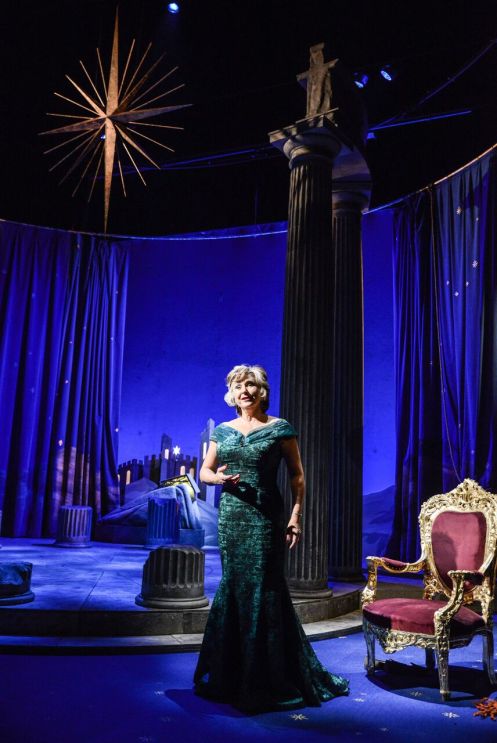
Maurice is keen that his new show should not only be a success but have an up-market appeal. He has hit on an idea to achieve his aims by engaging, possibly at some expense, an opera singer to provide entr’actes to his nativity play in the shape of excerpts from Handel’s Messiah, the Christmas bits. But due to his budget constraints, he has settled on Mrs Leonora Fflyte, a diva whose career has recently been on the back-burner. Mrs F, as Ronald deferentially calls her, keeps a haughty eye on proceedings, willing to go along with Maurice’s directing of his “experimental” piece, until she gets the momentum up with a powerful burst of the oratorio. (Singing with “bit between her teeth”?)
Lesley Garrett, the renowned opera and crossover singer, gamely takes on the role of Leonora (“Lay-en-ora” she insists) Fflyte, a bold move for a Principal Soprano at the English National Opera. Some of the highlights of the production are when Garrett takes us briefly away from the comedy into the sublime moments of Händel’s masterpiece. “Comfort ye, comfort ye my people”, “Come unto Him, all ye that labour” and of course for Christmas “For unto us a Child is born, unto us a Son is given” were particularly beautiful and moving, alas only heard in tantalising snatches. But my, doesn’t it sound different when singing an oratorio a capella and without a chorus.
Without a chorus, except for Maurice and Ronald, who have a way to go before they reach ENO standard. Lesley Garrett has tutored Dennis and Marquez, but our two protagonists are not meant to be singers. And that is where the skill lies in this production, good actors and one brilliant singer playing poor actors and not so good singers. It is the play within the play conundrum, plus here we also have an oratorio within the play within the play. Are you following? It is Händel’s (real) Messiah, within Maurice Rose’s (fictitious) The Messiah, within Patrick Barlow’s (real) The Messiah.
Patrick Barlow is both writer and director of The Messiah and in both respects steers the play through the choppy channel between the fictitious bad players and the good real players. The first Act kicks off with the rehearsals for Maurice’s The Messiah, with worn visual gags, and a script of weak malapropisms (try “trauma” as “trousers”), spoonerisms (“unpart into” instead of “impart unto”), puns, and tongue twisters. (Although the monk who sat in his “cassock in Hassocks on a tussock in Sussex” is not bad as they go.) By the end of the Act things do liven up as the action spills into the auditorium and we get some audience participation. (Don’t worry nobody is pulled up on stage: that comes later in the Christmas season.) Dennis animates the audience to heckle Caesar Augustus’ tribune about the census. Some are even cued into part of script. (Was that a reference comparing Rome to the EU, with standing up and being counted?) By the interval one might feel short-changed, but then comes Act Two.


This is very much a play of two halves. In Act Two, all becomes clear that the feeble comedy of the first half is merely Maurice’s; and now things widen out. There is a priceless comic scene when the revolve turns as the Three Wise Men are on their travels and one, Ronald, can’t get on. This is a piece of well worked physical theatre involving all three actors, adroitly choreographed by Siân Williams, and involving acrobatic tumbling. Lesley Garrett has circus skills, surely unusual for an opera singer, and can even tightrope walk. Here those skills were invaluable.
Outside of the broad comedy, the scene showing the determination of the Wise Men is inspiring, the scene of the slaughter of the Holy Innocents horrifying, and the birth scene truly touching. The last is a full lecture in practical obstetrics!
Eventually, Ronald rebels against the overbearing and overambitious Maurice, calling him “a toad” and taunting him over his recent divorce. He tries to enlist Mrs F, but Maurice turns on him and chases him around the auditorium, while Mrs F attempts to hide her embarrassment with a quick aria from La bohème. However, it is this episode that is the catalyst for the denouement and the revelation of the true meaning of Christmas. Maurice is totally overcome emotionally by the enactment of the birth and falls into paroxysms of self-introspection, blaming his inner “toad”. Then he realises the message of hope and redemption in the Christmas story, and the two men are reconciled in a spirit of brotherly love.
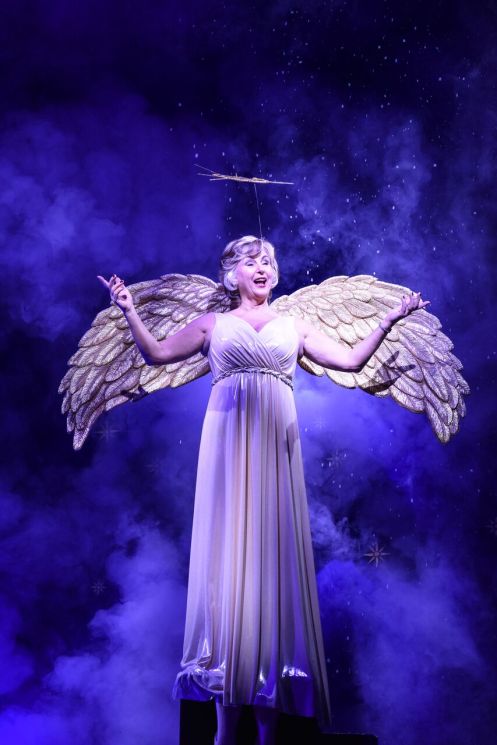
The final scene is the shepherds in the hills. One of the shepherds, Ronald, believes in angels, but has never seen one. Ironically, it is when he goes to count the sheep that Maurice sees the heavenly host, usefully including Mrs F singing Händel’s Hallelujah Chorus. He explains to Ronald that seeing one angel is like seeing “one bee”, whereas seeing the Christ child is like seeing “a whole summer”.
It was with some trepidation that I took up the invitation to review The Messiah. The promos looked as if it might be skating on the thin ice between being funny and being offensive. Blasphemy is a word that is no longer used (at least not in European usage), but treading on establish deeply held beliefs is not to be taken lightly. I need not have worried.
Patrick Barlow’s The Messiah can be enjoyed on many levels. It can be enjoyed for the sheer knockabout of the slapstick and the juvenile humour. It can be enjoyed for the human story, if you get past Act One. But most importantly, it can be enjoyed for its expression of the true Christmas message. Hugh Dennis’ father is The Right Reverend John Dennis, the former Bishop of St Edmunds: I wonder what he thinks?
Meanwhile, there’s the nostalgia for past nativity plays … and for tea-towel headdresses, toy sheep, false beards.
Mark Aspen
November 2018
Photography by Robert Day
Butterflies at Midnight
Cendrillon
by Jules Massenet, libretto by Henri Cain
Glyndebourne Opera, New Victoria Theatre, Woking until 23rd November, then tour continues until 1st December.
Review by Mark Aspen
Opéra féerie … a pretty term for a sadly neglected genre. What is dream; what is reality? Why is this magic; why is this actuality? Who am I; who is my personality? For a child, fairy tales build a safe bridge between infantile fantasies and adult realities. Often for the adolescent though, the bridge feels as if it is crumbling. So, just in case “pretty” sounds like beauty sweetened, Fiona Shaw’s direction of Glyndebourne’s first ever production of Cendrillon adds a delightful piquancy to Massenet’s mix of magic and l’amore … topped with a surprise garnish à la mode.
Visually Cendrillon is magic! Designer, Jon Bausor and lighting designer, Anna Watson, both new to Glyndebourne, have created a mystic world of mirrors, prismatic periaktoi of glass. Set against rich blues and greens, floats an ethereal pastel realm, inhabited by fleeting figures, in a “now you see them now you don’t” fantasy. The soft, delicate and flowing is set against the hard, brittle and crystalline.
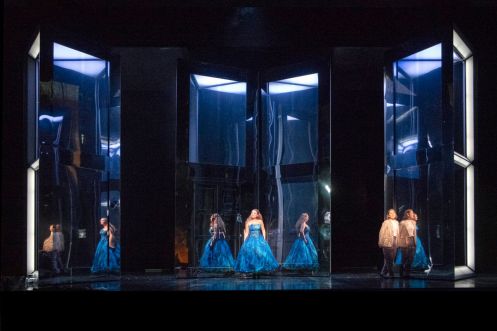
The set beautifully complements Massenet’s fine filigree of a score that interweaves voice, music and chorus into a gossamer of lyrical music. Cendrillon teases out the subtleties and psychological insights of Charles Perrault’s Cinderella, the original story written 1698 that is the evolutionary precursor of the children’s fairy tale, Victorian pantomimes and modern films. Two centuries on, Massenet understood that Perrault’s parable holds a mirror to human nature and is not just a story of virtue overcoming cruelty. Within the familiar framework of the story, Massenet’s librettist Henri Cain interpolated an episode in which the distraught heroine, thinking she has lost her Prince Charming, runs off in near-suicidal turmoil and falls asleep in a wood. In a dream conjured by the Fairy Godmother, her al-fresco resting place becomes a magic bower, in which they are united in a mystical consummation ceremony.
The bower gives ample opportunity for singing spirits and dancing imps to create fascinating tableaux reminiscent of A Midsummer Night’s Dream, but without asinine liaisons. A lithe troupe of five contemporary dancers, choreographed seamlessly by Sarah Fahie, animates this landscape, and indeed all of the scenes, in keeping with delicate web of the music and adding to the wit and humour that also runs under the opera.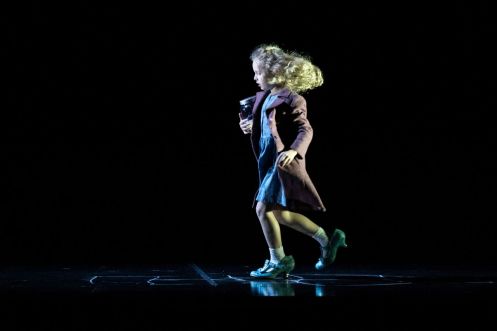
One of these dancers is discovered as the overture starts while a leprechaun cobbler sits making a slipper. In a prelude dumbshow with the child Lucette, who in a decade or so is to become known as Cendrillon, the child, beautifully enacted by Megan Silburn, tries on the slipper. The slipper is one of several visual motifs that reappear. Butterflies are ubiquitous, and if its symbolism is of emerging sexual awareness, then perhaps also is the slipper. Glass in its various forms is also omnipresent, that mirror to human nature and to ourselves.

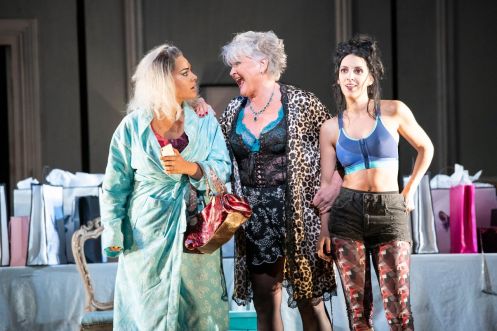
The elegant pale grey facades of exclusive shops, Bond Street plus, open the opera. Here the stepmother, Madame de la Haltière with her rancorous daughters Noémie and Dorothée shop ‘til they drop. Potuguese soprano Eduarda Melo and mezzo Kezia Bienek take on the ugly sisters with great gusto, sort-of Amy Winehouse and Diana Dors on a binge, meow-meowing about everyone and each other whilst indulging in that modern egocentric obsession, the selfie on the mobile. Agnes Zwierko has great fun with the role the battleaxe mum, Madame de la H, pushing the role towards the direction of the panto dame. All her servants defer tersely to her as they help her struggle into her gaudy gowns for the ball, but not before she has slipped in bum-falsies and corseted herself in Clingfilm, in desperate attempts to buttress her image. Meanwhile, the sisters are being pampered with hyperbolic cosmetics, blushers, Botox and blow-dry. Zwierko’s mezzo has presence and power, used to its full effect in Act IV when she bursts in with the news of the Prince’s entourage coming with the lost slipper, obviously for her daughters, she exultantly announces.
Her poor old hen-pecked husband Pandolphe keeps his head down and wishes himself back in his old countryside home, fishing. He is more comfortable in tweeds, Barbours and bucket-brimmed hats with fishing flies in the hatband, than the white-tie grandeur of the Haltière mansion where his misplaced ambitious social climbing has brought him. William Dazeley’s characterisation of Pandolphe as crushed and world-weary is warmly rounded in his rich baritone. He has some sympathetically touching duets with Lucette, as they remember his late wife, Lucette’s mother, before the soubriquet of Cendrillon attached to her, just as the cinders attached to her cheeks when she was demeaned as the tweenie-maid.

Needless to say, the essence of Cendrillon’s late mother is subsumed in The Fairy. A tall sophisticated, elegant figure, clad in pale she-mink, cool as a catwalk model, yet full of maternal warmth for her protégée, Caroline Wettergreen excels as The Fairy in her balanced acting, whereas the clear purity of her coloratura soprano voice is more then up to the demands of Massenet’s score in its acrobatic runs and trills, which seem almost effortless.
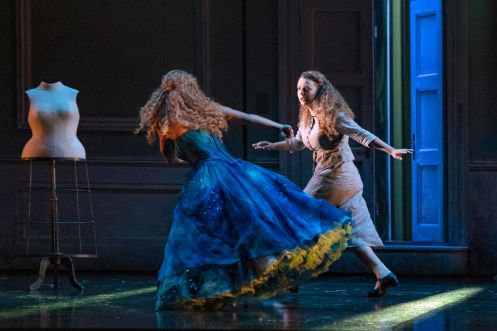
The magical transformation from rags to rich adornments is vested on the somnambulant Cendrillon via the agency of the dancing spirits who whirl her around in a garment-carrier until she emerges in a ball gown of dazzling blue, from a chrysalis to an Adonis Blue butterfly. In case the symbolism is hard to miss, a shadowgraph image of a butterfly flitters across the room. And it is in shadowgraph that we see her coach, formed from the banqueting table and chairs, and the prancing horses, shadows of the fire-dogs alongside the hearth where the ragged Cendrillon still sleeps.
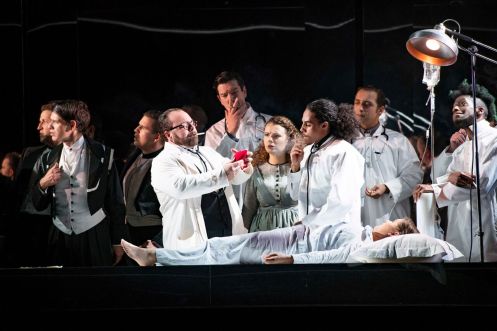
Meanwhile, in the King’s palace, there appears to be concern about the health of the adolescent Prince. We might have put it down to puberty, but The Dean (Anthony Osborne) takes charge, performing some pseudo-surgery, which involves examining his heart, which is now worn on his sleeve, quite literally, while a clock becomes his ersatz ticker. Time, maybe they imply, for coming of age. The King (Adam Marsden) just wants to kick him out of his teenage lassitude.
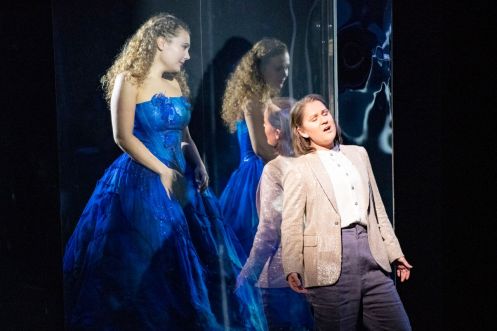 Alix Le Saux’s appealing portrayal of Cendrillon has great charm, a heroine of selfless fortitude in spite of all her mistreatment. In the breeches role of Prince Charming, Eléonore Pancrazi makes the emotional journey from an indolent and depressed teenager to a confident noble, from being sick with love to being charged with love; for when Cendrillon meets Prince Charming at the ball, it is love at first sight for both. The midnight chimes come all too quickly in the playful frustrations of a mirror-maze. When next they meet it is in the enchantment of the magic bower, where their feeling blossom. Le Saux and Pancrazi are both French mezzo-sopranos, but my, how different are the timbre of their voices. Le Saux has a soft delicacy and Pancrazi’s soprano dramatico has a brooding colour lower in the range. (Massenet calls for a “falcon soprano”, singing in the style of Cornélie Falcon, a contemporary French soprano who sang at l’Opéra in Paris.) When their voices intermingle beautifully in their pulsating love duets, we know that the two lonely adolescents are totally stricken. The duet in the magical bower is accompanied by the chorus and a harp in the wings, an exhilarating ethereal sound that thrills with enchantment.
Massenet brings together a full and contrasting range of women’s voices, Madame de la Haltière with Noémie and Dorothée, The Fairy with Cendrillon and Prince Charming, all different and all amalgamated into a complete musical and dramatic whole. With the other principals and the delightful Glyndebourne Chorus, in top form under chorus master Nicholas Jenkins, the effect is mesmerising.
As with the voices, so with the instruments. Massenet’s complex interlacing of delicate musical strands is sensitively evoked by conductor Duncan Ward, who consummately conjures all the magic form the augmented Glyndebourne Tour Orchestra, which at Woking spills out from the pit with the strings at stalls level, and with occasional excursions into the wings for flute and harp.
And Fiona Shaw’s surprise garnish à la mode ? Well, we discover that not only all that has happened is merely the youthful dream of a pubescent girl, but that it is a Freudian fantasy in which the Prince is a projection of Cendrillon’s erotic attraction to the parlour-maid. To the perceptive, however, there were some subtle signals towards the sapphic denouement. During Cendrillon’s transformation to princess, one of the spirits humorously hands her a small toad which she kisses to no avail and shrugs off. Moreover, didn’t the Prince look remarkably like the parlour-maid all along? It may be argued that Massenet’s prescription that that the Prince should be played by a falcon soprano en travestie nudges the plot in that direction, but it does seem to lay too adult an interpretation of the story. Gender fluidity is part of the Zeitgeist, but this twist in the tale may make things difficult to explain to an accompanying granddaughter. Nevertheless, Shaw presents the concept lightly with unabashed openness. Probably though, the overarching message is that love is to be found close to home, and that love lasts more than ambition.
Massenet’s opéra féerie epitomises the magic of the fairytale, and his entrancing music remains light and delicate as a butterfly, but reflective as a mirror-maze. Fiona Shaw’s Cendrillon stands out as a spellbinding tribute to his insight, and touches the quintessence of the fairytale, a peep into the adult world from the enchantment of childhood.
What is dream? What one fears or desires. Why is this magic? Because life is fascinating. Who am I? Whom I know myself to be.
Mark Aspen
November 2018
Photography by Richard Hubert Smith
Review of /Sylvia\ in English here
Verdrehte Ikone einer ganzer Zeitepoche
/Sylvia\
Von Ja?, nach einem Theaterstück von Stéphane Ghislain Roussel
Ja? Theatre Company im Etcetera Theatre, London bis 18. November
Voila Europe Festival
Bewertung von Louise Rauhreif
Da sitzt sie! Das Monokel ins Gesicht geklemmt, das Haar gestutzt und gescheitelt, das selbe unförmige Karokleid mit dem hohen Kragen, dass man bloß keine weiblichen Kurven erahnen kann. Auf dem Tisch vor ihr sind sorgfältig die Champagner Flöte und ein graviertes Zigarettenetui zurechtgelegt. Am meisten aber ist es die Pose, die spitzen Schultern, kantig und hochgezogen in seltsamem Winkel, die großen Hände, die langen Finger, Beine, Körper, alles verdreht und verdrechselt in bizarrster Anordnung. Das Portrait der Journalistin Sylvia von Harden von Otto Dix mag vielleicht nicht mehr schockieren wie 1926, doch ist es zweifellos eines der unverwechselbarsten, unmittelbar erkennbarsten Gemälde des 20sten Jahrhunderts, schaffte es doch genau was sein Schöpfer sich vorgenommen hatte – eine gesamte Ära auf Leinwand zu bannen.
Dix, berühmt und berüchtigt für seinen nicht gerade vorteilhaften Blick auf die verwahrloste, verrottete Gesellschaft der Weimarer Republik, verzerrte seine Huren, Bettler, Krüppel und Kriegsversehrten, Mörder, Diebe und Zirkusartisten bis ins Groteske, jeder Makel, jede Hässlichkeit überzeichnet und übertrieben wie Comicbuch Fratzen. Der Legende nach traf er Sylvia, ein festes Mitglied der Berliner Intellektuellen – und Literaturszene, in eben jener verdrechselten Pose im Romanischen Café am Kudamm sitzend an und ließ sich hinreißen zu dem Ausruf: “Ich MUSS Sie malen!” Er sah in der groben, harten, großen Type die Personifizierung der Neuen Frau, jenem gerade angesagten, burschikosen Bubikopf-Idealbild der Moderne. Sylvia lässt sich porträtieren, eine Stunde jeden Tag, wochenlang, das Stillsitzen fallt ihr schwer, das Resultat beurteilt sie als “befremdlich”, doch ist sie auch unheimlich stolz auf ihr Bildnis, dass sie noch als alte Frau im Centre Pompidou besucht, um sich danebenstehend fotografieren zu lassen.
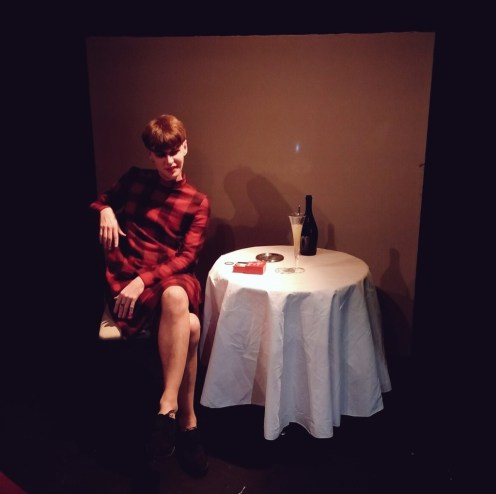
Wir lernen Sylvia kennen während sie für den Maler posiert, zappelig, gelangweilt, ihr reger Geist, ihr neugieriger Journalisten-Instinkt kann das Stillsitzen kaum ertragen und über kurz oder lang muss sie uns, dem Publikum, in die Position des observierenden Malers gedrängt, einfach unbedingt etwas erzählen. So ganz genehm ist ihr der bohrende, urteilende Blick des Malers auf ihren Körper nicht – doch irgendwie ist die ungeteilte Aufmerksamkeit auch ganz schmeichelhaft…
Der Geschlechter übergreifende Darsteller Joseph Morgen Schofield spielt Sylvia als eine umwerfend charmante, launige, mal nachdenkliche, mal Witz sprühende scharf beobachtende Klatschtante. Besonders die beinahe bis ins unerträgliche ausgedehnten, genüsslich ausgekosteten Momente der Stille bezeugen seine unglaubliche Bühnenpräsenz. Wir sind ganz im Bann seiner langen Finger, die seelenruhig nach den Zigaretten greifen, den bemalten Lippen die genüsslich inhalieren, innehalten, Rauch ausblasen, wir sehen, nein hören, den Adamsapfel schlucken… Otto Dix malte Sylvia um die traditionellen, gerade aufbrechenden Geschlechterrollen in Frage zu stellen – Monocle, Portrait de S. von Harden, das Theaterstück des Luxemburger Künstlers Stéphane Ghislain Roussel, geschrieben für einen Darsteller nichtspezifischen Geschlechts, möchte im Namen von Sylvia unsere aktuellen Ideen hinsichtlich Geschlechter-Identität oder Geschlechtslosigkeit erforschen. Mit der ersten Englischen Übersetzung des im Original halb Französisch halb deutschen Textes erhofft sich die Ja? Theatre Company, Sylvia, die immer noch das eine oder andere Französische bon mots elegant in ihren Monolog mixt, zu einem mehr internationalen, allgemeingültigen Symbol für Genderfluidity zu erheben. Die weiße Leinwand als Hintergrund dient simultan als Rahmen für die kleine Szenerie und als multimediales Fenster in eine Zukunftsprojektion, in der eine modern Sylvia (Caroline Tyka) einen heutigen Großstadtjungel erkundet. Zunächst tragen die kleinen Filme von rasenden Zügen, Neonlichtern und Straßenlärm schön zur urbanen Atmosphäre bei, während uns Sylvia von den “pailettenglitzernden” Berliner Nächten erzählt. Doch was die zweite Sylvia auf dem Bildschirm, immer wieder unterbrechend mit kurz und kürzer geratenen Deutschen Redefetzen, zum Stück beiträgt, bleibt mehr oder weniger unklar. Vielleicht ist sie einfach da um gegen die schleichende Nostalgie anzukämpfen, die sich schon mal breitmachen kann, wenn Schofield mit der brüchigen Stimme einer Cabaret Diseuse zum Schellack-Platten-Knistern singt. Ein magischer Moment von fragiler Schönheit, sofort unterbunden mit einer selbstironischen Bemerkung – bloß schnell über die eigene Sentimentalität lachen, bevor es ein anderer tut.
 Die Unsicherheit der gemeinhin als hässlich oder zumindest unkonventionell befundenen Frau ist unübersehbar, in ihren sehnsüchtigen Beschreibungen des üppigen Fleisches der Cabaret Tänzerin Martha oder dem weichen wollüstigen Wellenhaar einer Anita Berber, jener weiteren Ikone der Zeitepoche, die mit ihrer Schönheit “einfache Männer zu Poeten erheben konnte”. Ob wohl ihr Aktueller, Felix, sich auch für sie, Sylvia, erhängen wurde, wie es ein Verehrer der kurvigen Martha tat? Ob wohl sie, Sylvia, unter Dix geübtem Pinselstrich zu einer rotgelockten Sirene wie Anita Berber werden könnte? Vor unseren Augen erleben wir eine blitzgescheite, gebildete Frau, die dem bohrenden Blick auf ihr Äußeres ausgesetzt, nichts lieber wäre als sinnlich und begehrenswert. Gerne gibt sie sich auch mal ein bisschen dumm und kokett, imitiert den überkandidelten Glamour einer Sally Bowles. Je sündiger desto schicker im Weimarer Berlin, und genau wie der Rest der Gesellschaft ist auch Sylvia der verheißungsvollen Strahlkraft von Klatsch und Tratsch, Skandalen, Moralen und Verruchtheit verfallen. Doch es ist alles nur Pose. Eine Inszenierung. Der Typus der Neuen Frau ist letztendlich ein Konstrukt, ebenso hohl wie das Karokleid, das wie ein verwehtes Gespenst, ein leere Hülle auf dem Stuhl zurück bleibt.
Gerne verbringt man eine Stunde in Gesellschaft der charmanten amüsanten Sylvia, des ebenso charmanten amüsanten Joseph Morgen Schonfield. Otto Dix mag berühmt gewesen sein für seinen “bösen Blick”, ohne Erbarmen jeden Makel hervorzerrend – /Sylvia\ hingegen widmet sich mit Mitgefühl und Wohlwollen der Schönheit die denen inne lebt, die in keine Schubladen passen.
Louise Rauhreif
November 2018
Fotografie von Christina Bulford
Wool Over the Eyes
Three Bags Full
by Jerome Chodorov, based on a farce by Claude Magnier
Q2 Players at the National Archives, Kew, until 24th November
Review by Didie Bucknall
Quite properly, we have had plenty of sober theatrical offerings lately due to the commemoration of the end of WW1, so it is a joy to be presented with a rip roaring farce energetically performed by the Q2 Players.
The venue is a new one for Q2. The massive National Archives building has a smallish comfortable performance space. The scenery has to be mobile for easy removal as the space needs to be used for other purposes. In this instance, it enhanced the atmosphere of the play; the mobile flats painted in elegant Art Deco style delicately formed the backdrop to an elaborate Hampstead Heath house.
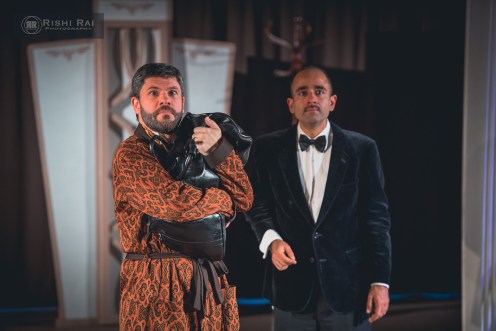
Three Bags Full has nothing to do with sheep but plenty of wool surrounds the possibility of distinguishing the very different contents of three identical black holdall bags. The director’s notes liken the play to be somewhat in the vein of a Whitehall farce with larger-than-life characters pursuing perfectly plausible agendas, which seem completely reasonable to themselves but totally incomprehensible to each other. Chaos ensues as one might expect.
Farce needs to be played with balance and good timing, seemingly so easy, but in fact very difficult to achieve. The cast were more than equal to the task.

The action takes place 1925 in the luxurious home of Bascom Barlow the successful entrepreneurial owner of the sports firm of Barlows, played by Hugh Cox. His long serving clerk, Richard Foyle (Neelaksh Sadhoo) arrives in great excitement and out of control on roller skates. He has spent £300 of the firm’s money on ordering more pairs of skates. He thinks Barlow will be delighted at his initiative. Barlow is furious. Unbeknownst to Foyle, Barlow has been granted a bank loan and is getting into serious debt. But all is well, according to Foyle, for over the years he has been stashing away small sums of money taken from the firm so he can hand back a considerable sum to his boss. But there is a proviso, first Barlow must give Foyle permission for him to marry his daughter. Barlow is livid and dismisses him on the spot. But he needs the money. The money is divided into diamonds and cash, each contained in two identical black holdall bags. The seemingly curious attitude of the downstairs maid so jaunty with her feather duster, played by Judy Ramjeet, becomes clearer as it emerges that she is secretly engaged to a rich banker’s eligible son. She too has been dismissed and has packed her belongings in, yes, you’ve guessed it, an identical black holdall bag.

The plots muddle up. People are not who other people think they are. Lynne Harrison and Cat Lamin as mother and daughter, exotic in stunning period costumes, Dominic Upton as Boris the chauffeur a failed army recruit. At one stage he picks Foyle up and bodily throws him around. The unexpected arrival of Jeanette (Camilla Danson) and later, Charlotte Muir as her mother add to the confusion. The banker, Malcolm McAlister slipping on a discarded roller skate is put out of sorts and calls in his bank loan while his son, Paul Huggins drives his Aston Martin to and fro obligingly exchanging holdalls.
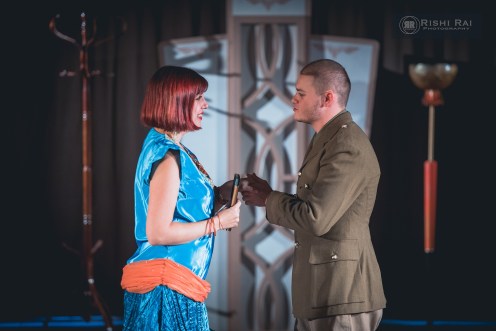
The laconic butler Jenkins (Christopher Hodges) trudging wearily back and forth to answer the front door engages the audience with a shrug as if to say, I know I am living in a mad house, but that’s all part of the job.
This is a very strong cast, well-rehearsed and well directed by Tony Cotterill. If this was his first attempt at directing, let us hope that it will not be his last. There are some good performances and it would be invidious to pick any one out, and this includes backstage staff as the lighting, sound, set construction and costumes were excellent. It was a thoroughly enjoyable evening.
Didie Bucknall
November 2018
Photography by Rishi Rai Photography
Haunting, Harrowing, Horrifying
The Trial
by Stephen Berkoff, adapted from Franz Kafka
Youth Action Theatre at the Hampton Hill Theatre, until 24th November
Review by John O’Brien
Franz Kafka’s The Trial, written in 1925, is one of the most important literary works of the twentieth Century. Indeed Kafkaesque has entered the language as a byword for byzantine bureaucratic obfuscation and frustration. Youth Action Theatre is currently reviving Stephen Berkoff’s 1971 adaptation. Directed by Rowan D ‘Albert it is showing all this week at Hampton Hill Theatre.

The set is suitable minimalist. Think of a contestant on Mastermind as she sits in that chair in the dark, add eerie music by Philip Glass, and a rope that hangs menacingly from the gantry and you have some idea of the show’s visual and aural presentation. This chiaroscuro contrast gives the set the feel of a German expressionist classic, such as Metropolis by Fritz Lang (1927).
Joseph K (Benjamin Buckley) is a young man who works as a clerk in a Bank and lives as a lodger in the house of Mrs Grubach (Ella Barnett). One morning he is arrested by two guards (Meagan Baxter and Joe Evans) on charges which are never made explicit. Joseph K. now enters a nightmarish Alice in Wonderland horror world of bureaucracy, law and unaccountable arbitrary power. The labyrinthine nature of this world is wonderfully realised by the use of six copper frames which do double duty as doors but also as mirrors. As he walks through and around these doors cum mirrors so Joseph becomes trapped in a series of absurd and menacing encounters. Famously this has become widely known through the notion of The Trial. But what’s very well demonstrated by this production is that The Trial is a metaphor for the whole of society as it impinges on the individual. One’s whole life is a trial so to speak. So we see Joseph being tormented by his landlady Mrs Grubach, his Father who recommends a terrible lawyer, Huld the Lawyer (Mary Rycroft), The Bank Manager (Cameron Christie), The Inspector (Josh Clarke), The Artist Titorelli (Josh Clarke), the Priest (Joe Evans) and various unpleasant women Miss Burstner (Georgia Griffiths) , Leni (Zofia Komoroska), the Laundress (Mary Rycroft) . All these different aspects of society, the law, finance, art, religion, the family, women are shown to confine, confuse and control Joseph in their own unique way. But what they all have in common is power. They symbolise the power of institutions over which Joseph has little if any control. He is a victim. Moreover he is alone. More than that the people he encounters are unreliable. So he becomes confused and paranoid.
What makes The Trial so haunting, so harrowing, so horrifying is the notion that you are on your own, the people you encounter have mendacious designs on you and that there is no way out. This is a deeply pessimistic and terrifying vision. But only fifteen years after he wrote it, the holocaust was under way and Kafka’s vision was all too real. It was happening. And in Germany the most civilised country in Europe, the home of Beethoven, Goethe and Einstein.
Walter Benjamin who committed suicide in 1940 as the Nazis closed in on him famously remarked that “every document of civilisation is simultaneously a document of barbarism”. The Trial is one of the most prescient, pessimistic and profound demonstrations of the truth of that aphorism. If you don’t know The Trial then this is a very good place to acquaint yourself with it. If you do then this intriguingly beguiling production will add fresh layers of meaning.
John O’Brien
November 2018
Photography courtesy of YAT
Joyful, Painful, Honest
Things I Know to Be True
by Andrew Bovell
Wild Duck Theatre at OSO Arts Centre, Barnes until 24th November
Review by Georgia Renwick
Has there, or can there ever be such a thing as a ‘normal’, quiet family life? Andrew Bovell’s 2016 Australian-British play tears right to the heart of the family unit in this suburban drama brought to life by the Wild Duck company, in searing, tear-jerking style.
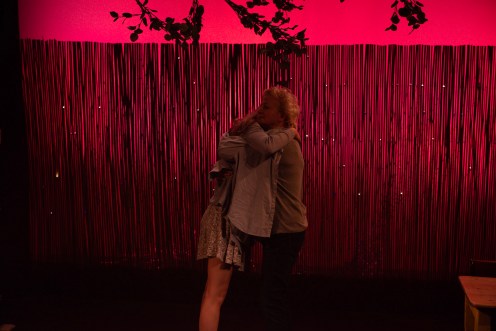
The play opens with Rosie, the youngest of four children, returning with a broken heart from her gap-year travels in Europe. Mum, Fran, quickly assembles her brood of grown-up children to welcome her home, but before Dad, Bob, has even handed round the cups of tea, the bickering has already started and the excuses pour out. “Oh, I can’t stay…”, “Just popping in…”, “That’s my cue to go…”. One by one they return to their lives and Bob and Fran are left with just one little bird in her nest. It’s an incomplete family picture; where are the Sunday afternoon BBQs they imagined? The weddings? The grand-kids? They’ve raised their children to believe they could have anything they wanted, and now they’ve gone out and taken it, what happens when they’re left behind? The fractures only widen, the further away they get.
Set in the suburbs of Adelaide, Australia but conceived with the Adelaide State Theatre alongside Frantic Assembly, a British company renowned for their physical theatre work, Wild Duck has brought to the OSO stage a topical, relevant naturalistic drama peppered with sections of choreographed movement, devised by the company. As a young breakaway company themselves (Director Susan Conte has 6+ previous years’ experience directing) Wild Duck is deservedly garnering a reputation for presenting bold, intelligent, contemporary work. Having appeared at the Lyric, Hammersmith only this year, Things I Know to be True is hot off the press.

Bovell has crafted a play of such startling honesty it is by turns joyful and painfully uncomfortable watch; at once heart-achingly tender, and biting. The ongoing battle of generational difference is fought over the big stuff: gender roles, love, money and social class, comically punctuated with instantly recognisable family micro-dramas, such as where all that Tupperware gets to, or whether it’s high time your 24 year old son should be ironing his own shirts. Whether you are a parent yourself or not, you were once a child, and perhaps felt too the pressure on your generation to make things better than the last. If this play were set in a British back garden you can be sure Brexit would be on the cards, but nonetheless every generational obstacle they face in suburban Australia is relatable. There are multiple generations in the audience tonight, and where the laughs come from is telling!
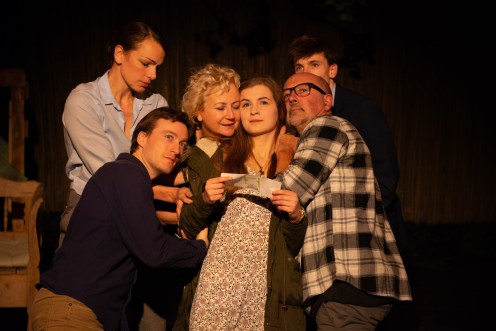
The material plays to the strengths of Wild Duck, whose young talents, Ben Dimmock and and Berenike Kahane have both shone in recent Wild Duck productions The Distance and Picnic at Hanging Rock respectively. Kahane brings a sensitive fragility to Rosie, who at 18 is precariously balanced on the daunting cusp of adulthood. Dimmock lends a buoyant but frantic energy to early-20s son Ben, who is caught up in the flow of life by forces he soon finds are beyond his control.
As the threads of the family start to unravel towards crisis point at an alarming pace, by Act Two Bovell’s tightly wound structure begins to read like a series of worse case scenarios. It reaches a point where I feel it would be beyond the realms of possibility to expect anyone to cope, without at least a nervous breakdown, but the resilience of the Wild Duck cast to the demands of the material is a truly impressive achievement.
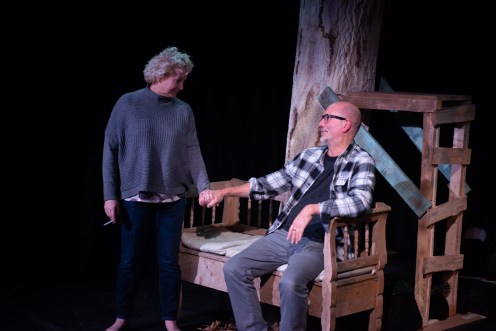
Dorothy Duffy’s Fran Price is a true matriarchal battle-axe. As a nurse, she frequently reminds us, she has seen it all before. Duffy’s fierceness does not ask for sympathy, and yet … Meanwhile, some challenging questions surrounding our expectations of ‘masculinity’ are raised by James Lloyd Pegg’s understated portrayal of Bob, her husband. His quietness speaks volumes.
The set design (Marc Pearce) and technical elements in this production also have a lot to say. A life-size bow of a tree sweeps over the top of the stage, unruly and untamed, and struck by the most deliciously warm and nostalgic light, the magical quality of light that captures the golden hour of a summer’s evening in a childhood memory. Borrell’s writing, enraptured by the cyclical nature of things, is also realised in the cool blues and crisp whites of the seasons as they pass. Exceptionally gorgeous work from lighting designer Katie Nicholl.
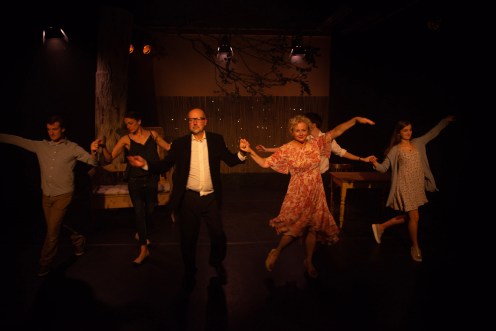
The physical theatre elements succeed in communicating a lot, without a word, set to the contemporary sounds of Joe Evans. Simple acts such as touching a hand, or buttoning up a shirt, are brought into clearer focus. How they connect in with the more naturalistic elements of the play, is left to our own imagining. They add another dimension, but visually do not linger in the mind as long as the emotions that surface.
No family looks exactly like we imagine. It is an organic thing shifting and changing and growing like the bow of the tree that sweeps across the stage. But if there’s one thing this family know to be true, there’s nowhere like the familiar chaos of family in a crisis.
Georgia Renwick
November 2018

 Mark Aspen