
Spirit, Spiritually and Splash
The Queen Symphony and Symphony of Psalms
By Tolga Kashif and Igor Stravinsky
UK Premiere
Kew Wind Orchestra and Choirs at St John’s Smith Square, Westminster, 18th November
Review by Eugene Broad
“Let’s do it, darling” is supposedly what Freddie Mercury said, before downing a shot of vodka and singing the vocals to The Show Must Go On in a single recording, shortly before his death. That vim and vigour was harnessed wonderfully by the immensely talented performers of Kew Wind Orchestra, the Hampton Choral Society, and The Hythe Singers in Tolga Kashif’s The Queen Symphony.
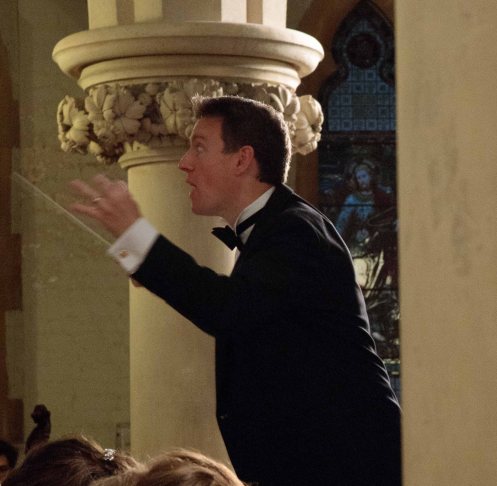
Just as eclectic and individual as Freddie Mercury was the musical choice presented to us, with the other selected works being Percy Grainger’s A Marching Song of Democracy and Igor Stravinsky’s Symphony of Psalms.
Grainger, as a composer and person, very much went his own way in life. This spirit was present throughout A Marching Song of Democracy, a lyrical series of waves building and washing over the listener, to the point of almost becoming blurry, before reorganising and rebuilding, with a central current of a theme pushing through the flotsam and jetsam around it. Intended to be performed to the rhythmic marching of feet as a chorus whistled and sung-along, the hypnotic drive of the piece came through without the need of this accompaniment.
Stravinsky’s Symphony of Psalms was almost painfully intense, given the power of the choir, the dexterity of the orchestra, and the atmosphere of St John Smith’s Square. A symphony split into three movements, each tackles a different Biblical psalm – 38, 39 and 150 respectively. Stravinsky was commissioned to compose the piece for $6,000 by Koussevitzky – his publisher, and the conductor of the Boston Symphony. This was supposedly somewhat a symbiotic relationship, with Koussevitzky loving Stravinsky’s music, and Stravinsky loving Koussevitzky’s money.
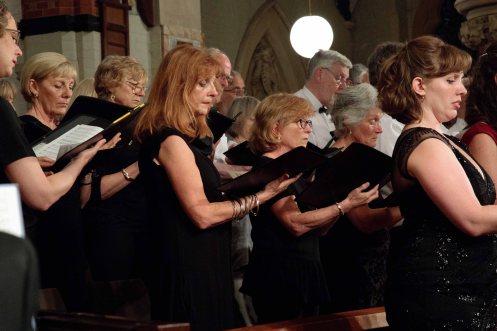
The first movement starts with a sudden jolt, a burst of E minor chords, which cascaded into a tempestuous piano (adroitly played throughout by Leo Nicholson), bass and cellos rumble, before bassoons circle in octatonic flight like hungry sea vultures waiting to swoop down and peck at the choir lamenting their fate. The effect is immediate – this has the desperation of drowning, deep in the ocean, in the midst of a storm. This is spiritual music designed to make the listener uncomfortably reflect on their mortality, as the choral voices plead with uncontrollable forces to “be no more”.
Compared to this movement (and likewise the third movement), the second movement is almost pedestrian by comparison. Evoking an uneasy Bach, the second movement begins with orchestral exposition, wonderfully morose oboes picking out a fugue, later joined by fluttery soft flutes and stronger-winged piccolos – reminiscent, perhaps, of the hungry sea vultures now being content, stomachs full of drowned choir, calling to each other on a becalmed sea. Kew Wind Orchestra handled this part especially marvellously, with the orchestra answering and calling to each-other, until the choir re-emerges from the morning stillness – slowly building and structuring their own answers and calls to their counterparts. This dialogue was excellently controlled and maintained by orchestra and choirs alike. This gentleness lulls into a false sense of security; all at once, the choir bursts into life again.
The third, final movement, is almost a mix of the two which come before it. It has a heavy tension within it, echoing the contrapuntal nature of the second movement. Mixed in is the same visceral force of nature which is so dominant in the first movement. Increasingly gentle cries of “hallelujah”, accompanied by the soft heaving breathing of the woodwind orchestra; no longer a fierce organ-beast, but its own voice distinct again. Adeptly handled by both orchestra and choir, this was evocative spiritual contemplation of a type that only someone from the fold of Russian Orthodoxy could produce, much like Rachmaninov’s far more traditionalist Vespers. The surprising difference between the two, however, is that Stravinsky infamously refused to endorse that music creates feeling. This particular work – not to mention a dozen others – begs to differ.

But the absolute highlight of the evening had to be Kashif’s The Queen Symphony, at which point the conductor, Matthew Willis, Kew Wind Orchestra, Hampton Choral Society, and the Hythe Singers clearly shared “one vision”. The symphony, split into six movements arranged by mood, drew from the feel and inspiration of Queen’s songs. Even so, clear motifs, patterns, and themes were recognisable as Queen’s – solely adding to the appeal and fun of the piece in listening and finding their famous riffs and rhythms echoed or masked in orchestral form.
Perhaps best considered (very) literally as a popular classical piece, it was never fully pop nor fully classical. Rather, it was an absolute “Bohemian rhapsody” (or well, rather, symphony) – with the motif of Who Wants to Live Forever re-emerging through it to add consistency and flavour. Despite being composed with Queen in mind, it could hold its own as a stand-alone symphony which even someone without a soft spot for Queen would comfortably enjoy.
Whilst all three of the soloists were superlative in their performances (with Rachel Barnes on violin, Gillian O’Dempsey on ‘cello, and Leo Nicholson on piano), the orchestra and choirs, marvellously marshalled by Matthew Willis were “the champions” of the night. I truly hope that this particular piece is one kept close for frequent future recitals, and it is equally one to keep a keen eye out for – it’ll rock you, make you gaga and want the show to keep going on.
Eugene Broad
November 2018
Photographs courtesy of Kew Wind Orchestra
Twisted Icon of an Entire Era
/ Sylvia \
by Ja?, adapted from a play by Stéphane Ghislain Roussel
Ja? Theatre Company at The Etcetera Theatre until 18th November
Voila Europe Festival
Review by Lola McKeith
The resemblance is striking. You enter the space and there it is: the cropped hair, the monocle, the shapeless plaid dress with the high collar repressing all notions of femininity, the champagne flute, the carefully arranged cigarette case, but most of all the uncanny angular pose, the pointy shoulders, interlocked legs, the twisted torso and peculiarly placed hands all artfully arranged in their awkwardness. The Portrait of the Journalist Sylvia Von Harden by Otto Dix, if not as shocking as in 1926 then arguably still as intriguing, is one of the most instantly recognisable images of the twentieth century because it did, exactly as intended by the artist, come to represent an entire era.
Dix was a German painter well-known for his brutal portrayal of debauched dilapidated Weimar society, all whores and cripples, murderers, beggars, street urchins, cabaret dancers and circus freaks, ghoulish and grotesque, often exaggerated in their ugliness to resemble comic-book-like caricatures. Legend has it that he spotted Sylvia, a fixed member of the intellectual glitterati in 1920s Berlin, at the Romanisches Café and exclaimed: “I have to paint you!” He saw in her the personification of the New Woman, the boyish, flapper dressed, bob-haired new ideal of modernity. Sylvia agreed to sit for him, an hour every day for weeks on end, a process she found tiresome and which resulted in a painting she thought “strange” at first but grew to be immensely proud of, posing next to it in old age at the Centre Pompidou.
We meet Sylvia as she sits for the painter, twitching, bored, unable to switch off her never resting inquisitive mind. She shares her trail of thoughts with us, the audience, standing in for the painter, observing her, “scrutinizing” her body, her features, her clothes. Sylvia isn’t entirely comfortable being watched like this, it seems, but defiantly pushes on and something about the attention seems to flatter her.
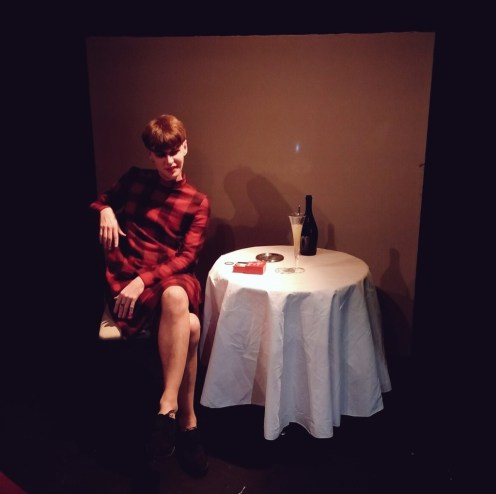
Performer Joseph Morgen Schofield, who uses pronouns they or them, is an utterly charming Sylvia, witty, observant, gossipy, pensive, with a commanding stage presence most notable in the long silences deliciously savoured to the last almost unbearable second. Where Dix saw in von Harden a question about femininity and the binary expectations enforced on women, Monocle, Portrait de S. von Harden by the Luxembourgish artist Stéphane Ghislain Roussel written for a non-binary performer explores modern day notions of gender fluidity and gender performance. In its translation from French and German into English, Ja? Theatre Company aims to give the figure of Sylvia a more international, universal appeal, still peppering her monologue with the odd French expression or German remark. A white screen as background serves both to frame the little scene and open up a multimedia window into the future where a modern day Sylvia (Caroline Tyka) explores her own nowadays urban environment. While initially the videos of city lights and noise add a layer of restless urban atmosphere, as Sylvia tells us of the “sequined nights” of Weimar Berlin, it is not entirely clear what the second actor, interrupting with shorter and shorter snippets of German text, adds to the play. Maybe it’s to disrupt the feeling of nostalgia that easily spreads when Schofield sings, with the breaking, fragile voice of a Cabaret diseuse, a song about Berlin to the crackling playback of an old shellac record. A moment of magic is promptly broken by a self-deprecating remark, Sylvia’s readiness to laugh at herself first before anyone else can.
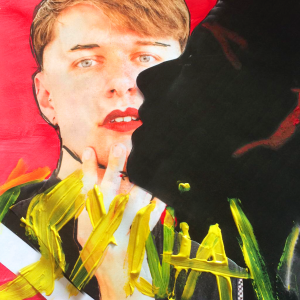
The fragility of the supposedly “ugly” or unconventional woman is painfully obvious, in the way she longingly describes the opulent flesh of the cabaret dancer Martha or the luscious red curls of Anita Berber, another era-defining woman whose beauty apparently turned men into poets. Would Felix, her current beau, kill herself for her, as a suitor did for Martha? Would she herself become a vision of Berber-esque red curls and beauty at the hands of Otto Dix? What we witness most of all is a fiercely intelligent woman who in the face of physical attention longs to be sensual, desirable, even a bit ditzy, imitating the reckless, devil-may-care glamour of a Sally Bowles. Vices were the epitome of chic in Weimar Germany and the chain-smoking Sylvia is as fascinated by gossip, tabloid scandal, lose morals and raunchiness as the entire era. It’s all a pose though. A performance. It’s a type that represented the era, not any one person, the New Woman is a construct as hollow as the plaid dress that is left on the chair like the shell of a ghost.
It’s an interesting hour spend in the company of the immensely watchable Joseph Morgen Schonfield. While Otto Dix was notorious for his merciless, flaw enhancing “evil eye”, /Sylvia\ celebrates with empathy and kindness the beauty of not quite fitting in.
Lola McKeith
November 2018
Photography by Christina Bulford
Half the Seed of Europe
War Requiem
by Benjamin Britten
English National Opera, London Coliseum until 7th December
Review by Mark Aspen
Last summer, when staying a few days in Alsace, that most Germanic part of France, I visited the Musée Unterlinden in Colmar. Although it was quite quiet in the museum, there was, as always, a small crowd around its crowning glory, Mathis Grünewald’s moving masterpiece, the Isenheim Altar. Benjamin Britten suggested this as an illustration of his War Requiem at its first performance at the consecration of the re-built Coventry Cathedral, destroyed early in the Second World War. Four and a half centuries separate their creation, but what they have in common is sacrifice. Britten’s 1962 monumental work speaks of the sacrifice, in the First World War, of “half the seed of Europe”; whereas the sacrifice of Christ for the sins of all mankind is the subject of Grünewald’s vivid depiction of suffering in his 1512 altarpiece, with Christ’s body on the Cross twisted in agony.
Britten is a composer greatly associated with the English National Opera, so it is fitting that the first fully-staged UK performance of his War Requiem should be presented by ENO, a company acclaimed for staging oratorio and similar works, most notably Deborah Warner’s Messiah nearly a decade ago. The scale is similar, the incomparable ENO chorus being augmented by the contrasting style of the ensemble from ENO’s recent Porgy and Bess and further complemented by forty members of the Finchley Children’s Music Group. Equally a chamber orchestra extends the full force of ENO’s orchestra.

A self-proclaimed pacifist, Britten absconded to the United States just before the beginning of the Second World War, as an “artistic ambassador”, only returning towards the end of hostilities to apply for exemption from military services as a conscientious objector. Consequently, some found it distasteful that he should write a requiem for the war dead; however, his requiem is cast wider to encompass all who suffer in war. The larger part of the requiem is given over to grief formal and anguish informal of non-combatants, represented by one soprano soloist, but with the full weight of the choruses. The emphasis is not on the glory of war, but on the pity of war.
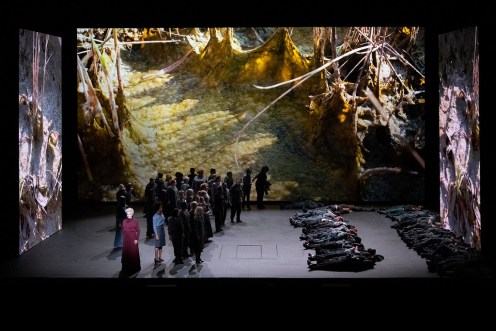
The universality of total war (a term coined by General Ludendorff in his First World War memoires) is embodied in War Requiem by the juxtaposition of two disparate texts, the Latin Missa pro Defunctis (Mass for the Dead) with Wilfred Owen’s war poetry. The Missa reflects on the spiritual and emotional losses in war, against Owen’s articulations of the physical and psychological damage. The human level of the war poetry is expressed by two men soloists, accompanied largely by the chamber orchestra. This contrasts with the mass, in all senses, of the Missa where the monumental momentum of the chorus, ensemble and full orchestra, accentuated by the soprano solo, proclaims an overawing magnificence. Yet there is an estranged ethereal presence of the voices of the children singers, with their own suppliant musical accompaniment. Hence War Requiem runs on three levels concurrently, as it contrasts the sublime with the horrific.
Horror is the starting theme for the stage set, which features huge photographs from the post-First World War shock-tactic album of conscientious objector Ernst Friedrich’s Krieg dem Krieges, including inter alia pictures of the badly mutilated faces of injured soldiers. However, one is left wondering whether the images of naked torn bodies of the battlefield to illustrate the opening chorous, “Requiem aeternam dona eis, Domine”, disrespectfully disturbs eternal rest that the Lord is asked to grant.
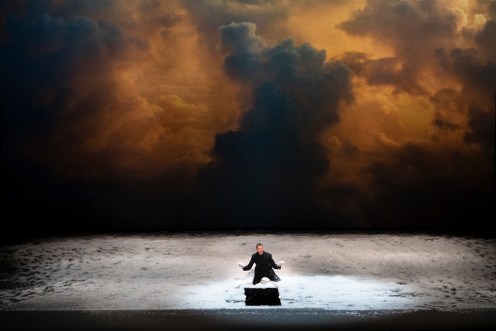
The designer, German photographer Wolfgang Tillmans, is one of today’s best-known artists in the photographic field, having the distinction of being both the first foreign winner of the Turner Prize, and the first photographer to do so. War Requiem is his debut in operatic design. He has eschewed a three-dimensional set, to a photographic design, which indeed plays to his strengths by creating an installation. Enhanced by Charles Balfour’s lighting, the diverse images used include riots, Coventry Cathedral, mosses, wind-torn tree limbs and slaughtered sheep. Eventually however, they becoming increasingly lyrical with brilliant flowers, awe-inspiring cloudscapes and snow. They are projected onto the cyclorama, or interspersed flats, or in one case across the whole front of the auditorium, filling the theatre with purple light and bold images of blue pulsatilla anemones. A fly-drop of concrete rubble transmogrifies from an inverted mushroom-cloud into a beautiful falling snowscape, but the one nod to a three-dimensional set is baffling, something resembling a gigantic ginger root that the children climb over.
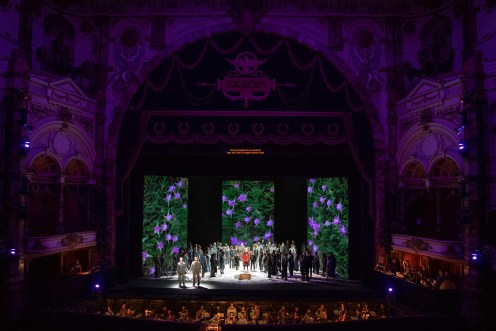
How do you go about staging an oratorio? This is the controversial question that the director, ENO’s own Daniel Kramer, seeks to again answer in this production. There is a need for balance in trying to enhance the work rather than distract from it. Tillmans’ grand images are magnificent, and the disturbing ones harrowing, but there is a danger that these do sometimes steer away from what the music is trying to say.
Much of the visual imagery is created by the swirling crowds of humanity on stage. The three choruses are there most of the time and are supplemented by eight child actors from the Sylvia Young Theatre School. They are constantly in motion, always abject, sombre, cowed. Sometimes the movements are militaristic, sometimes like prisoners, sometimes like mourners. All the costumes are variants of muted grey-blues. In one vignette, the circling lines of bodies are reminiscent of Vincent van Gogh’s 1890 painting, Prisoners Exercising, although often the tableaux seem removed from the words. Ann Yee’s chorography is exemplary in keeping all the fluency in the movement. There are poignant episodes. In the Offertorium, Owen inverts the episode in Genesis when Abraham is told by God to sacrifice his son Isaac, in that no angel comes to substitute the ram: “ but the old man would not so, but slew his son, – and half the seed of Europe, one by one”.
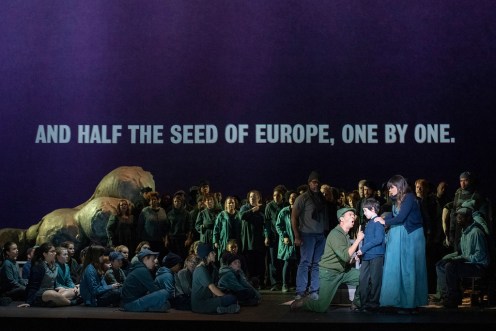
Britten’s music underlines the ironies of the often contradictory nature of the conflicting words of Owen’s war poetry and the Missa, with sudden turns from the soaringly lyrical to the edgily dissonant. The score makes a wide use of tritone, the interval that early music theorists called Diabolous in Musica, the devil in the music, to jar the listener and to point up the themes of conflict versus resolution, or reality versus glorification. Conductor, Martyn Brabbins specialises in twentieth century music and it shows in his magnificent interpretation of the power and intricacies of War Requiem and the control and co-ordination of his varied array of musicians and singers.
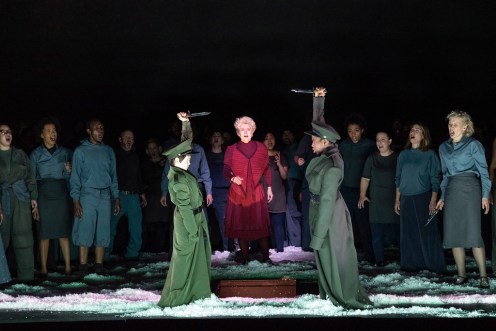
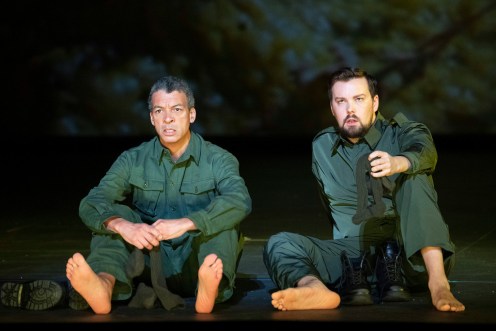
Emma Bell brings a strong and expressive voice to the soprano solo, a soul lost in the sea of humanity, hair shock stiff. Is she a grieving mother, a protective matron or an angel of death? All are amalgamated in her words and body language. Her “lacrimosa dies illa” (this day full of tears) has beauty, pathos and richness. The two men soloists are the combatants, the tenor one of “our boys”, the baritone, the enemy soldier, although the distinction blurs as the piece goes on. David Butt Philip, the tenor, brings full-on power to a soaring expression of the sentiment of the piece. Award-winning baritone, Roderick Williams’ rich and gentle approach is full of empathy and pathos. In the resolving moment of the requiem, the two are together. As the tenor sings “It seems that out of battle I escaped”, we realise it is in death that opposing soldiers meet with honour. “I am the enemy you killed, my friend”, the baritone replies in recognition, in a moment of heart-wrenching anguish.
There is a quote in the Agnus Dei from Owen’s At a Calvary near the Ancre, in which soldiers pass at a crossroads a damaged monument to the crucified Christ, and there is a recognition their hearts. The poem is dense with symbolism, which was not picked up in Kramer’s symbol-laden War Requiem, but it piercingly summarises the message of the piece as a whole, “But they who love the greater love lay down their life; they do not hate”.
Let us not pass by.
Mark Aspen
November 2018
Photography by Richard Hubert Smith
Poignant Gems
Echoes of the War
by J.M.Barrie
Teddington Theatre Club at Coward Studio, Hampton Hill Theatre until 17th November
Review by Didie Bucknall
Echoes of the War is the banner title for four one-act plays by baronet, author and playwright J.M.Barrie. As is well known, Barrie left the proceeds of his Peter Pan to Great Ormond Street Hospital but other works are less well known today. He was rich and moved in aristocratic circles so it is surprising that the first of the two plays being performed by the Teddington Theatre Club at the Hampton Hill Theatre was about charladies, as in those First World War days the social classes were more defined and he would have had little experience how the other half lived.

In The Old Lady Shows Her Medals, three strong experienced actors Sue Bell as Mrs Dowie, Liz Salaman as Mrs Tully and Mandy Stenhouse as Mrs Haggerty are having a trifle over- the-top competition as to which of their sons was the bravest and most dutiful. They all agree that anyone not having a boy at the front did not deserve a mention, they were to be despised and ostracised. Mrs Dowie brings out a small bundle of precious pencilled letters from her son, enquiring whether the other two also had had pencilled letters and were they addressed to ‘Dear Mother’? When they agreed that they had, she caps them all by stating that her letters were to “Dearest Mother”.

The Reverend Wilkinson (Andy Hewitt) arrives in a flurry of excitement, Mrs Dowie’s son has arrived back on five days leave and he is on the way to fetch him home. The ladies leave Mrs Dowie to greet her son in private not noticing that she is far from anxious to see her son – a tense and deeply revealing performance by Sue Bell. All is explained when the equally reluctant son, beautifully played by Charlie Higgs, arrives.

This little gem of a play begins with smiles and laughter, but ends with sadness and the audience leave for the interval with lumps in their throats.
Spiritualism was much practiced and brought comfort to many people during the war. The programme notes tell us that it was governed by the supposition that the dead cannot depart until they have returned to comfort the living; until that happened, the living would not have permission to move on with their lives.
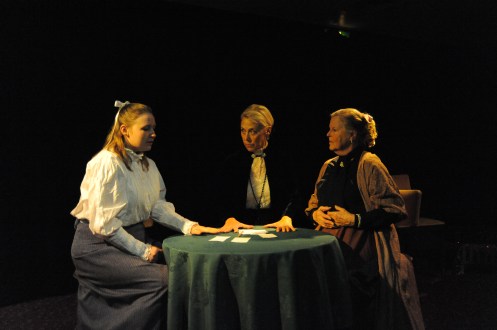
In the second play, A Well Remembered Voice, Mandy Stenhouse as Grace Don, a grieving bereaved mother, is desperately trying to communicate with her dead son by means of a séance. She is joined by Liz Salaman as Mary Rogers and Amy Addison-Dunne as Laura, the deeply saddened girlfriend of the dead soldier. A short circuiting lightbulb overhead seems to spell out answers to Grace’s anxious questions – well timed action by lighting operator John Hart – and she is reassured when it appears to spell out that he loves them. She does not ask whether the father is loved because she has convinced herself that he is heartless and uncaring about their loss. The lightbulb spells out a strange message which doesn’t make much sense to the ladies. They retire and Robert Don played by Andy Hewitt is left alone. We do not yet see that he has cast off his painter’s smock, hung up his fishing rods and put away his pipe in quiet sorrow. The strange message however calls Dick fresh faced in his cricket whites from the ‘other side of the veil’. He can only be seen by one person and the person he has chosen is his father. They have a very tender exchange with Dick constantly urging his father to put on a happy face as they get points ‘up there’ for happiness ‘down there’. A lovely performance by both men.


To set the scene and add to the atmosphere, a large collection of songs originally performed and recorded during the 52 month period of the war were played before and after both performances.
A little poem by Eva Jones penned in May 1916 included in the programme gives a poignant reminder of the tragic end of so many young men and the agonising sadness of those who had so proudly waved their loved ones off to fight for King and Country. The two plays chosen by director Sally Halsey are a fitting tribute towards marking the centenary of the ending of World War One.
Didie Bucknall
November 2018
Photography by Sarah J Carter
Small Island, Big Heart
Star of Strait Street
by Philip Glassborow
Morning Star at OSO Arts Centre, Barnes until 14th November
Review by Eleanor Lewis
To reach Strait Street in Valetta on the island of Malta, you cross Palace Square where the plaque quoting George VI’s letter awarding the George Cross to the island can be seen on the side of the Grandmaster’s Palace. It attracts tourists who naturally admire it but probably have little concept of the personal sacrifices made by so many individuals that together made Malta’s resistance to the German onslaught of World War Two as strong as it was. The Star of Strait Street is the story of one woman’s contribution to Malta’s glorious war effort.
Strait Street today is home to some of the less touristy cafes, jewellery workshops and shops selling the other thing the island is famous for, beautifully worked filigree silver. Back in the forties, service personnel and civilians made their way to the Morning Star nightclub there, where the singing and dancing skills of Christina Ratcliffe and her concert party, the Whizz Bangs, took their minds off war for a while.

Based on the true story of the entertainer Christina Ratcliffe and the love of her life, Adrian ‘Six Medals’ Warburton, the RAF’s most decorated photo-reconnaissance pilot, Star of Strait Street is a new musical play. At just about an hour’s length, like Malta it’s small but striking in the atmosphere it creates. There is little scenery, a couple of standing boards with photographs and posters of the era, a piano and a chair but writer Philip Glassborow, uses Ratcliffe’s cheerful, unsentimental voice to bring to life a vivid picture of Europe as it was from the late ‘30s into the war years.
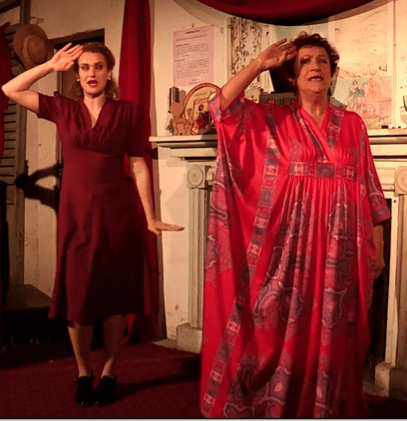
Polly March and Larissa Bonaci play Christina: March as she was in the ‘70s and Bonaci as her younger self, March playing a smattering of other characters too. March has one of those well-rounded ‘been everywhere, seen everything, shocked by nothing’ voices, it is a mix of Mary Poppins and Fenella Fielding, both authoritative and comforting and March gives a measured performance of total confidence and great wit, easily working an audience and taking them with her wherever she wants to, as she tells the story of this remarkable woman’s life.
Christina Ratcliffe’s story is interesting in itself. Brought up in the Cheshire countryside, she began her dancing career in London but progressed into Europe touring various exotic locations, landing in Spain on the opening day of the Civil War and ultimately in Malta in 1940. Alongside performing at the Morning Star (which she and her troupe turned in to one of the post popular clubs in the Mediterranean), she worked as a volunteer plotter in the Lascaris RAF HQ underneath Valetta for six months (and was herself decorated for gallantry) while Malta was relentlessly pounded by Luftwaffe bombing and the island pushed to the edge of starvation. All of which Christina refers to pragmatically, there is no regret, no sentiment and reference to the privations and difficulties she and the islanders experienced is made briefly and viewed as something to be dealt with rather than dwelt on. Clever writing is matched with understated performance.

Larissa Bonaci plays the younger Ratcliffe as a cheerful, positive woman who rose to address a period of time in which every stable and reliable feature of life was thrown up in the air, to come down who knew where. She has a clear and sweet singing voice suited to the ‘cheer up’ songs of wartime and her brisk demeanour as Christina brings a credibility to her performance despite a slight non-UK accent. The two performers were accompanied by pianist and MD Geoffrey Thomas, occasionally adding his voice when required for small interjections from other characters.
The tiny but indefatigable island of Malta received its George Cross “For acts of the greatest heroism or of the most conspicuous courage in circumstances of extreme danger.” The course of Ratcliffe and Warburton’s love story is probably predictable and certainly familiar to anyone who fell in love in wartime, but their personal dignity, bravery and their achievements form a small part of the huge picture that is the collective heroism of Malta.
The Star of Strait Street is a gem of a musical, it takes you right into the warm heart of Malta in the midst of war and makes you love it.
Recommended.
Eleanor Lewis
November 2018
Photography by E-P
Tradition and the Irreverent Talent
The Case of the Frightened Lady
by Edgar Wallace
The Classic Thriller Theatre Company at Richmond Theatre until 17th November
Review by Matthew Grierson
Pitched carefully and capably between the comic and the dramatic, tonight’s revival of an interwar thriller knows just how far to take the laughs before it treads back into darkness. Far from sending up the genre, the humour is staged in such a way as to help the audience connect with the characters, humanising them rather than letting them lapse into the stereotypes they could so easily have become.

The scene is the early 1930s – but you’d be forgiven for thinking it were much earlier, given that the curtain rises on a cast tumbling across the splendidly realised hallway of Marks Priory in a boisterous pageant of medieval costume. So it is apparent even before she speaks a word that Lady Lebanon (Deborah Grant in formidable form) is preoccupied by heritage, heraldry and hierarchy. Her Ladyship’s concern to perpetuate the family line is itself the through-line of the play, although not always in the ways we would expect. It is at least the main reason that her several times removed cousin Isla (Scarlett Archer), the titular frightened lady, remains in this tremulous state throughout: Lady Lebanon intends that the young woman will marry her jaunty, Bertie Woosterish son, in the person of the tremendous Matt Barber, who embodies William in a close resemblance of his current regal namesake. Barber is a hoot, swanking about the place with riding crop or billiard cue, at one point even using the latter to mime a shot behind a departing servant as though potting him offstage.
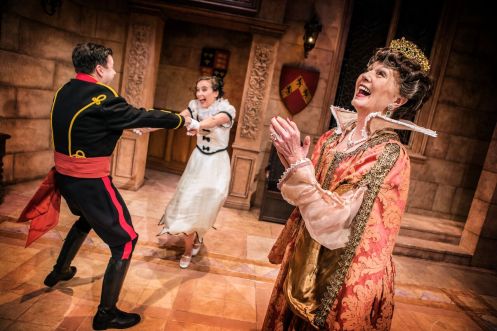
He’s not the only character to treat Lady L’s cherished tradition with irreverence. Robert Duncan gives a well-oiled turn as the caddish Dr Amersham, oozing between slimy insinuation and veiled threats, and is one of a number of participants in the opening round of flirtations and connivances between family, friends and staff that set out various possible motivations for murder. The whirligig of entrances, exits, couplings and uncouplings into which these are choreographed also gives an indication of energy with which this production will continue to speed through its revelations and red herrings, keeping things pacey enough for this period piece to feel sprightly instead of antiquated. Roy Marsden, himself no stranger to the exposition of murder, directs in a way that surefootedly wrongfoots us, giving a comic beat hot on the heels of some fresh terror, or producing new scares that jolt us out of laughter.
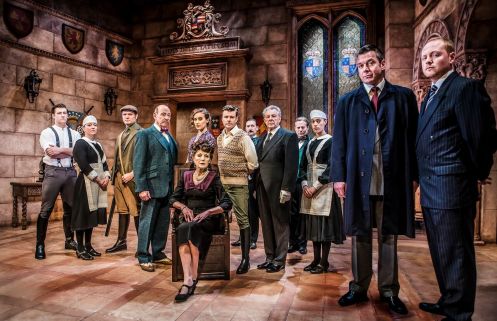
An index of this blend of comedy and chills are the repeated moments when certain characters (hush now, no spoilers) will suddenly stop mid-dialogue and look out over the stalls and whisper, hauntedly, ‘Someone’s listening!’ Then the sinister footmen slip into view and the audience laughs, a little relieved. But the moment, teetering on the brink of breaking the fourth wall, remains unnerving each time. Barber proves particularly effective in making these volte-faces from buffoonery to terror and back, much to the play’s benefit, while as Isla, Archer gives us a Lady Macbeth without the homicidal intent. Or does she … ? Her screams, like the thunderclaps that punctuate the play, prove that the production is equally adept at using stock sound simply but effectively to terrorise the audience.
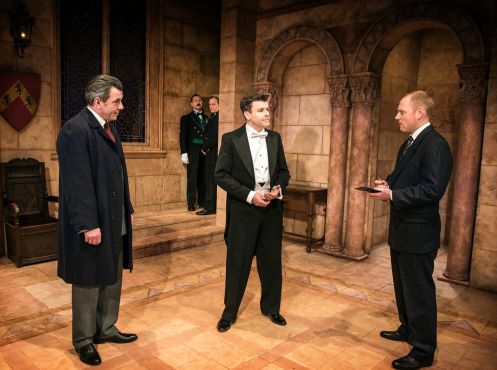
Someone who must have missed the memo to keep things lively and lifelike, however, is John Partridge in the role of Superintendent Tanner. Superintendent Mannered would be more on the mark, such is his arch delivery – viz. his reference to the ‘Lord Lou Tenant’ rather than ‘Lord Lieutenant’ – and proclivity for standing stock still then prowling the stage with no seeming purpose. Perhaps a hangover from his role in Cats?
As Tanner’s sergeant, Totti, Matt Lacey is much more agreeable, exhibiting the people skills necessary to police work in his unassuming interviews with suspects and his low-key flirtation with Isla. But while the relationship between the two policemen is written to be that of surrogate father and son, Tanner having worked with the late Totti Sr, the two actors are too close in age to sell this set-up, losing any residual authority the script may furnish the super’ with.
Given the tone of this production, it’s difficult to know quite how seriously a 1931 audience would have taken the original staging; but with characters called ‘Studd’ and ‘Totti’ there is a hint that Wallace had his tongue in his cheek even then, and this means the evening has a flavour of Carry On Christie. With the family also calling off repeatedly for ‘Gilder’, I was half-expecting a Rita Hayworth-alike to join them onstage. Sadly, the character thus named is a footman, so Scarlett Archer as Isla monopolises the fabulous frocks.


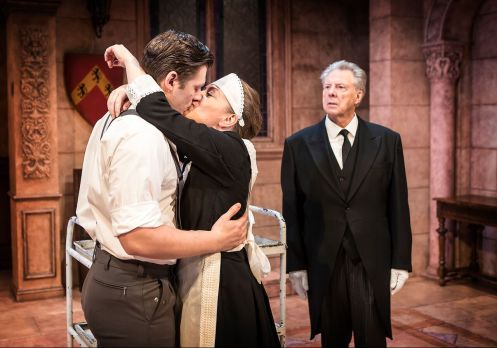
It is also intriguing to speculate how far the modern sensibilities of the piece are Wallace’s own and how far they are part of Antony Lampard’s adaptation. Certainly Lady L’s preoccupation with the dynasty is presented as an outmoded way of thinking even for its time, despite support from her reliable retainer Kelver (Philip Lowrie); so her son scores with the audience by professing himself ‘a bit of a democrat’ at point. Nevertheless, Grant’s performance as the matriarch is as a force to be reckoned with, and, of the below-stairs contingent, Rosie Thomson as Mrs Tilling also gives as good as she gets. One gets the sense of a rounded character willing to stand by her ill-tempered husband, the bluff gamekeeper (Gwynfor Jones), without actually loving him.
In another respect, though, this adaptation has missed a trick; without giving too much away, the story draws on the shared military background of several characters on the subcontinent, but there is not an Indian character among them. In a play that already has numerous character dynamics to explore, this may have been considered one too many. As it is, with the varied ingredients he has Marsden almost manages to keep the pot boiling right to the very end. The denouement when it comes is sudden and surprising, but at this point the direction bubbles over somewhat: no sooner is the culprit revealed than the policemen are reading them the litany of their rights and the curtain falls, giving us little time to savour what has up till then been a lip-smacking evening.
Matthew Grierson
November 2018
Photography by Pamela Raith
‘At the Going Down of the Sun’
A Commemoration of the Armistice Centenary of the Great War 1914–1918
Arts Richmond at the Coach House, Orleans House Gallery, Twickenham, 11th November
Review by Matthew Grierson
What impresses about today’s commemoration is the variety of the programme, diligently put together by Anne Warrington and John Crook. With the verse of the First World War so much part of the national imagination, the readings could easily have comprised widely anthologised poems, those that have become standards. But the organisers have chosen an array of interesting texts to offer fresh views and voices, alongside those we might expect.

The afternoon is structured into a number of themed strands, taking us from the romance and jingoism with which the outbreak of war was greeted, through the horrors and bleak humour of the trenches, to the memorialising and reflections that followed the Armistice. Each section is given an introduction by one of the readers, and while these can be insightful, bearing a pleasant resemblance to sermons, some can be a little overwritten, telling us much of what we will soon glean from hearing the poems themselves. Nevertheless, the readings are performed clearly and engagingly by a mixture of local writers and actors, including screen stars Madeline Smith and Robert Gillespie, and their tones range from the sombre and reverential to the grimly cheeky, according to the varying moods of the pieces.
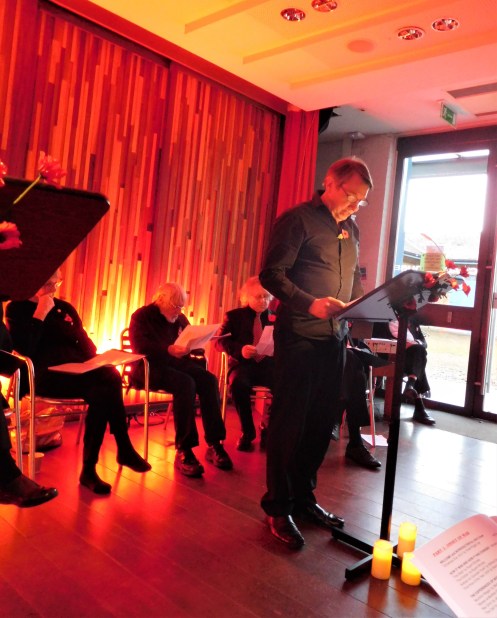
The quality of readings means that poems as familiar as Owen’s Anthem for Doomed Youth and Sassoon’s The General retain their bite and bitterness after all this time; so much so, in fact that it is difficult to listen to Brooke in their company. But the selection ranges much more widely than that. Highlights include Wilf Hastwell’s A Phantasy, which lists a paratactic assortment of objects and body parts, as though the war had broken down any framework of sense or meaning, and John Crook’s rapid, machinegun-like delivery expresses the sensory bombardment of this experience. Similarly unexpected is the ribald frankness of humourist A.P.Herbert’s The General Inspecting the Trenches, in which the title character finds himself literally in the shit, and Gillespie’s reading revels plummily in the repeated ‘sh’ sound strung through the poem.

Another distinguishing feature of the afternoon is the conscious effort to accommodate different perspectives on the conflict. In two of a number of poems by women about their experiences, Madeline Smith gamely takes on the voices of munitions workers, who touch on the danger, delight and empowerment of their jobs. This is picked up later in the afternoon by To My Unknown Solider, penned and read by Greg Freeman, based on the affecting conceit of such a woman slipping a letter for a frontline soldier into a crate of ammunition. Freeman then inverts Rupert Brooke in a subsequent poem, A Foreign Wood, about a graveyard in Woking where Muslim volunteer soldiers were buried, and which has since been converted into a peace garden.

Women’s wider role in the war is also picked up in a pair of pieces written during the war by Jessie Pope, which are both jauntier and more patriotic in tone. These lead into a run of recruiting songs that help recreate the experience of the home front. Linda Sirker and Lottie Walker do their best with Your King and Country Need You and I’ll Make a Man of You, but there is limited room in the Coach House for song and dance. Given the occasion the audience also seem rather subdued and, without lyrics to all of the numbers, only join in tentatively with those choruses they know.


As is pointed out several times by different readers, attitudes to the war changed very quickly as its scale and horror became apparent, so the sentiment of the music hall, for instance, can seem alien to us now. Some thought has therefore been put into the event to make connections across the hundred years. This can be touching, as when Crook reads from the reflections of Vernon Lee – really, Violet Paget Lee – on hearing Bach at Christmas Eve in 1914. She realises that German audiences would be listening to the same music and finds herself musing, as the late Jo Cox did, that there is more that unites than divides us. In other moments, the effort to find contemporary resonance feels more forced, as when Bob Sheed recounts a tale of his grandfather’s that means he himself is now able to acquire an Irish passport. It is, I have to say, a bold strategy to put these poems by local writers against those that have stood the test of time, particularly when the more recent pieces strain to work in forms that the war itself forced poets to rethink, as we hear in Hastwell. But the new writing lends at least a personal touch to the event, in contrast to the more celebrated public verses.
Already quite moodily lit by oranges and reds behind the readers, the room is properly darkened by the time of the going down of the sun. Heather Mountford’s Painting for the Botanist brings a little colour into the Coach House, then, as its talk of finding the proper hues for the poppy gradually develops into a piece of quiet memorial. And, aptly, the evening concludes with Robert Laurence Binyon’s For the Fallen, with its blend of wistful patriotism and grief for the dead making a bouquet from the different moods of the preceding readings.
We have remembered them.
Matthew Grierson
November 2018
Photography by Pam Frazer
Moths Pinned in the Light
Don Carlos
by Friedrich Schiller, translation by Robert David MacDonald
ARA, Exeter Northcott, Nuffield Theatres and RTK Co-production at Rose Theatre, Kingston until 17th November
A review by Mark Aspen
Shadows, moths flitting around a flame, afraid of the dark, but afraid of getting burnt. This is the atmosphere of the dark and edgy version of Schiller’s masterpiece now running at Kingston’s Rose Theatre.
Schiller’s tragedy, which he completed in Dresden in 1787 having incurred the displeasure of various authorities in other parts of Germany, is loosely based on historical events in Spain in the 1560’s during the reign of King Philip II. History’s verdict on Philip is to paint him as a tyrant, and it was from this viewpoint that Schiller wrote his play, with some prescience as it was two years before the storming of the Bastille ignited the French Revolution and stirred revolutionary furore throughout Europe. Schiller himself knew of the dangers of messing with authority.

The Rose production invites us to draw parallels with modern times worldwide, and designer Rosanna Vize has taken a scorched-earth approach to the piece, stripping out set, scenery, costume and mannerisms that would fix it in the 16th Century, or indeed in any century. Her stated idea is that “details … distract from the bigger picture” and the story can be told “with the bare bones of what is required”. In practice this means that she has abdicated the design to the lighting designer Jonathan Samuels, whose harsh un-gelled lanterns inhabit the stage like silent actors. Startling (and, for some of the audience, blinding) at first, I must admit that the stark lighting design grew on me. We have a vast minimalist and monochrome design that counterintuitively creates a stifling feeling of claustrophobia. The human actors, the protagonists in Schillers’ dense plot, are pinned to their places by the lamps of the lantern-actors, like moths to a museum display board. I later realised that the mise-en-scene is that of the “Black Paintings” of (Schiller’s contemporary) Francisco Goya’s later Quinta del Sordo period, foreboding, melancholy, threatening: Goya at his darkest.
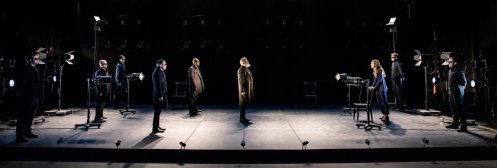
Philip, who had been married to Mary I of England, try to forge another political alliance in 1559 by marrying Elizabeth de Valois, daughter of Henri II of France. This was in spite of the fact that Elizabeth was already engaged to Don Carlos, Philip’s teenage son. This is the starting point for Schiller’s Don Carlos, with the anonymous prince’s incendiary reaction to his father usurping his engagement. What follows is the intricate web of intrigue and counter-intrigue, of conspiracy and counter-conspiracy that forms the tangled plot of the play. This requires concentration from an audience, and it certainly gets it from the Rose audience, notwithstanding the play’s three-hour plus duration.

Maybe the cast are conscious that here is a lot of play to fit in. The opening dialogues are rushed to the point of gabbling and much of the important content of the early scenes are missed, but when the play settles in, so do the speeches, which in translation largely retain the blank verse of the original text. Also significantly the import of the long reflective silences underlines the edginess of the play, and this feeling is enhanced by the quivering music of the sound track.
The sound design is the creation of director Cadi Roll and forms part of the overall stylisation of the piece, the form of which is shaped by the concepts of his new theatre company, Ara, set up by Roll and the actor Tom Burke. Technical theatre and action are entwined in a dynamic way, rather than established at the outset. So, the on-stage lanterns are wheeled around the stage, and no only in scene (in the sense of time) changes, almost becoming part of the action. There is a problem with this, in that the audience are static, so the lanterns often mask the action. And having actors facing each another, faces strongly lit by side battens, hides the action from much of the audience. Or is this to make us feel the uneasiness of in interrogation? Costumes are black and white, except for the occasional touch of red (the lining for the king’s coat for example and of course the red carpet). However, the stifling confinement of an oppressive court comes strongly across.
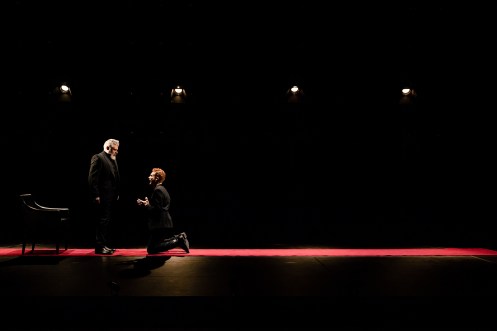
In this production, Tom Burke plays the part of the Marquis of Posa, a companion of the prince since boyhood, whom Don Carlos confides in. The Marquis is deeply concerned to hear Don Carlos tell of his continuing love for Elizabeth, now his step-mother, but nevertheless vows friendship to help him. In turn, asks for the prince’s support for his quest to alleviate the Flemish people from the tyrannical policies imposed by Philip. Gradually Posa is sucked relentlessly into the court intrigues. He manages to gain the King’s confidence, even though he has radical convictions and a heretical religious stance. You see, he appears to the king to be unique in speaking up honestly. However, in the end, to keep his oath to Don Carlos, whist trading a dangerously thin line with the King, he is the one to be sacrificed. Burke’s Marquis de Posa is calm, rational and level headed. He draws on an internal strength to think on his feet, although even he is not above threatening murder to advance the cause. Burke’s portrayal is strong, empathetic and self-sufficient. (However, his later role as the blind nonagenarian Grand Inquisitor is not so convincing.)
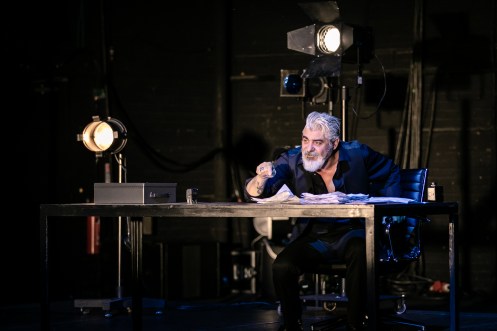
Samuel Valentine fills the eponymous role of Don Carlos with a jagged nervous energy, portraying a man in constant state of frustration: about the alienated affections of his hitherto fiancée, about his father’s refusal to allow him to lead troops in the Netherlands, about the impunity with which other members of the court insult him. King Philip does not trust his son; in fact, he does not trust anybody, even his new wife. Darrell d’Silva, in this role, plays Philip’s reaction to this lack of trust with anger, but then again the King seems to be angry about everything, from trivialities to matters of life or death. He is angry about not killing the right man; he is angry about killing the wrong man. He gets so angry that the makes himself ill, but what d’Silva gives is a one-dimensional character who has no other emotion. Even his basting-off of a loud klaxon doesn’t bring down the steam. He starts highly fired up and stays there.
Schiller’s much more rounded and subtle characters are the women. Kelly Gough’s Elizabeth of Valois is dignified and regal, a princess who understands her position in the social standing and the protocols that go with it, a woman with her emotions under control. She is eyed with suspicion as a foreigner in the court and is a butt of unfounded accusations, but she rides out these waves. The Princess of Eboli is potentially in a more precarious position. Young and vulnerable, she is importuned by the King, and does not have the power to reject his advances. Yet she is in love with Don Carlos, and when he rejects her, she has all the guile of the woman scorned and her fury is unleashed. Alexandra Dowling’s portrayal of the Princess is nuanced, a character who is a once spirited and fragile.

The court is however largely populated by men. The éminence grise is Domingo, the king’s confessor, right-hand man and procurer, who spends his time sowing poisonous seeds. Jason Morell is suitably sleazy in this role. Stephen Ventra’s Count Lerma, the Commander of the King’s Guard plays a pragmatic man, trying to keep his head above water … and on his shoulders. Don Carlos’ nemesis is the Duke of Alba, the King’s emissary in the Low Countries, who commands the armies in Flanders, but secretly would rid the court of both Don Carlos and Elizabeth. Vinta Morgan is unconvincing in this role, lacking the gravitas of the aristocrat, and instead of proud deportment a noble, we have the swagger of a night-club bouncer.

Perhaps all this is a reduction to the “purified” theatre of Roll and Vize. Does it say we are all in danger of tyranny? The portrayals are certainly widened. Elizabeth is a French princess, now living with her royal husband in Spain, but speaking with an Irish accent. (Gough’s native accent). Does this show the universality of Philip’s pan-European tyranny? What the effect is though is to reduce the universality to a uniformity.

Picking up the invitation to draw parallels with tyrannies in modern times, the tyranny of uniformity has come from stifling dominance of faceless power that reduces individuality, the faceless brutality of The Soviet Union, or the faceless bureaucracy of the European Union, which crush individuality into the greyness of uniformity. In the last century we have had totalitarian tyrants, Stalin, Hitler, Mao Zedong, Pol Pot, Saddam Hussein, Bashar al-Assad, who have possibly put Philip II of Spain into the shade. The overall picture of this Don Carlos is that created by the physical design and overlaid by the direction: not a black and white world, not a totalitarian tyranny, but a tyranny of uniformity, a tyranny that produces a stark, bleak greyness.
Still, where are the moths?
Mark Aspen
November 2018
Photography by ©The Other Richard
Hide and Shriek
Something to Hide
by Leslie Sands
SMDG at Hampton Hill Theatre until 10th November
Review by Eleanor Marsh
Something to Hide by the actor and writer Leslie Sands is a piece of its time: the 1950’s. Wisely, SMDG’s director, Jean Wood has chosen to leave it firmly where it belongs in terms of staging and thus it may be viewed as a “period” as opposed to “dated”. This overall feel is enhanced by touches such as masking scene changes by closing the curtains – something I’ve not seen in the theatre in a long time – and the choice of contemporary 1950’s music playing on the radio. Jerome Kern’s The Way You Look Tonight is a particularly good choice of song to evoke the atmosphere of what is both happening and about to happen.

Although the plot relies on several descriptive speeches of offstage action to move on, it is written is such a way that – as long as the actors are up to it – it does not appear as static and laboured as some other plays of its genre. In the main SMDG’s actors are more than up to this task of storytelling-acting and the dramatic action moves at a good pace.

The play is mooted as a “thriller” and it has everything an Agatha Christie fan could wish for: murder, adultery, blackmail, deception, twists and turns of plot and even a nosy neighbour. The cast is small and all are enthusiastic.
 Sue Birks and Gina Way both seem to be having fun playing respectively the nosy neighbour and the cleaner. These characters are somewhat superfluous to the plot but serve the good purpose of relieving the tension just when it is needed. The other minor role of Mr Purdie the mechanic is played by Paul Lawston. Nicola Doble does her best with the somewhat underwritten role of Julie. She has little to work with, but is a crucial character and Ms Doble is both three dimensional and sympathetic. As the protagonist (or is he…?) Howard Holt played by Richard Pool is suave and comes into his own towards the end of the play.
 Susan Reoch, as the moneyed wife, Karen is well cast, demonstrating vulnerability and steely determination in equal measure. And completing the cast we have the excellent Darren McIlroy as the dogged – and very clever – Inspector Davies. Like Chief Inspector Hubbard in Dial M for Murder, Davies is a forerunner of Columbo and there must have been a temptation to play him as a caricature, but thankfully both actor and director resisted temptation and there was an almost audible sigh of relief from the audience when Davies’ reassuring presence announced itself in Act Two.

Technically this production had some challenges – mainly in the (lack of) attention to detail. The overall look of the set did exactly what it was supposed to and took us immediately into the country home of a wealthy couple. However, the curtains in this rather grand house were the wrong length and un-ironed, the rather upmarket and business-like desk was mismatched with a dining chair and a rogue briefcase found its way into the centre of the set for no reason that I can recall, causing the actors to walk around or over it. This was quite distracting. Costumes were flattering to the ladies and serviceable for the men. Although not always true to period they enhanced rather than detracted from the overall ambience. Lighting and sound both suffered a little from the curse of the touring show – first time “live” in a new building, but the effects were good and my main complaint here is that the radio music at the beginning of the play was too loud – I was expecting Miss Cunningham the neighbour to be complaining about the noise when she knocked on the door …
Overall this was a very entertaining piece and a lovely nostalgic trip back in time and Ms Wood must have been delighted at the first night audience’s gasps and screams on more than one occasion during the play. There can surely be no finer recommendation for a thriller than that!
Eleanor Marsh
November 2018
Photography by Bill Bulford
Age Shall Not Weary Them
Dear Chocolate Soldier
by Kate Glover
Historia Theatre Company at OSO Arts Centre, Barnes until 10th November
Review by Andrew Lawston
Coming to the OSO less than a week before the UK commemorates the centenary of the 1918 Armistice, Dear Chocolate Soldier is a particularly timely production from the Historia Theatre Company. Billed as a “docudrama”, the show dramatises the years of correspondence that resulted from young Joan Burbridge posting a bar of chocolate to the soldiers on the front line, bearing her father’s inscription of “Little Joan”. In the trenches, Bombardier Edwin Hassall finds the discarded chocolate wrapper bearing Joan’s address, and so writes to Little Joan, talking about his life and experiences in the trenches with wit and plenty of historically fascinating detail.
Through this touching story, which lends a welcome human perspective to the international conflict of the First World War, Kate Glover’s script narrates the second half of the War; from the Somme, through Passchendaele, and even some time after the Armistice. Hassall’s letters, performed ably by Simon Brandon in authentic-looking World War One khaki, are interspersed with songs from the period, as well as poems, and short dramatic scenes extrapolated from the correspondence.
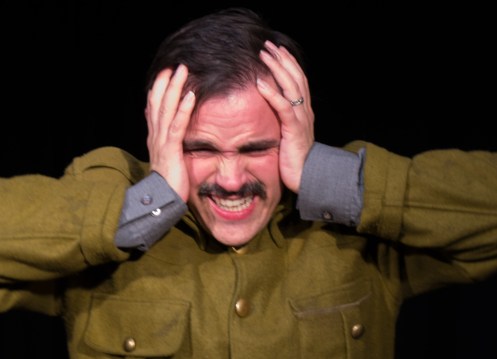
As the war grinds on, an increasingly cynical and weary Hassall returns to the front line as a sergeant, and “Little Joan” becomes both his personal mascot, and the name of his field gun. Kenneth Michaels plays numerous roles throughout the production, and increasingly supplements Hassall’s letters with quotes and narration from Field Marshall Haig, Lloyd George, and from General Ludendorff on the German side. Perhaps a victim of opening night nerves, Michaels seemed hesitant at the start of the show, but quickly settled into his numerous roles with confidence and gusto.
Completing the trio of actors is Kate Glover, who has enormous fun playing Little Joan in the opening scenes, before playing various characters throughout (most notably Hassall’s sister, Emma), and providing much of the narration. Glover is also the show’s writer (she settles for the more modest credit that the letters are “edited and arranged by Kate Glover”, but this seems to fall short of her contribution given the selection of musical numbers, poems, and dramatic scenes). Glover’s script keeps the proceedings varied, breaking up the letters with songs from the period, most of which will be familiar to contemporary audiences. All three actors reveal that they are also strong singers, with Simon Brandon’s voice ringing out particularly strong.
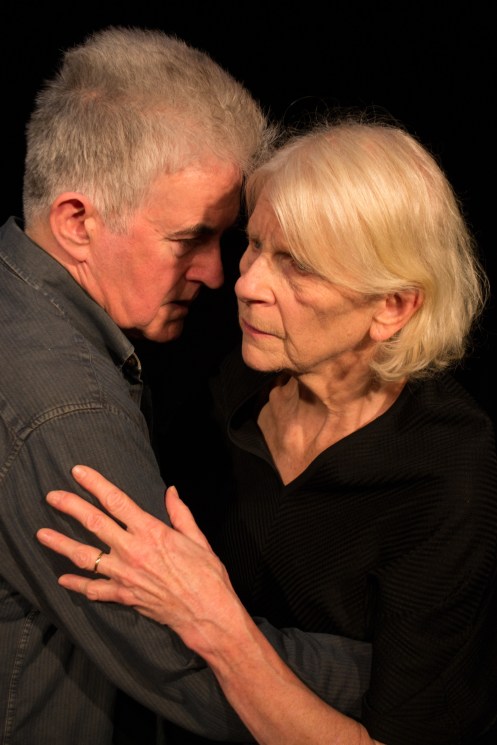
With just three performers, and a superb pianist in the form of Director of Music Laurence Williams, the set is little more than a piano and two chairs against the drapes of the OSO’s black box stage. Enlivened by Michael Murray’s evocative sound effects, simple but effective costumes from Questors, and a lively performance of what could easily have been a very static piece, this minimal staging allows Hassall’s authentic voice to resonate with audiences with no distractions. Director Kenneth Michaels (also acting) keeps the show moving at a brisk pace, with barely enough time for Edwin Hassall to catch his breath between the end of a song and the start of the next letter.
The title Dear Chocolate Soldier can’t help but evoke the fictional Captain Bluntschli, the “chocolate-cream soldier” of George Bernard Shaw’s Arms and the Man. Hassall’s letters convey a similar mundane and pragmatic approach to the business of warfare, most notably when he is furious over the wounding of the cook who was so good at preparing bully beef rissoles for the men. When the young Bombardier goes down with dysentery, he hangs on for a month as the trenches are so under-manned, before finally being hospitalised. He refuses to accept any glory in soldiering on despite his illness, instead feeling first disbelief and then jubilant relief when he is sent back to England to recuperate.
There is no room for nostalgic sentiment in this show, which pulls no punches when detailing the soldiers’ fighting conditions, rationing, and the vast numbers of senseless casualties, but it still has a great deal more warmth to it than , the show to which it will inevitably be compared, given its cabaret style. The play also touches on the way in which veterans are treated, as contentious now as in 1918, with Hassall’s fate desperately at odds with the “land fit for heroes” promised by Lloyd George.
Dear Chocolate Soldier is an entertaining evening that makes great use of contemporary documents to present a surprisingly fresh perspective on one of the formative events of the 20th Century. It is perhaps a shame that presumably only Edwin Hassall’s letters survive, as it would have been wonderful to hear some of the Burbridges’ replies, and to get even more of a sense of wartime society back in Blighty. But we are left with a compelling portrait of one man’s struggle through the War, and a glimpse of his innermost thoughts, and of the little comic incidents, often shot through with black humour, that made life in the trenches bearable.
Andrew Lawston
November 2018

 Mark Aspen