
Good and Evil Juxtaposed
The Sleeping Beauty
by Pyotr Ilyich Tchaikovsky , choreography by Marius Petipa
Moscow City Ballet at Richmond Theatre until 3rd February, then UK Tour continues until 23rd February
A review by Juliet Manners
Moscow City Ballet, founded in 1988 by choreographer Victor Smirnov-Golovanov, showcases the greatest works of the 19th and 20th century ballet heritage, whilst simultaneously using the strapline ‘Dancing for the New Generation’. Its remit was accomplished in this production, which was a true depiction of traditional Russian classical ballet, designed to appeal to all ages.
Although in today’s world of #MeToo, the idea of a woman receiving an unsolicited kiss is considered a violation, The Sleeping Beauty, based on the French La Belle au bois dormant by Charles Perrault, remains a well-known romantic fairy tale. If one can overlook this feature of the story, it provides more palatable food for thought in its expression of the fight between good and evil. With choreography from 1890 by ballet master and choreographer Marius Petipa (himself also French), the production features a variety of characters taken from Perrault’s other fairy stories, which in themselves were written as moral tales, albeit from another time and place. As Petipa enjoyed a career spanning over thirty years as Premier Maître de Ballet of the St. Petersburg Imperial Theatres, what became one of the most popular ballets of the repertoire certainly serves to illustrate the most traditional and pure form of the classical style.
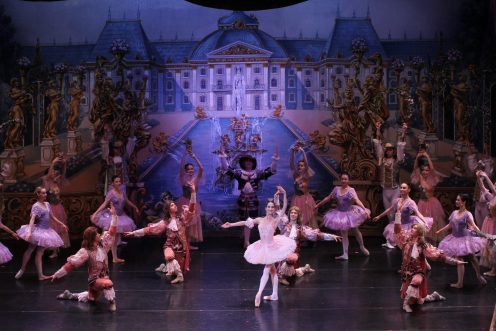
The design of the whole piece was what I have to come to expect from the Russian touring companies; opulent backdrops rendered by painted gauzes, which for the majority of the production depicted a Royal Palace in all its splendour. Designers Natalia Povago and Evgeny Gurenko evoked the magnificence of a baroque-style European Court, whilst Elisaveta Dvorkina had free reign to give the costumes a truly sparkling touch, particularly notable in the traditional classical tutus and the robes worn by King Florestan and his Queen.
The Royal couple have given birth to a daughter and it is the celebration of her christening to which we are invited in the Prologue. Master of Ceremonies Catalabutte, danced and acted with great animation almost in the style of a circus performer or pantomime character, has invited all the fairies of the land to bestow their gifts upon baby Princess Aurora. The courtiers portrayed by the corps de ballet were suitably regal and deferent, although in contrast to Catalabutte, their acting was noticeably understated. The sound classical technique and exceptional grace of movement on which the company prides itself was evident, although I did feel that the grand ensembles were somewhat hampered by the constraints of the relatively small Richmond stage.
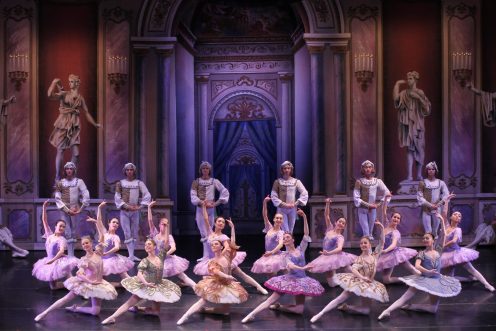
A series of variations from the fairies of the Crystal Fountain, the Woodland Glade, the Enchanted Garden and the Golden Vine, as well as the Breadcrumb Fairy were all well danced, although I must admit to finding some of Petipa’s choreography less attractive in this section. The Lilac Fairy however, is a dream of a part for any ballerina. Unfortunately there was no cast list available for this evening’s performance, but the featured dancer had a lovely ‘line’ and particularly beautiful ports de bras.
Too late for Catalabutte, he realises that he has forgotten to invite the Fairy Carabosse. She appears with her entourage of bats in a swirling mist of black and places a curse on the baby, that she will prick her finger and die. The character artist who portrays Carabosse was a ‘baddie’ in the most traditional sense, who in typical style is succeeded by the heroic Lilac Fairy, who revokes the spell so that Aurora will not die but merely fall asleep for a hundred years, until she is woken by a Prince’s kiss.
Act I commences with celebrations for Princess Aurora’s sixteenth birthday in the grounds of the Palace. The suitably glossy tour programme with pictures of the principal dancers of the company allowed me to see that Aurora was portrayed by the Ballet’s main ‘face’, Lilia Orekhova, coquettish in her interactions with the four Princes who appear as her suitors. The notoriously difficult Rose Adagio, which requires Aurora to balance for a long time en attitude to be serenaded by each Prince, showcased her long lines and extension and was received with appreciation by the audience.
Carabosse suddenly appears again disguised as an old woman and presents Aurora with a spindle, on which she pricks her finger and collapses. Here once again we see the juxtaposition between evil and good as Carabosse reveals her true identity and the Lilac Fairy reappears to cast a spell of sleep on the whole Court.
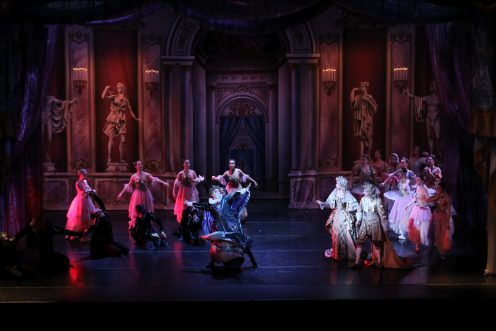
The dashing Prince Florimund of Act II was danced this evening by principal dancer , first seen out hunting with his courtiers. Here the backdrop of the forest was suggested by gauzes of brooding darkness which served to further illustrate the melancholic mood in which the Prince finds himself. A vision of the Princess Aurora asleep in the palace gives him a purpose, and the Prince is directed by the Lilac Fairy to find her. Tall and rangy, Orlov showcased athleticism in his solo dancing although once again the small size of the stage became apparent, and the extreme rake may have contributed to his one stumble, surely a terrible moment for any dancer. Notwithstanding, true professionalism reigned supreme. After awakening Princess Aurora with a kiss, their pas de deux was stunning to watch.
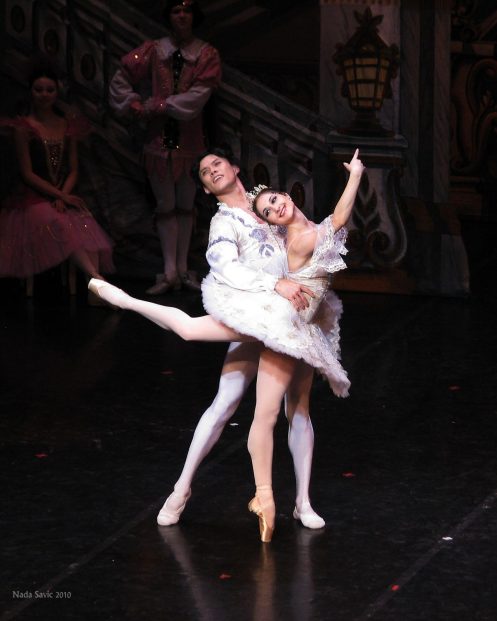
In the final Act we find ourselves in the Palace Ballroom where the Court is celebrating the wedding of Aurora and Florimund. The Grand polonaise dansée sees turns by characters such as the Bluebird, Puss in Boots and the White Cat and Red Riding Hood and Wolf who have come to pay their respects, all beautifully performed by members of the company, as well as some lovely variations by the Gold, Silver, Sapphire and Diamond Fairies. As the celebrations come to a close the Prince and Princess dance together in a final ‘happy ever after’.
Whilst the storyline has undeniably dated, this was an enjoyable evening in real fairy tale style.
Juliet Manners
February 2019
Photography by Nada Savic
Unfathomed Lake of Tears
Swan Lake
by Pyotr Tchaikovsky , choreography by Victor Smirnov-Golovanov after Marius Petipa, Lev Ivanov and others.
Moscow City Ballet at Richmond Theatre until 31st January, then UK Tour continues until 2nd March
A review by Mark Aspen
In a ballet that is so full of ironies as Tchaikovsky’s Swan Lake, it is perhaps appropriate that Smirnov-Golovanov, the Moscow City Ballet’s late chorographer should choose to make the character of the Jester so important.
The Jester is in on all of the action in the court of Prince Siegfried and acts rather like a one-man Greek chorus in commenting on the action. Aleksei Tsauko makes a very expressive Jester, embellishing his athletic yet relaxed style with adept tumbling and mime.
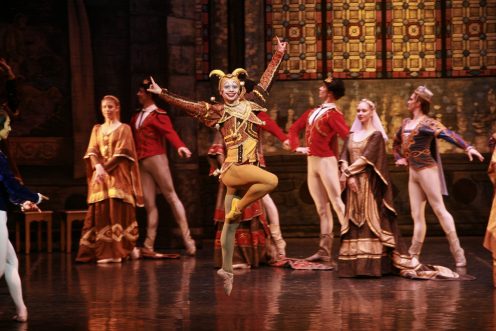
Tsauko’s nicely controlled jetés served to reassure me about the constraints of the Richmond Theatre stage. The ballet opens onto designer Natalia Povago’s beautiful cinnamon court, where the Jester is a prime mover in the celebrations of Siegfried’s twenty-first birthday. But when over two dozen dancers are in full flight the Richmond stage begins to look rather small. However, version choreography director Natalia Ryzhenko skilfully manages to overcome any potential problems, including the notoriously steep rake on this stage. One wonders, nevertheless, whether the male principals were inhibited by space limitations in the power that they could deliver to the larger moves.
In the birthday scenes Siegfried and his friend Benno do a lot of what 21 year olds do: they drink. (And my, they get through a quiet a few goblets of wine … or possibly vodka?) The admonishments of the Queen, in this production Siegfried’s aunt, that his coming of age means he must choose a bride, go unheeded. Olga Orlova plays a suitably haughty Prince’s Aunt, a statuesque disapproving observer. As Benno, Dzmitry Lazovik, the MCB’s youngest principal dancer, brings a fresh lightness to the part, imbuing it with easeful fluidity, which speaks of the light-hearted nature of Siegfried’s confidante, a temperament accentuated by Lazovik’s natural ballon.
Siegfried always seems to be at a loose end at his birthday bash, and it is not until Benno suggests a spot of evening hunting that he has chance to come into his own. The enchanting full moon (beautifully executed by lighting designer Evgeny Selivanov) throws its evanescent glow across Povago’s lake (which, as an aside, is eerily reminiscent of the Dorset coastline at Durdle Door). However, this is the Swan Lake, a lake of tears where the Princess Odette is held captive by the black arts of the evil Von Rothbart, in the guise of the Queen of the Swans, only briefly resuming her human form in the moonlight. In this conducive ambience, Odette and Siegfried fall in love.
 The established Principal Dancer, Daniil Orlov, tall and imposing, is a suitably princely Siegfried and is well matched with the company’s Prima Ballerina, Lillia Orekhova, who is often described as “the Face of the Moscow City Ballet”. Slender and sinuous she has the swan-like grace and portrays the elusively of the captive swan. However, their initial well-known pas de deux seems somewhat restrained, marked in delivery. It proved to be held-back for things to come later, lost in the chocolate-box symmetry of the corps de ballet’s eighteen fluttering swans. Another famous avian piece, the pas de quatre of the cygnets was an audience pleaser. Then Odette disappears from the Prince’s sight in Orekhova’s delicate quivering bourrées.
All the while Von Rothbart, disguised as an owl, has been hovering around the pair. A sinister black figure with filigree wings, Principal Talgat Kozhabaev’s interpretation of the bird of prey, ubiquitously stalking has an apprehensive feel.
The next day auntie has organised a debutantes’ ball at which Siegfried is obliged to consider candidates for his marriage, would-be brides who have come from all over the world. The presentation of the eligible princesses is a pleasing showcase of some fine dancing. Polina Dyachkova, the Hungarian Bride, dressed in pale grey, has a vivacious grace in her czardas, an arresting opening to this divertissement. The staccato passion of Kseniya Stankevich’s Spanish Bride, very much sangre de Toro in her swirling dress, brings great gusto to her bolero with its tambourine and castanets motif. The strident motif of the Neapolitan Bride is set by the cornet, and Kseniya Basnet is a joy to watch as the tempo gradually quickens. Then Mariya Tsibulina and Larisa Robles-Zaleveskaya complete this colourful interlude with the twin Polish Brides’ mazurka, danced with folksy abandon.
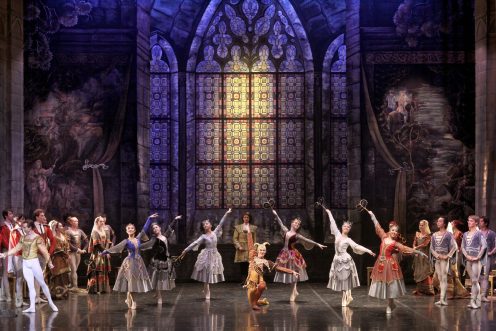
But all good things come to an end as the ball is gate-crashed by Von Rothbart and his nefarious daughter, Odile. Recognising the resemblance to Odette, the hitherto listless Siegfried is fired with desire. Orlov and Orekhova attack this scene with vigour. Maliciously seductive, the antithetical Odile teases Siegfried with allusions to Odette. Orekhova’s angular athleticism works well as Odile, a part often seen as the stronger in this mirrored double role, whist Orlov opens up with some strong interpretive working of his role including impressive tours jetés. Their rendering of the famous pas de deux and the multi-fouettées bravura, belied their earlier less inspired exposition. Equally, Kozhabaev opened up the confident triumph seen in Von Rothbart as he achieves his goal of tricking Siegfried into an engagement with his daughter. His strutting supremacy is echoed in Odile’s victorious lightness: she almost flies. Meanwhile, Siegfried has realised how he has been gulled. There is a moment of deflation that is so well acted by Orlov, a perforation of his soul.
The Hungarian Sinfonietta Orchestra, under the baton of Igor Shavruk, take the ballet on a musical journey much appreciated by the audience. Shavruk knows when to underline the whimsy, to have fun; or, in the most dramatic parts, to really punch home the power of Tchaikovsky’s score.
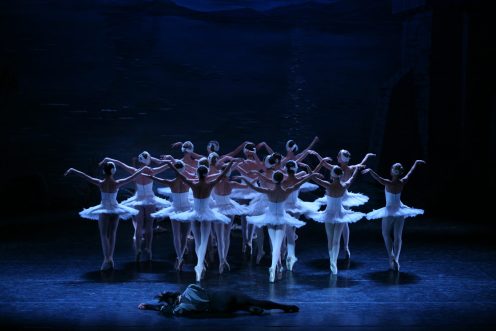
Back at the lake for the final act, the tempestuous setting adds to the drama in a concatenation of pathos, then fear, then despair. The anguished realisation for Odette of Von Rothbart’s treachery and the last attempts of the hapless Siegfried to beg forgiveness, and the torment of the swan-maidens expressed in the forming and re-forming of the corps de ballet, lead to an intense finale. In the many versions of Swan Lake, some end happily, most end tragically, but this one ends ambiguously. Siegfried fights and overcomes Von Rothbart, but are the swan-maidens freed form their bounds? Are Siegfried and Odette forever united in an apotheosis of their love? Or are they drowned in the lake of tears, the Swan Lake?
Death or glory? Perhaps the ambiguity is the quintessence of this Swan Lake. It starts with a Jester and the irony is that the jester figuratively has the last laugh.
Mark Aspen
January 2019
Photography by Nada Savic
Lamenting the Lost Childhood of the World
Lord of the Flies
by William Golding, adapted by Nigel Williams
Barricade Arts Theatre at OSO Arts Centre, Barnes until 2nd February, then TIE tour to Madrid until 11th February
A review by Celia Bard
William Golding wrote this play in the aftermath of World War II. When first reading this novel, I found it hard to conceive the notion of children resorting to savagery in the way as described in the book, hunting other children with intent to slaughter. That reality, sadly, is a recognisable aspect in the lives of many young people in twenty-first Century Britain today. Although bullying and such like behaviour has always gone on, its scale and severity, particularly in knife crime and social media bullying, has increased and has certainly become more visible in ways that could not be envisaged when the novel was written.
Influenced by his own experience of War and his disillusionment with prevailing attitudes in the 50s, Golding was able to visualise the worst in human nature and believed that in certain circumstances so called decent people could be easily led to act in terrible ways. The novel is a metaphor and provided Golding with the means to explore conflicting impulses that individuals have towards society when required to live by conflicting and different sets of rules.
As in the novel, the play tells the story of a group of British schoolboys marooned on an isolated tropical island after being shot down in a plane whilst being evacuated from a war raging in Britain. The boys believe that a cataclysmic event, namely the dropping of an atom bomb, has happened. With no adults on the scene, the boys have to fend for themselves. Free from the restraining voice of adult authority and rules, the boys descend into savagery. The boys splinter into two groups, one group led by Jack who wants to be ‘top dog’ and lead by coercion and violence, and Ralph who believes in living by a set of rules, but those which involve living peacefully and in harmony with each other.
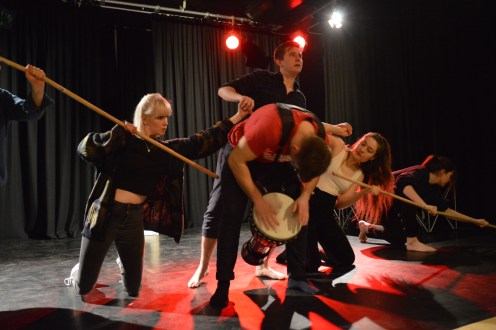
This dramatic performance of Lord of the Flies by the Barricade Arts Theatre in Education actors is certainly high impact, an important element of the TIE concept, which aims to engage young audiences in educational drama initiatives often linked to school curriculum subject content. This small cast of actors is versatile, capable of playing multiple roles on a simple, representational set, sing and play instruments. They are also successful in exploiting the script through their carefully studied and thoughtful portrayal of characters, enabling an audience to see the effect of actions upon others. All characters in this performance of Lord of the Flies are played by adults, who are required to play 7-14 year olds and all of them are successful in their ability to capture the movement and mannerisms of that age group.
The set is minimalist with just enough to indicate that the characters are on an island. Two large rostra either side of the acting area are indicative of mountains, allowing actors to work at different levels. At other times the rostra become shelters or tents. Costumes consist of school uniforms, though not of the period. Sticks play an important role in this production. At times they are wings of an aircraft, spears used for hunting, wood to keep the fire burning, sticks for beating out different rhythms. One minor observation is that although characters kept commenting on how hot it was, it didn’t always feel hot and steamy as if they were in jungle. Orange-red lighting effects could perhaps have helped here?
The opening scene is highly imaginative. With just a few sticks, flashing lights and sound effects and well thought out choreography, the actors were able to simulate the shape of an aircraft being shot at and crashing onto an island. The use of the conch shell in this production is strongly symbolic, as it is in the novel. It symbolises authority, conflict, leadership, and a rallying cry. The gradual decline in its use highlights the breakdown of social cohesion in the group. Although the struggle for leadership appears to be between Jack and Ralph, it is Piggy who in many ways is the real leader. The dynamics between the three actors who plays these roles is beautifully realised, the tension between them is taut and painful.

Harry Lukakis plays the character of Piggy with great sensitivity. It is really easy to empathise with him on several occasion, as when Ralph tricks him into telling him his nickname and then betrays him by letting on this knowledge to the whole group. The scenes when he is robbed of his glasses and walks about the stage blindly is wonderfully acted, as is his movement and vocal reaction when forced over the cliff.
The tension between Jack and Ralph is palpable and powerful. Jack as portrayed by Elizabeth Mason gives a convincing performance: domineering and ruthless in endeavours to be leader and to gain and maintain control: if they don’t conform, they don’t survive!
Ralph, played by Joseph Clayton, gives a totally believable performance, presenting a multi-faceted portrayal of this character. Although initially selected as a leader he is not secure in this role and cannot maintain control, he has doubts and is lost without Piggy.
Max Cadman in his role as Roger successfully captures the essence of this character: brawn, blindly following his leader without question: it doesn’t take him long to regress to savage roots ‘just following orders’.
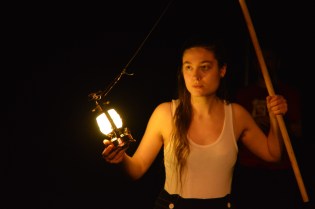 Hannah Marsters very successfully plays two characters, Simon and Eric, marked by a sharp difference in movement and voice between the two characters. The acting out of Simon’s fit is well studied. Sam as played by Rosa Garland gives a truthful performance. When loyalty to Ralph is put under pressure, he doesn’t waiver, pretends to submit to Jack but allegiance remains with Ralph.
Jonny Danciger as director and composer succeeds in bringing this story of Lord of the Flies very much alive. The tension is palpable, and it moves at a good pace which slows when important issues are highlighted. The director’s and actors’ interpretation of this story very much fits the modern world. It is a sobering thought to realise how quickly rules of society and the veneer of socialisation can break down, leading to anarchy and violence when conflict cannot be settled through rational debate and discussion.
Celia Bard
January 2019
Photography by Sarah Wright
A Sad Tale’s Best for Winter
The Winter’s Tale
by William Shakespeare
Teddington Theatre Club, Hampton Hill Theatre until 1st February
Review by Andrew Lawston
The Winter’s Tale is a play of two halves, lurching from courtly psychological drama to rustic comedy with only an infamous bear chase sequence to separate the two. Teddington Theatre Company gamely takes on both elements in this ambitious but confident new production from director Michelle Hood at Hampton Hill Theatre. By her own admission in the Director’s Notes, Michelle veered towards romance and mythology rather than literal geography when deciding on the settings for the two kingdoms of Sicilia and Bohemia. This is somewhat supported by Shakespeare’s liberal approach to geography throughout the play, but no such liberties are taken with the text.

Against Fiona Auty’s austere backlit set of Regency pillars and stylised white trees, Neelaksh Sadhoo opens the play as Leontes, the king who starts to believe, with frankly implausible swiftness, that his wife Hermione (Alana Wren), who conveys infinite patience throughout for her dangerously petulant husband, has been unfaithful to him with his childhood friend King Polixenes of Bohemia. It’s a challenging part to portray convincingly, and Neelaksh gives a sincere portrayal of a genuinely tormented man, which sells the character’s bizarre plummet into jealous insanity.
 As Leontes grows ever more paranoid, Matt O’Toole’s likeable Camillo is torn between loyalty and morality, opting to flee Sicilia with Polixenes. This perceived betrayal accelerates the chaos in the court as Dionne King’s wily Paulina and Darren McIlroy’s loyal Antigonus struggle in their own ways to make Leontes see sense. As he ignores the pleas of his whole court, and even the Oracle of Delphi (whose wisdom is communicated via a spectacular jewelled treasure chest), the cast avoid the temptation to ham up the increasingly melodramatic material, instead opting to play everything straight.
The Sicilian court is rounded out by solid supporting turns from Jo Hayes, Susan Gerlach, Liz Williams, Luke Daxon, Eilish Langham, Zoe Arden, and Jenny Hazell, most of whom later don rural garb for scenes set in the Bohemian countryside. The contrast between formal Sicilia and apparently-carefree Bohemia could not be clearer as hair is let down, and dancing performed. In their Sicilian mode, the courtiers and ladies in waiting lend further credibility to Leontes’ central performance as they react to his outbursts with fear, touched with concern for a once-great leader.
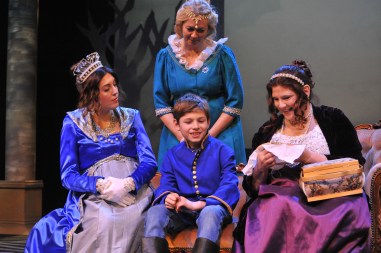 With Leontes’ young son Mamillius (played with great confidence on this occasion by Toby Ewen) and wronged queen Hermione both dead from grief, the king finally comes to his senses, but his new-born daughter Perdita has already been taken out into the wilderness by Antigonus. Antigonus is of course the pursuee in Shakespeare’s most famous stage direction, and Michelle Hood has made a sensible decision to depict the bear primarily through the use of sound. No sooner is Antigonus off stage than Sue Reoch appears as the Shepherdess to save the infant Perdita, and this hitherto relentless tragedy finally turns the corner into a more optimistic tale.
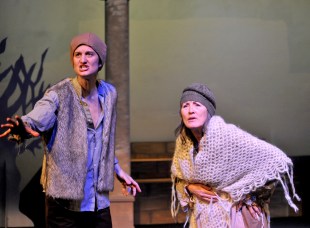 After spending much of the first half as a wordlessly disapproving courtier, Nicola Doble raises the energy going into the interval with a hugely spirited and physical performance as Pe’er. She maintains this tone throughout the second half and provided some of the show’s most enjoyable moments in her scenes with Steve Webb’s equally energetic Autolycus. There is some well-timed physical comedy between the pair during their first meeting which almost makes you forget the jealousy, insanity and death in the play’s opening scenes.
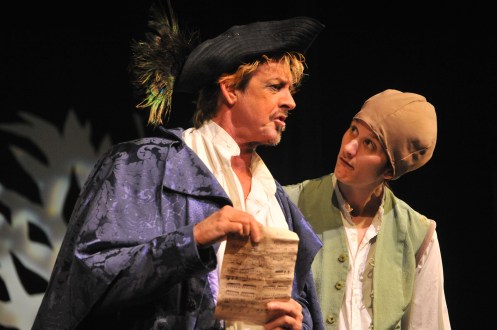
 The play’s second half takes place some sixteen years after the first. This is made explicitly clear in a post-interval chorus interjection from Time herself, Fran Billington setting the scene and indeed the tone for the rest of the play in a spectacular costume embroidered with various celestial objects. Time introduces Prince Florizel, son of King Polixenes, and Perdita. Charlie Higgs and Melissa Paris play these young lovers as a sweet and mutually infatuated pair, but their story is quickly overshadowed by that of their parents.
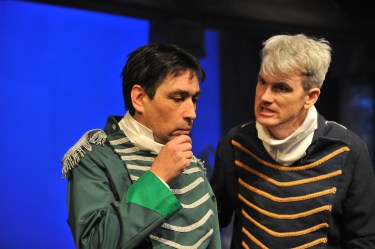 As sixteen years have passed, those parents, and many of the rest of the cast, have greyed and aged over the course of the interval, with Leontes now looking particularly haggard. Newly-minted silver foxes King Polixenes and Camillo up the ante further by wearing outrageous false beards and hooded cloaks for a trip into the countryside to spy on Florizel and Perdita, and Chris Mounsey shows his range as he moves from bemused spectator to apoplectic monarch over the course of a sheepshearing contest.
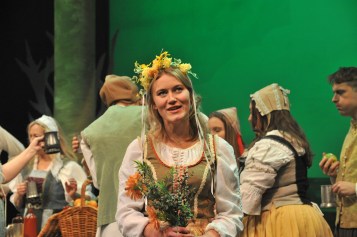 Mags Wrightson’s wardrobe draws a clear contrast between the buttoned up tunic and elaborate dresses of Sicily, and the loose peasant clothes of Bohemia, and the actors move with much greater fluidity and physicality throughout the Bohemia scenes, particularly throughout the dances choreographed by Sophie Hardie, which provide a striking contrast with the stately court dance that opens the show, choreographed by Fran Billington. This contrast is also heightened by the musical style, and even Gary Stevenson and Patrick Troughton’s lighting, which becomes much warmer for the rural scenes.
All things considered I had mixed feelings when the action returned to Sicilia for the final act. But there is a frantic pace to events as revelations come thick and fast, several of them offstage. The confirmation of Perdita’s royal heritage, and the reconciliation of both Polixenes and Leontes, and Polixenes and his son Florizel, are all related in a short scene between Autolycus and several courtiers.
Boasting a large cast, of whom many are playing multiple characters, and several dramatic changes of scenery, stage manager Harri Osborne and her team keep the action moving smoothly on stage, with occasional transitions smoothed over by musical interludes from Will Williams.
With its multiple settings, and drastic change in tone, The Winter’s Tale is a daunting prospect for any amateur company to stage. But by respecting Shakespeare’s text, and opting for a simple but adaptable set, Teddington Theatre Company have pulled off an enjoyable and entertaining production of one of the Bard’s most challenging plays.
Andrew Lawston
January 2019
Photography by Sarah J. Carter
Theatre with Realism and Bite
That Face
by Polly Stenham
Questors Theatre Company at The Studio, Ealing until 2nd February
Review by Ian Nethersell
I have been lucky enough to attend and work in many performance spaces throughout London and the Home Counties, ranging from ornate Victorian theatres to community halls. Of all these spaces The Studio at Questors Theatre is possibly my favourite. A slightly asymmetric black box that can be configured and used in a myriad of ways, limited only by imagination – and imagination and imagery were not missing from this production. It was the fully in-the-round configuration to which I entered to watch Questors Theatre’s first performance of That Face, directed by John Davey.
The play, written by Polly Stenham whilst relatively young (still in her teens) was first produced in 2007 at The Royal Court during her involvement with The Royal Court’s Young Writers’ Programme, and explores the interactions of a dysfunctional family centred around a mother who has mental health issues and a dependency to alcohol.
The set and settings by Ray Dunning were simple, striking a good balance of what was necessary to portray location and what was needed to facilitate the scene. I particularly liked the cracks painted onto the floor, echoing the fractured internal and external relationships of the characters, demonstrating great symbolism and attention to detail.
The eight scene changes were handled smoothly and confidently by Cathy Swift and her team. Sound design by Olly Potter worked well, the piece not being populated by copious sound effects. The thrash metal music for the scene changes added to the experience by creating a comfortable yet uncomfortable feeling which ironically portrayed a stability and consistency devoid from the life of the characters. Lighting design by Andrew Quick and Robert Walker was basic, but do not confuse this with simple, it achieved just the right balance of levels and coverage without complication which meant it never once stood out above the piece. Both lighting and sound were aptly operated by Tracey Wickens, who managed to juggle both tasks without drawing attention.
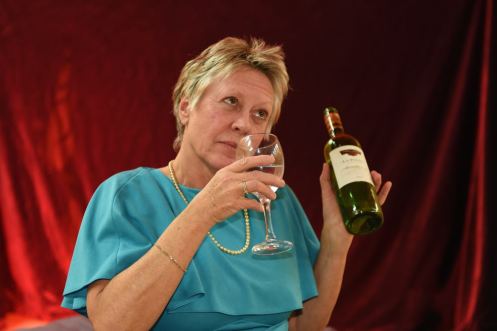
Could the tech have been used differently? Of course, if one wanted to create a different kind of production but for this telling there was a feeling of congruence which I felt hit the spot.
 In the opening scene we witness the hazing of a student, Alice, (Maria Gebhardt) in a girl’s boarding school. Not only disturbing because of the content but mostly for the callous, calculating narcissistic, bordering on psychopathic character of Izzy, (Chloë Bourke). Although initially the character of Mia, (Fionna Gough) seems to be submissive towards a bullying authority figure we soon see that this young girl is confident and more than capable of handling problems and people, a skill no doubt learned from years of living in her environment. She is quite prepared to do what is needed to be done.
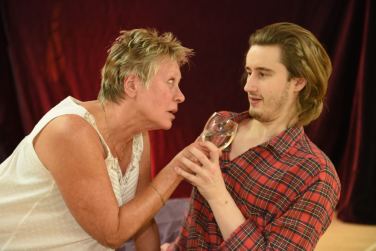 Scene Two introduces us to Martha (Wendy Gebhardt) the mother, who is in bed whilst her son, Henry, (Calvin Crawley) sleeps on top of the covers. She is recovering from the night before and with Henry upset, Martha speaks the hollow promise of the drunk, “Never again!”. When Henry threatens to leave she puts on an over-egged hypertension panic attack which shows to what degree of manipulation she is prepared to go, but this doesn’t wash with Mia who challenges Martha. It also sets clearly the reversal of role and identity, with the mother clearly in the child and victim position whilst the daughter inhabits the adult, whereas Henry is clearly adaptive to the mother. This scene also gives us a glimpse of an unhealthy relationship between mother and son which deepens and becomes more of their norm as the play progresses.
Scene Three is in the hospital where Alice is lying, hooked up to a drip after being fed a large quantity of Valium by Mia during the hazing and whilst it initially seemed that she had done it, ’just because’, it may also have been because Mia is a caring character and was trying to protect Alice from the spiteful Izzy who doesn’t care for anything except seducing Henry. After they have left the room Alice begins to cry which is loaded with emotion and content, clearly demonstrating that a good actor does not need lots of lines to act to a very high standard.
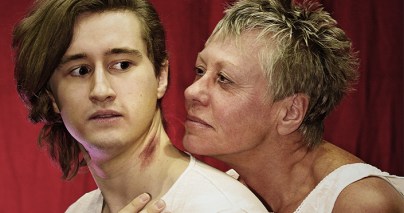 In Scene Four we witness the spiteful nature of Martha after she has cut up her son’s clothes for not coming home to her, and when she sees the marks of love-making on him she lashes out with a jealousy suggesting a different level of relationship. This is the first time we get an inkling that the underlying issue for Martha is a mental health disorder, also cemented by Henry’s words. “Martha, you live in an upside-down world”. Soon he relinquishes and we see the co-dependency in the relationship, both need each other and each other’s behaviour. This gets reinforced in the next scene when he verbally attacks Izzy who leaves in tears after her delusions to power are smashed when she sets herself against the mother for Henry’s affections.
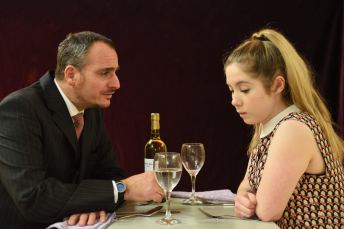 Meanwhile the father Hugh (Mike Hadjipateras) has been called by Mia’s school after her expulsion and is on his way from Hong Kong, where he now lives with his second family. During the restaurant scene with Mia we witness his inability to emotionally connect with his first family and he threatens to have Martha sectioned.
 In the final scene Martha is dressed to go out for dinner with Hugh. Henry is dressed in Martha’s nightgown and wearing make-up in what has become a complete inhabiting of the mother. Hugh and Mia walk into this and, as the conflict rises to fever pitc, Martha eventually concedes and goes with Hugh to voluntarily enter The Maudsley. After they leave we completely are left with Mia and Henry who is distraught, his reason for living and identity now gone and with the final words of the play spoken by Mia, “It will be alright. Everything will be alright” we become aware that the play was not about Martha’s issues and health, but about Henry’s.
Will history repeat itself in the relationship between sister and brother or will it be ‘alright’? Well, that would be another play and one I would rush to buy tickets for. I recommend you do for this production of a well written play with high production values by a respected theatre company if you like your theatre with realism and bite that challenges and makes you think.
It may seem this review is mostly a recounting of the story but it is more a reflection on the quality of the performances. Such was the standard of the acting and inhabiting of the roles that I fully lost contact with any actors and only experienced the complexity and depth of the characters and their world in a fully empathetic theatrical experience. John Davey has managed to pull together a superb cast to take the audience on a journey that could have been shallow and wordy but instead is taut and honest in its portrayal without glorifying or resorting to cheap gratuity. That Face is a wonderful production and well worth the 1¾ hours without interval.
Ian Nethersell
January 2019
Photography by Peter Collins
Existential Escape
Resolution 2019 (Triple Bill 10)
Dreamers Catch 28 Milk
by NamYoon Kim by Christina Dionysopoulou by Amy Ollett
NYK Dance Company, Christina Dionysopoulou, and Amy Ollett
Resolution at The Place, Euston, 24th January,
The Festival of New Choreography continues until 23rd February
A review by Mark Aspen
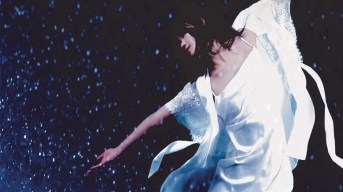 A gramophone crackling, or do we hear the fireplace where the shadow of one dancer mimics another? Like R.L. Stevenson’s My Shadow “She is very, very like me from the heels up to the head …”, but for the two dancers, the eponymous Dreamers, NamYoon Kim and Wai Shan Vivian Luk, the uneasy music and restless moves, the other “she” is uncannily not like “me”. One we see, the other in a shadowgraph on a gauze screen. The dream is not the reality, and the moves of the dreamer are distorted in the dream. Lighting design, Alex Mcmanus has kept the screen small and now we see them, no we don’t. Then birdsong, so perhaps this dream is not unpleasant. The music is more lyrical, the dance insistent but elastic. A reprise of the beat, a male dancer Ryan Charles Ledger appears, but even a Chopin nocturne cannot unravel this dream. The duet has an uneasy animation with hints of aggression. These include some unconventional moves where the dancer’s weight worryingly is taken on the neck. It is clear that dawn has not yet come, even when the lone dancer subsides in crackling uncertainty. The feeling choreographer NamYoon Kim leaves us with also seems uncertain and incomplete. The dreamscape she has created is not a nightmare, but not quite sweet dreams.
 Four figures crouch in the darkness, and then a controlled explosion of frenzied dance, a haka re-forms into a tightly coordinated concatenation of constrained tension; convulsive, percussive. Christina Dionysopoulou’s compelling Catch 28 has a raw animalistic feel. It hints at street dance within contemporary dance, but there’s more than that: there is a seething anxiety of something internalised trying to get out. The four performers (Lauren Anthony, Ayten Goksan, Hayleigh Sellors and Nevena Stojkov) move as one, fearful and staccato. Sellors’ painfully flagellatory solo is striking in all senses and highlights the impetus of the ensemble in all its aerobic robustness. The ensemble rolls agitatedly like a breaking surf in a fierce wind. Even a stylised brawl ignites in furious unison. Zack Hemsey has specially adapted the music of Enzio Bosso and the ostinato of the score underpins the edginess of the dance. Dionysopoulou’s choreography has an arresting grab-you-by-the-lapels immediacy that makes an absorbing and mesmerising experience.
 The visual impact of Milk is immediate, a bolt of white silk flows from the flies and spills across the stage. Integrating textile design into music and dance, choreographer Amy Ollett makes a bold and intriguing statement. Fabric and dancer move as one creature, creating a talking tissue, bringing a Michelangelo-esque depiction of drapery to life. Ollett has undisputable skills as a fashion designer, an art form that she has developed alongside choreography, pregnant with symbolism. The effect is poetic, but sometimes as the loops and swirls of the rich fabric envelope the dancer, there seems to the danger that she will drown. Henry Jackson Newcomb’s original score expands the lactational theme, pouring in musical milk that drips and gurgles. Here is the canvas for three veiled dancers (Rhiannon Hopkins, Federica Somma and Danielle Summers) to paint an elegant image. The shrouded bodies move with a viscous fluidity, yet one that tells of a struggle with innermost feelings. The fabric conceals; the fabric reveals. Brian J Morrison’s design is stark white and bold red, and the lighting snaps between the same colours to wash out the milk … or the blood.
Mark Aspen
January 2019
Read more at The Place’s Resolution Review
Photography by James Whiteley, Christina Dionysopoulou and Kerry Curl
Captivating Canards
C’est La Vie… Sarah Bernhardt and Me
by Hilary Tones
On The Brink Theatre at OSO Arts Centre Barnes until 24th January then on tour
A Review by Eleanor Marsh
“Sarah Bernhardt lied… she lied about everything”, is one of the first statements on the programme written by Hilary Tones, Author and Performer of this piece. And thus the scene is set: everything we are about to see may or not be true. It’s a good device, allowing much potential for artistic licence and guaranteeing that at least one audience member determined to read more about Ms Bernhardt post-show. My Amazon order has just been completed.

And what an entertaining life Bernhardt (may have) had. We discover tales of train crashes, courtesans, 19th century PR and a life lived in the global spotlight. Some of these tales are related direct to the audience, some illustrated with “silent movie” style projections and some illustrated by excerpts from some of Bernhardt’s famous performances. Of the latter, the “salad days” speech from Antony and Cleopatra was particularly effective and I was also moved by the French pieces. I do not speak a word of French but Ms Tones is a fine actress and proved – as did Bernhardt before her – that language need not be a barrier to understanding.
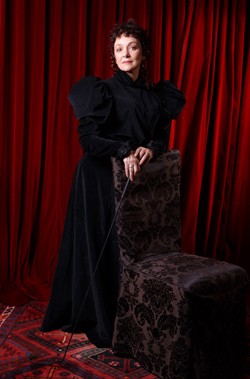 Ms Tones has quite obviously done her homework to properly research her subject. The temper tantrums, unconventional background, lack of respect for authority and legendary wooden leg are all covered. But where, amongst the delightful set comprising Art Nouveau screens, glamorous dressing gowns and the obligatory French absinthe was the coffin …? Perhaps it was too difficult to manage in practical terms but I for one was waiting to see La Bernhardt learning her lines or rehearsing in possibly the most famous bed in theatrical history. Would I have missed it had there not been so much other “set”? Probably not, but as we had a chaise longue, screens, dressing table, chest, etc. it did seem to be the missing elephant in the room. Which brings me to the argument “storytelling” vs “acting”:
 This play uses both. The initial plot device is that of an actress (we are led to believe Ms Tomes herself) en route to an audition for the role of Sarah Bernhardt. The storytelling element of the play continues as we hear about the research she’s undertaken and her quandary in choosing the correct monologue with which to audition. It’s a nice plot device and an easy way for the audience to relax into the performance. The tube journey projected behind the action, though, is a distraction and on opening night at OSO appeared to be as distracting for Ms Tones as it was for the audience. It is a relief when we meet the actual Bernhardt and the action really begins. This is when our actress seems to be at her most comfortable. As Bernhardt – and a range of her contemporaries – Hilary Tones shines. As herself (if indeed it is herself that she is portraying) she seems less sure and much more reticent; the feeling that she is deliberately holding back is palpable.
It is such a difficult thing to both write and perform a piece and ensure balance. When the subject matter is such a dramatic character in every sense of the word it makes perfect sense that the dramatic “acting” will win out over a more relaxed storytelling style and without more depth to the character of the Actress this it does. The Actress remains purely a device to introduce us to the larger than life phenomenon that was Sarah Bernhardt and on balance I think this is the right way to play the piece. And did we need the coffin? No we did not. Neither does Ms Tones require the distraction of too much back projection and lengthy costume changes. Her acting is beautiful to watch and should be admired for the talent it is without the need to dress it up unnecessarily.
This play is thoroughly engaging, entertaining and educational – Brava!
Eleanor Marsh
January 2019
Photography by Graham Bennett and Sam Parks
An Inimitable Vision of Wonderland
Alice in Wonderland
by Andrew O’Leary adapted by Jackie Howting from Lewis Carroll
Edmundian Players at Cheray Hall, Whitton until 26th January
A Review by Celia Bard
The Edmundian Players has chosen Alice in Wonderland as their pantomime this season. The script contains many of the characters that one is familiar with and loves including Alice, the Hatter, the White Rabbit, the Queen of Hearts, Dormouse, the Cheshire Cat, Tweedle Dum and Tweedle Dee. In this version of Alice, we are introduced to new characters, Jack (the gardener), Brandy, Sherry, Stella (friends of Alice), Ms Hackett, Cookie and the Drunken Archer. True to form the Edmundians has fashioned its own inimitable style producing a production that, though fun and incorporating many familiar pantomime elements, remains, in part, true to the spirit of Lewis Carroll.
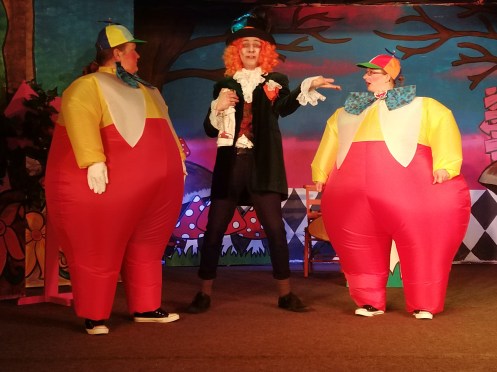
 The show opens with a musical number involving many of the ensemble characters gathered in Wonderland and the Palace Gardens. This is an effective opening and sets the tone and pace of the production. The Queen of Hearts is quickly established as the protagonist to Alice, whom the Queen wants to kill in order to steal her precious watch, but for what reason the audience is kept in suspense until the second act. Our ‘cut down’, Queen, a little person with an enormous ego, is beautifully portrayed by Jessica Young (do so hope knees were well padded!). Played straight by Jessica but the absurdity of her appearance undermines her authority. Watch out for the parody of the Royal wave.
In the next scene we are introduced to Alice’s friends, Brandy, Sherry and Stella who live with Alice in the orphanage run by the suitably snarling henchwoman, Ms Hackett. Theresa McCulloch plays this role with great gusto culminating in a rousing performance of Diamonds are Forever. Alice then makes her introduction played by Mary McGrath, who is very close to Lewis Carroll’s Alice: caring and gentle, courteous and truthful, but not afraid to stand up to any ‘baddies’. Mary gives a very pleasing performance as Alice, pleasing to look at and to listen to, a young actor with good physicality and a tuneful voice.


 The interaction between Alice and the wonderful hip-hop singing White Rabbit is lively and jokey. This character is far removed from Carroll’s vision, bringing in a very 21st century street culture. Paula Young relishes this role and gives a sustained ‘cutesy but matey’ performance. The Dame, beautifully played by Matt Ludbrook, makes a suitably grand entrance as Cookie, the cook, and manages to deliver many stock panto gags and jokes with a freshness and enthusiasm as if they had never been seen or heard before: a great feat. The mock slapstick striptease was a tour de force of timing and low humour. Ellen Walker and Becky Halden as Tweedle Dum and Tweedle Dee certainly live up to one of their personality characteristics, seeing riddles in everything. The three of them succeed in performing the well-worn custard pies routine deftly, resulting in a genuinely funny laugh out loud moment.
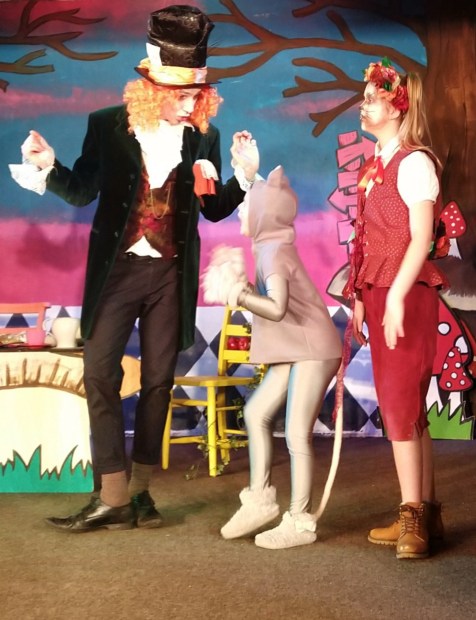 We then enter the Hatter’s Tea Party scenes between Hatter (Matt Nicholas), March Hare (Clare Blake) and Dormouse (Evie Schaapveld). All three are deliciously delightful performers. Matt Nicholas is an actor with a great star quality presence, bringing the Hatter to life with aplomb. His timing is faultless, as also is his ability to interact with other performers. His rendering of A Very Unhappy Birthday to Me and A Nice Cup of Tea was delivered as if he were a great opera singer, which so suits Hatter’s personality. A disarming moment occurs when he lifts the dormouse out of the teapot. Here mention must be made of the scene stealing performance of young Evie who has remarkably sharp timing and stage awareness for someone so young. Throughout her scenes she acts and re-acts, so totally absorbed is she in her role and all that is going on around her. The trio is completed by the March Hare, played with great authenticity and enthusiasm by Clare Blake.


The grinning Cheshire Cat is artistically and cleverly acted by young Marie Blake, popping up and disappearing throughout the performance, totally in keeping with Carroll’s concept of this character. The Cat is the only character to speak in verse and Marie’s balletic, feline movement beautifully complements her characterisation.
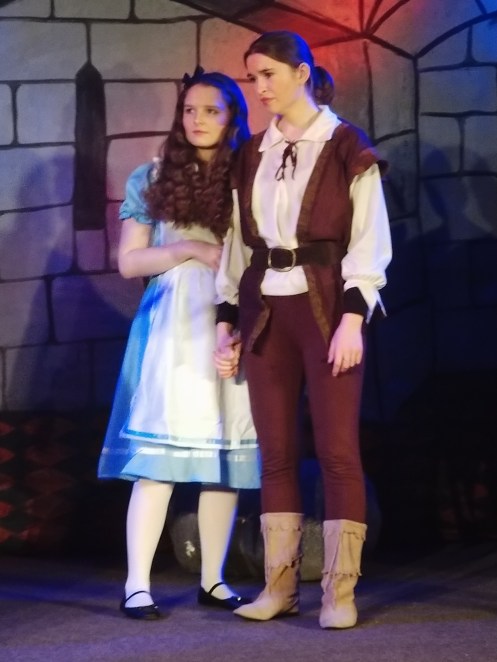
Jack, the Gardener, played by Lucy Blake, is a wholly pantomime stock character and here we part company with the Lewis Carroll story for Jack is introduced as a love interest for Alice. The stereotypical slapping of the thighs is restrained, but performed tongue-in-cheek, which goes down well with the audience. ‘His’ scenes with Alice are charming. Nick Garvey is well cast as the King, in every way an amusing contrast to the shrill, bossy, outrageous personality of his Queen. Bob King’s drunken archer scene is a delightful parody of the drunken sailor song.
Mention must be made of the musical director, Roger Swift. He is a musician who is totally sympathetic to the musical requirements of performers and production, and artistically makes full use of the numerous sound effects of his keyboard. The musical numbers selected are appropriate and integrate well in the scripts, sang with confidence and enthusiasm by the entire ensemble.
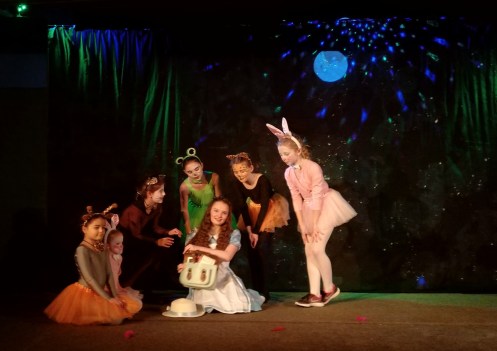
The production under the skilled hands of the Director, Jackie Howting, flows easily. Nothing is laboured. It has a pleasing pace and extremely good use is made of the acting area supported by beautifully constructed and designed sets and colourful costumes, helping to transport the audience, along with Alice, into Wonderland. The Palace Gardens and Mushroom Glade sets are particularly imaginative in design.
Alice in Wonderland proved to be a thoroughly enjoyable and entertaining production. Although it may not have been Lewis Carroll’s vision of Wonderland, it was just great to meet many of his anthropomorphic characters in an Edmundian Fairyland.
Celia Bard
January 2019
Photography by Juliette Wait
Two Stories, One Artiste
Piaf Remembered
by Gary Merry
Piaf Remembered Company at OSO Arts Centre, Barnes until 18th January, then on tour until 4th November
A review by Vince Francis
A welcome return to the OSO Arts Centre in Barnes on a crisp January evening, this time in full reviewer mode eagerly anticipating the delights of what I expected to be a straightforward tribute show. How gratifyingly erroneous that assumption turned out to be.

The auditorium was configured in cabaret style; that is to say, with tables and chairs rather than raked seating. Personally, I like this arrangement, particularly for music based shows, but it does have its drawbacks. If the stage is not elevated, as was the case here, then there can be sight-line issues. Having said that, we sat toward the rear of the hall and were not troubled in that respect.
 Piaf Remembered was premiered at the Edinburgh Festival Fringe 2017. The show is, effectively, two stories told in parallel by the narrator, Robert Dumont, played by Gary Merry. Firstly, there is the tale of Dumont, aged eight, accompanying his father on a trip to Paris in 1962, during which he is taken to see Piaf in what turned out to be her final concert. This leads us to the second story, which is that of Edith Piaf and his fascination with her. The stories are interwoven with the songs of Piaf, presumably from that final performance, delivered beautifully by Oriana Curls, who is supported most ably by Chris Jerome on piano and Katy Jungmann on clarinet, saxophone and accordion.
I found the storytelling hugely engaging, recreating the excitement, nervousness and fascination of an eight-year old attempting to understand the world of grown-ups and the frankly gob-smacking impact of seeing someone of the artistic stature of Piaf in full flow.


One of the points made is that you don’t need to be fluent in a language to understand and be affected by the songs written in it. I agree with this, having first encountered the phenomenon in a song called Guantanamera, by the Sandpipers sometime in the ‘60s. I would have been around the same age as Dumont was on his visit to Paris and my Spanish would have been equivalent to his French. My French remains at best rudimentary, to my shame, but Oriana Curls’ performance overcomes that by completely inhabiting the spirit of the song and laying it out for you.
I enjoyed this show enormously and would have no hesitation in recommending it, particularly to Piaf fans. Some of the finer details of Piaf’s life are glossed over or missing, but that, I think, should be viewed in the context of a young lad’s story of a foray into foreign climes.
Technically, the sound was well balanced for the venue, with the vocals nicely forward in the mix without being harsh or over dominant. Lighting-wise, I would have preferred to see stronger contrast between, particularly, Oriana and Robert, such that when Oriana sings, Robert is in blackout and vice versa. I appreciate that, for a touring production, there isn’t always time to rig and patch for the niceties but, if it is at all possible …
I would also have liked to have seen a programme, or at the very least a song list, so that I could go and chase down those numbers that I was less familiar with and add them to sundry playlists. In any event, most of the well-known numbers are present, including:
• Sous les ciels de Paris
• Padam, padam
• L’hymne à l’amour
• Les feuilles mortes (some very tasteful soloing here, on both piano and sax)
• Milord (guaranteed to get the audience’s feet a’stompin’ and hands a’clappin’)
• La vie en rose
• Je ne regrette rien
Minor niggles aside, go and see it. As I said earlier, an even more enjoyable evening than I had anticipated. Je ne regrette rien !!
Vince Francis
January 2019
Photography courtesy of Piaf Remembered Company
Interaction and Inter-Reaction
Resolution 2019 (Triple Bill 3)
Proxy Shifted Taffeta Dreaming
by Si Rawlinson by Natalie Bell by A.Cox, E. Howard and C. Williams
Wayward Thread, nat.co and Trah and Chips Theatre and Dance Ensemble at The Place, Euston, 15th January,
The Festival of New Choreography continues until 23rd February
A review by Mark Aspen
“Who are you?” A running theme of displacement preoccupies the triple bill on the third night of Resolution 2019, with three new choreographers looking from very different angles on the facets at the concept. Are we who someone else tells us to be? Are we who someone else forces us to be? Or are we who our own psyche tells us to be?
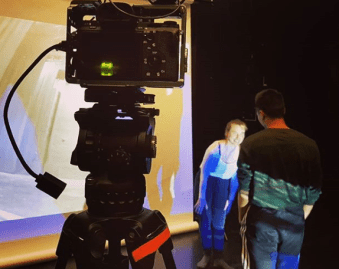 Do we all figuratively dance in the dark? But before that, an explicit question “Who are you?” Perhaps impossible to answer, but this is the question that experimental choreographer Si Rawlinson asks his dancers, quite literally so, in Proxy, a piece that demands much more than physical prowess from them. His eclectic approach brings together semi-scripted dialogue, video techniques including infra-red imaging, and physical theatre to explore the authenticity of self. The answer to Rawlinson’s question is in the title of the piece: we are what others make of us. Laura Vanhulle and Dan Phung, an engaging pair of dancer-actors, manipulate each other physically and psychologically. Laura moves as Dan gives voice to his image of her movements, Dan speaks as Laura manipulates his face muscles, and yes, they do dance in the dark as we watch through spy cameras. But technology rules OK, audio visual artist Dan Lowenstein is on stage with all his paraphernalia and the auto-voyeurism of the ubiquitous selfie is lasciviously demonstrated by our dancers. Proxy has the feel of work in progress and it begs a more rounded piece to allow us more of two supple and composed dancers.
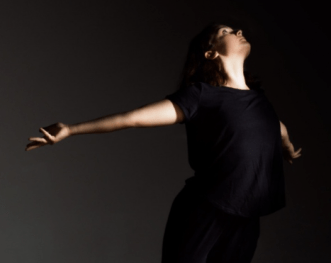 Shifted is supernal. From its lyrical opening to its tense conclusion, Natalie Bell’s intricately choreographed depiction of displacement is riveting. The piece has a narrative with a chronology double-defined by the distressful dichotomy of what is taken and what is left when humanity is uprooted. Whereas the season programme hinted at a reference to the refugee migrations into Europe over the last few years, this piece is far wider, its temporal and spatial co-ordinates being undefined. Shifted opens with an image reminiscent of a sea-anemone wafted to and fro by the currents. Is the creature confined or is she firmly rooted? Gabriele Martin moves with a limpid liquidity, but her ankles are tightly bound by the recumbent forms of fellow dancers Brandon Clarke and Samuel Ozouf. A dynamically depicted journey follows the turmoil of fleeing, at sea and on land. The precisely coordinated athleticism of the two male dancers underlined the agitation in this timeless study of expulsion and exile.
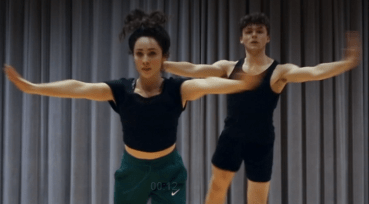 Now for something entirely different. Alex James-Cox’s characters in Taffeta Dreaming are displaced from the comfort of their northern hometown to the relentless pressure-cooker of London. Their story, told with well-defined body language, has open humour tinged with sincere pathos. Daisy is very fond of Isaac. Isaac is, however, a bisexual who is “trying to get to like girls”. The story unfolds in a robust blend of contemporary dance with stand-up, consummately delivered by Rebecca Hesketh-Smith and Stuart Thompson. When Isaac declares himself gay to Daisy, their experimental first kiss goes off, if you’ll excuse the term, at half-cock. The characterisation is spot-on: the awkwardness of encounter, the embarrassment of getting it wrong, the disappointments are all neatly portrayed, as brassy petulance and coy withdrawal fight for the moment.
Mark Aspen
January 2019
Read more at The Place’s Resolution Review


 Mark Aspen