
Captivating Canards
C’est La Vie… Sarah Bernhardt and Me
by Hilary Tones
On The Brink Theatre at OSO Arts Centre Barnes until 24th January then on tour
A Review by Eleanor Marsh
“Sarah Bernhardt lied… she lied about everything”, is one of the first statements on the programme written by Hilary Tones, Author and Performer of this piece. And thus the scene is set: everything we are about to see may or not be true. It’s a good device, allowing much potential for artistic licence and guaranteeing that at least one audience member determined to read more about Ms Bernhardt post-show. My Amazon order has just been completed.

And what an entertaining life Bernhardt (may have) had. We discover tales of train crashes, courtesans, 19th century PR and a life lived in the global spotlight. Some of these tales are related direct to the audience, some illustrated with “silent movie” style projections and some illustrated by excerpts from some of Bernhardt’s famous performances. Of the latter, the “salad days” speech from Antony and Cleopatra was particularly effective and I was also moved by the French pieces. I do not speak a word of French but Ms Tones is a fine actress and proved – as did Bernhardt before her – that language need not be a barrier to understanding.
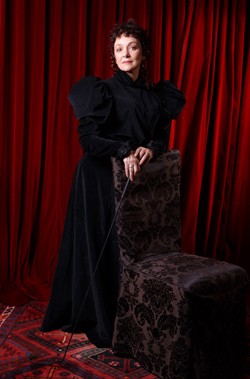 Ms Tones has quite obviously done her homework to properly research her subject. The temper tantrums, unconventional background, lack of respect for authority and legendary wooden leg are all covered. But where, amongst the delightful set comprising Art Nouveau screens, glamorous dressing gowns and the obligatory French absinthe was the coffin …? Perhaps it was too difficult to manage in practical terms but I for one was waiting to see La Bernhardt learning her lines or rehearsing in possibly the most famous bed in theatrical history. Would I have missed it had there not been so much other “set”? Probably not, but as we had a chaise longue, screens, dressing table, chest, etc. it did seem to be the missing elephant in the room. Which brings me to the argument “storytelling” vs “acting”:
 This play uses both. The initial plot device is that of an actress (we are led to believe Ms Tomes herself) en route to an audition for the role of Sarah Bernhardt. The storytelling element of the play continues as we hear about the research she’s undertaken and her quandary in choosing the correct monologue with which to audition. It’s a nice plot device and an easy way for the audience to relax into the performance. The tube journey projected behind the action, though, is a distraction and on opening night at OSO appeared to be as distracting for Ms Tones as it was for the audience. It is a relief when we meet the actual Bernhardt and the action really begins. This is when our actress seems to be at her most comfortable. As Bernhardt – and a range of her contemporaries – Hilary Tones shines. As herself (if indeed it is herself that she is portraying) she seems less sure and much more reticent; the feeling that she is deliberately holding back is palpable.
It is such a difficult thing to both write and perform a piece and ensure balance. When the subject matter is such a dramatic character in every sense of the word it makes perfect sense that the dramatic “acting” will win out over a more relaxed storytelling style and without more depth to the character of the Actress this it does. The Actress remains purely a device to introduce us to the larger than life phenomenon that was Sarah Bernhardt and on balance I think this is the right way to play the piece. And did we need the coffin? No we did not. Neither does Ms Tones require the distraction of too much back projection and lengthy costume changes. Her acting is beautiful to watch and should be admired for the talent it is without the need to dress it up unnecessarily.
This play is thoroughly engaging, entertaining and educational – Brava!
Eleanor Marsh
January 2019
Photography by Graham Bennett and Sam Parks
An Inimitable Vision of Wonderland
Alice in Wonderland
by Andrew O’Leary adapted by Jackie Howting from Lewis Carroll
Edmundian Players at Cheray Hall, Whitton until 26th January
A Review by Celia Bard
The Edmundian Players has chosen Alice in Wonderland as their pantomime this season. The script contains many of the characters that one is familiar with and loves including Alice, the Hatter, the White Rabbit, the Queen of Hearts, Dormouse, the Cheshire Cat, Tweedle Dum and Tweedle Dee. In this version of Alice, we are introduced to new characters, Jack (the gardener), Brandy, Sherry, Stella (friends of Alice), Ms Hackett, Cookie and the Drunken Archer. True to form the Edmundians has fashioned its own inimitable style producing a production that, though fun and incorporating many familiar pantomime elements, remains, in part, true to the spirit of Lewis Carroll.
 The show opens with a musical number involving many of the ensemble characters gathered in Wonderland and the Palace Gardens. This is an effective opening and sets the tone and pace of the production. The Queen of Hearts is quickly established as the protagonist to Alice, whom the Queen wants to kill in order to steal her precious watch, but for what reason the audience is kept in suspense until the second act. Our ‘cut down’, Queen, a little person with an enormous ego, is beautifully portrayed by Jessica Young (do so hope knees were well padded!). Played straight by Jessica but the absurdity of her appearance undermines her authority. Watch out for the parody of the Royal wave.
In the next scene we are introduced to Alice’s friends, Brandy, Sherry and Stella who live with Alice in the orphanage run by the suitably snarling henchwoman, Ms Hackett. Theresa McCulloch plays this role with great gusto culminating in a rousing performance of Diamonds are Forever. Alice then makes her introduction played by Mary McGrath, who is very close to Lewis Carroll’s Alice: caring and gentle, courteous and truthful, but not afraid to stand up to any ‘baddies’. Mary gives a very pleasing performance as Alice, pleasing to look at and to listen to, a young actor with good physicality and a tuneful voice.


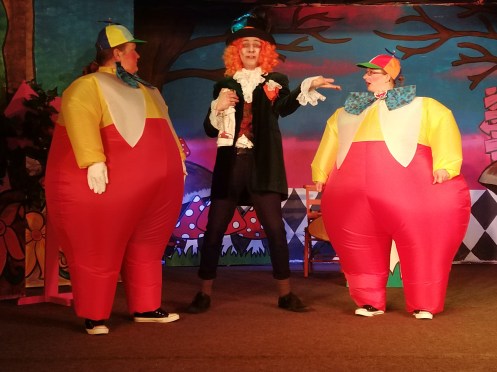
 The interaction between Alice and the wonderful hip-hop singing White Rabbit is lively and jokey. This character is far removed from Carroll’s vision, bringing in a very 21st century street culture. Paula Young relishes this role and gives a sustained ‘cutesy but matey’ performance. The Dame, beautifully played by Matt Ludbrook, makes a suitably grand entrance as Cookie, the cook, and manages to deliver many stock panto gags and jokes with a freshness and enthusiasm as if they had never been seen or heard before: a great feat. The mock slapstick striptease was a tour de force of timing and low humour. Ellen Walker and Becky Halden as Tweedle Dum and Tweedle Dee certainly live up to one of their personality characteristics, seeing riddles in everything. The three of them succeed in performing the well-worn custard pies routine deftly, resulting in a genuinely funny laugh out loud moment.
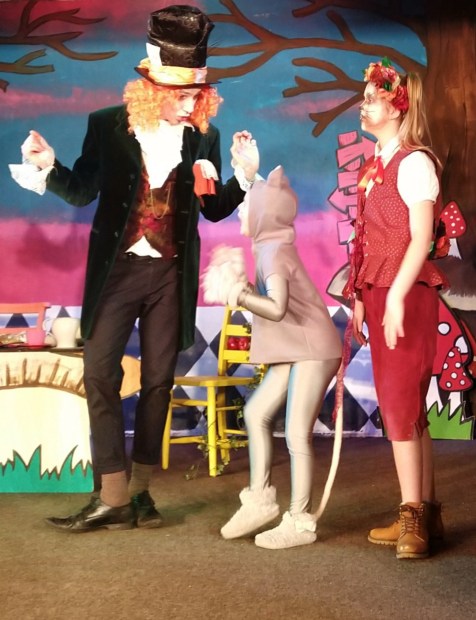 We then enter the Hatter’s Tea Party scenes between Hatter (Matt Nicholas), March Hare (Clare Blake) and Dormouse (Evie Schaapveld). All three are deliciously delightful performers. Matt Nicholas is an actor with a great star quality presence, bringing the Hatter to life with aplomb. His timing is faultless, as also is his ability to interact with other performers. His rendering of A Very Unhappy Birthday to Me and A Nice Cup of Tea was delivered as if he were a great opera singer, which so suits Hatter’s personality. A disarming moment occurs when he lifts the dormouse out of the teapot. Here mention must be made of the scene stealing performance of young Evie who has remarkably sharp timing and stage awareness for someone so young. Throughout her scenes she acts and re-acts, so totally absorbed is she in her role and all that is going on around her. The trio is completed by the March Hare, played with great authenticity and enthusiasm by Clare Blake.


The grinning Cheshire Cat is artistically and cleverly acted by young Marie Blake, popping up and disappearing throughout the performance, totally in keeping with Carroll’s concept of this character. The Cat is the only character to speak in verse and Marie’s balletic, feline movement beautifully complements her characterisation.
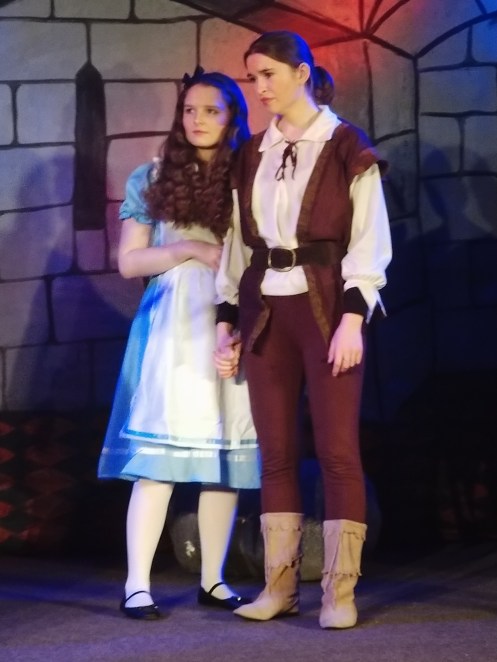
Jack, the Gardener, played by Lucy Blake, is a wholly pantomime stock character and here we part company with the Lewis Carroll story for Jack is introduced as a love interest for Alice. The stereotypical slapping of the thighs is restrained, but performed tongue-in-cheek, which goes down well with the audience. ‘His’ scenes with Alice are charming. Nick Garvey is well cast as the King, in every way an amusing contrast to the shrill, bossy, outrageous personality of his Queen. Bob King’s drunken archer scene is a delightful parody of the drunken sailor song.
Mention must be made of the musical director, Roger Swift. He is a musician who is totally sympathetic to the musical requirements of performers and production, and artistically makes full use of the numerous sound effects of his keyboard. The musical numbers selected are appropriate and integrate well in the scripts, sang with confidence and enthusiasm by the entire ensemble.
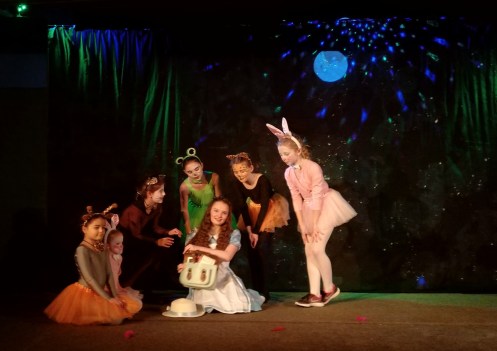
The production under the skilled hands of the Director, Jackie Howting, flows easily. Nothing is laboured. It has a pleasing pace and extremely good use is made of the acting area supported by beautifully constructed and designed sets and colourful costumes, helping to transport the audience, along with Alice, into Wonderland. The Palace Gardens and Mushroom Glade sets are particularly imaginative in design.
Alice in Wonderland proved to be a thoroughly enjoyable and entertaining production. Although it may not have been Lewis Carroll’s vision of Wonderland, it was just great to meet many of his anthropomorphic characters in an Edmundian Fairyland.
Celia Bard
January 2019
Photography by Juliette Wait
Two Stories, One Artiste
Piaf Remembered
by Gary Merry
Piaf Remembered Company at OSO Arts Centre, Barnes until 18th January, then on tour until 4th November
A review by Vince Francis
A welcome return to the OSO Arts Centre in Barnes on a crisp January evening, this time in full reviewer mode eagerly anticipating the delights of what I expected to be a straightforward tribute show. How gratifyingly erroneous that assumption turned out to be.

The auditorium was configured in cabaret style; that is to say, with tables and chairs rather than raked seating. Personally, I like this arrangement, particularly for music based shows, but it does have its drawbacks. If the stage is not elevated, as was the case here, then there can be sight-line issues. Having said that, we sat toward the rear of the hall and were not troubled in that respect.
 Piaf Remembered was premiered at the Edinburgh Festival Fringe 2017. The show is, effectively, two stories told in parallel by the narrator, Robert Dumont, played by Gary Merry. Firstly, there is the tale of Dumont, aged eight, accompanying his father on a trip to Paris in 1962, during which he is taken to see Piaf in what turned out to be her final concert. This leads us to the second story, which is that of Edith Piaf and his fascination with her. The stories are interwoven with the songs of Piaf, presumably from that final performance, delivered beautifully by Oriana Curls, who is supported most ably by Chris Jerome on piano and Katy Jungmann on clarinet, saxophone and accordion.
I found the storytelling hugely engaging, recreating the excitement, nervousness and fascination of an eight-year old attempting to understand the world of grown-ups and the frankly gob-smacking impact of seeing someone of the artistic stature of Piaf in full flow.


One of the points made is that you don’t need to be fluent in a language to understand and be affected by the songs written in it. I agree with this, having first encountered the phenomenon in a song called Guantanamera, by the Sandpipers sometime in the ‘60s. I would have been around the same age as Dumont was on his visit to Paris and my Spanish would have been equivalent to his French. My French remains at best rudimentary, to my shame, but Oriana Curls’ performance overcomes that by completely inhabiting the spirit of the song and laying it out for you.
I enjoyed this show enormously and would have no hesitation in recommending it, particularly to Piaf fans. Some of the finer details of Piaf’s life are glossed over or missing, but that, I think, should be viewed in the context of a young lad’s story of a foray into foreign climes.
Technically, the sound was well balanced for the venue, with the vocals nicely forward in the mix without being harsh or over dominant. Lighting-wise, I would have preferred to see stronger contrast between, particularly, Oriana and Robert, such that when Oriana sings, Robert is in blackout and vice versa. I appreciate that, for a touring production, there isn’t always time to rig and patch for the niceties but, if it is at all possible …
I would also have liked to have seen a programme, or at the very least a song list, so that I could go and chase down those numbers that I was less familiar with and add them to sundry playlists. In any event, most of the well-known numbers are present, including:
• Sous les ciels de Paris
• Padam, padam
• L’hymne à l’amour
• Les feuilles mortes (some very tasteful soloing here, on both piano and sax)
• Milord (guaranteed to get the audience’s feet a’stompin’ and hands a’clappin’)
• La vie en rose
• Je ne regrette rien
Minor niggles aside, go and see it. As I said earlier, an even more enjoyable evening than I had anticipated. Je ne regrette rien !!
Vince Francis
January 2019
Photography courtesy of Piaf Remembered Company
Interaction and Inter-Reaction
Resolution 2019 (Triple Bill 3)
Proxy Shifted Taffeta Dreaming
by Si Rawlinson by Natalie Bell by A.Cox, E. Howard and C. Williams
Wayward Thread, nat.co and Trah and Chips Theatre and Dance Ensemble at The Place, Euston, 15th January,
The Festival of New Choreography continues until 23rd February
A review by Mark Aspen
“Who are you?” A running theme of displacement preoccupies the triple bill on the third night of Resolution 2019, with three new choreographers looking from very different angles on the facets at the concept. Are we who someone else tells us to be? Are we who someone else forces us to be? Or are we who our own psyche tells us to be?
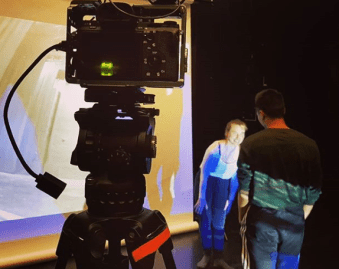 Do we all figuratively dance in the dark? But before that, an explicit question “Who are you?” Perhaps impossible to answer, but this is the question that experimental choreographer Si Rawlinson asks his dancers, quite literally so, in Proxy, a piece that demands much more than physical prowess from them. His eclectic approach brings together semi-scripted dialogue, video techniques including infra-red imaging, and physical theatre to explore the authenticity of self. The answer to Rawlinson’s question is in the title of the piece: we are what others make of us. Laura Vanhulle and Dan Phung, an engaging pair of dancer-actors, manipulate each other physically and psychologically. Laura moves as Dan gives voice to his image of her movements, Dan speaks as Laura manipulates his face muscles, and yes, they do dance in the dark as we watch through spy cameras. But technology rules OK, audio visual artist Dan Lowenstein is on stage with all his paraphernalia and the auto-voyeurism of the ubiquitous selfie is lasciviously demonstrated by our dancers. Proxy has the feel of work in progress and it begs a more rounded piece to allow us more of two supple and composed dancers.
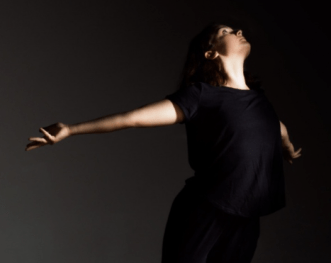 Shifted is supernal. From its lyrical opening to its tense conclusion, Natalie Bell’s intricately choreographed depiction of displacement is riveting. The piece has a narrative with a chronology double-defined by the distressful dichotomy of what is taken and what is left when humanity is uprooted. Whereas the season programme hinted at a reference to the refugee migrations into Europe over the last few years, this piece is far wider, its temporal and spatial co-ordinates being undefined. Shifted opens with an image reminiscent of a sea-anemone wafted to and fro by the currents. Is the creature confined or is she firmly rooted? Gabriele Martin moves with a limpid liquidity, but her ankles are tightly bound by the recumbent forms of fellow dancers Brandon Clarke and Samuel Ozouf. A dynamically depicted journey follows the turmoil of fleeing, at sea and on land. The precisely coordinated athleticism of the two male dancers underlined the agitation in this timeless study of expulsion and exile.
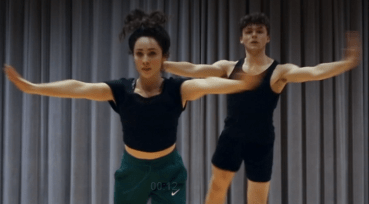 Now for something entirely different. Alex James-Cox’s characters in Taffeta Dreaming are displaced from the comfort of their northern hometown to the relentless pressure-cooker of London. Their story, told with well-defined body language, has open humour tinged with sincere pathos. Daisy is very fond of Isaac. Isaac is, however, a bisexual who is “trying to get to like girls”. The story unfolds in a robust blend of contemporary dance with stand-up, consummately delivered by Rebecca Hesketh-Smith and Stuart Thompson. When Isaac declares himself gay to Daisy, their experimental first kiss goes off, if you’ll excuse the term, at half-cock. The characterisation is spot-on: the awkwardness of encounter, the embarrassment of getting it wrong, the disappointments are all neatly portrayed, as brassy petulance and coy withdrawal fight for the moment.
Mark Aspen
January 2019
Read more at The Place’s Resolution Review
Photography by Dan Lowenstein, Dougie Evans and Tom Gimson
Decadent Dangers of the Demi-Monde
Manon
by Kenneth MacMillan, music by Jules Massenet
English National Ballet at the London Coliseum until 20th January
Review by Mark Aspen
Power, money, sex, the primordial drivers of the human psyche. If you play with fire, don’t use these as your toys. This is the moral of Manon, the ballet retelling of Abbé Prévost’s story of tenderness versus lust. In its reimagining of Kenneth MacMillan’s 1974 version, the English National Ballet’s production is an exquisitely spirited piece of storytelling.

Manon’s Coliseum production was germinated by the Royal Danish Ballet. Its crisp design by Mia Stensgaard counterintuitively uses the clean simplicity of twentieth century Danish style to portray the baroque of eighteenth century Paris, yet without any loss of period veracity. So panels slide to reveal the arrival of barouches and landaus bringing the wealthy to the fashionable salons. It is a Paris where, between lush luxury and bleak poverty, there floats a seedy demi-monde.
But to the young, adventurous and inquisitive Manon this is an exciting world where a frisson of danger may be the harbinger of many opportunities. Begoña Cao opens up an eloquent exposition of the contradictions of Manon’s character, swinging from caprice to caution, from romance to reason, licentiousness to licence. She pushes the boundaries of her allure in one direction after another, for she has an almost intuitive skill in flirting: the eyelids flicker, she floats off in a series of bourrée en arrière, a sudden turn …
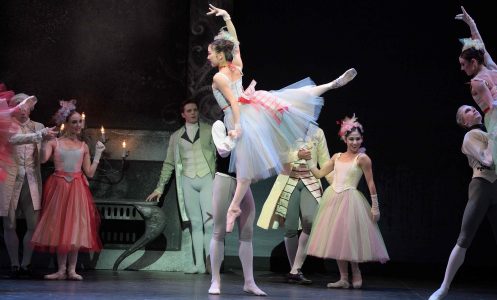
Nevertheless, manipulating the man’s world of pre-revolutionary France is fraught. Here women may be seen merely as chattels, witness a caged cart of tarts drawn through the crowds at the beginning of this ballet. Manon’s brother, Lescaut, has no compunction about cashing-in on the assets of his young sister by pimping her to the highest bidder, at first an Old Man (in a comic cameo by Michael Coleman), but soon to be trumped by the wealthy and ruthless Monsieur GM. No-one could argue that Lescaut is not a slimy sleazebag and Ken Saruhashi is compelling in his characterisation of Lescaut as depraved, ill-mannered and arrogant. Saruhashi’s precise and powerful performance portrays the cocky confidence of the corrupt fixer. Percussive jetés battus and highly defined movements speak of Lescaut’s misplaced self-assurance, whereas Saruhashi’s drunken dance as Lescault has hit the bottle injects a moment of comic relief. Maybe ruthlessness has a dark attraction, for Lescaut has a loyal mistress. Crystal Costa’s interpretation is charming and vivacious, with beautifully adept solos. One feels she is too good for the likes of Lescaut.

A monopoly in wickedness is not however held by Lescuat: try the domineering and volatile Monsieur GM. Here is a man not to be crossed. Whatever he wants he buys, with money, or … well, there’s the boys. Junor Souza cuts an imposing figure as a truly menacing Monsieur GM and, in a dangerous mix, he is both short tempered and vain. He struts like a peacock exuding an air of invulnerability. However, it is Manon who is the bird he wants to catch. Manon knows she is a bird flying into a gilded cage, but if the choice is hungry penury or comfortable courtesanship it is worth the risk. Cao shudders as she portrays Manon accepting GM’s furs and diamonds: a shudder of horror or of excitement? In a voluptuous pas de trois, she luxuriates in the risk she is taking as Lescaut and GM pass her back and forth. Equally in the later brothel scene, she clearly enjoys the power of her own allure as she is passed seductively from man to man, drifting in Massenet’s quasi-oriental musical sway. As she is lifted and lowered, we see it allegorises her adoration and inevitably her eventual degradation.

Nevertheless, Manon has found true love, love with the scholarly and serious student Des Grieux. Aitor Arrieta paints a picture of the innocent abroad as Des Grieux wanders into this stewpot of sleaze. But for him, and for Manon, it is love at first sight. He, literally and figuratively, sweeps her off her feet, and we are treated by Cao and Arrieta to a gorgeous series of pas de deux that are variously playful or erotic, but always with the urgency that comes with being in love. Arrieta’s performance speaks tenderness, Cao’s an unwonted vulnerability, but always with a sense of joy. This joy has a crowning moment as, when Des Grieux has just left, she leaps ecstatically onto their bed. However, when he returns, Manon has been abducted by GM. Arrieta’s display of DesGrieux’s anguish is palpable.
Des Greux though has some spunk, and is off to the chaos of Madame’s house of ill-repute, with its dissipated debauchery of its clients and catty wantonness of its harlots. Here the cock-a-hoop Monsieur GM is showing off Manon as his prize. Stensgaard’s restrained exoticism is evident in her caustic pastels contradicting the gaudy spirit of the scene. The corps de ballet populates this scene of frenzied decadence. The atmosphere is incendiary and finally ignites when Des Greux beats Monsieur GM at baccarat and runs off with the winnings and with Manon.

Still, we all know that this will end in tears. Des Greux’s aborted arrest by Monsieur GM and his subservient constables gives a great show of athletic fencing, culminating in the fatal shooting of Monsieur GM. Unjustly though, it is Manon who is captured, tried and sentence to deportation. Dao’s transparent rendering of Manon’s abject dejection is heart-breaking. Shorn, grey and heavy-headed she is the antithesis of the former self. The faithful Des Greux has followed her to New Orleans, but too late to rescue her from the licentious intentions of the The Gaoler, forcefully danced by Daniel Kraus. The Gaoler knows who is in control and his violation of the weakened Manon is sickening. Des Greux wreaks lethal vengeance on The Gaoler and, only just in the nick of time, they make their escape.

It’s out of the frying pan and into the fire of the Louisiana swamps (impressive superfog from the Coliseum’s techies!) where “the past flashes before her eyes” as the enfeebled and exhausted Manon succumbs to the vicissitudes of the tropics. The final moments of the ballet, the passion of Manon’s death, are visceral.
The dancers are indisputable fantastic storytellers, but a co-star is Massenet’s music so beautifully delivered by the English National Ballet Philharmonic under the controlled and consummate baton of Orlando Jopling with such balance and grace.
The delicacy of Massenet’s score contrasts bitingly with this story with no happy ending for the damaged Manon. She plays with fire and loses. We may reflect, which of those three toys is the most damaging, power, money, or sex?
Mark Aspen
January 2019
Photography by Laurent Liotardo
Tweaking the Triangle
Lies Low
by Rian Flatley
Clariann Productions at the Coward Studio, Hampton Hill Theatre until 19th January
A review by Eleanor Lewis
Lies Low, on the face of it, is a love triangle. It is the usual love triangle format, a man and two women and it occurs to me in passing that I can’t recall a love triangle drama involving a woman and two men and it’s probably time someone wrote one, but I digress.

Love triangle aside, there is a great deal more to the lives of the three characters in Lies Low than their relationship issues, which is quite frustrating because the potentially interesting plot lacks the required pace. It lacks a director.
I suppose every reviewer has their ‘thing’. This one currently has two: the biggest being directors (please get one if you’re doing a play); the second props. Directors have specific skills and they’re really useful. They haven’t written the play which makes them objective about it and therefore likely to produce it in the most effective way. If you’ve written the play you’re protective of it (as you should be) but as the writer, your role is to produce the food while the director gives the dinner party.
Lies Low has the type of story arc that requires a build-up of tension and a drip-feed of information. Whilst attempting to achieve this, it rather crawled through a couple of lengthy sections in the middle which served mainly to produce some heroic acting from Clare Gollop who was left alone on stage, more than once, with little to do other than look around a flat, for what felt like a very long time.
Similarly, towards the end of the piece, Kate Winder’s reaction to discovering the truth about her lover suggested that the direction she’d been given amounted to: “just really shout a lot”. Understandable, but dramatically there are a lot of opportunities for channelling your venom as a scorned woman and really getting under his skin at this point rather than just yelling as loud as you can.
Andrew McDonald’s portrayal of a confused rather than particularly complex middle aged man was a little black and white which again, may be due to direction (or writing).
Mr McDonald stumbled a little with his lines and this may have been first night nerves but beyond this, his character’s relentlessly aggressive and irritated attitude towards his wife needed a little tempering in order to make him sympathetic in any way at all.
Producing theatre, particularly new writing on a low budget, is both difficult and a good thing to do. It helps though, if you can iron out the details. Scene changes in this work took longer than was ideal and seemed to be governed by when the keyboard player providing the soundtrack had finished his agreed section of music. This would be better the other way round, with the actors dictating when the change is finished, it would help maintain pace. The soundtrack itself was an asset, being gentle and complimentary to the drama, as was the lighting which darkened effectively at appropriate moments.
Granted, props are not top of the priority list, but boy can they spring to the forefront sometimes! A small brown carrier bag which is apparently full of sandwiches but is evidently full of nothing at all has an annoying ability to draw attention to itself, particularly in the small space that is Hampton Hill’s studio. Empty sandwich wrappers stuffed with paper would suffice but sending it on empty makes it surprisingly noticeable. (Though this isn’t unusual, I’ve seen many actors, pro and amateur, breezily lifting apparently full suitcases as though they’re tissues plucked from a box).
All of which is rather negative, and that’s a shame because Lies Low has quite a lot of potential but would greatly benefit from some tweaking and trimming. The middle section moves very slowly. The revelation of everyone and everything at the end is rushed and the interesting explanation as to why one of the characters has a gun is given away almost casually. Sort out those elements – get a director! OK, OK, I’ll stop now – and a nice little thriller will hopefully emerge.
Eleanor Lewis
January 2019
Photography by Clariann Productions
Confined Conflict
Resolution 2019 (Triple Bill 1)
Void Blacklist No Sudden Moves
by Jane Chan by Joshua Nash by Victoria Fox
Jane Chan, Joshua Nash and TRIBE// at Resolution at The Place, Euston, 11th January, The Festival of New Choreography continues until 23rd February
A review by Mark Aspen
Tension, conflict, aggression. Surging into The Place, London’s sanctuary of contemporary dance, it could be the zeitgeist of the opening days of 2019. The triple bill that formed the first night of Resolution 2019, introduced three new choreographers with the unstated theme of conflicts of identity.

Void, performed by Hong Kong choreographer Jane Chan has a frustrated fluidity as its narrative illuminates the entrapment of a failing mind struggling within the encompassing coils of Alzheimer’s disease. For Chan this has a personal resonance as her grandmother succumbed to this dreaded and dreadful affliction. White clad within a cell of white light, she writhes within the blockades of its burgeoning assaults. Her hands clutch; clutching at straws. Chan barely moves from centre stage, a prisoner. Then an agitated move dislodges the knot of her bodice, a light streams in from offstage. Her arms stroke the air in confusion, and there is a sense of agonised release. It is as if the voids in the mind seek a transubstantial void.
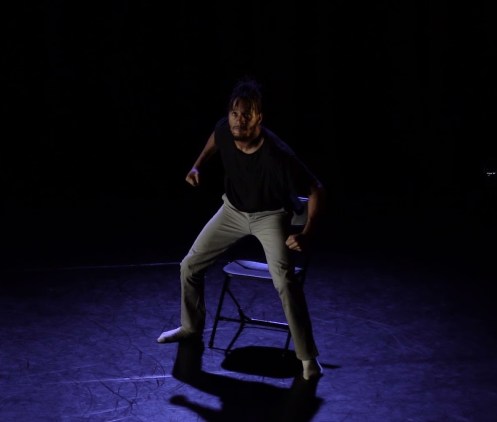
There is a more visceral attack in Joshua Nash’s Blacklist. Two dancers, naked to the waist, strut around each other, with the watchful aggressiveness of a pair of cockerels. How are they related? They look the same, same mannerisms, same topknot. They may be brothers, but Nash’s co-performer, Jordan Douglas, emerges as his alter ego. This is a story of three parts. The kinked kinetics of Krump suddenly hit a different note (as does the music) and the inner conflict becomes explicit aggression in a stylised fight sequence, which is smooth and fluent. Then, in another contrast, the triptych reverts to a street-dance fusion; as the protagonists lose their isolation, top-knots free into deluges of dreadlocks. The stomps and pops are still there, but focussed towards a feeling of reconciliation and unity.
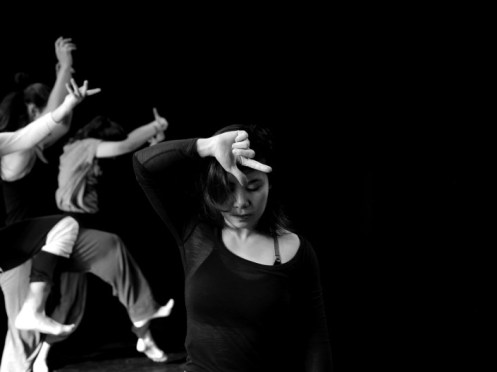
There is a distinct feral feel in No Sudden Moves, a dystopian piece by Brighton-based TRIBE//. A huddled pile of unkempt bodies opens the piece, which explodes into high energy exposition of urgent menace. The five dancers include the choreographer Victoria Fox, who has created impressively tightly coordinated expressions of surging masses, restless and lawless. They are joined on stage by sound designer, Jeph Vanger. Evident in hic sonic presence, he seems to pull the strings, an all-pervading éminence grise. Even before the thrashing of a stylised fight sequence, the air of danger permeates the air. Some of the characters are impelled to hide behind a strange cut-out of a caravan, which is moved around the stage. (Possibly a symbol of impermanence, it would be better in its absence.) In its ominous and changing dynamics, No Sudden Moves successfully conjures up a disquieting picture of post-apocalyptic insecurity.
The first three offerings for Resolution 2019 make a very strong and varied start to a season of dance. These three however do beg the question should dance inform the music or music inform the dance. Diaphragm resonance should not distract from a visual art-form that is dance, and certainly here are three works that deserve to be seen.
Mark Aspen
January 2019
Photography by Simon Richardson and Camilla Greenwell
Keeping Us on Our Toes
Dance Season
A feature by Mark Aspen
Mark Aspen Reviews often makes little pas de bourrée into the magical world of ballet, but this winter season we are making a grand jeté en avant to explore more deeply the world of ballet and contemporary dance.

The English National Ballet and the Royal Ballet, as well as the various touring ballets, all have a strong programme this season, which we are supplementing with a closer look at contemporary dance. One of the catalysts setting this in action is Resolution 2019. This is the thirtieth year that The Place, London’s powerhouse of dance development, has hosted Resolution, one of the world’s foremost festivals of new choreography. It covers a wide range of dance styles and explores exciting interactions with other genres.
The majority of British contemporary choreographers showcased their earliest work at Resolution, perhaps the best known being Wayne MacGregor. The most promising of emerging dance-makers are nurtured at The Place to progress towards professional choreography through custom programmes curated by leaders in the field. These programmes are not solely based around perfecting technical expertise, but include practical introductions to areas such as marketing and publicity.
Mark Aspen has been invited to join the team of reviewers for Resolution 2019, which includes dance critics from The Stage, The Daily Express, The Guardian, The Sunday Express and Dancing Times.
Resolution 2019 takes place from Friday 11th January to Saturday 23rd February. With no less than eighty-one productions from the best of today’s emerging choreographers, it promises to be an exciting season.
More widely, Mark Aspen’s Dance Season hopes to review first-class dance from classical ballet to cutting edge experimental contemporary dance. It should keep us on toes, or at least the edge of our seats, this winter.
Mark Aspen
January 2019
Photography by Vitorta
An Enthusiastic Ensemble Piece
Goodnight Mr Tom
by David Wood adapted from the novel by Michelle Magorian
Step on Stage Productions at Hampton Hill Theatre until 12th January
A review by Matthew Grierson
There is such an exuberance among the young cast of Goodnight Mr Tom that they seem at times to be racing through the children’s classic to get to the next set piece; but given the task of channelling their enthusiasm, directors Emma McCauley-Tinniswood and Maria Austin manage to ensure that the beats of the story are clear while also allowing us to warm to the characters.
Energy and choreography are alike apparent from the start, with the large ensemble briskly milling around on stage to signify the hustle of a railway station in 1939: parents are seeing their children off as they are evacuated to the countryside. Their enforced cheeriness comes through in a rousing chorus of Wish Me Luck as You Wave Me Goodbye, one of a number of wartime standards that recurs throughout the production to showcase the all-round talent of the cast.

The mood is dampened by the appearance of Mrs Beech (Hope Groizard) like a stormcloud across the back balcony, and the singing falls silent as she escorts her son William (tonight, Jasper Simmons) on to the platform. This is another motif of the production: the nature of the war means that the music of everyday life is repeatedly interrupted by a minor chord, often in the form of a telegram bearing sad news of a loved one in Europe. Thanks to the impetus of the performances, though, we are never asked to dwell on these moments for too long, and we keep smiling through.
So once William is out of his mother’s shadow he begins to bloom, and in the care of elderly widower Tom Oakley (Andrew Rhodes), finds a place he can call home among new friends and surrogate family. As the titular Mr Tom, Rhodes may move briskly about the place with the vim of a man a fifth of the character’s supposed age, but this at least communicates his brusqueness and initial distance from his charge; and, once he softens, it means his relationship with William is that of an older brother with his junior sibling. The scene where Tom teaches William to write is where this begins to crystallise, and later in the play when Tom puts a friendly, consoling hand on William’s shoulder, the moment feels well earned.
That’s not to say that it’s all easy going in between. At the end of the first act William is returned to London to be reunited with his Bible-bashing mother on the pretext of her illness, and we learn why the boy lives in fear of her. Groizard’s performance as Mrs Beech is legitimately terrifying, irrationally snapping at her son and completely dismissing his story of friendly country folk (Londoners, eh?). It’s all the more impressive that both performers convince us of this unhealthy domestic dynamic when the sound cue for baby sister Trudy’s bawling are so loud as to drown out most of their dialogue. Even a visit from the Luftwaffe’s a couple of scenes later is quieter.
On the whole, however, production values are excellent: the staging is simple and flexible, with plenty of space to accommodate the large cast, whether they’re sat cross-legged for school assembly or, dressed as grown-ups, huddling in the Underground to avoid Jerry’s bombs. The balcony across the back covers Tom’s rooms below, and, when we return to London, these are shrouded with black-out curtains that also suggest the sombre mood of the Beech household and cut us off from the cosy countryside.
The lighting is likewise simple but effective, signalling changes in location and tone. As if responding to Tom’s reminiscence about his late wife’s painting – she said she would only ever need to paint the sky as it was always changing – the cues evoke a raincloud grey, a pink dawn, the sunny countryside and the Blitzed capital with precision. Equally adeptly, characters are picked out in a spotlight to suggest their isolation, as happens at various moments for Tom, William and the latter’s new friend Zak.
In some ways it’s surprising Jasmine Carmody, tonight’s Zak, requires lighting at all given how brightly both she and the character shine. William’s fellow evacuee is appropriately described as a ‘livewire’ in the script, and, in a nice touch, is an aspiring actor, born to play the lead in the village’s amateur production of Toad of Toad Hall. The conceit of the play within the play is a cheeky nod to the potential pitfalls of a play with a large, non-professional cast, though Step on Stage manage to discharge their responsibilities much more capably than their fictional counterparts. The set-up also allows aspiring directrice Miss Thorne (Scarlett Gladstone) the opportunity to rebuke the actual pianist, although when it comes to breaking the fourth wall I do wonder about the wisdom of having the cast hare around the auditorium waving wooden swords about. Maybe I’m just getting fussy with age.
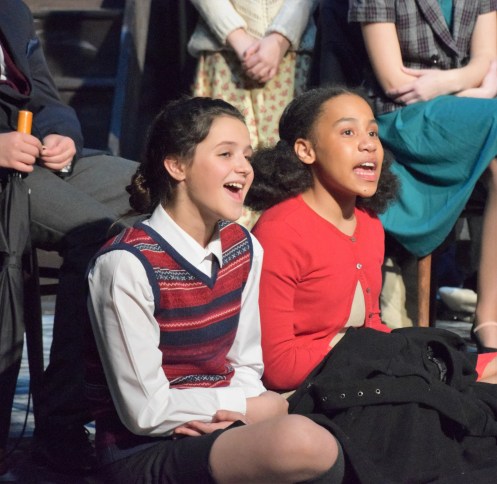
Just as charismatic as Zak though in an entirely different way is Tom’s dog Sammy, clearly influenced by the National’s Warhorse. His careful handler Nils Collins (who alternates with Simmons as William through the run) brings the puppet to endearing life, winning considerable affection from characters and audience alike. Rounding out a strong supporting cast are Ginnie, Carrie and George, the village schoolchildren, embodied tonight by Freya Peltonen, Amelia Miedzinska and Jessica Jenner.
Goodnight Mr Tom successfully conjures the spirit of the home front with its sense of pluck and resolve. If there are deaths and darkness the production does not ignore them, but soldiers on all the same, hoping for a bright future – as, one imagines, are many of its cast.
Matthew Grierson
January 2019
Photography courtesy of Step on Stage Academy
Classic Éclat
Swan Lake
by Derek Deane after Marius Petipa , music by Pyotr Ilyich Tchaikovsky
English National Ballet at the London Coliseum until 13th January
Review by Suzanne Frost
Swan Lake was my first ballet, as I’m sure it undoubtedly is for many people, and seeing a matinee performance with lots of families in the audience, it seems it will continue to be that perfect introduction to the art form. ENB’s Swan Lake, choreographed by Derek Deane after Petipa, was first created in 1992 to be played in the round at the Royal Albert Hall and remains, slightly scaled down for the classic proscenium stage of the Coliseum, London’s most rock-solid traditional production.
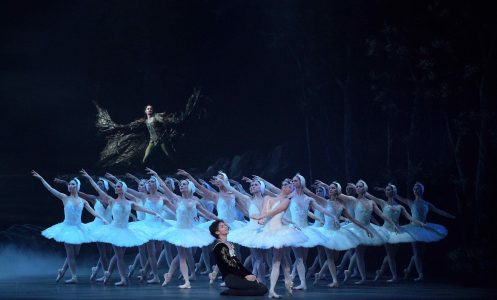
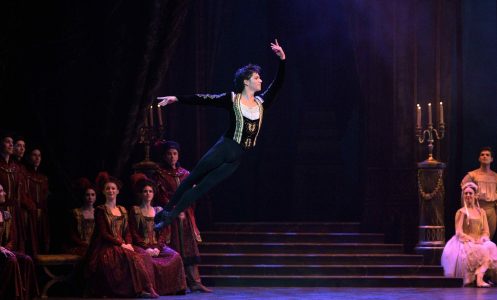
The curtain opens on a leafy clearing with lovely warm autumn colours. I love a muted colour palette! Nevertheless, the costumes seem to be thrown together from various epochs, a bit of medieval, a bit of renaissance, a touch of baroque, as if the briefing was “something period” – and most of the people around at Prince Siegfried’s birthday party seem to be peasants. The prince himself, Francesco Gabriele Frola, is a dashingly handsome Italian, on loan this season from National Ballet of Canada and definitely someone to watch.
As a first highlight, the pas de trois is perfectly lovely and very well danced; the exceptionally long legged Erik Woolhouse has entrelacé that just soar. Initially, the production seems to go easy on the miming and mostly aims to speak through dance alone. It is very busy choreography though and a lot of bodies on stage. Having recently been to Matthew Bourne’s contemporary version, I recall that at this time in the score his prince had already been to countless ribbon cutting ceremonies, been emotionally neglected by his mother the Queen, got himself an inappropriate girlfriend, got papped by paparazzi at a dodgy bar and attempted suicide – all in the same time and music. In this traditional production, we barely got the story started and we don’t get a chance to find out very much about the handsome prince. He seems sad and a bit like a bystander to his own life. Ballet never cares to explore much depth in male leads, which is a shame.
Wanting to test his birthday gift, a crossbow, Siegfried is off to the forest and Derek Deane’s production opts for a break, closing the curtain down to push some scenery around. The result is a dramaturgical disaster! Not that we have established much stage magic just yet but whatever spell was there is broken, as people start getting up, walking about, getting their phones out and taking selfies. When conductor Gavin Sutherlands tries to pick back up, the orchestra is barely audible and the most magical, powerful part of Tchaikovsky’s score is drowned out in chatter. People literally don’t realise the shows continues until the curtain opens again – on another forest. All this mess for some different trees and a few puffs from a smoke machine. Traditional is all fine but I am just reminded of a friend of mine, a stage hand, who proudly performed a two-second scenery change for Yerma – during a blackout…
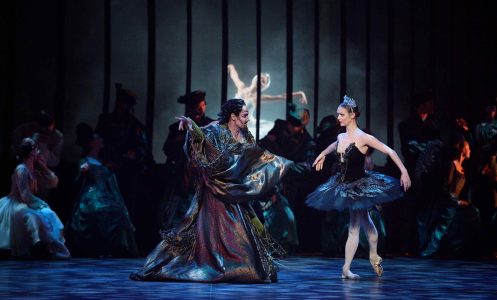
Anyway, back in the forest we are where we meet the sorcerer Rothbart, wearing a giant cape that allows for a very limited variety of ‘evil sorcerer’ movement. The beautifully fragile Erina Takahashi gives us an Odette that isn’t just shy but positively terrified. Her suffering is tangible and her technique flawless. Her balances are so endless she forces lead violinist Matthew Scrivener into ritardandos close to slow motion. His weeping violin is a perfect match with Takahashi’s interpretation of a traumatised princess close to giving up. She really fills those well-known steps with individuality. When she falls, she really falls, when she pulls away she really pulls, shifting her axis, taking risks. I like a risk taker in classical ballet, it feels much more real, like something is actually at stake for Odette. The ‘white act’ in the original untouched Ivanov/Petipa version is flawless, always has been and always will be and there’s very little you could do wrong. My only qualm would be that the stage again seems very busy. Twenty-four swans isn’t unusual per se but here, a line of decorative corps dancers often feels in the way, obstructing our main couple that could have easily filled the space all by themselves with their artistry.

Whenever a ballerina excels as the lyrical Odette I can’t wait to find out what she will do with Odile. Unfortunately, Deane, just like Liam Scarlett at ROH, opts for the version where the black swan’s entrance in immediately interrupted by the character dances. I’m never a great fan of cutting off a storyline for more divertissement but most of them are fine, the whirlwind Hungarian dance actually fantastic. When we finally get back to Odile, the music is too slow for my taste and there is no light change, to switch into a dreamlike state for the adagio – I know these are details but I like my Swan Lake just so and I suppose to get the perfect version that hits all your queues you probably have to stage your own…

Erina Takahashi has everything I’d want though from a black swan, all malicious smiles and perfectly mimicking, even mocking the mannerisms of Odette. Rothbart is interfering far too much in the iconic pas de deux for my taste but it gives the impression that rather than an impostor this could actually be the bewitched, obsessed Odette, which in a dramaturgical sense would kind of redeem Siegfried for not falling into the simplest of traps. The dashing prince finally gets to show some moves in his solo, which is flawless and points out even more what a thankless role Siegfried actually is. I think we haven’t seen half of what the handsome Italian actually would be capable of.
The pas de deux is very very well danced. People always clap at the 32 fouettées because they’ve heard about them – sure they are hard but the tours à la seconde that followed were spectacular! For all their tricks and stunts though (and boy that man can do great turns) they both never forgot to tell the story. You can see Siegfried falling in love and the betrayal that follows is truly heart breaking. Nobody in my audience needed that second interval. At this moment we were all, kids and grownups, invested in the story. In the last act I stopped taking notes. Something happened. The magic finally happened. The prince was genuinely, heart-breakingly sorry. In a most touching gesture, Odette made clear that not just her life was ruined, but that she is responsible for the fate of 24 cursed girls whom she graciously leads away before committing suicide, followed closely by the unlucky prince. Not a happy ending so. As it should be. I hate when they try to turn Swan Lake into a happy story.
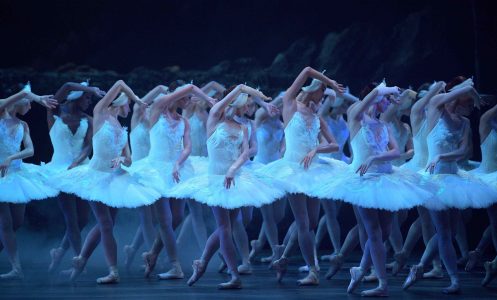
So still, it seems, a perfect introduction to ballet. My last mention goes to Francesca Velicu, a lovely dancer who stood out for me in every role, from pas de trois to cygnet to princess, mostly for her graciously lyrical neckline and beautiful musical phrasing. Since ENB does such a wonderful thing as their Emerging Dancer People’s Choice Award, and she is among the names nominated, she gets my vote today.
Suzanne Frost
January 2019


