
Winter Distillation of Delight
The Lion, the Witch and the Wardrobe
by Irita Kutchmy, adapted from C.S.Lewis
Dramacube Productions at the Hampton Hill Theatre, until 23rd December
Review by Thomas Forsythe
Spiritual, magical, fantastical, The Lion, the Witch and the Wardrobe blends everything that impinges on the imagination of a child … and of an adult. The essence of C.S.Lewis’ allegorical story distilled into a children’s musical thus not only makes an inspired choice for Dramacube’s Christmas family show, but has inspired the imaginations of the child performers to create a seasonal delight.

Lewis’ The Chronicles of Narnia have had an enduring popularity since they were first published in the 1950’s, and The Lion, the Witch and the Wardrobe, the first in the series, has the distinction of being the most common book that adults have also read as children. As an allegory for the Christian belief in redemption through the sacrifice of Christ, it has a huge resonance at Christmas, but, whatever their beliefs, Dramacube’s audience warmed to the story that was so touchingly told by the young actors.
The production seen by your reviewer was performed by the Twickenham Blue Cast, but one can easily believe that all of the ensembles of under-fourteen actors were as equally capable, committed and convincing as this team.
The black and white set, by Christine Osborne, makes economical use of the Hampton Hill stage. Simple and crisp, it has a precision suited to the wintery concept of Narnia, the land of mythical creatures that the White Witch has sequestered in snows a century deep, never to enjoy the respite of Christmas. This is the Narnia that is entered by chance through the back of an old wardrobe by each of four children, siblings evacuated from (a posh part of) wartime London to an old country house. The house, belonging to Professor Kirk, is historic enough to attract groups of visitors, who are shown around by a reluctant housekeeper, Mrs Macready, played by a suitably prickly Sejal Khadakkar. The distraction of the visitors provides the opportunity for the exploration of the fateful new surroundings in the Professor’s pile and the discovery of the mystical wardrobe.

The transition from the urbane Professor’s mansion to the oppressed and barren Narnia is effected by Francois Langton’s lighting and the music of William Morris delivered by the spirited keyboard of Dan Turek. How wonderful it is to have live music once more in a children’s show, with the tighter cueing that this brings.
The youngest child, Lucy, is the first to discover the way into the land of Narnia. Rosa Bruce-Ball gives an attractive interpretation of the innocent Lucy, lost in wonder in a strange world. Her first encounter is with the kind-hearted Mr Tumnus, a talking (and singing) faun, who befriends Lucy. Monty Appleton pictures Tumnus as a reticent, diffident creature, but one who can trip a nice pas-de-deux with Lucy. There are quite a few well-executed and well-timed dance sequences in this production, witness K’ja Young-Thomas skilful choreography. However, Mr Tumnus suffers dearly for his kindness, with the dawn knock on the door from the White Witch’s secret police, led by Maugrim the wolf, who is played by Ashwin Natarajan-noronha with a certain predatory glee.
Edmund, the second-youngest of the siblings, the next to enter Narnia, is seduced by the White Witch and her promises of unlimited supplies of Turkish Delight. However, these are far from non-conditional and Edmund, already the black sheep of the four children, becomes their quisling, betraying them to the White Witch. Jake McGowan portrays Edmund with animated naughtiness, but streaked with spite when in the thrall of the White Witch. Daisy Allen is exceptional as the White Witch, powerful and commanding. Menacing in her blue lippy, she steps into the character and lets it rip. As always with baddies, she gets some great musical numbers too, leading in Turkish Delight and The White Witch of Narnia Rules, OK! with malevolent gusto (even showing a flash of “sleigh-rage” when a prop encumbers her preferred means of transportation). When Edmund is eventually shaken from his entrapment and filled with remorse, he asks “What shall I do?” as Jake exhibits a fine singing voice in Edmund’s Song.
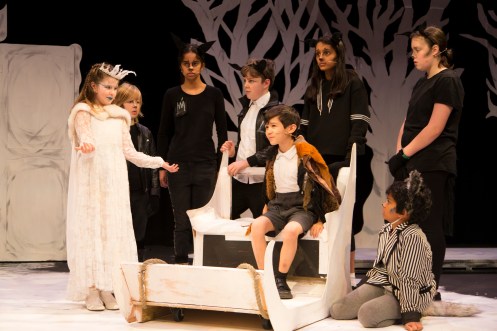
Significantly, it is the two older siblings who are the least easy to persuade about the magic of Narnia. Peter, the eldest, is a sceptical rationalist while Susan is judicious and protective of the others. Ethan O’Keeffe played Peter with authority, contrasting with Florence Gardner’s nurturing Susan. Amongst the first creatures that they meet in Narnia are the plucky Mr and Mrs Beaver, staunch friends of Mr Tumnus, who share his revulsion at the icy grip of the White Witch. Hattie Allen and Sophia Renahan, make a compelling castoral couple as the Beavers.
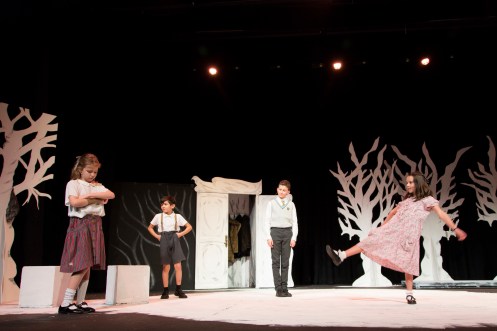
The children (“sons and daughters of Eve”) are harbingers of Aslan, the Lion. Perpetual winter begins to give way to spring. They are greeted by Father Christmas, who has been excluded from Narnia by the now-waning Witch’s magic. Finn Bralow’s assured Father Christmas is accompanied by the cheeky Robin, pertly played by Leila Simpson. He brings each child a present which proves invaluable in the forthcoming battle of Good versus Evil.
At this point, an aside to mention the great costumes designed by Akshy Marayen should underline the resplendent mane for Aslan and the neat solution to Father Christmas’ beard, often a big bushy problem with child actors.
Aslan is of course the analogue for Christ in C.S.Lewis’ allegory. The Witch invokes her magical rights to slaughter Edmund for his treason against her. Aslan denies her claim, but negotiates secretly with her to lay down his own life for Edmund’s. In Dramacube’s production, the sacrifice of Aslan is truly touching and majestically played out between Daisy Allen’s Witch and Isla Holmes, who plays Aslan with a gentle confidence. The execution of Aslan was brutal and drew a gasp with the audience. (Daisy had already shown that she has a good line in slapping, and now upped the stakes!) Isla acts the resurrection of Aslan with great presence (and she has an impressive roar!).
Director Matthew Bunn has kindled an imaginative fire in Dramacube’s young company which pulls out the deep messages in the lovely parable for Christmas, but perhaps the last word should go to Professor Kirk. Harry North puts across the kindliness and the discerning insight of the Professor as he says “What do they teach children in school nowadays?” with a knowing wink to the audience.
Thomas Forsythe
December 2018
Image courtesy of AnimalSake.
Photography by Bomi Cooper Photography
Suburbia Fragmented
Absent Friends
By Alan Ayckbourn
Questors at Questors Studio, Ealing until 5th January
A review by Eleanor Lewis
It’s not often you find yourself pleased by how aggressive a shirt is. And it’s probably wrong to feel like a bit of a rebel reviewer because you’re starting with the costumes. It must be said however that both costumes and set – but especially costumes – were pretty near perfect in Questors’ production of Alan Ayckbourn’s Absent Friends. Everybody on stage was cleverly dressed from the aforementioned aggressive shirt (thick brown with an angry orange stripe) worn by the bullying Paul, to the bold striped pullover sported by the uncompromising Evelyn which was almost a warning of the less-than-pliable womanhood which was just beginning to emerge in the ‘70s. This in direct contrast to the domesticated, shopping, giggling Marge in her relaxed, floral frock with incompetently hair-sprayed ‘flicks’. I could happily go on but it’s simply that the importance of costume design is often overlooked, particularly in domestic drama and the care that had been taken by Clare Malyon in this case was impressive.


Michelle Weaver’s 1970s living room set glowed with ‘burnt orange’ punctuated by a couple of ‘cooling’ leather chairs, a throbbing fire-effect fire, and was dressed with the type of hideous brown tea set, the teapot of which could have provided inspiration for Shrek in years to come. There was too, a Battenberg cake, white bread sandwiches and cheese and pineapple on sticks. Set, props and costumes take a bow, outstanding!
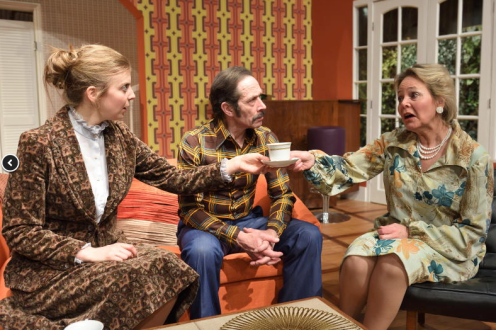
Absent Friends was written in 1974. It is essentially a drama about people trying and failing to conform to a social model that was no longer working. Five people calling themselves friends but who are more accurately described as people who know each other, assemble in Paul and Diana’s living room to have tea with their sixth friend Colin, whose fiancée died in a drowning accident some time before. The tea party is therefore for an ‘absent friend’ but in fact there are no real friends present.
Two and a half couples are present: Diana’s husband Paul sleeps around, she knows and makes noble but unsuccessful attempts to contain her fury; Marge, a happy character, enjoys domesticity but for her needy and constantly ill husband Gordon, present only by phone. Evelyn sits by the bar chewing gum, engages with no-one unless forced to, sleeps with whoever she pleases including Paul and rocks her baby with unconcealed contempt for the assembled company. Evelyn is married to John who is under no illusions about his wife but is probably sticking with it in the absence of a better offer. Into this mix comes Colin, the type of warm happy-go-lucky character who is initially attractive until you realise he is oblivious to the conversational needs of anyone else.
What follows is the fragmentation of the suburban, social ideal as the three couples are revealed as increasingly dysfunctional. Without reproducing a plot synopsis, Diana is forced to confront the extent to which Paul is uninterested in her, and her breakdown, as she remembers her childhood dream of joining the Royal Canadian Mounted Police and contrasts it with what her life has become, is both tragic and comic. Nina Flitman gave an understated and poignant performance as Diana that struck precisely the right tone. Lesser actors and directors would have laboured the comedy. It is Ayckbourn’s particular skill to write comedy and tragedy at the same time: performing it is challenging to say the least.

David Hovatter as the aggressive, bullying and wholly insecure Paul provided a suitably intimidating, presence on stage with a highly physical performance which gave the impression he would spark electricity if touched. Again, this was a controlled, and therefore effective, performance. Though Paul’s character was dominant, Hovatter’s performance did not dominate the other five.


It’s interesting that there is a natural focus on the women in this play, women as they were in the 50s and 60s and women as they were going to be in the 70s and 80s, but in 2018, there is also a focus on the type of man who is no longer acceptable. The bullying Paul was still tolerated in the 70s: he would not be today.

Colin, the only happy character in the mix, as played by Mark Redrup, was an ambiguous presence. His single status and his delight in his memories of what might have been had his fiancée not been lost to him was unnerving to the others. But the others at least had the ability to feel something. Colin was oblivious to the deep unhappiness of those around him, even as Diana poured cream over her errant husband, and if Colin cannot see other people’s feelings, can he really connect?
Ceri Jones as Marge was a hugely sympathetic, attractive character, restricted by her needy husband but constantly optimistic until exhaustion pins her down. She was a comforting relief from the palpable tension between the other characters. James Burgess as John was beautifully irritating with his constantly bouncing knee when he could be got to sit down, and his only partly successful decision to ignore his wife’s shortcomings. Clare Purdy as Evelyn, arguably the most straightforward to play, was blessed with a wealth of sarcastic facial expressions. These were all well observed, well-crafted performances.

I wonder how much we have moved on from the more fraught elements of 1970s suburbia. Simon Snashall’s careful direction, the skilled performances of every actor on stage and the superb support from all elements of the production staff made for an excellent production of a fascinating play. Highly recommended.
Eleanor Lewis
December 2018
Photography by Peter Collins
Flat-Pack Fun
Sleeping Beauty
By Ricky Coussins
The OSO Panto Players at OSO Arts Centre, Barnes until 22nd December
A review by Ian Nethersell
The Old Sorting Office is a popular and busy venue. The staging area is small with very limited wing space akin to that of ‘above pub’ theatres. This however, did not hamper the creation of the atmospheric and versatile setting of an outside garden/glade/forest defined and backlit by a very well-crafted tree which reached up to the ceiling, neatly dressed with some fake grass, a platform shelf and a branch which reached across the stage.

Steve Weeks “OSO Barnes”
The script, written by Ricky Coussins, sat well in this environment and each worked with the other. This helped to create a feeling of congruence and honesty which allowed the audience to inhabit a place rather than look at a set.
The action opened with a plummy narrator played by Jonny Danciger, who also took on the demanding role of Musical Director. In this role he managed to put together some good singing with harmonies and even graced us with accompaniment on the accordion. The first scene also introduced us to the palace’s general handyman, Peter Pooey. Will Jarvis brought great energy and even pathos to this part, continually engaging with the audience, especially the row of young children sitting on the floor at the foot of the playing area.
Our dames of the piece were neatly played by two fairies, Flora and Dora, portrayed by past director Joel Coussins and Frankie Brickman. There was good chemistry, facial hair and interplay between them and they delivered the only nod to inuendo when Flora entered with a small wand, and it wasn’t that cold in the auditorium!

Our villain was Grumblebum, a wicked fairy, confidently portrayed by Hana Jarrah, who worked against the unrelenting barrage of boos and banter from our young audience, a task she seemed to relish in, just on the border of corpsing which also gave great fun. Her downtrodden side-kick, Jackass Grease-Smog was beautifully played in an understated way by Daisey Jones. It was easy to feel for this character through the way Daisey played it, using physical posturing and facial expression. In the spinning wheel scene we were treated to some wonderful visual comedy with the implement arriving in flat-pack form.
Daisey Jones doubled as Queen Camilia while King Charlie Chump was played by Joel Coussins who brought caring yet strong demeanour to the role.
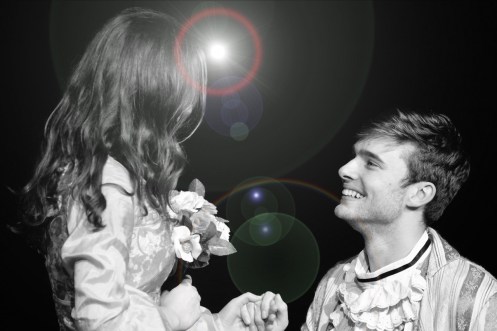
Our Beauty and Prince of this script, Meghan and Harry, played by Alex Payne and Alex Hill respectively, worked well together and gave a beautiful rendition of the Little Shop of Horrors song ‘Somewhere That’s Green’, re-written as ‘Somewhere Near Barnes Green’ – a very nice touch.

To protect Princess Meg from the evil machinations of Grumblebum she is squirrelled away for safe keeping with Flora and Dora until she reaches her 18th birthday and it is in this setting that Prince Harry stumbles and meets Meg. The unmade flat-pack is brought on and Grumblebum manages to coerce Princess Meg in to pricking her finger by picking up one of the strewn parts. Princess Meg falls asleep and Flora and Dora put a spell on the kingdom for all to sleep for a hundred years, or until Meg’s true love wakes her with a kiss, which of course is what duly happens.
Grumblebum is hit with a custard pie which sets Peter Pooey up to lead the company and audience in a chaotic re-written version of ‘The Twelve Days of Christmas’. Now we all like it when the ‘wheels fall off’ and this number delivered chaos in spades with the whole company falling apart and Peter Pooey desperately trying to keep it together till he finally gave in. This led us in to the closing number of ‘All I Want for Christmas is You’, and with our required happy ending achieved, the evening came to a close.
Ultimately this is a well written, well directed panto aimed squarely at a family audience with younger children. It has plenty of ‘It’s behind you’ and ‘Oh no it isn’t’ jokes, custard pies and is engaging and fun. At just over an hour there is no opportunity for the youngsters to become bored. Plenty of Bottom references, up to date songs and children’s television character names allowed the younger audience to engage and the politically satirical – rather than innuendo-based – script allowed this staunch Liberal Democratic heartland to relish in gibes about both major parties, so a merry time should be had by all.
Ian Nethersell
December 2018
Photography by Caroline Silfverling
A Magical Journey for Young and Old
Hansel and Gretel
by Ciaran McConville, adapted from the fairy tale of the Brothers Grimm
RTK Productions at The Rose Theatre, Kingston until 6th January
We asked one of our younger reviewers to share her thoughts on Hansel and Gretel, to complement Mark Aspen’s review.
A review by Milly Stephens (Aged 13)
Hansel and Gretel is a vibrant Christmas show with a funny, dark, magical twist. Hansel and Gretel (Oliver Smith and Sylvie Varcoe) take you on a magical journey through the great forest, meeting lots of familiar fairy-tale characters: a bar-maid Cinderella, a feisty Red Riding Hood, a sassy Rapunzel, a brave Snow White, a flirty prince frog and an Italian speaking Pinocchio.

The choreography by Aimee Leigh was outstanding. The dances were pulled off brilliantly, by a mix of professional and talented youth cast, with precision and energy. The original songs by Eamonn O’Dwyer matched the feel of the play perfectly. With the catchy finale song “happy ever after” leaving the audience on a high.

The costumes made by Juliette Craft and her amazing team and designed by Peter Todd were fantastic, with the traditional costumes with a twist. And of course there is Pinocchio’s nose, which when he told a lie appeared out of nowhere. And the bear (Devon Black) who was extremely tall, was suspended on stilts.

I recommend this for both the young and the old, whether you have grandchildren or grandparents, for you can never be too old for a fairy-tale.
Milly Stephens
December 2018
Photography by Mark Douet
Magic and Menace
Hansel and Gretel
by Ciaran McConville, adapted from the fairy tale of the Brothers Grimm
RTK Productions at The Rose Theatre, Kingston until 6th January
A review by Mark Aspen
As a Christmas bonus, one of our younger critics, Milly Stephens (aged 13) has also offered her thoughts on Hansel and Gretel . You can read Milly’s review here.
As a frequent visitor to Germany’s Black Forest, albeit in an open car in summertime, the setting of Hansel and Gretel should seem familiar, but in the winter of the Great Famine in fourteenth Century must have seemed a very different place. In the Rose Theatre’s production, the Black Forest of Hansel and Gretel takes us to a place of magic and of menace.
In 1812, the Brothers Grimm published Hansel and Gretel as part of their gathering of word-of-mouth folk tales. The Rose Theatre expands on this short snippet to bring a riveting story to the stage, a story that is both frightening and touching in equal measure, “a story about the magic that is in all of us”.
“Once upon a time”, starts all good fairy tales, and this one is no exception. As the play opens, a book, fully the height of the tall Rose stage, slowly opens to reveal a townscape outside the town hall. As the story progresses it transforms, as panels slide across each other and videoed images of exquisite examples of the illustrator’s art create a series of enchanted landscapes in a whimsical style somewhere between Aubrey Beardsley and Maurice Sendak. Set designer Adam Wiltshire and his team of lighting designer, Amy Mae, and video designers, Daniel Denton and Letty Fox, have created a mise-en-scène that is as delightful as it is inspired.
It is Christmas Eve in the walled town and the townsfolk celebrate their good fortune in having plenty to eat whilst neighbouring areas are badly affected by the famine. Gerhart, the town’s mayor, is popular with all, for this day is the day that he sends children of the deserving poor off on generous scholarships to improve their future. Or does he, for we hear him saying to himself, sotto voce, “What is the sacrifice of a child or two”? J.J Henry plays Gerhart as a man very ill at ease, enjoying the adulation of the town’s people, but wrestling with an inner guilt.
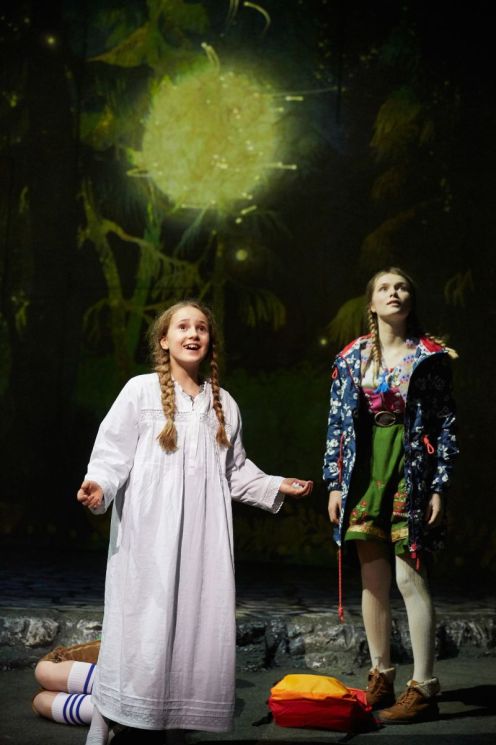
We next see J.J Henry, doubling in an entirely different role, that of the Blue Fairy, one of the inhabitants of Grub, a refuge in the forest where lost characters have a stockade, relatively safe from the tribulations of the forest. The motley band includes many ejected from their own fairy tales, including Rapunzel, Snow White and Pinocchio. Food parcels may occasionally flutter mysteriously in on colourful parachutes, but all are constantly fearful of attack. One protectoress of Grub is Red Riding Hood, hard-bitten, if only figuratively, by her encounters with the wolf, now fiercely self-assured, with a caustic wit cloaking a tender fidelity. Vanessa Fisher’s Red is a feisty action-woman, whilst Henry, nicely differentiated from Gerhart, plays Blue as a gentle giant, pragmatic but cautious, who sings that “life is never a fairy tale”, and warns that true life is “pretty Grimm”.
Blue may well so warn, for life has already rung true for Gerhart’s chosen children, the orphans, Hansel and Gretel. Gretel is open to the opportunity that Gerhart offers, but Hansel smells a rat. (Sibling spats and squabbles will stalk their escapades throughout this story – as always with brothers and sisters.) They are put in charge of Otto the Huntsman, who will guide them in the forest. However, before the magic storybook backdrop transmogrifies into the enchanted forest, snow falls in projection on the buildings and we see a rat scurry past.
Otto has immense misgivings about his task, now repeated many times, as he knows that he must leave the children at an appointed spot in the forest, and there give them a sleeping draft, abandoning them to their fate. This time it is doubly difficult for Otto as he knew their mother. He confides in them that their mother was a good witch who fought against evil in the world. Elliot Fitzpatrick not only accurately portrays Otto’s conflicted conscious in his body language, but has a rich baritone singing voice, “The magic is there”. Nevertheless, protection is there, for as the children sleep their Mother appears in a dream to reassure that within them is the strength they need: goodness and love. Devon Black, as Mother, puts across the nurturing softness that is the essence of the maternal instinct, always there.

Elliot Fitzpatrick also doubles to reappear as chief henchman to the baddies, Kabeljau, a deliciously dipterous picture of hunched veniality in a black winged costume with large compound eyes, like Ben Jonson’s Mosca on steroids. Baddies always wear black and he heads up a truly frightening dark pack of assorted avian and wolf-like monsters who scamper menacingly around the theatre. These are the forces of the arch-baddie, Circe the Witch. She is a sardonic, sassy and sensuous sorceress with a great line in zapping and zinging with her taser, a zany zigzag of a wand that she uses to cow her captive children to her wishes. More darkly, the wand has the power to transform by sucking the goodness from its victims. Georgina White tackles the role of Circe with some relish, but without losing the character’s mystery, and intriguingly adding a sense of vulnerability to round out Circe’s character.
Fortunately Hansel and Gretel acquire a number of magic items on their journey which get them out of a few scrapes, a crystal, a set of pan-pipes, and a broken mirror which tells the truth if questioned in rhyme à la Snow White. The Voice of the Magic Mirror finds a fitting celebrity cameo role for Jane Horrocks, appropriately of Little Voice fame.
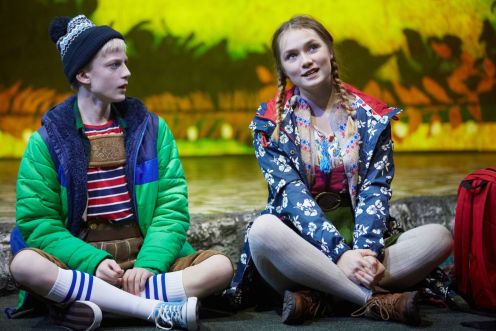
All these actors are experienced performers, but they form less than a quarter of the full cast of Hansel and Gretel, which is complemented by twenty-one young actors from the Rose Youth Theatre, working on an equal basis. Indeed, the eponymous roles of the two orphans are the largest and principal roles, are taken on with equanimity by Oliver Smith and Sylvie Varcoe, who work together in well balanced harmony in two fluently confident performances. Gretel is a brave and spirited young lady with the gall to outmanoeuvre Circe by subterfuge and flattery. Sylvie’s portrait of Gretel is very assured and has the true force of her character. Hansel has both courage and insight, but with a quick wit. Oliver’s Hansel is very securely played with chirpy and audacious bravura. Both young actors understand their characters with veracity and accuracy.
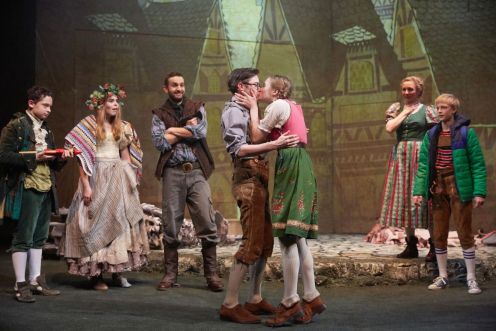
The Rose Youth Theatre is superb both as a team and as individuals. They work well in a self-controlled ensemble. It is hard to spotlight individuals but three exemplars will illustrate their achievements. Frankie Oldham’s Adelbert, one of Circe’s captives, a boy who was led to believe he was going to university, makes a marked emotional journey and pulls a lot of characterisation from his smallish part. Tom Stephens is outstanding in the comic cameo of Pinocchio, from Grub’s lost fairy tales. Physically the stiff movements of the carved puppet are all there, and his broad Italian accent, with a hint of caricature, made me wonder if he might be Italian. Nancy Whitworth really sparkles as Peppi, the Peregrine Falcon, with a lightness of touch and a vivacity that creates an easily likeable personality for her character.
The style of the production is also enhanced by the Rose Youth Theatre with an ubiquitous trio who play three Fairy narrators, Nyx (Jack Hadman), Freya (Anna Pryce) and Skrat (Francis Redfern). They open up the sense of place and action with poetic descriptions; and they motor the plot in the way that a Greek chorus might, but with a more serene approach.
The poetic style of the piece is further enhanced by the music-box filigree sounds of composer Eammon O’Dwyer whose music and lyrics once again illuminate the Rose’s Christmas show. Equally the seasonal return of puppetry director Yvonne Stone brings an innovative flare to animate the design using shadow and carnival puppets. The Robber Wolf is terrifyingly impressive in its realism.
Director Rosie Jones crafts a storytelling tour de force that has a sculptured delicacy in spite of its black themes. Its themes of redemption and restitution through goodness and love chime well with the Christmas story.
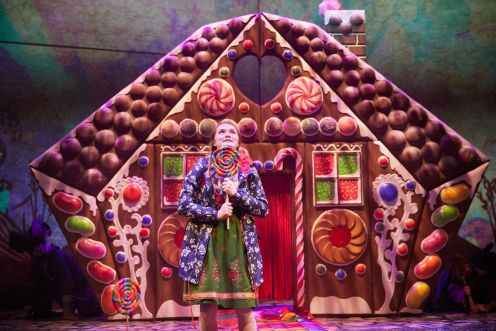
And of course, there is the delicious gingerbread house … enough to make anyone live happily ever after, for “happily ever after”, ends all good fairy tales, and this one is no exception.
Mark Aspen
December 2018
Photography by Mark Douet
You’ll be Hooked
Peter Pan
by Alan McHugh and Jonathan Riley, adapted from original by J.M.Barrie
Qdos Entertainment at Richmond Theatre until 6th January
A review by Mark Aspen
Panto is theatre writ big, and they don’t come much bigger than Qdos’s Christmas pantos. With three dozen pantos across the country this year, Qdos is becoming a staple of the Christmas theatre season. Richmond’s turn this year is with Peter Pan, and we go straight in with BIG: glitter balls, chasing lights, lasers, pyros, front gauzes: the full-on opening razzmatazz sets the pace for a show with go.

Whence comes the go? In a panto without (purists turn away) a dame (!) or a thigh-slapping principal boy, it comes from the high energy ensemble, motored by the turbo-charged principal performers. Peter Pan is billed as “the high-flying pantomime adventure” and indeed Peter makes his first entrance (and most of his entrances) flying. Tinkerbell is more down-to-earth and spends the whole show on roller skates.
Things move so quickly that even our noisy popcorn-strewing audience finds it hard to keep up and miss several “oh, no he isn’t” and “he’s behind you” moments. Still the gags, verbal and visual, do come thick and fast, so you really have to concentrate to follow the ruder of the triple-entendres.
So we go quickly to the quiddity of the plot: the Darlings Senior have already gone and Nanna the dog waves goodbye as Wendy and her brothers go to meet Peter Pan. Vikki Bebb makes an engaging Wendy, nicely prim and proper and sounding oh so much like Princess Elizabeth before she became Queen. She often says “orfen”. Smee says “she is so posh, she spells *art with a ph”. Bebb later has a chance to demonstrate a lyrical singing voice with “Remember me when I’ve gone”. Isobel Hathaway, as Wendy’s rival for Peter’s unrequited love, is a well-seasoned Tinkerbell, having played the role in many productions, but maybe not all on roller skates, a consummate skill that extends to vigorous dancing on her flashing wheels. Her Tinkerbell is a balanced blend of purity and petulance.

When Peter Pan (quite literally) drops into Wendy’s life, the promised adventure is perhaps a bit more then she bargained for. Harry Francis brings a bold boyishness to the eponymous role as the fearless and undaunted “boy who never grew up”. Francis has a wide portfolio of nimble physical skills to bring to the role, including adroit flying sequences, stage fighting and excellent dancing (in a Matthew Bourne style gleaned from Sadlers Wells), as well as superb singing and acting. Francis is a scion of a well-known local acting family (his father had a lead role at Richmond Theatre this June).
When they reach Neverland they find a realm of extraordinary exotics (and not just the plants), peopled by Native Americans and the Lost Children (equal opportunity Lost Boys), the remarkably agile dancing ensemble and The Young Set respectively, all beautifully choreographed by Paul Robinson, whose skills we saw at Richmond in Aladdin last Christmas. Keisha Marina Atwell’s charming Tiger Lily, caught up in the middle of all these goings-on, seems a little bemused but musters all her high-kicking troops in defence of Neverland at the call of a conch shell.

Also often to be found on the “shell-phone” is the Mimi, the Magical Mermaid, the epitome of piscine pulchritude, “38-22-and £1.43 per kilo”. Sassy Rachel Stanley brings her own sauce to this fish. Stanley may be fresh from filming Les Misérables, but there is nothing sole-full about her bubbly character. And isn’t it great to hear a genuine London voice back on the London stage. Mimi is the go-between twixt Neverland and the Pirates, so we swash our buckles and go to sea.

Smee, the Jolly Roger’s befuddled boatswain is also unsure which side he should be on. He only got the job after “coming second in Neverland’s Got Talent”. By coincidence, Jon Clegg who plays Smee, was a popular finalist in a television show with a similar name and is a great favourite with our panto audience. Clegg has real rapscallion rapport with said audience, culminating with the staple singalong, Old MacDonald Had a Farm this time, where some of the youngest members of the audience on press night gave him a real challenge with their choice of (farm??) animal noises. Try a wolf (to music) … or a dolphin! These were a tough test even for an outstanding impressionist who had just amazed the television aficionados in the audience. Clegg appeals equally to his more sophisticated Richmond audience at the start of his shopping trolley punning gag, saying that the only meat he could buy in Waitrose was venison, and that was too deer!
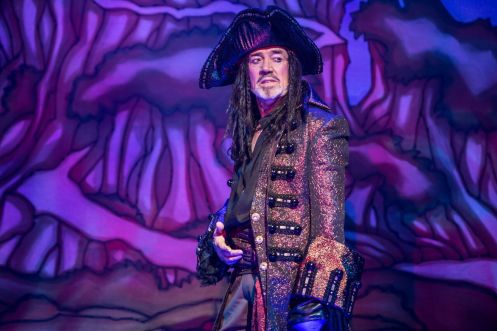
However, for wide audience appeal Robert Lindsay’s versatility, ranging from Sophocles, via a stack of Shakespeares, to Gorky on one hand, and the television sitcoms My Family and Citizen Smith on the other, must be the sine qua non (… on one hand … the mutt’s nuts on the other). Believe it or not this Peter Pan marks Robert Lindsay’s pantomime debut, so after BAFTA, Tony and Olivier Awards, he can now claim Captain Hook. This is from a man who celebrated his birthday on press night, and entered his seventieth year! And what a commanding Hook it is. This Hook takes over the stage; a hand gesture or a sideways glance is enough to have the audience in stiches as he spits sardonicisms like a sharp-shooting sniper. The comic timing is all there, even with puns that would make a Christmas-cracker writer blush. (Try, “where are your buccaneers” – “on the side of me bucking face”.) Lindsay’s musical theatre experience also stands him well, particularly with the parody numbers, such as “You’ve gotta pick a Pirate on two”. The problem is, as my lady companion put it, “his ruthless sexiness”. (Even one of his dancing – male – pirates’ timbers are shivered … raising a Hookian eyebrow from Lindsay.) Isn’t Captain Hook meant to be downright utterly wicked? This Hook has at least half the audience on his side.


Director Jonathan Kiley has nicely balanced the mood of the pantomime audience and there is something for everyone in this Peter Pan. Even the jokes range from in-yer-face to subtly under-the-counter. He packs in the pizzazz with the help of his designers, Mike Coltman on costumes, Nick Sagar on sound, and Pete Watts on lighting, whose pop event credentials show in the exuberance. All this energy is underpinned by the five strong musicians under musical director Pierce Tee, who play a wide variety of instruments, including a flugelhorn, whose timbre brings an unusual sense of menace to the dastardly deeds of Hook’s crew.

One slight niggle is that the balance of voice and music is not always optimised making the jokes in the lyrics difficult to catch. Oh, and then there’s the Baby Shark Challenge, this years’ panto Zeitgeist, which is an earworm I can’t displace, so I have given up and am getting my granddaughter to show me the actions. Pinkfong has a lot to answer for!
But if you don’t want to find yourself dancing in the aisles or laughing until you cry, then don’t go to see this Peter Pan, for if you do … you’ll be Hooked.
Mark Aspen
December 2018
Photography by Craig Sugden
An Essential Injection of Fresh Voices
Dispatches 3
OSO at OSO Arts Centre, Barnes until 6th December
A Review by Georgia Renwick
Writing for the stage is not an art form that is intrinsic, but one that is honed. The ‘scratch night’ format provides a platform for writers to try out their work in front of a live audience, gauge their responses and to see how it can be interpreted creatively by directors and performers. Perhaps they uncover something new they had not hitherto intended, perhaps it’s onto the London fringe, or maybe it’s back to the drawing board. Whatever the outcome, it’s an important part of the process that unequivocally influences the work of the writer.
The Dispatches scratch night returns to the OSO for the third time after debuting in March of this year, led by ambitious young producer Justin Treadwell. This return – and the fact that it is packed out once again – serves to show that ‘scratch’ is not only important, it is popular, too. Dispatches has garnered that popularity by presenting a diverse collection of new work, selected from hundreds in an open submission process.

Tonight’s selection is a series of eight pieces, each ten minutes long. Like a skilful short story, the ten-minute play is a tough art to master and I was pleasantly surprised by just how eloquently a good proportion of the writers achieved it. There were some very neat – and some shocking – twists. Although no overarching theme has consciously been decided upon, there were noticeable similarities in the topics being explored. Our attitude to death, intimacy (or lack thereof) in modern relationships and family secrets inadvertently tie all eight together. One of the most satisfying things about watching scratch work is that hot-of-the-press quality. Typically a play you are watching on the stage has spent years in development and programming to get where it is – these are fresh voices writing, right now.
The One, written by Lindsey Rose and directed by Alex Stenhouse, sets an appropriate tone for the evening; sharp, funny and a little bit strange. It concerns a dating agency who in their dedication to providing a fully customised service, have signed their young male client up with a stalker. Turning down the option of an ‘anxiety cuddle bunny’ Chris goes ahead with the match. He just wants someone to look his way and it turns out Anna, the girl he is matched with, just wants to be seen. Abbey Gardner and Joseph Thomas make a sweet pairing and I would like to see more of how their match plays out. Rose has tapped into a very current anxiety, and with impersonal apps like Tinder continuing to frustrate, perhaps a return to matchmaking services (of the more extreme and kind) is the natural next step. But I think I would probably rather take the bunny.
Taking a sharp turn towards the strange, writer William Patterson’s A Gradual Incline is an absurdist sketch concerning two men who, in classic absurdist fashion, aren’t sure who or where they are, or where they ought to be going. It feels rather like a quite skilful pastiche of Pinter’s memory play period, but in only ten minutes there is not a lot of space for it to develop. Patterson’s writing is at its most effective when it is searching, questioning, and the rushing in of more concrete details is to the piece’s detriment. Nonetheless, Michael Davies and Dominic Upton are engaging to watch.
Scratch nights are quite often dogged by last minute dropouts (such is the lifestyle of the early-career actor) but The Talk, by Jonathan Hughes carries on regardless. Set in a ‘good, Protestant’ household in Northern Ireland, father and son both find themselves in an awkward position around the breakfast table. They must ‘come-out’ to each other about their secret identities – the son about his sexual identity, and the father, his political one. Sounds serious? Well, nobody does dark humour quite like the Irish. Hughes’ writing and Megan McArthur’s direction bring out the comic in the perverse, and that final line… a stroke of comic genius! Samuel Chapman has a stab at the Northern Irish accent, which given he stepped in last minute (he will appear later on in the night, too) is worthy of a mention. Mike Duran and Ali Perotto are naturals at the bickering and thinly-veiled quiet resentment of a long-married couple.
Monologue all the men who used to text me back takes the most confessional tone of the night. Painfully honest, it’s hard sometimes to know whether to laugh or wince at some of descriptions writer Michelle Barnette has come up with. Lydia Bradford is to be commended for getting some of those words out with a straight, and endearing, face! Barnette’s structure has been thoughtfully rendered, and as Bradford concludes her tale of dating woe there is a touching moment of revelation to conclude the squirming, laughing melee. The title is a little misleading as there is just one man, perhaps there are more squirm-inducing stories yet to be recounted? I know most women have at least a couple such dating stories just waiting for a ready audience!
Onto act two, and there’s some uncomfortable truths to be found in the opener, dystopian Scheduled Transition by Emma Griffiths. In her searching piece, euthanasia has become legal, but at this corporate clinic, are their customers really getting the end they wished for? Who is really pulling the strings, and what do they seek to gain from it? Ella Jarvis makes for an eerily ice cold employee, who melts, troublingly, as she is flustered by Mike Duran’s relaxed but probing questions. Perhaps a little too relaxed for someone who has chosen to die, but then this is a future that is potentially not so far away – so who knows! Director Daniel Toye skilfully handles ‘the moment’ itself with a tactful swivel chair, a well-considered choice.
In or Out, Nicky Denovan’s tale of a robotic cat, is delightful light relief. Moggy Mr Twitchem’s believes he is the only light of his owner’s life, when a robotic rival arrives in a cardboard box. The intruder has technological advancement, but can Mr Twitcham’s outsmart the competition and win back his owner’s affections? Performed as a rehearsed reading and without a director due to another last minute drop out, the two cats are performed with voice only. Charming and hilarious in itself, it would be even more of a treat to see them move around. To stretch out a paw to clean their whiskers, or bask in the sunny spot from the window. This charming piece is certainly ripe for another performance, heck, I would take Mr Twitchem’s home with me and listen to him all evening if I could! Alice McGregor will also pop back later – but not through a cat-flap this time.
There is a delicious nostalgic quality to the penultimate piece of the night, Candyfloss. Brian Eley has captured that divine magic, reminiscent of ‘The Go-Between’ or ‘Great Expectations’, in his telling of a childhood tale with the sobering perspective of an adult. Samuel Chapman (seen earlier in The Talk) plays the writer in the tale in a meta-theatrical twist, as well as the principal male characters with a captivating fluidity, whilst Alice McGregor’s performance as ‘the actor’ assisting him in his retelling has a visual fluency that is irresistible to the eye. That this is a highlight of the evening, in performance and in writing quality, I am in no doubt. Aran Cherkez has kept things simple in his direction, and the work speaks for itself.
Ending on Can You Dig It makes sense when you see the construction that goes into it, but then levels are called for when you’re literally digging a grave and Sophie Storm Killip has brought them! Poppy Cleere’s imagination has sure been to some deep, dark places to dream up this little gem of a dark comedy. A lone woman digging up a grave in the dead of night; why is she there? And what’s in the bag? She is rudely interrupted in telling us by a stranger, who has his own reasons for digging alone by lamplight… Beth Watson is at once endearing and untrustworthy, it’s a tricky combination she brings to life with gusto. Eoin McAndrew is profoundly creepy, there’s no other way to describe it. One to watch.
Dispatches is an essential injection of fresh, vibrant voices to the OSO and to South West London’s theatre scene. Variety, in essence, is what it offers the casual theatre goer but to writers, performers and directors it offers a springboard. You may have missed them this time, but remember their names… whatever the outcome, they’re going places.
Georgia Renwick
December 2018
Photography by Laura Sedgewick
Flights of Fancy: Real and Imagined
Festival of One Act Plays
Step on Stage at The Exchange, Twickenham until 9th December
A Review by Celia Bard
The Exchange in Twickenham gives home to The Festival of One Act Plays by Step on Stage, as three new plays for youth theatre, written and directed by Emma Tinniswood, founder of Step on Stage, are performed. Two of the plays, Hope and Millie’s Dream contain strong psychological undertones whilst the third, Sing Little Cuckoo explores the mental states of women locked away in a mental institution. All three plays reflect the playwright’s passion for historical events and shifting time periods.

Sing Little Cuckoo is the first of the plays and is based on the life of Nelly Bly, the pen name for the American journalist Elizabeth Cochrane Seaman, who was famously known for her exposé of the conditions of asylum patients at Blackwell’s Island in New York City in 1887. This play makes use of pre-existing documentary material in the form of photographic images, letters and interviews and fits in with the concept of documentary drama. The use of choral speaking moves the drama and the horrific experiences of the women locked away in the asylum into the sphere of Greek tragedy.
The setting for the play Hope is World War Two. Caught up a bomb blast, Poppy escapes to the country where she meets a group of children. This is an unsettling play and works on suggestion. The character, Hope, is enigmatic. The audience is never entirely sure who she is and what she represents. She is always present, in the barn with Poppy and with Charlotte in flashback when the latter is hugging her dead baby brother. The implication is that Charlotte has accidentally smothered the baby through love, a recurrent theme in the play in which Charlotte is described by one of the characters as somebody who grows more dominant by the acts of kindness that she bestows on others.
Millie’s Dream tells the story of an eight-year-old girl whose life is changed for ever, the result of a car accident involving her parents and younger brother. Her mother is killed, and Millie is so badly injured in the crash that for a while she loses the use of her legs. The action takes place in the hospital ward and it is Millie’s love of writing and storytelling that help her cope with the sadness and awfulness of her situation. The times period switches between the eight-year-old girl and a grown-up Millie. Her journey involves coming to terms with the guilt she feels resulting from the unintentional part she played in causing the death of her mother.
 The director has given a great deal of thought about the many scene changes involved in the overall production, one which works both for the individual plays, and for the ensemble casts where there is lot of physical movement. Space for the chorus who comment with a collective voice on the dramatic action must also be considered. The use of a minimalistic stage, simple and plain with just a few items of furniture proves to be the solution. Photographic images projected onto a large screen provide information about settings, people, dreams. These include photographs of Nellie Bly, a workhouse, the Blackwell Island Lunatic Asylum, inmates, and quotations in Sing Little Cuckoo.
Images of a bombed town juxtaposed with that of green fields, followed by those of the inside and outside of a barn provide information about causation and settings in Hope; whilst the beautiful and imaginative image of a ladder reaching into the sky provide a vivid metaphoric insight into the journey that Millie yearns to climb.
The different casts are well costumed and tell the audience something about place and time period. The uniformity of costumes in Sing Little Cuckoo reflects the inhumanity of the people running the institute where the inmates count for nothing. Costumes in Hope are typical of those worn by children in WW2 whilst the nightdress worn by Hope and the attire of doctors, nurses and Hope’s father and brother reflect her hospital setting and a more modern time period.
Recurring motifs are dramatic devices used by the director to symbolise significant moods in the play. Sing Little Cuckoo starts with the sound of a trumpet playing O Shenandoah. This tune echoes throughout the play and is beautifully sung by Hope Groizard and Millie Bleazley in the penultimate scene. O, Shenandoah is a sad and wistful tune and well reflects the hopeless yearnings of the women locked away in the asylum. The nursery rhyme, Ring a Ring o’ Roses is repeated ominously throughout the play, Hope. Its association with plague and death strengthens the suggestion of a sickness of mind as evidenced in the character Agatha. At the end of the play the nursery rhyme is repeated again and again by the cast building up to a dramatic climax. Repeated spoken references by Millie to dreams and nightmares in Millie’s Dream tell the audience something about the guilt she feels, as do her stories.
The cast list is long and so your reviewer must be forgiven for not naming all the performers taking part in this Festival of One Act Plays. Suffice to say that the characterisation, interaction between actors, movement and confidence is strong throughout. Some of the cast, particularly those in Hope, with the exception of Agatha and Poppy, are not able to cope with the vastness of The Exchange theatre. Voice projection is soft, and voices do not carry into the auditorium thus audibility and meaning suffered.
In Sing Little Cuckoo, Hope Groizard is very convincing as Nelly Bly, both as the journalist in the outside world and as the undercover journalist within the asylum. Millie Beazley is notable for her strong, pleasing resonance of voice and an ability to stay in character throughout. Andrew Rhodes succeeds in portraying a frightening image of the bullying and insensitive Doctor whilst Matthew Greenway is thoughtful and believable in his portrayal of Mr Pulizter and Doctor. The young actress speaking in French stunned the audience into silence as she heartbreakingly railed against her situation, having ‘lost her state of mind’.
The cast of Hope are all aged between 9 and 13 and must be commended for their movement and commitment to the characters they portray. Charlotte Williams as Agatha gives a true to life performance, sometimes kind but at other times bossy and domineering. She is a young actress who is developing good vocal skills, able to project well, and endows her lines with meaning. Jessica Jenner too provides a realistic portrayal of the confused Poppy, unable to make sense of the situation in which she finds herself. Darcey Boyle as Hope is almost translucent thus adding to the mysterious quality of her character.
Maddie Everard provides an angry portrayal of the Young Millie. This is in keeping with her determined nature and strong sense of guilt she feels. At the same time the anger fuels her resolve to walk again and to write. Samia Islam is supportive and reassuring as Millie’s case worker; whilst Abbie Craddock plays Millie’s father realistically, at first resentful, withdrawn, and then supportive. Eve Gregson provides a mature image of the Old Millie, happy, confident and at ease with the people around her.
The production team did well to end the programme with Millie’s Dream, as this play ends on a note of hope, contrasting sharply with the other two plays in the festival. The themes in all the plays are hard hitting and starkly reflect some of life’s cruelties. Some might question the appropriateness of content for young people, some as young as nine, and their suitability for this festive time of year. Other will put forward the point of view that it does no harm in bringing home to children and young people the awful experiences that many people endure and that the Christmas season is not all about pantomimes, Christmas trees, presents and jollity. Judging from the involvement, and truthful performances displayed by all three casts, there was no question about their commitment to the roles they were playing nor to the nature of the themes being explored. Overall, I thought this festival of short plays was a brave production in terms of its mature and thought-provoking content. Emma Tinniswood must be congratulated for writing scripts that provide wonderful dramatic opportunities for her talented young casts.
Celia Bard
December 2018
Photography by Louise Hill
Paved with Gold
Dick Whittington
by Daniel Wain, directed by Bill Compton
Teddington Theatre Club at Hampton Hill Theatre until 15th December 2018
A review by Matthew Grierson
It is a truth universally acknowledged that a panto in possession of a fortune must be in want of a decent audience.
I say this because TTC’s production of Dick Whittington is in many respects as golden as Dick hopes London to be, but that, until the interval, we the audience are a lukewarm bunch, despite the cast’s best efforts. Poor old Idle Jack (an endearing performance by Lara Parker), for instance, can’t get any response from audience member Darren and has to pick on birthday boy Nick instead. And for heaven’s sake, we miss a sitter when the cast patiently cue up a gag about where their careers are and leave us a beat to call out ‘They’re behind you!’ No dice.

All the same, the show delivers everything you’d expect with aplomb – fun performances, big musical numbers, a clever, versatile set and excellent costumes. The jokes come hot on the heels of one another, so that if one is not to your taste – there is plenty of single entendre – then there will be a dumb pun, a sight gag or something political along shortly after. What more could we ask for?


Another truth universally acknowledged is that an audience in possession of children must be in want of a drink sooner or later, and it is certainly the case that after the interval there seems to be more engagement, and the cast can reap the reward for the work they have put in during the first half. Who knows, maybe they’ve been having a tipple as well: the normally urbane Alderman Fitzwarren (Jim Trimmer) certainly seems to drop an otherwise inexplicable follicle not long after he’s back onstage. Well, I strained to make out any pun at least.
To their credit, the performers remain straight-faced through plenty of such ribaldry, enabling them to tell some downright filthy gags in a room half-full of pre-teens as though butter wouldn’t melt. The moment Rebecca Dowbiggin, who is brilliantly disingenuous throughout as the titular Dick, delivers the punchline to meeting Tommy the Cat, sets the tone for the rest of the show (I’ll leave you to work it out, it’s not hard … so to speak). The master of these innuendos, in the person of Marc Batten, is Sarah the Cook. So I suppose that should that be the mistress of innuendo? A mistress is, as she tells us, what comes between a mister and a mattress … Perhaps all this barefaced smut explains the initially nervy reaction from the stalls.

In a more family-friendly vein, there is a string of intertextual – panpantomimical? – jokes that find characters forgetting which show they’re in. When we join Fairy BowBells (a chirpy Danielle Thompson) at the top of the show, she thinks she has a season off panto duty, only to get a call on her mobile to come to Dick’s assistance. As if our hero doesn’t have enough on his plate with making his fortune, wooing Alice and defeating King Rat, he’s also worried about the reviewers being in tonight. And the script doesn’t miss an opportunity to have a dig at rival groups and productions, or even the local rail franchise: Dave Dadswell, who makes great sport out of his multiple parts, has a lovely turn as Dandini looking for Cinders, having been delayed by South West Trains.
The topicality of poor transport is a motif at its most blatant in the naming of Alderman Fitzwarren’s ship the Brexitannia, which is boarded by way of an appropriately wobbly entrance and then not much later holed below the waterline. Far be it from me to spoil a delightful surprise, but our heroes are saved from a watery grave by an apposite, and appositely named, local celebrity appearing by video. I won’t say who this might be, but if you want a hint check your programme.
The whole sequence makes good use of the curtain as a semi-transparent screen for projection, bubbles playing up its surface with the cast stranded behind it doing the ‘Baby Shark’ challenge (yes, I had to look it up too). It’s been used similarly effectively to separate Dick from his true love Alice (steadfast Kelly-Marie Toothily) earlier in the show as they sing a tender ballad on either side. Nice work Patrick Troughton, who I daresay is fed up of being in the shadows of his Time Lord namesake, and Gary Stevenson on lights.

The shipwreck throws the crew – that is to say, the cast – ashore in Morocco, where they encounter the Sultana of Morocco. Mia Skytte Jensen makes the most of her long-delayed entrance to sing ‘Whatever Happened to my Part?’ in mock-diva mode. In a show packed with accomplished musical numbers it’s a particular highlight, and gives the hard-working chorus the opportunity to show their acting chops in an amusingly choreographed sulk. Fair play to them, they’ve already executed a number of fine routines – shout-out to choreographer Emma Knight – including a hornpipe, served to swell the rodent population and endured the jibes of the main characters.
Arriving in North Africa, the production avoids some awkward Orientalism by having the Sultana speak in the Queen’s English and her father – the redoubtable Mr Dadswell again – affect a Geordie accent. But seriously, guys, I’d have thought twice about the Native American headdress in the first act; just because the Village People used it in the 70s doesn’t make it all right. More perplexing, though for different reasons, is the decision for Sarah to get double drag on by dressing as Freddie Mercury for this number. Sure they’re all supposed to be in disguise, but I couldn’t work out was going on there – especially in a medley of ‘In the Navy’, ‘YMCA’ and ‘Go West’ – unless it’s an attempt to cash in on the recent Queen movie.
But back to the plot: it is also on their Mediterranean jaunt that our heroes find their fortune and finally trounce King Rat, who has troubled them throughout with his boo-hiss hair and Shakespearean pretensions … signalling the further truth that a writer in possession of a deadline will be in want of a handy quotation now and again (don’t worry, Daniel Wain, we all do it). As the recurrent rodent, Edz Barrett gnaws as much of the scenery as he does Fitzwarren’s stores and manages to send the kids scurrying as a result. The younger audience can take heart, however, from Asha Gill’s cutely wordless turn as Tommy the Cat, who is repeatedly on hand – or rather, on paw – to see off the villain and his entourage.
By now it’s time for the traditional singalong, and as Dadswell and Parker lead us through a rousing rendition of ‘Flash, Bang, Wallop!’, it’s clear just how much the audience has warmed up, given that some of us start singing ahead of the lyrics. Then it’s back to London, which as the opening number has told us is England, is home – a sentiment perhaps designed to ensure a bit of political balance to the piece. Here we are treated to the curtain call-cum-triple wedding of Jack and the Sultana, the Alderman and Sarah, and Dick and Alice. Three cheers indeed.
Was Dick worried that the reviewers were in tonight? I don’t think he needed to be.
Matthew Grierson
December 2018
Photography by Jojo Leppink, Handwritten Photography
Woolly Winter Warmer
Sleeping Beauty
by Ben Crocker
Barnes Community Players, Kitson Hall, Barnes until 1st December
Review by Ian Nethersell
Once upon a time, in the mystical land of ‘Woollybarnes’, we were warmly welcomed to a panto production by the community theatre group Barnes Community Players, Sleeping Beauty.
We knew we had arrived at the venue on this cold damp evening when we spied festoons of bunting and a show banner, the design of which was the winning entry from a competition offered out to local schools. The winner was 9-year-old Maggie Conway-Hughes, whose colourful design featured all the components that make up the tale of Sleeping Beauty.

On entering the hall we were greeted with the chance to partake in warming mulled wine and various other festive offerings, most appreciated on this dank night. The seasonal cheer continued as we were greeted and seated by our Front-of-House Mrs Santa, wearing a duly appropriate festive fascinator! The overall effect was very jolly and Christmassy, although it would have been nice to enjoy a little more pre-show music – on this particular evening it did not start until ten minutes before curtain up.
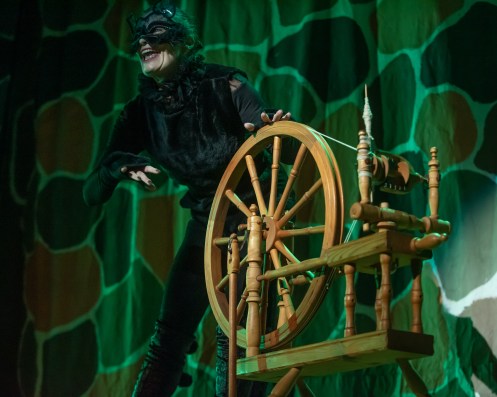
At the back of the hall sat the Lighting and Sound technicians. Quite a bit of installation work had been carried out to transform the tricky and sparse multi-purpose hall into a nicely atmospheric space. The pre-show lighting was at a gentle level with the basic rig being supplemented by a couple of movers which threw wonderful branch-like images on to the thicket gauze; later on in Act II this created a fantastic effect when the Prince was battling through the forest. The walk-down thrust resembled a catwalk runway dressed with hanging snow which brought the action out in the audience space: after all, panto has no fourth wall and at every possible opportunity should invite the audience to engage and take part, which in most parts this production attempted to do.
The colourful set was designed and constructed by the multi-talented Francesca Stone, who, as well as taking on the role of Princess Aurora, also directed the whole show together with Symeon Wade.

Francesca was an energetic and likeable Princess who displayed a pleasant singing voice and good rapport with the audience. Her parents were played by Terry Oakes and Rodger Hayward Smith as King Norbert and Queen Dottie respectively; both entered into their parts with gusto and were obviously favourites with the local crowd as they ventured ‘off book’.
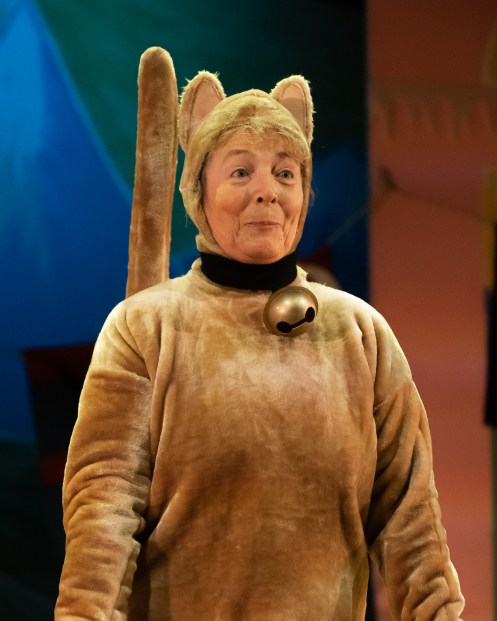
Annie Collenette as Kitty the cat was a loveable character, showcasing well-observed cat mannerisms, while Alexa Bushell as Billy, the court’s chief washer-upper, clerk and every other role under the sun, shone with a strong stage presence and a well-projected voice.

The traditional Fairy Godmother role was played by Marie Bushell, who led a highly entertaining troupe of fey fairies, Andrew Rapley and Symeon Wade – however for me her standout moment was the transformation into a Cockney serving wench in the second half. Songs were sparse in this production, but Roll Out the Barrel showcasing Marie and the enthusiastic chorus as said serving wenches was the most memorable of all. The small role of Prince Orlando, and later on his great, great grandson who was “in no way the same person” was nicely played by Steve Bannell.
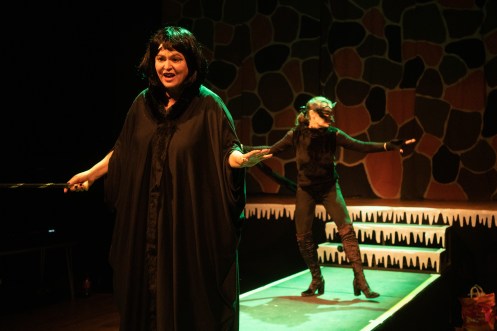
Special mention must go to Jill Turetzsky and Julie Smith as the evil fairy Carabosse and her cat Spindleshanks. This pair really embraced their remit of nastiness and gave a spirited rendition of One Way or Another, hugely appreciated by the audience.
Profits over and above the group’s working capital are donated to local causes, this year the 1st Barnes Rangers Guides and the Castelnau Community Centre, so this production offered a fitting start to this festive and giving season in more ways than one.
Ian Nethersell
November 2018
Photography by Lewis McCarthy
Image by Maggie Conway-Hughes (Aged 9)


