
Open Wide For a Deliciously Wicked Dose
George’s Marvellous Medicine
by Roald Dahl adapted by David Wood
RTK and Curve, Leicester co-production at The Rose Theatre, Kingston until 7th April, then on tour until 21st April
Review by Mark Aspen
(See also Evie Schaapveld’s review)
Do not do this at home! This was how I was going to begin this review immediately we got into George’s Marvellous Medicine. Then the show concluded with the cast singing together “Do not do this at home”. I was upstaged. Nevertheless, I am going to reiterate: DO NOT DO THIS AT HOME!
The Easter holiday show at The Rose is so full of that wicked anarchistic deliciousness which children of all ages enjoy, that the fourth wall soon collapses and the audience is revealed to be full of excited children and even more excited sourpuss adults (for there are plenty of home truths here).
The theme of Roald Dahl’s George’s Marvellous Medicine is the power of imagination. The eponymous George would prefer to spend his Easter holiday reading; reading fantastical book such as his favourite, about Bully the boy magician and all the wonderful things he can do. His thoughts sail on a sea of his own imagination and he introduces himself by singing about it, “There’s a story in my heart, and I’m its narrator”. You see, George Kranky only has his imagination to keep him company during the school holidays, as he lives away from town in an isolated farmyard.
And what a farmyard it is! A funky towering edifice, mischievously metastable, it could have come from the purple palette of Gerald Scarfe or Heath Robinson. But this is the ingeniously inventive creation of award-winning designer Morgan Large and his large (no pun intended) team that that produce the lighting, video, sound, props, puppets, wardrobe and more in a set that combines a kitchen, milking-shed, bedroom, caravan, and porta-loo, all under a exotically elaborate well-head and wind pump, and all appropriately lit in purple by lighting designer Jack Weir, enhanced by Andrzej Goulding’s video designs and David Gregory’s sound.
The whole Kranky family muck-in (reasonably) contentedly into the daily chores of a working farm, and there is much excitement, ranging from from birthing piglets (“all squelchy”) to capturing a raging bull (not That one), a nice cameo from Matthew Coulton as the scarlet taurine terror. However, for George there is usually time to settle his imagination into a good read, between spells as midwife or matador.
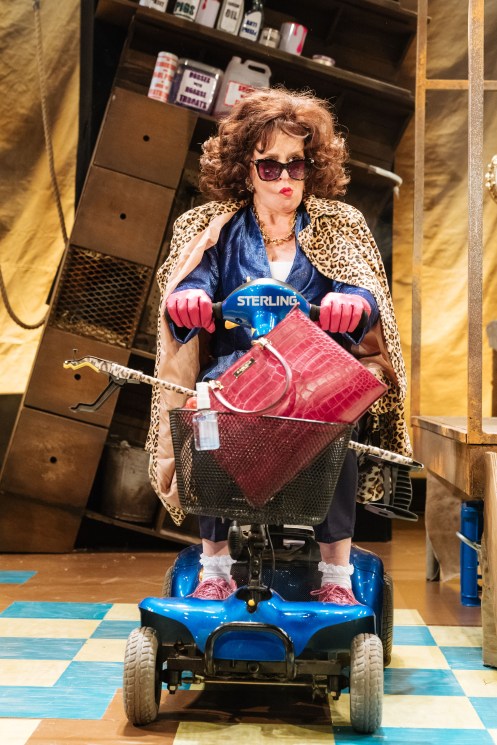
Then this ramshackle idyll is shattered by the news of the imminent arrival of George’s Grandma. This is not exactly welcome news for anyone in the family, who all know her to be a cantankerous, selfish bully, “with a mouth all puckered up like a dog’s bottom” adds George’s Dad. Panic ensues as a taxi arrives and disgorges Grandma, who makes an impressive entrance like Mad Max on a mobility scooter with dangling dolly-dice, clad in faux-leopard skin and bulging with bling. She does not like the bucolic life, prefers girls to boys, needs tea every two minutes in cups not mugs, medication reminders every five minutes, and flowers make her sneeze. She bosses George and bullies him, using her lazy-tongs like a Kalashnikov and summoning him with a loudspeaker. This is child abuse par excellence, a million miles away from your average kind and cuddly, loving lady that one hopes for as a grandmother. Lisa Howard has a ball as George’s Grandma. It is a part that you cannot overact, and she gives it full welly, full of luscious loathing, savouring the succulent spitefulness of Grandma.
Dad decides that a distant field needs urgent tending, while Mum hurries off to the supermarket, leaving the hapless George to look after Grandma. George’s defence is to retreat into his imagination. Firstly he try to imagine a grandma like all the other children’s, the kind kind of grandma: one who enjoys his presence, even gets up and boogies to his favourite music and, yes, gives him a £20 note to spend on himself! That dream is shattered when she complains that he is bigger than when she last saw him, “growing is a nasty childish habit”. Secondly, to imagine that she is a witch. This is too close to the truth when she wakes up and tells him how she likes eating slimy slugs and brittle beetles, “I never joke”.

This is too far, and George’s imagination takes its third flight into pharmaceutical fantasy. “If you only knew, Grandma, what George has in store for you?” Well it becomes quite a concoction brewed up in replacement for her own medication, every liquid, powder and paste, garnered for every room and outhouse; sanitary, culinary, toiletry, and veterinary. The result is momentous, a fifty foot Grandma and, on double checking its efficacy in the hen-house, a five foot chicken. Playing a five-foot chicken is mean feat, and it is a (chicken) nugget of part for Chandni Mistry. Her highly animated, very funny and somewhat aggressive fowl no doubt greatly extends the roles she prepared for at drama school, and is definitely no paltry poultry.

George’s Mum and Dad return. Getting over the shock with remarkable equanimity, Mum turns to practical issues, but when the super-economy sized chicken lays an egg the size of a, well, medicine ball, Dad’s thoughts turn to the commercial possibilities. Catherine Morris’ dynamic depiction of a supercharged Mum (most Mums need to be turbocharged at least), panicky pragmatic or perturbed by turns, is amazing. Justin Wilman is very impressive as Dad, not only accurately portraying the down-to-earth son-of-the-soil struck with vaunting ambition, but wowing with musical virtuosity. Wilman is a celebrated musician and demonstrates the breath of his skills by playing a plethora of different instruments. I counted, clarinet, violin, flute, recorder, guitar, and electric violin: there may be more from his rack of instruments stacked on the apron of the stage. Playing Tasha Taylor-Johnson’s especially composed music creates a wonderfully atmospheric ambience.
As the eponymous George, Preston Nyman whizzes around the stage with engaging eagerness and boyish innocent charm that sweeps the show along. And my, he knows how to work his audience, which is just as well, as in this production the fourth wall vanishes as the audience helps out in the second half, which is the denouement of the plot. While Dad hopes for a knighthood, Nobel prize and canonisation for solving the world’s food shortage, George struggles to remember what he put in the brew.


Here’s where we all help, with every member of the audience from seven to seventy shouting out the ingredients. (Being at the top end of this age range, I was pleased to do this sort of memory test, the type they use to check the marble count of us septuagenarians, and get it right!) Inhibitions fly to the wind and tears run down the cheek in a great family entertainment. Director, Julia Thomas and her company have clearly had great fun putting this show together, and it is epidemically infectious.

Does the second batch work? Well, suffice it to say that, as attested by a mesmerised whistling giant chicken (one has to suspend a bit more than the usual amount of disbelief), it doesn’t. The late Roald Dahl didn’t do gentle endings. The result is even more deliciously disastrous. Go and see for yourself, but if you go to the bar in the interval, give the gin and tonic a miss.
Mark Aspen
March 2018
Photography by Manuel Harlan
In, Out, Shake It All About!
George’s Marvellous Medicine
by Roald Dahl adapted by David Wood
RTK and Curve, Leicester co-production at The Rose Theatre, Kingston until 7th April, then on tour until 21st April
We asked one of our younger reviewers to share her thoughts on George’s Marvellous Medicine, to complement Mark Aspen’s review. Evie writes:
Review by Evie Schaapveld (aged 8 -just)
I was very excited to go along again to The Rose Theatre to see George’s Marvellous Medicine, as I knew Roald Dahl’s book.
Before I watched the play, I wondered how they would make the granny grow really tall, so I really loved how they made the granny and the chicken grow big. The big chicken was really funny and weird, and she acted it very well. She high-fived the audience although I was sitting a bit too far back to get a high-five.
I liked joining in and shouting out. It was very fun when we shouted ‘in’ or ‘out’. George was making a magic potion to make his grandma nicer, so he went round the house to collect some ingredients for the Marvellous Medicine. You had to yell ‘in’ if you wanted the ingredient in, or ‘out’ if you wanted the ingredient out of the potion.
I loved the songs and I liked the dancing, and I loved how George’s dad played lots of musical instruments. I especially liked the electric violin because it was really cool and I’ve never seen one like that before.
I thought the funniest bit was when the chicken went small after George gave her the medicine again. I liked how the puppet animals were so cute.
Evie Schaapveld
March 2018
Photography by Manuel Harlan
Dealing with Dementia
Banana Crabtree Simon
by David Hendon
Rigmarole Productions at Drayton Arms Theatre, South Kensington, until 14th April
Review by Georgia Renwick
Dementia. Whether we are at an age where we fear it for ourselves, or whether we fear it for the sake of our loved ones, dementia has a foreboding, threatening presence in the lives of millions of families. Whether you have read in the headlines that diagnosis is on the increase (the UK is estimated to reach one million people living with the disease in the next two years) or have first-hand experience, it is a difficult subject fraught with emotion.
In this new play from David Hendon (a finalist in The Kenneth Branagh New Drama Writing Award in both 2016 and 2017), 50-year-old Alan is facing an early-onset dementia diagnosis. The words ‘Banana Crabtree Simon’ all mean something to him, they are the three words that repeated over and over keep him resolute that he isn’t losing his mind. But they are slipping; he is slipping. His past is melding with his present as his future slips through his fingers, and he is agonisingly powerless to stop it.

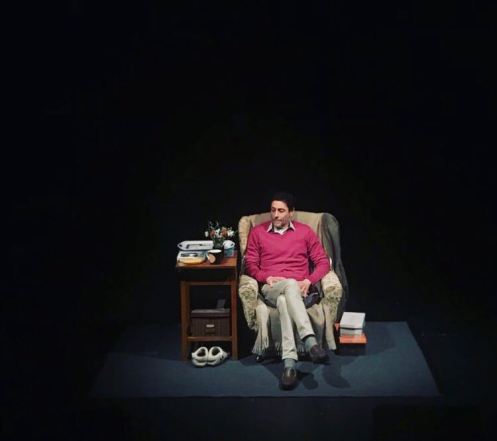
Holding court for an hour, CJ de Mooi delivers a well-paced and sensitively executed performance. He has reached TV fame for his memory as a panellist on the BBC show Eggheads and off-screen has competed as a professional quizzer. Perhaps it is this experience he draws on in his performance as the cruelty of the disease plays out. Mooi, who more than most must have come to rely so heavily on the sharpness and accuracy of his memory, captures in raw emotion the horror and betrayal Alan must feel as his memory becomes more unreliable, but his conviction in it remains unwavering. Mooi’s likeable and upbeat portrayal of Alan must gradually give way to a character almost unrecognisable, which he performs with sensitivity and emotional dexterity. It’s a frankly exhausting range of emotions to go through without even leaving the stage. Alan’s dramatic change of character is a cruelty anyone who has been there to support a dementia sufferer will surely recognise. Regardless of experience, you can feel the audience willing the bright-eyed Alan from 40 minutes earlier to come back.
Hendon’s script does not shy away from dementia’s cruelties and we must watch Alan suffer as he relives some of the worst days of his life over and over again. Yet, through Hendon’s writing we can see patterns emerge. There is a comfort and a hope to be found in the measurement of life in increments of births, weddings, of deaths; in life renewing and repeating itself over and over again.
Hendon also finds humour in the bleakness. There are episodes you might recognise from your own life including “Where are my glasses?” You probably don’t need me to tell you the answer: they’re on your head. Or, have you ever woken up feeling ready to go to work, only to remember you’ve already retired? The very real fear of what constitutes ‘normal’ memory loss and what invisible line you must cross to be tested for dementia, is captured in these moments.

Director Daniel Phillips’ has maximised a small studio set by cramming a host of domestic items into it, succinctly capturing the domestic environment of Alan’s life. We see him thumbing lovingly through a box of photos, the tactility of which allows the monologue to bring the family into the room with him through the memories he shares. It isn’t of course just Alan who is living with the disease, but his wife, son and granddaughter along with him. It’s somehow even sadder to watch the disease unfold from the comfort of his armchair, surrounded by his belongings. We don’t need to see hospitals or doctors to realise the seriousness of his condition. We are reminded by this familiarity that it could so easily be us. I am also reminded of the cancer campaign you often see around at the moment: Alan is still Alan, even with dementia, but is there a crossover point? A point of no-return where he isn’t there anymore? Our memories define us, so who are we when they disintegrate?
The searching questions Banana Crabtree Simon raises will only become more pertinent as more patients are diagnosed, and more friends and families must rally to cope. Hendon’s play offers the kind of emotional insight into the experience of those diagnosed with dementia and those supporting them that cannot be wrought through pamphlets. It is this kind of brave and thoughtfully crafted theatre which should in turn be supported.
Georgia Renwick
March 2018
Photography courtesy of Rigmarole Productions
Buds to Blooms.
Rose at Ten
RTK’s anniversary exhibition
The Rose Theatre, Kingston until 29th April
Mark Aspen celebrates a local treasure.
“It might not have happened”, said The Rose Theatre Kingston’s Chief Executive, Robert O’Dowd when looking back on the ten years since The Rose was officially opened on 16th January 2008. The occasion was at a reception last Friday (23rd March) to thank some of the people who had helped make sure that The Rose, Kingston’s treasure of a theatre, did happen, and happen with resounding success.
Some representatives of those he wished to thank were there to raise a glass to their theatre, artistic teams, staff, volunteers, donors, audience, sponsors, Kingston University and Kingston Council, and others. Even theatre critics were included in the others! But then again, The Rose can be confident in the high quality of the work that it produces or hosts.
That The Rose did happen, Chris Foy, the Chairman of the Board of Trustees recalled, was initially due to campaigning by well-known broadcaster the late David Jacobs, who in 1989 became the first Chairman of the Kingston Theatre Trust, which was instituted to bring back a professional theatre to Kingston since the demolition of the Kingston Empire in 1955.
The area situated between Kingston’s ancient market square and the River Thames at its confluence with the Hogsmill River, then largely scattered with rundown timber buildings, was acquired by property company St George plc. As one of the concessions for St George’s construction of Charter Quay, an award winning residential and commercial development, was that the shell of the building was to be provided to the Trust for at no cost. It was handed over in 2003. Charter Quay later won architectural and other awards for its site that comprised 238 apartments, five town houses, river moorings, restaurants, bars, and cafés, a piazza and a waterfowl conservation area, as well as the theatre shell, which was to be called The Rose, after its illustrious Tudor namesake in Southwark.
The community in Kingston rallied round with fund raising events and shows, such as Don Juan in Kingston, in the spring of 2004, which took place in the shell of the uncompleted building, with no seats, no loos and temporary lighting. The theatre was still very much in the raw just before Christmas that year, when Sir Peter Hall was invited to direct a production of As You Like It, now with porta-loos for the audience.
The theatre had gained an auditorium of 900 seats around its wide, thrust stage when it was officially opened on 16th January 2008, again with Sir Peter Hall directing, this time Anton Chekhov’s Uncle Vanya in co-production with English Touring Theatre.
Foy paid tribute, not only to Sir Peter Hall, but to other eminent directors who had lifted The Rose to its present high standing, including amongst others, Stephen Unwin (who was present) and Sir Trevor Nunn.
The Rose’s Executive Producer, Jerry Gunn, speaking in celebration of some of the milestones in the theatre past ten years, gave an optimistic outlook for its future, although noting that it had at times had a bumpy ride. Highlights of the past decade included Sir Peter Hall’s A Midsummer Night’s Dream, which had starred Dame Judi Dench as Titania. It was this production that propelled The Rose to international fame, following its transfer to Broadway, although it was admitted, by the subterfuge of describing The Rose run as a London opening, hence not untruthfully fulfilling the requirements of the US promotors.
Other landmarks included the trilogy The Wars of the Roses, first presented by the Royal Shakespeare Company, and adapted from Shakespeare’s history plays, which was directed by Trevor Nunn; and the world premiere of Elena Ferrante’s My Brilliant Friend, adapted by April de Angelis, presented in the spring of last year.
Looking forward to the coming year, Gunn mentioned that, specifically to mark the Rose’s tenth anniversary, a major revival of Shakespeare’s masterpiece, Much Ado About Nothing, in the spring paves the way for the autumn’s blockbuster, the world premiere of a double bill written by Nick Dear, Hogarth’s Progress. This a follows one of Britain’s most celebrated artists, William Hogarth, on two of his benders, one at the beginning of his career and one at the end. It promises political satire, boisterous romps and sleaze!
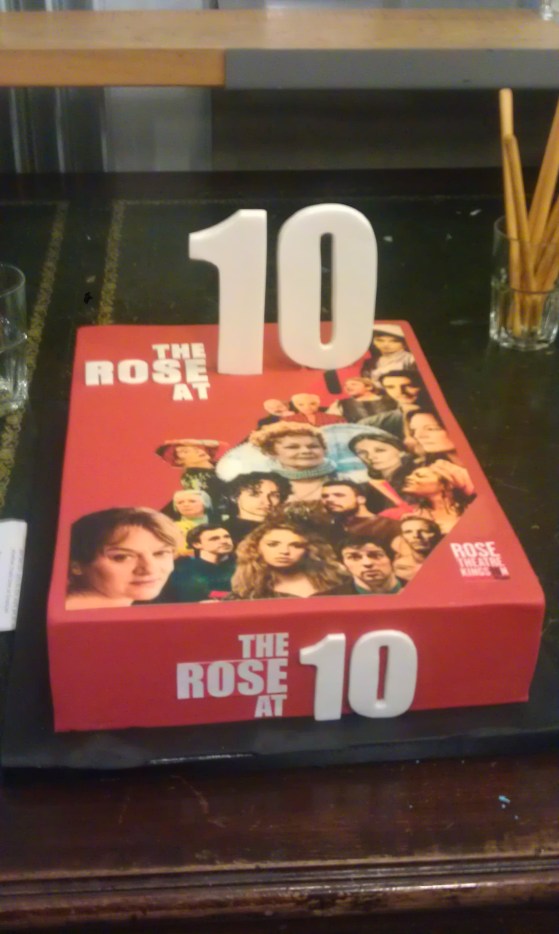
On that note The Rose’s tenth anniversary was toasted, followed by the cutting of a remarkable cake, which was decorated with images of the plays presented at the theatre over the past decade.

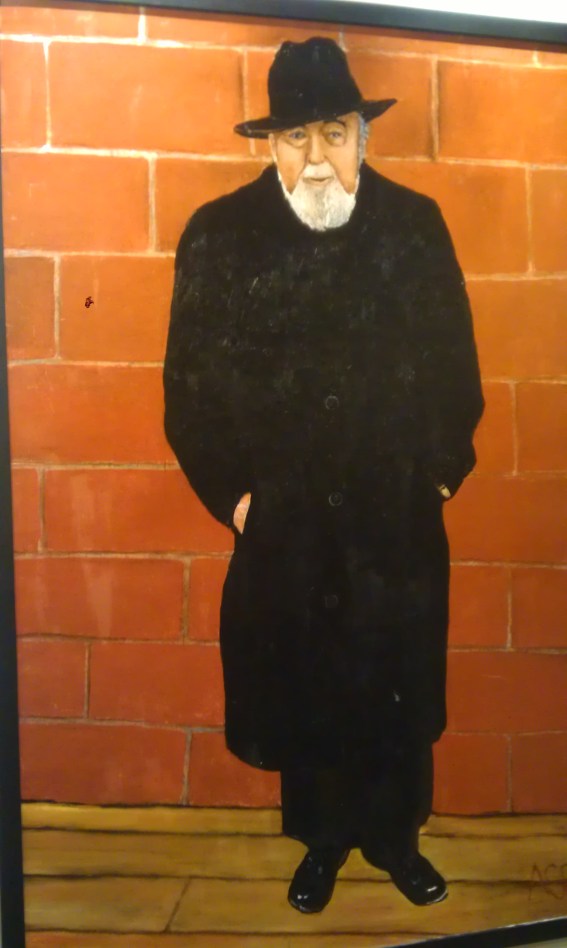
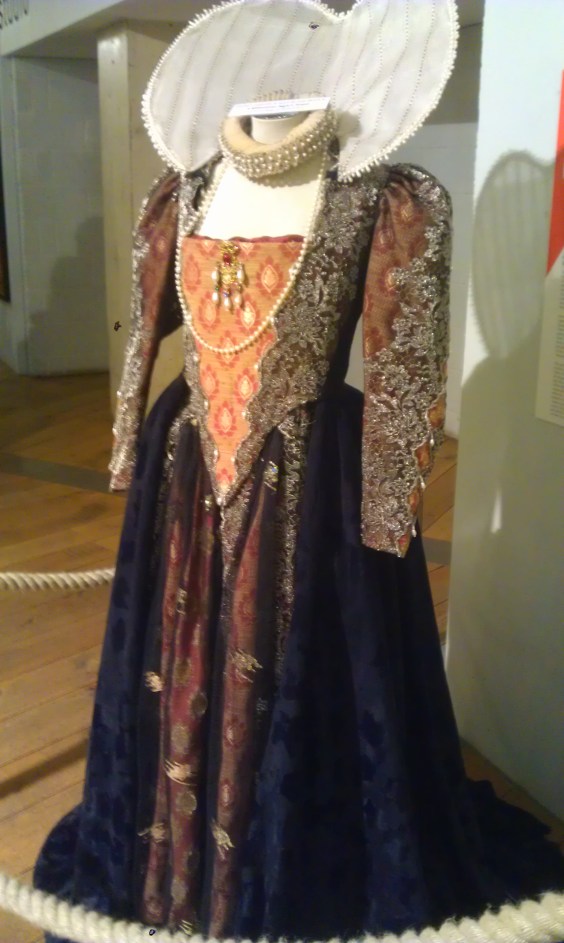
Replete with cake, the guests were able to wander amongst the exhibition, The Rose at 10, which continues until 29th April. One comes face to face with Sir Peter Hall on the stairs, in a full length portrait, before coming across Titania’s dress from A Midsummer Night’s Dream that was worn by Dame Judi Dench.

Among the assorted costumes and props, the set models and plans, and the press cuttings and behind-the-scenes photographs some surprises jump out. Is that Bill Clinton visiting The Rose, with his family? Yes, it is, what else does a US President do on a night out in Kingston? (Bill and Hilary Clinton actually visited the Rose and saw the production of As You Like It when it transferred to New York at the Brooklyn Academy of Music.) And does that chest really contain a wooden leg and a lobster? Yes, from Treasure Island (2009). And the steampunk tea trolley? The last Christmas show, Alice in Winterland.


The exhibition holds a cornucopia of rich pickings, all gleaned from what “might not have happened”. But it did … … Happy Anniversary, The Rose!
Mark Aspen
March 2018
Photography by Quentin Weiver
Magic From the Hat
Disney Alice in Wonderland Jr
music by Bryan Louiselle, adapted by David Simpatico from Lewis Carroll
Dramacube Productions, Watermans Arts Centre, Brentford, until 24th March
Review by Eleanor Lewis
It’s safe to say at present that there are a lot of highly talented professional child performers around. Should they choose to stay in a difficult profession this gives us all something to look forward to in a decade or so when they reappear on stage and screen as equally talented adults. Judging by Dramacube’s production of Alice in Wonderland at Watermans this Friday some of this talent will hail from west London.

Dramacube provides opportunities for children aged 7-14 to perform in musicals in working theatres such as The Rose in Kingston, Epsom Playhouse and Hampton Hill Theatre. Getting children to perform without self-consciousness or simple fear once faced with a real, live audience is a tricky business. A confident, relaxed child in school or rehearsal can succumb to a fit of panic once the lights go down and there are a lot of people s/he doesn’t know sitting in rows waiting to be entertained. Granted, Dramacube’s young members all want to be on stage and have been trained to that end but the consistent level of performance skill from everyone on stage was still impressive.


There were four different casts responsible for two performances each of Alice, no small feat of organisation for the production team headed by Stephen Leslie but nonetheless one they managed to pull off efficiently. The Hampton Hill and Sunbury cast gave it their all on Friday evening in a slick, fast-paced production of David Simpatico’s stage adaptation of Disney’s Alice in Wonderland. The show ran like clockwork, every child was aware of where they were supposed to be on stage, when they were supposed to be there and what they were required to do. Many of the children – possibly all of them – had more than one role to learn alongside dance moves, songs and lines and their ability to do this and carry it all off effectively is a tribute to their emerging professionalism. The Disney adaptation is both funny and charming without being sentimental and this was communicated well by the young performers.
David Simpatico’s clever adaptation allowed all of the thirty children on stage to have their moment and all of them had a confidence which allowed them to engage and entertain people. No child seemed conscious of the audience, despite it being full of friends and relatives and one waving (albeit discreetly) mum. It seems a little unfair to single out performances as this was a genuine team effort but mention must be made of Daniel Nascimento’s fabulous Caterpillar, fully in touch with his inner ‘fabulosity’; Jamie Brinsden’s consistently eccentric and very funny, stressed-out White Rabbit (some very nice, fluid dance moves there too), and the double act provided by Finn Bralow and Matilda Baker as the Mad Hatter and the March Hare.
Singing, under the musical direction of Artemis Reed and Erika Gundesen was exemplary: lyrics clear, great pace, it never dragged. Numbers such as Zip-a-Dee-Doo-Dah and The Unbirthday Song performed to such as level as to stay in your head afterwards (in a good way!)
Given that this is a review there must be some negatives? Two tiny ones only. It would have been perfect if, when changing sizes, a way could have been found for the ‘new size Alice’ to be sure the ‘old Alice’ was completely off stage before making her appearance – understandably difficult sometimes given the entrances. Children’s costumes are tricky too, the ones on show on Friday were imaginative and attractive – the Hatter’s hat with the cotton reels was great! It seemed a shame though for a couple of the cloaks/capes to have been safety pinned up. Tack them or cut them shorter?
Having sat through a lot of children’s performances in a previous life it’s quite something to be able to say that even though I was neither related to, nor friends with anybody in the cast on Friday I enjoyed and was thoroughly entertained by Dramacube’s performance of Alice in Wonderland. Well done everyone, round of applause I think!
Eleanor Lewis
March 2018
Photographs courtesy of Dramacube Productions
A Sense of an Ending
La Traviata
by Giuseppe Verdi, libretto by Francesco Maria Piave
English National Opera, London Coliseum until 13th April
Review by John O’Brien
The English National Opera is doing its best to shake off the idea of opera as posh and therefore only for toffs. It is reaching out to new audiences, especially younger and non-white. As a way of bringing such audiences to its home the Coliseum in St Martins Lane, I think Daniel Kramer’s new production of La Traviata ideal. It features sets with the wow factor by Lizzie Clachan, assured conducting from Leo McFall, the experience of Alan Opie singing Germont, the energy of Lukhanyo Moyake as Alfredo and above all the mesmerising Claudia Boyle as the doomed heroine Violetta Valery . So if you’re new to opera and want to find a way in, as it were, this is a good place to start.
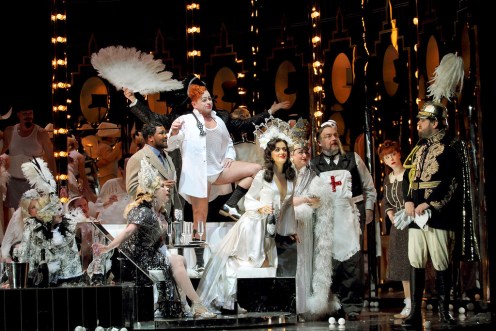
For me this production is all about opera’s best loved heroine Violetta Valery. Claudia Boyle brings her to life as earthy, erotic and eternal. Not surprisingly Violetta has made La Traviata the world’s most performed opera, the inspiration for films by Franco Zeffirelli, (as well as Pretty Woman and Moulin Rouge) and fiction from Turgenev’s On the Eve onwards. Why so?

The answer lies in the glamour and mystique of youth, sex, beauty, love and death. La Traviata (The Fallen Woman) is a tragedy about the demise and death of a doomed young woman. She is a high class prostitute in Paris dying of consumption. Her tragedy is to find real love, but then give it up to conform to convention; and then when she finally overcomes convention and achieves freedom it is too late, she only has hours to live. It is this tragic cycle of love, loss and death that makes La Traviata so compelling. Disturbingly a key aspect is what today we call “heroin chic”. The glamour of illness and the erotic young woman. The nineteenth century version of “heroin chic” was TB (consumption), it was a malady laden with meaning. Sex and death, creativity and pathology were associated with this “white plague” (not for nothing is Violetta pale ) that decimated the young, lovely and talented, meting out a protracted doom as poignant as it was painful. The consumptive look also conveyed such a thrilling eroticism that it was an aphrodisiac. The disease was said to heighten feelings, especially erotic ones. The tubercular woman was bewitching in appearance, with her prominent eyes, pallid skin and the hectic flush of her hollow cheeks. And the disease supposedly triggered inner erotic cravings too. Put these elements together add Verdi’s music and you have a hit. And a hit it has been since its first performance on 6th March 1853 at the Teatro La Fenice, Venice.

Daniel Kramer’s production has much to savour. The party in Act 1 is a tour de force. A dazzling set with mirrors, roundabouts and rocking horses (we get the double entendre of riding !) and the drinking song (Brindisi) is one highlight. But for me the production gets it absolutely right in the finale: the graveyard scene. Here Violetta is digging her own grave. She is literally falling into death. I was reminded of Winnie in Samuel Beckett’s Happy Days who is buried up to her neck in sand. Indeed La Traviata starts with dazzling light in Act 1 and ends in darkness in Act 3. Much like Waiting for Godot, “They give birth astride of the grave light gleams an instant then all is darkness”.

Brilliantly this production highlights the moment of spes phthisica (the false illusion of returning to life) and so Violetta sings “OH JOY!” in the grave: a supremely tragic irony and peripetia. Frank Kermode, the great literary critic’s most famous book was entitled The Sense of An Ending. To touch us all great art must have such a sense of an ending. Daniel Kramer’s marvellous production works precisely because it knows this and realises it triumphantly. As I say if you’re new to opera and have been put off, or intimidated, in the past by the snobs and the mystique, don’t be. The English National Opera belongs to all of us. Violetta is a prostitute. She is one of us.
John O’Brien
March 2018
Photography by Catherine Ashmore
Forecast for History
Pressure
By David Haig
Touring Consortium Theatre Co at Richmond Theatre until 24th March
Review by Mark Aspen
Umbrella, overcoat, sun-block? We take weather forecasts for granted, and in truth most of our needs, unless we are a farmer or a seafarer, are pretty trivial, notwithstanding the Beast from the East, which for most meant an extra spray can of windscreen de-icer. But what if the lives of 350,000 men and the whole history of freedom in Europe depended on a weather forecast? This was just the case in the historic opening days of June 1944, as the D-Day counter-invasion of Europe was poised to be unleashed. The knife-edge decisions of those few days, days which changed the world, are the subject of the aptly named play, Pressure, directed by John Dove, with which Touring Consortium is currently finishing its national tour at Richmond Theatre this week.
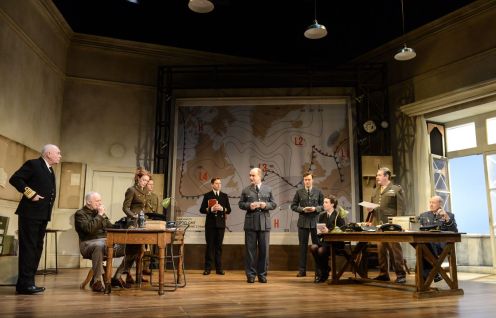
Less than 72 hours before the planned date for the D Day landings which were due to open Operation Overlord, the allied advance back into western Europe, a Scottish research meteorologist, Group Captain Dr James Stagg was sent by Churchill to advise the allied supreme commander, General Eisenhower, on the weather conditions predicted on the day, a forecast that would affect the success or failure of the largest seaborne invasion in history.
The action takes place in one room of a command centre somewhere on the south coast of England. Colin Richmond’s period accurate design is a grand room, now reduced by wartime civil-service drab paint and anti-blast scrim tape on the windows. But the dramatic achievement is the synoptic weather charts, covering the whole back wall, which almost become actors in this fast-moving drama. Tim Mitchell’s lighting design also uses these as time-line projection screens, but the set lighting immediately transforms the room from claustrophobic during the times when air raid precautions are in force to expansive at the weather is observed across the Downs through huge French windows.
A drama about meteorology may seem unlike, and indeed one of the characters in the play says “Weathermen are traditionally regarded as a bit boring” (a big “but” follows her statement). However, the title of the play drops the clue as to how it works, and work it does, for the pressure is on all round and especially throughout the frenetic first half. There is atmospheric pressure of course, barometric readouts rattle through the dialogue like hailstones, but for Stagg there is the pressure of making the most significant weather forecast in history, pressure exacerbated a family crisis.
The first half of the play is ultra-high paced. It zings along with an urgency propelled by an anxious soundtrack featuring music by sound designer and composer, Phillip Pinsky, a constant edgy ostinato. However, the hectic acting of the whole ensemble, fast, fraught and frantic builds an almost unbearable tension. (There are more spot-timed opening and closing of doors than I have seen in many farces!) Indeed without this pace and tension, the text would risk becoming repetitive: with it, it is highly exciting.
David Haig, who is an Olivier award-winning actor and an award-winning author, is both the writer of Pressure and plays the principal role of James Stagg, in a polished and powerful performance as a brusque and hyperactive scientist preoccupied with the task in hand, that of applying his advanced analytical approach to the most difficult decision of his life, and of 350,000 other lives, whether the prevailing conditions would favour the invasion, or make it impossibly hazardous.
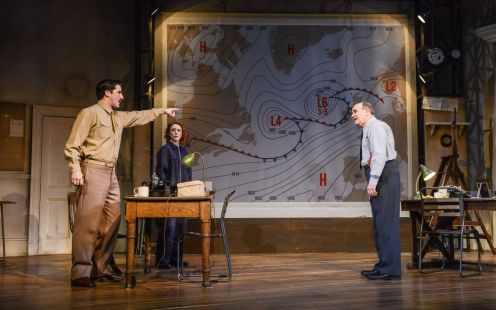
Stagg’s decision is not made any easier by the assistant who is seconded to him from the US army, Col. Irving P. Krick, whose claim to fame was as Hollywood’s meteorological consultant in films such as Gone with the Wind. Unfortunately for Stagg, Krick is not only implicitly trusted in his meteorological knowledge by General Eisenhower, it seems on the basis of correctly forecasting the ideal weather conditions for burning the fictional mock-up set of Atlanta, but that he is his high-school buddy. Krick merely extrapolates from archives of past weather patterns, moreover only at ground level. He does not understand the complexity of the weather factors governing the north-west Atlantic, which Stagg insists are controlled by events high in the stratosphere, including the newly discovered jet-stream. “There is no such thing as the jet-stream”, states Krick, while Stagg urges him to think in three-dimensions. Hence they are at loggerheads right from the start. Phillip Cairns gives a clearly defined performance as the arrogant, insolent and intransigent Krick, much a child of his culture, as to be fair Stagg is of his own. Stagg explains that “there is nothing predictable about the British weather”, but forecasts gale-force conditions for the Monday of the planned invasion, whereas Krick predicts a continuation of fair summer weather.

The towering figure, in all senses, is all this is that of General Dwight Eisenhower, known to all and sundry as Ike, whom we initially see as brash, bullying and blasphemous. Malcolm Sinclair plays Ike with a self-assured aplomb, as the resolute military man, but one with enough acumen to know when to change his mind.
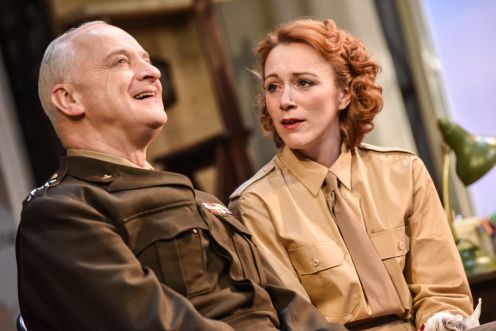
The catalyst to much of the development of the plot (as maybe in historical fact) is Kay Summersby, the personal secretary, chauffeuse and factotum to Ike, played by Laura Rogers as an attractive young woman with cut-glass accent, with a sharp mind and resilient determination. The play leaves ambiguous the relationship between Ike and Summersby (although in her late autobiography, she revealed that they were having an affair). The relationship is hinted at: a one point they intimately share an orange, and later Summersby lovingly covers the sleeping Ike.
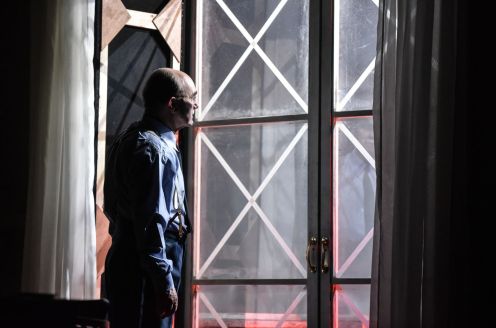
The second half of the play calms the freneticism a little, but tension continues to mount, not only as the preparations for the invasion reach their climax, but in the sub-plots. These include the parallel events in Stagg’s life as his wife, who is about to go into labour, is hospitalised with pre-natal hypertension. So Elizabeth Stagg’s high blood pressure becomes an off-stage metaphor for the meteorological pressures and for the military pressures acting out on stage. It is here that we see another side to Stagg as his professional self-confidence takes a knock and he even contemplates deserting in order to be with this wife. Intervention by Summersby however saves the day … and as it turns out D-Day.
One of the strengths of this play is the development of the characters (both in the script and the acting) into full three-dimension personalities. David Haig’s portrayal of Stagg is particularly strong in this respect. We see his detachment as he frets about his wife, obvious in the physicality of his acting, his mental torment as the pressure on him grows, and then the relief when he hears, via Summersby, the news of the birth of his child, and the contemporaneous acceptance of his recommendation to postpone the invasion for 24 hours while stormy weather passes.


Equally, we see the complex character of Eisenhower emerge, a weaker side in his succumbing to Summersby’s charms, a softer side in granting a short absence for her to visit Elizabeth Stagg in hospital, a genuine concern for “his boys” going to the front, and an admission that “I couldn’t command an army if I did not believe in God”.
Kay Summersby’s character is rounded out, when she explains how she feels at home with “Ike’s little family”, his entourage of staff-officers who have accompanied them during the campaign, and how she does not want the war to end and to leave this way of life.
Historically both Summersby and Stagg accompanied Eisenhower into Europe with Operation Overlord, but Haig’s script truncates this happy ending (if happy it is) with Gogol-esque ruthlessness. Ike ditches both Stagg and Summersby!
The dozen-strong cast work together seamlessly as an ensemble, with strong acting all round. Chris Porter makes a very starchy Air Chief Marshall Sir Trafford Leigh-Mallory, who had been a Battle of Britain commander. There is some well differentiated doubling. Mark Jax plays both the unbending US Army Air Force General “Tooey” Spaatz, and Commander Franklin, a Royal Navy officer. There is even greater differentiation in Michael Mackenzie’s Admiral Bertram “Bertie” Ramsay, very stiff upper-lip public school, with the Yorkshire telephone installer confined to the command centre.
Pressure is a totally gripping play, tense and exciting. It is does not however fall into the trap of being all gung-ho, but examines many issues that come to the fore under the pressure of war: sacrifice vs self, family vs country, society vs the individual, and freedom vs tyranny. However, it does leave one to reflect how things have changed in the past 74 years. Then the whole country was united in striving to free Britain from the tyranny of European hegemony, moreover millions, including those 350,000 men waiting to cross the Channel on D-Day, were willing to give their lives. Now only just over half the population strives for freedom from European dominance.
However, in Pressure the overarching paired conflict is that of man vs nature. We are all in thrall to nature and certainly to the power of the weather. Even our feeble efforts against the Beast from the East pale into insignificance with the events of Tuesday 6th June 1944.
As James Stagg says “How could the weather ever be boring? It defines us; it feeds us: it keeps us alive … it can destroy us.”
Mark Aspen
March 2018
Photography by Robert Day
Arresting
Windrush Square
Monument Theatre Co at OSO Arts Centre, Barnes until 22nd March
Review by Matthew Grierson
When we enter the auditorium for Windrush Square, the cast are seated and reading newspapers as though waiting in a laundry or barbers. Then, as the play begins, they move into a carefully co-ordinated routine with the papers lifted to cover and then reveal their faces as they move about the stage. Like an overture, this sets up the show’s mixture of issues and people, and how the former can obscure the latter. It also demonstrates the formidable range of the cast: they work in step physically before first breaking out into a well-choreographed crowd scene and then assuming the roles of the Johnson family of Brixton.
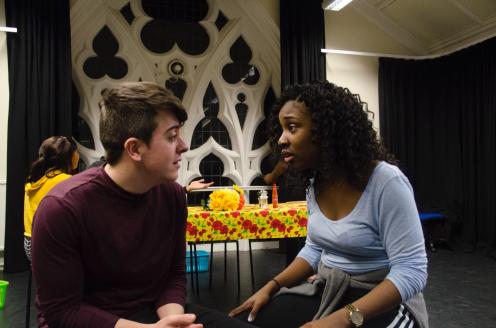
These switches are dramatically impressive, though the abrupt shifts in action also reflect the lived experience of that community in the 1980s, which we see as the momentum of a busy Brixton market is arrested when each character is in turn stopped and searched by police. The presence of these “Bobbies” – the older Johnsons use the term as though they are forever expecting the constabulary to be the trusted figures of nostalgia – is conveyed not by police presence onstage but by the performers’ reactions, so we continue to focus on, and empathise with, the family and the wider community of which they are part. The invisible police are a recurring motif, yet as the show goes on the action is interrupted by bigger, more distressing events. Almost without fail, joyous set-piece dances conclude suddenly with a fresh atrocity. In other contexts this could be monotonous, but here it puts us inside the lives of this community and the constant, wearying threats they face.


The thread around which the narrative is braided is the Johnson family, under patriarch Elijah. Abayomi Oniyide impresses with the gravitas of his performance, inflected with the humour, heart and hurt that binds his family, and the community, together. Similarly, Romy Iris Conroy as Elijah’s mother Joyce convincingly ages up in her portrayal of an authoritative, yet often cheeky, grandmother, trying to keep her son’s children in check. This does not often prove easy, however. Isaac for instance repeatedly falls foul of the law, and in Sirach Mcleish’s characterisation, we witness his bravado, frustration and sensitivity. Deslie Thomas as sister Ruby, meanwhile, is as vocal as her convictions, and though she cherishes her family is not shy of challenging them.
The family story develops with the romance between younger sister Naomi (Nadeyne Lewis) and her white boyfriend Lucas (Jack Bloss), a sweet relationship that is related from their meeting at dance through his awkward encounters with her family to its end in the concluding scene. While the tone of this is realistic rather than tragic, the social context is such that every scene between them is charged with threat, as though Romeo and Juliet could go straight from the balcony scene to the poisoning.
Such swift changes of tone and mood demand a versatile cast, and this is just one of the qualities for which the half-dozen actors in Windrush Square are to be praised. They have to escalate swiftly from familial banter into righteous anger, and all of them convince in conveying such sudden accelerations. These are not only required by the form of the drama but necessitated by the pressures that the Johnsons are under, as they are always forced to react, or to “Stand Up”, in the words of the Bob Marley song that scores the opening number. There may be only six actors onstage, but they have the energy, presence and volume of a much larger ensemble, and are ably supported by well-executed changes in lighting as well as a complicated array of sound cues used to great effect.
The cast confirm their versatility as the action is punctuated not only by dances but sequences of choreographed movement, as in the opening, while archive radio broadcasts are played to evoke events such as the Brixton riots. Each performer slips effortlessly between naturalistic dialogue and choreography, as well as switching in and out of choric roles as part of the community meetings that Elijah organises. The tone shifts accordingly: while at the meetings characters are given to state facts and set out opinions as though they are the newspapers they carry, the family scenes ground the piece in individual human lives.
An illustration of the way characterisation and social history are perfectly combined comes in the scene where Naomi introduces Lucas to her family. Lucas brings a bottle of rum as a gift, and from the moment Elijah mistakes him as a beggar at his door, this is a well-staged comedy of manners. The rictus grin that the patriarch forces on to his face remains for the next few minutes while he comes to terms with his daughter’s choice of boyfriend: not a silence is wasted in this play. The subsequent dinner, in which Lucas’ faux pas including starting to eat before grace is said and overdosing on hot pepper sauce, earns the audience’s laughs. But it is clear from the Johnsons’ passive-aggressiveness that they are uncomfortable with the young man’s presence. The genius of the scene is that, rather than rehearse racism from the point of view of a black outsider at a white family gathering, it makes the Caribbean family’s experience central, and through their behaviour we read the way they in turn have been treated by the London around them. Their hostility, although unpleasant for Lucas, is a necessary defence given everything we have seen them go through.
It is to the play’s credit that it is not all easy going for Lucas after this ordeal, though the Johnsons relax around him and invite him at least halfway into their lives, even allowing him to persuade them into an ill-timed but hilarious game of Twister at one point. Still, the tension generated when Lucas challenges Naomi over his experiences with her family is subsequently carried over into an awkward scene with her father, but it is defused when the two men struggle through their differences to bond over a shared love of football.
Only at the end does Windrush Square falter slightly. It’s not convincing either that Elijah, so long an advocate of peaceful protest, commits himself to rioting, or that Lucas is suddenly revealed to be a policeman, having mentioned earlier that he was studying criminal justice but giving no other indication of his profession. These only seem to be pretexts to have both men present at the denouement, and the sudden reversals become lost as the excellent choreography is now deployed to poignant effect when one of the Johnsons is shot.
It’s this image that remains, serving as an affecting conclusion to a thoroughly engaging production performed by an accomplished young cast. As Bob Marley sings, the audience too stands up to give them their well-deserved ovation.
Matthew Grierson
March 2018
Photography by Deslie Thomas
Page Goes to Stage
New Plays Festival
Arts Richmond, Orange Tree Theatre, Richmond, 18th March
Review by Mary Stoakes
The Arts Richmond New Plays Festival is a biennial event, originally conceived by Edie Purdue in memory of her husband Roy, an enthusiast for local amateur drama especially for young people, to encourage the writing of short one-act plays. The unique feature of this Festival is that all the plays submitted are read by a distinguished and experienced panel, who then shortlist four, whose authors have the opportunity of seeing their work in live performance in the round by a local amateur group at the Orange Tree Theatre in Richmond.
Eighteen one-act plays were read by Hannah de Ville, Vivien Heilbron, Grace Vaughan and David and Jane Whitworth, who selected four very differing entries:
The Open Window by Miranda Barrett
Mr Stripeytail by Katie Abbott
Tia and the Falcon by Loz Keal
Matrexit by Andrew Lawston
The Open Window, presented by the Richmond Shakespeare Society, was a tense, dark, psychological thriller which kept the audience guessing right up to the violent ending. Difficult moral choices had to be made and these were translated into good theatre by the taut plotting and economic dialogue. Excellent acting by members of RSS and good use of lighting and sound effects added value to this production.
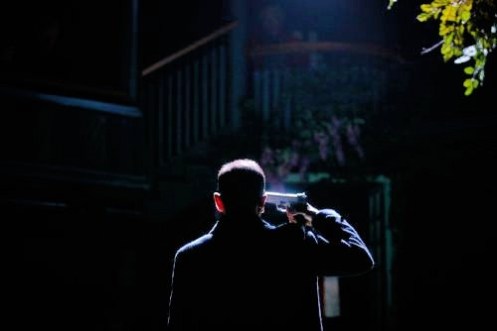
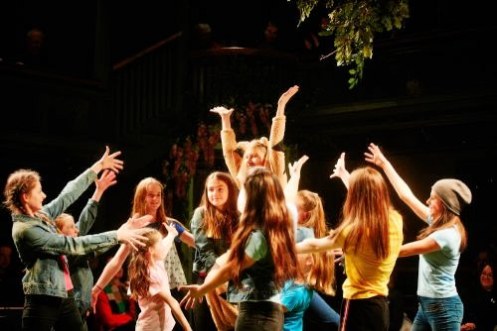
And now for something different! Mr Stripeytail was a verse play, written by Katie Abbot for her Performing Arts group of young people and presented by them. The action describes an animal who finds a human voice and his involvement and subsequent difficulties in crossing the line between the animal kingdom and man. In verse throughout, with many changes of rhythm and metre, and with passages for solo speakers and groups, this was exceptionally well written. Music and sound effects were very appropriate. This play will make an excellent addition to the repertoire of young people’s drama and deserves a wider audience.
The mysteriously named Tia and the Falcon was presented by two members of Teddington Theatre Club. This two-hander told of two friends reunited after several years and their subsequent exploration of what had gone wrong. The depiction of the characters was very credible, understandable and at times funny and the final resolution was brave and unexpected. Again excellent business, props and music enhanced this play.

Matrexit, presented by Barnes Community Players, another thought-provoking, surreal, sci-fi drama. Humanity’s minds have been uploaded to a virtual reality Digiscape to build a utopian society but this is questioned by the newly-arrived Sukky. She leads a campaign to return to the physical world but voting doesn’t necessarily lead to the desired outcome (? – Brexit parallels). This was an interesting play, full of imaginative ideas but with dialogue which could possibly have been written more succinctly for maximum theatrical effect.

The judges were Sara Burn Edwards, Kate Edwards, Jerry Gunn and Vivien Heilbron. After an interval for deliberation, Vivian Heilbron, speaking for the judges, praised the high standard of all the works which had presented the judges with some hard choices. Plays must be good in performance as well as on the written page and she announced that the winner was The Open Window, written by Miranda Barrett, which had given the best theatrical experience of the afternoon. The Deputy Mayor of Richmond, Cllr. Benedict Dias presented the Roy Purdue trophy to Miranda, who is 18 years of age and studying for A-levels at College: obviously a talent to watch!
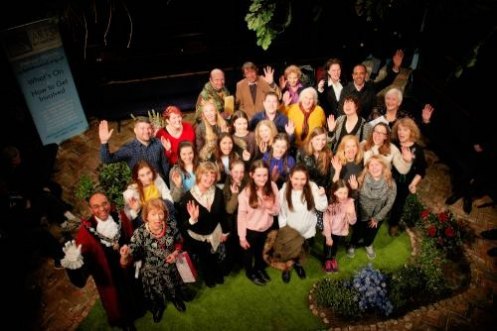
Arts Richmond expressed its appreciation of the Reading Panel and the Judges for their hard work which made this event such a success. Special thanks must also be given to Keith Wait and Johanna Chambers (Production Manager and Assistant Stage Manager), The Orange Tree Theatre and Stuart Burgess (Technical Manager), and Gillian Thorpe who co-ordinated the Festival on behalf of Arts Richmond Drama.
Mary Stoakes
March 2018
Photography by James Bell
More images at James Bell Photography
Pertinent, Poignant and Pleasing
A Month of Sundays
by Bob Larbey
Teddington Theatre Club at Hampton Hill Theatre until 23rd March
Review by John O’Brien
A Month of Sundays showing all this week at The Hampton Hill Theatre is a gem. The Teddington Theatre Club has produced a marvellous production of a play that is pertinent, poignant and pleasing. A Month of Sundays was written by Bob Larbey, best known as the writer of such classic TV sitcoms as: The Good Life, Ever Decreasing Circles, A Fine Romance, As Time Goes By and The Darling Buds of May. A Month of Sundays was Larbey’s first stage play. It won the Evening Standard best comedy of the year award in 1986, and starred the legendary duo George Cole (Minder) and Geoffrey Blaydon (Catweazle).

The play is set in a Surrey retirement home. The two central characters are Cooper (Roger Smith) and Aylott (John Bellamy). Their respective worlds have shrunk, a la Ever Decreasing Circles to the grounds of the care home for Aylott , but to just his room in Cooper’s case. All of the action takes place in Cooper’s room. Cooper and Aylott can be thought of us the two “Likely Lads” in an old people’s home, or two characters from Samuel Beckett faced with the daunting prospect of getting through the day. How to pass the time? how to deal with boredom ? how to get through the day ? these are the questions Cooper and Aylott now face. A military metaphor is used to frame their lives. The care home is imagined as a POW camp and the regime is likened to the panzer divisions conducting a blitzkrieg. This works particularly well when the tea trolley (pushed by Nurse Wilson, Julie Davis) and the hoover (activated by the cleaner Mrs Baker, Lara Parker) are seen as analogous to tanks. Cooper and Aylott form a bond based on the notion that they are the “Escape Committee” resisting the POW regime and planning their escape to Switzerland. Their biggest challenge is the unending struggle to remain with-it and not to become one of the zombies. The latter are the living dead, such as Colonel George who has lost it and has had to be fished out of the pond in his best blue suit. Like a Chekhov play, A Month of Sundays works as a tragi-comedy; it shows that life is at once tragic and comic and that the two cannot be separated. It is full of gallows humour, laughing in the face of oblivion.


Cooper and Aylott find ways to resist the panzers and pass the time. They play chess, drink whisky, talk about the fate of the zombies, compare their respective conditions: Aylott is losing his memory, Copper dreads the onset of incontinence (one has a declining mind the other a deteriorating body ) but above all they keep each other going by reciting the names of the 1947 Middlesex Cricket X1. They can only ever remember ten players’ names but they carry on trying to recall the eleventh. To give up would be to concede defeat and become a zombie.

And even when Cooper’s daughter Julia (Cath Messum) and her husband Peter (Geraint Thomason) bring him a 1947 copy of Wisden he refuses to look up the eleventh player’s name as that would deprive them of the challenge of recall. Such small triumphs are our lives made of. Everyone at The Teddington Theatre Club are to be congratulated on putting on A Month of Sundays, from the director Steve Taylor to Margaret Williams for embroidering Copper’s regimental badge. It shows amateur theatre at its best. This production deserves to be seen. A Month of Sundays does what W H Auden so memorably believed Art with a capital A ought to do: “In the prison of his days, teach the freeman how to praise”.
John O’Brien
March 2018
Photography by Jo-Jo Leppink at Handwritten Photography

 Mark Aspen