
Bonkers-Lite
Robinson Crusoé – in Concert
by Jacques Offenbach, libretto by Eugène Cormon and Hector Crémieux
West Green House Opera, at the Theatre on the Lake, Hartley Wintney, 28th July
Review by Mark Aspen

The none-to serious operetta, Robinson Crusoé, which was contentiously billed as an opéra comique when it was first performed as a pre-Christmas offering in Paris in 1867, is huge fun, in spite of (or perhaps because of) its putting its finger on a number of human weaknesses. If you like panto, you’ll like this. If you like Gilbert and Sullivan, you’ll love this. If you like wonderful symphonic music, you’ll adore this.
Glen Hurstfield, West Green House Opera’s Chairman, in his welcoming remarks from the stage, points out, a little too apologetically, that the evening’s one night stand is a concert performance, although he hints at some add-ons. He goes on to describe it as “quite bonkers”.
It doesn’t really quite fit either of these descriptions. In the event, it turns out to evolve from the black-tie concert event, then bit-by-bit into a costumed semi-staged performance. By the interval, it has acquired a set and we have almost the full works. Equally, it starts with establishing its setting and developing its characters, moves to become a lyrical love-story and on to being a gung-ho adventure, perhaps edging towards bonkers-lite. Everything happens at a joyful canter, whatever the outrageous goings-on, all enacted gorgeously tongue-in-cheek.
Read more…Paradise Found
Le Roi de Lahore
by Jules Massenet, libretto by Louis Gallet
Dorset Opera at the Coade Theatre, Bryanston, Blandford Forum until 29th July
Review by Claire Alexander

Dorset Opera was one of the first of the many summer opera festivals that have sprung up around the gardens of the UK in the last twenty years or so. In fact Dorset Opera, the prophetic brainchild of the late Patrick Shelley, then Director of Music at Sherborne School, will celebrate its 50th birthday next year and I am pleased to say it is in robust health.
Read more…Out in the Sticks
Cocktail Sticks and Two in Torquay
by Alan Bennett
BCP at the OSO Arts Centre until 30th July
Review by Vince Francis

A pleasant summer’s evening for an excursion to OSO Arts and, on arrival, the bonus of a jazz trio playing in the foyer. Nice. However, the evening’s dramatic offering consisted of an Alan Bennett double-header, Cocktail Sticks, followed by Two in Torquay.
Cocktail Sticks is an autobiographical piece, originally produced at the National Theatre in 2012, in which Bennett explores his feelings around his experience of childhood and his parents. He paints a picture of a budding author and dramatist, frustrated by the undramatic ordinariness of his upbringing and grieving for the lack of trauma, which he sees as the inspiration for good or great writers. The theme of separation is also explored, focussing on Bennett’s transition away from his working-class roots resulting from a university education, and echoing Willy Russel’s 1980 contemplation in Educating Rita. The piece is, to some extent, a revisiting of Bennett’s memoir A Life Like Other People’s, in which one of the themes is the prospect, or illusion, that other people have more fulfilling lives, including endless cocktail parties, which idea provided a fascination for both Bennett and his mother.
Read more…Inspiring Ensemble, Downbeat Musical
No For An Answer
Music and libretto by Marc Blitzstein
Arcola Theatre, part of the Grimeborn Festival, at Arcola Theatre, Dalston until 29th July
Review by Patrick Shorrock

Marc Blitzstein is possibly best known today for his translation and adaptation of Brecht and Weil’s Threepenny Opera rather than his own work. Tim Robbins’ 1999 film Cradle Will Rock told of the struggle against censorship to put on his political opera, The Cradle Will Rock, which was directed by one, Orson Welles.
Dawn Upshaw’s wonderful disc I Wish It So – recorded in 1993 (!) and one of my most played CDs, features Blitzstein along with Sondheim, Weil, and Bernstein. The Blitzstein songs on that disc hold their own against this formidable competition and include In The Clear from No For An Answer. Unfortunately, most of the other music in No For An Answer – apart from the rousing chorus that concludes Act 1 – is musically rather dull and not on this level. Even the programme note refers to the lethargic process of its composition.
Read more…Sticks and Stones, But …
Word-Play
by Rabiah Hussain
Jerwood Theatre Upstairs, at the Royal Court Theatre, Chelsea until 26th August
Review by Denis Valentine
Word-Play, written by Rabiah Hussain, aims to take a multi-layered look into how those in modern British society relate to each other and how at times a simple word or phrase to one person can have far out reaching connotations to another. The play has a multi-sketch structure and for many of them the dramatic central point is based on a person’s use of simple language and how it spirals into deeper meaning for another.
Read more…Up to Scratch
Itch
by Jonathan Dove, libretto by Alasdair Middleton based on novels by Simon Mayo
Opera Holland Park, Kensington, until 4th August
Review by Patrick Shorrock

Despite the rain and the icy temperatures, this new work by Jonathan Dove elicits hearty cheers from its audience at Holland Park, where we are under cover from the rain but not the wind! New operas can so often feel like calls of duty that are hailed as a good thing simply for having come into existence, even when they are a bit long and rather hard work for the audience. So the genuine warmth and enthusiasm from the audience, despite the inhospitable weather, is conclusive proof that Dove is something really rather special, who has a real understanding of what works on stage.
Read more…Cutting Edge
Sweeny Todd “The Demon Barber of Fleet Street”
by Stephen Sondheim
West Green House Opera, at the Theatre on the Lake, Hartley Wintney, until 23rd July
Review by Mark Aspen
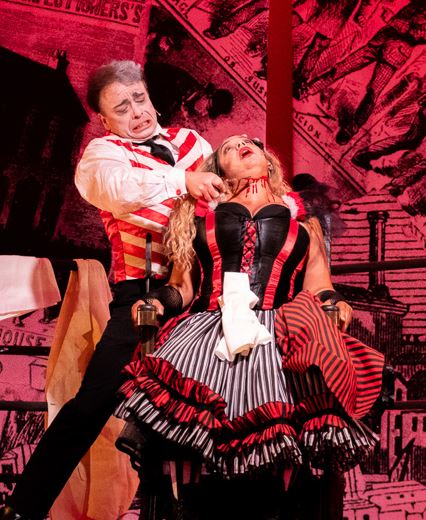
Picnics are a staple of the typical English country house opera, but seldom do you see the audience picnickers looking at their own meat pies with such circumspection before tucking in. You see, Sweeny Todd is not your usual opera. It is as gory a morsel as you could shake a meat cleaver at … and an opera where you can be sure that the majority of the cast will end up with sore throats.
West Green House Opera’s take on the well-known tale of “The Demon Barber of Fleet Street”, London’s tonsorial terror from the Victorian penny dreadfuls, , is a riotous rumbustious razor-fest, served up with wicked glee. Its gruesome Grand Guignol style in red and black makes a colourful feast for the eyes, and Sondheim’s urgent thrusting music a feast for the ears.
Read more…Enthralling Elegance
Mozart’s Constanze
devised by Thomas Guthrie
West Green House Opera, at the Theatre on the Lake, Hartley Wintney, 21st July
Review by Mark Aspen

How can such a sensitive and subtle piece provide such impact? The musical study in black and white, Mozart’s Constanze has opened the West Green House Opera Season with a superb semi-staged recital and dance pairing, prefacing its varied 2023 programme.
Maria Constanze Weber, who at 20 years old became Frau Mozart, has without justification had a bad press. Alexander Pushkin, in his verse drama Mozart and Salieri, written during Constanze’s lifetime, took a sideswipe at her (and trashed poor Salieri). Rimsky-Korsakov’s opera Mozart and Salieri takes up the theme and well into the twentieth century the calumny persists with Peter Shaffer’s 1979 play, Amadeus. The slur was compounded five years later in Miloš Forman’s film, in which Constanze is portrayed as a crude and immature air-head.
Recent Mozart biographers’ historical and musicological research has redeemed her reputation and the Grove Dictionary of Music and Musicians, in its current edition, comments that Constanze has been treated harshly and unfairly and that earlier assessments of her character were “probably wrong on all counts”.
Read more…Queering the Pitch
The Merry Wives of Windsor
music by Otto Nicolai, libretto by Lars Harald Magagerø after Salomon Mosenthal based on William Shakespeare
Queer Voices, at the Arcola Theatre until 22nd July
The Grimeborn Festival 2023
Review by Patrick Shorrock
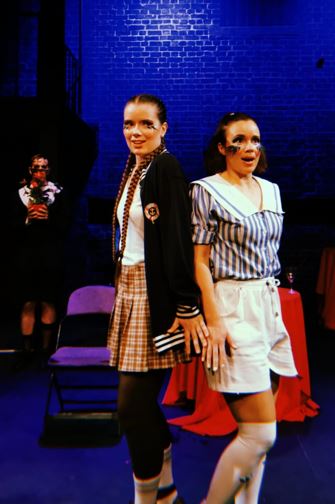
Otto Nicolai’s take on The Merry Wives of Windsor is a thoroughly delightful piece that doesn’t entirely deserve its neglect. It’s been overshadowed by a far greater work on the same subject (Verdi’s Falstaff), rather like Paisiello’s Barber of Seville, which is, if anything even more obscure than Nicolai’s work.
And then there is what one might call the Boris Johnson problem: the figure of the posh liar, with the gift of the gab, a high sex drive, and no moral scruples, has, for many of us, lost whatever charm it had. These days, we are more likely to side with the citizens of Windsor in their disapproval of Falstaff, while raising an eyebrow at the way that they see their daughters as commodities to be given in marriage to the husband most likely to support their business interests. Nicolai is truer to Shakespeare in making the wives as guilty of this as their husbands, whereas Verdi has them supporting the cause of true love, tipping the balance very much in favour of the women.
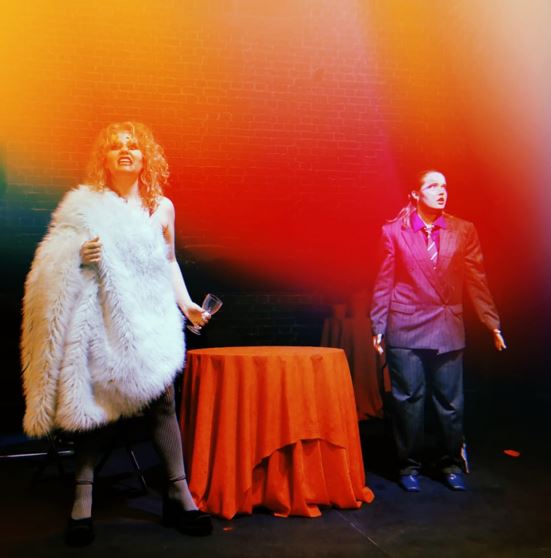
The opera is sung in Norwegian with English narration and subtitles. Queer Voices (who describe themselves as Norway’s only queer opera company) had the interesting idea – I quote from their publicity – of transforming ‘the archaic, fat, and sexist Sir John’ into a ‘liberated and gender non-conforming Falstaff with the narrow-minded people of Windsor reflecting society’s attitudes to those of us who break the binary code’. However, they didn’t really deliver what it said on the tin.
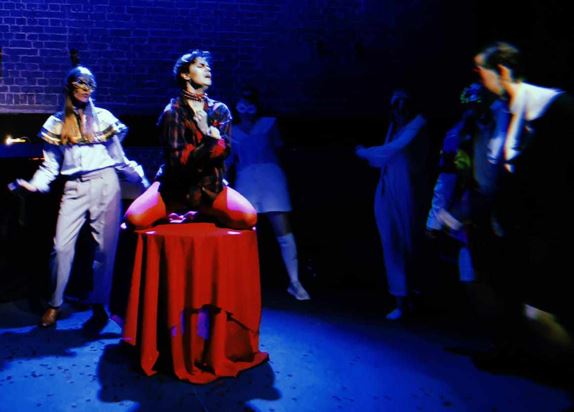
Part of the difficulty with queering traditional operas lies in the music. Unless you restrict yourself to operas with male roles that can be sung by women, it is going to be necessary to rewrite the music, something that doesn’t always work. Fenton’s music, beautifully sung by Eldrid Gorset, sounds absolutely fine sung by a soprano, but transposing Falstaff’s role is much less satisfactory, as Mae Heydorn lurches from using a chest voice for the low notes to something higher and more comfortable. Nor is her character very convincing. In reality, someone gender non-conforming is not going to be acting as a sexual predator in the blatantly public way that Falstaff does, because they will be far too worried about being queer-bashed. This Falstaff, for all the charisma that Heydorn brings to the role, comes across as more deluded than dangerous: young, thin, and not entirely masculine; for all the peacocking, this isn’t really Falstaff because the character no longer has the patriarchal dividend.

Another musical option is singers who have transitioned and retained their lower voices. Mathilde Hofvind Borgen as Mr Page wears a male suit and sings the part as written, as does her wife, which certainly intensifies the queer vibe. Indeed Windsor, for all its faults, couldn’t really be more queer if it tried. Mrs Ford and Mrs Page are very touchy feely. Ford carries a handbag and wears a skirt and heels, although his top half is businessman butch. There is barely any convention left in Windsor for Falstaff to disturb.
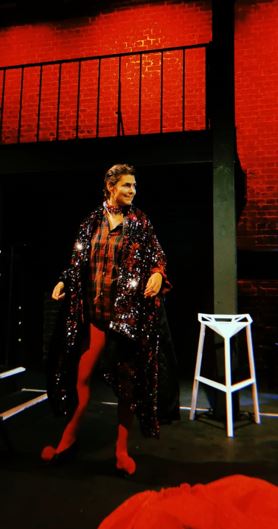
After the teasing and baiting of Falstaff gets out of hand, there is a long silence and a considerable cut, after which everyone waves rainbow flags for the finale (and we don’t get to hear whether Fenton and Anne are married). I’m not sure that it added up dramatically. But nor am I sure that it matters that much. The score is captivating with plenty of charm although it isn’t deep: this piece is a very conventional comic opera of its time that doesn’t engage with the melancholy of age or the class and gender antagonism that Verdi and Boito mine so effectively in Falstaff.
Director Kristin Lundemo Overøye keeps things moving along nicely, supported by Fridtjof Brevig’s minimal set and inventive costume designs, and the singing is impressive. Therese-Angelle Khachik (Mrs Ford) exhibits a fine grasp of coloratura and makes the most of her musical opportunities, as do the Anne Vilde Johnsbråten (Anne Page) and Maria Dale Johannessen (Mrs Page). Marte Arnesen (Dr Cajus), Mathias Vistnes (Slender) and Patrick Egersborg (Mr Ford) make telling contributions and fit in well with the ensemble.
Congratulations to Kelvin Lim, the solo pianist, for his stamina in maintaining the momentum over three acts. This is a lively and enjoyable start to 2023’s Grimeborn Festival.
Patrick Shorrock, July 2023
Photography by Talitha Khachik
Merry Monarch’s Mistress
Pretty, Witty Nell
by Ryan J-W Smith
Rogue Shakespeare at the Baron’s Court Theatre until 22nd July
Review by David Stephens
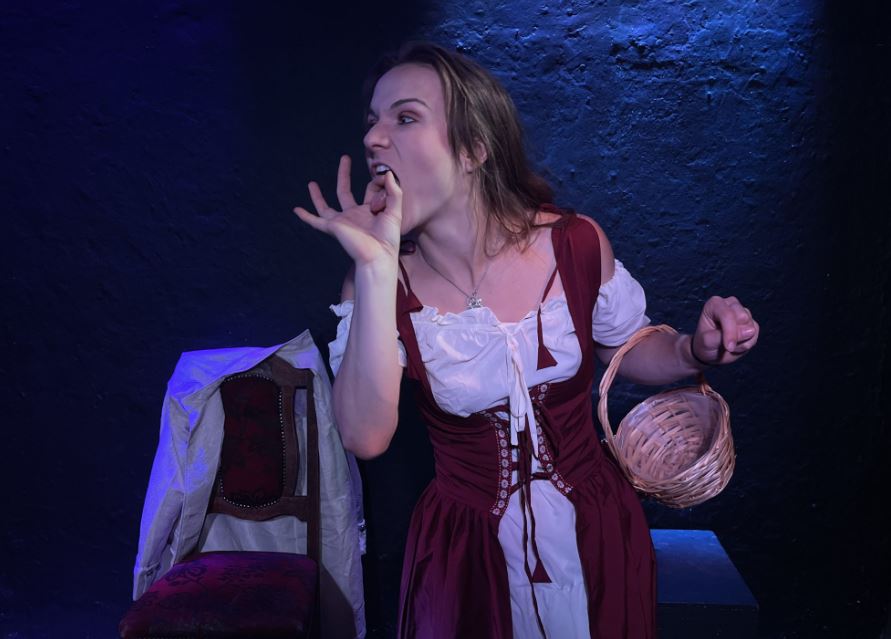
In the gloom of the English civil war and through the resulting years of austerity and religious suppression imposed on the downtrodden population by the largely puritan parliamentarians, life in 17th century England was bleak and largely devoid of fun and enjoyment. Punishments were issued for such things as taking leisurely strolls on a Sunday (the Lord’s Day), and joviality and over-exuberance were harshly frowned upon.
Read more…
 Mark Aspen