
Reflections of Shadowing
Creative Voices II
An Evening with Lisa Jewell
Arts Richmond at the Exchange Theatre, Twickenham, 8th November
Review by Heather Moulson

Seated before us was the very prolific writer, Lisa Jewell. With a backdrop of her latest book None of This Is True, the interviewer, York Membery introduced us to Jewell, who in turn presented this her latest novel. Part of Arts Richmond’s Creative Voices, this was the second talk with an established author at The Exchange.
We were eager to learn the secret of her engaging and gripping plots, and Jewell was happy to share the notion of how she would be obsessed with a particular idea, as in this case, being shadowed by someone from the outside. For instance, for his book A Year with Lisa Jewell,Will Brooker did indeed shadow Jewell for that amount of time, parting company, leaving the writer to surmise what if it was the wrong one you let into your life? The product of which emerged in July 2023 and lit up on the backdrop.
Read more…Flowers by the Docks
A Midsummer Night’s Dream
by William Shakespeare
YAT at Hampton Hill Theatre, until 11th November
Review by Celia Bard
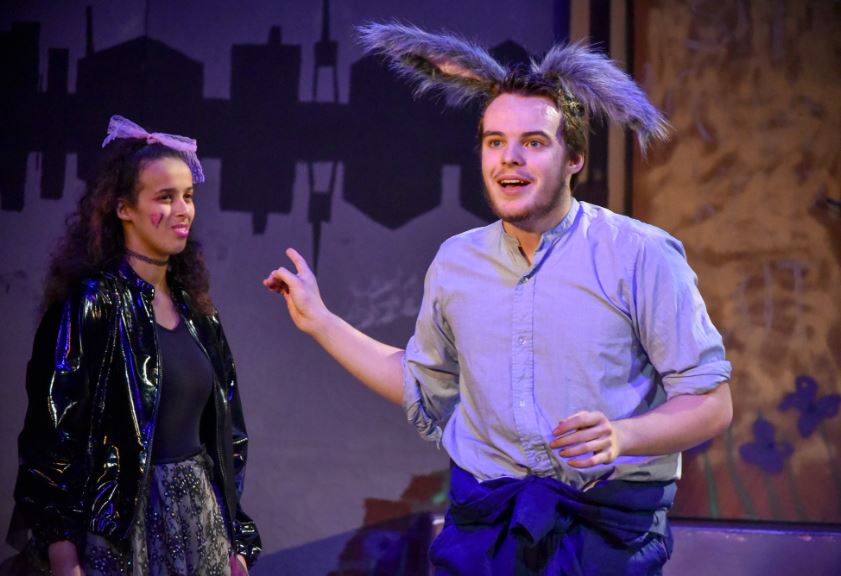
The play, A Midsummer Night’s Dream by William Shakespeare, is an interesting one as it takes the audience into fairyland, something that you don’t expect to see in his plays, apart from The Tempest. The majority of his plays focus on comedies, histories and tragedies with themes that reflect events taking place during his time period. So, it was interesting to see how YAT and the director of this production, Joseph Evans, interpreted the complexities of a ‘real’ world and its ‘realistic’ characters with a magical world containing fanciful characters pursuing their own ambitions and playful plots.
Read more…Bittersweet Memoirs
Love Letters
by A J Gurney
OHADS at the Coward Studio, Hampton Hill Theatre until 4th November
Review by Steve Mackrell

Love Letters is a play in which two seated characters read out a lifetime’s correspondence which, on the face of it, requires little in the way of set design or costumes and, arguably, not even much rehearsal. Nonetheless, the play has recently become something of a celebrity vehicle with the latest notable outing being a production by the late Bill Kenwright, with Martin Shaw and Jenny Seagrove, at the Theatre Royal, Haymarket. This was the first post-lockdown play to open in the West End following the Covid pandemic, a choice presumably made easier due to meeting the required social distancing between the two actors.
LoveLetters is an American play by A.R. Gurney that first opened in New York in 1988 and was a finalist for the Pulitzer Prize for Drama. The play centres on two characters, Melissa Gardner and Andrew Makepeace Ladd III who sit side by side at a table and read out aloud the story of their lives through correspondence with each other over a period of some fifty years. We follow their lives – their hopes and ambitions, their dreams and disappointments, over a lifetime of (mostly) separate lives.
Read more…Branagh Lithic
King Lear
by William Shakespeare
Fiery Angel and Kenneth Branagh Theatre Company, at Wyndham’s Theatre, West End until 9th December
Review by Mark Aspen
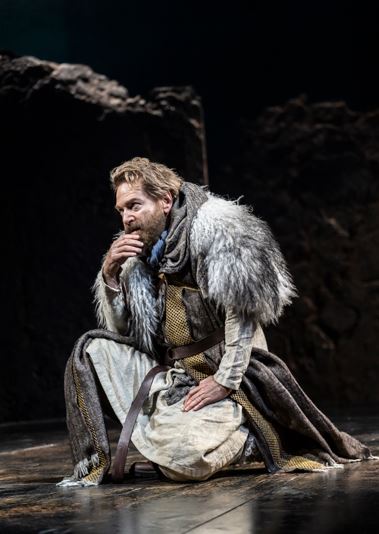
Welcome to the Stone Age. A circle of standing stones rings Wyndham’s stage, like a semi-dilapidated Stonehenge; and a fluid one, for we do not always see the same henge. Above hangs a massive glossy toroidal installation, its curved surfaces receiving the changing pictures of the projection and lighting designs of Ninna Dunn and Paul Keogan. It would not be out of place gracing the ceiling of a grand five-star hotel or an ocean liner. Designer Jon Bausor’s impressive setting is quite a spectacle.
The giant torus, though, often resembles the iris of a titanic eyeball, the pitch-black pupil in its central void an all-seeing organ of a Neolithic god, an atavistic deity. Such fatalistic influences impel the plot of King Lear, although Shakespeare does not place it in a clearly defined era. One can therefore forgive Shakespeare his anachronisms. The concept of political and military rivalries between England and France is clearly a preoccupation of the late medieval mind. And there are the repeated references to swords: the swordsmith first put in an appearance in the Bronze Age. This production sidesteps this by having almost everyone armed with a willow stave. A lot of time is spent by everyone thwacking everyone else with sticks.
Read more…Suspension Bridge
A View from the Bridge
by Arthur Miller
Headlong at the Rose Theatre Kingston until 11th November
Review by Heather Moulson
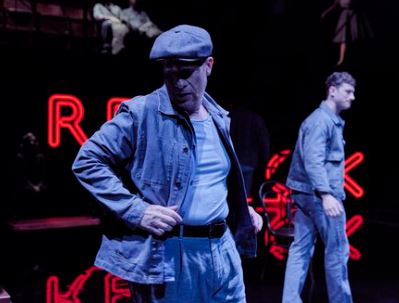
A girl sits on a swing with her back to the audience, against neon lighting, and a subtly tense soundtrack. A shiny floor resembles a river, surrounded by a stark black setting, with stairs leading up to a courtroom-like area. The overall design sacrifices the tawdriness of 1950s Brooklyn for a dark atmosphere that exudes an air of downbeat glamour.
Read more…Spectacle of Storms and Sherry
And Then There Were None
by Agatha Christie
Fiery Angel, Royal & Derngate, Northampton and ROYO at Richmond Theatre, until 4th November, then on tour until 13th April 2024
Review by Eleanor Lewis

For the British there are few places more appropriate to be transported away to on a rainy Hallowe’en night than a small, difficult-to-get-to island off the coast of Britain where ten strangers are about to meet their untimely deaths in very mysterious circumstances, which means of course an Agatha Christie.
Read more…Even Bigger Buns
Calendar Girls, The Musical
by Tim Firth and Gary Barlow
Bill Kenwright at the New Wimbledon Theatre, until 4th November, then on tour until 6th April 2024
Review by Michelle Hood

Tim Firth’s Calendar Girls began life in 2003 as a heart-warming comedy film based on the true story of a group of middle-aged women who, now famously, produced a hugely successful nude calendar in 1999 to help raise money for Leukaemia Research. The film, with a stellar cast including Helen Mirren, Julie Walters, Annette Crosbie and Celia Imrie, became a global phenomenon and went on to spawn a stage adaptation, also by Tim Firth. The stage version was successfully launched at the Chichester Festival Theatre in 2008, and the play subsequently transferred to the West End, during which time “the girls” were played by the likes of Lynda Bellingham, Anita Dobson, Lesley Joseph, Patricia Hodge and Sian Phillips.
Following the success of the film, and the further success of the stage play, came the third reincarnation – this time, Calendar Girls, The Musical, which Tim Firth developed with songwriter Gary Barlow in 2015. This latest 2023 touring version, produced by the late Bill Kenwright and directed by Jonathan O’Boyle, has been updated by the writers with a revised script and includes some additional songs.
Read more…Yo Ho!
Treasure Island
by Jago Hazzard after R.L. Stevenson
Teddington Theatre Club at Hampton Hill Theatre, until 28th October
Review by Celia Bard
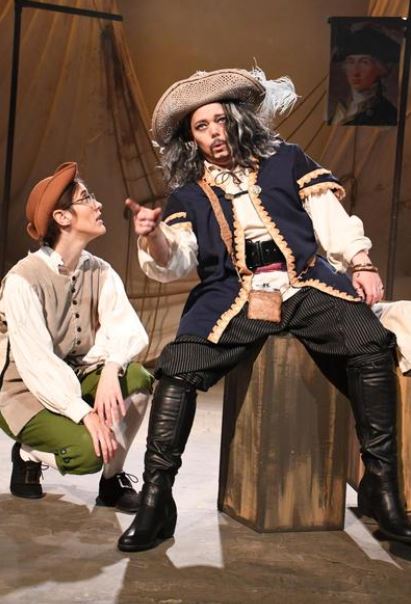
The cast of Treasure Island certainly succeeded in entertaining their audience at yesterday’s evening performance, not least because of an unintentional promenade staging element, signalled by a fire alarm, which resulted in the actors vacating the theatre followed by the entire audience into Hampton Hill High Street where, completely unfazed, the actors provided a bit of impromptu street entertainment until a fire officer gave the all-clear. The actors returned to the theatre, followed by the audience and the performance continued.
Read more…Dying to Come
Heathers the Musical
by Kevin Murphy and Laurence O’Keefe
Bill Kenwright and Paul Taylor-Mills, at the New Wimbledon Theatre until 28th October
Review by Gill Martin
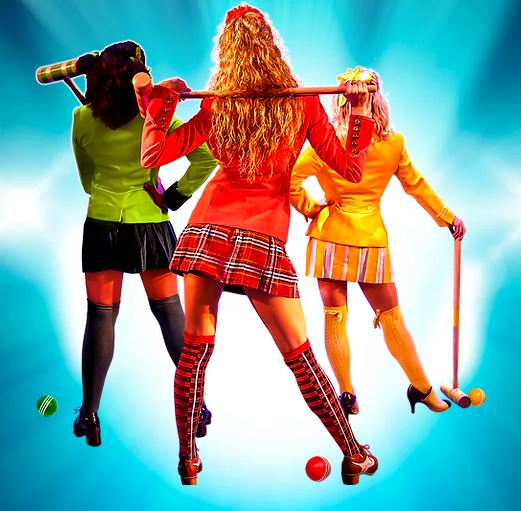
Beware, “Heathers the Musical contains haze, loud noises including gun shots, flashing lights and strobe as well as strong language and mature themes, including bullying, murder, suicide, physical and sexual violence and references to eating disorders.” That’s the dire warning in the theatre programme but, hey, it is a musical so how upsetting can it be?
Way back in 2018 a re-release of Heathers the Musical, a bizarre and bloody story of teenage cruelty, hit the cinema screens with stars Winona Ryder and Christian Slater. Even further back in the mists of time, i.e. 1988, it was cult satirical smash hit about vindictive and paranoid high-school kids who could score top marks in meanness.
Read more…Moral Dilemmas Exploded
Farm Hall
by Katherine Moar
Theatre Royal Bath and Jermyn Street Theatre Productions at Richmond Theatre until 28th October
Review by Mark Aspen

Theatre has many functions. Comedy makes us laugh; tragedy makes us cry. It can entertain (and the panto season is just around the corner) … or it can make us think.
Farm Hall has a contemplative depth that probably no other live performance art could provide. This is theatre at its best. It is not easy theatre though, and requires an investment by the audience, but an investment that pays handsomely.
Operation Epsilon was a military action towards the end of World War II. The British government detained some of Germany’s most gifted nuclear scientists, who were believed to have worked on Nazi Germany’s atomic weapons development. The scientists, who included three Nobel Prize winners, were captured in southwestern Germany during the late spring of 1945, as part of a larger intelligence mission. They were all interned together at Farm Hall, a former stately home near Godmanchester, then in in Huntingdonshire, from July that year until early in 1946.
Read more…


