
Absorbing and Powerful
12:37
by Julia Pascal
Pascal Theatre Company at the Finborough Theatre, Earl’s Court until 21st December
Review by Harry Zimmerman
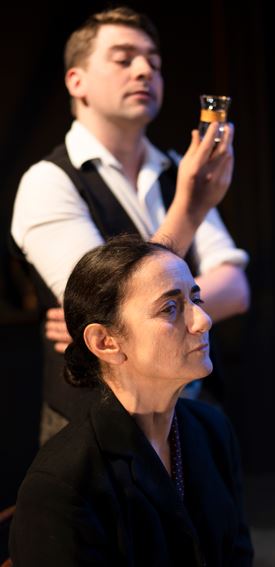
It was at 12.37 pm on 22nd July 1946 that the King David Hotel in Jerusalem was bombed. Ninety-one people were killed, and forty-six wounded. The bombing was carried out by right wing Zionists, targeting the headquarters of the British forces in Palestine.
This event is the culmination of a perfectly crafted and gripping narrative that intertwines the 20th century nationalist struggles of Irish and Jewish nationalism with a visceral love story. The result is an absorbing and powerful piece of theatre.
Read more…Fun-Filled Flamboyance
Legally Blonde, the Musical Jr.
music and lyrics by Laurence O’Keefe and Nell Benjamin, book by Heather Hach, based on the novel by Amanda Brown
Dramacube at the Esher Theatre until 29th November, then tours to 21st December
Review by Millie Stephens
Millie Stephens is one of our younger reviewers. Millie trained with the Rose Theatre, Kingston.

Legally Blonde, the Musical Jr was a fun and vibrant performance by Dramacube’s teenage Orange Cast at the newly refurbished Esher Theatre. It is a story of friendship, sorority, and the legal world, with the classic social message of ‘don’t judge a book by its cover’.
Read more…A Lion, a Witch, and a Spectacular Wardrobe
The Wizard of Oz
by Alfred Bradley adapted from the novel by L Frank Baum,
BCP at the Kitson Hall, Barnes until 3rd December
Review by Andrew Lawston
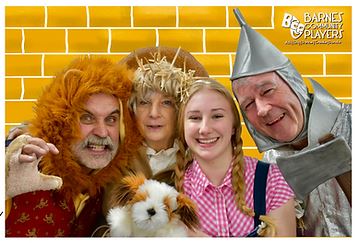
Even rail disruption and the prospect of an England vs Wales football match can’t dampen the spirits of Barnes Community Players as they launch their winter show, a joyful stage adaptation of L Frank Baum’s classic The Wizard of Oz, directed with pace and invention by Jane Gough. It’s important to stress from the outset that there are no songs, and few of the iconic lines of dialogue that you might be expecting, but there are buckets of charm and magic to go around.
Kitson Hall’s proscenium arch is held back for key scenes as the audience sit around a thrust stage. From the outset this creates an interesting tension, as Dorothy’s “real world” family are depicted on the main stage, while most of the Oz scenes are played out down at floor-level, encouraging the audience’s greater complicity with the fantastical world in which Dorothy finds herself.
Read more…Taster Menu
Reboot Festival 2022
Week Three
Barons Court Theatre until 3rd December
Review by Claire Alexander
Watching six plays in one evening is a little like getting a taster menu at a restaurant. You know which dishes you would like more of, which are perfectly portioned and which perhaps you would not have chosen. Happily, all of the plays I saw at the Baron’s Court theatre last night fell into the former two categories and I found myself wondering which of the short snapshots I saw, I would like to see in a longer version.
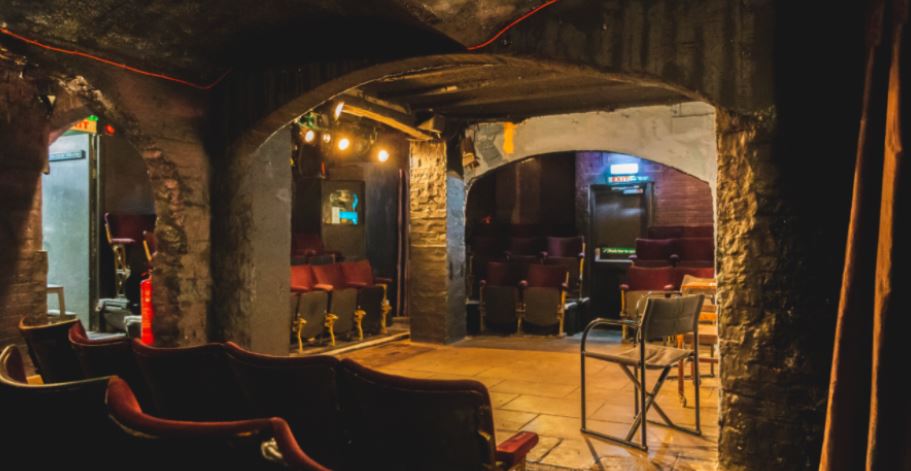
It’s quite a challenge in an evening – six plays – and I applaud the Baron’s Court Theatre for this concept and making it work so successfully. This is the third and final week of the Reboot Festival and will have given eighteen new and emerging writers an opportunity to showcase their work. The plays were short and snappy, perhaps only fifteen minutes at most, and thus the evening did not fall into the trap of being overlong and kept the audience on their toes!
Read more…Jack and the Broadway Stars!
Jack and the Beanstalk
by Jude Christian and Sonia Jalaly
Lyric Theatre Productions at the Lyric Theatre, Hammersmith until 7th January
Review by Viola Selby

In my opinion, to make a pantomime perfect, one must first add a good dollop of glitter, a generous helping of goofy gags and finally but most importantly a gigantic amount of gleeful energy!
Jack and the Beanstalk has all this and more, with so much colour and sequins (thanks to the creative creations of theatre design studio Good Teeth)! From the off, audience participation is perfected by having us countdown to the start of the show. Then through the whole perfomance, you are made to feel included through all traditional and slightly less known means, be it ‘He’s behind you’ and ‘Oh no it’s not’, to auditioning for “World of …” and getting to cast a spell together to make it snow!
Read more…Opera Goes to the Movies
It’s A Wonderful Life
by Jake Heggie, libretto by Gene Scheer
English National Opera at the London Coliseum until 10th December
Review by Patrick Shorrock

I must admit that I find the current trend of staging films rather perplexing, whether it is Moulin Rouge, Back to the Future, or Single Man. Theatre managements clearly like a product where the audience will know what they are getting. But there is still a sense where – like film sequels – they are likely to disappoint and seem a little unadventurous. Inevitably, staging a film loses much of what makes the original distinctive – particularly the original performers and the editing. The more it takes on a life of its own, the further away it seems from what made the original source distinctive.
It is even harder to turn a film into an opera, where the dialogue will generally have to be rewritten, the words will require a different delivery when sung, and the original music has to be replaced. It’s a Wonderful Life is ENO’s second go at the challenge of an operatic version of a film after Philip Glass’s intriguing Orphée last season. There is much to enjoy here, even if I am yet to be convinced that films turned into operas is the way to go.
Read more…Foiled
RedGreenBlue
by Billy Parker
The Hope Theatre, Islington until 25th November
Review by Heather Moulson
The Hope Theatre in Islington on a dim Friday afternoon looked a good prospect for a play reading … particularly when it was written and directed by the versatile Billy Parker. I had the pleasure of knowing Billy as a poet at Tenby in May this year, and I looked forward to discovering more of his work.
Walking up some steep pub steps at The Hope and Anchor, we came to a very intimate theatre with the set covered in foil – ingenious, striking and effective. Centre stage sat the cast of four on a line of chairs, adorned in sixties and other vintage glamour. With a voiceover of a sexual health warning, the journey really began. The impressive Zuleika Voegele-Downing as The Knight drew us in with a strong speech. In time we learnt the other three performers were “Who”, “Me” and “You”, a very clever move.

Chocolates or Cartridges
Arms and the Man
by George Bernard Shaw
OT Theatre Productions at the Orange Tree Theatre, Richmond until 14th January
Review by Steve Mackrell

First produced in 1894 and set during and after the Serbian-Bulgarian war of 1885, George Bernard Shaw’s celebrated comedy about the futility of war retains a stark relevance given today’s war in Ukraine. George Orwell claimed Arms and the Man, writtenwhen Shaw was at the height of his powers, was probably the wittiest play he ever wrote, technically flawless and, despite being a comedy, the most telling about the harsh realities of war. For his swansong as Artistic Director at the Orange Tree, Director Paul Miller has produced a brisk, well-paced and beautifully-acted piece of theatre. Miller is very much an aficionado of Shaw having produced six of his plays in the eight years of his tenure at the Orange Tree – including Candida, Misalliance and The Philanderer.
Read more…Quid Pro Quo
Mrs Warren’s Profession
by George Bernard Shaw
Theatre Royal Bath Productions at Richmond Theatre until 26th November, then on tour until 8th April
Review by Eleanor Lewis

Eleven years after the Married Women’s Property Act of 1882 first allowed women the right to their own property, George Bernard Shaw wrote Mrs Warren’s Profession. This was a play in which a woman works her way out of abject poverty via prostitution, earns enough to educate her daughter and ultimately becomes wealthy running a string of international brothels, with the additional investment aid of her aristocratic friend and his wider circle. Unsurprisingly, in 1894, the play was banned by the Lord Chamberlain on the grounds of what was deemed to be inappropriate discussion of prostitution. Prostitution was merely the pivot around which the rest of the system turned though and what Shaw revealed in his witty and unsentimental work was the grubby framework of a society in which women were bought and sold into work or marriage beneath a veneer of social acceptability, and to whom nothing else was available.
Read more…Out of This World
Dinner with Groucho
by Frank McGuinness
b*spoke theatre company at the Arcola Theatre, Dalston until 10th December
Review by Melissa Syversen

As I entered Studio One at the Arcola, I was quite taken with the beauty of the set for the play Dinner with Groucho. Designed by Adam Wiltshire, the set immediately tells you that we are somewhere otherworldly. There are lights encased in different sized bubbles hanging from the ceiling, a backdrop of sky and ocean against a wall of stars. On the ground there is sand and discarded oyster shells and in the middle of it all, an intimate dinner table and chairs. We are about to dine at the edge of existence it seems.
Read more…
 Mark Aspen