
Casanova Was a Librarian
Larkin With Women
by Ben Brown
Strut and Fret at the Old Red Lion, Islington until 17th September
Review by Louis Mazzini

The poet Philip Arthur Larkin was born in 1922 and to celebrate his centenary the Old Red Lion presents a revival of Ben Brown’s Larkin with Women, first seen in 1999 when it won the Theatrical Management Association’s Award for Best New Play.
Covering the last thirty years of his life, this sublime and very funny play begins as Larkin becomes the Librarian at Hull University. Larkin was a nexus of contradictions. In his thirties, he maintained an addiction for “top shelf” magazines and he was still swapping self-penned fiction about corporal punishment at girls’ schools with his Oxford friends. Yet, and perhaps more effectively than any of the other modern poets, Larkin wrote insightfully about the truth of love. And while he could be self-obsessed and fearful of commitment, he remained committed – in his way – for decades to those who loved him and whom in return he loved.
Read more…Whisked Away
Cooking With Microphones
by Deborah Whitmarsh-Boyce
Sensible Footwear at The Canal Café, Paddington until 28th August, then at the Bread and Roses Theatre, Clapham until 9th October
Review by Heather Moulson

Sally is a strong presence in this one woman show. The smartly attired Sally is highly watchable. Sally is a woman of a certain age in Cooking with Microphones. However, leave your cookbooks at home.
At the earliest opportunity Sally presents a milk whisk as her personal microphone. It is not only empowering, but it shares a common bond with women to use their voices. Black and white films are shown intermittently of women singing with similar cooking utensils, with an emphasis on the friends that made her stronger on those special Friday nights. Friday nights really belong to them, after a hardworking week putting everyone else first. Solace and comfort can be taken from those nights, against the tangible disappointment that the potential for the life of a working woman to get easier has still not materialised.
Read more…Illuminated Hope
The Apartments and At Least I Can Dance
by Verity Rowsell and by Michelle Hanks
Bird Mouth Collective at the Etcetera Theatre, Camden until 27th August. Double Bill as Part of the Camden Fringe
Review by Heather Moulson

Well, what can I say about such an ambitious presentation? With a strong cast and well written texts it is a satirical double bill of confrontation, human situations, mental illness – and dancing, by the new East London based Bird Mouth Collective.
Read more…Wit, Compassion and Hope
Three
by Christie Peto
Dangerosity at the Canal Café until 21st August
Review by Heather Moulson

Walking into the Canal Theatre Café was akin to walking into the Kit Kat club in pre-war Berlin, but without Sally Bowles. An opulent setting with round tables, an air of splendour, and an enticing proscenium arch stage met the eye.
The two hander ninety minute drama, Three was well-crafted, the central figure being played by the writer, Christie Peto alongside Patch, played by Hannah Harquart. The latter role represents an alter-ego, mentor or possibly guardian angel. Harquart covered all three of these persona with energy and gusto with her strong stage presence, while Peto gave an honest and sincere account of breakdown and other mental health issues. The writing was relevant and identifiable, with wit and understanding.
Read more…Identity Confronted
It’s Only Funny with Stage Directions
by Laila Sajir
Two Thousand and One Theatre Company at the Etcetera Theatre until 18th August
Review by Heather Moulson

Set in the morning after the night before, a scene uncomfortably familiar, this one woman play looked promising. The self-loathing and overthinking cloud hung over Manal as we opened up to an interesting and scattered set. She shared her thoughts with a lover from a directionless relationship, while preparing Iftar for her strict Muslim family who were due to visit. Torn between getting her lover out the flat while listing his negative points, and preparing the evening meal to end the Ramadan fast for the day, her frustration was palpable.
A one woman play by performed by the author Laila Sajir, It’s Only Funny with Stage Directions moved along at a good pace. An optimistic start as Manal, played with conviction by Sajir, made good use of every prop, including slicing an onion. (Uncomfortable viewing!) Strong writing and genuine poignancy was in abundance, but significant and humorous points went from subdued to inaudible. Projection was badly needed.
Read more…Unleashed
Tulu
Circus Abyssinia at The Layfette, Underbelly Circus Hub, the Meadows, Edinburgh Fringe until 27th August
Review by Eleanor Marsh
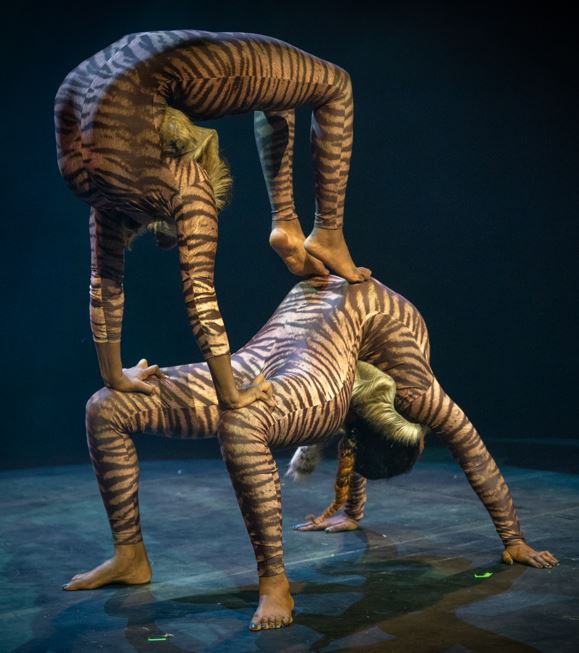
Tulu Derartu is the first African woman to win an Olympic gold medal (10,000 metres). She went on to win the World Cross-Country Championships twice and, at the age of 37 won the New York Marathon. She is currently President of the Ethiopian Athletics Federation. That level of achievement deserves to be celebrated and Circus Abyssinia celebrate her in style!
There is little narrative to this piece, excepting the opening of the show, which depicts a female athlete on a track running remarkably quickly around the big top to the accompaniment of what appears to be the actual commentary of the 1992 Olympic final. Of course, she’s not completing her circuit as quickly as it appears. It is sleight of hand on a grand scale: there are actually three “Tulus”, who all come into their own later in the piece. The audience is then taken to Africa, where the real Tulu tended cattle as she was growing up and reputedly ran at night-time – dodging the hyenas! This part of the show contains some truly incredible contortions – and the first of many audible gasps from the audience.
Read more…Footnotes
Footloose
by Dean Pitchford and Walter Bobbie
Selladoor Worldwide at New Wimbledon Theatre until 20th August
Review by Andrew Lawston
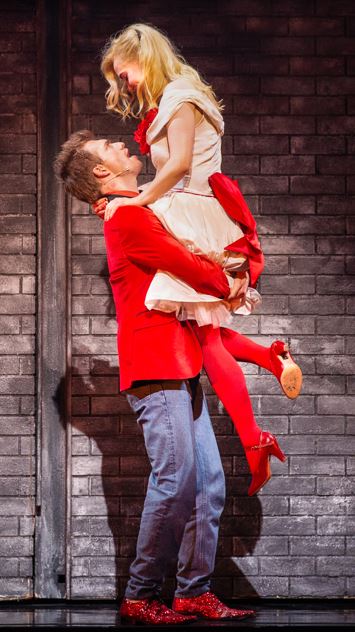
Wimbledon Theatre is tonight transformed into Bomont, the town where dancing and rock music are prohibited. Itchy-footed rebel Ren McCormack moves from Chicago to Bomont with his mother, and proceeds to challenge the status quo. Dean Pitchford and Walter Bobbie’s stage adaptation of the 1984 film starring Kevin Bacon, Dianne Wiest, and John Lithgow, has plenty of its own star power, in addition to an iconic soundtrack and music by Tom Snow.
A brief announcement mentions that Mike Nichols, the Musical Director, is conducting the evening’s performance, and excitingly that the actors will be playing instruments live on stage. In practice, most of the musicians on stage are in the ensemble, but Ren and Chuck both pick up an acoustic guitar and saxophone, respectively. It’s a bold move from director Racky Plews to have actors playing live in the middle of choreographed musical numbers, and it adds a sense of danger and rawness to the production. Nichols later takes a greatly deserved bow at the end of the show, brandishing a frankly gorgeous bass guitar.
Read more…Pre Prandial Perplexities
Sense and Compatibility
by Nina Schlautmann and Sarah Tiplady
SchlautladyINK at Etcetera Theatre, Camden, then at The Lion and Unicorn Theatre, Kentish Town until 16th August. Part of the Camden Fringe
Review by Heather Moulson
Not having been to a morning play for a long time, I looked forward to this pre-lunch experience.
As we take our seats in the surprisingly roomy theatre above The Oxford Arms, one of the actors, Nina Schlautmann paces the stage area nervously, already paving a nice build-up. She is joined by two wooden stools and an orange suitcase laid bare, containing toilet seats, and other intriguing props brought in to furnish the stark set. Then a projected backdrop of skilled and detailed sketches showing images, among other settings, of interview rooms and ironic supermarkets appears. However, even bereft of these things, the sharp performances and dialogue would have dressed the set beautifully.

Thin Wire Spectacle
Hotel Paradiso
Lost in Translation at The Beauty, Underbelly Circus Hub, the Meadows, Edinburgh Fringe until 27th August
Review by Eleanor Marsh

Guinness World Record holder Lost in Translation is a collective of international artistes based in the UK, all at the top of their game, and now creating quite a buzz at the Edinburgh Fringe.
Hotel Paradiso is a well-known play and film that has its original plot slightly changed for this production. But the plot is not the thing here and any purists looking for a replay of the movie are in the wrong place.
On the thin wire of the little of the plot that remains, hangs the favourite hotel’s future, which is under threat from the baddies from the bank; needless to say the occasional illicit affair and obligatory police chase are employed to add even more drama to the story and the clever use of proper slapstick is very impressive.
Read more…Dealing With a Sex Pest – Edwardian Style
The Boatswain’s Mate
music and libretto by Dame Ethel Smyth
Spectra Ensemble at The Arcola Theatre until 13th August, then on tour until 9th October
Review by Patrick Shorrock

It seems to be Dame Ethel Smyth’s year, with her opera, The Wreckers, performed at Glyndebourne and the Proms. The Boatswain’s Mate is lighter fare and actually funny (which can’t be always be said for operatic comedies). It’s worth hearing, as the music is pleasing, if not, perhaps, desperately individual. Pianist and Music Director John Warner – well supported by Emily Earl on violin and Meera Priyanka Raja on cello – did a fine job with the reduced score, while giving hints that the full orchestration might have something to add to the overall effect.
The lively overture features Smyth’s famous March of the Women – the anthem of the Suffragette Movement. We see a woman on a deck chair reading. She is subjected to the clearly unwanted advances from a man in beachwear. She is successful in driving him away when she proves that she is better than he is playing with his beach-ball.
Read more…
 Mark Aspen