
We Live in Glasshouses?
Radiant Vermin
by Philip Ridley
Progress Company at Progress Theatre, Reading until 20th October
Review by Nick Swyft

Radiant Vermin is a morality tale, in which a young couple are offered a free house in a rundown estate by the mysterious Miss Dee (Liz Carroll). The house needs a lot of work. No problem for a young couple, you would think, notwithstanding that there is a baby on the way. Except that they need it done quickly and Ollie’s DIY skills aren’t really up to it. This is all well and good until the husband, Ollie (Adam Wells) accidentally kills a vagrant whom he finds in the kitchen. There is, of course, a minute’s consternation (66.6 seconds to be precise) before a piece of magic happens and the kitchen is transformed. They realise that the entire house can be done out, room by room, provided someone dies in each room. There are a lot of homeless vagrants around, and so plenty of people who could die without too many questions being asked.
Read more…Totally Engrossing Golden Revival
The Diary of Anne Frank
by Frances Goodrich and Albert Hackett, adapted by Wendy Kesselman
YAT at Hampton Hill Theatre until 13th November
Review by Celia Bard
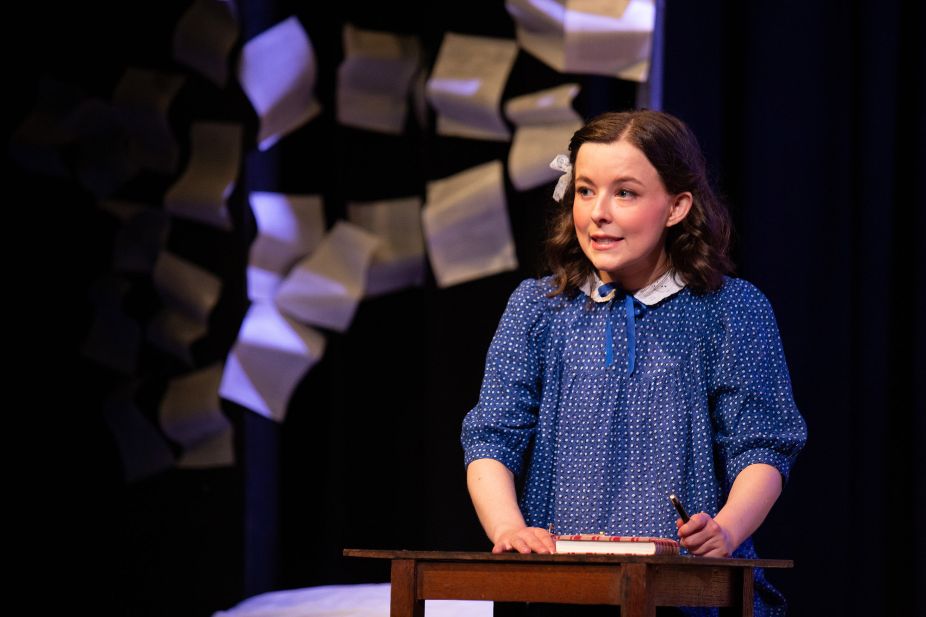
I was delighted to be back in Hampton Hill Theatre on Wednesday evening watching YAT’s roller-coaster production of the play, The Diary of Anne Frank, a stage adaptation of the posthumously-published 1974 book. The opening scene takes us into Anne Frank’s terrifying world very quickly and, apart from some lighter and very funny moments, the Frank family and guests are never free of the awful reality of their situation. This production sees the incorporation of music by composers killed in the Holocaust, thus adding another level of poignancy to this harrowing story of persecution during WWII, viewed through the diaries of tragic teenager, Anne Frank.
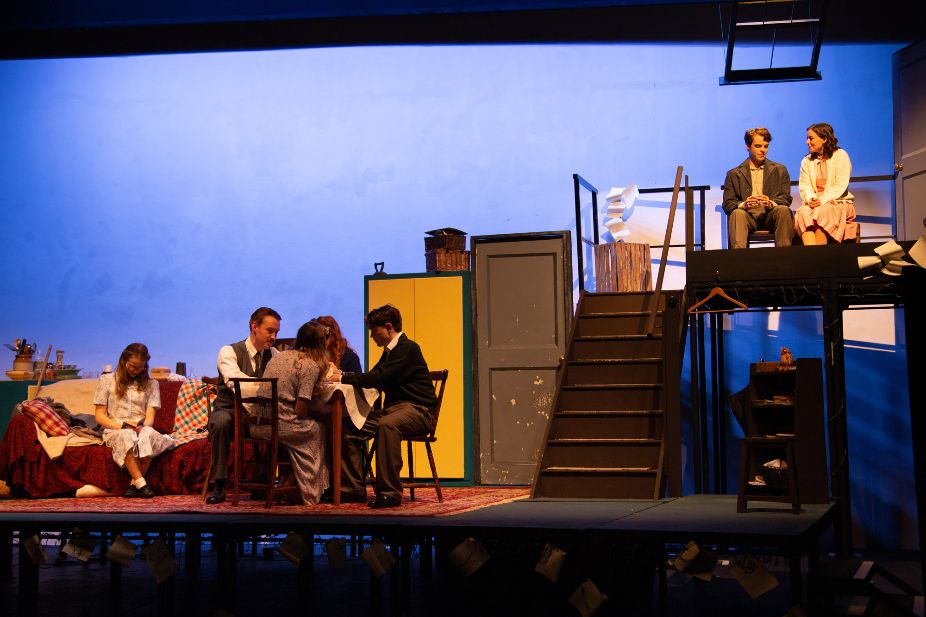
The set remains the same throughout the play, the top floor of a warehouse building in Amsterdam, Holland. About five years ago I had occasion to visit the actual building in which the Frank family and friends were holed up from 1942 to 1944. Then I marvelled how this group of people managed to live in such cramped and unsanitary conditions. The YAT crew show that CoVid, and its enforced absence from Hampton Hill Theatre has not dampened their enthusiasm, or their ingenuity and skills in designing a set that cleverly resembles a makeshift attic, consisting of different nooks and crannies, with a staircase that leads to a tiny attic. The entire set is full of chairs, tables, beds, stools, complete with cooking ring and pots and pans, and a wireless. As more and more of the cast appear the cramped feeling is complete. The whole acting cast must be complimented by the professional way in which the furniture is re-arranged several times during the performance, thereby suggesting different times of the day that, as a by-the-by, is part of the monotonous daily routine for this group of people. An inspired detail of this set is the pages, representative of Anne’s diary, pinned to an attic wall and outside floor level of stage. Psychologically this establishes a narrative link between details of the diary and the people Anne writes about in her diary.
Read more…Second Chances
Private Lives
by Noël Coward
Theatre Royal Bath Productions and The Nigel Havers Theatre Company, at Richmond Theatre until 13th November, then on tour until April 2022
Review by Andrew Lawston
Some people carry memories of an intense relationship, and regrets about how it fell apart, and it’s only human nature that they reflect on how things might have been different, and how they might approach the relationship differently if they were given a second chance. Back in 1930, Noël Coward considered how this might actually play out for a particularly unhealthy couple, freed from such mundane considerations as money and employment.
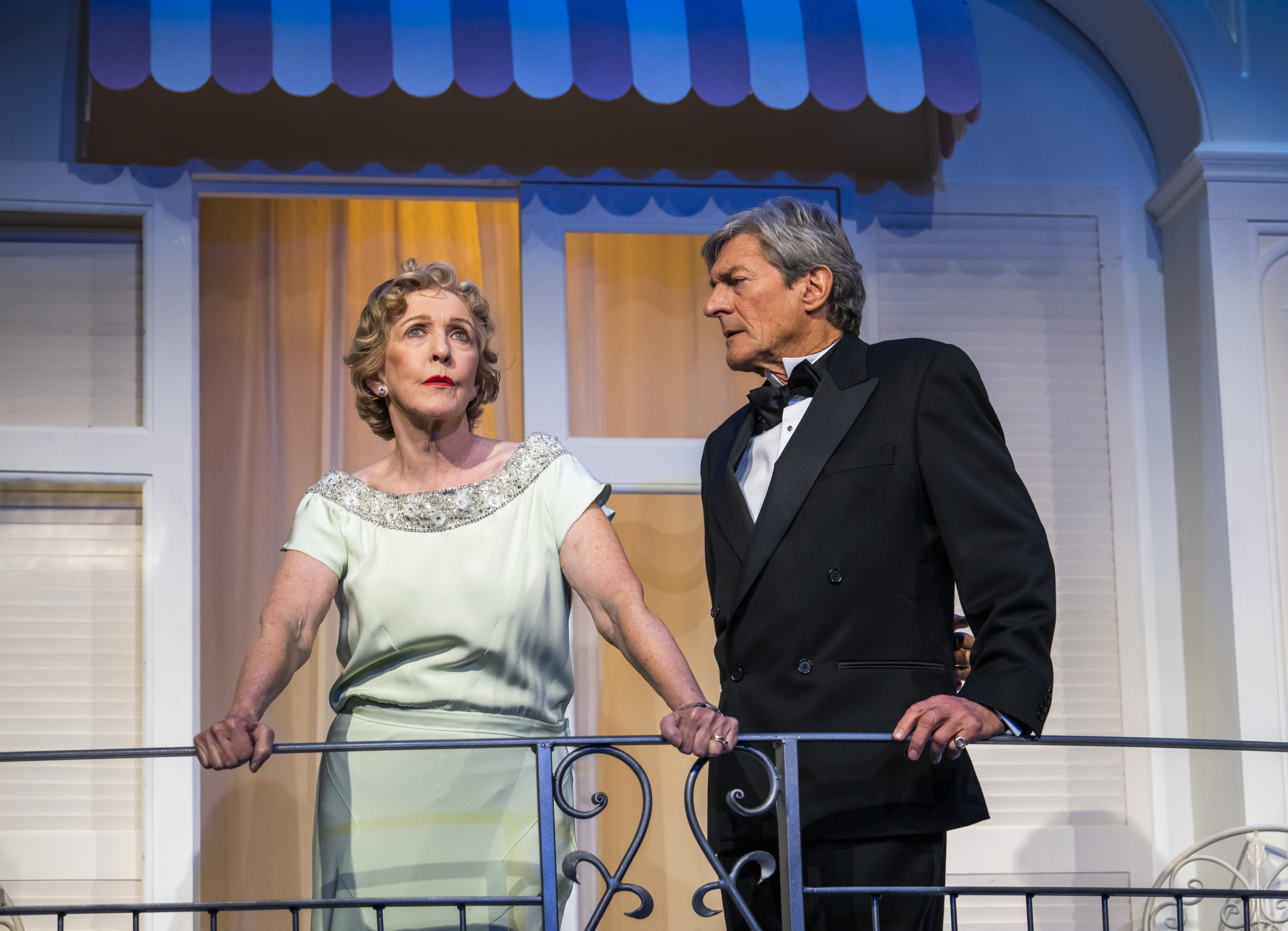
The inaugural production from the Nigel Havers Touring Company, Noël Coward’s Private Lives has reached a packed Richmond Theatre. The blindingly white frontage of a hotel, all plaster moulding, wrought iron balconies, and thick curtains, is a striking contrast to the auditorium’s gloomy house lights.
Read more…Ripples of a Past
The Water’s Edge
by Theresa Rebeck
The Questors, at the Questors Studio, Ealing until 13th November
Review by Claire Alexander

‘Leaving you here was a mistake’, says Richard at one point in the second half of The Water’s Edge. Indeed it was.
Richard has unexpectedly turned up to find his ex-wife (well not ‘ex-wife’ as it turns out in a small twist of the plot) and his two, now adult, children none of whom he has seen in seventeen years. The children are now in their mid-twenties. His ‘wife’ is angry and lonely and it soon becomes clear living on the edge, not only of a lake, but also of insanity. The setting in contrast to these fractured family relationships is an idyllic but dilapidated and faded cottage on the shore. The director, Lucy Aley Parker, has chosen to set this production in Cumbria although it was probably written for back-country Massachusetts, America. But this seems to work and makes the play more impactful by being closer to home.

The cataclysmic event seventeen years ago was that the couple’s child Leah (we assume youngest, though we are never told) drowned in the lake one tragic day. Helen and Richard, the two parents have never been able to forgive each other, even talk to each other about this terrible tragedy, and Helen has always blamed Richard thinking that he had taken his eyes off his daughter while having an affair with a lady who had moved in to a nearby cottage. Seventeen years of grief and resentment are played out.
And to throw into this uncomfortable mix we should not overlook that Richard has brought his ‘latest’ girlfriend with him who is not much older than his daughter.
Read more…Pinking Shears Vendetta
Romeo and Juliet
by William Shakespeare
Putney Theatre Company, at the Putney Arts Theatre until 13th November
Review by David Stephens
“Didst thou not fall out with a tailor?” asks Mercutio in Act III of Romeo and Juliet

Upon arrival at Putney Arts Theatre, a beautifully converted former chapel in SW15, the audience were warmly greeted by the friendly front-of-house staff and advised that we were free to choose our own seats within the auditorium. The stage was open (no curtain throughout) and one could therefore see immediately that Putney Theatre Company’s adaptation of Romeo and Juliet was to be a modern interpretation and, at first glance, seemingly set in the premises of a seamstress or tailor. Stage right was a mannequin and clothes rail, both adorned with dark clothing, and a tall table, complete with large scissors and fabric, all washed in a red downlight. In stark contrast, stage left, was the perfect mirroring of this but with everything in much lighter colours and lit in green. As it begins to sink in, this clever design tells the audience that they are, in fact, looking at the premises of two separate businesses which, as we read in the programme notes, are the rival London fashion-houses of Montague and Capulet.
Read more…Real Wags
The Hound of the Baskervilles
by Steven Canny, John Nicholson, based on the novel by Sir Arthur Conan Doyle
Original Theatre Company and Octagon Theatre Bolton, at Richmond Theatre until 6th November, then on tour until February 2022
Review by Mark Aspen

Having once visited the Reichenbach Falls on a car tour of Switzerland, I had seen for myself where Sherlock Holmes had fallen to his death. So, it was with dogged determination that I set out through the misty chill of a November evening to cross the moor to see The Hound of the Baskervilles. Well actually the moor was Richmond Green and another actually was the mist. There was plenty of it inside Richmond Theatre where the smoke machines worked overtime for Canny and Nicholson’s adaptation of Britain’s “best-loved novel”, Arthur Conan Doyle’s mystery of the fearsome demonic canine of Dartmoor.
First written for the zany theatre company Peepolykus, this is Conan Doyle’s Hound of the Baskervilles slimmed down to a sleek greyhound of a show; and just as fast. The greyhound, though, doesn’t immediately bound out of the trap. Part of the slimming is having a cast of just three to play all of the characters of the novel, of which there are …lots. So before the race starts we must meet the players.
Read more…Moments of Delight
Nell Gwynn
by Jessica Swale
Q2 Players at the National Archives, Kew until 30th October
Review by Celia Bard
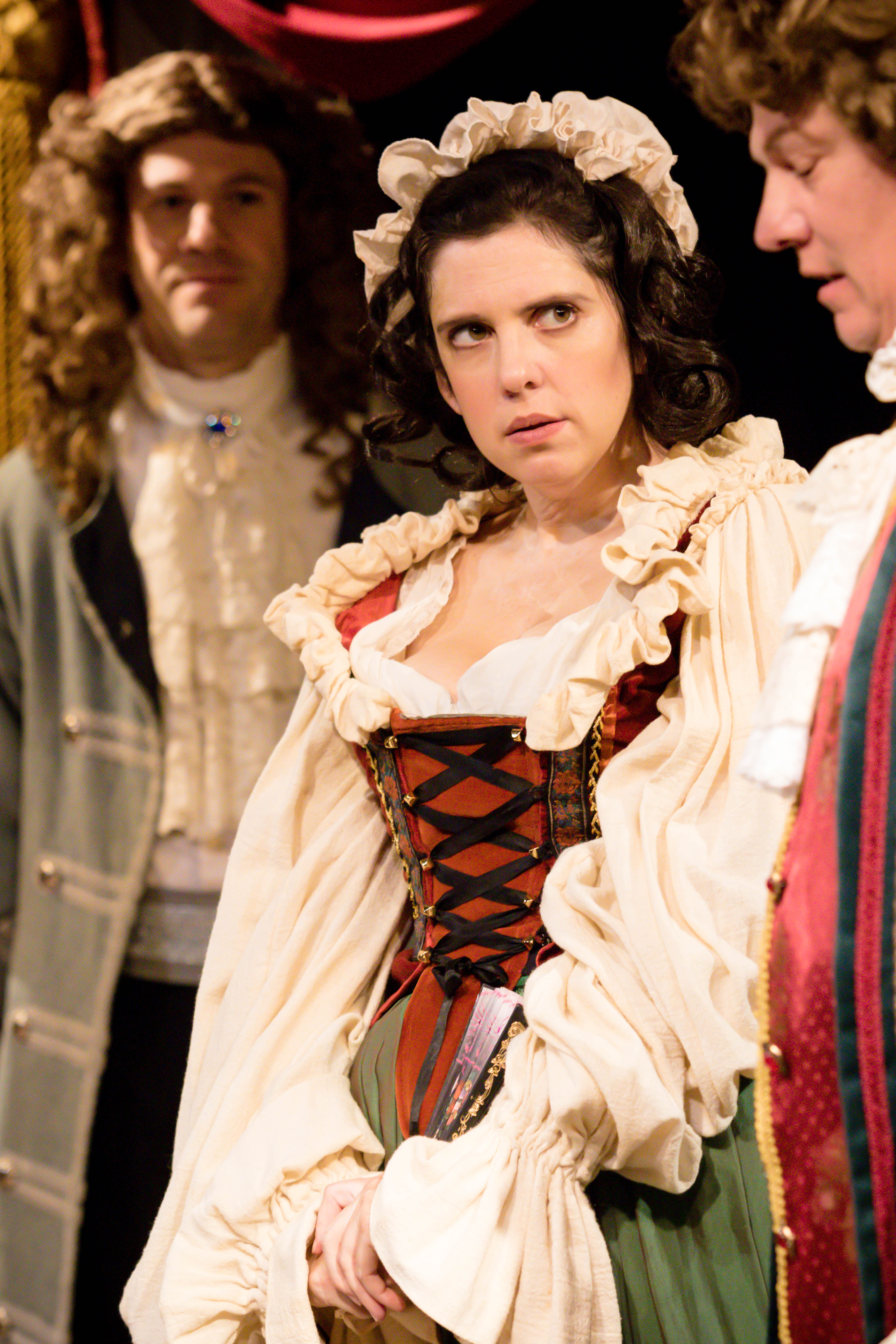
I admit to feeling of anticipation on entering the National Archive Centre for it was the first time of seeing Q2 Players in their theatre at Kew. I was also keen to see dramatist Jessica Swale’s treatment of the legendary Renaissance actress, Nell Gwynn. The play is set in the 1660’s, historically an interesting time in England. After almost two decades of revolution, war and theatrical suppression, monarchy and theatre have been restored. The play chronicles the meteoric rise of Nell Gwynn from a humble orange seller to the favourite mistress of King Charles II.
Read more…Making Waves
HMS Pinafore
by Sir Arthur Sullivan, libretto by W. S. Gilbert
English National Opera, at the London Coliseum until 11th December
Review by Heather Moulson
Yo-ho! “We sail the ocean blue” … and we had better have a fair wind behind us. This is the first time ENO has presented HMS Pinafore, so who wouldn’t rush to get there?!
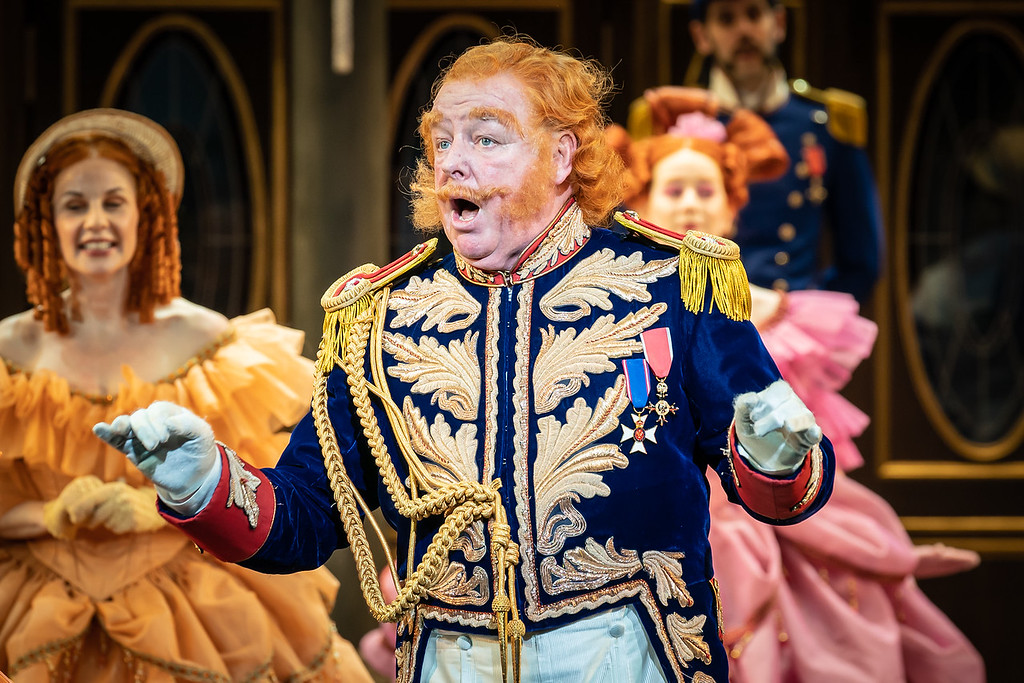
There is an extraordinary air of warm trepidation in the Coli’, London’s most splendid theatre, about Gilbert and Sullivan’s comic opera, and we were not to be disappointed. Even before the curtain comes up, the marvellous John Savournin, a versatile British bass-baritone, addresses the audience in character as Captain Corcoran with interaction from Les Dennis as himself. This worked extremely well, and we all admired the latter for poking fun at himself.
After the electrifying overture conducted by Chris Hopkins, the stage was opened up to a stunning ship set, designed by Takis, a prolific stage and costume designer. Sharply detailed, we enjoyed the timeless We shall sail the ocean blue, before the plot really unwound with the bumboat woman, Little Buttercup, an earthy and enticing woman, coming on board. While she pedalled her wares, Buttercup hinted at a dark secret …
Read more…Spooky, Creepy and Zinging
Cinderella Meets the Monsters
by Loz Keal
Teddington Theatre Club, Hampton Hill Theatre, until 31st October
Review by Gill Martin

Hallowe’en hit Hampton Hill early as Cinderella and the Monsters marched into town.
Witches in pointy hats, scary kids in chains and a mummified girl with her face and head completely wrapped in bandages made this a fright night not to forget. And that was just the audience.
The auditorium of Hampton Hill Theatre was festooned with cobwebs, bats and spiders. Drifting dry ice and an open coffin set the scene at Dracula’s castle. I was in character with a glass of blood, masquerading as reasonable red wine, a black eye and five stitches in a head gash (the latter from a pavement fight rather than stage make-up).
Teddington Theatre Club presented a drama-starved audience – an almost full house on the second night – with a panto to remind us of what we’ve so missed: high energy fun, song, dance, dodgy gags, crazy characters, ridiculous costumes with enough sequins for a Strictly series.
Read more…Speak Well of Me
The Dresser
by Ronald Harwood
Theatre Royal Bath Productions and Everyman Theatre at Richmond Theatre until 30th October, then tour continues until February 2022
Review by Eleanor Lewis
The relationship between actors and crew in a theatrical production used to be (and probably still is in some companies) delicate, there was an Upstairs Downstairs vibe to it. Actors created a performance and soaked up the applause, but it couldn’t happen without set builders, props, lighting, sound, dressers, and numerous others none of whom were ever visible. Like servants they were ‘below stairs’.
Ronald Harwood was dresser to the famous actor-manager Sir Donald Wolfit for some years after WWII, at a time when social dynamics were shifting on a grand scale. Men and women who had fought for their country came home wanting a life of their own rather than one ‘in service’ to another family.

Similar changes were taking place in the world of touring theatre. Donald Wolfit, who took the leading role in all the Shakespeare works his company played around Britain in the 50s, also managed the company. Thus he wielded enormous power, his actors and crew totally dependent on him, but he was drained emotionally and physically because of it. The more democratic theatre companies, like Joan Littlewood’s Theatre Workshop, were just beginning to appear and Wolfit’s era was coming to an end.
Read more…

 Mark Aspen