
Austen Allegro
Emma
by Ava Pickett, based on the novel by Jane Austen
RTK Productions at The Rose Theatre, Kingston until 11th October
Review by Polly Davies

The Rose Theatre’s Emma is a joy. I can think of no better antidote to the dreary, non-stop outpouring of news that we are now blessed with daily. Ava Pickettt’s fast-paced witty script shows, if there was ever any doubt, the brilliance of Jane Austen’s storytelling. A tale seemingly set intrinsically in the strictly mannered world of the 18th Century has been re-interpreted in the hands of a skilful playwright to look as if it was always intended for today’s world. And in Ava Pickett’s hands it is not only a good story, it is very, very funny. If you love Austen’s Emma, you will love this. If you have never heard of Austen’s Emma you will still love this, because the story it tells is as relevant now as it was when first written. To drop in the well known “Not well done Emma” line and make it fit amongst the modern world of TikTok messaging, and photo-sharing is pure genius.
Read more…
In a Stew about Scraps
God of Carnage
byYasmina Reza
Teddington Theatre Club at the Coward Studio, Hampton Hill Theatre until 27th September
Review by Steve Mackrell
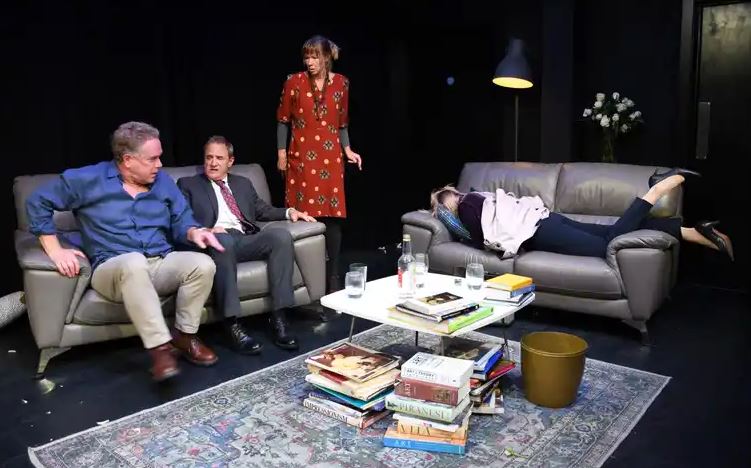
Two married couples, a physical fight between their children, then a verbal fight between the adults. That’s the backdrop to Yasmina Reza’s comedy God of Carnage currently being presented by Teddington Theatre Club at the Hampton Hill Theatre.
Originally written in French, and translated into English by Christopher Hampton, the play was first performed in Zurich in 2007 and follows her earlier notable plays Art in 1994 and Life x 3 in 2000. In Hampton’s translation, we are in North London, firmly located in serious bourgeoisie territory, with four fully paid-up members of the Camden chattering classes. We meet two sets of parents, four diverse characters in all, each with their own distinct personality, views and social attitudes.
Send in the Clones
A Number
by Caryl Churchill
Questors Productions at the Questors Studio, Ealing, until 27th September
Review by Andrew Lawston
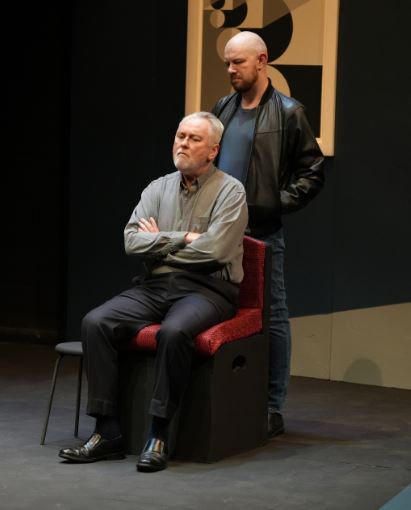
Cloning is a subject of endless fascination to creators of science-fiction, but is perhaps less commonly explored in theatre, which traditionally prefers to use twins to tell similar stories. Caryl Churchill’s short play A Number provides rich dramatic pickings through its simple story of a man meeting with several clones of his son, in the intimate confines of The Studio at The Questors Theatre.
Read more…Morse Code
Inspector Morse: House of Ghosts
by Alma Cullen, based on characters by Colin Dexter
Production Solutions at Richmond Theatre, until 20th September, then on tour until 11th April 2026
Review by Eleanor Lewis

Perhaps it’s unfair to begin this review with a line such as An Inspector Makes Noises Off but it is tempting considering the start to this much anticipated play featuring the debut of a TV favourite onto the Richmond stage. The opening scene involves a production of Hamlet, playing at a theatre in Oxford. During a poignant interaction between Hamlet and Ophelia the actor playing Ophelia dies, bloodily, on stage. An authoritative voice (Morse) calls out from the audience (the actual audience) to halt the action and Morse marches from his seat towards the stage waving his warrant card. He is immediately followed by Hamlet’s director striding down from the back of the auditorium with equally authoritative protestations and then a short but loud section of the familiar Morse TV theme tune is played, presumably to let us know that things have now really begun.
Read more…Fabulous, Fearless, in Full Voice
Mozart’s Women – A Musical Journey
English National Opera and Factory Films at the London Coliseum, 12th September
Review by Helen Astrid

It’s not often you get to hear an entire evening of Mozart’s female divas. This occasion at ENO, Mozart’s Women – A Musical Journey, proved to be just the ticket for a binge of 18th Century arias, duets and small ensembles to be seen later this year on Sky Arts and Freeview. (This will be presented alongside the previously announced Sky Original limited series Amadeus.)
On stage, a carefully curated ensemble of rising young singers performed, accompanied by the ENO orchestra under the assured baton of Clelia Cafiero, Principal Guest Conductor at the Opéra de Tours. In a bold staging choice by Artistic Director Annilese Miskimmon, the musicians were assembled on stage rather than in the pit, framed by red velvet drapery and resplendent chandeliers that transformed the Coliseum into a glittering salon.
Read more…Lifetime Rewards
Sixtieth Anniversary in Music : Preview
Donovan at Richmond Theatre, 12th October, Preview 12th September
Interview and preview by Vince Francis
So, yours truly was up with the lark on Friday morning, on his first assignment for a while, as part of a carefully calibrated plan to intercept the District Line’s first service following a strike. The objective of this dawn foray was to rendezvous in Notting Hill Gate with a hero of the musical, and social, revolution that was the 1960’s, namely Donovan, and I am pleased to report the objective was achieved.
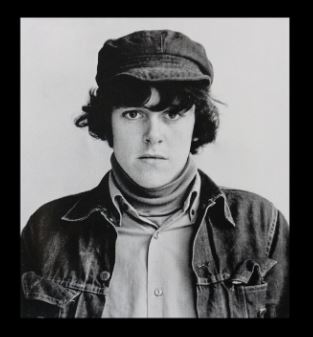
We took a table in the hotel bar and, refreshments served, Donovan, happy to provide as much background as might be required, proved to be an effortless raconteur and most generous with his stories. Our conversation explored a rich and varied life in music, which has led him from his birthplace in Glasgow, to the hotbed of the folk music scene that was 1960s Hertfordshire, through to the transcendental meditation craze in the ashram of Maharishi Mahesh Yogi in Rishikesh, India, where he taught John Lennon how to fingerpick, and tours to the U.S.A., and on to more current activities.
Much has been documented about his life and career in all media, but to summarise, Donovan, more formally Donovan Phillips Leitch, was born on 10th May 1946 in Mary Hill, Glasgow. At the age of 10, his father moved the family to Hatfield in Hertfordshire,
“… ’cause I’m 10 and it’s the 1950s, and Glasgow’s bombed, of course. All the old cities are bombed, so we moved down in that great migration down to the south from the big industrial towns …”
Read more…Othello for Septuagenarians
Creditors
by August Strindberg adapted by Howard Brenton
OT Productions at the Orange Tree Theatre, Richmond until 11th October
Review by Patrick Shorrock
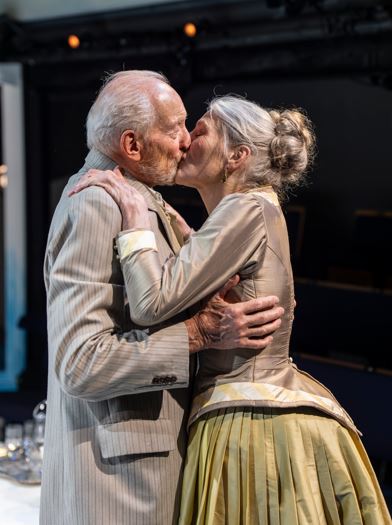
Strindberg has a reputation for making his audiences suffer while his characters tear one another apart in a desperate desire to destroy each other. He may have a reputation for misogyny, but it is perhaps more accurate to suggest that he hates humanity regardless of sex and gender. Miss Julie, his most famous play, is so harrowingly nasty that I don’t know I could ever bear to see it again. Creditors by contrast is unexpectedly funny and prompts a good deal of laughter in Howard Brenton’s witty and vivid translation. (‘The guilt doesn’t go away: your creditors will always get you in the end’.) These characters are older and tougher than in Miss Julie: harder to wound, with less to live for, which lowers the emotional stakes.
Read more…Bloodless but Heartfelt
Lucia di Lammermoor
by Gaetano Donizetti, libretto by Salvatore Cammarano
Barefoot Operaat the Arcola Theatre, Dalston until 13thSeptember and then on tour until 5th October
Review by Patrick Shorrock

Barefoot Opera shows it means business right from the start by beginning not with Donizetti’s prelude, but with Lucia’s mother singing a gloomy Scottish ballad about women being doomed to suffer at the hands of men, before the score proper starts.
The musical arrangement works really well at conveying the colour of Donizetti’s score, with a band comprising saxophone, accordion, double bass and piano – plus, on occasion, a xylophone that is also used to convey the sound of a glass harmonica by scraping a violin bow across the edge. This makes for a wonderfully spooky mad scene and is much better than the flute that used to be popular last century. I’m glad that reverting to the glass harmonica that Donizetti had in mind has now become fashionable again in the opera house. The care taken with this arrangement, where every musical choice seems to have been thought about thoroughly, was admirable and refreshing. I remember a production of the Coronation of Poppea at the King’s Head Islington that also made good use of a saxophone, which really is the arranger’s friend when it comes to reduced orchestration.
Read more…Glossy Prince
Pippin
music and lyrics by Stephen Schwarz, book by Roger O. Hirson
Cygnet Players at the Putney Arts Theatre until 6th September
Review by Heather Moulson
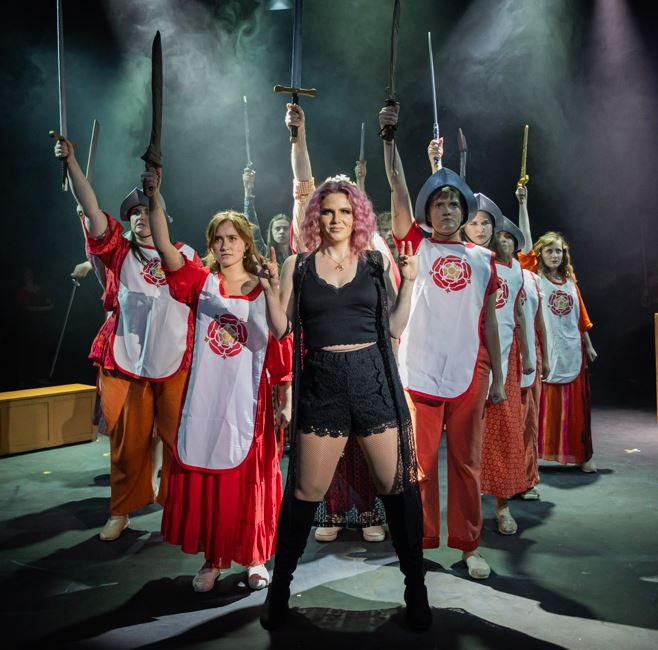
I had mixed feelings about the musical Pippin, with its strange fictional plot about two historical figures derived from the early Middle Ages. It fell flat when I had previously seen it. However, I went along this time to the Putney Arts Theatre with the incentive to get to really know this piece, the music and lyrics written by the legendary Stephen Schwartz: I was a big Godspell and Wicked fan and wanted to like Pippin too.
On James Chadwick’s set, the large orchestra was placed neatly to one side of the generous stage. Here the charismatic narrator, the Leading Player, greeted us with vibrancy. He brought everything to life very quickly, in the monumental stage presence and powerful voice of Jamie Miller-Hughes.

The eponymous Pippin, beautifully attired but suitably unimpressed with his royal father, was played by Laurence Parvu, whose singing was striking and strong. However, Paru took a while to get comfortable in the role, but by the second half he truly relaxed and used his performing skills beautifully.
The exciting, if shallow, half-brother Lewis was an impressive presence. I would like to see more of Alex Dehn, who took on this role, as his is a name worth watching out for. The conniving stepmother Fastrada, played by Caroline Steersmith, used her wiles skilfully.
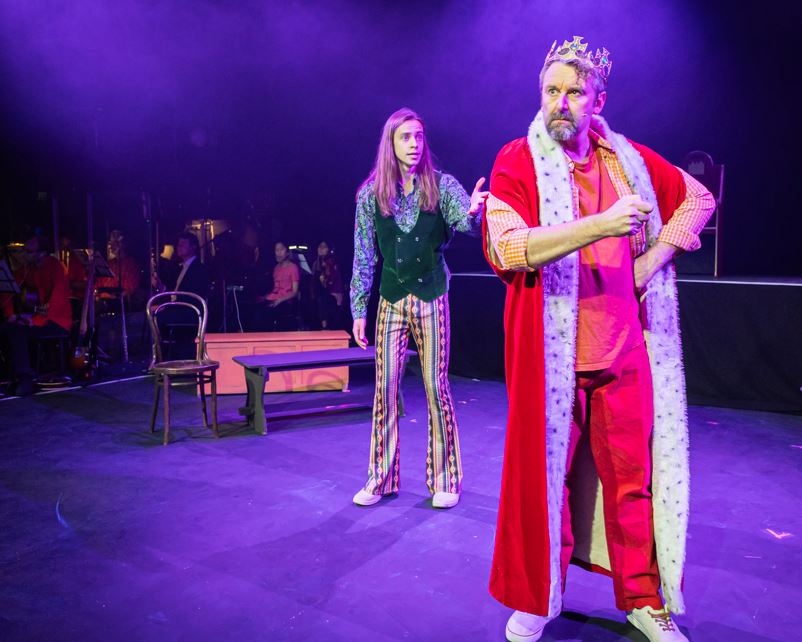
Alex McKinven, as Pippin’s father King Charlemagne, cut a noble figure while expressing a mixture of love and exasperation for his naïve son. The gory battle behind the glitz of the chorus to Glory with scattering of limbs and torsos was well done; an a headless dialogue with Katie Sterland was terrific.
I felt sad about the microphone turbulence, as Pippin’s vampy grandmother Berthe did such a wonderful number No Time At All. It was very profound, and with hearty audience participation. Lily Gillespie Moult still shone through the technical issues.
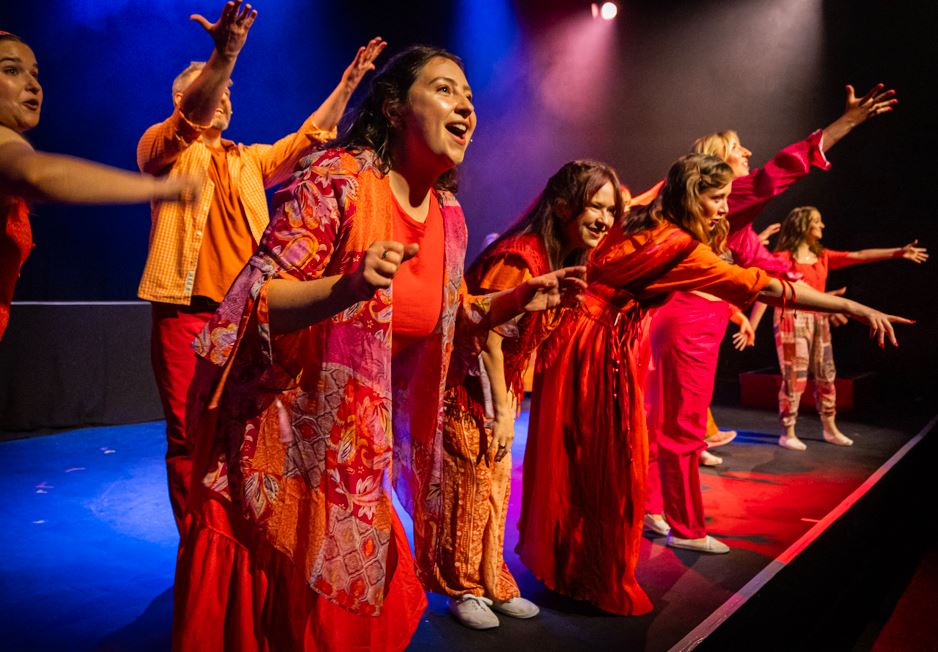
The supporting cast, strong and pleasing to the eye in co-ordinating shades of orange and red, connected well as a strong chorus. Phoebe Fleetham, Janet Huckle and Louise Bravery’s costumes arrangements were arresting. I particularly liked the Leading Players’ and Pippin’s seventies garb.
Musical director Mimi Roberts produced wonderful sounds. The energetic and studied chorus deserve an accolade. Choreography, by Kim Schenkelaars, was well planned out and confidently handled, and the featured dancers were flawless.

The widow Catherine, who rescued Pippin, was sincerely played by Katie Dart, who took what seemed pointless snide comments from the Leading Player on the chin beautifully. I Guess I’ll Miss The Man was sung poignantly, and was one of the best numbers. Thomas Carter as her son Theo was great fun and formed a bond with Pippin.
There was apt and bold lighting by Emma Hunt and Andy James. Particularly effective was the red hue on the orchestra, highlighting their presence without intrusion.
Director Alex Johnson brought the best out of this complex piece and, you know what . . . I like Pippin.
Heather Moulson, September 2025
Photography by Russell Hughes
Monochrome Mozart
Don Giovanni
by Wolfgang Amadeus Mozart, libretto by Lorenzo Da Ponte
Ensemble OrQuesta for Grimeborn Opera Festival at the Arcola Theatre until 30th August
Review by Patrick Shorrock

There is a fine line between authentically rough and ready and not really good enough. It gives me no pleasure to say it, but Marcio da Silva’s production of Don Giovanni is on the wrong side of that line.
Mozart’s opera is a hugely demanding piece, with fearsomely difficult roles that require immense vocal proficiency and theatrical charisma. Unless you have a vocally well equipped cast, you shouldn’t even be thinking of putting this opera on. With romantic and modern opera, sheer volume and intensity can cover a multitude of sins, but that is not an option for Mozart, where beauty of tone and fluent coloratura are also needed.
Read more…
 Mark Aspen