
Passion on the Rocks
My Cousin Rachel
by Daphne Du Maurier, adapted by Joseph O’Connor.
Theatre Royal Bath at Richmond Theatre until 8th February
Review by Mark Aspen
Kernow. Now there’s a name of mystery: it’s different and almost exotic. Cornwall has a certain differentness about it, the only English county with its own language, its sea pounded rocky peninsulas, beasts wandering its moors, and of course all those differently named Cornish saints, names that don’t exist elsewhere. There’s a preponderance of the surname English in Devon, an historical relic of times when the Tamar was a big boundary and the them-and-us-ness was more marked, times like the mid-nineteenth century when Daphne Du Maurier’s novel, My Cousin Rachel is set.
Add in a mysterious stranger who comes from a different, almost exotic country, and you have a potential powder-keg of tension. And of course, we are all suspicious of strangers (think the high-vis man who knocks unannounced at your front door and offers to “repair” your roof). Moreover though, if the mysterious stranger is also beautiful then it ups the potential for passion, and you have all the ingredients for the gothic romantic thriller, one of the hallmarks of Du Maurier.
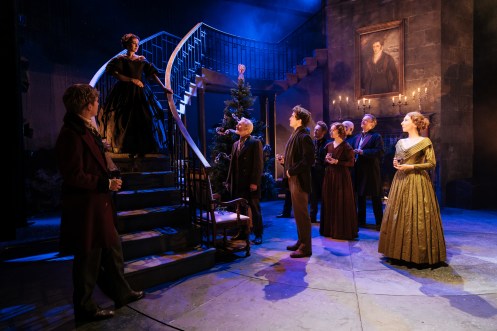
Barton House is a fine country mansion on the Cornish coast, the home for many generations of the landed and wealthy Ashley family. Twenty-four years old Phillip is the current incumbent of Barton and, following the death in Italy of Ambrose Ashley, Phillip is due to inherit the estate on his twenty-fifth birthday. He had been orphaned as a young child and for most of his life Ambrose, an older cousin, had been his attentive and loving guardian. Now, in these months before Phillip is to become master of Barton, the estate is held under the trusteeship of the family solicitor, Nicholas Kendall, also a close family friend, affectionately known as Nick. Indeed, his daughter, Louise has been always Phillip’s childhood companion.
Notwithstanding the frequent visits of Louise, Barton House has been an exclusively masculine domain. Even the household servants are all men, the old retainer John Seecombe and the young Thomas Conners, given employment after losing a leg in an industrial accident. Masters and servants have a mutual loyalty and respect which binds them in this austere environment. Into this milieu, unexpectedly, arrives an Italian countess, Contessa Sangalletti, who is Ambrose’s widow and another cousin in the tangled branches of the Ashley family tree. She is Rachel Coryn Ashley.
The presence of Rachel has an unnerving effect on the settled household. Rachel is a stranger, an exotic foreigner, and most difficult of all, a woman. On all three counts, she is a cause for deep suspicion. Why is she here: is she merely nostalgically visiting her late husband’s home, or is she after something for herself? Did Ambrose die, deranged, from a brain tumour, or did she have some hand in his death? Has she come to give or to take, to build or to destroy? The feelings of Phillip and Nick, and even of Louise, see-saw between attraction and repulsion. Only the servants are delighted in what seems like a breath of fresh air from the self-assured Rachel, but the other men feel threatened. Moreover, she is very beautiful and her attractions, of which she is all-too aware, gradually outweigh the balance of the see-saw. Clues push feeling one way or another and the plot develops more twists and turns than a Cornish cliff path.
The atmosphere of this volatile situation is beautifully evoked in designer Richard Kent’s clever set, mounted on a revolve and symbolically symmetrical. Its overarching feature is an elegant sweeping spiral staircase, its helix embracing the gothic Barton house, black and purple with soot-blackened baronial fireplace on the inside and opening to the Atlantic seascape at Guinevere’s Point on its outside. David Platter’s mood-enhancing lighting and Max Pappenheim’s tingling soundscape complete the charged ambience.
The metastable balance is carefully handled by director Anthony Banks and his skilled cast. Banks is not afraid to use silence, not in the sense of an awkward hiatus but of a suspended moment, characters weighing each other’s motives, a look that betrays the words, or that eyes-meeting moment. There is “the awful daring of a moment’s surrender” as T.S.Eliot would have put it. Banks is a prolific director, and a past-master in the thriller, many of which have been seen at Richmond Theatre (most recently Dial M for Murder) and hits a zenith with My Cousin Rachel.
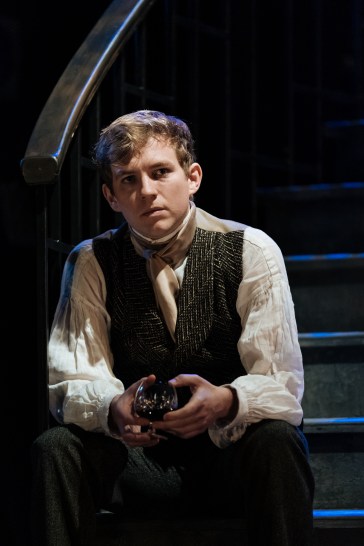 The Phillip Ashley we first see is grieving and not able to come to terms with Ambrose’s death. He is at the anger stage of grief and looking for something to blame. After the arrival of Rachel, his petulance becomes impetuosity as the charms of the older woman win over his suspicions. Jack Holden as Phillip depicts an immature young man, who would be a lairy “youf” if it were not for his sense of duty, but one who is genuinely troubled. He is a complex character, full of deep affection for his home and his household, including his loyal servants. Holden’s Phillip is buttoned-up with values instilled in him as a member of the landed gentry, but with another Phillip, impulsive and expressive, bursting to get out. Here is a young man with a long emotional journey from a misogynist, who equates marriage with murder, to a bowled-over lover who would give everything he has for the cousin with whom he has become infatuated.
 The impetus of that emotional journey of Phillip’s is the eponymous Cousin Rachel, an enigmatic figure of aristocratic bearing, fearless and self-confident. Helen George, currently best known for her role in the television series, Call the Midwife, here delivers an outstanding portrayal of Rachel as imperious and proud, her clipped tones adding to her authority. The multifaceted mystery of this winning widow only serves to add to her allure, and she is certainly not a lady to be crossed. She is intelligent and her multiple talents range from creating exotic tisanni, her herbal teas that raise further suspicions amongst her paranoid hosts, to landscape gardening. Helen George’s attractive portrait of Rachel is boldly painted, with strong characterisation, a particular example being her powerful speech when Rachel rejects a monetary allowance as unwanted charity, accusing Phillip of “ignorance and arrogance”.
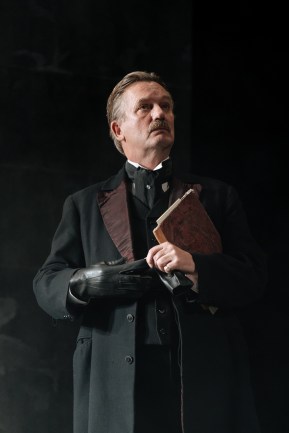 Kendall regards himself as guardian of not only the estate of his friend Ambrose, but also of the good name of the Ashley family and, by extension, that of local society. He constantly admonishes Phillip for any perceived in impropriety or weakness, urging him not show his emotions in front of the servants, whilst himself at first falling for Rachel’s charms. His mantra, “Things are done a certain way” is taken up by Phillip, sometimes mainly to extract himself from embarrassment. An assured and insightful actor, Simon Shepherd cuts a sharp figure as Kendall, astute and protective, yet not impervious to distractions.
Phillip fails to see that Louise is in love with him, although Rachel understands this straight away. The light-hearted and patient Louise is played with fetching charm by the sparkling Aruhan Galieva, as a constant factor in Phillip’s life. Louise, like her father, is both alarmed by, and jealous of, Rachel’s hold over Phillip.
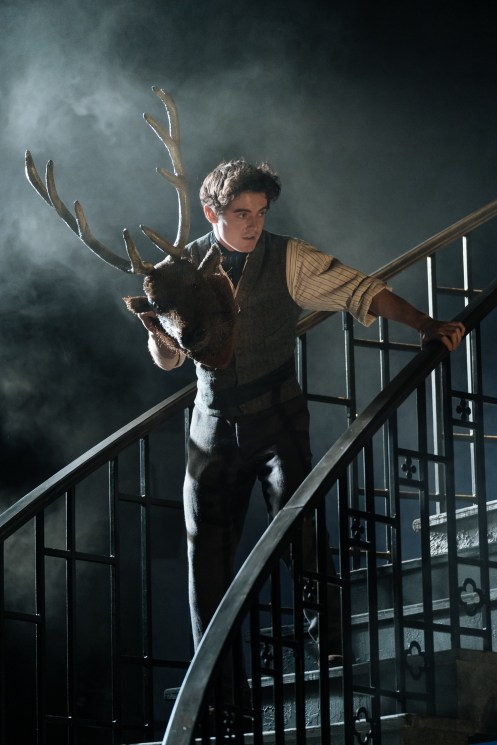
 The only characters acceptant of Rachel are the servants, Seecombe and Thomas. Long serving and much trusted Seecombe is the epitome of the “true and faithful servant”. He is comfortable with the family and they with him, but Seecombe immediately warms to Rachel, delighted to have a lady about the house once more. He can replace stuffed stag’s heads with flower arrangements, and is happy to assist Rachel in re-planning the garden. Sean Murray plays Seecombe as an amiable, kind and down-to-earth countryman. Seecombe’s loyalty is unimpeachable, think Adam in As You Like It. He also has some great Cornish turns of phrase. The manservant Thomas Conners is equally loyal, and is grateful that the Ashley family has rescued him from penury after his life-changing accident. Thomas has a hobby making string marionettes; perhaps so that he can still vicariously control a limb that he has lost. John Lumsden plays Thomas as a likeable, but sometimes cheeky young man, reliable and steadfast.
As they are beginning to be reconciled to Rachel, perhaps too much so, and Kendall warns that “the word mistress has many meanings”, so in Act Two a new side to Rachel is revealed with the unannounced arrival of Guido Rainaldi, an old friend of Rachel’s in Italy and ostensibly her lawyer. Rainaldi makes a stark contrast to Phillip and Kendall, snappily dressed and suave, he is ideologically the antithesis of them. He expresses his laid-back approach, “While you Englishmen conquer the world, we drink wine and make love in the sun”. His recollection of “nights of folly” with Rachel draws barbed insults from Phillip, who is riposted with seeming good-humoured but equally slighting replies. Christopher Hollis clearly enjoys playing Rainaldi but wisely steers way from a too-easy caricature towards a relaxed urbanity.
Banks has an eye for composition. Rainaldi’s presence in the room could have been etched by Hogarth, the Rachel-Phillip altercation in the garden painted by Millet (indeed with the two manservants in the background it smacks of The Angelus), or the Christmas scene illustrated by John Leech, it so resemble a Dickensian Christmas. This particular tableaux, with family, visitors and servants singing carols to the accompaniment of Louise on the piano, gave a quiet moment of beauty, and greatly enhanced by Christina Rossetti’s In the Bleak Midwinter, touchingly sung by the cast. A bit of an anachronism (there are a few) but who cares when the best Christmas carol in the canon is sung so well, especially by the lady members of the cast.
Harmony is however, not maintained in the running passions at Barton. Pride and jealousy surge in turn and the gradual dismantling of propriety fires up the emotional stew-pot. The plot moves on with a palpable inevitability along a path strewn with red herrings. If the path were straight the dramatic ending would be one of overblown melodrama, but this is Du Maurier who has ensured that it is not. There are the checks of the unexpected turns, of the balance of emotions, and there’s the mystery, the exoticism, there’s Cornwall.
Mark Aspen
February 2020
Photography by Manuel Harlan
No Score
The Maestro’s Last Words
by Barry Langley
A Trevor Hartnup production at the OSO Arts Centre, Barnes, until 8 February
A review by Matthew Grierson
An old white man from a privileged background with an international reputation finds out he has lymphoma, but the lump is swiftly and successfully removed in a private hospital: it would be difficult to spoil the surprise of The Maestro’s Last Words as, sad to say, there isn’t any.

The play attempts to overcome its dramatic deficit by being fortissimo from the outset, but, with so little at stake much of the incident feels contrived, bearing little sense of a reality with which we can engage. I appreciate we’re in an operatic milieu here, but there’s no modulation of the self-involved tone orchestrated by Sir Charles Ackroyd (Edmund Dehn). When, for instance, the conductor’s entourage visit him in hospital as he convalesces, they waste no time in running around screaming the place down with the threat of a lawsuit. There is no sense of crescendo, it’s a forced farce.
Yet the play doesn’t seem to be pitched as a comedy either. What jokes there are have little weight or build-up, as exemplified by the ill-judged interjections made by Sir Charles’s hapless secretary Hickton (Alexander Jonas) when his employer is entertaining morbid visions. The one joke that evidences some sense of structure is when soprano Madame Fontana (Violetta Gapardi) is invited to sing: assuming an operatic posture she then simply offers an anticlimactic: ‘No.’ I had thought this was to avoid the need to cast a trained singer, but Gapardi acquits herself admirably in this regard when she does get to sing.

Intimations of mortality ought to give an author something worthwhile to work with, whether they were going for introspection or dark comedy, but Barry Langley’s script is a series of rococo flourishes off the idea without taking it anywhere. This is typified by dumping information into the dialogue so we know exactly how he has conceived the characters, rather than taking us on a journey with them. Exhibit A: ‘You know I always conduct without looking at the score,’ says Sir Charles, telling Fontana something that she is explicitly already aware of. ‘Yes,’ she replies, ‘you’re world-famous for it.’ So now we know.
For a play so ostensibly concerned with music it’s surprising that all the characterisation is one note: Hickton is a toady, producer Herr Kleist (Stephen Riddle) is hysterical, Fontana is a diva, the Sister (Robin Miller) is firm but fair. If the story doesn’t develop, then the characters seemingly can’t. That’s not to say that Dehn isn’t watchable as Sir Charles, and present onstage for much of the play he sustains what momentum it has. He manages to convey something of the man’s ego and the physicality of his illness, but he is never allowed the opportunity to show the distress or vulnerability that would make us sympathise with, if not warm to, him. Is his doctor trying to kill him? Will Fontana leave him for a rival? Or has he really thrown her over for a nurse? It’s not so much that I wasn’t clear, it was that I didn’t care.
Surgeon Professor Galt (Martin Wimbush) fares a little better. Former schoolmate to Sir Charles – and long-time rival in a tiresome ‘two cultures’ debate that rears its head every now and again – he has a tongue-in-cheek sense of humour that the twinkly Wimbush brings to life, as when he joshes with his patient by sharpening a carving knife before an operation. But then I suppose am inclined to sympathise with a man who only goes to a show because he was given a complimentary ticket.

Nurse Hodges could be a breath of fresh air, too. Certainly in Mimi Tizzano’s unaffected performance she’s the most relatable of the characters, with a lighter touch when it comes to humour – I did actually chuckle when she told the recumbent conductor: ‘Your famous last words might be “Nurse! Get your pen out!”’ But the script largely lumbers her with being a dim-witted caricature of a working-class professional.
The show ends with Fontana’s rendition of ‘Song to the Moon’, a resurrected Sir Charles clad in his dressing gown conducting her, but the significance of her doing so is, like much of what happens in the play, unclear. It’s not funny enough to be a comedy and not plausible enough to be drama, so I still can’t see what The Maestro’s Last Words is trying to be.
Matthew Grierson
February 2020
The Mother of All Rom-Coms
Pride and Prejudice
by Jane Austen, adapted by Simon Reade
The Questors at the Judi Dench Playhouse, Ealing until the 8th February
Review by Emma Byrne
It is a truth universally acknowledged that Jane Austen is once again à la mode, with the film adaptation of Emma landing for Valentine’s Day, all decked in tulle and ringlets.
On the tulle and ringlets front, the Questors production of Pride and Prejudice refuses to be outdone. It has a wardrobe department of twenty under the direction of designer Carla Evans. That’s one more costumier than the nineteen-strong wardrobe department for the upcoming film. With gowns and petticoats aplenty, Pride and Prejudice doesn’t shy away from the ‘costume’ challenge of costume drama.
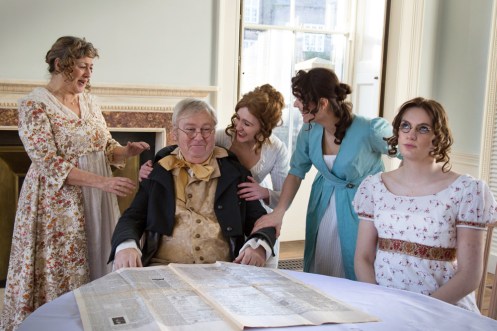
In some places, the costumes themselves deserve supporting actor billing: the gown and chapeau of Lady Catherine de Bourgh deserves a spotlight of its own. Wisely, director Sukhi Kainth allows us to revel in the visual feast of the gowns and breeches, as well as the effective and impressionistic set by Bron Blake, by opening with a dance number before hitting us with Mrs Bennet’s opening line: one of the most recognised lines in the canon of English novels.

And here is the challenge; Pride and Prejudice is such well-worn stuff that there is a danger that it can become threadbare with use. Cutting and stitching to display the material at its best is the job of the playwright and the director, and here they have done a deft job. Some things are necessarily compressed. Reade’s adaptation focuses on the will-they-won’t they pairings of the two elder sisters and gives only brief asides to the darker core of Austen’s work: the unenviable lot of women whose role was to remain in a marriageable state until a suitable match could be made.
 But what Reade’s adaptation does, it does well, and the cast carry the pace beautifully. Anthony Curran plays Mr Collins with an oleaginous self-satisfaction that is both great fun to watch and utterly horrifying to imagine in one’s partner for life. Sarah Morrison’s Mrs
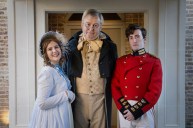 Bennet and Robert Gordon Clark’s Mr Bennet play beautifully together. Alexandra Rose Wilson’s Jane is so sincerely lovely, and James Burgess’ Mr Bingley so sweetly affable that it is impossible not to wish to see them reconciled. This is a beautiful change of pace from some adaptations that make the two of them such simpering simpletons that the cynic in me fears for the intellect of their offspring.
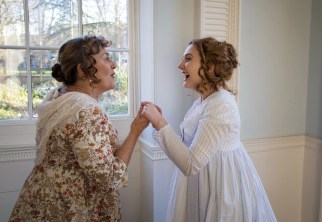 And while it is unfair to pick out favourites among such a strong ensemble, Kitty Cockram’s Lizzy and Madeleine Tavare’s Mary both won my heart in different ways. Cockram’s performance is rangy, bringing a truly rounded presence to a character that could so easily become a wafer thin portrait that is simply entitled ‘Feisty!’ Meanwhile Tavare takes what really is a wafer thin portrait (here entitled ‘Nerd!’) and imbues Mary with sweetness and a crippling lack of social poise. Tavare’s comic timing and consistent character deservedly got some of the biggest laughs of the night whilst also making me ardently hope that Mary gets her happy ever after, not through matrimony but by living out her days in a library. It is a truth universally acknowledged that we all need to get lost in a good story from time to time.
Emma Byrne
January 2020
Photography by Carla Evans
Taking the Bull by the Horns
Carmen
by Georges Bizet, libretto by Henri Meilhac and Ludovic Halevy
English National Opera at the London Coliseum until 27th February
Review by Nick Swyft
The cover of the programme for ENO’s revival of Calixto Bieito’s 2012 Carmen presents the sultry image of an angry dark-haired beauty. This is probably how most people see the character of Carmen. Arguably this is mis-selling, since the title role is played by Justina Gringytė, the Lithuanian mezzo-soprano, who is unashamedly blonde.
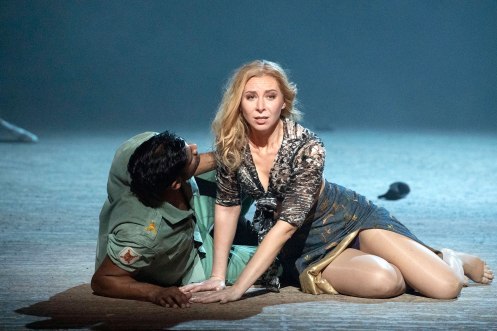
The running time for this opera has been advertised by other companies to be around three and a quarter hours. Valentina Peleggi, conducting, opened with the overture at a cracking pace, and although the rest of the music didn’t seem rushed, we were still out of the theatre in two and three quarter hours. This is great for catching the last train, but was symptomatic of a fast paced modern world that doesn’t suit the atmosphere Carmen was always supposed to generate.

Indeed one messes with the basic production of Carmen at one’s peril. The main focus should be on the four central protagonists. How those roles are interpreted is the core of any performance, not the set. It seemed pointless, for example, to make Lillas Pastia’s bar a Mercedes car, which only served to distract.
 As for Carmen herself, the passion that Justina Gringytė has clearly brought to the role in the past, was missing here. This may have been first night nerves, but the famous arias that send shivers down the spine in other productions, seemed disappointingly lifeless. Her lover Don Jose (Sean Pannikar) and the bullfighter Escamillo (Ashley Riches) were very strong as the jealous lovers, but like real lovers they needed more from Carmen herself. Don Jose’s fiancée Micaëla (Nardus Williams) lacked definition. Was she the wronged ‘wife’, or was she there simply as the agent of Don Jose’s mother? There was no real outrage that he was carrying on with Carmen, and not her.
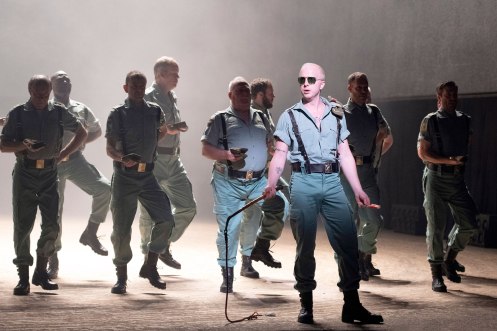
The show was stolen by the performance of the young girl (either Selma Benjelloun or Sofia Pang) with her short dance at the beginning of Act Two. Subsequently she flitted among the drunken adults like a restraining fairy, bringing a welcome innocent contrast to their behaviour, despite constantly being chivvied away by Carmen’s friend Mercédès (Samantha Price).

The interplay and performances of Mercédès and Frasquita (Ellie Laugharne) worked very well, providing a good basis for the wild gypsy atmosphere, which did come across well.
The primal sexual tensions of a culture centred around bull-fighting always make for a fun performance. This is why Carmen has remained popular over the years, despite societal disapproval of such things. This exists now as much as at its debut in 1870, albeit from a different perspective.
Nick Swyft
January 2020
Photography by Richard Hubert Smith
Mozart, Music and the Almighty
Amadeus
by Peter Shaffer
Teddington Theatre Club at Hampton Hill Theatre until 31st January
Review by Claire Alexander
In the years between 1781 and 1791 Vienna is at its zenith of European musical influence. Not only has the young prodigy Mozart recently come to town but there are references to Bach and Beethoven and other composers of the time. Antonio Salieri has been honoured with the position of Court composer but he is finding the role rigid and stultifying and not helpful to his own secret ambitions of becoming a celebrated composer. His aristocratic audiences are not genuinely appreciative of music – they have banned ‘encores’ and frequently refer to Mozart’s music as having ‘too many notes’.
Into this rigid and rarefied atmosphere the young Mozart bounds into town, fresh from a European tour, ready to make his name. But despite his music which is already turning ears, Mozart is also a spoilt toddler and his behaviour turns heads equally. The already respected Salieri (he taught the young Schubert, Beethoven and Liszt) is suspicious of this young upstart, initially looking on in horror and incredulity, but when he first hears Mozart’s music he quickly realises he is in the presence of unparalleled genius which only serves to highlight his own inadequacies.
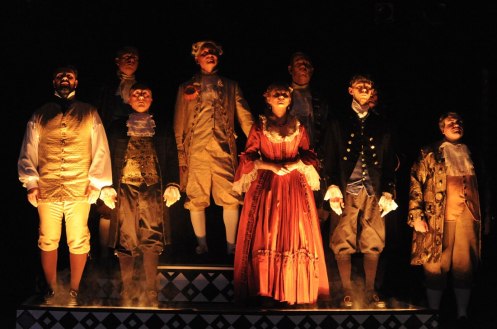
Amadeus is essentially the story of Salieri’s growing jealousy of Mozart and his attempts to block his path to success in the court hierarchy, but the play is so much more than that. The story is told from Salieri’s perspective, largely recounted in recall thirty years later as he lives in care suffering from dementia. He is wracked with guilt from his part in the early death of Mozart (who had died in poverty in 1791 at only 35). Salieri struggles not only with his dawning realisation of his own mediocre talent, but his relationship with God, his own personal sense of injustice alongside his inspirational peer. Mozart, in contrast, never wavers from the unshakeable belief that his more respected peer has his interests at heart – to get his music recognised, and out of poverty.
A note on Peter Shaffer’s writing here – there are shades of Dysart’s existential struggles – the psychiatrist in Equus (his play of a few years’ earlier) – who tries to make sense of his own behaviours alongside those of the boy that he has been asked to help, obsessed with blinding horses. Peter Shaffer excels in this type of writing, trying to understand the deeper motivations and influences that shape individuals when presented with a dilemma that shakes their own belief. But not only is Amadeus the story of Salieri’s struggle it is also a portrait of Mozart, his music and the Viennese court of the time. It is a brilliantly conceived play.

Its success relies hugely on the two central characters and the part of Salieri must be among the most challenging; and Mozart needs to be played with care and control without overplaying the excesses of his childlike behaviour so they do not become annoying and irritating to the audience. It is an ambitious play for a non-professional group to undertake.
This was not an ostentatious and elaborate production (a simple, effective set design by Jenna Powell and Lizzie Lattimore) that the Viennese court of the time might expect, but instead the story, and Salieri’s struggles, are clearly and empathically told. In the character of Salieri, Steve Taylor is outstanding, particularly effective as the old man, close to death. Although modern thinking suggests that Salieri is indeed  a provocateur in Mozart’s downfall, Steve gives us a sympathetic, thought provoking and intelligent performance. There are powerful moments as he is overcome by Mozart’s genius when he hears the Serenade for Wind, and The Mass in C minor for the first time. Ian Kinane equally gives us a measured and touching performance of Mozart avoiding overacting the child too much, and draws us slowly and compellingly into his journey into poverty with increasing desperation.
I would also like to mention Helen Geldert’s performance as Katherina Cavalieri (one of the leading sopranos of the time), who boldly steps up to the challenge of singing the fiendishly difficult Queen of the Night aria from The Magic Flute; and from the Mass in C minor. This was exhilarating singing and added to the production when all of the other music was recorded.
Trine Taraldsvik as Constanze Weber, Mozart’s wife, was touching at the end as she grieved over her dead husband and tried to keep his name alive by selling his manuscripts priced by the number of notes! I wanted the Venticelli (Salieri’s eyes and ears into the real Vienna) to have a little more variety and speed in their quick fire observations but they were well matched. The other roles are small compared to the central characters and in this production largely formed tableaux to the rear of the stage. For me this seemed in keeping with the production which never lost sight of Salieri’s story.
There might have been some inconsistencies in some of the detail, especially the dress wigs which would have been de rigeur at the time. Some of the cast had wigs, some didn’t, and I could not work out any pattern to this. But Mags Wrightson and Lesley Alexander and her team have clearly worked tirelessly to give us an accurate a picture of 18th century Vienna. And I enjoyed the atmospheric lighting by Patrick Troughton. Music is of course central to the story and many of Mozart’s most well-known compositions featured. I know this is specified in the script but I would have liked a little more Mozart especially in the first Act – it is as if Salieri is obsessed with his genius – almost as though he couldn’t get it out of his head.
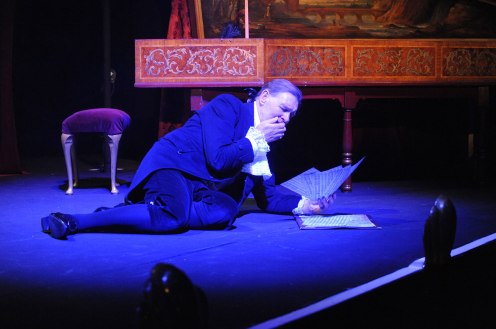
But these are small points. This production really excelled in the way it captured Salieri’s and Mozart’s contrasting fortunes and accompanying struggles. It never lost sight of the heart of the narrative, and Peter Shaffer’s brilliantly conceived script, in a way that other more lavish productions could. Although it is long, at almost three hours, the audience was rapt throughout, and the pause prior to Salieri’s death at the end, mesmerising. I applaud Dane Hardie’s sensitive, revealing direction and TTC for taking on another ambitious production so successfully.
Claire Alexander
January 2020
Photography by Sarah J Carter
Bean and Gone
Jack and the Beanstalk
by Jackie Howting
Edmundian Players at Cheray Hall, Whitton until 25th January
Review by Mary Stoakes
Edmundian Players belong to a diminishing group of Richmond upon Thames amateur dramatic societies who perform in what is designated by Arts Richmond as a ‘non-dedicated theatrical environment’, i.e. a church hall or similar. These venues usually present with a small stage area, often with little or no wing space, seating which has to be erected nightly, limited changing facilities and little storage room for props and scenery, elaborate costumes appear miraculously, often revamped from charity shops. Edmundians’ pantomimes are a prime example of the excellent and entertaining work which is produced on a very small budget under these difficult conditions year on year.
For 2020 it was the turn of Jack and the Beanstalk. One of the joys of reviewing pantomimes is that there is no need to relate the familiar story. However this adaptation, written specially by Jackie Howting to reflect the energy and enthusiasm of the cast, 18 out of 24 of whom were aged fourteen or under, did contain one or two novel twists and characters which delighted the audience.
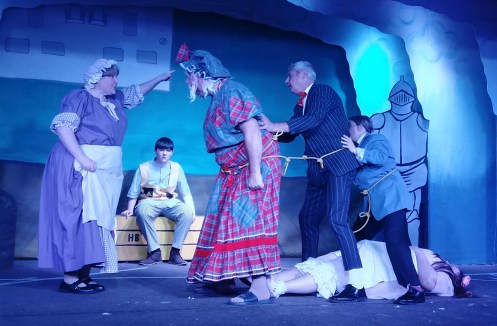
The young cast was energetically directed by Jessica Young who was also joint producer with Ellen Walker-DiBella and responsible for the choreography. Jessica was also the scenic artist for the show, producing striking, modern and colourful back cloths for the many scenes. She was ably supported in set building and beanstalk realisation by Dave and Paula Young, together with the versatile Alan Smith. Musical director Paul Wiz Baker not only arranged the music but created many new compositions and, whom one suspects, was responsible for the effective and fearsome Giant’s footsteps and snores. The sound and lighting management for the beanstalk and the demise of the Giant were very evocative and resulted in gasps from the younger members of the enthusiastic audience.
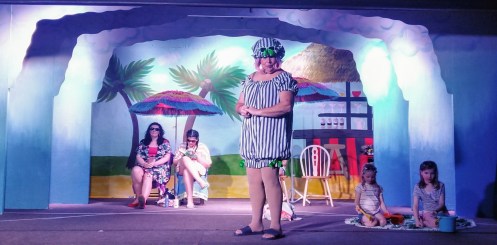 Somewhat surprisingly, the opening scene, A place to unwind and relax, was revealed as a colourful beach on a Greek island where Jack (14 year old Charlie McMaster) and his Mother Dame Trot (Dave Young) were on holiday with a group of mainly young children who formed a strong and well drilled chorus of family and friends. Dave’s pastiche of the song Price Tag demonstrated once again his locally-famed skill as a pantomime dame.
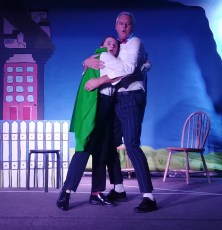 On our return to ‘Wickenham’ we were introduced to some new characters, Dash (Gary Evans) and Joe (Becky Halden) as the as the Debt Collectors working for the Giant. We also met Bertha Blunder (the Giant’s sister – Ellen Walker-DiBella) with a penchant for pizzas and a comically terrifying laugh. All three actors played an entertaining part in the action, with Becky’s expert com
 ic timing and reactions being particularly notable as they struggled with various mishaps and difficulties.
It was good to see Jack played by a teenage boy instead of the usual female ‘Principal boy’. Although we missed some of the swashbuckle and thigh- slapping of females in this rôle, Charlie personified the gullibility and hesitation of the character perceptively and his performance grew in stature as the panto progressed, especially when encouraged by the young chorus in The Only Way Is Up! Clare Blake was suitably demure as Jack’s girlfriend, Cathy.

As ever, one of the stars of this panto was Daisy the cow, expertly steered around the small stage by Kayleigh Spencer and Isabel Espi and involved in an amusing milking, or lack of milking, scene with Dame Trot and Jack.

After an interval with free ice creams for the lucky starred programme holders, Act Two took Jack and the audience to the Giant’s Castle. Here we met the Housekeeper (Theresa McCulloch) who was joined by a chorus of rats in a charming version of The Lion (Giant) Sleeps Tonight. The rats, Imogen Goddard, Aoife Kingsland, Saoirse Kingston and Evie Nunn, featured large in this act, deftly demonstrating their prowess in Irish dance and their ubiquity in the panto routine of He’s behind you. Mention should also be made of the excellent way they stayed in character throughout, even when not directly involved in the action, as indeed did young Evelyn Schaapveld as the Hen who had extreme difficulty in laying the requisite number of golden eggs.


After a cloud fight and an old-style cinema chase around the stage, led by Becky Halden, the Giant was slain with the help of some audience participation, unusually in the form of syncopated clapping. All ended happily and once again we were back on the colourful beach, A place to unwind and relax for the wedding of Jack and Cathy and a couple of rousing final choruses.
Author Jackie Howting incorporated many jokes into the script – some of which deserve to be immortalised in any definitive History of the Pantomime, if not there already. One sample:
Housekeeper – I’m going to make Jack some gold soup.
Dash – How to you make gold soup?
Housekeeper: Just put in 18 carats!
This was an entertaining pantomime, much appreciated by the large audience. Without being in the least patronising, one could say that this is good, slightly old–fashioned ‘am dram’ at its best and the Edmundian Players are to be congratulated in carrying on this great British tradition.
Mary Stoakes
January 2020
Photography by Juliette Wait
History Repeats
Ten Times Table
by Alan Ayckbourn
Classic Comedy Theatre Company at Richmond Theatre until 25th January, then on tour until 28th March
Review by Claire Alexander
Anyone who has ever sat on a committee or attended a meeting will recognise the challenges and little annoyances posed in Alan Ayckbourn’s Ten Times Table – the challenge of finding a convenient date for everyone for the next meeting, the freezing hotel meeting room with its unpredictable electricity supply, the list of apologies, the budding romances and the broken marriage spilling into the meeting’s purpose. Coupled with Ayckbourn’s unparalleled ability to turn unassuming domestic humdrum into witty entertainment, Ten Times Table is a clever script, not as often produced as many of his other works.

A small ill matched group of people are meeting to try and plan an inaugural pageant to bring their small town of Pendon together and provide a focus for the summer. Led by Ray, local history enthusiast, they take inspiration from an obscure story of the ‘Pendon 12’ a local uprising of farmers 200 years ago, whose only crime seems to be exuberant behaviour and throwing people into the air! Our committee is made up of ever patient 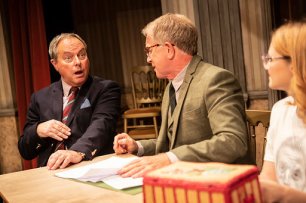 Ray and his expensively dressed snobbish wife Helen, pedantic local councillor Donald and his deaf elderly mother whom he has invited along to take the minutes, permanently drunk Laurence who is drowning his sorrows for the troubles in his marriage and two local teachers Eric and Sophie. Not a particularly inspiring idea for a play you may think, with all but its final scene set around a committee room table. But it is in good hands with Ayckbourn with his wickedly sharp observation of characters and situations. Conflict is inevitable from the first moment Eric and Helen meet when it becomes evident that they are from opposite ends of the political spectrum. Left wing Eric quickly interprets the ‘uprising’ as the local people suppressed by the elite of the community, and sees the opportunity to turn an innocent light hearted town pageant into a political rally and a golden chance to recruit people to his political cause, turning the leaders of the Pendon 12 into latter day political heroes.
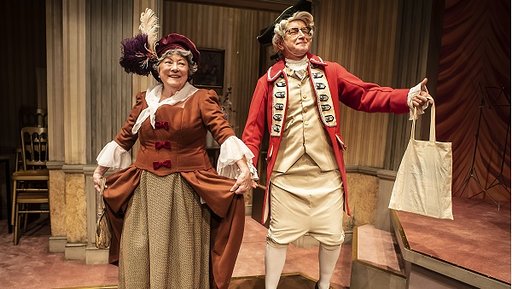
Perhaps reminiscent of the politics of the late 1970s, when this play was written, Eric quickly musters his resources of like-minded thinkers, turns the ‘pageant’ into a ‘rally’ and keenly takes the chance to play the leader’s role himself, producing tee-shirts and a song to market his cause. The rest of the committee members get caught unawares and struggle to keep up with their side of the organisation – the ‘military’ who are sent to quell the uprising. The final scene is set for a clever and farcical denouement of ‘art imitates life’ as the day of the pageant arrives and Helen and her pitifully few supporters face Eric and his apparently well organised locals!

The play is set entirely in the drab hotel room where committee meetings take place over the course of the eight months it takes to organise. As such, this could be a very static production, but in the able hands of director, Robin Herford, the action moves along swiftly never losing our interest.
In the role as chairman of the committee, Ray, Robert Daws keeps his committee in order with pleasant long suffering! I personally didn’t like the occasional vocal affectations to make a point, but his performance was pacy and assured. Similarly Deborah Grant, as Helen, portrayed her exasperation with Eric and his ideas with a controlled and believable performance never losing the naturalism. As Marxist Eric, Craig Gazey was a concentrated presence on stage and you could see the cogs ticking over in Eric’s psyche as his initial condescending boredom turned slowly into strategy and opportunity. His was an entirely recognisable portrayal of late 20th Century left-wing activism and could be equally relevant today too! I loved Elizabeth Power’s watchable performance as the elderly mother Audrey, bought in to take the minutes, not hearing much of the action but with wonderfully natural interjections and never overplaying the comedy. Mark Curry as  detail-obsessed councillor Donald who is more concerned with dotting the ‘i’s and crossing the ‘t’s in the minutes, is entirely recognisable as typical of such characters in committees the country over. And Robert Duncan gave a magnificently sustained performance as drunk Laurence never falling into the trap of caricature. Add to this Gemma Oaten as Sophie, subtly seeking romance with Eric, Harry Gostelow as her military, dog obsessed, over controlling husband Tim, and Rhiannon Handy as Eric’s diminutive wife Philippa (both the latter bought in to help in the organisation) and this production was entirely enjoyable and never overplayed the comedy.
There were a couple of set pieces it didn’t need, such as Helen’s realisation that Tim could come to her rescue in her part of the organisation, at the end of Act One. I would also like to have heard a little of Philippa’s frightened utterances – I know she was meant never to be heard but it was frustrating that we couldn’t actually hear!!

But the farce of the final scene as this motley group try to organise their pageant-rally was played with care and didn’t descend into pantomime which would have destroyed the ending! The constant soundscape of Audrey’s piano playing of typical English folk tunes just added to the absurd atmosphere. I think this was played live. If it was a recording it was incredibly well executed. And there were also many details that I loved, especially in set and costuming, that brought this production alive.
Ayckbourn’s text is so cleverly observed that it can tell itself. But this experienced group of actors, many well known for their TV roles, gave us an entertaining and believable evening without falling into the trap of stereotype and caricature.
Claire Alexander
January 2020
Photography by Pamela Raith
Complex and Intense
Long Day’s Journey into Night
by Eugene O’Neill
Richmond Shakespeare Society, Mary Wallace Theatre, Twickenham until 25th January
Review by Eleanor Lewis
It would be flippant to wonder whether three weeks after Christmas, the period during which families spend more extended time in each other’s company than they usually do, attending a performance of Eugene O’Neill’s Long Day’s Journey into Night is a good idea. Flippancy aside however, if you’re going to see Long Day’s Journey into Night, RSS’s present production is the one to go to.

The play is set in the summer home of the Tyrone family on the Connecticut coast in 1912. It is a largely autobiographical work in which the Tyrone family of four (broadly representing O’Neill’s own family) attempt to deal with what we would today call ‘their issues’ with almost equal degrees of success and failure. What saves them, broadly, is their love for each other and their wish to redeem each other despite the odds.
Mary Tyrone (Dorothy Duffy), following a difficult labour many years ago and the advice of a semi-competent doctor, is addicted to morphine and refusing to admit it to the family. Her husband James (Francis Abbott), formerly a successful actor, is a kind, affable man who drinks too much and spends too little on his family. Edmund, their son, is ill with consumption. His brother Jamie is following their father into acting and also drink, but with additional womanising. The turmoil and general angst the Tyrones go through while they analyse themselves, each other and their past and possible future forms the basis of the drama.
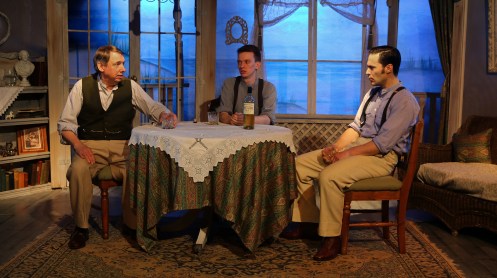
With this to work with, considerable credit must be given to director Simon Bartlett and his cast of five actors for presenting an amateur production that is as near professional as you can get without actually being professional. There are vast amounts of lines to be learnt for this work and at no point did the interaction between characters lull, drag or lose the pace of an actual conversation. Each family member was convincingly related to the others, the overall pace of the performance was brisk, and every actor on stage delivered his or her role in manner that indicated they fully understood everything they were saying and the position in which their character found themselves. This, for a complex and intense work of just under three hours’ length was very impressive.
Dorothy Duffy was superb as Mary Tyrone. She was a fragile mix of despair and keeping up appearances, her small, barely noticeable mannerisms – fiddling with the frill on her blouse, fixing her hair – a clue to the fragmenting woman beneath the beautifully presented exterior. When she talked about her long evenings alone in hotels, waiting for James when they were younger, you felt both the strain she felt and the toll it took on her.

Francis Abbott succeeded in presenting the whole of James Tyrone rather than just the older, drunker result of a difficult life lived. Similarly, both George Abbott and Luciano Dodero as sons Edmund and Jamie were fully rounded individuals. Early 20th century damaged, middle class sons are easy for actors to stereotype (O’Neill, or not) but George Abbott and Luciano Dodero’s performances were well thought out and effectively rendered. Luciano Dodero was particularly poignant as Jamie, a man who knows he is losing control and cannot stop but must not show panic and must also save his brother.
The Tyrone’s maid Cathleen was played by Fiona Poole with great attention to detail. Whilst it must be said (must it?) that Cathleen had evidently toured both Ireland and Scotland before settling in the US, Fiona Poole was very endearing as Cathleen. Even if you view Cathleen only as light relief, punctuating the family traumas, this was, again, a real woman, a woman you might want to talk to. No actor in this production had an easy job.
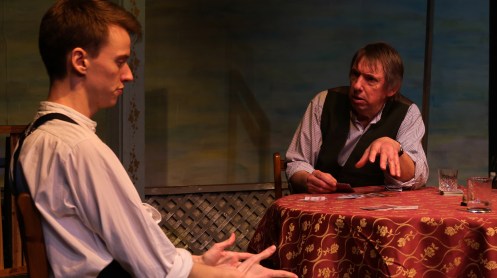
As the title suggests, the action takes place over the course of one day, from early in the morning to around midnight the same day. Junis Olmscheid’s set – an elegant conservatory-type room, looking out onto painted sand dunes and the sea beyond – was perfectly atmospheric. Slightly jarring though were what looked like the heads of two single bed frames over two of the windows. These were both weird and mesmerising as the legs are also to be found, I think, on set. However, I understand that the actual room in O’Neill’s house was in fact constructed using some of the remains of a shop that had been on the property when it was bought and this, coupled with the fact that Tyrone does not spend what he does not have to, could explain the bed heads, but they are still something of a distraction.
Adding to the professionalism of this production was Ralph Blackbourn’s sound design: quiet piano inserts during set changes and understated sound effects, a fog horn out at sea, a car drawing up outside, Mary moving around upstairs. Subtle lighting (save for the intentionally unsubtle room light when required) by Andy Mathieson and Sarah Hill contributed gently and significantly to the overall picture. The soft changes as the fog swirled in and out outside were almost characters in themselves.
Costumes (John Gilbert, Miriam King and Junis Olmscheid) were great. The small changes and additions throughout the day were particularly effective.
Long Day’s Journey into Night, deeply loved by many people, is a play you have to commit to. Family pain is not an easy watch. O’Neill himself did not want it performed, or in fact published until 25 years after his death. It was his widow, Carlotta Monterey who insisted it was performed in 1956 (in Stockholm) and from that point onwards it met with acclaim and success. RSS have done it full justice, this is a very impressive production, well worth seeing.
Eleanor Lewis
January 2020
Photography by Pete Messum
Blackmail and Brandy
Dial M for Murder
by Frederick Knott
Simon Friend and Gavin Kalinat at Richmond Theatre until 18th January, then on tour until 18th July
Review by Andrew Lawston
It’s a stormy night in Richmond, perfect for an evening of blackmail, deception, and murder. Frederick Knott’s Dial M for Murder, made internationally famous by Alfred Hitchcock’s 1954 film adaptation (from Knott’s screenplay), plays out almost like an episode of Columbo. The audience knows the truth behind a murder from the outset, and the play becomes a suspenseful psychological thriller as the question becomes how, or even if, the true culprit might be unmasked.

This production at Richmond Theatre updates the play’s setting slightly from the 1950s to 1963, and this is mostly reflected in the stylised décor of the spacious set that depicts Tony and Margot Wendice’s comfortable flat, as well as in the stylish and well-cut costumes that generally emphasise the characters’ physicality. Both set and costumes were designed by David Woodhead, and as a result they complement each other well. The set is full of details that inform the audience’s view of the characters before the play even begins: a shelf of tennis trophies can be seen very much on display, but not prominently, and several of them look tarnished and neglected, or are partially hidden behind other bric a brac. The record player’s lid is kept open throughout, suggesting heavy use. Pride of place is given to a drinks trolley, and indeed characters make themselves drinks almost constantly throughout the show. These are all neat and thoughtful touches that make the set look like a real home for much of the play.

Dial M for Murder is the story of Tony Wendice’s scheme to have his wife murdered in order to inherit her money, a scheme that goes very wrong. Wendice himself is played by Tom Chambers in a wide-ranging performance that is charismatic enough that you can never truly hate the character, despite his ruthless scheming. His Wendice is a charming host, and maintains a convincing façade as a devoted husband. Sally Bretton shines as Margot Wendice despite her character often being more of a plot device than a real person. Michael Salami makes the most of his part as TV writer and Margot’s love interest Max Halliday (who’s recently returned from New York, where he wrote a murder a week for a full year), and provides real energy to a very wordy script.

The cast is rounded out by Christopher Harper, in a dual role as Captain Lesgate, a petty criminal in an audaciously unconvincing fake moustache, and Inspector Hubbard, a deceptively placid detective who unravels, together with Max, Tony’s deadly plot. Harper was undoubtedly more effective as Inspector Hubbard, but was highly engaging in both roles.

The performances are uniformly strong, despite a few night stutters and jitters, and the play moves at an assured pace. For a play in which the action hinges on such minute details as the position of latchkeys, mud on the parquet, and the whereabouts of stockings, there was however one curious choice.
After Tony Wendice has coerced Lesgate into murdering his wife, in a scene where he establishes his alibi by leaving for a party with Max, Lesgate could clearly be seen crossing the stage behind the French windows, and could be seen taking up position behind the curtain and waiting for several minutes in order to carry out his attack. This was confusing for many in the audience as Wendice’s plan, and subsequent dialogue, made it clear that he supposedly entered through the front door. It was unclear whether the curtains should have been closed and we weren’t supposed to have seen him (the spectacle of Lesgate sneaking through the door and tiptoeing behind the curtain might have looked awkward). Or whether there was a problem backstage and he simply used the alternative entrance. Perhaps it could even have been a deliberate piece of misdirection on behalf of director Anthony Banks. In any case, it seemed to be a slip that caused some audience confusion in an otherwise assured performance.

With a naturalistic set, stylish period costumes, and brutally realistic fight sequences courtesy of Alison de Burgh, this new production is a slick, taut, thriller that provoked much engrossed conversation among audience members as we all filed back out into a dark and stormy Richmond night.
I ought to make the shameful admission that I’d not previously seen the play or film of Dial M for Murder, and so I was genuinely and completely gripped by the psychological drama that unfolded as Tony’s lies began to unravel, slowly but surely, throughout the second half. I was almost certainly in the minority in the auditorium with that omission, however, and it certainly seemed that familiarity with the material had made no impact on the audience’s enjoyment.
Andrew Lawston
January 2020
Photography by Manuel Harlan
Uplifting Festive Tale
A Christmas Carol
by Charles Dickens adapted by Emma Louise Tinniswood
Step On Stage Productions at Hampton Hill Theatre until 11th January
A review by Milly Stephens, one of our younger reviewers (aged 14)
Step On Stage’s production of A Christmas Carol performed by its Youth Theatre was extremely engaging with scenes from festivity and laughter through to death and poverty.
In Act One, due to the nature of the show, there is more need for chorus than action, but I think that Step On Stage overcame this obstacle very well, as the narration was very strong and engaging. Hampton Hill Theatre is a very big space, but the actors managed to project their voices exceptionally well and there wasn’t a word that I couldn’t hear. The set and costume were outstanding and creative.
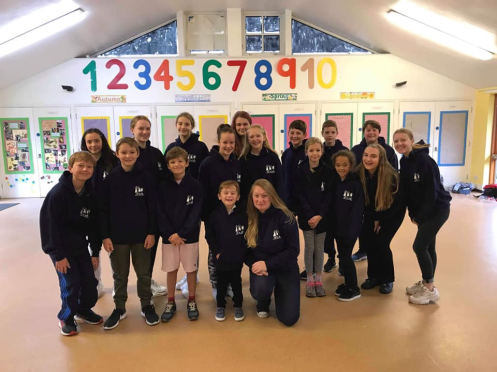
Cast of A Christmas Carol with Adaptor and Director Emma Louise Tinniswood
I really loved all the singing and I thought that the Christmas carols were very tuneful and even though it was a short time after Christmas, it still put me in a Christmassy mood, looking forward to next year’s Christmas.
The scene based at the Cratchit family’s house was one of my favourites, as it was realistic and had very good dialogue and atmosphere that made me feel included into a real family’s Christmas lunch. I also loved the scene at the feast with the Fezziwig’s as there was joy and dancing all the time. When the cast sang Five Gold Rings, the Ghost of Christmas Present broke the fourth wall, encouraging the audience to participate and sing along.
At the start of the play you see Scrooge – in this performance played by Scarlett Gladstone, who is a talented young actor, being glum and miserable even though there is so much Christmas merriment, especially at this time of year. (Alice Bray plays Scrooge on alternate performances).
Then Marley, who has been dead for the past seven years, comes to visit Scrooge to give him a warning. Daisy Diamond played the character of Marley extremely well, captivating the audience and leaving them on the edge of their seats. The creative use of haze, clanging chains and echoing microphone heightened the tension.
The first Ghost of Christmas to visit Scrooge was Laura Bergin, as the Ghost of Christmas Past. I thought that Christmas Past was acted very well, as she was delicate with her movements and that she had very good characterisation.
Then the Ghost of Christmas Present came to see Scrooge. I thought that Charlotte Williams brought a great sense of humour to the part and that it was a superb contrast to Scrooge who hated Christmas.
The last Ghost to appear before Scrooge was the Ghost of Future, played by Eli Rogers, who was cold, serious and foreboding and made Scrooge realise he had to change in order to be loved by everyone, not hated.
After the spirits had warned Scrooge of how he was viewed, he changed his ways and began to be generous to the poor and needy, especially the Cratchit family. Scrooge became a changed man.
I would highly recommend this show, as you can never be too young or too old to enjoy this festive tale with its uplifting moral ending. Congratulations to all the cast and creatives from Step On Stage.
Milly Stephens
January 2020

 Mark Aspen