
Craic and Broken Hearts
Once
by Enda Walsh, music and lyrics by Glen Hansard and Markéta Irglová, based the film by John Carney
Adam Spiegel, Robert Bartner, The New Wolsey Theatre and Queen’s Theatre at The Ashcroft Playhouse, Fairfield Halls, Croydon until 11th January, then on tour until 25th July
Review by Mark Aspen
Restraint is a word used much more than once in the wonderfully romantic piece of folk whimsy, Once. If restraint seems unapt a word for a musical, especially one that starts pre-show with full-on foot tapping folk rock band, then think again. Think Riverdance meets Brief Encounter.
In various manifestations, Once has jigged its sprightly way around five continents over the last decade. It started life as an Oscar winning film by John Carney, which had originally been released in 2007. In an adaption by Irish playwright, Enda Walsh, it then took off as a stage musical and it has rapidly developed something of a cult following. Croydon is debuting its first ever UK Tour and the some of the audience at the press night were showing off fanfolds of tickets to follow it throughout 2020. Certainly for these aficionados once is not enough for Once.
Once is a gentle love story, it is about taking courage and believing in oneself, it is about the power of music.
If music is the driving force of the plot of Once, it certainly gets a turbo-charged start. Cast and audience immediately enjoy the craic at a pre-show party that extend from stage to stalls and on, as sixteen musicians burst a lively fire-cracker of Irish folk music, the fidgeting fiddles set against soothing squeeze-boxes, pounding feet against honeyed harmonies, humming and keening against whoops and shouts, joyous and jolly. Remarkably, though, these talented musicians are also the talented actors who will tell us the story of Once.

The lights fade down, but the party continues; then with the house lights out, the fiddles become violins, the music lyrical and the soft story starts. The basis of the plot is fairly simple: boy meets girl, but both are already committed to another; they fall in love; girl helps boy to fulfil his aspirations, boy helps girl to regain security; both regain their committed significant others; boy and girl part, their love unconsummated. What make this simple plot special is the gentleness; that the two never lose their place in their own cultures, and they remain bound together by a common love of music. In fact, to paraphrase, they make music, not make love.
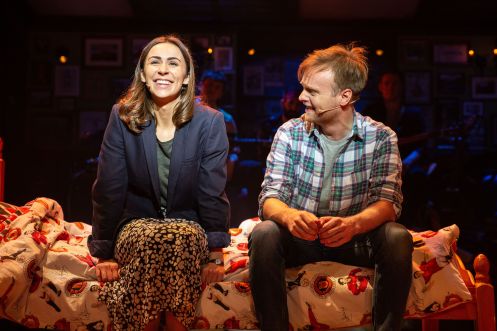
That music surrounds the pair’s attraction is the consummately presented theme in both director, Peter Rowe’s concept and Libby Watson’s design. The musician-actors are always there, a physical presence “greyed-out” from the action when not active in it, always there to play music, dance or sing; and more importantly, always there as their cultures, their communities, always ready to support each other. (Were all communities so supportive!)
Watson’s set is a corner of a Dublin pub, the music corner, adorned with framed music memorabilia and gig posters. It is the sort of pub where the locals often have an impromptu “Trad Sesh” where folk music and indie rock combine, mics are open, and everyone contributes. Other settings are created within the arms of the pub, by trucking or carrying on features for the interior of a flat or a shop. In the ceiling of the pub are roof-lights, but the whole roof may lift off to reveal the wide world of a night sky. Projection designer, Peter Hazelwood, creates some wonderful skyscapes, including a soulful crescent moon, and Mark Dymock’s lighting design is so precisely integrated to the whole that lights dance with the ensemble and a floor mounted starcloth becomes Dublin by night.
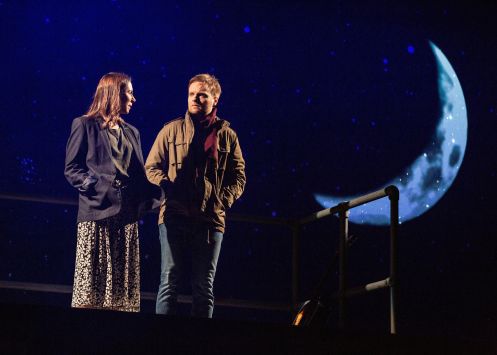
The plot is so much a boy-meets-girl story that the pair are called Guy and simply Girl. As the opening ceilidh dies down, we see Guy as lovelorn and dispirited, singing Leave, a lament for his lost love, now living in New York. Girl approaches him and brightly, if disarmingly, asks him “Do you enjoy being Irish”. We discover that she is a Czech émigré from a musical family, whereas his business is “hoofers”, he runs a vacuum cleaner repair shop with his “Da”. Soon a deal is struck, he will repair her old upright Hoover, and she will pay him by playing him music on an old upright piano in the music shop above which she lives.
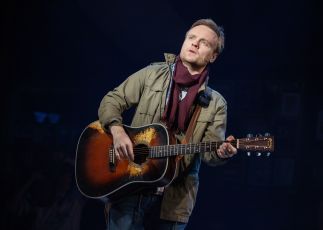 Daniel Healy is a natural as Guy (and has also been a composer and a busker), a man a crossroads in his life. His slightly husky tone works brilliantly with the melancholia of his songs. You can hear the catch in his voice in Leave. The elfin Emma Lucia plays Girl with a vivacious direct charm. She sings her own solo The Hill with such appealing clarity that it leaves the audience mesmerised. The centrepiece for many in the audience is the Oscar winning duet Falling Slowly, and their richly complementary voices leave all enthralled. It is almost as if the audience falls for these characters before they realise that they are falling for each other.
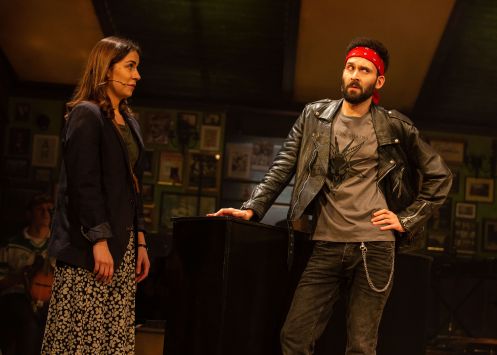
The music shop is owned by the fiercely protective eccentric Billy. Billy is not so much a loose cannon as a whole wonky ordnance. The loose-limbed Dan Bottomley has great fun playing up the loveable fire-eater. With his not-yet-perfected karate, Billy is willing to die for his friends. He has two pet hates, Corkonians and bankers. When he meets his seeming nemesis, Bank Manager, who comes from Cork, sparks fly. A superb violinist, Samuel Peverley plays Bank Manager not so much as gravel-voiced as tarmac-voiced, but has the great comic virtuoso solo, Abandoned in Bandon, which rescues the character from being merely the stooge to Billy.
There is a lot of, albeit big-hearted, stereotyping, especially when Girl introduces Guy to her extended Czech family. The ex-pats are learning (Irish-) English from RTE television sit-coms, so to help the audience their words are projected as surtitles … in Czech, a nice reversal of norms. The Czech family offer a host of wonderful cameos. Reza is a brazen go-getter in a scarlet mini-skirt (woolly leggings under), willing to use her charms in winning ways, for example to get Billy to use his shop as rehearsal space for their scratch music group when they are preparing to help Guy make a demo-disc. Ellen Chivers has a superb singing voice and she plays the part of Reza with great aplomb, tossing her blonde pony-tail to move the music and tease the men. Svec is the stout-hearted oak of the family, a heavy-metal drummer willing to sacrifice his art to the folk style by using his trousers to muffle the drums. With giant stage presence, Lloyd Gorman seizes the role of Svec, plus he gives us a rousingly impressive drum solo. The matriarch of the family is Baruska. Susannah van den Berg, who last exhibited her coloratura locally as a larger than life Queen of Hearts (in the Rose Theatre’s Alice in Winterland) excels as Baruska, pushing Guy’s pre-business-finance visit to a fine melodrama, culminating in “Those how live in fear, die in their graves!” She is also a very accomplished accordion player. Rosalind Ford, who plays Guy’s Ex-Girlfriend, dances and sings whilst playing a cello that seeming floats with her.
However, it does seem a little disingenuous to praise up individual performances from what is a seamless ensemble, which is constantly engaged with the storytelling, a benign Greek chorus. The ensemble is not only multi-talented but generous in its common creativity, seamless in its faultless acting, seamless in its dancing (unobtrusively choreographed by Francesca Jaynes), seamless in musicianship and seamless in its singing. The a cappella reprise of Gold was another show-stopping highlight.
 Nevertheless, in this now-you-see-it now-you-don’t, but never-to-be love affair, the most intense moments are quieter, reflective ones, when the poignancy that marks out this musical as being special comes into its own. These are moments of discovery between the two would-be lovers, and the revelations. Girl has a husband who has gone back home leaving her with their young daughter (played with great confidence on press night by Isabella Manning). Guy asks why he left, but Girl ignores the question to say Miluju tě, untranslated but meaning I love you.
Loneliness lurks just around the corner, but the demo disc is in the bag and the airline ticket in the pocket. Why complicate matters?
“It’s a complicated thing, this love” says Billy. But don’t you show restraint, for this bittersweet and idiosyncratic musical is one you should see once … then you will want to see Once once more.
Mark Aspen
January 2020
Photography by Mark Senior
New Age for This Flamboyant Ballet?
Le Corsaire
by Anna-Marie Holmes after Marius Petipa and Konstantin Sergeyev; music by Adolphe Adam and others
English National Ballet at the London Coliseum until 14th January
Review by Katie Hagan
Ah, Le Corsaire, what a joy you are! Ballet’s majestic romp took to the high-seas last night, with a triumphant first performance of its 2019 run at London’s indisputably splendorous Coliseum.
Performed by a hot cast of English National Ballet’s lithe dancers, Le Corsaire returns to the capital after a successful stint in 2016. A firm favourite, it will no doubt mesmerise its audiences once more with its romance, luscious choreography, luxurious set and costumes, not to mention the swelling music of English National Ballet’s Philharmonic Orchestra.
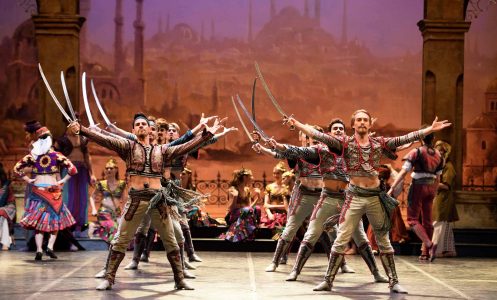
It would be false of me to deny the show has been missed. Delivering on spectacle and stunning virtuosic dance, it is easy to see why this ballet is loved by new and old enthusiasts. Not only does Le Corsaire have the visuals to keep the eyes stimulated, audiences can be strangely charmed by its bombastic, unbelievably believable turn of events. Of course the protagonists, Medora and Conrad, went unscathed and survived the final hurdle! Only in this illusionary ballet can a ballerina keep her tiara on during a ferocious storm at sea.


As an audience member, it is vital to suspend all your beliefs when embarking on the escapist Le Corsaire. Try to abandon all desires to follow a narrative, and just sit back and absorb the magnificence that this classical production has to offer. This extravagant feast, staged by the talented Anna-Marie Holmes, has been revised many a time, but was initially based on Jules-Henri de Saint-Georges and Joseph Mazilie’s libretto, itself an interpretation of the poem The Corsair by the 19th Century’s resident bad-boy Romantic poet, Lord Byron.

Divided into three acts, Le Corsaire follows the story of the heroic Conrad (Francesco Gabriele Frola), who is heading towards the Ottoman Empire to rescue his belle, Medora (Erina Takahashi) from the wretched hands of slave-tra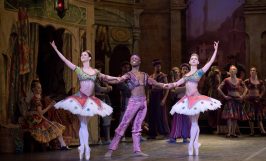 der, Lankendem. Played by guest artist Brooklyn Mack – who looks completely at home onstage – Lankendem plans on selling Medora for a hefty price to the bumbling governor, the Pasha, played by guest character artist, Michael Coleman.
Act One opens with a cargo of bodies on a busy stage, perfectly encapsulating the hustle and bustle of a popular citadel. This first scene is a real medley of ENB’s talented principals and soloists, all of them throwing down gauntlet after gauntlet with their jeté-ing and pirouetting. You wouldn’t have thought a significant change to the two main characters had occurred only hours before the curtain rose.
 Such an opening sustains the first act’s momentum. The Odalisque pas de trois is a memorable section, containing Precious Adams’s lightening-speed beats and oozing upper body extensions, as well as Julia Conway’s fluttering chaine turns. Whilst exhibiting herself to the Pasha, Medora’s friend and fellow enslaved girl, Gulnare, danced by Shiori Kase, flitters around the stage with the determination of a single-winged, wounded butterfly.
Although Le Corsaire has previously come under scrutiny for its negative representation of women, Gulnare moves with a force to be reckoned with. During her pas de deux with Lankendem she is resolute and does not engage with him as he vaingloriously parades her in front of the Pasha. It is an interesting characterisation which definitely paid off.
 Le Corsaire’s subplots come to the fore in Act Two, as we follow Birbanto’s sabotage of Conrad’s plans to save Medora. Jealous of Conrad’s bond, Birbanto tells Medora to give Conrad a rose which is, unbeknownst to her, poisoned. Played by Erik Woolhouse, his hair standing on end, Birbanto goes from trusted friend to enemy. Whilst his characterisation often veered on the sulky, frustrated school-boy, I was impressed with his maverick movements. It is rare to see a dancer splay their hands and sweep around the stage with a slightly hunched back, all the while looking roguishly enigmatic. There has definitely been a conscious effort to tread deeper into Le Corsaire’s characters and I applaud ENB for this decision.
 Conrad’s jumps are a wonder and so are his pal Ali’s – played by Jeffrey Cirio – split leaps. The buoyancy and vitality of this cast is affectingly infectious. All of this promise was narrowly jeopardised during Medora and Conrad’s pas de deux, however. The signs of their late casting showed during their strained final lift. Although still met with rapturous applauds, this anticipated duet unfortunately frayed at the seams.
Perking himself back up, Frola continues to barrel-turn and straddle jump into Act Three as he seeks to reconcile himself with Medora, who was once again *sigh* abducted by Lankendem. After the crisp and fresh Enchanted Garden section, the farce kicks into acceleration for the final time, until Birbanto is exposed for his misdeeds and Medora and Conrad are happily reunited.
In this staging, Anna-Marie Holmes has tried to do away with Le Corsaire’s sinister undercurrents of racism and sex-trafficking. Whilst the female roles have indeed grown stronger, and there is thankfully no yellow-face to be seen, the black ballet dancers are too token-y; either cast as the ‘comic’, ‘villainous’ or secondary character. Yes, it is encouraging to see three black dancers onstage. I just hope one day we see one in the lead role.
But change does not occur overnight. As far as I am concerned, Anna-Marie Holmes has done a sterling job at meticulously unpicking Le Corsaire. With a superb cast and an opulent aesthetic, the great outweighs the weak in this ballet.
Katie Hagan
January 2020
Photography by Laurent Liotardo
Impetuous Blasts with Eyeless Rage
Blast from the Past and Stage Door Blues
by Marc Harris
Barnes Community Players at the OSO Arts Centre, Barnes, 7th January
Review by Eleanor Lewis
The subject of ageing and coming to terms with the life changes accompanying it is currently a hot topic for dramatists. Marc Harris has taken up the theme in his new play, Blast from the Past.
The story is that of Tim Horton, a successful actor who has reached retirement age where he is struggling with the loss of his wife and some issues with his memory, but otherwise living a reasonably happy life. Tim has been offered an audition for a small part in a very decent, upcoming film and he’s nervous about going to it. In five distinct scenes Horton, played by Rodger Hayward-Smith, converses with his brother to whom he is close, his twin daughters and his young neighbour who invites him to dinner and the prospect of friendship across the generations. The play takes us through the usual themes of how the generations interact (quite positively in some cases) and how families function, or don’t, particularly when faced with an ageing parent. One of Tim’s daughters urges him to remove his late wife’s clothes from the house, something he cannot do, and a small row follows. This rift is eventually repaired with help from the other daughter. Tim’s family is in fact a happy and supportive one, (which does of course reduce the potential for drama).

The play itself is efficiently constructed and progresses steadily through its five stages, broken by an interval, and reaches a satisfying, if slightly hackneyed, conclusion. Its strengths are in the accessibility of its subject matter – it seems everyone in the developed world is seeking comfort and help with ageing – and the gentle, generally positive way in which the story is told.


Blast from the Past does need a boost of dramatic adrenalin though. The five scenes are long and whilst the dialogue is natural and on the whole believable, there is a great deal of it and at times this felt like listening to people actually making small talk. The first scene between Horton and his brother is particularly lengthy and would benefit from paring back. Given that each scene consists of people talking to each other, what is on view is mainly static: people sit down with each other and pretty much stay there, a little movement would be good, or else this becomes a radio play. Tightening the dialogue would also show off the vein of humour running through the work and it would be good to bring this rather more to the fore. There is for example a ‘running gag’ about pears, and whilst this shouldn’t be overdone it could be extended a little, I only noticed it twice. Blast from the Past clearly isn’t meant to be a laugh-a-minute-comedy, nor do I think it should be one, but even so a little humour tends to increase audience concentration.
 Accompanying Blast from the Past was a second, short sketch rather than a play, (it’s about ten minutes long) entitled Stage Door Blues. This involved a couple waiting at the stage door for one of the actors from the first play. It’s cold and they are sniping at each other but there is a little plot twist to entertain the audience and this worked reasonably well on Tuesday evening. Whether the entirely clichéd 1950s-style Actor character, complete with camel coat draped around his shoulders, was deliberately written, directed, or just misguided remains to be seen but it reduced the comedy somewhat, there was enough in the writing, the costume was overkill.
Tuesday night’s performance was a rehearsed reading rather than a performance so the fact that there is scope for change, improvement and finessing goes without saying. That said, there were costumes, props and scenery, semi-staging in fact, and Barnes Community Players rendered their roles effectively, giving life to the script while reading from files. Rodger Hayward Smith particularly deserves credit for being on stage most of the time and giving an endearing performance as Tim Horton. All in all, Blast from the Past with some tweaking and tightening could well make another dramatic source of reassurance for families and individuals trying to deal with the last phase of life as we know it.
Eleanor Lewis
January 2020
Photography by Courtney Everett
Whirlwinds and Wizardry
The Wizard of Oz
by Frank L Baum, music and lyrics by Harold Arlen and E Y Young
Dramacube Productions at Hampton Hill Theatre until 23rd December
Review by Claire Alexander
I looked forward to seeing Dramacube’s production of The Wizard of Oz with my six year old nephew. He would indeed be a critical audience having played the Tin Man in a (far, far simpler) performance as part of a holiday club earlier this year. We were not disappointed.

We all know the story. Young Dorothy, bored with life in rural Kansas, where she only has her beloved dog Toto for company and a number of very busy older siblings, is transported beyond the cyclone and the mysterious Land of Oz. There, on her quest to find the Wizard of Oz (only he has the power to get her home), she meets the Scarecrow, the Tin Man and the cowardly Lion. They are all looking for something to make their life complete. And so starts their journey through Munchkinland, to the Emerald City. Dorothy has to overcome the Wicked Witch of the West and rescue her broomstick, before the Wizard will grant their wishes. And in a final twist the balloon that will take her home blows away before she has a chance to catch it! This was presented as the traditional musical it is, complete with all of the well-known numbers – Over the Rainbow and We’re off to See the Wizard to name a couple.

This was an assured production from Dramacube, given all of their performers are under fourteen and some could be as young as seven. It was well presented and I liked the gauze curtain against which were projected images of life in Kansas, before it was raised to give us a more open stage depicting Oz. I particularly liked the animated horse, and the untethered balloon at the end. And then, once in Oz we had the eponymous yellow brick road stretching into the distance and the Emerald City, and this gave us a nice sense of perspective. The Hampton Hill Theatre can be a deep and a big stage when there is an open set and this cast of 21 young performers (all playing multiple roles) filled it impressively well. There was also a raised platform which was used to good effect by the wicked witch, and the crows, which also helped to give us a sense of power and height. I had the sense that the young cast had all been involved to some extent in the creation of the set and I certainly imagined the bright land of Oz ‘over the rainbow’.
There were some other nice touches. I liked the way Toto was played by a cuddly toy when we were in Kansas and turned into a shaggy scampering dog when we got to Oz – well maintained by Joshua Briggs. The chorus choreography (K’ja Young Thomas and Danielle Bond) was relatively simple but everyone knew what they were doing, and there were some good dancers among the Jitterbugs.

The performances (I saw the Twickenham Blue cast) matched the brightness of the set and costumes with their energy and enthusiasm. It is unfair to pick out a few names when everyone had multiple roles and really contributed to the whole. But I was particularly impressed with Anya Malinowska (as Dorothy 1) singing Over the Rainbow – this was a really striking performance, no obvious nerves, of the song that is always associated with Dorothy and right at the beginning of the show too. Well done. Almost unnoticed Dorothy 1 swapped into Dorothy 2 in the form of Daisy Allen. She has already developed a confident presence on stage and she ably led her growing team of characters in her quest to find the Wizard. And finally Sophie Collins was a truthful and natural Dorothy 3 just as Dorothy’s journey was ending. I also wanted to mention Joseph Kirwan who was a wonderfully natural scarecrow! He delivered his lines with a great ‘dead pan cool’ and there is an emerging comic talent there. My nephew pricked up his ears and enjoyed the Tin Man (Jake McGowan) who wanted a heart, and mouthed the lines ‘oil, oil’ with him. And the three were ably joined by Eva Scargill as the Lion in search of courage who had a gentle timid presence. Another performance that stood out for me was Larissa Shaffrick as eccentric Professor Marvel.

But this was truly an ensemble production. You have to be organised to play several parts with costume changes in the space of an hour and there was no sense of uncertainty on stage. Some of the performers are still very inexperienced but energy, enthusiasm and commitment shone from everyone and there is a wealth of talent among these young performers.
The only thing I missed was a reprise at the end of one of the well-known numbers by all of the cast – that would have been a worthy and fitting end to the show.
Dramacube has four casts of this show and they have all been rehearsing throughout the autumn term. I saw the ‘Twickenham Blue’ cast but I have no doubt I would have found just as much enchantment and talent in any of the other casts. Stephen Leslie and Matthew Bunn and all the adults assisting are doing some great work to nurture and encourage young performers and I am sure we will see them again as they get older and graduate to local youth theatres, secondary schools and adult groups.
Claire Alexander
December 2019
Photography by Bomi Cooper
Triumph from Disaster
Fault Lines
by Ali Taylor
Questors at Questors Studio Theatre, Ealing until 4th January
Review by Emma Byrne
“What’s Christmas without a disaster?” asks the tagline from this show, in which the geological and the personal combine to create the backbone of a funny, often touching, play. The epicentre of the action is a small and struggling UK charity, desperately trying to make an impact in the aftermath of an earthquake in Pakistan. Oh, and it’s Christmas Eve.

From ill-advised office party antics to well-meaning attempts to supply the first tents in the disaster area, the staff of Disaster Relief face a four-day reckoning that registers at least a five on the Richter scale: the effects are felt well beyond the epicentre.
Without giving away the plot, the comedy here is in a similar vein to the humane satire of Drop the Dead Donkey: whatever goes wrong is more likely to be the effect of cockup rather than conspiracy. There’s also something of Alan Ayckbourn’s Life and Beth here too: reactions to tragedy aren’t always as expected, which makes for cracking dramatic tension as well as some comedy moments.
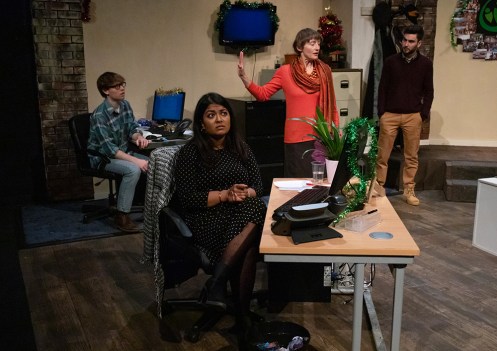
Playwright, Ali Taylor (and director Gary R Reid) set out the four protagonists, Abi, Nick, Ryan, and Pat in act one and, without being too heavy on exposition, they sell the stakes nicely. But if act one is the wind up then act two is the punch: high-stakes choices made amid rapid-fire cross talk, delivered with fantastic fervour by Will Langley (Nick) in particular.
 The piece has to be an ensemble to work, and there were lots of generous choices on stage. Questors newcomer Callum Dove (Ryan) does great background character work throughout, adding depth without ever pulling focus. Ryan could have been played as a bunch of nebbishy ticks, but Dove really sells Ryan’s awkward intensity in a way that is touchingly genuine.


Will Langley also makes some great choices when it comes to Nick’s effortless tone-switching between mockney man-of-the-people and media-schmoozing smoothie. Pamela Major’s Pat is a great portrait of someone whose idealism has been tugged slightly out of shape over the years – rather like a beloved but baggy cardigan. When she comments that Christmas is a great time for disasters, thanks to Major’s commitment it reads pragmatism plus idealism minus tact, rather than ghoulishness.
But it’s Neetu Nair’s Abi that has to carry much of the play’s weight. Abi’s personal and professional life are upended in the course of the play. The energy she brings is pretty relentless, but it is her resigned calm in act two that really allows her range to shine.

This is a technically demanding play and huge credit must go to set designer Fiona McKeon, whose mismatched and slightly grotty office interior is almost a character in its own right. Credit, too, goes to the stage manager and crew who manage fourteen scene changes (with attendant jumps in time) with a slick precision that ensures that the energy of the piece stays high. The number of technical cues from the control box, from phone calls to breaking news on TV, would have flummoxed a lesser company. This well-drilled production never skipped a beat.
If you’re feeling jaded, conflicted, or disappointed this Christmas season, this production of Fault Lines is for you. While hilarious, it’s by no means escapist: the conflict between ideals and pragmatism has rarely felt more timely than after this recent election. But by identifying with these well-meaning, all-too-human characters who are muddling through, there is at least catharsis in the chaos.
Emma Byrne
December 2019
Photography by Robert Vass
Cutlasses Out
Treasure Island
by Robert Louis Stevenson, adapted by Bryony Lavery
Putney Theatre Company at Putney Arts Theatre until 22nd December
Review by Andrew Lawston
Jim Hawkins goes to sea in search of buried treasure, and discovers storms, mutiny, pirates, and adventure. From Tim Curry brandishing his cutlass through a horde of Muppets, to Monkey Island computer games, Robert Louis Stevenson’s Treasure Island has been constantly adapted, reinterpreted, and reimagined since its first publication in 1882. Tonight it’s the turn of Putney Arts Theatre, in Bryony Lavery’s adaptation. Directed by Emma Miles and Angharad Ormond, the show makes effective use of cross-casting to assemble a confident and polished production that alternates between suspenseful drama and broad comedy, without ever quite veering into pantomime.
Stevenson’s adventure novel invented many of the tropes we’ve long come to associate with pirates and their grog-swigging, parrot-perching, treasure-burying, map-making ways, and this production embraces them unashamedly. The foyer has been dressed as an island, with a pre-show magician, live music, and there’s grog sold at the bar by a front of house team who are in costume and setting the mood wonderfully. Barney Hart-Dyke’s set is largely empty, except for a platform at the back, and a map of the island spread across the stage. Violinist Stan Stanley plays a long medley of sea shanties as the audience shuffles in.
As the lights go down and Jim springs to her feet to relate her life story, the cast quickly and effectively assemble the Admiral Benbow Inn from a few wooden barrels, pewter tankards and a door frame. Later on, the same simple set elements will be reconfigured into a coach, and the Hispaniola. This device has been well used over the years, but the ensemble really sell the illusion with slick, energetic, and confident scene changes.
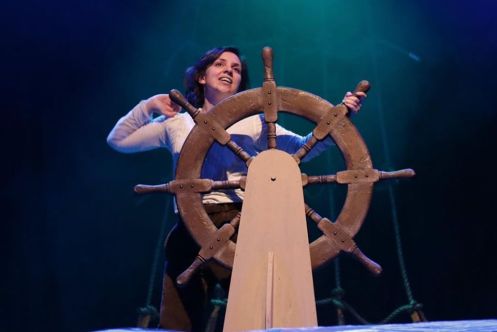
As visitors start to arrive at the Admiral Benbow, Live Foley Paul Graves starts to come into his own at his desk on stage left. While initially limited to providing sound effects for the inn’s bell for each new arrival, he quickly begins to steal the show with the sound of swords being drawn, bubbling mud, storms, tin skulls, and more.
The Admiral Benbow’s denizens are a lively bunch, from the charmingly surreal comedy of Grandma Hawkins (Ally Staddon) and Mrs Crossley (Chris Routledge) to tavern regulars Red Ruth, Job Anderson, Lucky Micky, and Silent Sue (Marie-Jose Fulgence, Michael Otim-Okot, Jeff Graves, and Loetitia Delais respectively). Black Cove life is presided over by Ben Kynaston’s splendidly pompous and clueless Squire Trelawney, and rather more severely by Carrie Cable’s gruff and fatalistic Doctor Livesey.
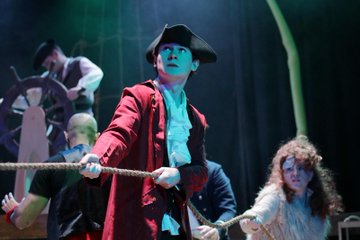 When the pirates show up: Vanessa Cutts as Billy Bones, and Sharon Czudak as Black Dog, the action begins in earnest. The first of many fights, arranged by Richard Kirby and Lindsay Rovan, ranges across the whole playing area as the two buccaneers fence with cutlasses. When the terrifying Blind Pew appears (Kim Dyas in a brief but imposing performance), however, it becomes clear that Treasure Island has an inherent problem with tone. It’s a family show, and the audience’s ages range tonight from eight to eighty, but alongside a great deal of humour and larks, there’s also a high body count. While Miles and Ormond have sensibly decided not to employ lashings of fake blood, the action stays true to the book’s occasionally brutal violence. As a result, there’s the occasional awkward moment where a character has their throat cut on stage only to have a comedy sailor step over their corpse to get on with the next bit of fun a few moments later.
In general, the directors have addressed the uneven tone of their material by playing the text as written. The comedy scenes, of which there are many, are played for laughs, and very successfully. During the serious or violent moments, everything is a lot quieter and more controlled.
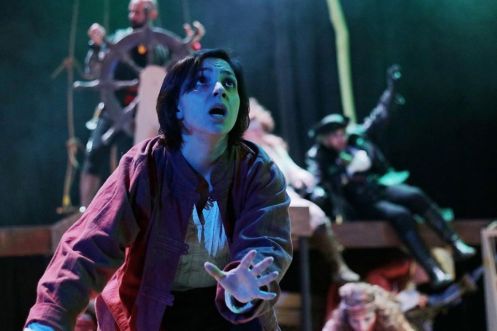
Although the story is traditionally viewed as a coming of age adventure for young Jim Hawkins (gamely played with gusto and energy here by Flavia Di Saverio, who carries the show, and provides a spirited point of identification for the audience’s younger members), the limelight is of course hijacked by the one-legged pirate-turned-chef-turned-pirate, Long John Silver. One of the most famous and distinctive characters in literature, this larger-than-life buccaneer demands a charismatic performance, and Charlie Golding more than rises to the challenge. His Silver is often quiet and calculating, with an easy charm. It’s easy to believe both in his friendship with Jim, and in his ruthless streak even when dealing with his own crew. Rather than the traditional “peg leg”, Long John Silver struts the stage in “the finest wooden leg in Brizzle”, a splendid steampunk-style prosthetic prop that allows him to move with real speed and menace.
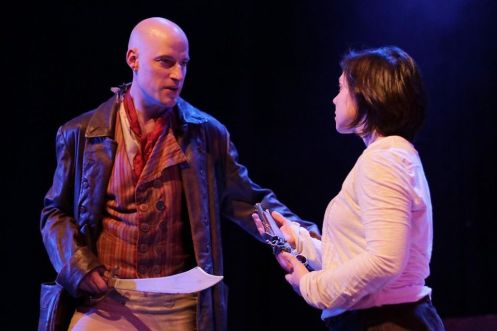
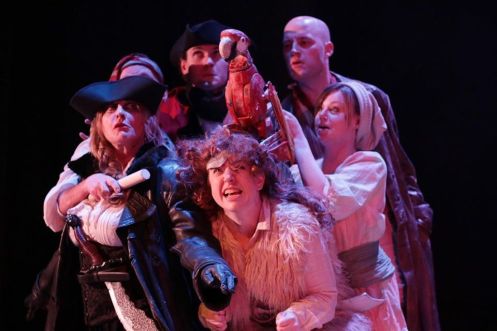
Silver is of course accompanied by the malevolent parrot, Captain Flint. Flint is depicted here through a wonderful wooden puppet created by Isaac Insley and Mae Fletcher, and operated by Alexa Adam, complete with punctuating squawks. As a puppeteer forced to cover the whole stage, often at some speed, Alexa sensibly doesn’t attempt to remain invisible, but all eyes were riveted on the parrot itself throughout.
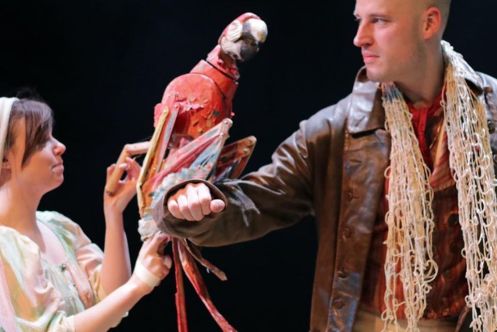
The rest of the pirates, cutting a dash in splendid costumes, are a wonderfully menacing group from their first entrance: Israel Hands, Dick the Dandy, Killigrew the King, and Joan the Goat (Miguel Bernal-Merino, Michael Maitland, Carlos Fain-Binda and Ally Staddon again) form a great contrast with the carefully anonymous but very likeable Grey (Harrison Chadwick). David Kelly’s blustering but dignified Captain Smollett forms a striking contrast with the pirates and amateur sailors from Black Cove.
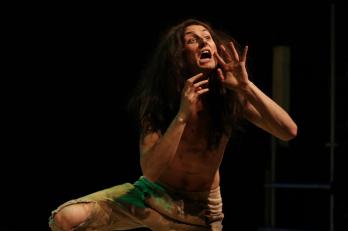 Once the Hispaniola reaches its destination, Act 2 opens with a bang, with an introduction to the island’s sole inhabitant, Ben Gunn. Wilf Walsworth’s performance as the abandoned cabin boy is glorious, taking in aspects of King Lear’s Poor Tom, Lord of the Rings’s Gollum, and any number of Monty Python hermits. Flavia Di Saverio’s Jim is particularly effective with Ben, as they discuss cheese, friendship, and buried treasure.
Although the programme notes that Putney Arts Theatre doesn’t have quite the resources of the National Theatre, finds inventive solutions to characters swimming, diving into underground tunnel networks, storms at sea, and more. The designers’ ingenuity seems to have been stretched to the limit throughout. The scenes in which characters are finally seeking the actual treasure are the only point at which you can see that they could really have benefitted from a trapdoor.
With wonderful sea shanties from Rosie Hayes and Stan Stanley, there’s plenty of music in Treasure Island, but this isn’t a pantomime. For families with slightly older children, however, this is a great production of a classic story, with likeable leads, and plenty of visual spectacle, that feels right at home in the festive season. The performance is slick and confident, and endlessly enjoyable. No black spots required!
Andrew Lawston
December 2019
Photography by Benjamin Copping
Mind-blowing, Amazing and Very Funny
Cinderella
by Will Brenton
Imagine Theatre at Phoenix Concert Hall, Croydon until 5th January
A review by Evie Schaapveld, one of our younger reviewers (aged 9)
I thought this panto of Cinderella was mind blowing, mind blowing as in my head nearly exploded because it was just so amazingly good.
One mind blowing bit was when Cinderella gets her luxurious ball gown. It was really very beautiful. They had a white sheet first where they projected these just beautiful images whilst the spell was commencing. Then they took it off, and she was wearing the beautiful gown.
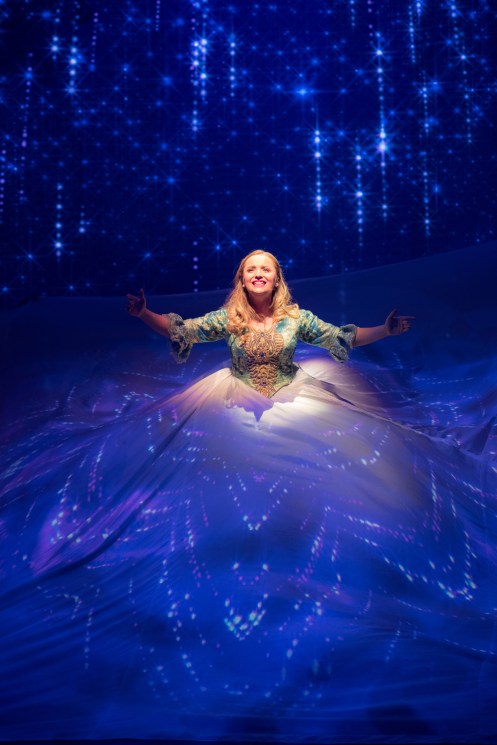
I gave the set and props 10/10. The screen background at the back of the stage was really good because it made the stage crew’s jobs easier. They didn’t have to change the set as the images were projected on to the back.
I gave the costumes 9/10. One of the stepsisters, Claudia had a pineapple costume and later o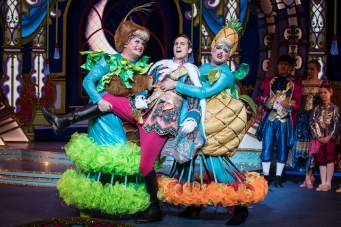 n a chandelier costume and I thought that was a bit weird! The other step sister Tess had an improved version of what Claudia wearing. She had a version that was still a chandelier but different to Claudia’s.
There were four characters who made me laugh the most. In order, first was Buttons, then the step sisters and then the stepmother. I think Buttons was very funny, probably the funniest character and my favourite.


Cinderella was very nice. She was quite shy at the beginning and didn’t really stand up for herself, but she became a very confident girl at the end. She was OK with standing up for herself, and was the kind of girl I’d like to be.
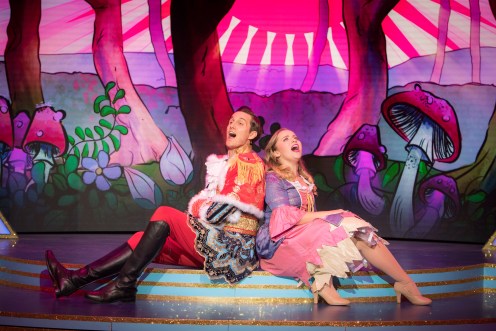
Prince Charming was a very good singer. He was a good lad, with a kind spirit. He just thinks all the girls want him for his money and riches and because if they marry him they’ll get rich (like the stepmother and the stepsisters). But when he meets Cinderella, she didn’t want him for his riches, she wanted him as he was a good man.
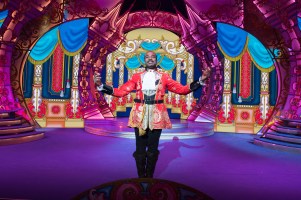 I thought his friend Dandini was very funny and he tried to help his friend. He knows that the Prince just wants to go out of the castle, so he gives him an idea of how to do that. They swap positions so the prince is the butler and the butler is the prince.
The ugly sisters were, as with all Dames, very funny. Dames are usually good people in Pantos, but in this one, the stepsisters had to be the Dames. I didn’t actually want to boo them, they were just too funny to boo!
The stepmother was an evil character, but she was a bit funny as well. In Pantos wicked people should have one funny part, at least one funny quirk. They should have something funny to say in a pantomime.
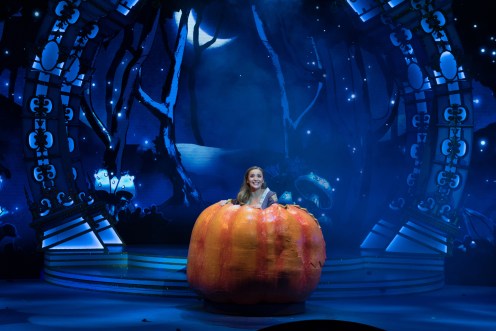
The fairy godmother was very nice. We didn’t see much of her but I liked how she had this little pink trail of fairy dust. It was very beautiful.
I liked how the dancers involved the children. There were three men and three women, and they were each in a pair like at the ball they were dancing whilst Cinderella and the Prince danced.

In the first scene the children were villagers, in the second scene they were like palace helpers, not slaves. Then the children were like little fairies. I found it very fun and the children were nice.
In the panto, they did the custard pies and he’s behind you. They had the thing when they brought out different chocolate bars and completed the sentences. The audience shouted out, and someone in the audience shouted out “Boris Johnson!” But they didn’t include the “oh no they didn’t, oh yes they did”.
Overall it was very nice and I found it very funny and enjoyable. I’d recommend other people to go and see this Cinderella twice, it was worth it even if they have to travel from Hampton to Croydon!
Evie Shaapveld
December 2019
Photography by Craig Sugden
An Amazing yet Warming Winter Story
The Snow Queen
by Ciaran McConville, based on the story by Hans Christian Andersen
RTK and Rose Youth Theatre at The Rose Theatre, Kingston until 5th January
A review by Milly Stephens, one of our younger reviewers (aged 14)
This year’s Christmas show by the Rose Theatre Kingston, directed and written by Ciaran McConville, is an adaption of the classic story, The Snow Queen by Hans Christian Andersen. The story is about a girl called Gerda (Parisa Shahmir) and one of her close friends, Kai (Jack Wolfe) who have to fight to save the world from the Snow Queen and eternal winter.

The action starts in a town called Evergreen where the elves are preparing gifts for Christmas, but one young girl called Joy (Emily Porter) finds a mysterious shard mirror which causes some of her older Elf friends to recount the tale of how the mirror came about. I thought that this was a creative and clever way to tell the story of Gerda and Kai, as the story is addressed to Joy on stage as well as the audience.

This year was the first time for the Christmas show since the refurbishment of the auditorium which has restricted the use of the pit area, which has been used during pre-show in previous years. Even though this might potentially have prevented some interaction with the audience, the cast managed to interact with children in the audience by inviting them onto the stage to put a present in the pile which I thought was very creative direction by Ciaran McConville.

Another special feature of previous years’ Rose Christmas productions has been the magical snow showers which have cascaded onto the audience during the performance, especially delighting the younger children who often sat on cushion seats in the pit area. No longer having the pit seating meant that they couldn’t sprinkle the ‘snow’ onto the audience, which was a slight shame, but I liked the artificial snow falling on the stage during the finale.
 The original songs written Eamonn O’Dwyer were powerful with lots of strong solos. I especially liked Progress, a song lead by Kai, about his dad’s less than successful inventions, which had some clever pyrotechnics that made it both funny yet moving at the same time.
Jack Wolfe and Parisa Shahmir played Kai and Gerda convincingly with strong voices and amazing emotion. They conveyed their strong emotions towards each other and 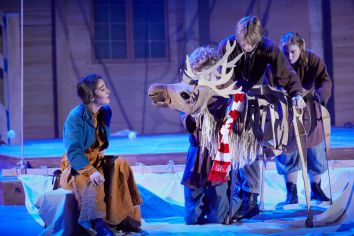 other characters. And it was very engaging for the audience as you felt their love towards each other was real. Parisa carried the story of her journey as her energy never faded and Jack supplied emotion and a switch in feelings. And Kai’s characters pulled on heart strings as he talked about wanting to bring his mum back. The pace and context of the story was well managed by the on-stage trio of narrators (Maisie Rodford, Jacob Towey and Daisy Tucker). But Bancu, led by Francis Redfern, stole the show with his amazing comic timing and animated voice. He made the audience laugh till they had stiches. Bancu, the reindeer, was a puppet which was pulled of amazingly. Also, Millie Brownhill gave an emotional and compelling performance as Edda which was particularly engaging and moved the audience with her bravery.

Whether you are a grandfather or a granddaughter I’m sure that audiences of all ages will delight in this year’s amazing story telling and engaging show at the Rose theatre
Milly Stephens
December 2019

 Mark Aspen