
Suor Angelica
Judge Not
Suor Angelica
by Giacomo Puccini, libretto by Giovacchino Forzano
English National Opera at the London Coliseum until 27th September
Review by Susan Furnell
Puccini wrote Suor Angelica in 1918, eight years before his death, and around twenty years after his famous lyrical verismo operas like La Bohème (1896), Tosca (1900), and Madam Butterfly (1904). This late work is an ocean apart in subject matter, structure, harmony, tonality, and style. Puccini was responding to the musical changes of the early 20th Century, where Debussy and Stravinsky were challenging harmonic structures, Schoenberg and Berg were eliminating them, and Wagner was developing the leitmotiv into a complex psychological tool.
The subject matter is not a love story, but one woman’s psychological torment. Angelica, sent to a stark convent to atone for having a child out of wedlock, holds on to the thought of her son, taken from her at birth, as her sole reason for living. When, after seven years, her aunt arrives, demanding she give up her inheritance and coldly tells her that her son has died, Angelica’s purpose is extinguished. In despair, she takes poison but, realizing she will be eternally damned, is granted a vision of her son and the Virgin Mary, which brings her peace.
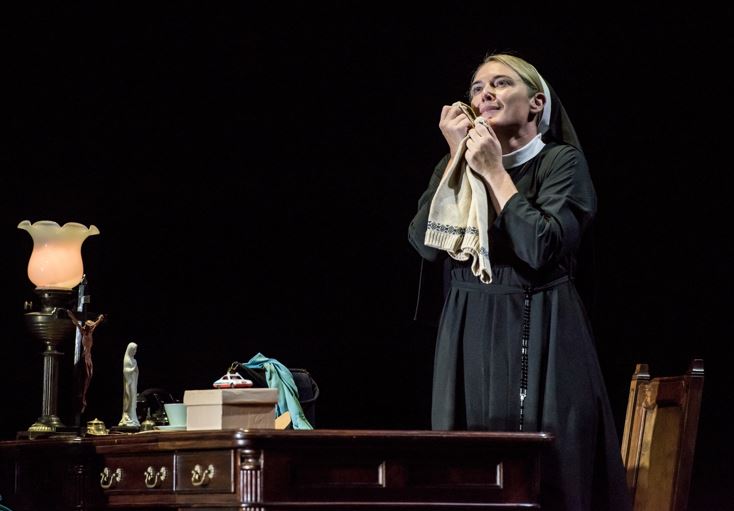
ENO’s production is not only heart-wrenching but also geo-politically charged. Irish director Annilese Miskimmon updates the setting from the 17th century to the 1960s Magdalene laundries in Ireland, where women were condemned to industrial servitude for life, many for sexual transgressions like out-of-wedlock births. The monumental sheets hanging above the stage are a visceral reminder that this is not a distant tale, but something that persisted in the West in our lifetimes. This makes the production a powerful commentary, compelling us to ask how such systemic injustice could have occurred at such a scale. If this happened so recently in Ireland, how can we be sure other Western systems were any better than the persecution in communist regimes? It’s hard not to conclude that, without transparency and checks like those in the American constitution (which itself is under strain), societies may always divide into a puritanical elite and an oppressed underclass. Will current trends in social media “cancel culture” or the rise of the far right create a new axis of persecution? As in the 1930s, many knew what was happening but did nothing. It’s rare for an opera to raise such profound, relevant questions with such emotional intensity.
Corinna Niemeyer’s conducting debut with ENO is noteworthy. This is a challenging work, and her reputation for attention to detail is key here. The structure is continuous, with no breaks between sections. The tempo shifts continuously, with frequent rubato. The tonality is fluid, moving between lush melodies in major keys, spiritual modes, and moments of unsettling entropy, where diminished and augmented chords destabilize the harmony and add to the unease. At times, the strings mirror the choral lines, enhancing the emotional weight. Elsewhere, the brass and timpani quietly evoke foreboding. Yet, in moments of hope, Puccini’s signature lyrical richness emerges, reminding us of his earlier works. Niemeyer navigated these shifts with skill, and the orchestra’s playing was integral to the psychological development of the story. Occasionally, entries felt rushed, but with more performances, these minor issues would likely smooth out.
The all-female cast was superb. Sinéad Campbell-Wallace, in the title role, and Christine Rice as the aunt were particularly impressive. Campbell-Wallace’s range was extraordinary, her high notes soaring while her lower register added depth. Her subtle vibrato was perfect for the convent setting, and her performance during the aria about her child’s death was heartrending. Rice brought nuance to the aunt, portraying a woman whose family had suffered because of Angelica’s actions, but who is blind to the cruelty of her own. Rice’s rich mezzo voice and her power-dressed blue suit emphasized her character’s self-righteousness, especially when she reveals, almost casually, that Angelica’s son died two years earlier. This chilling moment highlights the danger of puritanical beliefs … they are always myopic.
Alexandra Oomens, with her pure voice, added further poignancy, especially in her longing to cuddle a lamb again. Her performance reminds us that these women are not only cut off from society but also from nature.
The staging and costumes were visually striking. The desk onstage symbolizes power; the Abbess removes a mirror and brush from a newcomer’s suitcase and locks them in the desk, reinforcing the suppression of individuality. The conversation between the aunt and Angelica across the desk becomes a battle between evil and purity, self-righteousness and true righteousness. The Madonna is a limp idol, prayed to by the nuns, but offering little comfort.
The aunt’s blue coat contrasts sharply with the Madonna’s blue robes, raising an unsettling question. Is the aunt nearly righteous but so far from true belief that she might as well not believe at all? This subtle tension enhances the production’s psychological complexity.
In this production, Angelica’s vision of her son is staged rather than imagined. A five-year-old boy appears, his presence soothing her as she accepts redemption. This direct portrayal of her vision adds to the emotional power of the final moments.
Overall, this production is a tour de force in its ambition to raise difficult social questions while delivering an emotionally charged experience. Bring tissues, and bring friends: you’ll want to discuss it into the early hours. The themes are as big and relevant as they come.
Susan Furnell, September 2024
Photography by Genevieve Girling

 Mark Aspen
Trackbacks & Pingbacks