
Mary, Queen of Scots
Scots on the Rocks
Mary, Queen of Scots
by Thea Musgrave, libretto by the composer after Amalia Elguera
English National Opera, in co-production with the San Francisco Opera, at the London Coliseum until 18th February
Review by Mark Aspen
The political elite of Scotland are in hostile conflict with each other and with cousins south of the border; there is infighting within the various factions; the people are restless and volatile; and bubbling away in the background religious enmities find violent expression.
This may all sound very contemporary, but here Scotland is not ruled (tenuously) by the SNP, but (tenuously) by the royal dynasty of the House of Stuart. It is not today, but the mid sixteenth Century, although the setting is distinctly modern.
One can consider the life of Mary, Queen of Scots as very roughly divided into three periods: her early years in France, in due course as Queen Consort of France until being widowed on the death of King Francis 1; her early twenties, when as titular Queen of Scotland she returned to her native land; and her later ill-fated years as an exile in England. Thea Musgrave’s opera Mary, Queen of Scots looks solely at the turbulent mid years in Scotland from August 1561 to May 1568.
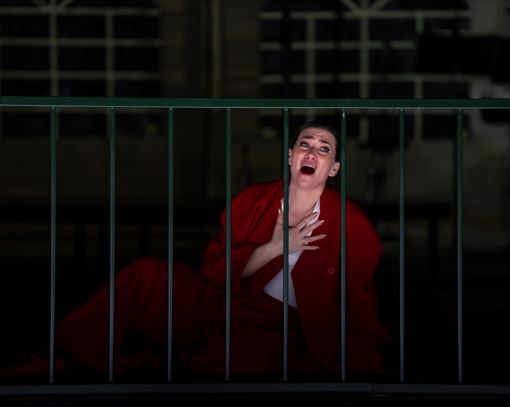
On entering the auditorium, it seems that the set is still in the process of being built. Riggers are assembling the framework of a large marquee, which all but fills the stage. Both directing and designing the opera, Stewart Laing has impregnated it with clever metaphor throughout. It becomes clear that the marquee is a metaphor for the state of Scotland as nation and for Mary’s position as its Queen. Its canvas roof may provide a shelter from the hostile elements, whilst allowing open access; or its canvas walls may give secrecy, but where watchers may also hide; or denuded of these, the bare frame gives no protection when protectors have gone. It is an allegory for Mary’s tenure of her throne, impermanent and ultimately insubstantial against the elements, the ambitions of her competing Lords. The forestage has a railing around, does it protect or does it imprison? It certainly throws shadows, and there are many shadows in Mary’s realm.
Thea Musgrave, who was present at the press night of this London premiere, is a remarkably expressive composer, and versatile in her musical scenography. In the opening few bars, one could swear to hearing bagpipes, but they are created in the woodwind and brass. Later French themes (she remains the dowager Queen of France) and Italian themes (Riccio, her private secretary) entwine. It is, however, in the creation of the threatening atmosphere of plot and counterplot, as the dynamics of power play out, that Musgrave excels. Joana Carneiro is a champion of contemporary works and here is in her element conducting the ENO Orchestra with vibrancy and verve to bring out the potency and the passion of the piece.
The first scene starts rather low key with Cardinal Beaton, a dour Darren Jeffery whose bass-baritone brings gravitas to the fanatical clergyman as he channels an Ulster circa 1980’s vibe. Beaton is organising a mass to welcome Mary back to her home and kingdom, but clashes with James Stewart, Mary’s half-brother. Their interchange, set against ambiguous tonality in the music, serves also to tell the back-story. It could plod, but with the arrival of Mary the match is thrown into the gunpowder keg and the power of the musical skyscape explodes.
Mary, in Beaton’s eyes, is a “flower stripped of its colour”. It is this idea that informs the Laing’s design and the costumes created by Mady Berry. There is the greyness of Ol’ Reekie and the effect is monochromatic except for the washed-out colour of the crowd’s charity-shop wear. In contrast are the patterned tailored sharp outfits of many of the lords. The divisions between continentals and Scots, between Catholic and Protestant, and between the rich and the poor, are clearly delineated.
The dowdy dockside of night-time Leith (nowadays a great base for reviewing the Edinburgh Festival) is the far-from impressive port of arrival for the Queen, who comes wearing her warmer-climes shades, and accompanied by her ladies in waiting wheeling their aluminium cabin-luggage. Four hail Marys one might say, as all are her namesake Mary Seton (Jenny Stafford), Mary Beaton (Monica McGhee), Mary Livingston (Felicity Buckland) and Mary Fleming (Siân Griffiths). A cor-anglais solo describes the mood of her desolate arrival. Yet she is back home, regal and ready to resume her rule that has largely been usurped by various errant regents in her absence. Hints of Scottish folksongs speak of a reviving spirit.
Befittingly, the eponymous Queen is the star of this opera, and American soprano Heidi Stober shines in this highly demanding role, with an imposing and controlled stage presence. And my, what an amazing voice, never faltering, be it in the powerful expression of the Queen’s control of her court, or the tender lullaby to her new-born baby. Mary, Queen of Scots is well cast, with stellar performers, but Stober scintillates. On the theme of stars, the Queen has a punchy aria that articulates the problem of reigning, and reigning as a woman, in a country of power gourmands, The Three Stars of My Firmament. These are the ambitious lords: James Stewart, the Earl of Moray, her half-brother; Henry Stuart, Lord Darnley, her cousin; and James Hepburn, the Earl of Bothwell.
Alex Otterburn’s performance as the manipulative James Stewart is gripping, bringing out the determination and the pragmatism of a man who knows how to play both ends against the middle. His steely baritone informs his character’s calm ruthlessness.
Lord Darnley is a divisive character, attractive and repellent in various measures to different people, or paradoxically to the same person. Mary, initially strongly drawn to him, falls under his spell. He flirts, she is infatuated, all in open view of the disapproving court. They are appalled when they marry. He is a provocative character, but worse of all he is a drunkard, and as such easily led. He is suggestible and can be engineered to do the dirty work. Rupert Charlesworth’s lively tenor is expressive of both the cockiness of Darnley and his easily inflamed temper, which leads to his downfall.
Bothwell is stolid and somewhat lumpen, but he is a dangerous warlord. The incomparable John Findon plays Bothwell as misguided and brutal, but not without a modicum of empathy. Bothwell is self-deluded in his loyalty to the Queen, thinking that she is sexually attracted to him. He take this to extremes in that when the Queen is later abandoned and without protection, in a particularly nasty scene, he violates her.
Mary has to navigate between the warring factions, which she does with diplomacy and considerable backbone. But the court is full of eyes and ears. Laing underlines this by having characters constantly lurking in the background, watching and listening. Moreover, DM Wood’s lighting design accentuates this furtiveness by playing constantly with shadows.
At first Mary lets her guard down a bit by indulging the cultures of the retinue who have come with her, French courtiers and her Italian private secretary David Riccio. Their partying and dancing fills the musical cornucopia of Musgrave’s diverse creation.
Barnaby Rea makes a colourful Riccio and his soft bass is ideal for Riccio’s gentle ballad about Orpheus seeking the dead Eurydice. But Darnley considers Riccio to be a “joker” and is only too willing to be convinced that he is cuckolding him. The Earls of Ruthven (the ever versatile Trinidadian tenor Ronald Samm) and Morton (Irish baritone Jolyon Loy) poison his ear to egg on his drunken rage, until he horrifically stabs Riccio to death before the eyes of the Queen and her ladies. Darnley recoils at Riccio’s bleeding body, “He was worm … but worms have no blood!”
ENO is fortunate in having such a wonderful Chorus and there is plenty of opportunity for them in this opera as the fickle crowd, or often opposing crowds, easily persuaded by the rhetoric of the various lords and prelates. Alex McCabe has studied their movement in the crowd choreography scenes, as well as creating the dance scenes. The ENO Chorus fills the vast auditorium of the Coli’ with gorgeously rich and robust sound.
Mary’s one true and faithful supporter is the prescient Lord Gordon, whose brave stands as bishop, inform and cation Mary’s course of action. Alastair Miles plays Gordon, his fine bass voice endowing the character with staunch dignity.
Ultimately, the machinations of the three stars of her firmament, their scheming and their readiness to resort to violence leave Mary in an impossible position politically, where she is derided and unfairly compromised. As the opera concludes, Mary cuts a pitiful figure, as she is forced to abdicate and leave Scotland for England for ever, a figure as desolate leaving her home land as when she arrived from France. Her hopes and fears are for her baby son, whom she is obliged to abandon. The infant is declared King James VI of Scotland (later to become King James I of England).
The tragedy of this opera may not be historically accurate, but provides an intense and compelling story for Musgrave’s superlative Mary, Queen of Scots, and for the expression of its dramatic and powerful music. With its outstanding cast and imaginative creative team it distils the essence of a tumultuous time in Scots’ history.
Mark Aspen, February 2025
Photography by Ellie Kurttz


 Mark Aspen
Trackbacks & Pingbacks