
The Deep Blue Sea
And the Devil in the Detail
The Deep Blue Sea
by Terence Rattigan
Putney Theatre Company at the Putney Arts Theatre until 15th November
Review by Mark Aspen
Terrence Rattigan has long been regarded as a pre-eminent master of the well-made play (the technically well constructed play that Wilkie Collins so succinctly categorised as, “make ’em laugh; make ’em weep; make ’em wait”). Certainly his depictions of controlled frustrations in a reticent world, a world now past, is crafted with consummate ease, yet with an emotional intensity.
To successfully portray those emotions, balanced between inner turmoil and stiff–upper-lip demeanour, requires skilful acting and direction. Putney Theatre Company’s production is an exquisite example of honed theatre-craft.
The play’s title tells it all. Hester Collyer is marooned between the devil and the deep blue sea. It is London in 1952. She has walked away from her stifling marriage to Sir William Collyer, a High Court judge, to live with the hard-drinking ex-RAF pilot, Freddie Page in what begins as a passionate, intimate and exciting new life. Freddie cuts across all the conventions and mores of the time.
Of these, and all the characters, there are no heroes and heroines, neither are there villains. They are human beings wrestling with their own aspirations and their flaws, wanting to change themselves, but stuck doing the right thing by the expectations their societal norms.
Reflecting on the structures or strictures of Rattigan‘s proclaimed masterpiece, director Roger Beaumont has wisely not fallen into the prevalent trap of “re-intrepretation” but presents a piece in its true setting of time and place. (It just would not work otherwise.) His pacing is surgically precise, making uses of pauses and unspoken contacts to bring out the subtleties of the text. His casting is accurately chosen, characterisation is scrupulously studied, and the actors all fully inhabit their roles.
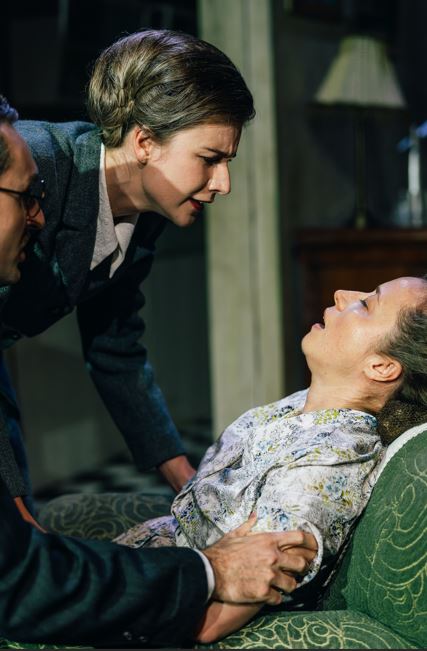
The Deep Blue Sea is essentially Hester’s story and, as such, it is a sea where whether a production sinks or floats rests on the portrayal of Hester. Sarah Sharpe, in this role, is remarkable. She accurately depicts Hester’s mannerisms. The clipped vowels are from the top drawer of 1950’s English society, as is her deportment and a haughtiness softened with unstinting politeness. Hester, the daughter of a country clergyman, is now Lady Collyer. In trying to seek a fugitive happiness, a quest that has limited success for her, she has found herself trapped in a quagmire of despair from which she has little to clutch onto to escape. Her emotions always have to be checked so not to cross the bounds of propriety. Sharpe gives an outstanding performance a woman whose fierce emotions are repressed, whose fulfilment can never be achieved, yet has an innate stubborn hope. The part is acted with consummate balance and control. Her roller coaster emotions are constrained to merely undulate within “proper” bounds.

We first see Hester at the trough of the undulation, discovered unconscious on the floor of an unprepossessing lodging in North Kensington, which she shares with Freddie. She is alone, having attempted to kill herself, with too small a dose of aspirin whilst gassing herself. The gassing is thwarted by there being insufficient coins in the slot meter. The flat is well past its best decoratively and presents a disheartening threadbare appearance. Beaumont designed the set himself, and has given painstaking attention to detail. The chaise-longue has its calico bottom liner dangling towards the floor, the pre-payment gas meter is slightly rusty, the faded wallpaper even looks musty. There is a working sash window (wow!), with a broken sash cord, so it has to propped open. Conor Sherrard’s lighting enhances the set and follows the course of the single day over which the action takes place.
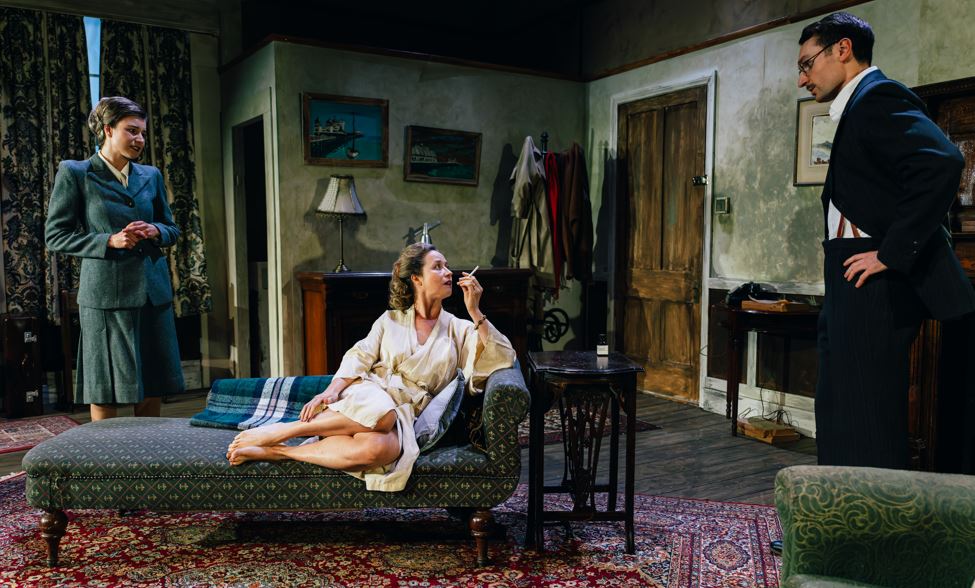
Hester is rescued by a couple from a neighbouring flat, Philip and Ann Walsh, who are about to leave for work. They could probably have worked for the Civil Service of the day. Ann is gingerly breaking the mould by going to work, but still lacks confidence. Heidi Bartholomew adroitly expresses the neat, unsure but genuinely concerned Ann, trying to assert herself, but still in deference to her husband. Philip has a does-what-is-expected approach, clearly seen later that day as he tries, unsuccessfully, to offer help and advice to Hester and to act as a go-between with Freddie, but it is an office for which he is totally unsuited. Calllum Hudson, owlish in large round glasses, gives Philip a slightly starchy edge of one aiming to have authority but missing the mark. One feels he might also be angling towards his own advancement in insisting on informing Hester’s husband, as a High Court Judge and knight of the realm.
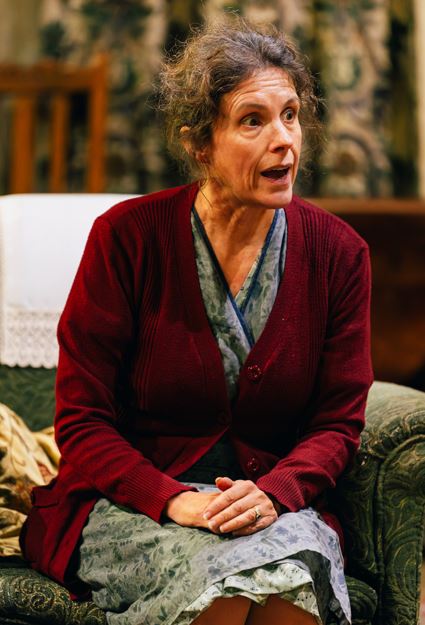
Also quick on the scene is the down-to-earth landlady, Mrs Elton, acting as confidant to her her lodgers and carer to her unseen bedridden husband. She is generous of heart, but likes to know what is going on. She can keep a secret until someone asks her what it is. She doesn’t like to gossip, but, well, you know. Philip doesn’t take long to find out that it is Sir William and not Freddie who is Hester’s husband. Carole Stewart is priceless as Mrs Elton, creating a character of great veracity who is unmistakeably recognisable.
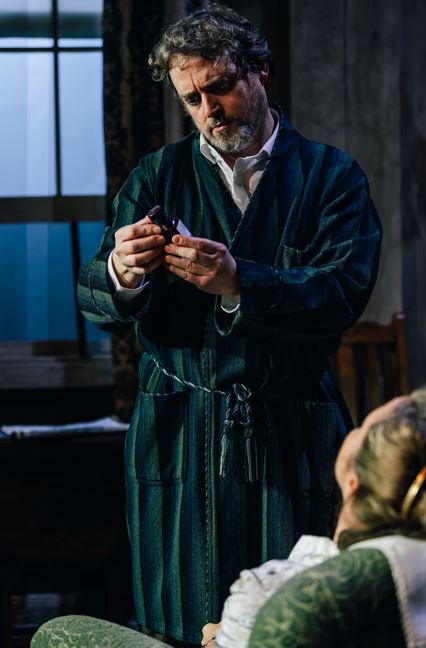
One of the most interesting of the characters is the enigmatic Mr Miller. We know he has been in gaol; we know he has been struck off the medical practitioners’ register and he baulks if addressed by the title “Dr”. Is he really Kurt Müller? If so, maybe he was interned as an enemy alien during the war. Was he an abortionist; or a homosexual? Both were illegal at the time. He has a platonic affinity with Hester, for attempted suicide was also illegal. It is he who is called as the emergency medic when Hester is found unconscious. Mrs Elton has more faith in him than in the local GP: and he doesn’t charge. (Five guineas was the going rate in 1952 !!) Miller’s natural responses come as unadorned common sense and his wry observations on life are deadpan matter-of-fact. He is never rattled. Tim Iredale excels in this part. He paints a picture of a man with secrets, who has seen it all yet can still remain pragmatic. His dry delivery is perfect for the part, his gestures, subtly expressive, underline the observant intelligence of a man standing aside from life to watch it for a while. Not that Miller is inactive. Quite the contrary; he is busily dividing his time between supporting a local charity for sick children and, to earn his keep, acting as a bookie’s runner.
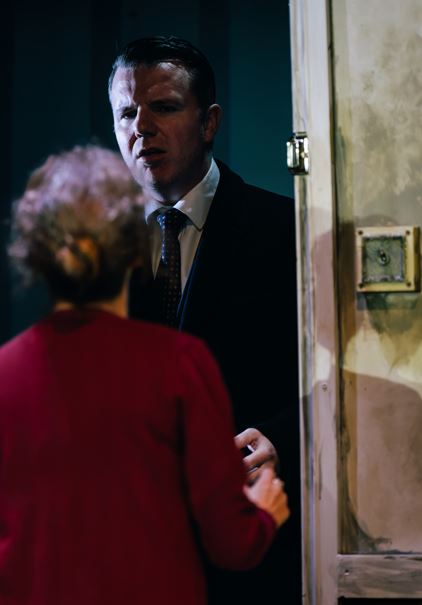
Sir William is quick to arrive a flat, driven by his chauffeur, a long-time family retainer, in a new Rolls-Royce, having just upgraded from an Austin, for he his going up in the world. He is a man who is stiff and buttoned-up emotionally, but not without sympathy. He has a reputation to protect, but buried in his heart there is love for Hester, who ten months ago ran off to Canada with test pilot Freddie, whom they had met socially at Wentworth golf club. Pip Nixon’s Sir William is an upright man, literally as well as figuratively, always repressing his feelings, and Nixon plays him with gravitas and authoritative bearing. Here is a man who definitely can not have fun, which is perhaps what was missing from his marriage to Hester. He cannot let his hair down.
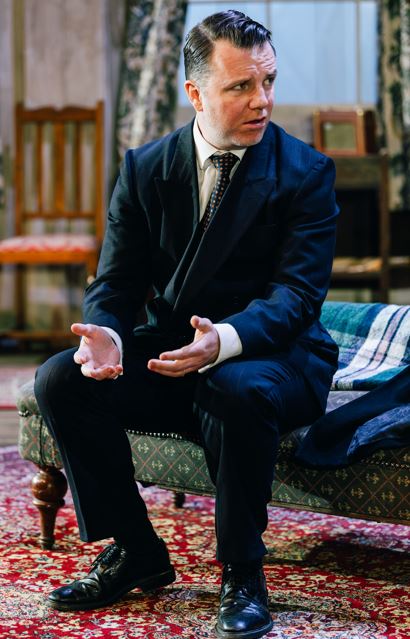
And Sir Willam’s hair is in fact hard to let down, it is period perfect short-back-and-sides, care of Peter Love’s attentive cast coiffure. Maybe Ann’s back-combed bouffant style edges a bit towards a 19060’s beehive, but for this cast detail is well served, as is the costume design under Lexa Barbulescu. However, business attire, “for town”, had a strict code and Sir William probably wore stiff detachable collars and Oxford shoes. This is however nit-picking amongst very well researched costume and hair designs.
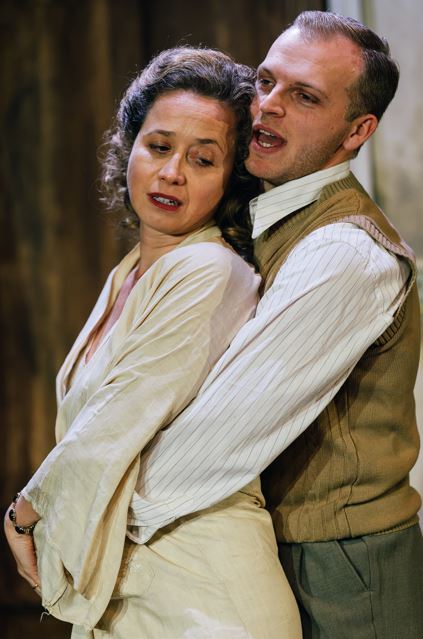
Kicking against these contemporary social constraints, is the maverick Freddie Page. Is he the archetypical bounder, or has he just lost his way? He is clearly an adrenaline junkie. The ultra-high risk life, usually tragically short, of a wartime fighter pilot, fired him with excitement. Peacetime cannot offering such high-stakes edge. He has swopped alcohol for adrenaline, and this is why he has lost his Canadian job as a test-pilot. He enters, mid-morning, dumping his golf clubs (the nineteenth hole has been a long one), insincerely apologising for not returning yesterday, before remembering it had been Hester’s birthday. He is totally unsympathetic. Here is a man who drives an Alvis sports car, yet cannot pay the rent. Although dismissive of his (surely well deserved) DSO and DFC, he sees them as conductive to getting his next job, and is meeting that afternoon with a South American businessman . . . in the Ritz. Nevertheless, Hester is in thrall of Freddie and soon succumbs, and there is a brief glimpse of the lustful passion that binds them. Daniel Jonusas plays Freddie with quite some vigour, and perhaps over aggressively. It would have been nice to see a hint of some redeeming features. Although of course, Freddie is now a slave to drink. Jonusas has a biting delivery which comes into its own as Freddie’s cruel streak emerges, most shockingly when his last act before going back out is to leave a shilling for the meter on the mantlepiece.

One doesn’t talk about one’s feelings, old boy. So mid-afternoon we find Freddie trying to confide his feelings about Hester’s attempted suicide to an old public school chum, Jackie Jackson. Freddie’s feeling are incomprehension and anger, but Jackie would rather not know. It’s all too embarrassing. Feelings are definitely closed subjects, especially about intimate matters, and particularly between men. It’s just not done in this world of restraint, reticence and repression. George Nettleton’s Jackie squirms with embarrassment. Tall and willowy, he seems almost to bend in the wind of Freddie’s impassioned rantings. It is clear that Freddie is insensitive and blind to Hester’s feelings. As for commitment, its “all things in moderation” . . . except for whisky. Freddie is working his way through a whole bottle of Johnnie Walker Black Label. Here Jackie is more in his depth in trying to moderate his friend’s drinking whilst appeasing his wilder ideas. Nettleton makes an engaging piggy in the middle, a role brought sharply into focus when Hester comes back in.
The Deep Blue Sea is often seen as a coded reference to Rattigan’s proclivities, and clearly the suicide by gas of his partner Kenny Morgan, some three years prior to his writing the play, gave him its inspiration and impetus. But there is far far much more to it. It sharply observes human psychology, its motivations and reactions. The text is crammed with piercing perceptive aphorisms. There are far too many to quote. Actions are left tantalisingly hanging. Hester’s desperation on hearing that Freddie has accepted the post in South America and is going alone, her cleaning of his shoes as an act of adoration, her rejection of Sir William’s offer to grant “your” divorce” are all part of her final catharsis. We can only guess her future. But she has experienced the devil and now metaphorically sets sail on a deep blue sea.
Mark Aspen, November 2025
Photography by Steve Lippitt


 Mark Aspen
Sunningdale golf club