
Surviving Survivor’s Guilt
The Night Watch
by Hattie Naylor, adapted from the book by Sarah Waters
The Original Theatre Company and York Theatre Royal, at the Ashcroft Theatre, Fairfield Halls, Croydon until 23rd November
Review by Denis Valentine
For the first half especially The Night Watch offers a very intriguing look into a period of time often overlooked by the mass event that came before it. The play delves into the lives of those attempting to live on from the Second World War and raises themes not often thought about when it comes to those time periods. Each actor on stage brings with them an air of a person living with a form of survivor’s guilt, an attribute not often thought about for those who outlived the war.
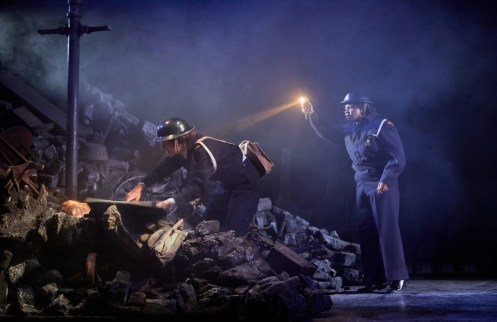
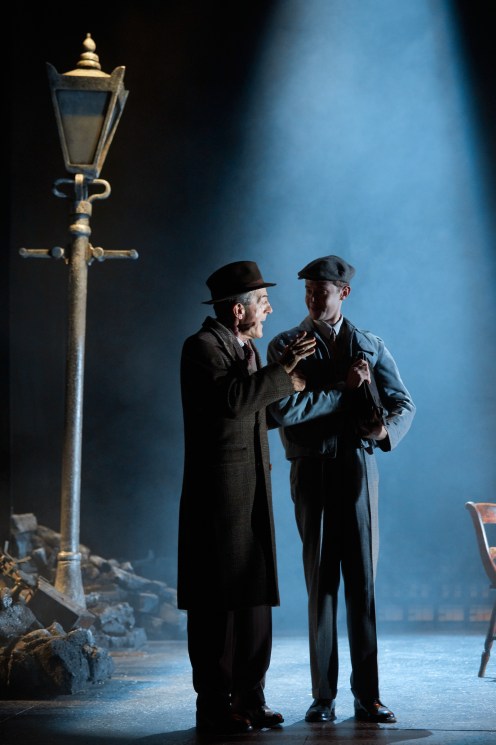
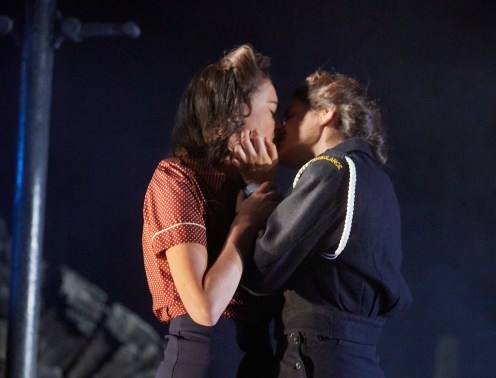
There are many duologue scenes with characters in similar situations, but each trying to find their own way in struggling to develop back into the world. This is seen with Lewis MacKinnon and Sam Jenkins-Shaw in their first meeting since wartime, both playing two sides of nervousness against each other and the search for how to move forward. Phoebe Pryce as Kay and Mara Allen as Mickey, both from a war effort perspective, remind everyone that as well as fighting overseas there was very much a war effort at home and that crucial inroads for the roles of women in the workforce were being made.
Maybe the most emotional journeys of the night strongly played from Louise Coulthard, who as Viv has to deal with getting pregnant from a random encounter, having her brother in prison as a conscientious objector and in a beautiful moment return something valuable to a person that helped her make it out of the Blitz alive. Coulthard offers a strong presence on stage and the fact that by 1947 her character possibly has the most full circle journey out of anyone in the play offers the most hope.
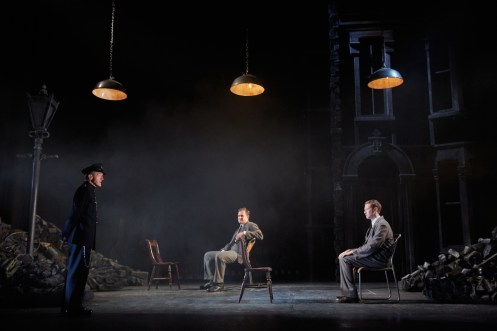
The set and costume from David Woodhead are first class and really help to capture the spirit and reality of the times they are depicting. The music and sound effects also accentuate the action well and add to the tension of the dramatic moments.
Special mention must go to Izabella Urbanowicz who as Mrs. Leonard delivers two moments of almost narration in the show which are very powerful and could have happily been listened to for an untold amount of time.

The one real disappointing aspect of the play itself is that for the second half rather than advancing and moving forward with the threads and developments established before the interval the play spends the entire second hour going back in time thus effectively ending anything that was being put in place before it. As interesting as it is to see characters in a previous state, it adds a slightly plodding feel to proceedings as the play is spending its entire second act just to see how things fell in place for the now unfinished story threads in the first.

It’s interesting to note that one of the taglines for the show’s description is “a poignant portrait of four ordinary people caught up in the aftermath of an extraordinary time”, which for the first half of the play rings true, but rather than continuing to explore the aftermath the play spends the entire second half right back in the extraordinary time which, although interesting in itself, negates the actual premise of the play and what was being built up in the first hour. By going back in time there is essentially no payoff or conclusion to what was built up and the ending more drifts along rather than landing with any real dramatic poignancy or punch.
One thing shows will initially struggle with as this venue attempts to re-establish itself is that the stage auditorium hosts a very large amount of seats which although the numbers in attendance for most fringe venues in London would be quite sufficiently full it will take a lot more to have the same effect in The Ashcroft Playhouse.
Denis Valentine
November 2019
Photography by Mark Douet
Lovingly Created, Meticulously Executed
Pornography
by Simon Stephens
Teddington Theatre Club at the Coward Studio, Hampton Hill Theatre until 23rd November
Review by Melissa Syversen
Ah, the details. The details! The sheer level of details in this production. It makes my dramaturgs heart happy just to think about it. If you are going to see Pornography, (this reviewer think that you should) playing at the Hampton Hill Theatre this week, do arrive early. That way you will have enough time to fully enjoy the incredibly high level of care put into each element of this production. Whether it be the tannoy announcements, the whiteboard at the top of the stairs or posters on the wall, it is all meticulously executed. Just look at the set: the team behind Pornography has brilliantly created a Circle line train carriage inside the Coward Studio. I don’t know who set designers Jenna Powell and Lizzie Lattimore had to bribe at TfL but everything is there, the tube line maps, the little blue stickers with info, the logos. Even the fastening at the bottom of the yellow poles is the same!

Gushing aside though; written by Simon Stephens, the story of Pornography takes place over roughly the week between the Live 8 Charity concerts that took place on 2nd July 2005 and leading up to the London terror attacks on 7th July 2005. I won’t go into too much details regarding the plot, but there are multiple narratives. We are introduced to 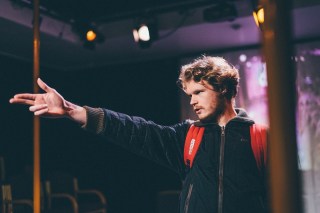 eight people: a pair of reunited siblings, a lonely widow, an angry schoolboy with a difficult home life, a former student and professor meeting for drinks, a working mum, and a man travelling into London from Manchester with a heavy rucksack. Pornography is not an easy watch. Its different stories and characters are all uncomfortable on multiple levels. I am unfamiliar with the original text by Stephens, but in the director’s notes in the programme, it says that it is written in seven blocks of text that each has a number between one and seven. There are no specifics regarding order or number of performers, it is a text that is malleable and encourages you to make it your own. As such I can only speak to the text as it has been cut and edited together in this specific production. Here the monologues and duologues each have a scene each in each act (the running time is about two hours with a twenty-minute interval) one going into the next. It flows nicely and even when characters jump around between different continuities within the scene, it rarely feels clunky. This is due to good blocking and effective use of
  light. Some storylines feel more organic than others in this edit but they are all interesting on their own. The scenes and characters are introduced with fairly little exposition. It is a testament to the skill of the cast and creatives how quickly the audience picks up on unsettling or unnerving situations and the layers within the stories. The cast is all very good, though I will give a special mention to Mandy Stenhouse as a wonderfully realised and grounded Widow and Benjamin Buckley as the angry teenager Jason. They both bring an assured and specifically nuanced performance, with pitch-perfect energy.


Despite appearances, the events of 7th July are not so much the point of the story as they are the framework around it. is a play about people and a story about London. It has heightened elements, but what it boils down to is that we know these people. We know this London and we all know the situations the people in it find themselves in, regardless of the major event that is about to take place. It is a complex piece with its many themes and mountains of possibility within the text; and all of this is exceptionally well handled, with great sensitivity, by its director Josh Clarke. The staging of the story inside a Circle Line train carriage with the audience in a traverse, the mixture of CCTV style live-feeds, video clips, simple yet effective blocking of the action, all create a precise and cohesive piece of theatre. Even at the end, notice how the actors lay down their yellow cards. As with everything else in this production, the beauty is in the details. Originally written in 2005 as a response to the attacks and premiering in Germany, Pornography didn’t have its UK premiere until 2008 at the Traverse Theatre during the Edinburgh International Theatre Festival. I could easily see Clarke and his cast take this lovingly created production back up north to Edinburgh for the Fringe festival next year.
Melissa Syversen
November 2019
Photography by Dave Shortland and Rebecca Dowbiggin
Not Engraved in Stone
Keeping Classics Alive
by Tamsin Shasha
Actors of Dionysus at the Athenæum Club, Pall Mall, 14th November
Review by Mark Aspen
What you can learn under the auspices of Actors of Dionysus is surprisingly broad: for example how to get into the Athenæum Club without a tie (succeed) or a cure for impotence (failed)! I speak not for myself about either subterfuge you understand, but I can tell you the secret of the first … you wear a dog collar and say you are a clergyman!
However the most enriching thing you can learn with Actors of Dionysus is the vibrancy and vivacity that springs from the Classics and that has made Classical drama the most fertile ground 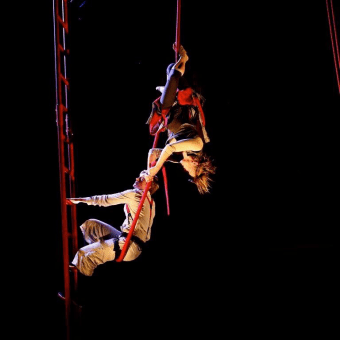 for the imagination of the possible and for the understanding of humanity, a ground that even after two-and-a-half millennia still bears precious fruit. AoD quotes from Pericles, “What you leave behind is not what is engraved in stone monuments, but what is woven into the lives of others”. For this is what AoD as a thriving company has striven to do over the twenty-six years of its existence, since it was formed in the summer of 1993 as the brainchild of eminent classicist and translator David Stuttard and a band of like-minded individuals, including Tamsin Shasha, the director of the current evening’s performance.

There is a strong evangelical element to AoD and it has an active educational outreach to schools and colleges, with a view to inspiring the young of the 21st century and firing them up to as much a love of the Classics as AoD itself has. It is however a highly successful producing company whose approach is to enhance the Classics with lively translations and an innovative approach. Hence its 2015 production of Medea featured aerial ballet, whereas the 2017 version of Antigone used drones flying above its austere set. If this sounds gimmicky, think again, for these approaches are beautifully relevant and inform the narrative.
Nevertheless, it is the power of the ancient texts that shines through as the guiding beacon in AoD’s work, and this was consummately exhibited in this private event at the Athenæum Club, where a specially invited audience witnessed the skills of the actors at the core of the company.
As an exemplar of AoD’s specialism in Greek drama in English translation, the performance that was offered took place within the plush, leather and oak surroundings of the Athenæum’s Smoking Room, hence without set, and also without costumes, the actors being clad in simple stage black. Consequently, the focus was on the text, the acting and voices of the performers, who included a chorus of singers from Vocal Explosion.
The pieces chosen were from two of the most archetypical of Greek tragedies, Aeschylus’ trilogy The Oresteia (Ὀρέστεια) and The Women of Troy (Τρῳάδες) of Euripides. Both these plays deal with the aftermath of the Trojan War, seen from different perspectives and from two sides of the Aegean Sea. The subject of The Women of Troy is the suffering of the noblewomen of the defeated royalty of Troy, now prisoners of war of the Greeks, and this was the centrepiece of the evening’s performance. An extract from this play was proceeded by a soliloquy from Agamemnon (Ἀγαμέμνων). Agamemnon concerns the fatal consequences of the eponymous Greek hero’s decade-long absence from his wife, Clytemnestra, the Queen of Mycenae.
In this production the traditional Greek chorus, omnisciently commenting on the action of the play, was absent and reflected instead by singing of the Vocal Explosion chorus. Its conductor and soloist is Juliet Russell, an international award-winning composer, but known at the choir’s base city of Brighton for the annual Burning the Clocks mid-winter festival. Specialising in Georgian and Corsican music, Vocal Explosion is a world music choir, but here its music edged towards the otherworldly, ethereal and haunting. Its main a cappella phrasing was from the phoneme of the sounds that form the basis of classical and European languages, dissociated from the connotations of the words themselves. A hair-raising buzz of intoned murmurs, punctuated by a staccato “ma, ma” sound introduced the entrance of Clytemnestra.
Agamemnon, the first play of Aeschylus’ The Oresteia trilogy begins with the news that, after a decade’s absence, King Agamemnon is returning home, having, with the other Greeks been victorious in the war against Troy. A watchman, seeing the signal beacons, has expressed his joy, but has indicted that all has not been well at home. Queen Clytemnestra, in a long soliloquy, describes the scene from her vantage point on the battlements of the clifftop palace. Dissembling, she expresses her elation, but disguises the resentment that she feels for Agamemnon, and that she is seeking revenge for his sacrifice of their daughter Iphigenia, but she does not let on that she has been having an adulterous affair with Aegisthus, rival to Agamemnon. Established actress and drama academic, Catherine Livesey was bitingly incisive in the role of Clytemnestra, with that edge of a woman who says one thing, thinks another; who plans to get even, and has the ruthlessness to carry out those plans.
We were indeed literally having some very nice canapés, but if Livesey’s Clytemnestra was the picante starter course for the evening’s figurative gourmandising on the classics, then the rich meaty course was the excerpt from Euripides’ The Women of Troy. Troy has fallen, and the women of the royal family lament that their city has been plundered, their husbands and sons killed, and they are to be taken away as concubines or slaves of the Greeks. The princess Cassandra has been raped (and later, as the forced concubine of Agamemnon, will be murdered by Clytemnestra) and the young princess Polyxena has been killed as a sacrifice to the Greek warrior Achilles. Generally, there is about as much mayhem as it is possible to imagine. But there is worse to come, a Greek herald arrives to tell the princess Andromache, widow of Hector, that that her baby, the Prince Astyanax, is condemned to death. The Greeks do not want to risk the boy growing up and avenging his father.
The Greek herald, Talthybius is one of Euripides’ most three-dimensional characters. Here is a man torn between his duty and his conscience. He is a soldier obeying the order to take Astyanax, but deeply troubled the prospect of having the blood of an innocent baby on his hands. Matt Barber (whom we have recently seen in the thrillers, The Frightened Lady and The Lady Vanishes) expressed the aching dichotomy of this humane man with a keen-edged incisiveness.
 The last member of the Trojan royal family to hold the baby is his grandmother, the dethroned Queen Hekabe. This role was brilliantly acted by Annette Andre, the prolific and much feted television and film actress of the swinging decades, who portrayed Hekabe with heart-rending intensity. “Here lies a little boy, whom the Greeks killed because they feared him so much.” Andre in fact stepped into the role at the last minute with consummate ease, witness to her wide experience, which has ranged from ballet to musicals, including the (sort-of) classical A Funny Thing Happened on the Way to the Forum.
 In the bitter catalogue of suffering that is The Women of Troy, the fate of Andromache is arguably the worse. Her husband, Hector has been killed by Achilles. Their baby son, Astyanax is now to be killed Neoptolemus, Achilles’ son by throwing the baby from the city walls. Neoptolemus is to take Hector’s brother, Helenus, as his slave, and the devastated Andromache is to become his concubine, effectively Neoptolemus’ perpetual sex slave in the context of the brutality of Classical warfare. Tamsin Shasha is a foremost Classical tragic actress and she is outstanding in the role of Andromache. Phrases such as “pouring out his life” flow straight form her soul, but she knows how to use brief silences to overwhelming effect.

In the hands of Actors of Dionysus, The Women of Troy is not a withering curiosity of 2,435 years ago, but a real event happening now. Both the cast and the audience were moved beyond tears at the enormity of the agonising torment of these real women.
 However Actors of Dionysus are not all about tragedy, witness their acclaimed 2016 production of Lysistrata, Aristophanes’ political satire cum out-and-out sex-romp. It was in this vein that AoD showcase was rounded off by a surprise appearance of the famous stand-up comedian Joe Pasquale. Pasquale’s well-known idiosyncratic voice, which he himself described as like “Noddy with a hernia” is not suited to acting the Classics he said, but then went on to prove himself wrong. He is in fact a very versatile straight actor and writer, as well as being a sought-after comedian. (He is appearing this winter as Wishee Washee in Aladdin at the Milton Keynes Theatre.) Our invited audience of classicists and Greek theatre lovers immediately warmed to his open, self-deprecating style, which was full of wit and certainly very funny. Pasquale’s all too short performance was of snippets of Classical poetry and prose or of parodies thereof. Many revolved around the primordial god, Eros as the god of lust. Oh, and it is the greybeard Eros in his later years who is searching for the cure for impotence.
And eh! Pasquale managed to get into the Athenæum Club without a tie or a dog collar. A quick wit clearly opens doors and as just well, for without him our gourmet soiree of the Classics would not have had its dessert course.
Mark Aspen
November 2019
Photography courtesy of Actors of Dionysus, Katerina Kalogeraki and Joe Pasquale
Military Engagements: Play of Significance
Days of Significance
by Roy Williams
The Questors at The Studio, Ealing until 23rd November
Review by Viola Selby
Through Lucy Aley-Parker’s direction, Roy Williams’ Days of Significance is made even more terrifyingly raw, yet captivatingly compelling, as the lives of young and ill-prepared soldiers sent off to fight in the Iraq war are laid bare.
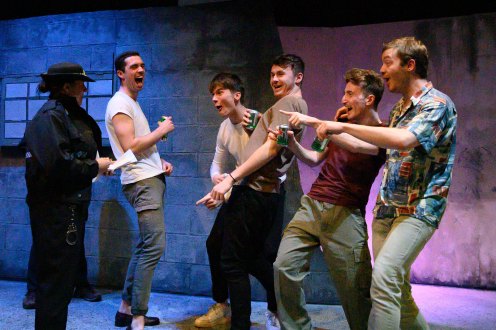
Starting off on a boozed-up Saturday night, the audience is straight away assaulted with shouting and screaming, constant swearing and a lot of urination and puking. A scene many of us know all too well yet not so much from a play setting, especially one which bases its inspiration from Shakespeare’s Much Ado About Nothing, helping to instantly surprise the audience and grab our attention. The actors also do not hold back, fully committing themselves to the drunk revelries and fighting scenes. Yet in a mesmerising way that also shows the superficial masks of their characters occasionally slipping to reveal the fears and vulnerabilities of these young people, a skill definitely shown by Joshua Perry and Matthew Saldanha, who play Jamie and Ben the two members of the group who go off to war. Perry and Saldanha manage to carefully convey their characters’ developments in an emotionally mature way; from being lads showing off their bravado as a front to their mates, to two young boys thrown into the heat of battle, no longer knowing what is wrong and what is right as they just try to survive.
This sudden scene change, from a fun night out in England to an active war zone in Iraq, makes the scenes that follow all the more shocking as it is not what we as viewers were expecting. The shock is also made more real by the use of just one set design used so creatively throughout the play by set designer Georgia Wilmott; a single wall that once represented the front of Lenny’s burger bar, now acts the only protection for a seriously injured officer and his three soldiers, all waiting to be rescued – a cutting scene that is professionally performed by Perry and Saldanha with Jason Lynch-Welch and Karl Knarr.


However, this section of the play is also given the most personal of scenes through the ingenious use of a projector and TV screen, made real by Gavin Jones and Terry Mummery. On the screen we are shown ‘home videos’ at the camp, made by Saldanha’s character Ben for his girlfriend Trish back home. In the first of these, the boys are messing about, jokingly humping each other and making fun of a naughty picture Ben’s girlfriend has sent him. In the other, we see a much-changed Ben, desperately clinging on to some normality and trying to make sense of what is going on. This change is extremely harrowing and is conducted in a sensitive and thought-provoking way.


Finally, we are brought back to England some months later to see the awful after-effects of the Iraq war whilst at a fun and booze filled wedding of two members of the group we met at the beginning. We find out from the two boys who went to war that one did not make it, and is now regarded as a hero by all, whilst the other faces jail time and court cases for the well-documented atrocities committed by soldiers on Iraqi prisoners. Again the drunk acting is done with such devotion and detail that it makes one question the sober levels of the actors themselves. Even through all the merriment, Roselle Hirst and Fiona Gough as Ben and Jamie’s girlfriends Trish and Hannah, are particularly sublime in their ability to show the anger, confusion and grief behind their characters’ drinking, highlighting even more just how vulnerable these young people truly are. However it is through arguments and monologues of support and experience given by such characters as Dan and Lenny, each played with such perfect passion by Bradley Peake and Julian Casey, that truly makes the audience question everything they ever thought both about what happened in Iraq and who was at fault. This is not just any old war time play, this is definitely a play of significance.
Viola Selby
November 2019
Photography by Jane Arnold-Forster
American Minimalism Meets French Surrealism
Orphée
by Philip Glass, based on the film by Jean Cocteau
English National Opera at the London Coliseum until 29th November
Review by Eugene Broad
The English National Opera at the London Coliseum revisited the underworld for a final time this season, in a precisely-paced and crisp production of Philip Glass’s Orphée, directed deliciously in an ENO debut for Netia Jones.

Glass based – or in his view, reflected – his opera on the 1950 Jean Cocteau film by the same name, the first of an operatic trilogy driven by Cocteau’s work. This idea of reflection is core to the philosophy of the production, mirrors acting as portals between the corporeal and Stygian dimensions. But there is a constant reflection on the earlier versions of the myth of Orpheus within the stagecraft, composition, and life experiences of Glass and Cocteau themselves.
 Cocteau and Glass’s Orphée is a celebrated Parisian poet, who after a string of successes has become self-obsessed with his fame, but has simultaneously lost his creative muse. A drunken brawl leaves his young poet-rival, Cégeste, dead – with some implicating Orphée in his death. Cégeste’s mysterious benefactor, the Princess, instructs Orphée to help her (inter-dimensional) chauffeur, Heurtebise, to transport Cégeste’s body. Witnessing the Princess apparently bring Cégeste back to life and travel through a mirror, Orphée becomes obsessed by the Princess – who in the underworld is some kind of civil servant in the department of deaths.
Taking a shaken Orphée home, Heurtebise falls in love with Orphée’s wife, Eurydice – the mirror inverse of Orphée’s love for the Princess. After an accident orchestrated by the Princess, Eurydice dies and with Heurtebise’s instruction and guidance, Orphée is taught how to travel to the underworld.
After Orphée confesses his reciprocated love to the Princess, and Heurtebise confessing to Eurydice, a humorous Kafkaesque tribunal allow Orphée and Eurydice to return to their correct realm.
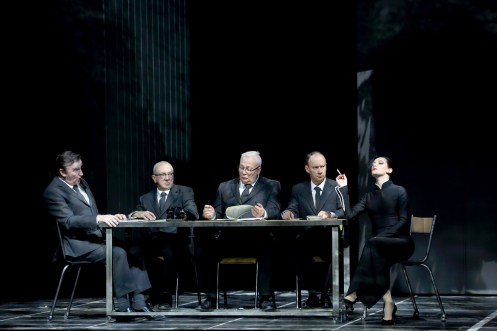
The tribunal in the underworld
The usual Orphic condition is established – Orphée may never look at Eurydice again. Orphée – here possibly intentionally – breaks the condition, both returning to the underworld. The Princess orders Heurtebise to reset Orphée’s and Eurydice’s lives, committing an act of sacrificial love, with Orphée and Eurydice having had their memories of the underworld now also wiped.
 As Jones comments, “Orphée is an opera of a film of a play of a poem of an opera” and her production and direction makes this clear. All elements of the stagework, set and production hint at the film origins of Orphée. Dynamism is given by impressive moving sets and projection work, which never distract from the story or narrative as a whole. The fluidity and aesthetic of the production and set incorporate a cheerful 1950s aesthetic (in the world of the living) and a greyscale Stygian underworld – as if a black and white film. Moving projections show the underworld as bombed out ruins, as lost souls aimlessly stumble through them – going hollow with the passage of time.
Musically, Glass’s composition doesn’t shine here. There are his usual signatures – ostinato, breathless woodwind, the steady thrum of strings. There are very few moments of brilliance within the composition, with the most stirring and memorable motifs in the second act. However masterfully Geoffrey Paterson conducts ENO’s orchestra, Glass hasn’t given much to the production; although suffering loss of his own at the time of composition, his work here feels more routine rather than inspired.
That isn’t to say the composition is weak or shoddy. It’s consistent, and clearly has a direction. There are Gallic reminders that Glass studied in Paris in the mid-20th century, and references to ancient Greek pentatonic minor modal harmonies used to great effect in the Stygian scenes. But where the production is so sleek and cinematic – truly feeling more like a scored film – it’s a shame for Glass’s composition to feel almost forgettable. But perhaps that is just a testament to how tight and flowing Jones’s modern and multimedia take on Orphée is.

As to be expected from the ENO, the singers are all incredibly highly polished – surely enough to see one’s own reflection. Nicky Spence’s performance as the interdimensional chauffeur Heurtebise had a delicacy and sensitive emotionality to it, only recently dead and torn between both realms. Jennifer France, marking her ENO debut as the Princess, similarly commanded authority vocally and with her stage presence – undoubtedly on the path of becoming a solid ENO favourite. Nicholas Lester as Orphée resonantly expressed himself and generated empathy for a poet at times obsessively narcissistic, but at other times touchingly selfless. Sarah Tynan reprises Eurydice, having performed in Orpheus and Eurydice, on this occasion being spurned for the Princess but beautifully performing with a genuine tenderness and warmth for Orphée. Anthony Gregory as Cégeste gave a lyricism and warmth of timbre which complimented his role as a vivacious and brilliant rival poet to Orphée.
This ENO production joins the other excellent performances of Philip Glass’s work it has put on relatively recently – the jaw-dropping Satyagraha and the Olivier Award-winning Akhnaten. Much like those productions, Orphée is not one which should be missed.
Eugene Broad
November 2019
Photography by Catherine Ashmore
Love Is Heavy and Light
Romeo and Juliet
by William Shakespeare
Youth Action Theatre at Hampton Hill Theatre until 16th November
Review by Stephen Leslie
Youth Action Theatre last staged Romeo and Juliet at Hampton Court Theatre, over thirty five years ago, in a production which boasted the name of Rebecca Wheatley, who has gone on to enjoy a very successful career in television, radio and theatre. I feel certain that thirty five years from now we’ll be talking about the success of the amazingly talented actors in the current production.
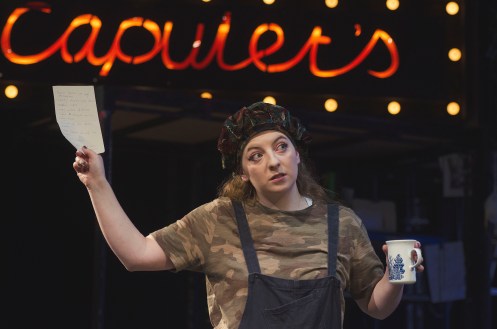
I understand the decision to produce the show was taken back in August 2017 on the way home from a successful run at the Edinburgh Festival and during that time directors Emily Moss and Jojo Leppink seem to have methodically planned every detail of the production, providing their young cast with the perfect platform to deliver thoroughly entertaining and professional performances.
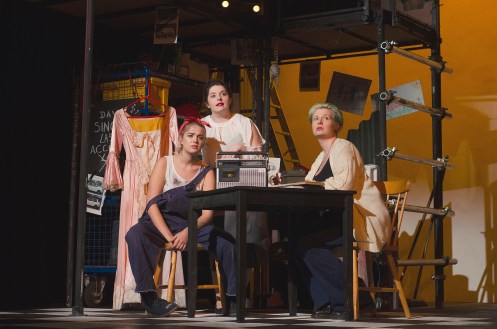
The contemporary setting was brilliantly framed by Alice Metcalf with a highly creative and original stage design. The juxtaposition of the Capulet’s car garage and the Montague’s portrait of traditional wealth, cleverly depicted the divide between the two families and in doing so provided the perfect back drop for the conflict which ensued.
 Despite Shakespeare writing Romeo and Juliet circa 1594, the themes which run strongly through the story are as relevant today as they were then. Not only did we empathise with the characters, but we identified with them, helped more so by their present-day attire which included mechanic’s overalls and T-shirts displaying the names of musicians such as Bowie, Def Leppard and AC/DC. This was a master-class in bringing Shakespeare into the twenty-first century.
The conflict between the two families was highlighted almost immediately with a chaotic brawl which had been carefully choreographed by ex-YATer Id Wheatley. The brutality increased as the story unfolded, with both Capulets and Montagues being slain in convincing bloody fight scenes.
But it wasn’t all violence! The playful and love-struck Juliet was brilliantly portrayed by Esme Frazer, demonstrating a wid e range of emotions from extreme joy, to absolute despair in the closing moments of the play. Equally impressive was her Romeo, played by Jake O’Hare, who found a good balance of bravado and sincerity as he glided effortlessly through the highs and lows of his fateful journey.
There were also fine performances from: Lucy Allan as the mischievous Nurse; Alex Farley as the straight-talking Lawrence and Oliver Hickey as the larger-than-life Capulet, who commanded the stage and brought great humour to the performance. But special praise must go to Elle Frazer, whose Mercutio bounced around the stage with boundless energy, flitting from friend to tormentor, until she came to a particularly gruesome end.
A production is only as strong as its weakest link but there were no weak links, with every actor playing their part with conviction and credibility. With so many talented performers I imagine casting the show must have been extremely difficult for all the right reasons. This was a truly ensemble piece which embodied the YAT spirit and drew on the talents of its members to create something truly great, including President Eileen Baker whose voice-over closed the play.


The programme tells us that Youth Action Theatre is dedicated to inspiring young people. I can’t lay claim to being young but I certainly left Hampton Hill Theatre feeling inspired, having been totally gripped by this outstanding production. Congratulations to all involved and I very much look forward to seeing the next show which will be The Snow Queen in April next year.
Stephen Leslie
November 2019
Photography by Jojo Leppink at Handwritten Photography
Buzzy Itchy Reality?
New Writing from Twickenham
Richmond Literary Festival at The Conservatory at The Exchange, Twickenham until 13th November.
Review by Eliza Hall
On a wet, cold evening over fifty young people, mostly undergraduates from the Creative Writing programme at St Mary’s University, along with an assortment of others, ranging from two graduates about to be published in 2020, to short course attendees and members of the public, gathered to listen and read.
It was noisy, buzzy, itchy. Some nervous about standing in public to read their private thoughts, others ready and keen to get started. It was an evening of prose, poetry and flash fiction. The lights in the Conservatory were perpetually altering in colour throughout the readings, just as the continuum of human emotions and experiences were constantly changing.

It seemed that everyone had something to say. Some writers expressed the real and the mundane whilst others conjured with the listeners’ sympathies and appreciation as they were plunged into the obscure, the magical, the humorous, the surreal. A myriad of meanings set in words, with cutting statements, some nightmarish moments, some crude and explicit, others read more delicately woven pictures of events and feelings.


Sometimes one could almost catch a glimpse of Proust through the kaleidoscope, or was it ‘Fleabag’? As the lights continued to change their colour, so there were expressions of loss, of love, reminiscences, of searching and of freedom. Cruel reality was mixed with pathos, charm and romanticism and reminiscences. The evening was a challenging mix of created images, imagined pictures, accepting loneliness, pain and life’s realities.
The evening drew to a close with two readings by two graduates whose books will be published in 2020. These were Molly Gartland’s The Girl from the Hermitage and Louise Fein’s People Like Us.
Such is the human condition and such is the power of the word. It was an evening of vibrant ideas being expressed by those who certainly had something to tell. It offered a secure platform on which to say in public what was important to the individual, as well as to showcase their course work and developing writing skills. There are promises of more evenings like this, if you want to sample, wonder or contribute!
Eliza Hall
November 2019
Photography by Agnieszka Studzinska
By Any Other
What’s in a Name
by Matthew Delaporte and Alexandre de La Patellière, translated by Jeremy Sams
Adam Blanshay at Richmond Theatre until 16th November, then on tour until 18th April
Review by Eleanor Lewis
If Mike Hitler had invaded Poland and then led the charge of fascism throughout Europe, it’s likely no child would‘ve been named Michael after 1945. The naming of children, specifically the appropriate naming of children, is just the starting point for the family gathering in this very funny play by Matthieu Delaporte and Alexandre de la Patelliere, translated from the French and adapted by Jeremy Sams.

Events begin with a character called Vincent strolling into Francis O’Connor’s set, a large, book-walled living room in a soon to be gentrified area of London. Vincent looks like every overconfident, can’t-be-more-than-fifteen, estate agent you’ve ever met: his hair slicked back and his demeanour one of someone who realises it’s part of his job to speak to you but actually he’d really rather not. As well as taking part in this story, Vincent is its occasional narrator, introducing characters, desperately announcing the interval and eventually drawing things to a conclusion.

Elizabeth and Peter are giving a dinner party for Vincent (Elizabeth’s brother), their friend Carl, and Vincent’s pregnant girlfriend, Anna. It is the potential name of this unborn child and the outrage it provokes which kicks off proceedings and appears to settle the play into something that is almost a cross between Yasmina Reza’s excruciatingly well-observed God of Carnage, and a decent 1970s farce without the slamming doors or falling trousers. This would be entertaining enough in itself, if a bit predictable but Act Two races off at breakneck speed and with great hilarity through every type of the most cringingly awful family and political rows you could possibly have, including the ones likely to cause twenty-year rifts, and leaves the issue of children’s names far behind. The press night audience on Tuesday lived through every hairpin plot bend squealing with delight at some. Eventually the action comes to what I am struggling not to describe as a rather sweet end. ‘Sweet’ being a fairly devalued word these days but in its purest sense, the conclusion of this work as it is related to the exhausted audience by a mellowed Vincent, it must be said, is sweet.

A highly skilled cast under expert direction (Jeremy Sams and Sadie Spencer) squeezed every drop of comedy out of this cleverly constructed script. Laura Patch as the patient Elizabeth gave full vent to her spectacular ‘enough already!’ exit scene, accompanied by a well-deserved round of applause. Bo Poraj’s Peter was suitably oblivious to his many shortcomings to great comic effect, and there was sterling eyebrow work from Summer Strallen, cleverly not overdoing the glam girlfriend and therefore giving her lots of credibility. Alex Gaumond as Carl provided a soothing and bonding presence between the other four until his own particular plot strand began to unravel, at which point chaos ramped up a gear and all bets were effectively off.


What’s In a Name contains distinct elements of Alan Ayckbourn, and Yasmina Reza. It targets everyone and everything including the woke generation, the rich seam of middle class pretentions, and the often bizarre complexity of personal relationships but I’m not convinced it’s intended to be more substantial than it seems. That said, making people laugh still makes points, it just makes them easier to absorb. What’s In a Name is very entertaining. Highly recommended.
Eleanor Lewis
November 2019
Photography by Piers Foley
Evergreen Holly
Buddy, the Buddy Holly Story
by Allan Janes
Buddy Worldwide at the Ashcroft Theatre, Fairfield Halls, Croydon until 16th November then on tour until 19th July
Review by Vince Francis
This show has become something of a phenomenon over the past thirty – count ‘em – thirty years. I last saw it about twenty years ago in the West End and was swept along by the sheer energy of the piece. It is a tribute to the writing, production, direction and performance that this still remains the case.
The show tells the story of Buddy Holly’s rise to fame and his untimely death in 1959, along with The Big Bopper and Ritchie Valens. I was born in 1956, so this was slightly before my time, but it is a tribute to Holly that his music continued to be played through the sixties, when I first became aware of such things, and into the present day, where he is rightfully revered as one of the founders of rock music as we know it.

The first act takes us from early beginnings in the local radio station through to the gig at the Apollo, New York, where Buddy and the band gain acceptance from the initially intimidating Harlem audience. The Apollo gig scene brings us a fine pastiche of Jackie Wilson, as played by Miguel Angel, and some particularly delicious vocals on the part of Sasha Latoyah and Cartier Fraser.

The second act opens with some audience “warm up” leading to a portrayal of the final gig that Buddy Holly played, along with Ritchie Valens and the Big Bopper. It was given to Harry Boyd to play the M.C. of the venue in question (Clear Lake, Iowa) and it has to be said, that on a cold Monday evening in Croydon, in a theatre where audience numbers could have been better, he was having to earn his keep up there, but he did it and with great aplomb. The remainder of the cast join as band members and backing singers for this section, which beefs up the numbers wonderfully.

The risk with a show like this is maintaining the balance between telling the story and being a tribute act. This production achieves that well, through strong characterization, supplemented by the use of a narrator, who steps out of the action to communicate directly with us when it helps to move the story along. Harry Boyd takes on this challenge, portraying various characters, including DJ Dave Stone and producers ‘Hipockets’ Duncan and Norman Petty with huge energy.
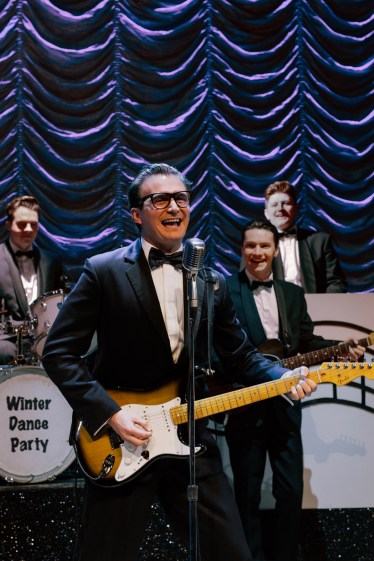 A J Jenks gives an impressively rounded portrayal of Buddy. Sometimes showing that young man’s awkwardness and sometimes the brashness, but always the growing confidence. He plays pretty well, too. The band around him were supportive, wholly credible, energetic characters, particularly, I thought, Josh Harberfield as Jerry Allison. Maintaining that drum pattern in Peggy Sue is no mean feat and the precision and attention to detail in Not Fade Away was excellent.
In the humble opinion of this hack, this genre of music is the most accessible and inclusive of any available in the western world. As a jobbing band musician, I know that you only have to include a ten-minute spin through the rock’n’roll hits of the late 50s and early 60s to fill the dance-floor with people of all ages. More than that, I’m sure I’m not alone in being able to remember all of the lyrics and flourishes of songs such as Johnny B. Goode, Peggy Sue and suchlike, whereas I struggle to get beyond the first four lines of I Wandered Lonely As A Cloud.
As a lover of Fender guitars and amplifiers, I’m always happy to hear the crystalline tones of a cranked Stratocaster or the nasal snap of a hard-strummed Telecaster (my instrument of choice, incidentally) and those joyous sounds are in abundance here. Having said that, I know that the two Fender amps on stage were set-dressing, but I had a sneaking suspicion that those models may be a little anachronistic. Still, it would have been nice, if at all practical, to hear them spreading the word. Also, the programme tells us that Buddy applied the tooled leather wrap to his Gibson acoustic, yet the guitar on stage is a Takamine, which, if nothing else, is also a little anachronistic.


This is a touring production and, as such, set and furniture is kept to the minimum required to suggest an environment, be that an office, a studio or a venue. For the most part, this works very well, but there were a couple of clunky changes, which may well have been first-night issues that will be corrected for the rest of the week.
Overall, this is a wonderful, feel-good evening out, which will have you up in the aisles singing out the lyrics, clapping your hands (on two and four, please … this is rock’n’roll dontcherknow) and bopping your hearts out. That is in some ways ironic given that the story itself is so tragic, but a tribute to the man and his legacy. Go see.
Vince Francis
November 2019
Photography by Rebecca Need-Menear
Watching You
George Orwell’s 1984
by George Orwell, adapted for the stage by Matthew Dunster
The Questors at the Judi Dench Playhouse, Ealing until 16th November
Review by Nick Swyft
“War is Peace”, “Freedom is Slavery”, “Ignorance is Power”. These are all seemingly nonsensical statements displayed on video screens around the theatre as the play begins. The set is austere, as befits the subject, with a room above the stage for later scenes. We then see Winston Smith (Julian Smith) doing his job of presenting ‘alternative facts’ according to the requirements of IngSoc, the shadowy regime under which everyone lives, embodied by the immortal figure of ‘Big Brother’.
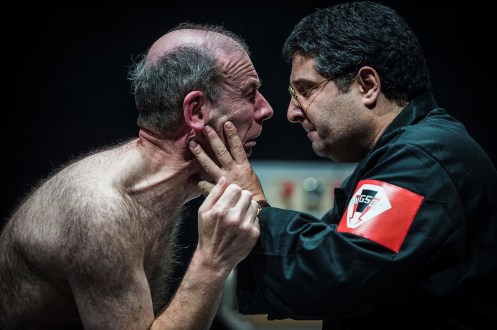
Winston Smith is a subversive from the start, and Julian Smith gives us a subtle portrayal of someone who is a little separate from the herd. When Goldstein (Simon Taylor), the resistance leader is pilloried on screen, his co-workers join the jeering enthusiastically in true Jeremy Kyle style, but Winston is seen as apart from the others.
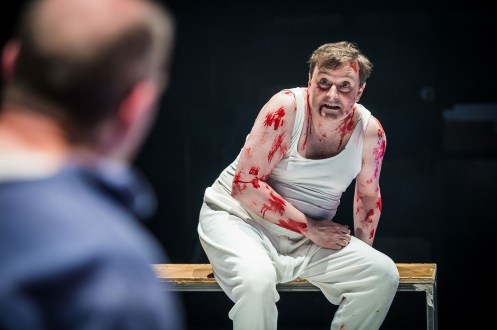
He writes his secret memoir in the ‘privacy’ of his apartment, although everywhere there are the ever-present telescreens. These present constant propaganda while at the same time watching the viewer (not unlike Alexa perhaps). Unfortunately throughout the performance these were inactive, which took away from their pervasive impact. Thus, when the old antique dealer Charrington (John Davey) shows him his upstairs bedroom, the fact that there is no telescreen there doesn’t have quite the impact it should.
The first part of the play is about world building – the constant war between Oceania and Eurasia, the relentlessly positive propaganda and the contrasting general misery of the populace. During this section, we learn of Winston’s relationship with his mother and also his sterile relationship with his wife. It is against party policy to derive any pleasure from sex, and as she lies flat on the marital bed it was easy to wonder how the population could possibly survive.
We are also introduced to Mrs Parsons (Lisa Day) and the Parson’s children. These are delightful brats who are disappointed at having had to miss the hanging of Eurasian prisoners – not too dissimilar to a lot of children today.
In the work canteen Smith meets Mr Parsons (Robert Gordon Clark), who portrays the proud father well, telling us how well his children support the Party. Smith also talks to Syme (Wesley Lloyd) who is working on reducing the number of words in the dictionary to make the fine art of ‘double think’ easier for the general population to grasp. Lloyd is very believable as the enthusiastic young lexicographer.
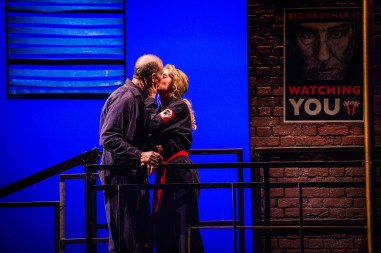 His first encounter with Julia (Clare Purdy) is puzzling to begin with. It is a fantasy scene in which he is seen attacking her. Later, it turns out that she is a member of the hated thought police and when he tells her that he used to think about raping and murdering her, one wonders whether this would ever work as a chat-up line.
When he gets the famous note in which she says “I love you” the words are repeated over and over on the speakers – the mechanism for voicing everything that is read. This should have had more impact than it did, since it wasn’t even clear that Winston had actually received the note.
 Clare’s performance brings a breath of fresh air both to the world in which they live and to the production itself, which is necessarily dour. She is a vivacious free spirit, who works in the porn department providing material to keep the proles in their bedrooms rather than on the streets causing trouble. What’s not to like?
As their relationship develops it is clear from the performances how different Winston and Julia are. He is an intellectual subversive, while his view of her is that her subversion begins below the waist.
At the start of Act Two, Winston reads Goldstein’s book to Julia in bed, and Goldstein (Simon Taylor) himself reads it to the audience. This is quite a long scene that adds little to the production, which is two and a half hours as it is, except perhaps for the die-hard intellectuals. For them the advice would be to actually read Orwell’s book.
Then follows the arrest and subsequent breaking down of Winston.
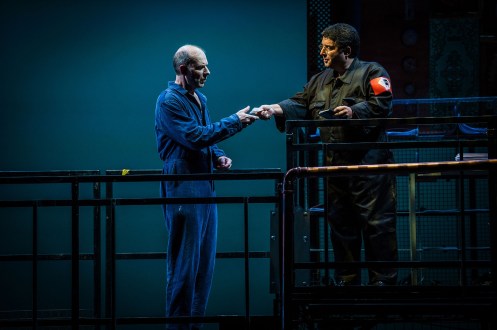
His nemesis O’Brien (David Erdos) does not come across as overtly sinister. Rather he portrays the cuddly, if somewhat sadistic, voice of reason, which is far more effective. He is almost able to persuade the audience that maybe Winston Smith is the bad guy after all. After all a man who has openly admitted to be willing to betray his country, spy for the enemy and more damningly, throw acid into the face of a child, may not be a paragon of virtue.
Smith is an outsider, and there are questions here regarding how such outsiders should be treated by society, but they are not the ones that we generally believe 1984 to ask.
A succession of other prisoners come and go, and the scene in which Bumstead (John Dobson) is constantly taunted for being unable to stop his shaking, was well done. A classic example of the kind bullying we’ve all seen, where the torturer is clearly enjoying his cruel fun. Parsons, the proud father, is even glad that it was his daughter who shopped him for talking in his sleep. Syme also appears, needing to be cleansed of the idea that he is actually destroying the language in his work.
 It is hard to portray torture scenes on stage, not least because it’s illegal to actually hurt the actor, but also because today’s audiences are too squeamish for that kind of thing. Unfortunately this means that we are not as engaged with this as we might be, although Julian Smith does much to recover this shortcoming.
 At the end, Smith is stripped and humiliated. More than the torture, this an extremely powerful scene. Julian Smith’s performance during this harrowing scene was outstanding. Winston Smith’s identity, which has been scurrying around his brain like the rats he is so frightened of, is finally cornered. When O’Brien holds up four fingers and tells him that the Party says that it is five, we can believe that he actually does see five fingers.
There is only one thing left. Julia. He insists that he will never betray her, even though she betrayed him at the first opportunity. O’Brien attaches a mask to his face, which is attached to a long tube at the end of which there is a box of hungry rats. O’Brien lifts the first door to the box which allows the rats to see him and him to see the rats. Smith’s morbid fear of rats prompts the response ‘do it to Julia, not me’. (Unfortunately the tube is so long that there is no way he could see the rats. A note perhaps to the props department?)
And so his ‘rehabilitation’ is complete. Free, he meets Julia again. They confess to having betrayed each other – although maybe betrayal is the wrong word in context – and they part with a kind of ‘see you around’; they don’t hate each other, but they no longer love each other either.
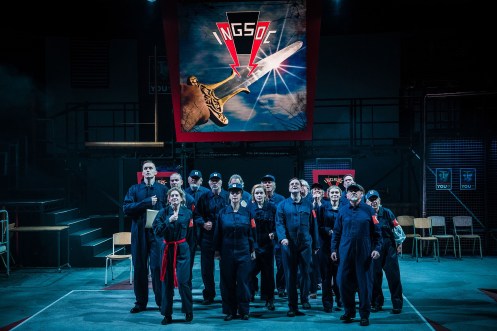
Finally, Winston is seen with a crowd enthusiastically confessing his love for ‘Big Brother’. What sets this production apart from other dystopian visions, aside from the glitches, is that we can believe that he means it.
Nick Swyft
November 2019

 Mark Aspen