
Dreams and Dreamtime
Twilight Reveries
Dreams and Dreamtime
compiled by Anne Warrington
Poetry Performance at Garrick’s Temple to Shakespeare, Hampton 29th March
Review by Roderick Garfield
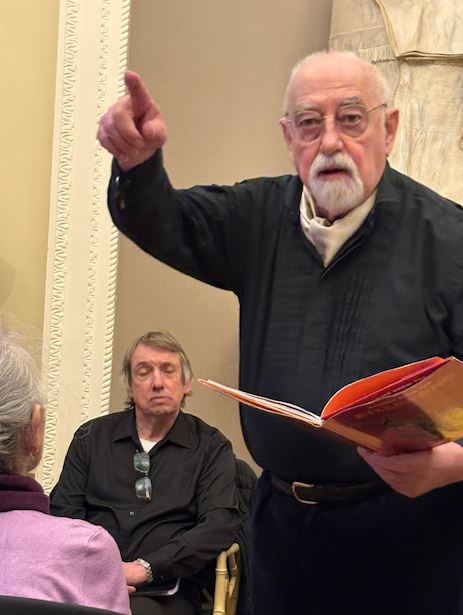
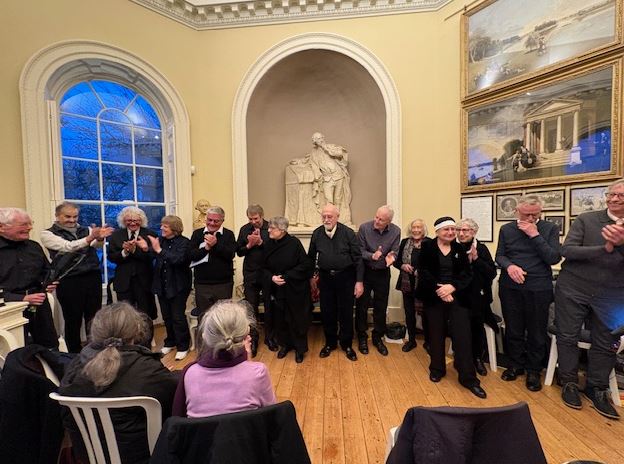
That half-way state between consciousness and sleep, the dream, evokes a crepuscular atmosphere. What then, could be more appropriate to an explore its fantasies as night approaches, than that riparian pavilion built in 1765 as a shrine to the nation’s most famous writer by its then most famous actor, David Garrick. His Temple to Shakespeare hosted Dreams and Dreamtime,a curated collection of poetry, prose and music exploring that state of euphoria or dysphoria that permeates all our slumbers or reveries.
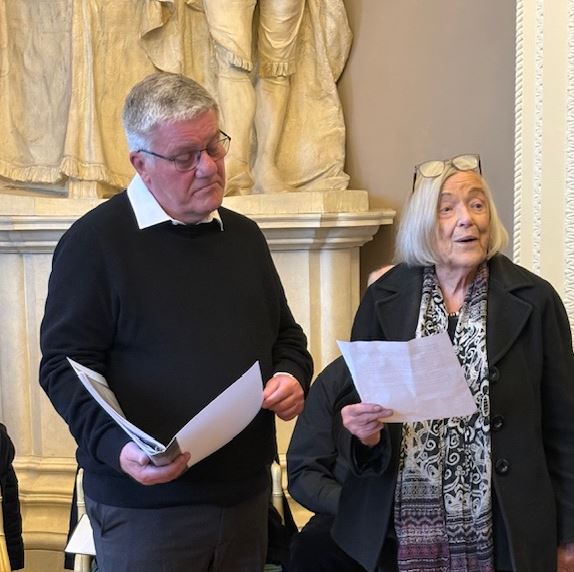
With a generous ratio of one performer to every three audience members, the twilight performance in the limited space of the Temple was quite an intimate affair, especially as a light drizzle began to shroud the gardens in a romantic mist (but failed to dampen the resolve of the open-air queue for interval wine, or “nectar” in the enthusiastic words of one of the narrators). These performers comprised two musicians, three actors, a pair of narrators and eight poets, with multi-tasking within these roles.
Fleet of fingers and with a warmth of smile, Ian Lee-Dolphin was an engaging presence with his acoustic guitar continuum, neatly linking the pieces and as an accompanist to the gentle-voiced singer Annie Morris, although her David of the White Rock was sung a cappella. Her mellow voice produced some wonderfully wistful sounds. Her rendering of Stephen Foster’s Beautiful Dreamer was a thing of beauty and Dream Angus, a Gaelic lullaby that was the penultimate piece of the evening, was mesmerising.
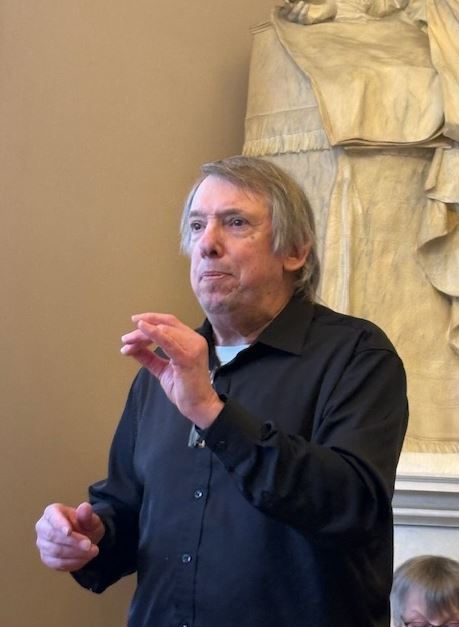
Actors breathed life into the poems (and the prose), works by famous names and by local published poets, some of whom explored the depths of their own poems.
Locally acclaimed Shakespearean actor, Francis Abbott, parenthesised the evening with The Bard himself. Opening with a post transformation Bottom recalling his dream as he wakes from sleep, he had great comic timing with a snippet from A Midsummer Night’s Dream, and he closed the proceedings with Prospero’s stoic valedictory speech from The Tempest, in which “our little life is rounded with a sleep”, imbuing it with pathos and just a little resignation. Abbott also had the thankless task of reading Edgar Allan Poe’s Gothic poem The Raven, a heavy offering just before the interval’s comfort break, but managing to bring variance and polish to it’s repetitions.
Popular and well-established local actress Sue Bell excelled with her reading of Steve Harman’s poem, If Only, a piece, although written just a year ago, has an almost Dickensian feel. Her rendering in Victorian cockney gave an authenticity to the voice of a hungry street urchin. Christina Rosetti was one of the most lyrical of Victorian poets, and her Dream Land takes the concept of the dream further, to the state where “no morn shall break ‘til joy shall overtake her perfect peace”. It was beautifully read by Sue Bell, but could she have underlined that idea more clearly? She obviously relishes the baddy though, and in the Elizabethan playwright John Webster’s The White Devil, thorough the device of a dream, her Vittoria has cold scheming in broaching the idea with her lover, Brachiano, to kill their respective spouses; chillingly done.
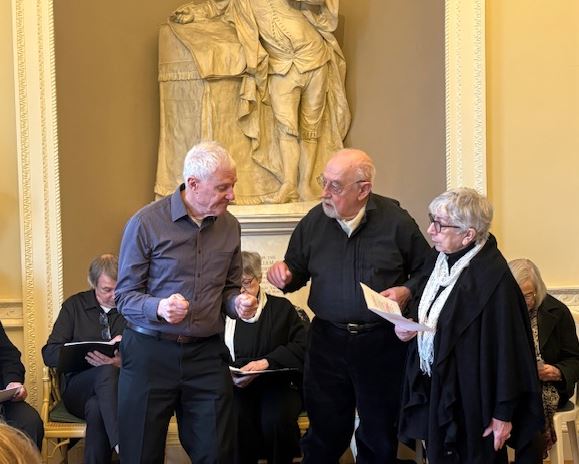
Great versatility was shown by locally based theatre practitioner and critic, Keith Wait in the acting of the comic, the tragic and the mystic. With fellow actors Laurie Coombs and Rory Gilbert, Edward Lear’s nonsense poem, The Table and the Chair was a wonderful froth of fantasy, its quirky action being taking right down thorough the audience in a fluffy fun piece. In contrast, Thomas Campbell’s The Soldier’s Dream, written in 1799 during an overnight lull in a battle during the Napoleonic Wars was presented with heart-wrenching tenderness by Wait. In an uneasy sleep an officer dreams that he wanders back in time to his youth, and then home to his family and friends who try to dissuade him from returning. But duty calls, with fatal result. The piece was acted with intense pathos, with very affecting immersion in its reality. In another switch of mood,
The Rainbow Serpent is an Aboriginal creation story passed down orally by the Yorta Yorta people of Australia. Wait’s storytelling brought it with inclusively into the audience, as a parent reading a bed-time story, with great warmth and wonder.
Where actors concentrate on feeling, poets do on words. Not so with James Brockbank in his presentation of his wonderful poem But I Can Dream, which tells of the thoughts of a person in a vegetative state, locked-in physically but even more so locked in emotionally, excluded from interaction with the world. Delivered confined in the “straight-jacket” of the poet’s own arms, it was piercingly impregnated with insight and incisiveness.
Dennis Tomlinson offers the epitome of a poet, simultaneously wild and gentle, but totally introverted into his words. His Bach’s Toccata and Fugue in D Minor and Snake have intellectual bite in spite of their soft delivery. And what does one make of his Polonia Palace, in which in a dream garden we encounter one of the most evil men who have ever lived, Joseph Stalin!
In Heather Cook’s works there is a contained sense of nostalgia and she reads them with a repressed passion that nicely illuminates them. A Fondness For Facts speaks of “shopping lists to dreams” and in Walberswick the Suffolk seashore becomes a metaphor for the bitter-sweetness of memories.
Adam Woods’ Pillow also deals with the nostalgia of lost love. Rory Gilbert in his whimsical Nights gets to the very essence of dreams, and in Mist Kenneth Mason plays with the idea of the ephemeral nature of the mind and its dreams. Clearly dreaming is a fertile subject, but especially in the creative imagination of such talented poets.
The cement for these memorably presented pieces was the narrators, Heather Montford and Graham Harmes, whose wry interjections provided context and structure. They also injected some subliminal humour which seemed to slip in sub-rosa.
What niggled slightly though was the lack of the spirit of the ensemble. Most of the cast, when not speaking, seemed to be engrossed in catching up with their general reading. Had they heard their fellow performers’ contributions too much in rehearsal, or did they just not like them? They could have at least acted out engaging with their co-artists. It was great distraction.
In spite of this niggle, Dreams and Dreamtime was a great experience, the atmosphere sublime and the craftsmanship exemplary. It is an accolade for the inspired compiler and director Anne Warrington and the culmination of much diligent research.
Perchance to dream, we may soon get another such treat.
Roderick Garfield, March 2026
Photography by Heather Moulson


Thank you for this very positive review of Dreams and Dreamtime. (Agree with reviewer’s niggle.)