
Bitter Irony
A Taste of Honey
by Shelagh Delaney
The National Theatre at Richmond Theatre until 12th October, then on tour until 29th February
Review by Mark Aspen
The taste of honey can be a bitter taste, an ironic thought when reflecting on all of the ironies that stream through this classical kitchen sink drama. Ironic too that we, the audience, are dimly reflected in a disintegrating mirror that stands at the back of the set.
From the viewpoint of 21st Century we can reflect on what we would find taboo and what would we tolerate as an audience in 1958; how we might have felt about premarital sex, miscegenation, homosexuality or abortion. Today, most people would not bat an eyelid, but in those days toes would curl to breaking point.
How remarkable then that an unexperienced teenager, Shelagh Delaney not only penned a play that touched on all these taboos, but boldly presented it to a leading theatre producer. And how bold it was that that producer, Joan Littlewood put that play, A Taste of Honey straight onto a major London stage.
The National Theatre’s version of A Taste of Honey gives more than a nod to the original production but has a more contemporary approach to the staging. Hildegard Bechtler’s design creates an atmosphere that is scruffy, smoky, seedy and subterranean. It is an empty warehouse; and it needs to be, for the wares are empty lives. It is open; and it needs to be as busy running changes are part of the action as each scene unfolds. What it is not, is claustrophobic; and it needs to be, as each of the lodging rooms that form most scenes are tightly closed spaces, each confining, pressuring and constraining taut human emotions. However, claustrophobia comes from Paul Anderson’s moody lighting, delineating closed spaces with angular vaporous beams in an expressionist sepia style.
The opening of the play eases into a scene in a rundown dive in Salford where a band plays lazy jazz. In a homage to the first 1958 Stratford East production, a jazz trio remains on stage throughout like a Greek chorus, musically commenting on the action. Music director, David O’Brien leads on keyboard with Alex Davis on double bass and George Bird on drums. Moreover, all the actors are called upon to sing and they make a fine job of it. In clever arrangements by Benjamin Kwasi Burrell, we only hear snatches of songs, for there never is any resolution or completion for what each is reaching out for. Hope is always frustrated. The truncated numbers interpose themselves in scene changes to summarise the coming plot element.
It is the mid-1950’ and in the first lodgings Helen, a forty-something alcoholic and single mother, has just moved in with her daughter Jo, seventeen, who has never had a continuous school education. There is no love lost between them, as their caustic conversation testifies. Their relationship is as dilapidated as the rooms they now occupy. Sandwiched between the gasworks and the slaughter house, it lacks heating, functioning fittings and wallpaper.
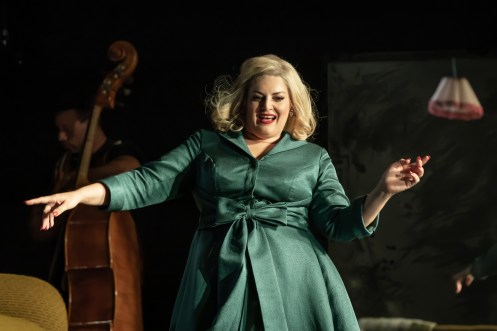
Hellen is a promiscuous good-time gal (Delaney described her as “a semi-whore”), living off of her latest lover, and whose only sustenance seems to come in a bottle. Jodie Prenger, as Helen, pulls out all the stops, brash, bold and brassy, she commands the part. She gives no quarter, for Helen doesn’t do subtle. Prenger does however, and once or twice we almost see a chink in the brass, but the soft side never quite makes it through.
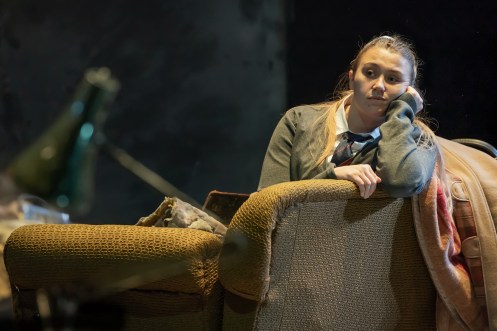
A Taste of Honey is largely Jo’s story. Jo is pert, precocious and pushy, but it is her protection against a harsh world without a father, without an education, without any hope. Gemma Dobson plays the sullen but sassy teenager to a tee. One can almost feel the frustration as she longs to escape her lifestyle, but knows she cannot.
It is worth noting that Delaney was Jo’s age when she wrote the play, and she lived in Salford. The opening dialogue between Helen and Jo is delivered ultra-fast and in a heavy Lancastrian accent, which takes a little while for the southern ear to tune into (although I have worked in Salford). However, the stinging whiplash of their interchange is only too clear. One hopes Delaney’s own adolescence was not this bleak. Nevertheless, her description in the programme for the first production in 1958 was as “the antithesis of London’s ‘angry young men’. She knows what she is angry about.”
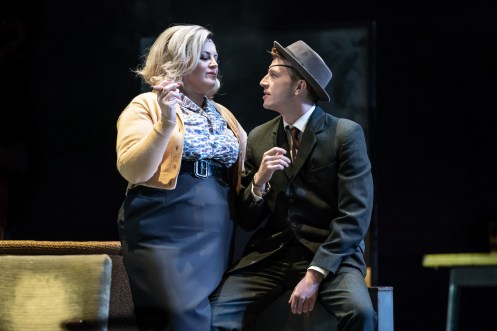
Helen is already starting an affair with her latest “fancy man”, Peter, a wide-boy some fifteen years younger than Helen, who has made a tidy sum in shady deals. A snappy dresser, he sports a black patch across one eye, which he says he lost during the war. But we feel that it was not lost in military action, and we never find out how. Tom Varey imbues Peter with an air of cocky menace, giving him an uncomfortable aura of barely contained violence. Helen finds it exciting.
In a heated conversation between Jo and Helen (Jo never calls her mother) about one of Helen’s former lovers, Jo says he had an ugly the nose, only to get the flat repost, “It wasn’t his nose I was interested in.” In contrast Jo is really only looking for affection.
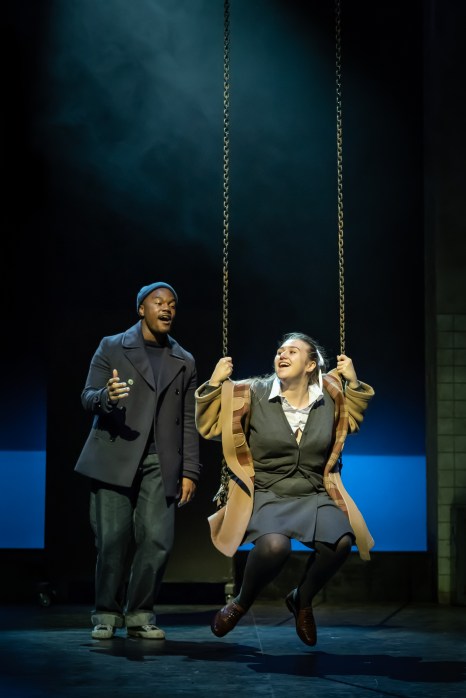
Along comes a West Indian sailor Jimmie, who woos Jo with apparent tenderness. Indeed, the scene with Jo on a playground swing and Jimmie singing My Love Is like a Red, Red Rose is genuinely affecting. He even proposes marriage and give her a ring, which she wears on a string, out of sight of Helen, who herself is now engaged to Peter. Durone Stokes makes a very personable Jimmie. With a disarming smile, he portrays the gentle nature of Jimmie that Jo falls for. Yet, Jimmie’s honeyed words count for nothing when Jo becomes pregnant. He disappears to sea, and we only see him again in Jo’s dreams.
Jo, abandon by Jimmie and left to fend for herself when Helen goes off to her wedding, lives a lonely life, pregnant and living on dog biscuits.
The second half opens with Geoff, an art student, supplementing his grant by singing in the jazz club. His song, Mad About the Boy, beautifully sung by Stuart Thompson, tells us right from the start where his proclivities lie. Even Jo understands this when she meets Geoff in a fairground, but she shrugs it off and they strike up a friendship. When she finds out that Jo is homeless, having been kicked out by his landlady (by implication because of his, then illegal, homosexuality) she offers him her couch for the night.
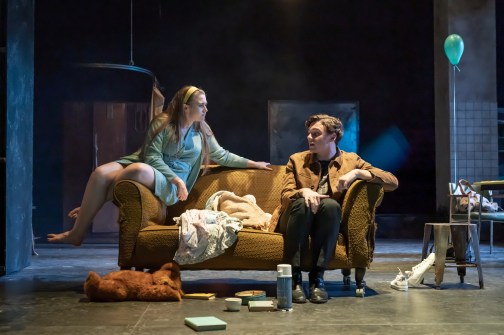 Needless to say, they need each other, and a warm and close platonic relationship develops, reinforced by their mutual love of art in which they are both skilled. She quickly becomes reliant on him, and Geoff enjoys “mothering” Jo, as her nurse and housekeeper. He is a far better mother to her than Helen ever was. Stuart Thompson is outstanding as Geoff, fully immersing himself in the affectionate and forgiving nature of the character, all the mannerisms and voice infections being spot on. The bond between Jo and Geoff is the only truly loving relationship in the play, uncomplicated by sex, although Geoff does offer to marry her. We can even believe that we are heading for happy-ever-after. We know though that a big “but” is coming, for this is the realism of the kitchen sink drama.
Director Bijan Sheibani has understood that, although giving his A Taste of Honey a modern presentation, it must be seen within the customs and moral codes of sixty years ago. It strongly underlines how much our outlook has changed in those few decades. The characters are very real and their predicaments have evolved from the exigencies that the deprivations of the then quite recent War had put upon them.
Sheibani has not lost the grit of the original. There is that “but” and for Jo, when the taste of honey dissolves, only bitterness remains.
Mark Aspen
October 2019
Photography by Marc Brenner
A Hell of a Time
Orpheus in the Underworld
by Jacques Offenbach, libretto by Hector Crémieux and Ludovic Halévy
English National Opera at the London Coliseum until 19th November
Review by Mark Aspen
Balloons, fluff, pastel, these Emma Rice trademarks are not what might spring to mind as immediate images of hell, but it is her ability to counterpoise picture-book imagery against disturbing undercurrents that makes her contribution to ENO’s Orpheus Series memorably different.

The Series takes four different approaches to the classical myth of Orpheus descending into hell to try to bring back his dead wife Eurydice, with four very different composers and with four very different directors, each with backgrounds of different genres. Rice brings the innovative drama style of her Wise Children company into this her debut as an opera director.
So what does Rice do with Offenbach’s spoof piece? We have balloon sheep, balloon bees, balloon tutus and a London taxi flying on a bunch of balloons. There are little wow moments and big wow moments. Fluorescent paint and phosphorescent light, within Malcolm Rippeth’s colour-bursting lighting design, Lez Brotherston’s zany costumes and an erotic fly puppet all add to the sense of a rumbustious romp.
… Yet there is an edge to this production that makes it feel very uncomfortable. The sheer nastiness and sleaze of some of the plot doesn’t sit easily in a knock-about comedy. Offenbach and his librettists took Virgil’s version of the Orpheus story, complete with abduction, murder, rape and incarceration and made it bearable by over-the-top lampooning, mocking the heaviness of the original. They we also taking a side-swipe at convention by inverting Gluck’s established Orpheus and Eurydice and covertly satirising Napoleon III, then established as Emperor of the French, and his court. Offenbach’s operetta leans towards a cruel Carry-On approach, but with its hint of misogyny, it clashes with the radical 21st Century zeitgeist that Emma Rice would subscribe to. In trying to rein it back, she has missed the point. Her Orpheus in the Underworld has something of the gorgonzola about it: creamily enjoyable but veined with bitter threads.
That all said, Rice’s Orpheus in the Underworld is entertaining, in spite of itself, a frothy spectacle, with lots of fun and much clever wit. Nevertheless, the Offenbach black comedy is wrong-footed from the start, with a dumbshow during the overture. This creates a back-story to account for the friction between Eurydice and Orpheus before her death, which culminates in their baby’s stillbirth. The jokey introduction of a wreath with the words Baby is miscalculated: not a good start for a comedy, even a black-comedy, and it takes a while for the show to get back into gear.
 But once the operetta is on the road, it motors along a fair old rate. Indeed our narrator, who can’t help interfering in the plot, is a London cabby called Public Opinion. You see, he has The Knowledge. Lucia Lucas makes a very genial Public Opinion and, although not a 1950’s London cabby’s speaking voice, Lucas’ firm warm baritone is convincing. Public Opinion soon convinces Orpheus to win back Eurydice from her dalliance with Aristaeus, the shepherd, a man full of conceit at his own handsomeness.
 Aristaeus is the alter ego of the demi-god of beekeeping and here he is “covered with bees from nape to knees”. The bees are one of the incarnations of the ever versatile ENO Chorus. All though is not as it seems, Aristaeus is one of the disguises from the box of disguises of Pluto, the god of the Underworld. ENO Harewood Artist, Alex Otterburn plays Pluto with mischievous gusto, bringing an athletic baritone voice to an athletic role.
Pluto also has a box of snakes, which lead to the demise of Eurydice in a cornfield. She believes she is going there to flatten the corn with Aristaeus and sings “I have dreamt of love again”. Mary Bevan shines as the hapless but defiant Eurydice, her elfin charm carrying a very difficult role. Bevan’s lovely clear soprano is heartrending, for we know her hopeful opening aria will ironically presage terrible things as Eurydice becomes used and abused.
Olympus, the home of the gods, is an Art Deco ocean yacht, the core feature of set designer Lizzie Clachan’s inspired concept which sits within a structure common to all four of the productions. The balloon-tutu clad chorus provides the heavenly clouds. Here the gods introduced themselves, each of in turn, Venus (Judith Howarth), the Kalashnikov-wielding Mars (Keel Watson), Diana (Idunnu Münch), Juno (Anne-Marie Owens) and Cupid (Ellie Laugharne) with all their various foibles.
 Then Jupiter, father of the gods, puts in an appearance. His foibles are more than petty peccadilloes, as his wife Juno forcefully reminds him, backed up by the other gods. Sir Willard White adds an air of authority with his rich stentorian voice, in spite of his laid-back garb of multi-patterned Bermuda shorts. Puffing on his vape, he looks a little ill-at-ease.
Jupiter knows of the post-mortal abduction of Eurydice and sends Cupid down to the Underworld to fetch Pluto. She is appropriately clad for hell in hot-pants (gold!) and goes off hot-foot.
Orpheus’ bold arrival in Olympus is by Public Opinion’s balloon-borne FX4 taxicab, but he is in earnest to “go down to hell to rescue love from death”. When Orpheus plays his enhanced violin, the gods are moved. And so they should be, for Ed Lyon is a personable Orpheus, and his heart-felt singing of “Who am I without Eurydice?” is genuinely touching. The gods all en-bloc go to hell.

Here is where the mood changes. The Underworld is 1950’s Soho. The gods have come to party in what could have been the Raymond Revuebar, but for Eurydice it is different. She is imprisoned in a sleazy Peep Show, a filthy plain bedroom, where she is leered at by D.O.Ms in archetypical dirty raincoats. Hell indeed, and made worse by the omnipresence of her gaoler, the drunken John Styx. As Styx, an Olympian medallist in creepiness, Alan Ope is brilliantly nasty, and manages to pull of the feat of acting the drunkenness whilst stinging with strong tenor punch a biographical song, Styx’s sob story about how he was once the King of Poland.


Shudder-inducing stuff, but Eurydice’s exploitation doesn’t end there, for Jupiter has designs on her. He disguises himself as a fly (previously he had specialised in bulls and swans) and comes to her room. Now, Rice does return to the Offenbach sense of ridicule. The lustful Jupiter has suitably erectile wings, while his entomological alter ego, a tickling stick skilfully sported by puppeteer Chloe Christian, sends her orgasmic: a sort of insect-ual intercourse, one supposes.
Meanwhile Pluto’s party continues and Eurydice is tricked in joining in, only to be abused by all in a burgeoning gang-bang. Her latest “admirer” is Bacchus, as drunk and revolting as Styx. ENO Chorus member, Peter Wilcock certainly savours the sliminess of this role, and manages to dance with enormous vigour, even with an enormous prosthetic beer-gut! The dancing is of course leading up to the famous (notorious?) galop infernal, now known to all as the Can-Can.
However, Public Opinion’s FX4 has made it to hell with Orpheus, whose violin charms the gods and convinces them that Eurydice should return … but for the ultimate irony that condemns her to stay forever as the consort of Bacchus.

And when the Bacchanal resumes, le galop infernal returns in a frenzy. Choreographer Etta Murfitt elicits a storm of energy from everyone on stage as the music’s tempo continually increases. In this version however, we realise that it is a dance to oblivion, to “embrace the frenzy and the pain”. Eurydice is in an abyss of despair, but she must dance with the others until “you feel your soul goes”. This puts an edge on what sets out to be a lampoon.
Emma Rice said of Orpheus in the Underworld in a recent interview that she doesn’t find much of it funny: rather awkward for a comedy. But then again, in an interview in May 2012, she was asked, “Is there an art form you don’t relate to?” …”Opera. It’s a dreadful sound; it just doesn’t sound like the human voice”. Maybe it is these contradictions in a director of a comic operetta that make this Orpheus in the Underworld jar in its ambiguity.
Nevertheless, this is a piece that is visually impressive, witty and bold, and is executed with consummate skill by its artistes and propelled by the baton of conductor Sian Edwards (formerly ENO’s Director of Music) and the ENO Orchestra. Maybe it is those contradictions, that very ambiguity, that lifts this Orpheus in the Underworld from Offenbach’s anarchistic frolic to give it a sharp bite.
Mark Aspen
October 2019
Photography by Clive Barda
Super Human
Orpheus and Eurydice
by Christoph Willibald Gluck, libretto by Ranieri de’ Calzabigi
English National Opera, in collaboration with Studio Wayne McGregor, at the London Coliseum until 19th November
Review by Suzanne Frost
I once read a very funny article that said: “God listened to all my hopes and dreams and then made them come true for Keira Knightley.” Poor Keira and her success famously annoy a lot of people. In the world of dance, the unstoppable rise and rise of choreographer extraordinaire Wayne McGregor could trigger an equal level of annoyance – if he wasn’t just so damn amazing. By now dripping in awards and with his fingers in pies as varied as the Royal Ballet, fashion week or the Harry Potter franchise, I still get a little kick out of brand McGregor reaching a new level of world domination.
So hurrah for his ENO debut as an opera director, opening this autumn season no less, and hurrah for his company of extraordinary super humans filling the stage of the Coliseum. In another themed season, this autumn ENO is looking at the Orpheus myth in a variety of forms: four different operas – from minimalist Philip Glass to wacky Offenbach – and four directors from a variety of disciplines, from dance to film to theatre. Plus, if I understand correctly, they will all be performed within the same set by Lizzie Clachan.
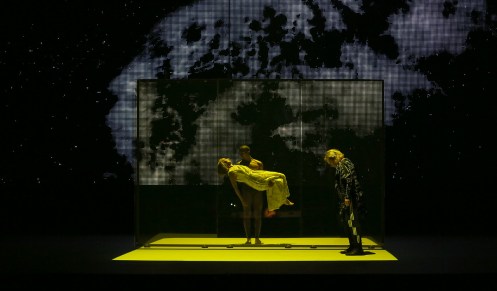
This set is more or less a barren stage with a screen backdrop, bathed in gloomy grey light. The choir is tucked away in the orchestra pit and only features as ghostly bodiless voices. For the prologue, we meet Orpheus (a very ill Alice Coote) and his wife Eurydice (the warm and wonderful Sarah Tynan) on the day of their wedding, but almost 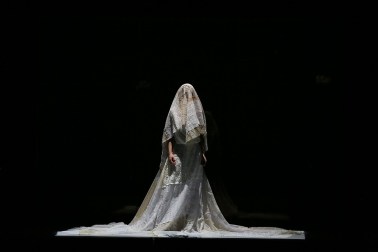 immediately, the happy bride is relieved of her bouquet, put into a hospital gown and given a deathly injection, whereupon she dies and is laid out on a futuristic suspension behind a yellowish acrylic glass, where she floats eerily like the shark in Damien Hirst’s fish tank. The backdrop turns into a black and white super slow-motion film of the ocean, the wave movement so sparse it is hardly noticeable – an immensely effective device but, to the superfan, actually familiar from McGregor’s stunning Virginia Woolf ballet Woolf Works at ROH (whose star, the prima ballerina Alessandra Ferri is in the audience tonight!). Nevertheless, there is very little that could transmit the idea of all consuming, time stopping grief better than an ocean zapped of its colour and movement.

For someone who is currently going through grief, there is a lot to recognise in Gluck’s Orpheus and Eurydice: denial, anger, pleading with the gods, bargaining, the complete incomprehension of the finality of death. The backdrop screen just showing flickering static, the nothingness of it all.  As Orpheus, Alice Coote practically has to carry the entire opera alone, visibly struggling with a nasty virus infection but her sniffles, whether real or performed, integrate into the story. Orpheus never reaches the last level of grief, acceptance, and is instead spurned on by Love (a chirpy Soraya Marfi) to rescue his wife from the underworld. Down to Hades we go, with a black light, strobe lit dance break to show off Company McGregor’s ridiculously skilled super-dancers. They are without a doubt among the best in the world. I wish they weren’t dressed in stripey deconstructed clown athleisure – but I suppose the blacklight does bring out the neon. It’s a version of hell I have never encountered in any of my fever dreams, but it looks fascinating.

Act Two opens on the peaceful dwellings of the shadows in their “calm and pleasing haven” – Company McGregor now dressed in more colourful sportswear and inexplicably all featuring a heart shaped patch on their bums… Their dancing is sublime, full of kindness and with the tenderest of male duets between the expressive Jordan James Bridge and the fantastically tall Izaac Carroll. I have so much respect for these dancers, which is why I would have really wished for something a little nicer than patched up Sweaty Betty sports bras. I know McGregor likes a deconstructed costume, but I’ve seen them look a lot more stylish before. His trademark zero-facial-all-bodily expression brings a serene calming quality to the movement. When Orpheus bursts into this kingdom of shades he is literally disrupting a meditation session. Again, it is a version of heaven I have never encountered in my dreams, but it does make you wonder if Eurydice isn’t actually perfectly fine surrounded by those calm, kind and colourful spirits. Sarah Tynan is a beautiful warm presence on stage and the final duet where the lovers almost reach the light at the end of the tunnel but of course cannot escape their terribly human instinct to look at each other – the one thing the gods forbade them to do – is moving. Eurydice dies for a second time and Orpheus begins the whole grieving process again, harder, angrier, bargaining with bigger stakes, threatening to kill himself. Love decides that this is proof enough for the gods and in a dreamy sequence, the lovers are reunited, not with each other but with a dancer version of themselves, a curious choice, possibly suggesting the dancer as a sort of animus of the singer? A beautiful thought that isn’t quite coherent but makes for a pretty final image under a twinkling night sky. As the very last notes sound though the auditorium, Eurydice is once again laid behind the sickly yellow glass. Maybe there is no bargaining with death. No gods to decide when your suffering is enough. Maybe Orpheus has reached acceptance finally. It’s oddly comforting in its terrible bleakness.

Nevertheless, I’m left wondering if I liked it. What was meant to be an interdisciplinary hybrid of dance and opera never really reaches amalgamation. The dancers are so highly trained they do look like a whole different species next to the trio of singers. The thing is, I do like McGregor tromping around the foyer in his vinyl platform boots with his entourage of neon clad designers, fashionistas and eccentrics. I like the audience he brings in. I think it’s healthy for opera, healthy for art and healthy for ENO. I’m just not quite sure this Eurydice felt very memorable to me …
Suzanne Frost
October 2019
Photography by Donald Cooper
Pints and Prejudice
Ghost Bell
by Steve Webb
This Is Us Productions at OSO Arts Centre, Barnes until 5th October
Review by Andrew Lawston
There’s an undercurrent of mild embarrassment at the OSO tonight. Due to circumstances beyond anyone’s control, there has been no technical or dress rehearsal, so this evening’s production of Ghost Bell, by Steve Webb, has been declared a preview. We’re told this on the door, and again by a member of the production team before the play – which gets underway perhaps a little later than advertised. Thankfully, the cast gamely rise to the occasion, apparently word-perfect and with Cornish accents in place as required. While they will no doubt pick up the pace a little as Ghost Bell’s run continues, the only visible mishap is a projected backdrop being reset while the cast carry on regardless.
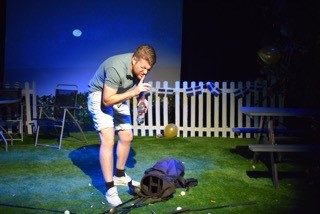
Set in a pub garden over a bank holiday weekend, Ghost Bell tells the story of a collection of regular drinkers in The Griffin. Joey, a troubled 40-something who “was going to go to drama school”, drives much of the play’s action through his drunken and drug-fuelled antics, and David Shortland pulls off a subtle performance that captures the inherent sadness in this grown man who knows he’s still acting like a teenager but can’t quite work out how to do anything else.
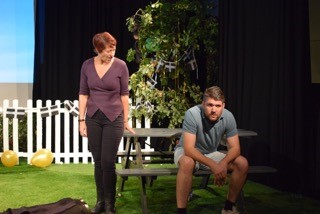 Joey’s antics drive his childhood best friend Debbie to distraction. A teetotaller who still always seems to be in the pub, Zoë Arden is powerful in perhaps the most emotionally demanding role in the play, and is ably supported by Danielle Thompson as her younger more carefree sister Hally. Meanwhile, Debbie’s boyfriend Matt (Scott Tilley, left out of the programme, but an imposing presence on the whole production) encourages and even funds Joey’s lifestyle.
 Debbie, Matt and Joey are surrounded by the rest of the Griffin’s regulars, and owners. Andy Hewitt’s Brendan remains rooted in the corner playing chess against himself, sipping pint after pint, and occasionally chipping in with a classic film quote with exquisite timing. Harry Medawar’s Burling also provides frequently welcome comic relief, as he wanders through the action with quaint tales of murdering the local wildlife, looking faintly bemused when anyone tries to involve him in the play’s plot.
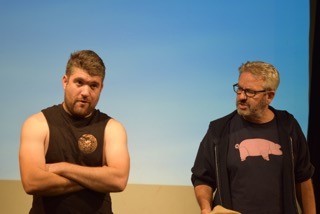 Publican Alan is played with a twinkle in his eye by Nigel Cole, handing out sage wisdom to his regular customers, and enjoying a tempestuous relationship with his wife Pauline. Pauline is literally a character of two halves, she opens the play snapping at all and sundry, before Alan shouts at her halfway through and she, literally, lets her hair down and becomes sweetness and light for most of the rest of the play. Liz Williams (also the play’s producer) plays both versions of the character well, but the contrast between them is… striking, and I’m not sure the message that shouting at your wife will turn her into a nicer person is one that makes for a comfortable evening’s theatre.
Finally Roberta Cole gives great gusto to a brief appearance as Barbara, just before the interval, and her breezy no-nonsense attitude provided a great contrast with the slightly drunk or stoned demeanour of much of the rest of the cast; it would have been great to see her again at the conclusion.
The set is an ambitious recreation of a pub garden in the OSO space, and Malcolm MacLenan’s lighting design captures the various times of day perfectly, from the midday sun to the mellow evenings and bright moonlight. Wearing two hats, Designer and Director John Buckingham makes sure his cast move with ease and pace through the artificial turf of his set. John Pyle’s sound conjures up wind, waves, and occasional bursts of music from inside the pub.
In short, Ghost Bell is a well-acted and sumptuously designed production which more than overcame its lack of final rehearsals. Unfortunately, it can’t always plaster over problems with the script. A lengthy foreword from playwright Steve Webb in the programme makes it clear that large amounts of the play are grounded in autobiography, which is always a tricky proposition. Truth is indeed often stranger than fiction, but reality has a shaky grasp of dramatic structure.
The play wants us to root for Joey, but he opens it by killing a cat with a golf club. It’s hard to come back from something like that, and the audience is given precious little reason to try, beyond Debbie’s clear concern for her old friend. Later we learn that he’s been caught trying to steal a penguin, and that’s the sort of quirky drunken crime that an audience can get behind. But we already know that a brutal cat clubber lurks behind the cheerful penguin pilferer.
Matt gradually emerges as a villain of sorts, keeping Joey trapped in his addictive spiral by supplying him with money and drugs, apparently so that he’ll always have someone to go to the pub with. When he takes a more active role in sabotaging his friend’s happiness by literally burning a lifeline, it’s all a bit melodramatic. “You’re not going anywhere, Joey. Not yet,” he purrs, and in an otherwise naturalistic play, this streak of soap opera intrigue that sets up the plot for the second half just doesn’t ring true.
Being set in a pub garden, the play’s dialogue is naturalistic in that it features a huge amount of swearing, and everyone drinks, smokes, and tokes their way through the play. Which (smoking ban notwithstanding) isn’t necessarily a problem, but it does mean that the play’s climax, in which revelations come thick and fast and loose ends are resolved, essentially descends into people screaming at each other to “eff off”, without resolving a great many of the loose ends.
The performance I attended also highlighted the big problem with filling your play with quotes of other people’s best material: you’re relying on people having seen that material. While the audience tittered dutifully when Brendan chipped in with familiar James Bond lines, they were a little more hesitant about The Usual Suspects. Finally it became very obvious that I was the only person in the audience who’d ever seen Withnail And I – which was a shame as it was quoted often, extensively, and in plummy-voiced character, to the audible confusion of much of the audience.
A strong cast, on top of the material and well-directed, have breathed life into this stunningly-designed production, but their best efforts can’t disguise a play in need of a bit more polish, and a little judicious pruning.
Andrew Lawston
October 2019
Photography courtesy of This Is Us Productions
Honesta Quam Magna
Daisy Pulls It Off
by Denise Deegan
Teddington Theatre Club, Hampton Hill Theatre until 4th October
A Review by Celia Bard
Daisy Pulls It Off is a play that treats it audience to a feast of ‘Jolly Japes’ and ‘spiffing fun’. There are ‘hi-jinks galore’ at the Grangewood School as girls indulge in midnight feasts, hot water bottle fights, overcome cliff edge dangers, search out lost treasure – all against a backcloth of bullying and cheating, mystery and intrigue. It all falls on Daisy Meredith to save the school and save the day. The play is inspired by the adventure stories about life in boarding schools written in the early 20th century by authors such as Angela Brazil. The play’s depiction of upper class language, social and moral attitudes and norms might provide a temptation for actors to caricature the characters. These two directors and cast members do not fall into this trap, the actors totally immerse themselves in their characters and succeed in drawing the audience into the ‘ups and downs’ of this group of schoolgirls, particularly those which befall Daisy Meredith. Although we laugh at many of characters’ utterances, we were not laughing at them. The quality of the acting is as such that we do not applaud when the bully and snob, Sybil Alexandra Burlington is expelled from the school but feel a sense of relief when the expulsion is lifted after Sybil’s moment of honesty, and pleas for clemency from Daisy. The play is more a pastiche of this genre of writing, not a parody. Although the time period is 1927 some of the themes the play touches upon are still with us: class discrimination; Public versus State Education; foreign enemies of the State.
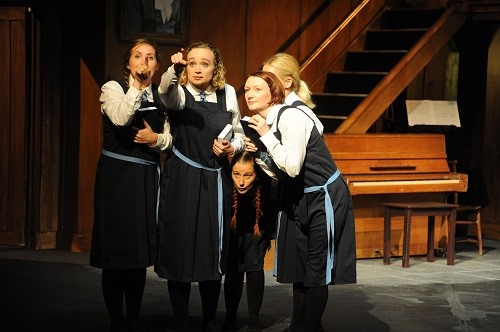
The main setting of the play is the Grangewood Boarding School for Girls. Our heroine is Daisy Meredith, daughter of an opera singer who has fallen on hard times. The fate of Daisy’s father is unknown, presumably killed during the First World War whilst at sea. Meredith is the first pupil from an elementary school to win a scholarship to Grangewood. Many of the girls are appalled by this event, while in return Daisy, a girl with a strong moral compass, is shocked by the snobbery and venom displayed by some of the girls. She does, however, bond very quickly with poetry lover, Trixie. Together they decide to set up a secret society with the purpose of finding some hidden treasure in order to save the school and the family that own it. Alas the two girls share the dormitory with a couple of rich girls who plan to get Daisy expelled and succeed in making her life as difficult as possible. The story unfolds in an establishment in which the game of hockey plays a significant role.
The dialogue of the majority of characters is interesting. Speech is directed to the audience when that character is introducing him/herself, an extremely helpful device with such a large cast, or continuing the narrative of the story to move the action on. It is also, of course directed to the other characters in the play.
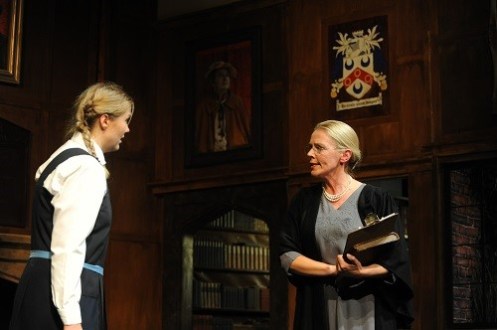
Daisy Meredith describes herself as a “daredevil, tomboy, possessed of a brilliant mind, exuberant, quick-witted, fond of practical jokes, honourable, honest, courageous, straight.” Ellie Greenwood, who plays Daisy, shows all these attributes in her characterisation and in her interaction with other characters, she lives the role. Just occasionally her enthusiasm got the better of her at the expense of intelligibility. Her loyal chum, Trixie Martin played by Lara Parker, is as much the ‘madcap’ as Daisy. She gives a fine performance and is just delightful to watch. Daisy’s nemesis, Sybil Burlington played by Lily Tomlinson, has the most wonderful facial expressions that aptly reflect her character which she herself describes as “conceited, beautiful, only daughter of very wealthy parents.” Sybil’s ‘chief crony and school toady’, Monica Smithers acted by Juliette Sexton, gives a great comic touch to the role without going over the top. The two of them together are mesmerising. Another significant character is Clare Beaumont, head girl and Games Captain, acted by Jenna Powell. Her telling of the tale about lost treasure to Daisy and Trixie is spell binding. Annabel Miller is a suitably stern Headmistress, comfortable with her school audience of parents, brothers and sisters and grandparents, slightly less so when dealing with the misdemeanours of her pupils, at times lacking projection. Jeremy Gill as Mr Schblowski provides a well-considered and sinister interpretation of the Geography teacher and Choir Master, succeeding in disguising his true character and motives. All actors in this production must be commended for their commitment and level of characterisation they bring to their roles, whether large or small. The History and Music teacher, Sue Bell, is a case in point. This actor does not have a word, a line to speak but throughout all of her scenes she is totally engaged in the action.
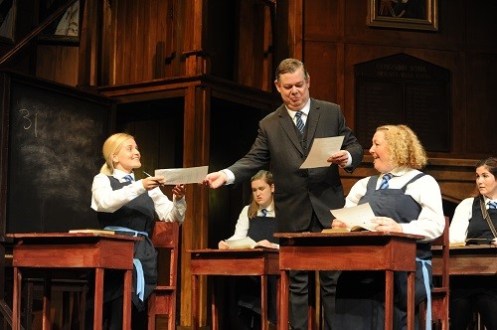
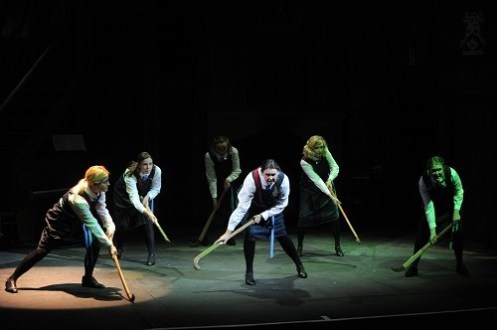
As well as a wonderful, talented cast of actors whose overarching strength is the quality of their vocal interaction mention must be made their physicality. There are a number of incidents when the human body is at the centre of the storytelling process including the spectacular hockey match sequence and the rescue from the cliff top. The choreography of the hockey match triggered an appreciative round of spontaneous applause from the audience and the ingenuity that went into the rescue of Sybil and Monica results in real drama.
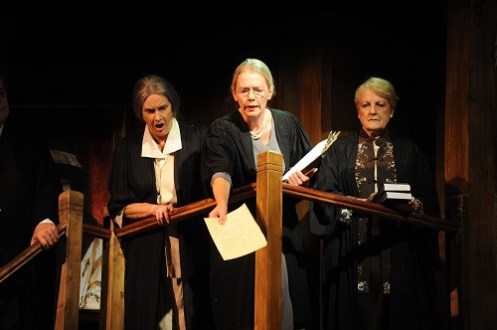
The play’s settings move speedily from a train to the school, from the library to the dormitory, to the sports grounds, to the cliff top. These speedy scene changes are imaginatively achieved by the use of smoke, which serve to disguise the main set, a wonderfully designed interior representation by Wesley Henderson Roe of a rambling red-brick Elizabethan Mansion consisting of a wooden staircase and panelling, an upper landing, and lower Manor Hall, now the school hall, still with portraits of former members of the family hanging on walls. The smoke acts as a mist during the playing of the hockey match. Contrasting this carefully crafted choreographed movement is Trixie sitting on the window ledge, looking out on the match, and acting as commentator. The same technical device is used for the cliff top scene: a puff of smoke, a clap of thunder and ‘hey presto’ the scene has shifted from inside to an outside scene of a cliff top shrouded in mist. Wonderful!
Well devised and effective Lighting design by Patrick Troughton and Sound including some special effects by Charles Halford was equalled in standard by realistic and well fitted costumes under the meticulous eye of wardrobe mistress Mags Wrightson, all components adding to the creditability of the piece. Overall this was a highly enjoyable play provided by a fine cast, organised by two creative, talented and visionary directors, Clare Henderson Roe and Wesley Henderson Roe, and enjoyed by a lucky audience. This is a production not to be missed.
Celia Bard
September 2019
Photography by Sarah Carter
Honeymoon Engagements
Private Lives
by Noel Coward
The Questors at The Judi Dench Playhouse, Ealing until 5th October
Review by Viola Selby
Private Lives is undoubtedly one of Noel Coward’s greatest successes, with its timeless humour it has entertained audiences since 1930, and Francesca McInally’s adaptation truly gives homage to this, as the audience are given a glimpse into the private lives of a divorced couple who run into each other whilst on their respective honeymoons. This meeting appears to relight an old flame and the couple decide to run away together to Paris. What follows is staged in such an intimate and awkward way that it makes anyone watching not only deeply invested but also able to engage with how the characters must be feeling at the time. Such engagement is also greatly helped by the stunning set designs, by Jake Smart, and period perfect costume design, by Carla Evans, which truly bring the 30s alive in Ealing!

The play’s success relies heavily upon the quality of its cast, ensuring that Coward’s repartee is done in a perfectly timed manner and that a simple story is turned into a night of high class hilarity. This need is strongly met by the tremendous talent of the caddish Robert Seatter as Elyot Chase, whose dance moves in silk pyjamas would rival those of Fred Astaire. Seatter manages to convey a wide range of ever changing emotions, from veracious fury when dealing with his ex-wife Amanda Prynne to relaxed indifference with his new wife, Sybil. He does this all whilst delivering most of the best yet completely misogynistic lines, like when he informs Amanda that it does not suit women to be promiscuous, which evoked a collective sharp intake of breath from the audience. Amanda, passionately portrayed by Kate Langston, then retorts this by stating “It doesn’t suit men for women to be promiscuous”, encouraging a huge applause. As Amanda, Langston completely becomes the passionate and often selfish character, always ensuring that every jibe and sarcastic comment is captured in the cold-hearted and brutal nature it was intended to be delivered.


Together, Seatter and Langston have a fantastic chemistry together that truly helps to create their characters’ overbearingly lustful and self-absorbed relationship. However, this relationship would be nothing without the added support and confusion that is brought along by the new yet estranged spouses, Sybil Chase and Victor Prynne. These characters, both polar opposites of each other, highlight how Amanda and Elyot have consciously chosen to marry individuals very different from their exes. Sybil for one, is very young and naively only ever wants the constant approval of her new hubby. Her ear splittingly shrill voice is cleverly kept constant throughout her performance by the comedic Nell Rose who gets the audience to feel both sympathy for the poor Sybil and annoyance at her incessant wailing, which would put any toddler to shame. Whilst Victor is the very definition of a British ‘stiff upper lip’, well to do gentleman, played perfectly pompously by Francis Lloyd whose ability to portray such a stiff man so naturally, especially in such emotional moments, added to the play’s overall humour.

Finally the most intimate and oh so awkward moments were made even more awkward and strangely intimate by the addition of the French maid Louise, whose accent and annoyance was made extremely realistic by Yvonne Monyer. For example, making everyone sit on the small sofa and drink the coffee she had been asked to make led to one of the most awkward scenes one could imagine having with their new partner, their ex-partner who they had just run off with and their ex partner’s new partner. Altogether, a thoroughly good night to be had and one not to let get away.
Viola Selby
September 2019
Photography by Jane Arnold-Forster
Show me the figures
Enron
by Lucy Prebble
Putney Theatre Company, Putney Arts Theatre, until 28 September
Review by Matthew Grierson
‘There’s a dignity in giving people things they can’t touch,’ is one of the observations that sustained Enron, and which sustains Enron in that so much of the play and the corporate scandal on which it is based is about selling us what is immaterial. As these things include both the energy being sold by the firm and the energy on which this play sells itself, it wouldn’t be unfair to say that both have their outages, with a subsequent effect on their respective reputations – perception being another of those qualities on which the business model is said to rely.
To redeem the promise of making something as abstract as the operation of markets visible before our eyes, the show therefore depends on its episodes of financial theatre. A large ensemble takes on the roles of employees, investors and public, and from their number will step an occasional individual to serve as newsreader and fill us in on key developments. Although some of these are entertainingly snappy, the diction is not always as clear as it really ought to be, with the American accents of varying quality, while the shift between chorus and speaker is often too pacey to help us pick up what is going on.
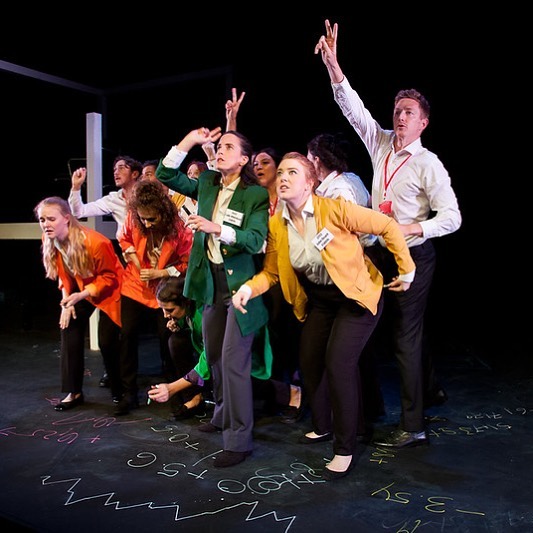
Most successful of these episodes is the metamorphosis of three of the swings into velociraptors at the end of the first act, with the simple addition of some effective cardboard masks and appropriate movement. The dinosaurs make material a metaphor openly embezzled by CFO Andy Fastow (Michael Maitland-Jones) from Jurassic Park and give stage presence to the shadow company he’s established to eat up the corporation’s losses, an objective correlative for his reptilian behaviour.
Maitland-Jones handles each aspect of Fastow’s personality well, from aspirant accountant to book-cooker to carnivore-keeper, especially as I understand he was drafted into the role at short notice. But, again, the transition between each could do with more work. I can buy him wanting to get on to the boss’s good side, but when it comes to the crucial shift from eager employee to criminal accomplice, well, I’m out.

Fastow’s character arc is less Faustian than Mephistophelean, for it is Enron chief Jeff Skilling who is effectively the tragic figure tempted from being your regular ruthless businessman into actual suspect practice. It’s hard to see why Lucas Pozzey’s Skilling should stand out at first: although he is built up in the dialogue before he gives his opening speech, this is delivered hesitantly from a set of steps stage left, and not all that well lit. Neither is it clear why the mark-to-market model that Skilling espouses distinguishes Enron, because if it’s as obvious as he makes it out to be won’t other companies be practising it as well?
The company’s USP continues to remain unclear for much of the rest of the first act, despite entertaining sequences along the way. A troupe of traders in bright, baggy jackets exchange braggadocio accounts of their activity amid a string of ‘buys’, ‘sells’, and ‘f***s’ as they hot-shoe shuffle around the stage and chalk prices on the floor. If you can overcome the cognitive dissonance of watching a largely female ensemble spout this testosterone-fuelled banter, it’s quite a spectacle – but given the traders are behaving just as we would expect them to behave, the scene obfuscates the mechanics of the market as much as it tells their story. While Enron was certainly in the business of pulling the wool over our eyes, dancing around the numbers here does nothing to illuminate this.
I found it worrisome, then, that the play began to sell itself to me at the precise point that Fastow is shilling his scheme to Skilling, miming the boxes within boxes on which the raptor-riddled shadow company depends. At this point, engagement with the narrative noticeably picks up, and we can see the tragic trajectory on which Skilling’s willingness to buy in to Fastow’s innovation sets them.
Pozzey’s performance, which has been gaining strength as the firm does, comes into its own here, adding light and dark to his characterisation of the self-styled captain of industry. A pair of contrasting scenes with his daughter capture his downfall perfectly. In the first, he helps her with her arithmetic by counting out actual dollars, but in the second he is left staring into the middle distance as though looking for the missing money, unable to answer her repeated question of ‘Why?’
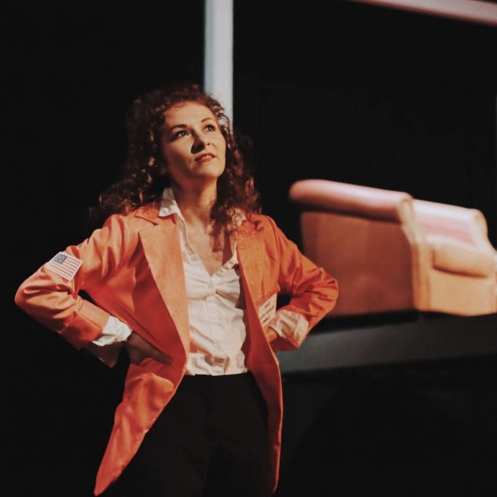
His fortunes are mirrored by those of Claudia Roe, who starts out awaiting her anointment as Enron’s boss from money man Ken Lay before Skilling talks himself into the job instead. Kendal Barrett gives a sympathetic portrayal of Roe, a woman as skilled as Skilling against whom we can measure his rise and fall, and her parting words to him show how much better her business nous is than his. Michael Rossi’s Lay, meanwhile, is as ethereal as Enron’s money: offstage, he is heard only in phone calls that echo around the auditorium, God with a Texan drawl.
As Enron overreaches itself, we see its effects on both Fastow and Skilling, the former haggardly trying to keep his raptors in check and the latter nervily having his office swept for bugs. It is not only the law closing in, however, but reality. We’ve already had nods to the Lehman Brothers, given amusing form as a kind of Tweedle Dum and Tweedle Dee, and there’s a surprisingly affecting rendering of 9/11 that ties together a metaphor about investment and flying. But it’s the jokey references to W that ask us to pay attention, as they gradually build into a critical moment for the plot.
Speaking of plot, throughout Enron a graphline is gradually being chalked downstage by the cast to chart the company’s fortunes, but it’s not clear how this should be understood. From the audience’s point of view, this would have to be read left to right to make sense of the stock price, while from the stage it would look to close on the up rather than the fall. With its highs and lows and a lack of certainty about where things are going, this might be the best metaphor of all for PTC’s production.
Matthew Grierson
September 2019
Photography courtesy of Putney Theatre Company
Transcending Tchaikovsky
Bright Stars Shone for Us
by Tama Matheson
Word & Music and the London Mozart Players, Wimbledon International Music Festival, Kings College School Concert Hall, Wimbledon until 21st September
Review by Helen Astrid
Russian poet Alexander Plescheyev supplied many poems for composer Peter Ilyich Tchaikovsky to create a series of Russian songs. The poet’s collection entitled Words and Music includes Нам звёзды кроткие сияли , Bright Stars Shone for Us, the title of this performance. In this unique production which launched the Wimbledon Music Festival, the stars were evidently on stage.
This was a unique and smart concept called Lyric Drama, devised by the multi-talented Tama Matheson alongside Davina Clarke and Dr Kirsten Fehring. It combines the spoken word with live music. The result? A powerful performance transcending all other art forms. It was captivating from start to finish and the trio of performers Tama Matheson, Eleanor McLoughlin and dancer Alexander Nuttall, were accompanied by the outstanding London Mozart Players.
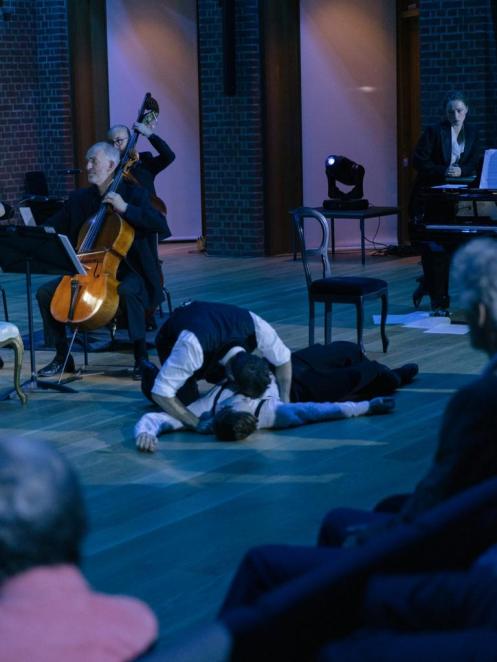
Bright Stars Shone for Us is based on the tumultuous personal and professional struggles of Tchaikovsky. The unadulterated and shocking truth about his life was revealed to us with such sensitivity and compassion, that the generous-sized Kings College School Concert Hall in Wimbledon did not deter from the intimacy which engulfed us.
Interspersed with the music of Tchaikovsky and a few bars from the overture of Mozart’s Don Giovanni, references to Eugene Onegin permeated throughout.
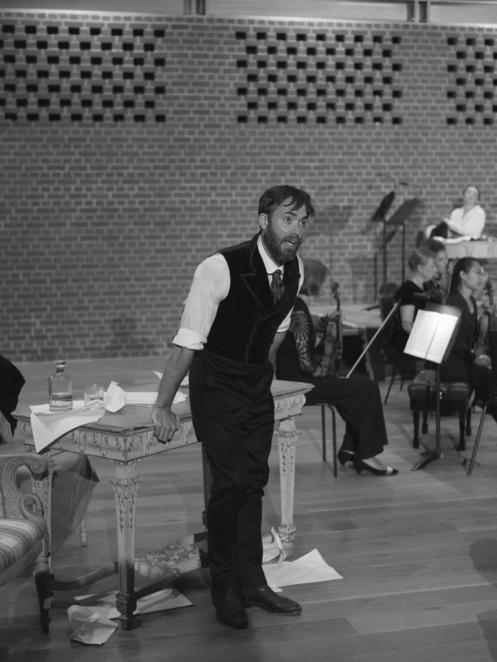
We are drawn to Tchaikovsky’s constant struggle with his sexuality causing him anguish and a yearning for salvation. Even God ignored his prayers. A string of eligible society ladies threw themselves in Tchaikovsky’s direction, but nothing matched the craving and passion he had for his many male lovers. These moments were breathtakingly choreographed and acted by Matheson and Nuttall. It was impossible not to be moved.
The London Mozart Players, founded in 1949 by Harry Blech, demonstrated some fine playing as well as acting, being an integral part of the action on stage. Clever.
Founded in 2018, Word & Music Production Company is one to watch out for. A genuine and heartfelt performance left us eager for more from this fresh and innovative young company.
Helen Astrid
September 2019
Photography by Oskar Chu
Thoughtful and Gripping
Table
by Tanya Ronder
Questors at The Studio, Ealing, until 28th September
Review by Mark Aspen
“If walls had ears” … they say … but what if a table had eyes, and ears and all the senses, for a table interacts much more with people than a wall. This is the thesis of Tanya Ronder’s ambitious intimate epic of a play, Table, in which the eponymous piece of furniture is as much a character as the human actors.
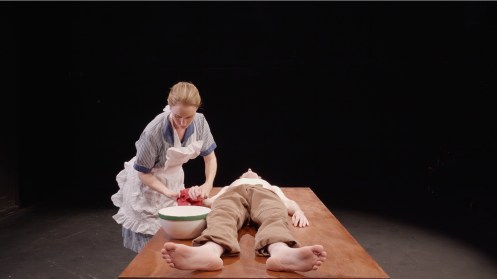
The play follows the family fortunes, or rather misfortunes, over a period of 115 years from the end of the nineteenth century up until 2013. All are united, or divided, by their commonalities. All seek happiness, and all (or maybe almost all) fail. Table potently illustrates the disintegration of family structures and values that have occurred over the last twelve decades or so, caused by huge upheavals such as war, but more so by changing social values. We all long for the continuity of the family, but is it still there? This is what makes Table such a thoughtful and gripping play.
There are no less than twenty-two characters in Table, members of the (ironically named) Best family. Over the decades, the biological family may spill into other “families”, maybe convents or communes, but these do not have the permanence of the blood line. The story, and its intercalated sub-stories, is revealed through a series of snapshots, but unlike a family photo-album we do not see only the happy and posed moments. The chronology is non-linear, so we are able to note recurring themes. If all this seems tough on the audience, it is. (The programme, though, helpfully contains a family tree). However, such is the skill of the Questors’ company that, although we look at the family metaphorically through the gaps in a picket fence, we really care for them. The first-night audience was totally engaged.
The play is equally tough on the cast of eight, who are not only called upon to play up to four characters each but also to portray their characters at myriad points in their lives, from cradle to grave, even as a new-born baby or as a corpse. Moreover, several characters speak in Cantonese or Swahili, and, oh, they must all sing well. And they do, for crucially the scenes are linked with snatches from the hymnal. These, although well-known hymns, make you think, for they comment pithily on the action. Inevitably, and pertinently, the most used is the reflective, “Dear Lord and Father of mankind, forgive our foolish ways …”
These foolish ways are seen, heard and felt by the ever-present table and indeed it is personified by one of the actors, who plays the character Gideon, the member of the family who is perceptive of the heritage of the table and its tangible link between the generations that mean so much to him. Effectively, Gideon is the table.
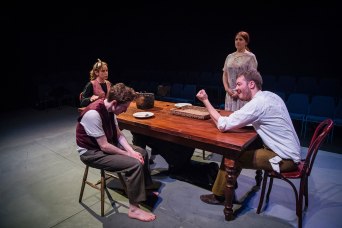 A good point to talk about the set: well, the set is the table. Normally tables are a director’s and designer’s nightmare: they get in the way. But here, congratulations, to the comprehensively consummate director Steve Fitzpatrick and to his inventive designers, especially the table constructor, Stephen Souchon, whose ingenuity allows the table to be moved, flown from the fly frame, and most remarkably cut up with axe and saws, and then later reconstituted. (Although there were some heart-stopping moments when the set did seem to be a test-bed!). The action takes place on a thrust stage, which helps the stage proxemics. Costumes and props are struck and set on the go, and Terry Mummery’s subtle lighting and Paul Wilson’s sound design appropriately enhanced the mood.
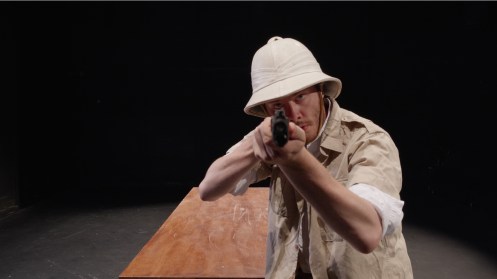
So, what happens? Well, lots and lots. And all of it on or around the table. There are health warnings on the box: violence, nudity, sex (lots), gunshots, prostitution, homosexuality, paedophilia, incest … but thankfully no smoking! The Best family have a very busy 115 years! No animals are harmed … except a leopard shot by a big-game hunter, but we only see blood splashed on the cyc. However none of this trivialises what is an in-depth study of human relationships, carefully and sensitively examined.
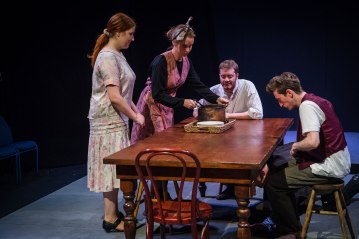 Amongst the relationships, fatherhood and motherhood feature strongly. The play is parenthesised by a prologue and an epilogue, repeating the cause of the marks on the table. Significantly this is recited by Gideon. It is Gideon, brought up as an only child, who most seeks a father. The only link he ever has with his father, Jack Holman, is the phrase pater familis carved on the table edge. Gideon’s emotional journey is as convoluted as his physical globe-trotting from his birthplace in post-colonial Tanganyika. Neil Dickens plays this role with intensity and physicality (he spends much of his under the table). In his attempt to reconcile with his wife and son, whom he abandoned three decades earlier, he is revealed as being as vulnerable as everyone else.
 Sarah, Gideon’s mother, also spends her life seeking. She is seeking something to believe in and it always just eludes her. Jordan Fowler (who also plays Elizabeth, the wife of the joiner who originally makes the table) is outstanding in this difficult role, portraying the hard knocks of Sarah’s life. Her twin brother, Albert and disabled father, Finley gradually become a burden as they cannot accept her Catholic faith. She becomes a missionary nun and has the table shipped out to the convent in Tanganyika. It is here she has her fateful meeting with Jack Holman, a big-game hunter who saves her from a marauding leopard. Sarah’s impulsive emotional response is to strip naked and offer herself to him.
Now here is a small difficulty with this play. After a notional nine-month long interval (yes, the bar and loo one), we return to witness the birth of Gideon, propelled into the world with a somersault from under the table. Is this a light-hearted attempt to leaven a heavy play, or is it just making fun of itself? This self-deprecation is, nevertheless, obvious in the scenes in which Sarah, the teenage Gideon and the table join a 1960’s hippie commune. This, presented as a caricature of the flower-power era, admittedly a sitting target for a bit of mickey-taking, rather trips up the passage of the plot. The second half of Table is perhaps not as well written as the first, and the scenes of Gideon’s belated family reconciliation seem somewhat overworked.
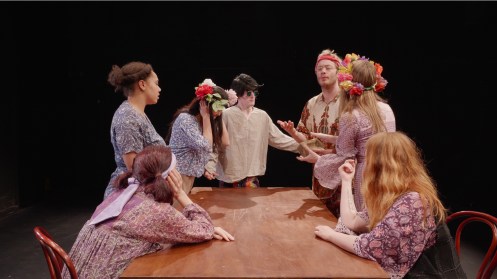
However the hippie episode does underline the message of the danger of messing with social and family structures, for their advocacy of free love does not turn out well, as their commune breaks up in rancour and jealousies. Sex is not a game, and fidelity is important to emotional security.
The density of the plot and its episodic nature does not lead to full analysis here, and the ensemble working of the cast is exemplary. Most actors play multiple roles and all differentiate them superbly. Special mention must be made of Lucy Aley-Parker, who stepped into her roles in the last minute. These include the hidebound Mother Superior and Michelle, Gideon’s hard-bitten wife. From her sharp acting book-in-hand on press night, one felt she would be seamless before the end of the run.
Oscar Gill’s Finley, coarsened and wounded mentally by the First World War, is a text-book example of hitting a difficult role at the right level, as it could easily be overplayed. His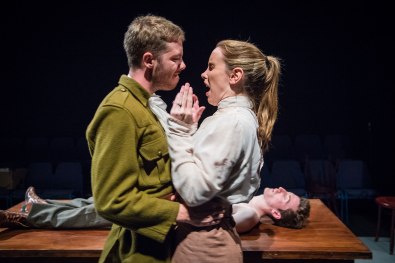 depiction of Finley’s final months, incapacitated by a stroke and dependent of his resentful son, Albert, is superlative.
Nia Acquaye’s transformation from brassy prostitute to demure nun is striking. As Sister Hope, strong in her faith, her interpretation of the scene in which she parts with Sarah and her young son when they are expelled from the convent is so moving, “I’ve never felt so miserable”.
Emma Kennedy’s contrasting roles of Margaret, Finley’s brittle-edged wife, and the feisty Sister Babette; and Tony Sears embittered Albert against the well-grounded David Best, the joiner, are further examples of top-notch acting.
As the youngest member of the hierarchy, Su-Lin, the ebullient actress Ting Ting Cul exactly captures the innocent charm and breathless naivety of the juvenile adoptee. Su-Lin has three carers, the gay couple Anthony and the unseen Ben, and Anthony’s mother, Michelle. One wonders in projected extension to the chronology, what would happen on the demise of Michelle. Would she be another lost soul searching for a mother-figure and for a father? Would she look for carvings on the ubiquitous table, or would she be adding to its scars? What if a table had eyes, and ears and … a sixth sense.
Mark Aspen
September 2019
Photography by Robert Vass and Rishi Rai
Powerful, Radical, Memorable
Giselle
by Akram Khan, music by Vincenzo Lamagna, after Adolphe Adam
English National Ballet at Sadler’s Wells until 28th September, then on European tour until 18th July
Review by Mark Aspen
Walls, walls that contain, walls that exclude have made potent socio-political statements throughout history from Hadrian’s Wall or the Berlin Wall to modern divides such as those in Israel or along the Mexican-USA border. Such a wall is the overarching presence in Akram Khan’s Giselle, first produced three years ago by the English National Ballet, and now vigorously revived for a ten-month tour of Europe, opening at Sadler’s Wells.
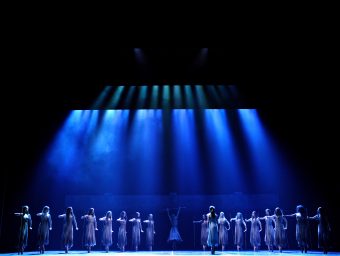 Khan has reworked the 1841 romantic ballet with dramaturg Ruth Little into a topical parable of today’s displaced peoples. It is set outside of an abandoned clothing factory, from which its former workers (the Outcasts) are excluded, shut off from employment or return to their own dispersed communities. Beyond the wall, which divides society, wealth from poverty, the Landlords live in luxury.
From its thunderously dramatic opening with its overwhelming heartbeat music, this is a piece that packs some punch. Full of energy and dark excitement, the tension and threatening nature of the story is retold in a way that takes it far away from the 1841 chocolate box ballet to something much deeper and intense. The imaginative imagery embraces the setting, the music and of course the dance.
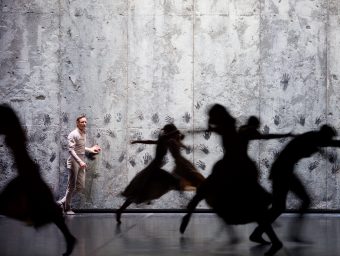 The setting, by designer Tim Yip, whose concept for the Beijing handover ceremony at the close of the Athens Olympics brought international recognition, has a clear feel for the monumental, and his Giselle design paradoxically combines large scale with a feeling of claustrophobia. Mark Henderson’s moody lighting underlines this dichotomy. Yip’s costume design starkly contrasts the Outcasts and the Landlords, plain shifts of the woman workers with the exotic dresses of their wealthy counterparts. The latter lifts the period from the topically of the present into an indeterminate unworldliness of all-time (witness the phantasmagoric pannier dress of one of the ladies).
The music is just as innovative in its synthesis of sources and styles. Composer Vincenzo Lamagna’s score is sit-up-in-your-seat powerful. Its opening impact is almost overpowering, fully illustrative of the power of the Landlords over the Outcasts, metaphorical chains and whips. However, Lamagna uses silence to equally impressive potency. Between, the motifs of Adolphe Adam’s original score percolate like primeval reminiscences. Adams contemplative lyricism mainly accompanies the pas de deux of Giselle and Albrecht, a solo cello when they meet in the underworld and a plaintive oboe when Giselle’s spirt is given up for ever. All this makes for a busy time in the orchestra pit, and the English National Ballet Philharmonic under conductor Orlando Jopling deliver an impassioned and energetic rendering of Gavin Sutherland’s orchestration.
Then there is the imagination in the dance. Akram Khan’s trademark fusion of contemporary dance with both classical ballet and the Kathak patterns of his Bengali heritage leads to a remarkably enthralling experience.
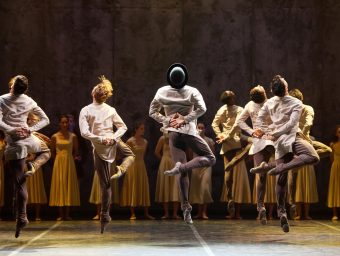
Khan’s concept takes the romantic ballet of 1841, peasants and aristocrats in a mediaeval Rhineland, into a much more totalitarian world. In Act I, the class divide becomes the physical barrier of the wall; the vicissitudes of the harvest becomes the factory closure; the gamekeeper, Hilarion becomes a predatory overseer; and the disguised grandee Albrecht becomes a 21st Century HRH mingling with the masses. Act II remains ethereal, but the forest glade haunted by Wilis, the spirits of jilted brides, becomes a ghost factory populated by the malign spectres of women workers killed in industrial accidents; while Myrtha, the Queen of the Wilis, becomes even more merciless and vindictive.
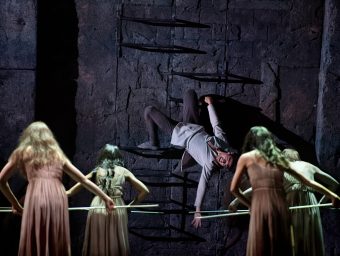 The hard-edged approach to the concept allows for an expansive mixed palette of choreography. It is percussive at its opening, then broadens to show the migrants’ plight through the metaphor of the movement of fleeing animal herds. The palette ranges from hints at the popping and locking of hip-hop to the more fluent forms of folk-dance. The lyrical pas de deux are pure classical ballet, and in Act II Khan, very atypically, uses extensive pointe work. In fact, the corps de ballet spend most of Act II en pointe, increasing the demands on them in an already difficult ballet. But the effect is mesmerising, as they move in numerous pas de bourrée, fluttering across the stage with a fragile lightness. However, Khan’s Wilis are far from fragile, they are terrifying! They goad Hilarion viciously to death, are unremitting with the pleading Giselle, and abandon a broken Albrecht with a chilling heartlessness. Moreover the Wilis come armed, literally to the teeth, with slender rods, symbolic of punishment and of authority, but these have been the battens of the dilapidated power looms. Their ensemble entrance, with its accompanying music, is a recreation of the working factory loom: a brilliant double edged metaphor.
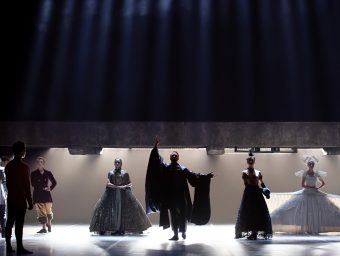
Lead Principal Fernanda Oliveira as Giselle dances with a light and delicate liquidity, the character’s naivety overshadowed by her hopeful and loving nature: a joy to watch. Giselle has fallen in love with the noble-born Albrecht, who has infiltrated the Outcasts in disguise. Aitor Arrieta makes an imposing Albrecht, bringing something of his native Basque country’s fire and determination to his unflaggingly energetic dancing. Their wooing scenes are full of tenderness.
The lovers are however thwarted by the cunning Hilarion, who also has designs on Giselle, which go unrequited. Hilarion, as the de facto go-between for the Outcasts and Landlords, is an ambiguous presence, hunting with the hounds and running with the hare. Khan describes him as “a shape-changing fixer”, lining his own pockets. In the role of Hilarion, Erik Woolhouse fills the part with a muscular athleticism, aerial yet grounded at the same time. Woolhouse is a remarkable dancer with enormous potential. (He was awarded Young British Dancer of the Year when still student.)
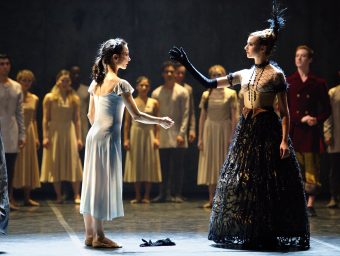 The sudden arrival of the Landlords, announced by a broken factory hooter, is a moment of remarkable theatre as the massive wall pivots and we see its gold-plated far side. Their entrance is stately, glamourous yet unnervingly bizarre. Amongst them is Bathilde, the heiress daughter of a duke, to whom Albrecht is betrothed, and Albrecht is exposed as a duplicitous two-timer. Giselle recognises Bathilde’s evening dress, a (not-so)-little black number, as her own handiwork. Bathilde’s reaction to the hurt Giselle feels is one of pure distain. Stina Quagebeur as the aloof Bathilde certainly knows how to put across an emotion by pure body image. She peels off a long formal glove and, before Giselle’s eyes let it drop on the floor. When coerced to choose, Albrecht takes money and status, rather than love and fidelity.
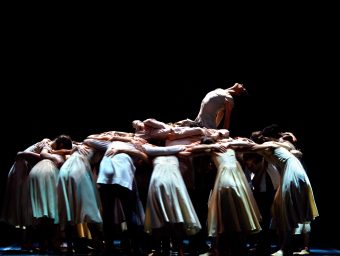 Khan’s Kathak style elements come into their own in the inactions of empathy of the Outcasts to Giselle, at first in the vibrant dance patterns as they rejoice with her in her finding love with Albrecht and now in a swooping whirl of sympathy with the distraught Giselle. As an ensemble, the Outcasts spiral around as one protective organism as she succumbs to death, traditionally of a broken heart, but here aided by a mimed overdose. The undulating whorl is a visually powerful image of the embrace of love in death.
The different feel of Act II is powerfully enhanced in this Giselle, as the corps de ballet transmogrify from the supportive but downtrodden Outcasts into the vengeful and implacable Wilis. Isabelle Brouwers’ Myrtha, the Wilis Queen, fairly drips with malice and callousness, exerting her unbending control on Giselle, truly the psychopath to make you shiver.
Giselle may be pliant to the whims of successive choreographers, but Khan’s radical retelling has already set itself as a definitive modern version, as powerful as it is memorable.
Nevertheless, one need not take a mere critic’s view. At the Saturday matinee, which this critic attended, a couple leaving after the final curtain were overheard: “I’d like to see that again”. “So would I: let’s go to the box-office to see if they have any tickets for tonight”. I was tempted to join them.
Mark Aspen
September 2019

 Mark Aspen