
Love rarely tells its truths directly
Much Ado About Nothing
by William Shakespeare
Shakespeare’s Wanderers, St George’s Gardens, Bloomsbury, 22–26 July
A review by Matthew Grierson
There’s a moment in Shakespeare’s Wanderers’ Much Ado when you can see how effortless the six-strong cast have made it. Having caught our attention from the first with a natural but audible manner that successfully competes with passing pedestrians and planes, Claudio, Don Pedro and Leonata deliver their dialogue with just that bit extra, convincing us that they’re playing not only to an audience of summer-evening picnickers but the supposedly hidden Benedick as well, secreted cartoonlike against a tentpole a tenth of his diameter.
Their connivance is no more contrived than Benedick subsequently binding himself in bunting as he tries to avoid their gaze, an episode that, along with the parallel scene in which Beatrice is likewise gulled into love, show the light-hearted liveliness that the Wanderers bring to the Bard’s timeless comedy. They give clear expression to its perfect pattern, in particular the way it demonstrates that love can rarely tell its truths directly and that anything presented straight is probably a lie. When Benedick says ‘there’s a double meaning in that’, it’s one of few lines that does not itself have a double meaning.

As our leads, Mark Rush and Tara Dowd are a fine pair – an airy B&B, you might say. Rush’s long, expressive face projects his reaction as capably in silence as in speaking, and he makes the masterful switch from screwball comedy to solemnity when drawn into conflict with Claudio. Dowd meanwhile is a sparky Beatrice, and the couple sustain a convincing chemistry throughout. Their relationship, which describes an arc from pretended hate into true affection, is counterpointed by that of Julia Parlato and Philip Honeywell as Hero and Claudio, who instead move from love to hate and then to marriage. Both the latter come across as more mature than other versions I’ve seen: although Hero definitely benefits from this, it does mean Claudio can seem more dogmatic than ingenuous when suspicious of his fiancée.
The mood of the play is largely that of a balmy, nay, blazing summer evening in the urban heat island, even though the production has transposed the scene from Messina to Dover, with the consequent loss of a syllable from the verse. In fact, recurrent imagery of the seasons – Beatrice’s protests that she will not love until a ‘hot January’, or Benedick’s that her fury exceeds her beauty as much as May does December – warrant an ironic nod of recognition in our rapidly changing climate.
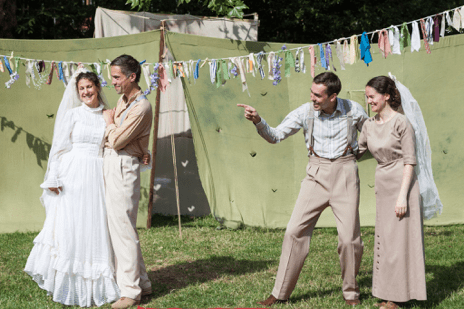
Whether intentionally or not, the play often acquires more resonance this way than it does from being set after the Great War. Songs of the period add a jolly touch to the dance scenes but there’s little hint of late autumnal gloom about the piece, and its relocation would feel curious were it not so buoyantly directed and ebulliently performed.
Against a khaki canvas that suggests a village summer fete as much as a military camp, the cast move with rhythmic, seamless ease between one scene and the next, and often between one part and the next along with the necessary costume change. Ben Higgins retains a sense of benign authority as Don Pedro, Sexton and the Watch despite his changes of hat, but pity Rebecca Peyton in a succession of Georgian blouses and crinolines: in the regendered roles of Leonata and Donna Julia, she has to switch frocks with unenviable speed, and if she’s suffering in the heat she doesn’t show it.

In keeping with the dualities of plot and dialogue, the production makes wry use of doubling among the cast, so ne’er-do-wells Donna Julia, Borachio and Conrad are no sooner done plotting than the actors reappear in the subsequent scene as Leonata, Hero and Beatrice, denouncing their wicked counterparts. Special mention, too, to Parlato, who as Borachio and Hero manages to be both villain and victim in the same scheme.
In other respects that scheme is not so cleverly executed; the point where Claudio is tricked into thinking his beloved is being seduced should pivot the play into tragedy, but unfortunately the moment is dispatched so quickly that it is lost, the comedy of Dogberry and Verges following hot on its heels. Similarly, Beatrice’s command that Benedick kill Claudio should merit at most a nervous titter, not the big laugh it gets tonight.
As the play moves into its tricky second half, though, these more serious undertones come to the surface, and in a world where as much authority is vested in ladies as in lords – with a syllable thereby restored to the verse – gender politics can’t help but be more apparent either.
For instance, Claudio seems more remorseful when he learns he has been tricked than he does when, taunting Benedick, he hears of Hero’s death, as though his code of honour is more important than the life of his fiancée. After this, Leonata’s insistence that he marries Hero in the guise of her cousin looks more like a punishment for bride than for groom. Indeed, the way patriarchy pervades the minds of men and women alike is strikingly evident when Hero is denounced by a Leonata rather than Leonato.
So perhaps here the postwar setting does resonate in the trauma of those who have lived through it, and want to assert an old order to prevent further conflict. To be fair, though, there is always the promise of sunnier days to come – a promise that the Wanderers keep alive even as the sky darkens over St George’s Gardens.
Matthew Grierson
July 2019
Photography by Chris Marchant
Deadpan Bedpan
Bed 13
by Marcia Kelson
Putney Arts Company, Old Sorting Office, Barnes, until 19th July
Review by Vince Francis
My mother was a nurse. She arrived from Ireland during the last war to train and dealt mainly with airmen and some mariners. After we had all grown up a bit (there are six of us), she returned to nursing as a dental nurse in the outpatients department of the local teaching hospital. This wasn’t as mundane as it might sound as she was occasionally involved in supporting the A&E teams’ work with survivors of road traffic accidents, fights and other traumatic events. It wasn’t unusual for her to come home having assisted in stabilising the facial injuries of some poor sot who had come off his motorcycle (and yes, it was usually a he and yes, it was usually a motorcycle) so that the trauma team could focus on other priorities. Also I think it’s fair to say that most of the issues explored in this piece are familiar to me as a result. I offer this information as I think it’s relevant to declare I have a particular interest in Putney Theatre Club’s production of Bed 13.
This is a new piece, written by Marcia Kelson, who also directs. The play has been entered for the Papatango New Writing Prize and has been long-listed as a result. For those who may be unfamiliar with this prize, it was established in 2009. It was the first and remains one of the few annual playwriting award in the UK to guarantee an emerging playwright a full production on the professional stage. It provides a royalty of 10% of the gross box office and publication by Nick Hern Books, as well as a full commission to support a follow-up play.
Putney Theatre Company (PTC) is normally associated with the Putney Arts Centre, so they are playing away here, and making a pretty good fist of it.
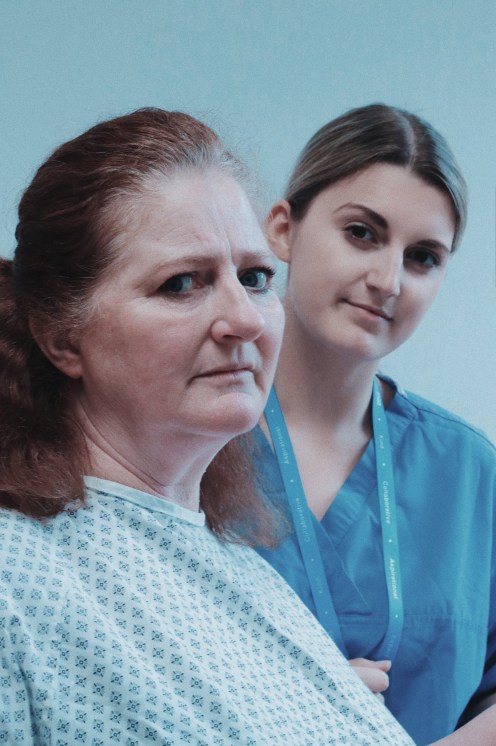
I’m sure that many of us are familiar with the problems and issues facing the NHS and offer opinions and solutions in the abstract. The advantage of a play, or film, or television programme is that it can set those discussions in the context of real people and the effects on them. This script has great strength in this respect. Marcia Kelson draws on her experience as an NHS researcher to provide characters that are well drawn, believable and developed throughout the play, as are the situations they face.
As we enter the auditorium, we are soothed into our seats by the playing of Samuel Woolf, offering such arch references as The First Cut Is The Deepest and I’m No Superman, which was the theme from the American hospital based comedy drama TV series Scrubs. But it is the theme from our own Casualty that acts as the figurative curtain-raiser and introduces us to Angela, an NHS manager who implores us to make proper use of A&E and not take up time with cuts and bruises or sniffles and coughs. The opening number, The 999 Song, serves to underline this plea and introduce us to a well-drilled ensemble.
Angela, ably presented by Caroline Salter, comes across well as someone who is trying to access and present that breezy efficiency that we all love to hate, but who is actually hanging on to any positivity by her fingernails in the face of conflicting demands that threaten to overwhelm. These demands are, of course the huge call on services by the public, diminishing resource levels and increasing management demands. As a result, Angela becomes an altogether more sympathetic character. Angela also addresses us directly on occasion to provide relevant information.
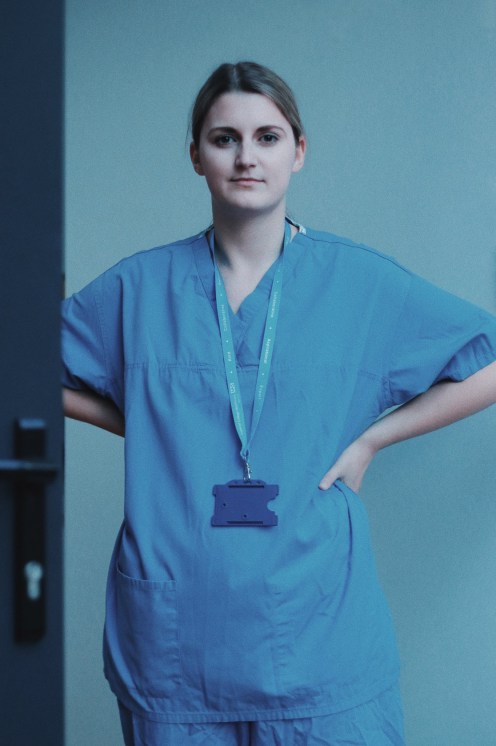
We are then introduced in short order to nurses Stacey (Emma Bugg) and Carol (Tamsin Gatewood), together with patients Mr Jackson (David Jones) and Graham (Tim Iredale). Mr Jackson is in the middle stages of dementia and is looking for his wife, who in reality has died some time previously, whilst Graham takes on the role of the ward jester. Both are familiar characters and in the case of Mr Jackson, sadly so. I wondered briefly whether this device of looking for his deceased wife was going to slip into a form of Carry-On standing gag, but it didn’t. It rightly emphasized the pathos of the situation. The character of Graham is interesting in that his storyline points towards a resolution that doesn’t occur. As such, it is more reflective of the random elements of diagnosis and treatment.
Stacey and Carol are a great pairing. The conversations between colleagues provide the opportunity to point up the front-line issues facing nurses and their overriding vocational dedication. The one element that is not referenced, I think, is that of violence towards A&E staff. That aside, the dialogue and interactions and emotional responses all felt natural and realistic. Both sing well, too. Their duet, Nurse Patient Note Song delivers a witty and insightful observation and demonstrates a well-balanced musicality.
Other notable performances include the aforementioned David Jones in a second role as Doctor. Rachelle Grubb as variously Susie, Alison, Sophie or Janice, where each character was distinct and defined and even her appearance and physicality changed to suit. The costume changes must be a nightmare. Also, Craig McAulay playing Clive, the sort of manager one would never get tired of slapping.
The scope of the piece is fairly wide ranging, including the effect of chronic illness on relationships, particularly family relationships. There are two key instances of this; one with Mr Jackson’s daughter, who is rather self-obsessed and materialistic and the other with a mother and her adult daughter, who has a recurrence of a cancer. This last, although it was well acted by Lesly-Ann Jones and Rachelle Grubb, felt a bit laboured in contrast to the pacy coverage shown up to that point. It may possibly benefit from a bit of tightening up in the writing, or the inclusion of a song, such as Alison and Mr Jackson’s duet, Alison’s Song, which occurs later in the piece.

Overall, I found this to be an engaging, entertaining and interesting exploration of the current state of the NHS. The action moves through comedy, sometimes the black comedy that is the means by which front-line staff deal with these situations, to pathos, to tragedy, in the death of a patient and the reaction of staff to it. The woman directly behind my partner was living through it and, rightly so. I would openly admit to welling up at the death of one of the patients. There is also a treatment of the growing corporate nature of the NHS and the politics within it.
Musically, the numbers felt appropriately crafted into the action and dialogue. The chorus numbers work well and there are some lovely duets, Carol and Stacey as already noted, but also Graham and Doctor in a glorious soft-shoe routine, Doctor-Patient Song, using crutches as walking canes – well, you would, wouldn’t you? I didn’t come out humming anything from the show, but that could be said of many a show I have enjoyed. Sometimes, the music works intrinsically for the piece. Geoffrey Hewitt’s score fulfils that requirement and that’s perfectly OK.
The choreography suited the space and the cast and that is the sign of a mature and considered approach in my humble opinion. If people look comfortable with what they are doing they come across so much better than if you can see the panic in their eyes. My current exemplar of this approach is Come From Away.
Other stand out points for me were:
The programme. Succinct, informative and comprehensive. Take a house point. But please, please, please include a list of the songs and characters singing them.
The baritone voice of David Jones and the lovely Mezzo/Alto voice of Tamsin Gatewood are both worth a hearing in their own right.
The use of set and lighting. In a small space like the OSO Arts, any crew intervention is noticeable and this production avoided that by blacking out areas not in use and using bed screens to mask upstage changes made by the cast. This keeps the action moving.
If I were able to offer a couple of touches at the elbow, they would be:
To the cast; relax and let the script and characters take you on the journey. The audience will come with you. Having said that, I appreciate this was an opening night and I’m confident that this cast will settle and shine.
To both the cast and tech crew be prepared for the bounce at the bows. This is good and it deserves one.
A minor irritant was that the electric piano had too much bass in it. This may be due to a heavy left hand, or it may perhaps be an EQ issue, but solo and duet voices were sometimes lost, particularly when temporarily facing upstage. It may be that this was not apparent to Samuel Woolf, who is an excellent player, as the amplifier was angled – rightly so – on stage. It just needs someone to listen from the auditorium to check.
Bed 13 refers to the practice of not having a bed number 13 in an A&E department, as it might be considered unlucky. With this crew, I’d risk it. I think I’d be in safe hands.
Niggles aside, I’d thoroughly recommend this production. At eighty minutes, there’s ample time to meet and greet after and that is an added bonus.
Vince Francis
July 2019
Photography by Benjamin Copping
Much ado about seeing this play!
Much Ado About Nothing
by William Shakespeare
Richmond Shakespeare Society, The Fountain Gardens, Twickenham until 20th July
A review by Viola Selby
2019; the 100th anniversary of the first female MP in the House of Commons and so far a year with a lovely sunny summer! What better way to spend it then with a picnic watching Fiona Poole’s exceptional and female focused rendition of Shakespeare’s Much Ado About Nothing. But how, you may ask, can one celebrate such a political anniversary through such a light-hearted comedy, written in a time where women had little if any political power? Well, Poole has managed to cleverly set her play a century ago, during the suffrage movement, with characters dressed in period-perfect attire, creatively crafted by Junis Olmscheid, Miriam King and John Gilbert. Along with the stunning, yet minimalistic set design, realised by Junis Olmscheid, Ron Hudson, Peter Messum and Fiona Poole, this play is both a feast for the eyes as well as the ears! There are also some toe-tapping musical numbers that bring the period even more to life, thanks to the maestra in charge of sound design and composition, Sarah Hill!
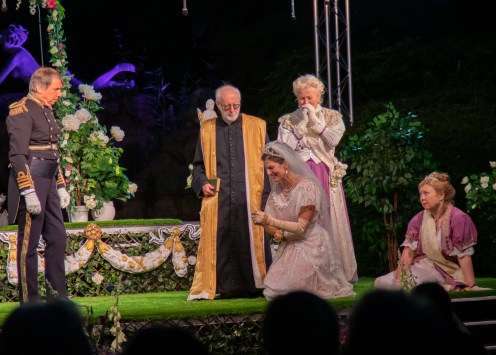
In addition to this, Poole has also chosen a powerful cast, each of whom shows an extraordinary level of performing expertise through their clear understanding of their character. For example, when Leonato’s daughter is shamed in front of everyone at her wedding, having been accused of sleeping around with another man who is not her betrothed, Vaughan Pierce, as Leonato, does not just fly off the handle at his daughter, but instead portrays a man who is a mixture of emotion. He is both shocked at this claim, furious by the shame it has brought his family and also upset due to the effect it has had on the daughter he loves so dearly.  As well as this, each thespian delivers the lines with such passion that they will have you sitting on the edge of your seat (or rolling on the grass) with laughter. This comedic element is especially true when Benedick and Beatrice are on stage. Francis Abbott (Benedick) and Dorothy Duffy (Beatrice) make a sublime double act, whom one may think are an old bickering married couple, when in fact the pair cannot stand one another yet later end up marrying one another! Whilst Ben Collingwood Best and
  Deborah Tinsdale will have you in stitches as they create an almost Laurel and Hardy – esque portrayal of an officer and his second who manage to catch Conrad and Borachio, played by the craftily cunning Francesca Ellis and Dominic Upton, in their plan to ruin the forthcoming wedding. It is a plan devised by the evil Princess, yes you read that right – a brilliant change made by Poole to focus the play on the power of the females, Donna Julia. Nicola Doble’s portrayal of Donna Julia is villainously victorious, as she uses both tone and body language to create a socially cunning classist whom no one would expect. Finally, this play would not be the same without Claudio and Hero, one of our main couples involved in both the weddings and “funeral”. Matthew Tyrrell is regal and upstanding in his depiction of the Prince’s favourite, and his chemistry with Héloïse Plumley as Hero passionately breathtaking, even though Plumley manages to create a character that is demure and gentle.

Altogether the cast and crew have given new life to this play and have made it their own. If you are a Shakespearean fan or completely new to the bard, there is much ado about seeing this play! A magnificent way that celebrates the skill of Shakespeare whilst also paying homage to the wonderful wit of women!
Viola Selby
July 2019
Photography by Simone Best and Sally Turnstill
Chain Drive: a Deportational Road Trip
Lunatic 19’s
by Tegan McLeod
Gangway at the Finborough Theatre, Earl’s Court, until 3rd August
Review by Eleanor Lewis
Opening a review with “In the present political climate…” is probably unwise at the moment. I’m calculating the amount of readers likely to roll their eyes and move onto less exhausting things, tennis perhaps. But let’s live on the edge!
In the current political climate there is much mileage to be got from, well pretty much everything really, the deportation of undocumented immigrants in the US being just one of many controversial themes around which to weave a drama. ICE (Immigration & Customs Enforcement) raids are due this weekend in the US which makes Lunatic 19’s timely to say the least.

This two-hander at the Finborough Theatre in Earls Court tells the story of Gracie, an undocumented immigrant, and Alec from ICE who has arrived at her hospital bed to deport her forcibly back to Mexico. Gracie has lived, worked and filed her taxes in Kentucky for twenty years, she’s recovering from a car crash with significant injuries and wearing a head brace. Nonetheless, she is handcuffed and put into a van, to be driven by Alec out of the country.
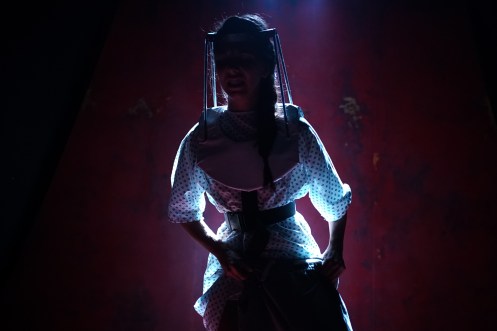
What follows, from the road trip narrative point of view, is fairly predictable. These two characters develop and interact in the way you might expect them to. It is almost The African Queen in a Van. Devon Anderson does a lovely job as Alec from ICE. Alec is a character forced by family circumstances to do a job he despises, but with enough self-respect to do it professionally. Every part of this man’s personal struggle is visible, you feel for him and you respect him despite his job.

Gabriela Garcia arguably had the bigger challenge playing the strong, stroppy, no-push-over Gracie. Strong women shouldn’t have to be endearing, nor should you need to make them endearing for the sake of a drama. That said, playwright Tegan McLeod has in fact written a witty, sarky, funny (and strong) character, and she’s funny from the start, but this I know because the programme contains the script. This is how Gracie has survived, she has entertained, she has made people like her or laugh with her and thereby got what she needed. But either by direction, or by playing, Gracie’s wit took time to show itself. She was loud and she was taking no nonsense, but the fully rounded clever, witty character Gracie is didn’t register for quite a while, which was a shame. Strong women are understandably ‘hot’ at present, but there are many types of strong, ‘loud’ is only one optional element. Once fully established however, Gracie was a warm, inspiring, spiky presence on stage.

The Finborough Theatre is an ideal space for this intense drama. The clever use of the small stage together with Kevin Treacy’s lighting and Edward Lewis’ sound created both the institutional glare of public buildings and the soothing calm of the sea, transporting the audience with Gracie and Alec along their journey.
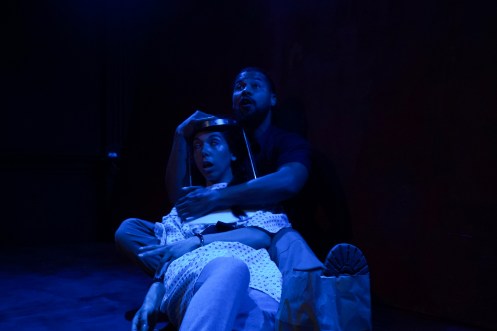
Tegan McLeod’s new play is an interesting journey through a number of themes: the state of play on immigration in the US raises questions about who belongs where, what qualifies them to belong and who decides. Alec himself is an immigrant but he has documents. Alongside this is the question of new beginnings. Gracie has difficulty with pregnancy, she has miscarried more than once but there is perhaps the promise of new life again. The significance of the title I will leave to be discovered by the next set of audience members. This is a smart play, efficiently performed and providing food for thought for a 21st century audience.
Eleanor Lewis
July 2019
Photography by Marian Medic
Regimented
Delivery
by Andy Walker
Barnes Fringe Festival, OSO Arts Centre, 11 July 2019
A review by Matthew Grierson
If many people’s experience of delivery is a long wait in for a pizza, then it’s no surprise that Delivery is such a pacey production – it clearly wants to avoid having to give us the free garlic beard.
The speed with which Andy Walker’s script cuts from one scene to the next as expectant father Joe (Alex Walton) recounts his life story is fitting given the character’s former life as a squaddie, and the production is so well drilled that you’d think Lesley Manning were more sergeant major than director. It’s doubly impressive given that only last week this was a rehearsed reading: not only dialogue but action and lightning move so swiftly and effortlessly tonight that I couldn’t help being caught up in it.
Walton remains present onstage throughout and delivers a nuanced performance that conveys Joe’s self-doubt, rage, fear and charm, slipping seamlessly between narrator and participant in his own story. The comic self-deprecation he deploys to woo wife Angela is just as effective and affecting as the rawness of his terror when deployed on active service.
Lizzie Aaryn-Stanton is likewise engaging as primary school teacher Angela. She’s a humane and compassionate counterpoint to Joe’s troubled masculinity, no more so than when her journey to assembly with her class is juxtaposed with Joe weeping over the corpse of a fallen comrade in the foreground. Yet despite this contrast there is still a genuine, touching chemistry between them, as seen in their first meeting at a football match – never has talk of the offside trap been more sexually charged.
If anything, Aaryn-Stanton is under-served by a show whose focus is very much on masculine identity. Certainly Walker’s script is interested in exploring the contradictions and frailties of masculinity that are intensified by military experience, and is justly angry about the treatment of former servicepeople. Nevertheless, these concerns are worked out of a stock of blokey tropes including football, beer and nightclubs that seem as generic as the unnamed blue and white team that Joe and Angela support, tropes that especially in the first half are played for laughs.
This makes Joe’s deployment to the Falklands a sudden and specific about-turn. The show benefits from the detail and context this gives, but nothing so far had suggested it was set in any time other than the present, or warned that it would be venturing beyond wry comedy. Even on the battlefield the jokey asides continue, making Delivery feel like a lighter piece than it should be by rights.
To earn our full engagement with Joe’s plight, the show could create more sense of jeopardy around his mental state. As it is, he kills an officer in one scene and is acquitted in the next; similarly, an implausible war crime committed by his chaplain is mentioned briefly and then not referred to again. Although the consequences of both play out later, the narrative of redemption is so far advanced by this stage that it’s clear the play is hastening towards a happy ending – handed his baby daughter, Joe quickly abandons thoughts of suicide. Taking the time to dwell on the trauma of war could have given more opportunity for legitimate discomfort and deepened our sympathy with Joe’s situation.

All the same, the momentum prevents us from lingering too long on these missed chances. In this the play is ably served not only by the energy of the two leads but also Gordon Peaston and Louis Davison, who each take on an impressive array of supporting characters. Peaston begins as a succession of stock authority figures – judge, teacher, sergeant major – enlivening them beyond sitcom stereotypes, before turning in a sensitive and insightful portrayal of the padre from whom Joe seeks support. Just as versatile, Davison offers us a posh officer and a light-fingered youth as comic turns, as well as the more sobering vision of an Argentine prisoner whose drowning drives Joe to murder.
Between them, Peaston and Davison also bring to life a veritable bestiary of hallucinatory animals, highlights being Peaston’s camp slug, Davison’s philosophic sheep and a laconic fruit fly. The switches of mood and manner in each case are total and convincing, set off by the simple addition of headgear or other costume flourishes.
That it’s possible to conceive of a show that deals with PTSD and gay gastropods and bring it to a happy ending without it coming across as silly or trite is a function of Walker’s well-crafted script. Although it focuses more than it might on maintaining momentum, it attends to the detail in dialogue that fleshes out characters as well as demonstrating an admirable command of plot. In this much, Delivery delivers.
Matthew Grierson
July 2019
Photography courtesy of OSO Arts Centre
Lasting Gift of Comic Verse
Remembering a Poet
Performance Poetry, The Adelaide, Teddington, 7th July
Review by Celia Bard
The July meeting of the Poetry Performance Group was a poignant occasion following the tragic, accidental death of co-founder, Bob Sheed. Joint co-founder, Anne Warrington, opened the evenings programme by recalling the formation of Poetry Performance and Bob’s influential impact on the group. She followed this with readings including Address Book by Maggie Butt, who reflects on the dilemma of what to do with names written in an address book once those people have died.

Robin Clarke presented his own moving poetic tribute to Bob, providing a moving brief biographical account of many aspects of his life. On a lighter note was the reading of I’m a Little Teapot, taken from Bob’s collection of poems, It’s Not What You Think, a tongue in the cheek reflection on changing social habits and etiquette. Graham Harmes then performed another of Bob’s numerous humorous poems The Lawyer, a poem that beautifully demonstrates Bob’s talents as a wordsmith, and how highly articulate people can use words to manipulate and outmanoeuvre people.
In contrast Judith Blakemore Lawton delivered Bob’s parody poem Unstoppable, a new twist on the Dutch story of the boy who plugged the hole in the dyke with his finger. In this version his efforts are rewarded with a good walloping from his father. The first half of the evening concluded with Keat’s Ode to a Nightingale, splendidly read by Ann Vaughan Williams, bringing the group back to the reality of contemplating Bob’s sad death.
Heather Montford, our MC for the evening, opened the second half with her poem No Golden Glory, the last line resonating with Bob’s work that like the chestnut tree, it will survive. Breaking the mood was Tony Josolyne’s delivery of his poem The Casting Couch, a humorous warning to those auditioning for theatrical, TV or film roles. The next performers were Vicki and Chris Naylor. Vicki gave us her shortlisted poem Another Time from the Roger McGough competition and printed in the Arts Richmond About Time anthology, a poem alive with fiery images, whilst Chris amused us with his rendition of Bob Sheed’s Gender Balance in which Golom, the hermaphrodite, thinks he had the right to use both the Ladies and the Gents toilets. Stephen Harman then gave us his historical I See No Ships, a reflection of Nelson’s last battle, cleverly written in rhyming verse. Following this was Barbara Lees self-reflective poem: I See Myself – What Do I See, a refrain that was echoed throughout each of the stanzas.
Steve White read two poems written by his late wife, Frances: Pink Fluff and Red Hat Band. These two poems seemed so appropriate to the occasion – particularly poignant as Frances only died a few months ago and regularly attended Poetry Performance sessions. In the same vein Carol Wain presented The Planting of Trees in Southern Scotland, a poem from her poetry collection More Poems for Alice, inspired by the loss of her much loved, gifted daughter who was killed in 2000. Heather Montford concluded this somewhat reflective session with Fallen Leaf.
Although the subject matter of the evening was greatly influenced by memories of Bob Sheed and others who have departed this life, the prevailing mood was uplifting, brought about by the humour in many of Bob’s poems. Members of Poetry Performance were as much celebrating his gift of comic verse and laughter as his sad loss.
Celia Bard
July 2019
Photography courtesy of the Bob Sheed estate
Pacing, Pursuing and Passion
Summertime Soirée
with Amy Gould and David Harrod
Garrick’s Temple to Shakespeare, Hampton 6th July
a review by Ian Nethersell
A musical journey through time and style, past and present with some familiar favourites and some new discoveries …
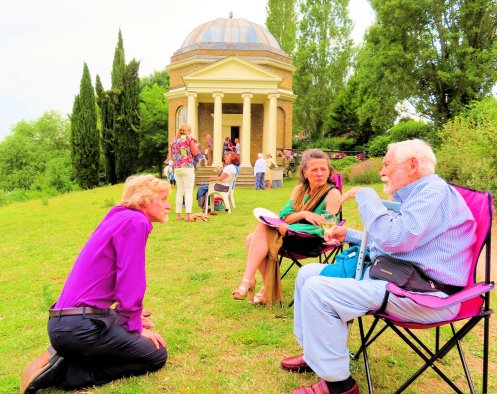
On a balmy summer’s evening on the banks of Old Father Thames we found ourselves lounging alongside a Grade 1 listed folly in Hampton. The Garrick Temple was built in 1756 as a tribute to a certain Mr William Shakespeare by the actor David Garrick, who made his name and success performing the works of the previously mentioned playwright in this, the perfect setting for some magical mid-summer happenings – and what a magical evening it was.
The history of chamber music stretches back to medieval times and as our talented duo opened with the melodic B aroque sounds of Bach, in this setting it was very easy to imagine and experience how it might have been in the Georgian era, sitting in the parlour of a fine house listening to music being performed by a small number of musicians. I was transported by the smooth and flowing bowing of a cello whilst enjoying the authentic sounding representation of a harpsichord from David’s modern keyboard. Amy beautifully demonstrated the emotional range of her cello and Bach, journeying from a smooth, flowing legato into a bright skipping pace building to a strong allegro and ending with a restrained, almost tortured emotion straining to burst forth which I felt viscerally. And I always thought Bach was boring!
Following on with a theme of discovery, I was introduced to the work of Astor Piazzolla and his very appropriate piece A Midsummer Night’s Dream. The jazzy, almost Scott Joplin-esque style engendering the passion and fire in the Latin American people, and closing my eyes, images of people dancing the tango through the streets at Mardi Gras flooded my mind and filled my body as I felt myself swaying in my seat, struggling to restrain my fire. This fusion of jazz and classical styles was echoed in the conversation between the keyboard and cello as they performed their own dance, a connectedness and yet a separation which culminated in a pacing, a pursuing, a passion which may devour, fear yet excitement.
Continuing our journey towards the interval, Amy took us Sailing down the River in an effortless display of dexterity and technique, encompassing the multi-note, multi-style and multi-tonal playing required in Aaron Minsky’s Journey through America represented in etudes by the styles and themes of music evocative of an area.

The second part of our evening opened again with Bach, his Sonata in G Minor. Amy seemed to take a while to get her fingers in flow but once there she was able to again demonstrate her dexterity and ability to create images. The first movement, flitted like two bees independently buzzing about on their own business, never resting, until the second movement where smooth legato engendered some rest and an almost internalised place. This was felt not only by Amy’s flowing technique but by a complete embodiment. It was a joy to be able to witness a musician so completely at one with a piece. In the third and final movement the pace quickened again and with it a form of conflict but without aggression, a conversation between light and dark, love and hate, joy and sadness. As the opposites drifted apart in the final moments there was tenderness, a coming together, a unity, an acceptance.
 David then played a small interlude, Le Cahier Romand #3 by Arthur Honegger, another discovery for me which I have since become acquainted with. David played for himself, not for performance, not for ego, but for pleasure, and then it struck me, something I had always known but never realised; it is impossible to play music without emotion.
Throughout the remainder of the evening Amy and David continued to conjure pictures and feelings. The audience felt wonderment at the skill displayed in the incredibly difficult Fantasy by Anton Hegner which requires contrasting bowing and picking, through the evocative Harlem Nocturne by Hagen and Dick Rogers with images of a laid-back 40s strolling through Central Park. Molly on the Shore by Percy Grainger, a favourite of mine, had great energy and invoked images of a maiden dancing freely over the fields and glens echoing the unrestrained freedom of the wind and spirit as it dances through the trees and across streams.


The final piece of the evening was a deeply rich and full embodiment of Summertime, the enduring standard from the versatile genius that was George Gershwin, our musicians managing to capture and convey the richness and emotion.
Rather than leaving on a dour note though we were given yet another Gershwin to see us home. I Got Rhythm, full of life and vitality, giving us the boost to skip home! On this enjoyable evening our duo definitely did have rhythm, and skill, and passion, a passion that was also shared and conveyed by the welcome and care of the custodians and volunteers of Garrick’s Temple.
Ian Nethersell
July 2019
Photography by Alison Gibson and Lewis Lloyd
Tough Journey of Self-Discovery
Blood, Sweat and Vaginas
by Paula David
Barnes Fringe Festival at OSO Arts Centre, Barnes until 9th July
A Review by Celia Bard
The Barnes Fringe Festival is now in its fourth year. An integral element of the Festival is its support in the development of two brand new plays. The play, Blood, Sweat and Vaginas, written and performed by Paula David is one of the two winning entries selected to be developed, refined, and performed over the course of the Festival. Performers are given the opportunity to perform their show twice, once a sneak view into a work-in-progress of the production using audience response to help in refining performance, and again as a fully, developed, and workshopped show.
One of many distinguishing features in Blood, Sweat and Vaginas is the sparse use of props. In fact, Paula David as Carolann doesn’t use them. She relies entirely on voice, physical movement, mime, song and one isolated chair, which is moved just once throughout the production. Carolann doesn’t direct any conversation to the chair, it is just there. The audience is left to interpret its symbolism, though at the end of the play its symbolism becomes clearer. To provide an interpretation in this review risks the danger of spoiling the end of the play, so this reviewer will refrain from doing so.

Blood, Sweat and Vaginas, a monologue play, runs for about an hour. Paula David is just superb as Carolann, the main character, who invites the audience to follow her on her path of self-discovery. With her we learn who she is, meet some of the main characters in her life, share her pain and discomfort, laugh at her jokes, respect her honesty, and admire her ability to burst into song whenever her feelings threaten to overwhelm her.
Carolann is an intriguing and fascinating character, shrouded in self-doubt, but with an air of mystery about her. She oscillates between loud, outrageous, shocking behaviour to moments of intense introspection about her relationships with men, her daughter Tanya, and her inability to make love without feeling intense vaginal discomfort. Suffering from atrophic vaginitis she only slowly realises the nature of this condition, which makes the act of love such a painful one. She states that she she is not frustrated, only puzzled, and it certainly does not stop her from being sexually aroused.
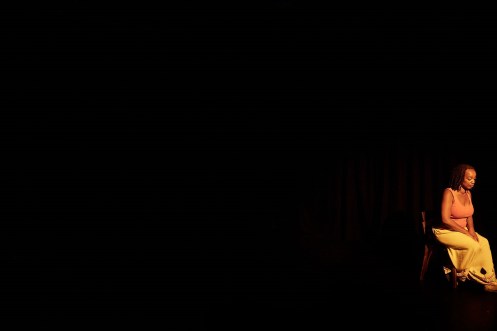
Her journey of discovery begins at the age of sixteen, her GCSE year. The dialogue here is characterised by a mixture of nervousness and humour. We follow her through the complexities of her life. Her first attempts at singing are hesitant although Paula David does just enough for the audience to realise that she is a performer with a rich, punchy but melodious voice. Continuing this journey of self-discovery, we learn about Carolann’s insensitive husband and marriage, motherhood, divorce, boyfriends, the lonely years, the painfulness of her condition, and eventually reconciliation and resolution.
During the play Carolann often refers to a character called Shelly. Who Shelly is doesn’t become clear until the end of the play, but she is certainly somebody Carolann knows extremely well and feels very close to. Shelly’s name and the snippets of sung music lines throughout the play act similarly to motifs, repeated word and musical phrases that contribute to Carolann’s moods. For example, the sung lines, “finding yourself,” “I don’t know why,” “being put down,” are delivered when we learn from Carolann that her husband has had an affair with another woman, Tracy. “Don’t know me,” and “sexy bitch,” are other phrases that are heard again.

This play demands a great deal of an actress in terms of physicality, mime and vocal range, and Paula David doesn’t disappoint. Her miming of intercourse with Jacob is strongly physical but is not obscene. At other times she throws herself on the floor with complete abandonment as when she trips on the dance floor and lands on a male figure, very much enjoying the proximity of his maleness. We meet a number of different characters on Carolann’s journey and Paula David succeeds in making them very real.
Against this backdrop of sex, song, laughter, physical action, there are quieter moment, times when Carolann is more reflective and when we learn more of her inner thoughts. Here she breaks the fourth wall and directs her observations to the audience. She manages to do this in a way that is conspiratorial, there is no sharp break between her engagements with other characters and chats with the audience. During these moments the audience get insights into her vulnerability.
The final encounter in this monologue is Carolann’s exchange with her daughter Tanya, whom she thinks may be gay. She thinks this because of their inability to easily communicate with each other. Realisation occurs when Tanya hands Carolann a bunch of flowers. The audience learn that Tanya is very supportive of her mother during anniversaries of a very sad event in Carolann’s life. Tanya is not gay; she has a boyfriend but can never find an occasion to tell her mother about him. The play ends on a strong note of hope and this is symbolised by Carolann and Tanya making pancakes together.
I wish Paula David the very best of luck with Blood, Sweat and Vaginas. It is a beautifully, constructed play, works on many different levels and is performed by a multi-talented actor. It deserves a good audience.
Celia Bard
July 2019
Photography by Arnhel de Serra; image by Mark Taylor
Human Interactions, Expressed With Flair
Dance@TheGrange
Company Wayne McGregor and Ballet Black
The Grange Festival, at The Grange, Northington until 26th June
A review by Mark Aspen
Our humanity is the one thing which we all share. This was the sentiment of the brief curtain speech by Michael Chance, the Artistic Director of The Grange Festival on the opening night of Dance@TheGrange, reflecting the enthusiasm of the audience for the inspired harmonisation of dance into the Grange’s opera season for a second year. His words, “We all love dance; we all love to sing; we all are human”, encapsulated the ethos of his collaboration with the renowned choreographer, Wayne McGregor.
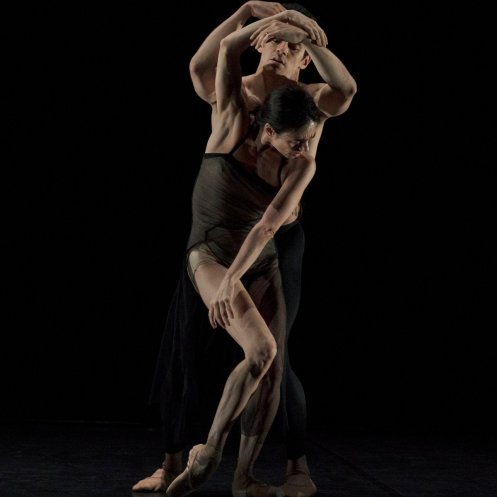
The common themes that emerge from the five dance pieces are twofold: how we interact with other human beings; and how we interact within ourselves, our bodies with our minds and our minds with our spirit. We could interchange the word interact with the word react, as the two themes interconnect.

The programme comprises five dance pieces, three by Company Wayne McGregor and two by Ballet Black. One piece by each company had its premiere on the opening night. Wayne McGregor is the doyen of the modern dance world, having successfully managed to fuse a spectrum of dance styles, the classical ballet of The Royal Ballet, the innovation of Sadler’s Wells and the cutting edge contemporary dance of The Place, having been choreographer in residence with all three companies.
Outlier, the first work of the programme, is by Company Wayne McGregor, a remounting of McGregor’s own neo-classical ballet, initially produced for the New York City Ballet, as part of its 2010 Architecture of Dance series. Although McGregor describes this as a mini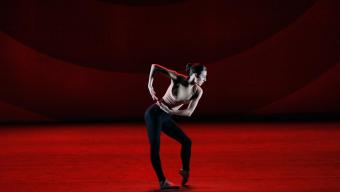 malist work, in many ways it is anything but. It is a high-tempo piece that is complex both visually and musically, being set to Thomas Adès’ labyrinthine Op 24 violin concerto Concentric Paths. Its three movements are entitled Rings, Paths and Rounds, which contextualises it within the architecture theme. The architectural inspiration is Bauhaus, and here is where the minimalism is apparent in the clean cut lines of Bauhaus reflected in the precise placings and movements of the dancers. The abstract presentation hints nevertheless at the human interaction within and its reaction to the built environment. Rings is a boldly sinuous section, where the interactions are between pairs dissolving from duets into investigative groupings. It is set at first against scarlet
  ring of light, an understated but effective design by Lucy Carter, who opens Rounds by bold placing the whole company in silhouette. This short passage includes some remarkable interpretations of flute set against a pizzicato violin, which is danced with staccato steps, humanity confined. These two movements parenthesise the longer middle movement, Paths, which features the guest artist, Alessandra Ferri, prima ballerina assoluta at La Scala Ballet and a former Principal of The Royal Ballet. This is a more lyrical and introspective movement with the intensity of the solo violin set against the caprice of the other instruments, giving ample opportunity show Ferri’s virtuosity, much en pointe, supported by the fugitive background of the corps. (It is difficult to find an image of Alessandra Ferri not en pointe.)
Washa, the first of the works with its premiere at The Grange, is a gorgeously vivid contrast. Produced by Cassa Pancho’s Ballet Black it is especially commissioned for the Grange Festival from the talented emerging choreographer, Mthuthuzeli November. Contemplating the origin of music, November asks in this piece “Exactly why do we dance to music?” and he answers his own question with this very affirming celebration of the human body and spirit interacting thorough music. Washa translates from Xhosa as “burn from the inside” and November is fascinated by the clicks and trills used in that language. The opening of the dance is inspired by the rhythms created by San Bushmen singing around the fire. Fire forms an all-encompassing image in this integrated ensemble piece from the full sextet of the company’s dancers. Opening with the sounds generated by a dancer kindling a fire from a fire-stick and driven by Peter Johnson’s percussive score, the image of fire is impressively pervasive, highlighted by the free-flowing fire-red flaming skirts of the dancers. The piece is a triumphant fusion of classical and modern dance into the millennia-old African culture, which realises November’s aim to cause the inner fire of the dancers to suffuse through their audience.
The emotionally penetrating duet, Clay, by the acclaimed Australian choreographer Alice Topp, is presented by Company Wayne McGregor as the second of the world premieres. Human beings can mould and shape each other like clay, but separation, grief and pain can intensify mutual feelings. Clay studies the sensitivities underlying the interactions between a couple where one is suffering under the burden of pain. How much can the burden be shared to the other, the clay stretched before it shears? The subtle lighting of erstwhile dancer Geneviève Giron provides a claustrophobic atmosphere. The ostinato score, Whirling Winds, by the Italian laureate composer, Ludovico Einaudi is the perfect vehicle for the two artists, Rebecca Basset-Graham and Izzac Carroll. The opening is lyrical and the dancing shows mutual sympathy, but as the music takes on an urgency and sense of aggravation, tensions become apparent. Carroll and Basset-Graham’s expressive dancing portrays the compassion and the tribulations of the relationship, its actions shift from gentle and sensitive to troubled and grudging. The pair cut some dramatic figures, difficult dynamic lifts are executed effortlessly, and the increasing weight of the piece is thoroughly acted out. As Clay is said to be a sketch for a larger dance-piece, we should be looking out with impatience to see the final work.
The versatility of Alice Topp’s choreography is exhibited in the style of Company Wayne McGregor’s Little Atlas, where it owes much to classical ballet. It premiered in 2016 at the Sydney Opera House, but transfers well to the Grange stage, where Jon Buswell’s adapted lighting plot enhances the sense of confinement crucial to the piece. This too is set to a score by Ludovico Einaudi, taken from two of his works, Fly and Pieces. Little Atlas is a piece of considerable crystalline beauty that explores the nature of memory. A solo dancer, Camille Bracher, is discovered held within a cone of brilliant light, the confines of her past experiences, her memories. She is joined by two male dancers, Jacob O’Connell and Jordan James Bridge, positive and negative reminiscences of her past. There are some beautifully executed classical movements, the ballerina held en attitude Balanchine. As forgetfulness intervenes, the top lit cone becomes more stable. Finally we are left with the solo dancer again, in a close top spotlight, a moment of sublime pathos.

The final work in the programme, The Suit, firmly picks up the theme of human interaction. It is a longer piece, with a sharply defined narrative. The plot is based on a short story by South African writer Can Themba about a married couple Matilda and Philemon, who live in a suburb of Johannesburg. The story moves from light-hearted observations of day-to-day life to a dark and tragic denouement, and requires a difficult emotional journey from the principals. American dancer Cira Robinson and Brazilian born José Alves, both Senior Artists with Ballet Black, are well up to this task and their characterisations are impeccable. The Suit won two Critics’ Circle National Dance Awards last year for Ballet Black, and choreographer Cathy Marston’s revival at The Grange remains fresh and energetic. The adage, less is more, works wonders in Jane Heather’s inspired set and David Plater’s lighting which give a sense of place as scenes move convincingly from bedroom to bathroom, to the road and bus-stop outside, to a park and on to a dance hall. All is done with two simple frames, albeit greatly augmented by the company ensemble who mime everything else from an alarm clock to a bathroom tap.  Alves, as Philemon, extracts much humour from the husband’s daily routine, taking scrupulous care of his ablutions. Then into the streets where he has a cheery hello for everyone, helps little-ol’-ladies across the road, and generally excels as a good egg. But things are about to change for Philemon. Back home Matilda has shown in her lover, Simon, and her morning is about to hot-up. Their amorous encounter rapidly develops in intensity. Robinson’s sensual dancing is matched by the erotically charged interpretation of Mthuthuzeli November, now as a dancer, as they come to “the awful daring of a moment’s surrender”. Unfortunately, Philemon has forgotten his briefcase, and discovers his wife in flagrante delicto. Alves’s depiction of Philemon’s revulsion is palpable. In true farce style, Simon disappears déshabillé, though the window, but not in Brian Rix style, since he leaves his trousers, and the rest of his clothes, behind. The score is written by Phillip Feeney, as arrangements of eight diverse composers’ music, and this works well to delineate the changing emotional circumstances of the protagonists. You see, Simon’s abandoned suit becomes a symbol, of shame for Matilda and of humiliation for the cuckolded Philemon. The vacant suit, cleverly becoming one of the ensemble on its coat-hanger, is constantly with the couple. It sits with them at dinner and goes with them on a walk to the park. Philemon’s personality has changed and he now only wants to humiliate his wife. He even forces her to come to a dance with their friends and makes her dance publicly with the suit. All the company, and the suit, dance a beautifully choreographed paso-doble, , but clearly its binary rhythm (and its title) is a sardonic musical pun. There is a point in the dance where it seems that Philemon is going to forgive her, a great moment of dramatic tension and you could almost feel the audience willing it to happen, but he cannot bring himself to do so. This is a moment he will regret for ever. Supported by a versatile ensemble, the expressive acting conveyed by skilfully interpretive dancing by the three principals, made this a memorable piece of story-telling.

A wide range of human interactions, bodies, minds and spirits, is packaged in the 2019 Dance@TheGrange programme, and is presented with the flair that we have come to expect of The Grange Festival, a successful pairing of opera and dance: what a wonderful way to express our humanity.
Mark Aspen
June 2019

 Mark Aspen