
The Show Must Go On!
The Dresser
by Ronald Harwood
Colwyn Bay and Crewe, in partnership with Blue Fire, Strut and Fret and FTS, at the Hampton Hill Theatre, until 23rd March
Review by Mark Aspen
“No man is an island, entire of itself”, meditates John Donne, but here we have seven human souls floating in Laputian insolation. They do not engage, although they have a common goal. The goal is theatre (theatre with a big T) and, for those of who allow ourselves to be sucked in, we know that Theatre is an obsessive thing. The show must go on, come hell or high water … or the Luftwaffe’s air-raids.
A rep company is touring provincial theatres, but it is January 1942 and not only are bombs damaging theatre buildings, but the audiences are sparse, and most young to middle-aged actors have been called up. Sir, the archetypical actor-manager, struggles to continue; and his loyal dresser is determined to support him. Against this background, Norman, the eponymous dresser in Ronald Harwood’s rightly much acclaimed play, The Dresser, subsumes a role that locks the lives of the two men together. Norman lives his life through Sir and Sir lives his life through the Theatre. However, in Harwood’s hands, the brilliantly written script opens hidden layers underneath this relationship.
The cast of The Dresser is described a “hand-picked” and director John Gilbert has chosen actors well known in the “Swan” circuit (Richmond’s “Oscars”), all have been nominees and most are award winners. Nevertheless, it could be easy to take the strongest cast and rest on their laurels, but Gilbert has taken the strongest cast and tuned the actors to play to their strengths.

But, as Norman says, “shall we begin at the beginning” because in the gestation of this play a strong production team has conceived an atmospheric setting within an economically efficient set. Designer Junis Olmsheid’s creation is a trucked cut-out of Sir’s dressing room, realised with Alan Corbett to be a revolve, without actually having a revolve, so that the dressing room can be turned to reveal the backstage areas of the provincial theatre. The cluttered, make-do-and-mend room is populated with period-perfect props by Lyn Randell amongst the semi-dilapidated wartime décor, nostalgically created by Olmsheid with the assistance of scenic artist Francesca Stone. The mood is completed by Miriam King’s costumes and the detail of the ladies’ hairstyling.
One of the most gorgeously period be-decked characters is Her Ladyship, Sir’s common-law wife (he didn’t want to press his previous wife for divorce as might spoil his chances of a knighthood) known by Sir as Pussy. (She calls him Bonzo.) The gilt has worn off of Sir’s spelter long ago for Her Ladyship, whose exasperation and disdain for her partner are barely contained, although her festering resentment is tempered with a proprietorial acceptance. Lottie Walker in this role fizzles like a pressure cooker, as Her Ladyship acquiesces in spite of her better judgement. If looks could kill …

The play opens with Norman and Her Ladyship anxiously discussing Sir’s current health. He has been hospitalised following incidents in the town that morning when he seemed confused and near collapse. Something is “untoward” with him. Her Ladyship is pragmatically in favour of pulling that night’s show, but Norman is confident that he can ensure that Sir will be fit enough to play the lead in King Lear, Sir’s favourite role, that evening. The devoted Norman knows Sir inside out, declaring that he has known Sir for “longer than a lifetime”.
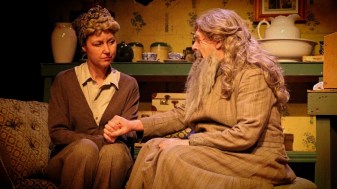 Another member of the company with long service, and devoted service, is Sir’s stage manager, Madge. As with Her Ladyship, Madge’s spectacles have long lost their rose-tint. You see Madge has been “the spinster in the corner”, apparently unappreciated as a woman by Sir. Norman derides her as “sensible”, although secretly seeing her as a rival. She takes the practical view regarding Sir’s “untoward” indisposition that they should cancel. As Madge, Mia Skytte-Jensen exudes a sense of resignation. One can almost feel her annoyed sighs.
Then the door bursts opens and in bursts Sir. He has discharged himself from hospital, is dishevelled and weeping, clearly near to a nervous breakdown. In spite of the seeming hopelessness of the situation, Norman ushers the women away and begins to work his magic on Sir, cajoling and encouraging, badgering and nurturing, all in equal measure.
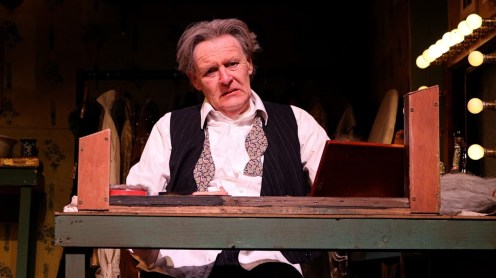
Steve Taylor as Sir, the arrogant and obsessive authoritarian, and Daniel Wain as Norman the loyal, painstaking, and sensitive servant, make a symbiotic acting duet. Wain, an actor known for big shouty roles, just gently underplays Norman, not too camp yet not too subservient: a nicely controlled portrayal. Taylor rightly plays Sir big, but stops just short of caricature. Taylor has great stage presence and uses it highly effectively in this measured performance. There is the declaiming pomposity of the egotistical actor-manger, used to getting his own way; but Taylor shows Sir’s vulnerability too.
After 227 performances, Sir has stage-fright and cannot remember his opening lines as Lear. He even fears “the stripes of the critic”. (God forbid, for we critics are gentle creatures.). But Norman’s wheedling works and, when Sir is propelled (almost literally) onto the stage, he gives a virtuosic house bringer-downer. Sir however feels let down, as per usual, with the storm effects. “I wanted a tempest, and you gave me farting flies”. We see the storm effects created in true period style by a wind machine and thunder-sheet. However, these are greatly enhanced by magnificent twenty-first century effects, thanks to skilfully coordinated lighting and sound designs by Tom Shore and Patrick Troughton.
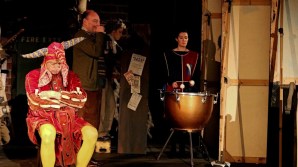 Sir’s cast for King Lear is a motley lot, fill-ins for the actors now called up for the war effort. One such has been drawn out of retirement, Mr Geoffrey Thornton, who plays Lear’s Fool, but in view of his age lacks the physicality demanded in this part. Dave Dadswell in turn plays the reticent and put-upon Geoffrey, as lugubrious and somnolent, but lovable and gracious. Dadswell’s Geffrey is rather like a once-loved but now threadbare teddy-bear, a stupendous piece of acting that defines his character to a tee.
The company has just lost Mr Davenport-Scott, who has just been refused police bail, having been arrested for importuning in a public convenience (although Sir describes Mr D-S’s misdemeanour as little more robustly!) His replacement is Mr Oxenby, a forthright Marxist activist, one of the few people to unnerve Sir. Luke Daxon plays the bolshie Oxenby with a defiant insouciance that is suitable intimidating. However, regardless of Oxenby’s insistence on demarcation of jobs, when the push comes to the shove in the storm scene his shoulder goes to the wheel in spite of himself.
The ingénue in the company is Irene, young and intensely ambitious. She is starry-eyed and quite willing to flaunt her femininity to advance her career. Sir is totally unabashed about exploiting her forwardness and he makes crude but not unwelcome advances. (Not quite 2019: o tempora o mores !) In the nick of time, Norman comes to the rescue, although of whom it is not quite sure.
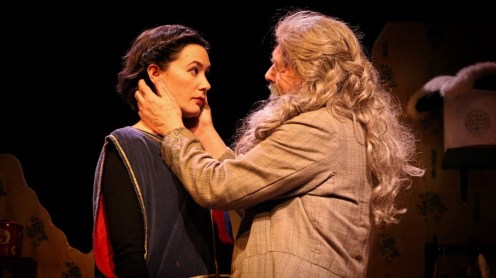
And now we see a very nasty side of Norman as he rounds on the girl and bullies her shamelessly and cruelly. Here is the brilliance of Harwood’s writing, for now the audience’s hitherto empathy with Norman is lost as one aspect of his character is stripped off to reveal an unpleasant side. Moreover, clearly Norman’s jealousy is more than for his professional privileged relationship with his boss. From an acting point of view, this gives a great opportunity to show a third dimension to Norman’s character, which Wain rises to consummately. However, this does require equal acting skill from Irene, and Jacinta Collins shines in portraying the uneasy balance of innocence versus coquettishness, of manipulation versus victimhood, and of subjugation versus triumph.
In the same way, Sir has much nastiness under the layers of bombastic eloquence. We learn that this larger than life character lacks all generosity. He is entirely self-centred. His autobiography is to be his “greatest memorial”, but he can hardly start writing it. All is self-centred arrogance that rides rough-shod over the needs of others. Taylor lets us peek at Sir’s deeper layers, and often quite subtly through a gesture or body-language.
The actor-manager as a species lasted two hundred years from the 1750s to the demise of touring repertory theatre after the Second World War. It is parenthesised by Hampton’s David Garrick and Hammersmith’s Sir Donald Wolfit. Ronald Harwood was Wolfit’s dresser, but rigorously denies that The Dresser’s Sir is a portrait of Wolfit, but admits that “what took place night after night in Wolfit’s dressing room is part of the inspiration of the play”. The similarities are there though: Lear was Wolfit’s favourite part (he hated anyone else playing it) and he did play Lear 227 times, for example. However, Wolfit did not die in harness in the theatre during the War. He lasted almost another quarter century, but died near his beloved King’s Theatre, Hammersmith, which ironically was demolished a few years after his death.

What marked Sir Donald Wolfit was his self-centredness and this he had in common with the fictional Sir. And the bitter, but touching, ending to The Dresser underlines that, in the end, Sir thought only of himself, and Norman thought only of himself. Norman’s last words are to repeat his own mantra, “I had a friend once…”.
… but we know it wasn’t Sir.
Mark Aspen
March 2019
Photography by Pete Messum and Tom Shore
Public Image
The Winter’s Tale
by William Shakespeare, in a new version by Helikon Theatre Company
Helikon Theatre Company, at OSO Arts Centre, Barnes until 23rd March
A review by Matthew Grierson
Stop me if you’ve heard this one: there’s this king, Leontes, who tells himself his pregnant wife Hermione is cheating on him with his best mate Polixenes, the king of Bohemia, so he orders his friend to be killed and banishes his new-born daughter. The twist is there’s a happy ending.
Don’t believe me? I’m not sure I would – and Helikon Theatre clearly don’t as they’ve attempted a bold(ish) reimagining of Shakespeare’s romance to amplify its contemporary resonance. And truth be told, they largely succeed.

The conceit of the production is that the stories we tell ourselves today are often relayed through the media, so scenes not only play on stage in front of us but are also live-streamed on a selection of screens behind and around the cast, or are supplemented by recorded footage. So when the play jumps right in with Polixenes’ speech about the great time he’s been having in Sicily, Lanre Danmola as the Bohemian monarch stands with his back to the audience facing a camera that projects his face on an upstage screen we can all watch. All right, there is a bit of a lag with the lip-synching and Danmola is prone to gabbling his lines, but we get the message: Sicily is both a surveillance state and a celebrity culture. The use of captions such as ‘Day One’ then not only helps place us in time – we’re up to day 5,000-and-something by the end – but also suggests the Sicilian cabinet is akin to the Big Brother house.
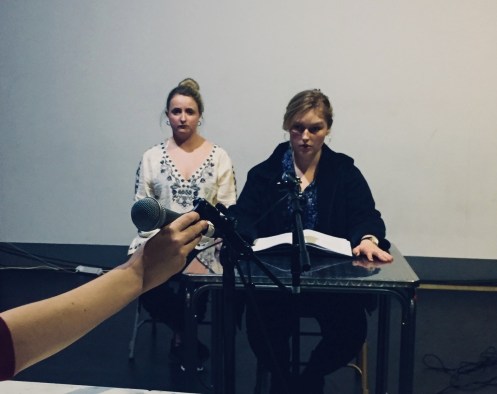
This televisual vision is successfully sustained throughout the piece as a feat of design, direction and, mostly, technical accomplishment. As though nothing is real if it is not also broadcast, the tyrannous Leontes (an intense and compelling Michael Howlett) insists on sitting his wife before the camera to ‘confess’ her adultery, and even forces a microphone back into her face as she defends herself at trial. Not to be outdone, Rhonwen Cash’s dignified Hermione co-opts the lens to declare her innocence before the presumed populace. In this respect, Helikon’s modernisation is spectacular in both senses.
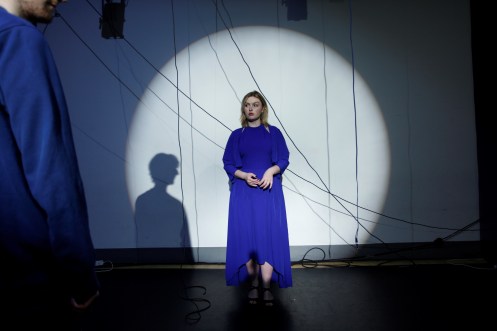
Not that the play depends entirely on technology for this spectacle, with the use of stagecraft and physical theatre proving just as effective. A cloth and a wig represent the baby princess as she is swaddled in the arms of the hapless Antigonus (Ben Walsh), for instance. He is then set upon by Leontes and his courtiers to signify both the exile the king has imposed and the shipwreck in which he loses his life. In the process, the wig finds its way on to the head of Emma Blacklay-Piech as the grown-up Perdita in the next scene. Hey presto, 16 years have elapsed.
Where the play feels less mature is in its revision of the dialogue. The transitions between Shakespeare’s verse and the modern interpolations are not at first noticeable, the dialogue being largely well spoken and easing between the two registers, but as soon as I heard the ‘fuck offs’, ‘special relationships’ and ‘depression’ with which the text has been peppered my sense was that we could have done without them; they are simply flourishes, pointing us towards an interpretation that is clear enough from the direction.
For instance, the intercession of Paulina (Eleanor de Rohan) on behalf of Hermione, ‘We need to reach a compromise and end this nightmare’, may net a laugh from the audience but it seems a cheap one – why insist on the play’s timelessness by trying to land it in the very particular politics of spring 2019? Thankfully, such nod-and-wink references are the exception. De Rohan is far better served by a more significant departure from the folio when Paulina seizes the mic and declares the king’s failings to the nation, taunting the now-heartbroken Leontes in a bravura blast of bitter sarcasm that ends with both characters on the verge of tears.
The counterpoint to this sequence comes in the first scene with the grown Perdita. The baby thrown out with the bathwater of the Bard’s verse is now an actor, and such is the freshness of her dressing room speech to paramour Prince Florizel that I thought the whole scheme of Shakespeare’s original had also been cast off to give a daring and incisive metatheatrical comment on female roles in the theatre. Blacklay-Piech has given equally impressive turns as her own brother Prince Mamillius and one of Leontes’ apparatchiks earlier in the play, and as Perdita she and Alex Chard as Florizel make the most of the naturalism this reworked scene offers, bringing a legitimate joy to this most difficult of pieces.
The difficulty that does remain in staging the play so definitively in the present moment is that we are then tempted to wonder why its contemporaneity is not more comprehensive, when Shakespeare’s Sicily and Bohemia is able to circumvent logic by keeping things at a romantic remove from reality. It’s difficult to imagine, for instance, under what circumstances a modern head of state such as Polixenes would be detained for so long in another jurisdiction, unless he is, as Hermione teases, being held against his will.
Perhaps more troublingly, the high-def mode of the production opens for scrutiny the psychological questions that have long perplexed spectators and scholars of the play, notably what occasions Leontes’ jealousy in the first place. Unlike Othello’s green-eyed monster, the Sicilian king’s is conceived as though from air, without any rationale, and its sudden reversal into heartbreak, as witnessed by Paulina, audience and cameras, is likewise inexplicable. This is not Aristotelian anagnorisis, rather the hinge for the play’s improbable happy ending. Helikon manage to hint at Leontes’ poor state of mental health with the references to depression but in truth he seems more paranoid than melancholy, and the play doesn’t pursue the issue of whether, when pitiful men are powerful, we ought to pity them.
Polixenes has grown similarly suspicious over the subsequent two decades, and is even more quickly disabused of his animus – one moment he’s all frowns about Florizel’s betrothal to Perdita, and when we next see him with son and daughter-in-law in Sicily he’s part of one big happy family. The production’s rush towards the end skips not just one but several beats as the onstage action is narrated on mic, doubling down on its improbability and doing a disservice to the effort cast and crew alike have put in over the preceding hundred minutes.
In one tentative respect, though, the ending does challenge the cosiness of reunion. At first, we only see Hermione come back to life on screen, that white space where we’ve seen Leontes project and manipulate his fantasies. Although the moment is then recapitulated onstage, the reanimated queen is cut off as she calls her husband’s name, as if to ask whether he can truly be redeemed. Putting a question mark at the end of play that, whether in the seventeenth or twenty-first centuries, has much to say about the misogyny of the powerful reminds us that we are not so far removed from Sicily and Bohemia after all. A sad tale may be best for winter, but a turbulent story such as this is better for these stormy days of spring.
Oh: and before you ask, there’s no bear.
Matthew Grierson
March 2019
Photography courtesy of Helikon
Profound Painful Pride
Father Figurine
by Isaac Ouro-Gnao
Body Politic at Stratford Circus Theatre until 20th March
Review by Suzanne Frost
Rarely have I seen a show focussing in on its central theme with such force within the first opening seconds. A father approaches his teenage son with a mild face and loving eyes, he leans in for a gentle touch, a tender hug – and then he slaps his son on the shoulder with the fake camaraderie of a sports team and they start their dance where intimacy equals awkwardness and the closest they get to human touch is a fist pump. Father Figurine explores the relationship between a father (Tyrone Isaac-Stuart) and a son (Isaac Ouro-Gnao, who also wrote the script) and the struggles and pressures men in general face in society regarding their emotional and mental wellbeing. Statistics show that the majority of mental health problems begin at age 14-18, during the time when young boys start the separation process and try to figure out how to become men themselves.

Both father and son seem to grapple with some traumatic event dominating their live, the nail chewing son responding with rising anxiety while the stoic, passive father seems to almost disappear within a cloud of depression and resignation. There is a gaping absence in their lives, made poignantly visible as they set the table for three every day, with particular, meticulous care given to that ominous third napkin that will never get used. Their little everyday routine is quickly established and maybe didn’t have to be repeated that often, but it is striking to see the choreography of their daily chores planned out so that they would never touch, never look at each other, never speak but warily observe the other man, passing by a million chances to reach out and break the toxic atmosphere.

Body Politic use hip hop dance and spoken word to tell their story and, while during the dance sequences their silent, moving bodies express a multitude of emotions – pain, torment, fear, excitement –, the scripted scenes are poignant for their lack of words, unbearable silences and aggressive one-word responses. “Did you sleep alright?” – “Fine”. And then we see them at night, each one tormented by the same nightmares, mirroring painful contortions in their separate rooms.

Over time, even the occasional empty phrases and platitudes disappear, until complete silence encompasses the dining table and the only interaction between the two family members is a wordless wave. It is the young son who gets up the courage to plead: “Dad, we need to talk.” He is a passionate kid actually, who enjoys school and is eager to share some of his thoughts and interests. The father is the one who has hardened, suppressing not just the emotions of pain and loss he puts down to his failure at being a man, but even little moments of joy he only allows himself behind closed doors, grooving tentatively to the radio as he takes of his suit after work. You have to feel for the guy who has rid himself of all humanity to appear strong, to fulfil the role of “man”. The failure of fathers has been handed down for generations. “Who can teach me?” he desperately cries out. But his young son is already watching, learning by imitation, reaching out less, hardening.
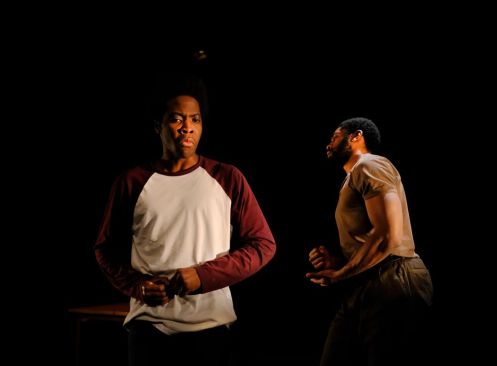
Father Figurine is a powerful show, profound, painful and full of empathy. Stereotypical ideas about masculinity and male behaviour are stubborn but it will be up to this generation to challenge them. Towards the end, the music gets laced more and more with verbatim statements of men talking about their struggles with manhood and the urgent beep of a helpline. Will this father pick up?
Suzanne Frost
March 2019
Photography courtesy of Body Politic
Countless Fascination
10
by Lizzie Milton
Snatchback and Joyous Gard at Cavern – The Vaults, Waterloo until 17th March
Part of The VAULT Festival (Week 8)
Review by Denis Valentine
It may be strange to start a review by talking about the final moment of a play, but with 10 the driving point of the past hour really hits home in the final seconds. The five actresses directly go up to the audience whispering names of women that the history books either like to gloss over or to forget entirely. As with the ten characters that the audience has just seen portrayed on stage, it is a wake-up call, a reminder that there are so many female figures from the past and now in the present whose accomplishments, achievements and impacts will also fail to be truly recognised.

When entering the Cavern’s stage room at the Vaults the audience gathers around the five actresses standing silently on the stage area. The costumes for the show are all variants of a blue dress which makes the fact that, although the stories cover a span from the first female monarch of Great Britain in 870 to Brenda Proctor, who led the 23,000 women miners’ strike in 2017, there is the continual notion that history keeps on repeating itself and the plight and struggles of the characters involved could be from the same time or centuries apart. Had it not been for the programme giving a brief synopsis of each character then it would have been almost impossible to place in time when the events some of them are talking about took place.
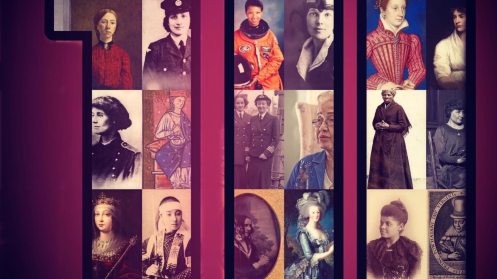
Director Nastazja Somers, although with limited time for each character, gives all a chance to shine and get their message and story across. It is also very well worked how each person can seamlessly go from being the main lead on stage to, within a second, transforming into the background and supporting the next person stepping forward.
The ten voices heard make it inevitable that each audience member will have a particular favourite. Lydia Bakelmun as Princess Caraboo is a wonderfully delivered piece and provides the first real tonal shift of the night. Her subtle use of weaving her story around the music feels effortless and suitably captivating. Each actress plays two characters and Pamela Jikiemi’s second turn as Mary Prince was also very engaging as it is a story that speaks directly to current events and relatable situations.
Rajiv Pattani (Lighting Designer) and Nicola Chang (Composer and Sound Designer) have a strong influence on proceedings, helping a stage with essentially no set or props to feel full and greatly atmospheric at the appropriate times. The music works well to give the feel of the change in setting and character for each actress and often the subtle light changes help punctuate the messages being sent across.
At times adding modern sensibilities to the characters helps drive home the message but can also lessen the value of seeing the person on stage and can at times make the messages feel more preachy than natural.
The play, written by Lizzie Milton, is essentially made up of ten monologues which are all strongly acted and well delivered along the strong thematic lines that Milton has running through. As such though, proceedings can begin to feel a bit repetitive in their nature, which is why moments of audience interaction and the way certain players use the music and lights helps break up what could otherwise start to feel monotonous.
Beth Eyre (who switches well between the artistically minded Gwen John to the far more mathematically grounded Joan Clarke) is one of the founders of the two companies involved with the production, Snatchback and Joyous Gard. With 10, Snatchback’s mission goal of ‘foregrounding roles for women’ feels well realised and it is the play’s triumph that it leaves its audience wanting to know more not just about the ten characters involved but also that there are countless more people with fascinating stories to tell.
Denis Valentine
March 2019
Who Needs Therapy When You Have Cocaine?
Margo: Half Woman, Half Beast
by Melinda Hughes
Melinda Hughes Company at OSO Arts Centre, Barnes until 15th March
Review by Andrew Lawston
The OSO in Barnes has been transformed into a dishevelled 1920s salon, centre stage sits a chaise longue festooned with cushions, sheets, clothes, champagne glasses, and expensive shoes. And, on the other side of the stage, an imposing grand piano.
Margo: Half Woman, Half Beast, written and starring Melinda Hughes, and directed by Sarah Sigal, celebrates the heyday of Margo Lion, one of Weimar Berlin’s most celebrated cabaret performers. Writer, actor and singer Melinda Hughes depicts Margo’s tumultuous life with her husband, the lyricist Marcellus Schiffer, and various partners including Marlene Dietrich, through a one-woman play interspersed with songs from the period, including many that feature Schiffer’s lyrics.

Margo opens the show with a hungover phone conversation with Dietrich, in which she excitedly reads reviews of the previous evening’s performance, while soothing a coughing fit with a swig of flat champagne. Dressed in an elegant dressing gown and white nightie, Margo tells the audience excitedly about the joys of counter-cultural life in Berlin, and the social, professional and sexual freedom she enjoys. She slinks around her flat, unashamedly sensual, admitting to casual shoplifting, addictions, and blazing rows with her husband and lovers.
At various points, Margo interacts playfully with the audience (asking one man to pay for her taxi) and the on-stage band, which comprises Robert Rickenberg on double bass, William Slingsby-Duncombe on clarinet, and Jeremy Limb on the piano, who also composed the show’s original songs. The band are fully integrated into the performance, but melt into the background when not performing.
Switching effortlessly between English, French and German, with occasional cheeky flourishes in an American accent, there is a relentlessly cosmopolitan flavour to Weimar life, which slowly ebbs away throughout.
As the show progresses, political unrest grows. Anti-semitism becomes rife, and while at first Margo laughs it off (“Aren’t we all Jews?” she asks), soon Brownshirts are disrupting theatre performances, smashing windows, and her friends are being taken in the night. Hyper-inflation is discussed several times in passing, growing ever more serious as even the sensual Margo grows frustrated with politicians’ failure to address the Weimar Republic’s economic problems. In the political turmoil in which we find ourselves, there are obvious parallels to be drawn and this production is certainly timely, but the audience is wisely left to draw their own conclusions.
After a brief entr’acte during which Margo slips offstage to change into a more sombre (but still fabulous) black dress, the tone becomes ever more desperate, culminating in Marcellus’s suicide and Margo herself fleeing Berlin for Paris, while thanking God she had “French papers”. Dan Jeffries provides sound effects from the street outside: traffic, a protest march, and then more sinister sounds of smashing glass and terror.
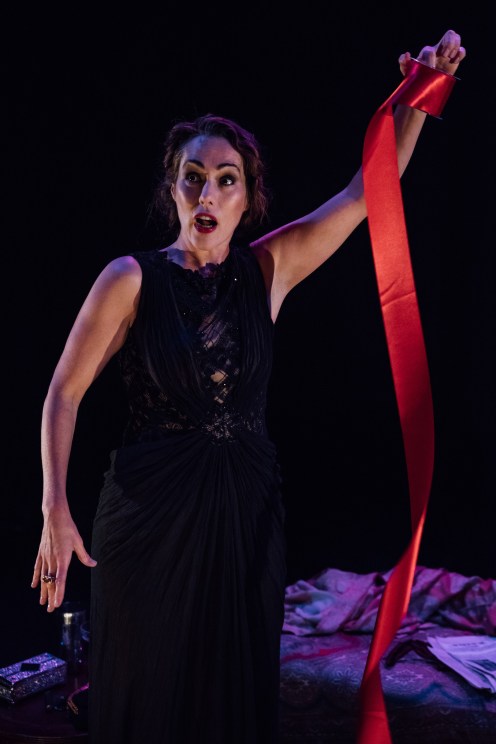
The songs also develop in tone from Mischa Spoliansky and Marcellus Schiffer’s lusty “I am a vamp” and “Life’s a Swindle” to more reflective numbers like Friedrich Holländer’s “Illusions”. The musical numbers are also generally when Sherry Coenen’s lighting kicks in from the relatively naturalistic light of Margo’s room to strident reds and blues, with bright footlights completing the evocation of 1920s cabaret.
The recreation of 1920s and 1930s songs proved to be the evening’s highlight for me, with the original numbers written by Hughes and Limb not quite matching the musical style in some intangible way that I couldn’t quite put my finger on. Certainly I was able to pick out the new compositions from the classics without referring to the programme notes. But all the music was powerfully evocative and beautifully performed, with Friedrich Holländer’s strident “Raus mit der Männern” (“Throw out the men”) being a particularly rousing moment.
Margo: Half Woman, Half Beast is a remarkable celebration of Margo Lion’s heyday, and despite the band’s constant presence and occasional interaction, it is essentially a tour de force solo performance from Melinda Hughes. Perhaps given those circumstances, it might seem churlish to ask for any more, but as Hughes and the band took their much-deserved bows after an hour onstage, I was certainly left wanting to see and hear more.
Andrew Lawston
March 2019
Photography by David Monteith-Hodge
Eighties Nostalgia
The Wedding Singer
by Matthew Sklar, and Chad Beguelin
Hinchley Manor Operatic Society at Hampton Hill Theatre until 16th March
Review by Andrew Lawston
I was unsure what to expect from Hinchley Manor Operatic Society’s production of Matthew Sklar, Chad Beguelin and Tim Herlihy’s musical The Wedding Singer, directed by Helen Wilson. The show boasts a full slate of original songs, while the film on which it is based was full of cover versions of 70s and 80s classic tunes. The film was also very much a star-making vehicle for Adam Sandler, and I was curious to see how the adaptation would fare without his schtick.
The story of a struggling musician who has put his dreams of rock stardom on hold while he plays wedding gigs to make ends meet, and his relationship with a young waitress unhappily engaged to a yuppy, The Wedding Singer translates remarkably well to the stage.
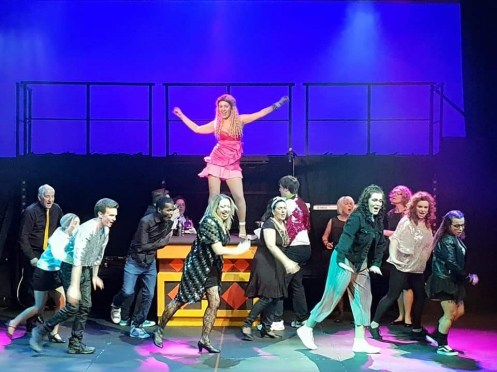
The production has clearly chosen to focus on the music, with a full live band kept out of sight, and a plain set with a gantry running across the back, designed by Wesley Henderson-Roe and Helen Wilson. The set dressing for individual scenes rarely amounts to more than a bed in a corner or a bar and stools centre stage, leaving plenty of space for energetic performances.
With such a basic set, visual spectacle is necessarily provided by an extensive wardrobe of colourful 80s “fashion” (courtesy of the large team of Kay Colston, Bernie Davis, Sandra Mortimer, Kelly Neilson and Gill Varon), and Sarah Jackson’s choreography. The dancing, from both the leads and from the spirited ensemble of Holly Artis, Colin Bousfield, Kay Colston, Suzanne Green, Tyrone Haywood, Shannon Hearn, Matt Howes, Kelly Neilson, and Katy Simon, is energetic, furious and well-drilled, with Holly Artis shining in particular.


It’s difficult to produce a musical set in the 1980s without acknowledging Michael Jackson, but it’s worth noting that the various bits of moonwalking, some costume elements, and an all-out homage to Jackson’s famous Thriller video do seem a little problematic, given current media discourse concerning the entertainer.
The music is top notch. The 1980s setting is acknowledged through heavy guitar work from Dominic Mackie and Connor Baxter, and crashing synth choruses courtesy of Shaz Dudhia and Musical Director Debbi Lindley. Alex Hinton-Smith also provides bass, so presumably Robbie’s bandmates aren’t playing their instruments live, but Scott Topping’s Sammy in particular puts in a highly credible miming performance. With the band completed by Joe Mackley on reeds and Josh Neale supplying some tremendous percussion noise, there are nods to classic songs from the era, but the original tunes are memorable in their own right. Stuart Vaughn’s sound design deserves special credit for the full concert feel to the music.

On stage, Michael Leopold as Robbie Hart, and Hannah Vincent as Julia are strong and engaging leads with strong chemistry, crooning their way through the sentimental numbers, and leaving some of the biggest musical numbers (most notably Act One finale Saturday Night In The City) to be led by Katy Jackson in a barnstorming performance as Holly. Robbie’s most spectacular song is probably the melodramatic heartfelt Somebody Kill Me, where Michael accompanies himself on acoustic guitar while also acting as a man whose world has fallen apart. It was one of many demanding scenes for the performer, and he pulled it off with great gusto. Robbie’s self-loathing depression for much of the show is treated sensitively rather than being played for laughs, and I must confess that the anarchic chaos of Casualty of Love was much more fun than any of the more orderly wedding band scenes.
Meanwhile, Julia’s stand out song was arguably Come Out Of The Dumpster, which she performed with great comic timing. Hannah Vincent succeeded in bringing depth to a character who has few opportunities to be pro-active throughout the story.
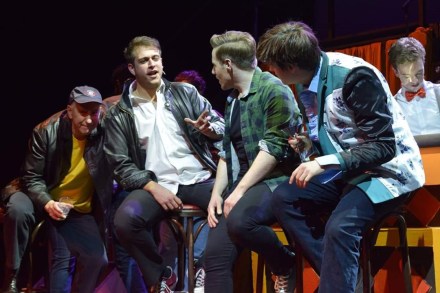 Robbie’s bandmates Sam and George, played respectively by Scott Topping and Jacob Rose are also constantly watchable. Scott remains sympathetic throughout the play, despite his character’s occasional misogyny as he pursues his ex-girlfriend Holly. Jacob has a tough task to keep George’s highly camp character from straying too far into stereotype territory, and it’s to his enormous credit that he puts in such an engaging performance despite apparently stepping into the role with only four rehearsals under his belt.
George performs in many of the wedding band numbers, and a hilarious solo effort, but his stand out song was clearly Move That Thang as a duet with Rosie, Robbie’s grandmother (a spirited and often cheeky performance from Catherine Quinn), which was just glorious fun.
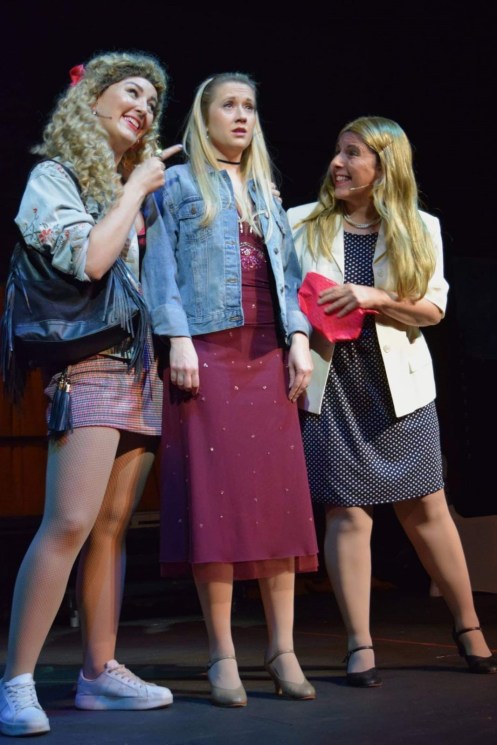
Emma Dixon’s vampy Linda provides an early highlight in A Note from Linda and later picks up the pace in Let Me Come Home. It’s a shame that the character didn’t have more of a role, as with Gill Varon’s confident performance as Julia’s mother, Angie.
Every good story needs a villain, and Zak Negri provided a wonderfully repellent Glen Guglia, Julia’s unfaithful fiancé. This Gordon Gekko character radiated quiet smugness throughout the production, making his final humiliation all the more satisfying.
The Wedding Singer moves quickly, and the cast and crew were clearly called upon to perform many swift set and costume changes. The production rocketed along at a slick pace, thanks to Stage Manager Sarah Woods and her team, and the show never felt anything less than completely professional.
The script is ambitious in that it excises most of the film’s best and most quotable lines (apart from the Van Halen t-shirt gag), but substitutes plenty of new jokes that follow the same path as the original plot. Lifted by this confident production, The Wedding Singer transcends its source material to become a hugely enjoyable night out, leaving the audience full of nostalgia for the 1980s, if such a thing is possible, and humming several of the songs into the foyer. Regardless of your opinion on the original film, Adam Sandler, and the 1980s, this production is well worth seeing.
Andrew Lawston
March 2019
Photography by Zak Negri
Now You See Her, Now You Don’t
The Lady Vanishes
by Sidney Gilliat and Frank Launder, adapted by Anthony Lampard
Classic Thriller Theatre at Richmond Theatre until 16th March, then on tour until 9th November
Review by Mark Aspen
Now here’s another spiffing yarn, fully gung-ho and stuffed with stereotypes. The Lady Vanishes is absolutely topping!
Bill Kenwright’s The Classic Thriller Theatre Company’s stage version is adapted from Alfred Hitchcock’s mystery thriller. The film was released in 1938, before his style became heavily psychological, and was based on Ethel Lina White’s novel The Wheel Spins, written two years earlier.
The play’s setting in in Austria in late spring 1938, immediately after the Anschluß. Germany had just annexed Austria and we find ourselves in a grand railway station somewhere to the west of the country. The vaulted glazed roof is now hung with eagle and swastika banners and everyone in authority, even the railway porters, wears swastika armbands. This is a gift for designer Morgan Large to create a magnificent edifice in sepia, like a vintage travel postcard, but certainly not on postcard scale, as the roof soars up, lost in smoke and steam.

Then a clever transform into an international express train of the period. Richmond Theatre has seen quite a few clever train interiors on its stage recently, but this is the most period-precise: all tasselled lampshades, elegant grey panelling and Biedermeier Revival fittings and fixtures.
This all sounds very serious, but then director Roy Marsden populates it with the stereotypes, a frightfully nice deb, a pair of what-ho English cricket fanatics, bullet-head and bull-necked Nazis, a dapper Italian with pencil moustache, and we have all the makings of a very entertaining evening’s whodunit … and howdunit and whydunit. Amongst the action and daring-do there is humour and suspense. However, the humour is lightly touched and the suspense leavened with self-deprecating wit.
The convoluted plot revolves around well-heeled Iris Henderson, who is reluctantly returning from Nice to London to marry daddy’s choice of a fiancé, who is titled but tiresome. At this Austrian railway interchange, other travellers from different departure points come together, unfortunately delayed by an avalanche on the line out to Zurich, where they are all heading. They are a mixed bunch of wealthy wanderers, from different nationalities. We open in German (which incorporates the audience’s turn-off-mobiles injunction), but oddly very much Hochdeutsch rather than Austrian German, but the majority of the travellers are English and so we settle into public school English as the lingua franca.
Just as well, since most cricket terms are untranslatable, and the two sporty chums, Charters and Caldicott, are totally preoccupied with getting to Old Trafford for the test match. (What, one wonders, and never finds out, were they doing in Budapest, whence they have come?) Robert Duncan and Ben Nealon are priceless in these roles, pulling all the incidental comedy from these characters, who prove to have rock-solid skills (like train driving) when the push comes to the shove.

Enter mining engineer and amateur folk musicologist Max, who strikes up a love-hate relationship with Iris, following a spat with the Nazi officers in the station. This is fired by the officers’ reaction to the dancing of folk songs on the station concourse, to the music of a blind beggar, an itinerant accordion-player. The Beggar (in a charming cameo by Cara Ballingall) first enters to a haunting tune that engages the travellers, and which we later find is crucial to the plot.
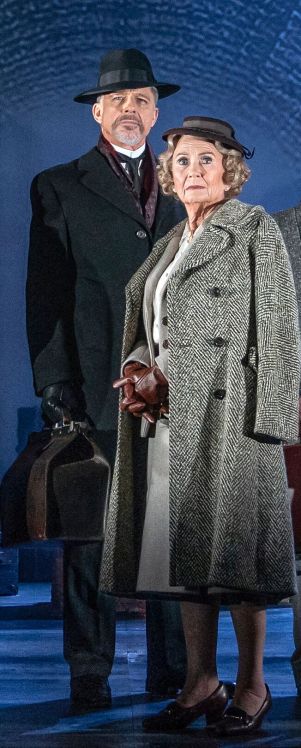 Most subtly engaged by the tune, however, is an elderly lady, Miss Froy, ostensibly a just- retired governess, making her way home to England. Juliet Mills, one of Richmond’s most eminent established actresses, plays Miss Froy with a comfortable poise that is well-received by the home audience. Iris forms an acquaintance with Miss Froy and they start as travelling companions when the Zurich train arrives. However, their companionship is short lived, for Miss Froy parenthesises the plot, for she is the eponymous Lady who vanishes, and does so for most of the action.
It is Miss Froy’s disappearance on the train that results in a concatenated chain of events. It appears that nobody on the train admits to seeing Miss Froy. Could it be that the blow to the temple that Iris sustained on the concourse, due to a mishandled piece of ski luggage, has clouded her recollection? However, it is Miss Froy’s singular preference for Harriman’s Herbal Tea that provides the evidence that convinces Max that Iris is not suffering from concussion and launches the two of them on a helter-skelter investigation that, after many hair-raising adventures, drives them into each other’s arms.
As Iris, TV star Lorna Fitzgerald puts over the strong-willed determination of the character, with a bold self-assurance. Matt Barber, as the initially bemused Max, puts great energy into his role. Together as the young leads, they make an appealing and empathetic couple and, with Juliet Mills as the lead name, a strong and integrated core to the cast.
 Equally strong are the villains. Actors have great fun playing villains and this cast is no exception. Joe Reisig’s powerful performance as the sinister jack-booted and leather coated Nazi is the epitome of the ruthless tough-nut. Signor Doppo is appropriately named, he is undoubtedly double-faced, affable and effusive one moment then sinister and devious the next. Mark Carlisle adds a gleeful nimbleness to this spruce man, an assistant assassin as his calling; an illusionist as the day job. In the guard’s van, his luggage includes a vanishing cabinet and a storage basket with Indian clubs and super-sharp rapiers: for natty tricks or nefarious trickery … who knows?
 And then there is the arch-villain, the suave Austrian neurologist, Dr Hartz. Sophisticated, well-groomed, urbane, he appears anxious to help the disorientated Iris. Why though is a critically injured patient swathed in bandages bought on-board the train, and why the nun … the nun in high heels to whom he gives instructions for administering a Mickey-Finn? Another well-known actor, Maxwell Caulfield, Juliet Mills’ husband, clearly relishes the role of Dr Hartz, and delivers it with fun-laced aplomb.
The already tortuous plot has at a couple of sub-plots, which have the feeling of vestigial remnants of the film’s screenplay. There is Iris’s American friend Blanche, played with sparkle by Natalie Law, who multi-roles as the polyglot stewardess on the train, and the mysterious nun. Blanche is left in Austria, but a fugitive couple continues with the others on the train, Eric, a prominent barrister, with his mistress Margaret, whom he has short-changed on their secret love tryst in Venice. In spite of her fading hopes, he is not intending to divorce his wife, in case the scandal stymies his chances of becoming a high-court judge. One can see why he wants to keep his head down throughout the shenanigans on the train, but why does he carry a loaded pistol? Is he in the plot to demonstrate discretion as the better part of valour in the shoot-out, or are the couple merely a red-herring? Nevertheless, this does not detract from the exemplary acting in these roles. Ex-Corri star Philip Lowrie portrays the hurt dignity of the prickly Eric with a steely seemliness, and Elizabeth Payne’s brittle Margaret really hits the mark. Payne also doubles as the enigmatic Frau Kummer (another appropriate name as it is the German word for grief), who is seen in the carriage dressed in Miss Froy’s prim tweeds during her disappearance.
Did I mention a shoot-out? A fair-old gun battle takes place on the train when it is diverted into a siding near the Swiss border, with various baddies getting shot and with various goodies getting the token “flesh-wound”. Fight director Richard Leggett has his work cut out in this play with sword fights, clubbings and fist-fights (although some of the punches are very distinctly pulled). More atmosphere is provided by Charlie Morgan Jones’s lighting design and effective Dan Samson atmospheric sound design.
Again vying to upstage the actors, the huffing puffing set is further transmogrified in Victoria station. These stations are quite impressive, and tall enough to be partially hidden even mid-stalls, from which incidentally (and here is a niggle) some of the actors become difficult to hear when they drop into screen mode rather than give full stage projection.
Of course, our heroes arrive successfully home, and able to deliver a message to Winston Churchill (presumably in his position in defence intelligence during Chamberlain’s government), which is as esoterically coded as you can imagine.
The Lady Vanishes manages to be both an evocative period piece and an entertaining spoof. It tells a griping story with its tongue firmly pouched in its cheek. It is as German as Wienersnitzel and as English as Eton mess. A jolly fine show; what, what!
Mark Aspen
March 2019
Photography by Paul Coltas
Recognising the Future of Culture
Young Writers’ Festival 2019
Art Richmond at The Exchange, Twickenham, 10th March 2019
Review by Eleanor Lewis
It’s always a pleasure to see emerging writers receiving recognition for the work they have produced. Few things are more encouraging than the validation that comes with a prize. At the Young Writer’s Festival, there is the additional joy of seeing the work in question professionally performed, putting the skill and talent in each piece on show for all to see.
The Festival follows a set structure, which had been slightly tweaked this year to provide a break between the younger and older writers during which they could talk about their work a little, and the actors presenting it could share how they felt about each piece.
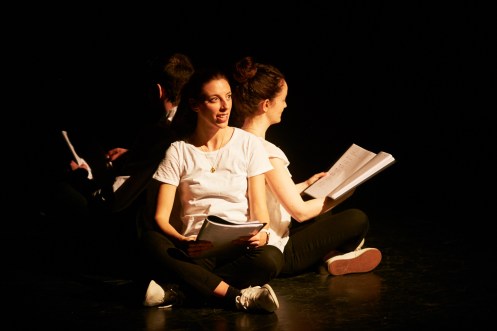
The performance of the work by three professional actors is an inspired part of this prize-giving. Tara Dowd, Emily Francis and Angus Woodward did a great job bringing out every element of the work they performed, Keith Wait’s direction being, as usual, highly efficient. The work on show was selected by three judges with a wide experience in the field of children’s writing: Anne Beach, Kavita A. Jindel and Guy Jones.

The Mayor of Richmond, with the Junior and Senior Laureates 2019
Not all children approach creative writing with enthusiasm, it’s something that can be guided, and there are certain props (an idea to work on, dictionaries, pictures,) but there are no specific instructions to follow and the whole thing really has to come out of your own head and, even more of a challenge, other readers must understand what you’re trying to say, it must communicate.


It’s a measure of the skill on show therefore that I’m left with lots of images in my head. One of these is of a little, mad dog running around as described by Rosa Bruce-Ball (Y5) in her clever poem making great use of short lines and the effect of one-syllable words followed by two or more to create the picture of the dog dashing about. Another is the beautiful, gentle African child Alora, living under the hot Serengeti sun as described by Cordelia Harber. Lighting by Dan Johnson gently enhanced the performance of this piece.
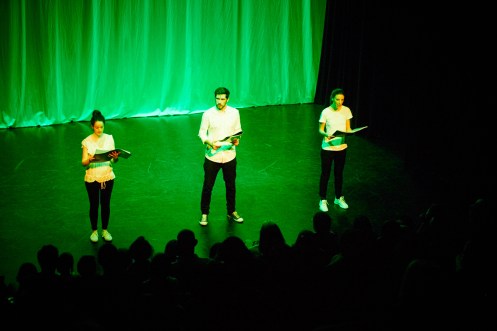
I’m drawn in, against my better judgement, by the conspiratorial tone of Hussain Ammar’s (Y4) piece Hussain’s Fabulous Fibs “If you want to be like me, come to 4J by the Y4 stairs and I will show you how to”. He’s going to show me how to tell fibs, but not without the warning that this might lead to trouble. I can’t wait! Assuming I escape trouble with Hussain, I probably shouldn’t be worrying about old age either. Megan Smith (Y4) has an impressively no-nonsense but inclusive view of it in her poem When I am Old: “I won’t be told what to do, Is that the same with you?”
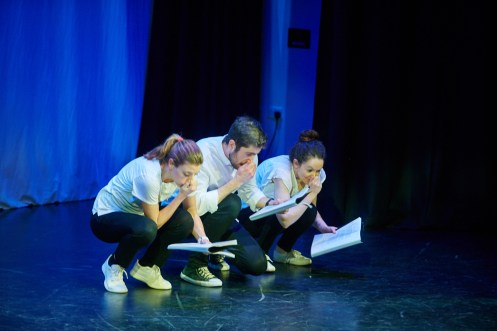
Striking in his understanding of conflict resolution and making sure everyone feels valued was James Siveyer (Y3) in his short story The Ghost and the Farmer, in which a ghost, a fox (James is clear that foxes obviously cannot speak but you can speculate about what they might say), and a farmer collaborate, problem-solve and leave everyone happy, “… they soon found it could actually be very handy to have a dark shadow following you around”. This was an entertaining and perceptive piece of writing, particularly for the age of the writer and I feel that James Siveyer should probably be in government.


Amongst the older group Rhodes Abukalil (Y9) wrote a striking description of a destructive, rage-filled relationship between father and son who realise their similarities too late, and Catherine James (Y7) put forward a philosophical view of the life ahead of her and the myriad of choices to be faced. Lilla Radek’s (Y9) Long Live the King, was so vivid in her creation of a dark forest that you could hear the leaves crunching “like small bones” and feel the damp in the air. Her exploration of the concept of personal darkness: “…pure, unsaturated darkness, the searing, tearing thoughts that grip one’s own heart and thrust it into an unidentifiable but terrifying abyss…” added further depth to her writing.
There was a striking immediacy about Natasha Syed’s (Y12) poem, Number 119, about a Palestinian nurse on the front line. It was pared down to short lines using only the most essential words, so that delivery was halting and jerky – nervous like the moments it described. “Hijab drawn tightly over face … Donned in white overalls, Arms raised, fingers fanned in gummy white medical gloves”, and later “Pockets filled with ammunition of sealed bandage rolls”. Again, it evoked the heat and the dust and the fear of the nurse in the moment. It was mature, sophisticated, very impressive.

All the work on show at the Writers’ Festival was enjoyable and it would require a review of several pages to mention all 17 prize-winning pieces on display on Sunday – who, for example, knew what Pneumonoultramicroscopicsilicovolcanoconiosis is? Zoe Taylor (Y5) does and she wrote a poem about it. I can confidently say that the future of culture is, at least in the borough of Richmond upon Thames, bright.
Eleanor Lewis
March 2019
Photography by James Bell Photography
Grief: A Self-Help Manual
Dead End
by Kathryn Gardner
Subtle Paws at Cage, The Vaults, Waterloo, until 10th March
Part of The VAULT Festival (Week 6)
Review by Abigail Joanne
Kathryn Gardner, writer and performer of Subtle Paws Theatre Company, presents Dead End at this year’s Vault Festival. Vault has teamed up with Guys and St Thomas NHS Foundation Trust to open up conversations around death, dying and grief. “Some shows will make you laugh. Some will make you cry. All will get you thinking. Death affects us all. Let’s talk about it.”
Dead End opened at The Vaults in their space named The Cage. The graffiti tunnels and the dark underground theatre was the perfect setting for a show about to tackle what is often perceived as a grim subject.
Upon arrival into The Cage we are seated in a cosy, humid and dark room, and there are leaflets on our seats with illustrations instructing how someone can be of help to a loved one who is grieving. “Ask questions” and “Let them be sad” reminds me of a difficult reality, but one that can be navigated more efficiently and with more heart, if given the right tools.
We are facing towards a scene scattered with rubbish, and a bench with tatty work tape strewn across it has ‘PRODIGY’ scratched into its surface. Our first character is humming Breathe – a fitting homage to the sad news this week that Keith Flint passed away by taking his own life.
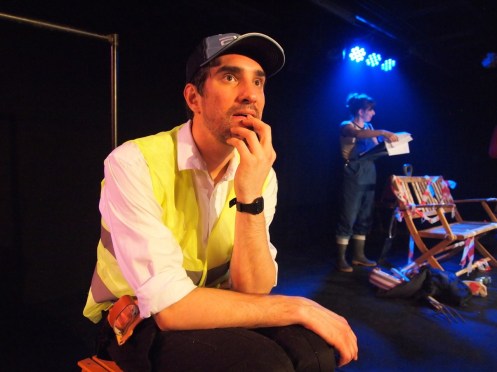
Caretaker Lance (Paul Collin-Thomas) talks to himself and the audience, sometimes wandering off stage, and he informs us that his tools keep mysteriously going missing, only to turn up again in a different place. His manner is somewhat simple but nevertheless light-hearted.
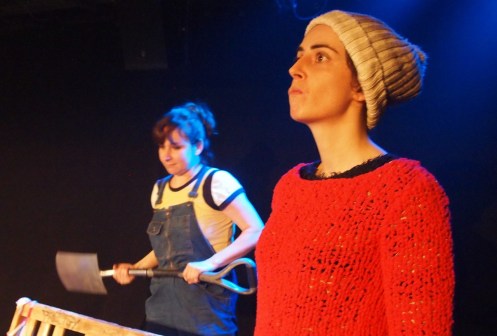
The next two characters come onto the stage, one carrying a spade and the other dirty with mud. Here we have Sue (Gardner) and Carol (Chloe Wigmore), who chat about what the Caretaker might be up to, and how might they feel if he disappeared?
Sue clearly finds it difficult getting in touch with her real feelings surrounding grief, and the two chat away in slang phrases which is endearing, as they are obviously avoiding getting real about their feelings on the matter.
When the plot takes us back to Lance, we see Carol looking into the distance, a worried look on her face, and we might wonder what it is that she really wants to say, but cannot?
All three characters capture a wonderfully British charisma; keeping things light-hearted yet making sure it’s still evident that they care. It certainly makes a point about British culture and our often-lacking ability to connect to this difficult topic. Yet we also see the importance of making light in challenging times, and how grief can also eventually lead to new opportunities, such as friendships.
There are many unanswered questions, each character carrying an unexplained plot of their own, such as the dead body left to rot in the sunshine along with the chicken shop bones and empty buckets, or the appearance of a dead cat who has been kept in a cool bag for two weeks after being murdered at the pub. This might be a pointer to the plays title Dead End, leaving us with more questions than answers.
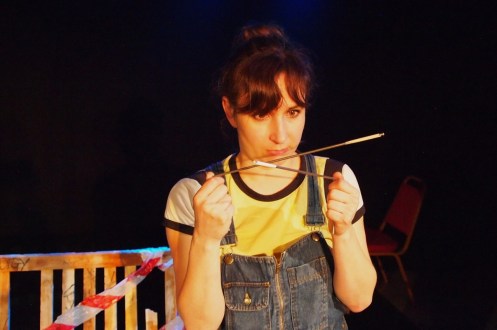
There’s a lot within the plot to be missed that I think mirrors the theme of avoidance (which of course, is one of the stages of grief) and our cautiousness of entering too far into a topic that can leave us feeling all too vulnerable.
It’s an interesting play, one that is definitely worth a watch and one that is open to interpretation. For some it may fall flat but I was encouraged to look beyond the bizarre plot lines and see what was really going on for each of the characters.
I was left wondering, where is the balance between finding comfort in making light of a situation, and paying respect for what is a difficult reality we must all come to terms with and honour?
Cue Eleanor Rigby.
We are the wheelbarrow, moving forwards whether we like it or not.
Abigail Joanne
March 2019
Photography by Freya Evans
Triple Jump to the Fringe
Three Ayckbourn Plays
by Alan Ayckbourn
Barnes Community Players’ Triple Bill at OSO Arts Centre, Barnes until 10th March, then on Fringe tour until August.
A review by Vince Francis
Barnes Community Players trilogy of Alan Ayckbourn one-act plays are presented at the Old Sorting Office, this week, are in preparation for the Edinburgh festival. The selected plays are Mother Figure, A Cut in the Rates and No Knowing, with the first two being performed before the single interval. I was not familiar with any of these (I’m mainly a music and musicals bloke), so I was looking forward to having my horizons expanded.
Mother Figure features Amanda Larson as Lucy Compton, Bryony Wilman as Rosemary Oates, Rodger Hayward-Smith as Terry Oates and not forgetting Curly Bear as Mr. Poddle. Lucy is the mother of three children who are under school age and the wife of Harry, a travelling businessman whom we do not see in this production. As a result, Lucy has become wholly preoccupied with acting as single parent to the children, to the extent that she has given up answering the door or the phone and barely bothers to change out of nightclothes. Her husband, worried by the lack of response to calls, has contacted the neighbours to check she’s OK and this leads to Rosemary visiting, followed later by her oafish husband Terry.
 The comedy lies in the wry observation of how the behaviour of adults reflects that of children and can be managed by good parenting. This worked well, generally, although I wondered if Lucy might be a little more preoccupied, or distracted, than angry, which the predominant response was. That may well be a matter of taste and fancy, though. Amanda’s portrayal was consistent and believable throughout. Bryony’s performance was similarly classy and the two worked well together. Sadly, I would have to say that I found Rodger’s Terry Oates less believable. I’m not sure whether it was a lack of direction, or lack of comfort in knowledge of the script, or character, or blocking, but Terry seemed to thrash around for responses on occasion and this hesitation detracted from the portrayal of a straightforward oaf, i.e. someone who doesn’t think of anyone else simply because nobody else matters. That said, this was a good piece and there were plenty of well-earned laughs.
A mention for the stage management at this point. Mother Figure employs a fair number of furnishings and props to give the impression of the chaos that is a room that has been occupied by under-fives, together with the laundry overhead that is attached. It works really well, but it is a busy set and it had to be cleared and reset for the second production. This was done efficiently and without fuss by a combination of cast and crew, but it is a bit of a big change. Given that time is a limiting factor in Edinburgh venues, I wondered whether any simplification is possible to shave off a few seconds.
The second piece, A Cut in the Rates, is another three-hander, featuring Alexa Bushel as Monica Pickhart, Nicola Doble as The Woman Upstairs and Patrick Van den Bergh as T L Ratchet. It’s difficult to summarise this one without giving the game away, but let’s just say that Miss Pickhart, a Town Hall employee, visits Mr. Ratchet, a retired illusionist, to investigate unpaid bills. During the course of the visit, she is left alone in the cellar, where the ghost of Ratchet’s stage assistant (Nicola Doble) appears. We learn that she died as a result of an accident on stage during a sawing the woman in half routine.
This was the best of the bunch for me. It was clear that all three were absolutely at ease and felt able bring the piece to life, if that’s an appropriate way to put it. Alexa Bushel’s Monica was suitably jumpy. Nicola Doble’s double-billing brings us a couple of very effective visual gags (no, I’m not going to tell you; go and see it) and some very affecting sinuous movement, whilst Patrick van den Bergh’s Ratchet is wonderfully expansive and enigmatic. Good stuff.
The final piece, No Knowing, has Trevor Hartnup as Arthur, and Marie Bushell, as Arthur’s wife, Elspeth. Steve Bannell played their son, Nigel, and Fiona Lawrie their daughter Alison.
Arthur and Elspeth have been married for forty years and it’s clear that they have drifted. He regularly disappears off to his shed, to surf the Internet, whilst she, equally regularly, meets up with her friend Janice. The seeds of suspicion are thus sown among the audience. Is he going to turn out to be some sort of pervert? Is Janice simply a cover for an extra marital affair? The answer to the first question is no, thankfully, but he is up to no good. The answer to the second question is yes, sort of, but not quite as you think.
The tension is built up as Nigel informs Arthur of local gossip regarding his mum and, later, Alison informs Elspeth of incidents that reveal Arthur’s on-line antics.
In the end, there is reconciliation and a nice observation about how we pledge ourselves to someone we hardly know. It’s a comforting resolution, but I was expecting more fireworks. Perhaps I’m just a pessimist.
A very special acknowledgement is due to Marie Bushell who read in the part of Elspeth. We were informed that she had only eight days’ notice of this and I have to say, that within minutes, it was easy forget that she had the script in front of her. A brave rescue of a tricky situation that happened to reveal a very credible and creditable performance.
This was the longest and most complex of the three pieces and, as such, most of the little niggles and nudges below apply here. These are general points. I feel it would be unfair to criticise individual performances in this piece given the potential effect that the change in personnel may have had. Let’s get those out of the way here.
Not everyone is safe on his or her lines. There was a fair amount of spluttering, a number of repeated cues or dialogue exchanges and a couple of pauses that were other than dramatic.
Movement. I was fortunate enough to see Art at Richmond Theatre on the previous evening, a production that provides a fine example of how to employ movement and stillness effectively. By contrast, there was a point in No Knowing where the shuffling of feet was reminiscent of a sand dance worthy of Wilson, Keppel and Betty.
Ad-libbing: very risky, in my humble opinion. It can act as a distraction for the performers and audience and, at worst, can quickly deteriorate into a competition of wit, or an orgy of in jokes and references.
Hit your marks. There are no follow spots and being half lit is one of the unfortunate and avoidable archetypes of amateur theatre.
Be quiet in the wings. The OSO is wholly unforgiving in this aspect, which is unsurprising, since it wasn’t designed as a performance space. Any mutterings are clearly audible in the, er, auditorium and there were plenty.
Opening nights are always fraught. It’s not unheard of for professional productions to implement last minute fixes and changes and these can be apparent, even when the cast and crew are engaged full-time on the show, so an allowance should be made for those of us in amateur world, where we may also be working full-time. In this case, as mentioned, a key cast member had dropped out at a late stage. There’s also the element of nerves building up with the first audience arriving in their seats.
Taken in that context, this was a pleasant evening with a few minor crits, which, it is hoped, will be accepted in the spirit they are offered. As a first outing for an Edinburgh project, it shows promise, but it does need a bit of sharpening up. A good script – and these are good scripts – can get you through a lot of difficulties, but do, please, beware. The home crowd will always, rightfully, be supportive and, in some instances, make allowances. An away crowd, particularly a discerning Edinburgh festival audience, may vote with their feet and that would be a genuine crying shame for this project, which, as I say, I believe has great potential.
Vince Francis
March 2019

 Mark Aspen