
Newton’s Cradle and Interconnecting Relationships
Closer
by Patrick Marber
Putney Theatre Company, at Putney Arts Theatre until 23rd February
A Review by Celia Bard
First successfully performed at the Royal National Theatre in May 1997 the play Closer continues to play to receptive audiences, bearing out the idiom by Woody Allen that “Sex without love is an empty experience, but as empty experiences go it’s one of the best!” The four characters in this play, Alice and Anna and Dan and Larry, in their pursuit of love lead each other a merry dance of sex and infidelity, but their quest is founded on deception and lies which ultimately leads to pain and disillusionment. The theme is as old as the hills but in the hands of Patrick Marber it remains as fresh and pertinent as ever.

The play consists of twelve scenes where events play out over hours, days, months, years. Innovative use of video images, including shots of The London Aquarium, an Art Gallery, Postman’s Park, and some carefully selected pieces of furniture provide easily recognisable settings. The audience is never left in doubt as to where the action is taking place, leaving audience members free to focus on the cleverly constructed dialogue, which is both witty and poignant, and on the characters’ brutal and tense relationships. An ingenuous prop is the use of a Newton’s Cradle. The continuous backwards and forwards force of the swinging spheres symbolise the dramatic tension between the characters, wonderfully realised by both director and actors.
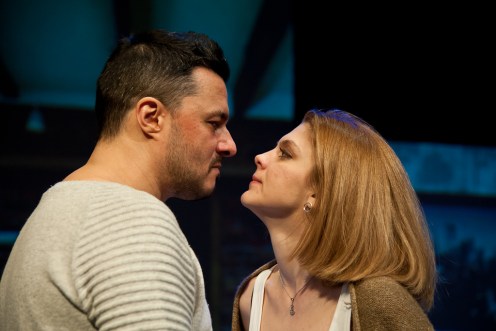
The first scene opens in a hospital waiting room. Alice, a club stripper, nursing a minor injury meets Dan, a newspaper obituarist and would be novelist, whom he helps and quite soon afterwards goes to bed with. The other two characters in the play are Larry, a dermatologist, who meets Anna, a photographer, in The London Aquarium. They too go to bed. Dan then meets Anna when he is having his portrait taking for his new book. Sexually drawn to her, he eventually succeeds in persuading her too to go to bed with him. Larry finds out about the affair and goes to bed with Alice whom he meets in a strip cub. This merry go round of sexual encounters and splitting up exacerbate emotional wounds. The title of the play, Closer, becomes irony as the scenes we see and don’t see make it clear that the couples do not become closer, even at their most intimate moments. Although each of them embarks on a quest for true love, their search is fruitless. The men cannot commit, and the women want something that their partners as lovers cannot provide.
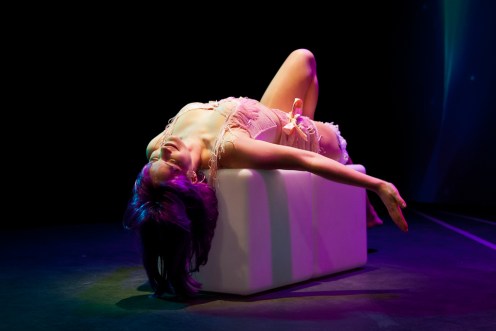
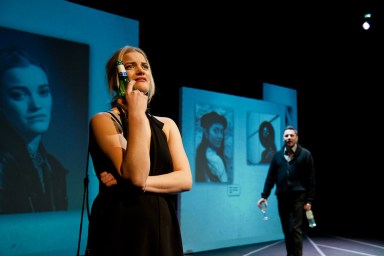 Grace Cullen brilliantly portrays the character of Alice, needy, vulnerable, sexually alluring, and feisty. Her vulnerability shows through in her facial expression during a photographic session with Anna when she instinctively realises that Dan is going to stray. This actor is able to exactly replicate her character’s wistful facial expression in the photograph later on display at Anna’s photographic exhibition. The scene with Larry in the striptease club is wonderfully played out. Grace’s physicality is impressive. Her movement is sexy, but not seedy nor offensive: throughout she manages to convey an innocence and vulnerability, which maintains audience sympathy. Her character’s façade disappears in the final scene when Dan who, on having learned the truth about the question mark etched on her leg, questions her about it. Rather than face up to the brutal truth of her insecurity and destroying the fiction of the persona she so carefully maintains, she sharply ends her relationship with Dan. Alice is a complex character and Grace Cullen exploits this to the full.
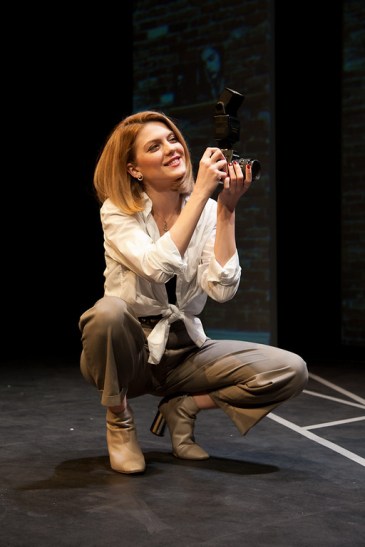 In contrast Anna, skilfully played by Olivia Nita is a very different character. Sexually attractive, older, sophisticated, a talented photographer, appears not to be needy, but she has an Achilles’ heel. She practises deception, which she cannot maintain when challenged, she cannot lie. In many ways Anna is a victim of her own sexuality and she is easily manipulated. She feels guilt about betraying the three other characters, but her feelings of guilt do not override any moral consideration. The beautifully directed scene in the restaurant when the audience sees her in different time zones with both Dan and Larry highlights the extraordinary and painful situation in which she frequently finds herself. This scene requires careful timing which this actor handles expertly.
 The two men, Dan and Larry, superbly acted by Tim Duthrane and Jerome Joseph Kennedy do not display the same sensibilities. They appear to be driven by certain Alpha Male negative characteristics, displaying confidence and dominance in pursuit of women and being possessive and jealous. Dan, as realised by Tim Duthrane, is manipulative and mischievous as revealed in the computer chat room. He of all the characters swings the most, backwards and forwards, in his quest for sexual desire. In Larry’s office, Dan appears wearing glasses. Although this indicates failing eyesight the spectacles also symbolise his lack of insight regarding women: his relationships with women are only skin deep. Larry on the other hand is driven by feelings of revenge. This same encounter with Dan in his office, earlier in the strip club scene with Alice, and then in the restaurant, acutely reveals this trait of personality. He is not going to forgive Dan for robbing him and sleeping with Anna, he sleeps with Alice as revenge and he forces Anna to have sex with him again before signing the divorce certificate. The male characters in Closer are not depicted sympathetically by the writer. Both actors, however, play their parts with such a lightness of touch, incredible believability, and an ability to hold and engage the audience by varying the way they portray their characters on stage that you never become bored or irritated by them.
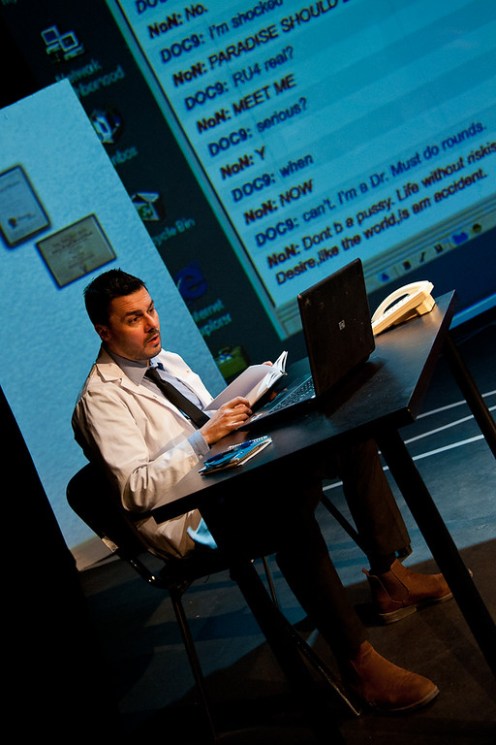
For all four characters love, friendship and genitals are explosive ingredients of items that go to make up affairs of the heart, which as Larry puts it is “wrapped in a bloody fist.” This brutal, hard-hitting, interesting, and thought-provoking play, cleverly directed by Jeff Graves, superbly acted by the four actors, and supported by an imaginative and skilful technical design team make this a memorable production, one that is not easily forgotten.
Celia Bard
February 2019
Photography by Rich Evans
Laughter or Treason?
Trial by Laughter
by Ian Hislop and Nick Newman
Trademark Touring and Watermill Theatre at Richmond Theatre until 23rd February, then on tour until 9th March
Review by Mark Aspen
Huzzah, huzzah! Hislop and Newman’s latest historical docu-drama,Trial by Laughter has all the robust rumbustiousness that we have come to accept as the quintessence of the Regency period. Indeed, it is a fitting caricature of a highly caricaturible period and centres around the famous caricaturist George Cruikshank, or more specifically his promoter and collaborator William Hone. Who? I hear you say. Hone, a writer, satirist and Fleet Street bookseller, is undeservedly much less well known than Cruikshank. Hone is often described as “the greatest champion of press freedom”, for his court battles against censorship, where he was victorious in defending freedom of speech against the powerful interests of the day.
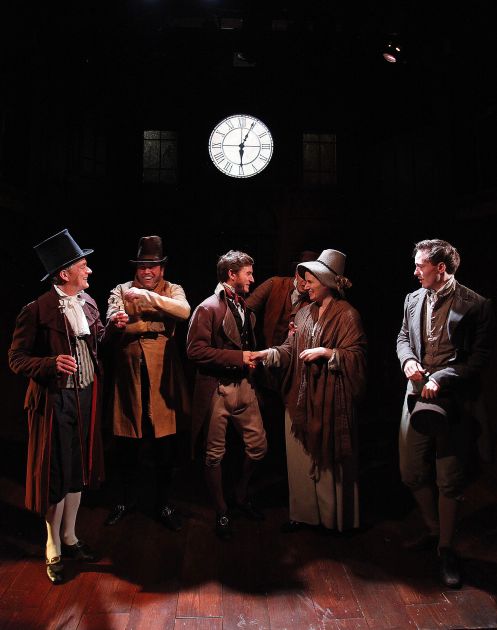
In fact there were three court cases on three consecutive days just before Christmas 1817, three separate trials, which took place in The Guildhall before special juries, and in all of which he was found not guilty and acquitted. Unfortunately, in Trial by Laughter, we are put on trial by having the same play three times over. The writing of the play does not stir the same empathy for the protagonists, nor have the gentle humour, of Hislop and Newman’s earlier historical piece, Wipers’ Times.
Notwithstanding a somewhat weaker script, the cast of Trial by Laughter attack the drama with huge dynamism and such palpable glee that it sweeps these misgivings aside. It is carried vigorously away by a score by Nick Green whose Baroque style draws on Thomas Attwood, who was a chamber composer for the Prince Regent. Indeed, Trial by Laughter is leavened by musical interludes sung by the cast, in the style of Regency “glees and catches”, ribald rounds loaded with double entendres (not that the text is in any way short of double entendres). For instance, the catch The Tree of Life straddles biblical allusion and suggestive satire: your imagination can unravel the entendre.
Herein lies the basis for Hone’s prosecution. He had published political parodies in the Reformists’ Register, which were illustrated by Cruikshank. These squibs not only exposed the corruption in the establishment of the day, but also ridiculed their scandalous “private” lives, including the sexual incontinence of the Prince Regent. Hone’s biggest mistake was to use the then familiar patterns the Bible, the Prayer Book and the liturgy of the church as the template for his satires. This gave a very sharp hook on which the prosecution could hang its case, and he was charged both with seditious libel and with blasphemy.

Designer Dora Schweitzer’s set has the calculated proportions and precision of Regency cabinetwork, in a sedate “solid mahogany” street façade, complete with a practical town clock, which adds to the state of urgency. It is a metaphor for the society. Behind those doors all is far from sedate, including in the royal court. Jeremy Lloyd portrays the Prince Regent as a shallow indecorous fop. The part is played big in many senses, for Prinny is surrounded by his mistresses, in a pneumatic ménage à trois with Lady Hertford and Lady Conyngham, played by Helena Antoniou and Eva Scott respectively. This is caricature writ big and all three have great fun in a continued scatological and sexual romp. Even children’s games are voluptuously hijacked into use as sexual horseplay by this plush trio.
Through the long-suffering courtiers and palace staff stride Baron Ellenborough, the Lord Chief Justice, and Viscount Sidmouth, the Home Secretary. They are intent on using the Prince Regent’s vanity to lever up the charges against Hone and use the courts to silence his criticisms. Sidmouth had already suspended the right of Habeas Corpus, hence securing a trail and two retrials of Hone on three successive days was a straightforward matter. Dan Mersh’s Ellenborough is a bluff character, a hard man, ruthless in getting his way, whereas Phillip Edwards plays Sidmouth as a manipulator, insinuating his own way, but equally effective.
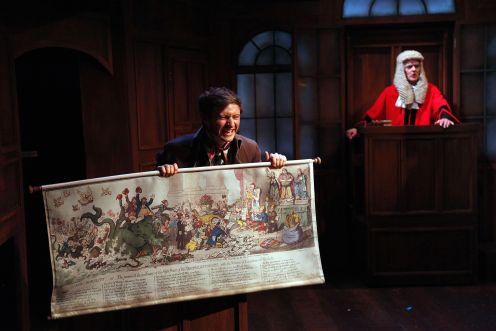
The court of law is convened in The Guildhall, where we, the audience, in a nod to the metatheatrical, are included in the noisy crowds inside the court (if not in the mob of thousands outside), enhanced by some clever stereophonic effects by sound designer, Steve Mayo, which plant virtual hecklers in our midst. The court is depicted as, to say the least, biased. Most bigoted is the judge himself, Mr Justice Abbott, a wickedly gimlet-browed Nicholas Murchie. Dirty tricks even extend into the gaol, where a lithe seductress, Mary Oliver, is sent to compromise Hone, in a delicious cameo for newcomer Rosa Hesmondhalgh.

The open matter-of-factness of William Hone, which borders on the naïve, is energetically depicted by Joseph Prowen, as a passionate and earnest young man, a David bold (and foolish) enough to take on the Goliath of the state machine. Hone has the self-belief, and lack of cash, to mount his own defence. He is spurred on by the devil-may-care Cruickshank, played with verve by Peter Losasso, who embodies the relentless energy of the caricaturist who incites Hone to keep going, despite his exhaustion to give six or eight hour long defence speeches. The increasingly ill Hone uses a good natured humour to win over the jury on each occasion, in spite of being counselled by the much more grounded William Hazlitt to be wary of using jokes in a court of law, “Wit is the salt of conversation, not the meat”.
Jeremy Lloyd doubles as Hazlitt, well differentiating the urbane literary critic with Ellenborough, the head-on Cumbrian. Other effective doubling comes from Nicholas Murchie, who returns as an exasperated Frederick, Duke of York, and Eva Scott who plays the pivotal role of Sarah, Hone’s loyal and very resourceful wife. Sarah is very much the rock-solid foundation of the ever increasing Hone household. Initially with little sympathy for his, as she sees it, self-imposed incarceration, it is she who eventually gathers the evidence that leads to his third acquittal.
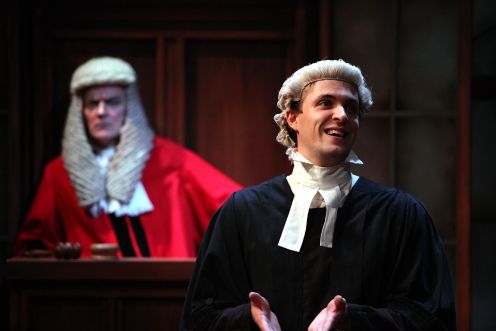
Prosecuting council, Weatherill, played with tenacity by Lewis Bruniges, plugs away at the blasphemy angle. Hone argues that he is using the sacred texts as models in style because they are familiar, and that he is parodying that style in his satires, without any intention of being disrespectful to the name of God. It cuts little ice with the lawyers. However, in the third trial Lord Ellenborough himself takes the judge’s bench, and Hone is able to bring out evidence, uncovered by Sarah, that Ellenborough’s own father, Edmund Law, had used a similar literary device … when he was Bishop of Carlisle.
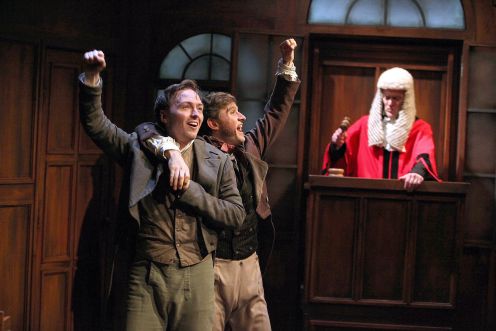
There is a nice comment, pointed at our modern world, from Hazlitt when a youth gets Cruickshank to sketch him with Hone, as a sort-of early nineteenth century selfie, “ah, well there is unlooked-for fame”. Director Caroline Leslie’s boisterous high-octane knock-about makes for entertaining fun in twenty-first century Britain, but one should feel some sympathy for the “villains” of the piece when one reflects that in 1817 that the bloody aftermath of a bloody revolution across the Channel continued, that a revolution had lost us a valuable colony in America and that a British Prime Minister had been assassinated five years before. Revolution was in the air. There was an edginess with the instability of politics that perhaps chimes two centuries later. In an age of belief, blasphemy was an unspeakable offence against the Almighty, whereas it is actively encouraged in politics today. It is ironic that Richmond Council has just voted to prevent people peacefully praying in silence outside of an abortion clinic within half a mile of Richmond Theatre. Freedom of speech and freedom of religion are just as under threat as they were 202 years ago.
Blasphemy may be old-hat here and now … but try that out in Raqqa! A sobering thought even for the less than temperate protagonists in Trial by Laughter. Hislop and Newman’s new play makes an entertaining and fun evening, but gives much food for thought, a Prince Regent’s banquet load of food for thought. Huzzah, huzzah!
Mark Aspen
February 2019
Photography by Philip Tull
Infinite and Expansive
Ondule
by Rouet and Martinez
Resolution at The Place, Euston, 12th February,
The Festival of New Choreography continues until 23rd February
A reflection by Abigail Joanne
Ondule by Laura Rouzet and Alejandro Martinez is a performance showcased as part of Resolution 2019 at The Place. Part of a Resolution triple bill in-between Hazel Lam’s Lighthouse and Mara Viva’s time/less, Ondule entices the audience into its mysterious dimension. Informed by contemporary, popping, voguing, and dancehall, Ondule is a ‘point of intersection where otherness emerges’.
 Ondule, from the French, means ‘undulate, swirl, swing, sway’: the dancers have captured this beautifully and invite the audience to relax into their organic display.
Choreographed and performed by Rouzet and Martinez, with music produced by Monica Mia in collaboration with Rouzet, Ondule is a duet which explores genderless movement.
In the beginning we see two figures joined in motion, foreheads touching to create a loving and intimate composition. Sparkles dance from nude tones and masks with edgings, twinkling to the curling movements, the figures are like cells under a microscope, merging, then moving away. I am reminded of the power of ten; the miniscule and the massive are as one, infinite and expansive.
 We see each dancer become more independent while the other gently continues undulating in the background, behind a shimmer of silver curtain strips. The physical expressions become stronger and wider. The music picks up and an irresistible beat takes you into the night where the covert becomes liberated.
I wonder what ‘otherness’ they describe in their bio is? Is it something different, separate, and unknown? Or is it, in fact the very core essence of us all? The inevitable evolution of nature?
It is possible to expand beyond our preconceptions of gender, and to challenge our own identifications within ourselves and towards others. We can connect and move into this space to find celebration in our sovereignty and togetherness in our independence.
I really hope Rouzet and Martinez continue to collaborate; I would be interested to see their ideas develop further.
Abigail Joanne
February 2019
Read more at The Place’s Resolution Review
Photography by Laura Rouet
Discovery: Home, Heart or Hostility?
Birthright
by Bram Davidovich
Kryptonite Theatre Company at The Vaults, Waterloo until 16th February
Part of the Vault Festival
London’s own fringe, The Vault Festival 2019, is staged in eclectic venues in and around Waterloo.
A Review by Georgia Renwick
In this unorthodox tale of a pilgrimage (of sorts) to Israel by two young, Jewish twenty-somethings, questions of faith, identity and the nature of religion exchange blows. Like faith itself, in Birthright the conviction is there… but in practice, the execution is messy.

Joshua and Becca are two young Jews out on ‘the trip of a lifetime’, their ‘Birthright’ trip to Israel. This very real organisation (You can look it up!) sponsors trips for young adults of Jewish heritage to their ancestral homeland, and these two have come for very different but inadvertently connected reasons. Joshua is keen to escape the nagging of his Orthodox Jewish family, who are hell-bent on ruining his life of video games and online pornography with suggestions like getting a job or going to university, but what direction should he take, and will his religious upbringing play a part? Becca resents her parents on the other hand for neglecting their heritage and raising her in a secular home. She feels drawn to taglit – Hebrew for discovery. In learning her history and the Hebrew, can she discover more about herself? Both young people join the tour to find out, but discover far more off the beaten track when they become lost, than they do on the group’s bus tour.


A promising premise descends rapidly into a muddled farce of Jews behaving badly. There are Jewish in-jokes and other funny moments (I was tickled by Becca’s likening of Joshua to a young King Solomon) but you can feel the writer heading purposefully towards the edge of what you might call ‘insensitive’ humour and pressing hard up against it. Blunt exchanges of arguments surrounding the nature of faith have little poetry to them. Some of the ideas they put forward are interesting: does being a Jew have to equate to a belief in God, for example, or can it just be about respect for and an understanding of the history and heritage? But it’s hard to pick these thoughtful moments out under the continuous swearing, Joshua’s frankly uncomfortable sexual propositioning and Becca’s exasperating heavy sighs.


To pay credit to the actors, the performances themselves are energetic, playful and overflowing with conviction. They have some fun creating the array of strange characters they encounter on their trip. Aimee Bevan’s tour guide has an instantly recognisable insistent ‘pay attention’ quality to his demeanour and a slightly disconcerting but well observed fixed grin. David Samson’s dancing makes several appearances in his characters, each of which is a comedic delight.
It was a curious ‘visit’ to Israel that offered some food for thought, heavily veiled in impish humour.
Georgia Renwick
February 2019
Photography by Team Kryptonite
Absorbing Water
Resolution 2019 (Triple Bill 18)
Lighthouse Ondule time/less
by Hazel Lam by Rouet and Martinez by Maria Vivas
Resolution at The Place, Euston, 12th February,
The Festival of New Choreography continues until 23rd February
A review by Mark Aspen
Resolution goes to sea! The eighteenth of the triple bills of Resolution 2019 evokes an eerie marine world as more emerging choreographers find watery settings to be an expressionist metaphor for human perception.
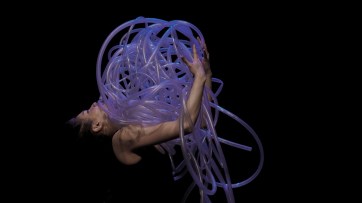 Lighthouse shows us the way. A violet square of light-rope delineates a world outside a safe emotional harbour. In this piece of object theatre, two protagonist straddle this boundary, one a solo dancer, choreographer Hazel Lam, the other a writhing mass of translucent tubing like the tentacles of an unseen cephalopod. In silence, she approaches apprehensively, quizzical, then probes this alien form, sounding the whip-like feelers, and allows herself in a trance to become enveloped and embraced … then aggressively draws back. But she has crossed a boundary, both emotionally and in the vision of this work. For it is a performance of two halves, for as she releases herself to the sensuality of this relationship, the piece becomes a graceful aerial ballet. The cartilaginous elasticity of the tubing imbues it with a zoological quality while Bert van Dijck and Margot Jensens’s lighting design subtly enhances this feel. The aerial ballet is accompanied by original music by Max Morris, which hints at Nyman in lyrical mode. Lam’s athletic agility amalgamates varied art-forms, all of which require considerable skill. Lighthouse illuminates an effective exploration of strength in femininity, how the tender can overcome the terrifying.
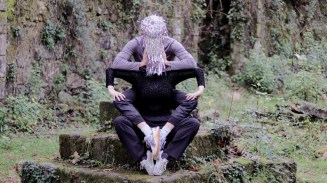 The senses are inundated in Ondule (from ondulé, rippling). Laura Rouzet’s expressionist Laban approach combines full-on video and music into a mesmerising dance-form that remains aquatic in its palpitating, pulsating, pounding fluidity. Rouzet dances with fellow choreographer, Alejandro Martinez, and their performance is dynamic, driven by the cardiac music of Monika Mia, with a bold lighting design by Alejandro Martinez. The sinuous synchronicity of the dancers’ undulating moves are organic. They seem to merge into a single life-form from two twin organisms, girdled and veiled in articulated pink. They become hyperactive decapods, which throb to a heartbeat sound as, in the depths behind them, the cyclorama swirls with hydrodynamic globules. The promise of popping and voguing suggested a more angular and assertive style, but Ondule takes the technique to a much more fluent form, as hypnotically watchable as it is overwhelming.
 The mood is much different in Mara Vivas’s time/less, a contemplative study of the nature of time. We are in Another Place redolent of Crosby Beach, where cinnamon statues stare motionless out to sea. The superficial rusting on Antony Gormley’s steel men is replicated in the long cinnamon shifts worn by the performers, Lynn Dichon and Tara Silverthorn, two women who stand in silence. There is a palpable tension between the two. One traces figures of eight with a toe, the other raises and lowers her heels. Gradually, by almost imperceptible degrees, they engage with each other and drift together, mirroring each other in the taut exposure of their naked feet. Vivas states that her work references the Italian physicist Carlo Rovelli, who has developed a theory of physics without time. However, for me it began to feel like a choreographed Waiting for Godot. You see, I’m an impatient sort of chap, and ached for action. The, with the inching in of an anxious musical accompaniment, an original soundscape by Portuguese composer Filipe Sousa, action came as slo-mo miming of life’s experiences, perhaps a hint of a things shared. Here is a reflection of time that focusses on human mortality. The background set, which had appeared to be an abandoned breakwater, was top-lit to reveal a random myriad of fine glass jars, which the dancers manipulated to sound of a glass armonica. There is a resolution of the thesis of the piece in this representation of the celestial spheres that gave it an elegiac quality. It is thought that I shall ponder … time/lessly.
Mark Aspen
January 2019
Read more at The Place’s Resolution Review
Photography by Geert Roels, Rouet and Martinez, and Nicole Guarino
Missed Connection
The Girl on the Train
by Paula Hawkins, adapted by Rachel Wagstaff and Duncan Abel
Simon Friend in association with Amblin Entertainment at Richmond Theatre until 16th February, then tour continues until 23rd November
A review by Matthew Grierson
For a thriller, The Girl on the Train is rarely thrilling. In fact, it seems to have decided it is a comedy, so successful it is in generating laughs from the Richmond Theatre audience. There is scarcely a situation in the play that does not merit a titter, from the awkward encounters between Rachel, ex-husband Tom, new wife Anna and neighbour Scott, to Rachel’s repeated, blatant denial of her alcoholism. Rather than ratcheting up the tension or offering a bleak comment on it, humour remains the predominant mode of a play whose plot nonetheless hinges on the disappearance (spoiler: murder) of Scott’s wife Megan.

This makes it all the more difficult to tell a serious, affecting story, and so the production largely does not choose to do so. Instead, it makes a virtue of staging it, never resorting to performance and direction when it can mount a stage effect. We can tell Rachel’s unfortunate condition because her kitchen is littered with a neat row of empties and artfully arranged bin-bags, as though set designer James Cotterill had been given the note ‘alcoholic’ and responded artfully but with little reference to reality. So genteel is the squalor that the number of references to Waitrose made me wonder whether the supermarket was actually paying the production to take away carrier bags rather than charging for them.
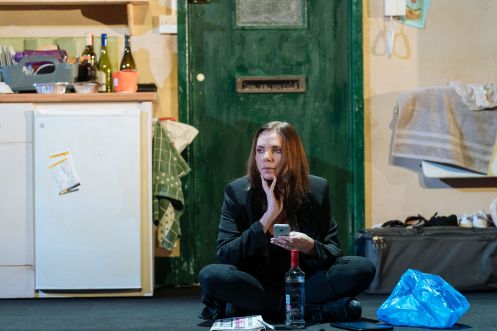
As a consequence of the production-led storytelling, neither star Samantha Womack as Rachel nor most of the supporting cast are called upon to give convincing performances, simply do what is necessary to advance the plot. We are to believe that Rachel has not only been a regular commuter, but that she has persisted in her daily journey simply to observe Scott and Megan through the window of the train as it stops at a signal. Certainly, the presentation of this is very effective – a combination of projection and live action – but in order to establish that it has been Rachel’s routine she needs to explain as much in the dialogue. Show and tell may work in the classroom, but on stage? Please.
 The narrative depends on a sense of routine that, however it is established in prose (I confess I’ve not read Paula Hawkins’ novel, on which this is based), is not easily dramatised. Likewise, whatever the rationale for Rachel fantasising that Scott and Megan are actually called ‘Jason’ and ‘Jess’ in the book, it’s just an unnecessary complication on stage, particularly as we are introduced to them by their real names before those that the first Mrs Watson imagines.
Further stage effects are all we get to cement any sense of Rachel being an alcoholic, too. Womack’s performance never convinces in this respect; indeed, she never convinces as a character, because no insight is offered into why she chooses to involve herself in the mystery. Rather than Megan, it is she who is the absence from this play, a black hole around which the action orbits. If we’re in danger of missing the heavy hint of this given in Megan’s painting, Rachel’s alcoholism is most tellingly conveyed by the scene in which she returns home and traces the motif from the artwork on her window. Impressively, this spirals out into an audio-visual effect that giddies both her and the audience. She passes out in the floor and then it is the next day, as helpfully flagged by the Sherlock-style caption ‘Wednesday’ on the wall above her sink. Under the spell of sexy modern TV shows, the action hastens along.
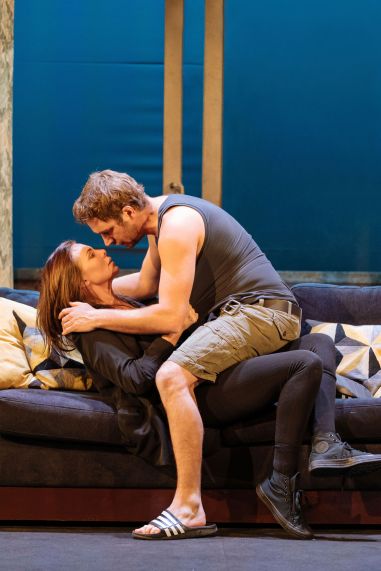 I feel I’m always banging on about the rhythm of a piece in my reviews (what can I say, I’m a trained poet and that training has to come in use somewhere), and if anything director Anthony Banks gets that rhythm exactly right. It observes a timetable in a manner that South Western Railways could only envy; but in being so punctual, we the audience are left unaffected because the production becomes more concerned with hitting its beats rather than hinting at character. There is more choreography than chemistry, for instance, in the love scene that suddenly begins between Rachel and Scott (Oliver Farnworth, who himself seems overly keen to get his dialogue spoken and done with), or in the upstage scene in which Megan exchanges possible paramours in flashback.
The play is committed to such a perfunctory tone. Pushed another way, it could become an arch, traditional thriller that simply happens to be set in the present day, spiced up with judicious use of the f-word; but even being generous to this piece one could not call it overacted. Or, it could have been a taut psychological study, in which even at the close we are never certain of Rachel’s story. Is she an alcoholic or a fantasist? Or both? As it is we do end up finding out, but crucially we don’t care – this is a fast service, content on letting us board but barely stopping till the terminus.

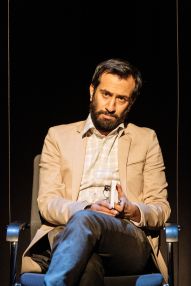 How welcome, then, is John Dougall as Inspector Gaskill for pitching his performance perfectly for all eventualities. The dour Scottish copper is the most sympathetic person in the piece, either a pastiche of a careworn copper, or a policeman playing up to a pastiche knowing that this is what is expected of him. He also seems to be the only professional in the play worthy of the epithet. Naeem Hayat’s therapist Kamal is by contrast all detachment and questions until the script wants us to suspect him, at which he becomes sarky and judgemental about Rachel’s habits and clams up about his relationship with Megan. I’d have him struck off, save that one of the show’s only true human moments occurs when Megan tells him, and the audience, her backstory – kudos to Kirsty Oswald for managing to inject a genuine moment of tragic drama into proceedings.
 So what might at first seem a passable evening’s entertainment, rattling past at the speed of a 125, in retrospect unravels as quickly as Tom (Adam Jackson-Smith)’s volte-face and the subsequently rushed trackside denouement. At the end, we are left with a pat epilogue in which two of the principals offer the equivalent of the conclusion to a school essay, summarising the preceding two hours without convincing us that they feel anything new as a result. The Girl on the Train? I think I’ll take the bus.
Matthew Grierson
February 2019
Photography by Manuel Harlan
Furious Realism
Fury
by Phoebe Eclair-Powell
Nicole Charles and Company, Guildhall School of Music and Drama, Milton Court Theatre, Barbican until 16th February
Review by Isobel Rogers
Fury is a contemporary tale by Phoebe Eclair-Powell (winner of the Soho Theatre Young Writer’s Award) based on Euripides’ Medea. Director Nicole Charles’ production is boldly 2019. Three narrators tell the story of Samantha: a stressed single mum living on a Peckham council estate. She’s a powerless figure in a vest top, hair scrunchie and spray-on jeans, inhabiting a city which is increasingly moneyed and unforgiving. She’s weighed down by the modern female prison sentence of two children and a cleaning job she can barely hold on to.

Lydia Fleming as Sam is arresting, but the character is so archetypal that she’s almost blank: she could be any one of countless unlucky women, ‘anywhere between 17 and 35’. She meets Tom, a comparatively-privileged Masters student with gelled hair and a preppy polo shirt. His intentions for Sam head increasingly wayward and sadistic. He pays her to do his chores and more. Joseph Potter’s eyes sparkle as Tom realises his upper hand in their uneven relationship. She needs him to pay her in cash.
The night they meet, they dance together on the top of designer Charlie Cridlan’s silver framed set. Its starkness represents this harsh, unbending city: a place full of skyscrapers. The structure needs to be half a metre larger in scale to avoid play-acting connotations. Sam’s place in this world is signalled with yellow marigolds pinned onto the frame.
Our narrators manipulate three heavy grey blocks to create Sam’s landscape as it morphs into the seaside and back again. Tom and Sam are intent on adventures away from their city sprawl. They kiss at Nunhead Reservoir. The interplay between them is sorrowfully fascinating: a believable downward spiral of cruel manipulation, acted with skill.
Sam’s children are two shining balls of fairy lights, disembodied but always there. A large handheld spotlight is employed in tender moments of exposition, bringing the seriousness of Sam’s fate to our attention.
The narrators (Brandon Ashford, Isabella Brownson and Kristina Tonteri-Young) are slick and omniscient, uniting as a batch of orderly social workers come to check up on Sam’s violent outbursts. They become lofty commentators on her downfall – singing angelically in harmony – instead of her allies, as I think the script intends. Confident and seemingly a class above the story, they are removed from the plot; their cameos as real friends in Sam’s life are difficult to relate to and stunt the storytelling.
A short time before the end, the performance is curtailed by a stage manager: Fleming is streaming blood from her face. She has hit her head on the silver frame during a tussle (I heard a sharp clunk). I hope that Sam finds enough fury to fight back her oppressors: a triumphant ending is needed.
Isobel Rogers
February 2019
Photography courtesy of Guildhall School of Music and Drama
Master of Northern Melodramas
Rutherford and Son
by Githa Sowerby
Questors Theatre at the Judi Dench Playhouse, Ealing until 16th February
Review by Viola Selby
Through Sowerby’s unsentimental writing of Rutherford and Son, made real by the excellent direction of Simon Roberts and the period perfect costumes designed by Nichola Thomas, the audience is plunged through time to an industrialised Northern English family living room, where the whole play takes place. This living room has been creatively designed by Bron Blake and lighting designer Chris Newall to appear and feel wonderfully warm and welcoming, with the continued hanging smoke of an industrial town.
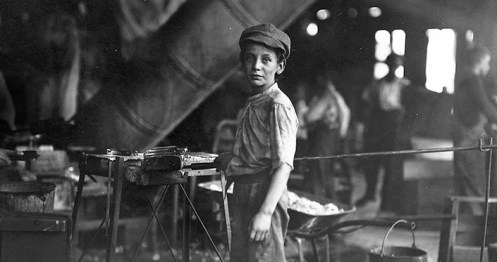
However, once into the story, having everything happen in this small space heightens the feeling of claustrophobia which each family member feels whilst under their father’s rule. And what control the father has! David Sellar is not only master of the house but also master of the stage as he manages to brilliantly depict a man whose sole focus is his business and family name, no matter the cost. Through tense silences, fervent debates, groans and moans made hilarious by the brilliant Despina Sellar as Rutherford’s ever-complaining sister Anne, and malicious monologues, passionately performed by an extremely creative cast, the audience are sent on an emotional rollercoaster of dramas, all of which are made even more realistic and relatable due to the personal approach each actor has taken in understanding their character.
Rutherford’s main issue, as the title hints, is one of his sons. John and Dick Rutherford want to create futures for themselves, both of which go against their father’s views and wishes for them and his company. Kai Hogenacker (John) and William Newsome (Dick) represent their characters’ struggles in such a sensitive and realistic way that the audience can truly understand and empathise with the characters.


Whilst a less obvious issue, which arises once a secret affair is brought to Rutherford’s attention, is the oppression of Rutherford’s daughter Janet and John’s wife Mary. Both women are subject to the men’s commands and constant criticism and, although they seem to have peacefully succumb to this subjugation, it is through the explosive acting abilities of Dani Beckett (Janet) and Evelina Plonyte (Mary) that it becomes obvious that these women are not to be messed with.
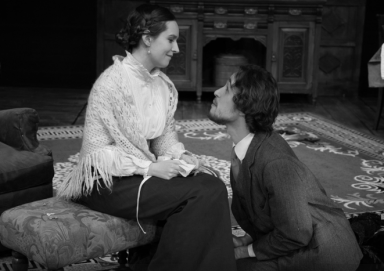 Nevertheless, through various events, it also becomes clear how Rutherford’s control reaches far beyond his family, as his focus on success impacts the lives of his neighbours and work force. In particular Martin, portrayed by Julian Casey, and Mrs Henderson, skilfully represented by Alex McDevitt as a poor working-class mother who comes begging for Rutherford to reinstate her son after Rutherford has fired him, but who threatens Rutherford the very second he threatens to take her son to the magistrate. Whilst Casey exquisitely encapsulates his character’s moral dilemma, as Martin has to decide whether to stay true to his beliefs or to go against a friend as his boss, whom he greatly respects and has worked for many years, wishes. Yet no matter his decision, it is a secret revealed to Rutherford by Dick and Janet that ends up being Martin’s undoing, again showing the power and control Rutherford has.
Rutherford and Son was originally meant to be called The Master and from Robert’s interpretation it is clear to see why. This is the master of all Northern melodramas.
Viola Selby
February 2019
Photography by Robert Vass and Lewis Hine
Sacrifice Through a Prism of Ice
Anthropocene
by Stuart MacRae, libretto by Louise Walsh
Scottish Opera at the Hackney Empire until 9th February
Review by Mark Aspen
A polar vortex sweeps down from the north this weekend with the London premiere of Scottish Opera’s Anthropocene, an Arctic blast that is as terrifyingly fascinating as an iceberg, as multifaceted as a snowflake.
The multifaceted nature of this unusual opera is as refreshing as ice, although some may find the concept as worrying as being trapped on a ship icebound in the Arctic Ocean somewhere to the north of Greenland. For this is the setting of Anthropocene, MacRae’s new opera, on-board a scientific research ship, the RV King’s Anthropocene (undoubtedly a unique setting for an opera). The ship’s name in geological nomenclature is that of the contentiously suggested alternative to the current Holocene epoch, that where humans are in the ascendancy; or so they believe. With hubris greater than any Greek god, the owner of the ship, Harry King declares that he has mastery over nature and has sponsored this expedition to discover the origins of life. “We are like gods, reaching out” he states, hence the ship has “a name that guarantees a winner”. Anthropocentrism is all.

Anthropocene is a piece in which meanings are multi-layered, a piece saturated with symbolisms. Its inspirations are manifold and diverse: librettist Louise Walsh refers inter alia to Frankenstein and The Tempest, and Agatha Christie seems to be lurking somewhere in this psychological thriller, but the overwhelming symbolism revolves around the theme of sacrifice. Should we look to Euripides or to the Bible? With such a wealth of allusions, Act One does seem to be overburdened with trying to work out its own genre, thriller, polemic, spoof, adventure story, spiritual guide, fable …? However, once this labour produces a clear narrative direction, it develops a strong ethos, and we are presented with an edge-of-the-seat griping tale, albeit one with mores twists and turns than the Stelvio Pass.
MacRae’s score is edgy, delicately brittle, insistent. It has the nervous feel of later Schoenberg, and conductor Stuart Stratford places the timing just right. The music is wonderfully expressive of the actions and emotions of the opera, which often bursts forth in great displays of lyrical beauty, including some duets and trios that have a transcendent early Baroque cadence. There are no huge set-piece arias: this is an ensemble driven work.
What can a designer do with a backdrop of the Arctic? Designer Samal Blak hails from the sub-polar Faroes, so he has a head start: white drapes all round. His set is largely the structure and marine plant of the ship. Hints of the form of the red hull jut out from the proscenium, hydraulic lifts and ramps centre stage, and the fourth wall starts out as the ship’s rail made up the proudly proclaimed name, A-N-T-H-R-O-P-O-C-E-N-E.
It is a pity that director, Matthew Richardson allows himself to be constrained by the ship’s rail in Act One. The cast tend to be lined up behind it like concert singers, but when the rail is removed, then his performers can move, use the whole stage and act as well as sing. Sing they do consummately, with a demanding score that expands the usual register of most of them.
Richardson also doubles as the lighting designer, and here have creates some very evocative effects, for the light of nature, and lack of it, is an imperative feature in polar regions. Most memorable is the aurora borealis, whose awe-inspiring presence is equally impressively evoked in the score, its flicker picked out by the woodwind, with the soft-focus of quarter tones.
 Even the brash and arrogant Harry King is uneasy under the eerie aurora. He has turned his entrepreneurial father’s “little million” into billons, but now wants to make a name for himself in saving the planet as well as discovering the secret of life. (He is nothing if not ambitious.) In the wilderness of the ice tundra though, he “might imagine those old superstitions true”. Tenor Mark Le Brocq plays King with gusto, his range extended with high-noted wonder, contrasting with the passages in which volatile temper boils over. On the ship with King is his daughter, Daisy, ostensibly the official photographer, but really along for the ride. Mezzo Sarah Champion makes a spirted Daisy, a voice of reason when emotions run high.
The opera opens straight into the action with the ship’s captain and engineer, Ross and Vasco, observing with great concern the rapidly falling temperature of the pack-ice that surrounds the ship. The rich resonant bass of Paul Whelan as Ross spoke strongly of the down-to-earth seafarer, yet not without the superstitions traditionally associated with this calling. Vasco is a man trying to focus on the practicalities of the day, but becoming increasingly distracted, none the least by a growing attraction to Daisy. Anthony Gregory’s fine and gentle tenor voice nicely characterises a man moved in spite of himself.
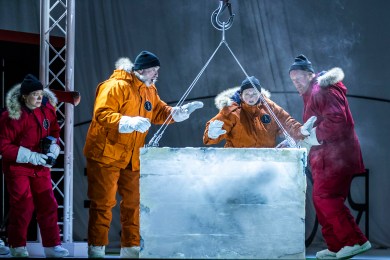 Captain Ross wants to head immediately into open waters, but the expedition’s leader Professor Prentice urges him to stay as her husband, research scientist Charles, together with Daisy and a journalist, Miles, are away from the ship, drilling for ice-cores. Daisy and Miles return exhausted, but it is already too late and the ship is frozen in. When Charles returns, it is with an astounding discovery, a human body preserved in the ice.
One is reminded of the five millennia old Ötzi found in a glacier on the Italian-Austrian border in 1991, but this body is much better preserved.
 The shock comes when the body opens its eyes!! The unnerved Vasco smashes the ice with an axe and a young woman awakens from hibernation. In the hours after this shattering discovery, the members of the expedition party each nurtures their own ambitions for fame or fortune or both by planning to exploit this discovery. King is jubilant in that it represents an unimagined triumph for his project. Professor Prentice dreams of Noble Prizes for an “eclipsing Darwin” discovery. Jeni Bern portrays Prentice as a woman in conflict, as her objective scientific approach runs in conflict with almost maternal feelings for the mysterious woman. Her well edged soprano enhances the opportunities given by the music as she tries to assure herself that “we only know what we can measure”. Baritone Stephen Gadd fills his short arias with a sense of wonder, that “we will unlock the secrets of existence”, but relishes the fame it will bring him, he who saved her from the ice and “brought you back to life”.
Miles, however, bitter and resentful at his, at one point violent, treatment by King, is determined to make the most of the overarching scoop that will lift him from being a jobbing hack to being a wealthy man, but when his editor back in London is incredulous, he resolves to up the ante by sabotaging communications with the ship. However, when he goads Vasco over his affections for Daisy, a fight breaks out and Vasco discovers the electronic board that Miles has removed from the telecoms unit. In a panic, Miles strikes Vasco a fatal blow with a spanner. Benedict Nelson imbues the part of Miles with a skulking aggrieved edge, and an animalistic baritone underlines the character.
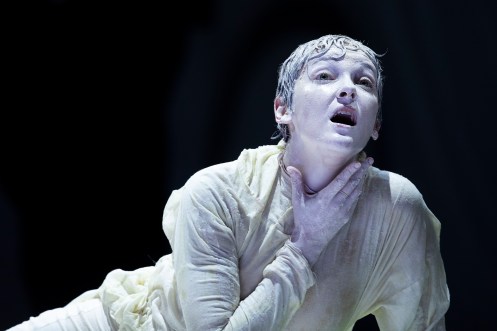
The young woman from the ice calls herself Ice in a primordial expression of her own being. As Ice, Jennifer France is outstanding, right from the moment that she uncurls like a foetus from the womb, but shaking the stiffness of age from her limbs. France’s ethereal otherworldly soprano in made for the most fragile phrasing of MacRae’s score. Soaring yet subtly and delicately decorated, her voice captivates with its alien coolness. Nevertheless, there is a plangent urgency that draw as an immediate sympathy for the plight of this creature, torn between two different worlds. As the weeks pass, we learn of the shocking events that befell Ice. It was she who was chosen by her tribe to be the human sacrifice to appease the gods who bound her people in a winter without a spring. Her description of her own death is heart-rending, how (with edgy illustration from some unusual percussion) “father’s knife screamed on the whetstone” while “mother told me I was beautiful”, until “my blood melted the snow”. Here is an Iphigenia in Aulis or an Isaac on Mount Moriah without an Artemis or an angel of God to intervene.
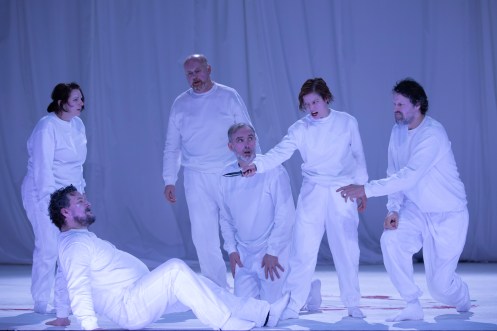
Some of the opera’s most lyrical passages are around the interaction of Ice with the other two women. In a duet of Baroque colour and intensity, France and Bern contrast the world views of Ice and Prentice, whilst a poetic trio by the women, a prelude to Ice’s revelations, is truly exquisite.

Meanwhile, at the back of the set, above the hungry marooned mariners, there hangs a skinned and paunched carcass of a seal. Ice’s sacrifice was undone by her release from her frozen womb, and another sacrifice is needed to release the now crushed ship … but it is not to be the seal.
Ice explains “love bound my wrists”, “the favoured child, most loved, true sacrifice”. A sacrifice made “in fear and hate” is not true.
This cold Arctic will make some shudder, but those who see a Christ-like sacrifice through the prism of Ice will find a bracing wind in Anthropocene.
Mark Aspen
February 2019
Photography by James Glossop
Strings Attached
The Last Five Years
by Jason Robert Brown
Augusta Park Productions at the Questors Studio, Ealing until 9th February
Review by Vince Francis
Jason Robert Brown’s The Last Five Years premiered at Chicago’s Northlight Theatre in 2001 and was then produced Off-Broadway in March 2002. The original concept was for a song cycle for two people, arising from a desire to write something “small and self-contained”. Brown did not intend it to be as personal as the resulting show, which ended up with his ex-wife, Theresa O’Neill, threatening legal action on the grounds the story represented their relationship too closely. Consequently, Brown made some changes in order to reduce the alleged similarities between the character Cathy and O’Neill.
Since then it has had numerous productions both in the United States and internationally. The production won the 2002 Drama Desk Award for Outstanding Music and Lyrics, as well as receiving Drama Desk nominations for Outstanding Musical, Outstanding Actor, Outstanding Actress, Outstanding Orchestrations, and Outstanding Set Design. It also received the Lucille Lortel Award nomination for Outstanding Musical and Outstanding Actor, and the Outer Critics Circle Award nomination for Outstanding Off-Broadway Musical.
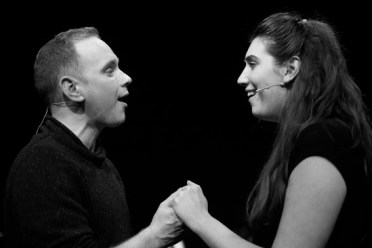 This production is presented by Augusta Park Productions in the Constantin Stanislavsky Studio at Questors Theatre in Ealing, an excellent choice of venue for an intimate, off-Broadway style piece. The oblong studio is laid out “end on”, that is with the audience on the short side and the band visible upstage of the action at the other end. This provides for about a hundred seats, which adds to the intimate atmosphere. Prior to the show, I couldn’t find out much about Augusta Park Productions apart from their Facebook page (and a reference in Google to a housing development in the Test Valley). The programme tells me that the company was set up by Josh Lewis and if this production is anything to go by, I genuinely wish him all the very best in his future endeavours.
 The story as presented describes the five year relationship between the two protagonists, Jamie Wellerstein, played by Josh Lewis himself, and Cathy Hiatt, played by Alexandra Christle.
The show sees their stories told in opposite directions; Jamie moving forwards and Cathy backwards through their relationship, meeting only briefly for a moment in time as their stories cross. Josh and Alexandra are both consummate singers and the band, ably directed by Sara Page, provides an ideal platform for them to explore and play around with timing and phrasing, which adds to the character development.
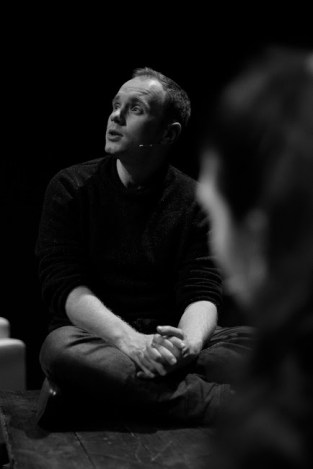 In terms of orchestration, the show is an ideal candidate for a small ensemble, perhaps even a straightforward solo piano accompaniment and, indeed, the last time I saw it, the band comprised keyboard, bass and guitar and that worked very well. The band for this production follows the original orchestration of Keyboard, Bass, Guitar, two Cellos and violin. Drum kit is omitted, which is probably wise for a smaller venue. This configuration obviously allows the songs to be heard as intended by the writer and was a welcome enhancement to my previous viewing of the show. The band was generally excellent, although there were one or two issues with tuning on the violin on occasion and a couple of instances where it seemed a little bass heavy, although this might have been a function of where I was sitting.
For me, one of the most appealing aspects of Brown’s music is its accessibility, which is achieved, at least in part, I think, by the inclusion of contemporary and mainstream references and influences in the writing. There is a direct sample of Johann Sebastian Bach’s Jesu, Joy of Man’s Desiring in the opening number, I’m Still Hurting and, elsewhere, it’s good to hear a Jackson Browne or a Jimmy Webb hint in the broad mix of styles used in the show.
I also liked the straightforward and simple production values in elements such as the set, which uses mainly furniture and furniture dressing and which is changed subtly by the two players as required. Similarly, costumes are kept simple and contemporary, with the addition of a cardigan or sweater here and there to indicate changes in time and mood. Lighting is supportive and sympathetic and creates appropriate moods without being fussy or tricksy. All of these elements help to keep the focus on the performers and the poignant story they are telling.
Grab a ticket if you can, it’s well worth a look.
Vince Francis
February 2019
Photography courtesy of Augusta Park Productions

 Mark Aspen