
Feathers, Sparkle and Passion
Copacabana – The Musical
music by Barry Manilow, lyrics by Bruce Sussman and Jack Feldman, book by Barry Manilow, Bruce Sussman and Jack Feldman
TOPS Musical Theatre Company at Hampton Hill Theatre until 13th April
Review by Jennifer King
There was a great buzz in the foyer of Hampton Hill Theatre on the opening night of Barry Manilow’s Copacabana – The Musical. As a well-known larger-than-life show full of music and passion, this musical is a real feel-good concoction of feathers and sparkle, which this audience were clearly greatly looking forward to.

The curtains opened to reveal a large-scale set with two sweeping staircases either side, designed and realised by Wes Henderson-Roe. Unflowery and versatile, and with minimal dressing, it never overpowered the piece and created a base to transport the audience into the varying locations of the action as it moves from New York to Havana. It has become the norm to secrete the band behind the set or off in the wings, but in this instance we were allowed to see them in all their glory and finery, appropriately attired for the atmosphere, upstage beneath the raised rostra which added to the sense of the nightclub environment. MD John Davies maintained great pace and level through all the players, and they believably created the feel of a swinging nightclub orchestra.
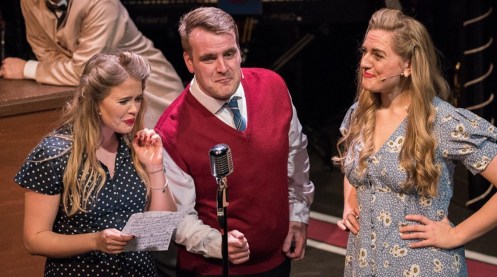
The story opens with the character Stephen, working on the composition of a hit musical – or so he hopes. As we hear his wife from offstage calling him to get ready for their 5th anniversary night out, we realise that, entirely engrossed in his work, he is somewhat neglectful of their relationship. Tom Daniels as Stephen created a solid and consistent performance throughout, particularly excelling late in Act I in the number ‘Who Needs to Dream’, a beautifully smooth and congruent delivery laden with emotion.
Switching to the Copa nightclub in New York circa the late 1940s, Stephen morphs into Tony Forte who, whilst tending bar, is trying also to become a successful songwriter. The ‘Copa Opening’ number was delivered by the full cast with gusto, setting the scene for where the story is to take us. As Lola la Mar arrives in New York from Tulsa, Oklahoma, the ladies’ ensemble presented a montage of the hopes and dreams of young girls everywhere arriving and hoping to see their name up in lights one day in ‘Just Arrived’.

Becky Silverstein as Lola was more than up to the task and seemed to relish the challenges of this role, especially during her audition scenes when she showed a good range of sensuality, exuberance and confidence, even in the face of continued rejection. When she connects at last with Tony her star is born, and as a team they move into ascendance.
Choreography by Kimberley Powell, a seasoned performer in professional theatre productions, was imaginative and effective, making full use of the large ensemble in the big company numbers. Whilst I applaud the use of the whole cast, they were sometimes hampered by the size of the stage; I felt that such an over-the-top musical merits a much larger venue to really showcase the dancing and the costumes, however the glamorous troupe of Copa girls more than strutted their stuff despite the limitations of the space.
There were some lovely featured moments for the dancers, including a solo with some really impressive lifts by Dance Captain Antonia Anthony and James Madge in ‘Bolero d’Amore’. In the ‘Dancing Fool’ number led by Stephen inside the Copa, it would have been nice if he had shown us a little more movement – as we saw later he was obviously a very capable dancer.
Bee Wilkinson gave a sterling performance as former Copa showgirl turned cigarette seller Gladys Murphy. With a consistently believable New York accent, her great comic timing and lovely voice offered us a fantastic version of ‘Copa Girl’, which illustrates the perks to which all the girls aspire. Bee was every bit the match to Ian Stark’s comedic and exuberant Sam Silver, owner of the Copa, who gave a strong and reliable performance.
Act I closes with the arrival at the Copa club of Rico Castelli, an Italian gangster with a predilection for running off with Sam’s showgirls. Dan Stark portrayed the part of Rico with a subtle and restrained, yet ever-present, menace, whilst his lover Conchita Alvarez was beautifully played by Cate Blackmore in a fully-realised characterisation, showing all of the nuances and layers of a woman wronged, yet so much in love. With an excellent singing voice, I would like to have seen her give even more pizzazz in her number ‘Ay Carumba’ at the start of Act II.
The ensemble were fully committed to their various roles throughout the piece. Special mention goes to Sue Neale as the Copa soloist who also demonstrated virtuosity on the saxophone, and Ellie Barrett and Alex Alderson who featured in singing numbers later on, showcasing great stage presence through their entirely believable performances.
Costumes were presented at the perfect level throughout and demonstrated great variation, especially for the showgirls who had quantities of quick changes. However it does slightly irk me when I see mismatching undergarments and shoes, which for a group of showgirls at a premier club such as the Copa, should really be all the same. Sound was consistent and balanced throughout, and whilst lighting was generally excellent, it must be noted that there were a couple of moments when lights facing the audience were a little blinding.
Overall, TJ Lloyd’s direction presented us with a thoroughly enjoyable evening’s entertainment which showed his skills in facilitating such a large cast. When we return to Stephen’s apartment at the end of the show and we see him realise that his dream-girl character Lola was actually an incarnation of his wife, it renews his love for her, a classic happy ending which left the audience on a huge high.
Jennifer King
April 2019
Photography by Ace
Jump, Squeal and Try Not to Panic
The House on Cold Hill
by Peter James, adapted by Shaun McKenna
Joshua Andrews Productions at Richmond Theatre until 13th April
Review by Eleanor Lewis
“From ghoulies and ghosties and long-legged beasties, and things that go bump in the night, Good Lord deliver us!” pleads the Scottish prayer, and yet there are few things more thrilling than snuggling up in a dim theatre, looking forward to being scared out of our wits by a decent ghost story.
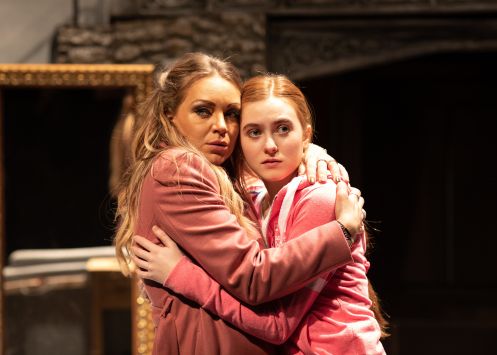
The House on Cold Hill is definitely a decent ghost story. At first sight it could be a predictable story too as Michael Holt’s set presents the kind of ancient, creaking house with the potential for both loving restoration and all the horrors imagination can conjure. Typical ghost story-type in fact. Into this ‘project house’ move Joe McFaddon as Ollie, Rita Simons as Caro, and Persephone Swales-Dawson as their phone-addicted, teenage daughter Jade. Ollie is starting his own web-design business, Caro is a solicitor and Jade, though appalled at being removed from big-city civilisation, takes it on the chin with wit and a philosophical attitude. This is a happy little family. Various other characters appear from time to time to help the trio settle into their new house of horrors.
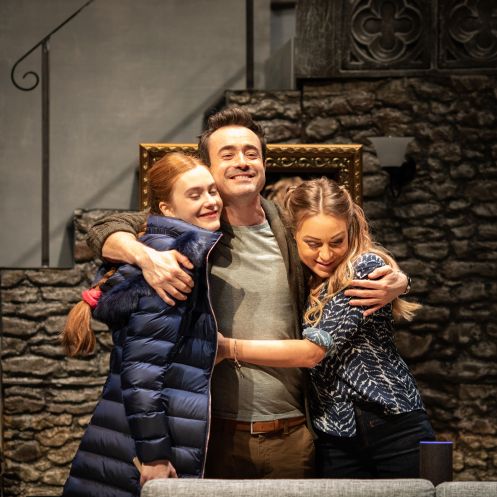
As might be expected, a series of events (no spoilers) then begin to unnerve the three of them and a slow, gentle build of tension in the first act, beautifully complemented by Jason Taylor’s subtle lighting, ramps up considerably in the second, causing the audience to jump and squeal in a very satisfying way. The elderly house, though unnerving in itself, is far from the only unsettling feature of the unfolding story.
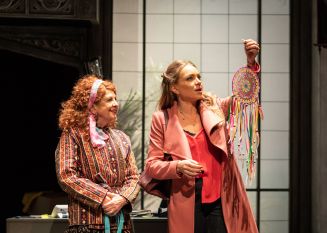 McFaddon, Simons and Swales-Dawson play an attractive family without being sentimental. Similarly Tricia Deighton manages to make Annie, the part-time village Medium, endearing without tipping into caricature, and Charlie Clements produces a closely observed, quite physical portrayal of ‘tech whizz’ Chris, who contorts his body when moving in the self-effacing way specialists who know the rest of the world doesn’t understand them, so often do.
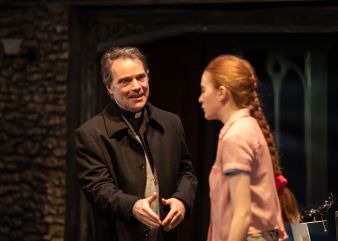 Leon Stewart plays the builder we have all met, complete with long intakes of breath when giving a quote; and an attractive, non-stereotypical vicar, not entirely keen on dealing with exorcisms, is neatly portrayed by Padraig Lynch. (Attractive clergy seem to be the next big thing these days, yes, I speak of Fleabag).
So much of the success of these productions is down to the skill of crew and technical teams and all credit to Tuesday night’s crew and tech teams when those skills were in full and highly effective working order.


Issues were tiny: the musical inserts at times were a little clunky, the volume seemed high for the required effect; and the idea that a web-designer in 2019 would write something as quaint as a cheque to pay the builder seemed incongruous, but that is probably of no importance at all.
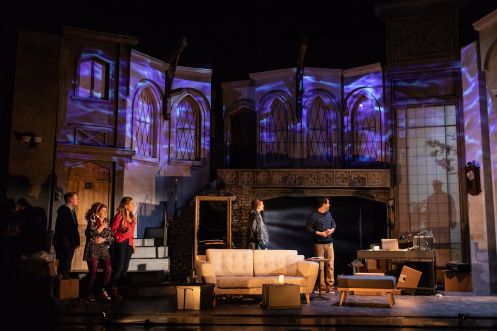
The more predictable elements of the story were handled with style and humour – even an in-joke suggesting Ollie should go on Strictly was greeted with affection rather than groans (McFadden won the competition in 2017) – and the use of the wayward Alexa is inspired. This is a production that doesn’t take itself too seriously but still manages to scare the living daylights out of you from time to time. Shaun McKenna’s polished adaptation of Peter James’ novel has produced a great piece of theatre which totally engages everyone to the point of a near mass intervention by the slightly panicked – in a good way – Tuesday audience, towards the end! Huge fun.
A shockingly good night’s entertainment! Recommended.
Eleanor Lewis
April 2019
Photography by Helen Maybanks
Remembering Frances
Fashion: Fads and Trends
Poetry Performance at The Adelaide, Teddington, 7th April
A Review by Celia Bard
There was a poignant gathering of poetry performers at the Adelaide when the April session was dedicated to Frances White, a regular contributor to Poetry Performance, who sadly died earlier in the year from Motor Neurone Disease. Until her diagnosis she had performed her poems at many venues and festivals throughout England and her beloved Wales where many people recognised her as a member of the poetry group, Words, founded by the late Aeronwy Thomas, daughter of Dylan Thomas.
The upstairs function room was packed, standing room only, as members of her family, friends and fellow poets listened in quiet contemplation as many of her poems were performed for the appreciative audience. Frances’ husband, Steve began the tribute with a most moving reading of The Ghost of My Former Self. Frances wrote this poem just before she died, in which she talks about coming to terms with her condition. At the end of the poem she writes reassuringly that she didn’t fear death: “With the ghost beside me…I don’t fear the end.” This poem will appear in Frances’ final collection of poems which will be printed later in the year. Heather Montford shared this part of the tribute with Steve, most of the poems coming from Frances’s collection Swiftscape and included the poem The Black Cuillin, a mountain range on the Isle of Skye, and where Frances’s youngest brother died when he was only twenty-two. On a lighter, contrasting note was An Appointment with Mrs Hardill in which Frances writes an amusing poem about a visit to her dentist in Wales.

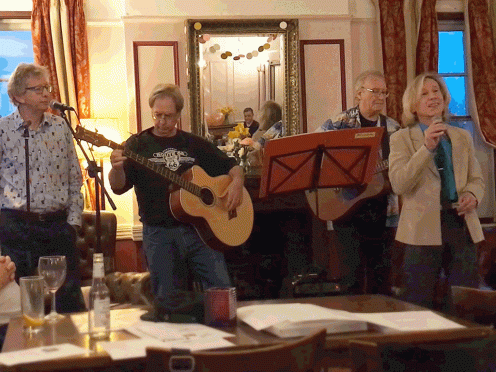
After the interval, many of Frances’s close friends, read their favourite poem of hers. A poem particularly enjoyed by the audience was The Red Hat Band, read by Judith Blakemore Lawton. This poem conjures up a delightful and easily recognisable image of Frances dashing across Richmond Green on her way to work, anxious not to be late, but then she stops suddenly in her tracks as her sharp observational skills spots an elderly gentleman wearing a red hat band. Here is a poem in the making. Much of Frances’s poetry is keenly observational and all the poems read at this session reflect this delightful quality. French Lessons, a music group that knew Frances well, Ian Lee Dolphin, Richard Gleave and Martin Plum, rounded of this tribute by performing some of her favourite musical numbers including Bob Dylan’s song, It’s All Over Now, Baby Blue.

The second strand of the evening focused on the theme of Fashion and Trends, which was interpreted in many varied and humorous ways by the many poets who attended this session. It is not possible to mention everyone in this short review but a few of the many highlights include Judith Blakemore Lawton, who strode centre stage wearing a pair of thigh length leopard coloured boots, carrying a large carrier bag crammed full of shoes which she emptied all over the floor. She then performed, I Love My Grandmother’s Leather Boots, a highly humorous poem, which she’d written for her granddaughter. Carol Wain gave us What Goes Around Comes Around, a longitudinal view of fashion from Victorian Times through to the 1960s and Flower Power and beyond. Fashion not lost, just browse the Charity Shops. Connaire Kensit followed next with Music for Cool Cats and, although written some time ago and a few of the recording images are now forgotten, nevertheless its sentiment remains strong. Robert Meteyard, a former MC made a very welcome return with his poem Fashion Retail Academy. This went down a storm, particularly the last line which ends with a real punch.


The evening concluded with the ever-fashionable Kevin Taggerty with his own foot-tapping composition, What Happened to the London Boys, linking up then with French Lessons who gave a brilliant rendition of The Kinks and their Dedicated Follower of Fashion. Not to be forgotten, was the inimitable MC for the evening, Ian Lee-Dolphin who masterfully guided his appreciative and exuberant audience through the evening, making sure they finished on time.
All of the proceeds from the evening, including door entry, raffle and sale of poetry books raising over £150 was being donated to The Motor Neurone Disease Association. One of Frances’s friends was overheard saying as she left the Adelaide: “Frances would have been well chuffed with this evening!” One can only concur.
Celia Bard
April 2019
Photography by Graham Harmes, Marcus McAdam and Kevin Taggerty
Power, Punch, Passion
Them/Us
by William Trevitt, Michael Nunn, Christopher Wheeldon, et al, music by Charlotte Harding, Keaton Henson
The BalletBoyz, at Richmond Theatre, until 7th April, then on tour until 28th April
Review by Mark Aspen
Once upon a time, male ballet dancers were adjuncts to the ballerina, there to provide the strong lifts, to support the ballerina, and to be fulcrum for the delicate love story. Then, towards the end of the twentieth century, out popped Matthew Bourne and Les Ballets Trockadero. These though could be seen as re-workings of the ballerina roles for men, with artistic, or even (Trocks) comic, effect. Suddenly, it’s the 21st century and two Royal Ballet principals, Michael Nunn and Billy Trevitt, quit the Royal Ballet to start a dance revolution with their company that eventually metamorphosed into BalletBoyz.
That BalletBoyz has not only brought a muscular masculinity to dance but also an innovative symbiosis with dance makers: composers, designers, choreographers and the dancers themselves, is self-evident in its current work, Them/Us, now on nationwide tour.
The Them/Us double bill comprises two new pieces with new original scores by composers who have previously collaborated with BalletBoyz. The two pieces are linked in that Them is described as a prequel to Us, the latter a work that has expanded around the acclaimed eight-minute duet from Fourteen Days, premiered by BalletBoyz in 2017. Thematically, the two half-hour long pieces speak of the relationships, the tensions and bonds, the attractions and alienations that exist between society and the individuals within it.
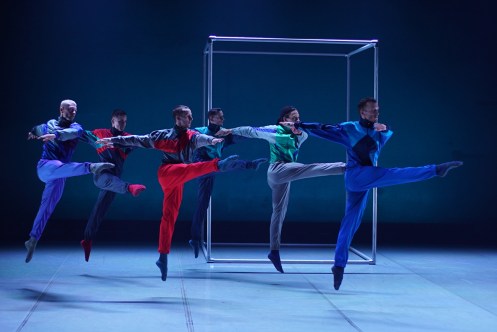
Them could be said to be the consummation the company’s two decades of collaborative working, in that this is a collaborative work, gestated from improvisations with the dancers in choreographic workshops, held alongside the composer Charlotte Harding. Nunn and Trevitt co-credit the choreography to the BalletBoyz dancers and Charlotte Pook, their rehearsal director. With these fledgling choreographers safely tucked under the wings of the maestros, the rapidly developing skills of Harding’ emerging style are added in. What sounds like it could be a horse designed by a committee, turns out to be a wonderfully coordinated empathy of movement, with dancers and music integrated in easeful fluidity. The company takes another calculated risk in that (as for both pieces) the music is all pre-recorded, leaving no leeway. Both scores are for strings and percussion, and conductor Mark Knoop creates a richly vibrant soundscape.
Charlotte Harding’s music owes a little to her mentor Mark-Anthony Turnage in a striking score of varied runs and turns, urgently coloured string motives that enable music and dancers to work together in symbiosis, such that it is difficult to elaborate on the dance without reference to the music.

The striking opening sees the chorus of six dancers with an open cube half as high again than the dancers. The music is staccato strings, highlighted with a pizzicato cello. The dancers wear fluorescent shell suits. The cube is becomes almost another dancer, as it is manoeuvred in delicate equilibrium around the stage. It mirrors their moves, then becomes a cage which traps them. The dancers move with dynamic grace.
The dance style is an effortless amalgam of ballet, contemporary dance and gymnastic movement, fluent in its execution. The group has a slightly sinister feel and the music is edgy. It then enters wide expressive phrasing and we see the group as a microcosm of male society, greetings, rejections, hints at back-slapping hugs, shrugs. It becomes a wary mass.
The frame lifts, scooping the limp body of one of the dancers, and we see it as a scaffold, in both senses of the word. Gymnastic movements on the cage dissolve into street dance. The cello comments wistfully at suspended humanity while one solitary figure sits at a topmost corner high above, observing.
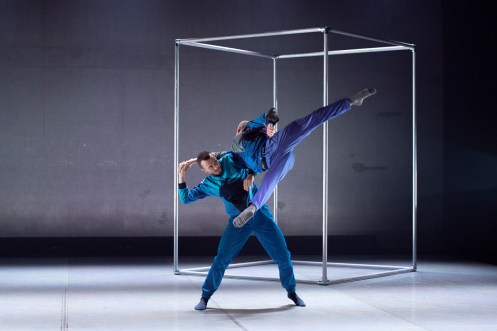
Although this is an ensemble piece, there are remarkable duet and solo moments. A lone figure, danced by Dominic Rocca, is lost in a faceless city. His solo is inspired by street dance, with undercurrents of hip-hop and nods towards krump. It makes riveting watching. At this point, it becomes clear that the Richmond Theatre stage has been opened to its full depth, right back to the far upstage wall. There are slight imperfections in the matt black surface and the lighting picks these out, such that the background becomes a night-time cityscape see from high. This is Rocca’s lonely world.
We are extracted from this world into a lyrical flowing passage of music as the full ensemble gradually returns and there are reconciliatory mutual greetings and the eventual re-bonding of the group. Then the men seem conscious of an external threat. The music becomes agitated and the dancing even more energetic. It is an exhibition of the virtuosity of the BalletBoyz technique, building to a finale that is an exciting visual spectacle, culminating in a frenzied concatenation of spiccato strings and percussion.
The piece is resolved in a coda, the music regretful, almost mournful, dancers heads bowed down.
The atmosphere is both Them and in Us is enhanced by the strong foundation of Andrew Ellis imaginative, but not intrusive, lighting design. The rich colours seen in Them give way to a much more muted pallet in Us, and the design underlines the relationship between the two complementary pieces of dance. Us has stark top or side lighting as each scene demands. Whereas Them explores the otherness of society, Us examines the own-ness of the individual. So, the opening of Us reveals a tightly lit bare stage.
There is a certain polymathy about Keaton Henson, the composer of Us. He is a writer, an artist and a highly respected creator of many music forms. His score puts in context the much acclaimed 2017 short duet, also called Us. It mounts the sostenuto of Karl Jenkins with the ostinato of Philip Glass within a ground of pure lyricism, so suited to the mood of this piece.
Ellis’ lighting and costume designer Katharine Watt’s inspiration run in parallel. The colourful shell suits of Them are replaced by grey frockcoats and white chemises in Us.

Us opens to a stark hexagon of frockcoated men, who steadily advance. Are they footmen? Are they pall-bearers? There is a compulsion in their movement, bound by a constraint that becomes more evident as they bounce on tiptoe. Maybe they are in a vehicle on a journey, but it has the impatient feel of a horse scratching the ground with its hoof, anxious to be on the move.
When they break free, it is into a lyrical dance that smacks of classical ballet, grandes jetés included. The ostinato breaks in and the dance becomes contemporary in style, almost folksy, until it is a stage reproduction of Matisse’s La Dance. But when the group dissipates into trios, pairs and individuals there is a terseness in their interaction.
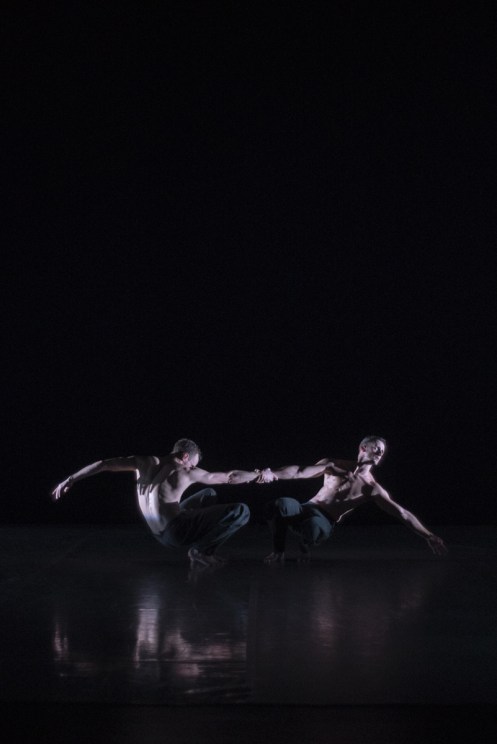
Reflecting the solo of the lonely figure in Them, a more organic liquid solo emerges, a dances of anguished solitude. Bradley Waller’s portrayal of the innermost torment of this individual is palpable. Here is a man full of longing for companionship. In his shirtsleeves, Waller seems a lost soul. The dance is intense yet with a fluidity of feeling.
The message that comes across is John Donne’s “No man is an island, entire of itself”. The much vaunted final duet, previously seen as a stand-alone piece, is a study in male bonding. Waller is joined by Harry Price in a passage of soaring intensity as the two bare-chested men meet and their companionship is cemented. The emotional and aesthetic potency increases as the trust between the two is realised. Faces are turned away and toward each other, arms touch in mutual support and their moves become as one. These become more than a pair with a common goal; they need each other for mutual survival. They could be the salt of industry, early miners, or seaman whose respect of each other is crucial. However the picture that emerges is inspired by Hellenic art: warriors. These are the First World War soldiers whose belief in each other leads to unbelievable sacrifices.
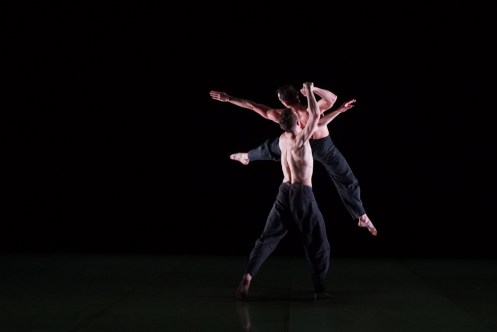
Nevertheless, this double bill is not chiefly a vehicle for individual virtuosity, but is very much the work of art of a fully integrated ensemble, who almost breathe as one: Benjamin Knapper, Liam Riddick and Matthew Sandiford complete the sextet. These are practitioners who know their craft and apply it with consummate skill.
Within society there is an equilibrium between them and us, that is elusive as it is precise. This concept is superlatively studied in Them/Us in a production with spell-binding beauty and suffused with power, punch, and passion.
Mark Aspen
March 2019
Photography by George Piper
Glints of Brilliance
She Persisted
by Annabelle Lopez Ochoa, Stina Quagebeur and Pina Bausch
music by Peter Salem, Philip Glass and Igor Stravinsky
English National Ballet at Sadler’s Wells, until 13th April
Review by Isobel Rogers
Is it possible to create a ballet about female empowerment?
She Persisted is the triumphant output of three prominent female choreographers in this exciting triple bill, performed by English National Ballet at Sadler’s Wells. The concept was the brainwave of Artistic Director Tamara Rojo, after realising that her twenty-year dance career had never required her to perform a piece created by a woman.
ENB’s striking posters on the Underground had certainly piqued my interest. And by the look of the audience, mostly well-dressed career women, I was not alone. The stories in She Persisted are a conventional array of romantic entanglements, female oppression and pain. Frankly, I had expectations of a broader feminist agenda. Women here take the reins but remain disappointedly wedded to traditional themes and modes of presentation.
We open with Broken Wings by Annabelle Lopez Ochoa. It is vibrant, colourful and boldly Latin American, with music to match. It centres upon the tragic life of painter Frida Kahlo, famed for her strange but arresting self-portraits. Kahlo herself said, ‘I never painted dreams. I painted my own reality.’ In turn Ochoa strives to relate this duality, intertwining the real and the imagined. Kahlo’s story and strife are fascinating. They have preoccupied me since the curtain came down.
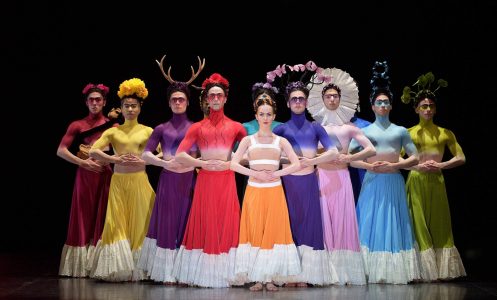
Recently promoted to the role, Katja Khaniukova is enchanting as the young artist, her opening movements keen and uplifting. A rainbow of petticoated figures (both female and male) spring forth, swishing lace-tipped skirts and flaunting elaborate headdresses.
Before long, however, Kahlo is shaking, collapsing in a silent scream, marooned in a box. She is haunted by a group of cheeky skeletons, representing her encounters with death. They are a fabulous device: playful and mischievous as they scuttle across the space, poking their heads out at opportune moments. They are choreographed and danced with good-humoured aplomb.

Not as vibrantly, we see Kahlo’s injuries to her foot and spine, demonstrated with a sequence of gestured lameness, a distressing juxtaposition to the fluency of ballet. Her striped costume references her corrective corset. We never see her paint, though her self-expression continuously unfolds in the brushstrokes of elegant dance.
Kahlo tenderly duets with older lover Diego Rivera (the excellent Irek Mukhamedov). He pulls her into his clutches, then pushes her away with adulterous betrayal. The fighting and fierceness between them feel underplayed; I was surprised to learn that the couple married, divorced and remarried.
The depiction of Kahlo’s repeated miscarriages is memorable: a thick crimson ribbon is pulled out from her open legs as Khaniukova writhes beneath. Red paint is already splattered on the wall behind her.

The most enjoyable scene is set in a forest of huge green leaves suspended from the ceiling. Bright creatures dance through including a prancing fawn (evoking Kahlo’s famous Wounded Deer, a seminal work on suffering). At the denouement, Kahlo is herself incarnated as a giant, multi-coloured butterfly, symbolically liberated from her physical and marital sorrows.
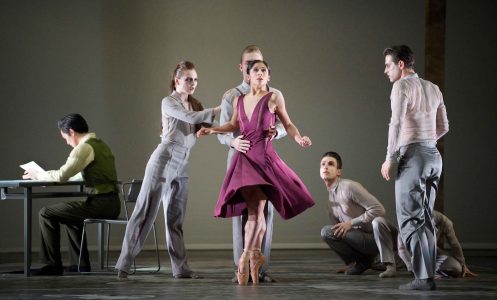
Whilst Broken Wings feels fresh, I’m left craving more contemporary content and a stronger sense of Kahlo’s own internal darkness. I want the experimental essence of Frida channelled into a more daring vision and sharper storytelling.

Nora by Stina Quagebeur leaves me unmoved. It’s a restrained take on Ibsen’s A Doll’s House, the plot of which is unfamiliar to me, but which centres upon a woman who walks out on her husband and children.
There is no choreographic statement – no remarkable repeated devices to help characterise the ballet or the figures within it: essential watermarks achieved by male competitors such as Wheeldon and Scarlett. Crystal Costa, in the central role, crafts smooth sections not en pointe. There is an interesting interlude between two men warring over a desk. It irks me that the plot requires a background description in the programme to be understood. (Maybe Quagebeur is assuming her audience will know the story…always a dangerous mistake. Weighty classics aren’t cultural reference points for a 2019 generation of ballet-goers.)
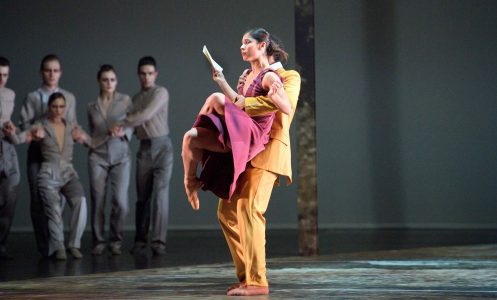
The movement itself is too generic: performed with dedication but ultimately a little flat in its impact. Who is Nora? What do her husband and family mean to her? ENB has missed an opportunity here to present a more abstract and alive exploration of women’s domestic oppression as wives and mothers. I don’t know this woman, even at the end, and so cannot care about her fate.
Le Sacre du printemps is a well-chosen revival for ENB. Pina Bausch’s blistering creation is an undisputed triumph. It is raw, urgent and wholly unfiltered in its emotional charge. The dancers’ love for this work communicates clearly. Set to Stravinsky’s dramatic score, the ensemble bounces steadily at the knee, a transfixed and terrified pack. They clasp their arms together and fling themselves into piles of dark peat, staining their slip dresses and bare chests.
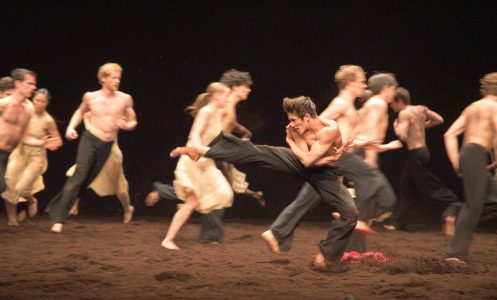
The result is utterly mesmeric; a fundamental exploration of what it means to be alive. The authority of Bausch’s agenda, delivered with such verve and commitment, seems to highlight the choreographic downfalls of the previous two pieces.

Francesca Velicu is the principle female, the always-uncredited ‘chosen one’. She is slight of frame and vulnerable. Her youth seems to amplify the pain that tears through her. This modern work suits the lithe physicality of ENB as a company: they take on this fervent battle of the sexes with conviction. With stunningly precise movements (suited to staunch classical technique), they build complex canons of contraction and release. In perfect tribal circles they animate, barefoot and enraptured, as if caught in a violent nightmare. Elbows strike sweaty rib cages in a cacophony of sounded breath.

The applause is bountiful and heartfelt. A spectacular achievement that outshines the rest of the line-up with its visceral power. Bausch’s harsh, uncompromising spirit is alive in every nuance of this performance. It is unadulterated. The women that bravely follow in her footsteps can achieve the same feats, if only they throw out their keenness to please. Great choreography is only made that way.
A beautiful conceit by Rojo, brilliance glints through the sometimes-heavy structures of classical ballet across this triple bill. Yet, a fledgling female audience needs to be shown more ways in which women ‘persist’. Thematically, we must see them succeed sometimes too.
Isobel Rogers
April 2019
Photography by Laurent Liotardo
Kick and Punch, or Dance and Flirt?
The Elephant in the Room
Chronologics Theatre Company at The Hen and Chickens, Islington until 6th April
Review by Denis Valentine
Upon entering the theatre at The Hen and Chickens, the audience is straightaway given a sense of the 1920s. They are taken back to this time by the music and by a busy tailor, who greets each person as he tends to his shop. It makes for a fun pre-opening and sets the stage for the night’s events well.
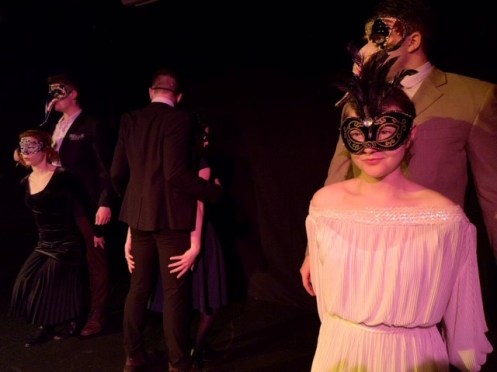
One of the standout features that The Elephant in the Room company has put together are the set pieces which are well worked and used to brilliant effect. At one point the way we see the two gangs going about their robberies in back to back scenes is striking. The male group use the rough-house tactics one might expect from such a gang – kick in the door, throw some punches and bully your way to the prize (the fight choreography and execution is excellent throughout) – whereas conversely in the next scene the audience is treated to a musical piece where the women dance and flirt their way to profit. The coordination and subtlety of the onstage pickpocketing is very well worked and serves to highlight one of the core themes of the play.
The multi-role playing is very strongly handled and there were moments where it genuinely seemed a brand new actor had entered the scene, even though they had been on stage seconds earlier. The changes that the players make in their voices and body postures so quickly is quite stunning at times. Adam Ralph Moysen as the poor robbed tailor, who begins the play as the plummy tailor who greeted the audience so eloquently upon arrival, suddenly transforms into street gang member Walter McDonald and is quite unrecognisable from the person we saw moments before.


Melanie Crossey as Alice Diamond grows into the performance and by the end is firmly established as the cunningly brilliant criminal boss she is. At points in the opening thirty minutes, she at times felt a little rushed in her delivery but by the conclusion of the play had settled into a strong performance. Her closing line of the play brings an end to proceedings and leaves the audience thinking not only of the story but of its bigger message and the way examples of stories like it can definitely be found throughout history.
Joe Cavendish as Harry Harcourt gives a strong performance, with a well measured and strong grasp of the character he is portraying. A steady presence as the leader, he really allows everyone else in the gang to play off of him well.
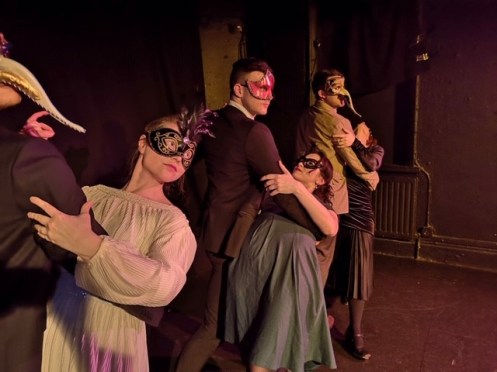
Heather Smith, Jack Eccles and Martin Fox handle all their characters well and make the most out of each one they get to play. Each have scene stealing moments and it is testimony to strong character performances that the audience is left with a desire and interest to see more of the side characters if only the play allowed.
Bethan Barnard is very engaging to watch on stage as her character Baby Face Mags is a key figure for many of the themes of the play. It is poignant that her own love interest underestimates her ability and sees her as a damsel in distress in need of saving rather than a criminal of equal (better) ability, which leads to everything unravelling.
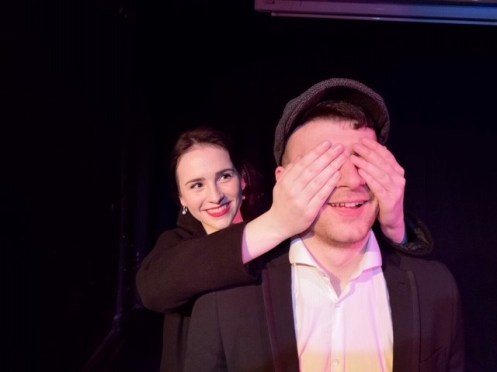
The cockney accent is not an easy one to pull off and maintain, and although certain words have the wrong inclination and there were a few line slips, the world of the play is never broken as each player on stage is clearly relishing and living the character they are in.
Special mention must go to the wonderfully crafted scene in which the two gangs plan the heist. It is a setup that is slick and so well created that the play suddenly feels like it is channelling Oceans 11 at its stylish heist best.
The way the actors in the piece seemingly relaxed more into the performance is evident from how the jokes and moments seemed to land with the audience better as the play went on. Giving the setups and punch-lines to scenes that extra moment to breathe and land really led to a very fine show, which became more enjoyable the longer it went on.
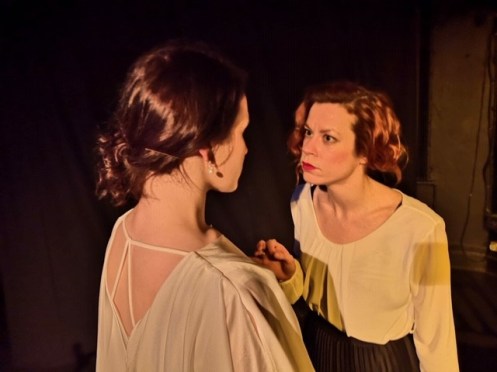
The Elephant in the Room is well acted, with a recognisable story that not only entertains but also educates. The company’s bold choices in staging and physicality elevate proceedings and make a stage with minimal set always feel full. A fast pace and tight running time make for a fun and enjoyable evening of theatre that keeps you thinking about its core theme afterwards.
Denis Valentine
April 2019
Photography by Josie Ship
Caring for Each Other
Ellie and Starlight – the Musical
by Sarah Watson, adapted for the stage by Kenneth Mason, music by William Morris.
Dramacube Productions at Hampton Hill Theatre until 6th April, then on tour
Review by Celia Bard
A beautiful children’s show with an important message about caring for our planet.
Stepping into Hampton Hill Theatre this morning where most of audience were under five was a heart-warming experience. The modest but very effective Icelandic setting with its large glacier dominating the fishing village, and gentle, calm music being played in the background immediately grabbed the attention of this young audience as they entered the theatre, transporting them into the world of Ellie and her ‘imaginary’ friend, Starlight. This young audience sat in their seats absorbing the play content as if they were in a dream – not a cough, not a cry, not a shout. The message in this musical is no dream, it is extremely relevant with its hard-hitting environmental content. The dramatic and music techniques employed by the entire cast, actors, director, writers, composer succeeded in relaying the dangers of global warning through different channels of communication.
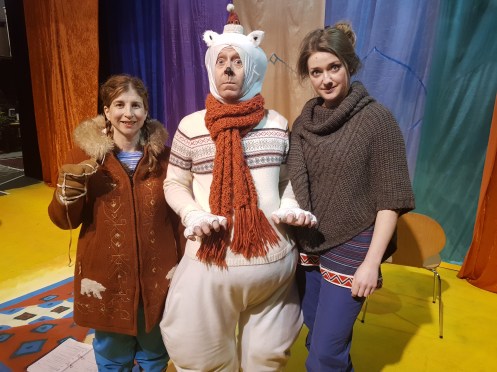
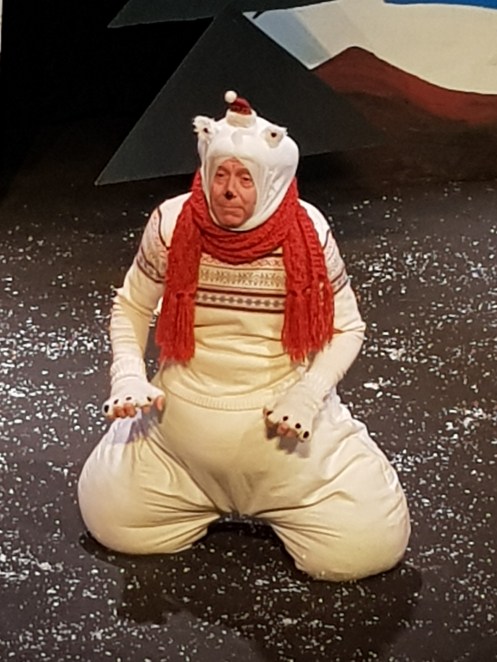
The tale told is that of an enthusiastic, thoughtful, and observant little Yupik Eskimo girl called Ellie, and her best friend, Starlight, a delightfully humorous but insightful polar bear. One day Ellie notices that something very strange is happening to her Eskimo tree house. There are less steps to climb and, as she attempts to uncover the mystery, the problem worsens and her pleas for help go unnoticed by her mother. The resourceful Starlight advises her to seek the help of an old wise woman who lives the other side of the glacier. This journey is not without peril and Ellie encounters a number of dangers as she embarks on this quest to save her Village.
Not only are all the musical numbers pleasing to the ear, the lyrics written by Kenneth Mason are cleverly and imaginatively embedded in the script. Their rhythmic composition makes it easy for the audience to listen to and comprehend. Music and songs help to bring home the message of global warning.
“Hurry! Hurry!” The first lyric introduces us to Ellie’s mother, Katrin, beautifully acted by Liis Mikk. In this song and in her physical action, we learn that she is a very busy lady. Though a loving mother she is always working, as is her husband who joins her in this strikingly delivered duet. As a consequence, Ellie, played by Kate Barton, spends a great time by herself and communicating with her very real, imaginary polar bear friend, Starlight played by Peter Gardiner. This number is followed by “Don’t Cry, there’s brightness at the end of the day.” This is an optimistic song, which it needs to be as Ellie has just discovered that her tree house has sunk a step. Unable to understand the reason for this nor other strange events happening in the Village, she tries to tell her mother, but she is too busy to listen.
Starlight comes up with a solution and that is to travel to the other side of the glacier and to ask the advice of the Wise Woman who lives high, high in the mountains. Ellie is frightened, but she puts her trust in Starlight: “I must put my faith and truth in Starlight,” and off they go on a journey which is not without dangers, deep crevices in the glacier, wolves, fierce thunderstorms. The appearance of travelling a long distance is imaginatively executed by the use of a long rope which physically and symbolically link together these two characters.
The following morning Katrin discovers that Ellie is gone. Her thoughts and feeling are expressed in the mournful, plaintive number, “Where is Ellie,” a song full of regrets tunefully interpreted by Liis. In the meantime, Ellie and Starlight have reached their destination and are in conversation with the wonderfully physicalised Wise Woman, a tall, human body puppet wearing a mask. What follows is the song, “The World’s Topsy Turvy,” a song that the very young audience responded to with spontaneous clapping. This song with its strong rhythmic beat accompanied by the beating of a drum, beats out a strong global and ecological message about the whole world being in chaos and danger, e.g. in some countries it hasn’t rained for years. Solutions are suggested as to what everyone on Earth can do to save the planet, and for Ellie she is given the message that in order to save the Village they must move to higher ground.
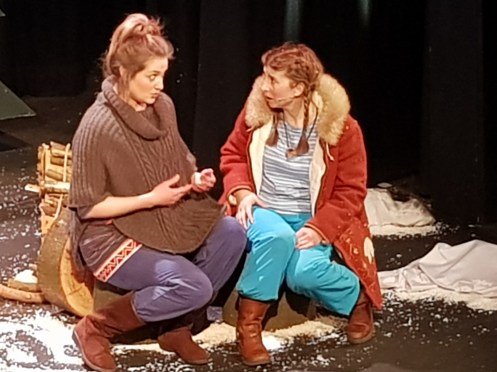
Ellie and Starlight is blessed with a talented cast. Katie Barton’s Ellie is enthusiastic, intelligent, and observant and delivers her singing numbers with great confidence. She successfully embodies the spirit of childhood through her physicality which she maintains throughout the production. Peter Gardiner as Starlight presents an amicable, fun loving and resourceful Polar Bear, a character that the children in the audience loved. He is also very believable as the very busy father, too busy to spend much time with his wife and daughter. Katrin as Liis Mikk and also the Wise Woman is an adaptable actress, able to convincingly play both roles and strong musically.
The whole creative team and cast in Ellie and Starlight succeed in communicating eco content information and issues affecting our planet, without being overtly didactic. Dramacube must be congratulated for mounting this highly imaginative production, which has an appeal and message for an audience of all ages. I wish them every success for the rest of their tour.
Celia Bard
April 2019
Photography by Stephen Leslie
Corpsing on Stage
Murder on Cue
by Robin Jennifer Miller
Rare Fortune Productions at the OSO Arts Centre, Barnes until 6th April
Review by Andrew Lawston
As if there weren’t enough actors living in Barnes already, the OSO has been transformed into Maple Lodge: a small but comfortable retirement home where a select group of thespians spend their autumn years sipping glasses of dry sherry, reliving past glories, and indulging old grudges. And possibly committing murders?
Robin Jennifer Miller brings her second play, Murder on Cue, to the OSO with Rare Fortune Productions, following last year’s enjoyable farce Liberty Hall. This time she has turned her sights on that other mainstay of British theatre, the murder mystery.
Maple Lodge’s relentlessly chipper manager Sue (Julie Haythorn) is not having a good day. The home has been cut off from the outside world by a blizzard, someone is sending poison pen letters to her residents, and the council are threatening to close her down. The one bright spot is that she has been named as a beneficiary in the will of one of the residents.

As the residents gather in the home’s lounge for drinks, along with the wonderfully obnoxious Gareth (James Price) nephew to the pugnacious resident Sybil (Sylvia Carson), many of their past misdeeds are revealed. The emotional stakes are raised and everyone takes a turn to look suitably suspicious until, inevitably, a dead body turns up just in time for the interval. Murder on cue, indeed!

In addition to writing Murder on Cue, Robin Miller appears as one of the actors, the apparently timid and fragile Desiree, and I’ve often observed that you can usually tell that a play has been written by an actor from the fact that everyone in the cast gets a decent joke. Here, there is a real ensemble feeling to the cast. Leonora Fyfe’s spirited Judy gets a lot more to do than your average cleaner in a murder mystery, and the murder victim spends most of the first half being so wonderfully unpleasant as to give the entire cast a motive! Martin Wimbush gives a poignant performance as Charles, an apparently restrained man, spending a lifetime regretting youthful mistakes, while Gregory Cox often dominates the room as Larry – positively relishing his own colourful past. Hilary Derrett’s Olivia clashes with him frequently, as the other larger than life character among the actors. Carolyn Pertwee’s character Molly remains an enigma throughout much of the play, always observing but speaking comparatively rarely.
It’s amusing that in a play full of characters complaining about being upstaged, however, director Maurice Thorogood gives each character time to shine and the cast is extremely well-balanced.

Miller’s new play embraces the genre’s tropes full-bloodedly, and often with its tongue firmly in its cheek. The cast are playing it straight, but most of them are also playing wonderfully camp old actors who are visibly glorying in the chaos and mystery that surrounds them.
The set, full of comfortable chairs and drinks cabinets, surrounded by drapes and faded black and white photos of the characters in their heyday, conveys the setting from the outset. The cheeky renditions of the Casualty and Midsomer Murders theme tunes prior to the show set the tone perfectly. The gentle and slightly knowing comedy is never allowed to dominate the production, but it’s also never far away.
The mystery at the heart of Murder on Cue’s second act is well-constructed, but the murderer is ultimately relatively guessable – although hopefully not from this review, which is spotlessly spoiler free. It’s around this point, however, that it becomes clear that the play is more about spending a wonderful evening with these delightful characters than it is about constructing a fiendishly ingenious mystery.
Murder on Cue is an enormously fun play, well aware of its roots, and not afraid to acknowledge them.
Andrew Lawston
April 2019
Photography by Paddy Gormley
Much Ado About Nothing
Waiting for Dawn
Nocturnal Productions at the Pop-Up Theatre until 1st April
Review by Avril Sunisa
“Unbeliveable” tended to be the reaction of the audience at last night’s premiere of Waiting for Dawn, at the inaugural outing of the ephemeral Nocturnal Productions company.
The concept of the non-venue specific production seems to be à la mode. For the weary theatre critic an invitation to review another such dramatic experience seems almost quotidian, but this performance emphatically shattered the mould. The theatrical conceit was that it should not be performed on a fixed acting space. Moreover the ethos of Nocturnal Productions is that the performance should be before sunrise, for its magic would be broken at noon.
Hence, the surprise venue for the specially invited audience was inspirational. When we arrived at Pop-Up Theatre, it was what might more accurately be described as a plop-up theatre, for it took place on an acting space that was certainly not fixed, on the River Thames itself. “Sweet Thames flow softly ‘til I end my song”, wrote Edmund Spencer in his Prothalamium, a phrase usurped by the dreary copier, T.S.Eliot. There was no such usurpation at last night’s premiere, which began shortly after midnight, and certainly no Waste Land. In fact, there was no land at all, as the performance took place solely on the quietly moving water. The moon, now in its third quarter, had not risen, and a superinundation of cumulus ensured there was not a glint to distract from the restful effect, so suited was it to this post-modern masterpiece.
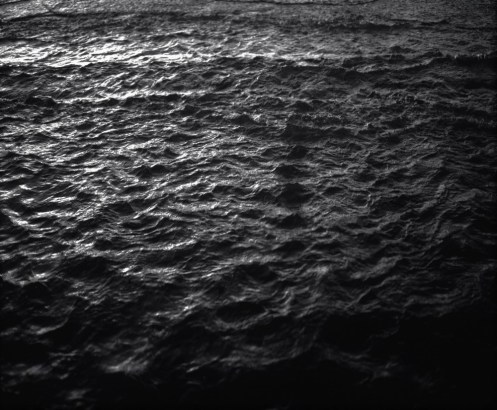
Designer Hydra Cherwell is at the forefront of her profession in minimalist design and her work for Waiting for Dawn seemed totally effortless. Of course a remarkable designer needs a remarkable team, and what can one say about Lighting Designer, Elifrop Tops, fresh from his home town near North Cape, where he habitually spends each winter. His lighting design is unique in never using, to quote his own words, “wavelengths in the range 380 to 740 nanometres”. I have never seen anything like it, and it is only his own much vaunted modesty that prevents me from calling his work brilliant. Equally remarkable is the Sound Designer, “Buz” Rowfoe’s nihilistic soundtrack, which cleverly enhances Cherwell’s concept of silently moving water. It left me speechless. You could have heard a pin drop.
It is difficult to summarise the plot in less than a few words. Preposterogenious does not do it justice. It honours the classical unities of time, space and action, indeed bringing them to their ultimate. The plot centres around the inaction of Otto Nix, scion of a wealthy family of stopwatch makers. His parents, Bob and Anna, named him Otto as they liked the nature of a palindrome, in that it makes no difference if it goes forward or backwards, and it is this equilibrium that has informed Otto Nix’s life. The role of Nix was played with great indifference by Hamm Stil, who neatly underplayed the somnambulant hero to great effect. Then into Nix’s life strolls Fanny Grey, who has an imperturbable influence on him. She plays hard to get by totally ignoring him and eventually succeeds in losing his understated affections. The excellent ennui of Ida San Souci, who played the part of Fanny, gave an air of unconcern which provided the dramatic statement needed for this circumventive femme flatale.
However, Nix has an erstwhile rival Hugo Slack, a cataleptic villain whose inability to do no evil knows no bounds. It would be a spoiler to reveal the extent of the dramatic tension that leads to the play’s inevitable conclusion, but suffice it to say the incredible portrayal of Slack by veteran actor Cyrus Bender leaves one breathless with anticipation.
A cameo role by much loved household name Penelope Prolapse as Mrs Toxwell, the unnoticed chatelaine of Nix’s country mansion, brought a definitive punctuation mark to the skilfully measured denouement of the plot. However it was largely the unnamed minor characters that stood out as the deep bedrock of this phenomenal production and gave it the nuanced hint at a love story that is not be.

The audience received this minimalistic mood-piece as mind boggling. One felt them willing it to go on. Riveting.
Director Nemo Knightman is to be congratulated for an unforgettable spectre of theatre, which barely ruffled the waters of his fugitive stage, a low-energy footprint piece that is worth watching out for, in case it makes a revival.
The last Tuesday in March 2020 marks Nocturnal Productions’ next post-midnight premiere. It is firmly in my last diary. It is already in rehearsals, Waiting for Godot, the Musical. It is also mooted that the company is acquiring the rights to Waiting for Brexit, which is under discussion for Nocturnal Productions’ 2029 season. For the aficionado of the hypo-minimalistic theatre these productions will be a must!
Watch and watch this space.
Avril Sunisa
April 2019
Photography courtesy of Nocturnal Productions
Caprine Caprice
The Goat
or Who Is Sylvia?
by Edward Albee
Arena Theatre at the OSO Arts Centre, Barnes until 30th March, then on tour until 29th May
Review by Celia Bard
I first became aware of this question ‘Who is Silvia? What is She’ in the play Two Gentlemen of Verona, written by William Shakespeare. Edward Albee provides us with his own 21st century account of the same question.
Arguably Albee has something else in common with Shakespeare other than his use of the same question and that is his interest in bestiality, but with a difference. For example in the play A Midsummer Night’s Dream, Titania falls in love with Bottom after his head metamorphoses into that of a donkey’s. In the play The Goat, our protagonist, falls in love with a goat, but that is where the similarity ends. Shakespeare’s play is a comedy, and it is fanciful. There is no question that you are in the world of make believe, a world controlled by fairies. Shakespeare tells the story of young Athenian lovers, a group of mechanicals and fairies. Any thoughts of sexual deviancy as seen between Titania and Bottom is viewed as comedic, light-hearted, and mischievous. Although there is a great deal of comedy in The Goat, the same cannot be said of Martin and Sylvia where the relationship falls into the arena of sexual deviance, though the audience is spared the actual physical sordid details of intercourse. The play tears apart any semblance of social norms relating to an extra marital affair. What occurs between Martin Grey and Sylvia goes well beyond what is considered acceptable by society, the audience is asked to consider the sexual relationship between a man and a goat, and this is a hard task for any audience.
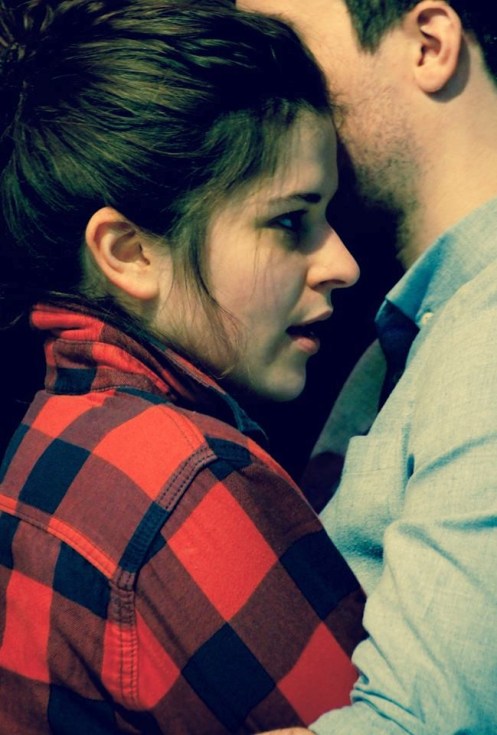
The setting of the play lulls the audience into a false sense of security. The trendy black chairs suggest that we are in the living room of an educated, comfortable, middle-class, trendy family. The cast consists of four characters: Martin Grey, a successful architect; his wife, Stevie; their 17 year old gay son who is at College; and Ross Tuttle, a close family friend and host of a television programme. To all intents and purposes Martin, played by Matthew Ellison, and Stevie, played by Lotte Fletcher-Jonk, are a happily married couple of some 23 years. They are casual in conversation, joke a lot and their sex life is good, judged by their conversation, Stevie’s flirtatious behaviour and sexual innuendos in the opening scene. There are however signs of strain in Martin. Despite the jesting, he appears ill at ease and forgetful. In casual conversation he comments that he is having an affair with a goat. The audience, like Stevie, can be forgiven for thinking that this is light-hearted banter. She laughs aloud and jokingly responds that she off to the pet shop to buy some food.
Just before Stevie leaves, Ross arrives at the Grey’s house ready to tape an at-home interview with Martin. During a lull in the taping, tells Ross of his transgression. This secret once fully comprehended by Ross and then Stevie, after Ross informs her in a letter, turns this comfortable, middleclass home into a combat zone. Any illusion of normality dissolves. Martin’s secret is dramatic and is threatening to both his family and career, and he has a lot to lose, having just won the prestigious Prizker price and the contract to design a very large city community complex.
All three adult actors give excellent performances. The dialogue is fast moving, they are quick to pick up on each other’s cues and are superb at building up dramatic tension, holding the audience in suspense. This play demands strong physical action and movement, and the actors don’t disappoint. Direction is sound, good use is made of the stage and the director unquestionably has a good grip of play content, and stage and acting strategy.
Lotte Fletch-Jonk is outstanding as Stevie. Her performance is spell-binding, able to convey intense emotion whether it is anger, horror, disbelief, realisation and then eventually revenge. Her vocal range is impressive, as is the way she is able to shape her speeches, the highs, and the lows. She is totally immersed in this character, so it is quite a shock when she comes to take her bow at the end of the performance and smiles disarmingly at the audience.
Mathew Ellison as Martin provides a perfect behavioural contrast. On the whole an understated performance, given to occasional bouts of anger. He succeeds in depicting a character totally detached from his own feelings, that is until he experiences an epiphany with Sylvia. He knows that he is behaving in an amoral way, is ashamed of the act, but doesn’t feel guilty. He is surprised when he attends a therapy group with people who share his same peculiarity that he feels different to them. Whereas they feel guilty, he doesn’t: they are going there to be cured. He rejoices in his new-found relationship and doesn’t want it to stop. In the opening scenes he displays a preoccupation, and forgetfulness, which may be explained away by the secret he has to keep for fear of retribution. The other explanation is that suffers from the beginnings of dementia and this is having an effect on his sexual urges. Martin is a complex character and Matthew captures the disturbed and tormented dimensions of him well.
Ross is played by Ancor Figueras Ramos who gives a strong performance. The friendship between him and Martin is long standing, some forty years, starting when they were both ten. One aspect of his performance that slightly jars is Ancor’s European accent, which felt that he hadn’t been in England for long. He is, however, extremely convincing, at first wanting to help Martin by finding out what is troubling him, but then totally disgusted, horrified, and shocked when he finally realises that Martin is ‘having it off’ with a goat, i.e. Sylvia.
The gay teenage character Billy, played by Stephanie Brewer adds another dimension to the play. It is perhaps no coincidence that the couple’s off-spring is called ‘Billy’, a name often word associated with a male goat. The kiss between father and son plus Martin’s dialogue about holding a baby and feeling a sexual urge arouse uncomfortable thoughts in minds of audience. Stephanie acted this part with intelligence and sincerity, but for me this role does need to be played by young male and Stephanie undoubtedly is female. This broke the suspension of belief that is needed for the drama.
The Goat is a difficult play to watch, often stomach churning, no taboos, nothing is off limit, but it does succeed in raising questions about the nature of human beings and the relationship between the intellect, sexual desire, and uncontrollable sexual urges. To complicate things Martin make it quite clear that his feelings for Sylvia are more than just a sexual urge. He talks about having an epiphany on first seeing Sylvia on the farm in the countryside and gazing into her eyes. Shakespeare touches on this theme in The Tempest and in the character of Caliban, who has some of the beautiful, poetical lines in the play, but is depicted as bestial by Prospero and imprisoned, because of his urge to sexually assault Miranda. The audience left with the question: not who is Sylvia, but who is Martin and how could this educated, creative, happily married, sordid, tragic man behave in such a bestial manner? If Martin represents human kind, a greater question is an old age one “What piece of work is Man!” [Hamlet (2.2.295-302), Hamlet to Rosencrantz and Guildenstern.]
Celia Bard
March 2019


