
Pandora’s Box Opened by Apollo
The Habit of Art
by Alan Bennett
The Original Theatre Company with York Theatre Royal and Ghost Light Theatre productions
at Richmond Theatre until 20th October, then on tour until 1st December
Review by Mark Aspen
“Why does a play have to be such a performance?” asks Neil, the exasperated playwright of the play-within-the-play in Alan Bennett’s The Habit of Art. This triggered an interval discussion around whether Bennett is at his best with simplicity (like his character studies in Talking Heads) or in his undeniably clever, complex pieces, of which The Habit of Art is probably his most complex.
On reflexion, the answer to this question lies in the performance rather than the play. Original Theatre’s touring production of The Habit of Art, which has just touched down at Richmond Theatre this week, is remarkably good at unravelling these complexities by, amongst other things, simply the brilliant acting across the full cast. For real actors in a play to play fictional actors in a fictional play-within-a-play about real characters in a fictional situation (I hope you are keeping up) requires concentrated acting that differentiates between each without losing fluidity and intent. Director Philip Franks has done a superb job in balancing the talents of his well-chosen cast. Moreover the play deals with awkwardly delicate issues which are handled with a sensitivity that is lightened by the legendary Bennett wit.

The theme revolves around another man of letters, well-known for his wit, W.H. Auden, who is a real character in Caliban’s Day, the fictional play within The Habit of Art. Caliban’s Day imagines a day in 1972 when Auden, having just taken up a sinecure at Christ Church, his alma mater in Oxford, has a number of visitors, including Benjamin Britten, whom Auden had not seen since he had left the USA in 1942, where they fled as conscientious objectors at the beginning of the war; and Humphrey Carpenter, who was to become a distinguished biographer, including of both these men. The Habit of Art is set in a parish hall in 2009, where a group of professional actors is rehearsing Caliban’s Day under the supervision of Kay, the stage manager, in the director’s absence. The author of play, Neil, also turns up. Without directorial guidance, all take the opportunity to question the play, its presentation and their roles in it.
What could be metatheatre for its own sake, is used in a series of interwoven didactic explorations of the nature of theatre, of reality versus imagination, of sexuality, of politics, and, as the title suggests, of the purpose of art. Bennett also makes it a gentle lampoon of actors, theatre practice, and (perhaps self-deprecatingly) playwrights.
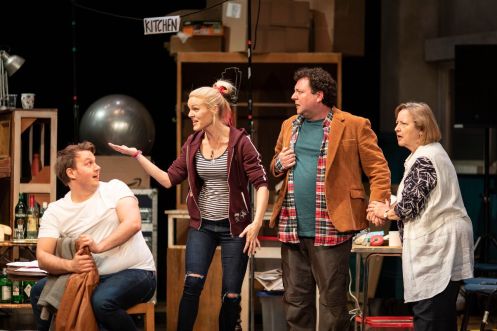
Designer Adrian Linford, with lighting designer Joanna Town, creates a precisely all-embracing setting for the rehearsal space. An untidy clutter of theatre accoutrements and rehearsal props in a recognisably tired church hall. With the Victorian meatiness of its heavy porch, roof beam corbels and wainscoting now disappearing under thick green paint, and a harsh addition of fluorescent strip-lighting, you could almost smell the dampness.
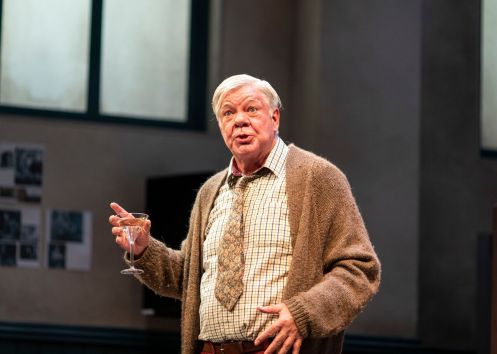
Dampness is an appropriate setting Auden in his Oxford rooms (once the college Brewhouse), who is prematurely senile, particularly in his hygiene, but not in his sexual practices. His untidiness, incontinence and toilet short cuts makes for a sordid ambience, which is compounded by his frankly admitted promiscuous homosexual dalliances, for which his lust is still strong. However, the explicitness of all this is hair-curling, and Fitz, the actor playing Auden thinks it demeans the character. “He is not coarse” says Fitz and the wider realisation of his character does indeed concentrate on the sharpness of his mind, his mobile facetiousness and his comprehension. The Auden depicted is also an obsessive. He obsesses about time and timekeeping, about his fear of aging, although “oracles repeat themselves”, and above all about the art of writing, which has become a life-sustaining habit … and he does repeat about “the habit of art”. Matthew Kelly, in this definitive role, not only is the essence of Auden (and even looks like a taller Auden), but typifies the old-school actor that is Fitz. The two are subtly but clearly differentiated down to the body language: the physically weary Auden shuffling in his carpet slippers and urine-stained trousers, and the world-weary Fitz, doing the job, the sparkle returning at the thought of his next part, a supermarket ad voice-over.

Equally another widely experienced actor, David Yelland, extracts the quintessence of Benjamin Britten from the character played by the actor Henry. The verisimilitude of Henry’s portrayal of Britten’s urbanity and his covert sexuality, discretely exposed in the presence of his one-time friend Auden, are accurately put across by Yelland. Just as we realise that Britten’s perversions extend to paederasty with his would-be choir boys, we also realise that Henry’s account of someone he knew, who became a part-time rent-boy to pay his way through RADA, is in fact Henry himself.
John Wark gives a strong and well-studied portrait of the third real-life character Humphrey Carpenter as played by Donald, an earnest new actor in Caliban’s Day. Carpenter, was not only a prolific biographer, but was instrumental in the development of The Third Programme (now BBC Radio 3). Son of a Bishop of Oxford, he was Oxford personified. In Caliban’s Day, Carpenter remains always in the background as a de-facto narrator, a theatrical conceit that Donald is keen to expand. He demonstrates his idea, an idea received by the rest of the company with a mixture of amusement and bemusement: he enters as the Goddess of the Wind (pronounced wine-ed), playing a tuba … in drag. The Richmond audience loved it (and Wark too clearly enjoyed the diversion).

Donald is merely trying to catch the drift of Neil, the playwright, who is besotted with theatrical conceits in all their forms. Inter alia, he is experimenting with making pieces of Auden’s furniture animate in order to give the play more depth. Fitz is distinctly unimpressed, as are the stage crew, who are reading in for absent actors but dutifully don the cardboard cut-outs of the dancing fixtures and fittings. As the overbearing hyper-precious playwright, Robert Mountford fairly bristles in the role of Neil, as he treats all the actors with supercilious distain, “chimpanzees trying to repair the watch”. Bennett’s spoof of Neil is as the ultimate intertextual plagiariser. So, pretentiously, we have as allegories of Auden and Britten: Phaedrus and Socrates, Dionysus and Apollo, von Aschenbach and Tadzio etc etc. The last pair from Thomas Mann’s Death in Venice is perhaps the most pertinent, as Auden in fact married Mann’s daughter (an unconsummated marriage arranged to get her out of Nazi Germany) but Auden did not write the libretto for Britten’s opera Death in Venice that is mooted in this Neil’s play. (Also I believe Mann based von Aschenbach on Gustave Mahler.)

Cutting through all this bullshit is Kay, Caliban’s Day’s stage manager, pragmatic, astute and focussed, everything a stage manager needs to be. She has been there, seen that and has a full wardrobe of proverbial tee-shirts. Veronica Roberts is outstanding in this role and is strongly supported by Alexandra Guelff in the role of George, the Assistant Stage Manager. (Guelff also has a great singing voice, her character standing in for Britten’s boy trebles and taking her soprano into this range in lovely traditional songs like The Ash Grove – in musical arrangements by Max Pappenheim.) Between them Roberts and Guelff are stage management embodied, as anyone who has ever worked in the theatre will testify.
The title of the fictitious play, Caliban’s Day, is, as Neil tries to explain, based on Auden’s poem, The Sea and the Mirror, which alludes to The Tempest and has, in its final long section, Caliban addressing the audience in lieu of Shakespeare. Symbolically, Caliban is the rent-boy, Stuart, who is one of the visitors that day in Auden’s rooms, and is perfunctorily used by Auden. As such, he is seen as one of unrecorded masses who impinge on the lives of the famous, but are marginalised when posterity apportions their biographies. Benjamin Chandler in this role has the deference of the newcomer actor Tim and the self-assurance of Stuart, the rent-boy whom he plays, a difficult role acted well.
Britten may say of a boy that “he was an Apollo, I seduced by his beauty”, but Auden’s reply that “it was not corruption but collaboration” opens a veritable Pandora’s Box. The Habit of Art may, like the actors, question the play, its presentation and their roles in it, but what Bennett’s metatheatre is really questioning is life, its presentation and all our roles in it.
Mark Aspen
October 2018
Photography by Helen Maybanks
Melting Pot comes to the Boil
Multitudes
by John Hollingworth
Questors Theatre Company at the Questors Studio, Ealing, until 20th October
Review by Eleanor Lewis
London and other cities seen as having a multi-cultural identity are frequently described in terms of a melting pot, a description which tends to gloss over the actual ‘melting’ process. First performed in 2015, Multitudes addresses what happens when the melting pot reaches boiling point.
Set in the city of Bradford, the Tories are about to arrive for conference in the city. They have just won an election and they’re supporting military action in the Middle East. The nation as a whole is squirming with unrest, mosques and a vicar having been attacked. A peace camp appears in the city, set up by Muslim women. Against this backdrop, Kash, a local Muslim councillor is hoping to become an MP. Natalie, his white partner, converts to Islam (but without consulting Kash) and takes up the hijab. Natalie’s confused and increasingly defensive mother, Lyn, fears the changes in the city she grew up in and turns to alcohol, from time to time launching into rants of the go-home-this-isn’t-really-your-country type. Perhaps most disturbingly Kash’s daughter Qadira, while struggling to reconcile her western environment with her Muslim identity starts to look for answers in radicalism.
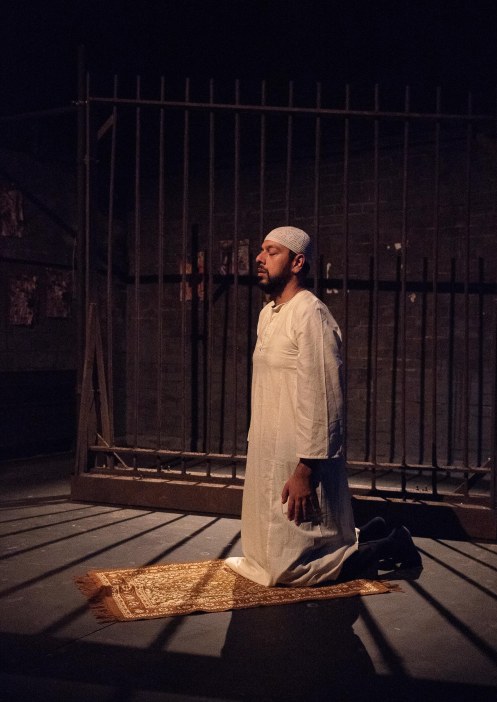
Over the course of six days this small family fragments, the strain of events around them forcing them to take a side however much they don’t want to. Natalie tries to function as a human bridge between all parties but breaks under the stress coming at her from all sides: she loses her job, suffers abuse from the community she’s tried to join, her mother can’t accept her religious conversion and Kash worries about how her actions supporting the peace camp look to the watching world. Eventually every character is backed into a corner and “whose side are you on?” is really the only question any of them has to answer. Whilst writer John Hollingworth does not provide a happy conclusion to this dilemma, he does perhaps suggest in the final section of the work that tribal loyalties are ultimately counterproductive, particularly in the face of the behemoth that is radical terrorism.

All of which might sound like heavy going, but this is a tightly written work with comic moments scattered throughout it, cropping up naturally as they do in everyday life, adding authenticity to the interactions taking place. This is not to say that authenticity is lacking, the level of performance matched the quality of the writing. All four principals were rounded, flawed, sympathetic characters: Anil Goutam’s Kash, was a man constantly keeping himself in check while trying to advance his career and keep his integrity; Maya Markelle brought out Natalie’s articulate but increasing frustration as she tried and failed to sort everyone out; Sarah Assaf conveyed the bewildered anger of a teenage Quadira lacking direction but wanting to do the right thing. Gillian Jacyna played Lyn as a woman whose anger and bigotry was born of the fear she felt at failing to cope with changing times, she was vulnerable. The supporting cast produced equally skilled performances, five actors sharing eleven roles, but still fully-formed character sketches: evidence of efficient direction and thoughtful performance.

The production moved at a great pace – there is a lot packed into this play, there would be, it’s the ‘melting pot’ issue – but strong direction brought out everything there was to be noted. Terry Mummery’s lighting and Olly Potter’s sound, including the call to prayer between scenes sometimes, enhanced the sparely furnished central playing block, though the staging itself could have been better. The fact that all the action took place in various sections across the long, black brick wall of Questors Studio meant that exits and entrances, particularly from stage right could be quite lengthy. This was particularly clunky after one significant moment toward the end of Act II. Possibly a couple of drapes either side might have helped.
There was a strange sort of script ‘tic’, more often in the first act than the second, when the question What? i.e. “what’s wrong with you/that” is furiously asked by different characters more times than is effective, and it interrupts the flow a little. Aside from that, Bradford accents were consistently sound, with only the very occasional lapse into somewhere in Scotland and the north east.
I enjoyed Multitudes, the family relationship between the four principal characters was both believable and attractive despite, or possibly because, it was fraught. Multitudes ticks two important boxes, it’s both interesting and entertaining. The play’s ending is open to different interpretations but one of those has to be that ultimately we will all come together again, it’s just that the process of getting to that point is probably going to be unbearably difficult.
Eleanor Lewis
October 2018
Photography by Jane Arnold-Forster.
Real Deep South Heat
Porgy and Bess
by George Gershwin, DuBose and Dorothy Heyward, and Ira Gershwin
English National Opera, London Coliseum until 17th November
Review by Suzanne Frost
Hotly anticipated, Porgy and Bess is a great choice for programming not just because the work hasn’t been seen in London since the eighties and has never been staged at ENO before, but also because it fits so urgently into their overarching season theme – patriarchal structures.

Gershwin famously saw his American Opera somewhere between Meistersinger and Carmen (although I got some serious Sondheim shivers in the overture), but Bess, the unmarried, outcast addict, endlessly passed on from one man to the next, is the Anti-Carmen. A vulnerable woman with no agenda of her own, only defined by the man who is housing her at any given moment and suffering under the societal structures that only assign worth to married women and mothers, Bess is a victim of patriarchy if there ever was one. As human rights activist Malcom X famously said, the most disrespected, unprotected, neglected person in America is the black woman, and Bess may well be opera’s only intersectional heroine.
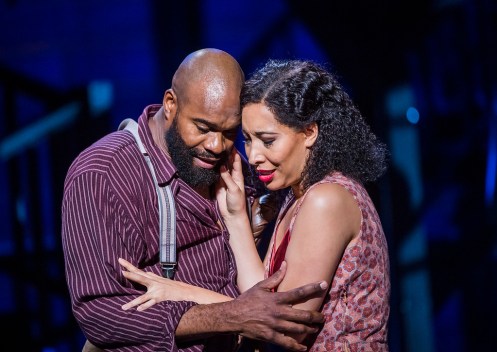
Just like Carmen, the storyline of Porgy and Bess is pure verismo, set amongst the poor hardworking downtrodden community of Catfish Row in South Carolina. Their close-knit lives are well presented through the mobile set designed by double Tony-Award winner Michael Yeargan, always bustling with various activities across two levels of a typical southern colonial house. Under the subtle direction of James Robinson it is interesting how the centre stage is almost at all times taken up by the men of the community while the women are pushed to the margins of the stage or busy on the upper levels with endless household chores and the care of numerous children. The evenings are “man time” as they take their apparently God-given right to relax, drink, gamble, waste time and lounge about after a day of work, while the labour never end for the women. The male privilege is most striking when you notice a teenage boy already lazing away with the men while a small girl upstairs is pushing a broom. The patriarchal structures are internalised by everyone, not least of all by the women who shame and bully Bess, making her entrance in a classic Carmen red dress to mark her as a “slag”, for not conforming to the acceptable stereotype of wife and mother. “Gawd-fearin’” women can be the worst!

It is quite obvious how Bess, whose beauty might be her curse, ends up in the company of men, as she is persistently shunned and excluded from the sisterhood. Immensely vulnerable and victim of her drug addiction, Bess needs shelter and protection and the only way to find those is via men. Of course those men rarely have her best interest at heart. The violent Crown is abusive, the drug dealer Sporting Life seeks ways to exploit her addiction. Only Porgy, the warm hearted cripple with a happy soul sees any good in her. Though still unmarried, a prim floral dress and someone else’s baby to care for turn Bess into an almost acceptable woman in the eyes of the clan. Yet, preconceptions remain under the surface at all times. Bess is a “bad woman”. The drug dealer and the murderer are perfectly acceptable members of the community.


With a storyline as eternal as this one, I was a little bit disappointed with the perfectly traditional mise en scene. While many may sigh in relief, I do generally love ENO’s boldness with direction and Porgy and Bess would work brilliantly in a more contemporary setting. But perfectly neat southern 1920s is what we get. Also, for anyone familiar with that old tune Summertime – and who isn’t – the original version sound surprisingly unjazzy. The orchestra, under jazz expert James Wilson, sounds mighty fine, but tamer than I expected and so, at over three hours running time and a never-ending first act, it did test my patience. The score does of course include some evergreens – and Frederic Ballentine as Sporting Life gets the crowds swinging, letting loose with It Ain’t Necessarily So – but rather more impressive are the gospel numbers, most of all the first act funeral, where that big luxurious specially enlarged ensemble of forty raises to a glorious chorus, building up real Deep South heat. Tichina Vaughn made a showstopper of her scenes as a sassy Maria throwing shade at Sporting Life while dissecting a shark. Much audience love was directed at Eric Greene for his debut as a warm and big hearted Porgy with a goofy smile and great physicality. His I Got Plenty of Nuttin was light-hearted and humorous, with more than a whiff of Fiddler on the Roof “If I was a rich man” charm. Soprano Nicole Cabell was less warmly received for her portrayal of Bess which is curious. There is a tendency with audiences these days to judge the characters rather than the performers during their curtain call, with lots of booing for the white police men, who are of course unlikeable but perfectly performed as such by singers who don’t deserve this kind of judgement. Bess is a less likeable figure than Porgy, she is beautiful and flawed, underwritten as a character by the – what else – male librettists, lacks courage and personal agenda, acts merely as a prop for most of the men in the story and was as such perfectly portrayed by the gorgeous Nicole Cabell. The fact that she pales in comparison to her male counterpart is in a way patriarchal structures personified. As long as only men write the stories and give space to male characters, this is how women will be painted on stage. Unfortunately the only piece of new writing this season, the Jack the Ripper opera in March next year, is also by a man.
Suzanne Frost
October 2018
Photography by Tristram Kenton
Journey on Foot
Soiree for MTV
St Mary’s Church, Hampton, 6th October
Review by Mark Aspen
Jazzy cello, folksy cello? No, no, no most might say, the cello is a classical instrument, middle orchestra but with many beautiful solo pieces: it has the rich throatiness that makes it so good for, well passion yes, but melancholy certainly. But yes, yes we can say, and as Amy Gould in her recent Soiree at St Mary’s has deftly shown us, it is a versatile instrument, quick on its feet (foot?) and full of … fun.

At the special concert in support of MTV, a local youth project run by St. Mary’s (not MTV, the teenager’s controversial radical broadcaster), a freshly coiffured William Ormerod introduced (reintroduced for many of the evening’s enthusiastic audience) Amy Gould, an award winning cellist, trained at the Royal Academy of Music, who is well-known locally, and her nimbly adept accompanist, David Harrod.

The pair were to take us musically on an inspired tour around Europe, but with sojourns across the Atlantic, with Gershwin in the USA and to Argentine for Piazzolla’s tangos and more.
Astor Piazzolla, the Argentinian composer, created the “nuevo tango”, whose newness melded jazz and classical music into the tango. His best-known work is Libertango, expressing an open freedom, which Gould’s spirited playing almost induced some of the audience to dance to its smouldering rhythms. Equally foot-tapping was Le Grand Tango, one of Piazolla’s later pieces that he dedicated to the famous cellist Mstislav Rostropovich. This piece is a musical marriage made in heaven, with the piano providing the staccato tango rhythms and the cello’s huskiness adding the passion. It is a piece that knows where it is going.
However, Piazzolla is not all about swirling sensuality and fiery dancing, Los Suenos lives up to its name, we are in a land of dreams, somnambulant, softly drifting to the sonorous smooth sounds of the cello.
Then we awake to put on white tie. Ah, George Gershwin, and we are immediately in a sophisticated world of between-the-wars high society … and They Can’t Take That Away From Me. This romantic nostalgic piece is from Shall We Dance and that is what the cello and piano do: cello leading and piano gently echoing the melody. But at a concert it is strictly non dancing and the audience had to content itself with more foot-tapping even for I’ve Got Rhythm, the standard from Girl Crazy, which transcribes (perhaps surprisingly) beautifully to the cello, but with the eponymous rhythm being lightly delivered by Harrod’s piano. Girl Crazy took Broadway to Arizona, but to get away from over-sophistication Gershwin set his “American folk opera” Porgy and Bess way down south in Charleston, South Carolina. The jazzy feel of It Ain’t Necessarily So comes over strongly on the cello and more didactic than the big swinging chorus number of the folk opera, whereas the lyricism of Porgy’s love song Bess, You My Woman Now is more extended on the cello. Leaving America, Gershwin peers thorough a stereotypical 1930’s London peasouper with Foggy Day.
Nevertheless, Gould and Harrod’s landfall in Europe is not in London but in Spain with the first to the two Spanish Dances No 2 by Enrique Granados. This trip to Spain however lingers a little on the other side of the Med. There is a certain mystery about it, well deserving its title, Orientale. One can almost feel the swirling of veiled ladies as they dance, and that exquisite last drawn-out note is quite seductive. It is a French composer, Maurice Ravel however, who takes us truly into Spain with his Pièce en Forme de Habanera, the spiccato cello making the confident, defiant statement of the Spanish dance.
Perhaps exhausted by the dance, we awaken from a dream in Gabriel Faure’s Après un Reve. The cello’s subtle exploration the theme is underlined by the piano. Does it get there? Almost, but then we are gently awakened by another drowsy sound. L’Abeille may sound French, but it is by Franz Schubert. One is immediately lead to think of the better-known bee of Rimsky-Korsakov, but to my mind Schubert’s honeyed composition sounds far more bee-like, and the short piece packs in a hive of virtuosity.
From an Austrian composer to a Czech as Antonín Dvořák takes us into a peaceful forest with his Waldesruhe. In the silence of the woods it feels like an evening walk as the adagio piece uses the cello’s lowest register. On into Slovakia with Bohuslav Martinu’s Slovak Variations, which although based on a folksong are definitely not rustic, but rather nostalgic and wistful. Their reflective nature is at its most intense in the first, becoming urgent and spirited in in the second. The piano opens the third variation with steady solemnity, which the cello picks up with an elegiac boldness, breaking into the lively scherzo of the fourth (did I hearing someone running?) and, in the expansive pizzicato cello of the final variation, I swear I could hear those bees again.
Eastward again, with the Hungarian composer, Béla Bartók, into Romania and his Romanian Folk Dances. We were treated to six of them, but since in a programme note we were told that the dancing involves sticks, sashes, spinning, stamping and even kicking the ceiling (!!), nobody dared to try. Nevertheless, it was exhausting to watch and hear the cello taking us through the dances, with the all these flourishes, including a top register dance “in one spot”, leading to a lively Romanian Polka, and on to the Mărunţel, the fastest of the dances.
We went into Russia with Sergei Rachmaninoff, although his Prelude and Dance Orientale are by no means typically Russian (or typical Rachmaninoff). The pizzicato cello in the prelude however, could have been at home on the balalaika, but the Dance Orientale moves us through smoky bazaars … ah, those swirling veiled ladies again!
Our second Russian composer, and the only living composer, was Nikolai Kapustin, who offered the most interesting fusion of classical and jazz music. As the name suggests, Elegy is contemplative, moving in a steady flow, with the piano initially taking the centre stage until the cello flows in and elaborates the whole with jazz style and rhythm. The overall feel is one of yearning: a remarkable composition, remarkably delivered by a pair of instruments in complete symbiosis.
David Harrod makes a perfect foil to the precise and studied style of playing of Amy Gould, with the refinement and concentration of a Pierre Fournier rather than the abandoned passion of a Pablo Casals. The intensity of her approach tends to be quite addictive and she had a very warm and positive response from the St Mary’s audience.
As a reward we were treated to a sparkling encore, Allegro Appassionato by Camille Saint-Saëns, a brief piece in scherzo form with a hint of gypsy about it … ah! the traveller, of course. The pace was a nice horsey canter, faster for an international journey than being on two feet … … but musically not as fast as being on one foot.
Mark Aspen
October 2018
Photography by Pat Stancliffe
Courting Trouble
The Regina Monologues
by Rebecca Russell and Jenny Wafer, with
Ladies in Waiting: The Judgement of Henry VIII
by James Cougar Canfield
Teddington Theatre Club Double Bill at Hampton Hill Theatre, until 13th October
Review by Eleanor Lewis
The fact that Anne of Cleves apparently smelt terrible is a good way to spark children’s interest in Tudor history which may be useful if you ever find yourself having to teach Tudor history to children. Anne of Cleves or Anna in The Regina Monologues, is however just one of six women who can all hold your attention completely for slightly more than an hour in the first of two short plays presented by TTC at Hampton Hill Theatre this week.

The Regina Monologues is a sharp, funny, well written short play which puts the six wives of Henry VIII into a modern context and imagines how the lives they lived might unfold now. All six wives are present onstage, taking turns to talk to the audience about their relationship with Henry. Annie (Anne Boleyn) is a suburban sex siren dreading the time “another woman like me” comes along once Henry tires of her. Katie (Catherine Howard) is an abused fifteen year old; Jane Seymour, in hospital gown, begins to go into labour; and Anna (Anne of Cleves) speed dates on her laptop, in full control of her life and her men, chasing the lifestyle rather than the man and with a philosophical, attitude towards life in general. Katherine (Parr) is the canny last wife, irritated by the stepchildren but willing to nurse the old man in order to reap the financial benefits after his death.


The direction of this piece was imaginative and impressive, it moved at a great pace, every performance well-researched and carefully presented. There were social media posts projected onto a background and short bursts of contemporary pop music at appropriate moments to break between monologues or to highlight significant moments. Joint directors Josh Clark and Michael Bishop were blessed with a strong team of TTC actors and since there was a consistently high level of performing skill on show, marking out specific actors is a bit like having your favourite Blue Peter presenters, it’s purely a personal preference – on that basis though, I found Helen Geldert and Tanya Gardner, as Cathy and Anna (Aragon and Cleves) highly entertaining. Tanya Gardner’s deadpan, unfazed Anna was very funny and there is not much to match Helen Geldert’s description of a woman’s experience of IVF compared to that of a man.


Emily Dixon played Katie’s (Katherine Howard) response to an abusive relationship well, bringing out the poignancy and shattered innocence of the situation, and her experience caused an instinctive recoil at the reality of a forced marriage between a 15 year old and a 49 year old man.

I had a small but frustrating issue with the ‘glass’ into which the women looked at the end of the play which was positioned so it could hardly be seen from one side of the audience.
The second play, Ladies in Waiting reverts to the sixteenth century. Henry VIII has died and is introduced into what seems to be purgatory by his fourth wife Anne of Cleves. What follows is relatively predictable as Anne and the other five wives treat him to 7-10 minutes each of home truths, each of them now uninhibited by the threat he constantly represented to them in life. The difficulty with this is that listening to one couple having a ‘domestic’ is relatively exciting, another five and the interest begins to wane. The unsurprising conclusion is that Henry, the ultimate ‘alpha male’ is, despite his own achievements, in fact defined by his wives and the huge historical presence of his daughter Elizabeth I.
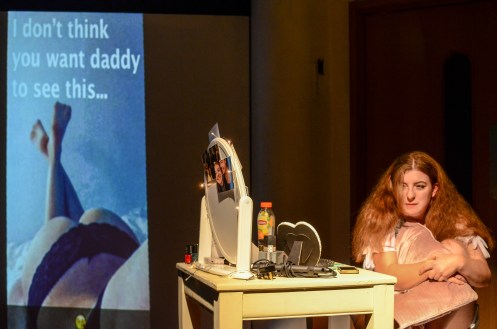
In this age of #metoo there is a point aimed at but not quite made here. These are strong, interesting women all subjugated by one man and the social constraints of the time but, despite this, Catherine of Aragon managed to raise an army and put down a Scottish rebellion while Henry was away in France. Katherine Parr was the first woman in England to have a book published in her own name, and Anne of Cleves secured herself the kind of divorce package likely to bring a sparkle to the eyes of today’s lawyers to the rich and famous. These things are all mentioned but briefly, the main thrust of the narrative being the women’s relationships with Henry, relationships about which they had little if any choice. Perhaps better from the #metoo point of view would be to take Henry out altogether, make him an offstage character who is referred to occasionally. These however, are writing issues and director Linda Sirker and her clever cast did an efficient job with the material they had. This was again very much a team performance and, although the queens were played by the same actors as in the first play, there were subtle changes of character and demeanour to reflect the period. Paul Furlong was a convincing bewildered, beleaguered and appropriately unsympathetic Henry.
The staging of this work was atmospheric, a dimly lit stage suggesting the limbo all seven characters now occupy, and just six elegant chairs. The Tudor costumes were great – headdresses were particularly impressive, evidently a lot of attention had been paid to detail. This was noticeable too in the way the women clasped their hands in front of them and slightly lowered their heads when they moved around the stage.
The two plays together provide an interesting contrast the similarities between those women now and 500 years ago are striking, thought provoking and funny. An entertaining night.
Eleanor Lewis
October 2018
Photography by JoJo Leppink, Handwritten Photography
This is a Man’s World
Cosi Fan Tutte
by Wolfgang Amadeus Mozart, libretto Lorenzo da Ponte
Dulwich Opera Company at All Saints Church, East Sheen, until 6th October, then on tour* until 2nd November.
Review by Matthew Grierson
‘What madness to seek out misery’: so says one of the soldiers soon to wager on his intended’s virtue in the first scene of Cosi Fan Tutte. Misery may not be an easy sell for what has become a popular comic opera, but the bet certainly results in the anticipated ‘madness’, with this engaging production steering a careful course through three hours of seriousness and silliness, if occasionally sailing a little close to the wind. All this to the accompaniment of Elspeth Wilkes at the piano and some simple but effective staging.
The piece opens with a pair of soldiers at a patio table, where Guglielmo (David Fletcher) nonchalantly drinks wine as his companion Ferrando (Robert Barbaro) paces up and down, angered by the suggestion that his fiancée could possibly be unfaithful. For the pair are not only under the shadow of a creeping vine but also the creepy Don Alfonso (James Williams), keen to press his misogynistic agenda. Boys being boys, it is not long before they agree to his plan to test the women’s virtue.

Girls will be girls as well, it seems, and the soldiers are replaced at the table by Fiordiligi (Loretta Hopkins) and Dorabella (Phillipa Thomas), praising the men who have just been seen promising to hoodwink them. Comparing pictures of their suitors, they playfully if unknowingly rehearse the reversal Mozart has in store for them, as one steals the other’s locket and forces a light-hearted chase. When Ferrando and Guglielmo enter with news of their supposed mobilisation, the women are heartbroken.
So far, so normative. It’s a tricky proposition to stage a piece that depends so heavily on the double standard, especially when the lads are established as typically laddish and the ladies as typically ladylike. But – I think – Ptolemy Christie’s direction maintains a precarious balance between stage tradition and 21st-century sensibilities, which is nowhere clearer than in Honey Rouhani’s joyous characterisation of the ladies’ maid Despina, a standout performance among an excellent ensemble.

While Fiordiligi and Dorabella may be justly distraught at the soldiers’ departure, this can’t excuse the ill treatment they mete out to their servant on their return home. In turn this gives her good grounds for wanting to bring them back to earth from their, well, operatic upset, in responding to which Rouhani proves herself an expert in the exasperated look. But more than this, Despina’s case that the ladies allow themselves some fun while the men are off ‘fighting’ shows that delight can be taken in women’s pleasure for its own sake, ignoring society’s constraints. The interwar ambience of the production’s design gives some credibility to this emerging possibility for women’s own agency. Viva Despina!
The production draws a fine contrast between her and Don Alfonso as the twin engines of the plot. Whereas the maid offers clear and convincing reason for bringing her mistresses down a peg or two, the Don’s animus against womankind gets no explanation other than the title of the piece – ‘They are all like that’. He lays claim to some ‘experience’, though he is of similar age to the soldiers and, presumably, excused military service on account of a limp, so it’s just as plausible that he’s bitter about not being in on that action. James Williams’ fine turn as the conniving Alfonso, complete with cad’s moustache and co-respondent shoes, puts one in mind of Iago, with his similarly nebulous reasons for misleading Othello.
Forgive for a moment my own aria, but I find the comparison with Shakespeare instructive: Alfonso proves his thesis about women correct through his manipulation of the other characters, but similar accusations made of Desdemona, Hero and Hermione are all unfounded. In fact, the closest comparable moment in the Bard is when Portia and Nerissa, in the guise of young lawyers, pull one over on their lovers Bassanio and Gratiano, giving women the upper hand and proving men unfaithful. As most of these episodes are in the tragic mode, even if they occur in comic plays, what does it say of Mozart that the same theme is played (and in this case, successfully) for laughs?
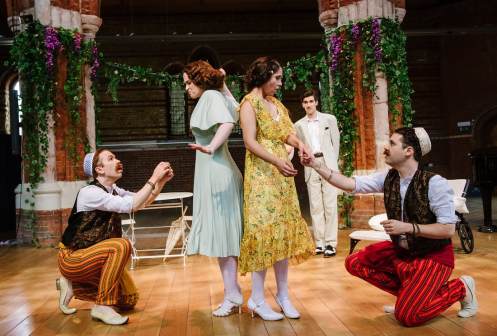
Perhaps it has to be. When Ferrando and Guglielmo return disguised as ‘Albanians’ to woo each other’s fiancées, the grotesquerie of their advances has to be comic, as it becomes here, because if it weren’t it could get very uncomfortable today. Likewise, the casual Orientalism of their fancy dress needs to be taken in a similar pantomime spirit to avoid offence. The cleverness of the production allows this stagey lasciviousness and implicit xenophobia to be interpreted as the soldiers’ attempt to be as off-putting as possible to the women in order to win their bet with Alfonso.
Any doubt may be dispelled by the delightful silliness of what ensues. Having seemingly poisoned themselves because of their heartsickness for Fiordiligi and Dorabella, the two ‘Albanians’ are revived by Despina, tricked out as a Frankenstein-style scientist, by attaching enormous crocodile clips to their harem trousers to jolt them back to life. Despite earning the women’s pity – are they in on the joke, or simply that gullible? –Ferrando and Guglielmo remain rebuffed and are driven off the stage, proving that the conned fiancées can still give as good as they get.
By the time of the second act there has been a crucial change of heart on both sides. The boys have upped their charm, serenading the objects of their affection with hand puppets in an effectively simple substitute for an elaborate masquerade, and the women begin to relent. This leads to a mock betrothal, with the two couples having their hands bound with vines; playing out along All Saints’ nave, this vignette makes good use of the church setting to suggest a ceremony at ninety degrees to a conventional wedding.
The awkward moment that follows is played legitimately awkwardly, with neither couple certain of where to take things from here. The subsequent contrasting arias of the women play out two of the options they face. Dorabella follows Despina’s advice, and returns from a liaison with Guglielmo to recount, in some detail, the fun she’s had. In her simulation of the encounter, Phillipa Thomas completes a convincing transition from fidelity to postcoital knowingness. Fiordiligi remains in two minds, however, and her aria exposes the passions she feels for her absent fiancé and would-be lover alike; all the same, she still spurns the disguised Ferrando.
That Dorabella yields and Fiordiligi remains faithful then opens the faultline between the two men. Guglielmo is able to brag simultaneously of his conquest while his own fiancée has remained loyal, but this prompts Ferrando to redouble his efforts, threatening to run himself through if Fiordiligi does not yield. If anything, this shows the opera to be as much about masculine egos as it is an exploration of feminine (in)fidelity. A sham wedding is ministered by Despina in the role of a priest, Rouhani enjoying the business this allows with papers and funny voices, but this only confirms the wounded pride of the male protagonists. As the unhappy couples toast their nuptials, they sing an aside to the effect that they wish their brides were drinking poison.
Rather than leave such a sour taste in the mouth, though, the production concludes by having its composer reveal himself. Don Alfonso spirits away the ‘Albanian’ grooms to have them return in their own person, exposing the plot and casually shopping Despina as its conductor. In a nice wink to the audience, as the piano strikes up to hymn the reunion, he then distributes the scores that they’re to use, with the title clear for all to see: ‘Cosi Fan Tutte, di Don Alfonso’. Once they realise they’ve been singing his tune throughout, the women each give the cad the slap that he’s more than earned, and even Despina rips up her earnings from the scam.
Technically, Alfonso has proved himself right, but he’s not allowed to take any pleasure from the fact. And this is probably the best way to retell the old lie in such an entertaining way, as this production manages, while keeping it palatable in a more equal century.
Matthew Grierson
October 2018
*forthcoming shows in Poplar (25th October) and Chatham (2nd November)
Photography by Alex Brenner
Just a Stage I’m Going Through
An Actor’s Nightmare
by Christopher Durang, and
The Real Inspector Hound
by Tom Stoppard
OHADS Double Bill at Hampton Hill Theatre, until 6 October
Review by Matthew Grierson
There’s more to tonight’s double bill at Hampton Hill than simple meta-theatrical mischief. Yes, both are plays about plays, but that was old when Hamlet did it. More particularly, they are plays about the kind of behaviour that plays force us into, and try as he might the Dane’s Mousetrap never manages that with Claudius or Gertrude.
Just as procrastinating as the prince is the protagonist of An Actor’s Nightmare, who finds himself extemporising throughout Christopher Durang’s one-act piece, in an attempt to perform a part he has not rehearsed. The remorselessly dreamlike logic sees the hapless George (or is it Stanley? It’s definitely not the mega-star they all expected), called on to the stage unexpectedly to appear in a play that some of the cast think is Coward and others Beckett, before it ends up on the executioner’s block à la Thomas More – a Bolt from the blue, you might say.
So unsure are this cast of George (or Stanley’s) identity that the poor fellow is not even credited in the programme. Perhaps that’s just as well. If the play were to feel truly like a nightmare we should be squirming in our seats, but such is the competently nonplussed performance of the enforced understudy that we never feel involved in his plight. I say ‘we’ on the assumption that many of my fellow theatregoers are like me onetime or sometime thesps, so there would have been considerable potential in mining our collective stage fright. Instead, having been plucked from obscurity, our (non-)hero seems barely to register our presence again, and has no sense of the embarrassment that would attend being onstage without line or reason. He also seems unfazed to find himself wearing a lycra cycling one-piece accessorised with ruff and a gold medallion that keeps annoyingly catching the light.
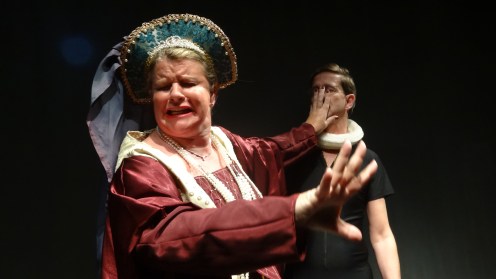
As a result, a capable and versatile supporting cast expend a lot of energy to keep things going. At least they’re having fun as they do so, sending up the various milieux of Coward, Beckett, Bolt and the Bard: Joolz Connery gives a fine turn as a Riviera honeymooner trying to get George/Stanley to remember his lines, while Denise Rocard has a brief appearance as her rival before a quick change into a bin liner for the Happy Days-cum-Endgame pastiche, where she showcases her proficiency at face-pulling.
Craig Cameron Foster then chews the scenery as a courtier in a sporting spoof of Shakespearean tragedians, and Lily Tomlinson serves throughout as a harassed stage manager in the guise of a maid whom George/Stanley summons to prompt him at regular intervals. Nevertheless, despite the combined efforts of the cast and crew orbiting George/Stanley, the play rather peters out. Even the executioner’s chopping block lacks threat because, well, it’s all just a dream, isn’t it?
Once everyone has woken up with their interval drinks we go further behind the curtain, and in front of it, for Tom Stoppard’s The Real Inspector Hound. As I said, there’s more than simply stage play that the two pieces have in common: if in An Actor’s Nightmare the supporting cast find themselves repeating dialogue in increasing desperation, Hound – which might just as easily have been called A Critic’s Nightmare – is built on the repetition that results from the characters’ own fixations. As in the first play, the relationship between audience members and cast on stage is blurred. Oh, and there’s a maid in both.
OHADS make good use of Stoppard’s device of critics being part of the show, sitting Birdboot (Andy Smith) and Moon (Luke Daxon) as far apart from one another as possible when the curtain goes up. This means that once the former recognises the latter, he fusses his way from one side of the stalls to another, and for maximum effect disrupts an entire row in the process. There is then plenty more to enjoy as we switch between overhearing them and keeping an eye on the play they and we are watching together. For as long as the reviewers engage in dialogue they are talking around their own preoccupations, but once they get down to taking notes they are effectively soliloquising, revealing their respective statuses as egotistical philanderer and jealous pseud.
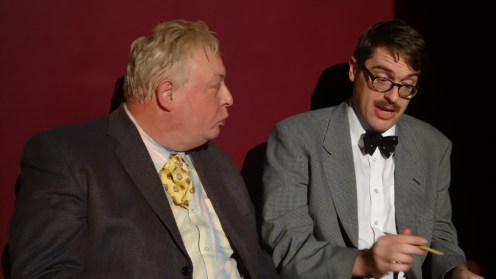
The action onstage meanwhile unfolds with gleeful over-explanation, making the machinations at Muldoon Manor seem much more straightforward than the reviewers’ hyperbolic reaction to it. As in Nightmare the cast have a game old time, and on this occasion the interlopers seem more than capable of keeping pace with them in sending up the Christie clichés. Indeed, it is Birdboot’s fondness for hackneyed turns of phrase, not to mention himself, that means he is first to cross the fourth wall to assume the role of bounder, recently vacated by the murdered Simon Gascoyne (Matt O’Toole).
In contrast to that young man’s sharp turns between diffidence, lust, suspiciousness and vulnerability, well handled by O’Toole, Smith proves an adept blusterer, his character’s critical instincts so poorly attuned that he does not realise that his affairs with Felicity (Francesca Stone) and Cynthia (Dionne King) have drawn him into the fiction. The ladies themselves are spot-on as the perky love interest and older vamp respectively, and Lara Parker adds excellent value as Mrs Drudge, whose dialogue is as laboriously delivered as the card table she has to carry to and fro.
Birdboot getting in on the action, so to speak, is much to the exasperation of Moon, a more cerebral form of critic whom the entire audience can get behind, a model of probity and insight who … Oh no, wait, I’m looking in the mirror. Moon is after all as hung-up as his companion, and it’s frustrated ambition that eventually carries him beyond the pros arch. Ostensibly there to resolve (spoiler!) Birdboot’s murder, Moon soon discovers that the corpse who has lain, elephantine, in the room since the beginning is his rival critic Higgs, whom he has himself fantasised about bumping off. (Incidentally, given that both scripts are peppered with up-to-date references, might there be a gag to be made about Higgs lending weight to proceedings, like the namesake boson? Wait and see, I suppose.)
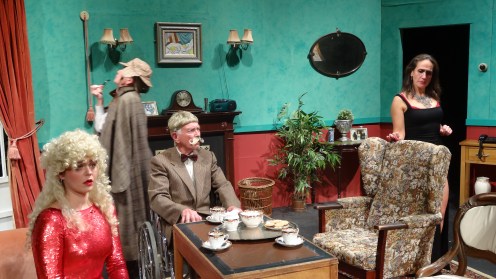
Thank heavens Inspector Hound – in a fun cameo by Fran Billington – is on hand to clear things up. Or is she? Once the critics have written themselves into the play, she and Gascoyne take their turn in the stalls to comment on proceedings, leaving wheelchair-bound Major Magnus (Jim Trimmer) to cast off his own well-conjured bluster to stand up and be counted as the real Inspector Hound.
If this sounds like a reviewer’s nightmare, the clarity of the direction makes it much easier to follow than it is for me to précis. It also helps that the structure of the play around which Birdboot and Moon orbit, before they are fatally drawn into its gravity, is relatively simple. That said, I’m still not sure why the third act of the play within a play rehashes its first; neither by what agency Gascoyne and the first Hound are granted temporary critical oversight. Perhaps what was a convention-busting device fifty years ago would benefit from a bit of tidying, now we are all familiar with it?
Then again, perhaps they are commenting on the need for essentially meaningless structure in a world without God. The moment Moon thinks aloud ‘Where is God?’ and Birdboot frantically scans his programme for said deity to show that Hound handles its religious ruminations much more deftly and humorously than An Actor’s Nightmare, where repeated references to George/Stanley as a monk manqué fail to find their mark. On the other hand, like Stoppard’s reviewers, yours truly may just be projecting his own critical unconsciousness on to the plays.
I wish it weren’t so. As it happens, though, among the deliberately miscued slides that serve for scenery in An Actor’s Nightmare is one bearing the legend ‘Conservative Party Conference 2018’, and once the image was in my head I found it hard to shake off the fact that the lead resembled a certain … … Well, let’s just say that prospect would have been a genuine nightmare
Matthew Grierson
October 2018
Photography by Raymond Wheatan
Salacious, Sordid and Stupendous
Hogarth’s Progress
by Nick Dear
Double Bill: The Art of Success and The Taste of the Town
World Premiere Production: RTK Productions at The Rose Theatre, Kingston until 21st October
Double review by Mark Aspen
Strip Me Naked, A Kick in the Guts, Cuckold’s Comfort: just a sample of the labels on gins from the nine thousand gin shops in the London of the 1750’s. Perhaps you would like to visit one, or perhaps a cock-fight, a brothel, a public flogging. As one of his contemporaries said, “It would take a Hogarth to describe” what you might see.
“It would take a Hogarth to describe” the rollicking, riotous, rumbustious start to The Rose Theatre’s The Art of Success, as it creates Georgian London before your very eyes, and then it is Hogarth himself who, with a huge splash of paint onto a giant canvas, opens that world vicariously to us.
And “it takes Hogarth to describe” and show us the scene at the Sublime Society where its “gentlemen” members, well into their wonted pub crawl, lie, somnolent and sozzled, amidst half devoured joints of meat and piles of empty bottles, awaking to plan the next round of the evening’s entertainment in the brothel upstairs.
The Art of Success is set around one such night for William Hogarth in 1730 and the days of its aftermath. The Taste of the Town mirrors that night thirty years on, with Hogarth still (mis-)firing on all cylinders in 1760, and the months of its aftermath. Against this background wash, the double bill paints a portrait of the matchless William Hogarth, artist, social commentator and champion of innovative art and British genius, in Hogarth’s Progress, a robust blockbuster that is altogether salacious, sordid and stupendous!
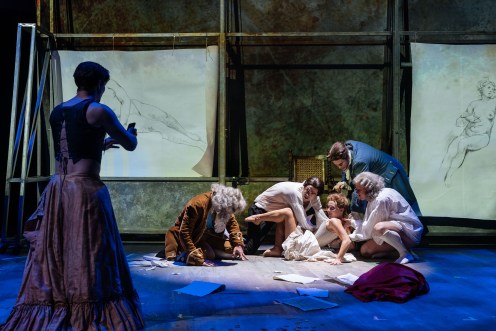
In The Art of Success we see Hogarth trying to hold his own in an ultra-competitive society, and trying, with considerable difficulty, to stay faithful to his newly-married wife, Jane, with whom he had eloped, the daughter of his former teacher, Sir James Thornhill. This is the high-energy play of the two, reflecting the vigour and urgency of the life of a thirty-something of ambition. However, this ambition is tainted with insecurity; and the ingenious design and presentation of the play lets us see inside the mind of Hogarth as, with the help of copious amounts of alcohol, dreams, nightmares and reality blur together where they meet.
The more realistic and reflective approach in The Taste of the Town lowers the freneticism, but does not lose its punch. Now we see Hogarth as a man in his sixties, still trying to come to terms with his wife, and with his prickly mother-in-law, the haughty, and indeed thorny, Lady Thornhill. Although highly successful, his insecurity is now around his acceptance as a serious artist, particularly from an establishment that holds his arch-rival Sir Joshua Reynolds in greater esteem, an esteem bolstered by the over-arching arbiter of Taste, Horace Walpole.
Designer, Andrew D Edwards creates a big statement, a set that comprises a stage-height easel and canvas that serves to catch the projections of the video designs of Douglas O’Conell and the lighting designs of James Whiteside. Moreover, it revolves and transforms to become various rooms and settings for a vigorous world that overflows with life.
Upon this canvas, director Anthony Banks splashes a dynamic depiction of Hogarth’s world. His approach may replicate the overstated view of the debauched times of Hogarth’s own series of Progress etchings. It may caricature the personalities who inhabit it, but they all deserve to be writ large. The picture is colourful in its darkness, big and bold, roaring and robust.
From the opening dance sequence, to Olly Fox’s music, we see a cast that is working seamlessly as an ensemble, but an ensemble that is a foil for many noteworthy individual performances. Almost all the cast double the roles between the two plays (and within a play) and the differentiation of characterisations is remarkable, unmistakable and accurate.
Perhaps a key to the timbre of Hogarth’s Progress are the characters of Oliver and Horace Walpole, both played by Ian Hallard in the respective plays. Hallard is called upon to point up his two aristocratic characters the most. So we have Oliver, a Viscount as grotesque as any figure in a Hogarth engraving. He is a perverted solipsistic monster, uncaring and sexually predatory, well accounted for in Hallard’s gloves-off depiction. In contrast the historical figure of Horace Walpole, Twickenham’s “natural celibate” and creator of Strawberry Hill, is a far more subtle character. Hallard’s portrayal of Walpole is of a precious fop, effeminate but by no means effete, for Walpole has and keeps the upper hand when confronted by a disaffected and well inebriated Hogarth.
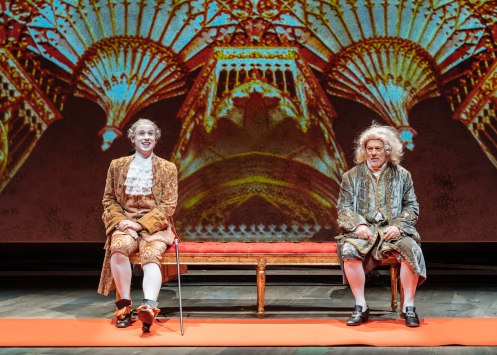
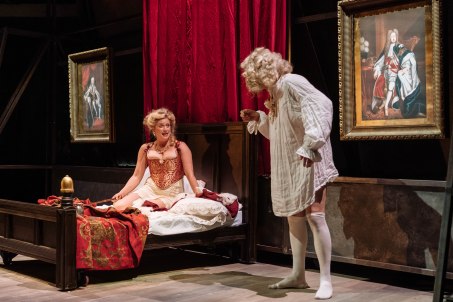 Another real character lampooned is Queen Caroline, Consort of George II, who in assumed the regency at the end of the King’s reign and did exercise a lot of power over the Prime Minister, Sir Robert Walpole, although perhaps not in quite the way depicted in The Art of Success. Nevertheless, Susannah Harker has huge fun with this role, as a dominatrix par excellence. In The Taste of the Town, she plays with equal verve the older Jane Hogarth, yet to reconcile herself to her husband’s foibles, a mixture of exasperation and reluctant acceptance. Sir Robert Walpole is presented somewhat larger than life by Mark Umbers as a ruthless retainer of power, who would sell his own grandmother for his own advancement. Here we see him manipulating would-be satirists, Henry Fielding, although not entirely successfully, and Hogarth himself, more successfully, much to Hogarth’s shame. In The Taste of the Town, Umbers takes on the role of David Garrick, Hampton’s renowned actor (whose memory is locally perpetuated at Garrick’s Temple to Shakespeare) a confidant to Jane Hogarth, and “mate” to Hogarth. Garrick goes on a prolonged pub-crawl with Hogarth, on foot from Chiswick towards Hampton, losing him at Strawberry Hill. However, “losing” Hogarth is a shrewd move when he realises that Hogarth is to confront Horace Walpole, for Garrick is painted as a likable but hyper-conceited man, yet one willing to play both ends against the middle.
 Unfortunately, the lone and well-oiled Hogarth is vulnerable to misfortune, which he meets on the way home at Twickenham Ferry, in the form of a prostitute, Nancy, and a war-wounded discharged fusilier Zachariah Blunt, who (using a blunt instrument) relieves Hogarth of his purse, boots and topcoat. Ben Deery plays Blunt as a hard-man, but one with a soft spot for culture (demonstrated by feeding Garrick’s conceit). Deery first appears as Frank, one of the reprobates of the Sublime Society, in a clearly enjoyed performance.
 One of the best-known historical figures from the Sublime Society is Henry Fielding, the satirical playwright and legal activist, whom we see railing against the establishment and especially Sir Robert Walpole. In The Art of Success one might say, tongue in cheek, that he seems to be gathering material for his later novel, Tom Jones, although it is Fielding who contrasts love and lust, “… we betray love”. Jack Derges clearly relishes the part of Fielding, which he plays with great vigour. His talents were however underutilised in The Taste of the Town as the timid rector, Parson Venables, a part unfortunately rather underwritten.
It is the lower class women characters who benefit from three-dimensionally written parts. Emma Cunliffe excels as the tart-with-a-heart, Louisa. An habitué at Louisa’s lodgings, the young Hogarth has long been a companion of Louisa and they have a mutual affection that transcends their commercial relationship. Cunliffe puts a considerable depth into the role of Louisa, making her one of the more compassionate characters. She later appears as an early feminist, Mrs Colquhoun, a character perhaps based on one of the many society women who hosted learned soirées in the late Georgian period.
Another class transformation is made by Sylvestra le Touzel as brothel keeper Mrs Needham and later as Lady Thornhill. “Mother” Needham, was notorious procuress who ran the most exclusive bawdy-house in London who died as a result of injuries received when sentenced to stand in the pillory. Le Touzel gives a very strong and sympathetic performance as Mrs Needham, forthright but understanding. As the equally plainspoken Lady Thornhill, Le Touzel’s depiction is of an acerbic and scornful grande-dame, someone you contradict at your peril, but respect at your will.
Ruby Bentall’s characters again span the social spectrum. Whilst being the common prostitute, Nancy of whom the older Hogarth falls foul at Twickenham, she earlier is Jane, daughter of Sir James Thornhill, the young Hogarth’s new wife. Bentall’s Jane makes an emotional journey from the somewhat immature newly-wed to the power-behind-the-throne wife, and developing a sexual inquisitiveness along the way.
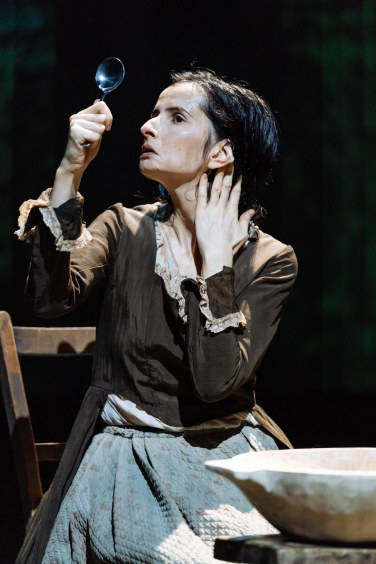
Perhaps the most interesting character is Sarah Sprackling, a convicted murderess, based on a real-life criminal notorious of the time, whom Hogarth visited in Newgate to draw in order to sell engravings to a prurient public. Sarah Sprackling poses the questions pertinently implied in Hogarth’s Progress: What is the value of art? What is life for? What is reputation? As such she reflects precisely the questions that rattle through Hogarth’s own mind. Jasmine Jones is outstanding as Sarah Sprackling, a truly frightening portrayal of a woman whose mind is sharpened by her impending death, a portrayal that totally gripped the audience, but with an empathy and depth. In one of the most shocking moments in the play, we are catapulted into the mind of a woman who would violently defend her reputation above all else. She does not like the salacious style of Hogarth’s drawing of her. She is content to be vilified as a murderess, but not as an implied prostitute. Jones’ edgy engagement with the character is all-absorbing. Then later we see Jones as Bridget, the older Hogarth’s maid, a totally different, but equally engaging character, youthful, bright and loving.

The double bill is eponymously centred on Hogarth, whom we see as a multi-faceted character with a complexity of motivations, often contrarian in his actions. He is full of conflicts. Art is a high expression of spirit; or a cash-cow to be exploited. Women are to be loved, cherished and protected; or are simply objects of lust to be used in self-gratification. Social advancement is mere snobbery; or is an essential ratchet when cranking up power and wealth. Reputation honours others and is a key to self-respect, or just a worthless vanity. Bryan Dick plays the young Hogarth in The Art of Success as a buzzing jack-the-lad, jam-packing the part with energy. There is much farce in this play and he has the physicality to put this over, whilst not losing the urgency, audacity and alacrity of the ambitious Hogarth at the start of his career.

Keith Allen as the older Hogarth in The Taste of the Town is world-weary and disaffected, a blustering bully. However, what we do see in Allen’s performance is a Hogarth that is also capable of introspection, who realises he may have reached his limits. He is also a man frustrated by not achieving all the he knows he is capable of achieving. There is a memorable scene during Hogarth’s ineffective confrontation with Horace Walpole, when these two very differ personalities put aside their differences as they weep over their dead dogs. (To the amusement of a twenty-first century audience, Hogarth’s pug was actually called Trump.)
The two actors’ performances complement each other in that we can believe that one is the same man thirty years on.
However, the credibility of the older Hogarth is somewhat marred by the script, with (and I risk sounding very fuddy-duddy) the overuse of the now ubiquitous and versatile f-word. It is not historically correct, not being used as a swear word until a century and a half later. It becomes really tedious. More importantly it demeans the character of Hogarth and one begins to lose empathy with him. Maybe Dear was losing interest in Hogarth when penning The Taste of the Town. Having got that off my chest, the casting of this play is unusually accurate to the period and the historical characters, and it good to see that the actors do closely resemble the real people they portray. Moreover, dialect coach Elspeth Morrison has worked to get accents accurate and spot on. So not only does Fielding have a Somerset accent and Bridget the maid a gentle Dublin accent, neither over-egged, but both Hogarth’s speak an accurate West London accent rather than a generic Cockney.
The latter is important in that it should chime with the Kingston audience as the plays are chock full of local references: Garrick at Hampton, Walpole at Strawberry Hill, the ferry at Twickenham and Hogarth’s house at Chiswick. As a child, Hogarth’s house was an afternoon’s stroll away, and when I first saw Hogarth’s engravings of eighteenth century London, I thought thankfully things are no longer like that. Now one wonders. Leaving that thought hanging, I’m off to have a gin … there’s a place in Chiswick that serves 180 different types. I wonder if they serve a A Kick in the Guts ?
Mark Aspen
September 2018
Photography by Manuel Harlan
Obtuse Obsessions
Salome
by Richard Strauss, based on Oscar Wilde’s play
English National Opera, London Coliseum until 23rd October
Review by Suzanne Frost
This autumn, ENO is promising a season exploring masculinity and what patriarchal structures may mean, opening with a highly anticipated Salome in a directorial debut by Australian director Adena Jacobs, who promised to present the biblical antihero through a “feminine” lens. Personally, I like tipping well-known stories on their heads and I really like radically reimagined opera – nevertheless, I don’t think I have ever left a theatrical production more baffled and confused. All my efforts at trying to create meaning and get inside Jacobs’ many directorial ideas and choices pretty much ran into nothing so in order to gather my thoughts, this is what I saw:


Herod and his royal family are celebrities with a cult-like following, watched by the ordinary people held behind red ropes. We hear of Salome first through the description of her beauty by a man, the besotted Narraboth. Right from the start, Salome is thus restricted to her appearance and “othered” by her onlooker, compared to a rosebud, a dove – never anything human. When Salome finally appears, a role with more feminist icon burdening and preconceptions than anyone should carry, she sneaks onto the stage almost unnoticed. The Scottish mezzo-soprano Allison Cook is small and slim with a very young face. This Salome is obviously barely a teenager, which makes the luring of all the men over her body and the discomfort of her mother witnessing their lust very poignant. The voice of the prophet Jokanaan comes from out of space like the voice of God, spiting misogynist phrases about women being “the whores of Babylon” with a conviction as if they were eternal truths. Salome, for some obscure reason, is intrigued by this and this is the first time we see her using her femininity to exude power, ever twirling her long blond hair until Narraboth leads her to the prison where the prophet is kept.


He is stripped to his underwear, wrapped in a plastic sheet and sporting a pair of bright pink high heels. This image made me think of Abu Ghraib, but I am not entirely sure why. Some kind of sexualised torture seems to be going on, and the high heels – usually a symbol of femininity as well as oppression are maybe used as a tool to humiliate Jokanaan? He who repeatedly states his contempt for women would probably feel shame being forced into lady’s shoes? It’s my best guess. Where the prisoners of Abu Ghraib had their heads covered in bags, Jokanaan is forced to wear a construction around his face that looks like a futuristic muzzle and films his mouth in close up projected on to the back of the bare stage. His soft mobile lips and the wet tongue rolling around as he sings look somewhat pornographic, like a money shot of a male mouth, and Salome’s sexualised obsession with Jokanaan’s mouth, hair and flesh are maybe the male gaze she continuously endures thrown right back at the patriarchy – but again, I’m only guessing.
While Salome sings herself into ecstasy and starts to strip off her clothes, a lurking Narraboth holds a voyeuristic camera firmly on her, documenting her sexual awakening that the great storyteller Strauss filters through the most glorious music. Salome, topless, in men’s trousers and her platinum hair comes out of her trance now looking like Lady Gaga in Born This Way and steps into Jokanaan’s pink high heels. They must mean something.

The pop culture references and music video aesthetic continues with Herod awakening in his royal bed surrounded by “bitches” like a rapper in a hip hop video. The stage resembles a super hip art gallery, a blank white box with arty installations placed in random corners – Damian Hirst’s shark tank filled with a milky white liquid; a gigantic beheaded My Little Pony suspended from the ceiling like Jeff Koon’s lobster, later gutted and spilling garlands of flowers. A plastic sheet that maybe Joseph Beuys carefully crumpled in a corner in the name of art. Everything is millennial pink and artificial, even a spill of blood from Narraboth is bright pink paint that Herod rolls around in. He is dressed as Santa and will at some point produce lots of presents out of a sack. There is obviously an overload of symbolism here but what it means – I cannot say. Most of the time I felt like being at Whitechapel Gallery or any other fiercely arty hipster venue, looking at a random collection of mystifying objects that might be art or somebody’s discarded plastic bag and wondering if I am just too uncool and stupid for it all. The backdrop switches to an oversized image of a young boy with lipstick, his eyes bound. Maybe Herod just acquired a David La Chapelle portrait of Saint Sebastian for his art collection. Who knows? Sometimes I felt like being at Berlin’s Schaubühne, where theatre just isn’t theatre without some nudity and bodily or other fluids to smear all over people.

Salome returns now dressed as a stroppy teenager in hotpants and sneakers, doing a casual sequence of morning yoga. Then she smears her face with make up until she resembles DC Comics heroine Harley Quinn from Suicide Squad. Her dance of the seven veils is a performance of femininity, a sequence of instagrammable poses. She is supported by Herod’s bitches, all underage teenagers twerking through a hypersexualised dance routine, while the stone-faced Salome swings a baseball bat. The head of Jokannaan is delivered in a plastic bag spilling pink paint. It’s a plastic fantastic pink Barbie world this Salome lives in. Of course these are all symbols of girlhood, but I don’t know if just throwing symbols on stage is enough as a concept. Salome never kisses the head. I don’t think it was ever about love for her. Just exuding power and winning. Maybe she was just pissed off with Jokanaan’s comments about the “race” of women being the evil of the world. I know I was. In the end she seems to miss the male gaze that made her so uncomfortable all through the opera, exclaiming ever more desperate “why did you not look at me, Jokanaan” while the backdrop seems to be a gigantic eye framing her.

Then, Salome has a bonding moment with her mother Herodias, who has been watching Salome’s growing emancipation with pride and admiration, maybe witnessing a new generation of women going further than she ever could. I really want to get on board with feminist opera but I wish it wouldn’t be this confusing. Strauss’ music sounded sublime under Martyn Brabbins, ENOs new Music Director, and Allison Cook has stamina and presence in this most demanding role and she was game for all the directorial nonsense, acting her socks off. It probably wasn’t nonsense. I assume a lot of intellectual conception went into this and maybe I just wasn’t smart enough to get it – but this is not a particularly great feeling to release an audience into the night with.
Suzanne Frost
September 2018
Photography by Catherine Ashmore
Poorish Love
The Heiress
by Ruth and Augustus Goetz
The Questors at The Judi Dench Playhouse, Ealing, until 6th October
Review by Genni Trickett
It is no secret that Henry James didn’t much care for his own novel, Washington Square. He called it “poorish”, and it is true that there is a simplicity to it compared to his later writings. However, simple is not always bad, especially when it is as layered and psychologically incisive as the theatrical adaptation by Ruth and Augustus Goetz.
The Heiress is a play about love. Or rather, the lack of it, and the devastating effects produced by that lack. It is the mid nineteenth century and gauche, shy Catherine Sloper is living with her widowed father in New York. Socially crippled by her father’s indifference and polite contempt, she is utterly defenceless when handsome, charming Morris Townsend comes knocking on the door. Suddenly the quiet, orderly lives of the residents of Washington Square are thrown into chaos as they find themselves compelled to question their loyalties, motivations and the very meaning of love itself.

The director wisely keeps the action plain and stilted, reflecting the awkwardness of the characters. People sit, stand and walk in a considered manner, rather like a joyless, stately waltz. The set is beautiful, though the sheer size of the windows draws the eye to the view outside the house, distracting one from the action within and compromising the feeling of claustrophobia generated by too many passions being cooped up together. Sound effects such as eagerly-awaited carriages drawing up outside are very effective, though marred by a lot of loud whispering and muttering from the cast behind the scenes as they await their entrance.
In a letter to his older brother, Henry James wrote of Washington Square; “The only good thing is the girl”. While that is not entirely true of this production, it is certainly the case that Stella Strange as Catherine steals not only the show, but also the hearts of the audience. Her transformations from touchingly tongue-tied girl to passionate lover to cold, majestic chatelaine are wonderful to behold, and even when her judgement falters you are rooting for her all the way. Our actor gives us a nicely slippery Morris, neither hero nor truly villain, but a vacillating, weak man somewhere in between. There is good support from a sparkling belle, cruelly throwing Catherine’s social inadequacies into sharp relief, and a lovely turn from a ditsy, romantic Aunt Lavinia. Elsewhere the acting is sadly monotone and featureless. While this is not such a problem for the small characters, in the larger roles it means that much of the oppressive, stifling atmosphere of the play is lost. The script gives us sudden, shocking flashes of razor sharp bitterness and resentment, but these are not felt. Accents, always a problem when English actors attempt American plays, also slip bewilderingly from New York to deepest, darkest Texas by way of Essex and Ireland.
The Heiress is a production with a lot of potential. With a little polish, some voice coaching and some serious directorial influence on the line delivery to really bring out the subtext, Questors could have a hit on their hands.
Genni Trickett
September 2018

 Mark Aspen