
Moths Pinned in the Light
Don Carlos
by Friedrich Schiller, translation by Robert David MacDonald
ARA, Exeter Northcott, Nuffield Theatres and RTK Co-production at Rose Theatre, Kingston until 17th November
A review by Mark Aspen
Shadows, moths flitting around a flame, afraid of the dark, but afraid of getting burnt. This is the atmosphere of the dark and edgy version of Schiller’s masterpiece now running at Kingston’s Rose Theatre.
Schiller’s tragedy, which he completed in Dresden in 1787 having incurred the displeasure of various authorities in other parts of Germany, is loosely based on historical events in Spain in the 1560’s during the reign of King Philip II. History’s verdict on Philip is to paint him as a tyrant, and it was from this viewpoint that Schiller wrote his play, with some prescience as it was two years before the storming of the Bastille ignited the French Revolution and stirred revolutionary furore throughout Europe. Schiller himself knew of the dangers of messing with authority.

The Rose production invites us to draw parallels with modern times worldwide, and designer Rosanna Vize has taken a scorched-earth approach to the piece, stripping out set, scenery, costume and mannerisms that would fix it in the 16th Century, or indeed in any century. Her stated idea is that “details … distract from the bigger picture” and the story can be told “with the bare bones of what is required”. In practice this means that she has abdicated the design to the lighting designer Jonathan Samuels, whose harsh un-gelled lanterns inhabit the stage like silent actors. Startling (and, for some of the audience, blinding) at first, I must admit that the stark lighting design grew on me. We have a vast minimalist and monochrome design that counterintuitively creates a stifling feeling of claustrophobia. The human actors, the protagonists in Schillers’ dense plot, are pinned to their places by the lamps of the lantern-actors, like moths to a museum display board. I later realised that the mise-en-scene is that of the “Black Paintings” of (Schiller’s contemporary) Francisco Goya’s later Quinta del Sordo period, foreboding, melancholy, threatening: Goya at his darkest.
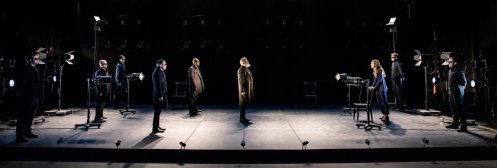
Philip, who had been married to Mary I of England, try to forge another political alliance in 1559 by marrying Elizabeth de Valois, daughter of Henri II of France. This was in spite of the fact that Elizabeth was already engaged to Don Carlos, Philip’s teenage son. This is the starting point for Schiller’s Don Carlos, with the anonymous prince’s incendiary reaction to his father usurping his engagement. What follows is the intricate web of intrigue and counter-intrigue, of conspiracy and counter-conspiracy that forms the tangled plot of the play. This requires concentration from an audience, and it certainly gets it from the Rose audience, notwithstanding the play’s three-hour plus duration.

Maybe the cast are conscious that here is a lot of play to fit in. The opening dialogues are rushed to the point of gabbling and much of the important content of the early scenes are missed, but when the play settles in, so do the speeches, which in translation largely retain the blank verse of the original text. Also significantly the import of the long reflective silences underlines the edginess of the play, and this feeling is enhanced by the quivering music of the sound track.
The sound design is the creation of director Cadi Roll and forms part of the overall stylisation of the piece, the form of which is shaped by the concepts of his new theatre company, Ara, set up by Roll and the actor Tom Burke. Technical theatre and action are entwined in a dynamic way, rather than established at the outset. So, the on-stage lanterns are wheeled around the stage, and no only in scene (in the sense of time) changes, almost becoming part of the action. There is a problem with this, in that the audience are static, so the lanterns often mask the action. And having actors facing each another, faces strongly lit by side battens, hides the action from much of the audience. Or is this to make us feel the uneasiness of in interrogation? Costumes are black and white, except for the occasional touch of red (the lining for the king’s coat for example and of course the red carpet). However, the stifling confinement of an oppressive court comes strongly across.
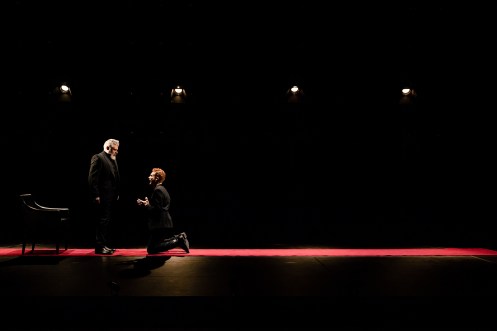
In this production, Tom Burke plays the part of the Marquis of Posa, a companion of the prince since boyhood, whom Don Carlos confides in. The Marquis is deeply concerned to hear Don Carlos tell of his continuing love for Elizabeth, now his step-mother, but nevertheless vows friendship to help him. In turn, asks for the prince’s support for his quest to alleviate the Flemish people from the tyrannical policies imposed by Philip. Gradually Posa is sucked relentlessly into the court intrigues. He manages to gain the King’s confidence, even though he has radical convictions and a heretical religious stance. You see, he appears to the king to be unique in speaking up honestly. However, in the end, to keep his oath to Don Carlos, whist trading a dangerously thin line with the King, he is the one to be sacrificed. Burke’s Marquis de Posa is calm, rational and level headed. He draws on an internal strength to think on his feet, although even he is not above threatening murder to advance the cause. Burke’s portrayal is strong, empathetic and self-sufficient. (However, his later role as the blind nonagenarian Grand Inquisitor is not so convincing.)
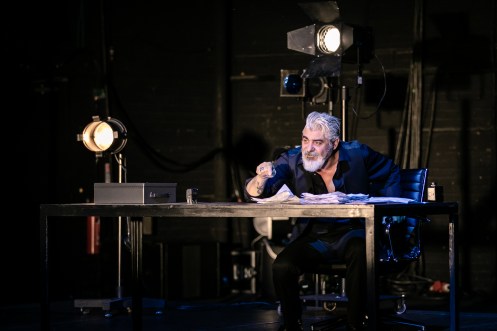
Samuel Valentine fills the eponymous role of Don Carlos with a jagged nervous energy, portraying a man in constant state of frustration: about the alienated affections of his hitherto fiancée, about his father’s refusal to allow him to lead troops in the Netherlands, about the impunity with which other members of the court insult him. King Philip does not trust his son; in fact, he does not trust anybody, even his new wife. Darrell d’Silva, in this role, plays Philip’s reaction to this lack of trust with anger, but then again the King seems to be angry about everything, from trivialities to matters of life or death. He is angry about not killing the right man; he is angry about killing the wrong man. He gets so angry that the makes himself ill, but what d’Silva gives is a one-dimensional character who has no other emotion. Even his basting-off of a loud klaxon doesn’t bring down the steam. He starts highly fired up and stays there.
Schiller’s much more rounded and subtle characters are the women. Kelly Gough’s Elizabeth of Valois is dignified and regal, a princess who understands her position in the social standing and the protocols that go with it, a woman with her emotions under control. She is eyed with suspicion as a foreigner in the court and is a butt of unfounded accusations, but she rides out these waves. The Princess of Eboli is potentially in a more precarious position. Young and vulnerable, she is importuned by the King, and does not have the power to reject his advances. Yet she is in love with Don Carlos, and when he rejects her, she has all the guile of the woman scorned and her fury is unleashed. Alexandra Dowling’s portrayal of the Princess is nuanced, a character who is a once spirited and fragile.

The court is however largely populated by men. The éminence grise is Domingo, the king’s confessor, right-hand man and procurer, who spends his time sowing poisonous seeds. Jason Morell is suitably sleazy in this role. Stephen Ventra’s Count Lerma, the Commander of the King’s Guard plays a pragmatic man, trying to keep his head above water … and on his shoulders. Don Carlos’ nemesis is the Duke of Alba, the King’s emissary in the Low Countries, who commands the armies in Flanders, but secretly would rid the court of both Don Carlos and Elizabeth. Vinta Morgan is unconvincing in this role, lacking the gravitas of the aristocrat, and instead of proud deportment a noble, we have the swagger of a night-club bouncer.

Perhaps all this is a reduction to the “purified” theatre of Roll and Vize. Does it say we are all in danger of tyranny? The portrayals are certainly widened. Elizabeth is a French princess, now living with her royal husband in Spain, but speaking with an Irish accent. (Gough’s native accent). Does this show the universality of Philip’s pan-European tyranny? What the effect is though is to reduce the universality to a uniformity.

Picking up the invitation to draw parallels with tyrannies in modern times, the tyranny of uniformity has come from stifling dominance of faceless power that reduces individuality, the faceless brutality of The Soviet Union, or the faceless bureaucracy of the European Union, which crush individuality into the greyness of uniformity. In the last century we have had totalitarian tyrants, Stalin, Hitler, Mao Zedong, Pol Pot, Saddam Hussein, Bashar al-Assad, who have possibly put Philip II of Spain into the shade. The overall picture of this Don Carlos is that created by the physical design and overlaid by the direction: not a black and white world, not a totalitarian tyranny, but a tyranny of uniformity, a tyranny that produces a stark, bleak greyness.
Still, where are the moths?
Mark Aspen
November 2018
Photography by ©The Other Richard
Hide and Shriek
Something to Hide
by Leslie Sands
SMDG at Hampton Hill Theatre until 10th November
Review by Eleanor Marsh
Something to Hide by the actor and writer Leslie Sands is a piece of its time: the 1950’s. Wisely, SMDG’s director, Jean Wood has chosen to leave it firmly where it belongs in terms of staging and thus it may be viewed as a “period” as opposed to “dated”. This overall feel is enhanced by touches such as masking scene changes by closing the curtains – something I’ve not seen in the theatre in a long time – and the choice of contemporary 1950’s music playing on the radio. Jerome Kern’s The Way You Look Tonight is a particularly good choice of song to evoke the atmosphere of what is both happening and about to happen.

Although the plot relies on several descriptive speeches of offstage action to move on, it is written is such a way that – as long as the actors are up to it – it does not appear as static and laboured as some other plays of its genre. In the main SMDG’s actors are more than up to this task of storytelling-acting and the dramatic action moves at a good pace.

The play is mooted as a “thriller” and it has everything an Agatha Christie fan could wish for: murder, adultery, blackmail, deception, twists and turns of plot and even a nosy neighbour. The cast is small and all are enthusiastic.
 Sue Birks and Gina Way both seem to be having fun playing respectively the nosy neighbour and the cleaner. These characters are somewhat superfluous to the plot but serve the good purpose of relieving the tension just when it is needed. The other minor role of Mr Purdie the mechanic is played by Paul Lawston. Nicola Doble does her best with the somewhat underwritten role of Julie. She has little to work with, but is a crucial character and Ms Doble is both three dimensional and sympathetic. As the protagonist (or is he…?) Howard Holt played by Richard Pool is suave and comes into his own towards the end of the play.
 Susan Reoch, as the moneyed wife, Karen is well cast, demonstrating vulnerability and steely determination in equal measure. And completing the cast we have the excellent Darren McIlroy as the dogged – and very clever – Inspector Davies. Like Chief Inspector Hubbard in Dial M for Murder, Davies is a forerunner of Columbo and there must have been a temptation to play him as a caricature, but thankfully both actor and director resisted temptation and there was an almost audible sigh of relief from the audience when Davies’ reassuring presence announced itself in Act Two.

Technically this production had some challenges – mainly in the (lack of) attention to detail. The overall look of the set did exactly what it was supposed to and took us immediately into the country home of a wealthy couple. However, the curtains in this rather grand house were the wrong length and un-ironed, the rather upmarket and business-like desk was mismatched with a dining chair and a rogue briefcase found its way into the centre of the set for no reason that I can recall, causing the actors to walk around or over it. This was quite distracting. Costumes were flattering to the ladies and serviceable for the men. Although not always true to period they enhanced rather than detracted from the overall ambience. Lighting and sound both suffered a little from the curse of the touring show – first time “live” in a new building, but the effects were good and my main complaint here is that the radio music at the beginning of the play was too loud – I was expecting Miss Cunningham the neighbour to be complaining about the noise when she knocked on the door …
Overall this was a very entertaining piece and a lovely nostalgic trip back in time and Ms Wood must have been delighted at the first night audience’s gasps and screams on more than one occasion during the play. There can surely be no finer recommendation for a thriller than that!
Eleanor Marsh
November 2018
Photography by Bill Bulford
Age Shall Not Weary Them
Dear Chocolate Soldier
by Kate Glover
Historia Theatre Company at OSO Arts Centre, Barnes until 10th November
Review by Andrew Lawston
Coming to the OSO less than a week before the UK commemorates the centenary of the 1918 Armistice, Dear Chocolate Soldier is a particularly timely production from the Historia Theatre Company. Billed as a “docudrama”, the show dramatises the years of correspondence that resulted from young Joan Burbridge posting a bar of chocolate to the soldiers on the front line, bearing her father’s inscription of “Little Joan”. In the trenches, Bombardier Edwin Hassall finds the discarded chocolate wrapper bearing Joan’s address, and so writes to Little Joan, talking about his life and experiences in the trenches with wit and plenty of historically fascinating detail.
Through this touching story, which lends a welcome human perspective to the international conflict of the First World War, Kate Glover’s script narrates the second half of the War; from the Somme, through Passchendaele, and even some time after the Armistice. Hassall’s letters, performed ably by Simon Brandon in authentic-looking World War One khaki, are interspersed with songs from the period, as well as poems, and short dramatic scenes extrapolated from the correspondence.
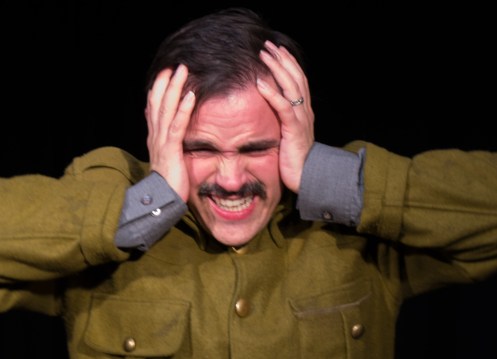
As the war grinds on, an increasingly cynical and weary Hassall returns to the front line as a sergeant, and “Little Joan” becomes both his personal mascot, and the name of his field gun. Kenneth Michaels plays numerous roles throughout the production, and increasingly supplements Hassall’s letters with quotes and narration from Field Marshall Haig, Lloyd George, and from General Ludendorff on the German side. Perhaps a victim of opening night nerves, Michaels seemed hesitant at the start of the show, but quickly settled into his numerous roles with confidence and gusto.
Completing the trio of actors is Kate Glover, who has enormous fun playing Little Joan in the opening scenes, before playing various characters throughout (most notably Hassall’s sister, Emma), and providing much of the narration. Glover is also the show’s writer (she settles for the more modest credit that the letters are “edited and arranged by Kate Glover”, but this seems to fall short of her contribution given the selection of musical numbers, poems, and dramatic scenes). Glover’s script keeps the proceedings varied, breaking up the letters with songs from the period, most of which will be familiar to contemporary audiences. All three actors reveal that they are also strong singers, with Simon Brandon’s voice ringing out particularly strong.
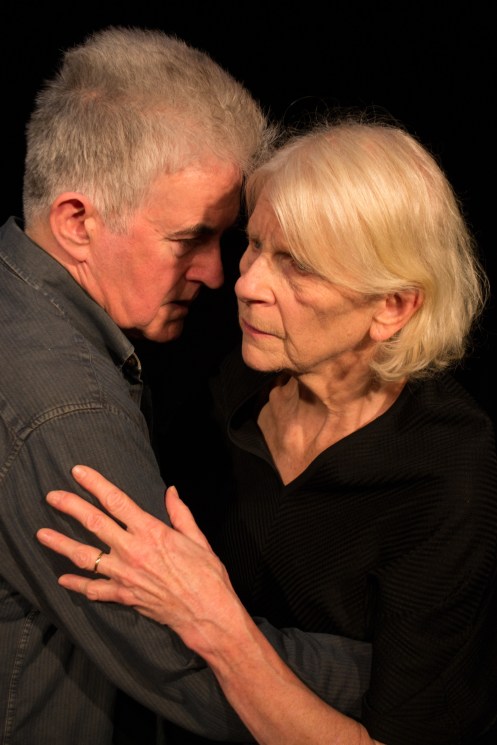
With just three performers, and a superb pianist in the form of Director of Music Laurence Williams, the set is little more than a piano and two chairs against the drapes of the OSO’s black box stage. Enlivened by Michael Murray’s evocative sound effects, simple but effective costumes from Questors, and a lively performance of what could easily have been a very static piece, this minimal staging allows Hassall’s authentic voice to resonate with audiences with no distractions. Director Kenneth Michaels (also acting) keeps the show moving at a brisk pace, with barely enough time for Edwin Hassall to catch his breath between the end of a song and the start of the next letter.
The title Dear Chocolate Soldier can’t help but evoke the fictional Captain Bluntschli, the “chocolate-cream soldier” of George Bernard Shaw’s Arms and the Man. Hassall’s letters convey a similar mundane and pragmatic approach to the business of warfare, most notably when he is furious over the wounding of the cook who was so good at preparing bully beef rissoles for the men. When the young Bombardier goes down with dysentery, he hangs on for a month as the trenches are so under-manned, before finally being hospitalised. He refuses to accept any glory in soldiering on despite his illness, instead feeling first disbelief and then jubilant relief when he is sent back to England to recuperate.
There is no room for nostalgic sentiment in this show, which pulls no punches when detailing the soldiers’ fighting conditions, rationing, and the vast numbers of senseless casualties, but it still has a great deal more warmth to it than , the show to which it will inevitably be compared, given its cabaret style. The play also touches on the way in which veterans are treated, as contentious now as in 1918, with Hassall’s fate desperately at odds with the “land fit for heroes” promised by Lloyd George.
Dear Chocolate Soldier is an entertaining evening that makes great use of contemporary documents to present a surprisingly fresh perspective on one of the formative events of the 20th Century. It is perhaps a shame that presumably only Edwin Hassall’s letters survive, as it would have been wonderful to hear some of the Burbridges’ replies, and to get even more of a sense of wartime society back in Blighty. But we are left with a compelling portrait of one man’s struggle through the War, and a glimpse of his innermost thoughts, and of the little comic incidents, often shot through with black humour, that made life in the trenches bearable.
Andrew Lawston
November 2018
Photography by Paddy Gormley
Compassion Redeems
Rain Man
by Dan Gordon, based on the MGM motion picture from a story by Barry Morrow
Bill Kenwright and The Classic Screen to Stage Theatre Company at Richmond Theatre until 10th November, then on tour until 24th November.
Review by Mark Aspen
Can compassion be bought and sold? Every man may have his price, but wheeler-dealer Charlie Babbitt finds that, in spite of himself, his price is drastically reassessed in a journey of self-discovery.
This is a journey that we make this week at Richmond Theatre in an immersive re-imagining of the multi-Oscar winning film Rain Man. It is perhaps unusual to adapt a film for the stage, rather than vice-versa, but bringing a wide-vista film into the confines of a theatre allows the story to speak in a powerfully engaging way.
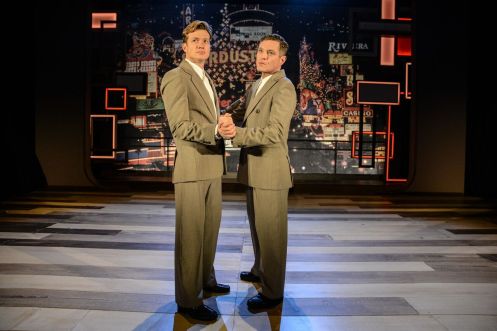
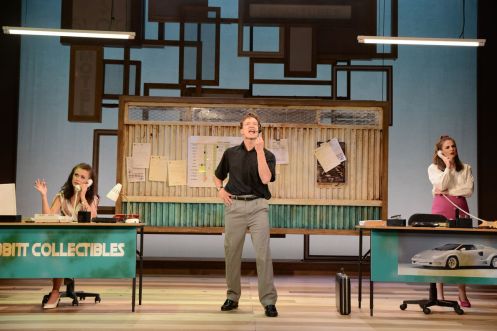
Los Angeles in the early 1980’s, Charlie Babbitt is trying to import four classic Lamborghinis, but they have been impounded at the docks, because they do not meet current emissions standards. A problem is that he has bought them with money he doesn’t have, but the egocentric Charlie knows how to bluster and stall. He knows when to wheel and when to deal. If fact, even his own employees, who include his fiancée Susan, think he is an “a**(*)hole”, which indeed might be an accurate character summary, but one that demeans an essential organ.
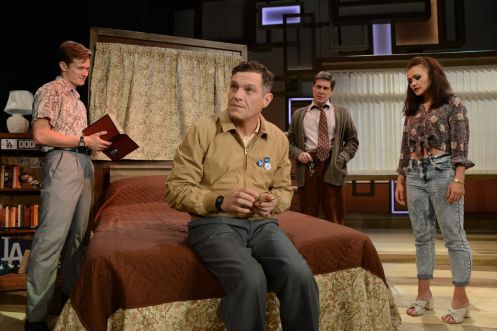
As his creditors close in, he gets the unexpected news that his estranged father has died. He greets his father’s death with cold-hearted distain, but the prospect of an inheritance promises a way out for his present dilemma. However, a meeting in his father’s home near Cincinnati, with a Mr Mooney, a lawyer representing his late father’s estate, shatters that prospect. He has only inherited his father’s rose bushes and his car, a classic 1949 Buick Roadmaster convertible, which are amongst the causes of their estrangement. The bulk of the estate has been put into a confidential trust. The confidentially is no protection against Charlie’s hacking abilities, and he soon has conned his way to the trustee, Dr Bruener, who is principal at a psychiatric nursing home. In confronting Dr Bruener to demand what he sees as his inheritance, he discovers that the main beneficiary is Raymond Babbitt. To his amazement Raymond is his brother, who had been sent to the home when Charlie was little more than a baby.
Charlie decides to abduct Raymond from the nursing home, hoping to gain custody of his brother and get control of the money. Raymond is autistic and obsessively observes strict routines. However, he also has savant syndrome, with a phenomenal memory and a prodigious ability to carry out mental calculations. As they travel back to Los Angeles together in their father’s Buick, Charlie not only learns about their early family lives, but much about himself. The journey, and Raymond, redeem Charlie’s marred personality.
The redeeming nature of the journey is much better served on the stage than on the big screen, where the geographical road trip of some 2,200 miles dominates. Charlie’s personal inner journey is the focus of director Jonathan Boyle’s intense stage version of Rain Man. Designer Morgan Large’s set is simple and versatile, comprising mainly a reconfiguring set of giant empty picture frames, animated by Jack Weir’s delineating lighting design. These are existential symbols of the mental pictures, framed in recall, of the divergent childhoods of the two brothers. When, in Las Vegas, their lives re-converge the frames vanish.
Ed Speleers, a seasoned exponent of both the big and small screen, makes his stage debut as Charlie. In an engaging performance, Speleers portrays the transformation of the abrasively adamant trickster, into a caring and concerned human, as the hard exterior softens and conscience and compassion begin to emerge. He took the audience from loathing his character to admiring him.
The part of Raymond is an enormously difficult role, playing an individual who is simultaneous afflicted with a burden of mental and emotional impediments and blessed with incredible intellectual skills. Mathew Horne pitches his depiction just right between understatement and hyperbole, avoiding the danger of mockery and engendering a warm empathy for his character. His cramped stance and constant tremor spoke of Raymond’s anxiety and nervous energy.
The character of Susan, Charlie’s fiancée serves to highlight both his moral weaknesses and the gradual revelation of his innate humanity. Elizabeth Carter gives a spirited and fluid interpretation of the part, supportive of Charlie’s predicaments, for good or ill, but leaving him in disgust at his initially uncaring treatment of Raymond.
The face of authority, and authority sometimes misjudged, are Dr Brunner, played with great insight by Neil Roberts, and the attorney Mr Mooney and the court-appointed psychiatrist Dr Marston, both played with suitable gravitas by Adam Lilley. Brunner and
Marston had caught up with the brothers in Las Vegas, where Raymond’s calculation skills have netted Charlie (a bankruptcy preventing) $80,000 at the blackjack tables, before being ejected by the casino management simply for being too successful. Brunner delivers an injunction to Charlie to regain custody of Raymond, but it up to the biased Marston to convince the court of the merits either way. Unlike in the film, this staged Rain Man leaves the forward story hanging, a much more interesting (if non-Hollywood) ending.

Of the supporting roles, special mention must be made of Mairi Barclay, who triples as Lucy, the put-upon secretary at Charlie’s nefarious car dealership; as Sally, the gob-smacked waitress who witnesses Raymond’s memory and cognitive prowess; and as the deliciously pneumatic Iris the Hooker, who populates the purlieus of the Vegas casinos.

The eponymous “Rain Man”, a childhood imaginary friend of Charlie’s, was it turns out a false memory, and was in fact Raymond himself. On the subject of mishearing, all-in-all the cast of this staged Rain Man are exceptional, but there is a niggling tendency with some to forget that the stage needs a bigger voice then the screen.
Rain Man is a journey, the actual road trip a metaphor for the huge emotional journey undertaken by the brothers. It considers the (often false) value of money, the important value of compassion, and the strength of family ties. Charlie discovers much about himself and about his past. The early loss of their mother weakened the coherence of their family and their father’s rejection of Raymond revolts Charlie when he discovers that their father’s own name had been transferred between the infant brothers. The father’s over-expectations of his older and “normal” son had in due course led to their permanent rift.
The journey is an adventure that tightly bonds the brothers, and the powerful coda to this play is a simple but moving expression of their brotherly affection. In its touching poignancy, this simple ending moved the gripped, and hitherto silent, audience to an audible gasp!
Mark Aspen
November 2018
Photography by Robert Day
Carrying On and Trying to Keep Calm
For Services Rendered
by W. Somerset Maugham
The Questors at The Judi Dench Playhouse, Ealing, until 10th November
Review by Viola Selby
‘Keep Calm and Carry On’; those famous words were produced by the British government in 1939 in preparation for World War II, only a few years after World War One had shaken the country and caused irreversible changes to the foundations of society. Even after such a massive event, many people went back to their daily lives, trying to salvage some form of normality that could never be the same again. Francis Lloyd’s realistically raw and immersive adaptation of W. Somerset Maugham’s For Services Rendered offers a chance for the audience to travel back in time and peep into one family’s struggles with life after the war.

At the start of the play, the audience members were lulled into a sense of security that this would be a light British afternoon-tea type of story. This was done by Fiona McKeon’s stunning and authentic 1920s set design and warm, inviting lighting designed by the talented Chris Newall. How wrong we all were. Through the exceptional acting of the whole cast, each character’s inner torment comes to light, building up a sense of stifled madness ready to explode. The set, that once made the audience feel relaxed, now acts as part of the claustrophobic vibe of the play, as all events happen within this one room.


Two of the most dramatic events occur due to Eva and the ill-fated Collie Stratton, brilliantly played by Claire McCarthy and Robert Seatter, whose entwining stories result in Eva going mad over Collie’s suicide. Both McCarthy and Seatter excellently use tone and facial expressions to accentuate their characters’ fall into madness and despair in a way that wrenches the heart.
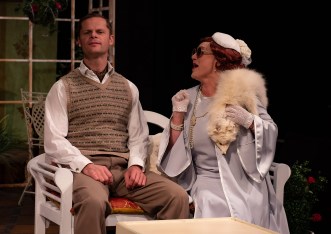 Added on to this, and something that assists in Eva’s fall into madness, is that her brother, Sydney, was gravely injured in the war and has become blind. Blindness can often be overacted in a way that is either comical or insensitive, both of which greatly affect the realism of a play and the audience’s ability to connect with the character.
However, Matthew Benson’s amazing talent effortlessly leaves the audience questioning whether the actor himself is actually blind or not. In addition to this, Eva’s sister, Ethel (Caroline Ash), is married to a drunk whom she soon realises is attempting to seduce her younger sister Lois. This sadly and in a strange way reflects many people’s experience in today’s society and is expertly acted by Claire Wilkinson in a mature and sensitive manner. At the same time, Lois (Rosie Louden), has to fight off the sexual attention of not only her father’s friend Wilfred (Robert Gordon Clark) but also her sister’s husband Howard (John Barron). Both Clark and Barron were absolutely superlative at playing such selfish and slimy characters; whilst Louden’s portrayal highlights a deep understanding of her character’s struggle in a way that gives her character an outstanding level of depth and development. Finally, if the audience thought that the story would somehow end on a happy note, they were sorely mistaken for it is at the end that Mrs Ardsley is told she has months to live, leaving her husband Leonard to face the new world and all of his family’s struggles without her. This may not have been so emotional had Anne Neville and Robin Ingram not worked so well as a married couple facing the new world, post war.


However, this play is not all doom and gloom, as part of the emotional rollercoaster Lloyd has also provided the audience with some comic relief in the form of Gwen Cedar – a well-to-do lady whose outfits (designed by the creative genii Raymond Childe and Nichola Thomas) shine just as much as her personality. Sarah Morrison’s depiction ensures Gwen is both funny but also realistic and relatable, so that audience members can identify with the character as someone they probably know in real life. In addition to this, Anthony Curran has been cleverly cast as Dr Prentice, providing some serious comedy with his straight to the point approach, in a stereotypically ‘doctor’ like way: overall adding to the mad brilliance of this play. Just as in the famous lines of Binyon’s Ode of Remembrance, ‘We will remember them’, I will definitely remember this play!
Viola Selby
November 2018
Photography by Jane Arnold-Forster
More details of the production are on The Questors website.
Forlorn Forbears and Dastardly Deeds
Ruddigore
by W.S. Gilbert and Sir Arthur Sullivan
Hounslow Light Opera Company at Hampton Hill Theatre until 3rd November
Review by Didie Bucknall
It is an ambitious venture to stage any Gilbert and Sullivan operetta at the Hampton Hill Theatre, but in tribute to their late, great and much loved President, Chair and long-standing member Peter King, the Hounslow Light Opera Company decided to put on Peter’s favourite G&S, the less familiar, zany Ruddigore. They gave a delightful and spirited performance to a packed and appreciative audience.

The auditorium lights dimmed, the conductor Isabella Stocchetti raised her baton, there was a drum roll – but where was the orchestra? There is no orchestra pit in the theatre, yet we had the full orchestral gamut, strings, brass, woodwind, timpani – a brilliant virtuoso performance throughout arranged by musical director Lee Dewsnap playing his Yamaha EL-900 electronic organ.

The curtain rises to an excellent backdrop of a harbour scene and the professional bridesmaids appear, bewailing the lack of weddings in the town as they are unable to perform their duties. The only possible candidates are Rose Maybud, Dame Hannah and, the extremely mad, Mad Margaret wildly played by Felicity Morgan who is driven to madness by her love of Sir Despard. Dame Hannah (Clare Henderson Roe), has taken a vow never to marry, as her love, Sir Roderic Murgatroyd, inherited the curse of Ruddigore, and so was doomed to commit a foul crime each day or die in agony. He failed and took the consequences.

Rose is in love with our hero, Robin Oakapple, but according to her trusty guide book of etiquette, she must not make the first move, one which Robin is too bashful to make. The two, played by Johanna-Marie D’Oyly Chambers and Paul Huggins, have a touching duet in which they express their love by pretending that they are asking advice on behalf of lovelorn friends. The scene is enlivened by the shenanigans of Old Adam, a hugely enjoyable comic performance by Edz Barrett.
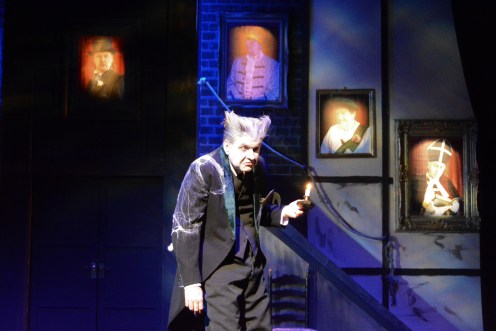
More excitement, a ship has come in and jaunty sailor Dick Dauntless (Tony Cotterell) is in town. He dances a very energetic hornpipe while smoking his pipe and singing – astonishingly – how does he do this without running out of breath? The very professional choreography was devised and arranged by ex-ballerina Karen Munday with the help of star Swan Award winner Fay Ellingham.

Dick promises to help his half-brother Robin to win Rose Maybud’s hand in marriage, but inevitably Dick falls for the girl himself. Robin, who is too nice to admonish him for stealing his intended, broken-heartedly sings a song seemingly praising Dick, but full of back-handed compliments. Nevertheless Rose and Dick are betrothed. The bridesmaids are delighted. The village folk are excited. Dick caps it all by dealing his rival a deadly blow – he announces that Robin is none other than Sir Ruthven Murgatroyd doomed like his forbears to commit fouls deeds or die.

The presumptive holder of that title Sir Despard Murgatroyd, enters, chillingly played by Geoffrey Farrar in evening dress and swirling black crimson-lined cloak. Relieved of the onerous task of his Baronial duties, he passes the cloak of doom on to poor Robin in his rightful role of Sir Ruthven.
A G&S operetta needs a large cast of singers to swell the sound and with a small stage this is not possible. Ingeniously, extra members, ex-members, friends and members of other groups were gathered together forming extra backup from the galleries on either side of the auditorium, the elegant bachelors in natty attire even sporting bowler hats on occasion.
Scene Two opens on the interior of the Ruddigore castle hung with portraits of former Baronets of Ruddigore. A great set – congratulations to Wesley Henderson Roe who was also the excellent performance director.
Robin, aka Sir Ruthven has spectacularly failed to commit any worthwhile crimes. His forbears emerge from their portraits to show him the horrific consequences of his failure.
Dick and Rose arrive with their wedding party to get poor Robin’s blessing, Dick’s pipe has been getting longer throughout the performance as has the feather duster of Old Adam whose stair climbing performance was a sight to see. Old Adam is sent by Robin to capture a lady from the village – “any lady”. He comes back with Dame Hannah. Steve Taylor who sang and acted well as Sir Roderic, the last in line to the title, recognises her to be his little nannickins!
Robin has come up with a way of breaking the curse: all will not be lost. As it is a crime to commit suicide none of the ancestors should have died and the curse is lifted. Sir Roderic and Dame Hannah can be together at last.
Rose drops her sailor lover and marries Robin and everyone lives happily ever after….or do they? Mad Margaret now respectably married to Sir Despard entwines herself around her husband but shows no inward sign of sanity….does the curse of Ruddigore live on?
As with all performances of G&S, professional and amateur alike, the difficulty for the chorus is to get the amusing words of the libretto clearly across to the audience. That said, HLOC did Peter King’s memory proud. The huge number of songs, the quality of the acting, singing and dancing, the lighting, sound and wardrobe were all a great tribute to him.
Didie Bucknall
November 2018
Photography by John Malone
Glitzy Glitterati Rediscovers True Love
High Society
by Cole Porter
BROS Theatre Company at Richmond Theatre until 3rd November
Review by Mark Aspen
True love: well, it “never did run smooth” says Shakespeare’s Lysander. True love: does wealth get in its way? True love: Will it win out in the end?
True love so much a theme in Cole Porter’s musical comedy High Society that the central musical number is called True Love. And this is just what glamorous American socialite Tracy Samantha Lord has lost and is trying to find, as it seems are most of her household, her family and friends.

The glamour and glitz of High Society is BROS’s commemorative show to celebrate the company’s 110th year. For almost half its lifetime, Richmond Theatre has been BROS’s prime venue and is a suitably opulent choice for its special blockbuster musical, the 1998 version of High Society, a concatenation of earlier plays and musical versions, and of two films, variously starring Katherine Hepburn and Grace Kelly as Tracy.
Tracy is the jewel of the Long Island glitterati. It is the summer of 1938 and her household, family and friends are making last minute preparations for her extravagant wedding to successful businessman George Kittredge, who just happens to own a few gold mines.
Then who should swan along, sailing his yacht along the estuary up to the Lord estate, but Tracy’s ex-husband, C.K. Dexter Haven. The name of the yacht … True Love!
The plot thickens when gossip columnists, Mike Macaulay Connor and Liz Imbrie arrive pretending to be guests, whilst covering the wedding for the tabloid Spy. It seems that Dexter has discovered that Spy is planning an exposé of Tracy’s father Seth, who is having an affair with a dancer. It is Dexter’s idea to invite them and cover up the situation by passing off the absent-minded Uncle Willie as the absent husband Seth.

Confusion abounds, lubricated by copious amounts of alcohol at the wedding eve party. At the Lord mansion, the oiling of the party is run smoothly by the coordinated team of the domestic staff, and BROS’s skilful ensemble of an octet of Singing Servants moves the show along like clockwork, setting the scene and commenting on the action like a glitzy Greek chorus.
Well, Did You Evah! … “What a swell party this is”, they all sing as romantic relationships are discovered, rediscovered or uncovered; assignations engineered or thwarted; and bonds broken or created by True Love.
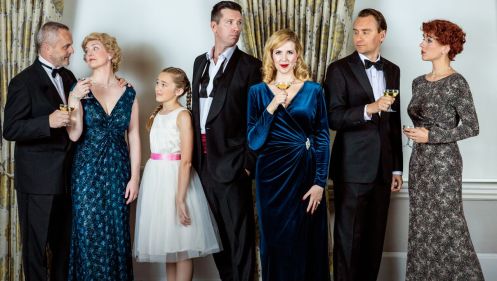
In this swirling melting pot of passions, the unlikely catalyst to the chemistry is Tracy’s precocious pre-pubescent sister, Dinah. “Out of the mouths of babes”, but then again Dinah is perceptive well beyond her years. Thirteen year-old Alice Bonney shines as Dinah. Confident, vibrant and fluent, she puts across the witty, incisive nature of the prematurely worldly-wise shrew. Dinah’s duet with Tracy, the “so, so Fren-ch” sororal spoof, I Love Paris is great fun.
High Society is largely Tracy’s story, and the leading role of Tracy Lord is a gift for the award-winning Heather Stockwell, whose vivacious performance lights up the part. Tracy’s path is one of self-discovery, and Stockwell makes that emotional journey lightly, without losing the sense of joie de vivre that is the essence of Tracy. Although we are treated to a number of group songs featuring Tracy, she has only one real solo, It’s All Right With Me, beautifully executed by Stockwell, but the star centrepiece is True Love, a duet with Dexter, sung with depth, precision and warmth by both singers. Upstage of the duet, we learn, by way of a dance vignette, that Dexter and Tracy were childhood sweethearts. The child dancers, Evan Huntley-Robertson and Lilah Rose Jones are charming, but overextending this conceit to a pair of less fluid adult dancers does distract somewhat from the key moment of the whole story, when we realise that Dexter really is the one for Tracy.
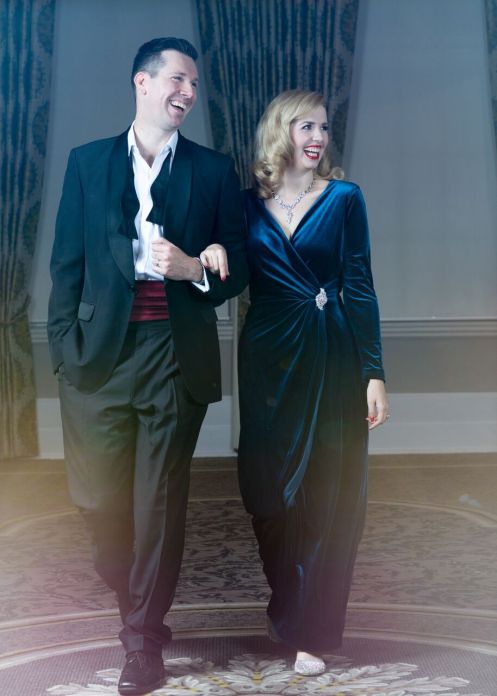
So poor old fiancé George is left high and dry. Even his panegyrical solo to Tracy sounds like a plea, I Worship You , which is sung with vigour by Jason Thomas. He is compelling as George and plays the role as a basically well-intentioned man, but one whose high principles are at odds with the louche Lord milieu.
Nick Moorhead portrays Dexter as a genial and dynamic man, with a ready wit, but one determined to regain his ex-wife. We don’t know why they parted, but we see that both have in truth regretted it. Dexter is not above manipulating everyone’s feelings though, and even gives a model to of his yacht True Love to Tracy as a pre-nuptial present. It has happy memories of their being together, and later, when more sure of his ground, he offers her the real yacht. Moorhead’s singing is rich and strong, and is given full rein in Just One of Those Things, Dexter’s nostalgic reminiscence “that our love affair was too hot not to cool down”.
The journalists, Mike and Liz appear at the start of the evening as a pair of sub-Guardian lefties, but the socialite lifestyle very rapidly seduces them. Mike is soon transformed via a champagne (Veuve Clicquot to be precise) socialist into a full blown sybaritic socialite. The prime mover of his transformation? … Tracy’s charms of course; although at the end he does redeem himself as a gentleman, by not taking bedroom advantage of his hostess when the opportunity (literally) falls his way. You’re Sensational, sings Mike, a solo that showcases the rich baritone of Jacob Botha, who nicely portrays the earnest yet conflicted Mike. Conflicted in a different way, by an unrequited yearning for Mike, is Liz, whom he initially regards as his photographer colleague and partner in dirt-dishing. But Mike cannot see a sassy Liz whose dishes are more wholesome fare. Bex Wood, in this part, shows all the frustrations of Liz’s predicament, beautifully expressed in her solo He’s a Right Guy, delivered in a soft but sturdy mezzo.
The hapless Liz does however, catch the eye of another man, who pursues her relentlessly, the slightly eccentric and highly-forgetful Uncle Willie, who asserts I’m Getting Myself Ready for You, a great comic duet with Liz. However, later having become, at his own admission, increasingly sozzled, Uncle Willie believes that you should Say It with Gin and that’s how he says it. BROS stalwart Carl Smith again proves himself a great comic actor and singer as the harmless pre-senile Uncle Willie.
Staying with the older generation to complete the circle, we find that Tracy’s parents Margaret and Seth also rediscover that their love affair was too hot not to cool down, and so their marriage is rescued. Rachel Williams sparkles as Margaret Lord, as the very much on-the-ball mother, and leading the quartet in Throwing a Ball Tonight reveals a strong and rich singing voice. Martin Wilcox, one of BROS’s longer standing members who knows the Richmond stage well, is very much relaxed in the role of Seth Lord, inhabiting the suave character of man who knows who is boss.
Since much of the musical is taken up with the wedding eve party, there is even more dancing in High Society than in many musicals. With sometimes two dozen dancers on the stage, choreographer Jen Moorhead has her work cut out, and as with all club companies her dancers vary in their experience. Her attention to detail is obvious and dance highlights include her high-kicking girls from the Featured Dancers and the big ensemble piece that opens the second act and merges into Let’s Misbehave (which speaks for itself!). This incorporates a range of Latin styles, including Charleston, Rhumba, and (perhaps anachronistically) Salsa.
Dancing is helped by a fairly open stage, largely a backpiece of the façade of the Lord mansion. Some scenery is flown in, but the trucked trellises for the garden are rather repetitively used. Ed Pagett’s lighting design adds much atmosphere. Suzy Deal’s costume design is colourful, nicely in period and wonderfully coordinated. (One very small niggle though is why do the men often appear with ties undone? Everyone else looking so smart, it really jars. It seems to have started with a tic of Frank Sinatra’s, but now is a cliché. Maybe Sinatra didn’t know how to tie a bow.)
As often, the unsung heroes of a musical are to be found in the pit, and an excellent ten-piece band under musical director Janet Simpson, keep a good pace to the evening. The versatility of the band pays off in tweaking the nuances in the score, and a well-balanced sound is enthusiastically delivered.
As BROS’s glittering anniversary offering, director Deb McDowell brings a slickly oiled production to the well-oiled party that is High Society, ensuring that true love really can run smooth.
Mark Aspen
October 2018
Photography by Paul Nicholas Dyke
Dark Fantasies and Morbid Fascination
Lucia di Lammermoor
by Gaetano Donizetti, libretto by Salvadore Cammarano, based on Sir Walter Scott
English National Opera, London Coliseum until 5th December
Review by Suzanne Frost
Men, nothing but men. Creeping around, peering through windows, observing the girl’s sleep, trespassing into her bedroom. Lucia, the child-bride, the commodity, the goods to be flock to the highest bidder, grieving her recently lost mother and accompanied by a mostly mute governess figure seems to be often the only female in her carefully constrained world.
Donizetti’s Lucia di Lammermoor, one of the most popular works in the opera canon, is a story about family, duty, honour and gender and as such obviously an instrumental item in ENO’s interesting and important season exploring patriarchy. David Alden’s production is a revival, first seen at ENO in 2008 and sent around the world and back three times, but when viewed through the lens of male power structures, Lucia quite evidently slots in nicely this season.
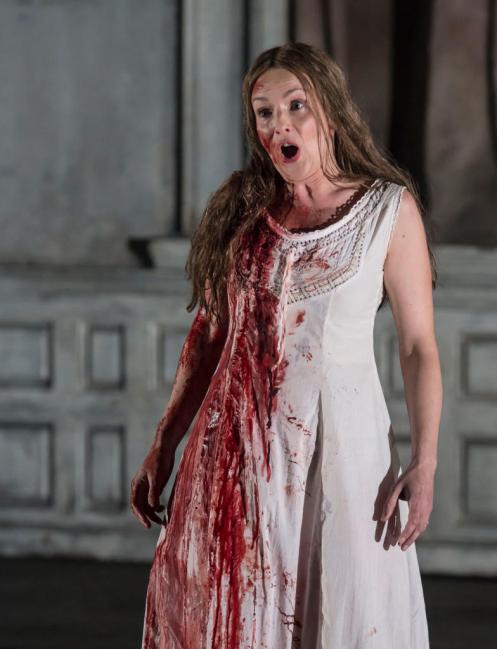
The Bride of Lammermoor is classic gothic horror story penned by nineteenth century novelist Sir Walter Scott inspired by a real-life tabloid scandal of a Scottish noble woman, Lucy Ashton, forced into a politically motivated marriage, stabbing her bridegroom during their wedding night. These kind of spooky “penny-dreadfuls” became immensely popular in the nineteenth century, so Alden’s choice to set the story in a sort of nondescript Victorian age is genius, an era ripe with oppressed sexuality, dark fantasies and a morbid fascination with (mostly female) insanity. While the demanding, technically virtuoso bel canto part of Lucia is a role written to showcase a real prima donna, Alden and the extremely fragile and slight soprano Sarah Tynan emphasis her innocence and vulnerability. This Lucia is already leered over and sized up for her sexual worth, while still clutching her doll and skipping around. There is something “off” about her, right from the start though, her playfulness and childishness already closer to insanity than innocence, her isolation and emotional distance maybe a symptom of previous trauma. Alden hints at abuse and paedophilia with her despotic brother Enrico tying his sister to her bed using her skipping rope to grope her childlike body and the constant lurking and climbing through windows to enter the space feels intrusive at every stage. Following the libretto though, Enrico has very little actual feelings for his sister and sees her merely as a tool, a means to secure a fortune through a prosperous marriage. God forbid, he would figure out how to make money himself when he has a woman at his disposal to sell. The evil Enrico is sung by Lester Lynch in a powerful baritone accompanied with lots of eye rolling cartoon villain ham acting. Lucia’s passion for Enrico’s arch enemy, the noble but poor Edgardo, seems more like a longing for safeguarding than an actual crush – the man saved her once from danger, that might be enough for such a troubled girl to trigger visions of escaping to a more trustworthy environment. Edgardo’s “love” for Lucia also seems more like kind affection – nobody in their right mind should physically desire this child. Nor should anyone approve her selling off like cattle at the market and under such visible distress. Alden uses effective theatrical tricks to expose society’s complicity in Lucia’s downfall, men holding up brooding portraits of stern looking ancestors to enforce duty and tradition while the women strongly support those structures laying their hands firmly on the shoulders of their partners. Couples toasting the happy occasion of a wedding party, ignoring Lucia sprawled on the dining table like a dead piece of meat. And later for the popular mad scene, as Lucia sings herself to death, society sits motionless, like spectators at the theatre quietly motioning applause. While the theatre metaphor works in the moment, the suffering woman displayed on stage for entertainment, those moments of heightened performativity are scattered few and far in between and feel a bit out of the blue, not coherent with the otherwise largely traditionally played action.
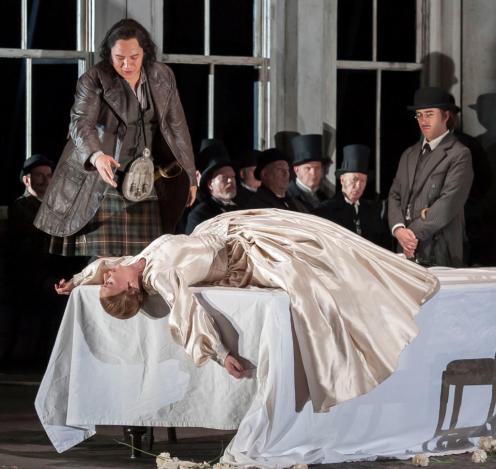
The stripped down set by Charles Edwards is instrumental in creating a miserable, barren atmosphere of hopelessness, high bare walls and barred up windows evoking the sense of claustrophobia that you might feel in an institution, while effective details such as crumbling wallpaper and a broken sofa bolstered up on books serve as reminders of the financial difficulties the run-down family is faced with. Brigitte Reiffenstuhl’s costume are a sea of monochrome grey, nicely singling out the blood soaked, disturbed bride as a colourful focal point – although I didn’t like the awkwardness of Lucia’s gigantic restricting petticoats, but maybe that is the whole point. Bathed mostly in darkness by lighting designer Adam Silverman, the scenes often evoke still life paintings by old masters and the mostly very static direction of the ensemble helps with this but not necessarily with bringing the story to life. As the single most action-laden scene, the wedding party contrasts effectively with the murder and doom bringing celebration to a sudden end.
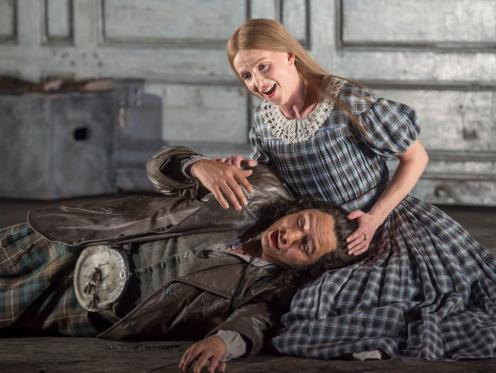
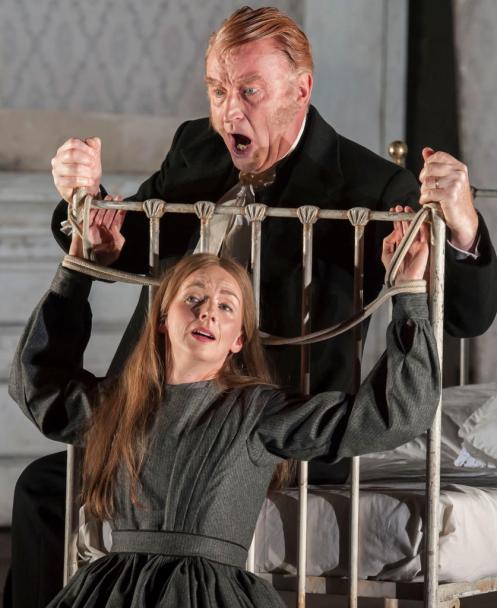
As a regal Calvinistic chaplain and a fur clad pimp respectively, Raimondo (Clive Bailey) and suitor Arturo (Michael Colvin) serve as the other two male stereotypes keeping women in check with their mutually out-cancelling expectations of virtue on one hand and lose morals on the other.
My main problem, and I am ever so sorry for even daring to say this, is with Donizetti. While his music is heartbreakingly beautiful, his lyrical melodies as pretty as can be, it is rarely tragic, never gothic or spooky. His shtick about never ending finales, the sweet florid embellishments and ornamentations turn singers into trilling little birds not dramatic heroes. Add to that the clunky English translation by Amanda Holden and you expose yourself to unintentional humour that more than once triggered grown men to giggle in the stalls. As grim as the story on stage is, as much as Alden amps the creep-factor and Tynan gives us good victim – I felt very little. Tynan is a phenomenal singer, her voice as clear as the glass harmonica Donizetti used for its spooky sound (an instrument itself doused in ghost stories of its apparently deranging effect on players) yet I was never spooked – rather left with a feeling of numb sadness. Lucia di Lammermoor is an example par excellence of a woman used as punch bag and playball between men and I suppose this facet of patriarchy needs to be included this season – but it probably makes for the most uncomfortable viewing.
Suzanne Frost
October 2018
Photography by John Snelling
Victory Winged With Peace
The Centenary Walk
Arts Richmond Poetry Hub at East Twickenham, 21st October
Review by Poppy Rose Jervis
On a Sunday morning a group of people set out to make a very special journey. It is one of those gorgeous autumnal days of the “Season of mists and mellow fruitfulness…” variety – the sort that remind you simultaneously of sparkling frost with log fires, and a warm glowing sun.
Similarly conflicted, as anticipation sought to harmonise with respect and empathic sadness on a fresh, bright day, we walk along with the interwoven emotions and strands of this journey entwining to commemorate and honour all those in or affected by The First World War, remind ourselves of those who lost their lives and those who lost loved ones, celebrate poetry and poets old and new but through an artistry born of tragedy, and re-awaken an awareness in our rich local heritage and beautiful surroundings. Memorials and poetry along the way mingle the poignant past with the here and now and powerfully transporting us in our journey alongside those who had made their own journey at the time.

Expertly guided by sisters, Helen Baker and Carol Wain of the Richmond in Europe Association, we learn of the Pelabon Munitions Works site and the East Twickenham Belgium community, discover little known facts at each stopping place, are fed with nuggets of interest, enlightened and fortified with local information and history, and sustained with bitter-sweet poetry. On a day that saw thousands attend the FiLiA Conference, a pause by the factory site (now a development of luxury flats) offered not just an insight into the changing face of East Twickenham and its landscape, and a time to reflect on the past, but served to remind how the dedication and strength of women workers during the war, against all adversity and in the face of untold misery, has affected women’s liberation today … “We are the daughters of the women who came before us …”
We think of The Great War poets, some writing bitterly and graphically of the horrific reality, despairing of God and country, while others exulted, glorifying patriotism and honour. Some died. Some survived. All left a legacy and the First World War is forever closely associated with the literature and poetry of its time. This was a time to listen, a time to read, and a time to reflect with a sensitive selection of work.

We walk on in the autumn sun through residential streets keeping their past a secret and not showing any traces or giving away any clues of what had gone on before, until, that is, we get to the leafy embankment where the public monument, tucked away and carved from Belgian Blue stone speaks eloquently of the 6,000 Belgian refugees and injured soldiers who made up “The Belgian Village on the Thames”. The words, “Memories flow through me like a boat flows down the river”, wrapping the memorial in English, French and Flemish (the languages of those immigrant Belgians) are read out to us by an eleven-year-old girl on the walk. The inscription was written by Issy Holton, a then eight-year-old pupil attending Orleans Primary School, the school attended by the Twickenham Belgian children during the war years.
Here, we listen to Carol Wain read her own moving poem about the Belgian community returning home to Belgium at the end of WW1 and to Gerald Baker reading a poem written by his wife, Helen Baker, creating a visual image of the red, white, and black tulips symbolic of warfare, peace, and hatred.
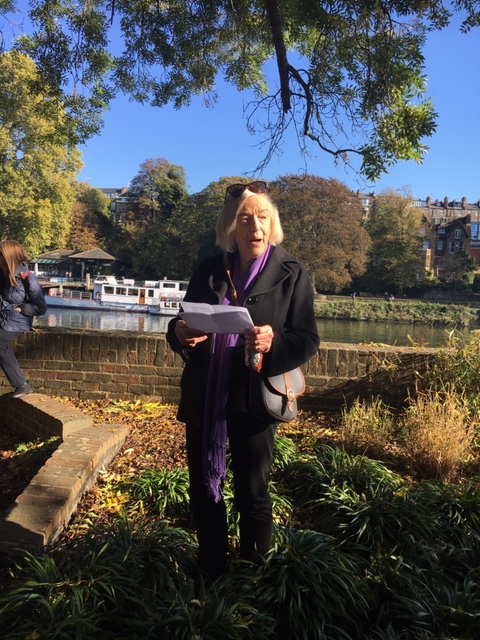 An autumn morning, glistening in glorious sunshine, we continue on our way and in the gentle breeze. Standing on the mound overlooking the Poppy Factory, Ian Lee-Dolphin reads In Flanders Fields by Major John McCrae, and Heather Montford, her own beautiful poem, Painting for the Botanist, vividly and intricately describing the poppy and remembering what it stands for.
Chatting softly to each other, we walk on again, along the river and under the bridge and, as celebrations for Trafalgar Day are being held on the Warship HMS Victory in anniversary and honour of the 1805 battle that confirmed the Britain as ruler of the waves, we find ourselves on this The Centenary Walk of 2018, alongside the River Thames and its gently lapping waves, a quiet and thoughtful group gathered around the Richmond War Memorial with a sailor on the north side and a soldier on the south, coats of arms to the east and west and its engraved wall of names, and we listen in silence to the last three poems of our journey: Drummer Hodge by Thomas Hardy, read by Ian Lee-Dolphin; I Stood by the Dead by Siegfried Sassoon, read by Graham Harmes; and The Man He Killed by Thomas Hardy, read by Anne Warrington. We remember once again, in the approach to Armistice Day that glorious victories are also great tragedies.
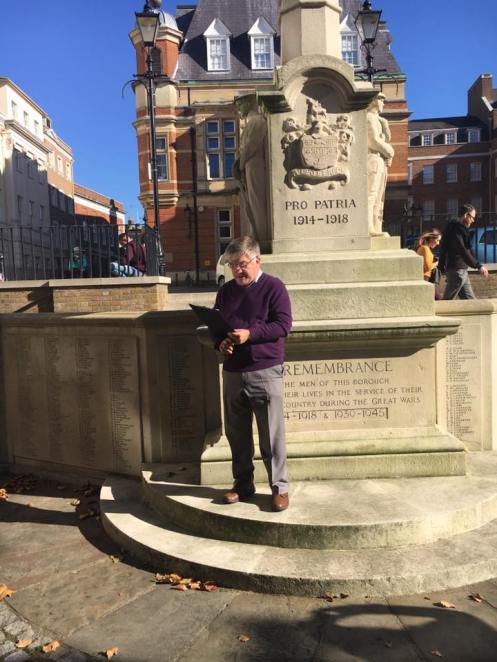
Thoroughly researched, perfectly planned and expertly organised, this event sang out with the success it deserved. All too often, caught up in the everyday bustle and turmoil of life, we are guilty of forgetting to remember. On Sunday 21st October we were given permission to pause our busy lives, we were given time to remember generations past and to think of generations new.
The sun was shining, the birds were singing and down by the river, the strains of a guitar could be heard. Of course, one hesitates to say, that an event commemorating such suffering and sadness is enjoyable, but what an opportunity to pay respects, to recognise and keep the bravery alive, to celebrate our culture and heritage, and remind ourselves of what’s around us through the artistry of poetry.
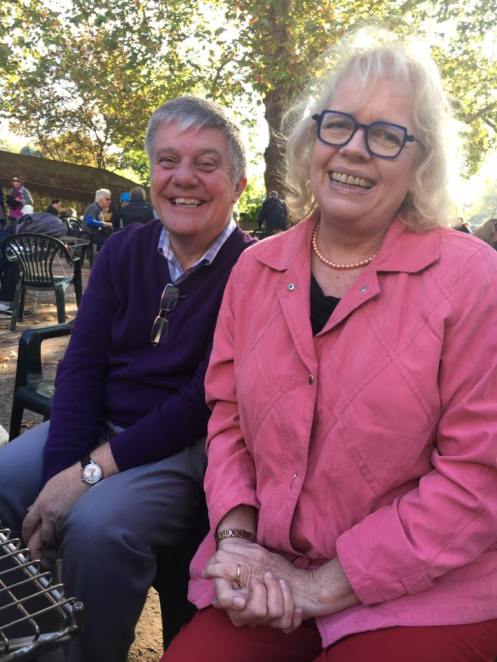
One couldn’t help feeling, as we stood above the river and under a canopy of leaves, and with the sun shining through, that we had been at one, sharing a wonderful celebration.
Poppy Rose Jervis
October 2018
Photography by Heather Moulson and Graham Harmes
Venice from Rome: A Pound of Flesh with All the Trimmings
The Merchant of Venice
by William Shakespeare
Bedouin Shakespeare Company at The Duke of York’s Theatre until 22nd October
Review by Denis Valentine
The Bedouin Shakespeare Company fresh from a successful run at the Globe in Rome, has brought its current production of The Merchant of Venice to the Duke of York’s Theatre, marking its West End debut.
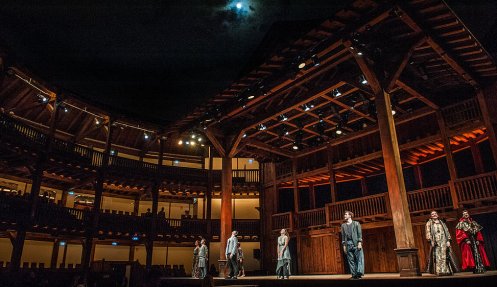
The type and style of the production is set immediately in the opening moments, with upbeat music accompanying a modern dress and setting. Anyone familiar with the company’s previous works and shows under director Chris Pickles will immediately see before a line is even spoken that the recognisable elements of fun and playfulness are all there.
 From the cast, special mention must go to Clare Bloomer who offers a dynamic performance as Shylock, gaining sympathy or aversion towards the character at all the right moments and having the ability to switch mid-scene between the two. Her “Am I not the same” monologue is allowed to reverberate hauntingly around the theatre, as it poses very relevant questions to modern day issues. It is quite poignant, in a production that often uses music and other accompaniments in its scenes, that in this moment Bloomer is given a silent stage in which to work and weave a very telling piece


Janna Fox and Eleanor Russo play their scenes as Portia and Nerissa brilliantly, offering a steady straightness to proceedings which allow the often more comedic elements around them to work to full effect.
 Michael Watson-Gray is often hilarious, as he plays an array of characters, with special mention going to his Prince of Aragon and a scene with Russo (who also offers a wonderful turn as Old Gobba in perfect Italian) as Launcelot Gobbo. The only unfortunate symptom of Watson-Gray having to multi-role as so many characters is there are certain moments in the show where it seems, through no fault of his own, like the a character showcase arising out of numbers necessity rather than being fluid with the production.
The BSC often implements a lot of different elements in its shows and Director Pickles takes full advantage of his multi-talented cast. There are musical numbers, clowning, commedia-dell-arte, physical comedy and moments of modern day ad-libs to the text, all expertly woven in and performed.


All the actors work well off of each other and are given their individual moments to shine. Camilla Simson, Kiki Darlowe, Azaan Symes, George Caporn and Edward Andrews all prove themselves to be very capable Shakespearian players with great commands of the text and the aforementioned wide variety of theatrical elements that BSC productions offer.
The only real stumbling block with the production is that at times scenes can feel dragged out for the sake of adding humour and some restraint with this element would have allowed the more genuine moments to shine through. Although an oft-used cliché ‘less is more’ would be a term to possibly apply here.
Overall the show is an enjoyable piece of Shakespearian theatre with moments that make it a unique production, but with a lot of care and respect given to the play’s classical nature and intention.
The BSC under Artistic Director Edward Andrews continues to expand and is an exciting, up-and-coming Shakespeare company with a growing amount of shows here, in Europe and the UAE.


 Mark Aspen