
A Toy Guitar
20th Century Boy
by John Maher
Greatbrit Productions at The Rose Theatre, Kingston until 6th May, then on tour until 30th June
A review by Matthew Grierson
There’s about an hour’s delay to 20th Century Boy going up this evening, which is put down to technical difficulties with the projector, so this means it opens with the late Marc Bolan in more ways than one. The conceit is that the T.Rex frontman’s life is flashing before his eyes after his fatal car crash on Barnes Common … and the show is certainly pretty flashy.

In the role of Marc Bolan, né Feld, George Maguire is a cheeky, endearing figure, perhaps more blokey than the androgynous glam rocker, but a charismatic enough performer to carry the show. His Bolan is enthusiastic as much as egotistical, amiable as much as ambitious. If his story is sometimes self-serving it’s because it’s from his point of view, and it’s the story he’s telling to himself to enable his success. So this is not only a greatest hits musical, it’s also a greatest hits version of the life, like the snapshots taken by Bolan Senior of his son posing with a toy guitar at the beginning of the show. A boy’s-own dream of growing up to become a gender-bending rock ’n’ roll pixie.

Another early scene exemplifies this tendency: in his mother’s kitchen, a pre-bouffant Bolan regales his mother Phyllis (Amy Rhiannon Worth, giving excellent value) with his adventures on tour, reeling off his band’s exploits at an increasingly improbable speed. This is not simply getting around the need to show the band themselves onstage – the small but perfectly formed ensemble already have enough costume changes as it is – it also dramatises Bolan’s irrepressible desire to tell stories about himself, building these up into the myth he then inhabits. As such, 20th Century Boy is not so much a biopic on the stage as it is sketches between the songs on a 70s TV show like Tiswas, where the repeated references to speeding cars and other in-jokes would have been delivered with a campy look to camera.

This set-up means the narrative is both as identifiable and as slight as Bolan’s boas – one of which appropriately starts shedding feathers when he is at his most dissolute – making for as loose, and indeed louche, a tragedy as you might imagine. Feld becomes Bolan and swiftly realises all his adolescent ambitions in Act I, marrying June Child (Sarah Moss, providing a stable, human counterpoint to Bolan’s fantasies), before embarking on a world tour with the band. In Act II, first the world then his producer, bandmates and wife weary of him, while other performers, notably David Bowie, command more of the public attention. He is rescued from his booze ’n’ drugs hell by the love of Gloria Jones (Ellena Vincent, with a wig that matches Maguire’s and a voice that outdoes his), who announces she is pregnant with his child. All is suddenly sunshine and smiles again until the fateful drive in the Mini.
Moving at a necessarily fatal speed, the storytelling tends to depend on overly expository dialogue, which grated with me at first – “Oh look, it’s Helen Shapiro!” “Hi there, I’m Tony Visconti.” But once I got used it, its corniness felt of a piece with Bolan’s own mischievous enthusiasm. More effective is when these transitions are enacted by the staging: a scene beginning in the lounge of Bolan’s prospective manager ends in the recording studio, while Bolan’s first date with June jumps straight from Tube to bedroom, with the sheets then whipped away to reveal them glad in their wedding gear. The story has been deftly abbreviated in much the same way as the band’s own name was.
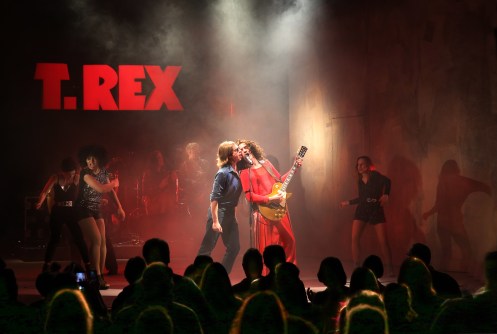
The set is constantly in motion around the performers, always part of the dance. The bare walls are where, I presume, the missing video would have been projected, but given the colour and vibrancy of the cast I can’t see how much this imagery would have added. Even the scene changes are executed pretty swiftly, because the emphasis is, after all, on getting to the next song. Like the sets, each number is made effectively into part of the action, dramatising emotional beats or a particular gig or studio session from Bolan’s career. This culminates in the first act with the set-piece recording of “Ride a White Swan”, where the song is gradually assembled by producer Visconti (endearingly portrayed by Derek Hagen). As the riff emerges, there is a frisson of excitement in the audience: T. Rex have arrived! In the second act, the performance of the show’s title song is then intercut with interviews where Bolan is pressed on whether he is a sell-out, Maguire switching effortlessly between music and dialogue, and subsequently, in a broken mirror image of the “Swan” session, the drunken singer fires Visconti and his band.
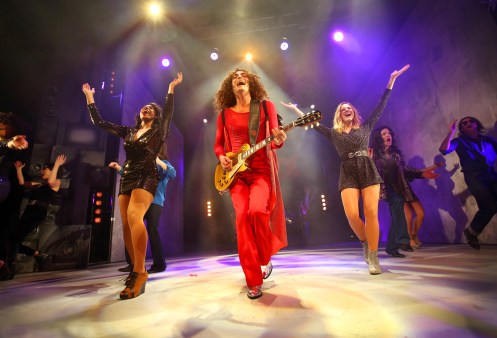
Despite this tragic arc, the production remains very up-tempo, very fun, because that is what Bolan’s music was. Not for him the languid chameleonics of Ziggy Stardust or the Thin White Duke; just keep the hits rolling. So even though it’s clear that Bolan has wronged his mother and June by taking up with Gloria, the love of each woman is given equal weight in a number they sing from opposite corners of the stage, representing opposite sides of the world. I wonder whether the production lets the actual Bolan off the hook by making his stage portrayal so sympathetic. Then again, this doesn’t feel like the place for real-life concerns.

One gripe I do have, and again it’s probably more of a gripe with the form of the greatest hits musical than this show particularly, is that silence could be used to more telling effect than it is here. When Bolan lies wrecked after the departure of June, his wife launches us into song again, and after his death there is likewise no respite but instead an improbably rousing funeral song. With the sound of T. Rex being so glam and growly, we might be more affected by the poignant moments if they were allowed to be poignant. That said, as Bolan and Gloria leave on their final journey together the opening chords of the title song play in, to excellent effect, as portents of doom.
The darkness never remains dark for all that long in 20th Century Boy, though, and even as Bolan leaves the stage he is a dandy in the underworld, walking away through a door into spotlight and dry ice. But a voiceover reassures us that it doesn’t end this way: the energetic cast and redoubtable musicians launch into a medley of the hits, summoning the audience on to their feet to join in the dancing (yes, even yours truly).
It’s a pity that the late start means some are already heading for the exits – don’t speed home, now.
Matthew Grierson
May 2018
Photography by Judy Totton
The Pursuit of Fair Play
The Winslow Boy
by Terence Rattigan
Chichester Festival Theatre Productions at Richmond Theatre until 12th May, then tour continues until 19th May
A review by Eleanor Marsh
The Winslow Boy is that most English of English plays. Or is it? On the surface it is the story of Ronnie Winslow, the fourteen-year-old naval cadet accused of stealing a postal order and subsequently becoming the centre of a media circus as his trial becomes more and more high profile. And what could be more English than the pursuit of fair play. “Let Right Be Done” is the rallying cry to arms.
Rattigan was fascinated by famous criminal trials and The Winslow Boy is based on the true-life story of George Archer-Shee, who was accused of the same crime, also represented by arguably the most prominent barrister of the day and made the headlines. In lesser hands this would be a pedestrian retelling of a familiar story. Rattigan’s script, however breathes life into the plot with the introduction of three-dimensional characters. They are aided by some excellent one-liners and the use of sub-plots within the Winslow family dynamic to illustrate both the social conventions of the time and the impact of the trial on a wider circle than just Ronnie and his father, who is the main protagonist in terms of pursuing the case. It is not an accident that over fifty years since it was first produced The Winslow Boy is still attracting large, diverse audiences of theatre-goers. The dialogue and characterisation is strong and the comic one-liners a gift for any actor. This is good entertainment that makes one think.
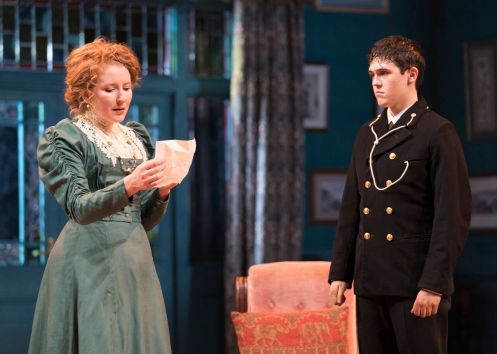
Rachel Kavanaugh’s production gallops apace at a furious speed. In the main this is a good thing. This is not a short play and in these times of shortened attention span it is wise to keep it moving. However, the initial dialogue between Arthur Winslow (Aden Gillett) and the maid Violet (Soo Drouet) went at machine gun delivery and although it was not exactly unintelligible it was difficult for even this seasoned theatre-goer to register all that was being said. It was the middle of the first act before we got to a comfortable slow canter, which was pitch perfect.

The by-product of the moving the dialogue so quickly in the exposition phase of any play is that the scene is not clearly set in the minds of the audience – we are too busy playing catch up with what we have been told. And in the case of this particular play it makes a big difference. The entire premise of this play is not duty or family honour. It is quite simply about a father’s love for his son. Gillett gives a sensitive performance, Misha Butler as Ronnie is excellent throughout the play, and they do have a certain chemistry on stage. BUT – the true affection they have for each other (and that Winslow has for all his children) only comes across at the play’s later stages; the all-important scene that sets up the whole plot is lacking. Because of the speed with which we get there it is all too easy to accept the face value of an Edwardian father wanting to protect the family name and reputation at any cost. At the point I felt I should have tears in my eyes I found myself pondering how they’d get themselves out of this rather major legal pickle.
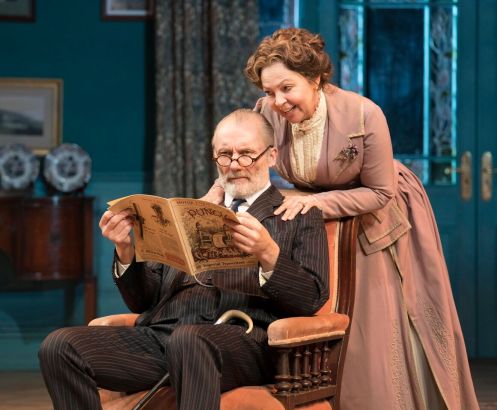
The entire play takes place over two years in the same middle class South London drawing room. Top marks to Michael Taylor for detailed, accurate and pleasant on the eye set and costumes. The subtle changes in season and Winslow family fortunes are neatly dealt with by Taylor and lighting designer Tim Lutkin. However, from the stalls seats the projection of what I assumed was the High Court was difficult to see and seemed a little superfluous. I must also confess to being confused by the obviously interior doors. In Act 1 we were led to believe they opened onto the hall and dining room respectively. In Act 2 they inexplicably opened out to an exterior street view. This really did not work and I’m sure I must have missed some key dialogue whilst I was pondering the layout of the house.


Ms Kavanaugh has a knack for making period pieces accessible without dumbing them down and here she succeeds magnificently. Her use of music and the choreographed set changes are inspired, and she is not scared of injecting a little 21st century body language and pronunciation into the play to keep it relevant. She also has an excellent cast on board to deliver those wonderful lines. Tessa Peake-Jones is a warm Grace Winslow who does not fall into the trap of the “flighty” mother hen. She has her feet very much on the ground and gets some of the best laughs of the evening, such is her comic timing and delivery. The all-important character of Sir Robert Morton is a nightmare of a role to cast –he must be austere, sympathetic, supercilious and charming all in one. He also needs to be charismatic with understated sex appeal. Timothy Watson is perfectly cast and gives a fascinating performance of a man at the top of his game but with an empty life.
The Winslow Boy is a classic of the 20th Century by one of our most enduring writers and this is an overall excellent production. What happens to Ronnie Winslow? Is he innocent or guilty? I urge you to buy a ticket whilst you still can and find out.
Eleanor Marsh
May 2018
Photography by Alistair Muir
A Hunger for the Theatre?
Animal Appetites
Barry Hill shares a Theatre Thought
My newspaper this morning featured a piece about a farmer who, fed up with complaints from townie neighbours who had moved into an adjacent house, posted the following notice on his gate:
Notice: This property is a farm. Farms have animals. Animals make funny sounds, smell bad and have sex outdoors. Unless you can tolerate the above, don’t buy a property next to a farm.
And I do sympathise with the said farmer having endured, most times I go to the theatre nowadays, the equivalent theatre-going ‘townies’ who don’t seem to appreciate that in buying a ticket to see a show, they might find that they have bought a seat next to someone who actually wants to see, hear and enjoy the play in a reasonably civilised manner.


Would they suffer severe dehydration or starve to death if denied drink and sustenance for a couple of hours? It is a common sight to see theatre goers leaving the bar at the last possible moment and squeezing into their seats (almost always in the middle of a row) clutching a bottle of water (not too bad) or a glass of wine (much worse). We have even seen punters with smelly takeaway treats (inexcusable) and have heard of couples actually coupling (almost impossible, I’d have thought).

So maybe we should display the following sign outside Hampton Hill Theatre:
Notice: This is a theatre where people come to see and hear plays. If you wish to eat, drink or make out with your partner, don’t buy a theatre ticket. Go to a bar, a restaurant or consult an agony aunt or sex therapist who will be able to advise on a better, and more comfortable, position.
Barry Hill
May 2018
This article was first published in the May 2018 edition of Theatre, the magazine of Teddington Theatre Club, and is reprinted with permission
Anarchy Nailed
Accidental Death of an Anarchist
by Dario Fo
Latymer Theatre Company at OSO Arts Centre until 9th May
A review by Eleanor Lewis
The last ‘demo’ I was on (as we say when we’re of a certain age but hoping we might still have half a finger on some sort of pulse), there were a couple of incompetent-looking anarchists. This was four or five years ago and I think they were hoping for trouble but it was all they could do not to stand out like Chanel models in their fetching head-to-toe black outfits amongst a huge crowd of exhausted public sector workers. Latymer Theatre Co, on the other hand, have anarchy nailed and could bring down a government in their lunchtime with only a short pause for a song.
So it was on Wednesday night at the Old Sorting Office, Barnes where Latymer Theatre Company is currently reviving Dario Fo’s Accidental Death of an Anarchist. There is always the possibility with a young company that they will be full of something usually referred to as “boundless energy” which is great in many ways but means the audience comes out shattered and bewildered at the sheer speed with which the whole thing is performed. Not so with LTC’s Accidental Death of an Anarchist. They were indeed full of “boundless energy”, but so well directed were they and so skilled in their performance that Fo’s political farce was a joy to watch, very funny and not at all exhausting.

The play is based on a true event. In 1969, anarchist Guiseppe Pinelli died in police custody following a bomb attack in Milan in which sixteen people died. There was no evidence to suggest that he was in any way responsible for the bomb. Pinelli had been held by the police for three days prior to his death “falling” out of a fourth floor window. When he died there were several police officers in the room and he was found to have had bruises around his neck. The police account of what had happened was full of holes, suggesting an incompetent attempt at cover-up. Italy at the time was unstable and the police were thought to be broadly sympathetic to the fascist right who themselves were thought to be responsible for most of the bombings and attacks carried out then.
Fo turns Pinelli’s death into the most powerful of communicative devices, a political farce of commedia dell’arte slapstick and apparent anarchy of its own but with a piercing message: is the central character, the Maniac, mad or is it the system? If it’s the system, we’re all doomed. Performing this kind of theatre requires skill, discipline and flawless comic timing. LTC ticked all three boxes.
The Maniac is the audience’s friend in this work, she engages their attention as she manipulates the other characters, pushing them to the point of revealing themselves and their guilty secrets whilst at the same time seeming to be the chaos in the room. Hana Jarrah – a charismatic presence on stage – played this role with an authority and a playfulness which made it look much easier than it undoubtedly was. She had plenty of competition though. Elliot Hall, as Inspector Pissani – a confused man torn between his desire to perform stand-up comedy and the need to protect his boss and himself from some unpleasant consequences, whilst being blessed with very limited thinking skills – carried off this difficult role quietly, with great skill and wit. Pissani could have been Gene Hunt’s (Life on Mars) younger, overshadowed brother.
Other characters with arguably more straightforward roles nonetheless produced high quality performances. Sonny Pilgrem played the simple Constable without overdoing it so that he was a valid character rather than a dismissable one – even possibly a victim of the system himself. William Jarvis as Bertozzo was revved up to full stress for almost all his appearances as was Roel Fox, both actors pulling all the comedy available out of the ‘alpha-but-bewildered-male’ characters they played. Maisie Preston was perfectly appropriate as the journalist Miss Feletti, arriving to ask pertinent questions and bring the play to both of its possible conclusions.
Tiny issues are scarcely worth mentioning. James Orr’s lighting was effective and appropriate but the changes a little clunky. The one scene change wasn’t great either but the OSO stage is difficult it must be said. And there was a dodgy door – this being the second unreliable set door I’ve seen at OSO.
This was a hugely enjoyable night’s entertainment performed by very funny, skilled young actors. The rendition of I Get By With a Little Help From my Friends was inspired and hilarious, as was the short, demoralised moan mid-act one about the drudgery of being in a touring company of actors. The whole thing was fast-paced, well-disciplined, well directed and showed off a comprehensive understanding of every element of the material being presented – including the highly entertaining and suitably anarchic programme.
And you can’t get away either from the fact that Accidental Death of an Anarchist is a most pertinent production for the times we live in, as Fo himself said:
“There is no greater equaliser than the stupidity of men – especially when those men have power.”
Highly recommended.
Eleanor Lewis
May 2018
Misadventure or Adventure Averted?
Love from a Stranger
by Frank Vosper, adapted from Philomel Cottage by Agatha Christie
Fiery Angel in association with Royal and Derngate, Northampton, at Richmond Theatre until 5th May than on tour until 21st July
A Review by Mark Aspen
Adventures are dangerous. If you wish for an adventure be careful: it may become more of an adventure that you had wished for. In Agatha Christie’s Love from a Stranger, the sense of danger mounts with an irrepressible inevitability that makes it almost painful to watch. Then comes the typical Agatha Christie twist and misadventure is averted (or is it mis-averted) as Bluebeard meets Scheherazade. To say more would be a spoiler, for tonight was the Richmond opening of Fiery Angel’s national tour, and it has quite a way to go.
The gestation of the stage play Love from a Stranger was almost as convoluted as an Agatha Christie plot. Originally written in 1924 as a short story Philomel Cottage, it emerged ten years later in The Listerdale Mystery. Agatha Christie then rewrote it as a stage play, but it wasn’t until a further rewrite by actor Frank Vosper that it took off as a theatre hit, firstly in the West End in 1936, then on Broadway a year later. Bizarrely, the play’s pre-war life took a Christie-esque final twist, when Frank Vosper was lost at sea from a trans-Atlantic luxury liner, the SS Paris, apparently slipping into the ocean from the balcony of the room of Muriel Oxford, 1936’s Miss Great Britain, where she was having a party. His body was found near Plymouth a few days later.

Agatha Christie, the “Mozart of murder” was obsessed with the idea of the pathological successful liar, and the one of the two main protagonists of Love from a Stranger, Bruce Lovell, is such a subject, a con-man and much, much, worse. (Note how Agatha Christie drops the clues around: Lovell, “love”-all, is Bruce, the one who waits patiently watching the spider’s web being constructed.)
Friends and flatmates Cecily Harrington and Mavis Wilson are moving house. Things are changing and they are renting out Cecily’s Bayswater flat. Tied to a tedious office job, Cecily’s has been unable enjoy the adventurous life that she craves. Now, Cecily has won a half share of a half share of a £50,000 sweepstake prize. Is it too late? she thinks. That afternoon her fiancé, Michael is arriving from the Sudan, where his colonial duties have now finished, ready for their wedding. Cecily is in a tis-was: she has already suggested postponing the wedding, and confides to Mavis that her relationship with Michael is a “tepid romance”. So when a stranger walks into her flat as prospective tenant, a fast talking charmer with an American accent and tales of worldwide and everywhere adventures, she falls, but … but, he is Bruce Lovell.
Royal and Derngate’s set, designed by Mike Britton, creates the right mood. Sepia with gauze flats, it conveys a sense of claustrophobia, in spite of (or maybe because of) the open vista of the skyscape beyond the wide windows, with its promise of adventure. As the opening of Richard Hammarton’s edgy soundscape, the sudden and abrupt start to the play is startling.
Director Lucy Bailey moves Vosper’s mid 1930s setting to 1958, although it is not obvious why (or why such a precise reference date). However, the precise costumes of the period enhanced the characterisations and the mentions of Wimbledon as “cheap to rent” drew laughter from the audience.

The first half of the play is a slow burn. One quite hoped for a shorter fuse, knowing that the Agatha Christie fireworks were to come. However, this did give a good opportunity to meet and develop the characters other than the two principals, and the three characters we see from Cecily’s life in Bayswater are neatly and accurately drawn. Louise Garrard, Cecily’s Aunt Lulu, is played slightly larger than life and with obvious enjoyment by Nicola Sanderson. The wonderfully jolly-hockeysticks Aunt Lulu reminds us (whilst breaking a “priceless” candlestick) that she is one of The Garrards, who always have great taste. She believes that Harrods is the sine qua non for everything from estate agency to afternoon tea … until trumped by an offer to go to Fortnum and Mason’s. Pecking orders are clearly defined for Aunt Lulu. When Michael Lawrence, the fiancé arrives, we see from his bearing that he is an all-round good egg, upright, smart, with neatly parted and Brylcreem-ed moustache and hair. But Justin Avoth’s Michael is far from being a spoof. We see a man (a man of his time) needing to be in control of his emotions. His frustration and disappointment at being jilted (Aunt Lulu’s word) by his fiancée is palpable and, when confronting the “other man” the officer and a gentleman stiff upper lip wins, in spite of clenched fists. Alice Haig’s portrait of Mavis is well defined, the trustworthy and loyal friend, with intelligent insight and finely tuned intuition that all is not as it might seem. Why, I kept thinking, didn’t Michael go with Mavis when he lost Cecily; two generous characters, they so suit each other? Three spot-on characterisations.


Throughout the first half, the French scenes of the play are marked not only by changes in lighting but by a sideways sliding of part or all of the scenery accompanied by an eerie sound effect. Oliver Fenwick’s lighting plot is mood-enhancing and the whole effect is clearly intended to increase tension, which it well serves. Ingenious as it is, it does seem a little unnecessary and pulls out the slow burn even more. It smacks of aiming for the grand effect of opera, which is perhaps a vestige of Bailey’s operatic directing career.
The tempo is upped in the second half. We are now in a remote cottage in the country in West Sussex. Cecily and Lovell’s romance has been the archetypal whirlwind. A quick trip to Kew Gardens and they are they are engaged within hours; a flip around here and there and married in days.


The Agatha Christie genre demands isolation, but the Sussex cottage doesn’t quite fit this bill. It is a seven shillings and sixpence train journey from London, and unannounced visits thence constantly frustrate Lovell’s plans, translucent to us audience but seemingly opaque to (most) of the characters. Around their apparent marital bliss, Agatha Christie scatters lots of clues for us to see Lovell in his true light: Peeping Tom photography, bottles of hydrogen peroxide secretly hidden, parcels of soft porn, an obsession with sensational murder trials, sniffing of underwear, compulsive notebook keeping, a strangely significant silk stole. Then there is the secret “darkroom”, converted from the cellar, into which dark secrets accumulate.


Three characters we now see in Sussex are also accurately drawn. The local GP, Dr Gribble, and the gardener, Hodgson are both observant, a tutored and an untutored viewpoint each. Their characters are brought into perspective by Crispin Redman and Gareth Williams. Molly Logan plays Ethel, the learner housemaid, cheeky, energetic and playful. Ethel has a natural curiosity, especially about the secret dark room, which piques Lovell. “Curiosity killed the cat”, he reminds her. Logan demonstrates how to play a cameo role and get the most from it without pulling the focus, and with delightful subtlety. Again, three spot-on characterisations.
Sam Frenchum tackles the difficult role of Bruce Lovell with assurance, with all the right hints and flicks towards the hidden character, Lovell’s superficial charm and his manipulative manner. The svelte and willowy Helen Bradbury gives a nuanced portrayal of Cecily Harrington, her breath-taking belief in love-at-first-sight, her discovery of the emotional adventure and then the sudden revelation as the rose tinted spectacles are rudely broken. However, together they don’t seem to get the chemistry quite right. I was not convinced that this level-headed gal would be swept off her feet by a stranger with the corny line, “You have happened to me”. Equally, the sinister sub-consciousness of Lovell didn’t really come over.

Love from a Stranger is one of Agatha Christie’s earlier works and as a stage play much of the plot doesn’t really hold together (although we famously suspend disbelief on entering a theatre), but the Agatha Christie magic really comes out in this play in the ending twist. “Go on and then you will see how precious it will be”, says Lovell of the 9pm reminder in his notebook and Cecily’s alarm bells begin to ring. Suffice it to say, that the twist is unexpected.
Earlier Cecily, hearing a nightingale, says that “The nightingale only sings for lovers”. Ovid tells why: as TS Eliot puts it “The change of Philomel, by the barbarous king so rudely forced”. Barbarian or Bluebeard, this is an adventure too far for Cecily. Is Love from a Stranger a misadventure or an adventure averted?
Mark Aspen
May 2018
Photography by Sheila Burnett
A Whirling Maelstrom of Oestrogen
Ravenscroft
by Don Nigro
Q2 at The Alexandra Hall, Kew until 28th April
A review by Quentin Weiver
Heavy gothic opening music, heavy gothic velvet, heavy ladies’ frocks, the snow is falling heavily through the heavy mists surrounding the isolated house. Already a dead body as the curtain rises: could we be in for some gutsy Gothic heavy horror?!
Edgar Allan Poe meets Henry James in Q2’s production of Ravenscroft, directed with insight by Cat Lamin. The set and costume designs by Bob Gingell, Junis Olmscheid and Harriet Muir are indeed atmospheric, as is Felicity Morgan’s soundscape. But we open with a tableau. Inspector Ruffing, who has come to investigate the death of the groom, Patrick Roarke, is surrounded by the ladies of the house, sitting on chairs in a square. Are they in or out of the action? Look a little closer, there are anachronisms, some disquieting, like the painting on the wall, the (mid twentieth Century) M.C. Escher’s impossible staircase.
We have a whodunit … and a whatdunit, a whydunit and a howdunit. In fact there are two unsolved deaths, the groom and the late master of the house, both of whom died of a broken neck, having fallen down the same staircase. But were they pushed? Ravenscroft has two intertwined twists; in fact, it has more twists than the DNA double helix. Gradually, like a grotesque oozing through the mists around the house, there emerges the true Ravenscroft … a spoof Gothic horror.
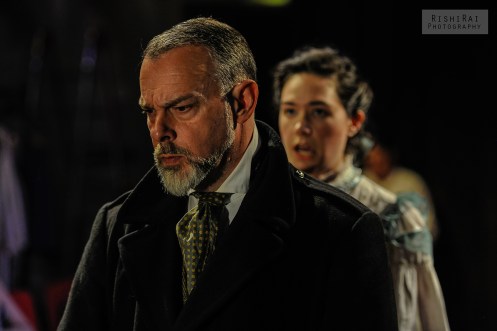
Here is the strength of the writing; that the concept of the spoof only slowly slips out. However, this isn’t Agatha Christie, the chronology doesn’t hold together, and its weakness is that it is poorly researched and it isn’t only the Escheresque picture that is anachronistic. It is set somewhere in England in 1905, but Edwardians did not say “smart” for intelligent, “hired” for employed or “throw up” for be sick. Author, Don Nigro is prolific, but with over 400 plays to his name, research is not uppermost. He hails from Ohio, so a setting in the USA may have worked better. That gripe out of the way, suffice it to say that Q2 squeezed the script hard for its tension, intrigue, and humour: a delicious mix that made for an entertaining evening.
The detective story is inverted in Ravenscroft: it is the detective who is vulnerable, not the suspects. The suspects are the five women of the house, all to be carefully reckoned with. And for the hapless Inspector Ruffing (who incidentally features in seven of Nigro’s plays) they are sirens.
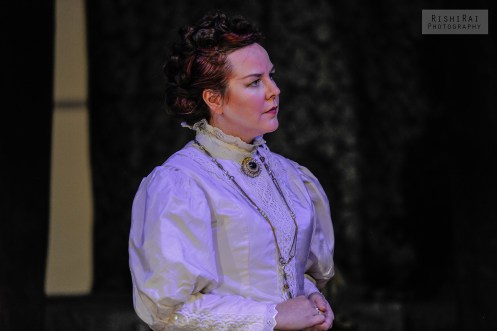
The governess, Marcy Kleiner, is in fact Austrian, a very self-assured lady, who meets Ruffing’s questioning with further questions and a sharp wit. Genevieve Trickett played this this role with great aplomb, revealing however the fragility of her true nature.
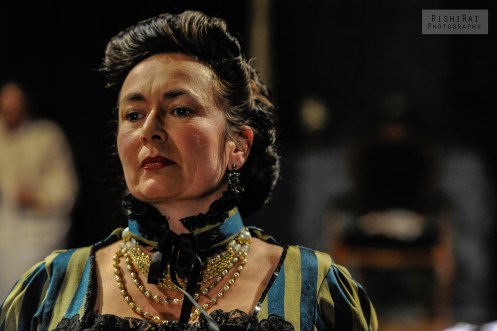
Mrs Ravenscroft is the queen-pin of the house, who is expert in using her feminine wiles to her advantage. Alison Arnold painted a clear picture of the character, endowing Mrs R with a sinuous seductiveness. Gillian Ravenscroft is an enigmatic seventeen-year old, with physical or mental impairments, or has she? For “She plays with people: it’s a game.”. It is Gillian who “sees” the phantom on the stair, but then again she “is not a liar. She just has a vivid imagination.” Jacinta Collins give this part just the right enigmatic touch and really animates the character.
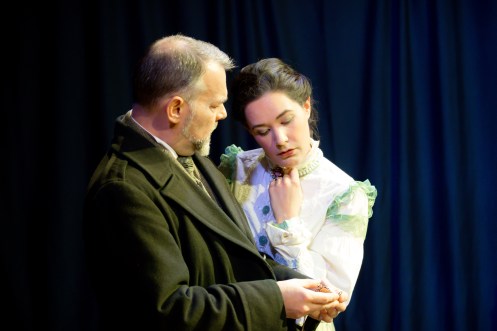
So these are the three above-stairs suspects, and each have their motives for pushing Patrick down the stairs or equally for preventing such an “accident”. But, what about the below-stairs, who are equally suspect. Dolly is the nervous and subservient tweeny maid, who nevertheless has a lot of native cunning and, one suspects is playing the “clever-daft”. Lily Tomlinson, has great fun with this part and gets under the skin of the character. Sarah Hill acts with veracity the part of the cook Mrs French, who is as solid as one of her bacon suet puddings.
As the investigations unfold, or rather enfold in a complex origami, all may have motives, all may be protecting others, or all may be incriminating others. All try amorous enticements on the Inspector, who tries to remain impervious. Mrs R is the most accomplished. Then lots of skeletons fall out of lots of cupboards. All five women may have had erotic encounters, none unwelcome, with the handsome and virile, and alas now decreased, Patrick. Further probing reveals that the same may apply to the also defunct Mr Ravenscroft, who it sees had an equally catholic taste in women … plus with his groom Patrick, with whom he used to dress in his wife’s nighties and waltz around the house! And so the plot thickens.
Then amongst this thickening plot, a seam of pathos emerges. Dolly is pregnant with Patrick’s child and is desperate to protect both herself and her unborn child. Moreover, Marcy has had an illegitimate child with Herr Klipstein, her former employer in Austria, and needs to support her absent, but much loved child.
Ruffing is caught up in this whirling maelstrom of oestrogen, and they all make up to him in various ways, subtle or otherwise. Then he makes the mistake that policemen should definitely not make; he drinks on duty. The women invite him to dinner, and is it the wine or the food or something else that affects his judgement? There is a hint that the drink may be poisoned, but what knocks him out is not the strength of his drink, but the strength of Dolly’s arm wielding a precious glass vase. They did warn him that they would “eat him for dinner”, but the prone figure on the floor hasn’t heard.
Has the Ravenscroft household claimed a third victim? Well … no. Ruffing recovers his composure and his dignity and investigations continue. But the women have him in their power, and know where to find the raw nerve to touch. In Ruffing’s case, it is his motherless daughter, even more beloved by him since he became a widower …
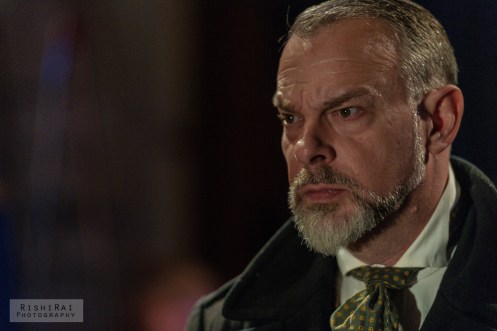
Inspector Ruffing is the centre of the action throughout the play and the role is very demanding. Craig Cameron-Fisher is certainly big enough for the role, which he executes with great stage presence, following all the nuances of this intricate plot. For all the foolishness and incredibility of the plot, Cameron-Fisher takes the emotional journey that Ruffing undergoes, and makes it as believable as the plot’s convolutions allow.
Whodunit, whydunit, howdunit? Who knows? As Inspector Ruffing says, “Life is infinitely more ambiguous”.
Quentin Weiver
April 2018
Photography by Rishi Rai Photography and Ben PG
Theatre at Its Best
Stones in His Pockets
by Marie Jones
Teddington Theatre Club, Hampton Hill Theatre until 5th May
A Review by Wendy Summers
When Stones in His Pockets first came out in the West End people went to see it who had “no idea that theatre could be like that” (my sister was one of them). It is, to say the least, an unusual and ambitious choice for an amateur company. Asking a cast of just two actors playing several roles each to play serious drama and low comedy in equal measure and take the audience with them on their journey is a big risk. The gamble at Teddington Theatre Club has paid off in spades. In actors Brendan Leddy and Ian Kinane, TTC gives us versatility, sensitivity and natural comic timing. The fact that they also both ooze charisma and seem to have a natural chemistry (that may of course have been developed over many weeks of rehearsal) is an added bonus.
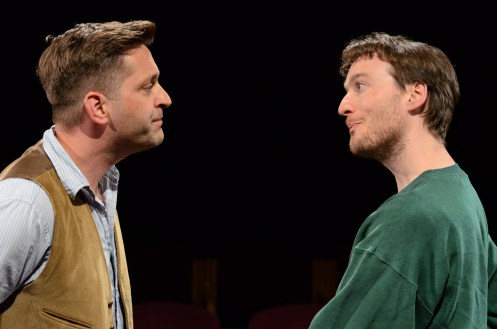
If TTC has been brave in choosing the play, then director Wesley Henderson Roe and his assistant Heather Stockwell have been braver by opting for no set, only a hint of costume and barely a prop in sight. This play stands or falls on the quality of its writing and performance, with assistance from a creative soundscape (Charles Halford) and atmospheric lighting plot (Mike Elgey).
The premise of the play is simple: Charlie and Jake, both with their own interesting backstories are extras on the Irish location set of a Hollywood blockbuster. Between them they create the characters of fellow extras, directors, producers, leading actors and various “colourful locals”. This means Kinane and Leddy covering accents from London, Glasgow, the US and at least four (that I counted) different regions of Ireland. This they do with aplomb, although there are inevitably some voices or accents that are more authentic than others. This, though, seems only just when we think back to Dick van Dyke in Mary Poppins or Tom Cruise in Far and Away – the Hollywood take on European accents is erratic to say the least.


This play needs to move quickly and this it certainly does, and the ease and speed with which the actors change character is very impressive indeed. Each character is clearly defined and instantly recognisable. It will be a long time before memories of Caroline Giovanni and Mickey “the only surviving extra from The Quiet Man” will leave me.


The first night audience in the studio at Hampton Hill Theatre seemed a little taken aback to be sitting in what amounted to an empty room and it took a while for them to catch on to the premise of the play, but once they did their appreciation was unequivocal. There was a lot of laughter and some gasps of genuine shock when the reason behind the play’s title was revealed. For this is not just a rip-roaring, knock about comedy. The play explores far broader and more serious themes, including the demise of rural communities, youth disenfranchisement, the effect of large corporates on small businesses and the “Disneyfication” of history. It is intensely moving as well as hysterically funny.

The studio space at Hampton Hill Theatre has been transformed in many ways over the years, but is rarely seen as the “black box” studio that it is here. It was both interesting and refreshing to see what actors and director can do with just their talent and an excellent script. And although it made us in the audience work that little bit harder than usual, Stones in His Pockets is theatre at its best.
Wendy Summers
April 2018
Photography by Joanna Leppink, Handwritten Photography
At a Gallop
Tess of the d’Urbervilles
by Mike Langridge and Caroline Bleakley adapted from the novel by Thomas Hardy
The Questors at The Judi Dench Playhouse, Ealing until 5th May
A review by Matthew Grierson
There was never any danger that Thomas Hardy’s fiction would be taken for an everyday story of countryfolk, though there is a species of tragic realism in his writing that the Questors’ fine production of Tess of the d’Urbervilles does very well to capture. Rather than emphasising the story’s distance from us in time and place, the play insists on its relevance by ensuring that the experience of the title character resonates with that of abused women today, never making it feel that this is not of a piece with the novel on which it’s based.
What also impresses about this play is how thoroughly imagined it has been as a play. It concentrates a much longer text by identifying the dramatic episodes and then articulating them with a fluidity that keeps a show of more than two-and-a-half hours remarkably pacey. The hard work of Mike Langridge and Caroline Bleakley, adaptors and directors both, is evident in the ease and lightness with which the actors are able to tell the story. So when I say most of the cast rotates, this is not just a rotation between parts or narratorial duties, but a literal rotation in sequences of dance and movement, whether a ballet of dairymaids and their milking stools or the coordinated motion of farmhands as they scythe a field. Such choreography connotes a sense of rural community, but this can be deployed just as effectively to show characters being ostracised: a man grabs Tess by the shoulder and turns her round to call her a whore, in a gesture later replicated by the other men and the women of the cast, while Angel Clare is literally shut out by a succession of householders in his search for his wife near the end of the play.

Such movement is enabled by the simplicity of the set, with two barn-like constructions working on two levels at the rear of a bare thrust stage. Scenes are staged from the top of these or from ladders and stairs leading up to them, the lighting used adroitly to pick out the action and lend it mood, while areas below stable the cast when they’re not required. “Stabled” because most of them stand in for horses at some point: this highly effective use of physical theatre is achieved by having the principals sat on the steps as though in a wagon, holding a pair of ropes that are pulled taut by a performer several yards in front of them, who then moves from foot to foot in an audible canter. There’s no need for them to drop to all fours when they fall as easily into a believably equine manner as they do into that of another human character, and this stagecraft allows for dramatic moments such as the collision of Tess’s wagon with the mail coach in the first act. Showcasing their versatility, the cast also provide a range of creditable animal noises – chickens and cows, mostly – from the back to evoke the rural milieu.
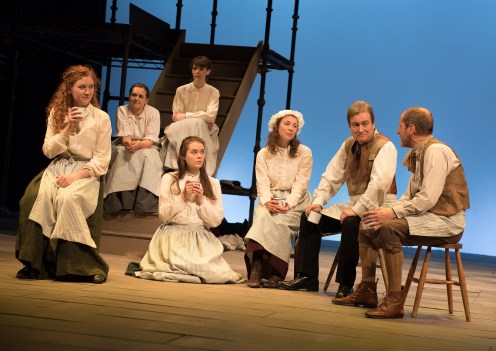
The energy and concentration of the ensemble is matched by that of the principals. Ella Hooper as Tess may not have to switch from part to part but covers as much ground emotionally as any of the supporting players, particularly when months have passed between one scene and the next. Hooper’s is a performance of sustained excellence, communicating Tess’s independence, her pride, terror, excitement and anguish. Victor Mellors as her “cousin” Alec meanwhile captures the smug self-assurance of this manipulative male, by turns charming, disingenuous, self-justifying and creepy. In each of his encounters with her, the tension is palpable, though their final confrontation is frustratingly offstage, overheard by townsfolk below as a recording, when it could have played out on one of the upper levels.
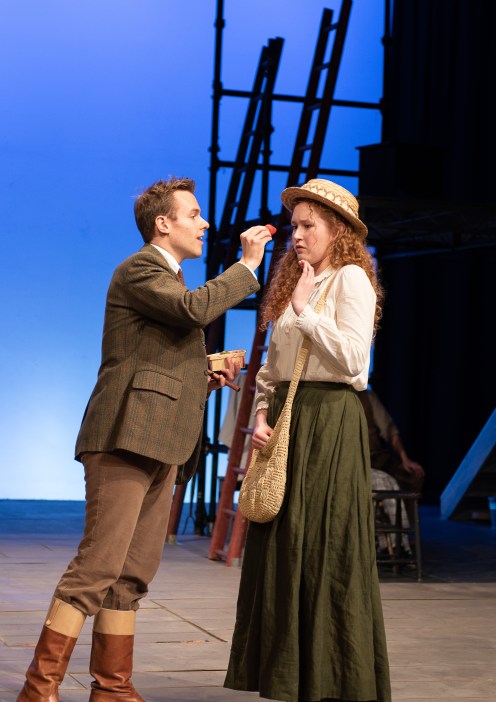
In contrast to these captivating portrayals, Rory Hobson as Angel Clare, Tess’s sometime husband, lacks the intensity that would give his hypocritical self-righteousness some weight. Certainly the love scenes between Tess and Angel are tender and affecting, with Hooper subtly modulating Tess’s stand-offishness into affection. But after blithely disclosing his dissolute past to her on their honeymoon, Angel’s anguish at learning of her own misfortunes does not convince. The “romantic” music cue played on their first meeting and at subsequent beats in their relationship thus comes across as trite, and it is the necessary momentum of the narrative rather than the force of feeling that maintains the pace.
Like a runaway wagon, this pace can also carry the plot past points where it might do better to stop a while. Tess’s illegitimate baby seems to be no sooner born that it is buried, though there is a perfect piece of business when her mother (Alison Griffin) takes the swaddling in which the child has been wrapped and shakes it out to reveal nothing but thin air. (Incidentally, that’s two shows I’ve seen in one week featuring a child called Sorrow.) The brief Sorrow is harder to register still given that the staging of Tess’s rape by Alec is conducted as though she dreams it, both characters hoisted above the heads of the rest of the cast in separate attitudes of pain and power, and audience members unfamiliar with the novel may not realise Tess is pregnant until after the fact. The transition might have been clearer.
This reflects a tendency for some moments to be overstaged, as though everything that had been workshopped had to make it into the final production. After Tess tells Angel of her Sorrow, the other cast members come onstage to reconfigure their positions, and whether this is to suggest the passage of time or the imposition of social expectation it disrupts the emotion of the moment. Other beats, such as a slow-motion fight sequence during the barn dance or the jokingly lit performer serving as a portrait of one of the d’Urbervilles, while accomplished, seem likewise unnecessary.
By contrast, much of the staging is simple and unfussy in its elegance – viz. the horseplay, or when the dustsheets in an abandoned house become bedsheets for the reunited Tess and Angel in a stolen moment of joy before the law catches up with her. And there is definitely room for humour and happiness for the rural community among the hard work and hardships of Hardy’s Wessex. While Lucy Hayton, Maddy MacConnol and Hannah Webster as Tess’s three dairymaid friends will have their own tragedies, they twinkle with adolescent delight as they talk about Angel and vie for his affections.

It is by conjuring this sense of community in all its complexity from a relatively small cast that Langridge and Bleakley make the tale of Tess both singular and typical, an accident on the road that is evident to all but impossible to prevent.
Matthew Grierson
April 2018
Photography by Jane Arnold-Forster
Compelling Drama at Its Best
Kindertransport
by Diane Samuels
Queen’s Theatre Hornchurch, Les Théâtres de la Ville de Luxembourg and Selladoor Productions at Richmond Theatre until 28th April
Review by Celia Bard
“I will take the heart of your happiness away,” is a line spoken by the Ratcatcher that sends a cold shiver down your spine. You are left wondering what Eva and the Ratcatcher have in common, for he is never far away from her whether in her dreams, in the people she encounters during her travels, in the attic, in the book she reads. He embodies the stuff of nightmares, always there, ready to pounce.
The back story of Kindertransport highlights both the worst of human behaviour and the best. In March 1938 after many nights of nightmarish violence against the Jews in both German and Austria, the British Parliament, gving sway to strong pressure from a coalition of Jewish, Quaker and other groups, agreed to admit a limited number of refugee children aged between five and seventeen to resettle in Britain, hence Kinder (children’s) Transport. Some ten thousand Jewish children from various countries were placed in British homes, an act that undoubtedly saved them from the death camps. The price to pay: separation from country; family, home, friends; culture, customs, faith, and language. One such child is Eva whose parents must make the heart-wrenching decision either to keep their beloved daughter with them in Germany or to let her become one of the Kindertransport children. They make their decision, but it is one that the grown-up Evelyn cannot forgive.

The setting of the play is significant, an attic, a wonderful place for the storage of items you no longer use but cannot bear to throw away. You may have forgotten them, but they still hold power, and continue to exert influence on behaviour, emotions, mood. In Kindertransport the attic acts as a conceit for all that Eva has suppressed about her troubled childhood. Most of the action takes place within the attic, though that attic, by the simple flipping over of sections of the floor to create a platform or seating, can become a railway station, a railway carriage.
This production is beautifully staged. Time periods seamlessly interweave, achieved by the clever cross cutting of scenes where characters appear on the stage at the same time and are juxtaposed to highlight different time sequences, enabling the play to move backwards and forwards between three periods: pre-war, in which Helga, Eva’s mother, tries to prepare her daughter for the separation; during the war where we see Eva settled in England with Lil Miller; post war and to a grown-up Eva, now called Evelyn, who now has a daughter of her own, Faith.

Lil, the foster mother, beautifully played by Jenny Lee, stays constant, never ageing whatever the time period. Lil has insight into Eva/Evelyn’s predicament as evidenced in the scene when Eva throws herself out of train carriage, so desperate is she not to have to endure another forced parting. But ultimately Lil is unable to help Evelyn, for the problem is as much about language and culture as it is emotional stability. However, Lil is the anchor, sympathetically realised by Jenny Lee throughout the action.
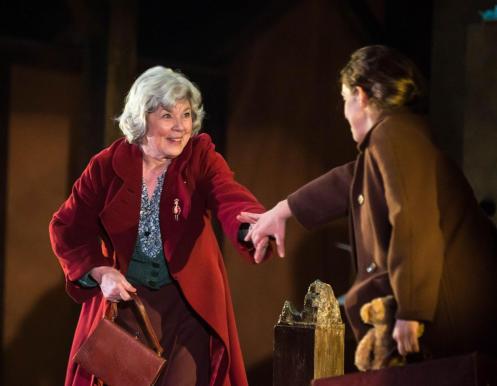
And the Ratcatcher? The Pied-Piper of Hamlyn? Always present in troublesome time, appearing in different guises. He will give you sweeties but beware for he signifies danger. He is there in all three-time periods: in the haunting, background music that draws you in, in the book, in the mind. A particularly interesting action of the Ratcatcher is the pulling down of curtains and wrapping them around himself. As he grows bigger and bigger Evelyn gives away more of her secrets. Matthew Brown, who plays this role, is most effective in all the different characters he plays, charming, frightening, a monster. This actor has an impressive stage presence and is convincing throughout.
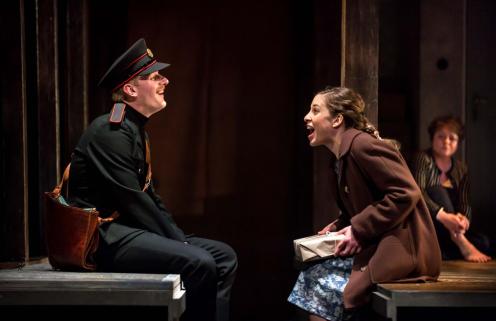
Suzan Sylvester presents a neurotic, withdrawn Evelyn. The emotional and feisty version of her younger self completely disappears. I liked this characterisation but for me Suzan’s performance lacks conviction and at times her action and movement are clumsy. She has many quiet moments, but the audience still needs to hear what she is saying. Her best moments are in the penultimate scene when she suddenly breaks down, and her story comes flooding out. Here she is strong and forceful and presents a real force.
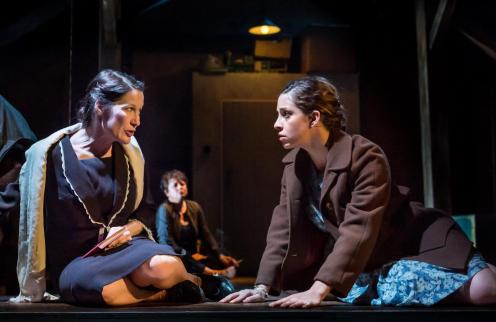
Likewise, I found Claire Thill’s performance as Helga a little lacklustre except in the first scene where she exerts pressure on Eva to sew the button on her coat. In her scene with the eighteen-year-old Eva she appears as an old woman. She may be broken in body, but certainly not in soul and this was not reflected in Claire’s acting. Here her interchanges with Eva lacked conviction.
Hannah Bristow as Faith, Evelyn’s daughter, gives a very strong performance in all her scenes. Her emotions swing from anger and frustration caused by her mother’s inability to communicate. This character is well named Faith, representing as she does the continuance of her family’s life-blood. Helga makes the decision to send Eva away, to keep her safe. The story book, The Ratcatcher, and a Jewish religious book end up in Faith’s possession, representing both a warning of shadowy ills, and faith in religious beliefs and customs. Hannah totally succeeds in drawing the audience into all that she is experiencing, acting with conviction and intelligence throughout.
Leila Schaus is just brilliant as Eva; the part could have been written specially for this actor: she totally owns it. Her transformation from the young, feisty, argumentative German nine-year-old girl to the self-contained ‘English’ seventeen-year-old is realistic and tragic. She stays safe, but she has lost the heart of her happiness, stolen when wrenched away from parents, language, and country.
In summing up this production this is one not to be missed. Psychologically strong, imaginatively directed, and overall beautifully and truthfully acted: it is compelling drama at its best.
Celia Bard, April 2018
Photography by Mark Sepple
Should Sell Like Hot Cakes
The Bakewell Bake Off
by The Baking Committee
Hinchley Manor Operatic Society at Hampton Hill Theatre until 28th April
Review by Vince Francis
Hinchley Manor Operatic Society (HMOS) has taken up the challenge of The Bakewell Bake Off, a piece written by a group of students, known as “the Baking Committee”, from the Guildford School of Acting. Originally intended as a writing exercise, it was given a trial run in the Waterloo East theatre in 2013 before transferring to the Landor.
From the original blurb, we get the synopsis: “Take seven eager contestants, three feuding judges and one bewildered hostess, add flour eggs and sugar and mix together in a small village. Add the pressure of a baking competition and you’ve got a recipe for a hilarious musical comedy!” (SimG Productions)

Arriving at Hampton Hill Theatre for the opening night, we were greeted warmly by the stewards, guarding the table displaying cakes, which can be taken in exchange for a donation to charity, together with the raffle prizes.
Once seated, the set takes us inside a straightforward village hall, depicted by a single stage-width flat with mock window and a working door. Blackboards, bunting and notices add to the authenticity. The bunting on stage extends into the auditorium, to draw us into the action and, indeed, there is some audience interaction, orchestrated with great authority by Victoria Sponge. More of her in a moment. The “corporation” green and cream colours are a nice touch, being reminiscent of many a parish hall and bringing to mind the school discos of my now sadly distant youth.
Three tables on locking wheels, together with a set of wheeled treads are used cleverly to provide surfaces for the baking and another level of staging for singers. These are moved around the stage by the cast without fuss. This device works well and helps to provide visual variety and occasional emphasis for a solo. Props are brought on and taken off by the cast, again, seamlessly. The ensemble also acts as stage crew, to the extent of cleaning up after the more slapstick moments.
From where I was sitting in the centre of the auditorium, the sound seemed well balanced and, generally, at the right sort of levels. I fancied I could hear the stage right monitor, even though the piano was stage left, which is good. Everyone could be heard clearly, although when singing chorally, the piano was a little overpowered. I also thought I heard a little tasteful reverb being added to the sung vocals in the second half. Nice. I might be imagining that, of course.
Costumes go for the authentic look, even on those characters who are, shall we say, extending the concept of everyday casual.

It has to be said, many of the character names sound like drag acts and that’s probably deliberate. We have Victoria Sponge, Flora Drizzle, Tina Tartin, Susie Sunflower and Holly Berry, alongside which are the likes of Henrietta Apfelstrudel, Griselda Pratt-Dewhurst and Freddie Twist.
The script is full of innuendo and double-entendre, which I love, but it is more than the pantomime that might suggest. The weakness, for me, is in the attempt at a comment on race relations, which is written into the interactions between Hugh Dripp and Pradeepta Smith. Zak Negri (Hugh) and Gill Varon (Pradeepta) handle these well, but there’s only so much that can be done.
Our first contact is with Victoria Sponge, played with great zest and knowing humour by Paige Fayers. Victoria likes to present herself as a kindly, but no-nonsense Mistress of Ceremonies, but there is a red-blooded woman underneath the veneer, who occasionally lets her presence be known …
… Sorry, I was slightly distracted there for a moment.
Victoria is the “hub” character, who is runs the competition, but is also acts as the audience contact for the participation elements, dealing with getting mobile devices turned off at the beginning of both halves, exhorting us to stand for the anthem and overseeing the raffle draw – yes, there is one. As an aside, I’m not normally a fan of raffles at shows, although I understand why societies run them. However, when they are dealt with in this way, I can get on board with them.
Performance-wise, the cast get hold of this and then it’s a matter of “fasten your seat belt, folks”, which works well for the most part. Steve Green’s direction brings out the comedy in both the script and the characters well, although overall, I wondered whether just backing off a touch on that high-energy pantomime feel might allow a bit more depth in the story to come through.
Mr. Green in a dress is a sight to behold, but his portrayal of cross-dressing German Henrietta Apfelstrudel is thoroughly believable and is an example of a comic character with a back story, which I would like to have seen a little higher in the mix.
I also enjoyed Katy Simon’s Flora Drizzle. A geek scientist, struggling to come out and declare her love to the fragrant Susie Sunflower, played with suitable delicacy by Claire Weston.
Musically, the score kind of does what you expect at the relevant moments, but is none the less charming for that and the solo piano, played with great aplomb by Musical Director Debbi Linley, adds to the village hall feel of the piece. Debbi has done a fine job with the cast, too. Although there were a couple of “pitchy” moments, I put this down to first night nerves, since they weren’t repeated elsewhere in the show. Standout moments for me were Sister Mary’s “Bake Your Way to Heaven”, with the gospel style choral accompaniment. The song builds to a characteristic high note ending. I could hear it coming and wondered what Catherine Quinn, as Sister Mary would do with it. She nailed it! I also loved the harmonies between Susie Sunflower and Freddie Twist (Ben Thomas) in “We Might Fall In Love”
Choreographically, Kelly Neilson has played to the strengths of the company so, for the most part, everyone looked coordinated, confident in what they were doing and thus able to present it to the audience, rather than checking what the person next to them is doing, which can sometimes be a bit of a give-away for amateur productions.
In summary, this is a well-drilled, experienced and confident cast, which, in turn gives the audience confidence to sit back and enjoy the portrayal of these slightly OTT characters in the ultimate in parochial contests.
The opening night audience wasn’t huge, which was a shame. However, they were responsive and rightly so. This is a slick production of a very witty piece, well delivered and well supported technically and musically. Go see.
Vince Francis
April 2018

 Mark Aspen