
Treasure on the Beach
Treading Water
by Kathryn Gardner
Subtle Paws at Brick Hall, The Vaults, Waterloo, until 4th March
Part of The VAULT Festival
Review by Melissa Syversen
Treading Water is several things. It is a quirky love story, a piece of slice-of-life theatre and a story about human interactions. It is mainly about Sue and Carol, two female bodyguards who spend their days on the beach keeping an eye out for distressed swimmers and other visitors to the beach. It is a slow job which involves mostly sitting, watching and waiting for something to happen. Carol is the savvier of the two, quick-witted and with a no-nonsense approach to things, whereas Sue is the sweet, well-meaning if ditzy one of the pair. She also happens to have a crippling crush on the play’s third character, a metal detector enthusiast who walks his dog every morning whilst looking for coins and other bits and bobs in the sand.

We meet these three on what seems to be a day much like any other. As is with well-established routines, all three have their little rituals: making tea, hiding coins in the sand to attract the man with the metal detector and making bets whether it is a Tesco bag or another type of shopping bag bobbing up and down in the ocean. One difference is that it is Carol’s birthday and the consequent presence of a seemingly innocuous carrot cake. One could make the point that these characters and their dynamics might not be the most original, but I would argue that that is kind of the point. These characters and this piece are so affecting and wonderfully funny because we recognize who they are. We all know people like this and can also see ourselves in them. Be it being so in love with someone you can barely talk to them, being so painfully awkward and shy you would rather spend your days looking for tiny treasures in the sand or hiding your personal pain and vulnerability behind a guise of wit and cynical realism.
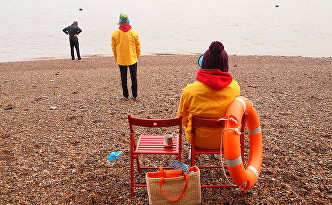
There are two clear strengths in Treading Water. The writing is tight, with a clear structure and dialogue that beautifully ebbs and flows much like the ocean evoked throughout the piece. Every now and then the man with the metal detector breaks the fourth wall and addresses the audiences in short soliloquies, offering some insight into his personality and thoughts. I was left very impressed by writer and performer (she also plays Sue) Kathryn Gardner’s ability to capture the silent pathos that can be found in everyday conversation. It especially comes through in moments regarding Carol and her husband, something Sue, ever the romantic keeps bringing up.

These moments, especially a later one, is beautifully acted by Amy Ambrose as Carol. Which brings me to the other strength, the acting. I have some thoughts and theories on what differentiates the good actor from the bad one. I won’t bore you with all of them but a key one is how the actor deal with silence. What they do when their character is not speaking or not in focus. Treading Water is full of silences, be it a lull in conversation or a character moving around in the background as others are talking. All three actors are clearly comfortable and present in these moments of silence and inhabit and fill them with small moments of human everyday behaviour. A particularly good moment was watching Joshua Ruhle as the metal detector enthusiast very slowly and deliberately wipe his nose with his finger and then, with the same quite deliberation, wipe of his finger with his other finger. Another was Sue and the man looking for coins together in silence. It just demonstrates again (to me at least) that watching someone just be, whether alone or quietly interacting with someone can be just as engaging and affecting as the most gorgeously written texts. More than once during the one-hour run-time did I find myself thinking of other plays of similar feeling and themes, I especially kept remembering Nice Fish by Mark Rylance and Louis Jenkins.
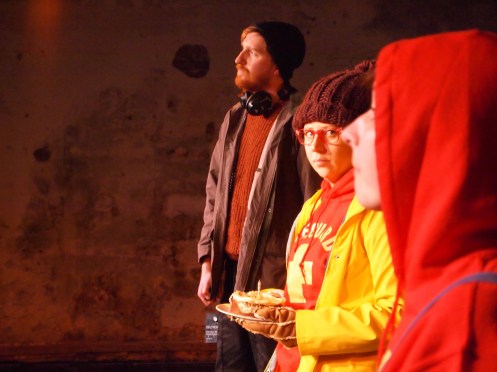
As I said in the beginning, Treading Water is many things. It is a story of patience, of friendship, of delicate humanity and taking the opportunity to make the things you want to happen when they present themselves. It is freezing outside but Treading Water will warm you right up with its gentle tenderness and endearing humour and charm.
Melissa Syversen
March 2018
Photography by James McInnes
Dying with Laughter!
Curtains
by Stephen Bill
RTK at The Rose Theatre, Kingston until 17th March
Review by Mark Aspen
No doubt The Grim Reaper has a chill edge to his scythe, so it was with some poetic justice that reaching The Rose Theatre for the press night of Curtains was through a -3˚C blizzard, with the scythe edge of the wind bringing a chill factor into the minus double digits. So, a good night to warm up by going to see a play billed as “a comedy about the end of life”. I approached unconvinced that The Grim Reaper is a laugh-a-minute sort of chap.
However, well before the interval, it became clear that Curtains is not a really comedy, it is a thought-provoking and taut exploration of bereavement and guilt that sits inside a comedy. The humour is there, but it is uneasy, although nevertheless genuine, and comes from the edginess of the play and from the characters’ non sequiturs that emerge from us all in times of stress.
Although the sanctity of human life is paramount, The Grim Reaper may in extremis be welcomed, although perhaps not when introduced by one of one’s nearest and dearest. Yes, Curtains is a comedy about euthanasia! But under the pen of Stephen Bill, and the exacting direction of Lindsay Posner, it becomes in the current Rose Theatre’s revival, a poignantly provocative work of art.

Designer Peter McKintosh’s set, subtly lit by Paul Pyant, of the living room in the home of elderly Ida, is in itself a metaphor for her life as it is now in 1987. There are cracks in the plaster, and some chunks have fallen from the frieze, but generally it is in not-too bad a shape, due mainly to the interventions of various of her adult relatives. Indeed, one such “improvement” is happening as the play opens, for today it is Ida’s 86th birthday and her daughters and their husbands are visiting, complete with Dream Topping trifle (“easier for her to digest than cream”), and sandwiches relieved of their bread-crusts.
In spite of her burgeoning dementia, Ida seems the only sensible person there, as the other all patronise her something rotten with accentuated baby-talk (to which she is able to give some pretty robust replies). Sandra Voe, as Ida, is outstanding with a well-studied portrait of the bewildered old lady, struggling to make sense of her disinteresting perceptions and pain-racked existence. I would have liked to have seen more of ex-RSC actress Voe, it was a pity that she is the one character to go early, but as you may have discerned, the plot demanded that she go early. However, it would be a real spoiler to reveal her actual psychopomp.

Much of the true comedy comes from looking in on the internecine bickering, which most of us will uncomfortably recognise in even the most loving families. The siblings in Ida’s family get along as smoothly as interlocking sandpaper, and Ida’s party has been organised by the sandpapers sisters, Margaret and Katherine, who have brought along husbands Douglas and Geoffrey. Margaret has allowed her feeling towards all her family, including mother and husband, to become soured and Wendy Nottingham in this role puts over all of the acerbity of the character to the point of vindictiveness. Katherine is a bag of nerves: Saskia Reeves’ portrayal fairly zings with tense fretfulness.

The sisters’ husbands are there reluctantly. Margaret’s husband ex-RAF man Douglas busies himself repairing Ida’s lawnmower. Tim Dutton depicts Douglas’ chisel-edged brusqueness and sarcasm with biting accuracy. Geoffrey, not having garden machinery to mend, sets about repairing the fractures in the family relationships with placatory resignation. Jonathan Coy plays Geoffrey to a tee, with the nuanced indecision of the fish-out-water.

For these two couples the party is, in honesty, a chore. Moreover it is a chore exacerbated by the dilemma that everyone finds themselves in. Ida does not want to go to a care home; trial attempts at a live-in granny have been disasters; but Ida is incapable of independence any more.
Ida is not home alone though. Her dutiful carer, Mrs Jackson, is always at hand, resourceful, resilient and reliable. Marjorie Yates plays the knowing Mrs J with just the right amount of starchy propriety. Moreover, Ida’s grandson Michael, lodges with her while he is studying at a nearby university. He is fiercely loyal and loving towards Ida, but all this is hidden under a protective carapace of flippancy. Leo Bill, as Michael, has the balance of geekiness and intensity that pervades an earnest but awkward young man.
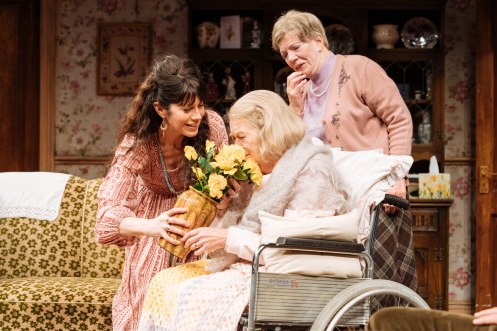
If this interplay of fraught relationships is not enough, into the party bursts the black sheep of the family, youngest sister Susan, her lively refreshing vivacity tempered by caution after a 25 year absence. She wants to see her mother on her birthday and to be welcomed back into the sheepfold. Her reception is not enthusiastic, for Susan has been an unmentionable embarrassment, having been ejected from the family bosom for having disgraced herself. O tempora! O mores! : this would not happen now, but in 1962 her taboo state was … pregnant. Caroline Catz’s Susan is bubbling, forgiving and remarkably thick-skinned to her ungracious reception. However she has taken a lot of knocks and her life has been unsuccessful to say the least. She is now divorced and homeless. Of all the characters Susan’s is the most sympathetic and one felt that the audience warmed to her. She adds spice to this complex melting pot of emotions and attitudes.

As a by-the-by, the characters accents are all eclectic generic Northern. Perhaps these indicate a diaspora of the family beyond its roots, but Susan’s strong Scouse accent at least gives a sense of place.
Unfortunately for Susan, her time with her mother is short-lived, literally, as she does not know that dear old mum is about to be bumped off. Maybe none of the protagonists did; perhaps it was a spontaneous act, but one of them had been researching in the library for the legalities and the mechanics of euthanasia.
When poor Ida is discovered dead, and soon to be realised, killed, the emotional melting pot is thickened by the conflicting and complex reactions that the family have to their sudden bereavement. It is as well that this is a comedy, for without the relief of humour (and for the characters mostly unwitting humour) the psychology of death, and especially of euthanasia, would become unbearable heavy.

Curtains is a play of two halves. Until Ida’s death, it is a knockabout of family trivia, laced with the black comedy of the inevitability of Ida’s impending death. There is the shock hiatus of the killing itself, then the second half falls into an introspective lecture on perceived views on euthanasia, albeit still leavened with clever crafted comedy. The insights move from revelatory to didactic in style.
In spite of Mrs Jackson’s repeated mantra that it is “a blessed relief”, reactions go into panic mode. The relief turns to fear and guilt moves to mutual blame.
Margaret’s blame is immediately laid on the bewildered and distraught Susan; “she was looking up until you arrived”. Katherine anxiety explodes in a paroxysms of guilt, while Geoffrey tries to mollify everyone with platitudes, but remains too weak-willed to achieve any sort of harmony; “underneath he’s terrified”. Then Douglas’s alcohol fuelled atheism fires in. With the firmly stated emphasis of one for whom there is no higher authority and a belief that there is no knowledge unbounded by human understanding, he pragmatically asserts that all is for the best. This is much to the dismay of Michael, the only person to take a moral stand, but he is not as articulate as his uncle and his arguments are quickly flattened by Douglas’s brutish humanism. When Michael returns having gathered his words to express his horror at the killing of his much-loved grandmother, and says “thou shalt not kill”, Douglas “accuses” him of being “religious”. Whist Douglas cites his military background for not believing “ancient superstitions” (*), Michael clearly is the only one of the family who has an untainted respect for human life.
Although Curtains does veer heavily to being a pedagogic analysis of the multi-faceted arguments around euthanasia, the characters who express the competing views are certainly not two-dimensional. Each undergoes a huge emotional journey and this is accurately demonstrated in both the script and in the superb, and ensemble-strong, acting of the RTK cast.
However, we must be thankful for the humour that makes Curtains so entertaining. It might seem odd that a play about euthanasia can be not only entertaining but actually funny, but we could reflect that, long before Agatha Christie, murder was, and remains, a subject for entertainment. Perhaps, O tempora! O mores! , taboos shift.
After all, when you see a picture of The Grim Reaper his teeth show us a laughing face. Maybe he is laughing all the way to the …
Mark Aspen
March 2018
(* but see General, The Lord Dannatt )
Photography by Manuel Harlan
A Midsummer Night’s Dream

Image by Carla Evans
A Special Offer for All Visitors to the Mark Aspen Reviews Website.
Two-for-One Tickets for The Questor’s production of William Shakespeare’s A Midsummer Night’s Dream at The Judy Dench Playhouse, Ealing.
A Midsummer Night’s Dream by William Shakespeare
The course of true love never did run smooth…
Young lovers, feuding fairies and amateur actors collide in the woods outside Athens one midsummer night … …. Is it real? Is it all a dream? Reality and appearances merge in Shakespeare’s most beloved comedy, all on midsummer’s night.
The Questors, Ealing’s premier theatre is giving all readers of the Mark Aspen website the offer of a free ticket for every standard ticket you buy. That’s a great offer: two tickets for the price of one!
To claim your free ticket, go to the Questors’ box-office website HERE and book two standard tickets. At the checkout enter the unique Mark Aspen discount code ASPEN421 and you will not be charged for the second ticket.
Sweet dreams!
Guinness is a Dark Drink
The Weir
by Conor McPherson
English Touring Theatre and Mercury Theatre co-production
at Richmond Theatre until 3rd March, tour continues until 10th March
Review by Celia Bard
I was delighted to be asked to review this play at Richmond as it is the first time that I’ve seen The Weir performed on a ‘large’ proscenium style stage. In smaller open stage theatres, it would not be unusual for an audience to feel that they are part of the same setting as the characters: in the case of The Weir, sitting in the same snug and eavesdropping on a group of locals enjoying the hospitality of their remote, rural pub on a bleak, blustery night, and amusing themselves by telling ghost stories. I wondered was there a risk that this level of intimacy would be lost at Richmond Theatre.

To a certain extent my fears were unfounded. The quality of the writing, the ghost stories, the rhythm of the dialogue, the acting strengths of some of the actors and the overall soundness of direction succeeded in drawing the audience into a world of casual bar joking and sometimes not so friendly local talk and gossip. The feeling of intimacy was also achieved by this production’s imaginative stage construction, set on the vertical and horizontal diagonal which created the illusion of a small one room bar. The shabby bar furniture, the wood burning stove, the atmospheric use of lighting, notably the firelight, the subtle spotlighting of story tellers all helped focus the attention of the audience, leading them to believe that they were in a real bar. Sound effects were minimal apart from the occasional sound of a howling wind, and loud clanking noises at the beginning and ending of the play, suggesting perhaps the noise of the water overflowing in the nearby dam? There was little, apart from dialogue references, to indicate that the night was wild and stormy.
The title of the play, The Weir, is interesting. It takes its name from the hydroelectric dam on the nearby river in Sligo. A weir, as many of you will know, regulates the flow of a river holding back the body of water until levels rise and the torrent of water cascades over the barricades. Metaphorically, this is what happens with this group of characters. On the surface they are jovial and full of bonhomie, but gradually this friendly banter gives way to deeper, disturbing emotions in part triggered off by the arrival of Valerie (Natalie Radmall-Quirke) a troubled young woman who comes to this part of Ireland to get away from her troubles.

The four men, Jack (Sean Murray), Jim (John O’Dowd), Finbar (Louis Dempsey) and Brendan (Sam O’Mahony) are long standing acquaintances and drinking buddies. They know each other’s weaknesses and foibles and are happy to tap into these in a friendly way. The ghost stories they tell, intended to impress, and spook the newcomer from Dublin, become more disturbing and result in themselves becoming spooked. The only person who hasn’t a story to tell is Brendan, the barman. Perhaps this is because he more part of the fabric of the pub rather than an individual character. He doesn’t say much, we learn about his life from other characters.

Jack, a bachelor, and local garage owner, has lived in the area all his life but because of his fear of leaving the village to go to Dublin he loses the love of his first sweetheart. He counsels Brendan, the young publican, from making the same mistake as himself. Finbar, Jack’s adversary, is a local businessman who has moved away from Ireland and made good. He returns that night to the pub with a potential buyer of one of his properties, Valerie, offering to take care of her and to show her around. The regulars mistrust Finbar’s motives towards her. The group is completed by Jim, the middle aged local man and Jack’s assistant.

There is very little physical action in the play, apart from the entrances and exits of characters in the pub, and is played out in real time in one location. Each character has a monologue, but these are skilfully entwined in the naturalistic exchanges between characters. The dialogue ebbs and flows between casual bar talk and the stories told by four of the characters.
The movement on the stage for the most part worked to the advantage of the characters when delivering their stories, apart from Jim’s somewhat contrived movement to the fireplace when telling his ghost story about the graveyard. His over use of the fourth wall when delivering this story robbed it of tension. The piece is well shaped in terms of the ebb and flow of the dialogue. The acting is naturalistic; unfortunately, the actors, apart from the two characters Jack and Finbar, fall into the trap of dropping their voices and this led to some problems with audibility and meaning, especially when speaking with broad Irish accents. Valerie’s story is moving, but the voice of the actress is at times inaudible and her accent is not convincing, sounding English rather than Dublin Irish. Props and technical resources were used well by all the actors, e.g. using the pumps, lighting cigarettes and smoking, looking for keys, using the till, pouring drinks. Such was the drinking prowess of Jack and Finbar I wondered whether there was a real toilet in the wings!

The two actors playing Finbar and Jack were outstanding. Louis Dempsey had a very strong stage presence and physically filled the stage. The smart, well-cut, light-coloured suit he wears sets him apart from the other characters, which is right. He is totally believable in this role. His re-telling of the story about the little people, which triggers in him a ghostly memory about a woman meeting an otherworldly woman on the stairs, succeeds in engrossing the audience, and at the same time unnerves Valerie.

Finbar’s nemesis, Jack, is beautifully portrayed by Sean Murray. The interaction between these two characters is fierce and memorable. Sean’s storytelling skills and his ability to hold an audience is impressive as demonstrated when telling the story about the fairies knocking on the floor, and when he recalls memories about his visit to Dublin to attend the marriage of his former sweetheart, the audience feel his lonely despair; even more so when he recounts the incident of the publican giving him a slice of bread, cheese, ham and onion to cheer him up. Jack undergoes a cathartic transformation, and this is shown is his ebullient behaviour when exiting with Valerie in the final scene.
For most of the time I felt I was in an authentic, remote Irish bar, enjoying a piece of old Irish charm and the storytelling gifts for which the Irish are so well known. The Weir was originally intended for a smaller more intimate venue; however, this production part achieves this, notably with its very clever set design and memorable performances by some actors.
Celia Bard
February 2018
Photography by Marc Brenner
Battling With Ideologies and Decisions
Taking Sides
By Ronald Harwood
The Questors at The Studio, Ealing, until 3rd March
Review by Viola Selby
From a young age we are taught about the horrors of World War II. We are taught about the monstrous Nazis and the heroic British and Americans, clearly defining the good and the bad. Yet one thing that is rarely looked into is that of the courageous deeds of certain Germans who did what they could to save those under persecution.
Wilhelm Furtwängler is an excellent example of one of these unsung heroes. Using his reputation as one of the greatest conductors of his time, Furtwängler helped many of the Jews in Berlin escape to safer territories. However, once the war was over, those considered to have been part of the Nazi party were questioned, tried in court and, if found guilty, often executed. Due to his decision to stay in Berlin throughout the war, Furtwängler was one of those accused and brought in for questioning. It is through Taking Sides, cleverly written by Ronald Harwood and excellently directed by Stephanie Pemberton, that the essence of humanity in such a time of manipulation and uncertainty is explored in a way that encapsulates the audience, taking them back in time to the events of April and mid-July 1946 in Major Arnold’s Office.


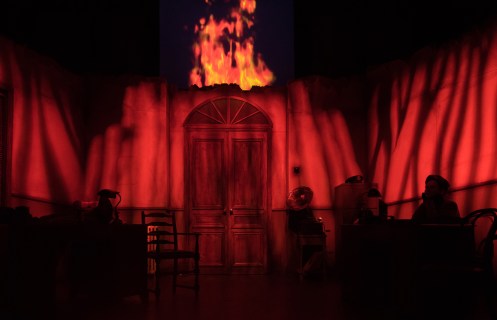
At the beginning, the audience are plunged into darkness with only the light from a projector above the stage, showing clips of Furtwängler conducting whilst other images of events from the war are being shown. At the same time the room is filled with the melodic sounds of one of Furtwängler’s pieces. This really does help to set the atmosphere, as well as help the audience to understand a little bit more about who this man was. This same simplistic yet effective approach is used throughout the play, thanks to the creative genius of both Pemberton and stage designer Carla Evans. With the use of only one set design, Major Arnold’s Office, and six characters, the feeling of intensity and claustrophobia are palpable as all of the audience’s attention is focused on the events within the office and Major Arnold’s growing frustration as he tries to gather evidence against this popular conductor.
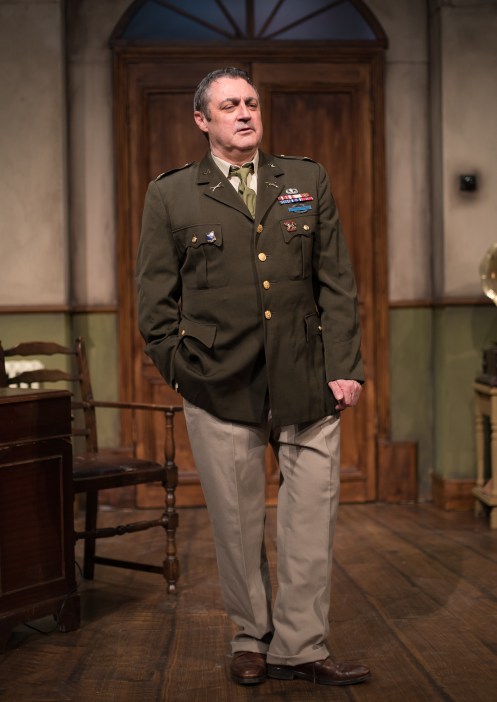
As well as through the script, character development has also cleverly been explored and depicted by the actors themselves. Adam Kimmel in particular, who plays Major Steve Arnold, manages to convey a man who one may perceive as being a bully, revelling in manipulation and interrogation. But whom, as the play progresses, actually shows a more relatable side, of a deeply vulnerable and hurt individual who has seen sights no one should ever see; sights and smells which have clearly affected him so much so that his life’s purpose has become all about revenge on anyone who did not do all they could to stop this monstrousness. This slow revelation is one of many great twists in the play and is also greatly helped by the exceptional responses and interactions of the other characters. For example, the way Lt. David Wills, performed by Zac Karaman, who perfectly effects the American accent throughout the play, becomes more unsettled and angry by the way Arnold treats Furtwängler. This tension greatly highlights the fact that there is a lot more going on beneath the surface and more than just one motive in this case. Whilst other characters such as Helmuth Rodes, perfectly portrayed by Russell Fleet, manages to keep audience members on their toes by first portraying himself as good man who hated the Nazis throughout the war and who idolised Furtwängler, to suddenly revealing his true easily-corruptible character, whose deepest secret maybe a little darker than just stealing the conductor’s baton. Even Furtwängler himself is not left out of this character revelation.


Through Arnold’s constant interrogating, mixed in with the praise and pity he gets from Lt. Wills and secretary Emmi Stroube, played by the exceptional Evelina Plonyte, and the evidence provided by Tamara Sachs, excellently acted out by Rosie louden, Furtwängler’s real motives for staying in Berlin are given a much more complex conclusion, riddled with self-survival, jealousy, and political games. Simon Taylor does an exceptional job in not only portraying a man battling with his ideologies and past decisions, but also in keeping the audience guessing as to whether Furtwängler was a hero or a villain. For an entertaining yet intense evening of intrigue, guessing and revelation, this show is not one to miss. The only question now is, which side do you take?
Viola Selby
February 2018
Photography by Jane Arnold-Forster
The Tales We Tell Ourselves
Rumours (the British Version)
by Neil Simon
Putney Theatre Company, at Putney Arts Theatre, until 24th February
Review by Matthew Grierson
It should be fairly easy to choose a gift for a couple’s anniversary – it’s tin for tenth, I understand, and Charlie and Viv are celebrating a decade of matrimony. Nevertheless, Leonard and Claire bring a crystal vase, and there’s another one apparently on its way from Harry and Joan in Venezuela. At least that’s something, I suppose: all that the other three couples bring to the party are their own problems. Oh, and the rumours that give this play its title. For, in the continuing absence of the hosts, their well-to-do but self-absorbed guests spin their own tales about what’s really going on.
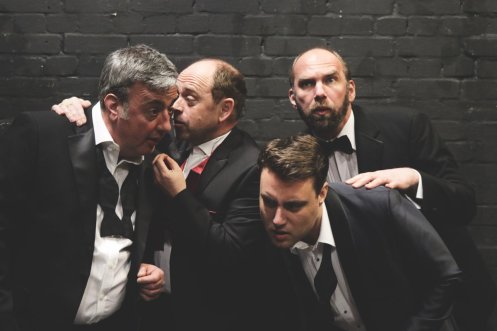
The narrative builds as each couple in turn have the run of the lounge, airing their grievances or speculating what has become of their hosts, but matters are brushed swiftly under the metaphorical carpet when another couple appears at the front door or on the landing of the impressive, expansive set. This balances the production between paired and ensemble performances, but also gives it something of a stop–start rhythm. So while the first half is certainly funny, the frenzy of activity that concludes it feels a little contrived, there having been more emphasis on individuals’ and couples’ stories rather than the ensemble. At two junctures, all present even admit what they know to the others – midway through the first act and during the interval – so there’s a chance that the comedic tension could be squandered. But Neil Simon is telling a story about other people telling stories, and he has a storyteller’s instinct for drawing particular tales to a close before they become untenable. With the air cleared at the beginning of the second act, the dynamic between the cast proves that the pressure doesn’t always need to be on for them to perform, and the plot is vamped effectively until Ernest reminds us that Charlie is still upstairs. By this stage, I was enjoying myself so much that I’d forgotten.
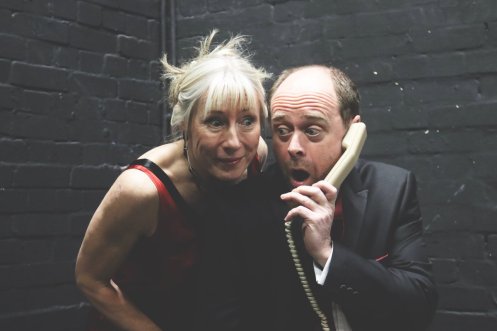
Only occasionally is credulity stretched more than Leonard’s neck (he arrives with whiplash from a prang in his new car). For instance, it’s hard to believe that Charlie and Viv have only been married 10 years, when to gauge by the age of most of their friends it could have been 20 or more – a simple tweak to the script would have spared the cast any embarrassment, or the need to refer to babysitters. And, second, though Simon’s script is surprisingly at home in a British English idiom, it seems more awkward when it tries to drop in specific UK references. Does the Chancellor even have a “Deputy Minister of Finance”, let alone an assistant one?
In other respects, however, these references give the play further grounding in its late 80s origins. Mrs T is namechecked as though an acquaintance, and there is an evident obsession, demonstrated by Leonard in particular, about makes of car from BMWs to Jags. This all makes sense of the characters’ – well, the male characters’ – concern to protect their reputations and ambitions, even at the expense of good sense. The awkward scenarios they foist on their wives make you wonder why the women ever married them, though Penny Weatherall and Josie Murphy, as Chris and Claire respectively, give such good value that you cannot help but enjoy their performances. Meanwhile, Jim Dixon as aspirant Tory candidate Glenn Cooper could be entirely loathable, but the wince that he offers in the second act when he thinks he’s given the game away – among a repertoire of similar expressions described by his scornful wife Cassie (Beth Pedersen) – almost makes you sympathise with him. Almost.
Only therapist Ernest and his wife Cookie, both living up to their names, eschew this venality. This is thanks largely to the performances of Jason Thomas and Cait Hart Dyke: the former comes across more likeably than the script would seem to demand, while the latter gets to enjoy several nice bits of business, her bad back meaning she must be hoisted bodily into a chair by the men at one point, and she then later makes her way crabwise across to the floor to the kitchen.
The final guests at this nightmare party are the police, in the person of Vaughan Evans, entertainingly inhabiting the stereotype of the sardonic PC, and Zoë Thomas-Webb as WPC Casey. Their presence prompts a scramble among the rest of the guests to spin a convincing yarn about the fate of Charlie and Viv, but the doubtful coppers want a statement from the homeowner.
Thankfully, Leonard has been dropping hints throughout that he’s the man for the part of Charlie Brooks, this play’s own Godot. Highly strung Scotsman Len has already made digs at another absentee, Dr Dudley – an unfortunate medico who is repeatedly called out of his hard-won seat for Miss Saigon – by complaining “I should have been a doctor. I could have been to the theatre and made a fortune.” (Readers, it’s not so – yours truly has a PhD and never gets so much as his bus fare.) It’s not long before Len is mashing up Polonius and the Prince in his dialogue, and thus inevitably he draws the short straw and ends up having to impersonate the missing host.
The improbable closing monologue is a work of wonder, and it’s no surprise that Graham Kellas has to be offstage while the rest of the partygoers are trying and failing to get their own stories straight. Neither is it any surprise that, once he reappears as Leonard in the guise of Charlie and delivers his extemporised disquisition, he not only earns the affections of his wife once more, hitherto waning, but warrants a pre-curtain round of applause from the audience as well. Perhaps most telling of all, Simon’s script teases with the possibility that this last, wildly strung-together narrative might actually be true – in effect, a storyteller congratulating himself on a job well done.
Matthew Grierson
February 2018
Photography courtesy of Putney Theatre Company
Intense, Intimate and Intriguing
Strangers on a Train
by Craig Warner, based on the novel by Patricia Highsmith
ATG co-production with Smith and Brant Theatricals
at Richmond Theatre until 24th February, then on tour until 24th March
Review by Mark Aspen
Life is a journey, but take care who your travelling companions are, especially if you travel by train … or chariot. Socrates’ Chariot Allegory is a metaphor of the human mind being pulled by a white horse and black horse, by good or by evil. In Patricia Highsmith’s novel Strangers on a Train, the same metaphor opens a discussion between two men who have never met before. In Plato’s Phaedrus, Socrates’ discussion with Phaedrus takes place walking on the shore of a lake. In Highsmith’s story, the stranger’s discussions take place on a train in the early 1950’s travelling west across America towards Santa Fe. Highsmith takes the metaphor to where Plato could not have dreamt of, expanding the Chariot Allegory to ask the question, who is holding the reins?
In a revival of Craig Warner’s 2013 stage adaptation of Strangers on a Train, the journey that director Anthony Banks takes us on in the production now running at Richmond Theatre becomes an intense, intimate and intriguing probing of the human psyche.

On the long train journey, the restless Charles Bruno strikes up an animated conversation with the highly successful architect Guy Haines, who at first just wants to catch up on his reading, a paperback version of The Phaedrus as it turns out. Very rapidly though, Haines finds himself drawn into a conversation about the duality of the mind, and soon Bruno is acting as an intrusive brother-confessor to Haines, who questions his wife’s fidelity and reveals that he intends to divorce her, so he can marry his mistress, Anne. Suddenly Bruno comes up with an idea, which Haines at first thinks is just a bit of banter: he’ll kill Haines’ wife if in turn Haines kills Bruno’s father, whom he loathes. But Bruno persists, asserting that it is the perfect double crime, because neither of them has an apparent motive, and they are not going to meet again, are they? They are just strangers on a train.


The set for a stage play of Strangers on a Train needs to convey both the wide vastness of the American train journey and the intimate setting of a taut psychological drama. Moreover there are many and varied scene changes, an unenviable challenge for a set designer, but one which David Woodhead and his colleagues have met with inventive brilliance. Sliding or retreating panels open or close windows on the action, such that intimacy is maintained without losing the full stage, and simultaneous scenes can also be depicted. This forms an intricate canvas on which lighting designer Howard Hudson and projection and video designer Duncan McLean paint inventive and imaginative pictures, smacking of an Edward Hopper painting. The overall effect is a thrilling combination that hints both at the comic-dynamic style of the strip cartoon with its storybook progression, and at the son-et-lumière beloved by custodians of French historic buildings. And the son aspects are brilliantly covered by the sound and music design of Ben and Max Ringham, ranging from the Doppler-effective passing express trains to the insightful choice of the musicscape.
The dramatisation of the duality of human nature is in vogue at present. Across the river, the tour Dr Jekyll and Mr Hyde has moved on from Kingston, just as Strangers on a Train follows on its heels. Both Bruno and Haines are Jekyll-and-Hyde characters, but from Bruno the Hyde springs all too readily, whereas Hyde is wrenched from Haines under the relentless harassment of Bruno.
You see, Charles Bruno keeps his side of the bargain with psychopathic coolness, killing Haines’ wife Miriam without remorse. However, in his recounting of the strangling of Miriam, his cold precision is countered by a warped thrill in its detailed description and his declaration that “death is only one more adventure untried”. Chris Harper excels in the role of Bruno, accurately portraying the manipulative control that his character exerts, an enigma that others find attractive, even in his frequent drunken state. Harper’s physicality expresses the startling athleticism and sudden movements of Bruno’s unhinged mind.
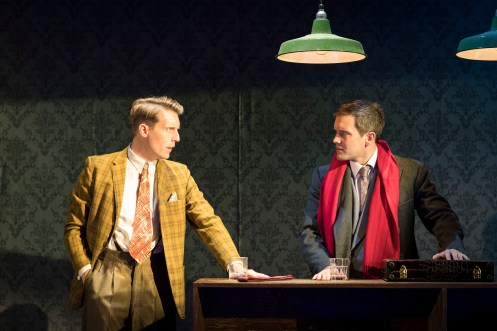
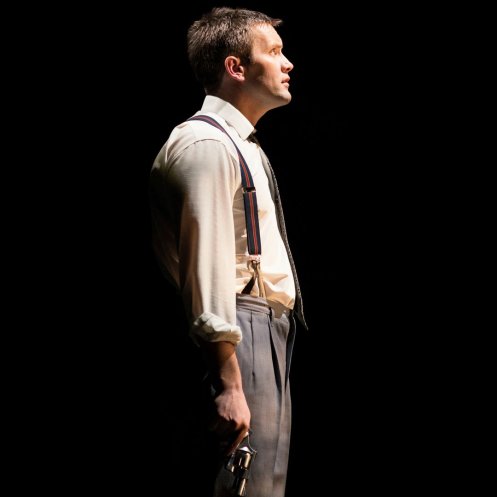
Equally the physicality of Jack Ashton revels that unbearable tension that builds in Haines’ mind. In this role, Ashton also gives an exemplary performance, as the spirit is sucked away from him as he is coerced into keeping his side of the bargain with Bruno. Appalled by his, albeit despised, wife’s murder, he cannot contemplate killing the innocent father of the resentful Bruno. By a gradual attrition, the constant phone calls, the stalking, the letters to his work colleagues, his clients and his fiancée, Haines is blackmailed into carrying out the deed. Haines’ huge emotional journey is precisely portrayed by Ashton in his delivery and his body language, halted advances towards Bruno, beginnings of a rolling of the sleeves, little gestures of a supressed fury.
Eventually Haines succumbs to the pressure, and we see him, thought a gap in the façade of Bruno’s family home, slowly mounting a staircase to the father’s room, gun in hand. The movement is deliberate, almost slow-motion, and set to Puccini’s sublime music, “O Mio Babbino Caro” (O, my beloved papa) from Gianni Schicchi. Nothing explicit, a crescendo of the music as the light fades. What a touching choice from the music design of the Ringham brothers, especially when you listen to the closing words of the aria, “Mi struggo e mi tormento … pietà, pietà!” (I grieve, I am in torment … have pity on me!). Brilliant!
There is biting irony in the choice of music. When alone, Bruno sings the habanera from Bizet’s Carmen, “L’amour est un oiseau rebelle …” (Love is a defiant bird), and when he is with his doting mother Elsie Bruno, his head on her lap, she sings the Victorian parlour song, Beautiful Dreamer to him.
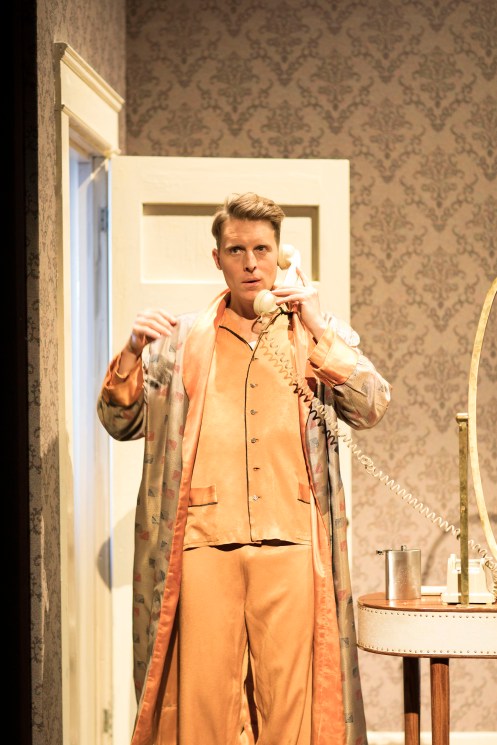
There is an edgy ambiguity in Bruno’s relationship with his mother. It is fuelled by Bruno’s resentment of his father, whom he depends on financially. Bruno’s oedipal reaction to her doting nature seems to go unrecognised by Elsie, even as she doles out her smother-love. Helen Anderson’s performance has a Tennessee Williams feel to it, the self- and son- indulgent nature coming sharply across, although she seeks to cling to her vanity.
Anne Faulkner’s relationship to Haines progress from mistress, to fiancée, to wife, even as, much to Anne’s consternation, his spirit disintegrates. She has an intuitive perception that something is badly wrong, but remains oblivious to Bruno’s interventions, even when he gate-crashes their wedding reception. Hannah Tointon, in the role of Anne, skilfully balances innocence and loyalty with disquiet and doubt.

As Bruno creepily caresses Anne’s neck while Haines is away, we are reminded of his recollection of Miriam’s strangulation, while we see yet another of the sublimated sexual impulses in Bruno’s perverted mind; repressed urges towards Anne, towards his mother, towards Haines himself, and towards violent and murderous assault.
However Haines is subsumed into the quagmire of Bruno’s charisma, in spite of the concerns of friends and colleagues. His successful career as an celebrated architect crumbles: his award-winning golf course in Palm Springs becomes too much associated in his mind with his late wife; he is passed by for the design of an office tower in New York when his client gets an anonymous letter from Bruno; and he loses the will to accept a commission that would fulfil his life-long dream of building a bridge, “white, with a span like an angel’s wings”. He declines prestigious projects, in spite of the attempts of his architectural assistant, Frank Myers, to bolster his failing confidence and to divert Bruno’s negativity. Sandy Batchelor brings a chirpy spark to the role of Frank, while Owen Findley brings a chumminess and fidelity to the part of Robert Treacher, a long-standing friend and one-time fellow student of Bruno’s, who pulls out all the stops to get him the white bridge contract.
The suspicions of Arthur Gerrard, a retired private investigator and old friend of Bruno’s father, lead to the unravelling of Bruno’s carefully laid plot. His pro-bono detective work and tenacity uncovers all. John Middleton’s rock-solid performance as the dogged Gerrard speaks of the intelligence, maturity and wisdom of the character. Gerrard decides that, since his private status puts him under no obligations to report to the authorities, he will do nothing, as both men have, and will suffer. His abandonment by his mother is a fate worse than death, and indeed proves fatal, for the now drink-besozzled Bruno, whereas Haines is now totally broken in resolve and riddled with guilt. Maybe Anne will bring him redemption, but who knows?
None of Highsmith’s stories has a happy ending, or any full resolution, which makes them, I believe, more interesting and more credible. Certainly, stage adaptations put them on a par with the bleak realism of Russian dramatists such as Gorky or Ostrovsky. Strangers on a Train is no exception, but its effect is intellectually satisfying in a way that the ordinary thriller could not be. On press night, an elderly lady sitting behind me, said “it’s not a proper thriller, because you know who did it right at the beginning”. Agreed, it is not a whodunit, not even a why-dunit, but more of an if-dunit: from the start of the play, you never know if, if, the fiendish pact will be fulfilled. That is why it is so gripping.
The destination is not the goal … the journey is. Never speak to strangers.
Mark Aspen
February 2018
Photography by RET
Marvellous Fun and Moving Poignancy: a Show for All
Iolanthe
by W. S. Gilbert and Sir Arthur Sullivan
English National Opera at the London Coliseum until 7th April
Review by Eleanor Lewis
This season’s Iolanthe begins with an appearance in front of the curtain by the character Captain Shaw who was the real chief of the 19th century London Metropolitan Fire Brigade and a well-known character, famous for attending first nights all over town. Captain Shaw, a sharp performance by Clive Mantle, entertains the audience for a couple of minutes while apparently waiting for the company to be ready. He notes that the audience is “a real melting pot, we have both the middle classes and the upper middle classes”.

Gales of laughter from said audience, but it remains an issue. Nicholas Hytner, director of the National Theatre (2003-2015) in his recent biography Balancing Acts, talked about the pressing need to attract younger audiences and people who simply don’t go to the theatre. Without a new generation of fans, the live theatre will die. For ENO, blessed with less subsidy than it would like, but with a mission to bring quality opera to a wider audience, Iolanthe is a show for all.

I am delighted to tell you that the fairy portal on St Martin’s Lane is now open, but only for a short period. ENO’s Iolanthe runs at the London Coliseum until 7th April, so mums and dads, aunts and uncle, bring the children.
The production itself is marvellous. It made me happy. The late, and greatly missed, Paul Brown’s design is beautiful. A luxuriant floral bower, warmly illuminated by Tim Mitchell’s soft lighting, is the fairies’ home. The distinctly Victorian fairies are each individually costumed with the emphasis on wit over elegance. Yvonne Howard as the Fairy Queen is equipped with a star-spangled, twinkly gown and armour-plated conical bra, (you can imagine her bladed-wheeled chariot waiting offstage). She has a couple of pyrotechnic tricks which are swiftly thwarted each time by Captain Shaw briefly reappearing.
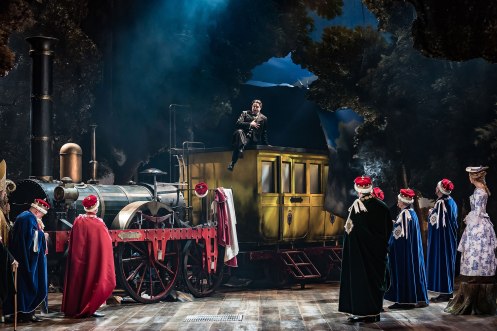
The peers enter via a huge steam engine which bursts through the stage backcloth spilling a mixture of noblemen as it rolls onstage. As might be expected there is a ‘Boris’ and a ‘Jacob’ amongst many other neatly observed characters. The first act closes with footlights gleaming on the assembled fairies with more warm, comforting lighting, it looks like a Victorian Christmas card.
What is magic though, is Cal McCrystal’s interpretation of this work. McCrystal directed the National’s hugely successful and painfully funny One Man Two Guvnors in 2011 and it is his rare talent for injecting precisely the right amount of anarchy into a production that he has brought to Iolanthe at the Coliseum. This comic opera, which was first performed in 1882 and last performed by ENO forty years ago, no doubt still works perfectly well when performed now as it was when written back then. W S Gilbert’s wit stands the test of time – indeed the Lord Chancellor’s Nightmare Song in this production was performed as written – but Iolanthe also lends itself happily to McCrystal’s additions. In fact it bursts into full bloom. Appearing against the Gainsborough backdrop, or the floral bower or the House of Lords (with throne) there are: a random flamingo, a unicorn, a singing pantomime cow, and there is some ‘business’ involving inexpertly handled model sheep and a sweet, brief bare bottom. Purists, I suppose, will have had a fit of the vapours at the last sentence but it all works, it is very, very funny whilst at the same time performed with a level of skill that means the reunion between Iolanthe and her Lord Chancellor husband in Act II is poignant and genuinely moving.

In 2016, an additional non-singing role was created for comedian Chris Addison in The Royal Opera’s production of L’Etoile. Similarly, though not necessarily in additional roles, McCrystal has involved three non-singing actors in his Iolanthe: the previously mentioned Clive Mantle as Captain Shaw; Flick Ferdinando as Fleta the fairy and Richard Leeming as Page to the Lord Chancellor. Richard Leeming is almost a living Ronald Searle character as he throws himself around the stage bringing a highly effective commedia dell’arte element to the proceedings. Their inclusion, again, the product of an inspired artistic vision.

Ronald Searle-ish elements are present throughout. The House of Lords set for the second act morphs into a Lords’ common room where the peers are all harassed and discombobulated by the fairies, occasionally flying across the stage. It’s very St Trinians, and/or Evelyn Waugh’s feckless journalists in Scoop. It’s very difficult to put your finger on – or to recreate – but very British.

Tim Henty conducts with relish. The sound of a full orchestra playing Sir Arthur Sullivan’s music as it was meant to be heard and giving the voices on stage a high platform from which to soar is glorious. The ENO chorus look as if they are thoroughly enjoying themselves. Ellie Laugharne and Marcus Farnsworth as Phyllis and Strephon are endearing and childlike as the young lovers, torn apart and then reunited, in their matching Spode blue and white Arcadian shepherd outfits. Andrew Shore as Lord Chancellor is unsurprisingly good, he is a charismatic stage presence, and Samantha Price as Iolanthe is both touching and funny.
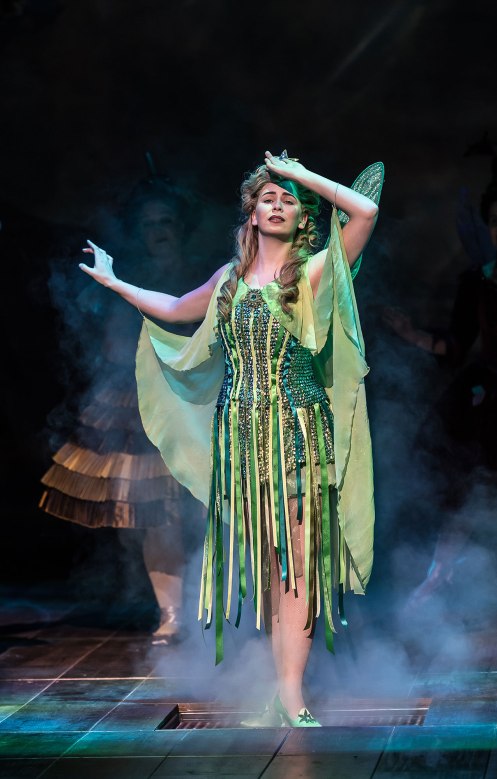
Personally, I could have lived without the small tap/clog routine – I think because the shoes made it clear something was going to happen when everything else was random. This was the only issue I could find with this fabulous and highly recommended production.
Where the purists are concerned, I should mention that in a box to my right, a child aged about eight and dressed in fairy wings and a small tiara loved the whole thing, she bounced up and down to the music and laughed in all the right places. She is the next generation.
Eleanor Lewis
February 2018
Photography by Clive Barda
Short and Sweet
Snow White and the Seven Dwarfs
Star Pantomime Group, Hampton Hill Theatre until 17th February
Review by Matthew Grierson
A long time ago, in a galaxy far, far away – well, last night in Hampton Hill at least – I was reminded of the opening to Star Wars. As the lights dim ahead of Snow White, the Fairy Godmother (Nicola Dean) scrolls through an in-depth prologue, before the show opens with a blast.
The dance number that kicks things off, and those that regularly punctuate the play, is spectacular. The choreography would be impressive enough for grown-up dancers, but with a chorus that ranges in age from (I’m guessing) three to late teens, it’s show-stopping. And that’s even before the gymnastics, all of which are Olympic in their confidence and accomplishment. At various points, the troupe also become villagers, servants and creatures of the forest, so there must be just as much choreography going on backstage to get them in and out of costume. They can all be very proud of themselves.

Just as charming are the seven dwarfs, played by a primary-age contingent of boys and girls who sport matching beards and costumes. They cope with a substantial amount of dialogue capably, rattling through a succession of puns on their diminutive stature with practised ease. Even when one of them dries they do not get flustered, and in fact it prompts the sweetest of prompts: Kate Turner, half in character as Scribbles the clerk and half in her role as producer, shuffles on in mock-disappointment, asks the septet to identify the culprit and, once she has reminded him (I think it’s Grumpy) of his line, sends them about their business.
The moment captures perfectly the show’s position in the overlap on the Venn diagram between “expertly staged” and “good-humoured improvisation”. While Turner herself rarely sticks to the script she rarely fails to steal a scene either, leaving Ian Pendry as the exasperated Justice Quill to keep the plot ticking over. I say “plot” but no writer is credited, nor a director come to that. So while the action hits the necessary beats – Snow White falls in love with Prince, check, Queen Avarice schemes to kill her stepdaughter, check, happy ending, check – it’s the muddle between these that allows the supporting cast to shine. In particular “GB” as housekeeper Edna Bucket, or, as she styles herself, “Edina Bouquet”, never seems more at home than when trying to improvise out of a situation or line that Scribbles has messed or missed.
The sitcom provenance of the dame’s name is not the only small-screen homage in the show. There’s a blatant steal from Morecambe & Wise in a gag about Ed(i)na’s singing, while the finale includes a beautifully choreographed rendition of the duo’s signature tune Bring Me Sunshine. More generally, the mixture of forestage humour, big numbers and dramatic interludes reflects the production’s debt to the variety tradition. The ad libs of Scribbles, dame and co. are buying valuable time for the changes of costume, scenery and players behind the curtain, so that the principals can earn just as much of our affection as the clowns.
Among them, Hayley Wheeler and Lewis Powysocki, as Snow White and Prince Ferdinand respectively, prove themselves especially versatile, keeping the action grounded but giving their songs lift. Powysocki’s version of I’ve Got You Under my Skin is affectingly carried, while despite a demanding amount of dialogue, dancing and vocals, Wheeler switches from one to the other effortlessly. But why is she so keen on housekeeping in “A Woman’s Touch” – hasn’t she heard the latest on the dangers of cleaning sprays? She doesn’t even get a rest at the interval either, but has photographs taken with members of the audience. A woman’s work is never done. (Incidentally, money raised from photos as well as box office proceeds is going to forces charity SSAFA, another good reason to see the show.)
Of course, no panto is complete without its villain, and Prussia Moore does everything to live up to the name of Queen Avarice. Her commissioning of put-upon plumber Slurp (Viv Benest) to cut out Snow White’s heart is gleefully evil, but she also channels the childish petulance of Miranda Richardson as Queenie in Blackadder to play to the younger members of the audience and cast. Even when banished to the diamond mine at the denouement, she stomps her foot like she’s been denied some sweeties. Moore is clearly relishing the part.
Keeping the audience amused is not always an easy ask, though, as jester Chuckles (Daniel Bosculescu) half-jokingly acknowledges when he calls us a “tough crowd”. Perhaps because it feels a little late in the season to start a panto, or the fact that it’s colder than Christmas out there, punters are a little slow to warm up. But after a few “Boos” from the wings, not to mention a little booze from the bar at the interval, we are properly getting into the swing of things by the second act, and along with the well-earned applause, the cast are even getting cries of “Encore!”
It’s a shame Snow White and the Seven Dwarfs has such a (pardon the pun) short run, as cast and crew have put such effort into it that it deserves to be seen. So if you’re reading this before Saturday’s finale, do catch it if you can.
Matthew Grierson
February 2018
Out of Melodrama Springs Psychological Insight
Dr Jekyll and Mr Hyde
by Robert Louis Stevenson, adapted by David Edgar
RTK and Touring Consortium Theatre Company at The Rose Theatre, Kingston until 17th February, then touring until 19th May
Review by Mark Aspen
There is a buzzing in the darkness.
Is there hidden is all of us a dark side? Is there a hidden demon awaiting the chance to spring forth? Is there hidden a basic animal behind our noble humanity? This question of the inner battle between good and evil, and of the duality within the human spirit, has been examined in many ways, theologically as God versus the Devil, and psychologically as the superego versus the id (a battle that Freud had fighting with the ego as mediator). The question was picked up in allegory by Robert Louis Stevenson in his The Strange Case of Dr Jekyll and Mr Hyde, a simple tale to illustrate a complexities of the mind, but with all the atmospheric trappings of the Victorian Gothic horror story.
The Gothic atmosphere certainly permeated the Rose Theatre on press night as the expectant audience at the opening of this spring’s tour of David Edgar’s adaptation as Dr Jekyll and Mr Hyde waited in the Gothic gloom for the start of the play. There was an excited buzz, accentuated by an edgy rumble, a taster of sound designer and composer, Richard Hammarton’s tautly haunting soundscape, which is accentuated by the equally haunting and ethereal singing of Rosie Abraham.
The Gothic atmosphere continues with Simon Higlett’s set and costumes and Mark Jonathan’s lighting. The multi-level set transforms effortlessly between dank 1880’s London, to a house in the country, to Jekyll’s drawing room, to his laboratory. For the last, the monochrome gains an eerie blue and light passes through the doctor’s colourful chemi’-set. The lab door is painted a foreboding blood red. Amongst the swirling smoke, you can almost feel the peasouper London smog.
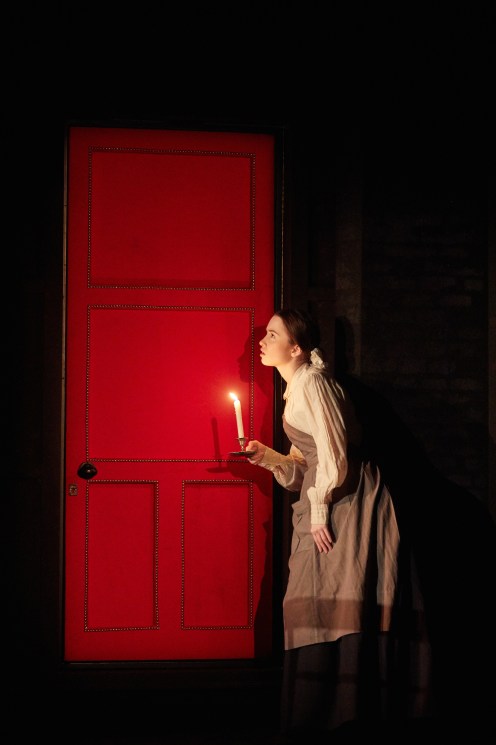
The Gothic atmosphere of Stevenson’s succinct novella, a century on in Edgar’s adaption, presented a much-thinned peasouper, however, a gruel of a maudlin melodrama. Edgar adds in a number of extra characters, some of whom are superfluous to the development of the plot and somewhat emaciate it. Nevertheless, towards the second half, out of the melodrama springs the nasty twists, albeit aching with psychological insight.
Director Kate Saxon has injected some deliciously scary moments and some sickeningly scary ones into what is otherwise a slow-burner of an adaptation, although there is the feeling that she could have made much more from a version closer to Stevenson’s original.
The extra characters are largely all female, brought in to Stevenson’s almost all male line-up. The intention seems to be to include sexual predation in Hyde’s list of crimes. To some extent this works, but seems to be there merely to follow the current Zeitgeist.
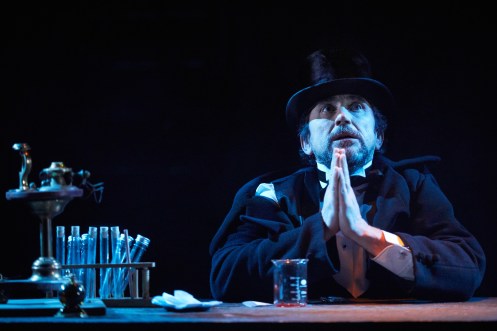
There is much scene setting. Firstly we find Jekyll and his three friends philosophising, including about the duality of human personality and how it may lead to “a fiend in human form” emerging, but when push comes to the shove they are unaccepting that this phenomenon could manifest itself in Jekyll. Dr Hastie Lanyon (Ben Jones), a fellow student from their medical school days, describes Jekyll’s theories as “balderdash”. Richard Enfield (Matthew Romain) is sceptical, but he is the man about town enjoying himself. The older and, he thinks, wiser of the three, Gabriel Utterson, a staunchly upright rational lawyer (in a robust portrayal by Robin Kingsland) cannot believe anything wrong of Jekyll even when the facts point otherwise.
The setting of the family background comes via a widowed sister Katherine, admirably played by Polly Frame, from whom we discover that the source of Jekyll’s dark knowledge is their father’s alchemic experimentations. Towards the end of the play, we also discover that the eye-patch she wears results from an eye injury in her childhood, caused when her head was smashed against a newel post, such that her brother could, in his own words, “hear the occipital bone crack”. Equally Katherine’s daughter Lucy (played by the versatile Rosie Abraham) is a victim of Hyde’s beastliness, but not violence, when his alter ego begins to emerge unbidden from Jekyll.
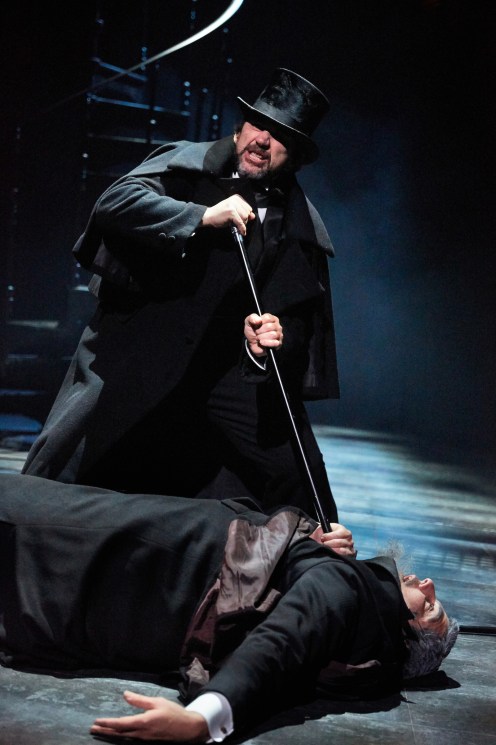
We eventually explicitly see the full extent of Hyde’s violence in the brutal murder of the elderly MP, Sir Danvers Carew (Ben Jones cleverly aged-up). Fight director, Kev McCurdy has recreated the full gut-wrenching viciousness of the attack: more bone cracking!
Edgar has borrowed quite heavily on other sources to expand the Stevenson original. The biblical “sins of the father” are evident in the adaption. The transformative potion is a formula of Jekyll Senior not one resulting from Jekyll’s own experimentation. The slashing of his father’s portrait is lifted from Wilde’s The Picture of Dorian Gray, as broadly is the idea of a mirror that Jekyll moves to his laboratory to observe his own disintegration, until the fearful time when “I look into the mirror and see nothing”. There is also a hint of a self-creating Frankenstein and his homunculus in this adaptation.
A heavy burden however is put on the actor playing the lead, for the role is doubly eponymous, he is called upon to play both Dr Jekyll and Mr Hyde. Disappointingly, this also robs the audience of a bit of theatrical magic in the transformation, but how does Phil Daniels cope in this double role? It is a hard task without opportunity for make-up or costume changes, but results in Hyde being a grotesque created by caricature. Daniels effectively alters his entire deportment from the tall erect (literally upstanding) Jekyll to the hunched and twisted Hyde, the confident stride becoming a suspicious scurry. So far, so good, but … the voice. As a nod to Stevenson, who was born in Edinburgh, Jekyll is given a soft urbane Edinburgh accent, whereas as Hyde he effects an impenetrable Glaswegian accent, what the more provocative youth of Edinburgh might call “thick Weegie talk”. (Thankfully, although the tour is going to Aberdeen and Edinburgh, it is not visiting Glasgow!) The result is to move our Victorian melodrama to Victorian music hall. Nevertheless, Daniels accurately portrays the degeneration of the respectable and principled Jekyll to the dissolute and brutish Hyde.
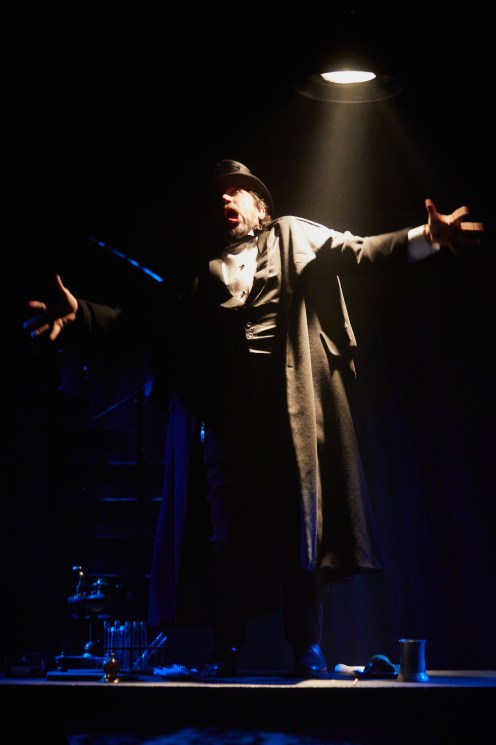
The Strange Case of Dr Jekyll and Mr Hyde has been described as “one of the best guidebooks to the Victorian social structure” and in this adaptation it is the servants who become the lynchpins of the plot. Poole, the butler, becomes almost a Greek chorus, powerlessly commenting on the unfolding tragedy. Poole is intelligent and concerned about his master, but fiercely loyal to him. Sam Cox plays the part to a tee. Poole is starchy, conscientious and unyielding, but firmly wedded to the concept of Victorian social hierarchy, and Cox portrays him with dry humour and withering facial expressions that add a light touch to the heavy melodrama. Equally, the added character of Annie, the maid who progresses, if that is the word, from Katherine’s household to Jekyll’s, has an enquiring mind and more insight into the burgeoning catastrophes that any of the other characters. It is Annie who becomes another victim and suffers a savage rape by Hyde, its depiction a deeply disturbing stage moment. Grace Hogg-Robinson as Annie accurately shows the character’s charm, her resolution and her vulnerability.
It is perhaps through Annie that we see that psychological insight springing from the melodrama, the truth springing from the caricature.
Eventually when Jekyll looks “little chink of light surrounded by an infinity of darkness” all he can see is “the devil in the darkness”, in what Utterson calls the “rancid burrows” of the mind.
Mark Aspen
February 2018
Photography by Mark Douet

 Mark Aspen