
Balanced and Gentle Performances
Tiger
by Joe Eyre
Joyous Gard at Network Theatre, Waterloo, until 18th February
Part of The VAULT Festival
Review by Melissa Syversen
Even before being asked to review it, Tiger had caught my eye in The Vaults Festival programme. It has a very intriguing premise. A man who is always dressed in a tiger costume. In short it is the story of Alice and Oli, a couple who are looking for a flatmate. Having recently had a terrible loss, Alice has stopped working as a stand-up comedian and they need help paying the rent. While Oli is at work, a man dressed as a tiger comes to view the room. Though initially thrown by this, Alice finds a rapport with Tiger, as she affectionately names him and offers him the room.
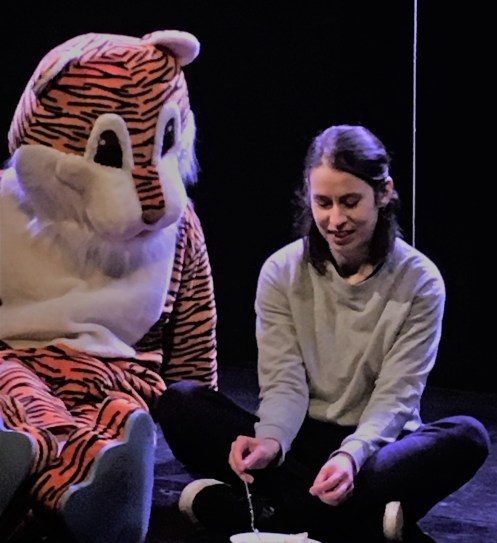
Written by Joe Eyre, Tiger is one of those lovely pieces that successfully manages to balance the line between comedy and drama. Eyre’s strength as a writer is evident especially in the way he has tapped into the, if I may say, remarkable everyday aspects of grief. Grief is painful, it is all-encompassing. Someone you loved just ceases to exist yet paradoxically, the normal world continues around you. The bins still must be taken out, bills must be paid. It is an absurd state of being in flux and there is a lot of humour to be found there. So, by meeting Tiger, dressed as he is and speaking in an outrageously thick New Jersey dialect, Alice is given something equally absurd as her situation to connect with. The play isn’t just fun and jokes though, there is pathos to be found. The scene Alice opens about her loss, whilst struggling to hold herself together is particularly potent and will probably ring painfully true to many who have lost someone dear to them. Stephanie Lane is a solid performer throughout this play, but that scene and her final vulnerable and heartfelt speech to Oli are truly stand-out moments. James Burton has arguably the trickier role of the “straight man” of the piece as Oli but he imbues him with a subtle undercurrent of emotion as Oli fights to support Alice in her grief and unconventional choice of a flatmate. And bless Joe Corrigal, not only does he give a surprisingly gentle performance as Tiger, he does it with what must be a very hot costume and one of the trickiest dialects out there.
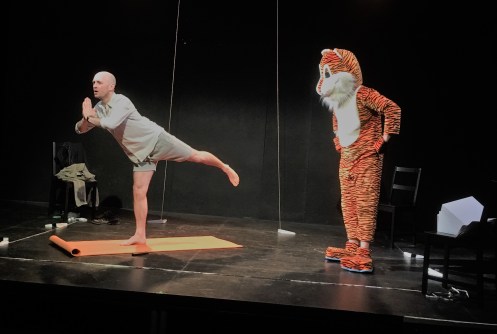
If I had one wish though, it would be that this piece was, say, ten minutes longer. There were moments of movement sequences reminiscent of sitcom montages, though well made, seemed rushed. The passing if the story was quite jarring in the middle. To use a metaphor: If the play is a mountain and the climbing team is the audience and the cast, we had a nice even climb during the first half. We were introduced to our three teammates and patiently and pleasantly began our journey. But then as we approach the dramatic (mountain) peak, suddenly the mountainside turned into a very steep uphill climb and the better trained cast out-climbed us and left us behind. As we were still climbing to catch up, there was then a triple of tropes thrown at us like snowballs in very quick succession. To paraphrase: The ‘He lied to us!’, and I don’t think I want you anymore…’, and at last but not least: ‘Don’t do it, life is worth living…!’ The sharp gear shift in speed (there is a car in this metaphor, I guess?) It made the peak feel truncated and melodramatic as we the audience were left behind to really earn the emotional payoff.
But keeping that in mind, it is a good sign that I wish I had more time with these characters, and not less. I enjoyed these characters, I enjoyed the writing, I enjoyed the lovely designed set. (I also enjoyed seeing a dramaturg on the list of creatives.) I loved the idea of a man dressed as a tiger, and what stories such an idea could develop into. And regarding the issue of time, I do appreciate that as a fringe production at The Vaults Festival, time (be it for performance or tech) is limited.
If you are free, do make time to see Tiger at the Network Space at the Vaults. If unable, then do keep an eye out for other works by Joe Eyre, and the theatre company Joyous Gard. I know I will.
Melissa Syversen
February 2018
Photographs of Beth Eyre
Connection with Genuine Enthusiasts
Tchaikovsky and Rossini: The Mozart Effect
Opera Foundry at Ormond Road, Richmond, 10th February
Review by Vince Francis
And so to the Unitarian Church in Richmond on a bracing Saturday evening, when England beat Wales in the Six Nations (but we won’t dwell on that unduly), for an intriguing assignment taken at the last minute.
Tchaikovsky and Rossini: The Mozart Effect, presented by Opera Foundry is, effectively, a lecture with music, or, to put it another way, a concert with student notes. However, that’s not to say that it lacked entertainment value.
So, who are Opera Foundry and what is their business? Well, according to the Opera Foundry website: “Opera Foundry is a Surrey based Opera Company serving London and the South East. We are a highly regarded platform for advanced singer development and our membership (selected from across the whole of Southern England) is showcased in our performances. We present vibrant opera concerts in programmes that defy (and exceed) the expectations of the format.”
It goes on to promise: “ … the highest level of musical and vocal preparation; rich, intense, intimate singing; intelligent, passionate and historically informed programming; opera by Opera specialists”
OK, so, some fairly strong claims there. How did they match up? Well, to start with, I’d have to make a confession and say that I’m not an opera lover. I don’t hate it; it’s just that I have never found a “connection” with it and certainly not the connection that genuine enthusiasts embody. Opera Foundry is clearly made up of such enthusiasts and that shone through.

The high points for me, therefore, were possibly different from those that a genuine enthusiast might identify. David Padua’s rendition of Lensky’s Aria from Yevgeny Onegin was, for me, an object lesson in how to inhabit a lyric and communicate the content. And then there is Opera Foundry’s repetiteur, the pianist Sarah Quantrell. What can we say about Sarah Quantrell? She has probably heard all of this numerous times and, to my mind, with good reason. This was a long evening and there was a wide range of musical styles to get to grips with. In my humble opinion, Sarah’s playing was the easily the match of this programme and then some. A phenomenal musician.

There were a couple of glitches. As someone who spent their working life in technology, the risks of using electronic kit in a presentation of any sort are myriad and one or two were encountered here. The surtitles somehow got out of sequence with the sung lyric at one point and there appeared to be some difficulty in powering the kit up again after the interval, which was distracting. Sonically, a church can be a bit of a gamble when it comes to producing music which requires the detail to be heard and the natural reverb in the sometimes had such a “blurring” effect.
My overall thought was, this is a valid idea, but it would benefit from something like a producer and/or an editor? For me, each half was a bit overstuffed. I found the repeated arch references to things that “would become clear later” a little tedious, particularly when they didn’t, or weren’t confirmed to be.
Was I converted? I’m afraid not. There was much to admire in this performance, the musicianship and vocal production were generally outstanding and, on an intellectual level, it was interesting to get a perspective on the connections and influences between Mozart and Tchaikovsky and Rossini, but my boat remains above the high water mark.
Vince Francis
February 2018
Photograph of Sarah Quantrell by Robert Piwko
An Encapsulation of Mesmerising Imagination
The Jungle Book
by Jessica Swale, adapted from Rudyard Kipling’s stories.
Children’s Touring Partnership and Royal & Derngate at Richmond Theatre until 10th February, then on tour until 12th May
Review by Viola Selby
Deep within the urban Jungle of Richmond, a group known as The Children’s Touring Partnership are putting on a wild performance of a tale that is well known but which has never been told like this before. Through first class acting, mesmerising costumes and stage sets and a musical ensemble brilliantly created by Jessica Swale and Joe Stilgoe, the audience are transported into the heart of an Indian jungle and become a part of the adventures of Mowgli and his friends.

To begin with, the stage is set with just a bed and a small light, just on this one prop. There is no noise apart from the atmospheric humming of one of the two actresses on stage. This is just one of the many clever set designs, created by the ingenious Peter Mckintosh, which encapsulates the audience and allows their imaginations to run as wild as the animals on stage. The use of wooden panels and ladders act perfectly as trees and vines, turning the stage into a tropical playground. This same level of creative genius can also be seen through the costumes of the characters. Peter Mckintosh has really outdone himself with his amazing line of outfits that truly highlight particular traits of each animal. One particular outfit that left me gobsmacked was Kaa’s body. A beautiful long green tube constantly wriggling and writhing like a real snake. This as well as all the others, from the fiery orange stripes of the tiger to the use of crutches as the front legs of the wolves, makes this show not just a pleasure to listen to but an absolute treat for the eyes.

As the story progresses, the actors continue to astound and amaze. Through the witty writings of Jessica Swale, childhood favourites such as Baloo and Bagheera are given a whole new lease of life and are made relatable both to adults and children alike. Although Baloo, performed by the talented Dyfrig Morris, is still as hilarious as ever, Bagheera is now a sassy feline, portrayed by the top cat herself Deborah Oyelade, who will not let any male mammal tell her what to do. Whilst the very agile Kesiah Jones, as Mowgli, manages to master the subtlety of character development, through the way she shows Mowgli’s realisation of who he really is and becoming a man.

One thing, however, viewers may find strange is their draw to the baddies. Although I knew I was meant to be fully against Sheer Khan, his bad boy image and being clad in a black and orange leather biker outfit, with the exceptional rock-n’-roll vocals of Lloyd Gorman, it was hard not to be a fan girl of the bad boy of the jungle. I also found myself and many of the adult audience members relating very strongly to Kaa’s sulking over the awfulness of ageing as she shed another skin.

In addition to this artistry and talent, there are also many other scenes that create humour and keep the audience very much entertained. For example, one of my particularly favourite parts was meeting the infamous monkeys, who have been given a modern makeover. They have now created a group called The Funkies and keep audience in stitches with their street slang and awful jokes. Whilst the occasional use of audience participation keeps all audience members, young and old, fully engaged and everyone clapping along to the music, the play has a wonderful overall feeling and message of inclusion, making this one adventure to the jungle all the family will enjoy.
Viola Selby
February 2018
Photography by Manuel Harlan
The Mozart Effect, at Ormond Road Richmond on Saturday 10th February
Richard Cartmale and Opera Foundry
Mark Aspen chats with ex-ENO singer and conductor, Richard Cartmale
Last year Opera Foundry presented The Language Series, which skilfully presented the essence of opera in the Italian, French and German languages in three separate productions. William Vine reviewed French Opera for Mark Aspen Reviews and Mark Aspen in turn gave a detailed critique of German Opera. Opera Foundry now returns to Richmond in 2018 with a brand new series, The Great Composers Cycle. Mark Aspen interviewed Richard Cartmale, the Musical Director of Opera Foundry after the opening of its new production in Guildford.

Richard Cartmale Photograph by Emma Stow
Mark Aspen: Having had the great pleasure to review your German Opera concert last year in Richmond, I am delighted to hear that Opera Foundry is returning to Ormond Road this weekend with your new project. Could you tell me a bit more about your current project?
Richard Cartmale: It is very pleasing to hear how much you enjoyed Opera Foundry’s Language Cycle, and this year the intention is to follow the pattern of having three foci for our concert, as we did in turn last year with Italian, French and German Opera. Our Great Composers Cycle uses three anchors of the repertoire, Mozart, Verdi and Puccini.
Mark Aspen: I believe you put your toe in the water at Richmond a few years ago with a similar series.
Richard Cartmale: Oh yes. It was the first time we did this, in 2015. We presented an all-Mozart programme followed by an all Puccini and an all Verdi. Artistically this was surprisingly successful. In the case of Mozart, which we presented at St Mary’s Parish Church in Richmond, we had a large and enthusiastic audience.
Mark Aspen: Why do you say “surprisingly” successful?
Richard Cartmale: Well, Opera Foundry’s main raison d’être is the development of emerging opera singers. We are a highly regarded platform for advanced singer progression and our performances act as a showcase for our work.
Mark Aspen: So the concerts largely emerge from the development of singers already established in the field of opera?
Richard Cartmale: We try to retain a core of nineteenth century opera-house repertoire as something directly applicable to the development of our singers. In practice this means that our membership, which is selected from across the whole of Southern England, will be showcased in our Great Composers Cycle.
Mark Aspen: I once described your concerts as opera for the thinking audience. But does your audience have to be opera buffs?
Richard Cartmale: Far from it. We believe that Opera Concerts can be, and should be, a vital, engaging and richly satisfying experience for any music lover. If you are a seasoned opera-goer, our concerts are a wonderfully satisfying way to bridge the gap between trips to major productions. If you are new to the medium, then you can discover more music in one evening than you ever could seeing a single production. You will also hear more singers. A full Opera Foundry concert features at least twelve soloists. Sometimes it is more. You will hear duet trios, quartets, sextets as well as arias.

Sarah Quantrell, Principal Repetiteur Photograph by Robert Piwko
Mark Aspen: Richmond upon Thames is of course an area well known for its immersion in the arts. Hence, the potential audience that you have just described will be local opera goers and music lover.
Richard Cartmale: More than that. That audience can be as wide as it wants to be. Whilst we are not doing this from any crowd-pleasing perspective, we have gradually become aware that there are a decent number of opera-lovers within the Richmond area – people who actually appreciate an intelligent and thoughtful programme and high musical standards. The problem is always convincing them that they won’t be attending another rambling aria-fest of poorly-delivered favourites.
Mark Aspen: So what can we expect from The Mozart Effect, this weekend in Richmond?
Richard Cartmale: At least partially inspired by some of your comments on the Mark Aspen website, as well as discussions with colleagues, we are now presenting a more thought provoking mixture. In later concerts, Verdi will, in due course be presented in the context of his contemporaries, as will Puccini, but before that we are putting together an exploration of Tchaikovsky and the not so obvious relationship with Mozart’s music. This is against the backdrop of the three Mozart operas with Da Ponte libretti.
Mark Aspen: Then Richmond will be treated to an interesting insight into the way these famous operas came into being.
Richard Cartmale: We wish to contextualize the repertoire and expand the development opportunities of our singers, at the same time, as part of a more pro-active programming policy that will engage our audiences.
Mark Aspen: The Guilford audience loved The Mozart Effect, so now it is Richmond’s turn at Ormond Road on Saturday 10th February. We look forward to it.
Richard Cartmale: We can promise you, the highest level of musical and vocal preparation to give you rich, intense, intimate singing and intelligent, passionate and historically informed programming. It is opera by opera specialists.
Mark Aspen: I will be there, at glass of wine at the ready for the 7:30pm overture.
More details are on the Opera Foundry website.
Photography by Robert Piwko
Sketches for a Farce
Liberty Hall
by Robin Jennifer Miller
Rare Fortune Productions at OSO Arts Centre, Barnes, until 10th February
Review by Matthew Grierson
Young Tom clearly has the imagination of a seasoned farceur. I mean, why else take his new American girlfriend to a posh hotel in the country and pretend it’s his ancestral seat? Thank heavens the hotel’s owners are willing to play along with their guest’s fancy to ensure misunderstandings are maintained.

One such misunderstanding is that the framework of farce is itself sufficient to sustain proceedings in the absence of rigorous plotting: too often, Liberty Hall depends on farcical logic rather than offering any sense of why its protagonists are behaving as they are. Characters enter, exit and make proposals without suggesting that they have personalities or indeed agency of their own. Precious time is devoted to telegraphing plot developments that are not then sold by the performances, while other disclosures blindside with their unpreparedness.
Bradley Crees as Tom exemplifies the play’s laissez-faire approach. Having gone to some lengths to impress his new girlfriend Zoe (Susan Casanove) by arbitrarily aspiring to be a real-life Hugh Bonneville, he conveys throughout a self-satisfied indifference to events. Even when Zoe and his ex, Anna (Georgia Riley), are both in the same room, he prefers to smirk rather than exhibit the anxiety you might expect. It is not long before it becomes evident that he and Anna will get together again and that Zoe will pair off with Tom’s best pal Colin, but the respective chemistries do not convince that the play is doing anything more than arranging a curtain call with four neat couples.
Similarly unlikely are the play’s Americans: Marvin Monroe – intentionally or not sharing the name of The Simpsons’ resident psychologist – has less psychological complexity than the current POTUS, while daughter Zoe has to remain gullible enough to be swayed by Tom’s wanton pretence at aristocracy. At least Kenneth Michaels’ broad, brash characterisation of Monroe matches the script’s limited understanding of our transatlantic cousins. Why, he even gamely falls in love first with Colin as dragged up as “Harriet Grey”, and then, once “she” is out of the way, with English teacher Miss Davis, having conveniently remembered that he met her on a cruise years earlier. Seemingly given to such spasmodic revelations, Michaels also skips a cue to send hotel staff looking for drugs in a suitcase before anyone else has announced their suspicions; in a taut, well-scripted production this might be forgivable, but here it compounds the sloppy dialogue and chopped logic.
Credit where it’s due, though: the rest of the cast don’t bat an eyelid at the slip and keep things moving briskly along. The play’s few highlights indeed depend on what energy and enjoyment the performers are able to bring. While no motivation is provided for her to do so, Julia Haythorn as Barbara clearly relishes the chance to act up as “Lady Stokes”. Such is the gusto with which she tackles the role of frosty aristo I wondered why she did not in turn volunteer herself to be “Miss Grey” as well … which would have made more sense than dressing Colin up as the fictitious English tutor. The only reason for this seems to be that it’s funny to see a man impersonate a woman badly (no slight on Alexander Jonas as Colin, who makes a good fist of a poor part). It might have been more satisfying had the script established him as Tom’s put-upon stooge rather than cheery factotum, so he could seize the opportunity of his transformation into a woman to come out of his shell and declare his love for Zoe. As it is, Tom gleefully strands him in his transvestism for no good reason and, just as improbably, Colin remains in drag until, stretching credulity still further, he is escorted offstage by Zoe and Anna as two ersatz police officers.
There are several such situations in the show, contrived to be incidentally amusing but squandering the opportunity to offer a more coherent – and funnier –story. Barbara, for example, spins a good yarn about the ghosts said to haunt the house, but other than a momentary confusion late on when Miss Davis rises from the banquette with a white blanket draped over herself, the joke goes nowhere. Couldn’t the spooky story have provided Tom with valuable cover for the appearance of Anna, whom he might have characterised as the Scarlet Lady? Once such entertaining possibilities occur, it’s difficult to remain engaged with the action as it appears on stage. Matters are not helped when lengthy set-ups are abruptly discharged like squibs – why is there so much business with the bags? Why is nothing made of George’s desire for a sneaky cigarette? What prompts Miss Davis to get so quickly drunk when she is a professed teetotaller? Comic potential is also thrown away when characters sit down and recap the plot to one another, as though the play were frightened of causing too much confusion.
Announcing itself as “a new farce”, Liberty Hall is sadly neither of these things, too concerned with rehashing the motifs of the genre without a framework of its own strong enough to hang them on. New farces have been more successful paying homage to the tradition while finding something fresh to do with it (as Suff’ring did, for instance). Writer and performer Robin Jennifer Miller acknowledges her debt to the genre in her programme notes, and despite token references to the present day, the play does seem to inhabit a generic mid-century setting where it would sit more comfortably. In the 1950s, it might have been at least plausible that an English Lady or an American gent might have had “old-fashioned” attitudes to the proclivities of their offspring, who are all clearly old enough to decide with whom they hop into bed. But if Miller’s goal is to celebrate a golden age of farce, why not simply revive one of those earlier, better-crafted plays? George’s line “It would help if I knew why we were performing this ridiculous charade” may be intended as a wink to the audience, but I felt more like wincing given that it nails the action’s lack of rationale.
Liberty Hall is at least a rewrite and a couple of rehearsals away from being a satisfying piece. As it is, it lacks the motivation or momentum to enable the suspension of disbelief, and is as delusional as Tom claims Anna is: it’s definitely not the play it imagines itself to be.
Matthew Grierson
February 2018
Image courtesy of Rare Fortune Productions
Tea, Scones and Tension
Say Something Happened
by Alan Bennett
NTC at Network Theatre, Waterloo until 4th February
Review by Georgia Renwick
In a departure from the more off the wall, experimental Vaults Festival fare going on all around, Say Something Happened is a rather more sedate offering out on the fringe, tucked away in the independent Network Theatre. The one-act play is a stage adaptation of a 1982 Alan Bennett television drama. Bennett fans will know that his work has a lot to say on the relationship between youth and age, and in our current oppositional political climate, his throwing together of their perspectives feels ever more pertinent. Are their attitudes really as oppositional as they would have each other believe?
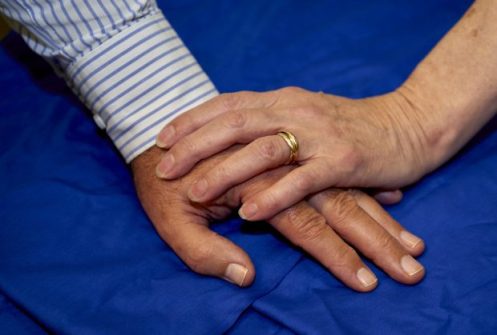
Mam and Dad are comfortable enough in their life together in their little grey living room. Mam twitches the curtains, watches the leaves pile up on the path and spies on the neighbours. Dad reads his atlas from his armchair and happily collects postcards of faraway places from his ‘career-women’ daughter. But then the doorbell rings. Confronted with a young and inexperienced social worker from the council, brandishing a briefcase full of notes and a local authority care questionnaire, all three must face fears about their futures as they work begrudgingly down the list.
Facing the future, as we all must do it, is often not easy. As Mam and Dad bat away questions regarding their health and future care plans, the young June reads from her notes that it is quite normal to “refuse to recognise the approach of old age”. They are older people, not old people, she is quick to clarify, but the sour expression of Sarah Wenban as Mam is more than enough to clarify how she feels about this grammatical inflection. She captures the matriarch with a no-nonsense sternness, a defiant stubbornness and unequivocal vigour. Unequivocal that is, until Mam crumbles like her scones that June Potter, the care worker, reluctantly eats. But even in her moment of emotional revelation her stiff upper lip barely wobbles for a moment, before her personal wall of stubbornness is rebuilt.
It in these moments, as hospitality is forcibly laid on June in the very British form of scones and tea, that June becomes flustered and the tables turn. She has fears of her own, fears that any young person embarking on an uncertain career path can tap straight into despite the 36 year lapse in time. Has she made the right choices? Is she the ‘people person’ she wants to be?
June’s anxiety is played wide eyed (a little TOO eye-poppingly wide eyed at times it ought to be said) by Tekle Baroti. Her loudness and awkwardness jar with Mam and Dad’s quiet, moderated ways in an appropriate youth vs. age fashion. Her accent jars with their soft Yorkshire lilt too, although it is not clear whether this is intentional, it does serve to distance her from Mam and Dad and their quiet, quaint Yorkshire life.
John Irvine, as Dad, provides a dose of calm with his softly-spoken performance. His grandfatherly way towards June is easy to warm to, that is until it is revealed he has a secret of his own. A secret from which he is dying to escape. It is a harsh reality to face what we have done, but harsher still to face what we could have done, but never will never do.
With just three actors to play with, Daniel Carter has created a set with an uncomfortable, claustrophobic quality to it. Director Charles Leo Raine resists the temptation to have them up and about playing musical chairs, so when a movement is made, it carries weight. The characters are left writhing, desperate to move, but are frozen in their fearful inability to take action. Youth and age, it seems, have that in common.
Georgia Renwick
February 2018
Photograph by Phil Lunnon
A Crime Noir Drama – With a Twist.
Double Infemnity
by Naomi Westerman, Catherine O’Shea, and Jennifer Cerys
Little but Fierce and Paperclip Theatre co-production at The Vaults, Waterloo until 4th February
Review by Georgia Renwick
The Vault Festival, currently taking place in the underbelly of Waterloo station, is the place to be for the new and experimental, and what better setting than the dark, damp arches of the underground for a crime noir drama … with a twist.

Our trilby hat-donned, mac-wearing, whiskey-sozzled, ruthless super sleuth … … is a she. As Effie-Lou leads us on her solo search for her missing partner, Jo, she is not only fighting crime but the sexism of the 1960s. She solves crime and subverts gender stereotypes wherever she goes, and boy have co-writers Naomi Westerman, Catherine O’Shea, and Jennifer Cerys have really gone to town on the stereotype busting!
Her new partner Brad, pretty but dumb, wanders in and out of the office (by means of a projection and voice over) half naked, reminiscent of the underwritten-oversexed female co-part in countless films both in and out of the crime genre. “Oh, go put a shirt on!”, she sighs with exasperation, “don’t play the goon, that role is usually reserved for me”. Then there are the cups of coffee she must make, the meetings she is butted out of, the gropes and period jokes. This play may be set in the 1960s, but these are a list of office grievances with an unmissable contemporary relevance. It’s no secret that office sexism still abounds.
Whilst the script is sparky however, opportunities have been missed to create much of anything suspenseful or sinister. With all the one-liners when the plot does take a serious turn towards sex trafficking, it is hard to take seriously. The ‘baddies’ are satirised with manic laughs and strange projections, it’s funny but it never really feels like there is a great deal at stake.
Similarly, with the stage and technical design the sinister factor is lacking. With a strict budget I imagine moody streetlights, driving rain or swirling cigarette smoke are hard to recreate, but perhaps some atmospheric music between scenes or some more dramatic lighting (to cast those sinister long shadows) would have aided in making it visually more reminiscent of that classic LA crime noir scenography. There are so many era references and cues in the evidently well-researched script, the opportunity is there to transpose more of them from the script to the staging.
Katrina Foster does a stellar job of keeping up the momentum of the monologue with oodles of sass. However, as Effie’s fierce feminist-heroine mode never really lets up enough to show her vulnerability, there aren’t many other levels to play with.
The decision to bring other characters in as sound clips was not a help to Foster either. The clips made the characters feel far off, and the challenge of timing them with Foster and the projections sometimes stalled the action. When Foster had the opportunity to don a wig and play a ‘baddie’ (hanging nonchalantly on a wall throughout, a nice touch) this was refreshing. She breathed life into the part a great deal better than voice clips could have done.
The laughs were the loudest and the play at its best when the audience were being directly engaged by Foster, moments that allowed the audience to be more intimately included in Effie’s one-women mission. Overall, it is an hour of feminist infused fun. Now the challenge will be to take the show above ground, whilst taking the story deeper into the crime-noir world.
Georgia Renwick
February 2018
Image courtesy of Little but Fierce
A Painfully Human Story
A View from the Bridge
by Arthur Miller
Teddington Theatre Club, Hampton Hill Theatre until 3rd February
Review by Melissa Syversen
In the neighbourhood of Red Hook, situated in Brooklyn not far from the famous Brooklyn Bridge, we meet the Carbones, your seemingly average Italian-American family. Eddie Carbone works as a longshoreman and lives with his wife Beatrice and her 18-year-old niece Catherine who they took in when Beatrice’s sister died. They are happy, loving and pride themselves on hard work. When Beatrice’s cousins Marco and Rodolph, two illegal immigrants from Italy, come to stay with them tension rises as a romance develops between Catherine and Rodolpho. As one of his most famous plays, Arthur Miller’s drama A View from the Bridge is (quite deservedly in this writer’s opinion) a true modern classic. It is in equal parts a uniquely American story and a traditional Greek tragedy. We follow as a hard-working everyman, carving out his part of the American dream, only to be brought down by his own tragic human flaw and hubristic inability to acknowledge his mortal sin. A man of the surrounding community, personified by the lawyer Alfieri, looks on, unable to stop the events from unfolding before it undoubtedly reaches its tragic end.
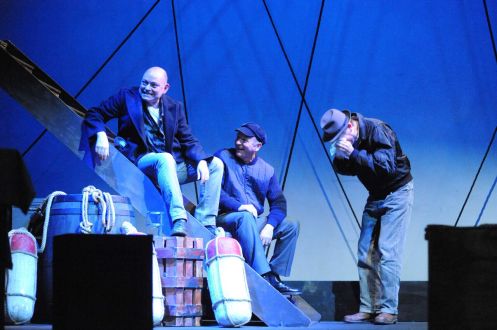
In previous reviews of TTC production I have praised the club for their ambitious choices of material to bring to the stage, and this time is no different. A View from the Bridge is a mammoth of a play. The sheer scope of themes, motifs and emotions ripe for the picking in Miller’s script continue to attract the very biggest names working in theatre since the two-act version we know today premiered in 1956. Never to be daunted by such things, the cast and crew of TTC give it their all, and more importantly, make it their own. And happily, despite my trepidations, it goes well beyond my expectations handling the infamously difficult Brooklyn-Italian and Sicilian dialects needed. Not every pronunciation might be perfect, but they get the rhythm and cadence right, and that together with earnest commitment goes a long way. A great example of commitment: Matt Nicholas is so charming and likeable as the young dreamer Rodolpho that I am more than willing to overlook that he sounded more and more like my Croatian friend Andrija as the play went on. I mean that in a good way.

In the lead role of Eddie Carbone, Daniel Wain cuts a defined and specific character. He sometimes moves dangerously close to a Joe Pesci-ish pastiche but saves himself by fully grounding Eddie with remarkable pain behind the bravado. He also has a likeable charm which makes Eddie’s descent into more and more obsessive and toxic behaviour particularly wrenching to watch. (And bless him, Daniel also impressively soldiers on like a pro during an unfortunate costume malfunction that happened in one of the main confrontational scenes of the play.)

As Marco, Paul Furlong, in particular, stands out by giving a beautifully understated performance. Here is a man who is torn, a man who sees what is happening, sees the way his brother is being treated but say nothing in fear of losing the work he desperately needs to support his wife and children starving in Italy. The role of Marco, like Beatrice, (a rock-solid and heartfelt performance by Susan Gerlach) is probably one of the trickier and underappreciated roles in Miller’s canon. They are not the romantic leads of Catherine and Rodolpho nor the tragic figure of Eddie but are equally vital players to the story. They, like our narrator Alfieri (Jim Trimmer) see what is happening, but both are unable to escape the black hole they are slowly being sucked into.


Director Dane Hardie wisely makes the cast and text its focus and that is this production’s strength. Never does he lose sight of the humans at the centre of it all, keeping his direction, set and technical elements simple and straightforward (though I did enjoy the recurring red hook). A View from the Bridge is a shorter play so even with a twenty-minute interval, it clocked in at exactly two hours. The slow burning of the 1st Act is somewhat undercut by a rushed 2nd Act, culminating in a blink and you’ll miss it ending. For all the strength of this show, I wish the 2nd Act was allowed to breathe a bit more. We never really get a moment when Eddie realises the true reasons for his actions and where they are leading him. We never see the moment when he could have made the choice to stop but decides not to. Because of this some of the nuances are lost and the emotional weight the final moments falls a bit flat
I once had a conversation with a friend who was trying to decide whether Marco or Eddie was the bad guys of the story and what the overall moral was. To me, though I did not point it out to my friend at the time, these questions are somewhat beside the point. Eddie was, despite his end, a good man for most of his life. A loving husband who worked hard and helped others in need be it his niece or his wife’s cousins. However, the love he had for his niece grew into something darker, something he might not even fully understand, nor the ramifications it would have, before it was too late. By the time Beatrice finally says it out loud, he is in too deep in the narrative, and in the excuses he has constructed to justify his actions and feelings of jealousy, and suffers the fatal consequences. Good guy or bad guy, it is a painfully human story. One that reminds us that we are all vulnerable creatures capable of fatal flaws.
Melissa Syversen
January 2018
Photography by Sarah Carter
A Tide Taken at the Flood
Sleepers in the Field
by Peter Whelan
World Premiere
Questors Theatre, The Judi Dench Playhouse, Ealing, until 3rd February
Review by Mark Aspen
“Do you fight against those you hate, or for those you love?” is one of many questions thrown up by those caught in an all-pervading war, the characters in Peter Whelan’s play, Sleepers in the Field, which is being given a posthumous premiere by the Questors, a company of which the renowned playwright was a member.
Set in the north midlands during the Second World War, the characters are well-drawn recognisable people, who would have been even more recognisable to the grandparents of most of the audience. Each of the characters has a definite and robustly expressed attitude to the war, and their differing opinions form the dramatic tension in the play. This is both the strength and the weakness in the writing. Whelan has clear portraits of his protagonists but their opinions come across as black and white clichés of certain views. Whelan was clearly trying to use them as allegories for the political problems of the present time. Hence Sleepers in the Field doesn’t quite have the coherence of Whelan’s earlier plays on an historic theme, such as The Accrington Pals or The Herbal Bed and the didacticism tends to get in the way of the emotional development of the plot.
Nevertheless, Questors has made this play its own and one senses the dedication of director John Davey and his cast and crew, in a production that engaged the first night audience.
The plot centres around the lives of the Walsh family over eighteen months from the summer of 1940, when we find them building an Anderson shelter in their garden. Left-leaning Ted is a skilled engraver, largely self-educated, especially in philosophy and socialism. He thinks the war is Churchill’s project. His wife Binnie, an anxious worrier, wishes it would end. His daughter, Marion, is a passionate patriot, fervently wishing Hitler’s demise. His son, fifteen-year-old Joe, and his pal Roy Minshall, are vicariously enjoying the adventure of war. Joe and Roy’s maths teacher, Leslie Nicholson, is a would-be pacifist. Next door neighbour, Dinty Moss, is a pragmatist, making what he can of (and from) the war, from “the tide of life”. 
This is the neighbourhood into which wanders the enigmatic Mr Sand, rendered dumb by the war, lost. Meanwhile, into Marion’s life marches the sceptical Sergeant Jill Williamson, and, with the emotional devastation of an artillery shell, Captain East, ex-public school, doing his duty by the book, dashing.
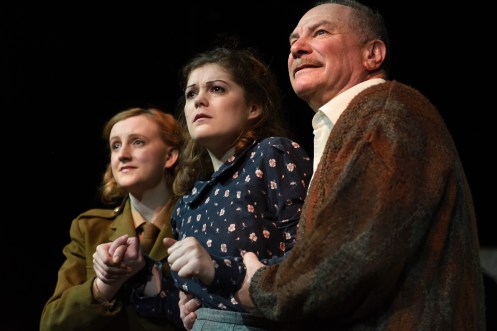
It is through these ten pairs of eyes that we see the effects of war.
David and Despina Sellar, as Ted and Binnie Walsh, set a solid foundation for the action with good characterisation of their roles. Ted is at heart a family man, a little world weary, still smarting, physically and psychologically from the First World War. David Sellar’s depiction of Ted the man, knowledgeable by his own efforts to the point of erudition is admirable. But Ted may be side-tracked by his political prejudices. When he quotes Socrates “How shall we live?”, Binnie Walsh’s answer would have been more down to earth than Ted’s polemics. Despina Sellar’s portrayal is of a woman living on her nerves, taunted by her very own prejudices, one nurturing her family to the exclusion of others.
Henry Knox and Dylan Lewis played the two boys on the opening night. Their performances are a joy to watch, an uninhibited picture of the rough joys of boyhood at a time when boys could be boys. Their vividly gory imaginations and savage humour brings a light hearted touch to the story.
Mark Redup’s Dinty Moss is a bumptious self-assured character, but likeable in his optimism. It is a full-on part, in contrast to the subtlety mysterious Mr Sand. A mute part is not easy to play, and requires a lot of concentrated acting. Robin Ingram (who had acted with Peter Whelan nearly three decades ago) is well up to the part. Sand is a man damaged by war, but is his shuffling gait and loss of voice due to physical injury, shell-shock or dementia? Whelan does not tell us, but we later learn that Sand is from Slovakia, a country devastated by the War. There is a half-explained symbolism in the roles of both Sand and Moss. (Note the names: desiccation vs verdancy?) Maybe Sand represents the silenced voice of his homeland. Moss boards other people’s dogs, whose barking aggravates Binnie Walsh. As Ted informs us, dogs have only evolved to bark in imitation of their raucous human masters.
Victor Mellors accurately puts over the nature of the schoolmaster Nicholson, whose lack of boldness in being able to state his burgeoning pacifist principles, is reflected in his lack of boldness in pursuing his attraction to Marion. We see a lonely young man, loss in indecision. Oddly, Nicholson seems to have never been conscripted.
The determined and positive Marion does not wait to be called-up. She volunteers and, after training at Catterick, is sent to an anti-aircraft unit nearby. Here she is in her element, doing “her bit”. Claudia Carroll gives a strong and feisty performance as Marion, sympathetically and believably played. The father-daughter relationship with Ted is particularly touchingly displayed.
Lisa Varty as the Scots ATS Sergeant Williamson gives an empathetic and very positive portrayal as the NCO in charge of the “ackers”, the anti-aircraft crew. We don’t learn much of Nicolson’s background (and Whelan uses her to express anachronistic 21st Century feminist views rather than plainly justifiable WWII feminism) but she acts as the doubtful piggy-in-the-middle when Marion becomes the love-interest of Royal Artillery Captain Gryff East.
As the forbidden relationship between officer and other ranks develops, it also opens up differences in expectations and in the social structures that each belongs to. This has catastrophic consequences for East, when he unexplainably disappears, and for Marion when their love-nest, an unused army hut from the First World War near their gun emplacement, is hit in a bombing raid.

Felix Granger as East paints a finely characterised picture of a man of principle torn by internal conflicts. He has a unwarranted guilt about those civilians whom he has failed to protect in air raids. Marion unwittingly brings out deeply suppressed feelings from under East’s soldierly carapace. East is a difficult role, in that he has a long emotional journey in a short time (even their romance seems to advance very quickly … but it is wartime), but Granger’s performance is genuinely convincing.

Carroll and Grainger have just the right balance of passion and restraint that work within the period of the play, as moral codes crack under the vicissitudes of war.
Under the pressures of the first night of a world premiere there were some signs of nervousness amongst the cast, which manifested itself in a reduced pace and a difficulty in immediately inhabiting the characters, but even within the first half this seemed to settle, and certainly this should not be an issue with the first night out of the way, especially noting that the cast have noticeably taken warm possession of the play.
They certainly have an inspiring set to act on, and Ray Dunning’s set design incorporates some inspired transforms to switch between family bungalow and the army hut love-nest, with the anti-aircraft battery in between. The air-raid effects are quite awe-inducing, with Robert Walker’s lighting design and Alan N Smith and Paul Wilson’s sound design enhancing the confused fear enacted by the cast. Continuity between scenes is provided by a soundtrack giving a voice-over of Churchill’s speeches. (The voice-over actor is not credited in the programme but it sounds too pristine to be authentic.)
Period uniforms are always a figurative military minefield for the costume designer, but Sarah Andrews has a studied accuracy for the period, as with the civilian clothing, right down to Marion’s cami-knick’s.
(However, sorry to be really nerdy about other details. Gerberas, a South African exotic, would have been impossible as cut flowers in wartime England. And weren’t the ATS girls looking down the objective lenses of the rangefinder, rather than the eyepiece? Picky I know!)
Peter Whelan’s widow, Ffrangçon has said that Sleepers in the Field is “the play he wanted to write”, and surely Whelan would have been proud of Questor’s stage fulfilment of one of his last ambitions.
And the “sleepers in the field”? It would be a spoiler to let on, but suffice it to say that they protect. They protect, just as Captain East wanted to protect the civilians with his ack-ack guns and Marion wanted to protect what she held dearest. But then again, do you fight against those you hate, or for those you love?
Mark Aspen
January 2018
Photography by Peter Collins
Coming Unstuck
Strawberry Starburst
by Bram Davidovich
Kryptonite Theatre Company, The Vaults, Waterloo until 28th January
Review by Georgia Renwick
Do you travel through Waterloo station every day? You may not be aware but some of the best new theatre is being made under your feet, right now! Vault Festival is back for another year, and it’s bigger than ever. Over 300 productions will take place in and around The Vaults, in the arches under Waterloo station, between now and the middle of March. Over the past six years Vault Festival has garnered a reputation for programming work that questions, that challenges, that tells us something new, that explores alternative perspectives. Strawberry Starburst fits the bill.

Shez is sixteen. From a happy childhood, she hit her teens and found her life started to unravel. As she grapples with her relationship with her Mum, her Dad, and her prickly-faced boyfriend, how can she forge an identity of her own? The answer she comes to means she can no longer enjoy her favourite strawberry Starburst in the same way.
Strawberry Starburst tells a story you may think you already know. A teenage girl growing up; girl encounters family problems, girl encounters relationship problems, girl battles demons… But every generation faces the challenges of adolescence in new guises which is why well observed ‘coming of age’ stories are always fresh and always relevant, even if we feel like we’ve seen the characters or encountered the obstacles before. For today’s teenagers, the Instagram generation, the line between health and the dangers of eating disorders has never looked so thin. And this is where Shez comes unstuck.
Now, I’m not sixteen anymore, but dancing around the kitchen to Taylor Swift would probably be what I was up to if I were. As she sits, legs swinging, on the kitchen table and begins her story, the disparity between her candid words and awkward gait, her mood swings between ecstatic and despairing and the intensity in actress Imogen Comrie’s eyes that pleads to be understood rings painfully true.
Yes, this is a play about eating disorders and the ease with which they can creep in and turn a life and a family upside down, but through Bram Davidovich’s sensitive and observant writing the emphasis is very firmly on Shez and her journey. We get to know the girl before the disorder, we see more of the human side and less of the clinical. She’s cheeky, she’s feisty and she won’t be pitied. She’s a far-cry from the frail, weak victim an eating disorder sufferer can sometimes be portrayed as on the stage or in the media, highlighting the ease with which healthy girls (and boys) can slip.
The monologue format Davidovich has chosen is instrumental in her character-building, whilst Comrie’s arresting vulnerability in her performance of Shez ensures we are transported by her story. The variety of ways with which she can take a sip, a mouthful or a gulp of a glass of milk, half a dozen or so of which are dotted around the stage in almost ritualistic placement, is testament to the observational quality of her acting. Her ability to communicate her character’s emotional and visceral reaction to food through this simple action was so emotionally taut, it could at times be hard to watch.
Effort has also evidently been made to portray accuracy in the representation of the treatment she receives once her condition is identified. The therapist’s portrayal is especially enlightening. I sincerely hope she is based on a real therapist out there, helping the real sufferers who struggle every day.
But what has brought her here? Her mother’s insensitive comments? Her boyfriend’s indiscretions? Or her own self-confessed “perfectionist” nature? Ultimately, the play doesn’t place sole blame. This is one of its strengths. It ensures that it doesn’t attempt to typify a disorder that manifests itself in many forms, or to suggest that there are easy answers or cure-alls.
One qualm is that the pace does escalates a bit fast, from her initial signs of illness. Perhaps a sign of it having been shortened to fit the Vaults’ tight seventy minute time slot. Ultimately however, the play feels like a snapshot of a girl on her way to the rest of her life. Can she learn to adapt, grow and accept herself? I am left sincerely hoping so.
Georgia Renwick
January 2018
Image courtesy of Kryptonite Theatre

 Mark Aspen