
Panto’s Fabulously Funny Family
Melissa’s Meeting with the Personalities of Pantomime
Issy van Randwyck and Steve Delaney chat to Melissa Syversen.
Part Two in a Seasonal Look at the Panto
Pantomime season is upon us once more, boys and girls! T’is that wonderful time of year again. The Christmas lights are shining along the high streets, the Christmas markets and Winter Wonderland have all popped up and we can finally eat mince pies to our heart’s content without the guilt. And as we enter the Christmas season, with it comes what is my favourite theatre genre: Christmas pantomime. All over the city, colourful posters of well-loved characters are gazing out at us as we hurry along to finish the Christmas shopping. They all range from Dick Whittington at the Palladium, Jack and the Beanstalk at the Lyric Hammersmith. And of course, Aladdin at the Richmond Theatre.

Aladdin marks the first partnership between pantomime production company Qdos Entertainment and ATG theatre group. Richmond Theatre’s production of Aladdin has gathered an impressive cast this year, led by pantomime legend Christopher Biggins as Widow Twankey. The cast further includes Issy Van Randwyck, Count Arthur Strong (Steve Delaney) and Rikki Jay as Aladdin’s brother Wishee-Washee. Making his pantomime debut, AJ Jenks will play the title role of Aladdin. I was lucky to meet Mr Biggins earlier in the autumn during the Richmond season presentation and he spoke very highly of this version of Aladdin, which he has previously performed at Nottingham Theatre Royal in 2015. He promised us many wonderful costumes, stars and humour.

Now as the premiere is just around the corner, I was lucky enough a few weeks back, to chat with two of the other stars of Aladdin, Issy van Randwyck and Steve Delaney (a.k.a. Count Arthur Strong). I had a lovely chat with both, to the point we might have diverted a bit from the task at hand to discuss other topics such as popular Scandi-noirs and the nature of drama schools. Our main topics, however, were this year’s production of Aladdin at the Richmond Theatre and pantomime itself, as a theatre genre and a uniquely British tradition.
Having made the trip to Richmond from Central London, I first sat down with the lovely Issy Van Randwyck at the Richmond Theatre. Issy has a long and eclectic career on the stage that includes musicals, Shakespeare, pantomimes and modern plays. She was a member of the popular cabaret group Fascinating Aïda. On the big and small screen, her credits include The Danish Girl, Partners in Crime and Spooks. In Aladdin, she will be playing the magical genie Scheherazade

You were born to Dutch parents and lived abroad during the early years of your life. What was your first encounter with British pantomime, as it is such a British institution?
You know, my first cognitive memory is going to see one of those ‘On Ice!’ shows when I was living in South Africa when I was little. So, it must have been when I was around four or five. I think I saw one of those pantomime stories but on ice, somewhere in Durban. That must be my first memory of seeing a Christmas show.
When did you do your first pantomime as an actress?
I did my first pantomime, I think it was 1999. At Guilford, I did Peter Pan playing the traditional principal boy.
Pantomime is something that has been going on, in somewhat different formats since ….. forever. What do you think it is about Pantomime that keeps attracting audiences?
Community. I think it is Community. It is something that brings all ages together. I think it is the first time a young generation goes to the theatre and sees the whole magic of it. They have never seen and been in a place like that and then it gets dark and the band starts up and the curtain rises. And then the lights and the magic of it all, you know. It is really wonderful and, as a parent, you get to see it through their eyes and you remember your first time. And then as a grandparent, you have been for years. I think it is a coming together of a community.
That must be wonderful for you as an actress being able to be part of that community in different places.
I did Aladdin, playing Aladdin, with Christopher (Biggins) actually, fourteen years ago at Cambridge Arts. I have done a number of them and loved each one. It is a lot of hard work, don’t get me wrong, two shows a day, six days a week. It’s not for the faint-hearted. You have to get match-fit, make sure that you get your sleep, take your vitamin C. You really have to look after yourself like an athlete. But there is so much joy backstage, and I have to say working with Christopher Biggins: he is pure joy! He just is, wherever he goes.
I met him about a month ago: he really does brighten the room.
He really does, he is just one of those people. There are those people that just suck energy out of the room and then there are those that just give, and that is him.
He is a bit of an institution in his own right within pantomime.
He is.
It must be great fun for the two of you to keep coming back and do pantomimes together?
I have known him for much longer than that. The first time we worked together, he directed me in a production of Taming of the Shrew in Barbados. Rehearsing in bikinis and sarongs, on the beach you know, it was joyous. Again, not work, just glorious.
Your Aladdin, AJ Jenks, this is his first pantomime.
Often with pantomime, it is often the first professional job among the younger members of the cast, and it is a wonderful introduction for them.
It is an opportunity to learn from the best. Have you given him any advice on how to do pantomime?
No, I actually only just met him today for the photographs. We start rehearsals on the 27th November.
That is very close to the opening date on 9th December!
It is. You absolutely have to be match fit. You do as much background homework to learn your stuff, so that rehearsals are rehearsals. We rehearse for nine days and then tech-rehearsals on Thursday and Friday and open on Saturday. It is what it is and it is the way that everyone does it. That is what you sign up for and it is a part of the joy of it because you all go over the top together. We’re all in it together.
How does this Aladdin differ from other pantomime versions of Aladdin?
Each pantomime is written to play to the strengths of the key players and likewise, you have Count Arthur Strong who is hilarious, Riki James and Christopher Biggins. It is keeping it topical, keeping the narrative of the story of Aladdin and then you can go off on little tangents.
You were a member of the cabaret group Fascinating Aïda for six years. Do you think that has helped with your work in pantomime?
Yes, but I have done a lot of comedy since then and I did comedy before as well. You know what, I think working as the only girl at Madame Jojo’s, the drag show, that was probably closer because that really was that badinage between the audience and ourselves on stage. That, and being the only real girl, I think gave me a greater insight and experience I think for panto.
In terms of Pantomime endings, do you prefer the Disney route where the villain perishes in some way or do you lean more towards redemption for the villain?
Oh, very interesting. I think you do it for the children don’t you, so what is going to be the last thing they need. They have enough things to process these days. The least upsetting thing for them to process is the better. Redemption and moral of the story, definitely. Violence and Christmas shows don’t really mix.
Will you continue to do pantomimes?
Oh, God yes, I am an actress I do what I am told to do. I have a young family, and I think this time is a time of magic. Children have so much to process these days, so for as long as we can bring love and joy and the illusion of magic to them, at this time, I will continue to do it. You can laugh as a family and break down the barriers and the walls, it can only be a good thing. That back and forth that happens in a pantomime, the social interaction, it is so important. It makes it possible to spark imagination and discussion. And also anywhere where you can take the mickey out of yourself is very important, that can only be a good thing as well.
Can you describe Aladdin in three words?
Family. Fabulous. Funny.
After my chat with Issy, I was lead down to the stalls bar to meet the Count himself, Arthur Strong. Or perhaps more accurately, with his affable creator and portrayer, Steve Delaney. Count Arthur Strong was created while Delaney studied at The Royal Central School of Speech and Drama. In the ‘90s, The Count started appearing on the London comedy circuit before debuting at The Edinburgh Fringe in 1997. Since then Arthur Strong has become a staple in British comedy, having performed numerous tours and radio shows and also starred in his own titular sitcom on BBC2. Count Arthur Strong made his pantomime debut last year at The London Palladium, playing Baron Hardup in their production of Cinderella. This year he will be playing The Count of Peking who is the father of the beautiful princess.

I saw Cinderella at the Palladium last year, which was your pantomime debut. How did you find that?
Yes, and what a place to debut! It was great, I really enjoyed it. It was a spectacle for sure. And that is what they went for. One of the reasons I am doing this one (Aladdin) is, you know I wanted to do a more story based pantomime. Something that is a bit more about the characters than perhaps the Palladium was. But it was great. I have been offered pantomimes before but hadn’t done it really because I always thought well Baron Hardup seems to me the right character for Arthur. A bit batty, an old man who doesn’t really notice that he is married to the wicked stepmother and that his daughter is being ill-treated. So when the combination of Baron Hardup and the Palladium came up, I jumped on it, and it was great. For me, it felt like being in a variety show. Everybody came on and did their schtick. I don’t really have an act in the same way they do, mine is more character-based so it kind of has to be its own thing. Pretty much all year round I tour the country in my own bubble so it seems like now that pantomime is the only time I come out of that bubble, so it is good for me. It is a good opportunity to work with people I consider real variety artists, and Arthur thinks he is a proper variety artist, so it is an interesting notion as well.
That must be interesting for you because pantomime is to a certain extent about casting celebrities and name recognition. But you play a character who plays a character. The audience is coming to see Arthur, who is such a well-known character.
It is definitely different, you’re quite right. For instance, one thing that happens a lot in pantomime is that people drop out of character that they are playing and they address the audience directly as themselves. Paul O’Grady was doing it all the time and it’s a pantomime device almost. Whereas I can’t really do that. I can drop out of the character that I am playing, but it’s got to be Arthur who’s doing the character and doing him somewhat badly, that is the notion behind it. So, it is a slightly odd thing and I think I’d have to do a few more pantomimes before I found that balance.
If Steve Delaney were suddenly to pop out…..
I could never do that. I am either Arthur or I am not. So every role I play in pantomime would have to be Arthur, essentially. But you know, I am never credited as Steve Delaney in these things, I have always insisted that it is Arthur Strong. I don’t want people to be too preoccupied with the fact that somebody “does” Arthur, I’d rather they just believe the character.
It was funny, because, even in the press release I received, it says Arthur Strong, so even I was a bit unsure whether I’d be talking to Steve or to Arthur before this.
Well you know, when I first started for a number of years I never did interviews as me at all, even if I was on a radio show or something like that. I did a spot for BBC Scotland in London and I turned up dressed as Arthur. I always used to do that, but after ten or fifteen years, it got to the point where I was frustrated because I couldn’t actually say anything coherent. I couldn’t answer a question properly because I was answering them in character and it got to the point where I had to say ‘I’ve got to stop doing it now’ because sometimes people seriously wanted to know the answer to the questions and they weren’t getting them. Now it is a balance between interviews I do as me and those I do as Arthur.
Pantomime is such a unique theatre genre. Do you remember your first pantomime that you saw?
It was at the Leeds Grand Theatre. It was Cinderella with Lonnie Donegan playing Buttons. He was a Skiffle artist in the late 50s, great singer. I must have been about six or seven. Someone I partly based a little bit of Arthur on was a next-door neighbour who was the chief electrician at The Grand. And his mum, the lovely old Mrs K, she used to take us to the pantomimes. So that was the first one I saw. And later I actually worked there, I used to be a theatre carpenter and our workshop was at the same level as the fly floor. This was about ten years later and Frank Carson the Irish comedian was playing Baron Hardup in Cinderella. Quite different from Arthur, a bit savvier. I saw many of those pantomimes because, rather than working, I’d spend a lot of time on the fly floor and watch the show.
But you’re absolutely right; pantomime is its own genre, there’s nothing like it. I think it is pretty much all we’ve got left from variety, true variety theatre as it was. There is no other outlet for that kind of thing these days. You know, it’s like when Top of the Pops finished. You think of all those bands who win The X Factor. Twenty years ago they would all have wanted to go on Top of the Pops. They would have a record out and it would be on the charts and everything, but a lot of that has changed completely. The fact that there is none of those music shows that aren’t talent shows, it is a shame.
I agree with you that pantomime is one of the last genres that carries the elements of variety, musical halls, even the old harlequinades. It is a genre that has endured in different forms, yet somehow stays the same. What do you think it is about Pantomime that keeps attracting audiences?
I think a lot of it is tradition, you know. Obviously, it is tied into Christmas. I think we are looking for something to do that is special and different at Christmas. And there is always a lot of spectacle attached to pantomimes. A lot of kids are kind of blooded into the theatres, often for the first instance if you like. The very first shows they see are pantomimes, whether they go to see another show again is a different matter. It’s the tradition, it’s kind of like having turkey for Christmas. Christmas is a unique time of a year and that is why pantomime exists in the first place. People looking for something that is very different, and these days pantomime is something different. Like we said, it is the only thing of its kind now. When I was a kid there used to be a lot a variety transitioning into television in the early sixties but we don’t even have those variety shows anymore. I could name dozens like The Dickie Valentine Show, The Dickie Henderson Show and The Arthur Haynes Show. All these had variety acts and guest stars on. We have none of these now. You don’t see that sort of thing on television anymore, it just doesn’t exist really. And I think pantomime theatre is here to stay for a very long, long time. The kids who came along to pantomime and it made a strong impression on them, they will bring their kinds twenty years down the line because they want their children to have the same experience. It is unique.
I was talking to Issy and she said you only have nine days of rehearsal?
It’s crazy, isn’t it? But I have to say, having done three television series where there would be so much work in the last four or five days, even largely rewriting entire scripts, I am really not fazed with having nine days. I’ve got the script at home for this: I know it will change and I have rewritten bits of it already. It won’t be a nightmare like having to rewrite a television script in four days and then record it on a Friday. So nine days is a luxury.
Can you describe Aladdin in three words?
I couldn’t do it. No, wait that is four words. Couldn’t do it.

Aladdin will be playing at Richmond Theatre from Saturday 9th December to Sunday 14th January. Be sure not to miss it!
This interview was conducted on Monday, 6th November 2017 at The Richmond Theatre by Melissa Syversen.
Photography by Craig Sugden
Sex, Power and Suppression
Carmen
by Georges Bizet, libretto Henri Meilhac and Ludovic Halévy
Ormond Opera, at Richmond Unitarian Church, 25th November to 3rd December
Review by Suzanne Frost
Carmen might well be one of the hardest operas to stage. With the hit density of a Britney Spears best-of album, popular tunes come hard and fast, scene by scene, and the melodies that almost force you to hum along to take away from the impact this tragic opera should have. Keeping it serious, avoiding clichés and finding something new to say in the age old canon – that is the difficult task every director faces with Carmen. All the more praise so, for Ormond Opera and director Mark Burns who brings a proper ambitious Regiekonzept to the tiny Unitarian Church Building in Richmond. Hearing the usually so vivacious overture come tinkle from a shrill piano is sobering but, with a lot of the oom-ta-ta – and some of the exuberant temperament of the music – gone, the mind is able to sharply focus in on the story that is actually told and all the undertones of the libretto become crystal clear.

Burns shifts the plot from Sevilla to a 1980’s England, easily identifiable by a graffiti wall covered in punk rock posters, Labour slogans and anti-AIDS campaigns. Of course with not much of a stage to fill, sparse pieces of scenery – a derelict bus stop, a rusty bench, a wheelie bin – bring all the atmosphere we need. The policemen and their new recruit Don José, in unflattering hi-vi security vests, are lazily flicking through some soft porn magazines. Sex, power and suppressed desires are the themes of this opera, undercurrent in every line of the libretto. Roberto Abate brings a lovely innocence to the country boy Don José, who is technically a bore and a mummy’s boy, the puppy love between him and his prim fiancée Micaëla devoid of any sexual tension.
In tumbles life – and chaos – in the shape of the two cigarette girls Frasquita and Mercédés (Sofia Troncoso and Ailsa Mainwaring) and their hysteric gossiping about the shenanigans of La Carmencita, who already sounds notorious before we even meet her. In this production, the cigarette girls and Carmen, the ultimate gypsy woman, are Travellers – a term that carries all the social undertones that Bizet intended. The concept works a charm. Visually because they look hilarious and, well, different, in their chav outfits and their garish make up, constantly chewing gum. And it works on a dramaturgical level, as Carmen is the first and most well-known big proletarian opera, set in a working class milieu. Escamillo, the celebrated torero (Samual Pantcheff, occasionally struggling with timing) becomes a popular boxer, a concept which works wonderfully, showing the working men’s obsession and idolising of sportsmen, while for the girls and Carmen, he is first and foremost a source of money (they quickly raid his pockets) and then perhaps, power through popularity.
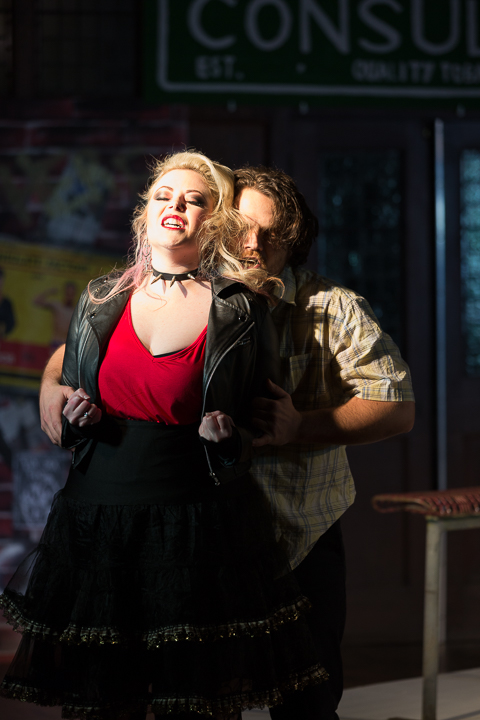
Caroline Carragher is a Carmen of dreams. While her costume plays with the clichés of a Spanish dancer – red and black, a ruffled skirt and tumbling curls – there is little folklore to her Carmen but a real sense of danger right from the beginning. This is a dangerous woman, a selfish fighter, a calculating flirt. Somewhere between “Like a Virgin”-Madonna and Patsy from Ab Fab, she pops her gum in boredom, absentmindedly rubs her little coke nose and keeps all her aces close to her leather biker jacket. The blasé way she answers all the police questions with an obnoxious bratty “tra-la-la-la” has quite a bit of Catherine Tate’s “Am I bovvered”-comedy routine. Caroline Carragher’s powerful voice breaking through all this nonchalant attitude gives wonderful contrasts to Carmen’s volatile personality. I loved how, at Don José’s passionate and earnest declaration of love, her heart almost visibly breaks but she doesn’t know what to do with true and trustworthy emotions. I loved how, with her lifestyle being always close to danger, the idea of looming death is so realistic, and superstitious beliefs so deeply anchored in gypsy culture, that Carmen almost goes looking for death to fulfil the prophecy.
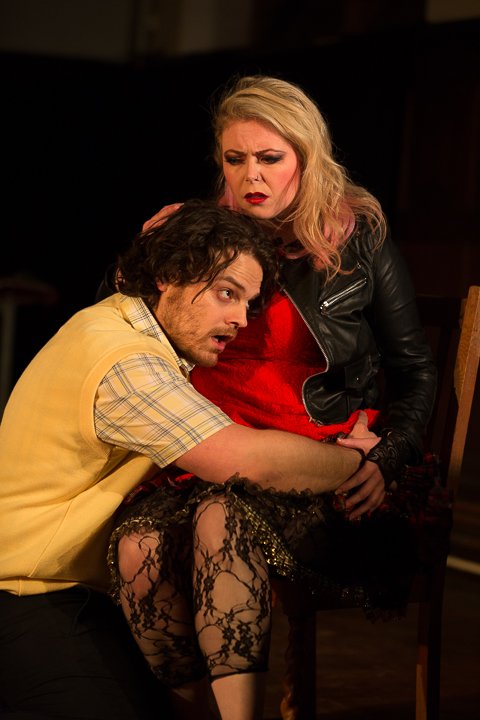
Meanwhile Don José blindly tumbles through his descent in life, seamlessly going from man-child to murderer, from good little soldier boy to deserter and thief, all in chase of a woman who walks over people for self-gratification, who works her charms always with an end-goal in mind. This Carmen, I thought, though a great seductress, doesn’t revel in the attention of men but since attention habitually comes her way she might as well use it to her advantage. And since society already thinks the worst of gypsies, calls them thieves and liars, they might as well give them what they want. How many times the phrase “prends garde” comes up in the libretto! Everyone is constantly wary of everyone else, arms at the ready, be that the quick fists of the boxer, a ready pocket knife or the little razor blade hidden in Carmen’s bra, that she has no intention of turning on herself but simultaneously wouldn’t hesitate to use if it gives her an advantage. She is so detached from ever meaning anything she says or does. How many times Carmen sings of l’amour without ever describing actual love. It is still such a powerful character study and, with the right nuances, Carmen can still wrap an audience around her little finger and take us all down with her.
Well done, Ormond Opera! Olé !
Suzanne Frost
December 2017
Photography by Michael John White
Panto for the Perplexed
Grierson’s Guide for the Pantomime First-Timer
A Theatre Thought by Matthew Grierson
Part One in a Seasonal Look at the Panto
London is a cosmopolitan capital, home to people from all over the world. So it’s possible that plenty of its citizens are poorly acquainted with the distinctly British art of the panto, and may be mystified by its popularity and its place in the national culture. Whether we consider them fortunate or unfortunate, it’s for those people that I offer the following, to bring them up to speed in time to catch a show or two this festive season.
Part music hall, part Commedia dell’arte, the panto is essentially a rendition of a classic fairy story or folk tale such as Cinderella or Dick Whittington, staged according to a host of its own peculiar theatrical conventions. The style is sufficiently deeply engrained in the British psyche that, although many of us won’t have seen a show since childhood, we still immediately recognise (and often wince) when we come across its tropes, so widespread they are. But don’t be frightened – the more of these you know, the more fun watching a panto will be.
Frocks appeal
One of the cornerstones of the pantomime is the dame, a larger-than-life portrayal of a woman –usually an aunty, ugly sister or queen of some description – played by a man under the thickest, most outrageous make-up and camper than, well, Christmas.
Christopher Biggins is the undisputed king of queens, the duke of dames, if you will, and if you’re around Richmond for the festive season, you’ll be able to see him give his Widow Twankey on the Green in Aladdin …so to speak. To many, Biggins’s name is a byword for panto dame, and he has been donning frocks around the country for close to fifty years – making him the genuine article, compared to the more recent trend for big-name stars to get in on the act.
Christopher Biggins goes into Richmond Theatre Photograph by Craig Sugden
When it used to be your former soap actor or past-it stand-up taking on a panto role, there have of late been a number of high-profile players roped in, possibly to their own bewilderment. Stellar Stateside names such as David Hasselhoff, Henry Winkler and Priscilla Presley have all twirled their moustaches (literally or metaphorically), while closer to home (real-life) Dame Joan Collins and Sir Ian McKellen have rummaged through their dressing-up boxes, the latter certain to have ticked off another long-nursed ambition in doing so.
Girls who (look) like boys
For all the dragged-up men, it’s important that, more conscious of gender parity as we now are, the ladies also get a look-in on the transvestism. It’s not only Shakespeare who offers a native tradition of gender-bending after all, and the role of principal boy, the young hero of our story, is often taken by a sylph-like young woman.
Given this all-round cross-dressing, it’s no surprise that pantomimes are often laden with innuendo and ribaldry, the idea being that, although it’s a family audience, such remarks should go over the heads of the kiddywinks and ensure that the mums and dads – that is, the actual ticket-buyers – are getting their money’s worth. The children in their turn are offered the chance to be summoned up on stage, individually or en masse, to help in key parts of the action, and they are, literally, catered for with sweeties showered from the stage. The presence of the children also gives the parents an excuse to enjoy slapstick humour, which is as unsubtle as the smut is. There’s usually a pantomime horse, or, in Jack and the Beanstalk, a cow, comprising two artistes taking the front and back ends of the barnyard costume respectively, their ignominy spared only by their remaining unseen. Whether these parts are as sought after among Equity members as the dame or the villain – sorry, ‘Boo, hiss! It’s the villain!’ –is debatable, but undoubted skill and co-ordination is required. Fancy having to be Warhorse but with only a pair of you, and not the elbow room for the puppetry?

Some strange animals escape from Richmond Theatre’s panto. Photograph by Craig Sugden
Of course, no-one’s attempting to pretend that there are real farm animals prancing around onstage. The key thing about panto is that the cast and the audience are both in on the joke – which is why you’ve got to know what you’re letting yourself in for. The performers do go out of their way to help you, with lines often flung direct to the audience like the confectionery, while the dame will usually introduce the hero and villain to encouraging cheers or jeers from the punters as appropriate. There are sudden, anachronistic references to TV shows or the news, spoken with a pronounced wink. And, of course, there are the staple scenes when the hero is looking for the villain and asks the audience if they can see him. ‘He’s behind you!’ we’re expected to chorus, at which point the hero makes a laboured show of looking around and the villain nips behind some conveniently placed scenery. ‘Oh no he isn’t!’ says the hero, turning back to us – during which time his adversary has reappeared. ‘Oh yes he is!’ we respond, ad infinitum. Or at least until the plot catches up.
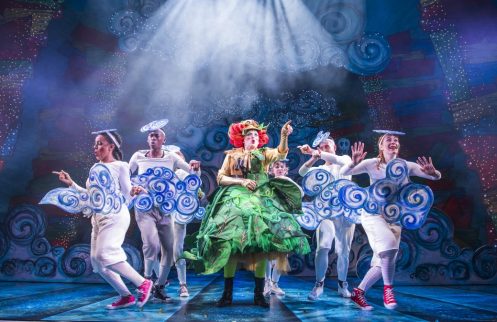
Jack and the Beanstalk at the Lyric, Hammersmith
It’s before you!
This might not sound like either your traditional theatregoer’s or your serious thesp’s cup of tea. However, aside from being a great deal of fun – please, don’t be deterred by the above – panto is a surefire money-spinner for theatres themselves, which otherwise eke their budgets out through the year, in this age of multimedia entertainment and economic uncertainty. So if you want to support your local theatre, and keep the family occupied for at least some of the time between family get-togethers and the festive telly, packing yourselves off to a panto is a perfect way to do so.

Hackney Empire’s Sleeping Beauty Photography by Robert Workman
Quite apart from what’s going on elsewhere in the capital –such as the Palladium’s Dick Whittington and the Hackney Empire’s Sleeping Beauty – in this corner of London, you not only have Richmond’s Aladdin, but there’s another at the Beck in Hayes as well as Hammersmith Lyric’s Jack and the Beanstalk. In fact, there must be quite a few magic beans around as there are also versions of J & t B in Croydon, at the New Wimbledon and Putney Arts. Meanwhile Hillingdon is having a ball with its Cinderella, as is the OSO in Barnes, and Questors is flying high with Mother Goose. So in short, you’re not short of options.
Whatever you choose, it’s sure to be fun, isn’t it? … … Oh yes it is ! …
Matthew Grierson
December 2017
Lessons for Christmas
Poetry at the Adelaide
by David Russomano and others
Performance Poetry, The Adelaide, Teddington, 3rd December 2017
Review by Matthew Grierson
Good evening class: for though it may not be far off Christmas, tonight’s Poetry at the Adelaide has an educational bent. Even as we sit down we notice test papers – well, quizzes – laid out on the tables, asking us to identify the authors of four seasonal quatrains. In kicking things off, host Bob Sheed explains the idea is either to educate us or give us the satisfaction of knowing we could get all the answers right, and as if any more satisfaction were needed each table has a plate of Quality Street (‘A Rose by any other name …’) for the seated throng, while Tricia brings round a tray full of mince pies at the interval.
But as I said: education, education, education. Once Bob has taken us through the rubric about fire escape, toilet and returning glasses to the bar, Malisa Elliott gives a short presentation on best practice for poets using social media and how to go about getting published. I’m none too clear on the context for this – it makes me feel as though I’ve missed some homework – but it’s evident that there’s more going on with Poetry at the Adelaide than these Sunday night open mics, and in this case Malisa’s advice is well received by the audience.
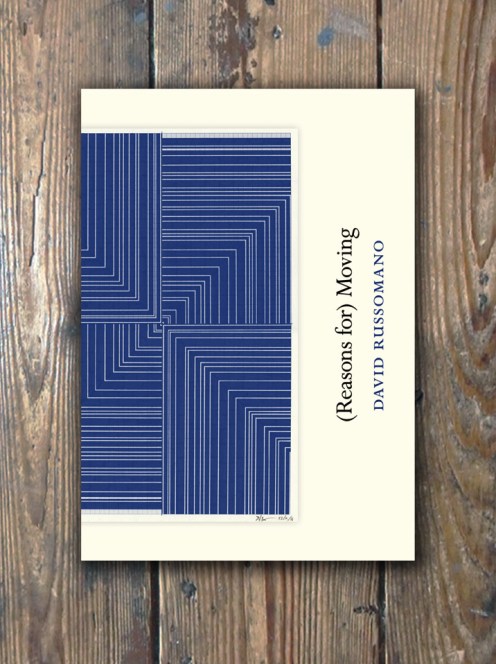
Further insight is offered by tonight’s guest poet, David Russomano, who in an interview with Bob’s co-host Anne Warrington gives an eloquent account of his creative process and the composition of his collection (Reasons for) Moving. His poems evince a keen sense of place, elegising a house lost under a frozen lake and an abandoned lot where a tyre factory once stood, both in his native Connecticut. Even when he lists the titular reasons that inspire him to leave Worcester Park, their invocation defines that place within the orbit of the ice cream van, under the flightpath of planes and seagulls. Though Russomano says of his travels in Greece, Thailand and Turkey that ‘there’s so much there to catch your eye’, it’s evident that he sees beyond the sights and communicates what it means to travel as well. I hope the Adelaide continues to attract visiting poets of his calibre, and Anne, likewise enthused, encourages her pupils – sorry, audience – to give the visitor polite applause. Indeed, she pops up teacher-like every now and then between readings to offer similar praise to tonight’s performers.
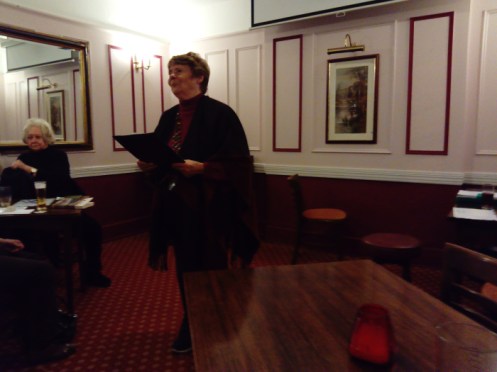
The classroom feel is picked up in several of the poems themselves, with Robert Meteyard imagining a rebound relationship as though he has a supply lover rather than substitute teacher, a conceit that wittily and effectively conveys the tenderness of heartbreak. In his contribution to the second half, like an English teacher, he explains The Uses of Poetry, but the images are affecting rather than prescriptive and again broach a tentative relationship. Unlike an English teacher, he has an attentive audience. The languages department also gets a look-in when Margaret May reads a pair of translations, Every Day Plugged , from the German, followed by Wisława Szymborska’s Funeral, both attending to the minutiae of life – and death – in a way that complement Russomano’s style.
Where Margaret offers us a stanza of her first poem in German before her translation, Rachel Woolf reads Progress through twice, in both English and Scots; while in another piece also inspired by the collection of the National Galleries of Scotland she speaks not only in the voice of The Hind’s Daughter but also the hind (= ‘farmhand’) himself. Art class continues with Fran Thurling’s But Is It Life?, an ekphrastic and reflective Sunday afternoon wander around the Tate. But not all of the lessons we learn at school are the formal ones, and as the bell approaches, Heather Moulson takes us back to class 2D and the eponymous Christmas Card she never received from the object of her adolescent affections, even though he sent them to the other girls. Christmas cad, more like!
Inevitably, with school soon due to close for Christmas the poets find themselves anticipating the festivities. Suzy Rowlands gives us the furry Tails of Christmas Gone and Midnight Mass, while in her As Snow Fell, the image of ‘pregnant clouds’ alludes to the Nativity, an image more central in Anne’s stately, polyvocal Christus Natus Est. Eyeless Angels are overhead in Fran’s imagining of what Epicurus would have made of the lights on Regent Street, and Sara Burn Edwards’ The Witness is a contemporary take on the Gospels as a snobbish suburbanite is eventually won round by her carpenter neighbour, though the persecution he endures rings only too true in these days of Brexit.
But Christmas is a time for warmth as well, and family gatherings are the theme of both Judith Lawton’s Dreaming of Branscombe and Bob’s Paula’s Mother Arrives for Christmas. Robin Clarke not only shares his playful Shipping Forecast for Christmas, which prompted plenty of wry laughter, but also dons a lupine mask to participate in Bob’s panto-themed take on The Boy Who Called Wolf. It’s a game effort, but I have to say I was glad I wasn’t wearing my theatre reviewing hat. Fortunately, the audience proved equally indulgent.
Even though, some things seem to have become more formalised since my last visit to the Adelaide – what with the quiz, flyers, raffle and visiting writer – other matters are still conducted endearingly on the fly, with joint hosts Anne and Bob each seeming to read from a variorum edition of the running order. If MC-ing were poetry, this would be more free verse than pentameter. Though to be fair, it is almost the end of term.
Matthew Grierson
December 2017
Live Music, Red in Tooth and Claw
Geno Washington and the Yo-Yos
Eel Pie Club, Twickenham, 30th November 2017
Review by Vince Francis
Oh, Geno!
… So went the chorus of the Dexy’s Midnight Runners’ 1980 tribute to Geno Washington. Let us step through the evening to get to the point where we are all cheering thus.

Firstly, the club: the Eel Pie Club forms an annexe to the Cabbage Patch pub on London Road in Twickenham. It has been established for around 18 years or so and has welcomed a number of “name” acts alongside perhaps lesser known, but no less hard-working stalwarts of the circuit. If you haven’t been before, I’d highly recommend it. As with most clubs, non-members will pay a bit extra for admission, but the difference isn’t excessive. You go upstairs and enter into the main club bar where you will be welcomed and where tickets are purchased.
This room has an intimate feel, which is perfectly suited to its purpose. At the stage end, the floor level has been lowered to form a sort of mosh pit. The stage itself is at standard room height, I think, but the effect of this is that it feels elevated.
I arrived early, and managed to secure a seat at the stage end of the bar. A good move, as it turned out, as Mr. W had generated a fair amount of interest.
The house filled quickly with enthusiastic members, regulars and fans, who were overwhelmingly of a certain vintage.
Peter Hammerton opened proceedings and provided us with an eclectic half hour, encompassing Don’t Let Me Be Misunderstood, Walking My Baby Back Home, Rock The Casbah, A Day In The Life, all delivered with skill and soul on acoustic guitar.
Peter is an energetic veteran of the 60s and 70s club scene and a member of The Others, a band originally formed at Hampton Grammar School. Between songs, he recounted various tales of the Flamingo and Marquee, etc, all of which were received with knowing nods and nostalgic sentiments. I overheard someone close by say that Peter is 72. If that’s true, then I salute his continued enthusiasm for performance.
And so to the headline act. I first became aware of Geno Washington via Radio London. That isn’t the current Radio London, of course, it’s the pirate radio station that broadcast from the M.V. Galaxy, a ship anchored off Clacton in Essex. Also known as “The Big L” and “Wonderful Radio London”, the station was active between 1964 and 1967, when it was closed down following the implementation of the Marine Telegraph Act.
This was a station that my siblings and I listened to first on the mahogany wireless in the kitchen, with its glowing panel showing the names of exotic sounding places, such as Hilversum and which needed a couple of minutes to warm up after being switched on. Within a couple of years, we were using transistor radios, of course. These were known as “trannies”, which is not, perhaps, a term that would be bandied about now. Radio London introduced me to the music of my youth; Wilson Pickett, The Four Tops, The Temptations, Jackie Wilson, The Beach Boys, Simon and Garfunkel … and Geno Washington.
As an aside, Paul Simon is the reason I took up guitar. That riff at the beginning of Homeward Bound, to be precise.
Radio London also introduced many DJs to the nation, the likes of Tony Blackburn, Kenny Everett, Dave Cash and John Peel, to name but a few. It seems a shame, therefore that the fate of the M. V. Galaxy was to be sunk deliberately in Kiel harbor, to form a reef, although it was later salvaged due to pollution concerns.
Geno Washington and the Ram Jam Band occasionally cropped up on playlists and seemed to my young ears to fall into the same groove as Pickett, et al, but never seemed to be as prolific on vinyl. There were minor hits with Hi Hi Hazel, Water and Michael (the Lover), but nothing in the same league as Sittin’ On the Dock Of the Bay, or Respect. The general view seemed to be that they were a better live act. Having said that, they had two of the biggest selling albums of the sixties; Hand Clappin’ Foot Stompin’ Funky-Butt … Live! from 1966 and Hipsters, Flipsters, Finger-Poppin’ Daddies from 1967. Both were albums of live gigs, where their real strengths lay.

However, for the Eel Pie Club, Geno was to front the Yo Yo Band which, which is a power trio comprising: Pinocchio on drums, Steve Duce bass , Buffalo Bill on guitar.
Now, I would have to admit, I haven’t been keeping close tabs on Geno’s career and so, to my shame, hadn’t heard of the Yo Yo band. I’ve since discovered that they seem to form the kernel of the current incarnation of the Ram Jam Band and provide support for the smaller venue gigs. Having said that, I have great respect and regard for the trio format. Think Jimi Hendrix, Thin Lizzy, The Jam, Rush and so on.
The band opened with Hideaway from John Mayalland the Blues Breakers’ Beano album, demonstrating the power available. And what power it is ! Crisp, blues lead lines carved out on a classic Telecaster and mounted on a solid foundation of bass and kit, each adding their own curlicues.
The man himself then appeared and after a short introductory chat, launched into an energetic rendition of High-Heeled Sneakers.

We were then led through a tasteful menu of R’n’B and soul covers, including Little Red Rooster – great slide guitar playing, although I think the navigation went awry at one point. Well recovered, though – Jumpin’ Jack Flash and Everybody Needs Somebody to Love … … all interspersed with anecdote and audience interaction. He has a twinkle in the eye, a mischievous grin and an earthy wit, all of which enables him to establish a real connection with the audience, although I would say that this no gig to attend if you are sensitive to strong language. As a live performance, this is top-drawer stuff. Geno’s energy and powerful voice matches that of the band with ease. I particularly enjoyed his count-in to the band, which went something like:
Geno: “Y’all ready?”
Band (and Audience): “We are indeed”, (or similar !)
Geno: “Kick it!”
Geno is no spring chicken, but he exudes a delight in performing and an energy level to embarrass many half his age. So what if the occasional lyric line gets forgotten, or “mashed up” in some way? This is live music, red in tooth and claw. There will be some casualties and we love it.
The club closes at 11pm so there are no repeated encores, which can be a good thing. All in all, a thoroughly enjoyable evening in one of the great venues in the area. I chatted to a young couple on the bus who had been in the audience and had only heard of him through the festival circuit. They were equally impressed. And so, ladies and gentlemen, boys and girls, we all wended our weary way home with our ears ringing and our faces grinning at having seen one of the greats.
Marvelous!
Vince Francis
December 2017
Photography by Jennifer Noble
Giving Voice to the Girls
The Matchgirls
by Bill Owen and Tony Russell
Barnes Community Players, Kitson Hall, Barnes until 2nd December
Review by Matthew Grierson
To mount a successful play – like a successful strike – requires charismatic leadership and co-ordinated action. Unfortunately, The Matchgirls doesn’t always achieve this. But while the dialogue lacks rhythm and spark and some of the performances fail to catch, the musical numbers come together with a flair that the rest of the production would benefit from.
This much is at least appropriate: the story concerns women in an East End match factory in the 1880s who aspire to improve their working conditions and pay, and characters and performers alike are far more audible when working in unison than they are by themselves. The opening exchanges, which ought to twinkle with camaraderie and sardonic humour as the matchgirls discuss their lives and work, are delivered in static, isolated fashion, so I was grateful the songs came early, and often. True, the chorus can be hesitant to assemble, and the solos tend to lack punch when sung against the blaring synth – but once the numbers get going, it gives the show the vigour and ebullience to carry it over two and a bit hours.


As a series of set-pieces, then, The Matchgirls is fine, but the script, like the cast, can struggle to string them together. No sooner is one element introduced than there is an awkward transition to another, and it is difficult to see their connection. Rodger Hayward Smith’s turn as the glum Mr Potter is fun, and Terry Oakes has a good stab at the tyrannical foreman, but after their first appearances we barely see either character again. It is as though the play presumes the audience is on board with the women’s struggle and, however many diversions there are before the narrative gets into gear, we will bear with them.
The songs themselves are not immune to the disjointed quality of the script, being, largely, declarations of feeling or states of mind rather than driving the action. The music itself only seems to move things along when it comes to Winnie and Bert’s wedding, but at least it does so there with aplomb. Otherwise, we are party to remarkably little of the women’s struggle towards their inevitable, heart-warming triumph. In fact, I found myself smiling ruefully at one of the later choruses, which consists of the chorus sitting and complaining about waiting – I could sympathise – while the climactic confrontation between leading matchgirl Kate, firebrand Fabian Annie Bessant and the directors of the match firm was kept offstage.
Even as a story emerges, it develops fitfully and unevenly: on the arrival of Annie into proceedings, for instance, Kate expresses suspicion at the older woman’s middle-class interference, and yet in the next scene, she is singing the socialist’s praises to her love interest, Joe, whose turn it now becomes to air his suspicions. Similarly, when at the end of the first act Kate faces the dilemma of leading the strike or leaving with Joe it comes out of nowhere, and is then only picked up again in the second act after a lengthy exchange about Joe getting the sack, which it renders irrelevant. In the hands of more capable performers this may not matter, but Viv Wilson and Steve Hunter both seem a little stiff and awkward under the burden of their parts. They manage a pleasant duet together in a woodland glade, a setting effectively conveyed by simple lighting on the drapes, but even this tender moment feels a little tentative.


Much of this may just be first-night nerves, though, and there are plenty of indications that the show will warm up to the weekend. Indeed, it gets more confident as it goes along. When Winnie’s baby is stillborn, the matchgirls’ reaction feels truer than anything so far in the play, and subsequent rabble-rousing by Mrs Purkiss (Judi Phipps) strikes another significant emotional beat. Most of the women get a similar chance to shine – Marie Bushell clearly enjoys portraying Old Min and her gin win, Julie Smith is a capable and capricious Polly and young Darcey Hunter is a swaggering Jess.


No wonder the men can’t match up: and here, the script does get something right, showing them as the conservative force the women must overcome. Whether they have a good reason for their recalcitrance, seeing change as a threat to their jobs at the docks, or are more self-interested, and wouldprefer to race their pigeons rather than mobilise, the men are seen as holding the women back. Even the enlightened George Bernard Shaw, jovially essayed by Nick Barr (on double shift as Bert), is rather backward in his outlook and has to be won round by action rather than words. (And why does he find the idea of women going on strike such a novelty? Has he never heard of Lysistrata?) So the play remains alive to distinctions of class as well as gender … although it was rather ironic to hear St John’s Wood pooh-poohed for being posh in a church hall in Barnes.
It would in the end be doubly uncharitable to disavow the cosy good-heartedness of the play. First, this is an ambitious production for an amateur group to undertake, but with the songs and the simple but flexible set they certainly prove up to the challenge. Second, the Players donate their profits to a good cause, which this year is the Alzheimer’s Society, and to gauge from the opening night’s crowd they should do quite well.
The play ends with the victorious matchgirls being instructed to get back to work as the factory opens to them again. If this serves as an encouragement to the cast to stoke up the energy during the course of the run, they may well be able to strike it big.
Matthew Grierson
November 2017
Photography by RishiRai
Tangled Trauma
Marnie
by Nico Muhly , libretto by Nicholas Wright
English National Opera, London Coliseum until 3rd December
World Premiere, directed by Michael Mayer
Review by Suzanne Frost
In recent years, there has been a sudden – and entirely overdue -quest for female-centred narratives, from movies to books to television, as if the entirety of pop culture had suddenly decided that women are actually interesting. As part of this culture shift, a trend occurred for the unsympathetic heroine: from Gillian Flynn’s Amy in Gone Girl to House of Cards’ Claire Underwood to Katniss Everdeen of The Hunger Games, women who don’t have the word “nice“ as their defining quality are all the rage. Marnie is such a woman, a complex, tangled, traumatised, manipulative, revengeful and wounded character and it is extremely interesting to find out how such a character fares in the world of opera.
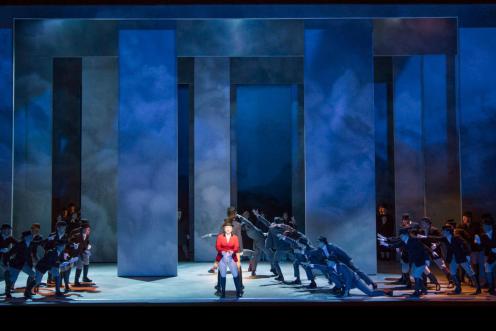
Marnie is a world premiere, which is hugely exciting in its own right, opera being such a traditional museolised art form where newness is rarely added to the repertory. The American Nico Muhly is the youngest composer ever to have been commissioned by the ENO (in coproduction with the Metropolitan Opera) with the creation of a new work and being able to witness such an event is of course a huge privilege. Alas, Marnie is an odd one to see in an operatic setting, one that I struggle forming an opinion on. One that still makes me contemplate if I liked it or not, days later. Which is good in a way, I suppose.
Why on earth Marnie? No doubt, the thieving, identity changing, obsessive compulsive liar with a dark secret is a compelling, hugely layered and complex character – but one that isn’t easily portrayed with an aria or two. Opera, simplistically said, lives from grand emotions. Marnie keeps all her feelings locked up, under control, half of them are just acted out for the sake of manipulation, half of them she doesn’t even realise she has. Opera adores a great romantic sacrificial love story. Marnie is the definition of an anti-love story, all the people on stage despise each other to some extend and are, each in their own way, despicable. The settings – a cruise liner, a fox hunt, a bland office – all seem impossibly non-theatrical and none of this screams opera. Nevertheless, this is an experiment of pushing the art form somewhere unusual and it is interesting – if not entirely successful.
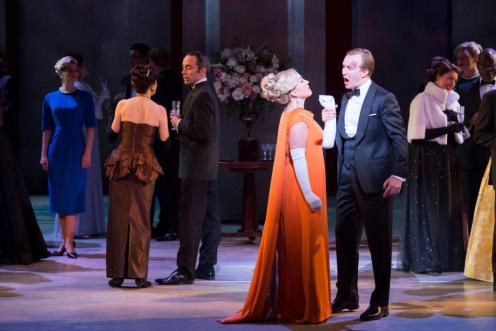
Muhly and his librettist Nicholas Wright base their opera not on the famous Hitchcock film but on the original novel by Winston Graham who – fun fact – is also the author of the Poldark series. I have never read the novel but the programme (and may I just say here, the ENO produces excellent programmes full of information and interesting texts rather than just ads and images: they are well worth the £5, unlike in so many other venues) offers snippets from the novel, which is written in the first person. From those phrases, a Marnie emerges who is full of undercurrent desire and sensuality, cunning, wit, smarting and passion and an autoerotic sexuality that is not levelled at men but at power, money, daring and winning. That Marnie rarely comes to live on the stage. Muhly links his reading of Marnie to Debussy’s Mélisande, another mysterious troubled female who rejects physical contact and obviously carries some kind of trauma with her. But Mélisande is the portrayal of the eternal child woman, a frail and vulnerable girl who desires only pure platonic love and doesn’t survive maturing into motherhood. Marnie’s fear and hate of men, her disgust at sex and her inability or unwillingness to trust anyone do not stem from immaturity. I think that kind of reading underestimates her, just as the psychoanalyst completely underestimates the extent of Marnie’s trauma: a scene I truly loved. The way this- naturally- male doctor pesters her about her attitude towards childbirth, lazily reducing women’s trouble to only ever womb related issues and his mouth-gaping awe when the true extend of murder and violence emerges.

Marnie is constantly followed by four “Shadow Marnies”, a visualisation of her past identities or her split personality. Musically this is stunning as they echo Marnie in close harmony creating a haunting sound. Dramaturgically I find it more problematic: can we not accept that one woman can be multifaceted and many faced without being physically split? Mezzo-soprano Sasha Cooke is an accomplished actress and I would have trusted her to portray all of Marnie’s intricate emotional landscape. I feel equally dubious about the company of shadow men, a group of suited dancers that follow Marnie around. They symbolise the ever present threat that Marnie feels from masculinity, but their constant frantic movement doesn’t really add much. Except in the before mentioned psychotherapy scene where the men seem to be leering at Marnie’s exposed vulnerability, taking in her suffering as some sort of titillating spectacle, lounging on the floor with their legs spread. They finally made sense to me when they stopped moving.

Completely convincing, on the other hand, is Muhly’s use of the ENO chorus: every time Marnie ventures into any kind of social environment her every action is underscored with a soundscape of gossiping and judging, revealing society’s deeply ingrained misogyny. The whispering hypocritical chorus condemns Marnie for her coldness and frigidity just as they condemned her mother for freely living out her sexuality.
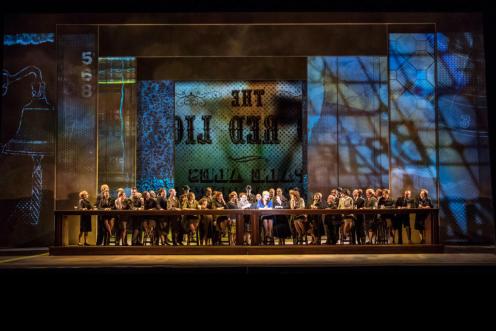
Very clearly, this opera makes a point about the pressure that women are under and very clearly, in the age of pussy grabbing presidents and the Harvey Weinstein scandal, plus of course the revelations of Hitchcock’s own misconduct and bullying of his leading ladies, this is a hugely relevant and current subject. But here, with this multitude of ambiguous characters, it is difficult to pick sides. There is no easy villain to condemn, no clear hero to root for – on an opera stage where normally story telling is so black and white. I thought of Aribert Reimann’s Medea and how strongly and decisively he portrayed the child murderess as a victim of circumstances. With Marnie, I felt my sympathies shifting from scene to scene, from character to character. I was almost offended at Marnie’s husband Mark being portrayed in his lyrical aria as some kind of romantic hero, furiously scribbling in my notebook how this man’s crimes – attempted rape and blackmailing Marnie into marriage nonetheless– are easily forgiven…. when I stopped my pen and realised how masterfully Muhly uses music to manipulate even the audience. For the genre of opera, this shifting of sympathies and ambiguity of characters is very very interesting but also very difficult. Marnie should be a fascinating person but her emotional detachment makes her at times an non-engaging presence on stage while the dubious character of Mark is troublingly charming, sung by the sharp looking Daniel Okulitch. The countertenor voice of James Laing gives a great sleazy quality to Mark’s rivalling brother Terry. Both Mark’s and Marnie’s mothers are characterised as plain old horrible, manipulative and overbearing the one, unloving and ice cold the other. Women, it seems, just can’t get it right. I would have liked a bit more fleshing out and nuancing for Marnie’s mother who, as we later learn, smothered her new born out-of-wedlock baby. With all the underlying motivations undercutting every action, I don’t accept the murder of the child as an act of pure evil, more likely an act of desperation of a different kind. Visually, the opera is stunning, sleek, stylish, simple, smooth.

The libretto feels, at times, clunky. One critic called it a “peasant libretto” which is harsh, but, since all real emotion is subconscious or kept at bay, the dialogue that gets expressed is often banal lines such as “that dreadful man from the country club” sung in a stylised operatic manner. Though it never felt comedic, it was often slightly awkward. Musically it was pleasant, at times beautiful, but hardly ever thrilling or memorable. Few scenes are emotional or passionate, which is down to the subject matter. But then even dramatic high points, such as the suicide attempt lack impact, as Marnie’s emotions never seem genuine. Tender scenes such as her grieving for her horse Forio are more touching. Opera needs some real emotions. In the end, when the cause of Marnie’s trauma is revealed and her guilt is lifted, there is a real sense of release, healing and freedom. All in, I found it hugely interesting, thought provoking and ambitious – but maybe too ambiguous for its own good.
Suzanne Frost
November 2017
Photographs by Richard Hubert Smith
One Magical Night
Arabian Nights
by Dominic Cooke
Q2 Players, The Alexandra Room, Kew, 23rd to 25th November
Review by Viola Selby
Once upon a time there was a group of fantastic storytellers, called the Q2 Players, who transported their audience to a magical Arabian land, through the use of their first class acting skills; exotic costumes, excellently designed by Harriet Muir; and atmospheric music, organised by Felicity Morgan. The tale they told, of Arabian Nights, may have been heard many times over the centuries, but never with such magic and passion, that made it feel like this is the first time it has ever been told.
To begin with, the stage is intimate, with the audience members sitting in a sort of semi-circle close to the action. This, met with the use of a minimalist set design, encourages the viewers to really get involved, using their imagination, just how one would when being told a bedtime story. However Q2 have not let this minimalist approach limit their creativity, using other props in creative and occasionally humorous ways. For example, the use of some of the players, dressed in cleverly designed cloaks with gold inner lining, as the opening of the Cave of Wonders was spectacular; whilst the use of a puppet as Sinbad on his adventures was comedic genius and really helped create more variety in the manner each story’s presentation.

As the stories are told, each of the actors’ talents is shown off, as a wide variety of characters are created through just eleven players. Each character is brilliantly acted out, depicting their individual wants, desires, fears and personality. An example of this is the manner in which Tony Cotterill goes from being the captain of the forty thieves to old Sinbad, to a man turned into a dog by his wife, to a man so embarrassed by letting off a large fart at his wedding that he runs away to India for the rest of his life. Cotterill manages to make each of these characters so realistic and relatable, that it feels as if each part had been played by a different actor. Such subtlety is also mastered into the play as Sharazad , played by the talented Jess Warrior, uses her power of story-telling to not only keep herself alive, but to also seduce the king, excellently portrayed by Scott Tilley, into loving her. The effect this is having on the king is shown through the clever way Warrior and Tilley change the way they act towards each other, building up chemistry, and getting closer to one another, both physically and emotionally, as each story is told.

In addition to this sexual passion and talent, there are also many other scenes that create humour and keep the audience very much entertained. For example, one of my particularly favourite moments was seeing Alison Arnold, as the clever slave girl Marjanah, do a mesmerising belly dance. Although the dance itself was very bewitching, Arnold still kept the feeling of suspense of her character’s deadly plan going as she shook her hips to the music. Whilst the occasional use of audience participation kept all audience members, young and old, fully engaged; clapping along to the music and shouting the magic words at Sidi (played by Cotterill ) to turn his wife into a horse. All this comes together in the enlightening messages that can be taken away from each story and … with the delicious baklavas sold during the interval … truly make this one magical night not to be missed.
Viola Selby
November 2017
Images by RishiRai Photography
A Delight and a Joy
Still Life and Red Peppers
by Noel Coward, Double Bill
Teddington Theatre Club at the Coward Studio, Hampton Hill Theatre until 25th November
Review by Eleanor Lewis
It’s probably compulsory to use the word ‘iconic’ whenever discussing Brief Encounter. I imagine questions are asked and authorities notified if the word doesn’t feature at least once in any review of it. So I’ll get it out of the way now before moving on: Noel Coward’s Still Life is the play from which the iconic film Brief Encounter grew and it, together with another short, one-act play Red Peppers can be seen at Hampton Hill Theatre this week in Teddington Theatre Club’s production directed by Mandy Stenhouse.
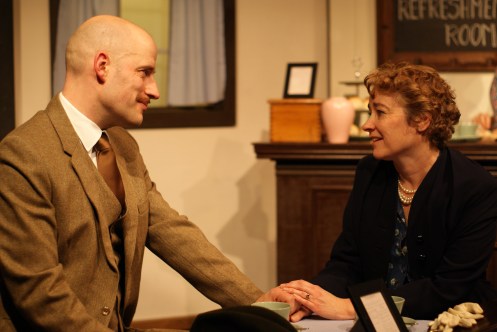
Fiona Auty’s set for Still Life is perfect. It’s obviously the first thing you see as you enter Hampton Hill’s Coward Studio and it’s delightful: a small, tidy and cosy 1930s station refreshment room, flowers on the tables, small cardboard menus. It makes you long for the days when railway stations actually had these places, staffed with people who poured tea for you and served you pastries which would be accompanied by real cutlery as opposed to wooden sticks. Noel Coward sings gently from the wireless in the background and trains can occasionally be heard arriving and leaving outside the window, Tom Shore’s lighting is soft but businesslike.
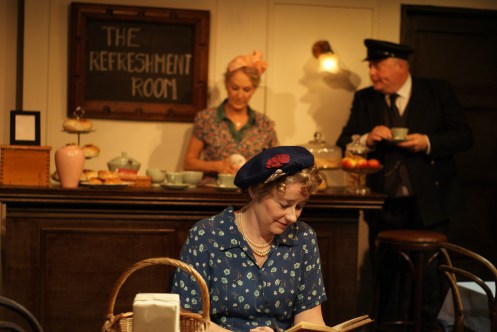
Into this beautifully created little world come the formidable Myrtle, manageress of the refreshment room, directing operations from behind her beautifully arranged counter, and waitress Beryl, together with ticket collector Albert and other characters with small but expertly written roles. These characters set the scene and establish their relationships with each other until the main players arrive on the set, one with a familiar piece of grit in her eye and the other to gallantly help her remove it and thereby fire the spark which begins one of Britain’s best known and most agonising romantic dramas.
Tracy Frankson and Charlie Golding played the famous Laura and Alec, both actors giving accomplished and efficient performances in roles more difficult than they seem. Laura and Alec are neither heroic nor particularly unusual characters, but ordinary – 1930s middle class ordinary, but ordinary nonetheless. They are anyone who has fallen in love with someone they aren’t officially committed to and then battled with their integrity because of it. To bring these characters to life and then to carry an audience with them as they fall in love and consequently struggle with the natural course of their affair is no easy task, particularly as Coward only allows them to interact with each other within the walls of the station tea room.

Tracy Frankson and Charlie Golding rose to the challenge and took their first performance audience with them all the way. I wondered a little at Charlie Golding’s use of a constantly softened, gentle voice of the type used by some adults when speaking to small children, as it seemed unnecessary, but it didn’t detract from his performance. Where voices are concerned though, the 1930s-40s upper class accent is too easily parodied to go for it wholesale (see Victoria Wood’s Brief Encounter sketch and many others) but possibly a few clipped vowels from time to time between Alec and Laura would have matched the ‘I should say so and no mistake’ accents of the station staff but these are only details against what were two strong performances.
Talking of the ‘lower orders’, Samantha McGill’s Myrtle was marvellous. She was totally engaging, entertaining and real, as was Andy Smith as ticket collector Albert, the beau she dangled at arm’s length … or closer … to the delight of both of them and all of the audience. They were a joy to watch. It’s worth noting too that the level of professionalism on view on the stage at all times – particularly for a first performance – was impressive. Focus naturally switched between the refreshment staff and Alec and Laura but at all times everyone on stage whether speaking or not was occupied appropriately and naturally, a credit to the actors and the director’s attention to detail.
The second play to be seen was Red Peppers. This very short play could be seen in its entirety as a barbed comment on the draining effect of a life touring in vaudeville. Husband and wife double act Lily and George Pepper are, as aptly described in the programme, “on their way down the ladder of success”. The two stagger through a song and dance number Has Anybody Seen Our Ship and then retreat to their cluttered dressing room – another impressive set – where they snipe mercilessly at each other but come together as one to highlight the shortcomings of the musical director and then the theatre manager, nicely played by Andy Hewitt and Edz Barrett. Noisy arguments ensue, disturbing the rest of Miss Mable Grace, a Shakespearean actress somewhat past her best, who floats in and provides an opportunity for new types of sarcasm to be employed by George and Lily who have little time for such types. Helen Smith is appropriately oblivious and other-worldly in this cameo role. The hapless two conclude the play, newly costumed, with a rendition of Men about Town which comes to a disastrous end, sabotaged by the enraged musical director.

It is a delight to watch and very funny, and tribute must be paid to the skill on show from Lottie Walker and Steve Taylor, two strong actors more than capable of getting everything that is to be got out of Lily and George but whilst doing so they are required to change out of one costume and into another, apply additional make-up, arrange and fit wigs and ultimately consume a plate of steak and chips each. Impressive.
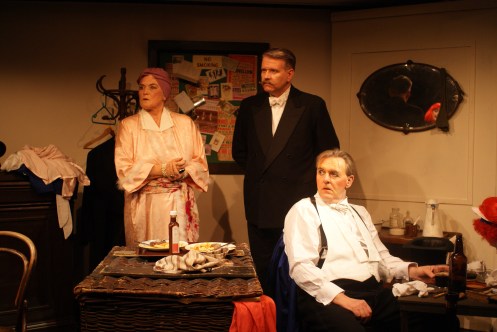
Still Life and Red Peppers are two highly enjoyable plays, well produced and well directed. The level of consistency of performance across both productions was striking, every performance was rounded, every detail attended to. Highly recommended.
Eleanor Lewis
November 2017
Photography by Joe Stockwell
The monster consumes itself
Hercules
by George Frideric Handel, libretto by Thomas Broughton
Richmond Opera at Normansfield Theatre until 19th November
Review by Mark Aspen
Hercules, legendary strongman hero, tackled fearsome lions, hydras, bulls, boars, and monstrous dogs: twelve gruesome creatures, and others beside, hand-to-hand, alone. He succumbed to none, vanquished all these monsters … but then came the green eyed monster!
Sophocles, in one of his best tragedies, Τραχίνιαι (Women of Trachis), tells how Hercules’ death was brought about by the jealousy of his wife, Dejanira. Hercules is returning from Oechalia, where he has been victorious in a war against King Eurytus and his sons, whom he has killed. He is returning home to Trachis in Thessaly, with his army, much booty and many prisoners, including the beautiful Princess Iole, Eurytus’ daughter. Dejanira has been waiting many years for news of Hercules, but now she is not too happy about his principal captive, an aristocratic woman who is young and highly desirable. Seeds of marital discord soon germinate in Dejanira’s heart, with disastrous consequences.

Handel’s Hercules, which premiered in January 1745, had a bumpy ride in its early days. The part of Lichas, the herald, originally a minor tenor role, was rewritten for actress Susannah Cibber, one London’s most popular stage personalities of the time. Unfortunately, she was taken ill and the part was read in. The piece flopped and Handel offered his Subscribers (the production’s “angels”) their money back, but they stuck with him and the houses picked up later in the season. Nevertheless, Handel’s confidence in the work was shaken, and he continued to write and rewrite that piece for years.
Hence, Hercules has always had the feel of a work in progress, and Richmond Opera in its current production of Hercules continues this notion by presenting an abridged version and splitting some of the original roles between other characters, albeit characters with a mythological pedigree. Moreover, director Lucy Green has moved the action to Britain, and in the mid-fifteenth century, although the reason for this is not obvious. However, it does give a wonderful opportunity for scene designer Lynn Keay to blend her set beautifully with the Victorian medievalism of the Normansfield Theatre and the pre-Raphaelite feel of its paintings. It furthermore gives a complementary opportunity for costume designer Kate Cleeland to regal us some luxurious medieval garments, including featuring of the hennin, the tall steeple hat favoured by ladies at the start of the Wars of the Roses, the archetypical fairy princess hat.

The fairy princess of this story is Iole, who is finely acted by soprano Philippa Dodd, whose vocal precision lightly colours the baroque figuring. From the initial lament for her lost freedom, and for her slaughtered family, to being able to feel sympathy and love for her captors, Iole has a huge emotional journey to make. At first she contrasts, “Daughter of gods, bright liberty! … thou, alas, hast winged thy flight … removed for ever from my sight” with “Captivity, like the destroyer death, throws all distinctions down”. Whereas, later she recognises the effect of jealousy in her nemesis Dejanira, “Ah, think what ills the jealous prove. Adieu to peace, adieu to love”. In due course, she can feel deep sympathy with Dejanira, “My breast with tender pity swells at sight of human woe …”. Philippa Dodd achieves this task consummately.
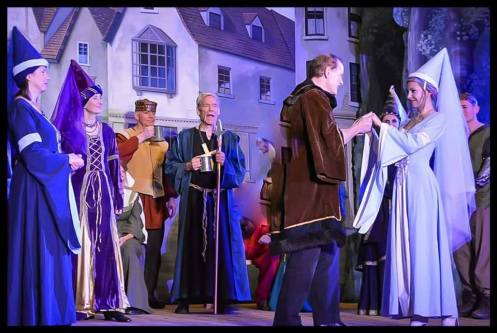
Emilie Taride brings great mezzo fire to the role of Dejanira, giving her passions full rein. When jealousy takes hold, she knows how to spit the venom, and has a good turn of sarcasm for her hero husband, “Oh, I grieve to see the victor to the vanquished yield …. Your fame eclips’d, and all your laurels blasted!”. It may be true to the mezzo cliché of bitches, witches and britches but Handel is not very kind to poor Dejanira. Perhaps Taride could have turned down the heat, although not for the deranged full-blast arias such as “Where shall I fly”. Sophocles, in contrast to Handel, shows Dejanira as the victim of her own jealousy, not its mistress.

What is the consequence of Dejanira’s jealousy? While Hercules is away overseeing preparations for the rites to celebrate his victory, Dejanira remembers she has stored a “garment, dipped in Nessus’ blood”, which will “revive the expiring flame of love” in Hercules. She sends Lichas to the temple with it for Hercules to wear at the ceremony. Now, Nessus was a centaur, who had offered to ferry Dejanira across the River Evenus. In mid-crossing, Nessus attempted to rape her and Hercules shot him dead with an arrow steeped in the blood of the Hydra. The dying centaur claimed to Dejanira that a garment soaked in his blood could be used as an aphrodisiac specific to Hercules, and that he would never look at another woman again.
However, when Hercules dons the garment, the Hydra’s blood bursts into flames, burning the skin from his body, whilst irretrievably sticking the deadly garment to him. Choreographer Harita Stavrou has created an atmospheric ballet sequence for this gruesome immolation of Hercules with five young dancers from the Richmond Academy of Dance, a ring of silk flames surrounding Hercules as he dies. Hercules, played with rich bass resonance by Tony Moss, calls out in agony “I burn, I burn. Tormenting fire consumes me. Oh, I die. Some ease, ye pitying powers!”. But no help comes, although he calls, “Neptune, kindly pour Ocean’s collected flood into my breast and cool my boiling blood!”.
Handel referred to his Hercules as a Musical Drama, and dramatic it certainly is, to distinguish it in essence from his non-staged oratorios. It is much more in the style of the Italian operas of his time. Not only is da capo aria form prominent, but the chorus plays an important role. Here the link with the source material from Sophocles is evident, as the chorus has the same function of the chorus in Greek tragedy, commenting on the action as well as being part of the narrative itself.
Richmond Opera’s chorus greatly fleshes out the piece. It’s collective outburst “Jealousy! Infernal pest, tyrant of the human breast! How from slightest causes bred dost thou lift thy hated head!” forms a powerful climax to the first half of the opera, a massed fugato highlight. Its lament following the death of Hercules is striking: “Tyrants now no more shall dread on necks of vanquished slaves to tread … Fear of punishment is o’er. The world’s avenger is no more!”


Notwithstanding the strong presence of the chorus, the stage often feels congested and over-used. There are often occasions when groups of actors are there for no particular reason and sometimes pull the focus. Equally the temptation to over-use the renowned Normansfield scenery and fly in its magnificent painted backdrops overwhelms. (Incidentally the use of free-standing scenery blocks to supplement the Victorian flats is a very clever idea.)
We know that opera thrives on spectacle but sometimes less can be more.
The plot of Hercules is not all negative however. There is the underlying element of the transmutation of Iole’s despair, and her hated of her captors, into a growing love for Hyllus, Hercules’ son. Tenor Andrew Evans delivers an imposing vocal interpretation of the part, secure through the full range of his register, but could allow himself to be more impassioned in his physical interpretation of the role, particularly as Hyllus woos the lovely Iole, when, “Gods have left their heaven above to taste the sweeter heaven of love”.
Some of the Hyllus’ words are given in this production to Iolaus, in mythology Hyllus’ cousin. Luke Reader gives the role sharpened vitality, with vocal accuracy and a pleasing tone, particularly at the lower end of the register. Lichas, the herald, the part Handel originally intended for contralto Susannah Cibber, was later transposed for counter-tenor and Mark Fletcher ably demonstrates his remarkable vocal abilities in this role.
Handel shows his mastery of inventive contrapuntal and temporal variation. Dramatically, the music follows the moods of the plot and underlines the characterisation of the protagonists. Conductor Lindsay Bramley, Richmond Opera’s Music Director, runs expertly with all these nuances, pacing at the appropriate tempo, and pushing the anxious energy of the music. She gets the most from her fifteen piece orchestra under the experienced leadership of Jocelyn Slocombe. Whist mainly modern instruments, it has an authentic baroque feel, helped not only by Michael Keen’s harpsichord, but by the full expression of the foregrounding of individual instruments elicited in Handel’s narrative score.
Hercules is a work full of ironies. The ironies of Nessus’ words, of the guilt of the innocent, of love arising from hatred, set the foil for its greatest irony, that Dejanira’s love for her husband bring about his destruction. Keep the green eyed monster in its lair, for if love conquers all, it may commit suicide.
Mark Aspen
November 2017


 Mark Aspen