
Kooky Capers in a Bare Forest
As You Like It
By William Shakespeare
Shared Experience, in co-production with Theatre by the Lake
at Richmond Theatre until 11thNovember, then on tour until 9th December
Review by Mark Aspen
When Richmond Theatre opened on 18th September 1899 as Frank Matcham’s latest architectural tour de force, it’s first offering was As You Like It , but would that staid audience have recognised the latest offering of William Shakespeare’s much-loved comedy that opened its national touring version this week?
They may have been a little bemused by Shared Experience’s colourful kooky setting, and perhaps by the exuberant inclusion of contemporary dance and music, but they would have been at home with the familiar words, as the production has been true to Shakespeare’s script. All of the play’s well-known songs are there, but with sparkling new adaptations by composer Richard Hammarton, whose powerful sound designs set the mood. With the inclusion of movement director Siân Williams’ dances, the production edges towards “As You Like It, the Musical”.
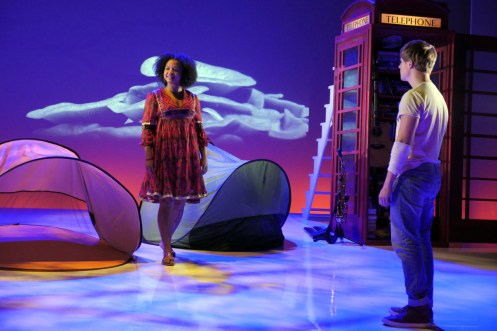
Now, what about this setting? It is meant to be 2017, and has modern paraphernalia such as mobile phones. However, it often feels more 1967 with its flower-power hippies and Gilbert Scott red phone box. Shakespeare clearly wanted to contrast the two worlds of As You Like It , the stern court in the city and the idyllic Forest of Arden in the countryside. Designer Libby Watson has certainly achieved the contrast. The court becomes a politicians’ committee room (Portcullis House rather the Palace of Westminster), black and white, charcoal coloured faux-suede walls, off-white faux-marble floor; Nespresso machine, water cooler: stark. The countryside is full of colour, open, bare; Phone box, bench: exposed. When the back wall of the room unzips to reveal the country, it impacts with a momentary wow … but then there follows wait-a-minute thoughts. The pastoral pastel of the foreground clashes with the lighting designer Chris Davey’s cyclorama of saturated light-washes. There are beautifully stylised poetical images projected across the cyc, but also across the stage items, leaving their shadows on the scene and with their edges visible. Isn’t this meant to be a sanctuary beyond the reach of the Duke’s henchmen? It looks like the edge of Richmond Park, but scruffy, a recreation ground accessible by supermarket trolleys. Why has Arden got the Duke’s water-cooler? Why is the telephone box crammed with bookshelves? And why does a forest have only one Waiting for Godot bare tree, that doesn’t so much sway in the wind as wobble at the roots?
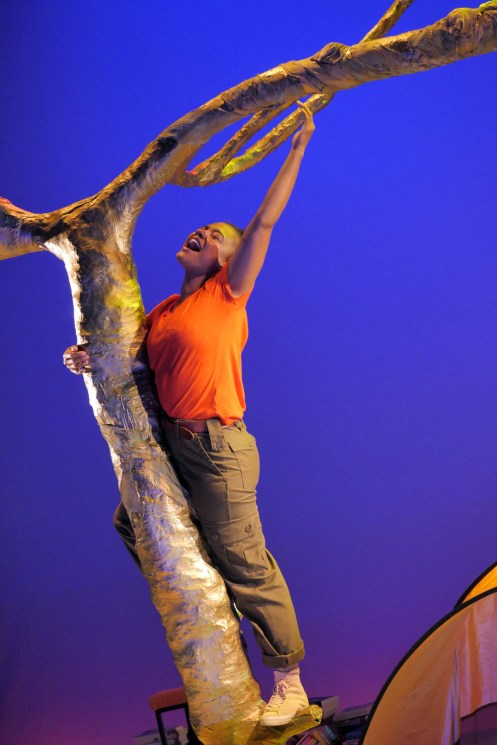
Strangely though, all this quirkiness works, even if its surrealistic symbolism doesn’t percolate through. It its own characteristic way, Shared Experience has for forty years championed a style that merges physical theatre with a rediscovery of the text. Director Kate Saxon, in this As You Like It , has a natural fluent telling of the story, savouring Shakespeare’s words, but its potency comes from a juxtaposition of styles from film noir to pastoral idyll to panto comedy. Hence the country comedy is highlighted against the threatening city, and what a contrast.
The strong opening pitches brothers Oliver and Orlando in an explicitly violent fight. (Fight director Kevin McCurdy aims to shock at several points during the play.) Orlando’s near strangulation of Oliver prompts him to use Charles the wrestler as a hit-man to get his revenge, but Orlando triumphs in a no-holds-barred punch-up across the committee room table. Equally, Duke Frederick is a hard man, a yer-don’t-mess-with-me geyser, not averse to personally meting out a good beating, followed by water-boarding using one of the ubiquitous water-coolers. These, thankfully short, Tarantino-esque episodes form a foil for the broad comedy to follow.
Some of the actors are called to play multiple roles, which with great versatility and a variety of accents they differentiate admirably. Hence, in a very strong performance, Alex Parry plays not only the violent Duke Frederick and in contrast his laid-back brother, Duke Senior, whom Frederick had usurped, but the sheep-farmer Corin.
Perhaps the widest versatility is asked of Matthew Darcy, who amongst other roles dexterously portrays Oliver, Amiens (as a Scottish New-Age musician!) and the country wench Audrey. His Audrey, pig-tailed and bobby-socked, is reminiscent of a pubescent Grayson Perry. The comedy is taken towards knockabout pantomime in Audrey’s scenes with her amoretto, the joker Touchstone, played with expansive mock-gravitas by Matthew Mellalieu, as a Screaming Lord Sutch lookalike in orange crocs and red velvet drape jacket. Mellalieu earlier doubles as Adam, Orlando’s faithful old servant and one of the most sympathetic characters in the whole Shakespearean canon. He plays the part well, but casting such a robust heart-of-oak actor as the frail and halt octogenarian doesn’t quite work.
Having doubled as Charles, the wrestler, we later see Adam Buchanan as Silvius, the young shepherd, whom he plays to the hilt as a gormless, lovelorn swain. The object of his affections is Phoebe, pertly portrayed by Josie Dunn, whose lithe and vivacious acting is complemented by lively musicianship: a plaintive clarinet solo and energetic saxophone accompaniment to the music played live by five members of the cast. Their music and dancing keeps the pace of the play moving.
Richard Keightley, a very camp Le Beau at the beginning of the play, makes a fine Jacques (here described as Cultural Secretary to Duke Senior) in an insightful interpretation of the role. His rendering of the Seven Ages of Man speech, growingly despairingly morose at the prospect of old age, makes perfect sense in view of his self-proclaimed melancholia.


Although As You Like It has a number of parallel themes including a four mirrored love stories, it really revolves around Rosalind, the daughter of the exiled Duke Senior, who herself spends most of the play banished to Arden disguised as a the young man, Ganymede. In this role, Jessica Hayles makes a charming and playful fugitive, energetic in her hopes and highly animated in her emotions, expressed in neatly choreographed mute movement sequences. Orlando, love-struck for Rosalind, and seemly fooled by the Ganymede masquerade, is convincingly acted by Nathan Hamilton in a strong performance, full of teenage urgency and anxieties. Rosalind has escaped from the court with her cousin, Celia, the daughter of Duke Frederick, who in Shakespeare’s script shares in the despairs, hopes and aspirations of her cousin. However, Layo-Christina Akinlude’s performance in the role was totally tangential to these emotions. She puts across a bored and cynical take on the character, antithetical to Rosalind.
It may seem sniffy to say that production is clearly pitched at the first-time Shakespeare audience, but it seems to want to say more than that. (There are some side-swipes at current politics, Duke Frederick coming across as a Jean-Claude Juncker, an unelected tyrant usurping the legitimate sovereignty of Duke Senior, while a poster in the forest proclaims “Stags for Remain”, oblivious that they will soon become EU venison.) The production may want to say something about current social conflicts around the roles of men and women, but falls short of pulling that from the text.
Nevertheless, with its bold visual impact, musical interludes and intelligent dialogue As You Like It was well received by the young Richmond press night audience. It is fun and makes for enjoyable entertainment; it is colourful and makes for good visual theatre; it enjoys Shakespeare’s words and makes for good story telling. Enjoyable entertainment, good visual theatre, good story telling: all the things that the Richmond audience of September 1899 recognised… oh, and Shakespeare’s words.
Mark Aspen
November 2017
Photography by Keith Pattison
Consumed by the Drama of Himself
The Dramatic Exploits of Edmund Kean
The Exchange, Twickenham, 5th November
Review by Matthew Grierson
Can we love a fine performer who is a dreadful man? It’s a question we should ask of the Romantic tragedian Edmund Kean in Ian Hughes’ absorbing one-man show, as practically the first thing we learn about him is that he – Kean – is making his wife, who is six months pregnant, walk 180 miles to Swansea where he has been offered a job. Yet he – Hughes – pursues the tragic arc of Kean’s career from strolling player to West End star, then to sozzled has-been, with such virtuosity that it is difficult not to sympathise with him.

This is partly a function of Hughes’ writing, which aims to showcase both his own and Kean’s versatility, and he deftly manages the lightning changes required when, for example, his joy at being invited to perform at Drury Lane becomes bereavement and impotent rage at his son’s premature death. But it’s also partly that Kean has to be built up, because a performer from the age of the stage leaves no direct record for the present in the way that (say) his contemporary Lord Byron does. So Hughes’ Kean is a wry raconteur, an intimate sharing his life story and interspersing it with displays of admirable range to conjure the various company managers and committee members he comes across. His manner is indeed so engaging that it overcomes the limitations of the production. For instance, the changes of scene that calibrate each act are largely unnecessary, because Kean is rather so free and easy with his narration, his showman’s sleight of hand shuffling past and present, that the Turner-lite backdrops become redundant when a tavern or dressing room might be more appropriate to the retrospective relation of the life story.
Hughes thus ably conveys the greatness that was evident to men such as Byron and Hazlitt (not many actors would commend their reviewers as “astute young men” as Kean does the latter). But because there is little distance between audience and performer – no, performers – it is difficult to see the tragedian’s own fatal flaws. With more flecks of arrogance, delusion or inconsistency, we would have been better able to glimpse him in his less pleasant but truer complexity. Yet with Hughes on his side, Kean will always seem more heroic than tragic.
As a result, when his downfall does come midway through the second act, it is not altogether clear where it has come from, as we’ve been party more to his joys and japes than to his demons. We’ve seen how he is affected by poverty and by the death of his son, certainly, but these are flashes of darkness in a tale that is otherwise reminiscent of Henry Fielding in its picaresque quality. Though the brandy has been with him since the first act, where the impoverished Kean hails its advent as that of a lifelong friend, it enables more humour than horror, as though he is a Regency Withnail; and when we see Kean preening at the height of his fame, there is still a loveable twinkle in Hughes’ eye, and the little jig he gives upon reading that his performance of the Dane has “brought down the classical school” is not only joyous but a nice callback to earlier comic roles as a monkey or Harlequin. Rather than have us take Kean’s word that his acting style was “innovative” or “revolutionary”, Hughes also begs, “Let me illustrate” – whereupon we are treated not only to a rendition of his Shylock and Richard but also to his rival John Kemble’s stilted, singsong delivery and the pirated Shakespeare of the off-West End performances, giving us a sense of the broader theatrical context. That said, it’s odd to note how much Kean’s tragic style is not realism as we have come to know it but somewhat hammy and formulaic, especially compared with the easy, modern idiom with which Hughes’ Kean comes across.
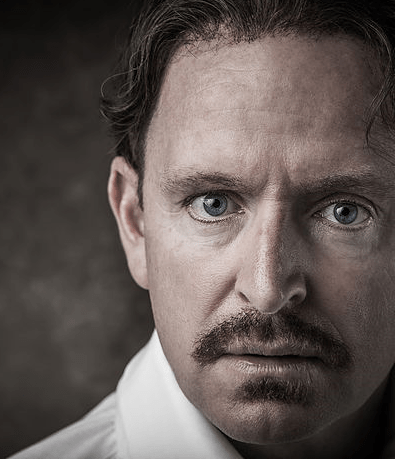
When we again see the tragedian in his cups, Hughes’ portrayal of a man about to undo himself communicates that moment with conviction.But I would have appreciated a little more insight into the causes of it, of the kind the best tragedy provides. Why, having fulfilled the ambition that has nursed him through the vicissitudes of the preceding hour, which we and his offstage wife have endured, does Kean regale us with the arrangements he makes to have young actresses available to him in his dressing room? It’s a pointed and sadly timely reminder of the abuse of power by public figures, but reading his decline and fall as a modern narrative of celebrity denies us an opportunity to see what makes Kean’s story truly distinctive, and thus properly tragic.
Does it lie in the further remove of Kean’s childhood, recounted but not performed, which saw him abandoned by his mother and brought up by a strict aunt, also an actress? Kean does after all quote Hamlet in his misogyny: “Frailty, thy name is woman.” Like the prince, he too is haunted, and the touching end to the first act sees him take the ghost hand of his younger self, Hughes imagining Kean in turn imagining the boy’s presence – while all the time we are imagining his son Howard, dead at the age of four.
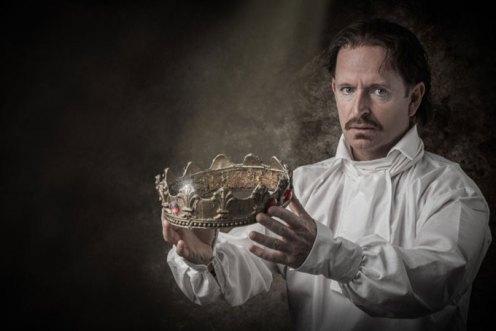
Perhaps the true tragedy of Kean is not of a man undone by ambition, drink or lust, but of one who cannot separate his life from the performance of it. While he can, at his height, imagine claiming Kemble’s crown as the King of London’s Theatreland, at the end he cannot even reach the prop crown of Henry V off a chair as he lies prostrate with gout on the dressing room floor. So if it is the case that a man who lived for tragedy has made a tragedy of his life, then he is lucky to have an actor as understanding as Hughes is to perform it for him.
Matthew Grierson
November 2017
Photography courtesy of Ian Hughes
Editor’s Note:
Ian Hughes is an acclaimed Shakespearean actor and member of the Royal Shakespeare Company. The Dramatic Exploits of Edmund Kean was first performed at The Other Place (the RSC’s studio theatre) earlier this year.
The Exchange, Twickenham is the country’s newest theatre, which opened in October and is opposite Twickenham railway station.
Rings of Brass
For Love or Money
by Blake Morrison adapted from Turcaret by Alain René Lesage
Northern Broadsides
at The Rose Theatre, Kingston until 4th November, then on tour until 2nd December
Review by Mark Aspen
Let’s sit down, have a nice chatter-watter, and natter about For Love or Money. Now here’s a nice tale if you like, a fun-filled farce about folks’ foibles.

Halifax has come to Kingston with Northern Broadsides’ tongue in cheek play about a concatenation of conmen, with more fiddles than the Yorkshire Symphony Orchestra. The company often works with journalist and author Blake Morrison to adapt plays from the past, ranging from Aristophanes to Kleist, into the Yorkshire vernacular. This time round the source is Turcaret by Alain René Lesage, which was first performed at the Comédie Française in 1709, and which in turn is based on Tartuffe by Lesage’s muse Molière. How does the play cope with its 220 year transplant from Paris to a Yorkshire mill town in the late 1920s ? Surprisingly well, for human vices like lust and greed, which are the peccadilloes that form the driving force of For Love or Money, are real hardy perennials.
The Great War took the colonel who lived in the grand mansion on the outskirts of the Yorkshire town. Ten years since, he never returned from the front, and his young and attractive widow Rose is finding it hard to cope financially. The furniture has been sold, as have the oil paintings, witness the shadows of the frames on the William Morris wallpaper (one of many inspired touches by designer Jessica Worrall, which include some colourful pastiches of period dress by Lucy Archbould).

The scene is set at the opening with Rose in conversation with Marlene, her housekeeper and one remaining servant. The bluff Marlene, robustly played by Jacqueline Naylor, speaks in broad Yorkshire vernacular, which the opening night audience at Kingston found almost impenetrable, but it mattered not, as her whiplash tongue said it all. Marlene is warning Rose about the predations of some of the local men, whose intentions may not be honourable. For her pains Marlene is given the sack, but Rose loses her rough-edged guardian. She doesn’t know that her husband, the late colonel, sent Marlene a letter to ask the she look after Rose as he believed her to be very vulnerable. Well, perhaps she is, but perhaps she isn’t.
Rose is wooed by two suitors, the well-heeled banker Algy Fuller, and the louche gigolo Arthur. However, Arthur is a con-man and is fleecing Rose, but Rose is taking Algy for all she can, while Algy is embezzling from his bank, and a great merry-go-round of greed tootles its merry way around the story.
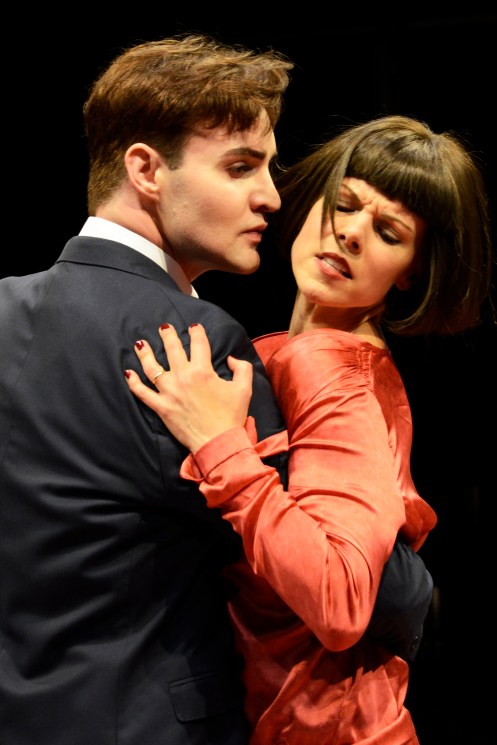
The guileful but gorgeous Rose is played by the Sarah-Jane Potts who skilfully balances the demure innocent-abroad against the shrewd schemer in Rose’s psyche, coy one moment pert the next. She is the flapper par excellence, fringed hair, satin dress the colour of, well, a peach. For Rose is the focus of the action, the honeypot cum money-pot to which the men are drawn, some for the honey, some for the money. Arthur is after both; the money to feed his gambling addiction, the honey to feed his voracious sexual appetite. Neither his promiscuity nor his ego know any bounds. He describes his liaison in a back alley with an older woman as “performing an act of mercy”. Jos Vantyler has the part of Arthur to a tee, oozing debauchery from his coiffured hair to his co-respondent’s shoes; even his movements are dissolute. Now, Algy has plenty of money of his own, or is it his own? For Algy runs so much of a double life that it probably counts as a triple life. Suited and booted, smiling and moustache twirling, Algy bursts onto the scene adamant to achieve his goal of seducing Rose. His armoury includes gifts of jewellery (fraudulently acquired), verses proclaiming his love (witless doggerel) and promises to build a magnificent new house for her with orangery and haha (castles in Spain). Barrie Rutter portrays Algy as an effusive convivial man, opulent and expansive, comfortably rotund and very self-satisfied. He his lost his wife to the ‘flu epidemic, or was it the flew epidemic? Algy is wary in matters of business, particularly dodgy-business, but totally blind in his enthrallment by the alluring Rose.

Barrie Rutter is also the Founder and the prime mover of Northern Broadsides. Describing himself as a “theatrical animal”, he has grown the company to world-wide recognition, with its mission to promote the richness of the dialects of the North of England. Rutter has himself taking on the direction of For Love or Money, and has run with the vivacious dialogue and the sinewy humour, the emotional slapstick that is the engine of this play. At some points the play has a late music-hall feel, such as at the opening of the second half and the pre-curtain call which involve quite elaborate song-and-dance routines: much credit is due to Beverley Norris-Edmunds’ choreography with Conrad Nelson’s music. There is a bit of the shoulders back “I say, I say, I say” to the setting up of gags. The play is certainly stylised with every character having a distinct but exaggerated style of moving, and all the first entrances are down-stage right into a spot, with an unspoken “Dah! Dah!”. The effect of this somehow smacked in my mind of a comic strip unfolding across the stage, with the “Umphs” and “Ouchs” and “Ooos” imagined in the air. It is a distinctive style that gives the piece so much vibrancy.
Much of the comic strip reference comes from Jordan Metcalfe as Jack, with his quiff a Tin-Tin overdosed on E-numbers. With a Jack-the-lad twinkle in his eye, he energises his part to the brim. Jack is described as an odd job man, and they certainly are odd jobs. He is the general run-around for Arthur, doing all his dirty work. Then he takes up the same services for Rose, and then for Algy, but concurrently. Here is a sharp sharper who knows how to play all ends against the middle.
Jack’s girlfriend is Lisa, who is a young woman with a strapping way with words and who knows how to look after herself. She has worked as a char and as a street-walker, hence Jack’s honest introduction of her as “the best scrubber in town”. Jack insinuates her into Rose’s household, putting another tangle in the thread of farce. Kat Rose-Martin makes a gamine Lisa, pouting her scarlet lipstick. She plays the role with a warmth that makes one disregard her felonies as mere naughtiness. The audience though is itself seduced by Jack and Lisa, maybe because everyone in this play is an anti-hero, so we root for the best of a bad bunch in these characters. And we know that they will be the ones who will win out in the end.
This wild welter of nefarious plans begins to unravel when wronged parties appear. Martin, a farmer, has been tricked by Algy in his dealings with Algy’s bank, and tricked out of his late mother’s jewellery. Martin’s addiction is to booze, but he is looking for a wife to change his life. He also has some wonderful turns of phrase, including a very apt spoonerism: his riposte to Algy’s “I run a tight ship”, as “Yes, a shite tip”. Jim English delivers these lines for maximum comic impact with spot-on timing, playing Martin as a lanky sot, somewhat simple. Martin is the susceptible victim at the bottom of this food chain of deception.
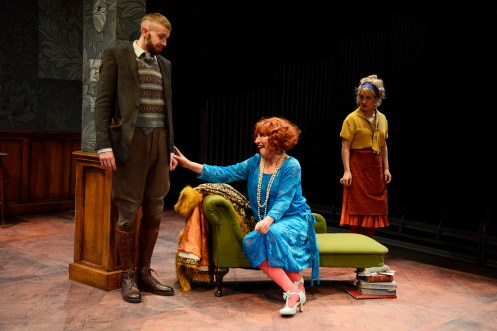
Then comes Ruddles (Matthew Booth), Algy’s bank clerk, coerced into getting his hands dirty for Algy, with a list of chickens coming home to roost; and Gwen (Jacqueline Naylor doubling) an “antiques dealer”, who turns out to be Algy’s sister and proceeds to tell more than a few home truths. A bailiff, Hever, arrives to seize some of Rose’s land, but this is Jack in disguise perpetrating another fraud. All adds to the general mayhem.
Finally, Teresa, “a visitor” joins in the party. She comes as Martin’s fiancée, a “classy French” woman of a certain age. Arthur recognises her as his “act of mercy” but stays mum. But when Algy appears his recognition of her is … (to avoid a spoiler) … not welcomed. Sarah Parks is priceless as Teresa, multi-coloured and grotesque, complete with cod French, she grabs the stage by the throat. A deep Fanny Cradock contralto enhances the far from understated picture of the wronged woman. Algy is in, as Teresa puts it, the merde.
For Love or Money makes an hilarious evening’s entertainment, but underneath it is a salutary allegory to human greed. Everyone exploits everyone in a riotous Ring a Ring o’ Roses; everyone abuses everyone in a way that would make Arthur Schnitzler blush: everyone milks everyone else, but the most loveable scoundrels run off with the cream.
Oh, a “chatter-watter” is a cup of tea, so we learn proper Yorkshire too.
Mark Aspen
November 2017
Photography by Nobby Clark
The Musical That Ticks All the Boxes
Made in Dagenham
BROS Theatre Company, Hampton Hill Theatre until 4th November
Review by Eleanor Lewis
The single most frustrating thing about Richard Bean, David Arnold and Richard Thomas’ musical Made in Dagenham is that you can’t sell it to someone who’s never seen it. It’s the story of the women machinists at Ford, Dagenham and their struggle for equal pay in the late 60s and early 70s. Standard response to this as an evening’s entertainment is: “right, lovely, all for equal pay (who isn’t?) loved the film but do we really need a musical as well?” And that would be the point at which that individual’s quality of life would be a tiny but significant bit reduced.
Dagenham is that rare thing, a musical that ticks all the boxes, It’s well written, very funny, the music is memorable with grown up lyrics, and it tells a complex story efficiently and without patronising its audience, including those people who don’t do musicals – “God no! Is it a musical? You didn’t say it was a musical, I loathe musicals!” was the genuinely horrified reaction of a friend’s girlfriend, not paying full attention to what she’d been invited to. More of her later.
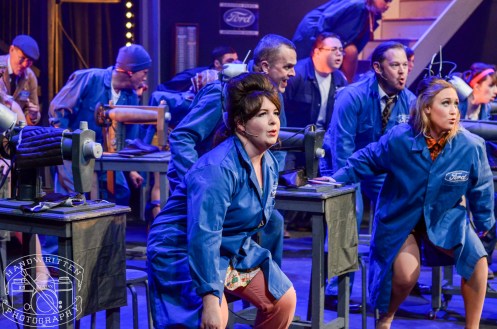
A strong show done by a strong company in the depths of October is going to sell out and Dagenham duly did, quite early. The production then had to live up to expectations which it also did, seamlessly. The energy and talent on show at Hampton Hill did not disappoint nor were there any visible signs that the challenges of putting on this spectacle had been too much. Dagenham is a long show – not that you notice – it covers a lot of ground and therefore requires a director who knows what he’s doing (not to be taken for granted in amateur productions). Wes Henderson Roe, as well as directing, also created a set that worked on all levels, allowing scene changes to take place efficiently with no extraneous activity and including an upstage office on a balcony accessed by a surprisingly unobtrusive, almost centre stage staircase, making use of the entire visual playing space. Clever.


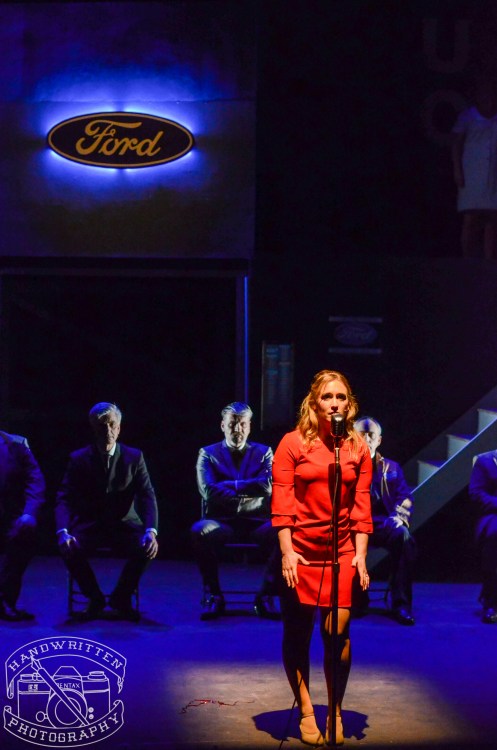
Under the guidance of shop steward Connie, the show’s central character, Rita O’Grady is persuaded to lead the machinists’ protest and then the strike despite having no previous experience. The story is based on true events but Rita and her husband Eddie are fictional characters, emblematic of the Ford workers at the time. O’Grady is therefore the type of character that actors probably dread because she’s an unremarkable, ordinary, nice wife and mother. Her husband, Eddie is unremarkable, nice and ordinary too. How therefore do you make them engaging? How do you take an audience with you, make them sympathise with your character and want what they want? What do you have to work with? I have no idea, I’m only the reviewer but Dagenham is well enough written to give you plenty of clues. Lacey Creed and Martin Wilcox as Rita and Eddie evidently found the clues and succeeded not only in creating a believable family unit, with some talented younger actors as their children (Emily Pegler and Noam Sala Budgen), but also in drawing the audience into their world and making them care about them.


There were many and varied opportunities for actors to shine in this show in every kind of role and BROS Theatre Company is fortunate in being able to provide a consistently high level of performance across the show. There was the trio of shop stewards Bill, Sid and convenor Monty played respectively by John Paul Sutherland, Berni Messenger and Carl Smith, sometimes in their elevated office commenting on the action, sometimes interacting with the rest of the cast their banter authentically delivered, their characters believable. There were Rita’s workmates, notable among them the verbally challenged Clare played astutely by Aggie Holland whose job it was to sing the fabulous Wossname. Many women sing well, fewer can do comedy. Aggie Holland does both but understands how to do comedy better than a lot of people.
Where comedy is concerned it might be overdoing it to wonder wistfully whether Steve Taylor and Clair Jardella should be available on the NHS in these trying times, but for those of us old enough to remember the 70s, Harold Wilson lives, still. Steve Taylor is a talented actor but his portrayal of Wilson as a combination of eccentric, spasmodic intellectual desperation could only be described as weirdly adorable. Clair Jardella, surely not old enough to remember the force of nature that was Barbara Castle nonetheless played her entirely convincingly, her rendition of Ideal World a showstopper.
The singing in this production was outstanding, as might be expected from this company, every set piece choreographed expertly by Susi Pink, filling the stage with energy. The technical skill of Edz Barrett’s This is America and the poignancy conveyed by Martin Wilcox’s rendition of The Letter were only two of many strong individual performances.
Other gems amongst a raft of sound performances included Lizzie Brignall who was playing against type and gave a subtle and accomplished performance as Connie, the women’s shop steward a character who had battled all her life for the equality she began to see as being within Rita’s reach. Not the easiest role to play but Ms Brignall did an impressive job with it, she was totally convincing. Greg Smith, a young actor beginning what may be a promising career, played a couple of small parts very efficiently, in character all the time, at no point either over the top or self-conscious
Any issues with this production were tiny ones: Kerry McGee’s Beryl veered rather more towards caricature than it needed to. It’s true to say that if swearing were an Olympic sport, Beryl would lead the British team, but despite this the character is an authentic working class woman with more than one dimension. Lacey Creed as Rita struggled a little with pitching, an opening note sometimes eluding her and I wasn’t entirely convinced she understood the running gag about Martin Luther King, she rather threw it away a couple of times. (Whenever Rita lacks the confidence required to take the lead and wants to compromise in some way, she is reminded of King’s struggle for race equality and she responds with “you know they shot him”). These are only details and in neither case did they matter significantly, Beryl got all the laughs she should have in all the right places and Rita had the audience on side the whole time, in fact the audience reaction to this show – standing ovations both times I saw it – is probably all you need to know.
If Made in Dagenham were still on this reviewer would highly recommend it, it was a strong, highly entertaining and well executed show, but perhaps its best recommendation would be from the previously mentioned friend’s girlfriend who loathed musicals: “I loved it, absolutely loved it – did you say they were an amateur company?”
Eleanor Lewis
November 2017
Images by Handwritten Photography
Uneasy sleeps the head that wears the crown
Rodelinda
by George Frideric Handel, libretto by Nicola Francesco Haym
English National Opera at The London Coliseum until 15th November
Review by Suzanne Frost
I always find it quite amusing how the English have adopted the German Georg Frideric Handel as one of their own, a great British composer. But one could possibly describe him as a truly European artist, masterfully incorporating Italian, German and – to a lesser extent – French style and influences while authoritatively shaping English Baroque music. Richard Jones’ hugely entertaining and innovative production of Rodelinda at ENO strikes me as equally European, something you would maybe expect Barrie Kosky to do in Germany: a bold, quirky reimagining, moving the plot into a 1940s Mafiosi milieu with a distinct cinematic aesthetic, half Italian film noir half Graphic Novel, topped with a blood-heavy Tarantino-esque finale.

The story, in typical Baroque Opera style, is a confusing muddle of love triangles and Machiavellian politics, where Queen Rodelinda loves Bertarido, whom she believes dead so agrees to marry the usurper Grimualdo but only to save her son Flavio, whose life is threatened by the evil Garibaldo, secretly plotting his own ascend to the throne by manipulating the lovesick Eduige, sister of Bertarido … more tangled relationships than a season of Game of Thrones. Baroque audiences didn’t really care for coherent plot, they came for masterful virtuosity showcasing spectacular voices and musical skill – Handel’s particular field of expertise, stringing together one da capo aria after the next. It is therefore surprising, imaginative and an extraordinary achievement, how Richard Jones puts all the focus and energy of his staging into storytelling. Our character’s motivations are so central to this production, they each and all have them tattooed somewhere on their body.


Rebecca Evans as Queen Rodelinda is a fierce and fearless Italian Mama, dominating every scene and singlehandedly driving the action, manipulating the men to her needs, sometimes sensuous and flirty, sometimes furious and raging. Juan Sancho, in his ENO debut, gives a sleazy skinny rock star attitude to Grimoaldo, all sharp suits and coiffed hair.

The male lead Bertarido is a surprisingly passive character, always outside the action watching his wife’s struggles from exile. It is down to the unique stage presence and crystal clear voice of counter tenor Tim Mead, that Bertarido’s few scenes are some of the most memorable and magical. I loved him crashing in a trashy neon lit bar, singing his sorrows into a whiskey glass á la Frank Sinatra. The duet “Io t’abbraccio” with his wife Rodelinda at the end of Act II is heart wrenching, two exceptional voices blending in ethereal beauty while Jones creates the most stunning visual image with our lovers divided by a wall slowly drifting apart leaving the triumphant Grimoaldo alone on an empty stage.
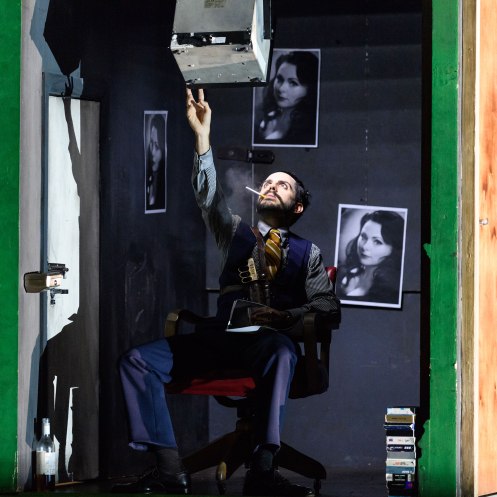
But singling out two melancholic moments would undermine how hilariously funny this production is, from Garibaldo nonchalantly feeding Bertarido’s portrait into a shredder and observing Rodelinda on CCTV, to her pouring coffee onto a pristine white fur stole, an unwanted gift, all while easy- breezing through elaborate coloratura. The American countertenor Christopher Lowrey plays Bertarido’s servant Unulfo as a comic relief sidekick, a buffo countertenor, something I didn’t even know could exist. He is adorable and darkly funny, slowly and copiously bleeding, while profusely apologising to his master who stabbed him by mistake. The actor Matt Casey makes the most out of his role as Rodelinda’s mute son Flavio. Slightly psychopathic, slightly OCD, he is a looming Frankenstein’s monster presence obsessively covering every inch of the dingy cell they are kept in with pictures of his father, tattooing “vengeance” on to his hands and skilfully miming all the various ideas he has for murdering Garibaldo.


All this over the top humour might sound gimmicky, and I could understand someone holding that opinion, but for me the production at all times finds the perfect balance between overdrawn campiness and serious skill. Between all the action, the abundance of ideas and the constant movement, Jones finds beautiful moments of stillness where only the music speaks. Occasionally I would have wished for more power and energy from the orchestra (lead by baroque specialist extraordinaire Christian Curnyn) to match the exuberance of the singers on stage, such as in Grimoaldo’s aria in Act III “Fatto inferno é il mio petto” or Bertarido’s final “vivi, tiranno” where Handel suddenly has a welcome urgency, dramatically different to the many lamenting largos he admittedly does so well. A very special note to the outstanding translation by Amanda Holden, simple modern English, every phrase perfectly articulated, every word crystal clear. This is what I believe opera should be like in 2017. I want singers to act their socks off while delivering their extraordinary skills. I want directors with real imaginary vision and bold new takes on those old masterpieces. A simple but perfectly functioning set design full of atmosphere. Most of all, I want storytelling, characterisation, theatricality all on the same level as the music. This Rodelinda has it all, it is engaging, vivacious, hilarious, virtuosic and an absolute delight.
Suzanne Frost
October 2017
Pouting and spouting
Lipstick and Scones
by Paul Vitty
Venture Wolf
at Leicester Square Theatre until 26th October
Review by Melissa Syversen
It is great to see young, emerging companies produce new work. And it is always exciting to be introduced to new productions because one can go in completely blind. Anything can happen. But, as with all new thing, it can be a hit or miss. Venture Wolf’s production Lipstick and Scones, performed at the Leicester Square Theatre, is unfortunately mostly a miss. To be painfully honest, I am not sure what to choose to grapple with here.
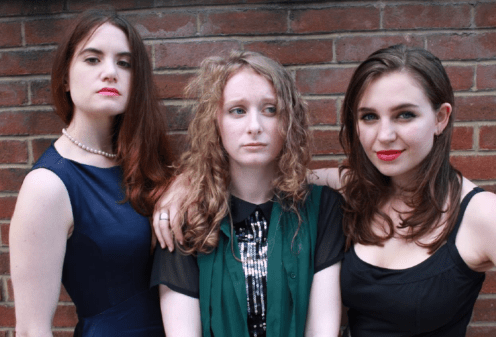
Lipstick and Scones is the story of three very different sisters meeting up at the eldest sister’s house for a weekend to celebrate her recent engagement … her fourth one in a year. What follows is what I can only call a weekend from hell. The sisters and their respective partners tear at each other, hurling insults, family trauma and bad life choices at each other seemingly for sport. It is a weekend spent mostly tearing everything and everyone around them apart with pure, malefic cruelty.
I think I will come at this with a view from the writing. Lipstick and Scones is a one-act piece of roughly 50 minutes. The main problem here, to be fair, is a classic one. Writer Paul Vitty has just crammed way too much into the limited time available. All the plotlines and backstories of alcoholic parents, adultery and sibling rivalry have been shoehorned in between banter, speeches and frankly cruel and vicious takedowns between supposed loved-ones. I am not denying that family members can be incredibly cruel to each other, but here it is all they are and seemingly without motivation. There are monologues that feel disjointed and left field, especially a long-running monologue characterising the different British political parties. It is funny, to be sure, but with only 50 minutes to unpack an entire family saga, it feels superfluous and indulgent. You can almost hear the turn of the knob as it switches from ‘this is the voice of the character on stage’ to ‘this is the voice of the playwright’. Bursting as this play is, the result is that the story shifts in jumps and starts and changes abruptly. There are segments of exposition and character behaviour that just doesn’t make logical sense, like the scene during the night with everyone running around. It gets to the point of ridiculousness.
A secondary problem of the writing is the characters themselves. They are so two dimensional and paper-thin that if presented in profile, they would disappear. In press releases the three ladies are presented as ‘powerful female roles’. No. No, they are not. They are all walking tropes and stereotypes of the worst kind. Let me present them. We have Liz, the eldest. She is the recently engaged, free-spirited, promiscuous, wine chugging one. (“It feels so good to be naughty!”) There is the middle child Hattie: the uptight, cold-hearted snob. And Ellie, the youngest, the fumbling, naïve and fidgety one. And their spouses don’t fare much better. In respective order: Robbie, the handsome, sexy fiancé; James, the older, stiff upper lipped lord and lastly Trevor: the jittery, but well-meaning husband whose idea of experimental sex is doing it with the lights on.
None of the characters seems to have been given any other qualities. It is all about the acid they can spit at each other within these tropes which makes it very hard to like or at the very least empathise with them. When towards the end, when we get a semblance of a reason for this awful behaviour, it is too late. What human charm and dimension there is to be found I suspect comes mostly from the actors themselves, the most successful being Jessie Waterfield as Ellie. She has a natural and quirky warmth about her I found reminiscent of a young Olivia Coleman.

The one redeeming quality in all of this is that at times Lipstick and Scones are quite funny. There are some great zingers and quips that land quite well with the audience. I suspect that is the characters in this piece been given more layers and the direction (also by Paul Vitty) been clearer, even more of the humour could shine through the mess that is this play. Family dynamics are difficult to capture, but that is also what makes it so fascinating and timeless. There is a reason why Alan Ayckbourn could write not one, not two but three full length plays about the same six family members over a single weekend in the Norman Conquests (1973). A 50-minute one-act just isn’t enough time to fully play with the premise presented nor to do the characters justice. This is presumptuous of me, but I would suggest either cutting down, simplify and streamline what you have or take the leap and expand it into a full-length play. No more plot is needed, but with that added runtime, the characters can be fleshed out and given time to breathe. That way the audience could get the chance to get to know them all, and hey, perhaps even like them.
Melissa Syversen
October 2017
Abigail’s Party goes to Ambridge
The W.I. Blues
by John Peel
SMDG at Hampton Hill Theatre until 28th October
Review by Eleanor Lewis
The WI is not to be messed with. It is they, let us not forget, who slow hand-clapped Prime Minister Tony Blair for impolitely hijacking their Wembley conference with a political speech in 2000. It is they too, who raised huge amounts of money for leukaemia research with a ground-breaking, naked calendar (since copied by almost every workplace and group to be found anywhere) and gave us a new national catchphrase on the subject of buns. But in the case of WI Blues, the WI is in fact a simple plot device to bring a group of women together in a room for an evening, so we need not live in fear.
This group of five women duly gather in the living room of Grace who has just waved her husband off for the evening. First to arrive is Fiona, a simple and rather downtrodden farmer’s wife bearing homemade coleslaw. Fiona is patronised and abused by Grace (nicely played by Norma Beresford) who is equipped with gold standard qualifications in snobbery. Three other characters arrive: Gina Way as Jane, the good natured vamp; Bobbie Ennals as Pippa, a woman who appears for most of the proceedings to be an ordinary wife and mother, and Hazel who owns the local deli and is struggling with an illness which may turn out to be serious. These characters then interact with each other, largely on the subject of the men in their lives, but also giving vent to their frustrations and the ups and downs of daily life. Their reason for being there is to help Grace with a speech she’s going to make in the hope of being elected head of the local WI.
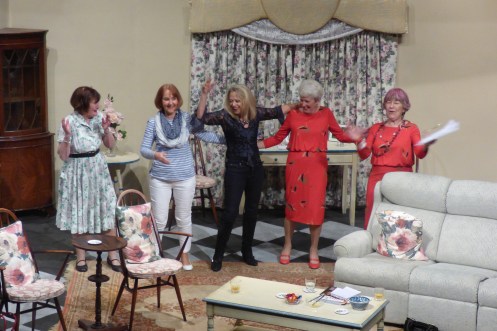
St Mary’s Drama Group is evidently blessed with a group of skilled actors, everyone in this piece was doing their best with rather weak material. Norma Beresford as Grace would deserve credit for the vast amount of lines she had to deliver but in addition to this she gave life to a caricature role that drew a lot of laughs from a receptive audience. Gina Way and Sue McMillan similarly gave it their all and got any comedy that was to be had from what they were given. I was startled to learn towards the end of the play, that the character Pippa was the child of a peer of the realm, as the children of the aristocracy generally carry themselves with more languid superiority than the rest of us but this character seemed a little underwritten anyway and also might have benefited from more directorial input.
Stand out performance of the evening was Jean Keay as Fiona. Ms Keay clearly bagged the best role and played it to great effect. She was very funny, timed her responses beautifully and overdid nothing despite a rather bizarre section in which her character got halfway drunk and forced everyone else to play pass the parcel, you need some degree of skill as an actor to carry that off – and trust me, when women get drunk together, we don’t play pass the parcel!

My issues with WI Blues are in the writing, not SMDG’s performance of it. As a play, WI Blues has certainly got potential but probably needs a rewrite. Its writer is male and it’s very much a man’s idea of “what we girls get up to” when they’re not around.
It’s a comedy, but it helps to get the detail right. The action is set in the present day but the writer asks us to believe that Grace, a woman who has devoted her suburban life to the pursuit of all things snobbish, would pronounce the “J” in Rioja. Beverley in Abigail’s Party famously rushes to put a gift of red wine in the fridge generating a huge laugh from the audience but Abigail’s Party was set 40 years ago when if you were British and had a bottle of any sort of wine in the kitchen you were either an exceptionally good cook or an alcoholic. I suspect today’s Graces of suburbia probably know how to pronounce Rioja. Similarly, it’s highly unlikely that a woman in exclusively female company would talk in terms of the operation/treatment she’s just had on her “whatnot”, she’d have no need to disguise it, she’d call it by its name. A man, on the other hand, talking about his wife/partner’s operation is more likely to use a euphemism. Only details but they raise the quality of the material and make it more believable and you need credibility for good comedy.
That said, who really cares? The opening night audience at Hampton Hill – which included a group of real WI members – laughed along with it and clearly enjoyed themselves. I commend SMDG for its efforts with this piece but would respectfully suggest they take on some stronger material next time.
Eleanor Lewis
October 2017
Photographs by Archie McMillan
Adagio furioso
Duet for One
by Tom Kempinski
Lee Dean and Daniel Schumann in association with Birmingham Repertory Theatre
at Richmond Theatre until 28th October, then on tour until 11th November
Review by Mark Aspen
“Shrinks versus nuts”, two hours in the psychiatrist’s chair: such a play seems unlikely to create dynamic theatre. But Duet for One achieves much more than the unlikely. It excels as a gripping, intensive and moving piece of theatre.
In the hands of acclaimed director Robin Lefevre, Tom Kempinski’s taut eulogy to the resilience of the human spirit totally absorbed the audience at its Richmond opening.
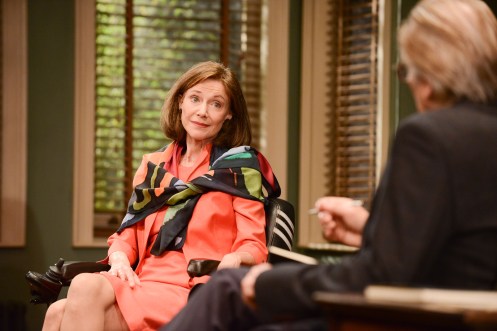
World-famous violinist Stephanie Abrahams is diagnosed with multiple sclerosis and is desperately trying to cope with the trauma of the disease, which has taken away her ability to play and has left her largely confined to a wheel-chair. Her husband David, an equally renowned composer, arranges for her to have counselling and treatment from emigre psychiatrist Dr Feldmann, hoping that she can come to terms with her condition.
Intriguingly, there is a note in the programme by the playwright himself denying the long held view that the character of Stephanie Abrahams is based on Jacqueline du Pré, the universally acclaimed cellist whose young career was brought to an abrupt end when she contracted multiple sclerosis in 1971. Kempinski wrote the play in the late 70s for his wife Frances de la Tour, who played the leading role when it premiered at the Bush Theatre in 1980. Kempinski declares that it is a metaphor for his own life. The metaphor seems at best opaque.
Duet for One unfolds like a tense game of chess between patient and psychiatrist. As the defining psychological fulcra of Abrahams’ life are exposed by Dr Feldmann, a series of resentments develop towards her husband, then her late father, then the psychiatrist himself.

Belinda Lang is outstanding as Stephanie Abrahams, the anguished artist, bereft of her very life-force, her violin. Her performance is beautifully balanced and portrays the pitching and tossing of Abrahams’ state of mind with great understanding. Her body language is all there, from the vibration building her body as she fights to control her anger, to the locked-in frustration expressed in the exercising of her failing limbs. Lang is totally engaged with Abrahams’ roller-coaster emotional journey.
Kempinski has written Dr Feldmann as a hint of a stereotype, the Viennese sage of the mind, and indeed Abrahams in an angry mood calls him a “mid-European guru” with a “phoney German accent”. But Oliver Cotton brings out the full complexity of this role, depicting Feldmann as wise, sympathetic and supportive, but realistic, with commitment to his calling and with strong moral standing. Cotton is a master of dramatic tension and, crucial in this part, knows how to really act the silences. As the psychiatrist, there is a lot of listening. The dramatic hiatuses quiver with tension and one can almost feel the psychiatrist’s brain at work.

We first see Stephanie Abrahams, successful violinist, house in St John’s Wood, another in Tuscany, proud … but hiding that she is frightened to face a future of failing faculties. She “gets low”, but baulks at Feldmann calling it depression. “It’s creeping bloody paralysis”. However, when Feldmann asks whether she had ever contemplated suicide, she admits to “flashes”. He prescribes antidepressants, but she leaves thinking that it was rather perfunctory. On her second visit, she feels better and brighter, is trying to be positive, has taken on violin students and is training herself to be he husband’s secretary. Nevertheless, she admits that the increased energy has also manifested itself in irritability and becomes very snappy, sharp and sarcastic with Feldmann.
And so the pattern repeats with subsequent visits, although the progression is steadily downward, and we see the gradual disintegration of her spirit. But along the way, we learn of the major influences on her life, her supportive mother who died when she was six years old, her artisan chocolatier father who begrudged her violin lessons, and her musician husband with whom she had a “fairy story” romance, and married after six weeks following a passionate coup de foudre first meeting.
For Abrahams, music is a “magic” that “expresses humanity”. She believes that music is “where they got the idea of God”. The most abiding passionate love of her life is her violin. So, when she announces that she has given her violin away, Feldmann is clearly shocked. She has dismissed all her students, “I’m a performer not a teacher”, and denigrates he husband’s compositions as “pretentious polyphonic shit”.
But by now she is in a highly offensive mood, and more so on her penultimate visit, haggard and bedraggled, she declares that she is “wearing the same knickers as on the last visit”. She says she has taken an old totter as a lover, and pays him in scrap copper pipe to have sex with her: “he fucks me like a sack”. Her loss of dignity appals Feldmann and his professional inscrutability cracks. He angrily explains why she needs to help herself regain herself. “The purpose of life is life itself”.
This intense emotional see-saw can only be kept in motion by very skilful acting and Lang and Cotton deliver it with consummate skill.
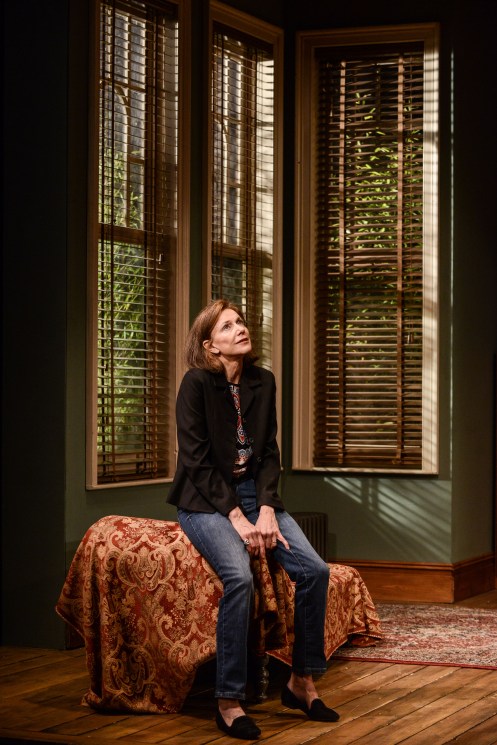
This is a subtle and clever piece and the mood of the piece is astutely commented on by the design itself. Award-winning designer, Lez Brotherston has created a set that is a metaphor for the action. Feldmann’s consulting room with its tall shelves of books and music recordings speak volumes of his approach it is precise and ordered: it is the deal mind; there are library steps but the primitive sculptures are out of the way on the least accessible shelves. The room is closed and shuttered off from the world but light is let in only through the shutters. Ian Scott’s lighting design and John Leonard’s sound design follow the action through the lighting and music plot: adroitly restrained.
Although it is challenging to watch, Duet for One is a beautifully concentrated piece of emotional theatre. It is shot through with witty lines and some truly funny moments, but at heart it is a searing examination of the human spirt in extremis.
Mark Aspen
October 2017
Photography by Robert Day
An All Consuming Passion !
Little Shop of Horrors
by Alan Menken, lyrics by Howard Ashman
Hounslow Light Opera Company at Hampton Hill Theatre until 21st October
Review by Quinten Weiver
A gargantuan dionaea, or some sort of droseraceae on steroids, is living in the Hampton Hill Theatre … and it needs feeding!
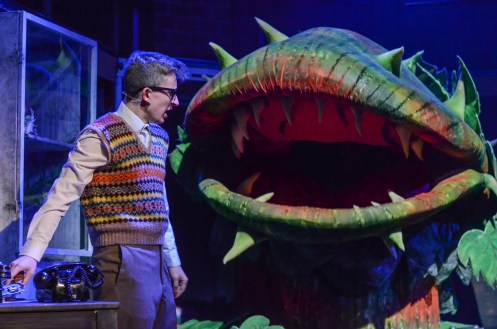
Hounslow Light Opera Company dangerously brings an eclectically mixed bunch of comedy, horror, thriller, song and dance in the form of a Little Shop of Horrors, a seedy (no pun intended) 1970s New York florist’s shop, to the gentile purlieus of Hampton. Being in the poorest part of town (NY not Hampton), and on Skid Row at that, where more money is spent on gin than on gerberas, Mr Mushnik’s shop is not flourishing; witness the lack of stock (or stocks … of any sort of flora). Poor Mr M, an asthmatic Jewish florist is himself going to seed. However, Seymour, his timid but loyal shop assistant and general factotum, has a secret hobby, raising hitherto-fore unknown species of carnivorous plants; and now he is germinating an idea to make Mushnik’s floristry business blossom again.
The set, by the director Bill Compton (better known for his inspired productions with Youth Action Theatre), has created a versatile set in three dimensions and two levels, which is first seen through a gauze, iridescent like a lupin in twilight, by a lighting team headed by designer Nigel Lewis. Set and lighting hold lots of surprises … plus a five-piece band (two keyboards, two guitars and percussion) under award-winning musical director Lee Dewsnap, who sets a lively pace to Menken’s score, a mixture of jazz, Motown and rock, whilst keeping a good balance with the singers.
Mushnik’s other assistant is the young and appealing Audrey, for whom Seymour holds out a torch (and bunches of unsold floristry), but to no avail: Audrey is in thrall to another. Both are low in self-esteem: Seymour because of his lack of education (notwithstanding his self-taught botany skills and pioneering horticultural techniques); Audrey because she has only known herself to be a victim of physical abuse. And here for a while black comedy becomes black tragedy.

Enter the spiky end of the love triangle, the super-sadistic, Harley riding, misogynistic, rock-dentist, Dr Orin. Orin’s legal high is nitrous oxide, and appropriately it is laughing gas that brings black comedy to dentistry. Audrey, in spite of herself, is entranced by Orin, both captive and captivated. However when Seymour sees Orin mistreating Audrey, the worm turns. Gun-toting Seymour ends up in the dentist’s chair, but in this surgery it is the dentist not the patient who has the gas. But the gas mask gets stuck and, gasping in the giggle-gas, the dope-head dies in an overdose of dopamine and an under-dose of fresh air.
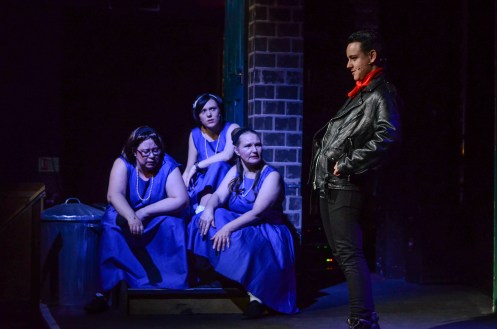
The part of Orin cannot be underplayed, and Michael Greatorex gives the role a full Harley Davidson tyre-burn. Elvis-hipped, with sadistic smiles, he works up a lather in leather. It’s songs all the way, Dentist! , at his God’s-gift entrance, to It’s Just the Gas at his bizarre demise.
The young lovers are well cast with strong vocal skills. Jack Walford hits the spot exactly as the lovelorn Seymour. Clad in striped tank-top, complete with moth-hole, he arrives as the little-boy-lost. Grow for Me is assured in its accurate singing. He tracks Seymour’s growing anxiety and helplessness as he realises he has sold his soul to the devil. A relative newcomer, Walford is one to watch. Joanna-Marie d’Oyly Chambers, who won a Swan nomination for her Yum-Yum with HLOC last season (See Georgia Renwick’s review Infectious and Delirious: The Mikado), gives a very touching performance as Audrey, beautifully portraying the character’s vulnerability. Her impossible dream, Somewhere That’s Green sung with hope at the beginning of the story and then with resignation at her sacrificial ending is lyrically delivered and differentiated in mood. As a couple, Walford and Chambers gell well, but for each there is a tendency to slip from acting into set-piece singing.
HLOC stalwart, Tony Cotterill, with a good line in Noo-Yark Yiddish, is very secure as Mushnik. When Seymour becomes celebrated (and rich) from his floral excesses, Cotterill’s facial expressions say it all about Musnik’s duplicitous intentions in suddenly wanting to adopt his goy-boy assistant.
So on to Audrey II, who stole (some) of the show, source of Seymour’s wealth, and everybody’s downfall. The back-room crossing of an exotic pseudo-flytrap plant get surreally interesting when it turns into a sentient triffid, after a drop of blood from a scratch on Seymour’s finger accidentally falls on the plant. Then it become a vampire Venus, the nightmarish source of the eponymous Horrors.
Audrey II gets a lot of good songs too, Feed Me, Coda, and Sominex Suppertime ; oh yes, a singing plant that packs some punch. More than punch too. When the desperate Seymour feeds it the dismembered body (yes, this is a family show: Titus Andronicus eat your heart out) of Dr Orin, it develops an insatiable appetite for human flesh. Oh, and some powerful, if totally unsubtle lines, “Cut the crap, bring on the meat!”. And meat the power-plant gets, next Mushnik, then even more tragically the hapless Audrey.
Audrey II makes a nice visual gag that really works, due to the efforts of the puppeteer, Shaun Lati, from the celebrated Little Angel Theatre puppet theatre in Islington, who works with tireless physicality; to John Furlong, Audrey II’s voice, a rich pitch-shifted baritone; and to the unsung prop makers, who have created such fearful floristry.
The petrifying petals and shudder-inducing stamens of this ravenous botanical monster make the fortunes of Seymour as a new-found celebrity, who attracts the rich and famous (real people of mid-20th Century America played by the ensemble), and of Mushnik, as a host of new customers flocks (phlox … giddit?) to his shop. But why did we not then see a plethora of overflowing florist’s buckets and all the flower shop accoutrements of frames and wires and ribbons and cellophane? Perhaps they sold so quickly.
A clever touch, which Ashman wrote into this show, is the Greek-chorus-like trio of Crystal (Rae White), Ronette (Lindsey Carter) and Chiffon (Kirsten Johnson), bopping away as they comment or the actions, its reality and morality. The redoubtable HLOC regulars give solid support as a well drilled ensemble who also play the minor roles.
Catch the show if you can. It is a great one to watch from behind the sofa. I came away pondering on the deeper psychological complexities behind this meeting of Dr John Faustus with Dr Sigmund Freud in John Wyndham land, but gave up. After all, this is show where no disbelief cannot be suspended. Though, it did have me reaching nervously for the Baby-Bio when I got home.
Quinten Weiver
October 2017
Photographs by Jo-Jo Leppink, Handwritten Photography
Monsters in Unchartered Waters
Little Shop of Horrors
by Alan Menken, lyrics by Howard Ashman
Hounslow Light Opera Company at Hampton Hill Theatre until 21st October
Review by Eleanor Marsh
There is in the headline to this review a dichotomy; Hounslow Light Opera Company is best known for its productions of Gilbert and Sullivan operettas. They have, of course, strayed from this genre occasionally (a memorable Anything Goes and The Baker’s Wife both spring to mind), but have not, to my mind ever strayed as far from their comfort zone previously as they do this week at Hampton Hill Theatre. Little Shop of Horrors is so far removed from G&S that it is a wonder that this group attempted to produce it at all. That they do so with some success is remarkable.

As the two star crossed lovers, Seymour and Audrey; Jack Walford and Johanna-Marie D’Oyly Chambers are very well cast. Jack Walford demonstrates exactly the right level of geek, is believable and has a singing voice that is pleasant to listen to. Johanna-Marie’s singing is delightful, especially in the Somewhere That’s Green number, possibly the best-known song in the show. She works hard to portray Audrey’s vulnerability, but is very obviously a singer feeling her way through an acting role. Where there is a tune involved Audrey becomes a three -dimensional tragic heroine; where there is not she loses some depth of character.
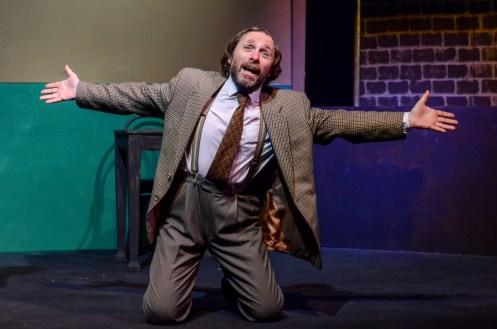
The supporting characters fare less well in this production, mainly because of a lack of clear diction. Tony Cotterill’s Mushnik is suitably comic and the “3 Degrees/Supremes” trio of Chiffon, Ronette and Crystal sing in beautiful harmony, but often their lyrics are lost. With the pedigree of HLOC’s singers I am minded to think that this is an issue with sound design rather than the individual performers, but whatever the reason it is a shame that so much of the narrative (as provided by this most Motown of Greek choruses) is lost as the overall musical sound is so good. Michael Greatorex is obviously having a lot of fun as Orin the sadistic dentist made famous by Steve Martin in the movie of the show. A little less caricature would have made this character truly chilling. And again better diction or sound quality (whichever is to blame) at the beginning of Dentist ! would have guaranteed a belly laugh from the audience where there were only titters.
The real star of this production is the unseen – but certainly not unsung – John Furlong as the voice of Audrey II. It is always a treat to see “the voice” in the flesh and it was a real pleasure to see John receive an excellent ovation, which was richly deserved.
The perennial problem of what directors do with the wider ensemble for a show where there is little or nothing written for them was managed very well by director Bill Compton, who decided not to people the stage with unnecessary bodies but to instead bring on the “chorus” when there was need of them. And at these moments the company really came into its own demonstrating the excellent part singing and chorus work for which it is known.

Musical Director Lee Dewsnap has put together an excellent band and the show has a good period look and feel to it. This show was undoubtedly a trip into unchartered waters for HLOC and they should be pleased and satisfied that they have pulled it off and succeeded in delivering a good evening’s entertainment.
Eleanor Marsh
October 2017


